Body Fluids & Electrolyte Balance
Department of Human Physiology
| Nnamdi Azikiwe University Nnewi Campus, Nigeria
Lecture Slide
David C. Ikwuka
Outline
 Body Fluids
 Functions
 Compartments
 Measurement
 Indicators for measurement
 Body Fluid Homeostasis
 Electrolytes
 Regulation
 Clinical Significance
2
Nnamdi Azikiwe University Nnewi Campus
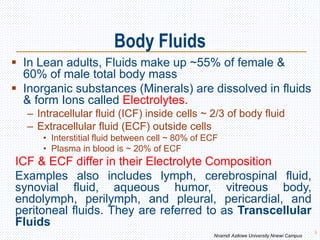
Body Fluids
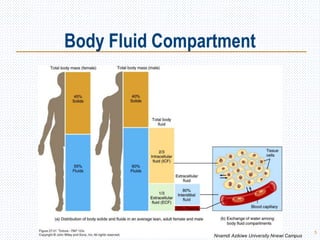
 In Lean adults, Fluids make up ~55% of female &
60% of male total body mass
 Inorganic substances (Minerals) are dissolved in fluids
& form Ions called Electrolytes.
– Intracellular fluid (ICF) inside cells ~ 2/3 of body fluid
– Extracellular fluid (ECF) outside cells
• Interstitial fluid between cell ~ 80% of ECF
• Plasma in blood is ~ 20% of ECF
ICF & ECF differ in their Electrolyte Composition
Examples also includes lymph, cerebrospinal fluid,
synovial fluid, aqueous humor, vitreous body,
endolymph, perilymph, and pleural, pericardial, and
peritoneal fluids. They are referred to as Transcellular
Fluids
3
Nnamdi Azikiwe University Nnewi Campus
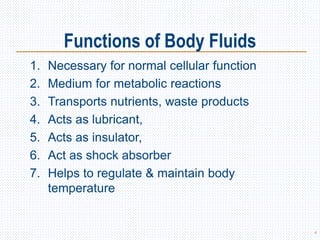
Functions of Body Fluids
1. Necessary for normal cellular function
2. Medium for metabolic reactions
3. Transports nutrients, waste products
4. Acts as lubricant,
5. Acts as insulator,
6. Act as shock absorber
7. Helps to regulate & maintain body
temperature
4
5
Body Fluid Compartment
Nnamdi Azikiwe University Nnewi Campus
Movement of Body Fluids
 The movement of body fluid across cell and
capillary membranes accomplished
through:
– Osmosis
– Diffusion
– Filtration
– Active transport
6
Terminologies Associated with Body Fluids
 Osmolality (Osm): Concentration of Solutes per kg of water
(Osm/kg)
i. Greatest determinants of osmolality in ECF: sodium,
glucose, urea
ii. Greatest determinants of osmolality in ICF: potassium,
glucose, urea
 Tonicity: Osmolality of solution
i. Isotonic solution: same osmolality as body fluids
ii. Hypertonic solution: higher osmolality than body fluids
iii. Hypotonic solution: lower osmolality than body fluids
7
Nnamdi Azikiwe University Nnewi Campus
Continua.
 When RBCs are placed in Hypotonic solutn
they gain water & may burst (Hemolysis).
 When RBCs are placed in Hypertonic solution
which has higher osmotically active solutes at
higher osmolality & osmotic pressure relative
to plasma, they shrink because of the osmosis
of water out of the cells (Crenation)
8
Nnamdi Azikiwe University Nnewi Campus
Measurement of Body Fluid Compartment
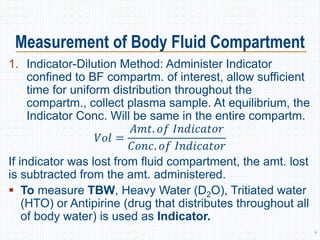
1. Indicator-Dilution Method: Administer Indicator
confined to BF compartm. of interest, allow sufficient
time for uniform distribution throughout the
compartm., collect plasma sample. At equilibrium, the
Indicator Conc. Will be same in the entire compartm.
𝑉𝑜𝑙 =
𝐴𝑚𝑡. 𝑜𝑓 𝐼𝑛𝑑𝑖𝑐𝑎𝑡𝑜𝑟
𝐶𝑜𝑛𝑐. 𝑜𝑓 𝐼𝑛𝑑𝑖𝑐𝑎𝑡𝑜𝑟
If indicator was lost from fluid compartment, the amt. lost
is subtracted from the amt. administered.
 To measure TBW, Heavy Water (D2O), Tritiated water
(HTO) or Antipirine (drug that distributes throughout all
of body water) is used as Indicator.
9
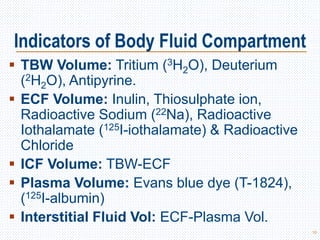
 TBW Volume: Tritium (3H2O), Deuterium
(2H2O), Antipyrine.
 ECF Volume: Inulin, Thiosulphate ion,
Radioactive Sodium (22Na), Radioactive
Iothalamate (125I-iothalamate) & Radioactive
Chloride
 ICF Volume: TBW-ECF
 Plasma Volume: Evans blue dye (T-1824),
(125I-albumin)
 Interstitial Fluid Vol: ECF-Plasma Vol.
10
Indicators of Body Fluid Compartment
Body Fluid Homeostasis
 A steady-state balance where the volume &
composition of body fluids remain constant
despite the addition & elimination of water &
solutes from the body. It’s a complex process
involves all organs systems of the body.
 Transport by epithelia cells of the GIT, kidneys
& Lungs controls both the intake & excretion
of numerous substances & water.
 The CVS delivers nutrients to & removes
waste products from cells & tissues
 Nervous & Endocrine systems provide
regulation & integration of these important
functions
11
Nnamdi Azikiwe University Nnewi Campus
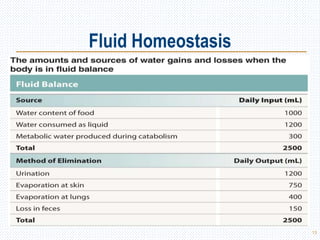
Fluid Homeostasis
 The body maintains fluid homeostasis by
ensuring that the amount of water added to
the body each day equals or is balanced by
the amount lost or excreted.
 Although the amount of water added to the
body each day may not be constant
 There are several routes for water excretion
but the Kidney is the only regulated route.
12
Fluid Homeostasis
13
Body Fluid Homeostasis
 2 barriers separate ICF, interstitial fluid and plasma
– Plasma membrane separates ICF from
surrounding interstitial fluid
– Blood vessel wall divide interstitial fluid from
plasma
 Body is in fluid balance when required amounts of
water and solutes are present and correctly
proportioned among compartments.
 The conc. Of Virtually all substances in the body
must be maintained within narrow range ie there is
a Set Point & mechanisms for monitoring
deviations from set point & Effector Mechanism to
maintain the conc. Of that substance in the body
constant
14
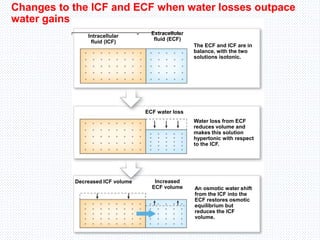
Intracellular
fluid (ICF)
Extracellular
fluid (ECF)
The ECF and ICF are in
balance, with the two
solutions isotonic.
ECF water loss
Water loss from ECF
reduces volume and
makes this solution
hypertonic with respect
to the ICF.
Increased
ECF volume
Decreased ICF volume
An osmotic water shift
from the ICF into the
ECF restores osmotic
equilibrium but
reduces the ICF
volume.
Changes to the ICF and ECF when water losses outpace
water gains
– Very different composition
– Are at osmotic equilibrium
– Loss of water from ECF is replaced by water
in ICF
• = Fluid shift
– Occurs in minutes to hours and restores osmotic
equilibrium
• Dehydration
– Results in long-term transfer that cannot replace ECF
water loss
– Homeostatic mechanisms to increase ECF fluid volume
will be employed
ICF and ECF compartments balance
16
Nnamdi Azikiwe University Nnewi Campus
ELECTROLYTES
 Are ionized substances in Body fluids
which contributes most to the total solute
conc. (Osmolality) of Body Fluids. Body
fluids also contains uncharged particles
(Glucose, Urea etc)
17
Electrolytes In Body Fluids
18
 Ions form when electrolytes dissolve ad
dissociate
 4 general functions
– Control osmosis of water between body fluid
compartments
– Help maintain the acid-base balance
– Carry electrical current
– Serve as cofactors
Nnamdi Azikiwe University Nnewi Campus
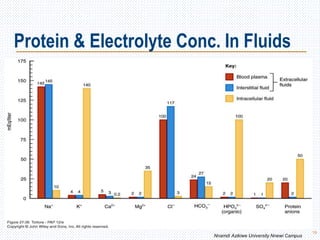
Protein & Electrolyte Conc. In Fluids
19
Nnamdi Azikiwe University Nnewi Campus
Concentrations in Body Fluids
20
– Concentration of ions typically expressed in
milliequivalents per liter (mEq/liter)
• Na+ or Cl- number of mEq/liter = mmol/liter
• Ca2+ or HPO4
2- number of mEq/liter = 2 x
mmol/liter
– Major difference between 2 ECF
compartments (plasma and interstitial fluid) is
plasma contains many more protein anions
• Largely responsible for blood colloid osmotic
pressure
Nnamdi Azikiwe University Nnewi Campus
ICF & ECF
21
–ECF most abundant cation is Na+, anion
is Cl-
–ICF most abundant cation is K+, anion are
proteins and phosphates (HPO4
2-)
–Na+ /K+ pumps play major role in keeping
K+ high inside cells and Na+ high outside
cell
Nnamdi Azikiwe University Nnewi Campus
Na+
22
 Most abundant ECF ion (Serum level:135-
145mEq/L)
 Together with Cl- constitute 90% of solute in ECF
 Plays pivotal role in fluid and electrolyte balance
because it account for more than half of the
osmolarity of ECF
 Level in blood controlled by
– Aldosternone – increases renal reabsorption
– ADH – if sodium too low, ADH release stops
– Atrial natriuretic peptide – increases renal excretion
Nnamdi Azikiwe University Nnewi Campus
K+
23
– Most abundant cations in ICF (Serum level:
3.5-5.3mEq/L)
– Key role in establishing RMP in neurons and
muscle fibers
– Also helps maintain normal ICF fluid volume
– Helps regulate pH of body fluids when
exchanged for H+
– Controlled by aldosterone – stimulates
principal cells in renal collecting ducts to
secrete excess K+.
Nnamdi Azikiwe University Nnewi Campus
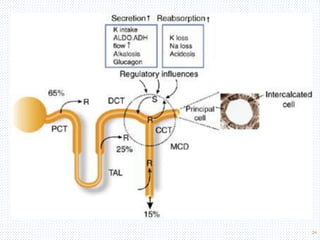
24
Factors That Alter K+ Distribution Between Fluid
Compartments
Factors That Shift K+ into
Cells
(Decrease Extracellular [K+])
Factors That Shift K+ Out of Cells
(Increase Extracellular [K+])
Insulin Insulin deficiency (DM)
Aldosterone Aldosterone deficiency
b-adrenergic stimulation b-adrenergic blockade
Alkalosis Acidosis
Cell lysis
↑ed ECF Osmolarity
Strenuous exercise 25
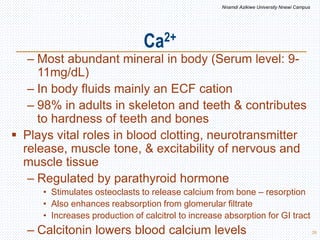
Ca2+
26
– Most abundant mineral in body (Serum level: 9-
11mg/dL)
– In body fluids mainly an ECF cation
– 98% in adults in skeleton and teeth & contributes
to hardness of teeth and bones
 Plays vital roles in blood clotting, neurotransmitter
release, muscle tone, & excitability of nervous and
muscle tissue
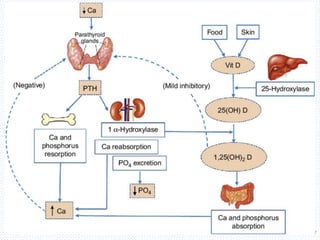
– Regulated by parathyroid hormone
• Stimulates osteoclasts to release calcium from bone – resorption
• Also enhances reabsorption from glomerular filtrate
• Increases production of calcitrol to increase absorption for GI tract
– Calcitonin lowers blood calcium levels
Nnamdi Azikiwe University Nnewi Campus
27
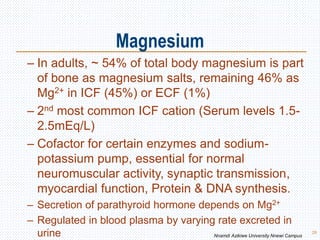
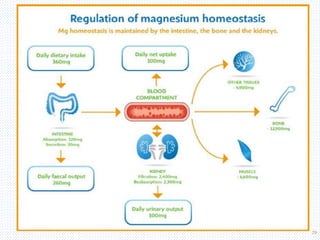
Magnesium
28
– In adults, ~ 54% of total body magnesium is part
of bone as magnesium salts, remaining 46% as
Mg2+ in ICF (45%) or ECF (1%)
– 2nd most common ICF cation (Serum levels 1.5-
2.5mEq/L)
– Cofactor for certain enzymes and sodium-
potassium pump, essential for normal
neuromuscular activity, synaptic transmission,
myocardial function, Protein & DNA synthesis.
– Secretion of parathyroid hormone depends on Mg2+
– Regulated in blood plasma by varying rate excreted in
urine Nnamdi Azikiwe University Nnewi Campus
29
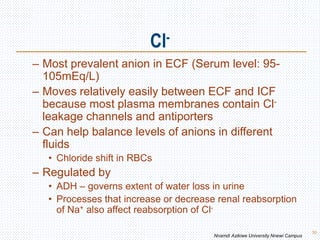
Cl-
30
– Most prevalent anion in ECF (Serum level: 95-
105mEq/L)
– Moves relatively easily between ECF and ICF
because most plasma membranes contain Cl-
leakage channels and antiporters
– Can help balance levels of anions in different
fluids
• Chloride shift in RBCs
– Regulated by
• ADH – governs extent of water loss in urine
• Processes that increase or decrease renal reabsorption
of Na+ also affect reabsorption of Cl-
Nnamdi Azikiwe University Nnewi Campus
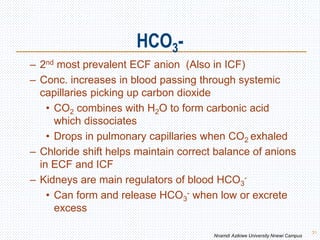
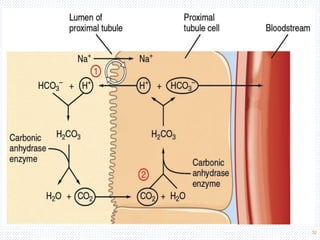
HCO3-
31
– 2nd most prevalent ECF anion (Also in ICF)
– Conc. increases in blood passing through systemic
capillaries picking up carbon dioxide
• CO2 combines with H2O to form carbonic acid
which dissociates
• Drops in pulmonary capillaries when CO2 exhaled
– Chloride shift helps maintain correct balance of anions
in ECF and ICF
– Kidneys are main regulators of blood HCO3
-
• Can form and release HCO3
- when low or excrete
excess
Nnamdi Azikiwe University Nnewi Campus
32
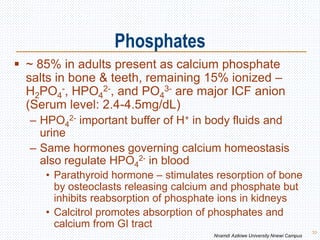
Phosphates
33
 ~ 85% in adults present as calcium phosphate
salts in bone & teeth, remaining 15% ionized –
H2PO4
-, HPO4
2-, and PO4
3- are major ICF anion
(Serum level: 2.4-4.5mg/dL)
– HPO4
2- important buffer of H+ in body fluids and
urine
– Same hormones governing calcium homeostasis
also regulate HPO4
2- in blood
• Parathyroid hormone – stimulates resorption of bone
by osteoclasts releasing calcium and phosphate but
inhibits reabsorption of phosphate ions in kidneys
• Calcitrol promotes absorption of phosphates and
calcium from GI tract
Nnamdi Azikiwe University Nnewi Campus
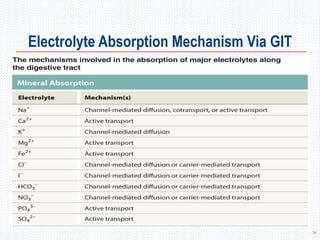
Electrolyte Absorption Mechanism Via GIT
34
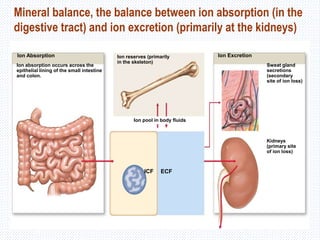
Ion Absorption Ion Excretion
ICF ECF
Ion absorption occurs across the
epithelial lining of the small intestine
and colon.
Ion reserves (primarily
in the skeleton)
Ion pool in body fluids
Sweat gland
secretions
(secondary
site of ion loss)
Kidneys
(primary site
of ion loss)
Mineral balance, the balance between ion absorption (in the
digestive tract) and ion excretion (primarily at the kidneys)
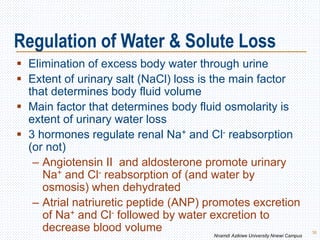
Regulation of Water & Solute Loss
 Elimination of excess body water through urine
 Extent of urinary salt (NaCl) loss is the main factor
that determines body fluid volume
 Main factor that determines body fluid osmolarity is
extent of urinary water loss
 3 hormones regulate renal Na+ and Cl- reabsorption
(or not)
– Angiotensin II and aldosterone promote urinary
Na+ and Cl- reabsorption of (and water by
osmosis) when dehydrated
– Atrial natriuretic peptide (ANP) promotes excretion
of Na+ and Cl- followed by water excretion to
decrease blood volume 36
Nnamdi Azikiwe University Nnewi Campus
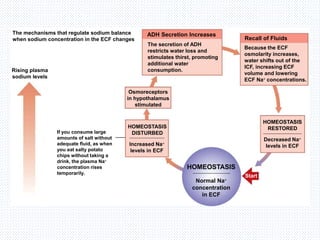
The mechanisms that regulate sodium balance
when sodium concentration in the ECF changes
Rising plasma
sodium levels
The secretion of ADH
restricts water loss and
stimulates thirst, promoting
additional water
consumption.
Osmoreceptors
in hypothalamus
stimulated
HOMEOSTASIS
DISTURBED
Increased Na
levels in ECF
If you consume large
amounts of salt without
adequate fluid, as when
you eat salty potato
chips without taking a
drink, the plasma Na
concentration rises
temporarily.
ADH Secretion Increases
Recall of Fluids
Because the ECF
osmolarity increases,
water shifts out of the
ICF, increasing ECF
volume and lowering
ECF Na concentrations.
HOMEOSTASIS
RESTORED
Decreased Na
levels in ECF
HOMEOSTASIS
Normal Na
concentration
in ECF
Start
Two types of Thirst
38
1. Osmotic/Osmometric Thirst:
Occurs when solute conc. Of ECF ↑ses>it draws
water out of the cells (by osmosis) & they shrink in
volume causing dehydration>triggers CVOs
(Osmoreceptors: Vascular organ of lamina terminalis
& Subfornical organ)> Median preoptic nucleus
(MPN) in hypothalamus>initiates water seeking &
ingestive behaviour.
 Destruction of MPN of hypothalamus in
humans/animals results in partial or total loss in
desire to drink even with extremely high salt conc.
In ECF. Thirst sensation is also reduce or diminish
in elderly.
2. Hypovolemic Thirst
Caused by Blood loss, vomiting & diarrhea
- TBV drops too low↓>vascular system responds by
constricting blood vessels> Renin release>RAS
Also provoke the CVOs-Osmoreceptors (Area
postrema, subfornical organs, vascular organ of
lamina terminalis) >MPN which initiates water seeking
& ingestive behaviour.
Others include:
- Arterial baroreceptors sense decreased arterial
pressure & signals CNS
- Cardiopulmonary receptors sense decreased blood
volume & signals area postrema & nucleus tractus
solitarii
39
Antidiuretic Hormone
40
– Also known as vasopressin
– Produced by hypothalamus (Supraoptic &
Paraventricular nuclei), released from posterior
pituitary
– Promotes insertion of aquaporin-2 into
principal cells of collecting duct
– Permeability to water increases
– Produces concentrated urine
Nnamdi Azikiwe University Nnewi Campus
41
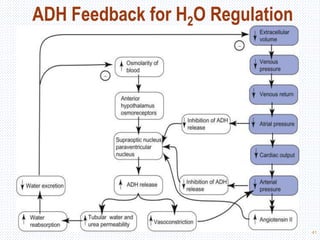
ADH Feedback for H2O Regulation
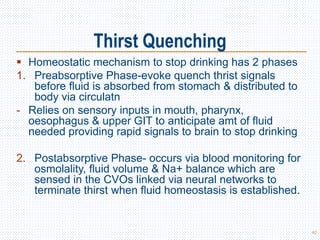
Thirst Quenching
 Homeostatic mechanism to stop drinking has 2 phases
1. Preabsorptive Phase-evoke quench thrist signals
before fluid is absorbed from stomach & distributed to
body via circulatn
- Relies on sensory inputs in mouth, pharynx,
oesophagus & upper GIT to anticipate amt of fluid
needed providing rapid signals to brain to stop drinking
2. Postabsorptive Phase- occurs via blood monitoring for
osmolality, fluid volume & Na+ balance which are
sensed in the CVOs linked via neural networks to
terminate thirst when fluid homeostasis is established.
42
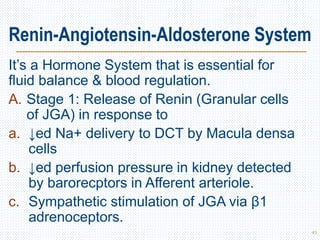
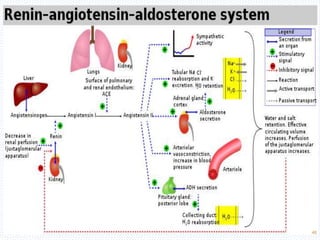
Renin-Angiotensin-Aldosterone System
It’s a Hormone System that is essential for
fluid balance & blood regulation.
A. Stage 1: Release of Renin (Granular cells
of JGA) in response to
a. ↓ed Na+ delivery to DCT by Macula densa
cells
b. ↓ed perfusion pressure in kidney detected
by barorecptors in Afferent arteriole.
c. Sympathetic stimulation of JGA via β1
adrenoceptors.
43
44
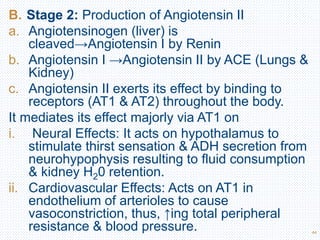
B. Stage 2: Production of Angiotensin II
a. Angiotensinogen (liver) is
cleaved→Angiotensin I by Renin
b. Angiotensin I →Angiotensin II by ACE (Lungs &
Kidney)
c. Angiotensin II exerts its effect by binding to
receptors (AT1 & AT2) throughout the body.
It mediates its effect majorly via AT1 on
i. Neural Effects: It acts on hypothalamus to
stimulate thirst sensation & ADH secretion from
neurohypophysis resulting to fluid consumption
& kidney H20 retention.
ii. Cardiovascular Effects: Acts on AT1 in
endothelium of arterioles to cause
vasoconstriction, thus, ↑ing total peripheral
resistance & blood pressure.
45
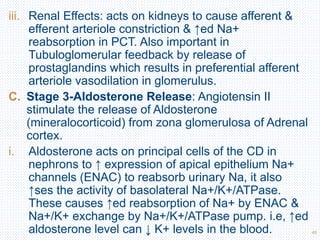
iii. Renal Effects: acts on kidneys to cause afferent &
efferent arteriole constriction & ↑ed Na+
reabsorption in PCT. Also important in
Tubuloglomerular feedback by release of
prostaglandins which results in preferential afferent
arteriole vasodilation in glomerulus.
C. Stage 3-Aldosterone Release: Angiotensin II
stimulate the release of Aldosterone
(mineralocorticoid) from zona glomerulosa of Adrenal
cortex.
i. Aldosterone acts on principal cells of the CD in
nephrons to ↑ expression of apical epithelium Na+
channels (ENAC) to reabsorb urinary Na, it also
↑ses the activity of basolateral Na+/K+/ATPase.
These causes ↑ed reabsorption of Na+ by ENAC &
Na+/K+ exchange by Na+/K+/ATPase pump. i.e, ↑ed
aldosterone level can ↓ K+ levels in the blood.
46
Clinical Significance
 Intravenous Fluid: Must be isotonic to
blood in order to maintain the correct
Osmotic pressure & prevent cells from
shrinking or expanding.
Eg. Normal saline + 5%
Dextrose~300mOsm= Plasma osmolality
& Ringer’s lactate: Glucose+ Lactic Acid
+different salts
Reduce Swelling in Cerebral Edema:
Hypertonic solutions of Mannitol
47
Clinical Significance
Cerebral Edema: when neurosurgical
procedures & strokes result in
accumulation of interstitial fluid in the brain
& swelling of neurons, raising intercranial
pressure disrupting neuronal fxn & leading
to coma and death.
48
Clinical Significance
 Diabetes insipidus: A rare disorder, a persons kidney
is passes abnormaly large urine vol. that is insipid
 Types are
i. Central DI (Neurogenic, hypothalamic or Pituatary):
damage to Pituatary gland, hypothalamus from
surgery, tumor, head injury or illness that affects
production, storage & release of ADH. Can also be
autoimmune rxn ie immune cells damage cells that
produce ADH.
ii. Nephrogenic DI: defect in kidney tubules (Collcting
Ducts), make them unable to respond to ADH (may be
genetic-Aquaporin-2 channels mutations, or caused
by certain drugs like lithium or foscavir)
iii. Gestational DI: occurs in pregnancy, enzyme from
placenta destroys ADH in the mother.
49
Clinical Significance
 Syndrome of Inappropriate ADH (SIADH): Caused by
Bronchogenic tumor which produces ADH in
uncontrolled fashion. Plasma ADH levels are very high
& Plsma Osmolality Low because Kidneys form
Conc.Urine & save water.
 Primary Polydipsia (or Psychogenic polydipsia)
characterized by intake of excessive fluid in absence of
physiological stimuli to drink could be as a result of
psychiatric disorders (Schizophrenia) associated with
dry mouth
-Symptoms include: excessive thirst & xerostomia> large
water consumption; hyponatraemia (causing headache,
vomiting, muscular weakness, twitching);
hypervolemia(leading to Oedema, hypertension & weight
gain); behavioural changes (fluid seeking behaviour)
50
Clinical Significance
Diarrhea: characterized by loose & watery
stool. In most cases the cause is unknown
cause (idiopathic origin) & it goes away on its
own. Diarrhea can cause dehydration,
electrolyte imbalance (Loss of Na+, K+ & Mg+
vital to body fxn) & kidney failure (no enough
blood supplied to kidneys)
 It can be acute (loose watery diarrhea lasting
1-2 days) persistent (lasting 2-4 weeks) &
chronic diarrhea (lasting >4 weeks or comes &
goes regularly over a long period of time)
51
Clinical Significance
A. Hyponatremia: Plasma Na+ levels <135mEq/L. In
H2O & Na+ Loss seen in Vomiting, diarrhea &
overuse of diuretics: the decrease in ECF stimulates
thirst & ADH release which causes increase H2O
ingestion & kidney concentration of urine and
plasma Hyposmolality & hyponatremia results.
 Could result from Addison’s Disease.
 Symptoms: muscle cramps, lethargy, fatigue,
disorientation, headache, anorexia, nausea, agitation,
hypothermia, seizures, and coma. These symptoms,
mainly neurologic, are a consequence of the swelling
of brain cells as plasma osmolality falls.
52
Clinical Significance
 Hypernatremia: is ↑ed plasma Na+ conc. & H2O
loss caused by excess Na+ added to ECF
(hyperosmotic overhydration) or primary loss of
H2O from ECF (hyperosmotic dehydration) as a
result of lack of ADH secretion.
 Hypercalcaemia: Problem in Parathyroid glands
producing excess parathormone causing ↑ed blood
calcium levels.
 Hypocalcaemia: caused by hypoparathyroidism
leading to ↓ed levels of calcium in blood.
53
Clinical Significance
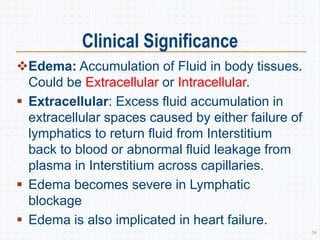
Edema: Accumulation of Fluid in body tissues.
Could be Extracellular or Intracellular.
 Extracellular: Excess fluid accumulation in
extracellular spaces caused by either failure of
lymphatics to return fluid from Interstitium
back to blood or abnormal fluid leakage from
plasma in Interstitium across capillaries.
 Edema becomes severe in Lymphatic
blockage
 Edema is also implicated in heart failure.
54
Closing Remarks and
Questions
Closing Remarks
56
Questions?
57

Body Fluids and Electrolyte Homeostasis

  • 1.
    Body Fluids &Electrolyte Balance Department of Human Physiology | Nnamdi Azikiwe University Nnewi Campus, Nigeria Lecture Slide David C. Ikwuka
  • 2.
    Outline  Body Fluids Functions  Compartments  Measurement  Indicators for measurement  Body Fluid Homeostasis  Electrolytes  Regulation  Clinical Significance 2 Nnamdi Azikiwe University Nnewi Campus
  • 3.
    Body Fluids  InLean adults, Fluids make up ~55% of female & 60% of male total body mass  Inorganic substances (Minerals) are dissolved in fluids & form Ions called Electrolytes. – Intracellular fluid (ICF) inside cells ~ 2/3 of body fluid – Extracellular fluid (ECF) outside cells • Interstitial fluid between cell ~ 80% of ECF • Plasma in blood is ~ 20% of ECF ICF & ECF differ in their Electrolyte Composition Examples also includes lymph, cerebrospinal fluid, synovial fluid, aqueous humor, vitreous body, endolymph, perilymph, and pleural, pericardial, and peritoneal fluids. They are referred to as Transcellular Fluids 3 Nnamdi Azikiwe University Nnewi Campus
  • 4.
    Functions of BodyFluids 1. Necessary for normal cellular function 2. Medium for metabolic reactions 3. Transports nutrients, waste products 4. Acts as lubricant, 5. Acts as insulator, 6. Act as shock absorber 7. Helps to regulate & maintain body temperature 4
  • 5.
    5 Body Fluid Compartment NnamdiAzikiwe University Nnewi Campus
  • 6.
    Movement of BodyFluids  The movement of body fluid across cell and capillary membranes accomplished through: – Osmosis – Diffusion – Filtration – Active transport 6
  • 7.
    Terminologies Associated withBody Fluids  Osmolality (Osm): Concentration of Solutes per kg of water (Osm/kg) i. Greatest determinants of osmolality in ECF: sodium, glucose, urea ii. Greatest determinants of osmolality in ICF: potassium, glucose, urea  Tonicity: Osmolality of solution i. Isotonic solution: same osmolality as body fluids ii. Hypertonic solution: higher osmolality than body fluids iii. Hypotonic solution: lower osmolality than body fluids 7 Nnamdi Azikiwe University Nnewi Campus
  • 8.
    Continua.  When RBCsare placed in Hypotonic solutn they gain water & may burst (Hemolysis).  When RBCs are placed in Hypertonic solution which has higher osmotically active solutes at higher osmolality & osmotic pressure relative to plasma, they shrink because of the osmosis of water out of the cells (Crenation) 8 Nnamdi Azikiwe University Nnewi Campus
  • 9.
    Measurement of BodyFluid Compartment 1. Indicator-Dilution Method: Administer Indicator confined to BF compartm. of interest, allow sufficient time for uniform distribution throughout the compartm., collect plasma sample. At equilibrium, the Indicator Conc. Will be same in the entire compartm. 𝑉𝑜𝑙 = 𝐴𝑚𝑡. 𝑜𝑓 𝐼𝑛𝑑𝑖𝑐𝑎𝑡𝑜𝑟 𝐶𝑜𝑛𝑐. 𝑜𝑓 𝐼𝑛𝑑𝑖𝑐𝑎𝑡𝑜𝑟 If indicator was lost from fluid compartment, the amt. lost is subtracted from the amt. administered.  To measure TBW, Heavy Water (D2O), Tritiated water (HTO) or Antipirine (drug that distributes throughout all of body water) is used as Indicator. 9
  • 10.
     TBW Volume:Tritium (3H2O), Deuterium (2H2O), Antipyrine.  ECF Volume: Inulin, Thiosulphate ion, Radioactive Sodium (22Na), Radioactive Iothalamate (125I-iothalamate) & Radioactive Chloride  ICF Volume: TBW-ECF  Plasma Volume: Evans blue dye (T-1824), (125I-albumin)  Interstitial Fluid Vol: ECF-Plasma Vol. 10 Indicators of Body Fluid Compartment
  • 11.
    Body Fluid Homeostasis A steady-state balance where the volume & composition of body fluids remain constant despite the addition & elimination of water & solutes from the body. It’s a complex process involves all organs systems of the body.  Transport by epithelia cells of the GIT, kidneys & Lungs controls both the intake & excretion of numerous substances & water.  The CVS delivers nutrients to & removes waste products from cells & tissues  Nervous & Endocrine systems provide regulation & integration of these important functions 11 Nnamdi Azikiwe University Nnewi Campus
  • 12.
    Fluid Homeostasis  Thebody maintains fluid homeostasis by ensuring that the amount of water added to the body each day equals or is balanced by the amount lost or excreted.  Although the amount of water added to the body each day may not be constant  There are several routes for water excretion but the Kidney is the only regulated route. 12
  • 13.
  • 14.
    Body Fluid Homeostasis 2 barriers separate ICF, interstitial fluid and plasma – Plasma membrane separates ICF from surrounding interstitial fluid – Blood vessel wall divide interstitial fluid from plasma  Body is in fluid balance when required amounts of water and solutes are present and correctly proportioned among compartments.  The conc. Of Virtually all substances in the body must be maintained within narrow range ie there is a Set Point & mechanisms for monitoring deviations from set point & Effector Mechanism to maintain the conc. Of that substance in the body constant 14
  • 15.
    Intracellular fluid (ICF) Extracellular fluid (ECF) TheECF and ICF are in balance, with the two solutions isotonic. ECF water loss Water loss from ECF reduces volume and makes this solution hypertonic with respect to the ICF. Increased ECF volume Decreased ICF volume An osmotic water shift from the ICF into the ECF restores osmotic equilibrium but reduces the ICF volume. Changes to the ICF and ECF when water losses outpace water gains
  • 16.
    – Very differentcomposition – Are at osmotic equilibrium – Loss of water from ECF is replaced by water in ICF • = Fluid shift – Occurs in minutes to hours and restores osmotic equilibrium • Dehydration – Results in long-term transfer that cannot replace ECF water loss – Homeostatic mechanisms to increase ECF fluid volume will be employed ICF and ECF compartments balance 16 Nnamdi Azikiwe University Nnewi Campus
  • 17.
    ELECTROLYTES  Are ionizedsubstances in Body fluids which contributes most to the total solute conc. (Osmolality) of Body Fluids. Body fluids also contains uncharged particles (Glucose, Urea etc) 17
  • 18.
    Electrolytes In BodyFluids 18  Ions form when electrolytes dissolve ad dissociate  4 general functions – Control osmosis of water between body fluid compartments – Help maintain the acid-base balance – Carry electrical current – Serve as cofactors Nnamdi Azikiwe University Nnewi Campus
  • 19.
    Protein & ElectrolyteConc. In Fluids 19 Nnamdi Azikiwe University Nnewi Campus
  • 20.
    Concentrations in BodyFluids 20 – Concentration of ions typically expressed in milliequivalents per liter (mEq/liter) • Na+ or Cl- number of mEq/liter = mmol/liter • Ca2+ or HPO4 2- number of mEq/liter = 2 x mmol/liter – Major difference between 2 ECF compartments (plasma and interstitial fluid) is plasma contains many more protein anions • Largely responsible for blood colloid osmotic pressure Nnamdi Azikiwe University Nnewi Campus
  • 21.
    ICF & ECF 21 –ECFmost abundant cation is Na+, anion is Cl- –ICF most abundant cation is K+, anion are proteins and phosphates (HPO4 2-) –Na+ /K+ pumps play major role in keeping K+ high inside cells and Na+ high outside cell Nnamdi Azikiwe University Nnewi Campus
  • 22.
    Na+ 22  Most abundantECF ion (Serum level:135- 145mEq/L)  Together with Cl- constitute 90% of solute in ECF  Plays pivotal role in fluid and electrolyte balance because it account for more than half of the osmolarity of ECF  Level in blood controlled by – Aldosternone – increases renal reabsorption – ADH – if sodium too low, ADH release stops – Atrial natriuretic peptide – increases renal excretion Nnamdi Azikiwe University Nnewi Campus
  • 23.
    K+ 23 – Most abundantcations in ICF (Serum level: 3.5-5.3mEq/L) – Key role in establishing RMP in neurons and muscle fibers – Also helps maintain normal ICF fluid volume – Helps regulate pH of body fluids when exchanged for H+ – Controlled by aldosterone – stimulates principal cells in renal collecting ducts to secrete excess K+. Nnamdi Azikiwe University Nnewi Campus
  • 24.
  • 25.
    Factors That AlterK+ Distribution Between Fluid Compartments Factors That Shift K+ into Cells (Decrease Extracellular [K+]) Factors That Shift K+ Out of Cells (Increase Extracellular [K+]) Insulin Insulin deficiency (DM) Aldosterone Aldosterone deficiency b-adrenergic stimulation b-adrenergic blockade Alkalosis Acidosis Cell lysis ↑ed ECF Osmolarity Strenuous exercise 25
  • 26.
    Ca2+ 26 – Most abundantmineral in body (Serum level: 9- 11mg/dL) – In body fluids mainly an ECF cation – 98% in adults in skeleton and teeth & contributes to hardness of teeth and bones  Plays vital roles in blood clotting, neurotransmitter release, muscle tone, & excitability of nervous and muscle tissue – Regulated by parathyroid hormone • Stimulates osteoclasts to release calcium from bone – resorption • Also enhances reabsorption from glomerular filtrate • Increases production of calcitrol to increase absorption for GI tract – Calcitonin lowers blood calcium levels Nnamdi Azikiwe University Nnewi Campus
  • 27.
  • 28.
    Magnesium 28 – In adults,~ 54% of total body magnesium is part of bone as magnesium salts, remaining 46% as Mg2+ in ICF (45%) or ECF (1%) – 2nd most common ICF cation (Serum levels 1.5- 2.5mEq/L) – Cofactor for certain enzymes and sodium- potassium pump, essential for normal neuromuscular activity, synaptic transmission, myocardial function, Protein & DNA synthesis. – Secretion of parathyroid hormone depends on Mg2+ – Regulated in blood plasma by varying rate excreted in urine Nnamdi Azikiwe University Nnewi Campus
  • 29.
  • 30.
    Cl- 30 – Most prevalentanion in ECF (Serum level: 95- 105mEq/L) – Moves relatively easily between ECF and ICF because most plasma membranes contain Cl- leakage channels and antiporters – Can help balance levels of anions in different fluids • Chloride shift in RBCs – Regulated by • ADH – governs extent of water loss in urine • Processes that increase or decrease renal reabsorption of Na+ also affect reabsorption of Cl- Nnamdi Azikiwe University Nnewi Campus
  • 31.
    HCO3- 31 – 2nd mostprevalent ECF anion (Also in ICF) – Conc. increases in blood passing through systemic capillaries picking up carbon dioxide • CO2 combines with H2O to form carbonic acid which dissociates • Drops in pulmonary capillaries when CO2 exhaled – Chloride shift helps maintain correct balance of anions in ECF and ICF – Kidneys are main regulators of blood HCO3 - • Can form and release HCO3 - when low or excrete excess Nnamdi Azikiwe University Nnewi Campus
  • 32.
  • 33.
    Phosphates 33  ~ 85%in adults present as calcium phosphate salts in bone & teeth, remaining 15% ionized – H2PO4 -, HPO4 2-, and PO4 3- are major ICF anion (Serum level: 2.4-4.5mg/dL) – HPO4 2- important buffer of H+ in body fluids and urine – Same hormones governing calcium homeostasis also regulate HPO4 2- in blood • Parathyroid hormone – stimulates resorption of bone by osteoclasts releasing calcium and phosphate but inhibits reabsorption of phosphate ions in kidneys • Calcitrol promotes absorption of phosphates and calcium from GI tract Nnamdi Azikiwe University Nnewi Campus
  • 34.
  • 35.
    Ion Absorption IonExcretion ICF ECF Ion absorption occurs across the epithelial lining of the small intestine and colon. Ion reserves (primarily in the skeleton) Ion pool in body fluids Sweat gland secretions (secondary site of ion loss) Kidneys (primary site of ion loss) Mineral balance, the balance between ion absorption (in the digestive tract) and ion excretion (primarily at the kidneys)
  • 36.
    Regulation of Water& Solute Loss  Elimination of excess body water through urine  Extent of urinary salt (NaCl) loss is the main factor that determines body fluid volume  Main factor that determines body fluid osmolarity is extent of urinary water loss  3 hormones regulate renal Na+ and Cl- reabsorption (or not) – Angiotensin II and aldosterone promote urinary Na+ and Cl- reabsorption of (and water by osmosis) when dehydrated – Atrial natriuretic peptide (ANP) promotes excretion of Na+ and Cl- followed by water excretion to decrease blood volume 36 Nnamdi Azikiwe University Nnewi Campus
  • 37.
    The mechanisms thatregulate sodium balance when sodium concentration in the ECF changes Rising plasma sodium levels The secretion of ADH restricts water loss and stimulates thirst, promoting additional water consumption. Osmoreceptors in hypothalamus stimulated HOMEOSTASIS DISTURBED Increased Na levels in ECF If you consume large amounts of salt without adequate fluid, as when you eat salty potato chips without taking a drink, the plasma Na concentration rises temporarily. ADH Secretion Increases Recall of Fluids Because the ECF osmolarity increases, water shifts out of the ICF, increasing ECF volume and lowering ECF Na concentrations. HOMEOSTASIS RESTORED Decreased Na levels in ECF HOMEOSTASIS Normal Na concentration in ECF Start
  • 38.
    Two types ofThirst 38 1. Osmotic/Osmometric Thirst: Occurs when solute conc. Of ECF ↑ses>it draws water out of the cells (by osmosis) & they shrink in volume causing dehydration>triggers CVOs (Osmoreceptors: Vascular organ of lamina terminalis & Subfornical organ)> Median preoptic nucleus (MPN) in hypothalamus>initiates water seeking & ingestive behaviour.  Destruction of MPN of hypothalamus in humans/animals results in partial or total loss in desire to drink even with extremely high salt conc. In ECF. Thirst sensation is also reduce or diminish in elderly.
  • 39.
    2. Hypovolemic Thirst Causedby Blood loss, vomiting & diarrhea - TBV drops too low↓>vascular system responds by constricting blood vessels> Renin release>RAS Also provoke the CVOs-Osmoreceptors (Area postrema, subfornical organs, vascular organ of lamina terminalis) >MPN which initiates water seeking & ingestive behaviour. Others include: - Arterial baroreceptors sense decreased arterial pressure & signals CNS - Cardiopulmonary receptors sense decreased blood volume & signals area postrema & nucleus tractus solitarii 39
  • 40.
    Antidiuretic Hormone 40 – Alsoknown as vasopressin – Produced by hypothalamus (Supraoptic & Paraventricular nuclei), released from posterior pituitary – Promotes insertion of aquaporin-2 into principal cells of collecting duct – Permeability to water increases – Produces concentrated urine Nnamdi Azikiwe University Nnewi Campus
  • 41.
    41 ADH Feedback forH2O Regulation
  • 42.
    Thirst Quenching  Homeostaticmechanism to stop drinking has 2 phases 1. Preabsorptive Phase-evoke quench thrist signals before fluid is absorbed from stomach & distributed to body via circulatn - Relies on sensory inputs in mouth, pharynx, oesophagus & upper GIT to anticipate amt of fluid needed providing rapid signals to brain to stop drinking 2. Postabsorptive Phase- occurs via blood monitoring for osmolality, fluid volume & Na+ balance which are sensed in the CVOs linked via neural networks to terminate thirst when fluid homeostasis is established. 42
  • 43.
    Renin-Angiotensin-Aldosterone System It’s aHormone System that is essential for fluid balance & blood regulation. A. Stage 1: Release of Renin (Granular cells of JGA) in response to a. ↓ed Na+ delivery to DCT by Macula densa cells b. ↓ed perfusion pressure in kidney detected by barorecptors in Afferent arteriole. c. Sympathetic stimulation of JGA via β1 adrenoceptors. 43
  • 44.
    44 B. Stage 2:Production of Angiotensin II a. Angiotensinogen (liver) is cleaved→Angiotensin I by Renin b. Angiotensin I →Angiotensin II by ACE (Lungs & Kidney) c. Angiotensin II exerts its effect by binding to receptors (AT1 & AT2) throughout the body. It mediates its effect majorly via AT1 on i. Neural Effects: It acts on hypothalamus to stimulate thirst sensation & ADH secretion from neurohypophysis resulting to fluid consumption & kidney H20 retention. ii. Cardiovascular Effects: Acts on AT1 in endothelium of arterioles to cause vasoconstriction, thus, ↑ing total peripheral resistance & blood pressure.
  • 45.
    45 iii. Renal Effects:acts on kidneys to cause afferent & efferent arteriole constriction & ↑ed Na+ reabsorption in PCT. Also important in Tubuloglomerular feedback by release of prostaglandins which results in preferential afferent arteriole vasodilation in glomerulus. C. Stage 3-Aldosterone Release: Angiotensin II stimulate the release of Aldosterone (mineralocorticoid) from zona glomerulosa of Adrenal cortex. i. Aldosterone acts on principal cells of the CD in nephrons to ↑ expression of apical epithelium Na+ channels (ENAC) to reabsorb urinary Na, it also ↑ses the activity of basolateral Na+/K+/ATPase. These causes ↑ed reabsorption of Na+ by ENAC & Na+/K+ exchange by Na+/K+/ATPase pump. i.e, ↑ed aldosterone level can ↓ K+ levels in the blood.
  • 46.
  • 47.
    Clinical Significance  IntravenousFluid: Must be isotonic to blood in order to maintain the correct Osmotic pressure & prevent cells from shrinking or expanding. Eg. Normal saline + 5% Dextrose~300mOsm= Plasma osmolality & Ringer’s lactate: Glucose+ Lactic Acid +different salts Reduce Swelling in Cerebral Edema: Hypertonic solutions of Mannitol 47
  • 48.
    Clinical Significance Cerebral Edema:when neurosurgical procedures & strokes result in accumulation of interstitial fluid in the brain & swelling of neurons, raising intercranial pressure disrupting neuronal fxn & leading to coma and death. 48
  • 49.
    Clinical Significance  Diabetesinsipidus: A rare disorder, a persons kidney is passes abnormaly large urine vol. that is insipid  Types are i. Central DI (Neurogenic, hypothalamic or Pituatary): damage to Pituatary gland, hypothalamus from surgery, tumor, head injury or illness that affects production, storage & release of ADH. Can also be autoimmune rxn ie immune cells damage cells that produce ADH. ii. Nephrogenic DI: defect in kidney tubules (Collcting Ducts), make them unable to respond to ADH (may be genetic-Aquaporin-2 channels mutations, or caused by certain drugs like lithium or foscavir) iii. Gestational DI: occurs in pregnancy, enzyme from placenta destroys ADH in the mother. 49
  • 50.
    Clinical Significance  Syndromeof Inappropriate ADH (SIADH): Caused by Bronchogenic tumor which produces ADH in uncontrolled fashion. Plasma ADH levels are very high & Plsma Osmolality Low because Kidneys form Conc.Urine & save water.  Primary Polydipsia (or Psychogenic polydipsia) characterized by intake of excessive fluid in absence of physiological stimuli to drink could be as a result of psychiatric disorders (Schizophrenia) associated with dry mouth -Symptoms include: excessive thirst & xerostomia> large water consumption; hyponatraemia (causing headache, vomiting, muscular weakness, twitching); hypervolemia(leading to Oedema, hypertension & weight gain); behavioural changes (fluid seeking behaviour) 50
  • 51.
    Clinical Significance Diarrhea: characterizedby loose & watery stool. In most cases the cause is unknown cause (idiopathic origin) & it goes away on its own. Diarrhea can cause dehydration, electrolyte imbalance (Loss of Na+, K+ & Mg+ vital to body fxn) & kidney failure (no enough blood supplied to kidneys)  It can be acute (loose watery diarrhea lasting 1-2 days) persistent (lasting 2-4 weeks) & chronic diarrhea (lasting >4 weeks or comes & goes regularly over a long period of time) 51
  • 52.
    Clinical Significance A. Hyponatremia:Plasma Na+ levels <135mEq/L. In H2O & Na+ Loss seen in Vomiting, diarrhea & overuse of diuretics: the decrease in ECF stimulates thirst & ADH release which causes increase H2O ingestion & kidney concentration of urine and plasma Hyposmolality & hyponatremia results.  Could result from Addison’s Disease.  Symptoms: muscle cramps, lethargy, fatigue, disorientation, headache, anorexia, nausea, agitation, hypothermia, seizures, and coma. These symptoms, mainly neurologic, are a consequence of the swelling of brain cells as plasma osmolality falls. 52
  • 53.
    Clinical Significance  Hypernatremia:is ↑ed plasma Na+ conc. & H2O loss caused by excess Na+ added to ECF (hyperosmotic overhydration) or primary loss of H2O from ECF (hyperosmotic dehydration) as a result of lack of ADH secretion.  Hypercalcaemia: Problem in Parathyroid glands producing excess parathormone causing ↑ed blood calcium levels.  Hypocalcaemia: caused by hypoparathyroidism leading to ↓ed levels of calcium in blood. 53
  • 54.
    Clinical Significance Edema: Accumulationof Fluid in body tissues. Could be Extracellular or Intracellular.  Extracellular: Excess fluid accumulation in extracellular spaces caused by either failure of lymphatics to return fluid from Interstitium back to blood or abnormal fluid leakage from plasma in Interstitium across capillaries.  Edema becomes severe in Lymphatic blockage  Edema is also implicated in heart failure. 54
  • 55.
  • 56.
  • 57.

Editor's Notes

  • #4 Water makes up about 60% of the body’s weight, with variability among individuals being a function of adipose tissue. Water content of Adipose tissues is lower than that of other tissues, hence, increased amts of adipose tissues reduces the fraction of total body weight attributed to water. Muscle Tissue: Contains 75% water % Body weight attributed to water also varies with age (In newborns~75%, this decreases to adult value of 60% by the age of 1year). Age: lose Muscle mass + add adipose tissue, Water Content decreases with Age
  • #7 Osmosis: Movement of water across cell membranes from less concentrated solution to more concentrated solution Diffusion: Movement of solutes due to conc. Gradient. Rates is affected by size of molecules, Conc. Of solution & Temp. of solution. Filtration: Movement of fluid & solute together across a membrane from one compartment to another-from area of higher pressure to lower Active Transport: Substances move across membranes against Conc. Gradient. Energy is expended eg. Na-K pump maintains higher levels of Na in ECF & higher K conc. In ICF
  • #8 Osmolarity is the measure of the Osmoles of solute per litre of water (Osm/L) A solution may be Isosmotic but not Isotonic such as when the solute in the Isosmotic solution can freely penetrate the membrane. Eg 0.4 Urea solution is Isosmotic but not Isotonic because the membrane is permeable to Urea.
  • #11 125I-albumin: Serum albumin labeled with radioactive iodine
  • #12 Epithelial cells are central to process of regulation of the volume & composition of body fluids.
  • #16 15
  • #18 Osmolality is of prime importance in water distribution between ECF & ICF compartments.
  • #24 RMP= Resting Membrane Potential. Principal site for k+ excretion is Principal cells of late distal tubules & cortical collecting ducts (in these segments, K+ can either be secreted or reabsorbed based on body requirements) Daily intake of K is about 100mEq/day but the kidney must excrete ~ 92mEq/day & remaining 8mEq/day is lost via feces. K+ deficiency is associated with expression & activity of luminal H-K ATPase in the alpha intercalated cells of the collecting ducts which act to promote K+ reabsorption from the lumen.
  • #25 Where, PCT= proximal convoluted tubule, DCT=Distal convoluted tubule, TAL=Thick ascending limb of Henle’s loop, CCT= Cortical collecting duct, MCD=Medullary collecting duct
  • #26 DM-Diabetes mellitus Aldosterone deficiency (Addison’s disease), Excess aldosterone production (Conn’s syndrome) associated with hypokalemia (due to movement of extracellular K+ into cell). For Alkalosis-Acidosis K+ movement, Increased H+ reduces the activity of Na+/K+/ATPase pump & reduces cellular uptake of K+ thereby ↑ing K+ in ECF.
  • #27 Parathyroid Hormone from parathyroid glands located behind Thyroid hormone (4 in No.) Calcitonin from parafollicular cells (C-cells) of thyroid gland opposes the action of Parathormone.
  • #28 Biologically inactive Vit. D2 or D3 undergoes 2 Enzymatic hydroxylation reactions to be Activated 25 Hydroxylase: from Endoplasmic Reticulum (ER) of Liver (converts Cholecalciferol [Vit D3] to Calcifediol or Calcidiol [25-hydroxyvitamin D3), it also hydroxylates Ergocalciferol (Vit D2) from dietary sources to Ercalcidiol (25-hydroxyvitamin D2). Represented as 25(OH)D it’s the major circulatory form (it bounds to carrier protein-Vit D binding protein) 1 a-Hydroxylase from Proximal tubules of Kidney, skin (keratinocytes), immune cells & bone (Osteoblasts), converts Calcifediol to Calcitriol-active form {1,25(OH)2 D} or 1, 25 dihydroxyvitamin D. Calcitriol acts on GIT cells to ↑ production of Calcium transport proteins (Calbindin-D proteins) which results to ↑ uptake of calcium from GIT & promotes bone formation by calcification of osteoid tissue.
  • #32 Major body buffer Regulates acid–base balance
  • #34 Forms bones and teeth, Metabolism of protein, fat, carbohydrates, Cellular metabolism, Muscle, nerve, RBC function, Regulates acid–base balance, Regulates calcium levels
  • #36 35
  • #38 37
  • #39 Solute conc. Of interstitial fluid increase by high intake of Na in diet or drop of ECF volume (Plasma & CSF) due to water loss via perspiration, respiration, urination & defecation
  • #40 Hypovolemic thirst is caused by loss of blood volume without depleting the interstitial fluid. During Dehydration, Water leaves the Osmoreceptor Neurons in the CVOs because of increased Osmolality of the ECF causing the Osmoreceptors to shrink, which mechanically stimulates them to increase their production of nerve impulses. TBV- Total Blood Volume The CVOs-Circumventricular Organs (characterized by highly permeable capillaries unlike those in other parts of brain with BBB) detect concentration of blood plasma & presence of Angiotensin II in the blood
  • #42 The human kidney can concentrate urine to 1200-1400mOsm/L which is 4-5 times plasma Osmolarity. This allows for survival in dry/arid areas. The urine concentrating ability of the kidney is limited by ADH levels. NB: Osmolarity of Interstitial fluid & Plasma is about 300mOsm/L
  • #44 Juxtaglomerular Apparatus-JGA, DCT-Distal convoluted tubule Renin release is inhibited by ANP released by Atria stretch receptors in response to ↑ed blood pressure.
  • #45 ACE-Angiotensin converting enzyme from Vascular Endothelial cells (Lungs) & small qty from renal endothelium
  • #46 PCT-Proximal convoluted tubule, CD-Collecting Ducts NB: Tubuloglomerular feedback helps to maintain glomerular filtration rate To counter this effect of Angiotensin II, ACE inhibitors (enalapril, ramipril,lisinopril) are used in hypertensive to inhibit ACE
  • #48 Cerebral Edema: A significant cause of mortality in people with brain tumor or stroke.
  • #49 Cerebrovascular accidents (Stroke) BBB seperates the CSF & brain interstitial fluid from blood is freely permeable to water but not most other substances. Excess fluid in the brain can be removed by imposing an osmotic gradient across BBB using Mannitol. Mannitol is a sugar that doesn’t readily cross the BBB & membrane of cells (neurons), therefore it is an effective Osmole & intravenous infusion results in the movement of fluid from brain tissue by osmosis.
  • #50 Diabetes “Large discharge of urine” or passing through Insipid: dilute & odourless
  • #53 Addison’s Disease (Decreased secretion of Aldosterone Decreased plasma Na+, resulting from loss of NaCl from ECF or addition of excess H2O to ECF results in hypoosmotic dehydration associated with reduced ECF vol. -Excessive brain swelling may be fatal or may cause permanent damage. Treatment requires identifying and then treating the underlying cause. If Na+ loss is responsible for the hyponatremia, isotonic or hypertonic saline or NaCl by mouth is usually given. If the blood volume is normal or the patient is edematous, water restriction is recommended. Hyponatremia should be corrected slowly and with constant monitoring, because too rapid correction can be harmful. -Hyponatremia in increased plasma osmolality is seen in hyperglycemic patients with uncontrolled diabetes mellitus. In this condition, the high plasma glucose causes the osmotic withdrawal of water from cells, and the extra water in the ECF space leads to hyponatremia. -Plasma Na+ level falls by 1.6 mEq/L for each 100-mg/dL rise in plasma glucose.
  • #54 ↑↓
  • #55 ↓ed plasma protein (from Nephrotic syndrome, Liver Cirrhosis) conc causes Colloid osmotic pressure to fall leading to capillary filtration throughout the body as well as extracellular edema. Intracellular Edema can result from depression of Metabolic systems of tissues, poor cell nutrition, or reduced blood flow. When blood flow is ↓ed to maintain tissue Metab., it causes malfunction of cell membrane ionic pumps making them unable to pump out Na+ that leaked into the cell, thereby causing ICF excess Na & H2O follows Na+ into cell by osmosis, increasing intracellular vol. Intracellular edema can also occur in inflamed tissues (membrane permeability is ↑ed in inflammation. Heart Failure: Inability of the heart to pump blood raises venous & capillary pressure causing ↑ed capillary filtration & ↑ed NaCl retention, it also stimulates RAS both of which causes additional NaCl retention by the kidneys.