WATER BALANCE
• Body is composed of about 60-70% water
• Distribution of water in body compatrments =
solute content of each compartment.
The body water compartments
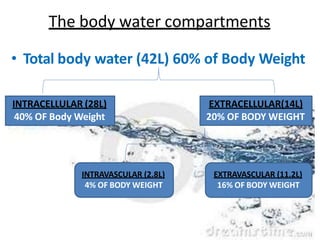
• Total body water (42L) 60% of Body Weight
INTRACELLULAR (28L)
40% OF Body Weight
EXTRACELLULAR(14L)
20% OF BODY WEIGHT
INTRAVASCULAR (2.8L)
4% OF BODY WEIGHT
EXTRAVASCULAR (11.2L)
16% OF BODY WEIGHT
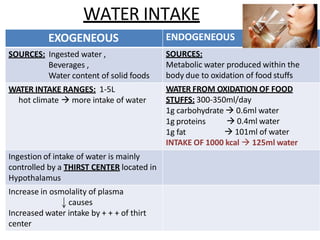
WATER INTAKE
EXOGENEOUS
SOURCES: Ingested water ,
Beverages ,
Water content of solid foods
WATER INTAKE RANGES: 1-5L
hot climate  more intake of water
1g proteins
1g fat
ENDOGENEOUS
SOURCES:
Metabolic water produced within the
body due to oxidation of food stuffs
WATER FROM OXIDATION OF FOOD
STUFFS: 300-350ml/day
1g carbohydrate  0.6ml water
 0.4ml water
 101ml of water
INTAKE OF 1000 kcal  125ml water
Ingestion of intake of water is mainly
controlled by a THIRST CENTER located in
Hypothalamus
Increase in osmolality of plasma
causes
Increased water intake by + + + of thirt
center
WATER OUTPUT
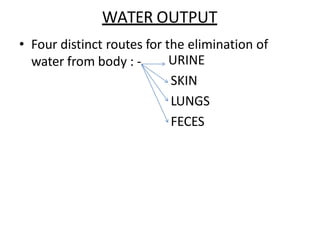
• Four distinct routes for the elimination of
water from body : - URINE
SKIN
LUNGS
FECES
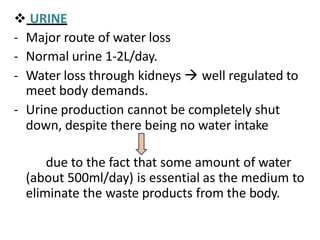
 URINE
- Major route of water loss
- Normal urine 1-2L/day.
- Water loss through kidneys  well regulated to
meet body demands.
- Urine production cannot be completely shut
down, despite there being no water intake
due to the fact that some amount of water
(about 500ml/day) is essential as the medium to
eliminate the waste products from the body.
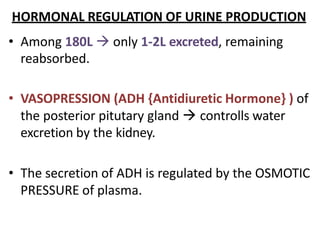
HORMONAL REGULATION OF URINE PRODUCTION
• Among 180L  only 1-2L excreted, remaining
reabsorbed.
• VASOPRESSION (ADH {Antidiuretic Hormone} ) of
the posterior pitutary gland  controlls water
excretion by the kidney.
• The secretion of ADH is regulated by the OSMOTIC
PRESSURE of plasma.
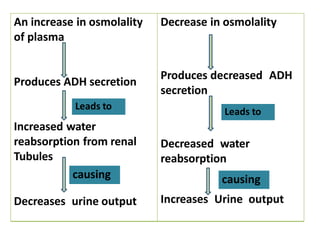
An increase in osmolality
of plasma
Produces ADH secretion
Increased water
reabsorption from renal
Tubules
Decreases urine output
Decrease in osmolality
Produces decreased ADH
secretion
Decreased water
reabsorption
Increases Urine output
Leads to
Leads to
causing causing
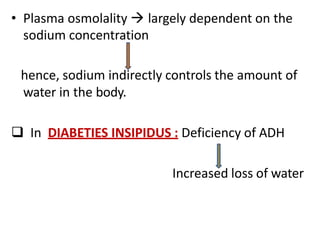
• Plasma osmolality  largely dependent on the
sodium concentration
hence, sodium indirectly controls the amount of
water in the body.
 In DIABETIES INSIPIDUS : Deficiency of ADH
Increased loss of water
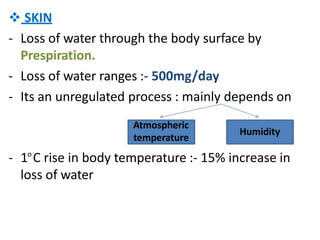
 SKIN
- Loss of water through the body surface by
Prespiration.
- Loss of water ranges :- 500mg/day
- Its an unregulated process : mainly depends on
- 1o
C rise in body temperature :- 15% increase in
loss of water
Atmospheric
temperature
Humidity
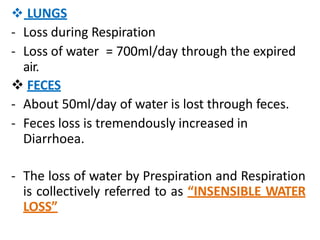
 LUNGS
- Loss during Respiration
- Loss of water = 700ml/day through the expired
air.
 FECES
- About 50ml/day of water is lost through feces.
- Feces loss is tremendously increased in
Diarrhoea.
- The loss of water by Prespiration and Respiration
is collectively referred to as “INSENSIBLE WATER
LOSS”
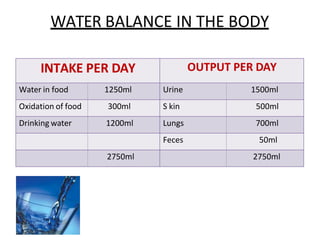
WATER BALANCE IN THE BODY
INTAKE PER DAY OUTPUT PER DAY
Water in food 1250ml Urine 1500ml
Oxidation of food 300ml S kin 500ml
Drinking water 1200ml Lungs 700ml
Feces 50ml
2750ml 2750ml
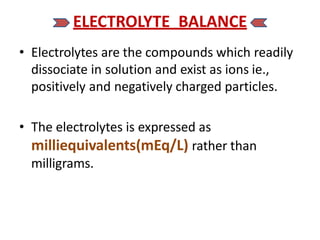
ELECTROLYTE BALANCE
• Electrolytes are the compounds which readily
dissociate in solution and exist as ions ie.,
positively and negatively charged particles.
• The electrolytes is expressed as
milliequivalents(mEq/L) rather than
milligrams.
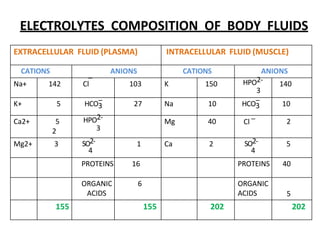
ELECTROLYTES COMPOSITION OF BODY FLUIDS
_ _
EXTRACELLULAR FLUID (PLASMA) INTRACELLULAR FLUID (MUSCLE)
CATIONS _ ANIONS CATIONS ANIONS
Na+ 142 Cl 103 K 150 HPO2-
3
140
K+ 5 HCO3 27 Na 10 HCO3 10
Ca2+ 5
2
HPO2-
3
Mg 40
_
Cl 2
Mg2+ 3 SO2-
4
1 Ca 2 SO2-
4
5
PROTEINS 16 PROTEINS 40
ORGANIC
ACIDS
6 ORGANIC
ACIDS 5
155 155 202 202
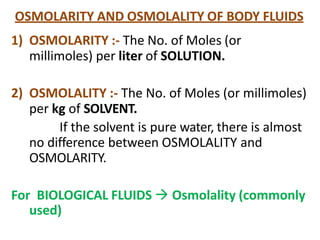
OSMOLARITY AND OSMOLALITY OF BODY FLUIDS
1) OSMOLARITY :- The No. of Moles (or
millimoles) per liter of SOLUTION.
2) OSMOLALITY :- The No. of Moles (or millimoles)
per kg of SOLVENT.
If the solvent is pure water, there is almost
no difference between OSMOLALITY and
OSMOLARITY.
For BIOLOGICAL FLUIDS  Osmolality (commonly
used)
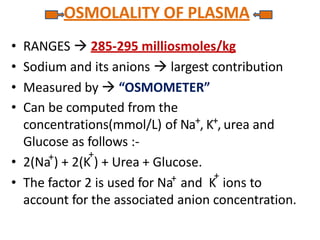
OSMOLALITY OF PLASMA
• 2(Na ) + 2(K ) + Urea + Glucose.
• The factor 2 is used for Na and K ions to
account for the associated anion concentration.
• RANGES  285-295 milliosmoles/kg
• Sodium and its anions  largest contribution
• Measured by  “OSMOMETER”
• Can be computed from the
concentrations(mmol/L) of Na+, K+, urea and
Glucose as follows :-
+ +
+ +
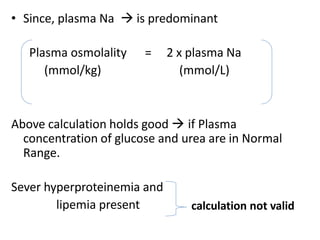
• Since, plasma Na  is predominant
Plasma osmolality =
(mmol/kg)
2 x plasma Na
(mmol/L)
Above calculation holds good  if Plasma
concentration of glucose and urea are in Normal
Range.
Sever hyperproteinemia and
lipemia present calculation not valid
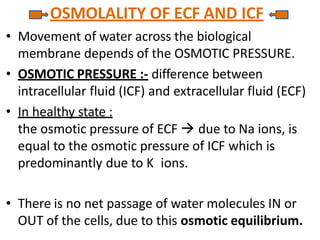
OSMOLALITY OF ECF AND ICF
• Movement of water across the biological
membrane depends of the OSMOTIC PRESSURE.
• OSMOTIC PRESSURE :- difference between
intracellular fluid (ICF) and extracellular fluid (ECF)
• In healthy state :
the osmotic pressure of ECF  due to Na ions, is
equal to the osmotic pressure of ICF which is
predominantly due to K ions.
• There is no net passage of water molecules IN or
OUT of the cells, due to this osmotic equilibrium.
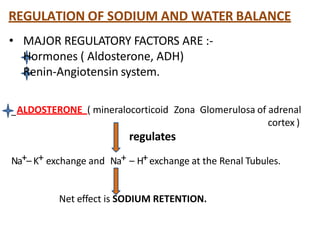
REGULATION OF SODIUM AND WATER BALANCE
• MAJOR REGULATORY FACTORS ARE :-
Hormones ( Aldosterone, ADH)
Renin-Angiotensin system.
ALDOSTERONE ( mineralocorticoid Zona Glomerulosa of adrenal
cortex )
regulates
Na+– K+ exchange and Na+ – H+exchange at the Renal Tubules.
Net effect is SODIUM RETENTION.
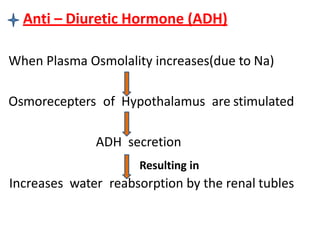
Anti – Diuretic Hormone (ADH)
When Plasma Osmolality increases(due to Na)
Osmorecepters of Hypothalamus are stimulated
ADH secretion
Resulting in
Increases water reabsorption by the renal tubles
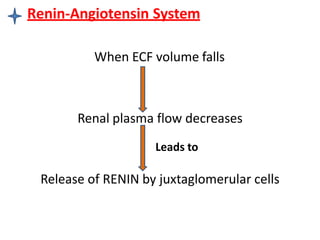
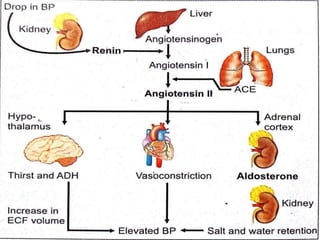
Renin-Angiotensin System
When ECF volume falls
Renal plasma flow decreases
Leads to
Release of RENIN by juxtaglomerular cells
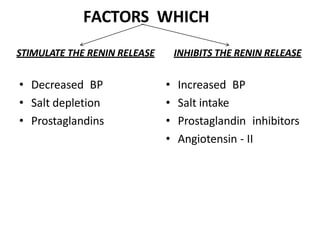
FACTORS WHICH
STIMULATE THE RENIN RELEASE INHIBITS THE RENIN RELEASE
• Decreased BP
• Salt depletion
• Prostaglandins
• Increased BP
• Salt intake
• Prostaglandin inhibitors
• Angiotensin - II
CLINICAL SIGNIFICANCE
• ACE (Angiotensin Converting Enzyme)  is a
glycoprotein.
• ACE inhibitors is useful in treating EDEMA &
CHRONIC CONGESTIVE CARDIAC FAILURE.
• Peptide Analog of Angiotensin-II [SARALASIN] &
antagonists of the converting enzyme [CATOPRIL]
are useful in treating Renin-Dependent
hypertension.
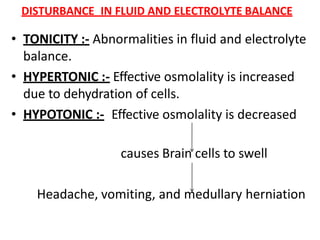
DISTURBANCE IN FLUID AND ELECTROLYTE BALANCE
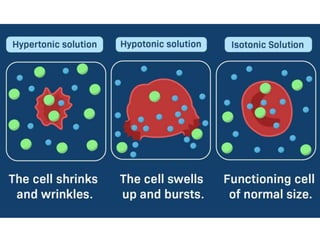
• TONICITY :- Abnormalities in fluid and electrolyte
balance.
• HYPERTONIC :- Effective osmolality is increased
due to dehydration of cells.
• HYPOTONIC :- Effective osmolality is decreased
causes Brain cells to swell
Headache, vomiting, and medullary herniation
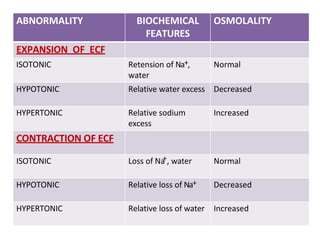
ABNORMALITY BIOCHEMICAL
FEATURES
OSMOLALITY
EXPANSION OF ECF
ISOTONIC Retension of Na+,
water
Normal
HYPOTONIC Relative water excess Decreased
HYPERTONIC Relative sodium
excess
Increased
CONTRACTION OF ECF
ISOTONIC Loss of Na
+, water Normal
HYPOTONIC Relative loss of Na+ Decreased
HYPERTONIC Relative loss of water Increased
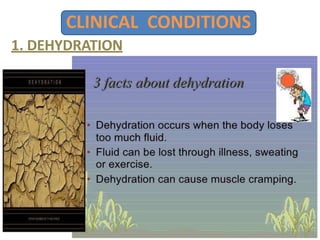
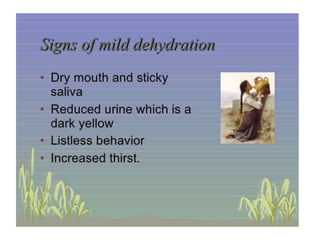
CLINICAL CONDITIONS
1. DEHYDRATION
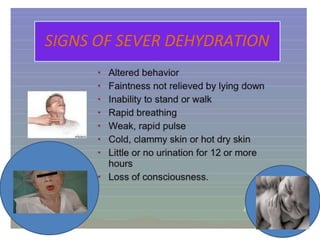
SIGNS OF SEVER DEHYDRATION
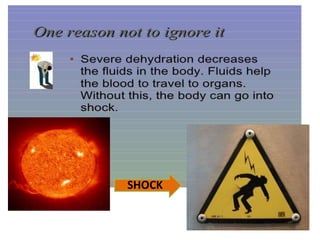
SHOCK
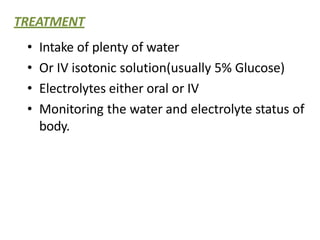
TREATMENT
• Intake of plenty of water
• Or IV isotonic solution(usually 5% Glucose)
• Electrolytes either oral or IV
• Monitoring the water and electrolyte status of
body.
OVERHYDRATION
Overhydration can lead to water intoxication.
This occurs when the amount of salt and other
electrolytes in your body become too diluted.
Hyponatremia is a condition in which sodium
(salt) levels become dangerously low.
This is the main concern of overhydration.
CAUSES OF overhydration
By making your body hold on to more fluid.
These includes:
congestive heart failure (CHF)
liver disease
kidney problems
Syndrome of inappropriate antidiuretic hormone
nonsteroidal anti-inflammatory drugs
uncontrolled diabetes
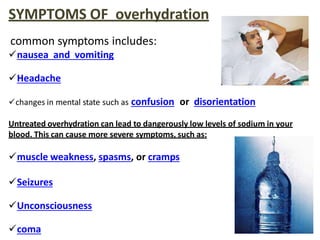
SYMPTOMS OF overhydration
common symptoms includes:
nausea and vomiting
Headache
changes in mental state such as confusion or disorientation
Untreated overhydration can lead to dangerously low levels of sodium in your
blood. This can cause more severe symptoms, such as:
muscle weakness, spasms, or cramps
Seizures
Unconsciousness
coma
How is overhydration treated?
 Cutting back on your fluid intake
Taking diuretics to increase the amount of
urine you produce
Treating the condition that caused the
overhydration
 Stopping any medications causing the problem
 Replacing sodium in severe cases
ELECTROLYTES OF IMBALANCE
,
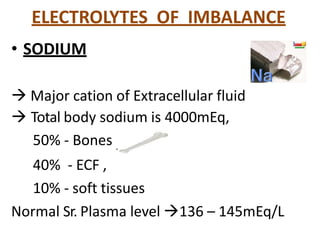
• SODIUM
 Major cation of Extracellular fluid
 Total body sodium is 4000mEq,
50% - Bones
40% - ECF ,
10% - soft tissues
Normal Sr. Plasma level 136 – 145mEq/L
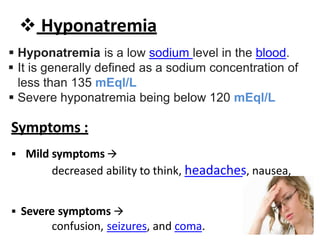
 Hyponatremia
 Hyponatremia is a low sodium level in the blood.
 It is generally defined as a sodium concentration of
less than 135 mEql/L
 Severe hyponatremia being below 120 mEql/L
Symptoms :
 Mild symptoms 
decreased ability to think, headaches, nausea,
 Severe symptoms 
confusion, seizures, and coma.
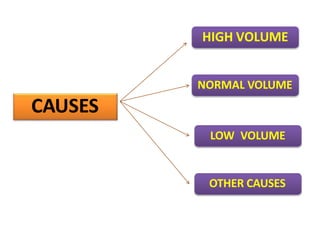
CAUSES
HIGH VOLUME
NORMAL VOLUME
LOW VOLUME
OTHER CAUSES
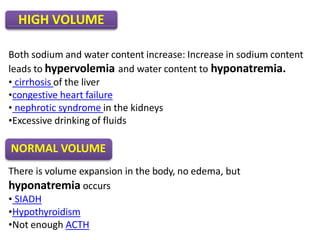
HIGH VOLUME
Both sodium and water content increase: Increase in sodium content
leads to hypervolemia and water content to hyponatremia.
• cirrhosis of the liver
•congestive heart failure
• nephrotic syndrome in the kidneys
•Excessive drinking of fluids
NORMAL VOLUME
There is volume expansion in the body, no edema, but
hyponatremia occurs
• SIADH
•Hypothyroidism
•Not enough ACTH
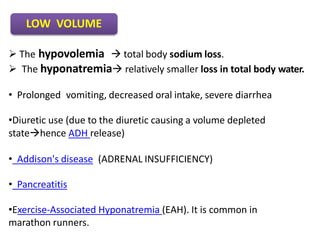
 The hypovolemia  total body sodium loss.
 The hyponatremia relatively smaller loss in total body water.
• Prolonged vomiting, decreased oral intake, severe diarrhea
•Diuretic use (due to the diuretic causing a volume depleted
statehence ADH release)
• Addison's disease (ADRENAL INSUFFICIENCY)
• Pancreatitis
•Exercise-Associated Hyponatremia (EAH). It is common in
marathon runners.
LOW VOLUME
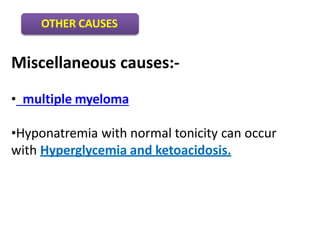
Miscellaneous causes:-
• multiple myeloma
•Hyponatremia with normal tonicity can occur
with Hyperglycemia and ketoacidosis.
OTHER CAUSES
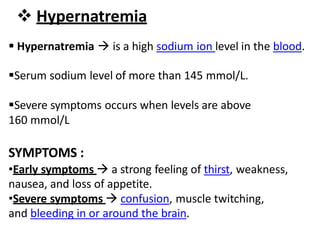
 Hypernatremia
 Hypernatremia  is a high sodium ion level in the blood.
Serum sodium level of more than 145 mmol/L.
Severe symptoms occurs when levels are above
160 mmol/L
SYMPTOMS :
•Early symptoms  a strong feeling of thirst, weakness,
nausea, and loss of appetite.
•Severe symptoms  confusion, muscle twitching,
and bleeding in or around the brain.
OTHER CAUSES
• POTASSIUM
• Total body content of potasium  3500mEq
• Major cation of INTRACELLULAR FLUID.
• Maintains intracellular Osmotic Pressure.
• Normal serum potassium level
3.5-5.2mmol/L
• The cells contains 160mEq/L, so precaution
should be taken to prevent hemolysis when
estimating for concentration of potassium
Hypokalemia
Hypokalemia is a low level of potassium (K+) in
the blood serum.
 Levels below 3.5 mmol/L defined as hypokalemia.
Symptoms :
• Mildly low levels do not typically cause symptoms.
• Feeling tired, leg cramps, weakness & constipation
•It increases the risk of an abnormal heart rhythm,
which are often too slow, and can cause cardiac
arrest.
Causes of hypokalemia include
• Diarrhea,
• medications like furosemide and steroids,
• Dialysis, Diabetes Insipidus
• Hyperaldosteronism, Hypomagnesemia,
• not enough intake in the diet.
 It is classified as severe when levels are less than
2.5 mmol/L.
 Low levels can also be detected on
an electrocardiogram (ECG)  T wave is inverted
H YPERKALEMIA
Hyperkalemia is an elevated level of potassium (K+)
with levels above 5.5 mmol/L in the blood serum
SYMPTOMS :
• Typically this results in no symptoms.
•when severe  palpitations, muscle pain, muscle
weakness, or numbness.
•An abnormal heart rate can occur which can result
in cardiac arrest and death.
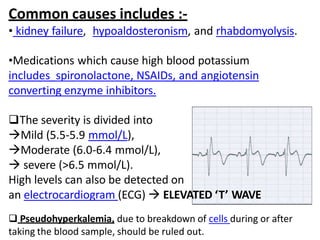
Common causes includes :-
• kidney failure, hypoaldosteronism, and rhabdomyolysis.
•Medications which cause high blood potassium
includes spironolactone, NSAIDs, and angiotensin
converting enzyme inhibitors.
The severity is divided into
Mild (5.5-5.9 mmol/L),
Moderate (6.0-6.4 mmol/L),
 severe (>6.5 mmol/L).
High levels can also be detected on
an electrocardiogram (ECG)  ELEVATED ‘T’ WAVE
 Pseudohyperkalemia, due to breakdown of cells during or after
taking the blood sample, should be ruled out.
• CHLORIDE
Intake , output and metabolism of sodium and
chloride run in parallel.
The normal serum range for chloride is 97 to
107 mEq/L.
 In CSF  125 mEq/L
 Renal threshold for Chloride is about 110mEq/L.
 Daily excretion of chloride is 5-8mg/L
 HYPERCHOLERMIA
Hyperchloremi a is an electrolyte disturbance in
which there is an elevated level of the chloride ions
in the blood.
The normal serum range for chloride is
96 to 106 mEq/L ,
chloride levels at or above 110 mEq/L usually
indicate kidney dysfunction as it is a regulator of
chloride concentration.
Symptoms and causes includes :
 Dehydration  due to diarrhea, vomiting, sweating
Hypertension due to increased sodium chloride intake
Cardiovascular dysfunction  due to increased sodium
chloride intake
Edema  due to influx in sodium in the body
Weakness  due to loss of fluids
Thirst  due to loss of fluids
Kussmaul breathing  due to high ion
concentrations, loss of fluids, or renal failure
High blood sugar  due to diabetes
Hyperchloremic metabolic acidosis  due
to severe diarrhea and/or renal failure
Respiratory alkadosis  due to renal
dysfunction
 Hypochloremia
Hypochloremia is an electrolyte disturbance in which
there is an abnormally low level of the chloride ion in
the blood.
It is associated with
hypoventilation,
chronic respiratory acidosis.
respiratory acidosis + metabolic alkalosis (decreased
blood acidity) it is often due to vomiting.
It occurs in cystic fibrosis.
waterandelectrolyte balance.pptx

waterandelectrolyte balance.pptx

  • 2.
    WATER BALANCE • Bodyis composed of about 60-70% water • Distribution of water in body compatrments = solute content of each compartment.
  • 3.
    The body watercompartments • Total body water (42L) 60% of Body Weight INTRACELLULAR (28L) 40% OF Body Weight EXTRACELLULAR(14L) 20% OF BODY WEIGHT INTRAVASCULAR (2.8L) 4% OF BODY WEIGHT EXTRAVASCULAR (11.2L) 16% OF BODY WEIGHT
  • 4.
    WATER INTAKE EXOGENEOUS SOURCES: Ingestedwater , Beverages , Water content of solid foods WATER INTAKE RANGES: 1-5L hot climate  more intake of water 1g proteins 1g fat ENDOGENEOUS SOURCES: Metabolic water produced within the body due to oxidation of food stuffs WATER FROM OXIDATION OF FOOD STUFFS: 300-350ml/day 1g carbohydrate  0.6ml water  0.4ml water  101ml of water INTAKE OF 1000 kcal  125ml water Ingestion of intake of water is mainly controlled by a THIRST CENTER located in Hypothalamus Increase in osmolality of plasma causes Increased water intake by + + + of thirt center
  • 5.
    WATER OUTPUT • Fourdistinct routes for the elimination of water from body : - URINE SKIN LUNGS FECES
  • 6.
     URINE - Majorroute of water loss - Normal urine 1-2L/day. - Water loss through kidneys  well regulated to meet body demands. - Urine production cannot be completely shut down, despite there being no water intake due to the fact that some amount of water (about 500ml/day) is essential as the medium to eliminate the waste products from the body.
  • 7.
    HORMONAL REGULATION OFURINE PRODUCTION • Among 180L  only 1-2L excreted, remaining reabsorbed. • VASOPRESSION (ADH {Antidiuretic Hormone} ) of the posterior pitutary gland  controlls water excretion by the kidney. • The secretion of ADH is regulated by the OSMOTIC PRESSURE of plasma.
  • 8.
    An increase inosmolality of plasma Produces ADH secretion Increased water reabsorption from renal Tubules Decreases urine output Decrease in osmolality Produces decreased ADH secretion Decreased water reabsorption Increases Urine output Leads to Leads to causing causing
  • 9.
    • Plasma osmolality largely dependent on the sodium concentration hence, sodium indirectly controls the amount of water in the body.  In DIABETIES INSIPIDUS : Deficiency of ADH Increased loss of water
  • 10.
     SKIN - Lossof water through the body surface by Prespiration. - Loss of water ranges :- 500mg/day - Its an unregulated process : mainly depends on - 1o C rise in body temperature :- 15% increase in loss of water Atmospheric temperature Humidity
  • 11.
     LUNGS - Lossduring Respiration - Loss of water = 700ml/day through the expired air.  FECES - About 50ml/day of water is lost through feces. - Feces loss is tremendously increased in Diarrhoea. - The loss of water by Prespiration and Respiration is collectively referred to as “INSENSIBLE WATER LOSS”
  • 12.
    WATER BALANCE INTHE BODY INTAKE PER DAY OUTPUT PER DAY Water in food 1250ml Urine 1500ml Oxidation of food 300ml S kin 500ml Drinking water 1200ml Lungs 700ml Feces 50ml 2750ml 2750ml
  • 13.
    ELECTROLYTE BALANCE • Electrolytesare the compounds which readily dissociate in solution and exist as ions ie., positively and negatively charged particles. • The electrolytes is expressed as milliequivalents(mEq/L) rather than milligrams.
  • 14.
    ELECTROLYTES COMPOSITION OFBODY FLUIDS _ _ EXTRACELLULAR FLUID (PLASMA) INTRACELLULAR FLUID (MUSCLE) CATIONS _ ANIONS CATIONS ANIONS Na+ 142 Cl 103 K 150 HPO2- 3 140 K+ 5 HCO3 27 Na 10 HCO3 10 Ca2+ 5 2 HPO2- 3 Mg 40 _ Cl 2 Mg2+ 3 SO2- 4 1 Ca 2 SO2- 4 5 PROTEINS 16 PROTEINS 40 ORGANIC ACIDS 6 ORGANIC ACIDS 5 155 155 202 202
  • 15.
    OSMOLARITY AND OSMOLALITYOF BODY FLUIDS 1) OSMOLARITY :- The No. of Moles (or millimoles) per liter of SOLUTION. 2) OSMOLALITY :- The No. of Moles (or millimoles) per kg of SOLVENT. If the solvent is pure water, there is almost no difference between OSMOLALITY and OSMOLARITY. For BIOLOGICAL FLUIDS  Osmolality (commonly used)
  • 16.
    OSMOLALITY OF PLASMA •2(Na ) + 2(K ) + Urea + Glucose. • The factor 2 is used for Na and K ions to account for the associated anion concentration. • RANGES  285-295 milliosmoles/kg • Sodium and its anions  largest contribution • Measured by  “OSMOMETER” • Can be computed from the concentrations(mmol/L) of Na+, K+, urea and Glucose as follows :- + + + +
  • 17.
    • Since, plasmaNa  is predominant Plasma osmolality = (mmol/kg) 2 x plasma Na (mmol/L) Above calculation holds good  if Plasma concentration of glucose and urea are in Normal Range. Sever hyperproteinemia and lipemia present calculation not valid
  • 18.
    OSMOLALITY OF ECFAND ICF • Movement of water across the biological membrane depends of the OSMOTIC PRESSURE. • OSMOTIC PRESSURE :- difference between intracellular fluid (ICF) and extracellular fluid (ECF) • In healthy state : the osmotic pressure of ECF  due to Na ions, is equal to the osmotic pressure of ICF which is predominantly due to K ions. • There is no net passage of water molecules IN or OUT of the cells, due to this osmotic equilibrium.
  • 19.
    REGULATION OF SODIUMAND WATER BALANCE • MAJOR REGULATORY FACTORS ARE :- Hormones ( Aldosterone, ADH) Renin-Angiotensin system. ALDOSTERONE ( mineralocorticoid Zona Glomerulosa of adrenal cortex ) regulates Na+– K+ exchange and Na+ – H+exchange at the Renal Tubules. Net effect is SODIUM RETENTION.
  • 20.
    Anti – DiureticHormone (ADH) When Plasma Osmolality increases(due to Na) Osmorecepters of Hypothalamus are stimulated ADH secretion Resulting in Increases water reabsorption by the renal tubles
  • 21.
    Renin-Angiotensin System When ECFvolume falls Renal plasma flow decreases Leads to Release of RENIN by juxtaglomerular cells
  • 22.
    FACTORS WHICH STIMULATE THERENIN RELEASE INHIBITS THE RENIN RELEASE • Decreased BP • Salt depletion • Prostaglandins • Increased BP • Salt intake • Prostaglandin inhibitors • Angiotensin - II
  • 24.
    CLINICAL SIGNIFICANCE • ACE(Angiotensin Converting Enzyme)  is a glycoprotein. • ACE inhibitors is useful in treating EDEMA & CHRONIC CONGESTIVE CARDIAC FAILURE. • Peptide Analog of Angiotensin-II [SARALASIN] & antagonists of the converting enzyme [CATOPRIL] are useful in treating Renin-Dependent hypertension.
  • 25.
    DISTURBANCE IN FLUIDAND ELECTROLYTE BALANCE • TONICITY :- Abnormalities in fluid and electrolyte balance. • HYPERTONIC :- Effective osmolality is increased due to dehydration of cells. • HYPOTONIC :- Effective osmolality is decreased causes Brain cells to swell Headache, vomiting, and medullary herniation
  • 27.
    ABNORMALITY BIOCHEMICAL FEATURES OSMOLALITY EXPANSION OFECF ISOTONIC Retension of Na+, water Normal HYPOTONIC Relative water excess Decreased HYPERTONIC Relative sodium excess Increased CONTRACTION OF ECF ISOTONIC Loss of Na +, water Normal HYPOTONIC Relative loss of Na+ Decreased HYPERTONIC Relative loss of water Increased
  • 28.
  • 31.
    SIGNS OF SEVERDEHYDRATION
  • 32.
  • 33.
    TREATMENT • Intake ofplenty of water • Or IV isotonic solution(usually 5% Glucose) • Electrolytes either oral or IV • Monitoring the water and electrolyte status of body.
  • 34.
    OVERHYDRATION Overhydration can leadto water intoxication. This occurs when the amount of salt and other electrolytes in your body become too diluted. Hyponatremia is a condition in which sodium (salt) levels become dangerously low. This is the main concern of overhydration.
  • 35.
    CAUSES OF overhydration Bymaking your body hold on to more fluid. These includes: congestive heart failure (CHF) liver disease kidney problems Syndrome of inappropriate antidiuretic hormone nonsteroidal anti-inflammatory drugs uncontrolled diabetes
  • 36.
    SYMPTOMS OF overhydration commonsymptoms includes: nausea and vomiting Headache changes in mental state such as confusion or disorientation Untreated overhydration can lead to dangerously low levels of sodium in your blood. This can cause more severe symptoms, such as: muscle weakness, spasms, or cramps Seizures Unconsciousness coma
  • 37.
    How is overhydrationtreated?  Cutting back on your fluid intake Taking diuretics to increase the amount of urine you produce Treating the condition that caused the overhydration  Stopping any medications causing the problem  Replacing sodium in severe cases
  • 38.
    ELECTROLYTES OF IMBALANCE , •SODIUM  Major cation of Extracellular fluid  Total body sodium is 4000mEq, 50% - Bones 40% - ECF , 10% - soft tissues Normal Sr. Plasma level 136 – 145mEq/L
  • 39.
     Hyponatremia  Hyponatremiais a low sodium level in the blood.  It is generally defined as a sodium concentration of less than 135 mEql/L  Severe hyponatremia being below 120 mEql/L Symptoms :  Mild symptoms  decreased ability to think, headaches, nausea,  Severe symptoms  confusion, seizures, and coma.
  • 40.
  • 41.
    HIGH VOLUME Both sodiumand water content increase: Increase in sodium content leads to hypervolemia and water content to hyponatremia. • cirrhosis of the liver •congestive heart failure • nephrotic syndrome in the kidneys •Excessive drinking of fluids NORMAL VOLUME There is volume expansion in the body, no edema, but hyponatremia occurs • SIADH •Hypothyroidism •Not enough ACTH
  • 42.
     The hypovolemia total body sodium loss.  The hyponatremia relatively smaller loss in total body water. • Prolonged vomiting, decreased oral intake, severe diarrhea •Diuretic use (due to the diuretic causing a volume depleted statehence ADH release) • Addison's disease (ADRENAL INSUFFICIENCY) • Pancreatitis •Exercise-Associated Hyponatremia (EAH). It is common in marathon runners. LOW VOLUME
  • 43.
    Miscellaneous causes:- • multiplemyeloma •Hyponatremia with normal tonicity can occur with Hyperglycemia and ketoacidosis. OTHER CAUSES
  • 44.
     Hypernatremia  Hypernatremia is a high sodium ion level in the blood. Serum sodium level of more than 145 mmol/L. Severe symptoms occurs when levels are above 160 mmol/L SYMPTOMS : •Early symptoms  a strong feeling of thirst, weakness, nausea, and loss of appetite. •Severe symptoms  confusion, muscle twitching, and bleeding in or around the brain.
  • 45.
  • 46.
    • POTASSIUM • Totalbody content of potasium  3500mEq • Major cation of INTRACELLULAR FLUID. • Maintains intracellular Osmotic Pressure. • Normal serum potassium level 3.5-5.2mmol/L • The cells contains 160mEq/L, so precaution should be taken to prevent hemolysis when estimating for concentration of potassium
  • 47.
    Hypokalemia Hypokalemia is alow level of potassium (K+) in the blood serum.  Levels below 3.5 mmol/L defined as hypokalemia. Symptoms : • Mildly low levels do not typically cause symptoms. • Feeling tired, leg cramps, weakness & constipation •It increases the risk of an abnormal heart rhythm, which are often too slow, and can cause cardiac arrest.
  • 48.
    Causes of hypokalemiainclude • Diarrhea, • medications like furosemide and steroids, • Dialysis, Diabetes Insipidus • Hyperaldosteronism, Hypomagnesemia, • not enough intake in the diet.  It is classified as severe when levels are less than 2.5 mmol/L.  Low levels can also be detected on an electrocardiogram (ECG)  T wave is inverted
  • 49.
    H YPERKALEMIA Hyperkalemia isan elevated level of potassium (K+) with levels above 5.5 mmol/L in the blood serum SYMPTOMS : • Typically this results in no symptoms. •when severe  palpitations, muscle pain, muscle weakness, or numbness. •An abnormal heart rate can occur which can result in cardiac arrest and death.
  • 50.
    Common causes includes:- • kidney failure, hypoaldosteronism, and rhabdomyolysis. •Medications which cause high blood potassium includes spironolactone, NSAIDs, and angiotensin converting enzyme inhibitors. The severity is divided into Mild (5.5-5.9 mmol/L), Moderate (6.0-6.4 mmol/L),  severe (>6.5 mmol/L). High levels can also be detected on an electrocardiogram (ECG)  ELEVATED ‘T’ WAVE  Pseudohyperkalemia, due to breakdown of cells during or after taking the blood sample, should be ruled out.
  • 51.
    • CHLORIDE Intake ,output and metabolism of sodium and chloride run in parallel. The normal serum range for chloride is 97 to 107 mEq/L.  In CSF  125 mEq/L  Renal threshold for Chloride is about 110mEq/L.  Daily excretion of chloride is 5-8mg/L
  • 52.
     HYPERCHOLERMIA Hyperchloremi ais an electrolyte disturbance in which there is an elevated level of the chloride ions in the blood. The normal serum range for chloride is 96 to 106 mEq/L , chloride levels at or above 110 mEq/L usually indicate kidney dysfunction as it is a regulator of chloride concentration.
  • 53.
    Symptoms and causesincludes :  Dehydration  due to diarrhea, vomiting, sweating Hypertension due to increased sodium chloride intake Cardiovascular dysfunction  due to increased sodium chloride intake Edema  due to influx in sodium in the body Weakness  due to loss of fluids Thirst  due to loss of fluids
  • 54.
    Kussmaul breathing due to high ion concentrations, loss of fluids, or renal failure High blood sugar  due to diabetes Hyperchloremic metabolic acidosis  due to severe diarrhea and/or renal failure Respiratory alkadosis  due to renal dysfunction
  • 55.
     Hypochloremia Hypochloremia isan electrolyte disturbance in which there is an abnormally low level of the chloride ion in the blood. It is associated with hypoventilation, chronic respiratory acidosis. respiratory acidosis + metabolic alkalosis (decreased blood acidity) it is often due to vomiting. It occurs in cystic fibrosis.