Group Members
 Muhammad Talha Farooq (14-ME-123)
 Muhammad Talha Rasheed (14-ME-124)
 Muhammad Talha Sherwani (14-ME-125)
 Muhammad Tariq Nadeem (14-ME-127)
What is Crankshaft?
 It is a shaft which transmits the power developed by the
engine to the various parts of the vehicle.
 It is a link between the input and output of the vehicle.
Without crankshaft your vehicle won't even move an inch
though your engine will be running.
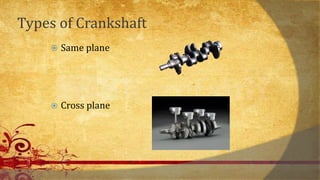
Types of Crankshaft
 Same plane
 Cross plane
Types of Crankshaft
 Single Throw Crankshaft
 Double Throw Crankshaft
 Four Throw Crankshaft
 Six Throw Crankshaft
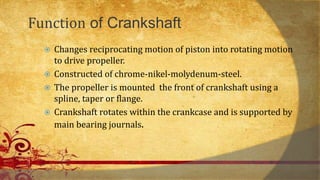
Function of Crankshaft
 Changes reciprocating motion of piston into rotating motion
to drive propeller.
 Constructed of chrome-nikel-molydenum-steel.
 The propeller is mounted the front of crankshaft using a
spline, taper or flange.
 Crankshaft rotates within the crankcase and is supported by
main bearing journals.
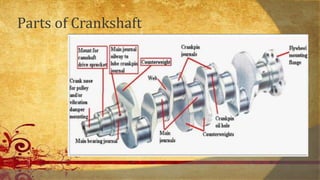
Parts of Crankshaft
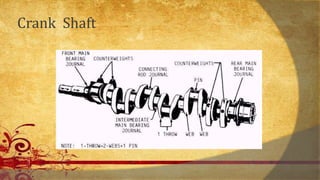
Crank Shaft
Web
The portion of a crank between
the crankpin and the shaft or between
adjacent crankpins —called also crank arm,
crank throw
Counter Weight
 Crankshaft counterweights are designed to offset (or balance)
the inertia effect of a relatively heavy piston and connecting
rod moving in both a rotational and reciprocating (up-and-
down) fashion. The weight of the piston and connecting rod
combination affects the size and placement of the
counterweight.
 If this is not done, the engine will experience vibrations that
will eventually tear up the main bearings and cause damage.
 Crankshaft counter weights are needed to statically and
dynamically balance the crankshaft.
Without them, the vibrations caused will destroy it.
Crank journals
 In a reciprocating engine, the crankpins, also known
as crank journals are the journals of the big
end bearings, at the ends of the connecting rods opposite
to the piston.
 If the engine has a crankshaft, then the crank pins are the
journals of the off-centre bearings of the crankshaft. In a
beam engine, the single crank pin is mounted on the
flywheel
 In a steam locomotive, the crank pins are often mounted
directly on the driving wheels.
Big End Bearings
Main bearings
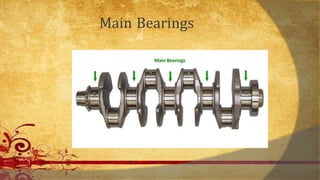
 In a piston engine, the main bearings are the bearing on
which the crankshaft rotates, usually plain or journal
bearings. The bearings hold the crankshaft in place and
prevent the forces created by the piston and transmitted
to the crankshaft by the connecting rods from dislodging
the crankshaft, instead forcing the crank to convert the
reciprocating movement into rotation.
Main Bearings
Conclusion
Crankshaft serves as important part of an engine in
avoiding vibrational motion and it allows smooth
transmission of power from engine to various parts.
Conversion of reciprocatory motion to rotational motion
was made possible using crankshaft.
Reference Links
 https://www.quora.com/What-is-a-crankshaft
 http://www.onallcylinders.com/2015/01/15/cross-plane-
vs-flat-plane-crankshafts/
Components of-crankshaft

Components of-crankshaft

  • 2.
    Group Members  MuhammadTalha Farooq (14-ME-123)  Muhammad Talha Rasheed (14-ME-124)  Muhammad Talha Sherwani (14-ME-125)  Muhammad Tariq Nadeem (14-ME-127)
  • 3.
    What is Crankshaft? It is a shaft which transmits the power developed by the engine to the various parts of the vehicle.  It is a link between the input and output of the vehicle. Without crankshaft your vehicle won't even move an inch though your engine will be running.
  • 4.
    Types of Crankshaft Same plane  Cross plane
  • 5.
    Types of Crankshaft Single Throw Crankshaft  Double Throw Crankshaft  Four Throw Crankshaft  Six Throw Crankshaft
  • 6.
    Function of Crankshaft Changes reciprocating motion of piston into rotating motion to drive propeller.  Constructed of chrome-nikel-molydenum-steel.  The propeller is mounted the front of crankshaft using a spline, taper or flange.  Crankshaft rotates within the crankcase and is supported by main bearing journals.
  • 7.
  • 8.
  • 9.
    Web The portion ofa crank between the crankpin and the shaft or between adjacent crankpins —called also crank arm, crank throw
  • 10.
    Counter Weight  Crankshaftcounterweights are designed to offset (or balance) the inertia effect of a relatively heavy piston and connecting rod moving in both a rotational and reciprocating (up-and- down) fashion. The weight of the piston and connecting rod combination affects the size and placement of the counterweight.  If this is not done, the engine will experience vibrations that will eventually tear up the main bearings and cause damage.  Crankshaft counter weights are needed to statically and dynamically balance the crankshaft. Without them, the vibrations caused will destroy it.
  • 11.
    Crank journals  Ina reciprocating engine, the crankpins, also known as crank journals are the journals of the big end bearings, at the ends of the connecting rods opposite to the piston.  If the engine has a crankshaft, then the crank pins are the journals of the off-centre bearings of the crankshaft. In a beam engine, the single crank pin is mounted on the flywheel  In a steam locomotive, the crank pins are often mounted directly on the driving wheels.
  • 12.
  • 13.
    Main bearings  Ina piston engine, the main bearings are the bearing on which the crankshaft rotates, usually plain or journal bearings. The bearings hold the crankshaft in place and prevent the forces created by the piston and transmitted to the crankshaft by the connecting rods from dislodging the crankshaft, instead forcing the crank to convert the reciprocating movement into rotation.
  • 14.
  • 15.
    Conclusion Crankshaft serves asimportant part of an engine in avoiding vibrational motion and it allows smooth transmission of power from engine to various parts. Conversion of reciprocatory motion to rotational motion was made possible using crankshaft.
  • 16.
    Reference Links  https://www.quora.com/What-is-a-crankshaft http://www.onallcylinders.com/2015/01/15/cross-plane- vs-flat-plane-crankshafts/