CRANKSHAFTS, BALANCE SHAFTS, AND BEARINGS 35
Objectives The student should be able to: Prepare for ASE Engine Repair (A1) certification test content area “C” (Engine Block Diagnosis and Repair). Describe the purpose and function of a crankshaft.  Discuss how to measure crankshafts.
Objectives The student should be able to: Explain how crankshafts are machined and polished.  Discuss the purpose and function of balance shafts.  Discuss engine bearing construction and installation procedures.
CRANKSHAFT
Crankshaft Purpose and Function Power generated in combustion chamber delivered to crankshaft though piston, piston pin, connecting rod
Crankshaft Purpose and Function Connecting rods and bearings attached to bearing journal on crank throw Crank throw offset from crankshaft centerline
Crankshaft Purpose and Function Distance from centerline of connecting rod bearing journal and centerline of crankshaft main bearing journal determines engine stroke
Crankshaft Purpose and Function Engine stroke calculated by multiplying the distance between the centerlines by 2
Crankshaft Purpose and Function Combustion force applied to crank throw after crankshaft has moved past top center Crankshaft rotates on main bearings
Crankshaft Purpose and Function Crankshaft includes these parts Main bearing journals Rod bearing journals
Crankshaft Purpose and Function Crankshaft includes these parts Crankshaft throws Counterweights
Crankshaft Purpose and Function Crankshaft includes these parts Front snout Flywheel flange
Crankshaft Purpose and Function Crankshaft includes these parts Keyways Oil passages
Figure 35-1   Typical crankshaft with main journals that are supported by main bearings in the block. Rod journals are offset from the crankshaft centerline.
Crankshaft Main Bearing Journals Crankshaft rotates in cylinder block supported by main bearings Number of cylinders usually determines number of main bearings
Figure 35-2   The crankshaft rotates on main bearings. Longitudinal (end-to-end) movement is controlled by the thrust bearing.
Crankshaft Main Bearing Journals Four-cylinder and V-8 engines usually have five main bearings Inline 6-cylinder engines usually have seven main bearings
Crankshaft Main Bearing Journals V-6 engines usually have four main bearings Crankshaft must absorb loads applied longitudinally and thrust loads
Crankshaft Main Bearing Journals Thrustloads push and pull crankshaft forward and rearward in engine block Thrustbearing supports these loads
Figure 35-3   A ground surface on one of the crankshaft cheeks next to a main bearing supports thrust loads on the crank.
Crankshaft Main Bearing Journals On most engines, bearing insert for main bearing has thrust bearing flanges that ride against thrust surface
Crankshaft Rod Bearing Journals Rod bearing journals (crankpins) are offset from centerline of crank Insert-type bearings fit between big end of connecting rod and crankpin
Crankshaft Rod Bearing Journals Crankshaft throw distance has direct relationship to engine displacement Engine stroke equals twice the leverage distance or two times length of crankshaft throw
Figure 35-4   The distance from the crankpin centerline to the centerline of the crankshaft determines the stroke, which is the leverage available to turn the crankshaft.
Crankshaft Surface Finish Crankshaft journals are ground to very smooth finish Surface finish is measured in microinches
Crankshaft Surface Finish Typical specification for main and rod crankshaft journals between 10 and 20 roughness average (Ra)
Crankshaft Journal Hardness Crankshaft journals hardened to improve wear resistance Case hardening—only outer portion of surface is hardened
Crankshaft Journal Hardness Nitriding Crankshaft is heated to about 1,000°F (540°C) in furnace with ammonia gas to add nitrogen
Crankshaft Journal Hardness Tuftriding Crankshaft is heated in molten cyanide salt bath
CRANKSHAFT CONSTRUCTION
Crankshaft Construction Forged Crankshafts may be forged or cast Forged crankshafts are stronger but more expensive
Figure 35-5   Wide separation lines of a forged crankshaft.
Crankshaft Construction Forged High-performance forged crankshafts made from SAE 4340 or similar steel Crankshaft is formed from hot steel billet using series of forging dies
Crankshaft Construction Forged Two methods for forging crankshafts Crankshaft is forged in place Crankshaft is forged in single plane
Crankshaft Construction Cast Crankshafts Cast crankshafts used in most production automotive engines May be cast in steel, nodular iron, or malleable iron
Crankshaft Construction Cast Crankshafts Advantages of cast crankshafts: Cost less than forged crankshafts Metal grain structure is uniform and random throughout
Crankshaft Construction Cast Crankshafts Advantages of cast crankshafts: Counterweights on cast crankshafts are slightly larger than on forged crankshafts
Figure 35-6   Cast crankshaft showing the bearing journal overlap and a straight, narrow cast mold parting line. The amount of overlap determines the strength of the crankshaft.
Crankshaft Construction Billet Crankshafts Billet crankshaft is machined from solid piece of forged steel called billet  Billet is usually SAE 4340
Crankshaft Construction Billet Crankshafts Advantages of billet crankshaft: Uniform grain structure  Stiff, strong, very durable Disadvantage:  High cost
Figure 35-7   A billet crankshaft showing how it is machined from a large round roll of steel, usually 4340 steel, at the right and the finished crankshaft on the left.
CRANKSHAFT OILING HOLES
Crankshaft Oiling Holes Purpose and Function Crankshaft is drilled to allow oil from main bearing oil groove to get to the connecting rod bearings
Figure 35-8   Crankshaft sawed in half, showing drilled oil passages between the main and rod bearing journals.
Crankshaft Oiling Holes Purpose and Function Oil on bearings forms hydrodynamic oil film to support bearing loads Some oil may be sprayed from spit or bleed hole in connecting rod
Crankshaft Oiling Holes Purpose and Function Rest of oil leaks from edges of bearing Stress tends to concentrate at oil holes drilled through crankshaft journals Edges of holes are chamfered to relieve stress
Figure 35-9   Typical chamfered hole in a crankshaft bearing journal.
ENGINE CRANKSHAFT TYPES
Engine Crankshaft Types V-8 Engine Arrangement Four inline cylinders in each of two blocks Each group of four inline cylinders is a bank
Engine Crankshaft Types V-8 Engine Arrangement Crankshaft for V-8 has four throws Connecting rods from two cylinders are connected to each throw
Engine Crankshaft Types V-8 Engine Arrangement Arrangement results in only minimal imbalance V-8 engine crankshaft has two planes One throw every 90 degrees
Engine Crankshaft Types V-8 Engine Arrangement Looking at front of crankshaft First throw is at 360 degrees (up) Second throw is at 90 degrees (to the right)
Engine Crankshaft Types V-8 Engine Arrangement Looking at front of crankshaft Third throw is at 270 degrees (to the left) Fourth throw is at 180 degrees (down)
Engine Crankshaft Types V-8 Engine Arrangement One piston reaches top center every 90 degrees of rotation
Engine Crankshaft Types Four-Cylinder Engine Crankshafts Four throws on single plane Usually a main bearing journal between each throw
Engine Crankshaft Types Four-Cylinder Engine Crankshafts Pistons move in pairs Pistons 1 and 4 move together Pistons 2 and 3 move together
Engine Crankshaft Types Four-Cylinder Engine Crankshafts Pistons move in pairs Each piston in a pair is 360 degrees out-of-phase with the other piston in the 720-degree four-stroke cycle
Engine Crankshaft Types Four-Cylinder Engine Crankshafts Pistons move in pairs One cylinder fires at each 180 degrees of crankshaft rotation
Engine Crankshaft Types Five-Cylinder Engine Crankshafts Five-throw crankshaft with one throw each 72 degrees Piston reaches top center at each 144 degrees of rotation
Engine Crankshaft Types Three-Cylinder Engine Crankshafts 120-degree three-throw crankshaft with four main bearings Requires balancing shaft that turns at crankshaft speed but in opposite direction ?
Figure 35-10   A cross-drilled crankshaft is used on some production engines and is a common racing modification.
Engine Crankshaft Types Inline Six-Cylinder Engine Crankshaft Four or seven main bearings Six crank throws in three planes 120 degrees apart Perfect primary and secondary balance
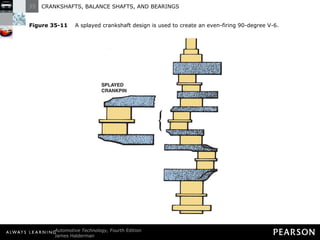
Engine Crankshaft Types 90-Degree V-6 Engine Crankshaft Even-firing V-6 Crankthrows are split making separate crankpins for each cylinder
Figure 35-11   A splayed crankshaft design is used to create an even-firing 90-degree V-6.
Engine Crankshaft Types 90-Degree V-6 Engine Crankshaft Angle between crankpins on crankshaft throws is a splay angle Flange appears between split crankpin journals Flange is sometimes called flying web
Engine Crankshaft Types 60-Degree V-6 Engine Crankshafts Similar to even-firing 90-degree V-6 engine Adjacent pairs of crankpins have splay angle of 60 degrees Four main bearings
COUNTERWEIGHTS
Counterweights Purpose and Function Crankshafts are balanced by counterweights May be cast, forged, or machined as part of crankshaft Crankshaft with counterweights on both sides of each connecting rod journal is fully counterweighted
Figure 35-12   A fully counterweighted 4-cylinder crankshaft.
Counterweights Purpose and Function Fully counterweighted crankshaft is smoothest and most durable design Fully counterweighted crankshaft is heaviest and most expensive
Counterweights Purpose and Function Most manufacturers do not use fully counterweighted crankshafts Lighter crankshaft allows engine to accelerate faster ?
Figure 35-13   The crank throw is halfway down on the power stroke. The piston on the left without an offset crankshaft has a sharper angle than the engine on the right with an offset crankshaft.
Counterweights Vibration Damage Each time combustion occurs, force deflects crankshaft as it transfers torque to output shaft Deflection can bend shaft sideways and twist the shaft in torsion
Counterweights Vibration Damage Crankshaft deflections directly related to operating roughness When back-and-forth deflections occur at same frequency as that of another engine part they will vibrate together
Counterweights Vibration Damage The parts are said to resonate If vibration becomes severe, crankshaft may fail
Figure 35-14   A crankshaft broken as a result of using the wrong torsional vibration damper.
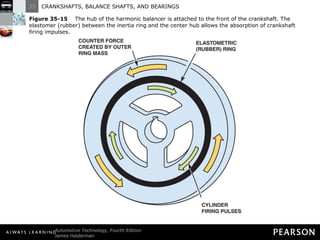
Counterweights Vibration Damage Harmful crankshaft twisting vibrations are dampened with torsional vibration damper (harmonic balancer)
Counterweights Vibration Damage Balancer usually consists of cast-iron inertia ring on cast-iron hub with elastomer sleeve
Counterweights Vibration Damage HINT: Push on rubber (elastomer sleeve) of the vibration damper with your fingers or a pencil. If rubber does not spring back, replace the damper.
Counterweights Vibration Damage Elastomers are synthetic, rubberlike materials Inertia ring size is selected to control amplitude of crankshaft vibrations
Figure 35-15   The hub of the harmonic balancer is attached to the front of the crankshaft. The elastomer (rubber) between the inertia ring and the center hub allows the absorption of crankshaft firing impulses.
EXTERNALLY AND INTERNALLY BALANCED ENGINES
Externally and Internally Balanced Engines Definition Most crankshaft balancing is done during manufacture Holes are drilled in counterweight to lighten and improve balance
Externally and Internally Balanced Engines Definition Some manufacturers control casting to make counterweight balancing unnecessary Engine manufacturers balance engine in two ways
Externally and Internally Balanced Engines Definition Externally balanced: weight is added to harmonic balancer and flywheel Internally balanced: rotating parts are individually balanced
Figure 35-16   A General Motors high-performance balancer used on a race engine.
ENGINE BALANCE
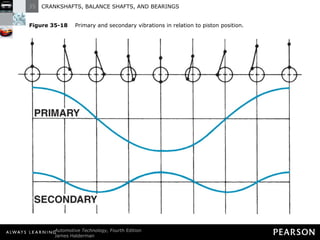
Engine Balance Primary and Secondary Balance Primary balance Pistons moving up and down create primary vibration
Engine Balance Primary and Secondary Balance Primary balance Counterweight on crankshaft opposite piston/rod helps reduce vibration
Figure 35-17   In a 4-cylinder engine, the two outside pistons move upward at the same time as the inner pistons move downward, which reduces primary unbalance.
Engine Balance Primary and Secondary Balance Secondary Balance  Four-cylinder engines have vibration at twice engine speed, called secondary vibration
Figure 35-18   Primary and secondary vibrations in relation to piston position.
BALANCE SHAFTS
Balance Shafts Purpose and Function Some engines use balance shafts to dampen normal engine vibration Dampening reduces vibration to acceptable level
Balance Shafts Purpose and Function Balance shaft on 3-cylinder inline turns at crankshaft speed but in opposite direction
Balance Shafts Purpose and Function Two balance shafts used on 4-stroke, 4-cylinder engines Both shafts turn at twice engine speed and in same direction
Figure 35-19   Two counterrotating balance shafts used to counterbalance the vibrations of a 4-cylinder engine
Balance Shafts Balance Shaft Applications Balance shafts commonly found on larger displacement 4-cylinder engines Most 4-cylinder engines larger than 2.2 liters use balance shafts
Figure 35-20   This General Motors 4-cylinder engine uses two balance shafts driven by a chain at the rear of the crankshaft.
Balance Shafts Balance Shaft Applications Since late 1980s, Ford and General Motors have added a balance shaft to V-6 engines These engines suffer from rocking couple motion
Figure 35-21   Many 90-degree V-6 engines use a balance shaft to reduce vibrations and effectively cancel a rocking motion (rocking couple) that causes the engine to rock front to back.
CRANKSHAFT SERVICE
Crankshaft Service Crankshaft Visual Inspection Crankshaft damage Worn journals Scored bearing journals
Crankshaft Service Crankshaft Visual Inspection Crankshaft damage Bends or warpage Cracks
Crankshaft Service Crankshaft Visual Inspection Crankshaft damage Thread damage (flywheel flange or front snout) Worn front or rear seal surfaces
Crankshaft Service Crankshaft Visual Inspection Crankshaft is one of most highly stressed engine parts Stress increases four times when engine speed doubles
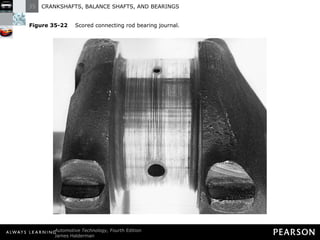
Crankshaft Service Crankshaft Visual Inspection Check for cracks through visual inspection Check with Magnaflux Bearing scoring common crankshaft defect
Figure 35-22   Scored connecting rod bearing journal.
Crankshaft Service Crankshaft Visual Inspection Check crankshaft journals for nicks, pits, corrosion
Crankshaft Service Crankshaft Visual Inspection HINT: If your fingernail catches on groove when rubbed across bearing journal, the journal is too rough to reuse and must be reground. Another test is to rub a copper penny across journal. If copper remains on crankshaft, it must be reground.
Crankshaft Service Measuring the Crankshaft Compare size of main and rod bearing journals to factory specifications Each journal checked for out-of-round condition Each journal checked for taper
Figure 35-23   All crankshaft journals should be measured for diameter as well as taper and out-of-round.
Figure 35-24   Check each journal for taper and out-of-round.
Crankshaft Service Crankshaft Grinding Typical Regrinding Procedure STEP 1: Crankshafts may require straightening before grinding
Crankshaft Service Crankshaft Grinding Typical Regrinding Procedure STEP 2: Place crankshaft ends in rotating heads on one style of crankshaft grinder
Crankshaft Service Crankshaft Grinding Typical Regrinding Procedure STEP 3: Main bearing journals are ground on centerline of crankshaft
Crankshaft Service Crankshaft Grinding Typical Regrinding Procedure STEP 4: Crankshaft is offset in two rotating heads enough so main bearing journal centerline rotates around centerline of crankpin Journal on crankpin is reground in this position
Crankshaft Service Crankshaft Grinding Typical Regrinding Procedure STEP 5: Reposition crankshaft for each crankpin center Another type of grinder always turns crankshaft on main bearing centerline
Crankshaft Service Crankshaft Grinding Grinder is programmed to move in and out as crankshaft turns Crankshafts are usually ground to these undersize measurements 0.010 in., 0.020 in., 0.030 in.
Crankshaft Service Crankshaft Grinding Finished journal should be ground to smooth surface finish Radius of fillet area on sides of journal should match original
Figure 35-25   The rounded fillet area of the crankshaft is formed by the corners of the grinding stone.
Crankshaft Service Crankshaft Polishing Polish journal after grinding with 320-grit polishing cloth and oil
Figure 35-26   An excessively worn crankshaft can be restored to useful service by welding the journals, and then machining them back to the original size.
Crankshaft Service Welding a Crankshaft Salvage a crankshaft by building up bearing journal and then grinding to original journal size Build up using either electric arc welder or metal spray
Figure 35-27   All crankshafts should be polished after grinding. Both the crankshaft and the polishing cloth are being revolved.
Crankshaft Service Stress Relieving the Crankshaft Greatest area of stress on crankshaft is fillet area Stress relief achieved by shot peening fillet area with #320 steel shot Stress relief strengthens fillet area and helps prevent cracks
Crankshaft Service Storing Crankshafts Coat with oil to prevent rusting Store vertically until engine assembly
ENGINE BEARINGS
Engine Bearings Introduction Clearance between bearings and crankshaft are critical to maintaining oil pressure Engine durability relies on bearing life
Engine Bearings Introduction Bearing failure usually results in immediate engine failure Engine bearings support operating loads of engine with minimum friction at all engine speeds
Engine Bearings Types of Bearings Plain bearing Sleeve bearing
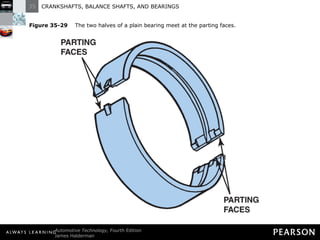
Figure 35-29   The two halves of a plain bearing meet at the parting faces.
Engine Bearings Types of Bearings Most bearing halves, or shells, do not have uniform thickness Bearing thickness is largest in center (the bearing crown)
Figure 35-30   Bearing wall thickness is not the same from the center to the parting line. This is called eccentricity and is used to help create an oil wedge between the journal and the bearing.
Engine Bearings Types of Bearings Tapered wall keeps bearing clearances close at top and bottom of bearing Lubricating system supplies oil to each bearing continuously
Engine Bearings Types of Bearings Oil enters bearing through oil holes and grooves Oil spreads in smooth wedge-shaped oil film that supports bearing load
Engine Bearings Bearing Materials Babbitt Copper-lead alloy Aluminum
Engine Bearings Bearing Materials Layer of bearing materials 0.01 to 0.02 in. (0.25 to 0.5 mm) thick is applied over low carbon steel backing
Engine Bearings Bearing Materials Engine bearing is called bearing shell Steep provide support for shaft load
Engine Bearings Bearing Materials Babbitt Oldest automotive bearing material Originally made of lead, tin, antimony
Engine Bearings Bearing Materials Babbitt Still used with soft shafts running at moderate loads and speeds Holds up under occasional borderline lubrication and oil starvation
Engine Bearings Bearing Materials Trimetal Copper-lead alloy More expensive than Babbitt
Engine Bearings Bearing Materials Trimetal Used for intermediate and high-speed applications Most easily damaged by corrosion
Engine Bearings Bearing Materials Trimetal Many copper-lead bearings use overlay of third metal, often babbit Overlay put on bearing through electroplating
Figure 35-31   Typical two- and three-layer engine bearing inserts showing the relative thickness of the various materials.
Engine Bearings Bearing Materials Aluminum Aluminum bearings have small amounts of tin and silicone  Most of its bearing characteristics are equal to or better than babbit and copper-lead alloy
Engine Bearings Bearing Materials Aluminum Well-suited to high-speed, high-load conditions Does not contain lead
Engine Bearings Bearing Manufacturing Modern bearings use precision insert-type bearing shells (half-shell bearings) Bearing manufactured to very close tolerances
Figure 35-32   Typical bearing shell types found in modern engines: (a) half-shell thrust bearing, (b) upper main bearing insert, (c) lower main bearing insert, (d) full round-type camshaft bearing.
Engine Bearings Bearing Sizes Usually available in standard size Usually available in measurements of 0.010, 0.020, and 0.030 in. undersize
Figure 35-33   Bearings are often marked with an undersize dimension. This bearing is used on a crankshaft with a ground journal that is 0.020 in. smaller in diameter than the stock size.
Engine Bearings Bearing Sizes Bearing is referred to as undersize because crankshaft journals are undersize
Engine Bearings Bearing Sizes Factory bearings may be available in 0.0005 or 0.001 in. undersize for precision fitting of production crankshaft
Engine Bearings Bearing Sizes Before purchasing bearings, use micrometer to measure all main and connecting rod journals
Engine Bearings Bearing Sizes Replacement bearings are also available in 0.001, 0.002, and 0.003 in. to allow proper bearing clearance
Engine Bearings Bearing Loads Forces on bearings vary with engine speed and load As engine speed (RPM) increases, rod bearing loads decrease
Engine Bearings Bearing Loads As engine speed (RPM) increases, main bearing loads increase NOTE: This explains why Crankshaft with four-bolt main bearing supports are only needed for high-engine speed stability
Engine Bearings Bearing Loads Loads on bearings vary and affect both rod and main bearings Replace all engine bearings at one time
Engine Bearings Bearing Fatigue Bearings can flex or bend under changing loads Bearing metals tend to fatigue and break after repeated flexing and bending
Engine Bearings Bearing Fatigue Cracks appear because bearing material is work hardened Time before fatigue causes failure is fatigue life
Figure 35-34   Work hardened bearing material becomes brittle and cracks, leading to bearing failure.
Engine Bearings Bearing Conformability Ability of bearing materials to creep or flow to match shaft variations is conformability
Engine Bearings Bearing Conformability Bearing conforms to shaft during break-in Little need with modern engines for conformability
Engine Bearings Bearing Embedability Some contaminants get into bearings Bearings must embed the particles into bearing surface so they don’t score shaft
Engine Bearings Bearing Embedability Bearing material works across particle, covering it
Figure 35-35   Bearing material covers foreign material (such as dirt) as it embeds into the bearing.
Engine Bearings Bearing Damage Resistance Under some operating conditions, bearing will be temporarily overloaded Shaft metal will come in contact with bearing metal
Engine Bearings Bearing Damage Resistance Spots become hot from friction Particles from bearing can break off and attach to crankshaft
Engine Bearings Bearing Damage Resistance The particles then scratch or score the bearing Bearings have score resistance that helps protect them from seizing during oil film breakdown
Engine Bearings Bearing Damage Resistance By-products of combustion form acids Ability of bearings to resist acid is corrosion resistance
Engine Bearings Bearing Damage Resistance Corrosion can attack entire surface of bearing or leach or eat into bearing material Either type of corrosion will reduce bearing life
BEARING CLEARANCE
Bearing Clearance Importance of Proper Clearance Bearing-to-journal clearance may be from 0.0005 to 0.0025 in. (0.025 to 0.06 mm)
Bearing Clearance Importance of Proper Clearance Doubling journal clearance allows four times more oil to flow around bearing
Bearing Clearance Importance of Proper Clearance Oil clearance must be large enough to allow oil film to build up Too much clearance allows excess leakage and loss of oil pressure
Bearing Clearance Checking Bearing Clearance Use Plastigage® between crankshaft  journal and bearing Measure crankshaft journal diameter and inside diameter of bearing Subtract the two and the difference is bearing clearance
Figure 35-36   Bearing spread and crush.
Bearing Clearance Bearing Spread and Crush Bearing spread: bearing shell has larger arc than bearing housing The difference (bearing spread) makes shell 0.005 to 0.02in. (0.124 to 0.5 mm) wider than housing bore
Bearing Clearance Bearing Spread and Crush Spread holds bearing shell in housing when engine is assembled Bearing crush: when bearing cap is tightened the bearing shells are forced together
Bearing Clearance Bearing Spread and Crush Crush must exert force of at least 12,000 PSI (82,740 kPa) at 250°F (121°C) to hold bearing in place
Bearing Clearance Bearing Spread and Crush Stress of 40,000 PSI (275,790 kPa) is maximum to avoid damaging bearing or housing
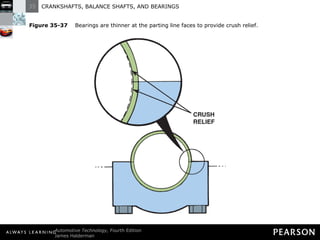
Figure 35-37   Bearings are thinner at the parting line faces to provide crush relief.
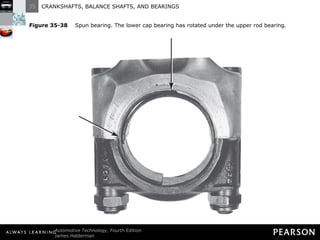
Bearing Clearance Bearing Spread and Crush Bearing shells without sufficient crush may rotate with shaft Condition is called spun bearing
Figure 35-38   Spun bearing. The lower cap bearing has rotated under the upper rod bearing.
Bearing Clearance Bearing Spread and Crush Bearing tang is a lip that locates bearing shell in housing When bearing clearance and crush have been worn or destroyed, bearing can spin
Bearing Clearance Bearing Spread and Crush Bearing spin can lead to failure Tang helps prevent failure
Figure 35-39   The tang and slot help index the bearing in the bore.
Bearing Clearance Bearing Spread and Crush Many newer engines do not use tang Replacement bearings should be as good as or better than originals Replacement bearings should also have same oil holes and grooves
Bearing Clearance Bearing Spread and Crush CAUTION: Some bearings may have oil holes in the top shell only. If these are installed incorrectly no oil will flow to connecting or main rods, resulting in instant engine failure. To help oil spread across entire bearing, some bearings use an oil groove.
Figure 35-40   Many bearings are manufactured with a groove down the middle to improve the oil flow around the main journal.
CAMSHAFT BEARINGS
Camshaft Bearings Types of Camshaft Bearings Camshafts in pushrod engine rotate in sleeve bearings Overhead camshaft bearings may be one of two sleeve-type bushings
Camshaft Bearings Types of Camshaft Bearings Full round bearings Split-type (half-shell) bearings
Camshaft Bearings Types of Camshaft Bearings Split-type bearings have direct contact with aluminum saddles integral with head
Camshaft Bearings Types of Camshaft Bearings Integral aluminum head bearing design often requires replacement of cylinder head in event of bearing failure In pushrod engines, cam bearings are installed in block
Figure 35-41   Cam-in-block engines support the camshaft with sleeve-type bearings.
Camshaft Bearings Camshaft Bearing Installation Replace cam bearings whenever main bearings are replaced Replacement cam bearings must have outside diameter to fit snugly in cam bearing bores on block
Camshaft Bearings Camshaft Bearing Installation Replacement bearings must have correct oil holes and be positioned correctly
Figure 35-42   Camshaft bearings must be installed correctly so that oil passages are not blocked.
Camshaft Bearings Camshaft Bearing Installation In many engines, each cam bearing is different size Largest bearing is in front, smallest in rear
Camshaft Bearings Camshaft Bearing Installation Cam bearing journal must be checked and each bearing identified before assembly
Camshaft Bearings Camshaft Bearing Installation Location of each new cam bearing should be marked on outside of bearing before assembly
Camshaft Bearings Camshaft Bearing Installation Install cam bearings dry (not oiled) to prevent cam bearings from moving after installation
Camshaft Bearings Camshaft Bearing Installation Many aluminum cylinder heads have integral cam bearings If lubrication problem occurs to bearings, cylinder head may need to be replaced
Camshaft Bearings Camshaft Bearing Installation Camshaft bearings on overhead camshaft engines may be full, round, or split
Figure 35-43   Some overhead camshaft engines use split bearing inserts.
FREQUENTLY ASKED QUESTION What Does a “Cross-Drilled Crankshaft” Mean? A cross-drilled crankshaft means that there are two instead of only one oil hole leading from the main bearing journal to the rod bearing journal. Oil is supplied to the main bearing journals through oil galleries in the block. ? BACK TO  PRESENTATION A cross-drilled crankshaft has two outlet holes for oil to reach the drilled passage that supplies oil to the rod journal. Figure 35-10   A cross-drilled crankshaft is used on some production engines and is a common racing modification.
REAL WORLD FIX The Mysterious Engine Vibration A Buick 3.8 liter V-6 engine vibrated the whole car after a new short block had been installed. The technician who had installed the replacement engine did all of the following: BACK TO  PRESENTATION Checked the spark plugs Checked the spark plug wires Disconnected the torque converter from the flex plate (drive plate) to eliminate the possibility of a torque converter or automatic transmission pump problem Removed all accessory drive belts one at a time. Yet the vibration still existed. Another technician checked the engine mounts and found that the left (driver’s side) engine mount was out of location, ripped, and cocked. The transmission mount was also defective. After the technician replaced both mounts and made certain that all mounts were properly set, the vibration was eliminated. The design and location of the engine mounts are critical to the elimination of vibration, especially on 90-degree V-6 engines.
FREQUENTLY ASKED QUESTION What Is an Offset Crankshaft? To reduce side loads, some vehicle manufacturers offset the crankshaft from center. For example, if an engine rotates clockwise as viewed from the front, the crankshaft may be offset to the left to reduce the angle of the connecting rod during the power stroke.  ? BACK TO  PRESENTATION The offset usually varies from 1/16 to 1/2 in., depending on make and model. Many inline 4-cylinder engines used in hybrid electric vehicles use an offset crankshaft. Figure 35-13   The crank throw is halfway down on the power stroke. The piston on the left without an offset crankshaft has a sharper angle than the engine on the right with an offset crankshaft.
TECH TIP High Engine Speeds Require High-Performance Parts Do not go racing with stock parts. A stock harmonic balancer can come apart and the resulting vibration can break the crankshaft if the engine is used for racing. Check the Internet or race part suppliers for the recommended balancer to use. BACK TO  PRESENTATION Figure 35-16   A General Motors high-performance balancer used on a race engine.
TECH TIP Count Your Blessings and Your Pan Bolts! Replacing cam bearings can be relatively straightforward or can involve keeping count of the number of oil pan bolts. For example, Buick-built V-6 engines use different cam bearings depending on the number of bolts used to hold the oil pan to the block. BACK TO  PRESENTATION Fourteen bolts in the oil pan. The front bearing is special, but the rest of the bearings are the same. Twenty bolts in the oil pan. Bearings 1 and 4 use two oil feed holes. Bearings 2 and 3 use single oil feed holes.

Halderman ch035 lecture

  • 1.
  • 2.
    Objectives The studentshould be able to: Prepare for ASE Engine Repair (A1) certification test content area “C” (Engine Block Diagnosis and Repair). Describe the purpose and function of a crankshaft. Discuss how to measure crankshafts.
  • 3.
    Objectives The studentshould be able to: Explain how crankshafts are machined and polished. Discuss the purpose and function of balance shafts. Discuss engine bearing construction and installation procedures.
  • 4.
  • 5.
    Crankshaft Purpose andFunction Power generated in combustion chamber delivered to crankshaft though piston, piston pin, connecting rod
  • 6.
    Crankshaft Purpose andFunction Connecting rods and bearings attached to bearing journal on crank throw Crank throw offset from crankshaft centerline
  • 7.
    Crankshaft Purpose andFunction Distance from centerline of connecting rod bearing journal and centerline of crankshaft main bearing journal determines engine stroke
  • 8.
    Crankshaft Purpose andFunction Engine stroke calculated by multiplying the distance between the centerlines by 2
  • 9.
    Crankshaft Purpose andFunction Combustion force applied to crank throw after crankshaft has moved past top center Crankshaft rotates on main bearings
  • 10.
    Crankshaft Purpose andFunction Crankshaft includes these parts Main bearing journals Rod bearing journals
  • 11.
    Crankshaft Purpose andFunction Crankshaft includes these parts Crankshaft throws Counterweights
  • 12.
    Crankshaft Purpose andFunction Crankshaft includes these parts Front snout Flywheel flange
  • 13.
    Crankshaft Purpose andFunction Crankshaft includes these parts Keyways Oil passages
  • 14.
    Figure 35-1 Typical crankshaft with main journals that are supported by main bearings in the block. Rod journals are offset from the crankshaft centerline.
  • 15.
    Crankshaft Main BearingJournals Crankshaft rotates in cylinder block supported by main bearings Number of cylinders usually determines number of main bearings
  • 16.
    Figure 35-2 The crankshaft rotates on main bearings. Longitudinal (end-to-end) movement is controlled by the thrust bearing.
  • 17.
    Crankshaft Main BearingJournals Four-cylinder and V-8 engines usually have five main bearings Inline 6-cylinder engines usually have seven main bearings
  • 18.
    Crankshaft Main BearingJournals V-6 engines usually have four main bearings Crankshaft must absorb loads applied longitudinally and thrust loads
  • 19.
    Crankshaft Main BearingJournals Thrustloads push and pull crankshaft forward and rearward in engine block Thrustbearing supports these loads
  • 20.
    Figure 35-3 A ground surface on one of the crankshaft cheeks next to a main bearing supports thrust loads on the crank.
  • 21.
    Crankshaft Main BearingJournals On most engines, bearing insert for main bearing has thrust bearing flanges that ride against thrust surface
  • 22.
    Crankshaft Rod BearingJournals Rod bearing journals (crankpins) are offset from centerline of crank Insert-type bearings fit between big end of connecting rod and crankpin
  • 23.
    Crankshaft Rod BearingJournals Crankshaft throw distance has direct relationship to engine displacement Engine stroke equals twice the leverage distance or two times length of crankshaft throw
  • 24.
    Figure 35-4 The distance from the crankpin centerline to the centerline of the crankshaft determines the stroke, which is the leverage available to turn the crankshaft.
  • 25.
    Crankshaft Surface FinishCrankshaft journals are ground to very smooth finish Surface finish is measured in microinches
  • 26.
    Crankshaft Surface FinishTypical specification for main and rod crankshaft journals between 10 and 20 roughness average (Ra)
  • 27.
    Crankshaft Journal HardnessCrankshaft journals hardened to improve wear resistance Case hardening—only outer portion of surface is hardened
  • 28.
    Crankshaft Journal HardnessNitriding Crankshaft is heated to about 1,000°F (540°C) in furnace with ammonia gas to add nitrogen
  • 29.
    Crankshaft Journal HardnessTuftriding Crankshaft is heated in molten cyanide salt bath
  • 30.
  • 31.
    Crankshaft Construction ForgedCrankshafts may be forged or cast Forged crankshafts are stronger but more expensive
  • 32.
    Figure 35-5 Wide separation lines of a forged crankshaft.
  • 33.
    Crankshaft Construction ForgedHigh-performance forged crankshafts made from SAE 4340 or similar steel Crankshaft is formed from hot steel billet using series of forging dies
  • 34.
    Crankshaft Construction ForgedTwo methods for forging crankshafts Crankshaft is forged in place Crankshaft is forged in single plane
  • 35.
    Crankshaft Construction CastCrankshafts Cast crankshafts used in most production automotive engines May be cast in steel, nodular iron, or malleable iron
  • 36.
    Crankshaft Construction CastCrankshafts Advantages of cast crankshafts: Cost less than forged crankshafts Metal grain structure is uniform and random throughout
  • 37.
    Crankshaft Construction CastCrankshafts Advantages of cast crankshafts: Counterweights on cast crankshafts are slightly larger than on forged crankshafts
  • 38.
    Figure 35-6 Cast crankshaft showing the bearing journal overlap and a straight, narrow cast mold parting line. The amount of overlap determines the strength of the crankshaft.
  • 39.
    Crankshaft Construction BilletCrankshafts Billet crankshaft is machined from solid piece of forged steel called billet Billet is usually SAE 4340
  • 40.
    Crankshaft Construction BilletCrankshafts Advantages of billet crankshaft: Uniform grain structure Stiff, strong, very durable Disadvantage: High cost
  • 41.
    Figure 35-7 A billet crankshaft showing how it is machined from a large round roll of steel, usually 4340 steel, at the right and the finished crankshaft on the left.
  • 42.
  • 43.
    Crankshaft Oiling HolesPurpose and Function Crankshaft is drilled to allow oil from main bearing oil groove to get to the connecting rod bearings
  • 44.
    Figure 35-8 Crankshaft sawed in half, showing drilled oil passages between the main and rod bearing journals.
  • 45.
    Crankshaft Oiling HolesPurpose and Function Oil on bearings forms hydrodynamic oil film to support bearing loads Some oil may be sprayed from spit or bleed hole in connecting rod
  • 46.
    Crankshaft Oiling HolesPurpose and Function Rest of oil leaks from edges of bearing Stress tends to concentrate at oil holes drilled through crankshaft journals Edges of holes are chamfered to relieve stress
  • 47.
    Figure 35-9 Typical chamfered hole in a crankshaft bearing journal.
  • 48.
  • 49.
    Engine Crankshaft TypesV-8 Engine Arrangement Four inline cylinders in each of two blocks Each group of four inline cylinders is a bank
  • 50.
    Engine Crankshaft TypesV-8 Engine Arrangement Crankshaft for V-8 has four throws Connecting rods from two cylinders are connected to each throw
  • 51.
    Engine Crankshaft TypesV-8 Engine Arrangement Arrangement results in only minimal imbalance V-8 engine crankshaft has two planes One throw every 90 degrees
  • 52.
    Engine Crankshaft TypesV-8 Engine Arrangement Looking at front of crankshaft First throw is at 360 degrees (up) Second throw is at 90 degrees (to the right)
  • 53.
    Engine Crankshaft TypesV-8 Engine Arrangement Looking at front of crankshaft Third throw is at 270 degrees (to the left) Fourth throw is at 180 degrees (down)
  • 54.
    Engine Crankshaft TypesV-8 Engine Arrangement One piston reaches top center every 90 degrees of rotation
  • 55.
    Engine Crankshaft TypesFour-Cylinder Engine Crankshafts Four throws on single plane Usually a main bearing journal between each throw
  • 56.
    Engine Crankshaft TypesFour-Cylinder Engine Crankshafts Pistons move in pairs Pistons 1 and 4 move together Pistons 2 and 3 move together
  • 57.
    Engine Crankshaft TypesFour-Cylinder Engine Crankshafts Pistons move in pairs Each piston in a pair is 360 degrees out-of-phase with the other piston in the 720-degree four-stroke cycle
  • 58.
    Engine Crankshaft TypesFour-Cylinder Engine Crankshafts Pistons move in pairs One cylinder fires at each 180 degrees of crankshaft rotation
  • 59.
    Engine Crankshaft TypesFive-Cylinder Engine Crankshafts Five-throw crankshaft with one throw each 72 degrees Piston reaches top center at each 144 degrees of rotation
  • 60.
    Engine Crankshaft TypesThree-Cylinder Engine Crankshafts 120-degree three-throw crankshaft with four main bearings Requires balancing shaft that turns at crankshaft speed but in opposite direction ?
  • 61.
    Figure 35-10 A cross-drilled crankshaft is used on some production engines and is a common racing modification.
  • 62.
    Engine Crankshaft TypesInline Six-Cylinder Engine Crankshaft Four or seven main bearings Six crank throws in three planes 120 degrees apart Perfect primary and secondary balance
  • 63.
    Engine Crankshaft Types90-Degree V-6 Engine Crankshaft Even-firing V-6 Crankthrows are split making separate crankpins for each cylinder
  • 64.
    Figure 35-11 A splayed crankshaft design is used to create an even-firing 90-degree V-6.
  • 65.
    Engine Crankshaft Types90-Degree V-6 Engine Crankshaft Angle between crankpins on crankshaft throws is a splay angle Flange appears between split crankpin journals Flange is sometimes called flying web
  • 66.
    Engine Crankshaft Types60-Degree V-6 Engine Crankshafts Similar to even-firing 90-degree V-6 engine Adjacent pairs of crankpins have splay angle of 60 degrees Four main bearings
  • 67.
  • 68.
    Counterweights Purpose andFunction Crankshafts are balanced by counterweights May be cast, forged, or machined as part of crankshaft Crankshaft with counterweights on both sides of each connecting rod journal is fully counterweighted
  • 69.
    Figure 35-12 A fully counterweighted 4-cylinder crankshaft.
  • 70.
    Counterweights Purpose andFunction Fully counterweighted crankshaft is smoothest and most durable design Fully counterweighted crankshaft is heaviest and most expensive
  • 71.
    Counterweights Purpose andFunction Most manufacturers do not use fully counterweighted crankshafts Lighter crankshaft allows engine to accelerate faster ?
  • 72.
    Figure 35-13 The crank throw is halfway down on the power stroke. The piston on the left without an offset crankshaft has a sharper angle than the engine on the right with an offset crankshaft.
  • 73.
    Counterweights Vibration DamageEach time combustion occurs, force deflects crankshaft as it transfers torque to output shaft Deflection can bend shaft sideways and twist the shaft in torsion
  • 74.
    Counterweights Vibration DamageCrankshaft deflections directly related to operating roughness When back-and-forth deflections occur at same frequency as that of another engine part they will vibrate together
  • 75.
    Counterweights Vibration DamageThe parts are said to resonate If vibration becomes severe, crankshaft may fail
  • 76.
    Figure 35-14 A crankshaft broken as a result of using the wrong torsional vibration damper.
  • 77.
    Counterweights Vibration DamageHarmful crankshaft twisting vibrations are dampened with torsional vibration damper (harmonic balancer)
  • 78.
    Counterweights Vibration DamageBalancer usually consists of cast-iron inertia ring on cast-iron hub with elastomer sleeve
  • 79.
    Counterweights Vibration DamageHINT: Push on rubber (elastomer sleeve) of the vibration damper with your fingers or a pencil. If rubber does not spring back, replace the damper.
  • 80.
    Counterweights Vibration DamageElastomers are synthetic, rubberlike materials Inertia ring size is selected to control amplitude of crankshaft vibrations
  • 81.
    Figure 35-15 The hub of the harmonic balancer is attached to the front of the crankshaft. The elastomer (rubber) between the inertia ring and the center hub allows the absorption of crankshaft firing impulses.
  • 82.
    EXTERNALLY AND INTERNALLYBALANCED ENGINES
  • 83.
    Externally and InternallyBalanced Engines Definition Most crankshaft balancing is done during manufacture Holes are drilled in counterweight to lighten and improve balance
  • 84.
    Externally and InternallyBalanced Engines Definition Some manufacturers control casting to make counterweight balancing unnecessary Engine manufacturers balance engine in two ways
  • 85.
    Externally and InternallyBalanced Engines Definition Externally balanced: weight is added to harmonic balancer and flywheel Internally balanced: rotating parts are individually balanced
  • 86.
    Figure 35-16 A General Motors high-performance balancer used on a race engine.
  • 87.
  • 88.
    Engine Balance Primaryand Secondary Balance Primary balance Pistons moving up and down create primary vibration
  • 89.
    Engine Balance Primaryand Secondary Balance Primary balance Counterweight on crankshaft opposite piston/rod helps reduce vibration
  • 90.
    Figure 35-17 In a 4-cylinder engine, the two outside pistons move upward at the same time as the inner pistons move downward, which reduces primary unbalance.
  • 91.
    Engine Balance Primaryand Secondary Balance Secondary Balance Four-cylinder engines have vibration at twice engine speed, called secondary vibration
  • 92.
    Figure 35-18 Primary and secondary vibrations in relation to piston position.
  • 93.
  • 94.
    Balance Shafts Purposeand Function Some engines use balance shafts to dampen normal engine vibration Dampening reduces vibration to acceptable level
  • 95.
    Balance Shafts Purposeand Function Balance shaft on 3-cylinder inline turns at crankshaft speed but in opposite direction
  • 96.
    Balance Shafts Purposeand Function Two balance shafts used on 4-stroke, 4-cylinder engines Both shafts turn at twice engine speed and in same direction
  • 97.
    Figure 35-19 Two counterrotating balance shafts used to counterbalance the vibrations of a 4-cylinder engine
  • 98.
    Balance Shafts BalanceShaft Applications Balance shafts commonly found on larger displacement 4-cylinder engines Most 4-cylinder engines larger than 2.2 liters use balance shafts
  • 99.
    Figure 35-20 This General Motors 4-cylinder engine uses two balance shafts driven by a chain at the rear of the crankshaft.
  • 100.
    Balance Shafts BalanceShaft Applications Since late 1980s, Ford and General Motors have added a balance shaft to V-6 engines These engines suffer from rocking couple motion
  • 101.
    Figure 35-21 Many 90-degree V-6 engines use a balance shaft to reduce vibrations and effectively cancel a rocking motion (rocking couple) that causes the engine to rock front to back.
  • 102.
  • 103.
    Crankshaft Service CrankshaftVisual Inspection Crankshaft damage Worn journals Scored bearing journals
  • 104.
    Crankshaft Service CrankshaftVisual Inspection Crankshaft damage Bends or warpage Cracks
  • 105.
    Crankshaft Service CrankshaftVisual Inspection Crankshaft damage Thread damage (flywheel flange or front snout) Worn front or rear seal surfaces
  • 106.
    Crankshaft Service CrankshaftVisual Inspection Crankshaft is one of most highly stressed engine parts Stress increases four times when engine speed doubles
  • 107.
    Crankshaft Service CrankshaftVisual Inspection Check for cracks through visual inspection Check with Magnaflux Bearing scoring common crankshaft defect
  • 108.
    Figure 35-22 Scored connecting rod bearing journal.
  • 109.
    Crankshaft Service CrankshaftVisual Inspection Check crankshaft journals for nicks, pits, corrosion
  • 110.
    Crankshaft Service CrankshaftVisual Inspection HINT: If your fingernail catches on groove when rubbed across bearing journal, the journal is too rough to reuse and must be reground. Another test is to rub a copper penny across journal. If copper remains on crankshaft, it must be reground.
  • 111.
    Crankshaft Service Measuringthe Crankshaft Compare size of main and rod bearing journals to factory specifications Each journal checked for out-of-round condition Each journal checked for taper
  • 112.
    Figure 35-23 All crankshaft journals should be measured for diameter as well as taper and out-of-round.
  • 113.
    Figure 35-24 Check each journal for taper and out-of-round.
  • 114.
    Crankshaft Service CrankshaftGrinding Typical Regrinding Procedure STEP 1: Crankshafts may require straightening before grinding
  • 115.
    Crankshaft Service CrankshaftGrinding Typical Regrinding Procedure STEP 2: Place crankshaft ends in rotating heads on one style of crankshaft grinder
  • 116.
    Crankshaft Service CrankshaftGrinding Typical Regrinding Procedure STEP 3: Main bearing journals are ground on centerline of crankshaft
  • 117.
    Crankshaft Service CrankshaftGrinding Typical Regrinding Procedure STEP 4: Crankshaft is offset in two rotating heads enough so main bearing journal centerline rotates around centerline of crankpin Journal on crankpin is reground in this position
  • 118.
    Crankshaft Service CrankshaftGrinding Typical Regrinding Procedure STEP 5: Reposition crankshaft for each crankpin center Another type of grinder always turns crankshaft on main bearing centerline
  • 119.
    Crankshaft Service CrankshaftGrinding Grinder is programmed to move in and out as crankshaft turns Crankshafts are usually ground to these undersize measurements 0.010 in., 0.020 in., 0.030 in.
  • 120.
    Crankshaft Service CrankshaftGrinding Finished journal should be ground to smooth surface finish Radius of fillet area on sides of journal should match original
  • 121.
    Figure 35-25 The rounded fillet area of the crankshaft is formed by the corners of the grinding stone.
  • 122.
    Crankshaft Service CrankshaftPolishing Polish journal after grinding with 320-grit polishing cloth and oil
  • 123.
    Figure 35-26 An excessively worn crankshaft can be restored to useful service by welding the journals, and then machining them back to the original size.
  • 124.
    Crankshaft Service Weldinga Crankshaft Salvage a crankshaft by building up bearing journal and then grinding to original journal size Build up using either electric arc welder or metal spray
  • 125.
    Figure 35-27 All crankshafts should be polished after grinding. Both the crankshaft and the polishing cloth are being revolved.
  • 126.
    Crankshaft Service StressRelieving the Crankshaft Greatest area of stress on crankshaft is fillet area Stress relief achieved by shot peening fillet area with #320 steel shot Stress relief strengthens fillet area and helps prevent cracks
  • 127.
    Crankshaft Service StoringCrankshafts Coat with oil to prevent rusting Store vertically until engine assembly
  • 128.
  • 129.
    Engine Bearings IntroductionClearance between bearings and crankshaft are critical to maintaining oil pressure Engine durability relies on bearing life
  • 130.
    Engine Bearings IntroductionBearing failure usually results in immediate engine failure Engine bearings support operating loads of engine with minimum friction at all engine speeds
  • 131.
    Engine Bearings Typesof Bearings Plain bearing Sleeve bearing
  • 132.
    Figure 35-29 The two halves of a plain bearing meet at the parting faces.
  • 133.
    Engine Bearings Typesof Bearings Most bearing halves, or shells, do not have uniform thickness Bearing thickness is largest in center (the bearing crown)
  • 134.
    Figure 35-30 Bearing wall thickness is not the same from the center to the parting line. This is called eccentricity and is used to help create an oil wedge between the journal and the bearing.
  • 135.
    Engine Bearings Typesof Bearings Tapered wall keeps bearing clearances close at top and bottom of bearing Lubricating system supplies oil to each bearing continuously
  • 136.
    Engine Bearings Typesof Bearings Oil enters bearing through oil holes and grooves Oil spreads in smooth wedge-shaped oil film that supports bearing load
  • 137.
    Engine Bearings BearingMaterials Babbitt Copper-lead alloy Aluminum
  • 138.
    Engine Bearings BearingMaterials Layer of bearing materials 0.01 to 0.02 in. (0.25 to 0.5 mm) thick is applied over low carbon steel backing
  • 139.
    Engine Bearings BearingMaterials Engine bearing is called bearing shell Steep provide support for shaft load
  • 140.
    Engine Bearings BearingMaterials Babbitt Oldest automotive bearing material Originally made of lead, tin, antimony
  • 141.
    Engine Bearings BearingMaterials Babbitt Still used with soft shafts running at moderate loads and speeds Holds up under occasional borderline lubrication and oil starvation
  • 142.
    Engine Bearings BearingMaterials Trimetal Copper-lead alloy More expensive than Babbitt
  • 143.
    Engine Bearings BearingMaterials Trimetal Used for intermediate and high-speed applications Most easily damaged by corrosion
  • 144.
    Engine Bearings BearingMaterials Trimetal Many copper-lead bearings use overlay of third metal, often babbit Overlay put on bearing through electroplating
  • 145.
    Figure 35-31 Typical two- and three-layer engine bearing inserts showing the relative thickness of the various materials.
  • 146.
    Engine Bearings BearingMaterials Aluminum Aluminum bearings have small amounts of tin and silicone Most of its bearing characteristics are equal to or better than babbit and copper-lead alloy
  • 147.
    Engine Bearings BearingMaterials Aluminum Well-suited to high-speed, high-load conditions Does not contain lead
  • 148.
    Engine Bearings BearingManufacturing Modern bearings use precision insert-type bearing shells (half-shell bearings) Bearing manufactured to very close tolerances
  • 149.
    Figure 35-32 Typical bearing shell types found in modern engines: (a) half-shell thrust bearing, (b) upper main bearing insert, (c) lower main bearing insert, (d) full round-type camshaft bearing.
  • 150.
    Engine Bearings BearingSizes Usually available in standard size Usually available in measurements of 0.010, 0.020, and 0.030 in. undersize
  • 151.
    Figure 35-33 Bearings are often marked with an undersize dimension. This bearing is used on a crankshaft with a ground journal that is 0.020 in. smaller in diameter than the stock size.
  • 152.
    Engine Bearings BearingSizes Bearing is referred to as undersize because crankshaft journals are undersize
  • 153.
    Engine Bearings BearingSizes Factory bearings may be available in 0.0005 or 0.001 in. undersize for precision fitting of production crankshaft
  • 154.
    Engine Bearings BearingSizes Before purchasing bearings, use micrometer to measure all main and connecting rod journals
  • 155.
    Engine Bearings BearingSizes Replacement bearings are also available in 0.001, 0.002, and 0.003 in. to allow proper bearing clearance
  • 156.
    Engine Bearings BearingLoads Forces on bearings vary with engine speed and load As engine speed (RPM) increases, rod bearing loads decrease
  • 157.
    Engine Bearings BearingLoads As engine speed (RPM) increases, main bearing loads increase NOTE: This explains why Crankshaft with four-bolt main bearing supports are only needed for high-engine speed stability
  • 158.
    Engine Bearings BearingLoads Loads on bearings vary and affect both rod and main bearings Replace all engine bearings at one time
  • 159.
    Engine Bearings BearingFatigue Bearings can flex or bend under changing loads Bearing metals tend to fatigue and break after repeated flexing and bending
  • 160.
    Engine Bearings BearingFatigue Cracks appear because bearing material is work hardened Time before fatigue causes failure is fatigue life
  • 161.
    Figure 35-34 Work hardened bearing material becomes brittle and cracks, leading to bearing failure.
  • 162.
    Engine Bearings BearingConformability Ability of bearing materials to creep or flow to match shaft variations is conformability
  • 163.
    Engine Bearings BearingConformability Bearing conforms to shaft during break-in Little need with modern engines for conformability
  • 164.
    Engine Bearings BearingEmbedability Some contaminants get into bearings Bearings must embed the particles into bearing surface so they don’t score shaft
  • 165.
    Engine Bearings BearingEmbedability Bearing material works across particle, covering it
  • 166.
    Figure 35-35 Bearing material covers foreign material (such as dirt) as it embeds into the bearing.
  • 167.
    Engine Bearings BearingDamage Resistance Under some operating conditions, bearing will be temporarily overloaded Shaft metal will come in contact with bearing metal
  • 168.
    Engine Bearings BearingDamage Resistance Spots become hot from friction Particles from bearing can break off and attach to crankshaft
  • 169.
    Engine Bearings BearingDamage Resistance The particles then scratch or score the bearing Bearings have score resistance that helps protect them from seizing during oil film breakdown
  • 170.
    Engine Bearings BearingDamage Resistance By-products of combustion form acids Ability of bearings to resist acid is corrosion resistance
  • 171.
    Engine Bearings BearingDamage Resistance Corrosion can attack entire surface of bearing or leach or eat into bearing material Either type of corrosion will reduce bearing life
  • 172.
  • 173.
    Bearing Clearance Importanceof Proper Clearance Bearing-to-journal clearance may be from 0.0005 to 0.0025 in. (0.025 to 0.06 mm)
  • 174.
    Bearing Clearance Importanceof Proper Clearance Doubling journal clearance allows four times more oil to flow around bearing
  • 175.
    Bearing Clearance Importanceof Proper Clearance Oil clearance must be large enough to allow oil film to build up Too much clearance allows excess leakage and loss of oil pressure
  • 176.
    Bearing Clearance CheckingBearing Clearance Use Plastigage® between crankshaft journal and bearing Measure crankshaft journal diameter and inside diameter of bearing Subtract the two and the difference is bearing clearance
  • 177.
    Figure 35-36 Bearing spread and crush.
  • 178.
    Bearing Clearance BearingSpread and Crush Bearing spread: bearing shell has larger arc than bearing housing The difference (bearing spread) makes shell 0.005 to 0.02in. (0.124 to 0.5 mm) wider than housing bore
  • 179.
    Bearing Clearance BearingSpread and Crush Spread holds bearing shell in housing when engine is assembled Bearing crush: when bearing cap is tightened the bearing shells are forced together
  • 180.
    Bearing Clearance BearingSpread and Crush Crush must exert force of at least 12,000 PSI (82,740 kPa) at 250°F (121°C) to hold bearing in place
  • 181.
    Bearing Clearance BearingSpread and Crush Stress of 40,000 PSI (275,790 kPa) is maximum to avoid damaging bearing or housing
  • 182.
    Figure 35-37 Bearings are thinner at the parting line faces to provide crush relief.
  • 183.
    Bearing Clearance BearingSpread and Crush Bearing shells without sufficient crush may rotate with shaft Condition is called spun bearing
  • 184.
    Figure 35-38 Spun bearing. The lower cap bearing has rotated under the upper rod bearing.
  • 185.
    Bearing Clearance BearingSpread and Crush Bearing tang is a lip that locates bearing shell in housing When bearing clearance and crush have been worn or destroyed, bearing can spin
  • 186.
    Bearing Clearance BearingSpread and Crush Bearing spin can lead to failure Tang helps prevent failure
  • 187.
    Figure 35-39 The tang and slot help index the bearing in the bore.
  • 188.
    Bearing Clearance BearingSpread and Crush Many newer engines do not use tang Replacement bearings should be as good as or better than originals Replacement bearings should also have same oil holes and grooves
  • 189.
    Bearing Clearance BearingSpread and Crush CAUTION: Some bearings may have oil holes in the top shell only. If these are installed incorrectly no oil will flow to connecting or main rods, resulting in instant engine failure. To help oil spread across entire bearing, some bearings use an oil groove.
  • 190.
    Figure 35-40 Many bearings are manufactured with a groove down the middle to improve the oil flow around the main journal.
  • 191.
  • 192.
    Camshaft Bearings Typesof Camshaft Bearings Camshafts in pushrod engine rotate in sleeve bearings Overhead camshaft bearings may be one of two sleeve-type bushings
  • 193.
    Camshaft Bearings Typesof Camshaft Bearings Full round bearings Split-type (half-shell) bearings
  • 194.
    Camshaft Bearings Typesof Camshaft Bearings Split-type bearings have direct contact with aluminum saddles integral with head
  • 195.
    Camshaft Bearings Typesof Camshaft Bearings Integral aluminum head bearing design often requires replacement of cylinder head in event of bearing failure In pushrod engines, cam bearings are installed in block
  • 196.
    Figure 35-41 Cam-in-block engines support the camshaft with sleeve-type bearings.
  • 197.
    Camshaft Bearings CamshaftBearing Installation Replace cam bearings whenever main bearings are replaced Replacement cam bearings must have outside diameter to fit snugly in cam bearing bores on block
  • 198.
    Camshaft Bearings CamshaftBearing Installation Replacement bearings must have correct oil holes and be positioned correctly
  • 199.
    Figure 35-42 Camshaft bearings must be installed correctly so that oil passages are not blocked.
  • 200.
    Camshaft Bearings CamshaftBearing Installation In many engines, each cam bearing is different size Largest bearing is in front, smallest in rear
  • 201.
    Camshaft Bearings CamshaftBearing Installation Cam bearing journal must be checked and each bearing identified before assembly
  • 202.
    Camshaft Bearings CamshaftBearing Installation Location of each new cam bearing should be marked on outside of bearing before assembly
  • 203.
    Camshaft Bearings CamshaftBearing Installation Install cam bearings dry (not oiled) to prevent cam bearings from moving after installation
  • 204.
    Camshaft Bearings CamshaftBearing Installation Many aluminum cylinder heads have integral cam bearings If lubrication problem occurs to bearings, cylinder head may need to be replaced
  • 205.
    Camshaft Bearings CamshaftBearing Installation Camshaft bearings on overhead camshaft engines may be full, round, or split
  • 206.
    Figure 35-43 Some overhead camshaft engines use split bearing inserts.
  • 207.
    FREQUENTLY ASKED QUESTIONWhat Does a “Cross-Drilled Crankshaft” Mean? A cross-drilled crankshaft means that there are two instead of only one oil hole leading from the main bearing journal to the rod bearing journal. Oil is supplied to the main bearing journals through oil galleries in the block. ? BACK TO PRESENTATION A cross-drilled crankshaft has two outlet holes for oil to reach the drilled passage that supplies oil to the rod journal. Figure 35-10 A cross-drilled crankshaft is used on some production engines and is a common racing modification.
  • 208.
    REAL WORLD FIXThe Mysterious Engine Vibration A Buick 3.8 liter V-6 engine vibrated the whole car after a new short block had been installed. The technician who had installed the replacement engine did all of the following: BACK TO PRESENTATION Checked the spark plugs Checked the spark plug wires Disconnected the torque converter from the flex plate (drive plate) to eliminate the possibility of a torque converter or automatic transmission pump problem Removed all accessory drive belts one at a time. Yet the vibration still existed. Another technician checked the engine mounts and found that the left (driver’s side) engine mount was out of location, ripped, and cocked. The transmission mount was also defective. After the technician replaced both mounts and made certain that all mounts were properly set, the vibration was eliminated. The design and location of the engine mounts are critical to the elimination of vibration, especially on 90-degree V-6 engines.
  • 209.
    FREQUENTLY ASKED QUESTIONWhat Is an Offset Crankshaft? To reduce side loads, some vehicle manufacturers offset the crankshaft from center. For example, if an engine rotates clockwise as viewed from the front, the crankshaft may be offset to the left to reduce the angle of the connecting rod during the power stroke. ? BACK TO PRESENTATION The offset usually varies from 1/16 to 1/2 in., depending on make and model. Many inline 4-cylinder engines used in hybrid electric vehicles use an offset crankshaft. Figure 35-13 The crank throw is halfway down on the power stroke. The piston on the left without an offset crankshaft has a sharper angle than the engine on the right with an offset crankshaft.
  • 210.
    TECH TIP HighEngine Speeds Require High-Performance Parts Do not go racing with stock parts. A stock harmonic balancer can come apart and the resulting vibration can break the crankshaft if the engine is used for racing. Check the Internet or race part suppliers for the recommended balancer to use. BACK TO PRESENTATION Figure 35-16 A General Motors high-performance balancer used on a race engine.
  • 211.
    TECH TIP CountYour Blessings and Your Pan Bolts! Replacing cam bearings can be relatively straightforward or can involve keeping count of the number of oil pan bolts. For example, Buick-built V-6 engines use different cam bearings depending on the number of bolts used to hold the oil pan to the block. BACK TO PRESENTATION Fourteen bolts in the oil pan. The front bearing is special, but the rest of the bearings are the same. Twenty bolts in the oil pan. Bearings 1 and 4 use two oil feed holes. Bearings 2 and 3 use single oil feed holes.

Editor's Notes

  • #15 Figure 35-1 Typical crankshaft with main journals that are supported by main bearings in the block. Rod journals are offset from the crankshaft centerline.
  • #17 Figure 35-2 The crankshaft rotates on main bearings. Longitudinal (end-to-end) movement is controlled by the thrust bearing.
  • #21 Figure 35-3 A ground surface on one of the crankshaft cheeks next to a main bearing supports thrust loads on the crank.
  • #25 Figure 35-4 The distance from the crankpin centerline to the centerline of the crankshaft determines the stroke, which is the leverage available to turn the crankshaft.
  • #33 Figure 35-5 Wide separation lines of a forged crankshaft.
  • #39 Figure 35-6 Cast crankshaft showing the bearing journal overlap and a straight, narrow cast mold parting line. The amount of overlap determines the strength of the crankshaft.
  • #42 Figure 35-7 A billet crankshaft showing how it is machined from a large round roll of steel, usually 4340 steel, at the right and the finished crankshaft on the left.
  • #45 Figure 35-8 Crankshaft sawed in half, showing drilled oil passages between the main and rod bearing journals.
  • #48 Figure 35-9 Typical chamfered hole in a crankshaft bearing journal.
  • #62 Figure 35-10 A cross-drilled crankshaft is used on some production engines and is a common racing modification.
  • #65 Figure 35-11 A splayed crankshaft design is used to create an even-firing 90-degree V-6.
  • #70 Figure 35-12 A fully counterweighted 4-cylinder crankshaft.
  • #73 Figure 35-13 The crank throw is halfway down on the power stroke. The piston on the left without an offset crankshaft has a sharper angle than the engine on the right with an offset crankshaft.
  • #77 Figure 35-14 A crankshaft broken as a result of using the wrong torsional vibration damper.
  • #82 Figure 35-15 The hub of the harmonic balancer is attached to the front of the crankshaft. The elastomer (rubber) between the inertia ring and the center hub allows the absorption of crankshaft firing impulses.
  • #87 Figure 35-16 A General Motors high-performance balancer used on a race engine.
  • #91 Figure 35-17 In a 4-cylinder engine, the two outside pistons move upward at the same time as the inner pistons move downward, which reduces primary unbalance.
  • #93 Figure 35-18 Primary and secondary vibrations in relation to piston position.
  • #98 Figure 35-19 Two counterrotating balance shafts used to counterbalance the vibrations of a 4-cylinder engine
  • #100 Figure 35-20 This General Motors 4-cylinder engine uses two balance shafts driven by a chain at the rear of the crankshaft.
  • #102 Figure 35-21 Many 90-degree V-6 engines use a balance shaft to reduce vibrations and effectively cancel a rocking motion (rocking couple) that causes the engine to rock front to back.
  • #109 Figure 35-22 Scored connecting rod bearing journal.
  • #113 Figure 35-23 All crankshaft journals should be measured for diameter as well as taper and out-of-round.
  • #114 Figure 35-24 Check each journal for taper and out-of-round.
  • #122 Figure 35-25 The rounded fillet area of the crankshaft is formed by the corners of the grinding stone.
  • #124 Figure 35-26 An excessively worn crankshaft can be restored to useful service by welding the journals, and then machining them back to the original size.
  • #126 Figure 35-27 All crankshafts should be polished after grinding. Both the crankshaft and the polishing cloth are being revolved.
  • #133 Figure 35-29 The two halves of a plain bearing meet at the parting faces.
  • #135 Figure 35-30 Bearing wall thickness is not the same from the center to the parting line. This is called eccentricity and is used to help create an oil wedge between the journal and the bearing.
  • #146 Figure 35-31 Typical two- and three-layer engine bearing inserts showing the relative thickness of the various materials.
  • #150 Figure 35-32 Typical bearing shell types found in modern engines: (a) half-shell thrust bearing, (b) upper main bearing insert, (c) lower main bearing insert, (d) full round-type camshaft bearing.
  • #152 Figure 35-33 Bearings are often marked with an undersize dimension. This bearing is used on a crankshaft with a ground journal that is 0.020 in. smaller in diameter than the stock size.
  • #162 Figure 35-34 Work hardened bearing material becomes brittle and cracks, leading to bearing failure.
  • #167 Figure 35-35 Bearing material covers foreign material (such as dirt) as it embeds into the bearing.
  • #178 Figure 35-36 Bearing spread and crush.
  • #183 Figure 35-37 Bearings are thinner at the parting line faces to provide crush relief.
  • #185 Figure 35-38 Spun bearing. The lower cap bearing has rotated under the upper rod bearing.
  • #188 Figure 35-39 The tang and slot help index the bearing in the bore.
  • #191 Figure 35-40 Many bearings are manufactured with a groove down the middle to improve the oil flow around the main journal.
  • #197 Figure 35-41 Cam-in-block engines support the camshaft with sleeve-type bearings.
  • #200 Figure 35-42 Camshaft bearings must be installed correctly so that oil passages are not blocked.
  • #207 Figure 35-43 Some overhead camshaft engines use split bearing inserts.