21 st  March 2011 Sakib Sarker Darlington Midrange Technical Operations (MTO)
“  Take the best that exists and make it better. When it does not exist, design it.” - Sir Henry Royce
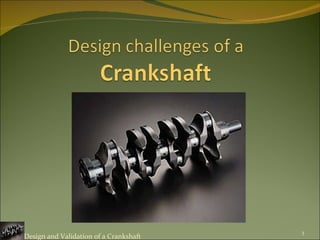
Design and Validation of a Crankshaft
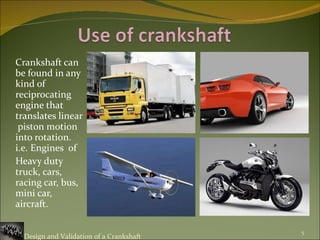
Crankshaft can be found in any kind of reciprocating engine that translates linear  piston motion into rotation. i.e. Engines  of Heavy duty truck, cars, racing car, bus, mini car, aircraft.  Design and Validation of a Crankshaft
Conceptual design Major functions are fixed Setting of Structural relationships of the principal components Sufficient details to provide approximate costs, weights Assured overall dimensions and feasibility of crank Major crankshaft dimensions must be chosen early in the engine design process as they affect overall engine dimensions. Design and Validation of a Crankshaft
Process analysis and selection crank stress integrity of the joints impact of the crank on the block stress and deformation Design and Validation of a Crankshaft
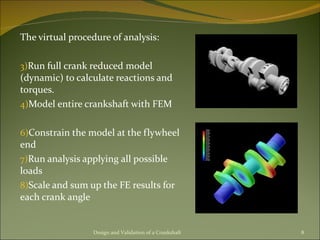
The virtual procedure of analysis: Run full crank reduced model (dynamic) to calculate reactions and torques. Model entire crankshaft with FEM  Constrain the model at the flywheel end Run analysis applying all possible loads Scale and sum up the FE results for each crank angle Design and Validation of a Crankshaft
Design and Validation of a Crankshaft
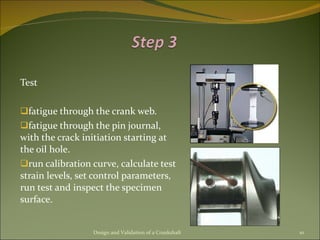
Test fatigue through the crank web. fatigue through the pin journal, with the crack initiation starting at the oil hole.  run calibration curve, calculate test strain levels, set control parameters, run test and inspect the specimen surface. Design and Validation of a Crankshaft
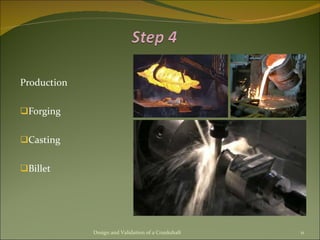
Production Forging Casting Billet Design and Validation of a Crankshaft
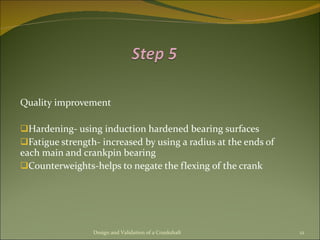
Quality improvement Hardening- using induction hardened bearing surfaces Fatigue strength- increased by using a radius at the ends of each main and crankpin bearing Counterweights-helps to negate the flexing of the crank Design and Validation of a Crankshaft
Supportive materials through Design and Validation: Six Sigma ISO 9001: 2000  BS 7000 Health and Safety Executive (HSE) Design and Validation of a Crankshaft
Step 1- conceptual design Step 2- process analysis and selection Step 3- test Step 4- production Step 5- improvement Design and Validation of a Crankshaft
Any questions? Design and Validation of a Crankshaft

Design of an Engine Crankshaft

  • 1.
    21 st March 2011 Sakib Sarker Darlington Midrange Technical Operations (MTO)
  • 2.
    “ Takethe best that exists and make it better. When it does not exist, design it.” - Sir Henry Royce
  • 3.
    Design and Validationof a Crankshaft
  • 4.
    Design and Validationof a Crankshaft
  • 5.
    Crankshaft can befound in any kind of reciprocating engine that translates linear piston motion into rotation. i.e. Engines of Heavy duty truck, cars, racing car, bus, mini car, aircraft. Design and Validation of a Crankshaft
  • 6.
    Conceptual design Majorfunctions are fixed Setting of Structural relationships of the principal components Sufficient details to provide approximate costs, weights Assured overall dimensions and feasibility of crank Major crankshaft dimensions must be chosen early in the engine design process as they affect overall engine dimensions. Design and Validation of a Crankshaft
  • 7.
    Process analysis andselection crank stress integrity of the joints impact of the crank on the block stress and deformation Design and Validation of a Crankshaft
  • 8.
    The virtual procedureof analysis: Run full crank reduced model (dynamic) to calculate reactions and torques. Model entire crankshaft with FEM Constrain the model at the flywheel end Run analysis applying all possible loads Scale and sum up the FE results for each crank angle Design and Validation of a Crankshaft
  • 9.
    Design and Validationof a Crankshaft
  • 10.
    Test fatigue throughthe crank web. fatigue through the pin journal, with the crack initiation starting at the oil hole. run calibration curve, calculate test strain levels, set control parameters, run test and inspect the specimen surface. Design and Validation of a Crankshaft
  • 11.
    Production Forging CastingBillet Design and Validation of a Crankshaft
  • 12.
    Quality improvement Hardening-using induction hardened bearing surfaces Fatigue strength- increased by using a radius at the ends of each main and crankpin bearing Counterweights-helps to negate the flexing of the crank Design and Validation of a Crankshaft
  • 13.
    Supportive materials throughDesign and Validation: Six Sigma ISO 9001: 2000 BS 7000 Health and Safety Executive (HSE) Design and Validation of a Crankshaft
  • 14.
    Step 1- conceptualdesign Step 2- process analysis and selection Step 3- test Step 4- production Step 5- improvement Design and Validation of a Crankshaft
  • 15.
    Any questions? Designand Validation of a Crankshaft