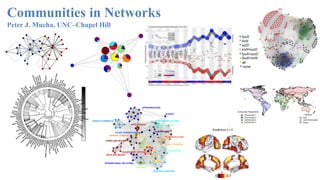
Communities in Networks
Peter J. Mucha, UNC–Chapel Hill
AGRICULTURE
APPROPRIATIONS
INTERNATIONAL RELATIONS
BUDGET
HOUSE ADMINISTRATION
ENERGY/COMMERCE
FINANCIAL SERVICES
VETERANS’ AFFAIRS
EDUCATION
ARMED SERVICES
JUDICIARY
RESOURCES
RULES
SCIENCE
SMALL BUSINESS
OFFICIAL CONDUCT
TRANSPORTATION
GOVERNMENT REFORM
WAYS AND MEANS
INTELLIGENCE
HOMELAND SECURITY
Outline & Acknowledgements
1. What is community detection and
why is it useful?
2. How do you calculate communities?
– Software links
– Importance of resolution parameters
3. Multilayer networks
– If time permits (I’ll leave you slides)
 Skyler Cranmer, James Fowler,
Jeff Henderson, Jim Moody,
J.-P. Onnela, Mason Porter
 Dani Bassett, Kaveri Chaturvedi,
Saray Shai, Dane Taylor
 Natalie Stanley, Mandi Traud,
Andrew Waugh, William Weir,
James Wilson
 Scott Emmons, Ryan Gibson,
Eric Kelsic, Kevin Macon,
Thomas Richardson
 JSMF, UCRF (UNC), ARO, CDC,
NICHD, NIDDK, NIGMS, NSF
Apologies that this presentation will seriously err on the self-absorbed side.
It’s a big field, and I do not promise to cover even a small piece of it here.
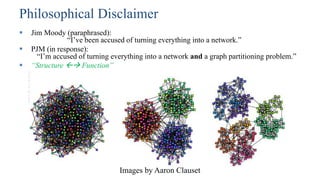
 Jim Moody (paraphrased):
“I’ve been accused of turning everything into a network.”
 PJM (in response):
“I’m accused of turning everything into a network and a graph partitioning problem.”
 “Structure  Function”
Philosophical Disclaimer
Images by Aaron Clauset
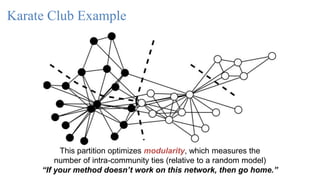
Karate Club Example
This partition optimizes modularity, which measures the
number of intra-community ties (relative to a random model)
“If your method doesn’t work on this network, then go home.”
Karate Club Club
“Cris Moore (left) is the
inaugural recipient of the
Zachary Karate Club Club prize,
awarded on behalf of the
community by Aric Hagberg
(right). (9 May 2013)”
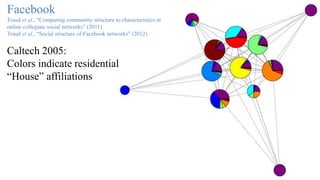
Facebook
Traud et al., “Comparing community structure to characteristics in
online collegiate social networks” (2011)
Traud et al., “Social structure of Facebook networks” (2012)
Caltech 2005:
Colors indicate residential
“House” affiliations
Purple = Not provided
Facebook
Traud et al., “Comparing community structure to characteristics in
online collegiate social networks” (2011)
Traud et al., “Social structure of Facebook networks” (2012)
Caltech 2005:
Colors indicate residential
“House” affiliations
Facebook
Traud et al., “Comparing community structure to characteristics in
online collegiate social networks” (2011)
Traud et al., “Social structure of Facebook networks” (2012)
Caltech 2005:
Colors indicate residential
“House” affiliations
Purple = Not provided
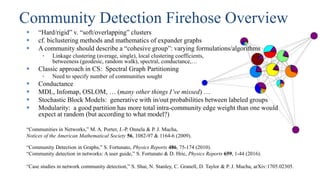
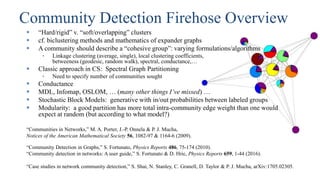
Community Detection Firehose Overview
 “Hard/rigid” v. “soft/overlapping” clusters
 cf. biclustering methods and mathematics of expander graphs
 A community should describe a “cohesive group”: varying formulations/algorithms
• Linkage clustering (average, single), local clustering coefficients,
betweeness (geodesic, random walk), spectral, conductance,…
 Classic approach in CS: Spectral Graph Partitioning
• Need to specify number of communities sought
 Conductance
 MDL, Infomap, OSLOM, … (many other things I’ve missed) …
 Stochastic Block Models: generative with in/out probabilities between labeled groups
 Modularity: a good partition has more total intra-community edge weight than one would
expect at random (but according to what model?)
“Communities in Networks,” M. A. Porter, J.-P. Onnela & P. J. Mucha,
Notices of the American Mathematical Society 56, 1082-97 & 1164-6 (2009).
“Community Detection in Graphs,” S. Fortunato, Physics Reports 486, 75-174 (2010).
“Community detection in networks: A user guide,” S. Fortunato & D. Hric, Physics Reports 659, 1-44 (2016).
“Case studies in network community detection,” S. Shai, N. Stanley, C. Granell, D. Taylor & P. J. Mucha, arXiv:1705.02305.
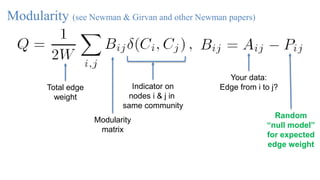
Modularity (see Newman & Girvan and other Newman papers)
Total edge
weight
Modularity
matrix
Indicator on
nodes i & j in
same community
Your data:
Edge from i to j?
Random
“null model”
for expected
edge weight
Modularity (see Newman & Girvan and other Newman papers)
 GOAL: Assign nodes to communities in order to maximize
quality function Q
 NP-Complete [Brandes et al. 2008]
~ enumerate possible partitions
 Numerous packages developed/developing
• e.g. igraph library (R, python), NetworkX, Louvain
• Need appropriate null model
 ER degree distribution (binomial/Poisson) is not a good model
for many real-world data sets
 Independent edges, constrained to expected
degree sequence same as observed.
 Requires Pij = f(ki)f(kj), quickly yielding
 g resolution parameter ad hoc (default = 1)
[Reichardt & Bornholdt, 2006; Lambiotte et al., 2008 & 2015]
Modularity (see Newman & Girvan and other Newman papers)
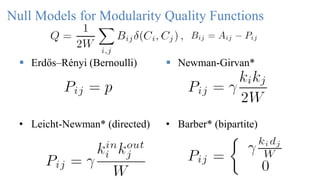
Null Models for Modularity Quality Functions
 Erdős–Rényi (Bernoulli)  Newman-Girvan*
• Leicht-Newman* (directed) • Barber* (bipartite)
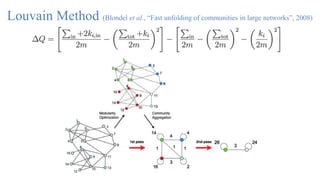
Louvain Method (Blondel et al., “Fast unfolding of communities in large networks”, 2008)
“Virality Prediction and Community Structure in
Social Networks”, Weng, Menczer & Ahn (2013)
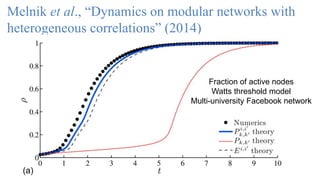
Melnik et al., “Dynamics on modular networks with
heterogeneous correlations” (2014)
Fraction of active nodes
Watts threshold model
Multi-university Facebook network
Modularity from Laplacian Dynamics
Lambiotte, Delvenne & Barahona [arXiv:0812.1770]
showed a way to derive modularity from normalized
Laplacian dynamics, defining partition quality in terms
of stability (autocovariance in Markov process)
Expansion of matrix exponential to first-order in t recovers
Newman-Girvan modularity with resolution g = 1/t.
(This is going to be important again for multilayer networks)
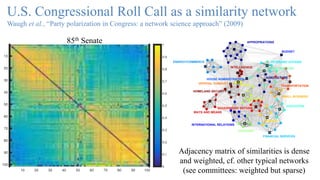
U.S. Congressional Roll Call as a similarity network
Waugh et al., “Party polarization in Congress: a network science approach” (2009)
AGRICULTURE
APPROPRIATIONS
INTERNATIONAL RELATIONS
BUDGET
HOUSE ADMINISTRATION
ENERGY/COMMERCE
FINANCIAL SERVICES
VETERANS’ AFFAIRS
EDUCATION
ARMED SERVICES
JUDICIARY
RESOURCES
RULES
SCIENCE
SMALL BUSINESS
OFFICIAL CONDUCT
TRANSPORTATION
GOVERNMENT REFORM
WAYS AND MEANS
INTELLIGENCE
HOMELAND SECURITY
Adjacency matrix of similarities is dense
and weighted, cf. other typical networks
(see committees: weighted but sparse)
85th Senate
U.S. Congressional Roll Call as a similarity network
Waugh et al., “Party polarization in Congress: a network science approach” (2009)
85th Senate 108th Senate
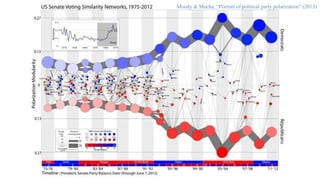
Moody & Mucha, “Portrait of political party polarization” (2013)
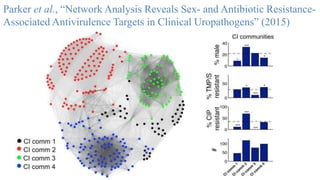
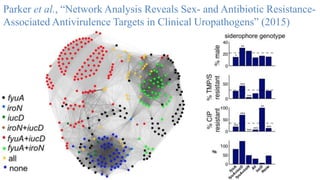
Parker et al., “Network Analysis Reveals Sex- and Antibiotic Resistance-
Associated Antivirulence Targets in Clinical Uropathogens” (2015)
Parker et al., “Network Analysis Reveals Sex- and Antibiotic Resistance-
Associated Antivirulence Targets in Clinical Uropathogens” (2015)
Outline & Summary
1. What is community detection and
why is it useful?
2. How do you calculate communities?
– Software links
– Importance of resolution parameters
3. Multilayer networks
Software
Other great codes to know:
http://www.mapequation.org/
https://graph-tool.skewed.de/
https://github.com/vtraag/louvain-igraph
http://netwiki.amath.unc.edu/GenLouvain
Recall the (pesky) resolution parameter?
Fenn et al., “Dynamic Communities in
Multichannel Data: An Application to the
Foreign Exchange Market During the
2007-2008 Credit Crisis” (2009)
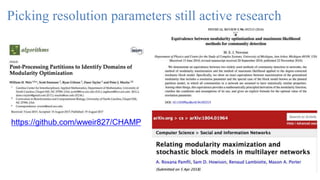
Picking resolution parameters still active research
https://github.com/wweir827/CHAMP
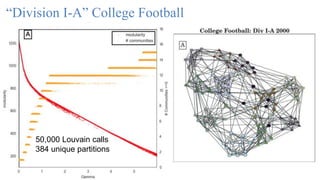
“Division I-A” College Football
50,000 Louvain calls
384 unique partitions
But Qs(g) isn’t a point; it’s a line for partition s
50,000 Louvain calls
384 unique partitions
But Qs(g) isn’t a point; it’s a line for partition s
50,000 Louvain calls
384 unique partitions
19 admissible partitions
Pairwise compare admissible partitions
50,000 Louvain calls
384 unique partitions
19 admissible partitions
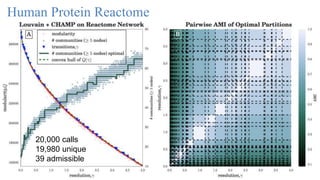
Human Protein Reactome
20,000 calls
19,980 unique
39 admissible
Human Protein Reactome
20,000 calls
19,980 unique
39 admissible
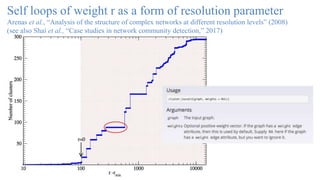
Self loops of weight r as a form of resolution parameter
Arenas et al., “Analysis of the structure of complex networks at different resolution levels” (2008)
(see also Shai et al., “Case studies in network community detection,” 2017)
Outline & Summary
1. What is community detection and
why is it useful?
2. How do you calculate communities?
– Software links
– Importance of resolution parameters
3. Multilayer networks
– We are surely out of time… If we had
more time, we would talk a lot about
the refs in the following slides
 Networks appear in many
disciplines
 Network representations provide a
flexible framework for studying
general data types, leveraging
methods of social network analysis
and network science.
 Community detection is a powerful
tool for exploring and
understanding network structures,
including multilayer networks.
 Network structures identify
essential features for modeling and
understanding data in applications.
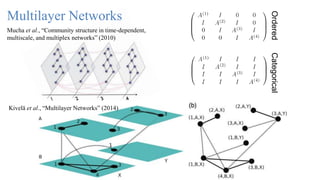
Multilayer Networks
OrderedCategorical
Mucha et al., “Community structure in time-dependent,
multiscale, and multiplex networks” (2010)
Kivelä et al., “Multilayer Networks” (2014)
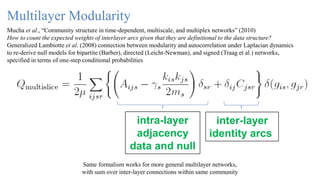
Multilayer Modularity
Mucha et al., “Community structure in time-dependent, multiscale, and multiplex networks” (2010)
How to count the expected weights of interlayer arcs given that they are definitional to the data structure?
Generalized Lambiotte et al. (2008) connection between modularity and autocorrelation under Laplacian dynamics
to re-derive null models for bipartite (Barber), directed (Leicht-Newman), and signed (Traag et al.) networks,
specified in terms of one-step conditional probabilities
intra-layer
adjacency
data and null
inter-layer
identity arcs
Same formalism works for more general multilayer networks,
with sum over inter-layer connections within same community
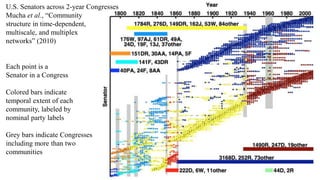
U.S. Senators across 2-year Congresses
Mucha et al., “Community
structure in time-dependent,
multiscale, and multiplex
networks” (2010)
Each point is a
Senator in a Congress
Colored bars indicate
temporal extent of each
community, labeled by
nominal party labels
Grey bars indicate Congresses
including more than two
communities
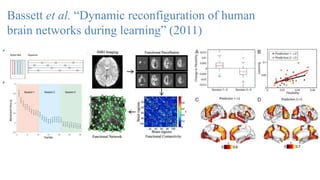
Bassett et al. “Dynamic reconfiguration of human
brain networks during learning” (2011)
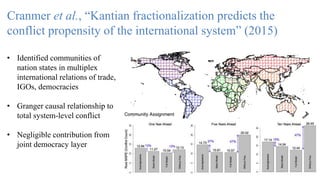
Cranmer et al., “Kantian fractionalization predicts the
conflict propensity of the international system” (2015)
• Identified communities of
nation states in multiplex
international relations of trade,
IGOs, democracies
• Granger causal relationship to
total system-level conflict
• Negligible contribution from
joint democracy layer
See mapequation.org
Phys. Rev. X 6, 011036 (2016)
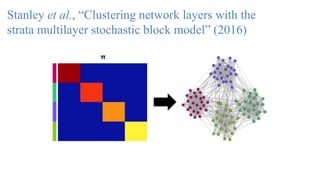
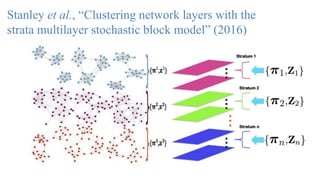
Stanley et al., “Clustering network layers with the
strata multilayer stochastic block model” (2016)
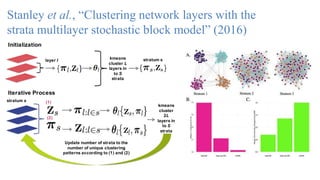
Stanley et al., “Clustering network layers with the
strata multilayer stochastic block model” (2016)
Stanley et al., “Clustering network layers with the
strata multilayer stochastic block model” (2016)
Initialization
layer l kmeans
cluster L
layers in
to S
strata
stratum s
Iterative Process
stratum s
Update number of strata to the
number of unique clustering
patterns according to (1) and (2)
kmeans
cluster
2L
layers in
to S
strata
(1)
(2)
ns
r L
in
a
stratum s
kmeans
cluster
tion
layer l kmeans
cluster L
layers in
to S
strata
stratum s
Process
kmeans
cluster
2L
layers in
to S
strata
(1)
(2)
tion
layer l kmeans
cluster L
layers in
to S
strata
stratum s
Process
kmeans
cluster
2L
(1)
kmeans
cluster L
layers in
to S
strata
stratum s
Taylor et al., “Enhanced detectability of community structure
in multilayer networks through layer aggregation” (2016)
Taylor et al., “Enhanced detectability of community structure
in multilayer networks through layer aggregation” (2016)
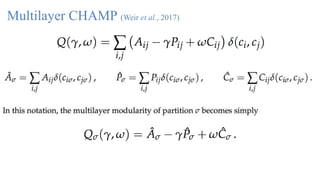
Multilayer CHAMP (Weir et al., 2017)
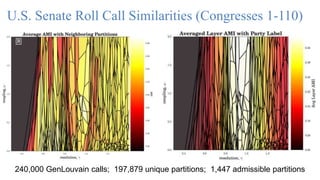
U.S. Senate Roll Call Similarities (Congresses 1-110)
240,000 GenLouvain calls; 197,879 unique partitions; 1,447 admissible partitions
Community Detection Firehose Overview
 “Hard/rigid” v. “soft/overlapping” clusters
 cf. biclustering methods and mathematics of expander graphs
 A community should describe a “cohesive group”: varying formulations/algorithms
• Linkage clustering (average, single), local clustering coefficients,
betweeness (geodesic, random walk), spectral, conductance,…
 Classic approach in CS: Spectral Graph Partitioning
• Need to specify number of communities sought
 Conductance
 MDL, Infomap, OSLOM, … (many other things I’ve missed) …
 Stochastic Block Models: generative with in/out probabilities between labeled groups
 Modularity: a good partition has more total intra-community edge weight than one would
expect at random (but according to what model?)
“Communities in Networks,” M. A. Porter, J.-P. Onnela & P. J. Mucha,
Notices of the American Mathematical Society 56, 1082-97 & 1164-6 (2009).
“Community Detection in Graphs,” S. Fortunato, Physics Reports 486, 75-174 (2010).
“Community detection in networks: A user guide,” S. Fortunato & D. Hric, Physics Reports 659, 1-44 (2016).
“Case studies in network community detection,” S. Shai, N. Stanley, C. Granell, D. Taylor & P. J. Mucha, arXiv:1705.02305.
Outline & Summary
1. What is community detection and
why is it useful?
2. How do you calculate communities?
– Software links
– Importance of resolution parameters
3. Multilayer networks
 Networks appear in many
disciplines
 Network representations provide a
flexible framework for studying
general data types, leveraging
methods of social network analysis
and network science.
 Community detection is a powerful
tool for exploring and
understanding network structures,
including multilayer networks.
 Network structures identify
essential features for modeling and
understanding data in applications.

06 Community Detection

  • 1.
    Communities in Networks PeterJ. Mucha, UNC–Chapel Hill AGRICULTURE APPROPRIATIONS INTERNATIONAL RELATIONS BUDGET HOUSE ADMINISTRATION ENERGY/COMMERCE FINANCIAL SERVICES VETERANS’ AFFAIRS EDUCATION ARMED SERVICES JUDICIARY RESOURCES RULES SCIENCE SMALL BUSINESS OFFICIAL CONDUCT TRANSPORTATION GOVERNMENT REFORM WAYS AND MEANS INTELLIGENCE HOMELAND SECURITY
  • 2.
    Outline & Acknowledgements 1.What is community detection and why is it useful? 2. How do you calculate communities? – Software links – Importance of resolution parameters 3. Multilayer networks – If time permits (I’ll leave you slides)  Skyler Cranmer, James Fowler, Jeff Henderson, Jim Moody, J.-P. Onnela, Mason Porter  Dani Bassett, Kaveri Chaturvedi, Saray Shai, Dane Taylor  Natalie Stanley, Mandi Traud, Andrew Waugh, William Weir, James Wilson  Scott Emmons, Ryan Gibson, Eric Kelsic, Kevin Macon, Thomas Richardson  JSMF, UCRF (UNC), ARO, CDC, NICHD, NIDDK, NIGMS, NSF Apologies that this presentation will seriously err on the self-absorbed side. It’s a big field, and I do not promise to cover even a small piece of it here.
  • 3.
     Jim Moody(paraphrased): “I’ve been accused of turning everything into a network.”  PJM (in response): “I’m accused of turning everything into a network and a graph partitioning problem.”  “Structure  Function” Philosophical Disclaimer Images by Aaron Clauset
  • 4.
    Karate Club Example Thispartition optimizes modularity, which measures the number of intra-community ties (relative to a random model) “If your method doesn’t work on this network, then go home.”
  • 5.
    Karate Club Club “CrisMoore (left) is the inaugural recipient of the Zachary Karate Club Club prize, awarded on behalf of the community by Aric Hagberg (right). (9 May 2013)”
  • 6.
    Facebook Traud et al.,“Comparing community structure to characteristics in online collegiate social networks” (2011) Traud et al., “Social structure of Facebook networks” (2012) Caltech 2005: Colors indicate residential “House” affiliations Purple = Not provided
  • 7.
    Facebook Traud et al.,“Comparing community structure to characteristics in online collegiate social networks” (2011) Traud et al., “Social structure of Facebook networks” (2012) Caltech 2005: Colors indicate residential “House” affiliations
  • 8.
    Facebook Traud et al.,“Comparing community structure to characteristics in online collegiate social networks” (2011) Traud et al., “Social structure of Facebook networks” (2012) Caltech 2005: Colors indicate residential “House” affiliations Purple = Not provided
  • 9.
    Community Detection FirehoseOverview  “Hard/rigid” v. “soft/overlapping” clusters  cf. biclustering methods and mathematics of expander graphs  A community should describe a “cohesive group”: varying formulations/algorithms • Linkage clustering (average, single), local clustering coefficients, betweeness (geodesic, random walk), spectral, conductance,…  Classic approach in CS: Spectral Graph Partitioning • Need to specify number of communities sought  Conductance  MDL, Infomap, OSLOM, … (many other things I’ve missed) …  Stochastic Block Models: generative with in/out probabilities between labeled groups  Modularity: a good partition has more total intra-community edge weight than one would expect at random (but according to what model?) “Communities in Networks,” M. A. Porter, J.-P. Onnela & P. J. Mucha, Notices of the American Mathematical Society 56, 1082-97 & 1164-6 (2009). “Community Detection in Graphs,” S. Fortunato, Physics Reports 486, 75-174 (2010). “Community detection in networks: A user guide,” S. Fortunato & D. Hric, Physics Reports 659, 1-44 (2016). “Case studies in network community detection,” S. Shai, N. Stanley, C. Granell, D. Taylor & P. J. Mucha, arXiv:1705.02305.
  • 10.
    Modularity (see Newman& Girvan and other Newman papers) Total edge weight Modularity matrix Indicator on nodes i & j in same community Your data: Edge from i to j? Random “null model” for expected edge weight
  • 11.
    Modularity (see Newman& Girvan and other Newman papers)  GOAL: Assign nodes to communities in order to maximize quality function Q  NP-Complete [Brandes et al. 2008] ~ enumerate possible partitions  Numerous packages developed/developing • e.g. igraph library (R, python), NetworkX, Louvain • Need appropriate null model
  • 12.
     ER degreedistribution (binomial/Poisson) is not a good model for many real-world data sets  Independent edges, constrained to expected degree sequence same as observed.  Requires Pij = f(ki)f(kj), quickly yielding  g resolution parameter ad hoc (default = 1) [Reichardt & Bornholdt, 2006; Lambiotte et al., 2008 & 2015] Modularity (see Newman & Girvan and other Newman papers)
  • 13.
    Null Models forModularity Quality Functions  Erdős–Rényi (Bernoulli)  Newman-Girvan* • Leicht-Newman* (directed) • Barber* (bipartite)
  • 14.
    Louvain Method (Blondelet al., “Fast unfolding of communities in large networks”, 2008)
  • 15.
    “Virality Prediction andCommunity Structure in Social Networks”, Weng, Menczer & Ahn (2013)
  • 16.
    Melnik et al.,“Dynamics on modular networks with heterogeneous correlations” (2014) Fraction of active nodes Watts threshold model Multi-university Facebook network
  • 17.
    Modularity from LaplacianDynamics Lambiotte, Delvenne & Barahona [arXiv:0812.1770] showed a way to derive modularity from normalized Laplacian dynamics, defining partition quality in terms of stability (autocovariance in Markov process) Expansion of matrix exponential to first-order in t recovers Newman-Girvan modularity with resolution g = 1/t. (This is going to be important again for multilayer networks)
  • 18.
    U.S. Congressional RollCall as a similarity network Waugh et al., “Party polarization in Congress: a network science approach” (2009) AGRICULTURE APPROPRIATIONS INTERNATIONAL RELATIONS BUDGET HOUSE ADMINISTRATION ENERGY/COMMERCE FINANCIAL SERVICES VETERANS’ AFFAIRS EDUCATION ARMED SERVICES JUDICIARY RESOURCES RULES SCIENCE SMALL BUSINESS OFFICIAL CONDUCT TRANSPORTATION GOVERNMENT REFORM WAYS AND MEANS INTELLIGENCE HOMELAND SECURITY Adjacency matrix of similarities is dense and weighted, cf. other typical networks (see committees: weighted but sparse) 85th Senate
  • 19.
    U.S. Congressional RollCall as a similarity network Waugh et al., “Party polarization in Congress: a network science approach” (2009) 85th Senate 108th Senate
  • 20.
    Moody & Mucha,“Portrait of political party polarization” (2013)
  • 21.
    Parker et al.,“Network Analysis Reveals Sex- and Antibiotic Resistance- Associated Antivirulence Targets in Clinical Uropathogens” (2015)
  • 22.
    Parker et al.,“Network Analysis Reveals Sex- and Antibiotic Resistance- Associated Antivirulence Targets in Clinical Uropathogens” (2015)
  • 23.
    Outline & Summary 1.What is community detection and why is it useful? 2. How do you calculate communities? – Software links – Importance of resolution parameters 3. Multilayer networks
  • 24.
    Software Other great codesto know: http://www.mapequation.org/ https://graph-tool.skewed.de/ https://github.com/vtraag/louvain-igraph http://netwiki.amath.unc.edu/GenLouvain
  • 25.
    Recall the (pesky)resolution parameter? Fenn et al., “Dynamic Communities in Multichannel Data: An Application to the Foreign Exchange Market During the 2007-2008 Credit Crisis” (2009)
  • 26.
    Picking resolution parametersstill active research https://github.com/wweir827/CHAMP
  • 27.
    “Division I-A” CollegeFootball 50,000 Louvain calls 384 unique partitions
  • 28.
    But Qs(g) isn’ta point; it’s a line for partition s 50,000 Louvain calls 384 unique partitions
  • 29.
    But Qs(g) isn’ta point; it’s a line for partition s 50,000 Louvain calls 384 unique partitions 19 admissible partitions
  • 30.
    Pairwise compare admissiblepartitions 50,000 Louvain calls 384 unique partitions 19 admissible partitions
  • 31.
    Human Protein Reactome 20,000calls 19,980 unique 39 admissible
  • 32.
    Human Protein Reactome 20,000calls 19,980 unique 39 admissible
  • 33.
    Self loops ofweight r as a form of resolution parameter Arenas et al., “Analysis of the structure of complex networks at different resolution levels” (2008) (see also Shai et al., “Case studies in network community detection,” 2017)
  • 34.
    Outline & Summary 1.What is community detection and why is it useful? 2. How do you calculate communities? – Software links – Importance of resolution parameters 3. Multilayer networks – We are surely out of time… If we had more time, we would talk a lot about the refs in the following slides  Networks appear in many disciplines  Network representations provide a flexible framework for studying general data types, leveraging methods of social network analysis and network science.  Community detection is a powerful tool for exploring and understanding network structures, including multilayer networks.  Network structures identify essential features for modeling and understanding data in applications.
  • 35.
    Multilayer Networks OrderedCategorical Mucha etal., “Community structure in time-dependent, multiscale, and multiplex networks” (2010) Kivelä et al., “Multilayer Networks” (2014)
  • 36.
    Multilayer Modularity Mucha etal., “Community structure in time-dependent, multiscale, and multiplex networks” (2010) How to count the expected weights of interlayer arcs given that they are definitional to the data structure? Generalized Lambiotte et al. (2008) connection between modularity and autocorrelation under Laplacian dynamics to re-derive null models for bipartite (Barber), directed (Leicht-Newman), and signed (Traag et al.) networks, specified in terms of one-step conditional probabilities intra-layer adjacency data and null inter-layer identity arcs Same formalism works for more general multilayer networks, with sum over inter-layer connections within same community
  • 37.
    U.S. Senators across2-year Congresses Mucha et al., “Community structure in time-dependent, multiscale, and multiplex networks” (2010) Each point is a Senator in a Congress Colored bars indicate temporal extent of each community, labeled by nominal party labels Grey bars indicate Congresses including more than two communities
  • 38.
    Bassett et al.“Dynamic reconfiguration of human brain networks during learning” (2011)
  • 39.
    Cranmer et al.,“Kantian fractionalization predicts the conflict propensity of the international system” (2015) • Identified communities of nation states in multiplex international relations of trade, IGOs, democracies • Granger causal relationship to total system-level conflict • Negligible contribution from joint democracy layer
  • 40.
  • 41.
    Stanley et al.,“Clustering network layers with the strata multilayer stochastic block model” (2016)
  • 42.
    Stanley et al.,“Clustering network layers with the strata multilayer stochastic block model” (2016)
  • 43.
    Stanley et al.,“Clustering network layers with the strata multilayer stochastic block model” (2016) Initialization layer l kmeans cluster L layers in to S strata stratum s Iterative Process stratum s Update number of strata to the number of unique clustering patterns according to (1) and (2) kmeans cluster 2L layers in to S strata (1) (2) ns r L in a stratum s kmeans cluster tion layer l kmeans cluster L layers in to S strata stratum s Process kmeans cluster 2L layers in to S strata (1) (2) tion layer l kmeans cluster L layers in to S strata stratum s Process kmeans cluster 2L (1) kmeans cluster L layers in to S strata stratum s
  • 44.
    Taylor et al.,“Enhanced detectability of community structure in multilayer networks through layer aggregation” (2016)
  • 45.
    Taylor et al.,“Enhanced detectability of community structure in multilayer networks through layer aggregation” (2016)
  • 46.
  • 47.
    U.S. Senate RollCall Similarities (Congresses 1-110) 240,000 GenLouvain calls; 197,879 unique partitions; 1,447 admissible partitions
  • 48.
    Community Detection FirehoseOverview  “Hard/rigid” v. “soft/overlapping” clusters  cf. biclustering methods and mathematics of expander graphs  A community should describe a “cohesive group”: varying formulations/algorithms • Linkage clustering (average, single), local clustering coefficients, betweeness (geodesic, random walk), spectral, conductance,…  Classic approach in CS: Spectral Graph Partitioning • Need to specify number of communities sought  Conductance  MDL, Infomap, OSLOM, … (many other things I’ve missed) …  Stochastic Block Models: generative with in/out probabilities between labeled groups  Modularity: a good partition has more total intra-community edge weight than one would expect at random (but according to what model?) “Communities in Networks,” M. A. Porter, J.-P. Onnela & P. J. Mucha, Notices of the American Mathematical Society 56, 1082-97 & 1164-6 (2009). “Community Detection in Graphs,” S. Fortunato, Physics Reports 486, 75-174 (2010). “Community detection in networks: A user guide,” S. Fortunato & D. Hric, Physics Reports 659, 1-44 (2016). “Case studies in network community detection,” S. Shai, N. Stanley, C. Granell, D. Taylor & P. J. Mucha, arXiv:1705.02305.
  • 49.
    Outline & Summary 1.What is community detection and why is it useful? 2. How do you calculate communities? – Software links – Importance of resolution parameters 3. Multilayer networks  Networks appear in many disciplines  Network representations provide a flexible framework for studying general data types, leveraging methods of social network analysis and network science.  Community detection is a powerful tool for exploring and understanding network structures, including multilayer networks.  Network structures identify essential features for modeling and understanding data in applications.