Social Network Analysis
Suman Banerjee,
Department of ISE
IIT Kharagpur
September 22, 2015
Suman Banerjee, Social Network Analysis
Outline
1 Basics of Social Network Analysis(SNA).
Suman Banerjee, Social Network Analysis
Outline
1 Basics of Social Network Analysis(SNA).
2 Different research issues in SNA.
Suman Banerjee, Social Network Analysis
Outline
1 Basics of Social Network Analysis(SNA).
2 Different research issues in SNA.
3 Community Detection.
Suman Banerjee, Social Network Analysis
Outline
1 Basics of Social Network Analysis(SNA).
2 Different research issues in SNA.
3 Community Detection.
4 Link Prediction.
Suman Banerjee, Social Network Analysis
Outline
1 Basics of Social Network Analysis(SNA).
2 Different research issues in SNA.
3 Community Detection.
4 Link Prediction.
5 Opinion Dynamics.
Suman Banerjee, Social Network Analysis
Outline
1 Basics of Social Network Analysis(SNA).
2 Different research issues in SNA.
3 Community Detection.
4 Link Prediction.
5 Opinion Dynamics.
6 Influence Propagation.
Suman Banerjee, Social Network Analysis
Outline
1 Basics of Social Network Analysis(SNA).
2 Different research issues in SNA.
3 Community Detection.
4 Link Prediction.
5 Opinion Dynamics.
6 Influence Propagation.
7 Stability analysis.
Suman Banerjee, Social Network Analysis
Introduction
1 Study of Social Entities and Their Relationships.
2 Can be Modeled as a graph.
Suman Banerjee, Social Network Analysis
Introduction
1 Study of Social Entities and Their Relationships.
2 Can be Modeled as a graph.
3 A graph G(V,E) where V= Set of Vertices,E= Set of Edges/
Links.
4 Several E-business application.[1]
Suman Banerjee, Social Network Analysis
Introduction
1 Study of Social Entities and Their Relationships.
2 Can be Modeled as a graph.
3 A graph G(V,E) where V= Set of Vertices,E= Set of Edges/
Links.
4 Several E-business application.[1]
5 In Social Network [2]V represents Social Entities and there
will be an edge between two Social Entities if they have some
relation which is under consideration.
Suman Banerjee, Social Network Analysis
Contd....
1 For network construction several model exist.
Examples:-
Crisp Model.
Threshold Model.
Distance Model.
Suman Banerjee, Social Network Analysis
Contd....
1 For network construction several model exist.
Examples:-
2 In Crisp Model If link exist then 1 otherwise 0.
3 In Threshold Model Considers vectors of dimension k for each
player and a threshold value t.
Vi = (vi1, vi2, ......., vik)
Vj = (vj1, vj2, ......., vjk)
Suman Banerjee, Social Network Analysis
Contd....
1 Dot product of these two vectors are given by:
T = k
p=1 vip.vjp
2 If T ≥ t then link exist otherwise not.
3 In Distance Model distance between two vectors are
calculated: Dij = k
p=1(v2
ip − v2
jp)
4 If Dij ≤ d then link exist otherwise not.
Suman Banerjee, Social Network Analysis
Example
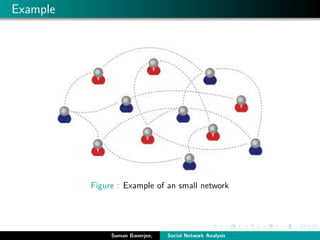
Figure : Example of an small network
Suman Banerjee, Social Network Analysis
Basic Research Issues in SNA
1 Community Detection.
2 Link Prediction.
3 Opinion Formation and Opinion Dynamics.
4 Influence Propagation.
5 Stability of the network.
Suman Banerjee, Social Network Analysis
Community
1 Community[3] is formed by individuals such that those within
a group interact with each other more frequently than with
those outside the group.
a.k.a. group, cluster, cohesive subgroup, module in different
contexts.
2 Community detection means discovering groups in a network
where individuals group membership are not explicitly given.
3 Why communities in social media?
Human beings are social.
Easy-to-use social media allows people to extend their social
life in unprecedented ways.
Difficult to meet friends in the physical world, but much easier
to find friend online with similar interests.
Interactions between nodes can help determine communities.
Suman Banerjee, Social Network Analysis
Community Detection
1 An old research problem for SNA research.
2 Different algorithms exist.
Sprectal Bisection Method.
Graph Partitioning Method.
3 A Modularity function is maximized. [4]
Q = 1/2m n
i,j(Aij − ki.kj/2.m)δ(i, j)
n= no. of nodes of the network.
m= no. of edges of the network.
A= Adjacency matrix of the network.
δ(i, j) = (i, j) th entry of the matrix A.
Suman Banerjee, Social Network Analysis
Contd . . . .
1 Maximum modularity value means better community
structure. [5]
2 Degree matrix of a graph is a diagonal matrix.
D = (deg1, deg2, deg3, ....., degn)
3 Graph Laplacian can be defined as
L = D − A
4 Graph Laplacian can also be considered.
Suman Banerjee, Social Network Analysis
Contd . . . .
1 Different meaning in different networks.
2 In friendship network community means friends with strong
communication.
3 In a collaboration network a community means researchers
working almost similar topics.
4 In a citation network a community signifies papers of almost
similar topics.
5 Product- Customer Network.[6, 7]
Suman Banerjee, Social Network Analysis
Link prediction
1 Given a social network at time ti predict the social link
[8]between actors at time ti+1.
2 Given a social network with an incomplete set of social links
between a complete set of actors, predict the unobserved
social links.
3 Given information about actors, predict the social link between
them (this is quite similar to social network extraction).
4 Links are Dynamic in nature.[9]
5 Considers a score function Score(u , v).
Suman Banerjee, Social Network Analysis
Opinion Formation
1 How users update opinions based on their neighbors opinions.
2 Well studied problem in SNA research.
3 Use an Opinion matrix.[10]
4 Opinion is iteratively updated by
Xi(t + 1) = Wi1X1(t) + Wi2X2(t) + ..... + WikXk(t)
Suman Banerjee, Social Network Analysis
Influence Propagation
1 Sub work of the previous one. [11]
2 Topical Affinity Propagation (TAP) is used for modeling.[10]
3 Characterization of dynamicity of a networks.
4 Vector based modeling is used.
5 Considers weighted network. Influence from node s to node t
is µst.
6 Considers three following function:
Node feature function.
Edge feature function.
Global feature function.
Suman Banerjee, Social Network Analysis
Stability Analysis
1 Real world networks are unstable in nature. [13]
2 Analyzing group stability is an important job.
3 Communities may evolve or shrink by influence propagation.
4 Threshold model techniques are used.
5 Some probabilistic models are required like markov chain etc.
Suman Banerjee, Social Network Analysis
Application of SC in SNA Research
1 Several algorithms exist for different problems .
2 Most of them run in Polynomial time.
3 Still, for large networks computational time is high.
4 Apply SC techniques to get approximate solution.
5 GDPSO, DE for community detection is already exist.[14]
6 ACO was used for link prediction problem. [15]
Suman Banerjee, Social Network Analysis
Research Gap
1 Existing Algorithms are useful for small world networks.
2 To apply in real world network some modification has to be
done.
3 Application of SNA research is mainly in Face book, Twitter
etc.
4 This concepts may also be used in E-commerce Network.
5 Different metahuristics can be used for this purpose.
Suman Banerjee, Social Network Analysis
Different Tools for SNA research
1 MATLAB ( with some additional toolbox).
2 R ( mostly for data mining applications).
3 NATBOX. (Equipped with R)
4 Python.
5 UCINET (Version 6.530)
Suman Banerjee, Social Network Analysis
10 Journals of SNA Research
1 IEEE transaction on Systems, Man, Cybernetics. IF-6.22.
2 IEEE transaction on Evolutionary Computation. IF-5.545.
3 Swarm and Evolutionary Computation, Elsevier, SNIP 5.220.
4 Applied Soft Computing, Elsevier.IF 2.810.
5 Informs Journal of Management Science, IF-2.482
6 Decission Support System. IF-2.313.
7 IEEE Transactions on Computational Social Systems. IF -
2.171
8 Social Networks, An International Journal of Structural
Analysis, Elseviar, IF- 2.000.
9 Journal of Computational Science, Elseviar, IF- 1.231.
10 Computational Social Networks,Springer.
Suman Banerjee, Social Network Analysis
10 Conferences of SNA Research
1 European Conference on Social Media.
2 IEEE World Congress on Computational Intelligence.
3 International Conference on Social Network Analysis and
Mining.
4 ACM Conference on Online Social Networks.
5 International Conference on Web and Social Media.
6 International Conference on Social Computing and Social
Media.
7 International Conference on Computational Aspects of Social
Networks.
8 International Conference on Artificial Intelligence. [AAAI]
9 International Conference on Computational and Social
Sciences.
10 International Conference on Social Informatics.
Suman Banerjee, Social Network Analysis
10 Researchers of SNA
1 Mark Newman, Department of Physics, Center for the Study
of Complex Systems, University of Michigan
http : //www − personal.umich.edu/ mejn/
2 Reuven Cohen, Department of Mathematics, Bar-Ilan
University
http : //u.math.biu.ac.il/ reuven/.
3 Jon Kleinberg, Department of Computer Science, Cornell
University.
http : //www.cs.cornell.edu/home/kleinber/
4 ÃĽva Tardos, Department of Computer Science,Cornell
University.
http : //www.cs.cornell.edu/ eva/.
5 David Liben-Nowelly, Department of Computer Science,
Carleton College.
http : //www.cs.carleton.edu/faculty/dlibenno/.
Suman Banerjee, Social Network Analysis
Contd . . . .
1 Karl H. Johansson, Professor, School of Electrical
Engineering, KTH Royal Institute of Technology
https : //people.kth.se/ kallej/.
2 David Liben-Nowelly, Department of Computer Science,
Carleton College,
http : //www.cs.carleton.edu/faculty/dlibenno/
3 Chilukuri K. Mohan, Professor, School of Electrical
Engineering and Computer Science.
http : //www.cis.syr.edu/ mohan/
4 Stephen P. Borgatti, Professor, Dept. of Management, Gatton
College of Business and Economics
http : //www.steveborgatti.com/.
5 David Kempe, Department of Computer Science, University of
Southern California.
http : //www − bcf .usc.edu/ dkempe/.
Suman Banerjee, Social Network Analysis
Top 10 Cited Papers
1 L Page, S. Brin, R Motwani and T Winogard, ”The Page
Rank citation ranking: bringing order to the Web”, Stanford
InfoLab Technical report, 1999. [Cited by 8504]
2 N. B. Ellison, C. Steinfield, C. Lampe,” The Benefits of Face
book Friends: Social Capital and College Students Use of
Online Social Network Sites”, Vol. 12, Issue 4, 2007. [Cited
by 5319]
3 J. E. Hirsch, ”An index to quantify an individual’s scientific
research output.”, Proceedings of the National Academy of
Sciences, Vol. 102, No. 46, 2010. [Cited by 5081]
4 M. E. J Newman, ”The structure of scientific collaboration
networks”, Proceedings of the National Academy of Sciences,
Vol. 98, No. 2, 2006. [Cited by 3455]
Suman Banerjee, Social Network Analysis
Top 10 Cited Papers
1 N. M. Tichy, M. L. Tushman and C. Fombrun, ”Social
Network Analysis For Organizations”,Academy of
management review, Vol. 4, No. 4, 1979. [Cited by 1136]
2 M. E. J. Newman,”Coauthorship networks and patterns of
scientific collaboration”, Proceedings of the National Academy
of Sciences, Vol. 101, No. 1, 2004.[Cited by 1106]
3 Eszter Hargittai,”Whose Space? Differences Among Users and
Non-Users of Social Network Sites” Journal of Computer-
Mediated Communication, Vol 13, pp 276-297, 2008.[Cited by
992]
4 M. E. J. Newman, D. J. Watts, and S. H. Strogatz,”Random
graph models of social networks”, Proceedings of the National
Academy of Sciences, Vol. 99, No. 1, 2002.[Cited 954]
Suman Banerjee, Social Network Analysis
Top 10 Cited Papers
1 H Small,”Visualizing science by citation mapping”, Journal of
the American society for Information Science, Vol. 50, No. 9,
pp 799 - 813,1999. [Cited by 692].
2 Hugo Liu,”Social Network Profiles as Taste Performances”,
Journal of Computer Mediated communication, Vol. 13, pp
252-275, 2008. [cited by 345]
Suman Banerjee, Social Network Analysis
Benchmark Dataset for SNA Research
1 Stanford Large Network Data Set collection.
https : //snap.stanford.edu/data/
2 Complex Network Resources.
http : //math.nist.gov/ RPozo/complexdatasets.html
3 US Air traffic Data,.
http :
//www.levmuchnik.net/Content/Networks/NetworkData.html
Suman Banerjee, Social Network Analysis
References
1 1. F Bonchi, C Castillo, A Gionis and A Jaimes,”Social
Network Analysis and Mining for Business Applications”,
ACM Transactions on Intelligent Systems and Technology,
Vol. 2, No. 3, Article 22, 2001.
2 2. Carter T. Butts,”Social Network Analysis with sna”,
Journal of Statistical Software, Volume 24, Issue 6, February
2008.
3 3. W. Fan , K.H. Yeung,”Similarity between community
structures of different online social networks and its impact on
underlying community detection”, Journal of Computational
Social Science, Vol. 07, No. 002,2014.
Suman Banerjee, Social Network Analysis
Contd . . . .
1 4. M. E. J. Newman,”Detecting community structure in
networks”, The European Physical Journal B-Condensed
Matter Physics, Vol. 32, No. 2, pp 321-330, 2006.
2 5. Q Cai, M Gong , L Ma, S Ruan, F Yuan, L Jiao,”Greedy
discrete particle swarm optimization for large-scale social
network clustering”, Information Sciences, Vol. 316, No. C,
503-516, 2015.
3 6. Martin Smits, Serban Mogos,”The Impact Of Social Media
On Business Performence”, Proceedings of the 21st European
Conference on Information Systems, 2008.
4 7. David A. Marca,”E-Business and Social Networks: Tapping
Dynamic Niche Markets Using Language-Action and Artificial
Intelligence”, Procedings of the 5-th International Conference
on Software Technology, pp 3-23, 2013.
Suman Banerjee, Social Network Analysis
Contd . . . .
1 8. D. L. Nowell, J. Kleinberg,”The Link Prediction Problem
for Social Networks”, Proceedings of the Twelfth Annual ACM
International Conferencon Information and Knowledge
Management (CIKM’03), November 2003, pp. 556-564 .
2 9. Catherine A. Bliss, Morgan R. Frank Christopher M.
Danforth, Peter Sheridan Dodds,”An evolutionary algorithm
approach to link prediction in dynamic social networks”,
Journal of Computational Science, Vol. 5, pp 750-764, 2014.
3 10. S. Patterson, B. Bamieh,”Interaction-Driven Opinion
Dynamics in Online Social Networks”, Processidings of the
Workshop on Social Media Analytics (SOMA), Washington,
July 25, 2010.
Suman Banerjee, Social Network Analysis
Contd . . . .
1 11. Jie Tang, Jimeng Sun, Chi Wang and Zi Yang, ”Social
Influence Analysis in Large-scale Networks”, KDD’09, Paris,
France, June 28-July 1, 2009.
2 12. Zaixin Lu, Lidan Fan, Weili Wu, Bhavani Thuraisingham
and Kai Yang, ”Efficient influence spread estimation for
influence maximization under the linear threshold model”,
Journal of Computational Social Networks, Vol. 1, No. 2,
2014.
3 13. Akshay Patil, Juan Liu, Jie Gao, ”Predicting Group
Stability in Online Social Networks” , procesidings of the
International World Wide Web Conference (IW3C2), Rio de
Janeiro, Brazil, May 13-17, 2013.
Suman Banerjee, Social Network Analysis
Contd . . . .
1 14. N. H. Mua, J. Xiea, Y. Liua, F. Chena, Y. Liub, L. C.
JiaoaaKey, ”Memetic algorithm with simulated annealing
strategy and tightnessgreedy optimization for community
detection in networks”, Information Science, Vol. 05, No.
034, 2015.
2 15. B. Chen, L. Chen, ”A link prediction algorithm based on
ant colony optimization”, Journal of Applied Intelligence,Vol.
41, pp. 694-708, 2014.
Suman Banerjee, Social Network Analysis

Social Network Analysis

  • 1.
    Social Network Analysis SumanBanerjee, Department of ISE IIT Kharagpur September 22, 2015 Suman Banerjee, Social Network Analysis
  • 2.
    Outline 1 Basics ofSocial Network Analysis(SNA). Suman Banerjee, Social Network Analysis
  • 3.
    Outline 1 Basics ofSocial Network Analysis(SNA). 2 Different research issues in SNA. Suman Banerjee, Social Network Analysis
  • 4.
    Outline 1 Basics ofSocial Network Analysis(SNA). 2 Different research issues in SNA. 3 Community Detection. Suman Banerjee, Social Network Analysis
  • 5.
    Outline 1 Basics ofSocial Network Analysis(SNA). 2 Different research issues in SNA. 3 Community Detection. 4 Link Prediction. Suman Banerjee, Social Network Analysis
  • 6.
    Outline 1 Basics ofSocial Network Analysis(SNA). 2 Different research issues in SNA. 3 Community Detection. 4 Link Prediction. 5 Opinion Dynamics. Suman Banerjee, Social Network Analysis
  • 7.
    Outline 1 Basics ofSocial Network Analysis(SNA). 2 Different research issues in SNA. 3 Community Detection. 4 Link Prediction. 5 Opinion Dynamics. 6 Influence Propagation. Suman Banerjee, Social Network Analysis
  • 8.
    Outline 1 Basics ofSocial Network Analysis(SNA). 2 Different research issues in SNA. 3 Community Detection. 4 Link Prediction. 5 Opinion Dynamics. 6 Influence Propagation. 7 Stability analysis. Suman Banerjee, Social Network Analysis
  • 9.
    Introduction 1 Study ofSocial Entities and Their Relationships. 2 Can be Modeled as a graph. Suman Banerjee, Social Network Analysis
  • 10.
    Introduction 1 Study ofSocial Entities and Their Relationships. 2 Can be Modeled as a graph. 3 A graph G(V,E) where V= Set of Vertices,E= Set of Edges/ Links. 4 Several E-business application.[1] Suman Banerjee, Social Network Analysis
  • 11.
    Introduction 1 Study ofSocial Entities and Their Relationships. 2 Can be Modeled as a graph. 3 A graph G(V,E) where V= Set of Vertices,E= Set of Edges/ Links. 4 Several E-business application.[1] 5 In Social Network [2]V represents Social Entities and there will be an edge between two Social Entities if they have some relation which is under consideration. Suman Banerjee, Social Network Analysis
  • 12.
    Contd.... 1 For networkconstruction several model exist. Examples:- Crisp Model. Threshold Model. Distance Model. Suman Banerjee, Social Network Analysis
  • 13.
    Contd.... 1 For networkconstruction several model exist. Examples:- 2 In Crisp Model If link exist then 1 otherwise 0. 3 In Threshold Model Considers vectors of dimension k for each player and a threshold value t. Vi = (vi1, vi2, ......., vik) Vj = (vj1, vj2, ......., vjk) Suman Banerjee, Social Network Analysis
  • 14.
    Contd.... 1 Dot productof these two vectors are given by: T = k p=1 vip.vjp 2 If T ≥ t then link exist otherwise not. 3 In Distance Model distance between two vectors are calculated: Dij = k p=1(v2 ip − v2 jp) 4 If Dij ≤ d then link exist otherwise not. Suman Banerjee, Social Network Analysis
  • 15.
    Example Figure : Exampleof an small network Suman Banerjee, Social Network Analysis
  • 16.
    Basic Research Issuesin SNA 1 Community Detection. 2 Link Prediction. 3 Opinion Formation and Opinion Dynamics. 4 Influence Propagation. 5 Stability of the network. Suman Banerjee, Social Network Analysis
  • 17.
    Community 1 Community[3] isformed by individuals such that those within a group interact with each other more frequently than with those outside the group. a.k.a. group, cluster, cohesive subgroup, module in different contexts. 2 Community detection means discovering groups in a network where individuals group membership are not explicitly given. 3 Why communities in social media? Human beings are social. Easy-to-use social media allows people to extend their social life in unprecedented ways. Difficult to meet friends in the physical world, but much easier to find friend online with similar interests. Interactions between nodes can help determine communities. Suman Banerjee, Social Network Analysis
  • 18.
    Community Detection 1 Anold research problem for SNA research. 2 Different algorithms exist. Sprectal Bisection Method. Graph Partitioning Method. 3 A Modularity function is maximized. [4] Q = 1/2m n i,j(Aij − ki.kj/2.m)δ(i, j) n= no. of nodes of the network. m= no. of edges of the network. A= Adjacency matrix of the network. δ(i, j) = (i, j) th entry of the matrix A. Suman Banerjee, Social Network Analysis
  • 19.
    Contd . .. . 1 Maximum modularity value means better community structure. [5] 2 Degree matrix of a graph is a diagonal matrix. D = (deg1, deg2, deg3, ....., degn) 3 Graph Laplacian can be defined as L = D − A 4 Graph Laplacian can also be considered. Suman Banerjee, Social Network Analysis
  • 20.
    Contd . .. . 1 Different meaning in different networks. 2 In friendship network community means friends with strong communication. 3 In a collaboration network a community means researchers working almost similar topics. 4 In a citation network a community signifies papers of almost similar topics. 5 Product- Customer Network.[6, 7] Suman Banerjee, Social Network Analysis
  • 21.
    Link prediction 1 Givena social network at time ti predict the social link [8]between actors at time ti+1. 2 Given a social network with an incomplete set of social links between a complete set of actors, predict the unobserved social links. 3 Given information about actors, predict the social link between them (this is quite similar to social network extraction). 4 Links are Dynamic in nature.[9] 5 Considers a score function Score(u , v). Suman Banerjee, Social Network Analysis
  • 22.
    Opinion Formation 1 Howusers update opinions based on their neighbors opinions. 2 Well studied problem in SNA research. 3 Use an Opinion matrix.[10] 4 Opinion is iteratively updated by Xi(t + 1) = Wi1X1(t) + Wi2X2(t) + ..... + WikXk(t) Suman Banerjee, Social Network Analysis
  • 23.
    Influence Propagation 1 Subwork of the previous one. [11] 2 Topical Affinity Propagation (TAP) is used for modeling.[10] 3 Characterization of dynamicity of a networks. 4 Vector based modeling is used. 5 Considers weighted network. Influence from node s to node t is µst. 6 Considers three following function: Node feature function. Edge feature function. Global feature function. Suman Banerjee, Social Network Analysis
  • 24.
    Stability Analysis 1 Realworld networks are unstable in nature. [13] 2 Analyzing group stability is an important job. 3 Communities may evolve or shrink by influence propagation. 4 Threshold model techniques are used. 5 Some probabilistic models are required like markov chain etc. Suman Banerjee, Social Network Analysis
  • 25.
    Application of SCin SNA Research 1 Several algorithms exist for different problems . 2 Most of them run in Polynomial time. 3 Still, for large networks computational time is high. 4 Apply SC techniques to get approximate solution. 5 GDPSO, DE for community detection is already exist.[14] 6 ACO was used for link prediction problem. [15] Suman Banerjee, Social Network Analysis
  • 26.
    Research Gap 1 ExistingAlgorithms are useful for small world networks. 2 To apply in real world network some modification has to be done. 3 Application of SNA research is mainly in Face book, Twitter etc. 4 This concepts may also be used in E-commerce Network. 5 Different metahuristics can be used for this purpose. Suman Banerjee, Social Network Analysis
  • 27.
    Different Tools forSNA research 1 MATLAB ( with some additional toolbox). 2 R ( mostly for data mining applications). 3 NATBOX. (Equipped with R) 4 Python. 5 UCINET (Version 6.530) Suman Banerjee, Social Network Analysis
  • 28.
    10 Journals ofSNA Research 1 IEEE transaction on Systems, Man, Cybernetics. IF-6.22. 2 IEEE transaction on Evolutionary Computation. IF-5.545. 3 Swarm and Evolutionary Computation, Elsevier, SNIP 5.220. 4 Applied Soft Computing, Elsevier.IF 2.810. 5 Informs Journal of Management Science, IF-2.482 6 Decission Support System. IF-2.313. 7 IEEE Transactions on Computational Social Systems. IF - 2.171 8 Social Networks, An International Journal of Structural Analysis, Elseviar, IF- 2.000. 9 Journal of Computational Science, Elseviar, IF- 1.231. 10 Computational Social Networks,Springer. Suman Banerjee, Social Network Analysis
  • 29.
    10 Conferences ofSNA Research 1 European Conference on Social Media. 2 IEEE World Congress on Computational Intelligence. 3 International Conference on Social Network Analysis and Mining. 4 ACM Conference on Online Social Networks. 5 International Conference on Web and Social Media. 6 International Conference on Social Computing and Social Media. 7 International Conference on Computational Aspects of Social Networks. 8 International Conference on Artificial Intelligence. [AAAI] 9 International Conference on Computational and Social Sciences. 10 International Conference on Social Informatics. Suman Banerjee, Social Network Analysis
  • 30.
    10 Researchers ofSNA 1 Mark Newman, Department of Physics, Center for the Study of Complex Systems, University of Michigan http : //www − personal.umich.edu/ mejn/ 2 Reuven Cohen, Department of Mathematics, Bar-Ilan University http : //u.math.biu.ac.il/ reuven/. 3 Jon Kleinberg, Department of Computer Science, Cornell University. http : //www.cs.cornell.edu/home/kleinber/ 4 ÃĽva Tardos, Department of Computer Science,Cornell University. http : //www.cs.cornell.edu/ eva/. 5 David Liben-Nowelly, Department of Computer Science, Carleton College. http : //www.cs.carleton.edu/faculty/dlibenno/. Suman Banerjee, Social Network Analysis
  • 31.
    Contd . .. . 1 Karl H. Johansson, Professor, School of Electrical Engineering, KTH Royal Institute of Technology https : //people.kth.se/ kallej/. 2 David Liben-Nowelly, Department of Computer Science, Carleton College, http : //www.cs.carleton.edu/faculty/dlibenno/ 3 Chilukuri K. Mohan, Professor, School of Electrical Engineering and Computer Science. http : //www.cis.syr.edu/ mohan/ 4 Stephen P. Borgatti, Professor, Dept. of Management, Gatton College of Business and Economics http : //www.steveborgatti.com/. 5 David Kempe, Department of Computer Science, University of Southern California. http : //www − bcf .usc.edu/ dkempe/. Suman Banerjee, Social Network Analysis
  • 32.
    Top 10 CitedPapers 1 L Page, S. Brin, R Motwani and T Winogard, ”The Page Rank citation ranking: bringing order to the Web”, Stanford InfoLab Technical report, 1999. [Cited by 8504] 2 N. B. Ellison, C. Steinfield, C. Lampe,” The Benefits of Face book Friends: Social Capital and College Students Use of Online Social Network Sites”, Vol. 12, Issue 4, 2007. [Cited by 5319] 3 J. E. Hirsch, ”An index to quantify an individual’s scientific research output.”, Proceedings of the National Academy of Sciences, Vol. 102, No. 46, 2010. [Cited by 5081] 4 M. E. J Newman, ”The structure of scientific collaboration networks”, Proceedings of the National Academy of Sciences, Vol. 98, No. 2, 2006. [Cited by 3455] Suman Banerjee, Social Network Analysis
  • 33.
    Top 10 CitedPapers 1 N. M. Tichy, M. L. Tushman and C. Fombrun, ”Social Network Analysis For Organizations”,Academy of management review, Vol. 4, No. 4, 1979. [Cited by 1136] 2 M. E. J. Newman,”Coauthorship networks and patterns of scientific collaboration”, Proceedings of the National Academy of Sciences, Vol. 101, No. 1, 2004.[Cited by 1106] 3 Eszter Hargittai,”Whose Space? Differences Among Users and Non-Users of Social Network Sites” Journal of Computer- Mediated Communication, Vol 13, pp 276-297, 2008.[Cited by 992] 4 M. E. J. Newman, D. J. Watts, and S. H. Strogatz,”Random graph models of social networks”, Proceedings of the National Academy of Sciences, Vol. 99, No. 1, 2002.[Cited 954] Suman Banerjee, Social Network Analysis
  • 34.
    Top 10 CitedPapers 1 H Small,”Visualizing science by citation mapping”, Journal of the American society for Information Science, Vol. 50, No. 9, pp 799 - 813,1999. [Cited by 692]. 2 Hugo Liu,”Social Network Profiles as Taste Performances”, Journal of Computer Mediated communication, Vol. 13, pp 252-275, 2008. [cited by 345] Suman Banerjee, Social Network Analysis
  • 35.
    Benchmark Dataset forSNA Research 1 Stanford Large Network Data Set collection. https : //snap.stanford.edu/data/ 2 Complex Network Resources. http : //math.nist.gov/ RPozo/complexdatasets.html 3 US Air traffic Data,. http : //www.levmuchnik.net/Content/Networks/NetworkData.html Suman Banerjee, Social Network Analysis
  • 36.
    References 1 1. FBonchi, C Castillo, A Gionis and A Jaimes,”Social Network Analysis and Mining for Business Applications”, ACM Transactions on Intelligent Systems and Technology, Vol. 2, No. 3, Article 22, 2001. 2 2. Carter T. Butts,”Social Network Analysis with sna”, Journal of Statistical Software, Volume 24, Issue 6, February 2008. 3 3. W. Fan , K.H. Yeung,”Similarity between community structures of different online social networks and its impact on underlying community detection”, Journal of Computational Social Science, Vol. 07, No. 002,2014. Suman Banerjee, Social Network Analysis
  • 37.
    Contd . .. . 1 4. M. E. J. Newman,”Detecting community structure in networks”, The European Physical Journal B-Condensed Matter Physics, Vol. 32, No. 2, pp 321-330, 2006. 2 5. Q Cai, M Gong , L Ma, S Ruan, F Yuan, L Jiao,”Greedy discrete particle swarm optimization for large-scale social network clustering”, Information Sciences, Vol. 316, No. C, 503-516, 2015. 3 6. Martin Smits, Serban Mogos,”The Impact Of Social Media On Business Performence”, Proceedings of the 21st European Conference on Information Systems, 2008. 4 7. David A. Marca,”E-Business and Social Networks: Tapping Dynamic Niche Markets Using Language-Action and Artificial Intelligence”, Procedings of the 5-th International Conference on Software Technology, pp 3-23, 2013. Suman Banerjee, Social Network Analysis
  • 38.
    Contd . .. . 1 8. D. L. Nowell, J. Kleinberg,”The Link Prediction Problem for Social Networks”, Proceedings of the Twelfth Annual ACM International Conferencon Information and Knowledge Management (CIKM’03), November 2003, pp. 556-564 . 2 9. Catherine A. Bliss, Morgan R. Frank Christopher M. Danforth, Peter Sheridan Dodds,”An evolutionary algorithm approach to link prediction in dynamic social networks”, Journal of Computational Science, Vol. 5, pp 750-764, 2014. 3 10. S. Patterson, B. Bamieh,”Interaction-Driven Opinion Dynamics in Online Social Networks”, Processidings of the Workshop on Social Media Analytics (SOMA), Washington, July 25, 2010. Suman Banerjee, Social Network Analysis
  • 39.
    Contd . .. . 1 11. Jie Tang, Jimeng Sun, Chi Wang and Zi Yang, ”Social Influence Analysis in Large-scale Networks”, KDD’09, Paris, France, June 28-July 1, 2009. 2 12. Zaixin Lu, Lidan Fan, Weili Wu, Bhavani Thuraisingham and Kai Yang, ”Efficient influence spread estimation for influence maximization under the linear threshold model”, Journal of Computational Social Networks, Vol. 1, No. 2, 2014. 3 13. Akshay Patil, Juan Liu, Jie Gao, ”Predicting Group Stability in Online Social Networks” , procesidings of the International World Wide Web Conference (IW3C2), Rio de Janeiro, Brazil, May 13-17, 2013. Suman Banerjee, Social Network Analysis
  • 40.
    Contd . .. . 1 14. N. H. Mua, J. Xiea, Y. Liua, F. Chena, Y. Liub, L. C. JiaoaaKey, ”Memetic algorithm with simulated annealing strategy and tightnessgreedy optimization for community detection in networks”, Information Science, Vol. 05, No. 034, 2015. 2 15. B. Chen, L. Chen, ”A link prediction algorithm based on ant colony optimization”, Journal of Applied Intelligence,Vol. 41, pp. 694-708, 2014. Suman Banerjee, Social Network Analysis
  • 41.
    Suman Banerjee, SocialNetwork Analysis
  • 42.
    Suman Banerjee, SocialNetwork Analysis