RATNESH SHAH
SOCIAL NETWORK ANALYSISSupervisor :
Prof. Abhisek Gour
Presented By:
Ratnesh shah
INTRODUCTION
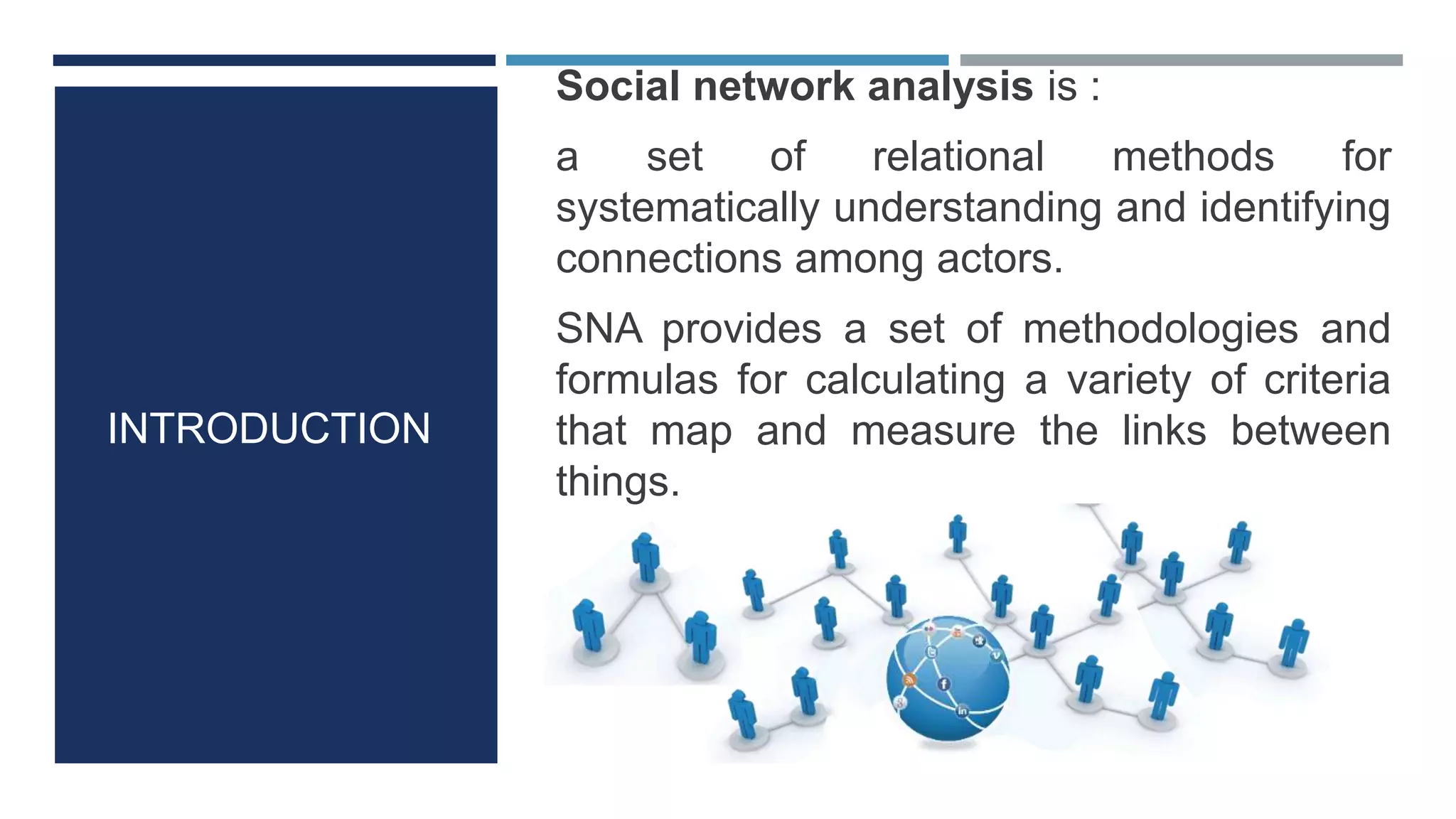
Social network analysis is :
a set of relational methods for
systematically understanding and identifying
connections among actors.
SNA provides a set of methodologies and
formulas for calculating a variety of criteria
that map and measure the links between
things.
INTRODUCTION
 SNA characterizes networked structures in terms of nodes (actors,
people, or things) and ties, edges, or links(relationships) that
connect them.
Example of social structures visualized through sna include social
media network, memes spread, information circulation, disease
transmission, & business networks.
 SNA has emerged as a key technique in modern sociology.
Example biology, communication, economics, geography, political
science, development studies & computer science.
SOCIOLOGICAL THEORIES
 Several sociological theories developed
 Homophily – birds of feather flock together
 Six degrees of separation – Milgram's experiments (1961)
 Strength of weak ties (1973)
 Spread of epidemics / conventions / news
ONLINE SOCIAL NETWORK AND RESEARCHERS
 Huge data readily available
 Volume – petabytes of user-generated content everyday
 Variety – text,image,speech,video...
 Velocity – thousands of post / minute during major events
 Automated data collection rather than surveys
MULTI-DISCIPLINARY RESEARCH ON OSN
 Computer network & distributed systems
 Sociology, social psychology...
 Network Science, complex network theory
 Data mining, machine learning, information retrieval, natural
language processing
SOCIOLOGICAL ISSUES
 Sociological theories investigated on OSNs
 Homophily, strength of weak ties
 Emergence and spread of conventions
 OSNs different from offline SNs in some aspects
 Almost Zero cost of maintaining social links
 Important users readily connect to many ordinary ones
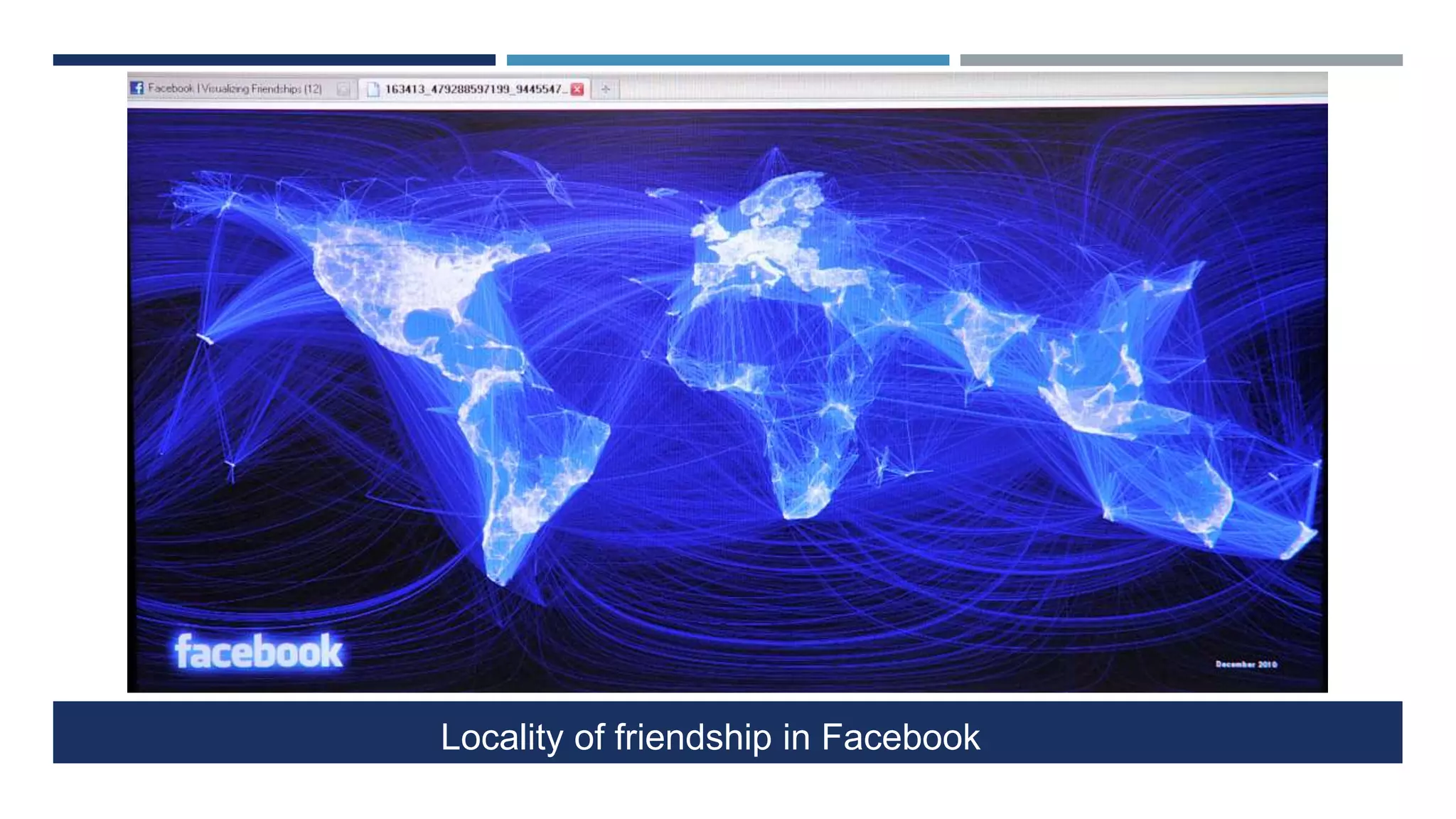
 Geographical distance does not matter
Locality of friendship in Facebook
GRAPH MODELS OF OSN
 Most common representation
 Nodes: users, edges: Social links
 Undirected network: Facebook
 Directed network: Twitter
 Other Variaties
 Network among blogs, videos..
 Bipartite network, viewer-video model of youtube
NETWORK PROPERTY OF OSN
 Most users have few links, few have many links
 Presence of numerous triangle (transitivity)
 Small world, e.g., six degree of separation
 Assortativity,homophily
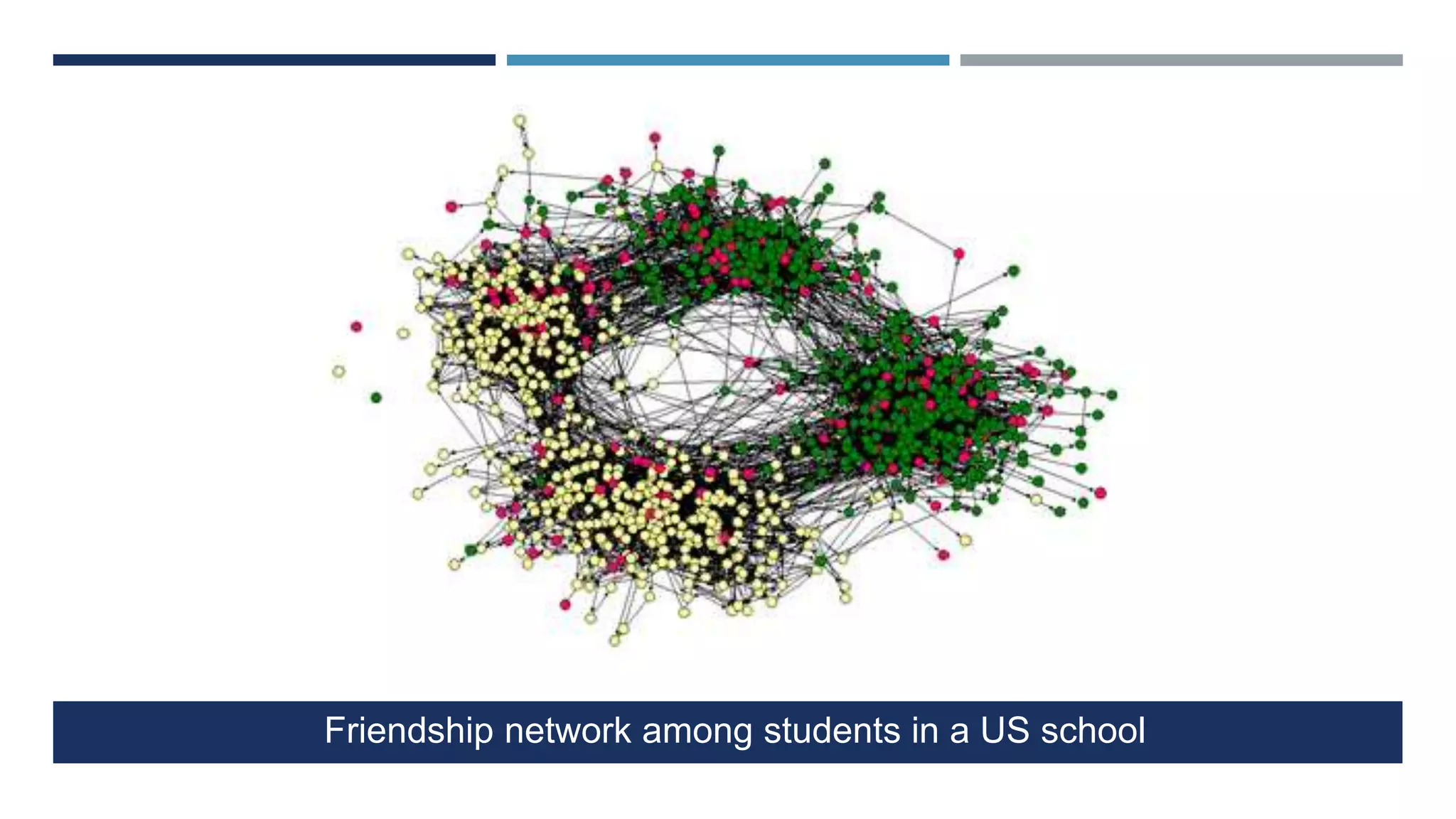
Friendship network among students in a US school
LINK ANALYSIS
 Classification of social links
 Strong and Weak links(e.g. based on level of interaction)
 Some OSN allow positive and negative links (friends and enemies)
 Variation of strength of links with time
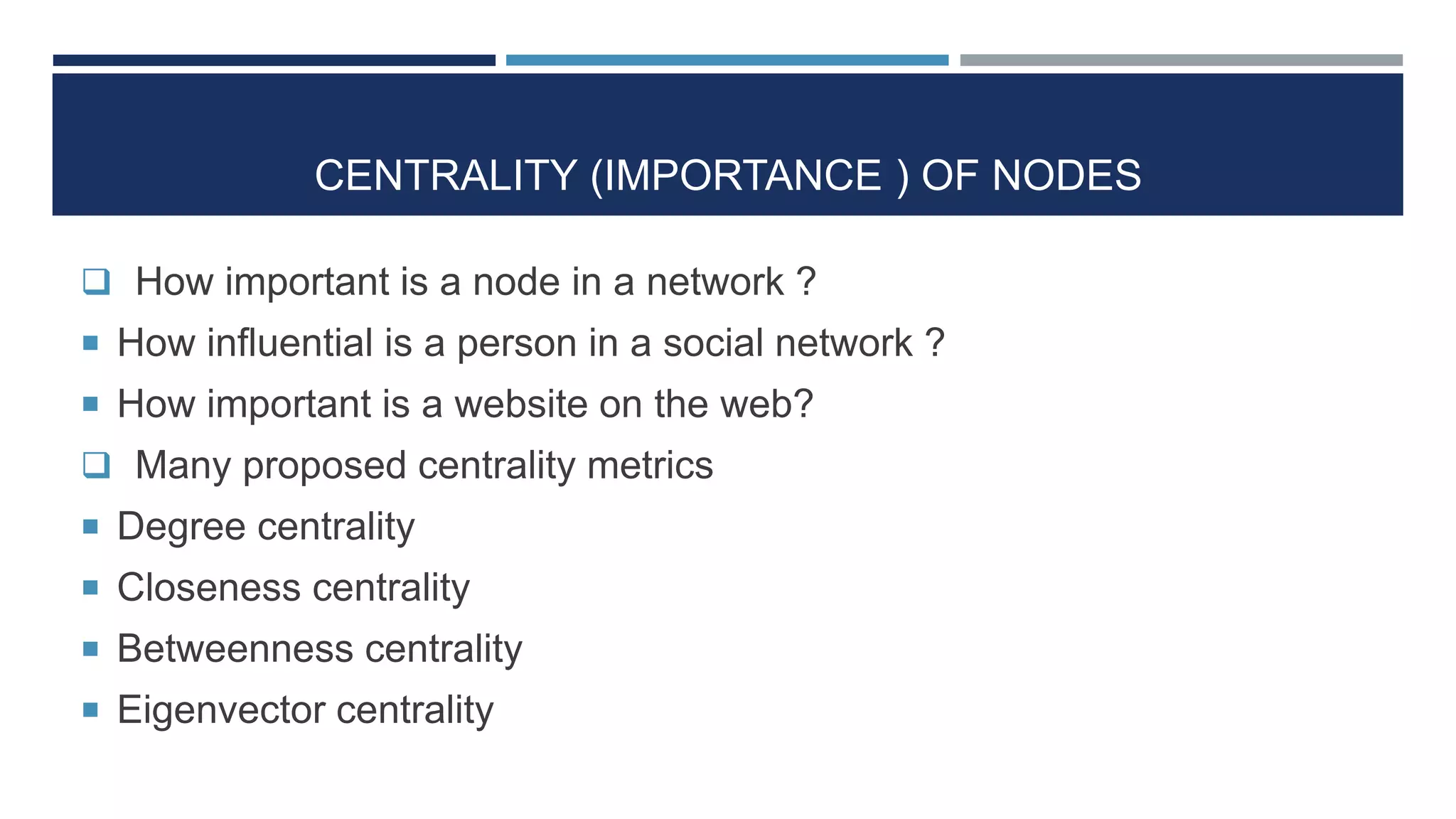
CENTRALITY (IMPORTANCE ) OF NODES
 How important is a node in a network ?
 How influential is a person in a social network ?
 How important is a website on the web?
 Many proposed centrality metrics
 Degree centrality
 Closeness centrality
 Betweenness centrality
 Eigenvector centrality
UTILIZING INFORMATION CONTENT IN
OSN
Recommendations and search
Information diffusion
Spam detection /trust
Authority identification
Identifying news on recent events
Social Recommendations
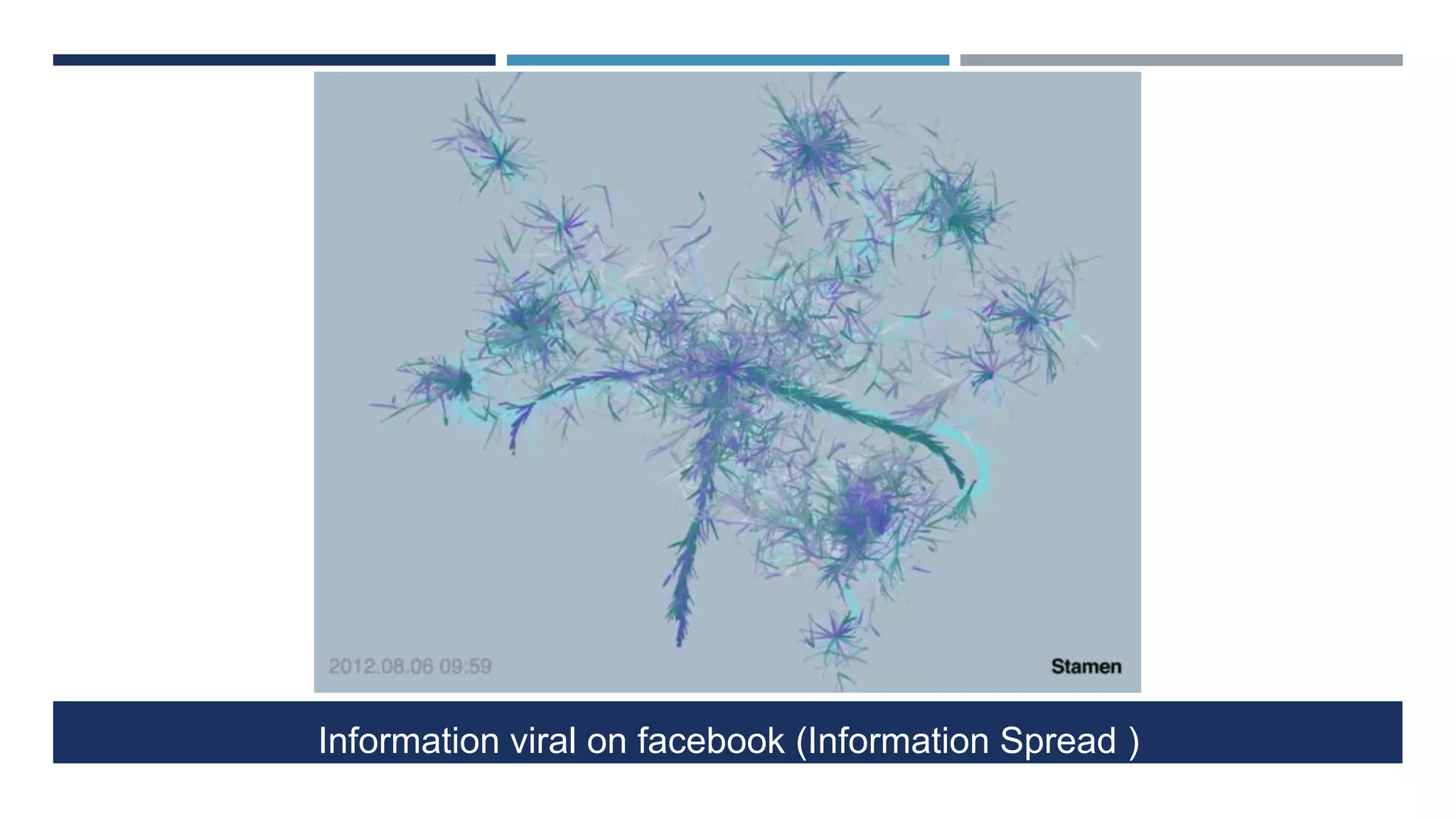
Information viral on facebook (Information Spread )
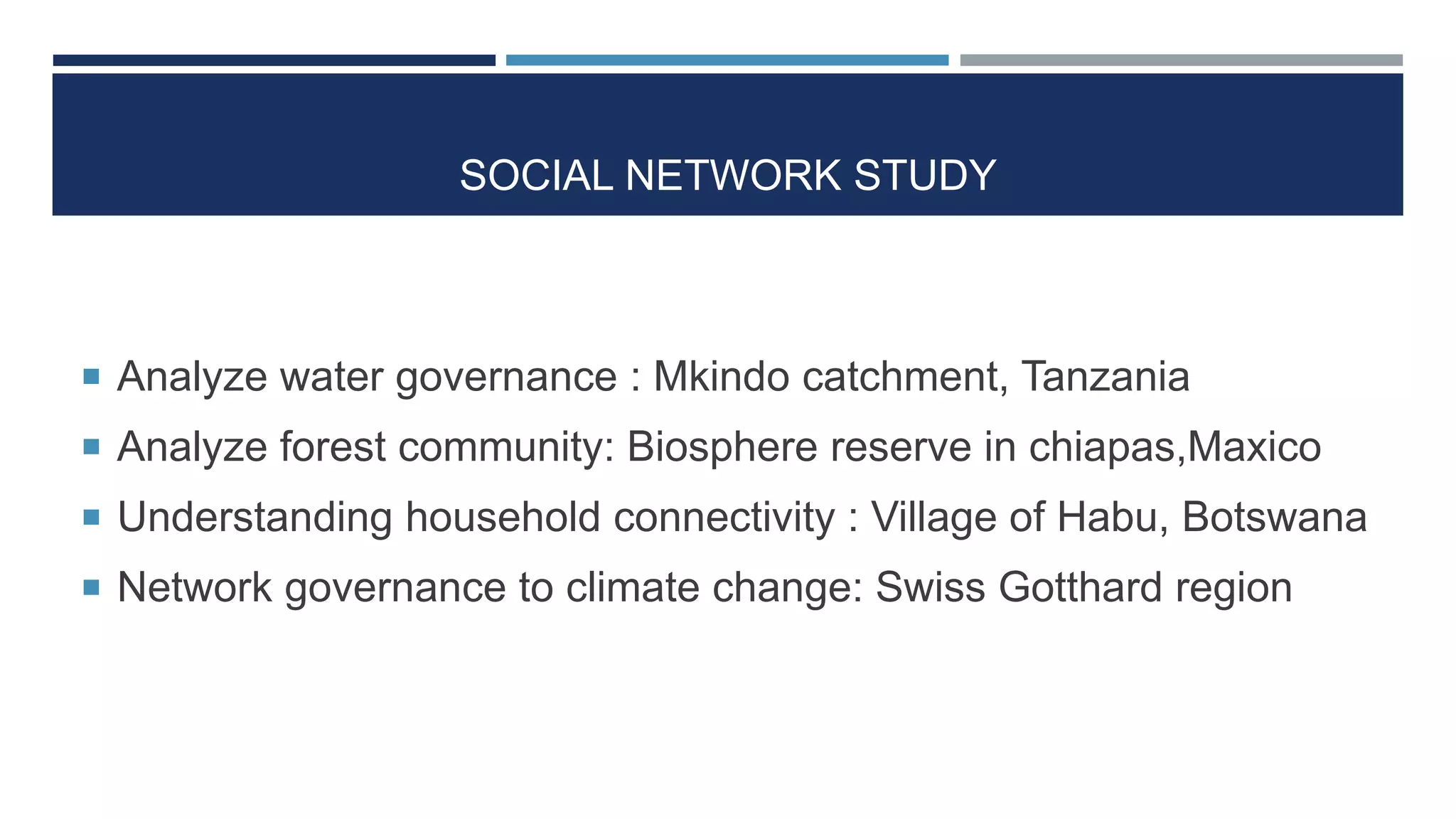
SOCIAL NETWORK STUDY
 Analyze water governance : Mkindo catchment, Tanzania
 Analyze forest community: Biosphere reserve in chiapas,Maxico
 Understanding household connectivity : Village of Habu, Botswana
 Network governance to climate change: Swiss Gotthard region
SOCIAL NETWORK SOFTWARE
 UCINET
 The standard network analysis program, runs in windows
 Not optimal for large network
 PAJEK
 Program for analyzing and plotting very large networks
 Intuitive windows interface
 NetDraw
 Also very new, but by one of the best known names in network
analysis software.
THANK YOU

Social Network Analysis power point presentation

  • 1.
    RATNESH SHAH SOCIAL NETWORKANALYSISSupervisor : Prof. Abhisek Gour Presented By: Ratnesh shah
  • 2.
    INTRODUCTION Social network analysisis : a set of relational methods for systematically understanding and identifying connections among actors. SNA provides a set of methodologies and formulas for calculating a variety of criteria that map and measure the links between things.
  • 3.
    INTRODUCTION  SNA characterizesnetworked structures in terms of nodes (actors, people, or things) and ties, edges, or links(relationships) that connect them. Example of social structures visualized through sna include social media network, memes spread, information circulation, disease transmission, & business networks.  SNA has emerged as a key technique in modern sociology. Example biology, communication, economics, geography, political science, development studies & computer science.
  • 4.
    SOCIOLOGICAL THEORIES  Severalsociological theories developed  Homophily – birds of feather flock together  Six degrees of separation – Milgram's experiments (1961)  Strength of weak ties (1973)  Spread of epidemics / conventions / news
  • 5.
    ONLINE SOCIAL NETWORKAND RESEARCHERS  Huge data readily available  Volume – petabytes of user-generated content everyday  Variety – text,image,speech,video...  Velocity – thousands of post / minute during major events  Automated data collection rather than surveys
  • 6.
    MULTI-DISCIPLINARY RESEARCH ONOSN  Computer network & distributed systems  Sociology, social psychology...  Network Science, complex network theory  Data mining, machine learning, information retrieval, natural language processing
  • 7.
    SOCIOLOGICAL ISSUES  Sociologicaltheories investigated on OSNs  Homophily, strength of weak ties  Emergence and spread of conventions  OSNs different from offline SNs in some aspects  Almost Zero cost of maintaining social links  Important users readily connect to many ordinary ones  Geographical distance does not matter
  • 8.
  • 9.
    GRAPH MODELS OFOSN  Most common representation  Nodes: users, edges: Social links  Undirected network: Facebook  Directed network: Twitter  Other Variaties  Network among blogs, videos..  Bipartite network, viewer-video model of youtube
  • 10.
    NETWORK PROPERTY OFOSN  Most users have few links, few have many links  Presence of numerous triangle (transitivity)  Small world, e.g., six degree of separation  Assortativity,homophily
  • 11.
    Friendship network amongstudents in a US school
  • 12.
    LINK ANALYSIS  Classificationof social links  Strong and Weak links(e.g. based on level of interaction)  Some OSN allow positive and negative links (friends and enemies)  Variation of strength of links with time
  • 13.
    CENTRALITY (IMPORTANCE )OF NODES  How important is a node in a network ?  How influential is a person in a social network ?  How important is a website on the web?  Many proposed centrality metrics  Degree centrality  Closeness centrality  Betweenness centrality  Eigenvector centrality
  • 14.
    UTILIZING INFORMATION CONTENTIN OSN Recommendations and search Information diffusion Spam detection /trust Authority identification Identifying news on recent events
  • 15.
  • 16.
    Information viral onfacebook (Information Spread )
  • 17.
    SOCIAL NETWORK STUDY Analyze water governance : Mkindo catchment, Tanzania  Analyze forest community: Biosphere reserve in chiapas,Maxico  Understanding household connectivity : Village of Habu, Botswana  Network governance to climate change: Swiss Gotthard region
  • 18.
    SOCIAL NETWORK SOFTWARE UCINET  The standard network analysis program, runs in windows  Not optimal for large network  PAJEK  Program for analyzing and plotting very large networks  Intuitive windows interface  NetDraw  Also very new, but by one of the best known names in network analysis software.
  • 19.