Identifying Communities on
Twitter: Time, Topics & Clusters


    Pascal Jürgens (@pascal)
    Dept. of Communication, U of Mainz, Germany


                                                  1
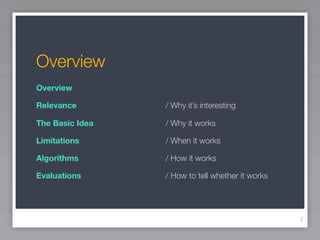
Overview
Overview

Relevance


   / Why it’s interesting

The Basic Idea	
              	    	   	   	   	   / Why it works

Limitations	
           	   	   	   	   	   	   / When it works

Algorithms		   	   	   	   	   	   / How it works

Evaluations	   	   	   	   	   	   / How to tell whether it works


                                                                    2
What Science are we in,
anyways?
“
The antireductionist catch-phrase, “the whole is more than the
sum of its parts,” takes on increasing significance as new
sciences such as chaos, systems biology, evolutionary
economics, and network theory move beyond reductionism to
explain how complex behavior can arise from large collections
of simpler components.
”

Mitchell, 2009 — Complexity: A Guided Tour


                                                                 3
What Science are we in,
anyways?
 Interdisciplinary territory with distinct influences

 20th century Sociology — small-scale social network analysis

 Econometrics — time-series analysis, predictions & forecasting

 Mass Communication — media effects

 Theoretical Physics — abstract, high-level descriptions of
 networks; large-scale network analysis (Why is this even here?)


                                                                   4
What is Community Detection?
“
Communities are groups of vertices which probably share common
properties and/or play similar roles within the graph.
”

Fortunato & Castellano 2009 — Community Structure in Graphs in the
Encyclopedia of Complexity and Systems Science

An exploratory method for partitioning a network into smaller pieces.
In many ways it is comparable to cluster analysis.


                                                                        5
(Caveat Emptor)
 CD is a complex, fairly new set of statistical methods for
 exploratively building groups from data

 So why not use simpler, better-known methods such as
 clustering?

 By all means, use simple methods!
 (but they do something different)


                                                              6
Relevance
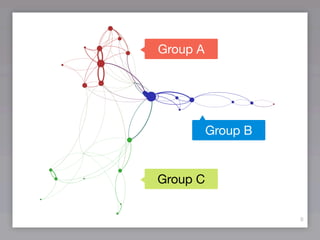
 Networks are a fundamental structure of the world

 There are global properties of networks (diameter &c.)

 There are properties of nodes (centrality &c.)


 However — Networks are almost never homogenous!

 There is a structure hidden within the whole


                                                          7
Group A


          Group B


Group C


                    8
Applications
 Identify separate groups within relevant population for further
 description

 Captures “public sphere” better than aggregates such as
 #hashtags
 (Users who share a #tag might have nothing in common)

 Investigate relationship of communities (mesoscopic graph)

 In general: more accurate, delivers more details


                                                                   9
Terminology
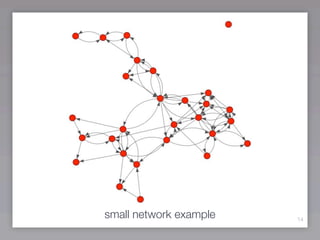
 Graph: A network, consisting of

 nodes (or vertices) such as twitter users
 - with degree = number of connections

 links (or edges) such as relationships via @-messages
 with weight = intensity of links

 Partition: one way to split a network into a set of communities

 (k-) Clique: a set of k completely connected nodes


                                                                   10
The Basic Idea
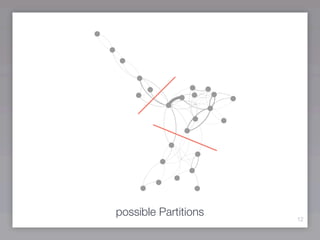
 Communities: Local structures within a network that differ in their
 structure from the surroundings

 A good starting point: communities are better connected among
 themselves than with other communities

 Opens up two obvious methods:

  Add links between close nodes until some condition is met

  Remove links between distant nodes until some condition is met


                                                                       11
possible Partitions   12
The Edge Betweenness
Algorithm (Girvan / Newman)
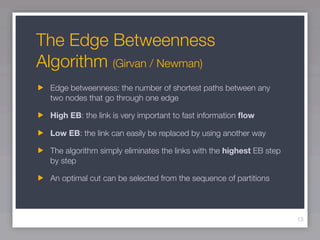
  Edge betweenness: the number of shortest paths between any
  two nodes that go through one edge

  High EB: the link is very important to fast information flow

  Low EB: the link can easily be replaced by using another way

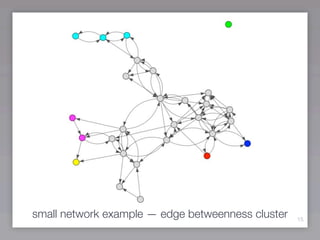
  The algorithm simply eliminates the links with the highest EB step
  by step

  An optimal cut can be selected from the sequence of partitions


                                                                       13
small network example   14
small network example — edge betweenness cluster   15
Limitations — Technical
 The number of potential ways to divide a network grows super-
 exponentially with the number of nodes (!)

 Two critical performance parameters of algorithms: runtime (“Big-
 O”-notation) and memory

 Networks up to 100s of nodes and/or edges — usually OK

 Networks up to 10 000s of nodes and/or edges — buy a lot of
 memory (8GB upwards) and prepare to wait

 Bigger networks: Ask a computer scientist


                                                                     16
Limitations — Methodological
 Quality of partitions — algorithms don’t guarantee best results

 Instability of partitions — algorithms can be non-deterministic and
 very sensitive to small changes

 Evaluation / Comparison of partitions is near-impossible

 Sometimes result is not one best but a whole set of partitions

 Nodes can only belong to one community (!)


                                                                       17
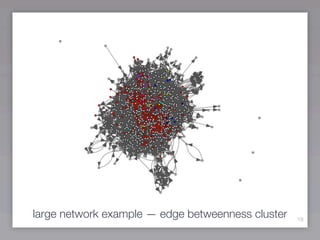
large network example — edge betweenness cluster   18
Notable Algorithms
 The Edge Betweenness Algorithm (Girvan / Newman)

 Markov Cluster Algorithm (MCL, van Dongen, this one is in
 gephi)

 Clique Percolation (CPM, Palla et al.)

 Information theoretical Algorithm (Roswall & Bergstrom, does
 hierarchies and works with communities of very different sizes)


                                                                   19
A Word about MCL
 Marked as experimental in gephi and hard to use (clustering panel
 needs to be open before loading dataset), but the only clustering
 algorithm available

 Based on probability of link use - simulates flow through the
 network

 Often sub-stellar results

 Connection probabilities seem an odd predictor for empirical
 connection habits

 DEMO

                                                                     20
Clique Percolation
 One among several new algorithms that address shortcomings

 Intuitive mechanism

 Nodes can be in several communities!

 Works rather well for dense networks!


                                                              21
Clique Percolation
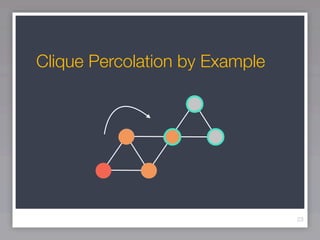
 Idea: Find k-cliques in the network

 Try to “move” the cliques until they reach a bottleneck that they
 can’t fit through

 All the nodes covered by this “trail” are assigned to a community

 Rather easy to implement in software (igraph) plus free
 implementation available (CFinder, cfinder.org)

 DEMO


                                                                     22
Clique Percolation by Example


                                23
Evaluation
 Exploratory methods are notoriously difficult to assess (beyond
 rule-of-thumb judgements).

 Two ways allow rigorous examination:

 Comparison of two partitions

 Comparison of a partition agains a baseline model (zero model)

 Effectively unfeasible for non-mathematicians: Pick a good
 algorithm and treat results with care


                                                                  24
What about user attributes?
 What happens when we use empirical attributes to group users?

 Example of the German General Election 2009: Measured party
 affiliation (wahlgetwitter hashtag +/- convention)

 Turns out, users don’t cluster by party affiliation

 But careful: this approach means measuring with two loose ends

 Clustering baseline needs to be really, really solid


                                                                  25
Takeaway
 Community detection used to be hard but is pretty usable now

 Think about the design and scope of a collected network
 beforehand! (timeframe, directed, size/scope etc.)

 Watch the outliers (Justin Bieber will sink your analysis)

 Choose an algorithm that

  uses directed & weighted links, is understandable, robust

  and one that produces meaningful, simple results!


                                                                26
Thanks!


          27
Literature
 Fortunato, Santo and Castellano, Claudio (2009): Community
 Structure in Graphs. In: Meyers, Robert A. (Ed.): Encyclopedia of
 Complexity and Systems Science. Springer.

 Lancichinetti, Andrea and Fortunato, Santo: Community detection
 algorithms: a comparative analysis. Phys. Review E.

 Mitchell, Melanie (2009): Complexity: A Guided Tour

 Palla, Gergely; Barabási, Albert-László and Vicsek, Tamás ():
 Quantifying social group evolution


                                                                     28

Jürgens diata12-communities

  • 1.
    Identifying Communities on Twitter:Time, Topics & Clusters Pascal Jürgens (@pascal) Dept. of Communication, U of Mainz, Germany 1
  • 2.
    Overview Overview Relevance / Why it’s interesting The Basic Idea / Why it works Limitations / When it works Algorithms / How it works Evaluations / How to tell whether it works 2
  • 3.
    What Science arewe in, anyways? “ The antireductionist catch-phrase, “the whole is more than the sum of its parts,” takes on increasing significance as new sciences such as chaos, systems biology, evolutionary economics, and network theory move beyond reductionism to explain how complex behavior can arise from large collections of simpler components. ” Mitchell, 2009 — Complexity: A Guided Tour 3
  • 4.
    What Science arewe in, anyways? Interdisciplinary territory with distinct influences 20th century Sociology — small-scale social network analysis Econometrics — time-series analysis, predictions & forecasting Mass Communication — media effects Theoretical Physics — abstract, high-level descriptions of networks; large-scale network analysis (Why is this even here?) 4
  • 5.
    What is CommunityDetection? “ Communities are groups of vertices which probably share common properties and/or play similar roles within the graph. ” Fortunato & Castellano 2009 — Community Structure in Graphs in the Encyclopedia of Complexity and Systems Science An exploratory method for partitioning a network into smaller pieces. In many ways it is comparable to cluster analysis. 5
  • 6.
    (Caveat Emptor) CDis a complex, fairly new set of statistical methods for exploratively building groups from data So why not use simpler, better-known methods such as clustering? By all means, use simple methods! (but they do something different) 6
  • 7.
    Relevance Networks area fundamental structure of the world There are global properties of networks (diameter &c.) There are properties of nodes (centrality &c.) However — Networks are almost never homogenous! There is a structure hidden within the whole 7
  • 8.
    Group A Group B Group C 8
  • 9.
    Applications Identify separategroups within relevant population for further description Captures “public sphere” better than aggregates such as #hashtags (Users who share a #tag might have nothing in common) Investigate relationship of communities (mesoscopic graph) In general: more accurate, delivers more details 9
  • 10.
    Terminology Graph: Anetwork, consisting of nodes (or vertices) such as twitter users - with degree = number of connections links (or edges) such as relationships via @-messages with weight = intensity of links Partition: one way to split a network into a set of communities (k-) Clique: a set of k completely connected nodes 10
  • 11.
    The Basic Idea Communities: Local structures within a network that differ in their structure from the surroundings A good starting point: communities are better connected among themselves than with other communities Opens up two obvious methods: Add links between close nodes until some condition is met Remove links between distant nodes until some condition is met 11
  • 12.
  • 13.
    The Edge Betweenness Algorithm(Girvan / Newman) Edge betweenness: the number of shortest paths between any two nodes that go through one edge High EB: the link is very important to fast information flow Low EB: the link can easily be replaced by using another way The algorithm simply eliminates the links with the highest EB step by step An optimal cut can be selected from the sequence of partitions 13
  • 14.
  • 15.
    small network example— edge betweenness cluster 15
  • 16.
    Limitations — Technical The number of potential ways to divide a network grows super- exponentially with the number of nodes (!) Two critical performance parameters of algorithms: runtime (“Big- O”-notation) and memory Networks up to 100s of nodes and/or edges — usually OK Networks up to 10 000s of nodes and/or edges — buy a lot of memory (8GB upwards) and prepare to wait Bigger networks: Ask a computer scientist 16
  • 17.
    Limitations — Methodological Quality of partitions — algorithms don’t guarantee best results Instability of partitions — algorithms can be non-deterministic and very sensitive to small changes Evaluation / Comparison of partitions is near-impossible Sometimes result is not one best but a whole set of partitions Nodes can only belong to one community (!) 17
  • 18.
    large network example— edge betweenness cluster 18
  • 19.
    Notable Algorithms TheEdge Betweenness Algorithm (Girvan / Newman) Markov Cluster Algorithm (MCL, van Dongen, this one is in gephi) Clique Percolation (CPM, Palla et al.) Information theoretical Algorithm (Roswall & Bergstrom, does hierarchies and works with communities of very different sizes) 19
  • 20.
    A Word aboutMCL Marked as experimental in gephi and hard to use (clustering panel needs to be open before loading dataset), but the only clustering algorithm available Based on probability of link use - simulates flow through the network Often sub-stellar results Connection probabilities seem an odd predictor for empirical connection habits DEMO 20
  • 21.
    Clique Percolation Oneamong several new algorithms that address shortcomings Intuitive mechanism Nodes can be in several communities! Works rather well for dense networks! 21
  • 22.
    Clique Percolation Idea:Find k-cliques in the network Try to “move” the cliques until they reach a bottleneck that they can’t fit through All the nodes covered by this “trail” are assigned to a community Rather easy to implement in software (igraph) plus free implementation available (CFinder, cfinder.org) DEMO 22
  • 23.
  • 24.
    Evaluation Exploratory methodsare notoriously difficult to assess (beyond rule-of-thumb judgements). Two ways allow rigorous examination: Comparison of two partitions Comparison of a partition agains a baseline model (zero model) Effectively unfeasible for non-mathematicians: Pick a good algorithm and treat results with care 24
  • 25.
    What about userattributes? What happens when we use empirical attributes to group users? Example of the German General Election 2009: Measured party affiliation (wahlgetwitter hashtag +/- convention) Turns out, users don’t cluster by party affiliation But careful: this approach means measuring with two loose ends Clustering baseline needs to be really, really solid 25
  • 26.
    Takeaway Community detectionused to be hard but is pretty usable now Think about the design and scope of a collected network beforehand! (timeframe, directed, size/scope etc.) Watch the outliers (Justin Bieber will sink your analysis) Choose an algorithm that uses directed & weighted links, is understandable, robust and one that produces meaningful, simple results! 26
  • 27.
  • 28.
    Literature Fortunato, Santoand Castellano, Claudio (2009): Community Structure in Graphs. In: Meyers, Robert A. (Ed.): Encyclopedia of Complexity and Systems Science. Springer. Lancichinetti, Andrea and Fortunato, Santo: Community detection algorithms: a comparative analysis. Phys. Review E. Mitchell, Melanie (2009): Complexity: A Guided Tour Palla, Gergely; Barabási, Albert-László and Vicsek, Tamás (): Quantifying social group evolution 28