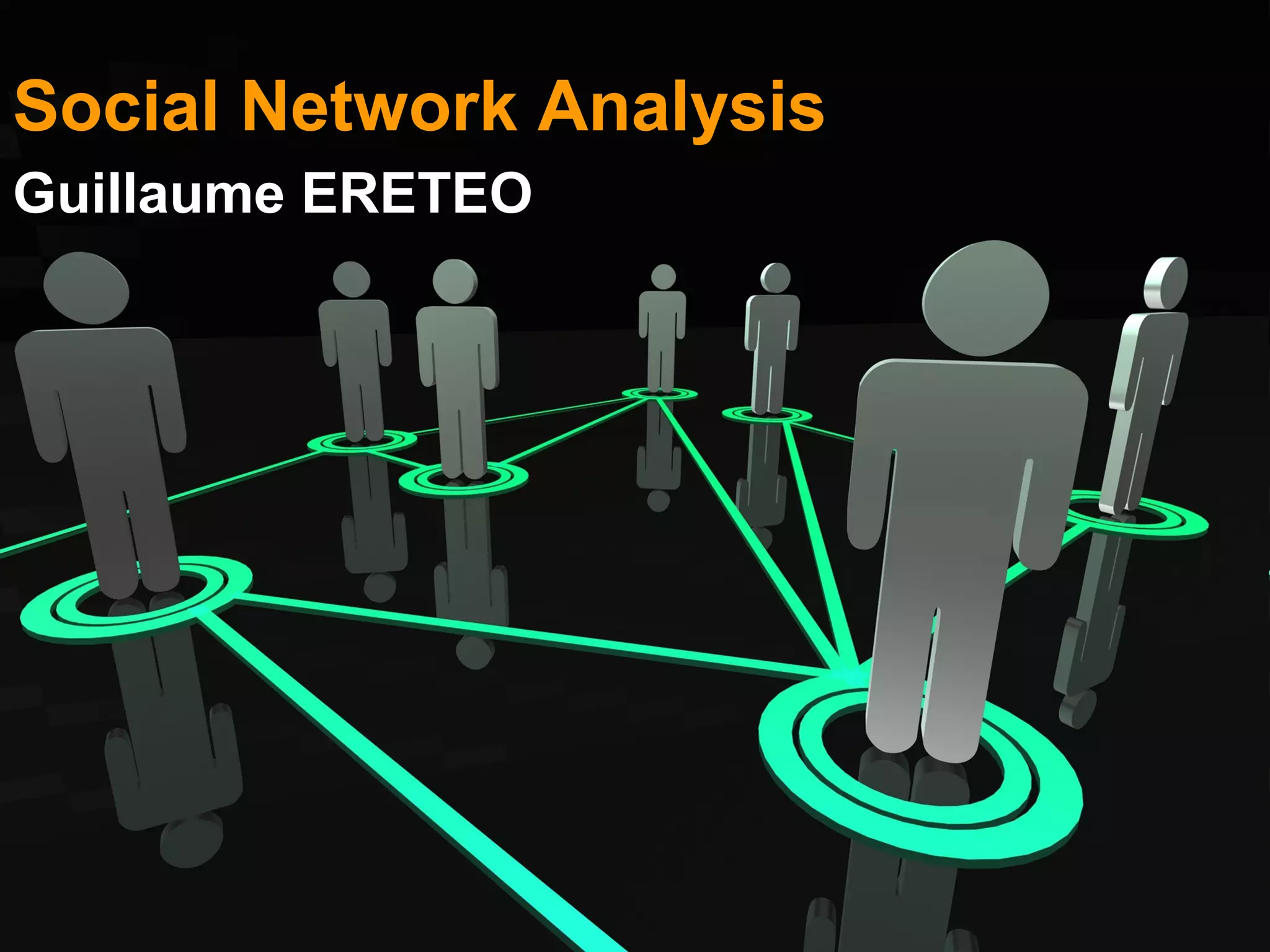
Social Network Analysis
Guillaume ERETEO
Social Networks
A social network is made of actors (people,
organizations, group) that are tied by social links.
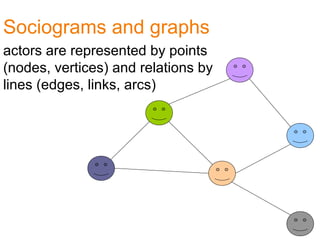
Sociograms and graphs
actors are represented by points
(nodes, vertices) and relations by
lines (edges, links, arcs)
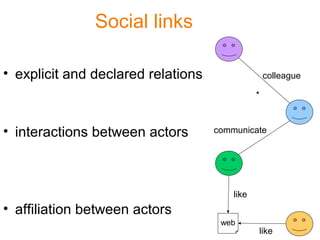
• explicit and declared relations
• interactions between actors
• affiliation between actors
Social links
colleague
communicate
like
like
web
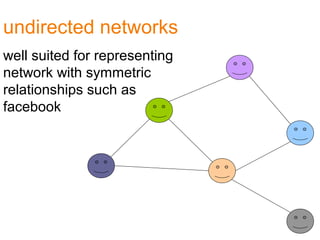
undirected networks
well suited for representing
network with symmetric
relationships such as
facebook
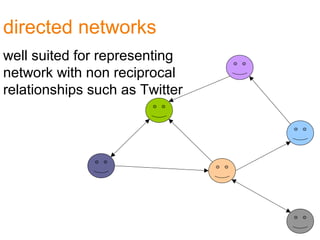
directed networks
well suited for representing
network with non reciprocal
relationships such as Twitter
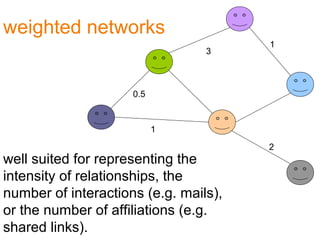
weighted networks
well suited for representing the
intensity of relationships, the
number of interactions (e.g. mails),
or the number of affiliations (e.g.
shared links).
1
0.5
1
2
3
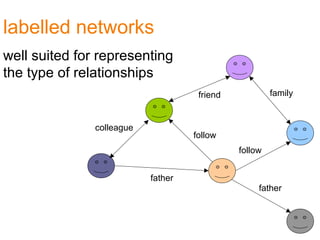
labelled networks
well suited for representing
the type of relationships
family
colleague
father
friend
follow
follow
father
Social network analysis
helps understanding and exploiting the key
features of social networks in order to manage
their assets, their life cycle and predict their
evolution.
What for?
• To control information flow
• To foster communication
• To improve network resilience
• To trust or not
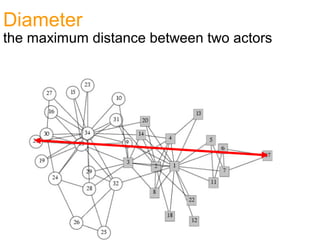
Diameter
the maximum distance between two actors
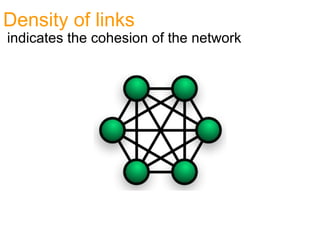
Density of links
indicates the cohesion of the network
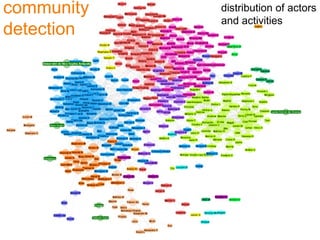
community
detection
distribution of actors
and activities
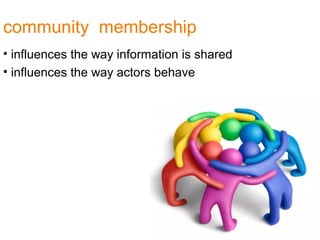
community membership
• influences the way information is shared
• influences the way actors behave
Centrality: strategic positions
degree centrality focuses on
the number of relations:
reveal local popularity
[Freeman 1979]
Centrality: strategic positions
closeness centrality focuses on
the proximity of actors:
reveal capacity to communicate
[Freeman 1979]
Centrality: strategic positions
beetweenness centrality focuses
on intermediary actors
reveals brokers and privileged
actor in the information flow
[Freeman 1979]
"A place for good ideas"
[Burt 1992] [Burt 2004]
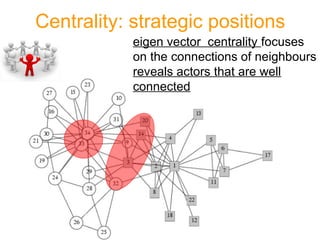
Centrality: strategic positions
eigen vector centrality focuses
on the connections of neighbours
reveals actors that are well
connected
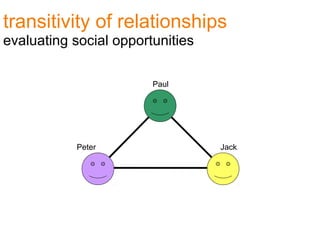
transitivity of relationships
evaluating social opportunities
Peter Jack
Paul
tendency to bind with similar others
"Birds of a feather flock together"
"interaction produces similarity, while
similarity produces interaction"
[Mika 2005]
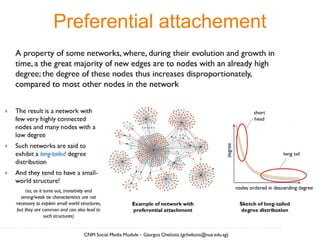
Preferential attachement
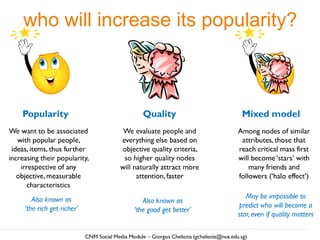
who will increase its popularity?
Balance Theory
[Heider 1958]
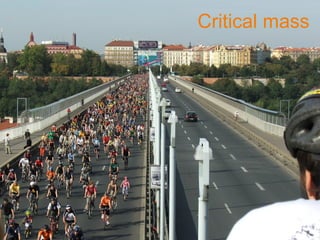
Critical mass
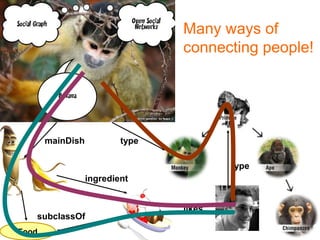
Many ways of
connecting people!
likes
ingredient
typemainDish
Food
subclassOf
type
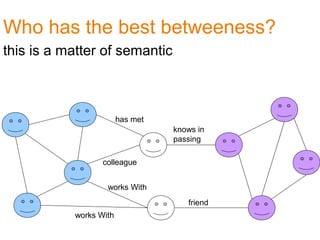
Who has the best betweeness?
this is a matter of semantic
knows in
passing
has met
colleague
works With
works With
friend
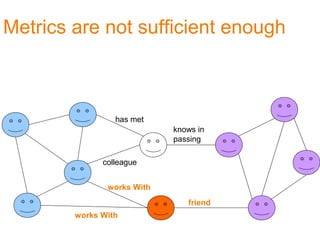
Metrics are not sufficient enough
knows in
passing
has met
colleague
works With
works With
friend
examples of vizualisation and
analysis tools
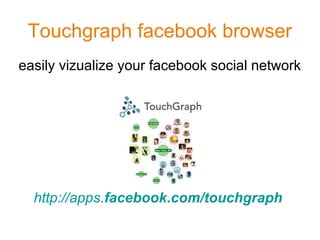
Touchgraph facebook browser
easily vizualize your facebook social network
http://apps.facebook.com/touchgraph
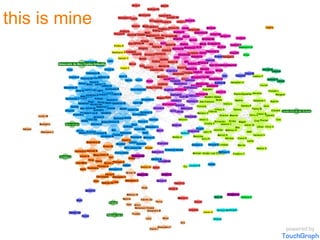
this is mine
Analyze your facebook network
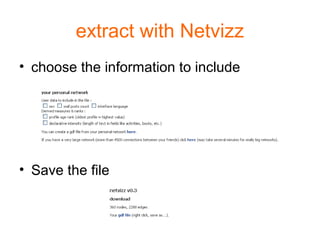
1. Extract it first with netvizz: http://
apps.facebook.com/netvizz
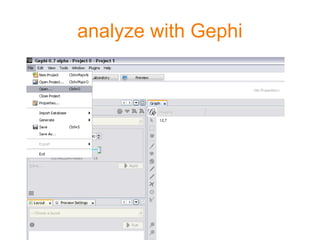
2. Open it with my favorite graph
visualization tool: Gephi http://
www.gephi.org
extract with Netvizz
• choose the information to include
• Save the file
analyze with Gephi
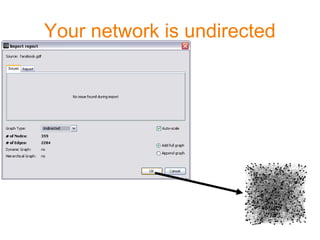
Your network is undirected
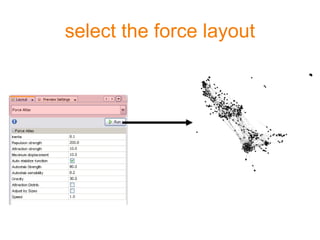
select the force layout
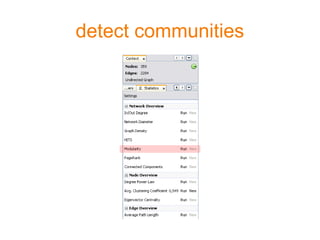
detect communities
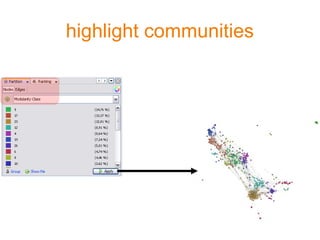
highlight communities
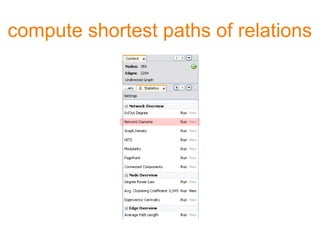
compute shortest paths of relations
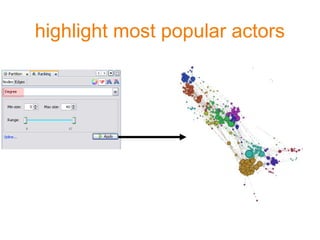
highlight most popular actors
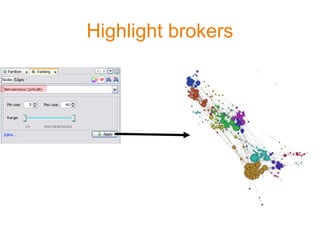
Highlight brokers
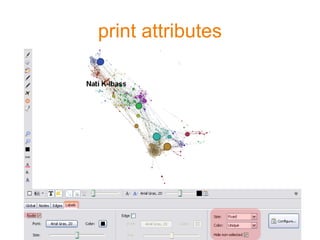
print attributes
NODEXL
• Excel 2007 based social network
visualization and analysis tool
• Homepage http://nodexl.codeplex.com
• Tutorial
http://casci.umd.edu/images/4/46/NodeXL_tuto
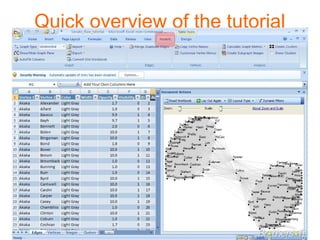
Quick overview of the tutorial
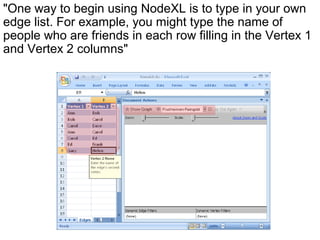
"One way to begin using NodeXL is to type in your own
edge list. For example, you might type the name of
people who are friends in each row filling in the Vertex 1
and Vertex 2 columns"
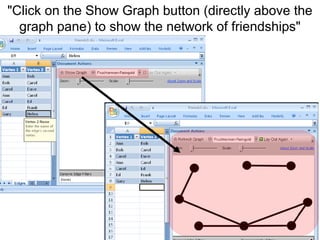
"Click on the Show Graph button (directly above the
graph pane) to show the network of friendships"
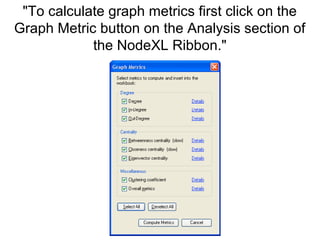
"To calculate graph metrics first click on the
Graph Metric button on the Analysis section of
the NodeXL Ribbon."
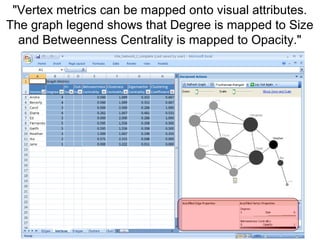
"Vertex metrics can be mapped onto visual attributes.
The graph legend shows that Degree is mapped to Size
and Betweenness Centrality is mapped to Opacity."
You can now handle your
social capital
The social capital is the "resources embedded in one's
social networks, resources that can be accessed or
mobilized through ties in the networks" [Lin 2008]
http://www.kstoolkit.org/Social+Network+Analysis
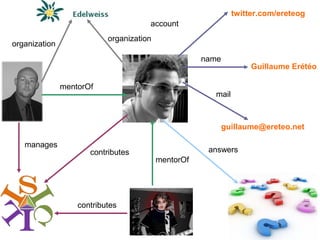
name
Guillaume Erétéo
account
guillaume@ereteo.net
mail
mentorOf
mentorOf
organization
organization
manages
contributes
contributes answers
twitter.com/ereteog

Social network analysis course 2010 - 2011

Editor's Notes

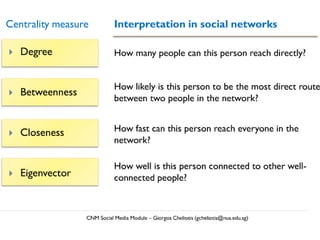
  • #12 The centrality highlights the most important actors of the network and three definitions have been proposed by Freeman. The degree centrality considers nodes with the higher degrees (number of adjacent edges). The closeness centrality is based on the average length of the paths linking a node to others and reveals the capacity of a node to be reached. The betweenness centrality focuses on the capacity of a node to be an intermediary between any two other nodes. A network is highly dependent on actors with high betweenness centrality due to their position as intermediaries and brokers in information flow.
  • #13 The centrality highlights the most important actors of the network and three definitions have been proposed by Freeman. The degree centrality considers nodes with the higher degrees (number of adjacent edges). The closeness centrality is based on the average length of the paths linking a node to others and reveals the capacity of a node to be reached. The betweenness centrality focuses on the capacity of a node to be an intermediary between any two other nodes. A network is highly dependent on actors with high betweenness centrality due to their position as intermediaries and brokers in information flow.
  • #14 Community detection helps understanding the global structure of a network and the distribution of actors and activities. Moreover, the community structure influences the way information is shared and the way actors behave. Information spread quickly in a community and is shared by most of it members.
  • #15 Community detection helps understanding the global structure of a network and the distribution of actors and activities. Moreover, the community structure influences the way information is shared and the way actors behave. Information spread quickly in a community and is shared by most of it members.
  • #16 The centrality highlights the most important actors of the network and three definitions have been proposed by Freeman. The degree centrality considers nodes with the higher degrees (number of adjacent edges). The closeness centrality is based on the average length of the paths linking a node to others and reveals the capacity of a node to be reached. The betweenness centrality focuses on the capacity of a node to be an intermediary between any two other nodes. A network is highly dependent on actors with high betweenness centrality due to their position as intermediaries and brokers in information flow.
  • #17 The centrality highlights the most important actors of the network and three definitions have been proposed by Freeman. The degree centrality considers nodes with the higher degrees (number of adjacent edges). The closeness centrality is based on the average length of the paths linking a node to others and reveals the capacity of a node to be reached. The betweenness centrality focuses on the capacity of a node to be an intermediary between any two other nodes. A network is highly dependent on actors with high betweenness centrality due to their position as intermediaries and brokers in information flow.
  • #18 The centrality highlights the most important actors of the network and three definitions have been proposed by Freeman. The degree centrality considers nodes with the higher degrees (number of adjacent edges). The closeness centrality is based on the average length of the paths linking a node to others and reveals the capacity of a node to be reached. The betweenness centrality focuses on the capacity of a node to be an intermediary between any two other nodes. A network is highly dependent on actors with high betweenness centrality due to their position as intermediaries and brokers in information flow.
  • #19 The centrality highlights the most important actors of the network and three definitions have been proposed by Freeman. The degree centrality considers nodes with the higher degrees (number of adjacent edges). The closeness centrality is based on the average length of the paths linking a node to others and reveals the capacity of a node to be reached. The betweenness centrality focuses on the capacity of a node to be an intermediary between any two other nodes. A network is highly dependent on actors with high betweenness centrality due to their position as intermediaries and brokers in information flow.
  • #25 La théorie de l'équilibre de Heider considère que le produit des sentiments dans un réseaux social doit être positif pour que les interactions dans le réseau soient dans un état d'équilibre.
  • #26 "Il semble que le terme « masse critique » vienne d'une observation du trafic routier en Chine, où sans feux de signalisation aux croisements, les cyclistes attendent d'être assez nombreux, de faire masse pour s'engager et traverser ensemble. " Le principe de masse critique dans un réseau social correspond à un niveau d'activité à partir duquel le réseau change d'état de manière permanente. Par exemple, à partir d'un certain nombre de personne et d'un volume d'activité minimale d'interaction, un groupe de personne devient une communauté d'intérêt.
  • #27 Semantic Web benefit: Platform interoperability, common models Structured Actors, structured resources Different semantic link  different community detection perspectives  cross communities membership!!! Semantic of interaction  semantic community detection!!!
  • #32 Community detection helps understanding the global structure of a network and the distribution of actors and activities. Moreover, the community structure influences the way information is shared and the way actors behave. Information spread quickly in a community and is shared by most of it members.