Chapter 1 A Brief History of Microbiology
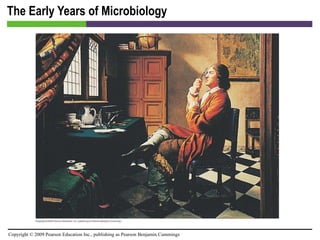
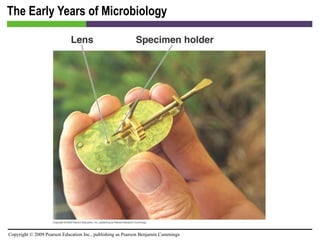
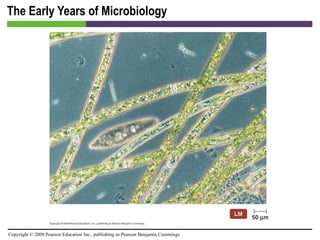
The Early Years of Microbiology What Does Life Really Look Like? Antoni van Leeuwenhoek (Dutch) Began making and using simple microscopes Often made a new microscope for each specimen Examined water and visualized tiny animals, fungi, algae, and single-celled protozoa; “animalcules” By end of 19th century, these organisms were called microorganisms
The Early Years of Microbiology
The Early Years of Microbiology How Can Microbes Be Classified? Carolus Linnaeus (Swedish) developed taxonomic system for naming plants and animals and grouping similar organisms together Leeuwenhoek’s microorganisms grouped into six categories as follows:  Fungi Protozoa Algae Bacteria Archaea Small animals
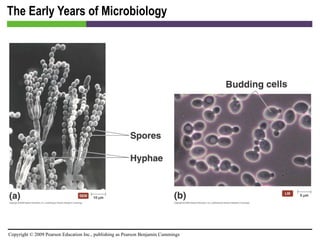
The Early Years of Microbiology Fungi Eukaryotic (have membrane-bound nucleus) Obtain food from other organisms Possess cell walls Composed of Molds – multicellular; have hyphae; reproduce by sexual and asexual spores Yeasts – unicellular; reproduce asexually by budding; some produce sexual spores
The Early Years of Microbiology
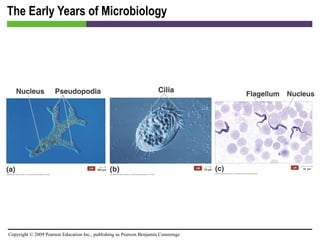
The Early Years of Microbiology Protozoa Single-celled eukaryotes Similar to animals in nutrient needs and cellular structure Live freely in water; some live in animal hosts Asexual (most) and sexual reproduction Most are capable of locomotion by Pseudopodia – cell extensions that flow in direction of travel Cilia – numerous, short, hairlike protrusions that propel organisms through environment Flagella – extensions of a cell that are fewer, longer, and more whiplike than cilia
The Early Years of Microbiology
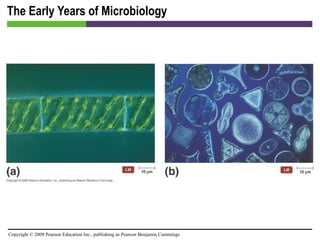
The Early Years of Microbiology Algae Unicellular or multicellular Photosynthetic Simple reproductive structures Categorized on the basis of pigmentation, storage products, and composition of cell wall
The Early Years of Microbiology
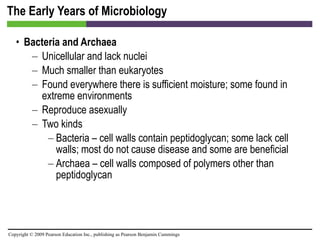
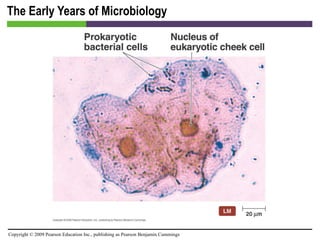
The Early Years of Microbiology Bacteria and Archaea Unicellular and lack nuclei Much smaller than eukaryotes Found everywhere there is sufficient moisture; some found in extreme environments Reproduce asexually Two kinds Bacteria – cell walls contain peptidoglycan; some lack cell walls; most do not cause disease and some are beneficial Archaea – cell walls composed of polymers other than peptidoglycan
The Early Years of Microbiology
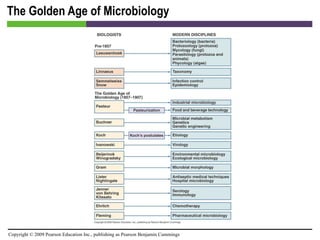
The Golden Age of Microbiology Scientists searched for answers to four questions Is spontaneous generation of microbial life possible? What causes fermentation? What causes disease? How can we prevent infection and disease?
The Golden Age of Microbiology Some philosophers and scientists of the past thought living things arose from three processes: asexual reproduction, sexual reproduction, or from nonliving matter Aristotle proposed spontaneous generation – living things can arise from nonliving matter
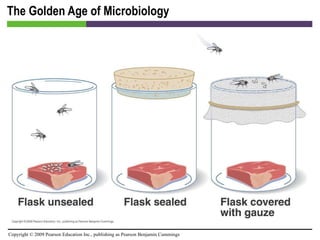
The Golden Age of Microbiology Redi’s Experiments When decaying meat was kept isolated from flies, maggots never developed Meat exposed to flies was soon infested As a result, scientists began to doubt Aristotle’s theory
The Golden Age of Microbiology
The Golden Age of Microbiology Needham’s Experiments Scientists did not believe animals could arise spontaneously, but did believe microbes could Needham’s experiments with beef gravy and infusions of plant material reinforced this idea
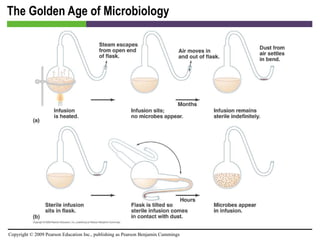
The Golden Age of Microbiology Spallanzani’s Experiments Concluded that Needham failed to heat vials sufficiently to kill all microbes or had not sealed vials tightly enough Microorganisms exist in air and can contaminate experiments Spontaneous generation of microorganisms does not occur Critics said sealed vials did not allow enough air for organisms to survive and that prolonged heating destroyed “life force”
The Golden Age of Microbiology
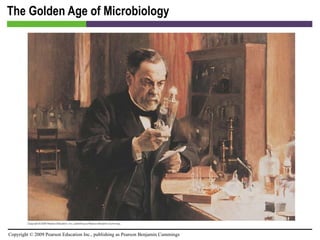
The Golden Age of Microbiology Pasteur’s Experiments When the “swan-necked flasks” remained upright, no microbial growth appeared When the flask was tilted, dust from the bend in the neck seeped back into the flask and made the infusion cloudy with microbes within a day
The Golden Age of Microbiology
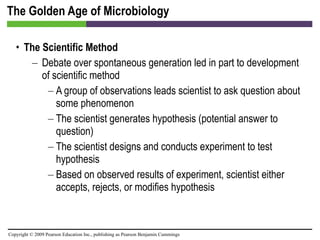
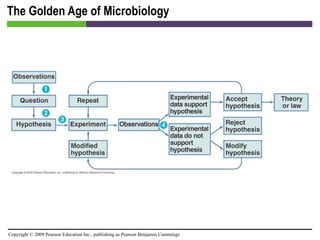
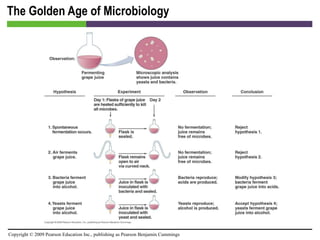
The Golden Age of Microbiology The Scientific Method Debate over spontaneous generation led in part to development of scientific method A group of observations leads scientist to ask question about some phenomenon The scientist generates hypothesis (potential answer to question) The scientist designs and conducts experiment to test hypothesis Based on observed results of experiment, scientist either accepts, rejects, or modifies hypothesis
The Golden Age of Microbiology
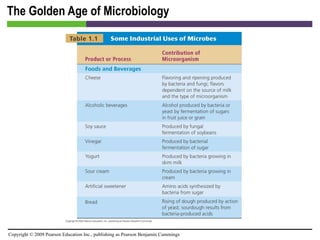
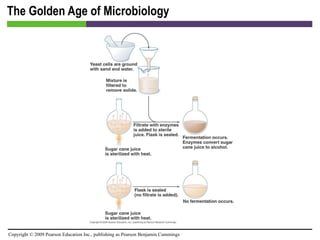
The Golden Age of Microbiology What Causes Fermentation? Spoiled wine threatened livelihood of vintners, compelling them to fund research into how to promote production of alcohol but prevent spoilage by acid during fermentation Some believed air caused fermentation reactions, while others insisted living organisms caused fermentation This debate also linked to debate over spontaneous generation
The Golden Age of Microbiology
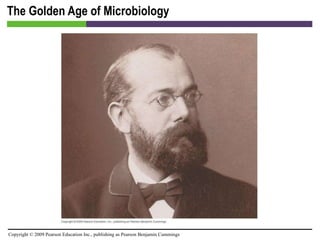
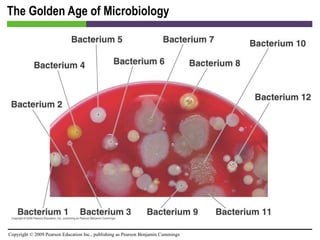
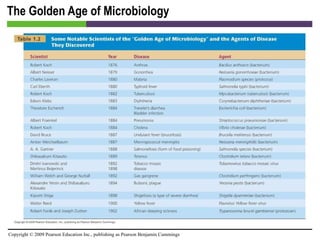
The Golden Age of Microbiology What Causes Disease? Pasteur developed germ theory of disease Robert Koch studied causative agents of disease Anthrax Examined colonies of microorganisms
The Golden Age of Microbiology
The Golden Age of Microbiology Koch’s Experiments Simple staining techniques First photomicrograph of bacteria First photomicrograph of bacteria in diseased tissue Techniques for estimating CFU/ml Use of steam to sterilize media Use of Petri dishes Aseptic techniques Bacteria as distinct species
The Golden Age of Microbiology
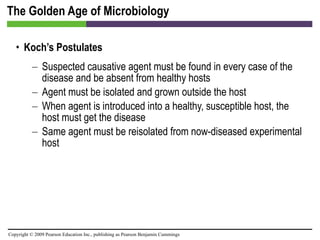
The Golden Age of Microbiology Koch’s Postulates Suspected causative agent must be found in every case of the disease and be absent from healthy hosts Agent must be isolated and grown outside the host When agent is introduced into a healthy, susceptible host, the host must get the disease Same agent must be reisolated from now-diseased experimental host
The Golden Age of Microbiology
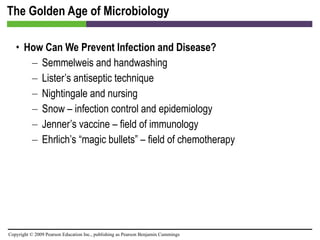
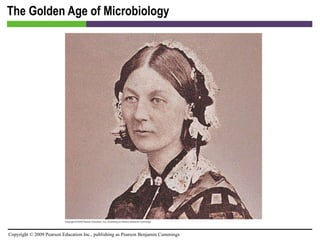
The Golden Age of Microbiology How Can We Prevent Infection and Disease? Semmelweis and handwashing Lister’s antiseptic technique Nightingale and nursing Snow – infection control and epidemiology Jenner’s vaccine – field of immunology Ehrlich’s “magic bullets” – field of chemotherapy
The Golden Age of Microbiology
The Modern Age of Microbiology
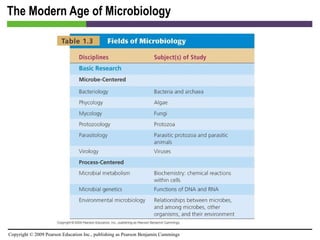
The Modern Age of Microbiology What Are the Basic Chemical Reactions of Life?  Biochemistry Began with Pasteur’s work on fermentation and Buchner’s discovery of enzymes in yeast extract Kluyver and van Niel – microbes used as model systems for biochemical reactions Practical applications Design of herbicides and pesticides Diagnosis of illnesses and monitoring of patients’ responses to treatment Treatment of metabolic diseases Drug design
The Modern Age of Microbiology How Do Genes Work? Microbial genetics Molecular biology Recombinant DNA technology Gene therapy
The Modern Age of Microbiology Microbial Genetics Avery, MacLeod, and McCarty determined genes are contained in molecules of DNA Beadle and Tatum established that a gene’s activity is related to protein function T ranslation of genetic information into protein explained Rates and mechanisms of genetic mutation investigated Control of genetic expression by cells described
The Modern Age of Microbiology Molecular Biology Explanation of cell function at the molecular level Genome sequencing Pauling proposed that gene sequences could Provide understanding of evolutionary relationships and processes Establish taxonomic categories that reflect these relationships Identify existence of microbes that have never been cultured Woese determined that cells belong to bacteria, archaea, or eukaryotes Cat-scratch fever caused by unculturable organism
The Modern Age of Microbiology Recombinant DNA Technology Genes in microbes, plants, and animals manipulated for practical applications Production of human blood-clotting factor by  E. coli  to aid hemophiliacs Gene Therapy Inserting a missing gene or repairing a defective one in humans by inserting desired gene into host cells
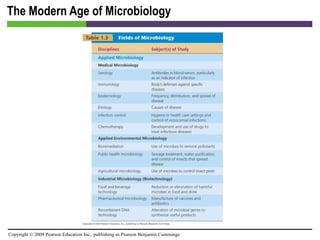
The Modern Age of Microbiology What Role Do Microorganisms Play in the Environment?   Bioremediation uses living bacteria, fungi, and algae to detoxify polluted environments Recycling of chemicals such as carbon, nitrogen, and sulfur
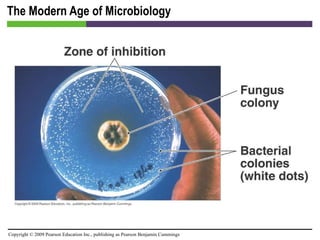
The Modern Age of Microbiology How Do We Defend Against Disease? Serology The study of blood serum Von Behring and Kitasato – existence in the blood of chemicals and cells that fight infection Immunology The study of the body’s defense against specific pathogens Chemotherapy Fleming discovered penicillin Domagk discovered sulfa drugs
The Modern Age of Microbiology
The Modern Age of Microbiology What Will the Future Hold?   Microbiology is built on asking and answering questions The more questions we answer, the more questions we have

C:\Fakepath\ Start Here Ch01 Lecture

  • 1.
    Chapter 1 ABrief History of Microbiology
  • 2.
    The Early Yearsof Microbiology What Does Life Really Look Like? Antoni van Leeuwenhoek (Dutch) Began making and using simple microscopes Often made a new microscope for each specimen Examined water and visualized tiny animals, fungi, algae, and single-celled protozoa; “animalcules” By end of 19th century, these organisms were called microorganisms
  • 3.
    The Early Yearsof Microbiology
  • 4.
    The Early Yearsof Microbiology
  • 5.
    The Early Yearsof Microbiology
  • 6.
    The Early Yearsof Microbiology How Can Microbes Be Classified? Carolus Linnaeus (Swedish) developed taxonomic system for naming plants and animals and grouping similar organisms together Leeuwenhoek’s microorganisms grouped into six categories as follows: Fungi Protozoa Algae Bacteria Archaea Small animals
  • 7.
    The Early Yearsof Microbiology Fungi Eukaryotic (have membrane-bound nucleus) Obtain food from other organisms Possess cell walls Composed of Molds – multicellular; have hyphae; reproduce by sexual and asexual spores Yeasts – unicellular; reproduce asexually by budding; some produce sexual spores
  • 8.
    The Early Yearsof Microbiology
  • 9.
    The Early Yearsof Microbiology Protozoa Single-celled eukaryotes Similar to animals in nutrient needs and cellular structure Live freely in water; some live in animal hosts Asexual (most) and sexual reproduction Most are capable of locomotion by Pseudopodia – cell extensions that flow in direction of travel Cilia – numerous, short, hairlike protrusions that propel organisms through environment Flagella – extensions of a cell that are fewer, longer, and more whiplike than cilia
  • 10.
    The Early Yearsof Microbiology
  • 11.
    The Early Yearsof Microbiology Algae Unicellular or multicellular Photosynthetic Simple reproductive structures Categorized on the basis of pigmentation, storage products, and composition of cell wall
  • 12.
    The Early Yearsof Microbiology
  • 13.
    The Early Yearsof Microbiology Bacteria and Archaea Unicellular and lack nuclei Much smaller than eukaryotes Found everywhere there is sufficient moisture; some found in extreme environments Reproduce asexually Two kinds Bacteria – cell walls contain peptidoglycan; some lack cell walls; most do not cause disease and some are beneficial Archaea – cell walls composed of polymers other than peptidoglycan
  • 14.
    The Early Yearsof Microbiology
  • 15.
    The Early Yearsof Microbiology
  • 16.
    The Early Yearsof Microbiology
  • 17.
    The Golden Ageof Microbiology Scientists searched for answers to four questions Is spontaneous generation of microbial life possible? What causes fermentation? What causes disease? How can we prevent infection and disease?
  • 18.
    The Golden Ageof Microbiology Some philosophers and scientists of the past thought living things arose from three processes: asexual reproduction, sexual reproduction, or from nonliving matter Aristotle proposed spontaneous generation – living things can arise from nonliving matter
  • 19.
    The Golden Ageof Microbiology Redi’s Experiments When decaying meat was kept isolated from flies, maggots never developed Meat exposed to flies was soon infested As a result, scientists began to doubt Aristotle’s theory
  • 20.
    The Golden Ageof Microbiology
  • 21.
    The Golden Ageof Microbiology Needham’s Experiments Scientists did not believe animals could arise spontaneously, but did believe microbes could Needham’s experiments with beef gravy and infusions of plant material reinforced this idea
  • 22.
    The Golden Ageof Microbiology Spallanzani’s Experiments Concluded that Needham failed to heat vials sufficiently to kill all microbes or had not sealed vials tightly enough Microorganisms exist in air and can contaminate experiments Spontaneous generation of microorganisms does not occur Critics said sealed vials did not allow enough air for organisms to survive and that prolonged heating destroyed “life force”
  • 23.
    The Golden Ageof Microbiology
  • 24.
    The Golden Ageof Microbiology Pasteur’s Experiments When the “swan-necked flasks” remained upright, no microbial growth appeared When the flask was tilted, dust from the bend in the neck seeped back into the flask and made the infusion cloudy with microbes within a day
  • 25.
    The Golden Ageof Microbiology
  • 26.
    The Golden Ageof Microbiology The Scientific Method Debate over spontaneous generation led in part to development of scientific method A group of observations leads scientist to ask question about some phenomenon The scientist generates hypothesis (potential answer to question) The scientist designs and conducts experiment to test hypothesis Based on observed results of experiment, scientist either accepts, rejects, or modifies hypothesis
  • 27.
    The Golden Ageof Microbiology
  • 28.
    The Golden Ageof Microbiology What Causes Fermentation? Spoiled wine threatened livelihood of vintners, compelling them to fund research into how to promote production of alcohol but prevent spoilage by acid during fermentation Some believed air caused fermentation reactions, while others insisted living organisms caused fermentation This debate also linked to debate over spontaneous generation
  • 29.
    The Golden Ageof Microbiology
  • 30.
    The Golden Ageof Microbiology
  • 31.
    The Golden Ageof Microbiology
  • 32.
    The Golden Ageof Microbiology
  • 33.
    The Golden Ageof Microbiology What Causes Disease? Pasteur developed germ theory of disease Robert Koch studied causative agents of disease Anthrax Examined colonies of microorganisms
  • 34.
    The Golden Ageof Microbiology
  • 35.
    The Golden Ageof Microbiology Koch’s Experiments Simple staining techniques First photomicrograph of bacteria First photomicrograph of bacteria in diseased tissue Techniques for estimating CFU/ml Use of steam to sterilize media Use of Petri dishes Aseptic techniques Bacteria as distinct species
  • 36.
    The Golden Ageof Microbiology
  • 37.
    The Golden Ageof Microbiology Koch’s Postulates Suspected causative agent must be found in every case of the disease and be absent from healthy hosts Agent must be isolated and grown outside the host When agent is introduced into a healthy, susceptible host, the host must get the disease Same agent must be reisolated from now-diseased experimental host
  • 38.
    The Golden Ageof Microbiology
  • 39.
    The Golden Ageof Microbiology
  • 40.
    The Golden Ageof Microbiology How Can We Prevent Infection and Disease? Semmelweis and handwashing Lister’s antiseptic technique Nightingale and nursing Snow – infection control and epidemiology Jenner’s vaccine – field of immunology Ehrlich’s “magic bullets” – field of chemotherapy
  • 41.
    The Golden Ageof Microbiology
  • 42.
    The Golden Ageof Microbiology
  • 43.
    The Modern Ageof Microbiology
  • 44.
    The Modern Ageof Microbiology
  • 45.
    The Modern Ageof Microbiology What Are the Basic Chemical Reactions of Life? Biochemistry Began with Pasteur’s work on fermentation and Buchner’s discovery of enzymes in yeast extract Kluyver and van Niel – microbes used as model systems for biochemical reactions Practical applications Design of herbicides and pesticides Diagnosis of illnesses and monitoring of patients’ responses to treatment Treatment of metabolic diseases Drug design
  • 46.
    The Modern Ageof Microbiology How Do Genes Work? Microbial genetics Molecular biology Recombinant DNA technology Gene therapy
  • 47.
    The Modern Ageof Microbiology Microbial Genetics Avery, MacLeod, and McCarty determined genes are contained in molecules of DNA Beadle and Tatum established that a gene’s activity is related to protein function T ranslation of genetic information into protein explained Rates and mechanisms of genetic mutation investigated Control of genetic expression by cells described
  • 48.
    The Modern Ageof Microbiology Molecular Biology Explanation of cell function at the molecular level Genome sequencing Pauling proposed that gene sequences could Provide understanding of evolutionary relationships and processes Establish taxonomic categories that reflect these relationships Identify existence of microbes that have never been cultured Woese determined that cells belong to bacteria, archaea, or eukaryotes Cat-scratch fever caused by unculturable organism
  • 49.
    The Modern Ageof Microbiology Recombinant DNA Technology Genes in microbes, plants, and animals manipulated for practical applications Production of human blood-clotting factor by E. coli to aid hemophiliacs Gene Therapy Inserting a missing gene or repairing a defective one in humans by inserting desired gene into host cells
  • 50.
    The Modern Ageof Microbiology What Role Do Microorganisms Play in the Environment? Bioremediation uses living bacteria, fungi, and algae to detoxify polluted environments Recycling of chemicals such as carbon, nitrogen, and sulfur
  • 51.
    The Modern Ageof Microbiology How Do We Defend Against Disease? Serology The study of blood serum Von Behring and Kitasato – existence in the blood of chemicals and cells that fight infection Immunology The study of the body’s defense against specific pathogens Chemotherapy Fleming discovered penicillin Domagk discovered sulfa drugs
  • 52.
    The Modern Ageof Microbiology
  • 53.
    The Modern Ageof Microbiology What Will the Future Hold? Microbiology is built on asking and answering questions The more questions we answer, the more questions we have