Topic: Unit 1
Scope and History of Microbiology
Faculty Name: Dr. Chitra Bhattacharya
Branch: Microbiology
Atmiya University, "Yogidham Gurukul", Kalawad Road, Rajkot - 360005
Web: www.atmiyauni.ac.in
: : atmiyauniversity : : atmiya_university
Subject Code: 18BMBCC101
Subject Name: Fundamentals of Microbiology
Content To Be Covered:
Terminologies for the Subject
Identification
Why to Study the Subject
Introduction of Microbiology
History of Microbiology
Contribution of Legends in
the Field of Microbiology
Question- Answer Round
Why to Study the Subject
Microbes Distribution in Nature:
Omnipresent: Generally microorganisms are
everywhere in nature and grows where they
get food, moisture and temperature.
Occurrence
• Air
• Soil
• Water, Oceans
• Food we eat
• Surfaces of our body (Skin) and inside
alimentary canal also.
Terminologies
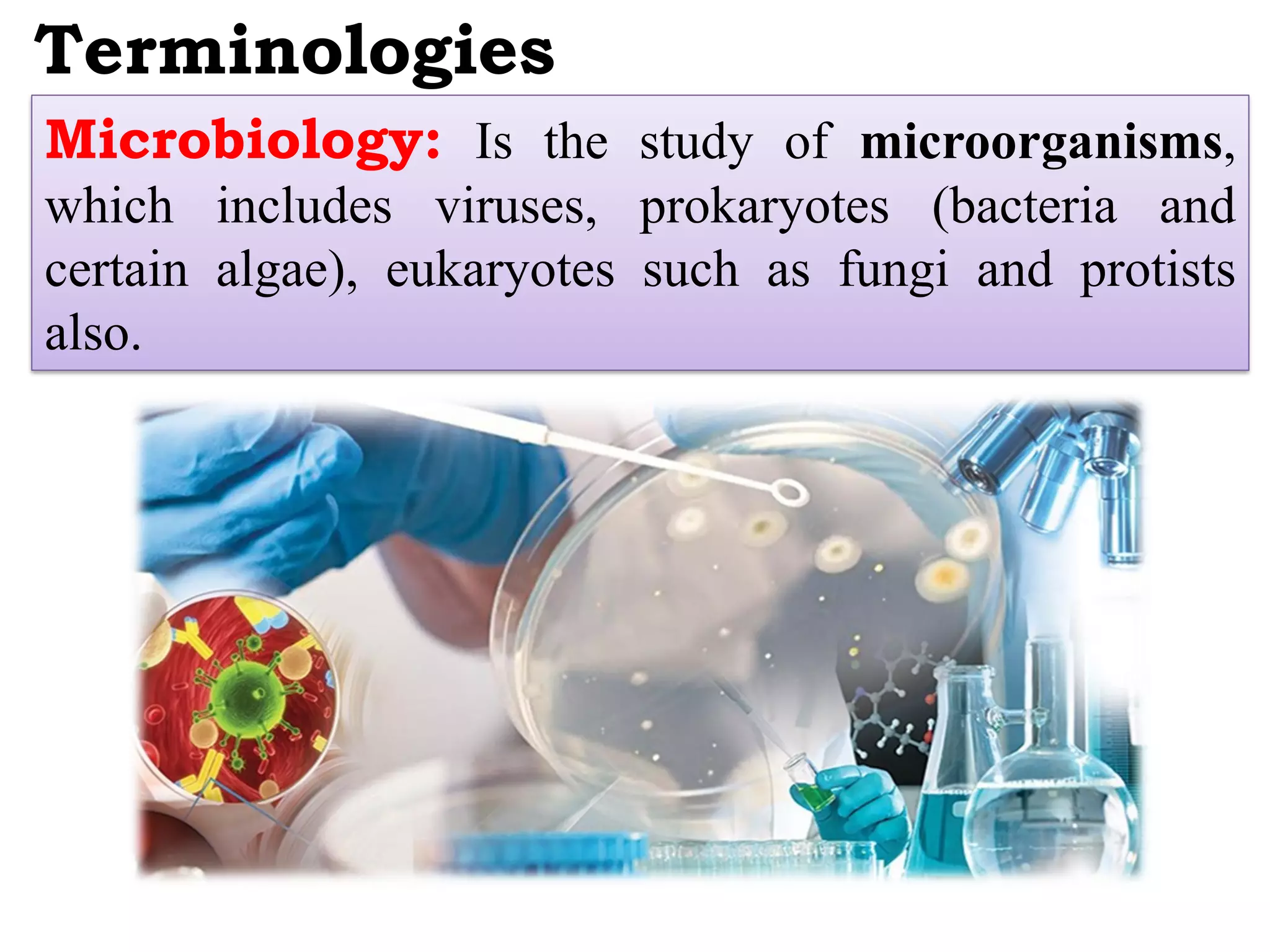
Microbiology: Is the study of microorganisms,
which includes viruses, prokaryotes (bacteria and
certain algae), eukaryotes such as fungi and protists
also.
Terminologies
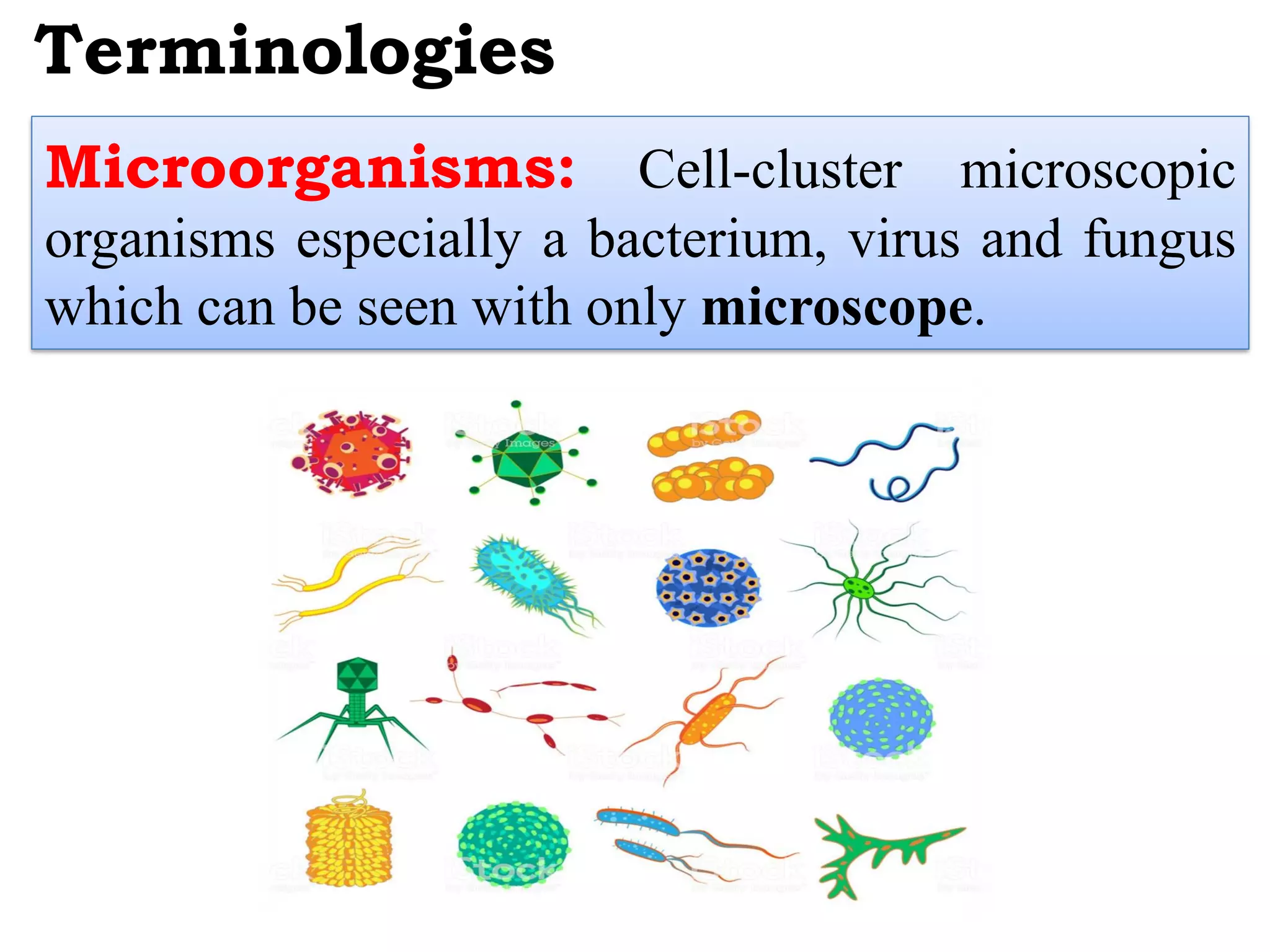
Microorganisms: Cell-cluster microscopic
organisms especially a bacterium, virus and fungus
which can be seen with only microscope.
Terminologies
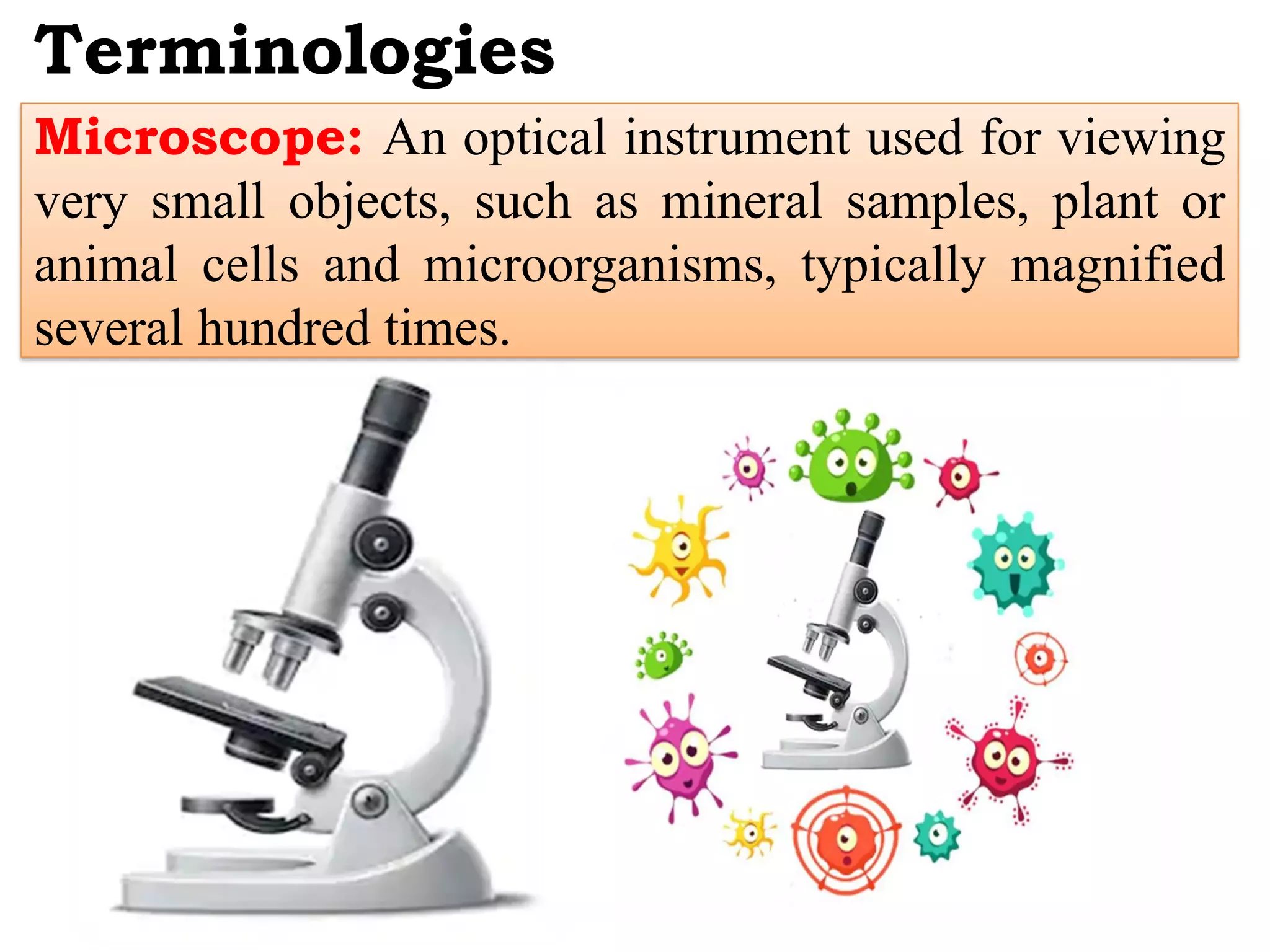
Microscope: An optical instrument used for viewing
very small objects, such as mineral samples, plant or
animal cells and microorganisms, typically magnified
several hundred times.
Terminologies
Era: An era is a span of time defined for the
purposes of chronology or historiography, as in the
regnal eras in the history of a given monarchy, a
calendar era used for a given calendar, or the
geological eras defined for the history of Earth.
Abiogenesis: The original evolution of life or
living organisms from inorganic or inanimate
substances.
Biogenesis: Living matter arises only from other
living matter.
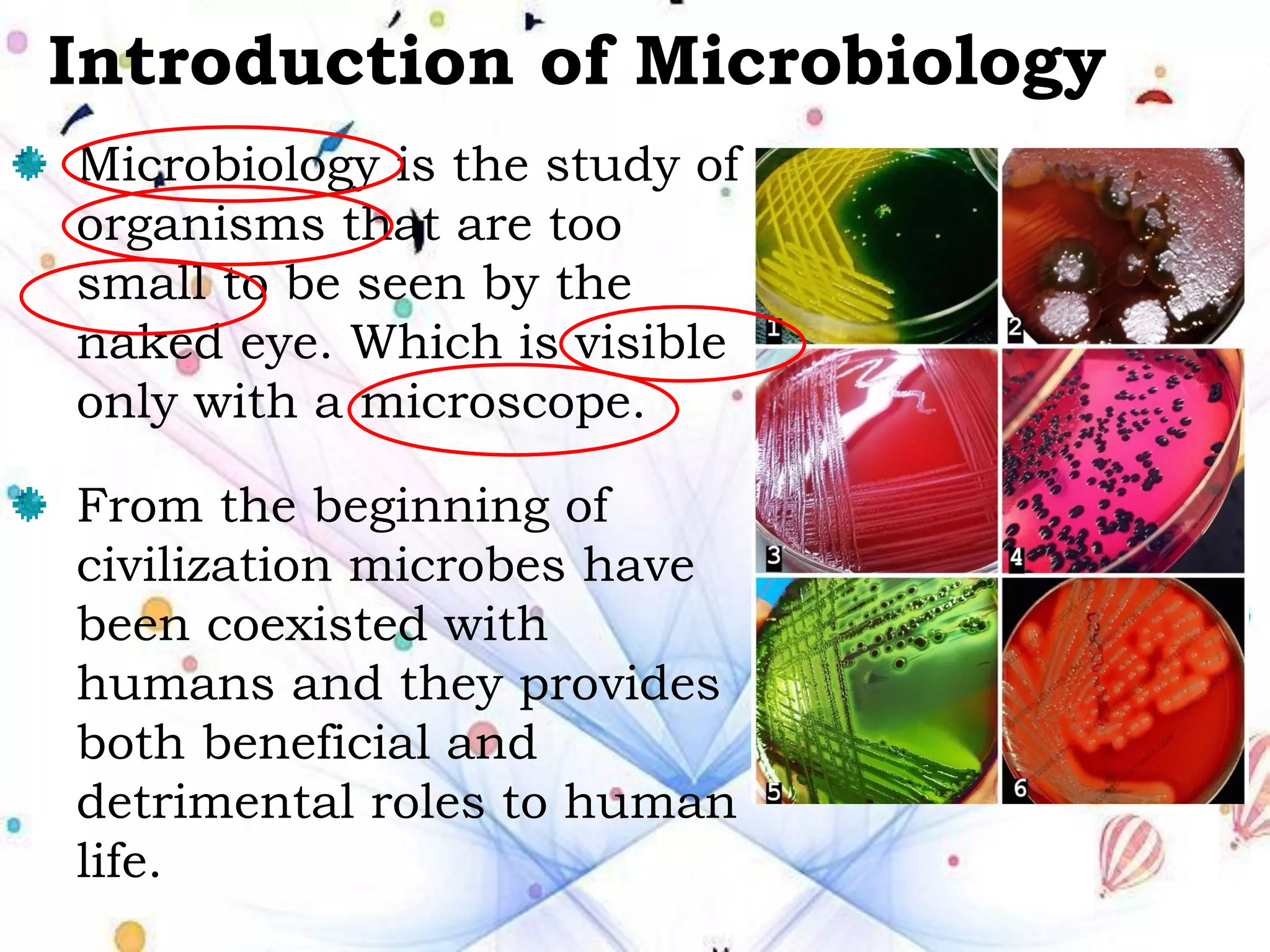
Introduction of Microbiology
Microbiology is the study of
organisms that are too
small to be seen by the
naked eye. Which is visible
only with a microscope.
From the beginning of
civilization microbes have
been coexisted with
humans and they provides
both beneficial and
detrimental roles to human
life.
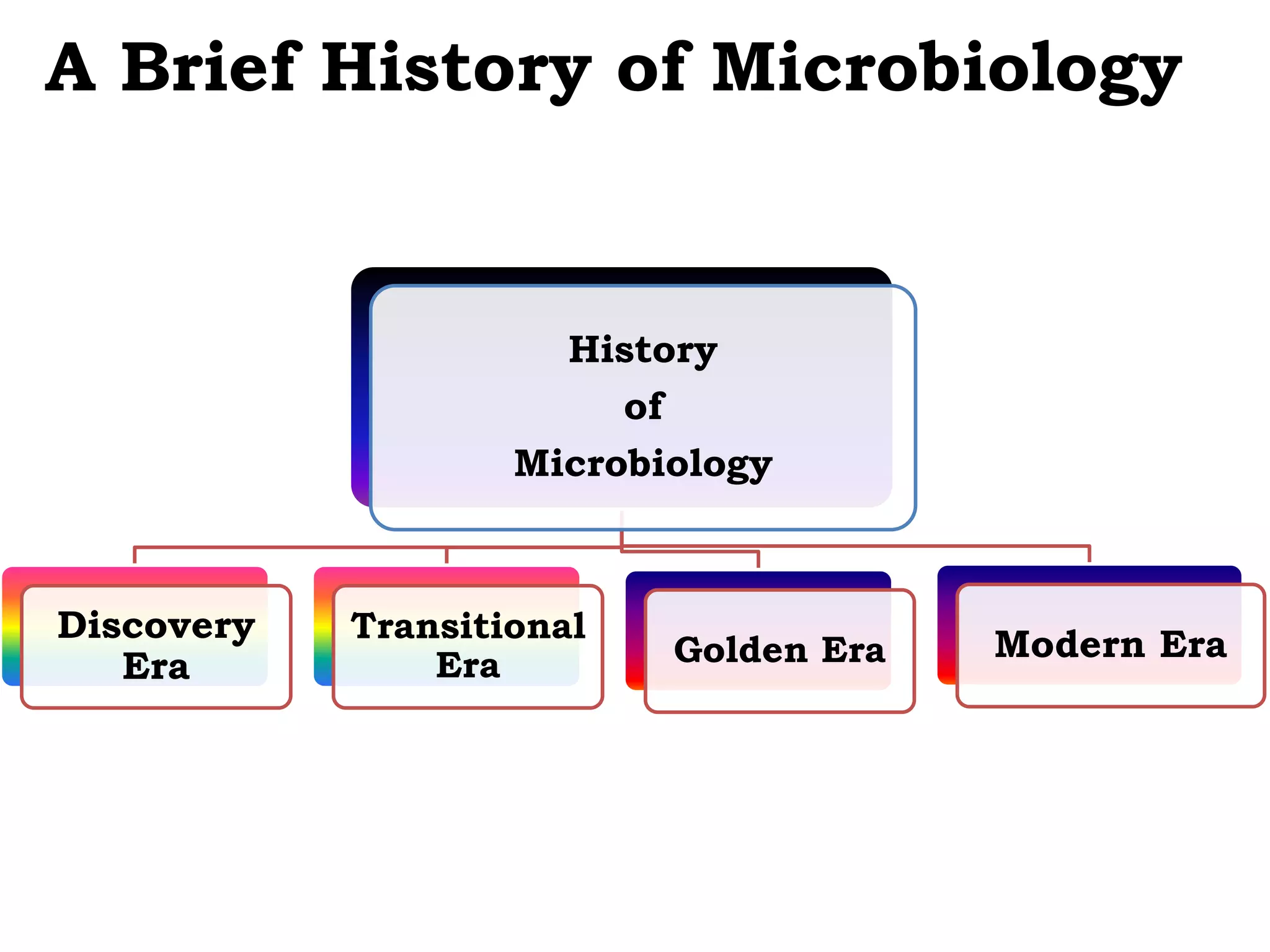
History
of
Microbiology
Discovery
Era
Transitional
Era Golden Era Modern Era
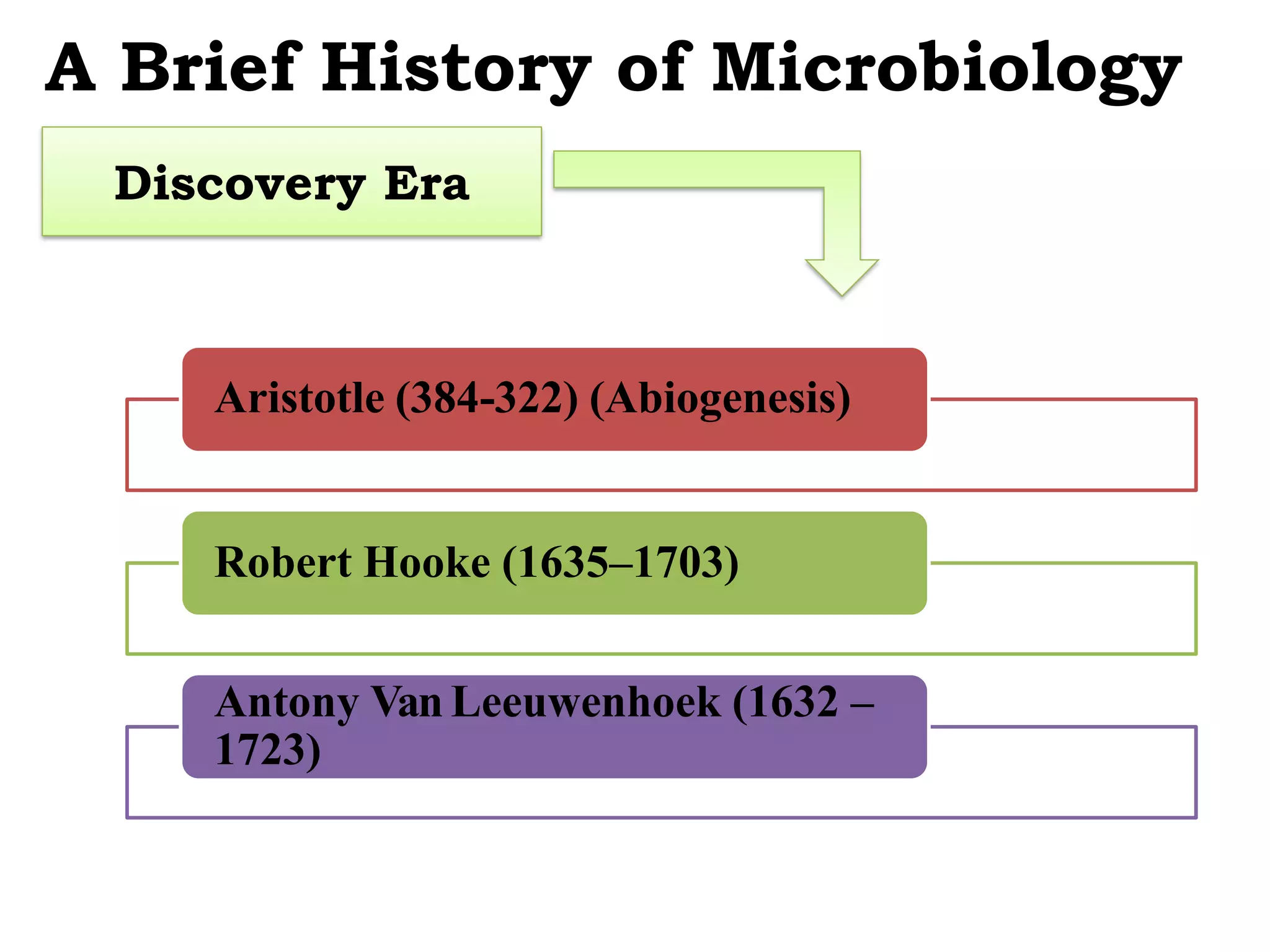
A Brief History of Microbiology
Discovery Era
Aristotle (384-322) (Abiogenesis)
Robert Hooke (1635–1703)
Antony Van Leeuwenhoek (1632 –
1723)
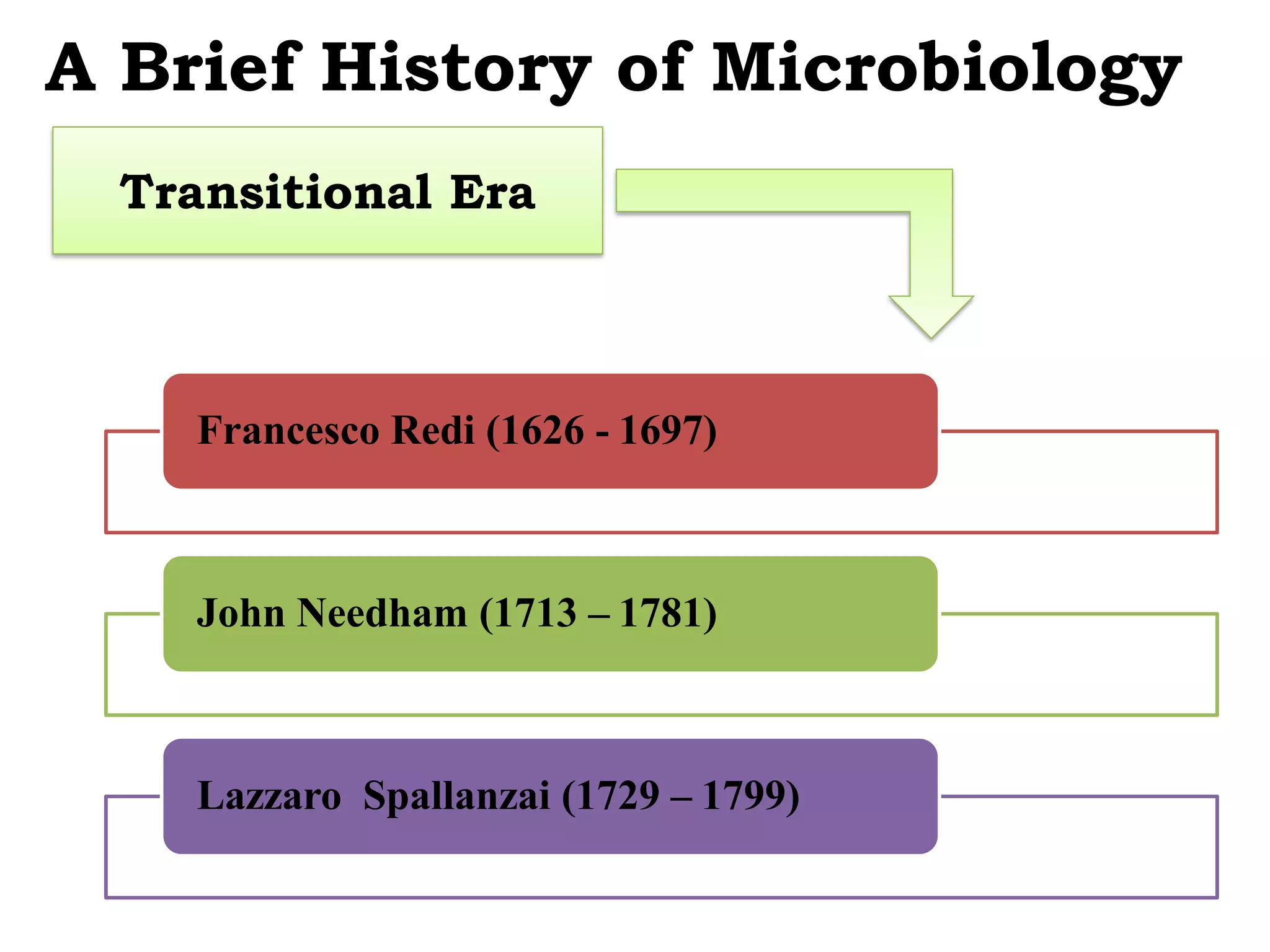
A Brief History of Microbiology
Transitional Era
Francesco Redi (1626 - 1697)
John Needham (1713 – 1781)
Lazzaro Spallanzai (1729 – 1799)
A Brief History of Microbiology
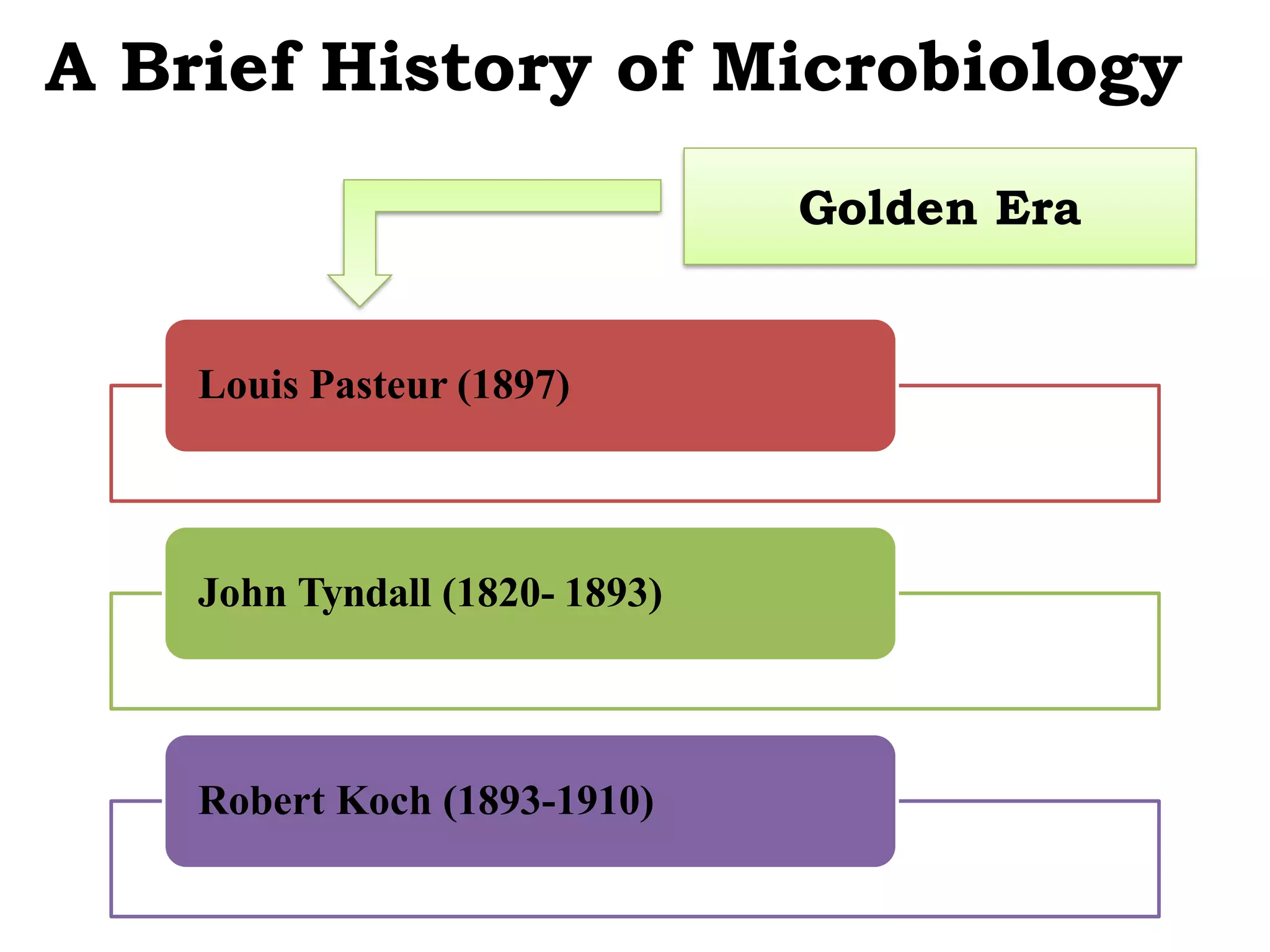
Golden Era
Louis Pasteur (1897)
John Tyndall (1820- 1893)
Robert Koch (1893-1910)
A Brief History of Microbiology
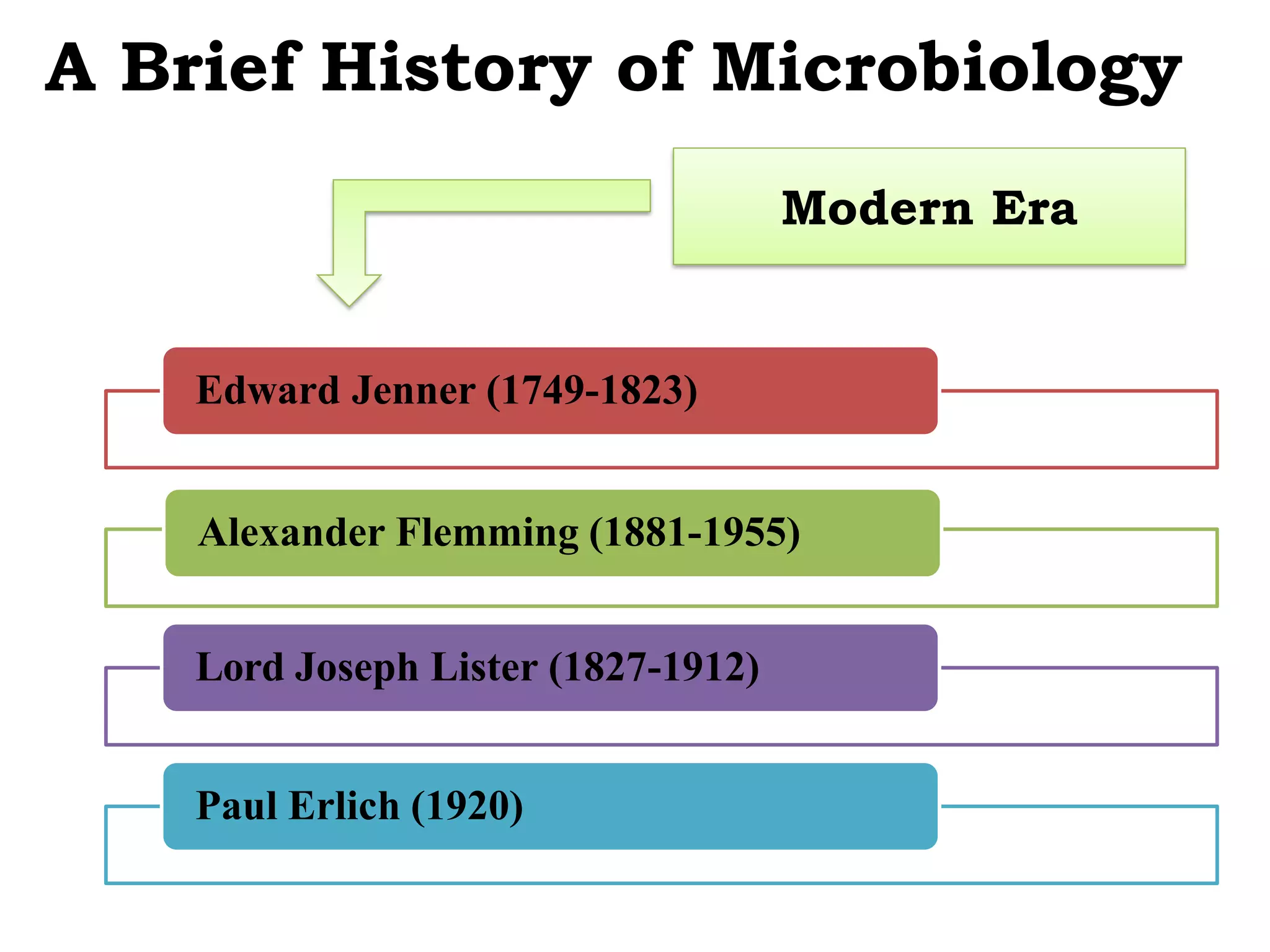
Modern Era
Edward Jenner (1749-1823)
Alexander Flemming (1881-1955)
Lord Joseph Lister (1827-1912)
Paul Erlich (1920)
A Brief History of Microbiology
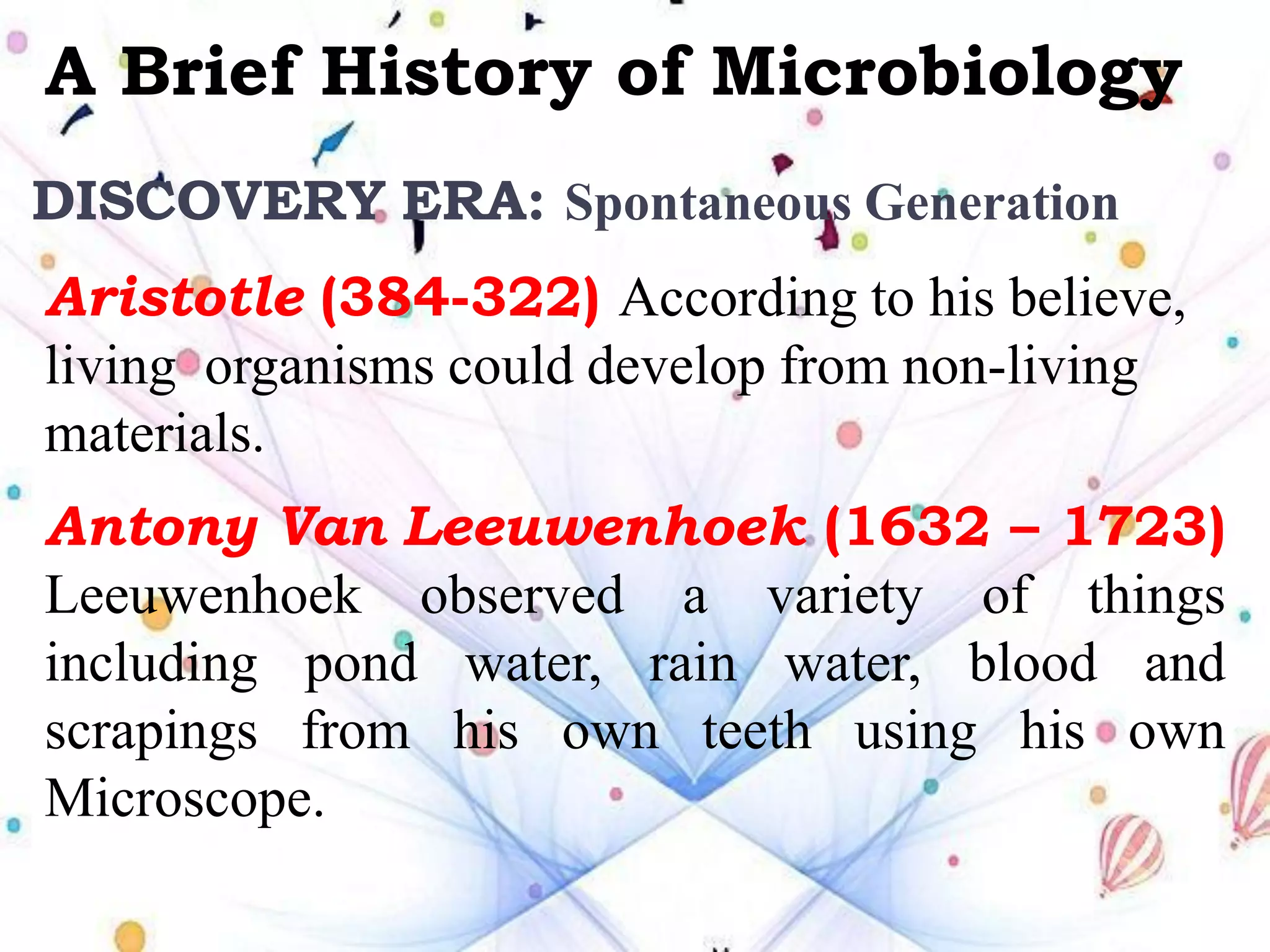
Aristotle (384-322) According to his believe,
living organisms could develop from non-living
materials.
Antony Van Leeuwenhoek (1632 – 1723)
Leeuwenhoek observed a variety of things
including pond water, rain water, blood and
scrapings from his own teeth using his own
Microscope.
DISCOVERY ERA: Spontaneous Generation
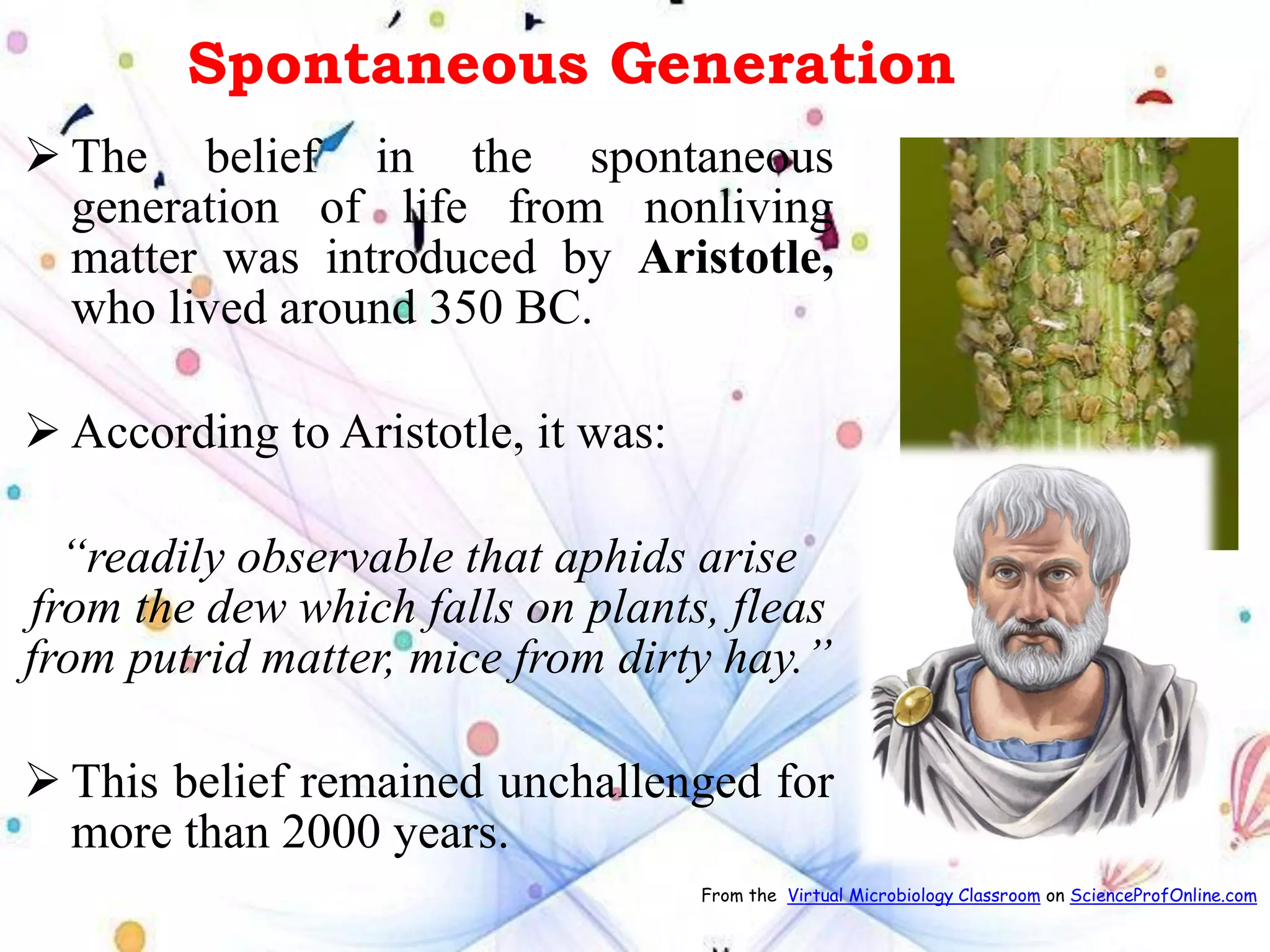
Spontaneous Generation
➢ The belief in the spontaneous
generation of life from nonliving
matter was introduced by Aristotle,
who lived around 350 BC.
➢ According to Aristotle, it was:
“readily observable that aphids arise
from the dew which falls on plants, fleas
from putrid matter, mice from dirty hay.”
➢ This belief remained unchallenged for
more than 2000 years.
From the Virtual Microbiology Classroom on ScienceProfOnline.com
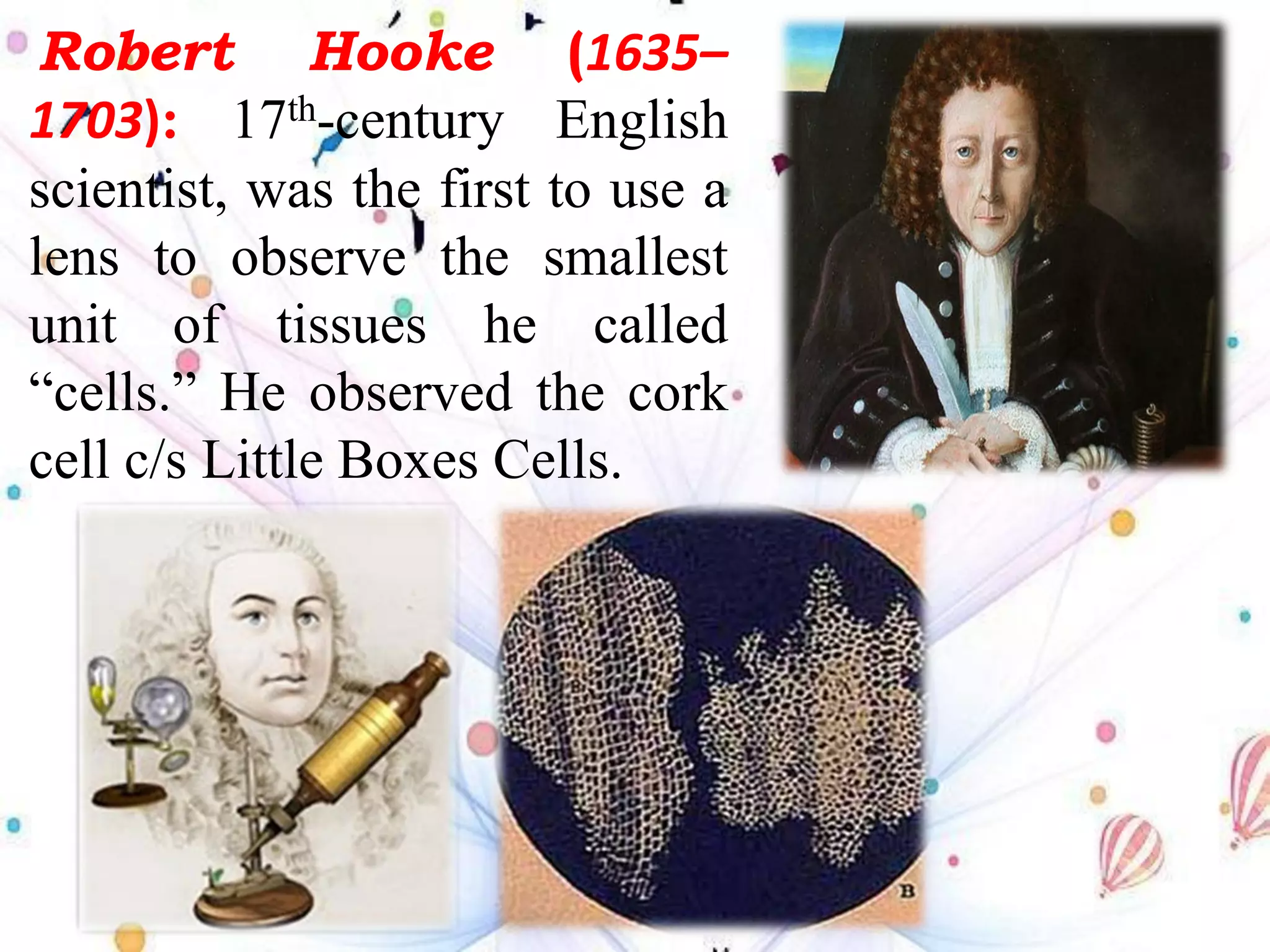
Robert Hooke (1635–
1703): 17th-century English
scientist, was the first to use a
lens to observe the smallest
unit of tissues he called
“cells.” He observed the cork
cell c/s Little Boxes Cells.
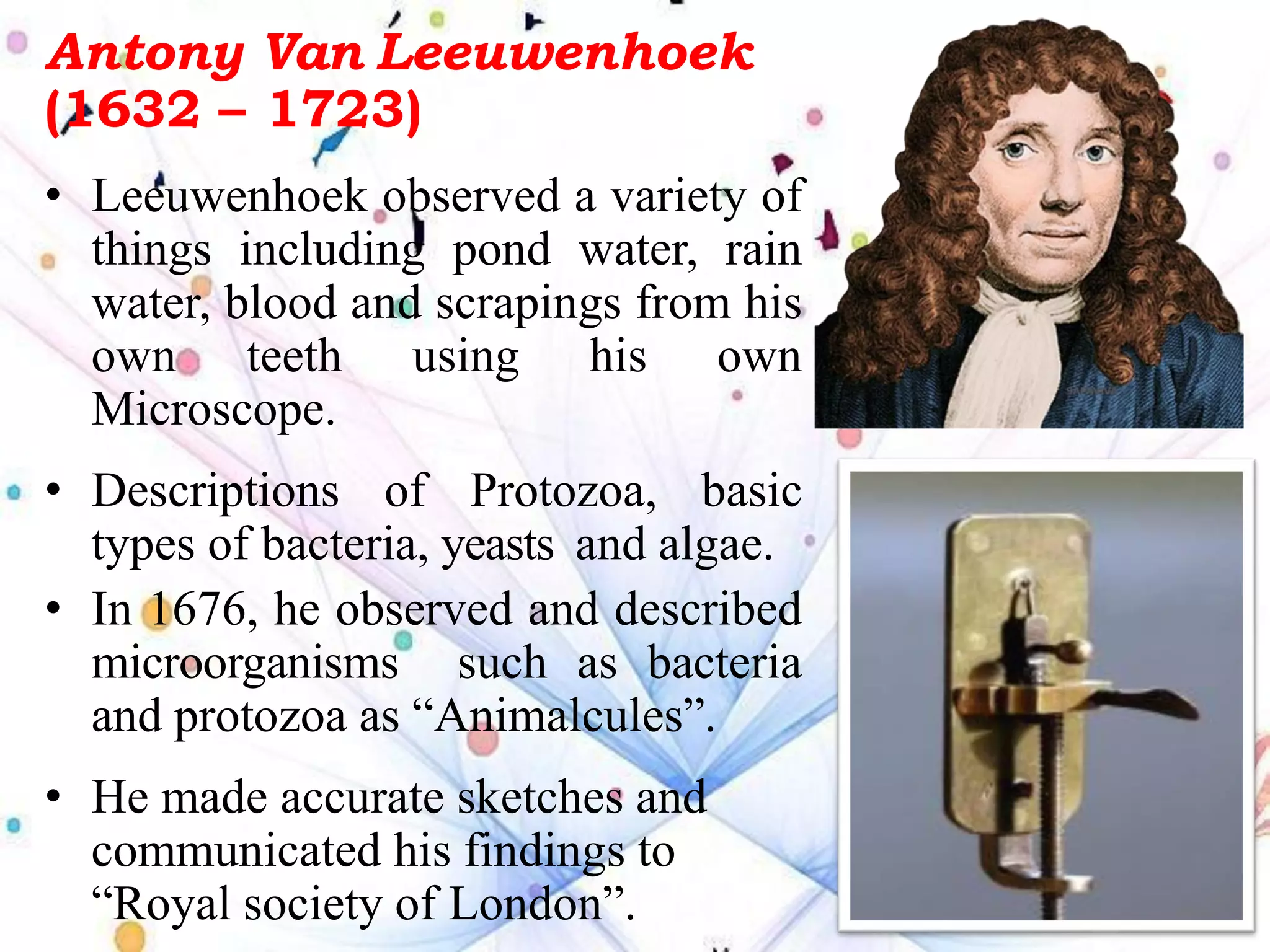
Antony Van Leeuwenhoek
(1632 – 1723)
• Leeuwenhoek observed a variety of
things including pond water, rain
water, blood and scrapings from his
own teeth using his own
Microscope.
• Descriptions of Protozoa, basic
types of bacteria, yeasts and algae.
• In 1676, he observed and described
microorganisms such as bacteria
and protozoa as “Animalcules”.
• He made accurate sketches and
communicated his findings to
“Royal society of London”.
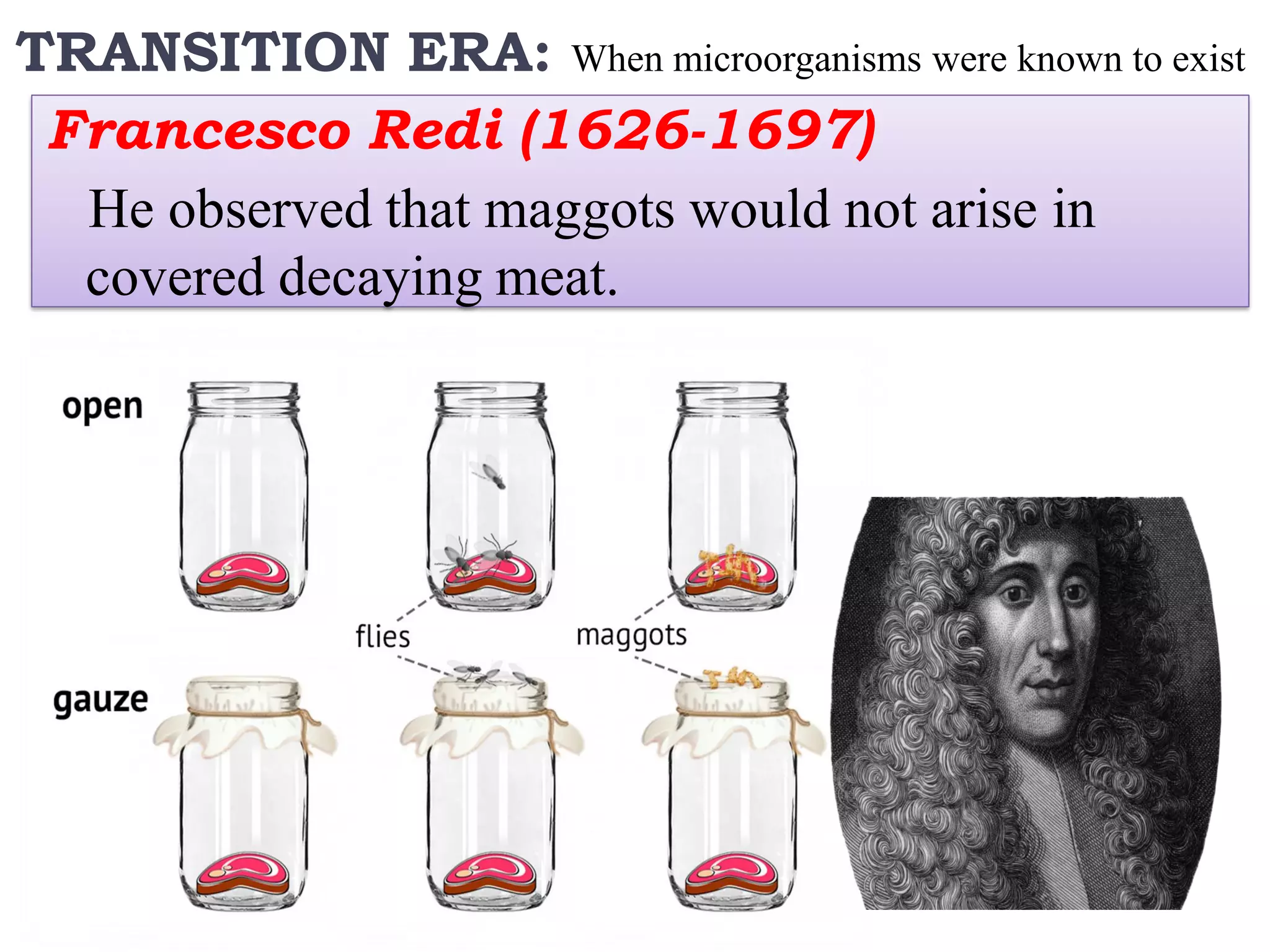
Francesco Redi (1626-1697)
He observed that maggots would not arise in
covered decaying meat.
TRANSITION ERA: When microorganisms were known to exist
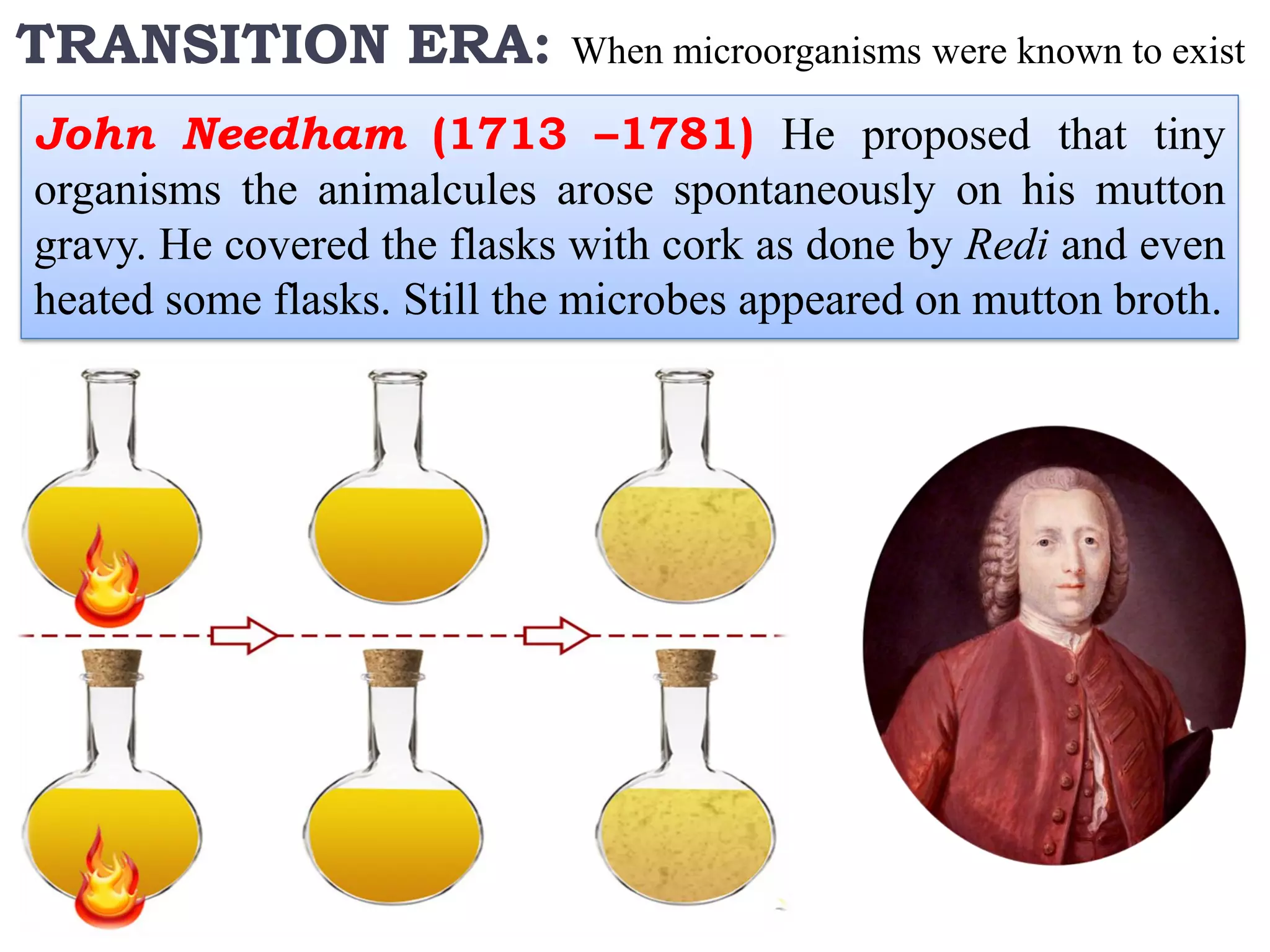
John Needham (1713 –1781) He proposed that tiny
organisms the animalcules arose spontaneously on his mutton
gravy. He covered the flasks with cork as done by Redi and even
heated some flasks. Still the microbes appeared on mutton broth.
TRANSITION ERA: When microorganisms were known to exist
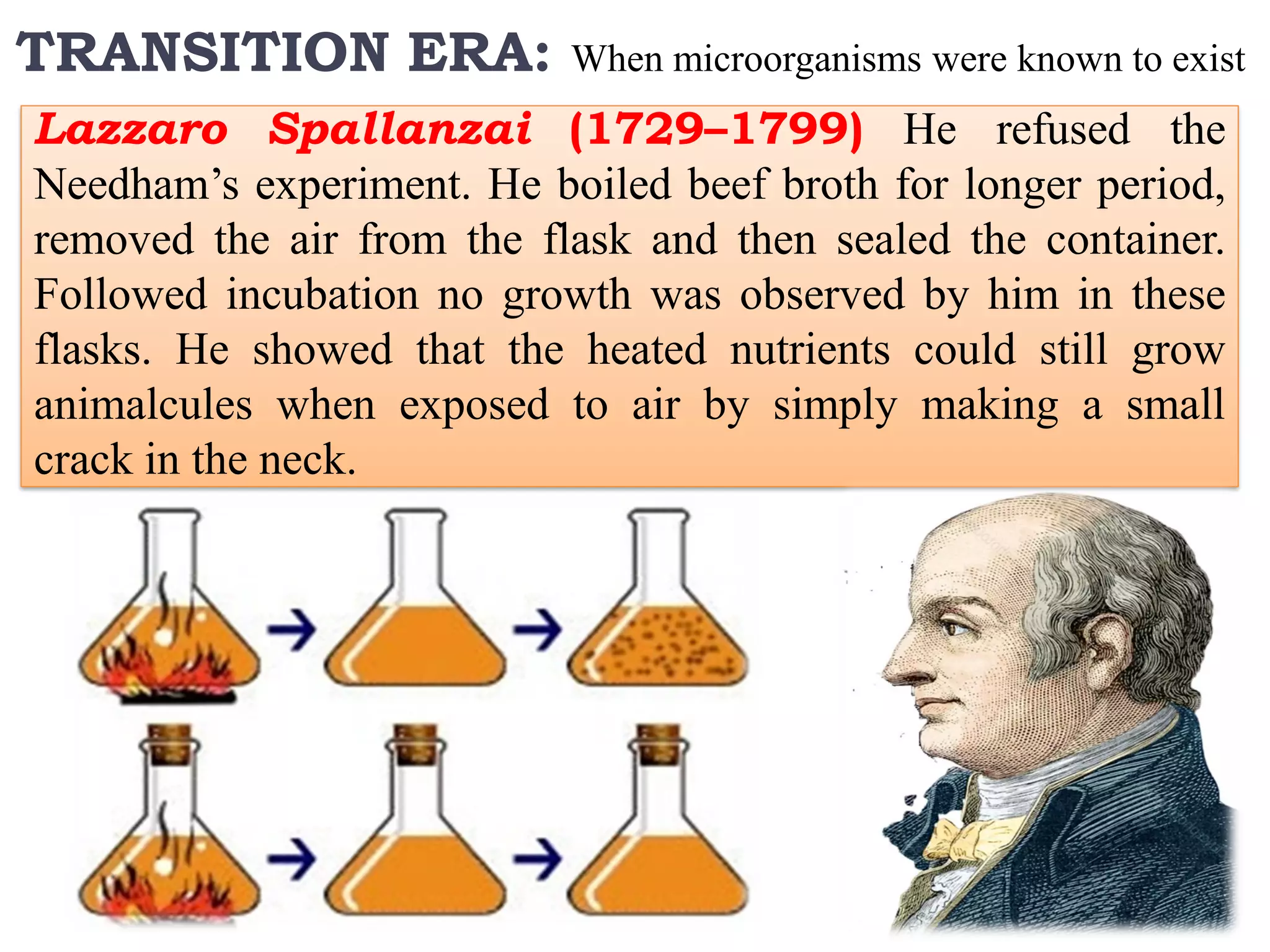
Lazzaro Spallanzai (1729–1799) He refused the
Needham’s experiment. He boiled beef broth for longer period,
removed the air from the flask and then sealed the container.
Followed incubation no growth was observed by him in these
flasks. He showed that the heated nutrients could still grow
animalcules when exposed to air by simply making a small
crack in the neck.
GOLDEN ERA: Work has been continue and expand.
During this period, we see the real beginning of microbiology as a
discipline of biology.
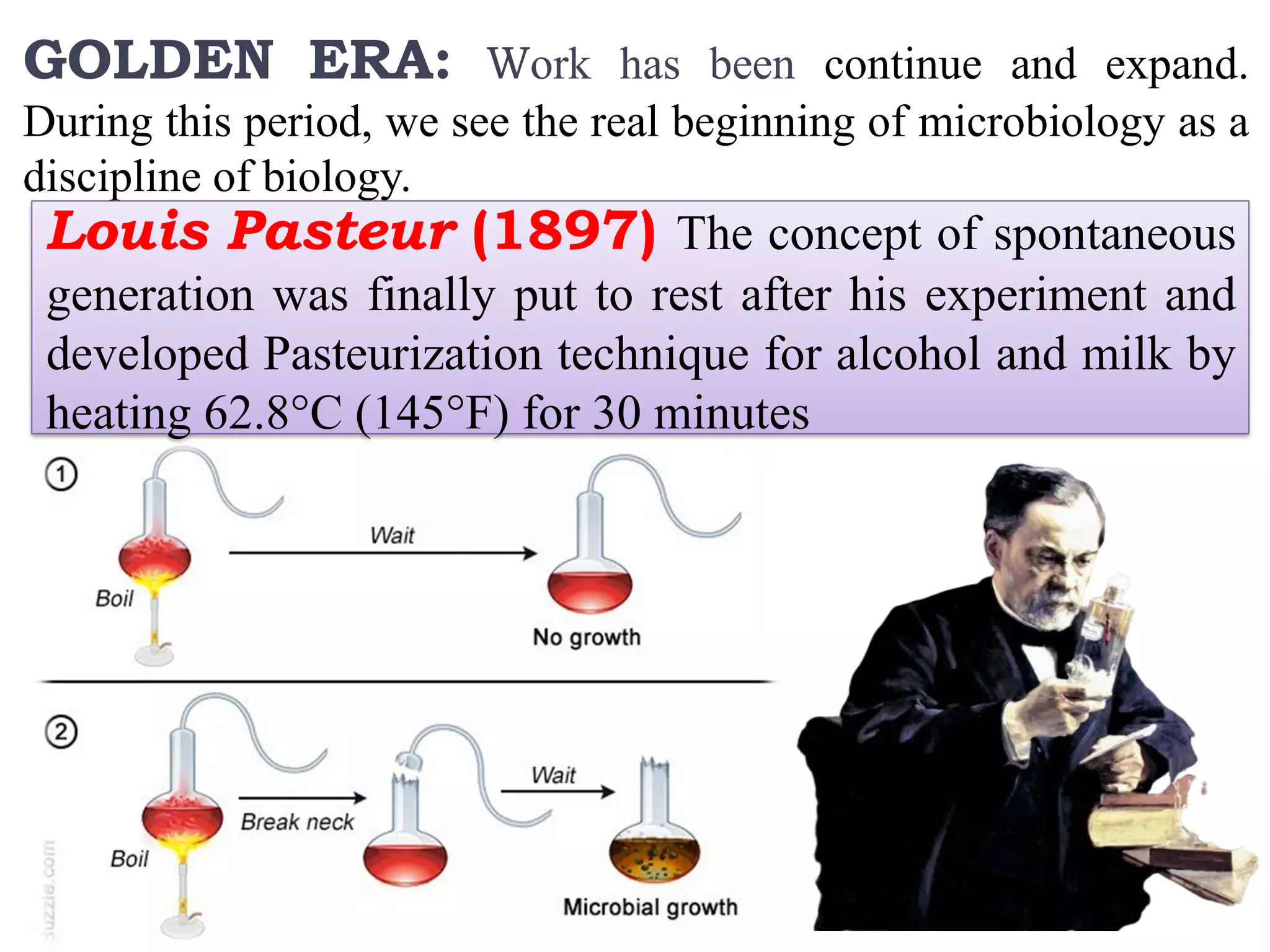
Louis Pasteur (1897) The concept of spontaneous
generation was finally put to rest after his experiment and
developed Pasteurization technique for alcohol and milk by
heating 62.8°C (145°F) for 30 minutes
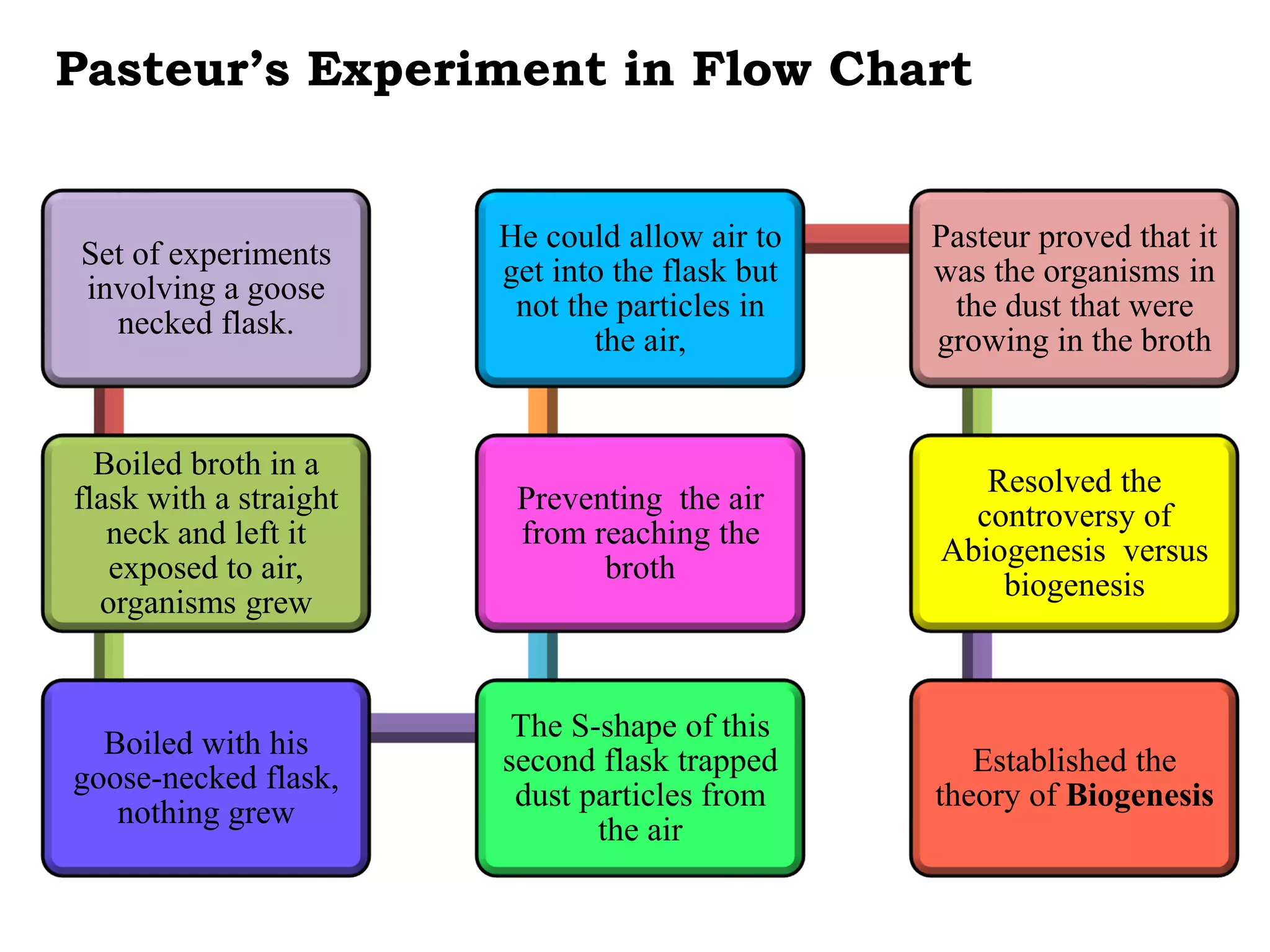
Set of experiments
involving a goose
necked flask.
Boiled broth in a
flask with a straight
neck and left it
exposed to air,
organisms grew
Boiled with his
goose-necked flask,
nothing grew
The S-shape of this
second flask trapped
dust particles from
the air
Preventing the air
from reaching the
broth
He could allow air to
get into the flask but
not the particles in
the air,
Pasteur proved that it
was the organisms in
the dust that were
growing in the broth
Resolved the
controversy of
Abiogenesis versus
biogenesis
Established the
theory of Biogenesis
Pasteur’s Experiment in Flow Chart
GOLDEN ERA: Work has been continue and expand.
During this period, we see the real beginning of microbiology as a
discipline of biology.
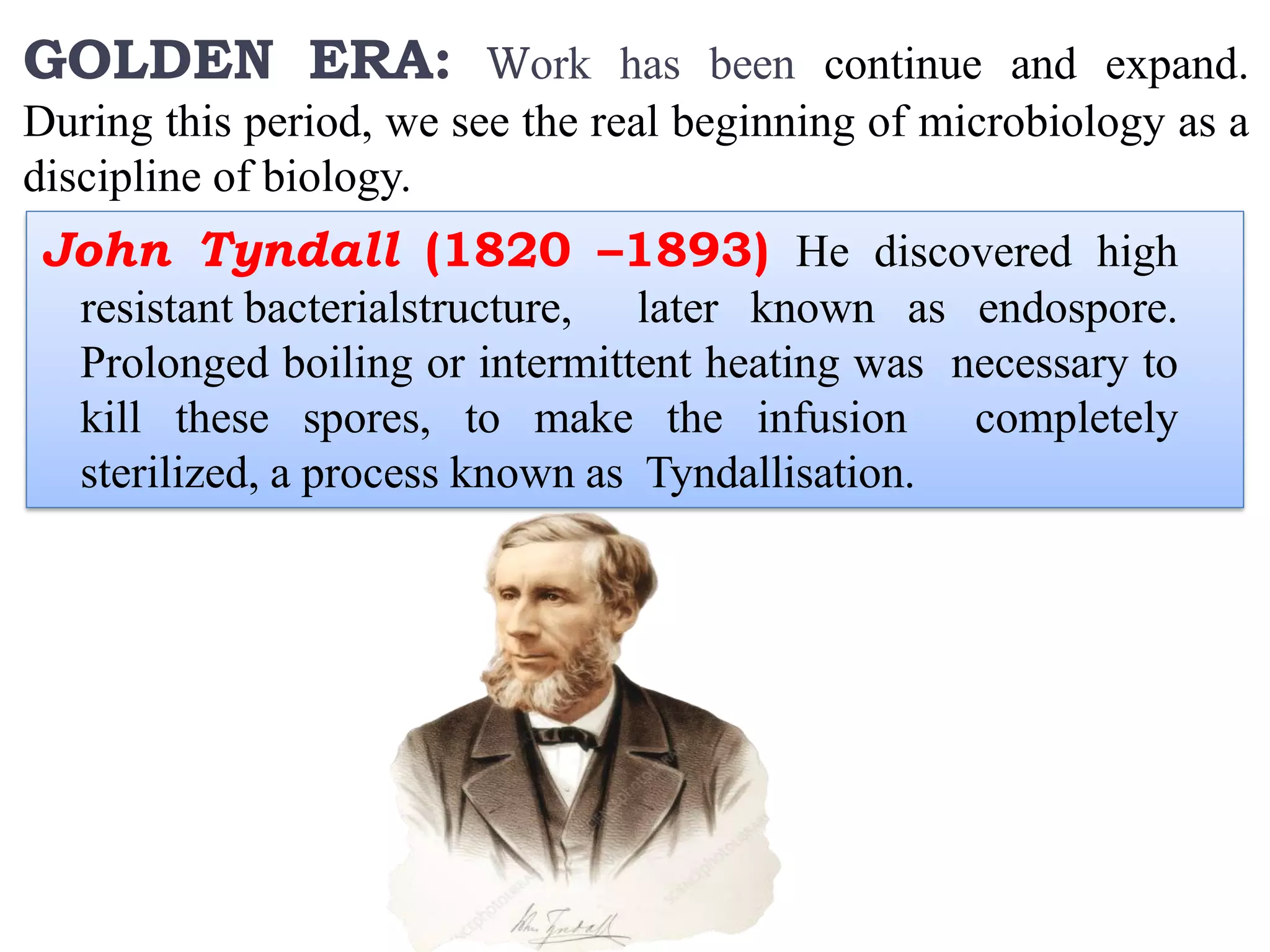
John Tyndall (1820 –1893) He discovered high
resistant bacterialstructure, later known as endospore.
Prolonged boiling or intermittent heating was necessary to
kill these spores, to make the infusion completely
sterilized, a process known as Tyndallisation.
GOLDEN ERA: Work has been continue and expand.
During this period, we see the real beginning of microbiology as a
discipline of biology.
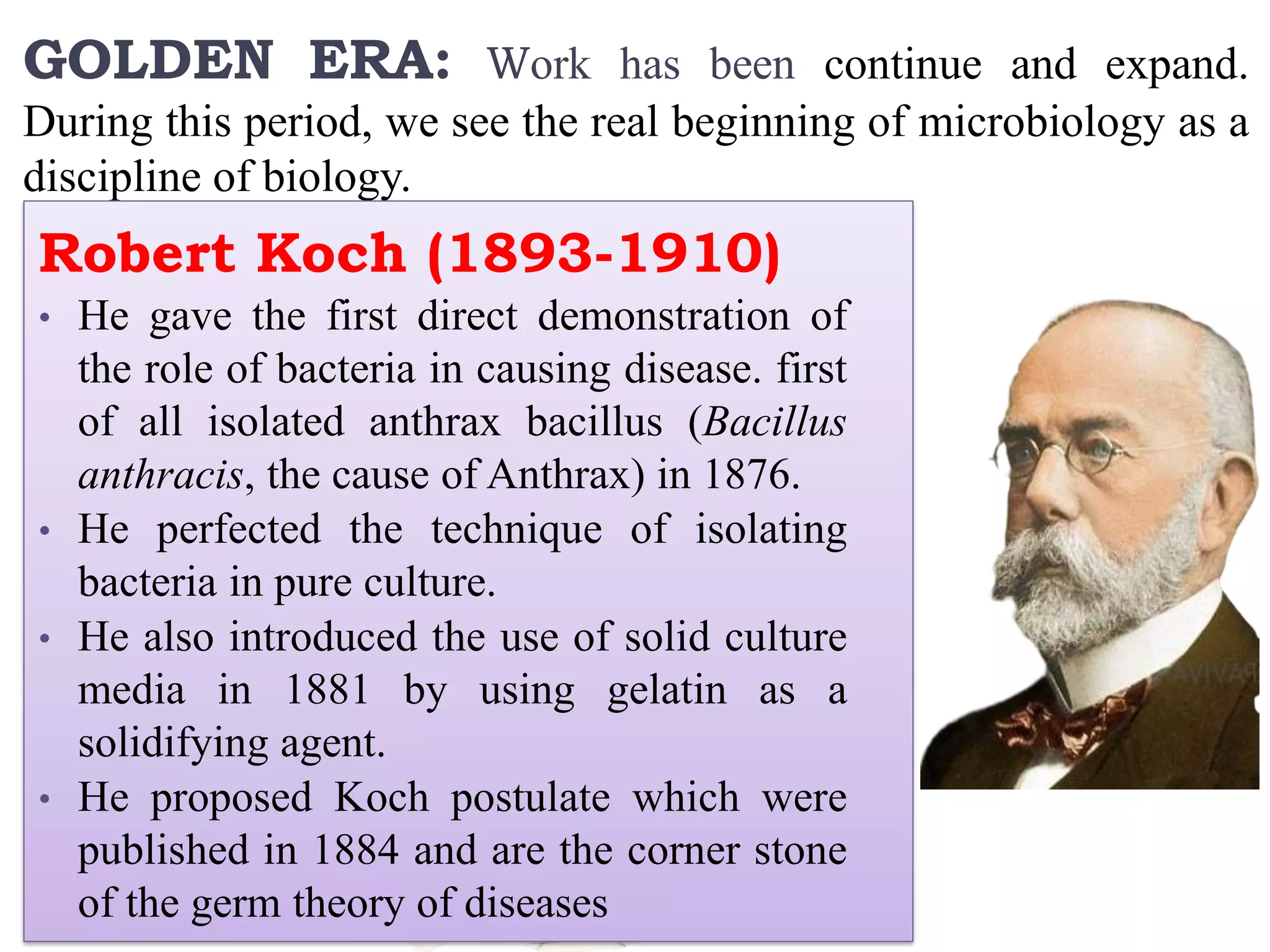
Robert Koch (1893-1910)
• He gave the first direct demonstration of
the role of bacteria in causing disease. first
of all isolated anthrax bacillus (Bacillus
anthracis, the cause of Anthrax) in 1876.
• He perfected the technique of isolating
bacteria in pure culture.
• He also introduced the use of solid culture
media in 1881 by using gelatin as a
solidifying agent.
• He proposed Koch postulate which were
published in 1884 and are the corner stone
of the germ theory of diseases
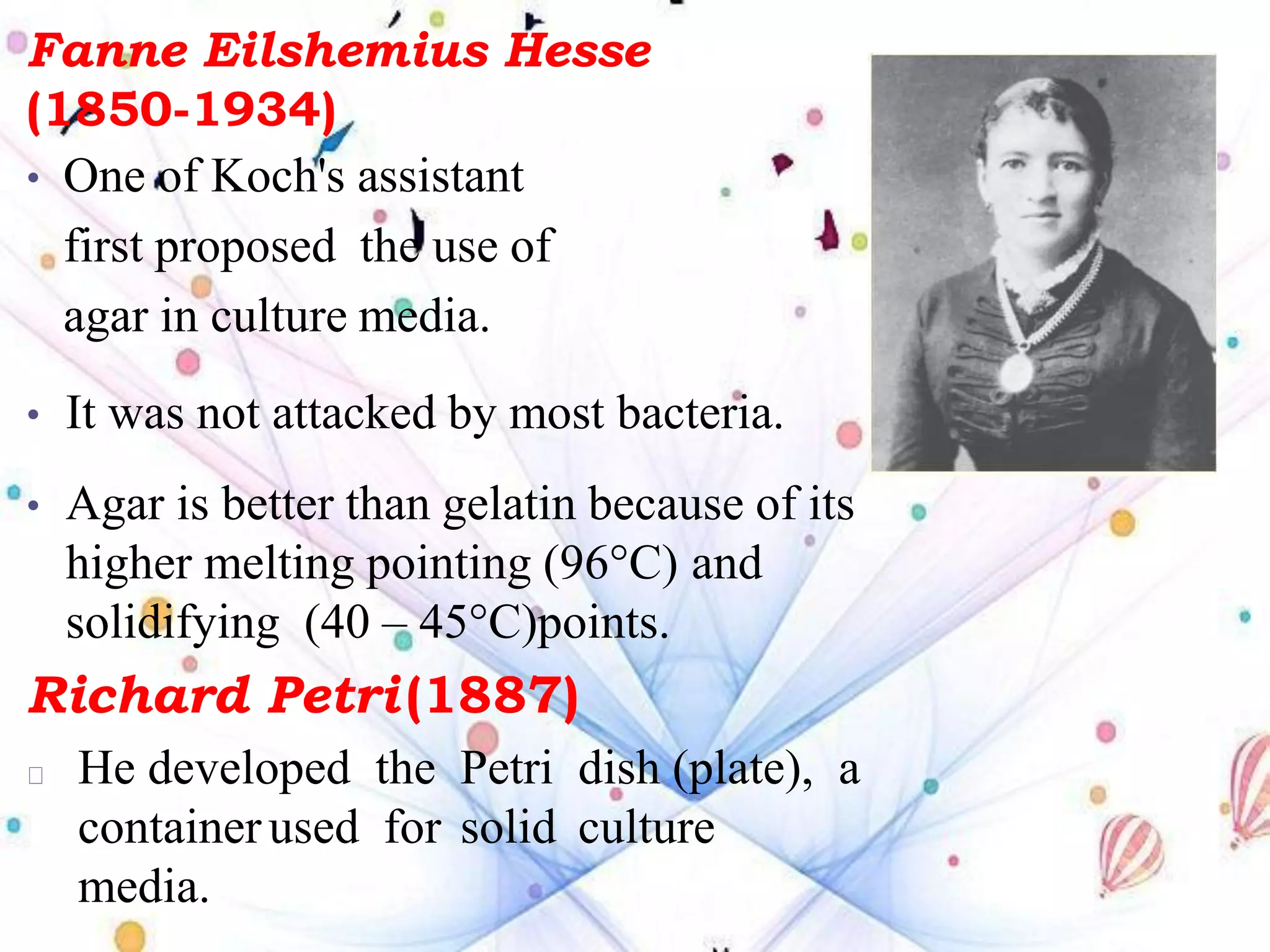
Fanne Eilshemius Hesse
(1850-1934)
• One of Koch's assistant
first proposed the use of
agar in culture media.
• It was not attacked by most bacteria.
• Agar is better than gelatin because of its
higher melting pointing (96°C) and
solidifying (40 – 45°C)points.
Richard Petri(1887)
He developed the Petri dish (plate), a
containerused for solid culture
media.
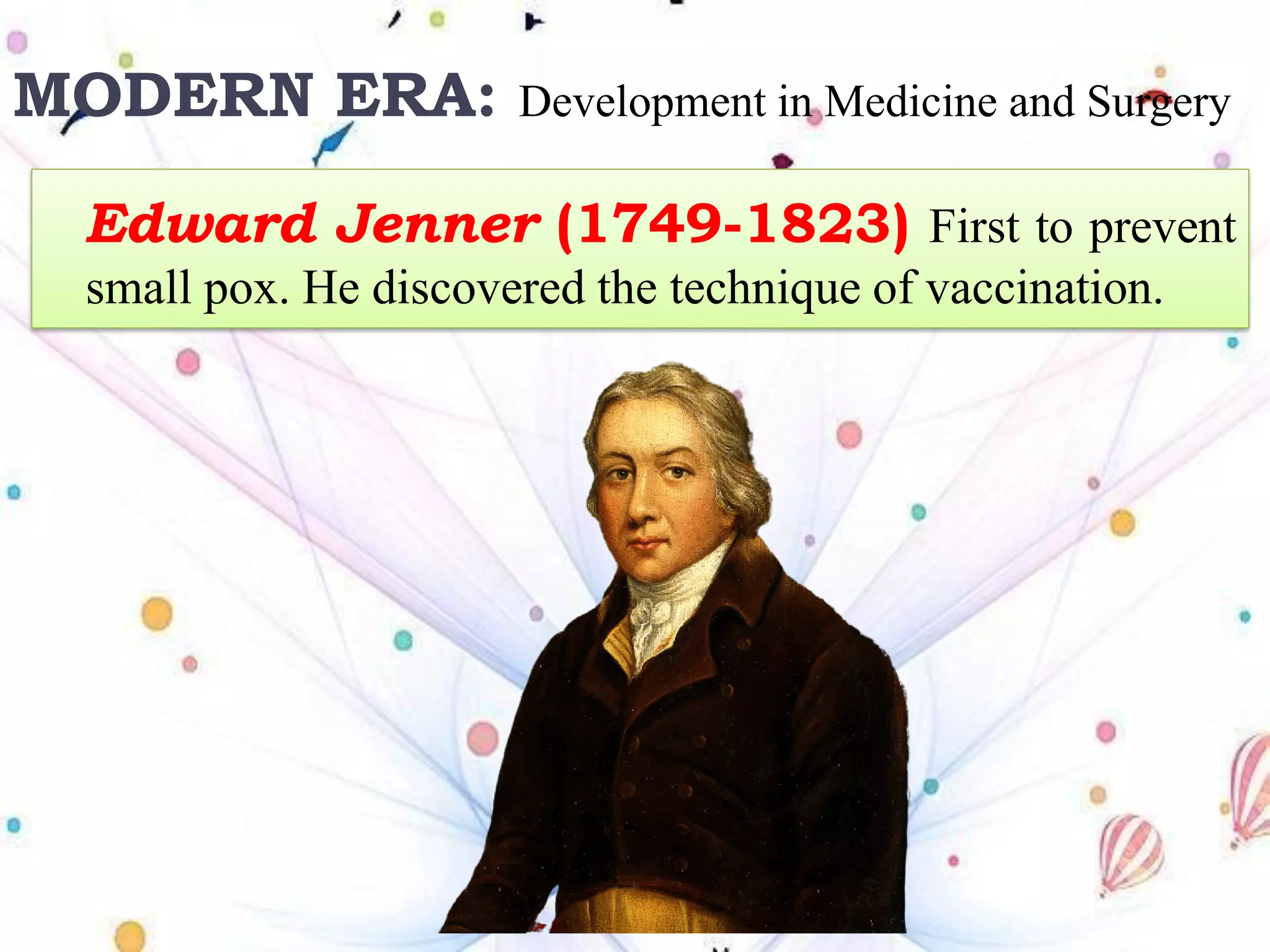
Edward Jenner (1749-1823) First to prevent
small pox. He discovered the technique of vaccination.
MODERN ERA: Development in Medicine and Surgery
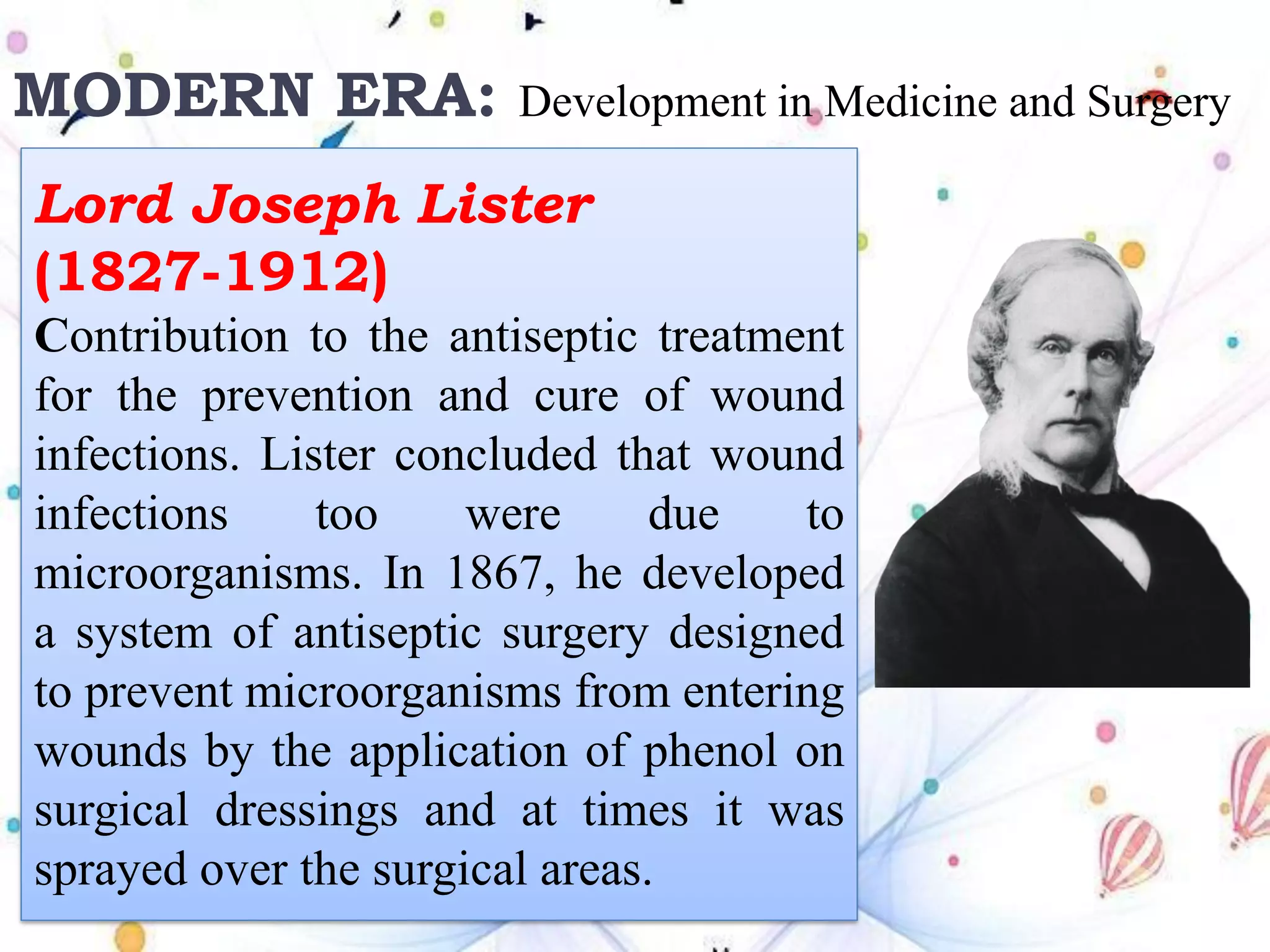
Lord Joseph Lister
(1827-1912)
Contribution to the antiseptic treatment
for the prevention and cure of wound
infections. Lister concluded that wound
infections too were due to
microorganisms. In 1867, he developed
a system of antiseptic surgery designed
to prevent microorganisms from entering
wounds by the application of phenol on
surgical dressings and at times it was
sprayed over the surgical areas.
MODERN ERA: Development in Medicine and Surgery
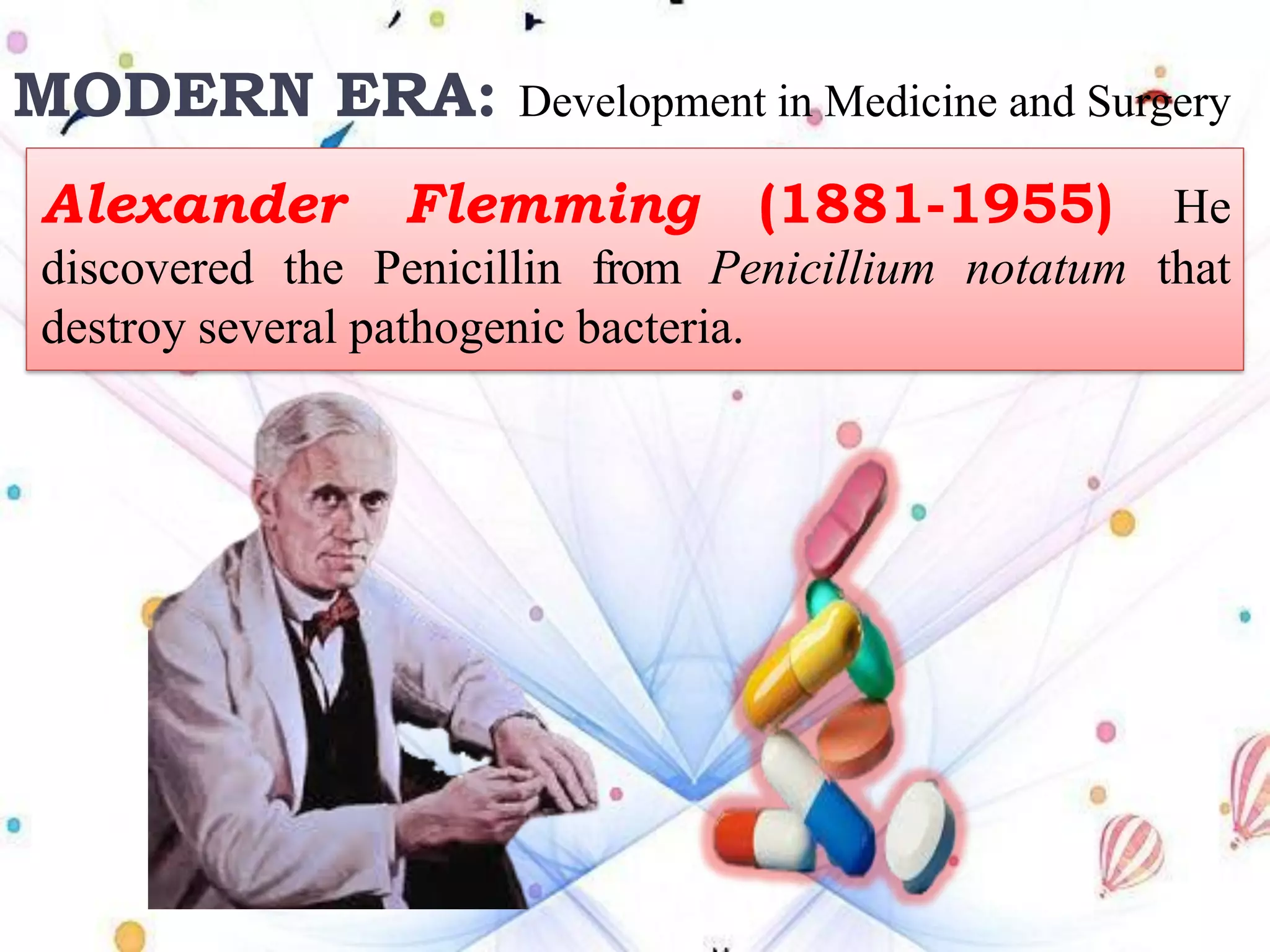
Alexander Flemming (1881-1955) He
discovered the Penicillin from Penicillium notatum that
destroy several pathogenic bacteria.
MODERN ERA: Development in Medicine and Surgery
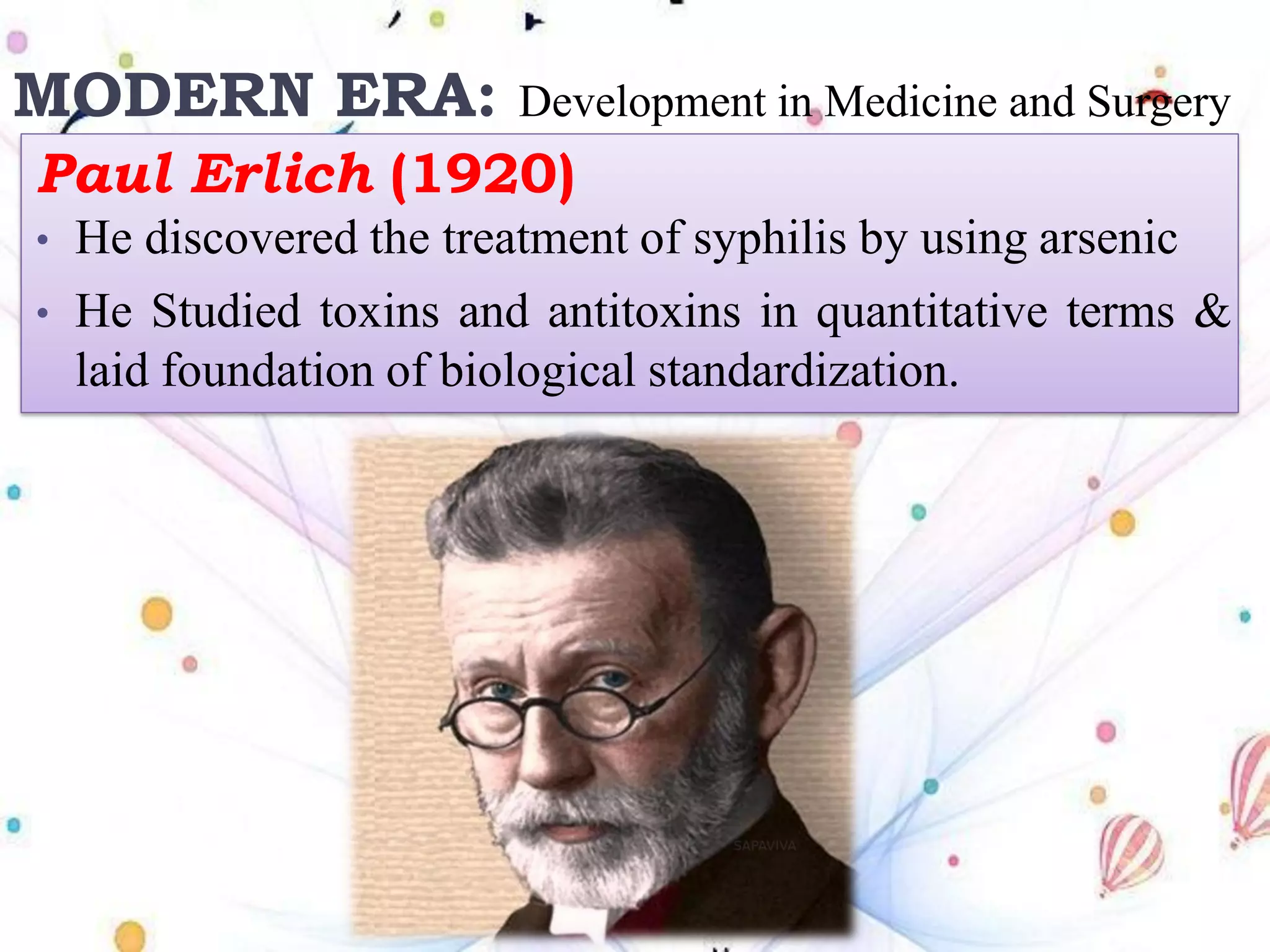
Paul Erlich (1920)
• He discovered the treatment of syphilis by using arsenic
• He Studied toxins and antitoxins in quantitative terms &
laid foundation of biological standardization.
QUIZ
1. Who is the Father of Modern Microbiology?
a) Antony Van Leeuwenhoek
b) Paul Erlich
c) Louis Pasteur
d) Robert Koch
2. Microorganism responsible for causing
Anthrax.
a) Bacillus cereus
b) Bacillus megaterium
c) Bacillus thuringiensis
d) Bacillus anthracis
3. The event that triggered the development and
establishment of microbiology as a science is
the
a) Development of microscope
b) Germ theory of disease
c) Spontaneous generation
d) Development of vaccines
4. Which scientist first disproved the
spontaneous generation by showing maggots
experiment
a) Joseph Lister
b) Francesco Redi
c) Robert Hooke
d) John Needham
5. Inventor of high quality magnifying lens
a) Robert Hooke
b) Robert Koch
c) Antony Van Leeuwenhoek
d) Lazzaro Spallanzani
6. Penicillin produced from fungi…
a) Aspergillus niger
b) Fusarium oxysporum
c) Penicillium notatum
d) Rhizopus oryzae
7. Spontaneous generation is also called as
Biogenesis..
a) True
b) False
8) Who is the Father of Microbiology?
a) Antony Van Leeuwenhoek
b) Louis Pasteur
c) Robert Koch
d) Alexander Flemming
9. In the process of pasteurization, what would
be the heating temperature?
a) 62.8°C for 30 min.
b) 62.8°C for 10 min.
c) 62.8°C for 20 min.
d) 62.8°C for 15 min.
10) Fanne Eilshemius Hesse, One of Koch's
assistant first proposed the use of agar in culture
media in between following year
a) 1749-1823
b) 1850-1934
c) 1893-1910
d) 1713-1781
ANSWER KEY
1. a
2. d
3. a
4. b
5. c
6. c
7. b
8. a
9. a
10.b
Thank You
Atmiya University, "Yogidham Gurukul", Kalawad Road, Rajkot - 360005
Web: www.atmiyauni.ac.in
: : atmiyauniversity : : atmiya_university

1.1 intro and brief history (1).pdf

  • 1.
    Topic: Unit 1 Scopeand History of Microbiology Faculty Name: Dr. Chitra Bhattacharya Branch: Microbiology Atmiya University, "Yogidham Gurukul", Kalawad Road, Rajkot - 360005 Web: www.atmiyauni.ac.in : : atmiyauniversity : : atmiya_university Subject Code: 18BMBCC101 Subject Name: Fundamentals of Microbiology
  • 3.
    Content To BeCovered: Terminologies for the Subject Identification Why to Study the Subject Introduction of Microbiology History of Microbiology Contribution of Legends in the Field of Microbiology Question- Answer Round
  • 4.
    Why to Studythe Subject Microbes Distribution in Nature: Omnipresent: Generally microorganisms are everywhere in nature and grows where they get food, moisture and temperature. Occurrence • Air • Soil • Water, Oceans • Food we eat • Surfaces of our body (Skin) and inside alimentary canal also.
  • 5.
    Terminologies Microbiology: Is thestudy of microorganisms, which includes viruses, prokaryotes (bacteria and certain algae), eukaryotes such as fungi and protists also.
  • 6.
    Terminologies Microorganisms: Cell-cluster microscopic organismsespecially a bacterium, virus and fungus which can be seen with only microscope.
  • 7.
    Terminologies Microscope: An opticalinstrument used for viewing very small objects, such as mineral samples, plant or animal cells and microorganisms, typically magnified several hundred times.
  • 8.
    Terminologies Era: An erais a span of time defined for the purposes of chronology or historiography, as in the regnal eras in the history of a given monarchy, a calendar era used for a given calendar, or the geological eras defined for the history of Earth. Abiogenesis: The original evolution of life or living organisms from inorganic or inanimate substances. Biogenesis: Living matter arises only from other living matter.
  • 9.
    Introduction of Microbiology Microbiologyis the study of organisms that are too small to be seen by the naked eye. Which is visible only with a microscope. From the beginning of civilization microbes have been coexisted with humans and they provides both beneficial and detrimental roles to human life.
  • 10.
  • 11.
    Discovery Era Aristotle (384-322)(Abiogenesis) Robert Hooke (1635–1703) Antony Van Leeuwenhoek (1632 – 1723) A Brief History of Microbiology
  • 12.
    Transitional Era Francesco Redi(1626 - 1697) John Needham (1713 – 1781) Lazzaro Spallanzai (1729 – 1799) A Brief History of Microbiology
  • 13.
    Golden Era Louis Pasteur(1897) John Tyndall (1820- 1893) Robert Koch (1893-1910) A Brief History of Microbiology
  • 14.
    A Brief Historyof Microbiology Modern Era Edward Jenner (1749-1823) Alexander Flemming (1881-1955) Lord Joseph Lister (1827-1912) Paul Erlich (1920)
  • 15.
    A Brief Historyof Microbiology Aristotle (384-322) According to his believe, living organisms could develop from non-living materials. Antony Van Leeuwenhoek (1632 – 1723) Leeuwenhoek observed a variety of things including pond water, rain water, blood and scrapings from his own teeth using his own Microscope. DISCOVERY ERA: Spontaneous Generation
  • 16.
    Spontaneous Generation ➢ Thebelief in the spontaneous generation of life from nonliving matter was introduced by Aristotle, who lived around 350 BC. ➢ According to Aristotle, it was: “readily observable that aphids arise from the dew which falls on plants, fleas from putrid matter, mice from dirty hay.” ➢ This belief remained unchallenged for more than 2000 years. From the Virtual Microbiology Classroom on ScienceProfOnline.com
  • 17.
    Robert Hooke (1635– 1703):17th-century English scientist, was the first to use a lens to observe the smallest unit of tissues he called “cells.” He observed the cork cell c/s Little Boxes Cells.
  • 18.
    Antony Van Leeuwenhoek (1632– 1723) • Leeuwenhoek observed a variety of things including pond water, rain water, blood and scrapings from his own teeth using his own Microscope. • Descriptions of Protozoa, basic types of bacteria, yeasts and algae. • In 1676, he observed and described microorganisms such as bacteria and protozoa as “Animalcules”. • He made accurate sketches and communicated his findings to “Royal society of London”.
  • 19.
    Francesco Redi (1626-1697) Heobserved that maggots would not arise in covered decaying meat. TRANSITION ERA: When microorganisms were known to exist
  • 20.
    TRANSITION ERA: Whenmicroorganisms were known to exist John Needham (1713 –1781) He proposed that tiny organisms the animalcules arose spontaneously on his mutton gravy. He covered the flasks with cork as done by Redi and even heated some flasks. Still the microbes appeared on mutton broth.
  • 21.
    TRANSITION ERA: Whenmicroorganisms were known to exist Lazzaro Spallanzai (1729–1799) He refused the Needham’s experiment. He boiled beef broth for longer period, removed the air from the flask and then sealed the container. Followed incubation no growth was observed by him in these flasks. He showed that the heated nutrients could still grow animalcules when exposed to air by simply making a small crack in the neck.
  • 22.
    GOLDEN ERA: Workhas been continue and expand. During this period, we see the real beginning of microbiology as a discipline of biology. Louis Pasteur (1897) The concept of spontaneous generation was finally put to rest after his experiment and developed Pasteurization technique for alcohol and milk by heating 62.8°C (145°F) for 30 minutes
  • 23.
    Set of experiments involvinga goose necked flask. Boiled broth in a flask with a straight neck and left it exposed to air, organisms grew Boiled with his goose-necked flask, nothing grew The S-shape of this second flask trapped dust particles from the air Preventing the air from reaching the broth He could allow air to get into the flask but not the particles in the air, Pasteur proved that it was the organisms in the dust that were growing in the broth Resolved the controversy of Abiogenesis versus biogenesis Established the theory of Biogenesis Pasteur’s Experiment in Flow Chart
  • 24.
    GOLDEN ERA: Workhas been continue and expand. During this period, we see the real beginning of microbiology as a discipline of biology. John Tyndall (1820 –1893) He discovered high resistant bacterialstructure, later known as endospore. Prolonged boiling or intermittent heating was necessary to kill these spores, to make the infusion completely sterilized, a process known as Tyndallisation.
  • 25.
    GOLDEN ERA: Workhas been continue and expand. During this period, we see the real beginning of microbiology as a discipline of biology. Robert Koch (1893-1910) • He gave the first direct demonstration of the role of bacteria in causing disease. first of all isolated anthrax bacillus (Bacillus anthracis, the cause of Anthrax) in 1876. • He perfected the technique of isolating bacteria in pure culture. • He also introduced the use of solid culture media in 1881 by using gelatin as a solidifying agent. • He proposed Koch postulate which were published in 1884 and are the corner stone of the germ theory of diseases
  • 26.
    Fanne Eilshemius Hesse (1850-1934) •One of Koch's assistant first proposed the use of agar in culture media. • It was not attacked by most bacteria. • Agar is better than gelatin because of its higher melting pointing (96°C) and solidifying (40 – 45°C)points. Richard Petri(1887) He developed the Petri dish (plate), a containerused for solid culture media.
  • 27.
    Edward Jenner (1749-1823)First to prevent small pox. He discovered the technique of vaccination. MODERN ERA: Development in Medicine and Surgery
  • 28.
    MODERN ERA: Developmentin Medicine and Surgery Lord Joseph Lister (1827-1912) Contribution to the antiseptic treatment for the prevention and cure of wound infections. Lister concluded that wound infections too were due to microorganisms. In 1867, he developed a system of antiseptic surgery designed to prevent microorganisms from entering wounds by the application of phenol on surgical dressings and at times it was sprayed over the surgical areas.
  • 29.
    MODERN ERA: Developmentin Medicine and Surgery Alexander Flemming (1881-1955) He discovered the Penicillin from Penicillium notatum that destroy several pathogenic bacteria.
  • 30.
    MODERN ERA: Developmentin Medicine and Surgery Paul Erlich (1920) • He discovered the treatment of syphilis by using arsenic • He Studied toxins and antitoxins in quantitative terms & laid foundation of biological standardization.
  • 31.
    QUIZ 1. Who isthe Father of Modern Microbiology? a) Antony Van Leeuwenhoek b) Paul Erlich c) Louis Pasteur d) Robert Koch
  • 32.
    2. Microorganism responsiblefor causing Anthrax. a) Bacillus cereus b) Bacillus megaterium c) Bacillus thuringiensis d) Bacillus anthracis
  • 33.
    3. The eventthat triggered the development and establishment of microbiology as a science is the a) Development of microscope b) Germ theory of disease c) Spontaneous generation d) Development of vaccines
  • 34.
    4. Which scientistfirst disproved the spontaneous generation by showing maggots experiment a) Joseph Lister b) Francesco Redi c) Robert Hooke d) John Needham
  • 35.
    5. Inventor ofhigh quality magnifying lens a) Robert Hooke b) Robert Koch c) Antony Van Leeuwenhoek d) Lazzaro Spallanzani
  • 36.
    6. Penicillin producedfrom fungi… a) Aspergillus niger b) Fusarium oxysporum c) Penicillium notatum d) Rhizopus oryzae
  • 37.
    7. Spontaneous generationis also called as Biogenesis.. a) True b) False
  • 38.
    8) Who isthe Father of Microbiology? a) Antony Van Leeuwenhoek b) Louis Pasteur c) Robert Koch d) Alexander Flemming
  • 39.
    9. In theprocess of pasteurization, what would be the heating temperature? a) 62.8°C for 30 min. b) 62.8°C for 10 min. c) 62.8°C for 20 min. d) 62.8°C for 15 min.
  • 40.
    10) Fanne EilshemiusHesse, One of Koch's assistant first proposed the use of agar in culture media in between following year a) 1749-1823 b) 1850-1934 c) 1893-1910 d) 1713-1781
  • 41.
    ANSWER KEY 1. a 2.d 3. a 4. b 5. c 6. c 7. b 8. a 9. a 10.b
  • 42.
    Thank You Atmiya University,"Yogidham Gurukul", Kalawad Road, Rajkot - 360005 Web: www.atmiyauni.ac.in : : atmiyauniversity : : atmiya_university