CTR Annual Symposium
50 years of Innovation in Bridge
Design and Construction
April 23, 2014
Details, Details, Details
The devil is in the details
or
The beauty is in the details
• A large part of the TxDOT Research Program has
been improvement in the detailing of
transportation structures to guide design and
construction
• Hallmarks of the program
–Identification of problem areas from
designers, contractors, or maintenance
personnel
–Large-scale tests
–Implementation of research findings
Examples—Concrete Structures
• Development and splices of reinforcement
• Anchor bolt design
• Epoxy-coated bars—performance and quality control
• Dapped ends of beams—strut and tie models
• T-headed bars
• Use of precast panels for bridge decks
– Elimination of thickened ends
– Skewed bridges
• Repair and strengthening of bridge girders
– Damage from over-height loads
– Use of CFRP for strengthening
Development and splices of
reinforcement
• 1960’s
– Ferguson began work on development and use of large
bars
• 1970’s and 80’s
– Reevaluation of data
– Tests on wall-type specimens,
– Effects of Casting position, Consolidation and
superplasiticizers, Impact loading, Interaction with shear
• 1990’s
– Bundled bars
– Headed bars
Why was this research important?
• Greatly improved understanding of bond
because the tests were large scale
• Provided data that led to major changes in
bridge and building codes
• Findings were incorporated into the TxDOT
Design Manuals
• Gained national and international attention
for TxDOT research program
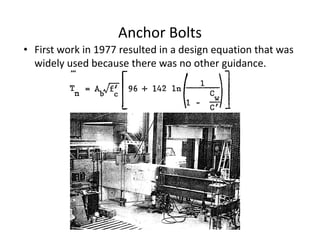
Anchor Bolts
• First work in 1977 resulted in a design equation that was
widely used because there was no other guidance.
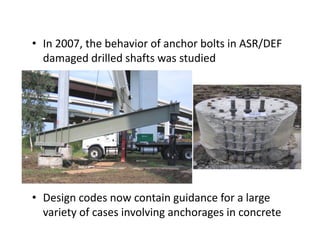
• In 2007, the behavior of anchor bolts in ASR/DEF
damaged drilled shafts was studied
• Design codes now contain guidance for a large
variety of cases involving anchorages in concrete
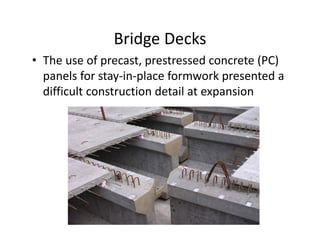
Bridge Decks
• The use of precast, prestressed concrete (PC)
panels for stay-in-place formwork presented a
difficult construction detail at expansion
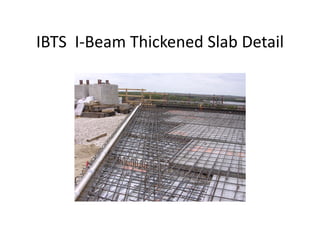
IBTS I-Beam Thickened Slab Detail
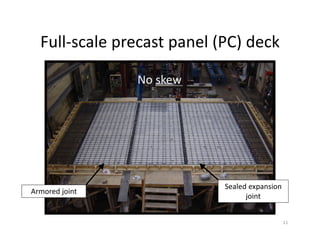
Full-scale precast panel (PC) deck
11
Armored joint
Sealed expansion
joint
No skew
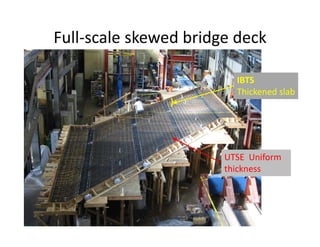
Full-scale skewed bridge deck
UTSE Uniform
thickness
IBTS
Thickened slab
}
Results
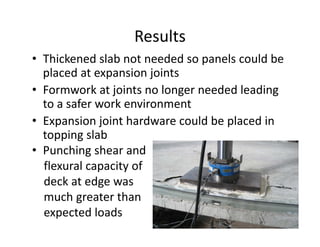
• Thickened slab not needed so panels could be
placed at expansion joints
• Formwork at joints no longer needed leading
to a safer work environment
• Expansion joint hardware could be placed in
topping slab
• Punching shear and
flexural capacity of
deck at edge was
much greater than
expected loads
Materials
• Epoxy-coated bars for durability
• High-strength concretes and effects of additives
• Fiber and alloy steels in corrosive environments
• Higher strength steels—80 to 100ksi bars are
being studied and will likely be permitted in
codes in the near future
• Materials for life extension--FRP’s, coatings,
chemical treatments
Structural Repair and Strengthening
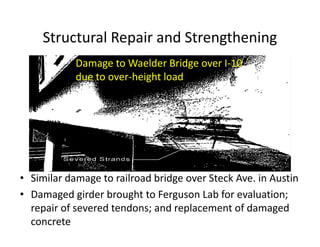
• Similar damage to railroad bridge over Steck Ave. in Austin
• Damaged girder brought to Ferguson Lab for evaluation;
repair of severed tendons; and replacement of damaged
concrete
Damage to Waelder
Bridge over I-10 due to
over-height load
Damage to Waelder Bridge over I-10
due to over-height load
Structural Repair and Strengthening
• For increased truck traffic and loadings
• Use of CFRP materials for improving shear
strength of bridge girders
• Combination of CFRP sheets and CFRP anchors
can be used for I and T sections where
complete wrapping is not possible
Other topics
• Fatigue studies of steel bridge girders and
illumination poles
• Stability of steel girder superstructures
• Bolted and welded connections
• Behavior of elastomeric bearing pads
• Stability of concrete arches—Fort Worth
Impact
• Viewed as leader among states in supporting
research that changed bridge design and
construction practice
• Influenced structural bridge and building
codes worldwide
• Provided training for a cadre of
knowledgeable engineers who became
leaders in the structural engineering
profession
Recognition
• Charles S. Whitney Award 1980 from ACI for
noteworthy engineering development work in
concrete design or construction
• Alfred E. Lindau Award 2005 from ACI for
outstanding contributions to reinforced concrete
design practice
• Citations for outstanding individual bridge
projects
• Numerous awards for technical papers based on
TxDOT-sponsored projects
Personal Reflections
• TxDOT Research Program
– Cooperation
– Collaboration
– Implementation
• The most rewarding research of my career
• Played a pivotal role in the development of Civil
Engineering at the University of Texas and in the
State of Texas
THANK YOU FOR THESE OPPORTUNITIES

50 years of Innovation in Bridge Design & Construction

  • 1.
    CTR Annual Symposium 50years of Innovation in Bridge Design and Construction April 23, 2014
  • 2.
    Details, Details, Details Thedevil is in the details or The beauty is in the details
  • 3.
    • A largepart of the TxDOT Research Program has been improvement in the detailing of transportation structures to guide design and construction • Hallmarks of the program –Identification of problem areas from designers, contractors, or maintenance personnel –Large-scale tests –Implementation of research findings
  • 4.
    Examples—Concrete Structures • Developmentand splices of reinforcement • Anchor bolt design • Epoxy-coated bars—performance and quality control • Dapped ends of beams—strut and tie models • T-headed bars • Use of precast panels for bridge decks – Elimination of thickened ends – Skewed bridges • Repair and strengthening of bridge girders – Damage from over-height loads – Use of CFRP for strengthening
  • 5.
    Development and splicesof reinforcement • 1960’s – Ferguson began work on development and use of large bars • 1970’s and 80’s – Reevaluation of data – Tests on wall-type specimens, – Effects of Casting position, Consolidation and superplasiticizers, Impact loading, Interaction with shear • 1990’s – Bundled bars – Headed bars
  • 6.
    Why was thisresearch important? • Greatly improved understanding of bond because the tests were large scale • Provided data that led to major changes in bridge and building codes • Findings were incorporated into the TxDOT Design Manuals • Gained national and international attention for TxDOT research program
  • 7.
    Anchor Bolts • Firstwork in 1977 resulted in a design equation that was widely used because there was no other guidance.
  • 8.
    • In 2007,the behavior of anchor bolts in ASR/DEF damaged drilled shafts was studied • Design codes now contain guidance for a large variety of cases involving anchorages in concrete
  • 9.
    Bridge Decks • Theuse of precast, prestressed concrete (PC) panels for stay-in-place formwork presented a difficult construction detail at expansion
  • 10.
  • 11.
    Full-scale precast panel(PC) deck 11 Armored joint Sealed expansion joint No skew
  • 12.
    Full-scale skewed bridgedeck UTSE Uniform thickness IBTS Thickened slab }
  • 13.
    Results • Thickened slabnot needed so panels could be placed at expansion joints • Formwork at joints no longer needed leading to a safer work environment • Expansion joint hardware could be placed in topping slab • Punching shear and flexural capacity of deck at edge was much greater than expected loads
  • 14.
    Materials • Epoxy-coated barsfor durability • High-strength concretes and effects of additives • Fiber and alloy steels in corrosive environments • Higher strength steels—80 to 100ksi bars are being studied and will likely be permitted in codes in the near future • Materials for life extension--FRP’s, coatings, chemical treatments
  • 15.
    Structural Repair andStrengthening • Similar damage to railroad bridge over Steck Ave. in Austin • Damaged girder brought to Ferguson Lab for evaluation; repair of severed tendons; and replacement of damaged concrete Damage to Waelder Bridge over I-10 due to over-height load Damage to Waelder Bridge over I-10 due to over-height load
  • 16.
    Structural Repair andStrengthening • For increased truck traffic and loadings • Use of CFRP materials for improving shear strength of bridge girders • Combination of CFRP sheets and CFRP anchors can be used for I and T sections where complete wrapping is not possible
  • 18.
    Other topics • Fatiguestudies of steel bridge girders and illumination poles • Stability of steel girder superstructures • Bolted and welded connections • Behavior of elastomeric bearing pads • Stability of concrete arches—Fort Worth
  • 19.
    Impact • Viewed asleader among states in supporting research that changed bridge design and construction practice • Influenced structural bridge and building codes worldwide • Provided training for a cadre of knowledgeable engineers who became leaders in the structural engineering profession
  • 20.
    Recognition • Charles S.Whitney Award 1980 from ACI for noteworthy engineering development work in concrete design or construction • Alfred E. Lindau Award 2005 from ACI for outstanding contributions to reinforced concrete design practice • Citations for outstanding individual bridge projects • Numerous awards for technical papers based on TxDOT-sponsored projects
  • 21.
    Personal Reflections • TxDOTResearch Program – Cooperation – Collaboration – Implementation • The most rewarding research of my career • Played a pivotal role in the development of Civil Engineering at the University of Texas and in the State of Texas THANK YOU FOR THESE OPPORTUNITIES