IRS Concrete Bridge Code..1997
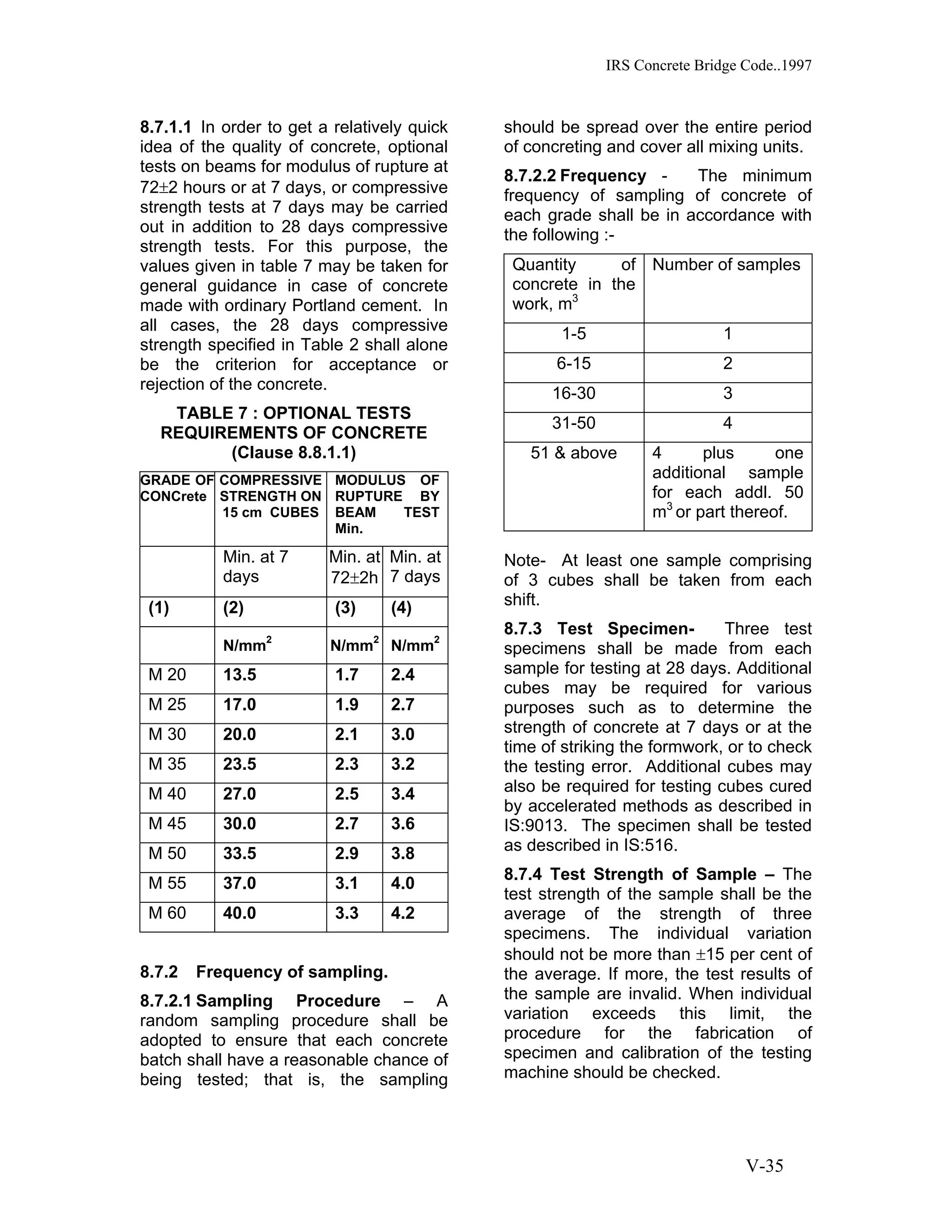
V-i
For Official use only
GOVERNMENT OF INDIA
MINISTRY OF RAILWAYS
(Railway Board)
INDIAN RAILWAY STANDARD
CODE OF PRACTICE FOR PLAIN,
REINFORCED & PRESTRESSED CONCRETE
FOR GENERAL BRIDGE CONSTRUCTION
(CONCRETE BRIDGE CODE)
ADOPTED –1936
INCORPORATING A & C SLIP NO. 7, YEAR : 2003
ISSUED BY
RESEARCH DESIGNS AND STANDARDS ORGANISATION
LUCKNOW - 226011
Contents
IRS Concrete Bridge Code..1997
V-ii
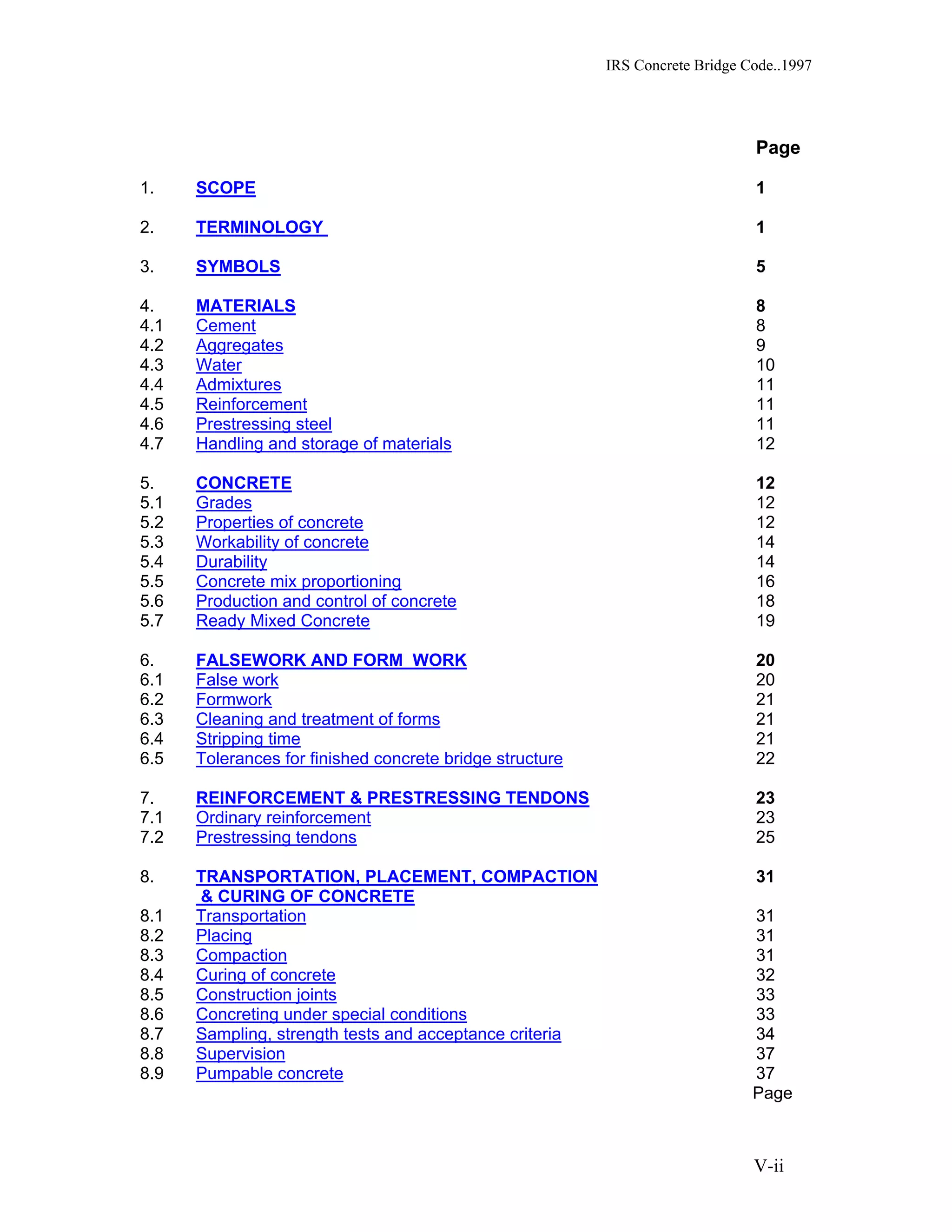
Page
1. SCOPE 1
2. TERMINOLOGY 1
3. SYMBOLS 5
4. MATERIALS 8
4.1 Cement 8
4.2 Aggregates 9
4.3 Water 10
4.4 Admixtures 11
4.5 Reinforcement 11
4.6 Prestressing steel 11
4.7 Handling and storage of materials 12
5. CONCRETE 12
5.1 Grades 12
5.2 Properties of concrete 12
5.3 Workability of concrete 14
5.4 Durability 14
5.5 Concrete mix proportioning 16
5.6 Production and control of concrete 18
5.7 Ready Mixed Concrete 19
6. FALSEWORK AND FORM WORK 20
6.1 False work 20
6.2 Formwork 21
6.3 Cleaning and treatment of forms 21
6.4 Stripping time 21
6.5 Tolerances for finished concrete bridge structure 22
7. REINFORCEMENT & PRESTRESSING TENDONS 23
7.1 Ordinary reinforcement 23
7.2 Prestressing tendons 25
8. TRANSPORTATION, PLACEMENT, COMPACTION 31
& CURING OF CONCRETE
8.1 Transportation 31
8.2 Placing 31
8.3 Compaction 31
8.4 Curing of concrete 32
8.5 Construction joints 33
8.6 Concreting under special conditions 33
8.7 Sampling, strength tests and acceptance criteria 34
8.8 Supervision 37
8.9 Pumpable concrete 37
Page
IRS Concrete Bridge Code..1997
V-iii
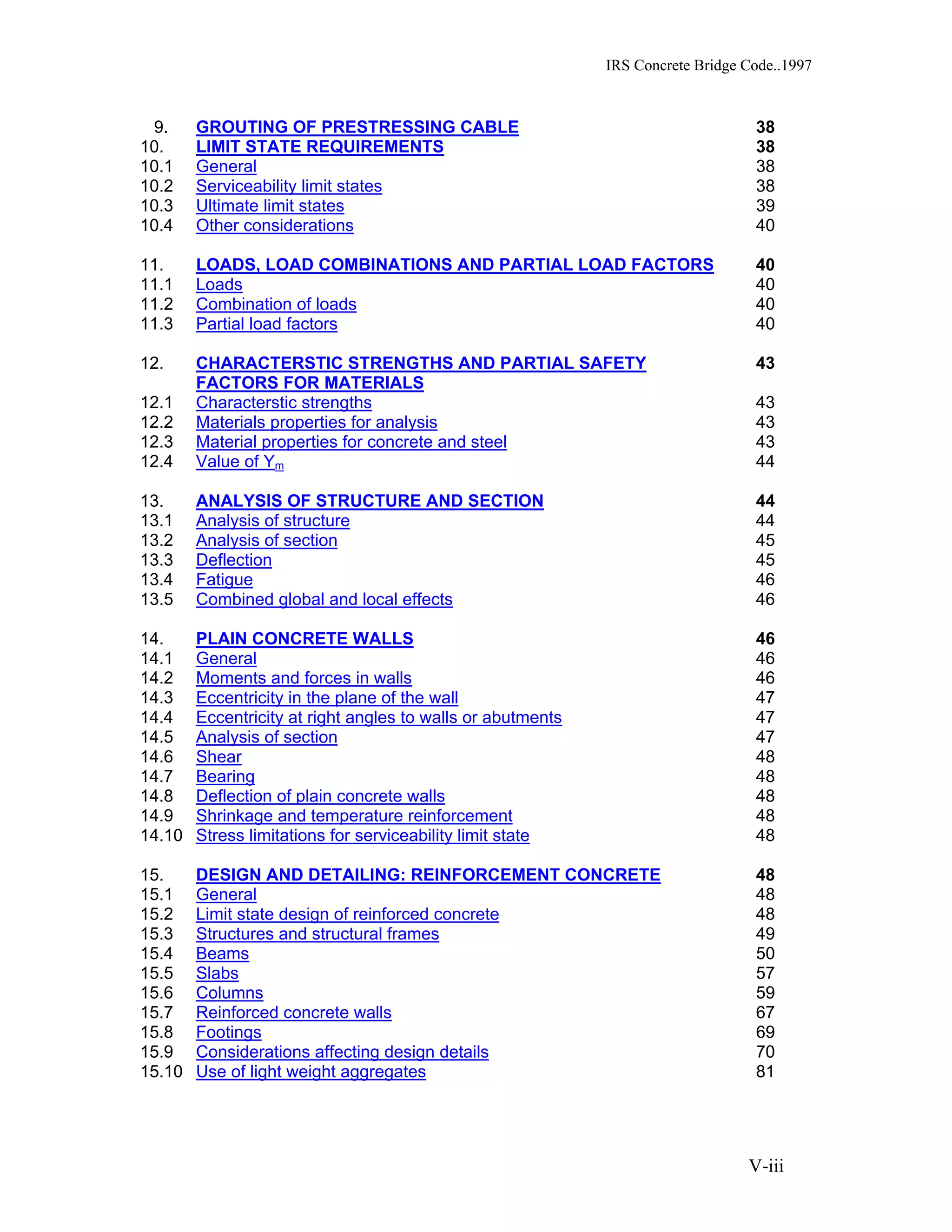
9. GROUTING OF PRESTRESSING CABLE 38
10. LIMIT STATE REQUIREMENTS 38
10.1 General 38
10.2 Serviceability limit states 38
10.3 Ultimate limit states 39
10.4 Other considerations 40
11. LOADS, LOAD COMBINATIONS AND PARTIAL LOAD FACTORS 40
11.1 Loads 40
11.2 Combination of loads 40
11.3 Partial load factors 40
12. CHARACTERSTIC STRENGTHS AND PARTIAL SAFETY 43
FACTORS FOR MATERIALS
12.1 Characterstic strengths 43
12.2 Materials properties for analysis 43
12.3 Material properties for concrete and steel 43
12.4 Value of Ym 44
13. ANALYSIS OF STRUCTURE AND SECTION 44
13.1 Analysis of structure 44
13.2 Analysis of section 45
13.3 Deflection 45
13.4 Fatigue 46
13.5 Combined global and local effects 46
14. PLAIN CONCRETE WALLS 46
14.1 General 46
14.2 Moments and forces in walls 46
14.3 Eccentricity in the plane of the wall 47
14.4 Eccentricity at right angles to walls or abutments 47
14.5 Analysis of section 47
14.6 Shear 48
14.7 Bearing 48
14.8 Deflection of plain concrete walls 48
14.9 Shrinkage and temperature reinforcement 48
14.10 Stress limitations for serviceability limit state 48
15. DESIGN AND DETAILING: REINFORCEMENT CONCRETE 48
15.1 General 48
15.2 Limit state design of reinforced concrete 48
15.3 Structures and structural frames 49
15.4 Beams 50
15.5 Slabs 57
15.6 Columns 59
15.7 Reinforced concrete walls 67
15.8 Footings 69
15.9 Considerations affecting design details 70
15.10 Use of light weight aggregates 81
IRS Concrete Bridge Code..1997
V-iv
Page
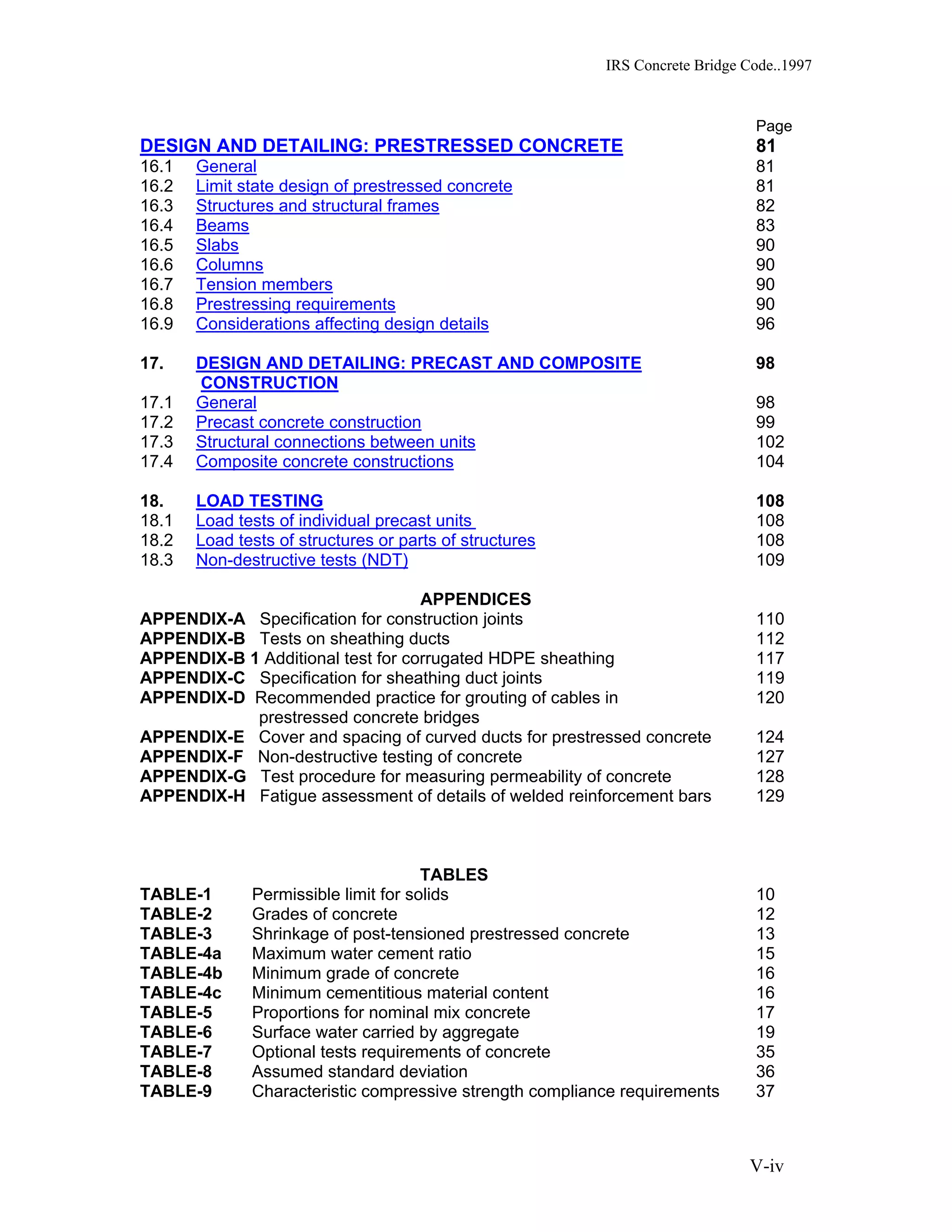
DESIGN AND DETAILING: PRESTRESSED CONCRETE 81
16.1 General 81
16.2 Limit state design of prestressed concrete 81
16.3 Structures and structural frames 82
16.4 Beams 83
16.5 Slabs 90
16.6 Columns 90
16.7 Tension members 90
16.8 Prestressing requirements 90
16.9 Considerations affecting design details 96
17. DESIGN AND DETAILING: PRECAST AND COMPOSITE 98
CONSTRUCTION
17.1 General 98
17.2 Precast concrete construction 99
17.3 Structural connections between units 102
17.4 Composite concrete constructions 104
18. LOAD TESTING 108
18.1 Load tests of individual precast units 108
18.2 Load tests of structures or parts of structures 108
18.3 Non-destructive tests (NDT) 109
APPENDICES
APPENDIX-A Specification for construction joints 110
APPENDIX-B Tests on sheathing ducts 112
APPENDIX-B 1 Additional test for corrugated HDPE sheathing 117
APPENDIX-C Specification for sheathing duct joints 119
APPENDIX-D Recommended practice for grouting of cables in 120
prestressed concrete bridges
APPENDIX-E Cover and spacing of curved ducts for prestressed concrete 124
APPENDIX-F Non-destructive testing of concrete 127
APPENDIX-G Test procedure for measuring permeability of concrete 128
APPENDIX-H Fatigue assessment of details of welded reinforcement bars 129
TABLES
TABLE-1 Permissible limit for solids 10
TABLE-2 Grades of concrete 12
TABLE-3 Shrinkage of post-tensioned prestressed concrete 13
TABLE-4a Maximum water cement ratio 15
TABLE-4b Minimum grade of concrete 16
TABLE-4c Minimum cementitious material content 16
TABLE-5 Proportions for nominal mix concrete 17
TABLE-6 Surface water carried by aggregate 19
TABLE-7 Optional tests requirements of concrete 35
TABLE-8 Assumed standard deviation 36
TABLE-9 Characteristic compressive strength compliance requirements 37
IRS Concrete Bridge Code..1997
V-v
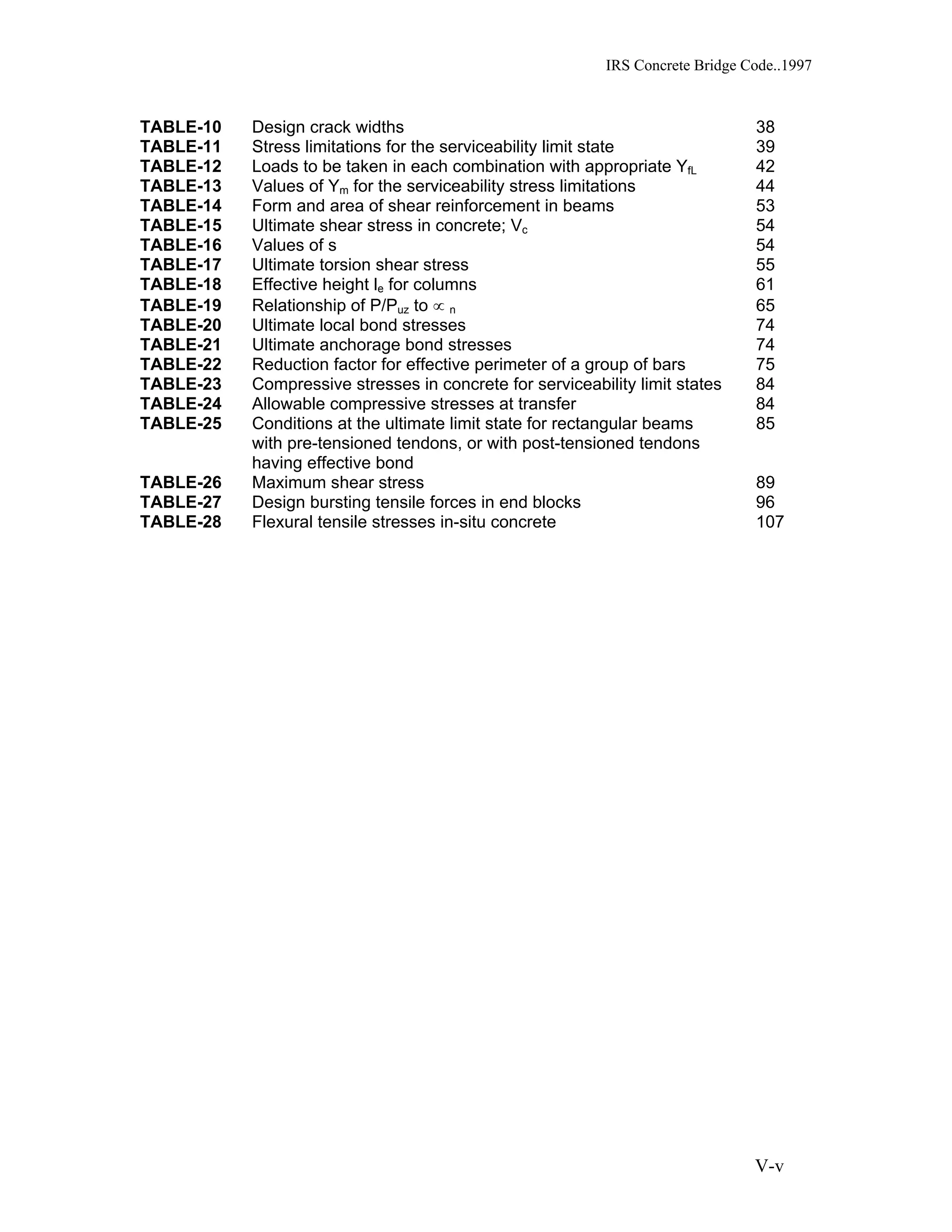
TABLE-10 Design crack widths 38
TABLE-11 Stress limitations for the serviceability limit state 39
TABLE-12 Loads to be taken in each combination with appropriate YfL 42
TABLE-13 Values of Ym for the serviceability stress limitations 44
TABLE-14 Form and area of shear reinforcement in beams 53
TABLE-15 Ultimate shear stress in concrete; Vc 54
TABLE-16 Values of s 54
TABLE-17 Ultimate torsion shear stress 55
TABLE-18 Effective height le for columns 61
TABLE-19 Relationship of P/Puz to ∝ n 65
TABLE-20 Ultimate local bond stresses 74
TABLE-21 Ultimate anchorage bond stresses 74
TABLE-22 Reduction factor for effective perimeter of a group of bars 75
TABLE-23 Compressive stresses in concrete for serviceability limit states 84
TABLE-24 Allowable compressive stresses at transfer 84
TABLE-25 Conditions at the ultimate limit state for rectangular beams 85
with pre-tensioned tendons, or with post-tensioned tendons
having effective bond
TABLE-26 Maximum shear stress 89
TABLE-27 Design bursting tensile forces in end blocks 96
TABLE-28 Flexural tensile stresses in-situ concrete 107
IRS Concrete Bridge Code..1997
V-1
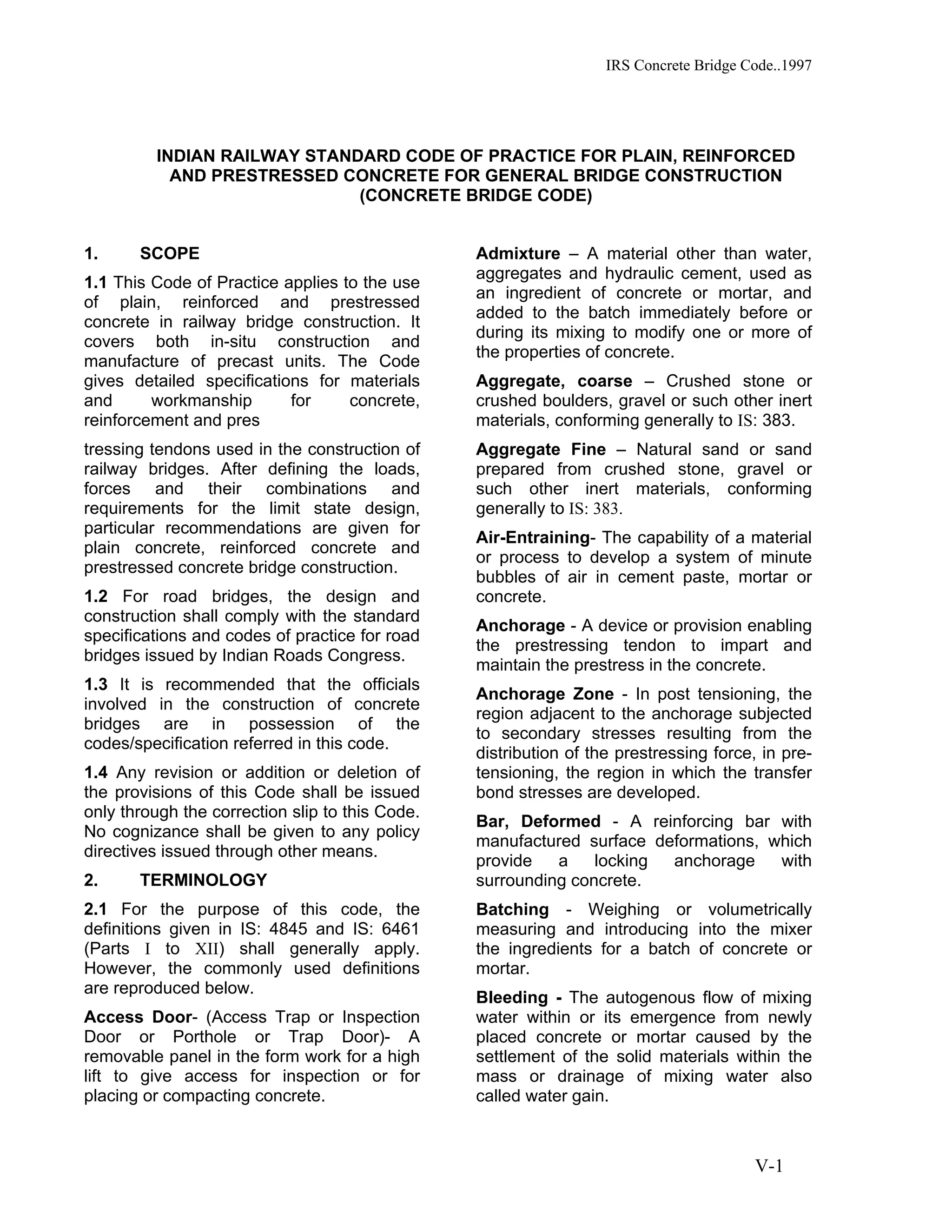
INDIAN RAILWAY STANDARD CODE OF PRACTICE FOR PLAIN, REINFORCED
AND PRESTRESSED CONCRETE FOR GENERAL BRIDGE CONSTRUCTION
(CONCRETE BRIDGE CODE)
1. SCOPE
1.1 This Code of Practice applies to the use
of plain, reinforced and prestressed
concrete in railway bridge construction. It
covers both in-situ construction and
manufacture of precast units. The Code
gives detailed specifications for materials
and workmanship for concrete,
reinforcement and pres
tressing tendons used in the construction of
railway bridges. After defining the loads,
forces and their combinations and
requirements for the limit state design,
particular recommendations are given for
plain concrete, reinforced concrete and
prestressed concrete bridge construction.
1.2 For road bridges, the design and
construction shall comply with the standard
specifications and codes of practice for road
bridges issued by Indian Roads Congress.
1.3 It is recommended that the officials
involved in the construction of concrete
bridges are in possession of the
codes/specification referred in this code.
1.4 Any revision or addition or deletion of
the provisions of this Code shall be issued
only through the correction slip to this Code.
No cognizance shall be given to any policy
directives issued through other means.
2. TERMINOLOGY
2.1 For the purpose of this code, the
definitions given in IS: 4845 and IS: 6461
(Parts I to XII) shall generally apply.
However, the commonly used definitions
are reproduced below.
Access Door- (Access Trap or Inspection
Door or Porthole or Trap Door)- A
removable panel in the form work for a high
lift to give access for inspection or for
placing or compacting concrete.
Admixture – A material other than water,
aggregates and hydraulic cement, used as
an ingredient of concrete or mortar, and
added to the batch immediately before or
during its mixing to modify one or more of
the properties of concrete.
Aggregate, coarse – Crushed stone or
crushed boulders, gravel or such other inert
materials, conforming generally to IS: 383.
Aggregate Fine – Natural sand or sand
prepared from crushed stone, gravel or
such other inert materials, conforming
generally to IS: 383.
Air-Entraining- The capability of a material
or process to develop a system of minute
bubbles of air in cement paste, mortar or
concrete.
Anchorage - A device or provision enabling
the prestressing tendon to impart and
maintain the prestress in the concrete.
Anchorage Zone - In post tensioning, the
region adjacent to the anchorage subjected
to secondary stresses resulting from the
distribution of the prestressing force, in pre-
tensioning, the region in which the transfer
bond stresses are developed.
Bar, Deformed - A reinforcing bar with
manufactured surface deformations, which
provide a locking anchorage with
surrounding concrete.
Batching - Weighing or volumetrically
measuring and introducing into the mixer
the ingredients for a batch of concrete or
mortar.
Bleeding - The autogenous flow of mixing
water within or its emergence from newly
placed concrete or mortar caused by the
settlement of the solid materials within the
mass or drainage of mixing water also
called water gain.
IRS Concrete Bridge Code..1997
V-2
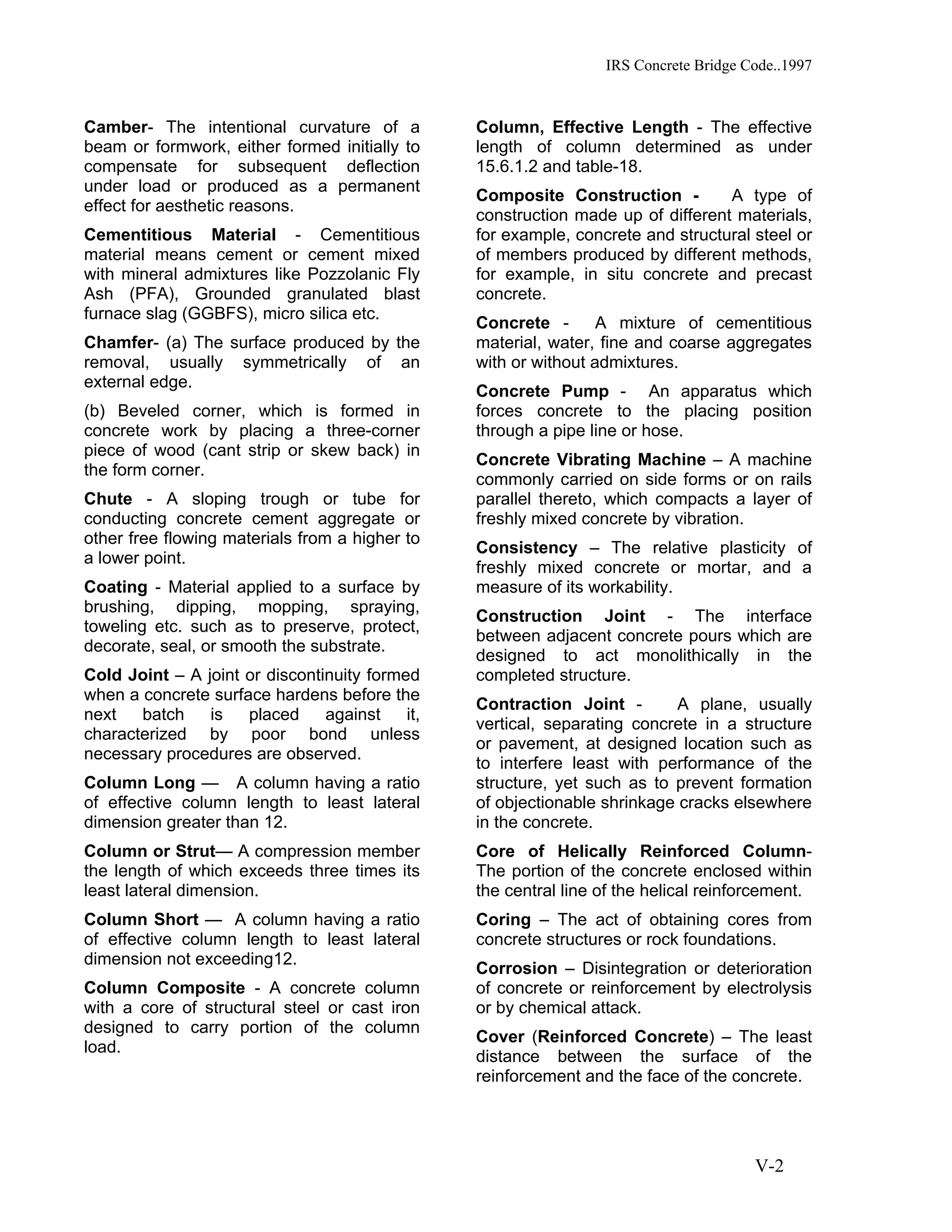
Camber- The intentional curvature of a
beam or formwork, either formed initially to
compensate for subsequent deflection
under load or produced as a permanent
effect for aesthetic reasons.
Cementitious Material - Cementitious
material means cement or cement mixed
with mineral admixtures like Pozzolanic Fly
Ash (PFA), Grounded granulated blast
furnace slag (GGBFS), micro silica etc.
Chamfer- (a) The surface produced by the
removal, usually symmetrically of an
external edge.
(b) Beveled corner, which is formed in
concrete work by placing a three-corner
piece of wood (cant strip or skew back) in
the form corner.
Chute - A sloping trough or tube for
conducting concrete cement aggregate or
other free flowing materials from a higher to
a lower point.
Coating - Material applied to a surface by
brushing, dipping, mopping, spraying,
toweling etc. such as to preserve, protect,
decorate, seal, or smooth the substrate.
Cold Joint – A joint or discontinuity formed
when a concrete surface hardens before the
next batch is placed against it,
characterized by poor bond unless
necessary procedures are observed.
Column Long — A column having a ratio
of effective column length to least lateral
dimension greater than 12.
Column or Strut— A compression member
the length of which exceeds three times its
least lateral dimension.
Column Short — A column having a ratio
of effective column length to least lateral
dimension not exceeding12.
Column Composite - A concrete column
with a core of structural steel or cast iron
designed to carry portion of the column
load.
Column, Effective Length - The effective
length of column determined as under
15.6.1.2 and table-18.
Composite Construction - A type of
construction made up of different materials,
for example, concrete and structural steel or
of members produced by different methods,
for example, in situ concrete and precast
concrete.
Concrete - A mixture of cementitious
material, water, fine and coarse aggregates
with or without admixtures.
Concrete Pump - An apparatus which
forces concrete to the placing position
through a pipe line or hose.
Concrete Vibrating Machine – A machine
commonly carried on side forms or on rails
parallel thereto, which compacts a layer of
freshly mixed concrete by vibration.
Consistency – The relative plasticity of
freshly mixed concrete or mortar, and a
measure of its workability.
Construction Joint - The interface
between adjacent concrete pours which are
designed to act monolithically in the
completed structure.
Contraction Joint - A plane, usually
vertical, separating concrete in a structure
or pavement, at designed location such as
to interfere least with performance of the
structure, yet such as to prevent formation
of objectionable shrinkage cracks elsewhere
in the concrete.
Core of Helically Reinforced Column-
The portion of the concrete enclosed within
the central line of the helical reinforcement.
Coring – The act of obtaining cores from
concrete structures or rock foundations.
Corrosion – Disintegration or deterioration
of concrete or reinforcement by electrolysis
or by chemical attack.
Cover (Reinforced Concrete) – The least
distance between the surface of the
reinforcement and the face of the concrete.
IRS Concrete Bridge Code..1997
V-3
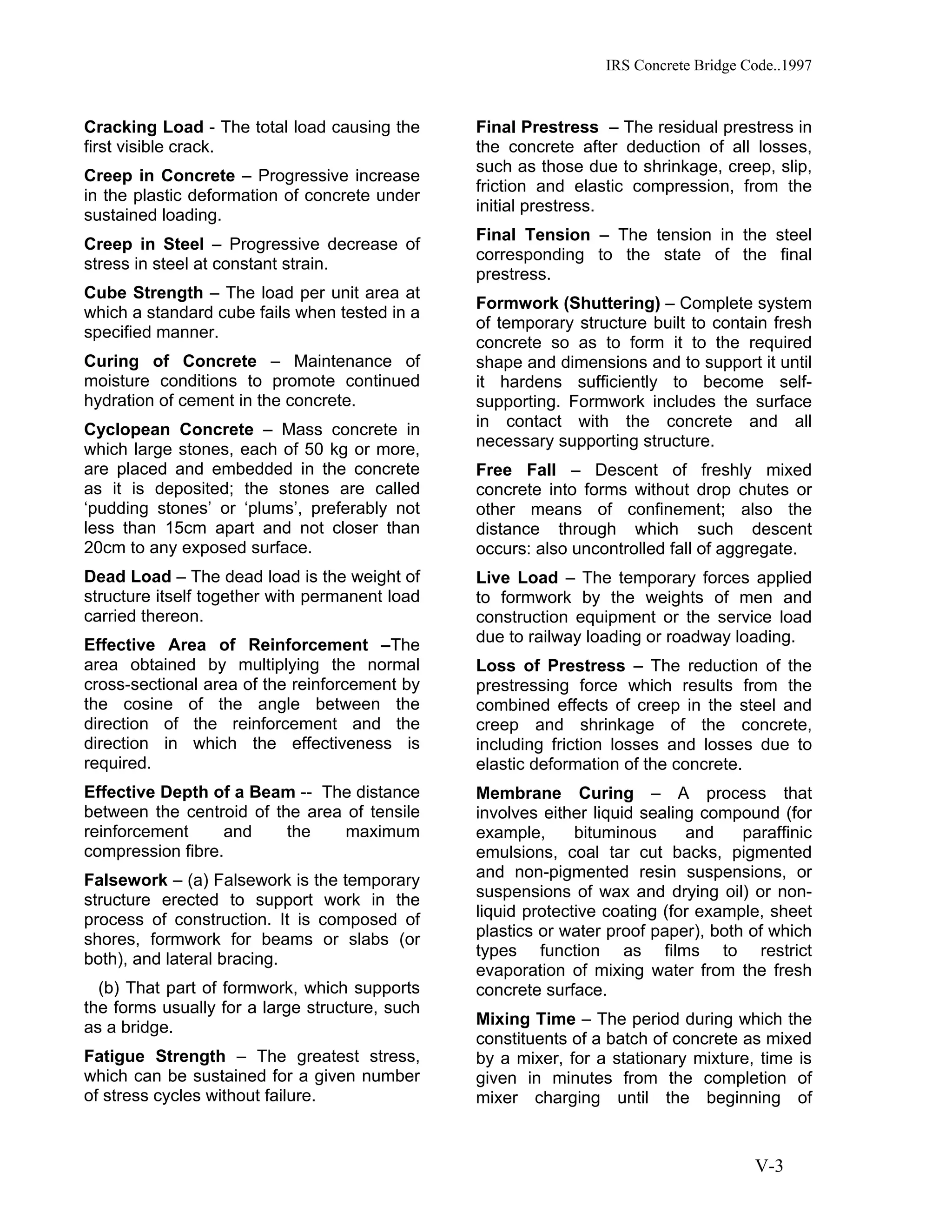
Cracking Load - The total load causing the
first visible crack.
Creep in Concrete – Progressive increase
in the plastic deformation of concrete under
sustained loading.
Creep in Steel – Progressive decrease of
stress in steel at constant strain.
Cube Strength – The load per unit area at
which a standard cube fails when tested in a
specified manner.
Curing of Concrete – Maintenance of
moisture conditions to promote continued
hydration of cement in the concrete.
Cyclopean Concrete – Mass concrete in
which large stones, each of 50 kg or more,
are placed and embedded in the concrete
as it is deposited; the stones are called
‘pudding stones’ or ‘plums’, preferably not
less than 15cm apart and not closer than
20cm to any exposed surface.
Dead Load – The dead load is the weight of
structure itself together with permanent load
carried thereon.
Effective Area of Reinforcement –The
area obtained by multiplying the normal
cross-sectional area of the reinforcement by
the cosine of the angle between the
direction of the reinforcement and the
direction in which the effectiveness is
required.
Effective Depth of a Beam -- The distance
between the centroid of the area of tensile
reinforcement and the maximum
compression fibre.
Falsework – (a) Falsework is the temporary
structure erected to support work in the
process of construction. It is composed of
shores, formwork for beams or slabs (or
both), and lateral bracing.
(b) That part of formwork, which supports
the forms usually for a large structure, such
as a bridge.
Fatigue Strength – The greatest stress,
which can be sustained for a given number
of stress cycles without failure.
Final Prestress – The residual prestress in
the concrete after deduction of all losses,
such as those due to shrinkage, creep, slip,
friction and elastic compression, from the
initial prestress.
Final Tension – The tension in the steel
corresponding to the state of the final
prestress.
Formwork (Shuttering) – Complete system
of temporary structure built to contain fresh
concrete so as to form it to the required
shape and dimensions and to support it until
it hardens sufficiently to become self-
supporting. Formwork includes the surface
in contact with the concrete and all
necessary supporting structure.
Free Fall – Descent of freshly mixed
concrete into forms without drop chutes or
other means of confinement; also the
distance through which such descent
occurs: also uncontrolled fall of aggregate.
Live Load – The temporary forces applied
to formwork by the weights of men and
construction equipment or the service load
due to railway loading or roadway loading.
Loss of Prestress – The reduction of the
prestressing force which results from the
combined effects of creep in the steel and
creep and shrinkage of the concrete,
including friction losses and losses due to
elastic deformation of the concrete.
Membrane Curing – A process that
involves either liquid sealing compound (for
example, bituminous and paraffinic
emulsions, coal tar cut backs, pigmented
and non-pigmented resin suspensions, or
suspensions of wax and drying oil) or non-
liquid protective coating (for example, sheet
plastics or water proof paper), both of which
types function as films to restrict
evaporation of mixing water from the fresh
concrete surface.
Mixing Time – The period during which the
constituents of a batch of concrete as mixed
by a mixer, for a stationary mixture, time is
given in minutes from the completion of
mixer charging until the beginning of
IRS Concrete Bridge Code..1997
V-4
discharge; for a truck mixer, time is given in
total minutes at a specified mixing speed or
expressed in terms of total revolutions at a
specified mixing speed or expressed in
terms of total revolutions at a specified
mixing speed.
Plain Concrete – Concrete without
reinforcement; or concrete that does not
conform to the definition of reinforced
concrete.
Plum – A large random shaped stone
dropped into freshly placed mass concrete.
Pumped Concrete – Concrete which is
transported through hose or pipe by means
of a pump.
Ready Mixed Concrete (RMC) – Concrete
produced by completely mixing cement,
aggregates, admixtures, if any, and water at
a Central Batching and Mixing Plant and
delivered in fresh condition at site of
construction.
Reinforcement – Metal bars, wires or other
slender members, which are embedded in
concrete in such a manner that the metal
and the concrete act together in resisting
forces.
Rubble – Rough stone of irregular shape
and size broken from larger masses by
geological process or by quarrying.
Segregation – The differential
concentration of the components of mixed
concrete, resulting in non-uniform
proportions in the mass.
Sheath – An enclosure in which post-
tensioned tendons are encased to prevent
bonding during concrete placement.
Slump – A measure of consistency of
freshly mixed concrete mortar, or stucco
equal to the subsidence measured to the
nearest 6mm of the moulded truncated cone
immediately after removal of the slump
cone.
Splice – Connection of one reinforcing bar
to another by overlapping, welding,
mechanical end connectors, or other
means.
Strand – A prestressing tendon composed
of a number of wires most of which are
twisted about a center wire of core.
Stress Corrosion – Corrosion of a metal
accelerated by stress.
Sulphate Attack – Harmful or deleterious
chemical or physical reaction or both
between sulphates in soil or groundwater
and concrete or mortar, primarily the
cement paste matrix.
Sulphate Resistance – Ability of concrete
or mortar to withstand sulphate attack.
Tamper – A timber or metal beam
spanning between edge forms or screed
rails and used for compacting concrete.
Tensile Strength – The maximum load
reached in a tensile test divided by the
original cross-sectional area of the gauge
length portion of the test piece. Also termed
as maximum stress, or ultimate tensile
stress.
Tremie – A pipe or tube through which
concrete is deposited under water, having at
its upper end a hopper for filling and a bail
by means of which the assembly can be
handled by a derrick.
Vibrator – An oscillating machine used to
agitate fresh concrete so as to eliminate
gross voids including entrapped air but not
entrained air and produce intimate contact
with form surfaces and embedded
materials.
Water Cement Ratio – The ratio of amount
of water, exclusive only of that absorbed by
the aggregates, to the amount of cement in
a concrete or mortar mixture; preferably
stated as a decimal by weight.
Wobble Coefficient – A coefficient used in
determining the friction loss occurring in
post-tensioning, which is assumed to
accounts for the secondary curvature of the
tendons.
Yield Strength – The stress, less than the
maximum attainable stress, at which the
ratio of stress to strain has dropped well
below its value at low stress, or at which a
IRS Concrete Bridge Code..1997
V-5
material exhibits a specified limiting
deviation from the usual proportionality of
stress to strain.
Yield Stress – Stress (that is, load per unit
cross-sectional area) at which elongation
first occurs in the test piece without
increasing the load during tensile test. In the
case of steels with no such definite yield
point, the yield stress is the stress under the
prescribed testing conditions at which the
observed increase in the gauge length is
1/200 of the gauge length when the rate at
which the load is applied is not more than
0.5 kg/mm2
when approaching the yield
stress.
3. SYMBOLS
Ac area of concrete
Acf area of effective concrete flange
Acon contact area
Acor area of core of the concrete section
Ae area of fully anchored reinforcement
per unit length crossing the shear
plane
Ao area enclosed by the median wall
line
Aps area of prestressing tendons in the
tension zone
As area of tension reinforcement
As’ area of compression reinforcement
Asl’ area of compression reinforcement
in the more highly compressed face
As2 area of reinforcement in other face
Asc area of longitudinal reinforcement
(for columns)
AsL Cross-sectional area of one bar of
longitudinal reinforcement provided
for torsion.
Ast Cross-sectional area of one leg of a
closed link
Asup supporting area
Asv Cross-sectional area of the legs of a
link
At area of reinforcement in a particular
direction
a Centre to center distance between
bars
a’ distance from compression face to
point at which the crack width is
being calculated
acent distance of the centroid of the
concrete flange from the centroid of
the composite section
acr distance from the point(crack)
considered to surface of the nearest
longitudinal bar
av distance between the line of action
or point of application of the load
and the critical section or supporting
member
b width or breadth of section
ba average breadth of section excluding
the compression flange
bc breadth of compression face
bcol width of column
bs width of section containing effective
reinforcement for punching shear
bt breadth of section a level of tension
reinforcement
bw breadth of web or rib of a member
cnom nominal cover
d effective depth to tension
reinforcement
d’ depth of compression reinforcement
dc depth of concrete in compression
de effective depth for a solid slab or
rectangular beam, otherwise the
overall depth of the compression
flange
do depth to additional reinforcement to
resist horizontal loading
dt effective depth from the extreme
compression fiber to either the
longitudinal bars around which the
IRS Concrete Bridge Code..1997
V-6
stirrups pass or the centroid of the
tendons, whichever is the greater
d2 depth from the surface to the
reinforcement in the other face
Ec static secant modulus of elasticity of
concrete
Ecf modulus of elasticity of flange
concrete
Es modulus of elasticity of steel
(EI)c flexural rigidity of the column cross-
section
E28 secant modulus of elasticity of the
concrete at the age of 28 days
e eccentricity
ex resultant eccentricity of load at right-
angels to plane of wall
Fbst tensile bursting force
Fbt tensile force due to ultimate loads in
bar or group of bars
Fh maximum horizontal ultimate load
Fv maximum vertical ultimate load
f stress
fbs local bond stress
fcav average compressive stress in the
flexural compressive zone
fci concrete strength at(initial) transfer
fcj stress in concrete at application of
an increment of stress at time j
fck characteristic compressive strength
of concrete
fcp compressive stress at the centroidal
axis due to prestress
fcr flexural strength of concrete
fpb tensile stress in tendons at (beam)
failure
fpe effective prestress (in tendon)
fpt stress due to prestress
fpu characteristic strength of
prestressing tendons
fs2 stress in reinforcement in other face
fi maximum principal tensile stress
fy characteristic strength of
reinforcement
fyc design strength of longitudinal steel
in compression
fyl characteristic strength of longitudinal
reinforcement
fyv characteristic strength of link
reinforcement
h overall depth (thickness) of section (in
plane of bending)
hagg maximum size of aggregate
he effective thickness
hf thickness of flange
hmax larger dimension of section
hmin smaller dimension of section
hwo wall thickness where the stress is
determined
hx overall depth of the cross-section in
the plane of bending Miy
hy overall depth of the cross-section in
the plane of bending Mix
I second moment of area
K a factor depending on the type of
duct or sheath used
kr depends on grade of reinforcement
kl depends on the concrete bond
across the shear plane
Ls length of shear plane
l distance from face of support at the
end of a cantilever, or effective span
of a member
l length of the specimen
le effective height of a column or wall
lex effective height for bending about
the major axis
ley effective height for bending about
the minor axis
IRS Concrete Bridge Code..1997
V-7
lo clear height of column between end
restraints
lsb length of straight reinforcement
beyond the intersection with the link
lt transmission length
M bending moment due to ultimate
loads
Ma increased moment in column
Mcr cracking moment at the section
considered
Mcs hogging restraint moment at an
internal support of a continuous
composite beam and slab section
due to differential shrinkage
Mg moment due to permanent load
Mi maximum initial moment in a column
due to ultimate loads
Mix initial moment about the major axis
of a slender column due to ultimate
loads
Miy initial moment about the minor axis
of a slender column due to ultimate
loads
Mq moment due to live loads
Mtx total moment about the major axis of
a slender column due to ultimate
loads.
Mty total moment about the minor axis of
a slender column due to ultimate
loads.
Mu ultimate moment of resistance
Mux ultimate moment capacity in a short
column assuming ultimate axial
loads and bending about the major
axis only
Muy ultimate moment capacity in a short
column assuming ultimate axial
loads and bending about the minor
axis only
Mx,My moment about the major and minor
axis of a short column due to
ultimate loads
M1 smaller initial end moment due to
ultimate loads (assumed negative if
the column is bent in double
curvature)
M2 larger initial end moment due
ultimate loads (assumed positive)
n number of sample test results
nw ultimate axial load per unit length of
wall
P ultimate axial load on the section
considered
Ph horizontal component of the
prestressing force after all losses
Pk basic load in tendon
Po initial prestressing force in the
tendon at jacking end on at tangent
point near jacking end
Pu ultimate axial load resistance
Px Prestressing force at distance x from
jack
Puz axial loading capacity of column
ignoring all bending
Q* design load
Qk nominal load
r internal radius of bend
rps radius of curvature of a tendon
S* design load effects
s depth factor
Sd estimated standard deviation
SL spacing of longitudinal reinforcement
Sv spacing of links along the member
T torsional moment due to ultimate
loads.
u perimeter
us effective perimeter of tension
reinforcement
V shear force due to ultimate loads
Va premeasured quantity of water in a
measuring cylinder
IRS Concrete Bridge Code..1997
V-8
Vb balance quantity of water left in the
cylinder after completely filling of the
test sample
Vc ultimate shear resistance of concrete
Vp actual volume
Vco ultimate shear resistance of a
section un-cracked in flexure
Vcr ultimate shear resistance of a
section cracked in flexure
Vl longitudinal shear force due to
ultimate load
Vux ultimate shear capacity of a section
for the x-x axis
Vuy ultimate shear capacity of a section
for the y-y axis
Vx applied shear due to ultimate loads
for the x-x axis
Vy applied shear due to ultimate loads
for the y-y axis
v shear stress
vc ultimate shear stress in concrete
vt torsional shear stress
vtmin minimum ultimate torsional shear
stress for which reinforcement is
required
vtu ultimate torsional shear stress
x neutral axis depth
xl smaller center line dimension of a
link
y distance of the fibre considered in
the plane of bending from the
centroid of the concrete section
yo half the side of end block
ypo half the side of loaded area
yl larger center line dimension of a link
z lever arm
∝n Coefficient as a function of column
axial load
∝1 Angle between the axis of the design
moment and the direction of the
tensile reinforcement
∝2 Angle of friction at the joint
βcc Ration of total creep to elastic
deformation
Yf1 Yf2 Yf3 partial load factors
YfL product of Yf1 Yf2
Ym partial safety factor for strength
Δ deviation of individual test strength
from the average strength of n
samples
ε strain
εdiff differential shrinkage strain
εm average strain
εs strain in tension reinforcement
εl strain at level considered
Sφ angle between the compression face
and the tension reinforcement
Yw coefficient for wall dependent upon
concrete used
μ coefficient of friction
ΣAsv area of shear reinforcement
Σus sum of the effective perimeters of
the tension reinforcement
φ size (Nominal diameter) of bar or
tendon or internal diameter of the
sheathing
Q creep coefficient
Q1 creep coefficient for prestressed
construction
4. MATERIALS
4.1 Cement
4.1.1 The cement used shall be any of the
following, with the prior approval of the
engineer:
IRS Concrete Bridge Code..1997
V-9
a) 33 Grade Ordinary Portland cement
conforming to IS:269
b) 43 Grade Ordinary Portland cement
conforming to IS:8112
c) 53 Grade Ordinary Portland cement
conforming to IS:12269
d) Rapid hardening Ordinary Portland
cement conforming to IS:8041
e) High strength Portland cement
conforming to IRS:T:40
f) Portland slag cement conforming to
IS:455(see Note 1&4 below)
g) Portland pozzolana cement conforming
to IS:1489(see Note 2&4 below)
h) Sulphate resistance cement conforming
to IS:12330(see Note 3 below)
Note: 1 Portland slag cement
conforming to IS:455 may be used for
prestressed concrete work, provided slag
content in cement is not more the 50%
Note: 2 Portland Pozzolana cement
shall not be used for RCC & PSC works.
Portland Pozzolana Cement can be used
only for foundation concrete and concrete
works in bridge substructures where
reinforcement is not provided for structural
strength or reinforcement provided is only
nominal for temperature stresses etc. When
Portland Pozzolana cement is used, it is to
be insured that proper damp curing of
concrete is done at least for 14 days and
supporting form work shall not be removed
till concrete attains at least 75% of the
design strength.
Note: 3 The sulphate resisting
cement conforming to IS:12330 shall be
used only in such conditions where the
concrete is exposed to the risk of excessive
sulphate attack e.g. concrete in contact with
soil or ground water containing excessive
amount of sulphate. It shall not be used
under such conditions where concrete is
exposed to risk of excessive chlorides and
sulphate attack both.
Note: 4 The rate of development of strength
is slow in case of blended cement i.e.
Portland pozzolana cement and Portland
slag cement, as compared to ordinary
Portland cement. This aspect should be
taken care while planning to use blended
cement. Accordingly stage of prestressing,
period of removal of form work and period of
curing etc. should be suitably increased.
4.2 Aggregates- Aggregates shall
comply with the requirements of IS: 383.
Where required by the engineer, aggregates
shall be subjected to the tests specified in
IS:383. These tests shall be done in
accordance with IS: 2386 (Part I) to IS: 2386
(Part VIII)
4.2.1 Size of Aggregate – The nominal
maximum size of the aggregate should be
as large as possible within the limits
specified but in no case greater than one
fourth of the minimum thickness of the
member, provided that the concrete can be
placed without difficulty so as to surround all
reinforcement and prestressing tendons
thoroughly and fill the corners of the form
work.
4.2.1.1 For heavily reinforced concrete
members as in the case of ribs of main
beams, the nominal maximum size of the
aggregates should usually be restricted to
5mm less than minimum clear distance
between the main bars, cables, strands or
sheathings where provided or 5mm less
than minimum cover to the reinforcement,
Whichever is smaller. However, in lightly
reinforced concrete members such as solid
slabs with widely spaced reinforcement,
limitation of the size the aggregate may not
be so important and the nominal maximum
size may sometimes be as great as or even
greater than the minimum cover.
4.2.1.2 For reinforced concrete and
prestressed concrete works a nominal
maximum size of 20mm is generally
considered satisfactory. In special cases
larger size aggregate may be specifically
permitted by the engineer, but in no case,
the nominal maximum size shall be more
than 40mm.
IRS Concrete Bridge Code..1997
V-10
4.2.2 In general, marine aggregate shall
not be used for reinforced concrete and
prestressed concrete bridges. However, in
special cases, use of marine aggregates
may be permitted by the engineer subject to
the following: -
a) The marine aggregates shall be
thoroughly washed.
b) Generally, the limits for chloride content
and sulphate content in aggregates after
washing will be as under:
Fine
Aggregate
Coarse
Aggregate
i) Chloride
contents (Cl)
max.
0.04% by wt.
acid soluble
0.02% by
wt. acid
soluble
ii) Sulphates
(SO3) max
0.4% by wt.
acid soluble
0.4% by wt.
acid soluble
c) After washing and drying, the
aggregates should conform to IS: 383. The
designer should take into account grading of
aggregates after washing.
4.3 Water – Water for washing of
aggregates and for mixing and curing
concrete shall be clean and free from
injurious amounts of oils, acids, alkalis,
salts, sugar, organic materials or other
substances that may be deleterious to
concrete or steel. As a guide the following
concentrations represent the maximum
permissible values: -
a) To neutralize 200ml sample of water,
using phenolphthalein as an indicator, it
should not require more than 2ml of 0.1
normal NaOH. The details of test shall
be as given in IS: 3025.
b) To neutralize 200ml sample of water
using methyl orange as and indicator, it
should not require more than 10ml of
0.1 normal HCl. The details of test shall
be as given in IS: 3025.
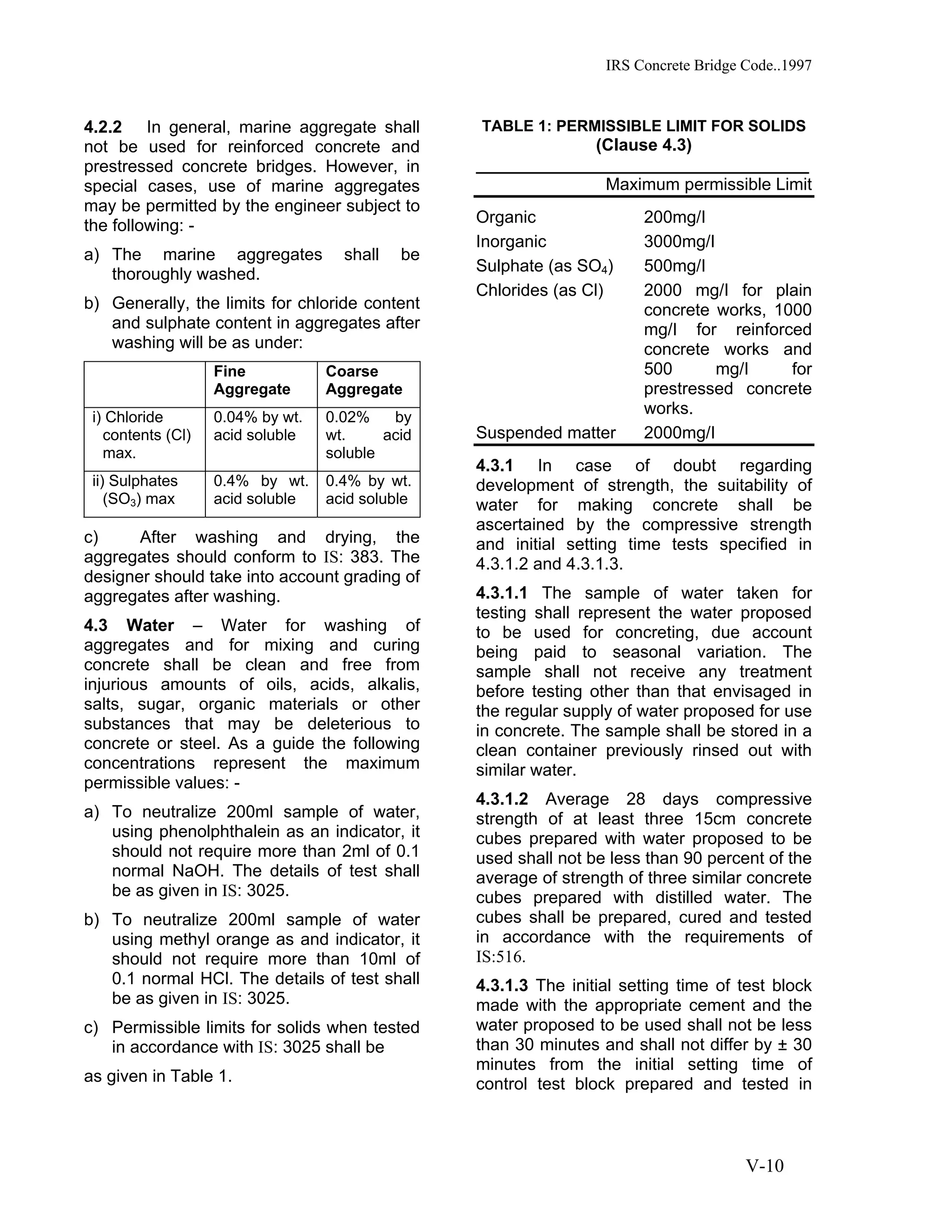
c) Permissible limits for solids when tested
in accordance with IS: 3025 shall be
as given in Table 1.
TABLE 1: PERMISSIBLE LIMIT FOR SOLIDS
(Clause 4.3)
___________________________________
Maximum permissible Limit
Organic 200mg/I
Inorganic 3000mg/I
Sulphate (as SO4) 500mg/I
Chlorides (as Cl) 2000 mg/I for plain
concrete works, 1000
mg/I for reinforced
concrete works and
500 mg/I for
prestressed concrete
works.
Suspended matter 2000mg/I
4.3.1 In case of doubt regarding
development of strength, the suitability of
water for making concrete shall be
ascertained by the compressive strength
and initial setting time tests specified in
4.3.1.2 and 4.3.1.3.
4.3.1.1 The sample of water taken for
testing shall represent the water proposed
to be used for concreting, due account
being paid to seasonal variation. The
sample shall not receive any treatment
before testing other than that envisaged in
the regular supply of water proposed for use
in concrete. The sample shall be stored in a
clean container previously rinsed out with
similar water.
4.3.1.2 Average 28 days compressive
strength of at least three 15cm concrete
cubes prepared with water proposed to be
used shall not be less than 90 percent of the
average of strength of three similar concrete
cubes prepared with distilled water. The
cubes shall be prepared, cured and tested
in accordance with the requirements of
IS:516.
4.3.1.3 The initial setting time of test block
made with the appropriate cement and the
water proposed to be used shall not be less
than 30 minutes and shall not differ by ± 30
minutes from the initial setting time of
control test block prepared and tested in
IRS Concrete Bridge Code..1997
V-11
accordance with the requirements of
IS:4031.
4.3.2 The pH value of water shall generally
be not less than 6.
4.3.3 Water found satisfactory for mixing is
also suitable for curing concrete. However,
water used for curing should not produce
any objectionable stain or unsightly deposit
on the concrete surface. The presence of
tannic acid or iron compounds is
objectionable.
4.4 Admixtures – The Chief Engineer may
permit the use of admixtures for imparting
special characteristics to the concrete or
mortar on satisfactory evidence that the use
of such admixtures does not adversely
affect the properties of concrete or mortar
particularly with respect to strength, volume
change, durability and has no deleterious
effect on reinforcement.
4.4.1 the admixtures, when permitted,
shall conform to IS:9103.
4.4.2 Calcium chloride or admixtures
containing calcium chloride shall not be
used in structural concrete containing
reinforcement, prestressing tendons or
other embedded metal.
4.4.3 The admixture containing Cl & SO3
ions shall not be used. Admixtures
containing nitrates shall also not be used.
Admixtures based on thiocyanate may
promote corrosion and therefore shall be
prohibited.
4.5 Reinforcement
4.5.1 The reinforcement shall be any of the
following :
a) Grade-I mild steel and medium
tensile steel bars conforming to IS:432
(Part-I)
b) High strength deformed steel bars
conforming toIS:1786.
c) Thermo-mechanically Treated (TMT)
Bars satisfying requirements of IS:1786.
d) Rolled steel made from structural
steel conforming to IS:2062 Gr.A and Gr.B.
4.5.2 Independent test check on quality of
steel from each lot shall be conducted. All
reinforcement shall be free form loose small
scales, rust and coats of paints, oil, mud
etc.
4.5.3 The modulus of elasticity of steel shall
be taken as 200kN/mm2
.
4.6 Prestressing Steel
4.6.1 The prestressing steel shall be any of
the following :-
a) Plain hard-drawn steel wire
conforming to IS:1785 (part-I)
b) Uncoated stress-relieved strand
conforming to IS:6006.
c) High tensile steel bars conforming
to IS:2090.
d) Uncoated stress relieved low
relaxation strands conforming to IS:14268.
4.6.1.1 All prestressing steel shall be free
from splits, harmful scratches, surface
flaws, rough, jagged and imperfect edges
and other defects likely to impair its use in
prestressed concrete.
4.6.2 Modulus of Elasticity – The value
of the modulus of elasticity of steel used for
the design of prestressed concrete
members shall preferably be determined by
tests on samples of steel to be used for the
construction. For the purposes of this
clause, a value given by the manufacturer of
the prestressing steel shall be considered
as fulfilling the necessary requirements.
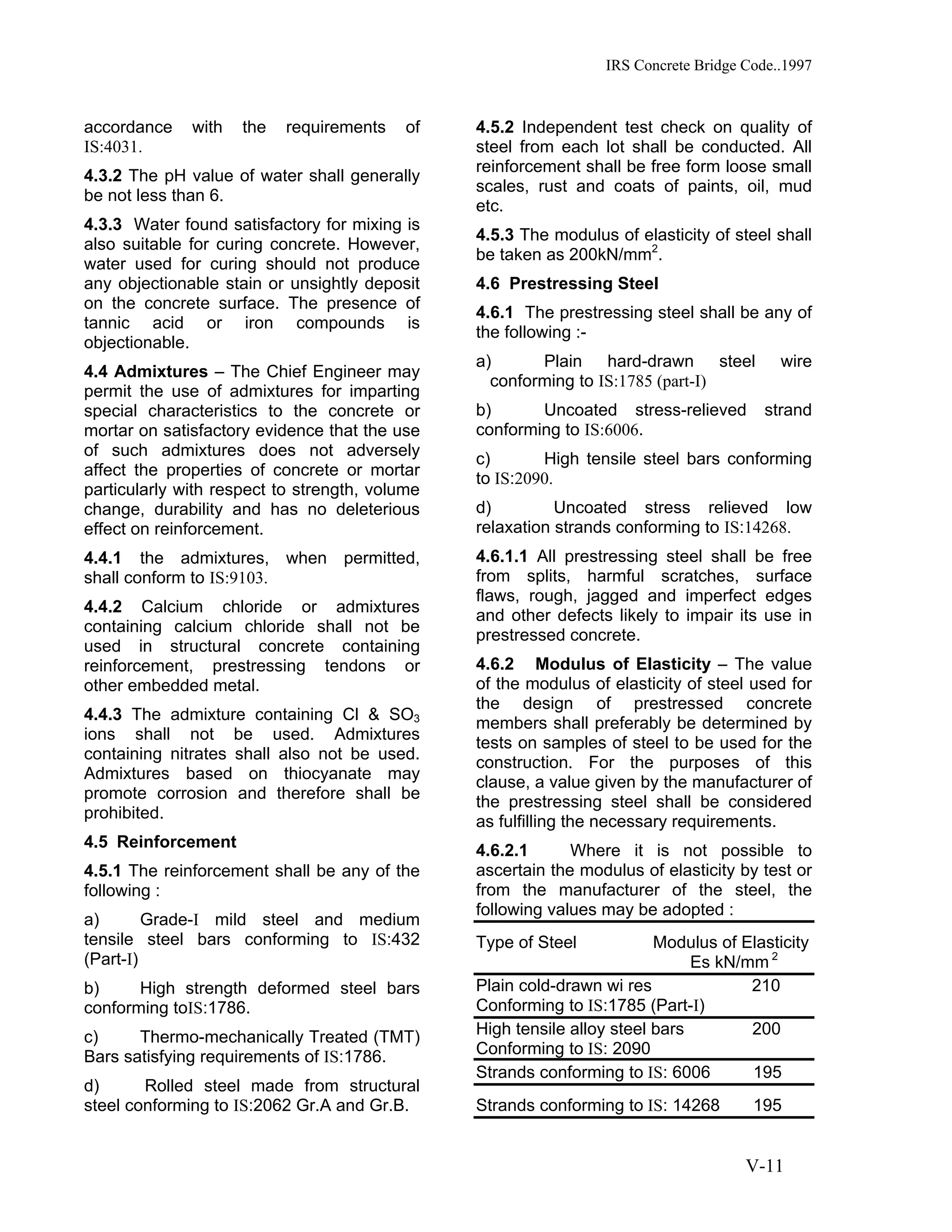
4.6.2.1 Where it is not possible to
ascertain the modulus of elasticity by test or
from the manufacturer of the steel, the
following values may be adopted :
Type of Steel Modulus of Elasticity
Es kN/mm 2
Plain cold-drawn wi res 210
Conforming to IS:1785 (Part-I)
High tensile alloy steel bars 200
Conforming to IS: 2090
Strands conforming to IS: 6006 195
Strands conforming to IS: 14268 195
IRS Concrete Bridge Code..1997
V-12
4.6.3 Coupling units and other similar
fixtures used in conjunction with the wires or
bars shall have an ultimate tensile strength
of not less than the individual strength of the
wires or bars being joined.
4.7 Handling & Storage of Materials –
Storage of materials shall be as per IS:
4082.
4.7.1 Cement – Cement of different
specifications shall be stacked separately
and quality of stored cement actually used
in any member or part of the structure shall
fulfill the design and construction
requirement of the same. Cement shall be
stored at the work site in such a manner as
to prevent deterioration either through
moisture or intrusion of foreign matter.
Cement older than 3 months should
normally not be used for PSC works unless
the quality is confirmed by tests.
4.7.2 Aggregates – Coarse aggregates
supplied in different sizes shall be stacked
in separate stockpiles and shall be mixed
only after the quantity required for each size
has been separately weighed or measured.
The quantity of coarse aggregates, thus
recombined shall be that required for a
single batch of concrete.
4.7.3 Steel – The storage of all reinforcing
steel shall be done in such a manner as will
assure that no deterioration in its quality
takes place. The coil of HTS wires & strands
shall be given anti-corrosive treatment such
as water soluble oil coating before wrapping
it in hession cloth or other suitable packing.
During transportation, it shall be ensured
that no damage is done to coils while
loading and unloading. Care shall be taken
to avoid mechanically damaging ,work
hardening or heating prestressing tendons
while handling.
4.7.4 Any material, which has deteriorated
or has been damaged, corroded or
contaminated, shall not be used for
concrete work.
5. CONCRETE
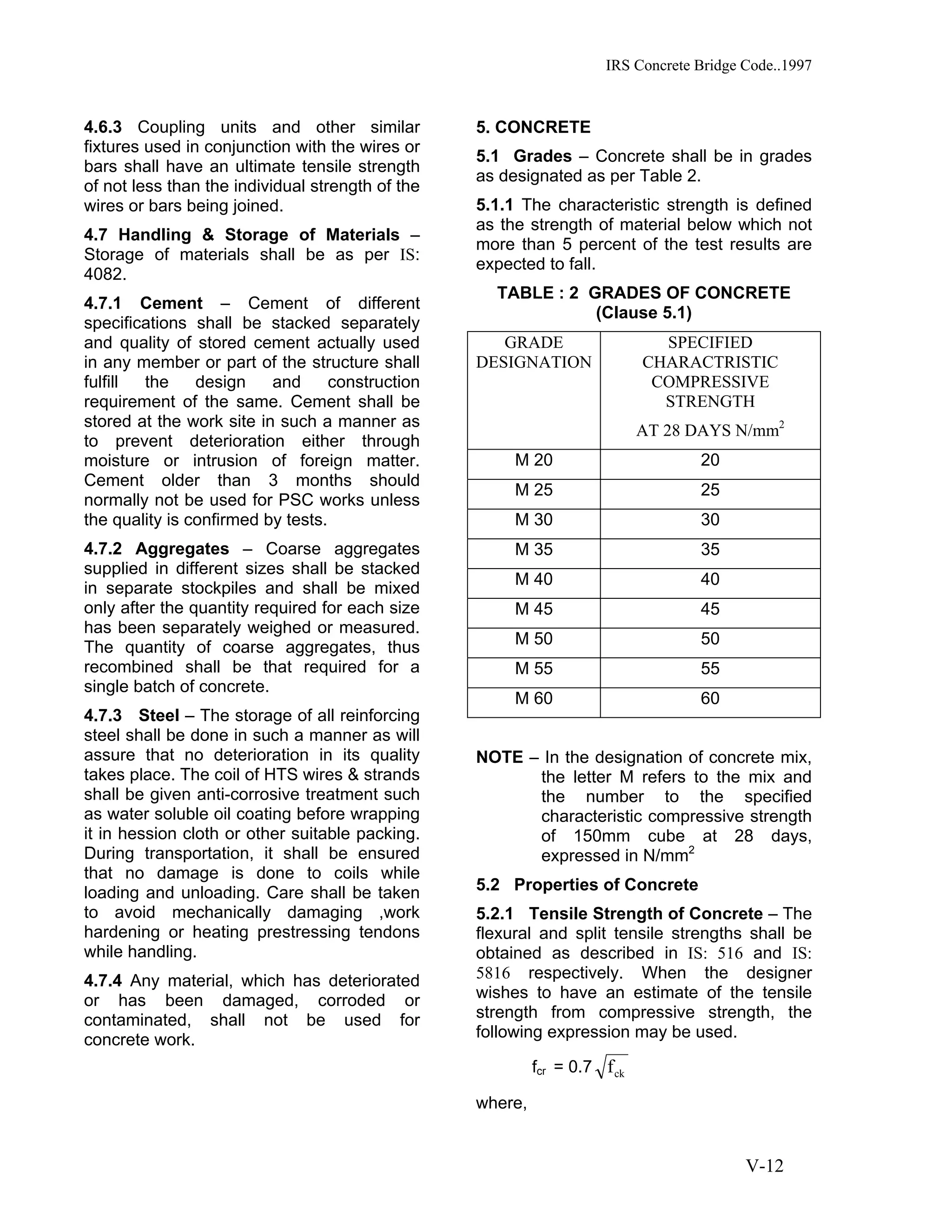
5.1 Grades – Concrete shall be in grades
as designated as per Table 2.
5.1.1 The characteristic strength is defined
as the strength of material below which not
more than 5 percent of the test results are
expected to fall.
TABLE : 2 GRADES OF CONCRETE
(Clause 5.1)
GRADE
DESIGNATION
SPECIFIED
CHARACTRISTIC
COMPRESSIVE
STRENGTH
AT 28 DAYS N/mm2
M 20 20
M 25 25
M 30 30
M 35 35
M 40 40
M 45 45
M 50 50
M 55 55
M 60 60
NOTE – In the designation of concrete mix,
the letter M refers to the mix and
the number to the specified
characteristic compressive strength
of 150mm cube at 28 days,
expressed in N/mm2
5.2 Properties of Concrete
5.2.1 Tensile Strength of Concrete – The
flexural and split tensile strengths shall be
obtained as described in IS: 516 and IS:
5816 respectively. When the designer
wishes to have an estimate of the tensile
strength from compressive strength, the
following expression may be used.
fcr = 0.7 ckf
where,
IRS Concrete Bridge Code..1997
V-13
fcr is the flexural strength in N/mm2
; and
fck is the characteristic compressive strength
of concrete in N/mm2
.
5.2.2 Elastic Deformation – The modulus
of elasticity is primarily influenced by the
elastic properties of the aggregate and to a
lesser extent by the conditions of curing and
age of the concrete, the mix proportions and
the type of cement. The modulus of
elasticity is normally related to the
compressive strength of concrete.
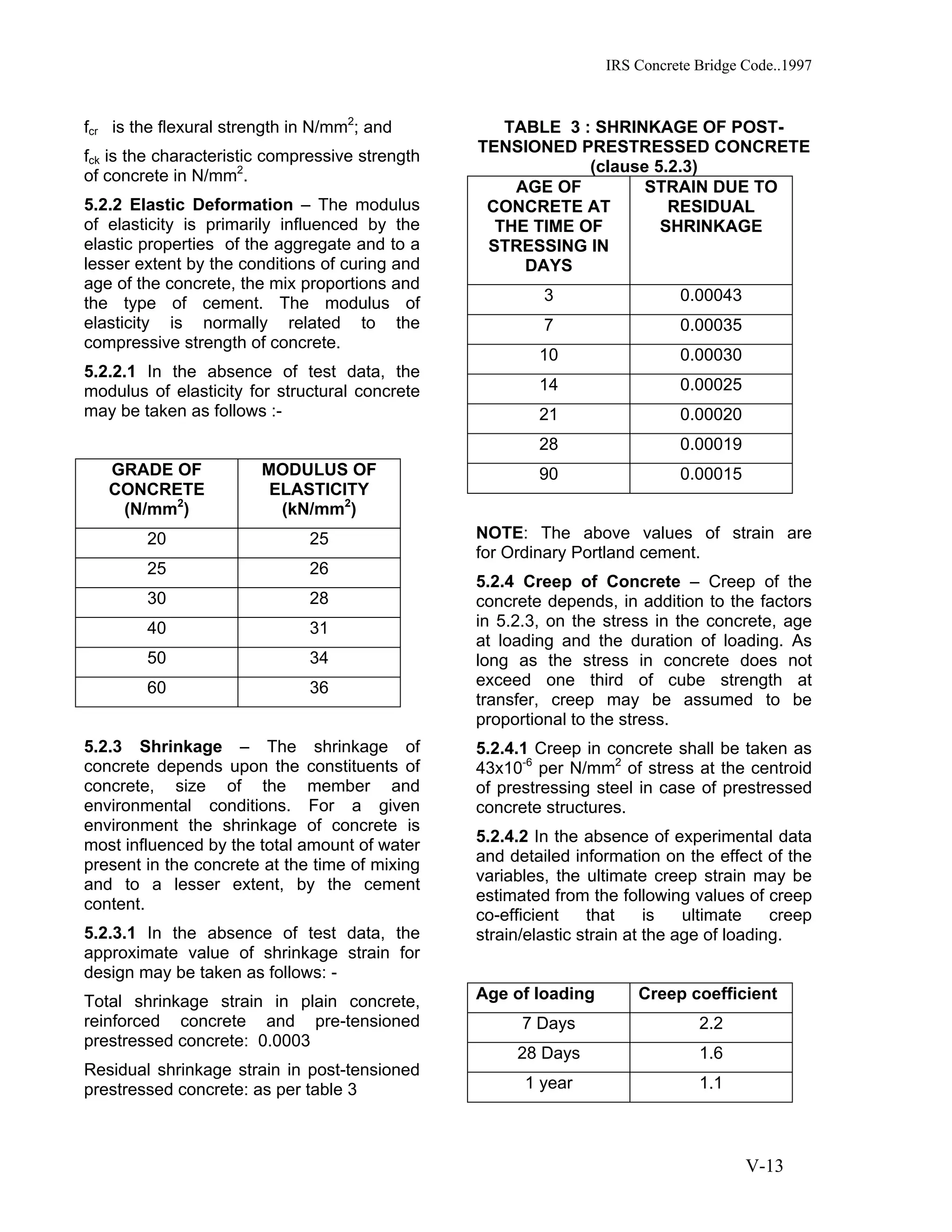
5.2.2.1 In the absence of test data, the
modulus of elasticity for structural concrete
may be taken as follows :-
GRADE OF
CONCRETE
(N/mm2
)
MODULUS OF
ELASTICITY
(kN/mm2
)
20 25
25 26
30 28
40 31
50 34
60 36
5.2.3 Shrinkage – The shrinkage of
concrete depends upon the constituents of
concrete, size of the member and
environmental conditions. For a given
environment the shrinkage of concrete is
most influenced by the total amount of water
present in the concrete at the time of mixing
and to a lesser extent, by the cement
content.
5.2.3.1 In the absence of test data, the
approximate value of shrinkage strain for
design may be taken as follows: -
Total shrinkage strain in plain concrete,
reinforced concrete and pre-tensioned
prestressed concrete: 0.0003
Residual shrinkage strain in post-tensioned
prestressed concrete: as per table 3
TABLE 3 : SHRINKAGE OF POST-
TENSIONED PRESTRESSED CONCRETE
(clause 5.2.3)
AGE OF
CONCRETE AT
THE TIME OF
STRESSING IN
DAYS
STRAIN DUE TO
RESIDUAL
SHRINKAGE
3 0.00043
7 0.00035
10 0.00030
14 0.00025
21 0.00020
28 0.00019
90 0.00015
NOTE: The above values of strain are
for Ordinary Portland cement.
5.2.4 Creep of Concrete – Creep of the
concrete depends, in addition to the factors
in 5.2.3, on the stress in the concrete, age
at loading and the duration of loading. As
long as the stress in concrete does not
exceed one third of cube strength at
transfer, creep may be assumed to be
proportional to the stress.
5.2.4.1 Creep in concrete shall be taken as
43x10-6
per N/mm2
of stress at the centroid
of prestressing steel in case of prestressed
concrete structures.
5.2.4.2 In the absence of experimental data
and detailed information on the effect of the
variables, the ultimate creep strain may be
estimated from the following values of creep
co-efficient that is ultimate creep
strain/elastic strain at the age of loading.
Age of loading Creep coefficient
7 Days 2.2
28 Days 1.6
1 year 1.1
IRS Concrete Bridge Code..1997
V-14
Note : The Ultimate creep strain estimated
as above does not include the elastic strain.
5.2.4.3 For the calculation of deformation at
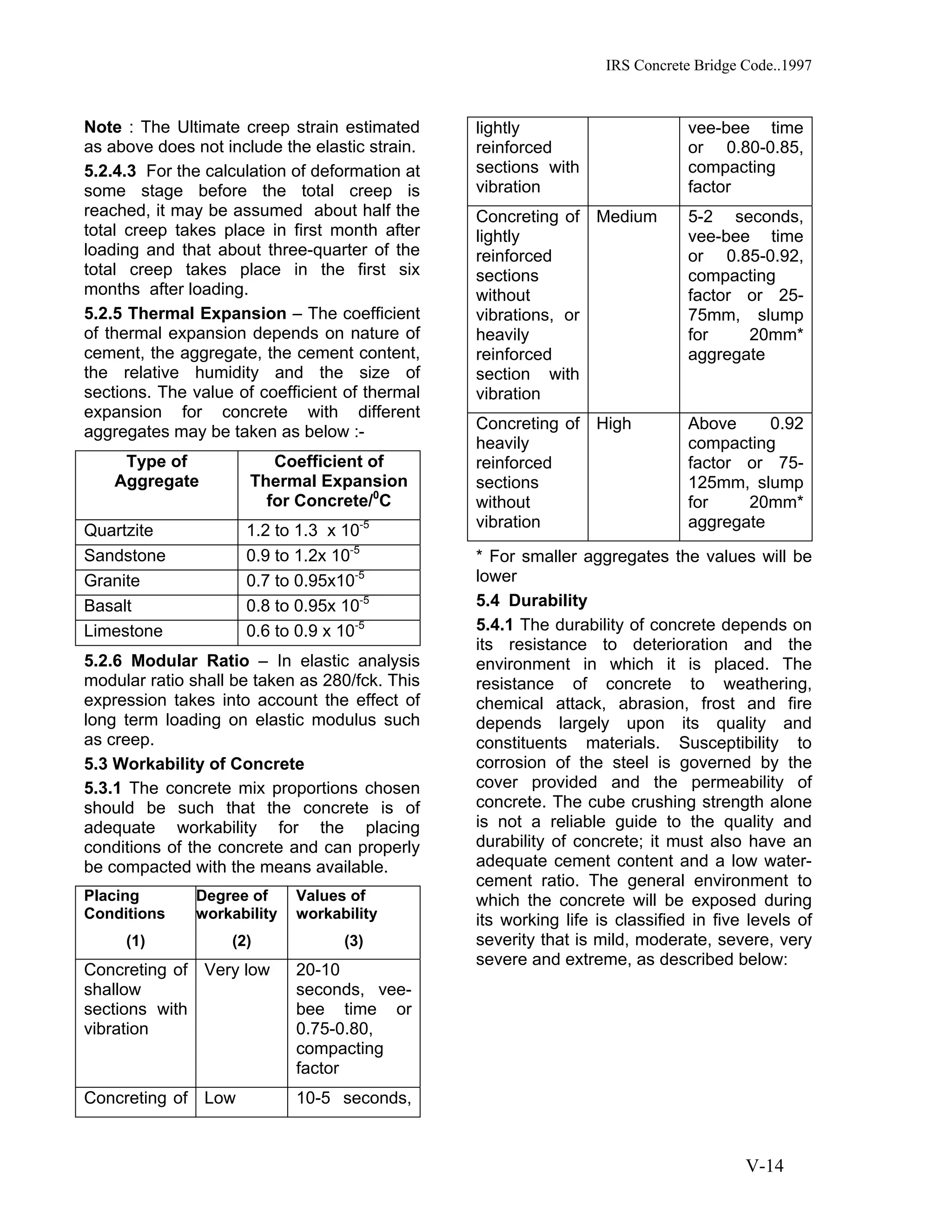
some stage before the total creep is
reached, it may be assumed about half the
total creep takes place in first month after
loading and that about three-quarter of the
total creep takes place in the first six
months after loading.
5.2.5 Thermal Expansion – The coefficient
of thermal expansion depends on nature of
cement, the aggregate, the cement content,
the relative humidity and the size of
sections. The value of coefficient of thermal
expansion for concrete with different
aggregates may be taken as below :-
Type of
Aggregate
Coefficient of
Thermal Expansion
for Concrete/0
C
Quartzite 1.2 to 1.3 x 10⁻⁵
Sandstone 0.9 to 1.2x 10⁻⁵
Granite 0.7 to 0.95x10⁻⁵
Basalt 0.8 to 0.95x 10⁻⁵
Limestone 0.6 to 0.9 x 10⁻⁵
5.2.6 Modular Ratio – In elastic analysis
modular ratio shall be taken as 280/fck. This
expression takes into account the effect of
long term loading on elastic modulus such
as creep.
5.3 Workability of Concrete
5.3.1 The concrete mix proportions chosen
should be such that the concrete is of
adequate workability for the placing
conditions of the concrete and can properly
be compacted with the means available.
Placing
Conditions
(1)
Degree of
workability
(2)
Values of
workability
(3)
Concreting of
shallow
sections with
vibration
Very low 20-10
seconds, vee-
bee time or
0.75-0.80,
compacting
factor
Concreting of Low 10-5 seconds,
lightly
reinforced
sections with
vibration
vee-bee time
or 0.80-0.85,
compacting
factor
Concreting of
lightly
reinforced
sections
without
vibrations, or
heavily
reinforced
section with
vibration
Medium 5-2 seconds,
vee-bee time
or 0.85-0.92,
compacting
factor or 25-
75mm, slump
for 20mm*
aggregate
Concreting of
heavily
reinforced
sections
without
vibration
High Above 0.92
compacting
factor or 75-
125mm, slump
for 20mm*
aggregate
* For smaller aggregates the values will be
lower
5.4 Durability
5.4.1 The durability of concrete depends on
its resistance to deterioration and the
environment in which it is placed. The
resistance of concrete to weathering,
chemical attack, abrasion, frost and fire
depends largely upon its quality and
constituents materials. Susceptibility to
corrosion of the steel is governed by the
cover provided and the permeability of
concrete. The cube crushing strength alone
is not a reliable guide to the quality and
durability of concrete; it must also have an
adequate cement content and a low water-
cement ratio. The general environment to
which the concrete will be exposed during
its working life is classified in five levels of
severity that is mild, moderate, severe, very
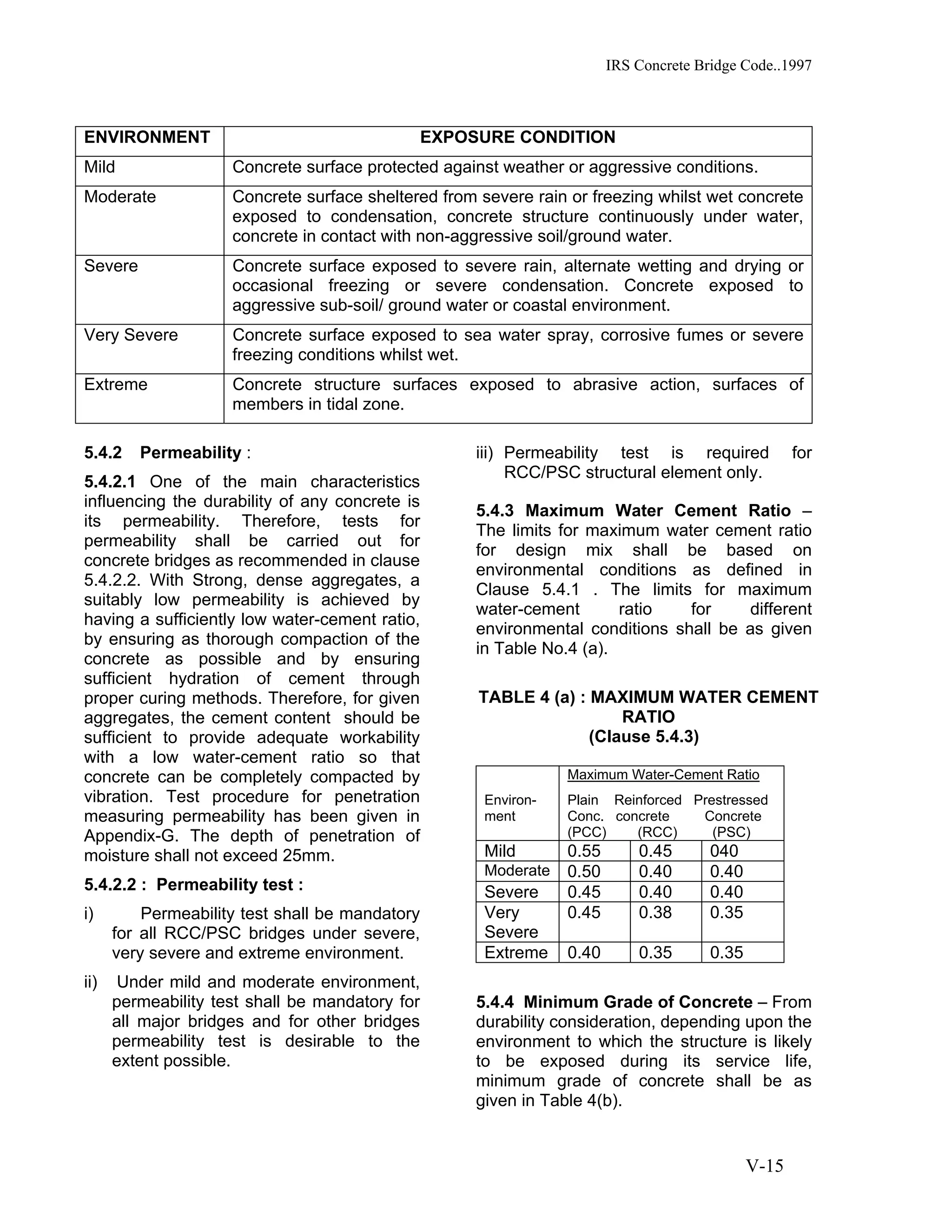
severe and extreme, as described below:
IRS Concrete Bridge Code..1997
V-15
5.4.2 Permeability :
5.4.2.1 One of the main characteristics
influencing the durability of any concrete is
its permeability. Therefore, tests for
permeability shall be carried out for
concrete bridges as recommended in clause
5.4.2.2. With Strong, dense aggregates, a
suitably low permeability is achieved by
having a sufficiently low water-cement ratio,
by ensuring as thorough compaction of the
concrete as possible and by ensuring
sufficient hydration of cement through
proper curing methods. Therefore, for given
aggregates, the cement content should be
sufficient to provide adequate workability
with a low water-cement ratio so that
concrete can be completely compacted by
vibration. Test procedure for penetration
measuring permeability has been given in
Appendix-G. The depth of penetration of
moisture shall not exceed 25mm.
5.4.2.2 : Permeability test :
i) Permeability test shall be mandatory
for all RCC/PSC bridges under severe,
very severe and extreme environment.
ii) Under mild and moderate environment,
permeability test shall be mandatory for
all major bridges and for other bridges
permeability test is desirable to the
extent possible.
iii) Permeability test is required for
RCC/PSC structural element only.
5.4.3 Maximum Water Cement Ratio –
The limits for maximum water cement ratio
for design mix shall be based on
environmental conditions as defined in
Clause 5.4.1 . The limits for maximum
water-cement ratio for different
environmental conditions shall be as given
in Table No.4 (a).
TABLE 4 (a) : MAXIMUM WATER CEMENT
RATIO
(Clause 5.4.3)
Environ-
ment
Maximum Water-Cement Ratio
Plain Reinforced Prestressed
Conc. concrete Concrete
(PCC) (RCC) (PSC)
Mild 0.55 0.45 040
Moderate 0.50 0.40 0.40
Severe 0.45 0.40 0.40
Very
Severe
0.45 0.38 0.35
Extreme 0.40 0.35 0.35
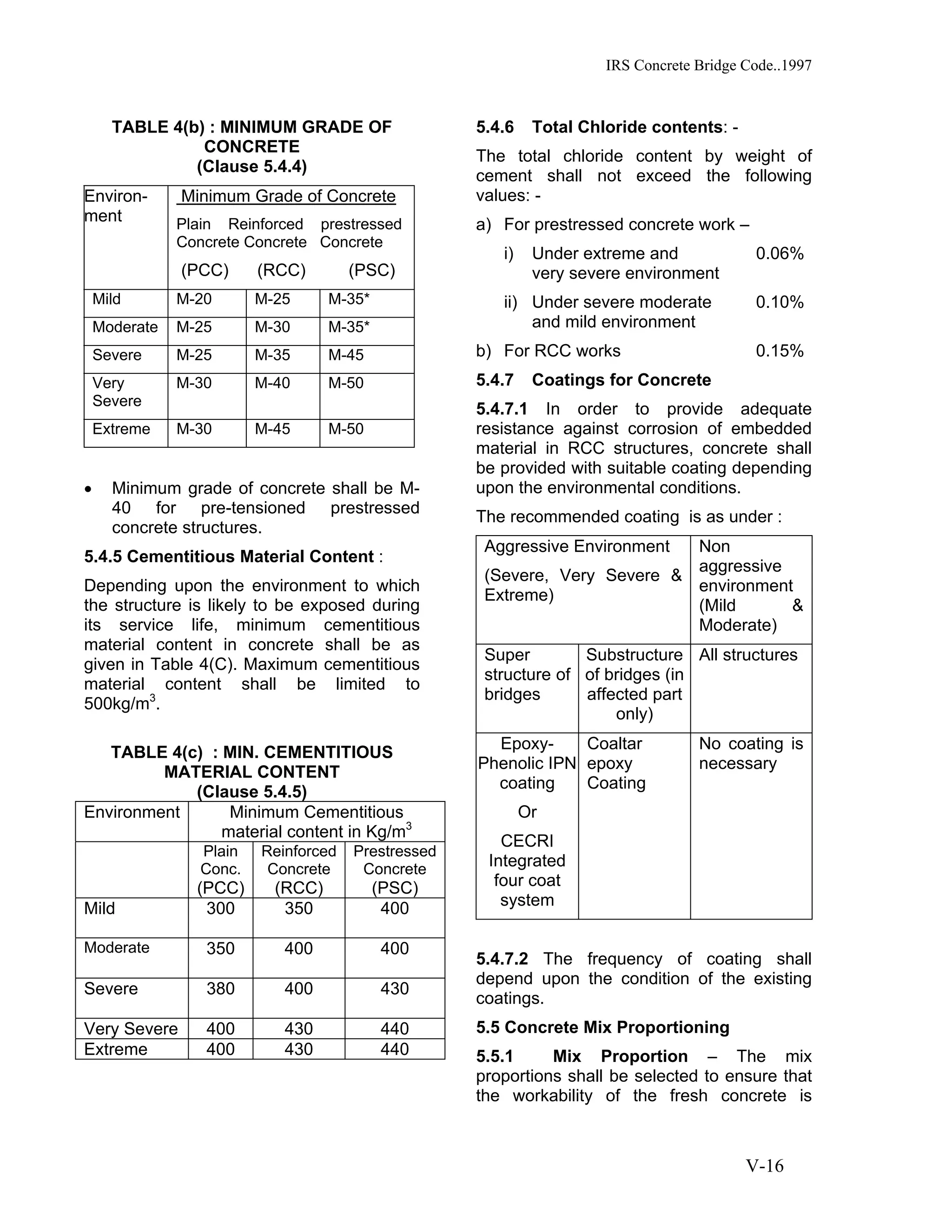
5.4.4 Minimum Grade of Concrete – From
durability consideration, depending upon the
environment to which the structure is likely
to be exposed during its service life,
minimum grade of concrete shall be as
given in Table 4(b).
ENVIRONMENT EXPOSURE CONDITION
Mild Concrete surface protected against weather or aggressive conditions.
Moderate Concrete surface sheltered from severe rain or freezing whilst wet concrete
exposed to condensation, concrete structure continuously under water,
concrete in contact with non-aggressive soil/ground water.
Severe Concrete surface exposed to severe rain, alternate wetting and drying or
occasional freezing or severe condensation. Concrete exposed to
aggressive sub-soil/ ground water or coastal environment.
Very Severe Concrete surface exposed to sea water spray, corrosive fumes or severe
freezing conditions whilst wet.
Extreme Concrete structure surfaces exposed to abrasive action, surfaces of
members in tidal zone.
IRS Concrete Bridge Code..1997
V-16
TABLE 4(b) : MINIMUM GRADE OF
CONCRETE
(Clause 5.4.4)
Environ-
ment
Minimum Grade of Concrete
Plain Reinforced prestressed
Concrete Concrete Concrete
(PCC) (RCC) (PSC)
Mild M-20 M-25 M-35*
Moderate M-25 M-30 M-35*
Severe M-25 M-35 M-45
Very
Severe
M-30 M-40 M-50
Extreme M-30 M-45 M-50
• Minimum grade of concrete shall be M-
40 for pre-tensioned prestressed
concrete structures.
5.4.5 Cementitious Material Content :
Depending upon the environment to which
the structure is likely to be exposed during
its service life, minimum cementitious
material content in concrete shall be as
given in Table 4(C). Maximum cementitious
material content shall be limited to
500kg/m3
.
TABLE 4(c) : MIN. CEMENTITIOUS
MATERIAL CONTENT
(Clause 5.4.5)
Environment Minimum Cementitious
material content in Kg/m3
Plain
Conc.
(PCC)
Reinforced
Concrete
(RCC)
Prestressed
Concrete
(PSC)
Mild 300 350 400
Moderate 350 400 400
Severe 380 400 430
Very Severe 400 430 440
Extreme 400 430 440
5.4.6 Total Chloride contents: -
The total chloride content by weight of
cement shall not exceed the following
values: -
a) For prestressed concrete work –
i) Under extreme and 0.06%
very severe environment
ii) Under severe moderate 0.10%
and mild environment
b) For RCC works 0.15%
5.4.7 Coatings for Concrete
5.4.7.1 In order to provide adequate
resistance against corrosion of embedded
material in RCC structures, concrete shall
be provided with suitable coating depending
upon the environmental conditions.
The recommended coating is as under :
Aggressive Environment
(Severe, Very Severe &
Extreme)
Non
aggressive
environment
(Mild &
Moderate)
Super
structure of
bridges
Substructure
of bridges (in
affected part
only)
All structures
Epoxy-
Phenolic IPN
coating
Or
CECRI
Integrated
four coat
system
Coaltar
epoxy
Coating
No coating is
necessary
5.4.7.2 The frequency of coating shall
depend upon the condition of the existing
coatings.
5.5 Concrete Mix Proportioning
5.5.1 Mix Proportion – The mix
proportions shall be selected to ensure that
the workability of the fresh concrete is
IRS Concrete Bridge Code..1997
V-17
suitable for the conditions of handling and
placing, so that after compaction its
surrounds all reinforcements are completely
fills the formwork. When concrete gets
hardened, it shall have the required
strength, durability and surface finish.
5.5.1.1 The determination of the proportions
of cement, aggregates and water to attain
the required strengths shall be made as
follows:
a) By designing the concrete mix; such
concrete shall be called ‘Design mix
Concrete’ ; or
b) By adopting nominal concrete mix;
such concrete shall be called
‘Nominal mix concrete’.
Design mix concrete is preferred to
nominal mix. Nominal mixes, when used,
are likely to involve higher cement content.
Concretes of grades richer than M 20 shall
only be design mix concretes.
5.5.1.2 Information Required – In
specifying a particular grade of concrete,
the following information shall be included: -
a) Type of mix, i.e. design mix concrete
or nominal mix concrete;
b) Grade designation;
c) Type of cement;
d) Maximum nominal size of
aggregate;
e) Workability
f) Mix proportion (for nominal mix
concrete);
g) Type of aggregate;
h) Whether an admixture shall or shall
not be used and the type of
admixture and the conditions of use;
and
i) Exposure condition.
5.5.2 Design Mix Concrete
5.5.2.1 The mix shall be designed to
produce the grade of concrete having the
required workability, durability and a
characteristic strength not less than
appropriate values given in Table 2. The
procedure given in IS:10262 may be
followed for mix design.
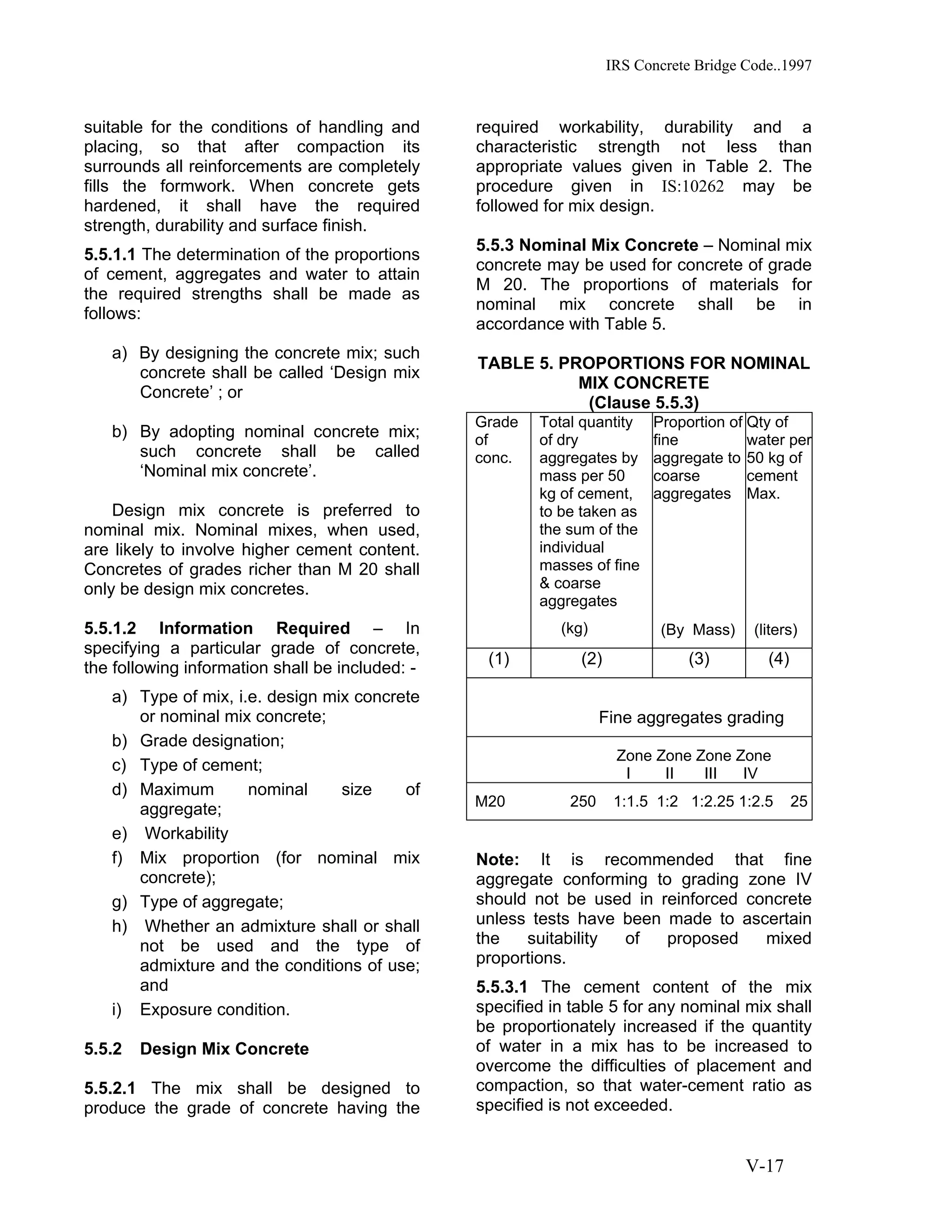
5.5.3 Nominal Mix Concrete – Nominal mix
concrete may be used for concrete of grade
M 20. The proportions of materials for
nominal mix concrete shall be in
accordance with Table 5.
TABLE 5. PROPORTIONS FOR NOMINAL
MIX CONCRETE
(Clause 5.5.3)
Grade
of
conc.
Total quantity
of dry
aggregates by
mass per 50
kg of cement,
to be taken as
the sum of the
individual
masses of fine
& coarse
aggregates
(kg)
Proportion of
fine
aggregate to
coarse
aggregates
(By Mass)
Qty of
water per
50 kg of
cement
Max.
(liters)
(1) (2) (3) (4)
Fine aggregates grading
Zone Zone Zone Zone
I II III IV
M20 250 1:1.5 1:2 1:2.25 1:2.5 25
Note: It is recommended that fine
aggregate conforming to grading zone IV
should not be used in reinforced concrete
unless tests have been made to ascertain
the suitability of proposed mixed
proportions.
5.5.3.1 The cement content of the mix
specified in table 5 for any nominal mix shall
be proportionately increased if the quantity
of water in a mix has to be increased to
overcome the difficulties of placement and
compaction, so that water-cement ratio as
specified is not exceeded.
IRS Concrete Bridge Code..1997
V-18
Note1: In case of vibrated concrete the
limit specified may be suitably
reduced to avoid segregation.
Note2: The quantity of water used in the
concrete mix for reinforced
concrete work should be sufficient,
but not more than sufficient to
produce a dense concrete of
adequate workability for its
purpose, which will surround and
properly grip all the reinforcement.
Workability of the concrete should
be controlled by maintaining a
water content that is found to give a
concrete, which is just sufficiently
wet to be placed and compacted
without difficulty by means
available.
5.5.3.2 If nominal mix concrete made in
accordance with the proportions given for a
particular grade does not yield the specified
strength, such concrete shall be specified
as belonging to the appropriate lower grade.
Nominal mix concrete proportioned for a
given grade in accordance with Table 5
shall not, however, be placed in higher
grade on the ground that the test strengths
are higher than the minimum specified.
5.6 Production and Control of Concrete
5.6.1 General – To avoid confusion and
error in batching, consideration should be
given to using the smallest practical number
of different concrete mixes on any site or in
any one plant.
5.6.1.1 A competent person shall supervise
all stages of production of concrete.
Competent person is one who has been
issued competency certificate by Divisional
Engineer/Senior Engineer for executing and
supervising relevant aspect of concreting.
Preparation of test specimens and site tests
shall be properly supervised.
5.6.1.2 The engineer shall be afforded all
reasonable opportunity and facility to
inspect the materials and the manufacture
of concrete and to take any samples or to
make any tests.
5.6.2 Batching – In proportioning concrete,
the quantity of both cement and aggregate
should be determined by mass. Water
should be either measured by volume in
calibrated tanks or weighed. Any solid
admixture that may be added, may be
measured by mass, liquid and paste
admixtures by volume or mass. Batching
plant where used should conform to IS:
4925. All measuring equipment should be
maintained in a clean serviceable condition,
and their accuracy periodically checked,
Coarse and fine aggregates shall be
batched separately.
5.6.2.1 Except where it can be shown to the
satisfaction of the engineer that supply of
properly graded aggregate of uniform
quality can be maintained over the period of
work, the grading of aggregate should be
controlled by obtaining the coarse
aggregate in different sizes and blending
them in the right proportions when required,
the different sizes being stocked in separate
stock piles. The material should be stock-
piled for several hours preferably a day
before use. The grading of coarse and fine
aggregate should be checked as frequently
as possible, the frequency for a given job
being determined by the engineer to ensure
that the specified grading is maintained. The
grading of fine and coarse aggregate shall
be as per IS:383. The combined aggregate
shall also conform to all in-aggregate
grading curve as per IS:383.
5.6.2.2 In case uniformity in the materials
used for concrete making has been
established over a period of time, the
proportioning may be done by volume
batching for M20 grade concrete with the
approval of the engineer, provided the
materials and aggregates conform to the
grading as per IS:383. Where weigh-
batching is not practicable, the quantities of
fine and coarse aggregate (not cement)
may be determined by volume batching for
concrete of grade upto M25. If the fine
aggregate is moist and volume batching is
IRS Concrete Bridge Code..1997
V-19
adopted, allowance shall be made for
bulking in accordance with IS:2386 (part III).
5.6.2.3 It is important to maintain the water-
cement ratio constant at its correct value.
To this end, determination of moisture
contents in both fine and coarse aggregates
shall be made as frequently as possible, the
frequency for a given job being determined
by the engineer according to weather
condition. The amount of the added water
shall be adjusted to compensate for any
observed variations in the moisture
contents. For the determination of moisture
content in the aggregates, IS:2386 (Part-III)
may be referred to. To allow for the variation
in mass of aggregate due to variation in
their moisture content, suitable adjustments
in the masses of aggregate shall also be
made. In the absence of exact data, only in
the case of nominal mixes, the amount of
surface water may be estimated from the
values given in Table-6.
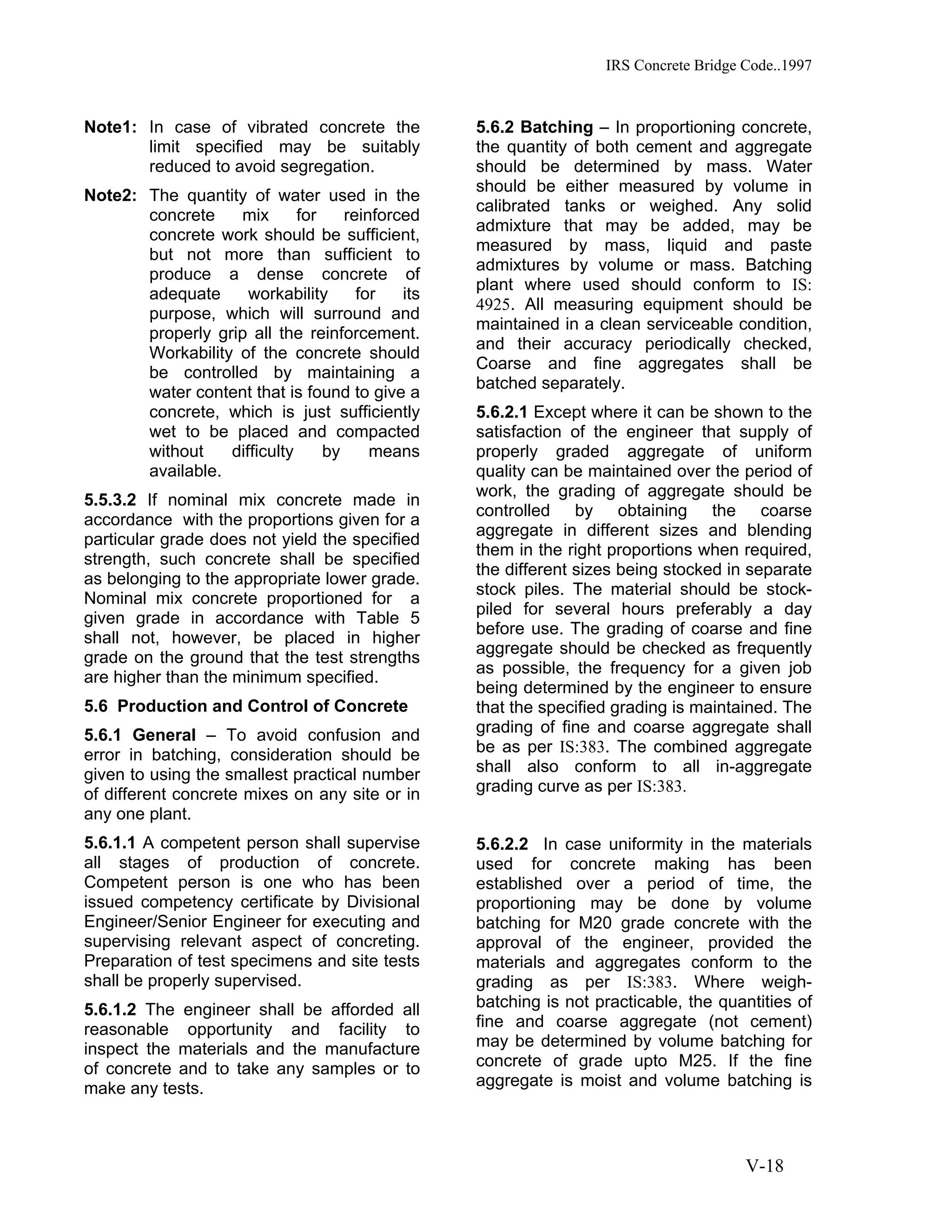
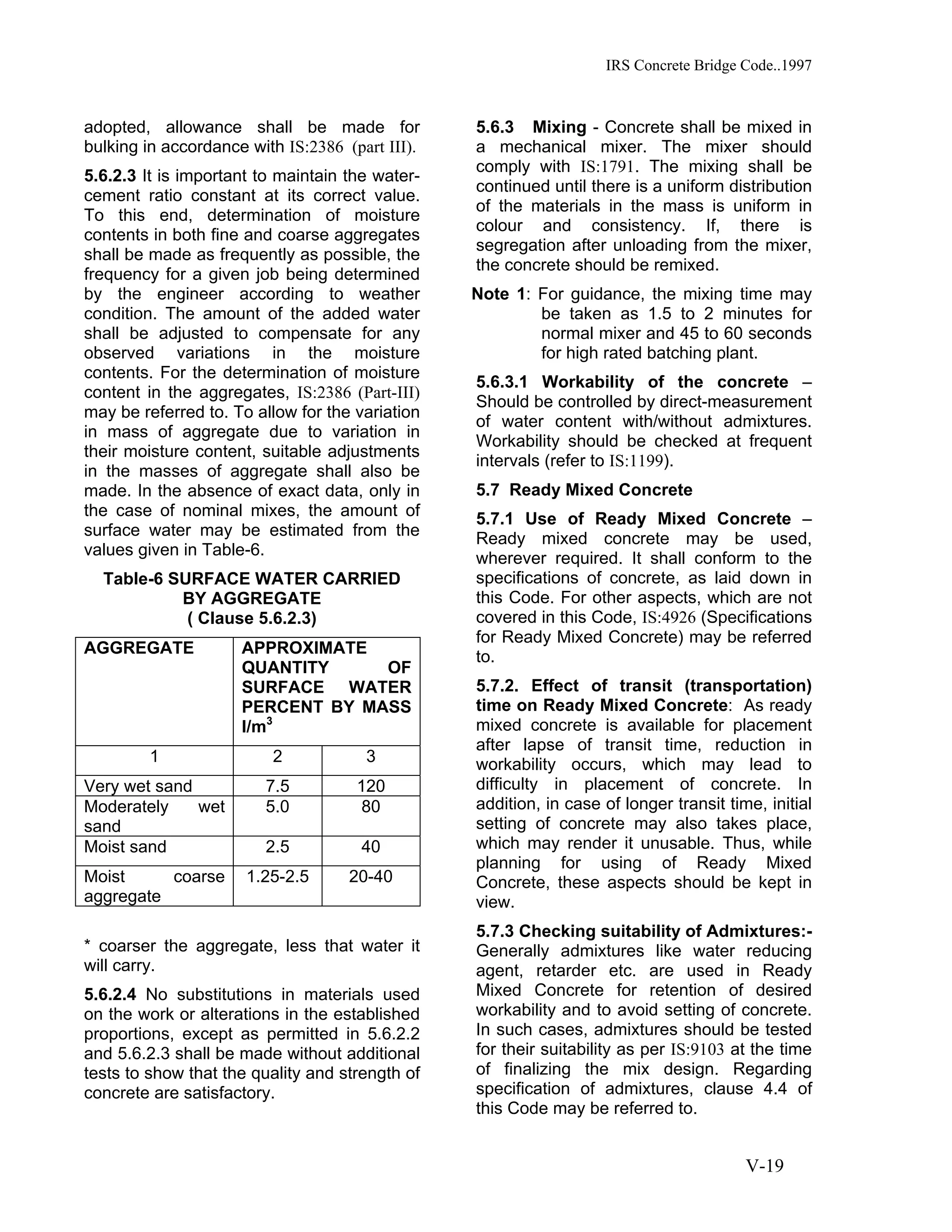
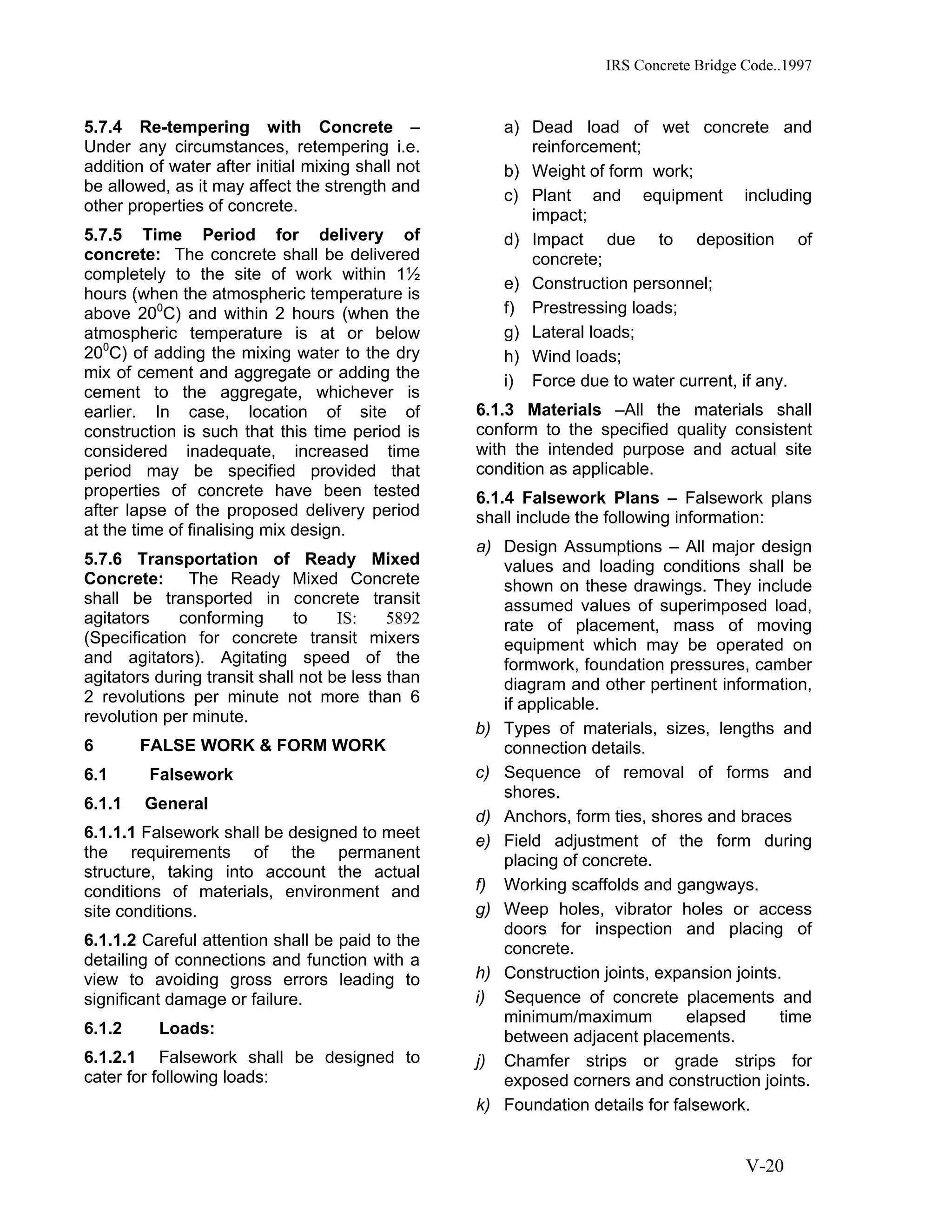
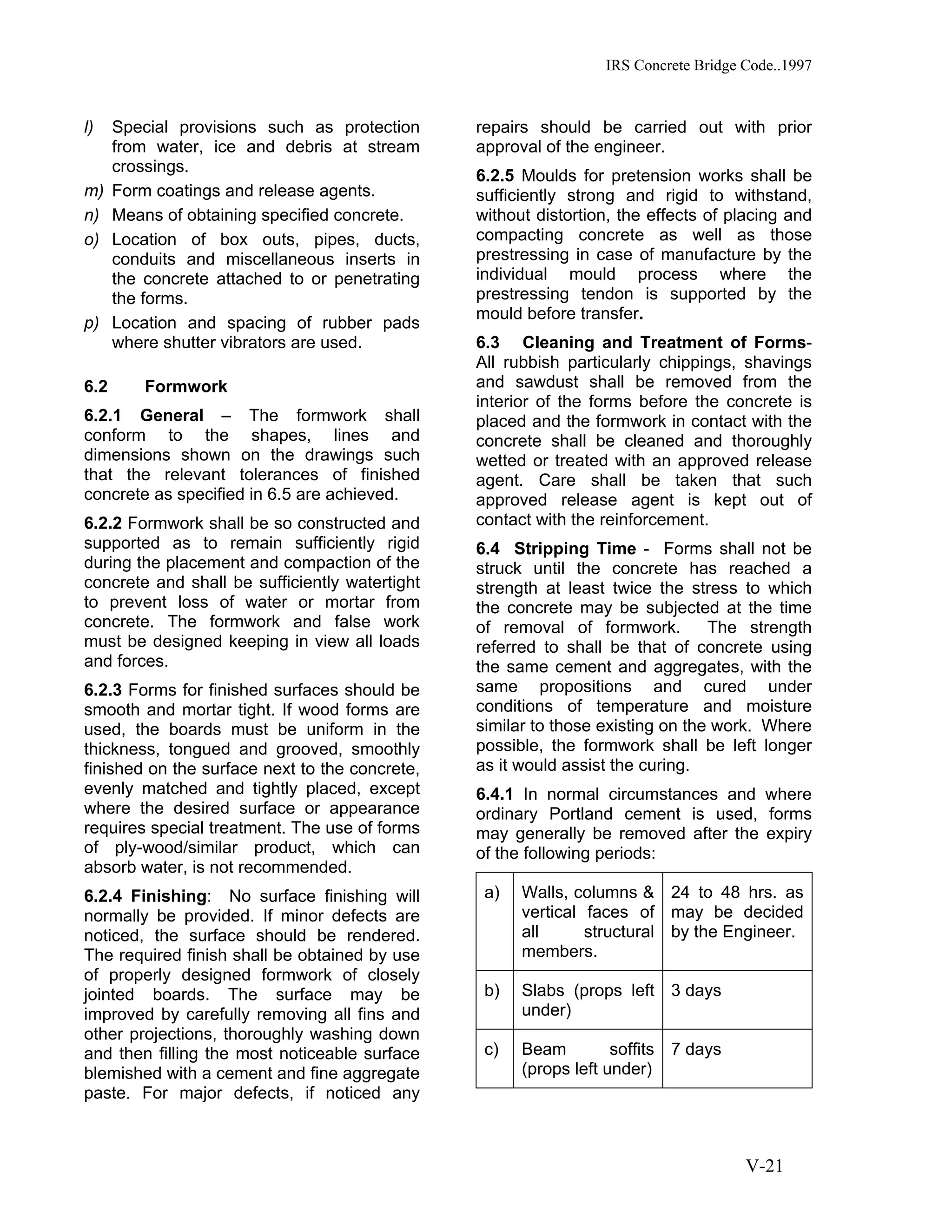
Table-6 SURFACE WATER CARRIED
BY AGGREGATE
( Clause 5.6.2.3)
AGGREGATE APPROXIMATE
QUANTITY OF
SURFACE WATER
PERCENT BY MASS
l/m3
1 2 3
Very wet sand 7.5 120
Moderately wet
sand
5.0 80
Moist sand 2.5 40
Moist coarse
aggregate
1.25-2.5 20-40
* coarser the aggregate, less that water it
will carry.
5.6.2.4 No substitutions in materials used
on the work or alterations in the established
proportions, except as permitted in 5.6.2.2
and 5.6.2.3 shall be made without additional
tests to show that the quality and strength of
concrete are satisfactory.
5.6.3 Mixing - Concrete shall be mixed in
a mechanical mixer. The mixer should
comply with IS:1791. The mixing shall be
continued until there is a uniform distribution
of the materials in the mass is uniform in
colour and consistency. If, there is
segregation after unloading from the mixer,
the concrete should be remixed.
Note 1: For guidance, the mixing time may
be taken as 1.5 to 2 minutes for
normal mixer and 45 to 60 seconds
for high rated batching plant.
5.6.3.1 Workability of the concrete –
Should be controlled by direct-measurement
of water content with/without admixtures.
Workability should be checked at frequent
intervals (refer to IS:1199).
5.7 Ready Mixed Concrete
5.7.1 Use of Ready Mixed Concrete –
Ready mixed concrete may be used,
wherever required. It shall conform to the
specifications of concrete, as laid down in
this Code. For other aspects, which are not
covered in this Code, IS:4926 (Specifications
for Ready Mixed Concrete) may be referred
to.
5.7.2. Effect of transit (transportation)
time on Ready Mixed Concrete: As ready
mixed concrete is available for placement
after lapse of transit time, reduction in
workability occurs, which may lead to
difficulty in placement of concrete. In
addition, in case of longer transit time, initial
setting of concrete may also takes place,
which may render it unusable. Thus, while
planning for using of Ready Mixed
Concrete, these aspects should be kept in
view.
5.7.3 Checking suitability of Admixtures:-
Generally admixtures like water reducing
agent, retarder etc. are used in Ready
Mixed Concrete for retention of desired
workability and to avoid setting of concrete.
In such cases, admixtures should be tested
for their suitability as per IS:9103 at the time
of finalizing the mix design. Regarding
specification of admixtures, clause 4.4 of
this Code may be referred to.
IRS Concrete Bridge Code..1997
V-20
5.7.4 Re-tempering with Concrete –
Under any circumstances, retempering i.e.
addition of water after initial mixing shall not
be allowed, as it may affect the strength and
other properties of concrete.
5.7.5 Time Period for delivery of
concrete: The concrete shall be delivered
completely to the site of work within 1½
hours (when the atmospheric temperature is
above 200
C) and within 2 hours (when the
atmospheric temperature is at or below
200
C) of adding the mixing water to the dry
mix of cement and aggregate or adding the
cement to the aggregate, whichever is
earlier. In case, location of site of
construction is such that this time period is
considered inadequate, increased time
period may be specified provided that
properties of concrete have been tested
after lapse of the proposed delivery period
at the time of finalising mix design.
5.7.6 Transportation of Ready Mixed
Concrete: The Ready Mixed Concrete
shall be transported in concrete transit
agitators conforming to IS: 5892
(Specification for concrete transit mixers
and agitators). Agitating speed of the
agitators during transit shall not be less than
2 revolutions per minute not more than 6
revolution per minute.
6 FALSE WORK & FORM WORK
6.1 Falsework
6.1.1 General
6.1.1.1 Falsework shall be designed to meet
the requirements of the permanent
structure, taking into account the actual
conditions of materials, environment and
site conditions.
6.1.1.2 Careful attention shall be paid to the
detailing of connections and function with a
view to avoiding gross errors leading to
significant damage or failure.
6.1.2 Loads:
6.1.2.1 Falsework shall be designed to
cater for following loads:
a) Dead load of wet concrete and
reinforcement;
b) Weight of form work;
c) Plant and equipment including
impact;
d) Impact due to deposition of
concrete;
e) Construction personnel;
f) Prestressing loads;
g) Lateral loads;
h) Wind loads;
i) Force due to water current, if any.
6.1.3 Materials –All the materials shall
conform to the specified quality consistent
with the intended purpose and actual site
condition as applicable.
6.1.4 Falsework Plans – Falsework plans
shall include the following information:
a) Design Assumptions – All major design
values and loading conditions shall be
shown on these drawings. They include
assumed values of superimposed load,
rate of placement, mass of moving
equipment which may be operated on
formwork, foundation pressures, camber
diagram and other pertinent information,
if applicable.
b) Types of materials, sizes, lengths and
connection details.
c) Sequence of removal of forms and
shores.
d) Anchors, form ties, shores and braces
e) Field adjustment of the form during
placing of concrete.
f) Working scaffolds and gangways.
g) Weep holes, vibrator holes or access
doors for inspection and placing of
concrete.
h) Construction joints, expansion joints.
i) Sequence of concrete placements and
minimum/maximum elapsed time
between adjacent placements.
j) Chamfer strips or grade strips for
exposed corners and construction joints.
k) Foundation details for falsework.
IRS Concrete Bridge Code..1997
V-21
l) Special provisions such as protection
from water, ice and debris at stream
crossings.
m) Form coatings and release agents.
n) Means of obtaining specified concrete.
o) Location of box outs, pipes, ducts,
conduits and miscellaneous inserts in
the concrete attached to or penetrating
the forms.
p) Location and spacing of rubber pads
where shutter vibrators are used.
6.2 Formwork
6.2.1 General – The formwork shall
conform to the shapes, lines and
dimensions shown on the drawings such
that the relevant tolerances of finished
concrete as specified in 6.5 are achieved.
6.2.2 Formwork shall be so constructed and
supported as to remain sufficiently rigid
during the placement and compaction of the
concrete and shall be sufficiently watertight
to prevent loss of water or mortar from
concrete. The formwork and false work
must be designed keeping in view all loads
and forces.
6.2.3 Forms for finished surfaces should be
smooth and mortar tight. If wood forms are
used, the boards must be uniform in the
thickness, tongued and grooved, smoothly
finished on the surface next to the concrete,
evenly matched and tightly placed, except
where the desired surface or appearance
requires special treatment. The use of forms
of ply-wood/similar product, which can
absorb water, is not recommended.
6.2.4 Finishing: No surface finishing will
normally be provided. If minor defects are
noticed, the surface should be rendered.
The required finish shall be obtained by use
of properly designed formwork of closely
jointed boards. The surface may be
improved by carefully removing all fins and
other projections, thoroughly washing down
and then filling the most noticeable surface
blemished with a cement and fine aggregate
paste. For major defects, if noticed any
repairs should be carried out with prior
approval of the engineer.
6.2.5 Moulds for pretension works shall be
sufficiently strong and rigid to withstand,
without distortion, the effects of placing and
compacting concrete as well as those
prestressing in case of manufacture by the
individual mould process where the
prestressing tendon is supported by the
mould before transfer.
6.3 Cleaning and Treatment of Forms-
All rubbish particularly chippings, shavings
and sawdust shall be removed from the
interior of the forms before the concrete is
placed and the formwork in contact with the
concrete shall be cleaned and thoroughly
wetted or treated with an approved release
agent. Care shall be taken that such
approved release agent is kept out of
contact with the reinforcement.
6.4 Stripping Time - Forms shall not be
struck until the concrete has reached a
strength at least twice the stress to which
the concrete may be subjected at the time
of removal of formwork. The strength
referred to shall be that of concrete using
the same cement and aggregates, with the
same propositions and cured under
conditions of temperature and moisture
similar to those existing on the work. Where
possible, the formwork shall be left longer
as it would assist the curing.
6.4.1 In normal circumstances and where
ordinary Portland cement is used, forms
may generally be removed after the expiry
of the following periods:
a) Walls, columns &
vertical faces of
all structural
members.
24 to 48 hrs. as
may be decided
by the Engineer.
b) Slabs (props left
under)
3 days
c) Beam soffits
(props left under)
7 days
IRS Concrete Bridge Code..1997
V-22
d) Removal of props
under slabs:
i) Spanning up to
4.5m
ii) Spanning over
4.5m
7 days
14 days
e) Removal of props
under beams:
i) Spanning upto
6 m.
ii) Spanning over
6m
14 days
21 days
For other cements, the stripping time
recommended for ordinary Portland cement
may be suitably modified.
6.4.1.1 The number of props left under, their
sizes and disposition shall be such as to be
able to safely carry the full dead load of the
slab or beam as the case may be together
with any live load likely to occur during
curing or further construction.
6.4.2 Where the shape of the element is
such that the formwork has reentrants
angles, the formwork shall be removed as
soon as possible after the concrete has set,
to avoid shrinkage cracking occuring due to
the restraint imposed.
6.4.3 The forms should be so constructed
as to be removable in the sections without
marring or damaging the surface of the
concrete. Forms should be removed as
soon as possible in order to make
necessary repairs and finish the surface. As
soon as forms are removed, list of
major/minor defects noticed in concrete
should be prepared. Repairing methodology
should be approved by Engineer- In charge.
After making necessary repairs, the surface
should be finished with wood float so as to
free from streaks, discolourations or other
imperfections. Plastering should not be
permitted and a steel trowel should not be
used to finish surfaces.
6.5 The Tolerances for Finished
Concrete Bridge Structures:-
1. Shift from
alignment
± 25mm
2. Deviation from
plumb or specified,
batter for face of
exposed piers.
1 in 250,
subjected to a
maximum value
of .05 times the
least lateral
dimension of
pier.
3. Deviation from
plumb or specified,
batter for face of
backfilled
abutments
1 in 125
4. Cross-sectional
dimensions of
piers, abutments
and girders
-5 mm
+20mm
5. Thickness of deck
slab of bridges
+6mm
-3mm
6. Size and locations
of openings
±12mm
7. Plan dimensions of
footings (formed)
+50mm
-25mm
8. Plan dimensions of
footings (Unformed
excavations)
+75mm
-00mm
9. Thickness of
footings
+No limit
- 5%
10 Footing eccentricity 0.02 times the
width of the
footing in the
direction of
deviation but
not more than
50mm.
IRS Concrete Bridge Code..1997
V-23
11 Reduced level of top of
footing/pier/bed block
±5mm
12 Centre to centre
distance of pier and
abutments at pier top
±30mm
13 Centre to centre
distance of bearings
along span
±5mm
14 Centre to centre
distance of bearings
across span
±5mm
7 REINFORCEMENT AND
PRESTRESSING TENDONS
7.1 Ordinary Reinforcement- Any
reinforcement, which is bent, should not be
rebent at the location of the original bend.
Where the temperature of steel is below
50
C, special precautions may be necessary
such as reducing the speed of bending or
with the engineer’s approval, increasing the
radius of bending.
7.1.1. Straightening, Cutting & Bending-
Reinforcement shall be bent and fixed in
accordance with the procedure specified in
IS: 2502 and shall not be straightened in a
manner that will injure the material. All
reinforcement shall be bent cold.
7.1.2 Special precautions like coating of
reinforcement bars shall be taken for
reinforced concrete elements exposed to
severe and very severe exposure
conditions.
7.1.3 Placing – All reinforcement shall be
placed and maintained in the position
shown in the drawings.
7.1.3.1 Crossing bars should not be tack-
welded for assembly of reinforcement
unless permitted by the engineer. At all
intersections, reinforcing bars shall be
securely bound together with 1.6mm dia
mild steel wire in accordance with IS:280 or
with approved reinforcement clips. The free
ends of the binding wire shall be bent
inwards. For aggressive environment,
galvanized binding wire shall be used.
7.1.3.2 All steel fabrics shall be lapped two
meshes unless otherwise shown on the
drawing and securely bound to the
supporting bars with 1.6mm dia mild steel
wire (IS:280) or approved reinforcement
clips. The free ends of the binding wire shall
be bent inwards. Proper cutting pliers shall
be used and the wire binding and tying shall
be done as tightly as possible.
7.1.3.3 Tolerance on placing of
Reinforcement- Unless otherwise
specified by the engineer, reinforcement
shall be placed within the following
tolerances:
a) For over all depth 200mm or less:
±10mm
b) For over all depth more than
200mm: ±15mm
The cover shall, in no case, be reduced by
more than one-third of specified cover or
5mm whichever is less.
7.1.3.4 Sufficient precast concrete spacers
shall be provided as shall, in the opinion of
the engineer, be necessary to maintain
specified concrete cover to the
reinforcement and preventing displacement
before and during the placement of the
concrete. These spacers shall be accurately
fixed to the reinforcement to ensure that
they will not be displaced during placement,
tamping or vibrating of concrete. The
composition of concrete of spacer blocks
shall be same as that of surrounding
concrete.
7.1.3.5 Binding wires, used for binding /
fixing reinforcement bars, shall be
Galvanized Iron wires.
7.1.4 Welded Joints or Mechanical
Connections – Welded joints or
mechanical connections in reinforcement
may be used with the approval of the
engineer but in the case of important
connections, test shall be made to prove
that the joints are of the full strength of bars
connected.
IRS Concrete Bridge Code..1997
V-24
7.1.4.1 Welding of mild steel bars
conforming to IS:432(Part I) may be
permitted with the approval of the engineer.
Welding of mild steel reinforcement shall be
done in accordance with the
recommendations of IS:2751. All welders
and welding operators to be employed shall
have to be qualified by tests prescribed in
IS: 2751. Inspection of welds shall conform
to IS:822 and destructive and non-
destructive testing may be undertaken when
deemed necessary. Joints with weld defects
detected by visual inspection or dimensional
inspection shall not be accepted.
7.1.4.2 Welded joints may be permitted in
cold worked bars conforming to IS:1786
provided that the carbon equivalent
calculated from the chemical composition of
the bar is 0.4% or less. Welding of the cold-
worked bars may be done in accordance
with the recommendations of IS:9417. When
cold-worked bars are welded, the stress at
the weld should be limited to the strength of
mild steel bars without cold-working.
7.1.4.3 Butt welding between the ends of a
bar in line, whereby the stress is transferred
across the section, is to be allowed for mild
steel bars only.
7.1.4.4 Welded joints should not be located
near the bends in the reinforcement.
Wherever possible, joints in the parallel bars
of principal tensile reinforcement should be
staggered. The welded joints may
preferably, be placed in regions of low
stresses.
7.1.4.5 Bars may be joined with mechanical
devices e.g. by special grade steel swaged
on to bars in end to end contact or by
screwed couplers or using bottle nuts, if
permitted by the engineer. Patented
systems with approved use shall only be
permitted to be used on production of test
results showing the adequacy of the device
to the satisfaction of the Engineer- In
charge. The effectiveness for such joints
shall invariably be proved by static and
fatigue strength tests. Such joints should
preferably be located at sections where the
bending moment is not more than 50
percent of the moment of resistance and
such joints should be so disposed that at
any section not more than 50% of the bars
are connected by mechanical devices,
bottlenuts or couplings (see 15.9.6.5).
7.1.4.6 Reinforcement temporarily left
projecting from the concrete at construction
joints or other joints shall not be bent during
the period in which concreting is suspended
except with the approval of the engineer.
Where reinforcement bars are bent aside at
construction joints and afterwards bent back
to the original positions, care should be
taken to ensure that at no time is the radius
of the bend less than 4 bar diameters for
plain mild steel or 6 bar diameters for the
deformed bars. Care shall also be taken
when bending back bar to ensure that the
concrete around the bar is not damaged.
7.1.4.7 No concreting shall be done until the
reinforcement has been inspected and
approved by the Engineer.
7.1.5 Protective Coatings: - In order to
offer adequate resistance against corrosion
reinforcement bars shall be provided with
suitable protective coatings depending upon
the environmental conditions. The
recommended coatings are as under: -
Aggressive Environment
(Severe, Very severe and
Extreme)
Non
aggressive
environment
(Mild and
Moderate)
Important
and major
bridges
Minor
bridges
and
structures
All structures
Cement
Polymer
Composite
Coating
Or
Fusion
Bonded
Epoxy
Coating.
Cement
Polymer
Composite
Coating
Or
Inhibited
Cement
Slurry
Coating.
Truncated
Inhibited
Cement Slurry
IRS Concrete Bridge Code..1997
V-25
7.2 Prestressing Tendons
7.2.1 Straightening
7.2.1.1 The wire and strands as supplied,
shall be self-straightening when uncoiled.
7.2.1.2 In the case of high tensile steel bars,
any straightening (or bending if the design
provides for curved bars) shall be carried
out by means of a bar-bending machine.
Bars shall not be bent when their
temperature is less than 10o
C. Bars bent in
threaded portion shall be rejected.
7.2.1.3 In no case, heat shall be applied to
facilitate straightening or bending of
prestressing steel.
7.2.2 Special precautions like coating of
prestressing wires/strands/ bars/tendons
shall be taken for post-tensioned pre-
stressed concrete elements exposed to
severe and very severe exposure
conditions.
7.2.3 Cutting
7.2.3.1 All cutting to length and trimming of
the ends of wires shall be done by suitable
mechanical cutters.
7.2.3.2 Bars shall preferably be ordered to
the exact length required. Any trimming
required shall be done only after the bar has
been tensioned and the grout has set; it
shall then be carried out in accordance with
7.2.3.1.
7.2.4 Jointing
7.2.4.1 Strands and hard-drawn wires, used
in prestressed concrete work shall be
continuous over the entire length of the
tendon.
7.2.4.2 High tensile steel bars may be
joined together by means of couplings,
provided the strength of the coupling is such
that in a test to destruction, the bar shall fail
before the coupling.
7.2.4.3 Welding shall not be permitted in
prestressing steel.
7.2.5 Arrangement of Tendons and
Positioning.
7.2.5.1 All prestressing steel shall be
carefully and accurately located in the exact
positions shown in design drawings. The
permissible tolerance in the location of the
prestressing tendon shall be ± 5mm.Curves
or bends in prestressing tendon required by
the designer shall be gradual and the
prestressing tendon shall not be forced
around sharp bends or be formed in any
manner which is likely to set up undesirable
secondary stresses.
7.2.5.2 The relative position of wires in a
cable, whether curved or straight, shall be
accurately maintained by suitable means
such as sufficiently rigid and adequately
distributed spacers.
7.2.5.3 In the case of post-tensioned work,
the spacing of wires in a cable shall be
adequate to ensure the free flow of grout.
7.2.5.4 The method of supporting and fixing
the tendons (or the sheaths or duct formers)
in position should be such that they will not
be displaced by heavy or prolonged
vibration, by pressure of the wet concrete,
including upwards thrust of concrete, by
workmen or by construction traffic.
7.2.5.5 The means of locating prestressing
tendons should not unnecessarily increase
the friction greater than that assumed in the
design, when they are being tensioned.
7.2.6 Tensioning the Tendons.
7.2.6.1 General – All wires, strands or bars
stressed in one operation shall be taken,
where possible, from the same parcel.
Each cable shall be tagged with its number
from which the coil numbers of the steel
used can be identified. Cables shall not be
kinked or twisted. Individual wires or
strands for which extensions are to be
measured shall be readily identifiable at
each end of the member. No strand that
has become unravelled shall be used. The
order in which wires or cables forming a part
of prestressing tendon are to stressed
should be in such a way that stresses
permitted are not exceeded at any stage.
The order should be decided by the
engineer responsible for the design and
IRS Concrete Bridge Code..1997
V-26
should be shown on the working drawings.
Similarly, where there are a large number of
separate tendons, the order in which the
tendons are to be stressed should be
decided by the engineer and shown on the
working drawings. The tensioning of each
tendon should be such as to cause as little
eccentric stress as possible and to ensure
this, symmetrical tendons should be
successively stressed.
7.2.6.2 Tensioning Apparatus.
7.2.6.2.1 The requirements of 7.2.6.2
shall apply to both the pre-tensioned and
the post-tensioned methods of prestressed
concrete except where specifically
mentioned otherwise.
7.2.6.2.2 Prestressing steel may be
tensioned by means of hydraulic jacks of
similar mechanical apparatus. The method
of tensioning steel covered by this code is
generally by means of hydraulic or similar
mechanical jacks.
The type of tensioning apparatus shall be
such that a controlled force can be applied.
It shall not induce dangerous secondary
stresses or torsional effects on steel,
concrete or on the anchorages.
7.2.6.2.3 The means of attachment of the
tendon to the jack or tensioning device shall
be safe and secure and such as not to
damage the wire or bar.
7.2.6.2.4 The force in the tendons during
the tensioning shall be measured by direct-
reading load cells or obtained indirectly from
gauges fitted in the hydraulic system to
determine the pressure in the jacks.
Facilities shall be provided for the
measurement of the extension of the tendon
and of any movement of the tendon in the
gripping devices. The load-measuring
device shall be calibrated to an accuracy
with +2% and checked at intervals to the
approval of the engineer. Elongation of the
tendon shall be measured to an accuracy
within ± 2% or 2mm, whichever is more
accurate.
7.2.6.2.5 The tensioning equipment shall be
calibrated before the tensioning operation
and at intervals to the approval of the
engineer.
7.2.6.2.6 Temporary Gripping Device –
Prestressing tendons may be gripped by
wedges, yokes, double cones or any other
approved type of gripping devices. The
prestressing wires may be gripped singly or
in groups. Gripping devices shall be such
that in a tensile test, the wire or wires fixed
by them would break before failure of the
grip itself.
7.2.6.2.7 Releasing Device - The
releasing device shall be so designed that
during the period between the tensioning
and release, the tension in the prestressing
elements is fully maintained by positive
means, such as external anchorages. The
device shall enable the transfer or prestress
to be carried out gradually so as to avoid
large difference of tension between wires in
a tendon, severe eccentricities of prestress
or the sudden application of stress to the
concrete.
7.2.6.3 Pretensioning.
7.2.6.3.1 Straight Tendons- In the long-
line method of pre-tensioning sufficient
locator plates shall be distributed throughout
the length of the bed to ensure that the
wires or strands are maintained in their
proper position during concreting. Where a
number of units are made in line, they shall
be free to slide in the direction of their
length and thus permit transfer of the
prestressing force to the concrete along the
whole line.
In the individual mould system, the moulds
shall be sufficiently rigid to provide the
reaction to the prestressing force without
distortion.
7.2.6.3.2 Deflected Tendons – Where
possible the mechanisms for holding down
or holding up tendons shall ensure that the
part in contact with the tendon is free to
move in the line of the tendon so that
frictional losses are nullified. If, however, a
system is used that develops a frictional
IRS Concrete Bridge Code..1997
V-27
force, this force shall be determined by test
and due allowance made.
For single tendons, the deflector in contact
with the tendon shall have a radius of not
less than 5 times the tendon diameter for
wire or 10 times the tendon diameter for a
strand, and the angle of deflection shall not
exceed 15 degrees.
The transfer of the prestressing force to the
concrete shall be effected in conjunction
with the release of hold-down and hold-up
forces as approved by the engineer.
7.2.6.4 Post-tensioning.
7.2.6.4.1 Arrangement of Tendons –
Where wires, strands or bars in a tendon
are not stressed simultaneously, the use of
spacers shall be in accordance with the
recommendations of the system
manufacturer.
7.2.6.4.2 Sheathing - The sheathings
shall be in mild steel as per the sub-clause
7.2.6.4.2.3. However, as an alternative,
HDPE sheathings as per sub-clause
7.2.6.4.2.4 may be used subject to its being
cost effective as compared to metal
sheathing. The sheaths shall be in as long
lengths as practical so as not to be dented
or deformed during handling and
transporting. These shall conform to the
requirements as per tests specified in
Appendix-B and B1 and the manufacturer
shall furnish a test certificate to this effect.
The tests specified in Appendix B1 are to be
performed as part of additional acceptance
tests for prestressing system employing
corrugated HDPE sheathing ducts and are
not meant for routine site testing purpose.
7.2.6.4.2.1The sheaths shall be sufficiently
watertight to prevent concrete laitance
penetrating in them in quantities likely to
increase friction. Special care shall be taken
to ensure water-tightness at the joints.
7.2.6.4.2.2. The alignment of all sheaths
and extractable cores shall be correct to the
requirements of the drawings and
maintained securely to prevent
displacement during placement and
compaction of concrete. The permissible
tolerance in the location of the sheaths and
extractable cores shall be 5 mm. Any
distortion of the sheath during concreting
may lead to additional friction.
7.2.6.4.2.3. Mild Steel Sheathing
7.2.6.4.2.3.1 Unless otherwise specified,
the material shall be Cold Rolled Cold
Annealed (CRCA) mild steel intended for
mechanical treatment and surface refining
but not for quench hardening or tempering.
The material shall be clean and free from
rust and normally of bright metal finish.
However, in case of use in aggressive
environment (severe, very severe and
extreme as defined in clause 5.4.1),
galvanized or lead coated mild steel strips
may be used.
7.2.6.4.2.3.2 The thickness of the strips
shall be a minimum of 0.24 mm ± 0.02 mm
for internal diameter of sheathing ducts upto
and including 51mm and shall be 0.30
mm±0.02 mm for diameter beyond 51mm
and upto 91 mm.
7.2.6.4.2.3.3 The joints of all sheathing
shall conform to the provisions contained in
Appendix “C”.
7.2.6.4.2.4. Corrugated HDPE sheathing
7.2.6.4.2.4.1 Unless otherwise specified,
the material for the high-density
polyethylene (HDPE) sheathing shall have
the following properties:
IRS Concrete Bridge Code..1997
V-28
Property Unit Applicable
Standard
Temperature Acceptance
Values
Min Max
Carbon content % 2 -
Density gm/cc IS2530 23O
C 0.94 0.96
Tensile strength at
Yield
MPa BS EN ISO
527-3
20 26
Shore ’D’
Hardness
BS EN ISO
2039-1
55 65
Elongation at
Yield
% BS EN ISO
527-3
7 10
Melt Flow Index
(MFI)
g/10
minutes
IS:2530 190 O
C under a
mss of 5 kg
0.5 1.2
Environmental
Stress Crack
Resistance
Hrs ASTMD-1693 70 O
C 192
Coefficient of
Thermal Expansion
for 20 O
C - 80 O
C
/ O
C DIN 53 752 1.50x
10-4
Charpy impact
strength of notched
specimen
(i)at 23 O
C
(ii) at -40 O
C
kJ/m2
BS EN ISO
179
1.0kJ/m2
4 kJ/m2
7.2.6.4.2.4.2 The thickness of the wall
shall be 2.3±0.3 mm as manufactured
and 1.5mm after loss in the
compression test as per clause B1-2 at
Appendix B1, for sheathing upto 160
mm Outer Diameter.
7.2.6.4.2.4.3 The sheathing shall be
corrugated on both the sides. The
sheathings shall transmit full tendon
strength from the tendon to the
surrounding concrete over a length not
greater than 40 times the sheathing
diameter.
7.2.6.4.2.4.4 Sheathings shall be joined
by adopting any one of the following
methods, as convenient to suit the
individual requirements of the location,
subject to the satisfactory pressure
tests, before adoption.
• Screwed together with male and
female threads.
• Jointing with thick walled HDPE
shrink couplers with glue.
• Welding with electrofusion
couplers.
The joints shall be able to withstand an
internal pressure of 0.5 bar (0.05Mpa)
for 5 minutes as per water loss test
procedure given in clause B-7 at
Appendix B.
7.2.6.4.3 Anchorages – The anchorage
system in general comprises the
anchorage itself and the arrangement of
tendons and reinforcement designed to
act with the anchorage.
7.2.6.4.3.1 The anchorage may consist
of any device patented or otherwise,
which complies with the requirements
laid down in 7.2.6.4.3.2 to 7.2.6.4.3.6.
Proprietary anchorages shall be handled
and used strictly in accordance with the
IRS Concrete Bridge Code..1997
V-29
manufacturer’s instructions and
recommendations.
7.2.6.4.3.2 The anchoring device shall
be capable of holding without more than
nominal slip the prestressing tendon
subjected to a load midway between the
proposed initial prestressing load and
the ultimate strength of the prestressing
tendon.
7.2.6.4.3.3 The anchoring device shall
be strong enough to resist in all respects
a force equal to at least the breaking
strength of the prestressing tendon it
anchors.
7.2.6.4.3.4 The anchorage shall transfer
effectively and distribute, as evenly as
possible, the entire force from the
prestressing tendon to the concrete
without inducing undesirable secondary
or local stresses.
7.2.6.4.3.5 The anchorage shall be safe
and secure against both dynamic and
static loads as well as against impact.
7.2.6.4.3.6 The anchorage shall have
provision for the introduction of a
suitable protective medium, such as
cement grout, for the protection of the
prestressing steel unless alternate
arrangements are made.
7.2.6.4.4 Deflected Tendons – The
deflector in contact with the tendon
shall, where possible, have a radius of
not less than 50 times the diameter of
the tendon and the total angle of the
deflection shall not exceed 15 degree.
Where the radius is less than 50 times
the diameter of the tendon, and the
angle of deflection exceeds 15 degree,
the loss of strength of the tendon shall
be determined by test and due
allowance made.
7.2.6.5 Stressing.
7.2.6.5.1 The tensioning of
prestressing tendons shall be carried
out in manner that will induce a smooth
and even rate of increase of stress in
the tendons. All wires/strands in a
tendon shall be stressed
simultaneously.
7.2.6.5.2 The total tension imparted to
each tendon shall conform to the
requirement of the design. No alteration
in the prestressing force in any tendon
shall be allowed unless specifically
approved by the designer.
7.2.6.5.3 Any slack in the prestressing
tendon shall first be taken up by
applying in a small initial tension.
The initial tension required to remove
slackness shall be taken as the starting
point for measuring the elongation and
a correction shall be applied to the total
required elongation to compensate for
the initial tensioning of the wire. The
extent of correction shall be arrived at
by plotting on a graph the gauge reading
as abscissae and extensions as
ordinates; the intersection of the curve
with the Y axis when extended shall be
taken to give the effective elongation
during initial tensioning and this effective
elongation shall be added to the
measured elongation to arrive at the
actual total elongation as shown in
Fig.1.
FIG 1 : ACTUAL ELONGATION
7.2.6.5.4 When two or more
prestressing tendons are to be
tensioned simultaneously, care shall be
taken to ensure that all such tendons
are of the same length from grip to grip.
The provision shall be more carefully
IRS Concrete Bridge Code..1997
V-30
observed for tendons of length smaller
than 7.5 m.
7.2.6.5.5 The placement of cables or
ducts and the order of stressing and
grouting shall be so arranged that the
prestressing steel when tensioned and
grouted, does not adversely affect the
adjoining ducts.
7.2.6.5.6 Measurements of
Prestressing Force. –
7.2.6.5.6.1 The force induced in the
prestressing tendon shall be determined
by means of gauges attached to the
tensioning apparatus as well as by
measuring the extension of the steel
and relating it to its stress-strain curve.
The variation between the two
measurements should be within ± 5%.
It is essential that both methods are
used jointly so that the inaccuracies to
which each is singly susceptible are
minimized. Due allowance shall be
made for the frictional losses in the
tensioning apparatus. If the variation of
two measurements exceeds 5% then :
i) the cause shall be ascertained.
ii) the cable should be released
and restressed.
iii) even then, if the variation does
not come within 5% then the
cable is to be rejected.
7.2.6.5.6.2 The pressure gauges of
devices attached to the tensioning
apparatus to measure the force shall be
periodically calibrated to ensure that
they do not at any time introduce errors
in reading exceeding 2 percent.
7.2.6.5.6.3 In measuring the extension
of prestressing steel, any slip which may
occur in the gripping device shall be
taken into consideration.
7.2.6.5.7 Breakage of Wires - The
breakage of wires in any one
prestressed concrete member shall not
exceed 2.5 percent during tensioning.
Wire breakage after anchorage,
irrespective of percentage, shall not be
condoned without special investigation.
7.2.6.5.8 Transfer of prestressing
Force
7.2.6.5.8.1 The transfer of the prestress
shall be carried out gradually so as to
avoid large differences of tension
between wires in a tendon, severe
eccentricities of prestressing force and
the sudden application of stress to the
concrete.
7.2.6.5.8.2 Where the total prestressing
force in a member is built up by
successive transfers to the force of a
number of individual tendons on to the
concrete, account shall be taken of the
effect of the successive prestressing.
7.2.6.5.8.3 In the long line and similar
methods of prestressing, when the
transfer is made on several moulds at a
time, care shall be taken to ensure that
the prestressing force is evenly applied
on all the moulds, and that the transfer
of prestress to the concrete is uniform
along the entire length of the tension
line.
7.2.7 Protection of Prestressing
Steel and Anchorages – In all
constructions of the post-tensioned type,
where prestressing is initially carried out
without bond, the prestressing tendon
shall, at a subsequent date and
generally not later than one week after
prestressing, be given adequate
protection against corrosion.
7.2.7.1 Internal Prestressing Steel-
Internal prestressing steel is best
protected by a cement or cement-sand
grout preferably in colloidal form. Care
shall be taken to prevent segregation
and, for that purpose, only fine sand
shall be used.
7.2.7.2 External Prestressing Steel-
The protection of external prestressing
steel is usually best done by encasing
the tensioned wires, strands or bars in a
dense concrete secured to the main
IRS Concrete Bridge Code..1997
V-31
concrete, for example, by reinforcement
left projecting from the latter. If a
cement-sand mix is used, the cover
provided and its density should be
adequate to prevent corrosion.
Alternatively, the steel may be encased
in bitumen or where the steel is
accessible for inspection and
maintenance, paint protection may be
provided.
7.2.7.3 The anchorage shall be
adequately protected against damage or
corrosion soon after the completion of
the final stressing and grouting
operations.
8 TRANSPORTATION, PLACEMENT,
COMPACTION & CURING OF
CONCRETE
8.1 Transportation – Mixed concrete
shall be transported from the place of
mixing to the place of final deposit as
rapidly as practicable by methods which
will prevent the segregation or loss of
the ingredients. Concrete shall be
deposited as near as practicable to its
final position to avoid rehandling.
8.1.1 When concrete is conveyed by
chute, the plant shall be of such size
and design as to ensure practically
continuous flow in the chute. The slope
of the chute shall be such as to allow
the concrete to flow without the use of
excessive quantity of water and without
segregation of the ingredients. The
delivery end of the chute shall be as
close as possible to the point of deposit.
When the operation is intermittent, the
spout shall discharge into a hopper. The
chute shall be thoroughly flushed with
water before and after each working
period; the water used for this purpose
shall be discharged outside the
formwork.
8.1.2 During hot or cold weather,
concrete shall be transported in deep
containers. Other suitable methods to
reduce the loss of water by evaporation
in hot weather and heat loss in cold
weather may also be adopted.
8.2 Placing – The concrete shall be
placed before setting has commenced
and shall not be subsequently disturbed.
Concrete shall be so placed as to avoid
segregation of the materials and
displacement of reinforcement. To
achieve this, concrete should be
lowered vertically in the forms and
horizontal movement of concrete inside
the forms should as far as practicable
be brought to a minimum. In wall forms
drop chutes attached to hoppers at the
top should preferably be used to lower
concrete to the bottom of the form.
Under no circumstances concrete shall
be dropped freely from a height of more
than 1.5 metre.
8.2.1 A record shall be kept of the time
and date of placing the concrete in each
portion of the structure.
8.2.2 Concrete cover blocks of the
same strength and density as parent
concrete shall be used.
8.3 Compaction – No concrete shall
be allowed without vibration except
under water concreting or tremie
concreting, or in specific cases with prior
approval where access is not available.
Concrete shall be thoroughly compacted
and fully worked around the
reinforcement, around embedded
fixtures and into corners of the
formwork. To achieve proper
compaction mechanical vibrators shall
be used. However, in case of vibrated
concrete, quantity of water in a nominal
mix concrete may have to be reduced
as brought out in Note 1 under 5.5.3.1.
The vibrator can be internal or external
type and depending on the shape and
size of the member both the types may
be used in combination. When internal
vibrators are used they shall be used
vertically to the full depth of the layer
being placed and shall penetrate into
the layer below while it is still plastic to
IRS Concrete Bridge Code..1997
V-32
the extent of 100mm. The vibrator shall
be kept in place until air bubbles cease
to escape from the surface and then
withdrawn slowly to ensure that no hole
is left in the concrete, care being taken
to see that it remains in continued
operation while being withdrawn.
Vibrator should not be used to move the
concrete as it can cause honey-
combing.
8.3.1 The internal vibrators shall be
inserted in an orderly manner and the
distance between insertions should be
about 1.5 times the radius of the area
visibly affected by vibration.
8.3.2 Form vibrators shall be used in
addition to internal vibrators in case of
prestressed concrete girders/slabs etc.
Whenever vibration has to be applied
externally, the design of formwork and
the disposition of vibrators should
receive special consideration to ensure
efficient compaction and to avoid
surface blemishes.
8.3.3 The use of vibrators complying
with IS: 2505, IS:2506, IS:2514 and
IS:4656 for compacting concrete is
recommended. Over- vibration and
under vibration of concrete are harmful
and should be avoided.
8.4 Curing of Concrete
8.4.1 Moist Curing – The concrete
should be kept constantly wet for a
minimum period of 14(fourteen) days.
Water should be applied on unformed
surfaces as soon as it can be done
without marring the surface and on
formed surfaces immediately after the
forms are stripped. The concrete shall
be kept constantly wet by ponding or
covered with a layer of sacking, canvas,
hessian or a similar absorbant material.
When air temperature is expected to
drop below 50
C during the curing period,
additional covering of cotton/gunny
bags, straw or other suitable blanketting
material shall be provided so that
concrete temperature at surface does
not fall below 100
C.
8.4.2 Curing Compound- Approved
curing compounds may be used in lieu
of moist curing with the permission of
the engineer. Such compounds shall be
applied to all exposed surfaces of the
concrete along with stripping of form
work. Tests shall be done to ascertain :
(i) Loss of moisture in concrete with
and without curing compound.
(ii) Cube strength of concrete with
moist curing and curing compound.
(iii) Permeability of concrete.
8.4.3 Steam-Curing- Steam curing can
be advantageously used to save time of
curing of concrete for transfer of
prestress. The optimum steam curing
cycle for a particular situation can only
be determined by trial and error.
However, it has been found satisfactory
to use a presteaming period of 4 to 5
hour or rate of temperature rise between
22-330
C per hour and a maximum
curing temperature of 66-820
C for a
period such that entire curing cycle does
not exceed 18 hour. Rapid temperature
changes during the cooling period
should be avoided and drop in ambient
temperature in the enclosure is not
sharper than 200
C per hour. The reuse
of casting beds and forms alongwith 18
hour steam curing makes it a total 24
hour cycle. Prestress to members in
pretension beds should be transferred
immediately after the termination of
steam curing while the concrete and
forms are still warm, otherwise the
temperature within the enclosure shall
be maintained at over 150
C until the
prestress is transferred to the concrete.
The steam curing will be considered
complete when the concrete has
reached the minimum strength at
‘Strength at Stress transfer’ or handling
strength.
IRS Concrete Bridge Code..1997
V-33
8.5 Construction Joints:
8.5.1 Concreting shall be carried out
continuously upto the construction
joints, the position and arrangement of
which shall be predetermined by the
designer.
8.5.2 The use of construction joints in
prestressed concrete work should
preferably be avoided. However, if
found necessary, they shall be kept to
the minimum by adopting proper
construction techniques.
8.5.3 The construction joints shall
comply with the provisions given at
Appendix-A. Properly designed
reinforcement shall be provided for
transfer of full tensile stress across the
joints prior to casting of the next lift.
8.6 Concreting Under Special
Conditions:
8.6.1 Work in Extreme Weather
Conditions- During hot or cold weather,
the concreting should be done as per
the procedure set out in IS: 7861 (Part I)
or IS: 7861 (Part II) with the approval of
the engineer. However, calcium
chloride or admixtures containing
calcium chloride shall not be used.
8.6.2 Under-water Concreting
8.6.2.1 When it is necessary to deposit
concrete under water, Tremie method
shall be used. The equipment materials
and proportions of the mix to be used
shall be submitted to and approved by
the engineer before the work is started.
The volume or mass of the coarse
aggregate shall be not less than one
and a half times, not more than twice
that of the fine aggregate.
8.6.2.2 Coffer-dams or forms shall be
sufficiently tight to ensure still water if
practicable, and in any case to reduce
the flow of water to less than 3m per
minute through the space into which
concrete is to be deposited. Coffer-
dams or forms in still water shall be
sufficiently tight to prevent loss of mortar
through the walls. Dewatering by
pumping shall not be done while
concrete is being placed or untill 24
hours thereafter.
8.6.2.3 Concrete shall be deposited
continuously until it is brought to the
required height. While depositing, the
top surface shall be kept as nearly level
as possible and the formation of seams
avoided. In the exceptional cases of
interruption of concreting which can be
resumed within 2 hours, the tremie shall
not be taken out of the concrete. Instead
it shall be raised and lowered slowly
from time to time to prevent the concrete
around tremie from setting. Concreting
should be resumed by introducing a little
richer concrete with a slump of about
200mm for easy displacement of partly
set concrete. All tremie tubes shall be
properly cleaned before and after use.
8.6.2.3.1 Tremie – The concrete
should be coherent and slump shall be
more than 150mm but it should not
exceed 180mm. When concrete is
carried out under water a temporary
casing should be installed to the full
depth of bore hole or 2m in to non-
collapsible stratum, so that fragments of
ground cannot drop from the sides of
the hole in the concrete as it is placed.
The temporary casing may not be
required except near the top when
concreting under drilling mud. The top
section of tremie shall be a hopper large
enough to hold one entire batch of the
mix or the entire contents of the
transporting bucket if any. The tremie
pipe shall be not less than 200mm in
diameter and shall be large enough to
allow a free flow of concrete and strong
enough to withstand the external
pressure of the water in which it is
suspended, even if a partial vacuum
develops inside the pipe. Preferably,
flanged steel pipe of adequate strength
for the job should be used. A separate
lifting device shall be provided for each
tremie pipe with its hopper at the upper
end. Unless the lower end of the pipe is
IRS Concrete Bridge Code..1997
V-34
equipped with an approved automatic
check valve, the upper end of the pipe
shall be plugged before delivering the
concrete to the tremie pipe through the
hopper, so that when the concrete is
forced down from the hopper to the
pipe, it will force the plug (and alongwith
it any water in the pipe) down the pipe
and out of the bottom end, thus
establishing a continuous stream of
concrete. It will be necessary to raise
the tremie pipe by 25cm to 30cm slowly
in order to cause a uniform flow of the
concrete, but the tremie shall not be
emptied to avoid flow of water into the
pipe. At all times even while
changing/adding pipes to tremie, the
bottom of tremie pipe shall be atleast
600mm below the top of concrete as
ascertained by sounding. This will cause
the concrete to build up from below
instead of flowing out over the surface,
and thus avoid formation of laitance
layers. If the charge in the tremie is lost
while depositing, the tremie shall be
raised above the concrete surface, and
unless sealed bye a check value, it shall
be replugged at the top end, as at the
beginning, before refilling for depositing
concrete.
8.6.2.4 To minimise the formation of
laitance, great care shall be exercised
not to disturb the concrete as far as
possible while it is being deposited.
8.6.3 Concrete in Sea Water
8.6.3.1 Special attention shall be given
to the design of the mix to obtain the
densest possible concrete; slag, broken
brick, soft limestone, soft sandstone, or
other porous or weak aggregates shall
not be used.
8.6.3.2 As far as possible, preference
shall be given to precast members
unreinforced, well cured and hardened,
without sharp corners, and having
trowel-smooth finished surfaces free
from crazing, cracks or other defects;
plastering should be avoided.
8.6.3.3 No construction joints shall be
allowed within 600mm below low water
level or within 600mm of the upper and
lower planes of wave action. Where
unusually severe conditions or abrasion
are anticipated such parts of the work
shall be protected by bituminous or
silico-fluoride coating or stone facing
bedded with bitumen.
8.6.3.4 In reinforced concrete
structures, care shall be taken to protect
the reinforcement from exposure to
saline atmosphere during storage and
fabrication.
8.6.4 Concrete in Aggressive Soils
and Water
8.6.4.1 General - The destructive action
of aggressive waters on concrete is
progressive. The rate of deterioration
which varies with the alkali resisting
property of the cement used, decreases
as the concrete is made stronger and
more impermeable and increases as the
salt content of the water increases.
Where structures are only partially
immersed or are in contact with
aggressive soils or waters on one side
only, evaporation may cause serious
concentrations of salts with subsequent
deterioration, even where the original
salt content of the soils or water is not
high. The selection of type of cement,
therefore, should be made after
thorough investigation. For particular
problems, engineer-incharge should
decide upon the method.
8.6.4.2 No concrete shall be allowed to
come in contact with sea water within 72
hours of casting.
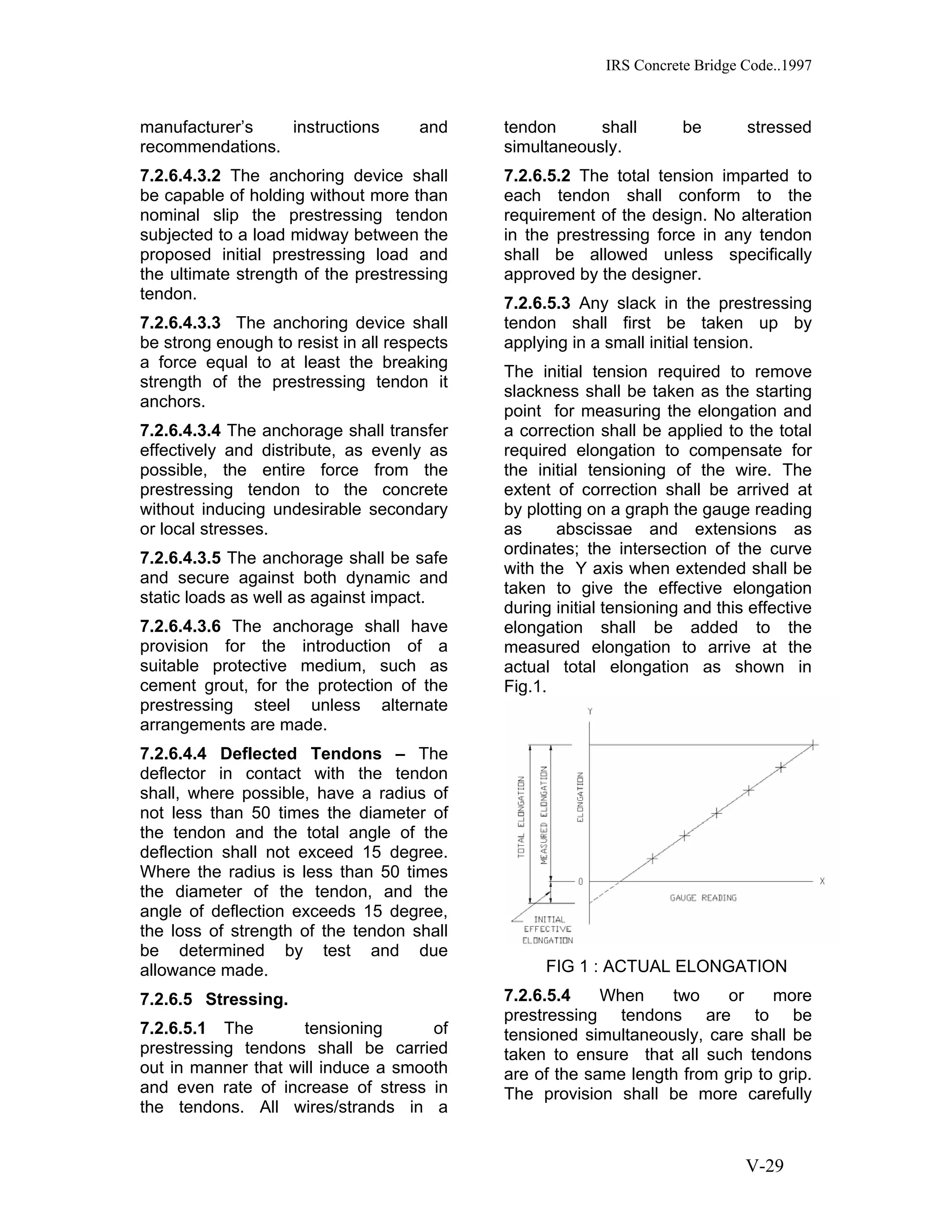
8.7 Sampling, Strength Tests and
Acceptance Criteria
8.7.1 General – Samples from fresh
concrete shall be taken as per IS:1199
and cubes shall be made, cured and
tested at 28 days in accordance with IS:
516.
IRS Concrete Bridge Code..1997
V-35
8.7.1.1 In order to get a relatively quick
idea of the quality of concrete, optional
tests on beams for modulus of rupture at
72±2 hours or at 7 days, or compressive
strength tests at 7 days may be carried
out in addition to 28 days compressive
strength tests. For this purpose, the
values given in table 7 may be taken for
general guidance in case of concrete
made with ordinary Portland cement. In
all cases, the 28 days compressive
strength specified in Table 2 shall alone
be the criterion for acceptance or
rejection of the concrete.
TABLE 7 : OPTIONAL TESTS
REQUIREMENTS OF CONCRETE
(Clause 8.8.1.1)
GRADE OF
CONCrete
COMPRESSIVE
STRENGTH ON
15 cm CUBES
MODULUS OF
RUPTURE BY
BEAM TEST
Min.
Min. at 7
days
Min. at
72±2h
Min. at
7 days
(1) (2) (3) (4)
N/mm2
N/mm2
N/mm2
M 20 13.5 1.7 2.4
M 25 17.0 1.9 2.7
M 30 20.0 2.1 3.0
M 35 23.5 2.3 3.2
M 40 27.0 2.5 3.4
M 45 30.0 2.7 3.6
M 50 33.5 2.9 3.8
M 55 37.0 3.1 4.0
M 60 40.0 3.3 4.2
8.7.2 Frequency of sampling.
8.7.2.1 Sampling Procedure – A
random sampling procedure shall be
adopted to ensure that each concrete
batch shall have a reasonable chance of
being tested; that is, the sampling
should be spread over the entire period
of concreting and cover all mixing units.
8.7.2.2 Frequency - The minimum
frequency of sampling of concrete of
each grade shall be in accordance with
the following :-
Quantity of
concrete in the
work, m3
Number of samples
1-5 1
6-15 2
16-30 3
31-50 4
51 & above 4 plus one
additional sample
for each addl. 50
m3
or part thereof.
Note- At least one sample comprising
of 3 cubes shall be taken from each
shift.
8.7.3 Test Specimen- Three test
specimens shall be made from each
sample for testing at 28 days. Additional
cubes may be required for various
purposes such as to determine the
strength of concrete at 7 days or at the
time of striking the formwork, or to check
the testing error. Additional cubes may
also be required for testing cubes cured
by accelerated methods as described in
IS:9013. The specimen shall be tested
as described in IS:516.
8.7.4 Test Strength of Sample – The
test strength of the sample shall be the
average of the strength of three
specimens. The individual variation
should not be more than ±15 per cent of
the average. If more, the test results of
the sample are invalid. When individual
variation exceeds this limit, the
procedure for the fabrication of
specimen and calibration of the testing
machine should be checked.
IRS Concrete Bridge Code..1997
V-36
8.7.5 Standard Deviation
8.7.5.1 Standard Deviation Bases on
Test Results.
a) Number of Test Results-
The total number of test results required
to constitute an acceptable record for
calculation of standard deviation shall
not be less than 30. Attempts should be
made to obtain 30 test results, as early
as possible, when a mix is used for the
first time.
b) Standard Deviation to be
brought up to date- The calculation of
the standard deviation shall be brought
up to date after every change of mix
design and at least once a month.
8.7.5.2 Determination of Standard
Deviation
a) Concrete of each grade shall be
analysed separately to determine its
standard deviation.
b) The standard deviation of concrete
of a given grade shall be calculated
using the following formula from the
results of individual tests of concrete
of that grade obtained as specified in
8.7.4:
Estimated standard deviation,
Sd =
1n
Δ2
−
∑
Where, Δ is the deviation of the
individual test strength from the average
strength of n samples ; and
n is the number of sample test
results.
c) When significant changes are made
in the production of concrete
batches(for example changes in the
materials used, mix design,
equipment or technical control), the
standard deviation value shall be
separately calculated for such
batches of concrete.
8.7.5.3 Assumed Standard Deviation
– Where sufficient test results for a
particular grade of concrete are not
available, the value of standard
deviation given in Table 8 may be
assumed.
TABLE 8: ASSUMED STANDARD
DEVIATION (Clause 8.7.5.3)
GRADE OF
CONCRETE
ASSUMED
STANDARD
DEVIATION
N/mm2
M 20 4.6
M 25 5.3
M 30 6.0
M 35 6.3
M 40 6.6
M 45 7.0
M 50 7.4
M 55 7.6
M 60 7.8
However, when adequate past records
for a similar grade exist and justify to the
designer a value of standard deviation
different from that shown in Table 8, it
shall be permissible to use that value.
8.7.6 Acceptance Criteria
8.7.6.1 Compressive strength.
When both the following conditions are
met, the concrete complies with the
specified compressive strength:
a) The mean strength determined from
any group of four consecutive test
results complies with the appropriate
limits in column A of table 9 ;
b) Any individual test results complies
with the appropriate limits in Column
B of table 9.
8.7.6.2 Flexural strength when both the
following conditions are met, the
IRS Concrete Bridge Code..1997
V-37
concrete complies with the specified
flexural strength:
(a) The mean strength determined from
any group of four consecutive test
results exceeds the specified
characteristic strength by at least 0.3
N/mm2.
(b) The strength determine from any test
result is not less than the specified
characteristic strength less 0.3 N/mm2.
TABLE-9: CHARACTERISTIC
COMPRESSIVE STRENGTH
COMPLIANCE REQUIREMENTS
(Clause 8.7.6.1, 8.7.6.2)
A
The mean of
the group of
test result
exceeds the
specified
characteristic
compressive
strength by at
least:
B
Any
individual test
result is not
less than the
characteristic
compressive
strength less:
Specified
grade
Group
of test
results
N/mm2
N/mm2
M 20 &
above
Any con-
secutive
4
3 3
8.7.6.3 Quantity of Concrete
Represented by Strength Test
Results- The quantity of concrete
represented by a group of 4 consecutive
test results shall include the batches
from which the first and last samples
where taken together with all intervening
batches.
For the individual test result
requirements given in column B of table-
9 or in item (b) of 8.7.6.2 only the
particular batch from which the sample
was taken shall be at risk.
Where the mean rate of sampling is not
specified the maximum quantity of
concrete that four consecutive test
results represent shall be limited to
60m3
.
8.7.6.4 If the concrete is deemed not to
comply pursuant to 8.7.6.2, the
structural adequacy of the parts affected
shall be investigated and any
consequential action as needed shall be
taken.
8.7.6.5 Concrete of each grade shall be
assessed separately.
8.7.6.6 Concrete shall be assessed daily
for compliance.
8.7.6.7 Concrete is liable to be rejected
if it is porous or honey combed; its
placing has been interrupted without
providing a proper construction joint.
The reinforcement has been displaced
beyond the tolerances specified; or
construction tolerances have not been
met. However, the hardened concrete
may be accepted after carrying out
suitable remedial measures to the
satisfaction of the engineer.
8.8 Supervision- It is exceedingly
difficult and costly to alter concrete once
placed. Hence, constant and strict
supervision by a competent person of all
the items of the construction is
necessary during the progress of the
work, including the proportioning and
mixing of the concrete. Supervision by
a competent person is also of extreme
importance to check the reinforcement
and its placing before being covered.
8.8.1 Before any important operation,
such as concreting or stripping of the
formwork is started, adequate notice
shall be given to the engineer.
8.9 Pumpable Concrete:
8.9.1 General- Pumpable concrete is
the concrete which is conveyed by
pressure through either rigid pipe or
flexible hose and discharged directly
into the desired area, it is especially
used where space for construction
equipment is very limited.
8.9.2 Pumping Rate and Range-
Depending on the equipment, pumping
rate should be 10 to 70m3
per hour.
IRS Concrete Bridge Code..1997
V-38
Effective pumping range is upto 300m
horizontally and 90m vertically.
8.9.3 Proportioning Pumpable
Concrete
8.9.3.1 Basic Consideration- More
emphasis on quality control is essential
to the proportioning and use of a
dependable pump mix. Concrete mixes
for pumping must be plastic. Particular
attention must be given to the mortar
and to the amounts and sizes of coarse
aggregates.
8.9.3.2 The maximum size of angular
coarse aggregate is limited to one-third
of smallest inside diameter of the hose
or pipe. Provisions should be made for
elimination of oversized particles in the
concrete by finish screening or by
careful selection of aggregates.
8.9.4 Pumping Concrete – Proper
planning of concrete supply, pump
locations, line layout, placing sequences
and the entire pumping operation will
result in saving of cost and time. The
pump should be placed as near the
placing area as practicable and the
entire surrounding area must have
adequate bearing strength. Lines from
the pump to the placing area should be
laid out with a minimum of bends. The
pipe line shall be rigidly supported.
8.9.4.1 While pumping downward 15m
or more, it is desirable to provide an air
release valve at the middle of the top
bend to prevent vacuum or air build-up.
When pumping upward, it is desirable to
have a valve near the pump to prevent
reverse flow.
9 GROUTING OF PRE-STRESSING
CABLES.
9.1 A recommended practice for
grouting of cables is given at
Appendix D.
10. LIMIT STATE REQUIREMENTS
10.1 General – In the method of design
based on limit state concept, the
structure shall be designed so as to
ensure an adequate degree of safety
and serviceability. The acceptable limit
for each of the safety and serviceability
requirements is called a ‘Limit State’.
For this purpose the limit states of 10.2
and 10.3 shall be considered. The
usual approach will be to design on the
basis of the limit state expected to be
most critical and then to check that the
remaining limit states will not be
reached and that all other requirements
will be met.
Consideration of other factors, such as,
deflection, fatigue and durability, will
need to be made as referred to in 10.4.
10.2 Serviceability Limit States –
The design shall be such that the
structure will not suffer local damage
which would shorten its intended life or
incur expensive maintenance costs. In
particular, calculated crack widths shall
not exceed those permitted in 10.2.1.
10.2.1 Cracking- Cracking of concrete
shall not adversely affect the
appearance of durability of the structure.
The engineer should satisfy himself that
any cracking will not be excessive,
having regard to the requirements of the
particular structure and the conditions of
exposure. In the absence of special
investigations, the following limit shall be
adopted.
10.2.1(a) Reinforced concrete –
Design crack widths, as calculated in
accordance with 15.9.8.2, shall not
exceed the values given in Table 10
under the loading given in 11.3.2 :
TABLE 10: DESIGN CRACK WIDTHS
[Cl. 10.2.1 (a) ]
Environment Design crack width
in mm
Mild 0.20
Moderate 0.20
Severe 0.10*
0.20**
Very severe 0.10*
0.20**
Extreme 0.10*
0.20**
*Surfaces exposed to weather.
IRS Concrete Bridge Code..1997
V-39
**Surfaces protected against weather.
Note – Exposure conditions are as
defined in 5.4.1.
10.2.1(b) Prestressed Concrete
Structures and Elements –
No tensile stresses are permitted and
therefore, no cracks shall occur under
the loading given in 11.3.2.
10.2.2. Stress Limitations- To prevent
unacceptable deformations from
occurring, compressive stresses in
concrete and stresses in steel should be
calculated by linear elastic analysis for
the load combinations given under 11.2
in any of the following applications :
a) for all prestressed concrete
construction;
b) for all composite construction;
c) where the effects of differential
settlement, temperature difference,
the creep and shrinkage of concrete
are not considered at the ultimate
state :
10.2.2.1 For reinforced concrete and
prestressed concrete, the compressive
and tensile stress limitations are as
specified in Table 11.
TABLE 11. STRESS LIMTATIONS
FOR THE SERVICEABILITY LIMIT
STATE.
(Clause 10.2.2)
Type of
construction
Material Type of stress
under design
loading
RCC PSC
Triangular or near
triangular
compressive
stress distribution
(e.g. due to
bending)
0.50
fck
0.40fckConcrete
Uniform or near
uniform
compressive
stress (e.g. due to
axial loading)
0.38
fck
0.30fck
Reinforc
ement
Compression
Tension
0.75
fy
Not
appli-
cable
Pre-
stressing
tendons
Tension Not
appli-
cable
Deemed
to be
satisfied
by 16.8.1
NOTE 1– The above stress limitations
have been derived from 12.2
after making allowance
according to Table 13 (see
12.4.2).
NOTE 2 - See 17.3.3 for limiting flexural
stresses in joints for post-
tensioned segmental
construction.
10.3 Ultimate Limit States
10.3.1 Rupture or Instability – The
assessment of the structure under
design loads appropriate to this limit
shall ensure that prior collapse of the
structure does not take place as a result
of rupture of one or more critical
sections, buckling caused by elastic or
plastic instability or overturning.
The effects of creep and shrinkage of
concrete, temperature difference and
differential settlement need not be
considered at the ultimate limit state
provided that these effects have been
included in the appropriate load
combinations to check the stress
limitations given in 10.2.2.1 for the
serviceability limit state.
10.4 Other Considerations
10.4.1 Deflections- The deflection of
the structure or any part of it, shall not
such as to affect adversely the
appearance or efficiency of the
structure.
10.4.1.1 The appearance and function
of concrete superstructures are normally
unaffected although calculations may be
required in the following circumstances :
IRS Concrete Bridge Code..1997
V-40
(a) where minimum specified
clearances may be violated;
(b) where drainage difficulties might
ensure;
(c) where method of construction
may require careful control of profile,
e.g. at discontinuities in serial
construction, and where decks comprise
abutting prestressed concrete beams.
10.4.2 Fatigue – The fatigue life shall
comply with the requirements of 13.4.
10.4.3 Durability – The specifications
in this code regarding drainage for the
deck (see 15.2.2.1), concrete cover to
the reinforcement (see 15.9.2) and
acceptable crack widths (see 10.2.1) in
association with the limits given in 5.4
are intended to meet the durability
requirements of almost all bridge
structures. Where more severe
environments are encountered,
however, additional precautions may be
necessary, and specialist literature shall
be referred to.
11. LOADS, LOAD COMBINATIONS
AND PARTIAL LOAD FACTORS
11.1 Loads – The values of loads as
given in IRS Bridge rules shall be taken
as characteristic loads for the purpose
of this code.
11.1.1 For design of concrete bridges of
span 30m and larger, an appropriate
temperature gradient shall be
considered. In the absence of any data
in this regard, depending on the
environmental conditions, a linear
gradient of temperature of 50
C to 100
C
between the top and bottom fibres may
be considered for design.
The effect of difference in temperature
between outside and inside of box
girders shall also be considered in
design.
11.1.2 Creep and shrinkage of concrete
and prestress (including secondary
effects in statically in determinate
structures) are load effects associated
with the nature of structural material
being used; where they occur, they shall
be regarded as permanent loads.
11.2 Combinations of Loads
11.2.1 Combinations of loads –
Following five combinations of loads are
considered.
11.2.1.1 Combinations 1 – The
permanent loads i.e. dead load,
superimposed loads etc. together with
the appropriate live loads.
11.2.1.2 Combinations 2 – The load to
be considered are the loads in
combination 1, together with those due
to wind/earthquake, and where erection
is being considered temporary erection
loads.
11.2.1.3 Combinations 3 –The load to
be considered are the loads in
combination 1, together with those
arising from restraint due to the effect of
temperature range and difference and
where erection is being considered
temporary erection loads.
11.2.1.4 Combinations 4 – The load to
be considered are the permanent loads,
together with the loads due to friction at
bearings.
11.2.1.5 Combinations 5- Dead load,
superimposed dead load, together with
derailment loads.
11.3 Partial Load Factors – The factors
by which the design loads are obtained
from the characteristic loads are
specified in 11.3.1.
11.3.1 Design loads, Q*
are the loads
obtained by multiplying the
characteristics load, Qk by Yfl the partial
safety factor for loads which takes into
account the following: -
1. Possible unfavourable deviations
of the loads from their
characteristic values.
IRS Concrete Bridge Code..1997
V-41
2. Inaccurate assessment of the
loading, unforeseen stress
distribution in the structure and
variation in dimensional
accuracy achieved in
construction.
3. Reduced probability that various
loads acting together will all
attain their characteristic values
simultaneously.
The values of the function Yfl for the
various loads are given in Table 12.
11.3.2 Serviceability Limit State – For
the limitations given in 10.2.1. load
combination only shall be considered.
For the stress limitations given in 10.2.2,
load combinations 1 to 5 shall be
considered.
The value of YfL. for creep and
shrinkage of concrete and prestress
(including secondary effects in statically
indeterminate structures) shall be taken
as 1.0.
11.3.3 Ultimate Limit State – To check
the provisions of 10.3 load combinations
1 to 4 shall be considered.
The value of YfL for the effects of
shrinkage and, where relevant, of creep
shall be taken as 1.2.
In calculating the resistance of members
to vertical shear and torsion YfL for the
prestressing force shall be taken as
1.15 where it adversely affects the
resistance and 0.87 in other cases. In
calculating secondary effects in
statically indeterminate structures YfL for
prestressing force may be taken as 1.0.
11.3.4 Deflection – Minimum specified
clearances shall be maintained under
the action of load combination 1.
The appearance and drainage
characteristics of the structure shall be
considered under the action of
permanent loads only.
11.3.4.1 The values of YfL for the
individual loads shall be those
appropriate to the serviceability limit
state.
IRS Concrete Bridge Code..1997
V-42
TABLE 12
LOADS TO BE TAKEN IN EACH COMBINATION WITH APPROPRIATE YfL
(Clauses 11.2 and 11.3)
LOAD LIMIT
STATE
YfL TO BE CONSIDERED IN
COMBINATION
1 2 3 4 5
Dead weight of concrete ULS
SLS
1.40
1.00
1.40
1.00
1.40
1.00
1.40
1.00
-
1.00
Superimposed dead load ULS
SLS*
2.00
1.20
2.00
1.20
2.00
1.20
2.00
1.20
-
1.00
During erection ULS
SLS
-
-
1.25
1.00
-
-
-
-
-
-
with dead and superimposed
dead loads only and for
members primarily resisting
wind loads.
ULS
SLS
-
-
1.60
1.00
-
-
-
-
-
-
With dead plus superimposed
dead plus other appropriate
combination 2 loads.
ULS
SLS
-
-
1.25
1.00
-
-
-
-
-
-
Wind
Relieving effect of wind ULS
SLS
-
-
1.00
1.00
-
-
-
-
-
-
Earth
quake
With dead and superimposed
dead loads only
ULS
SLS
-
-
1.60
1.00
-
-
-
-
-
-
With dead plus superimposed
dead plus other appropriate
combination 2 loads.
ULS
SLS
-
-
1.25
1.00
-
-
-
-
-
-
Restraint against movement
except frictional
ULS
SLS
-
-
-
-
1.50
1.00
-
-
-
-
Frictional restraint ULS
SLS
-
-
-
-
-
-
1.50
1.00
-
-
Tempe
rature
Differential temperature effect ULS
SLS
-
-
-
-
1.15
0.80
-
-
-
-
Differential settlement ULS
SLS
As specified by engineer
Fill retained and or live
load surcharge
ULS
SLS
1.70
1.00
1.70
1.00
1.70
1.00
1.70
1.00
-
-Earth
Pressure relieving effect ULS 1.00 1.00 1.00 1.00 -
Erection temporary loads (when being
considered)
ULS - 1.30 1.30 - -
Live load on foot path ULS
SLS
1.50
1.00
1.25
1.00
1.25
1.00
-
-
-
-
Live load ULS
SLS
2.00
1.10
1.75
1.00
1.75
1.00
-
-
-
-
Derailment loads SLS (As specified by bridge rules for
combination 5 only)
NOTE 1-ULS : Ultimate limit state SLS : serviceability limit state
NOTE 2-Wind and earth quake loads shall not be assumed to be acting simultaneously.
NOTE 3- Live load shall also include dynamic effect, forces due to curvature exerted on track, longitudinal
forces, braking forces and forces on parapets.
IRS Concrete Bridge Code..1997
V-43
12 CHARACTERISTIC STRENGTHS
AND PARTIAL SAFETY FACTORS
FOR MATERIALS
12.1 Characteristic Strengths
12.1.1 Characteristic strengths is that
strength below which not more than 5%
of possible test results may be expected
to fall.
12.1.2 The characteristic cube strengths
of concrete are given in 5.1. Until the
relevant Indian Standard Specifications
for reinforcing steel and prestressing
steel are modified to include the concept
of characteristics strength, the
characteristic strength shall be assumed
as the minimum yield/0.2 percent proof
stress for reinforcing steel and as the
minimum ultimate tensile stress/breaking
load for prestressing steel, specified in
the relevant Indian Standard
Specifications (see 4.5 and 4.6).
12.2 Material properties for Analysis
12.2.1 In general in analysing a structure
to determine the load effects, the material
properties appropriate to the
characteristic strength shall be used,
irrespective of the limit state being
considered.
12.2.2 For the analysis of sections, the
material properties to be used for the
individual limit states are as follows:
(a) Serviceability limit state- The
characteristic stresses, which shall be
taken as 0.75fy. for reinforcement and 0.5
fck for concrete in compression.
(b) Ultimate limit state-
Characteristic strengths given in 12.3.1.
The appropriate Ym values are
given in 12.4.
12.3 Material Properties for Concrete
and Steel
12.3.1 Concrete – In assessing the
strength of sections at the ultimate limit
state, the design stress-strain curve for
concrete may be taken from Fig. 3, using
the value of Ym for concrete given in
12.4. Equation for the parabolic curve
between
0ε = and mck
4
/Yf2.44x10ε −
=
may be taken as
f = ⎥
⎦
⎤
⎢
⎣
⎡
m
ck
Y
f
5500 2
2
ε
2.68
5500
ε ⎥
⎦
⎤
⎢
⎣
⎡
−
Where f is stress and ε is the strain.
12.3.1.1. Modulus of Elasticity – The
modulus of elasticity to be used for
elastic analysis shall be appropriate to
the cube strength of the concrete at the
age considered and in the absence of
special investigations may be taken as
given in 5.2.2.1.
12.3.2 Reinforcement and
prestressing Steel – The design stress-
strain curves may be taken as follows:
(a) for reinforcement, from Fig.4A or
4B, using the values of Ym given in
12.4;
(b) for prestressing steel, from Fig.2A
or 2B, using the values of Ym given
in 12.4.
FIG 2A: WIRES (STRESS RELIEVED) STRANDS &
BARS.
IRS Concrete Bridge Code..1997
V-44
FIG 2B: WIRES (AS DRAWN)
REPRESENTATIVE STRESS STRAIN
CURVES FOR PRE-STRESSING STEEL
12.3.2.1 For reinforcement, modulus of
elasticity may be taken from 4.5.3.
12.3.2.2 For prestressing steel, the
modulus of elasticity may be taken from
4.6.2.
12.4 Values of Ym
12.4.1 General – For the analysis of
sections, the values of Ym are given in
12.4.2. and 12.4.3.
12.4.2 Serviceability Limit State – The
values of Ym applied to the characteristic
stresses defined in 12.2.2 are given in
Table 13 and have been allowed in
deriving the compressive and tensile
stresses given in Table 11.
TABLE 13: VALUES OF YmFOR THE
SERVICEABILITY STRESS
LIMITATIONS
( Clause 12.4.2 )
Type of
Construction
Material Type of
Stress
RCC PSC
Concrete Triangular or
near
Triangular
compressive
stress
distribution
(e.g. due to
bending
1.00 1.25
Uniform or
near uniform
compressive
stress
distribution
(e.g. due to
axial loading)
1.33 1.67
Tension Not applicable
Reinforc
e-ment
Compre-
ssion Tension 1.00 N.A.
Pre-
Stress-
ing
tendons
Tension NA Not
requir-
ed
The higher values for prestressed
concrete arise because the whole
concrete cross section is normally
in
compression and therefore creep will be
greater than in reinforced concrete.
Similarly in reinforced concrete creep will
be greater where the compressive stress
distribution is uniform over the whole
cross section.
12.4.3 Ultimate Limit State- For both
reinforced concrete and prestressed
concrete, the values of Ym applied to the
characteristic strengths are 1.5 for
concrete and 1.15 for reinforcement and
prestressing tendons.
12.4.4 Fatigue- For reinforced concrete,
the value of Ym applied to the stress
range limitations given in 13.4 for
reinforcement is 1.0.
12.4.5 Unless specifically stated
otherwise all equations, figures and
tables given in this code include
allowances for Ym the partial safety
factor for material strength.
13 ANALYSIS OF STRUCTURE AND
SECTION:
13.1 Analysis of Structure-
13.1.1 General- Global analysis of
action shall be undertaken for each of the
most severe conditions appropriate to the
part under consideration for all the load
combinations prescribed in Table 12.
The methods of analysis shall satisfy
equilibrium requirements, all load effects
being shown to be in equilibrium with the
IRS Concrete Bridge Code..1997
V-45
applied loads. They shall be capable of
predicting all loading effects including,
where appropriate, those that cannot be
predicted by simple bending theory. The
requirements of methods of analysis
appropriate to the distribution of forces
and deformations, which are to be used
in ascertaining that the limit state criteria
are satisfied, are given in 13.1.2 and
13.1.3.
13.1.2 Analysis for Serviceability
Limit State
13.1.2.1. General- Load effects
under each of the prescribed design
loadings appropriate to the serviceability
limit state shall where relevant, be
calculated by elastic methods, The
flexural stiffness constants
(second
moment of area) for sections of discrete
members or unit widths of slab elements
may be based on any of the following:
(a) Concrete section-The entire member
cross section, ignoring the presence of
reinforcement.
(b) Gross transformed section-The entire
member cross section including the
reinforcement transformed on the basis
of modular ratio.
(c) Net transformed section-The area of
the cross section, which is in
compression together with the tensile
reinforcement transformed on the basis
of modular ratio.
Consistent approach shall be used which
reflects the different behaviour of various
parts of the structure.
Axial torsional and shearing stiffness
constants, when required by the method
of analysis, shall be based on the
concrete section and used with (a) or (b).
Moduli of elasticity and shear moduli
values shall be appropriate to the
characteristic strength of the concrete.
13.1.2.2. Method of Analysis and their
Requirements – The method of analysis
shall ideally take account of all the
significant aspects of behaviors of a
structure governing its response to loads
and imposed deformations.
13.1.3 Analysis for Ultimate Limit
State
13.1.3.1 General – Elastic methods may
be used to determine the distribution of
forces and deformations throughout the
structure. Stiffness constants shall be
based on the section properties as used
for the analysis of the structure at the
serviceability limit state (See 13.1.2.1)
13.1.3.2 Method of Analysis and their
Requirements – The application of
elastic methods of analysis in association
with the design loads for the ultimate limit
state in general leads to safe lower
bound solutions.
When treating local effects, elastic
methods may be applied to derive the in
plane forces and moments due to out of
plane loading.
13.1.3.3 Other methods of analysis (e.g.
plastic hinge methods for beams or yield
line method for slabs) are beyond the
scope of this code. Use of such methods
requires the prior approval of the
engineer and reference to specialist
literature.
13.2 Analysis of Section.
13.2.1 Serviceability Limit State – At
any section, an elastic analysis shall be
carried out to satisfy the
recommendations of 10.2 In-plane shear
flexibility in concrete flanges (shear lag
effects) may be allowed for. This may be
done by taking an effective width of
flange as given in 15.4.1.2.
13.2.2 Ultimate Limit State – The
strength of critical sections shall be
assessed in accordance with clauses 15
or 16 to satisfy the recommendations of
10.3. In- plane shear flexibility in concrete
flanges (shear lag effects) may be
ignored.
13.3 Deflection – Deflection shall be
calculated for the most unfavourable
distributions of loading for the member
(or strip of slab) and may be derived from
IRS Concrete Bridge Code..1997
V-46
an elastic analysis of the structure. The
material properties, stiffness constants
and calculation of deflection may be
based on 12.3.1.
13.4 Fatigue - The effect of repeated
live loading on the fatigue strength of a
bridge shall be considered in respect of
reinforcing bars that have been subject to
welding.
Welding may be used to connect bars
subjected to fatigue loading provided that
:
a) the connection is made to
standard workmanship levels as given in
7.1.3 ;
b) the welded bar is not part of a
deck slab spanning between longitudinal
and/or transverse members and
subjected to the effect of concentrated
loads ;
c) the detail has an acceptable
fatigue life determined as described in
Appendix-H;
d) lap welding is not used.
13.4.1 For unwelded reinforcing bars, the
stress range under various load
combinations for the serviceability limit
state shall be limited to 300 N/mm2
for Fe
415 grade bars and to 265 N/mm2
for Fe
250 grade bars.
13.5 Combined Global and Local
Effects-
13.5.1 General – In addition to the
design of individual primary and
secondary elements to resist loading
applied directly to them, it is also
necessary to consider the loading
combination that produces the most
adverse effects due to global and local
loading where these co-exist in an
element.
13.5.2 Analysis of Structure – Analysis
of the structure may be accompanied
either by one overall analysis (e.g. using
finite elements) or by separate analysis
for local and global effects. In the latter
case the forces and moments acting on
the element from local and global effects
shall be combined as appropriate.
13.5.3 Analysis of section – Section
analysis for the combined global and
local effects shall be carried out in
accordance with 13.2 to satisfy the
recommendations of 10.
a) Serviceability Limit State
1) For reinforced concrete elements, the
total crack width due to combined global
and local effects shall be determined in
accordance with 15.9.8.2.
2) For prestressed concrete elements,
co-existent stresses, acting in the
direction of prestress, may be added
algebraically in checking stress
limitations:
b) Ultimate Limit State –The
resistance of the section to direct and
flexural effects shall be derived from the
direct strain due to global effects
combined with the flexure strain due to
local effects. However, in the case of a
deck slab the resistance to combined
global and local effects is deemed to be
satisfactory if each of these effects is
considered separately.
14. PLAIN CONCRETE WALLS
14.1 General – A plain concrete wall is a
vertical load bearing concrete member
whose greatest lateral dimension is more
than four times its least lateral dimension
and which is assumed to be without
reinforcement when considering its
strength.
The recommendations given in 14.2 to
14.11 refer to the design of a plain
concrete wall that has a height not
exceeding five times its average
thickness.
14.2 Moments and Forces in Walls –
Moments, shear forces and axial forces
in a wall shall be determined in
accordance with 13.1.
The axial force may be calculated on the
assumption that the beams and slabs
IRS Concrete Bridge Code..1997
V-47
transmitting forces into it are simply
supported.
The resultant axial force in a member
may act eccentrically due to vertical
loads not being applied at the centre of
the member or due to the action of
horizontal forces. Such eccentricities
shall be treated as indicated in 14.3 and
14.4.
The minimum moment in a direction at
right angles to the wall shall be taken as
not less than that produced by
considering the ultimate axial load per
unit length acting at an eccentricity of
0.05 times the thickness of the wall.
14.3 Eccentricity in the Plane of the
Wall
In the case of a single member this
eccentricity can be calculated from
statics alone. Where a horizontal force is
resisted by several members, the amount
allocated to each member shall be in
proportion to its relative stiffness
provided
the resultant eccentricity in any individual
member is not greater than one-third of
the length of the member. Where a shear
connection is assumed between vertical
edges of adjacent members an
appropriate elastic analysis may be used,
provided the shear connection is
designed to withstand the calculated
forces.
14.4 Eccentricity at Right Angles to
Walls or Abutments –
The load transmitted to a wall by a
concrete deck may be assumed to act at
the one-third the depth of the bearing
area from the loaded face. Where there
is an in situ concrete deck on either side
of the member the common bearing area
may be assumed to be shared equally by
each deck.
The resultant eccentricity of the
total load on a member unrestrained in
position at any level shall be calculated
making full allowance for the eccentricity
of all vertical loads and the overturning
moments produced by any lateral forces
above the level.
The resultant eccentricity of the
total load on a member restrained in
position at any level may be calculated
on the assumption that immediately
above a lateral support the resultant
eccentricity of all the vertical loads above
that level is zero.
14.5 Analysis of Section – Loads of a
purely local (as a beam bearings or
column bases) may be assumed to be
immediately dispersed provided the local
stress under the load does not exceed
that given in 14.7. Where the resultant of
all the axial loads acts eccentrically in the
plane of the member, the ultimate axial
load per unit length of wall nw shall be
assessed on the basis of an elastic
analysis assuming a linear distribution of
load along the length of the member
assuming no tensile resistance.
Consideration shall first be given to the
axial force and bending in the plane of
the wall to determine the distribution of
tension and compression along the wall.
The bending moment at right angles to
the
wall shall then be considered and the
section checked for this moment and the
compression or tension per unit length at
various positions along the wall. Where
the eccentricity of load in the plane of the
member is zero, a uniform distribution of
nw may be assumed.
For members restrained in position, the
axial load per unit length of member, nw
due to ultimate loads shall be such that
nw ckwx f)Y2e(h −≤
Where
nw is the maximum axial load per unit
length of member due to ultimate loads.
h is the overall thickness of the section;
ex is the resultant eccentricity of load at
right angles to the plane of the member
(see 14.2) (minimum value 0.05h).
fck is the characteristic cube strength of
the concrete.
IRS Concrete Bridge Code..1997
V-48
Yw is a coefficient, taken as 0.35 for
concretes of grade M 20 and 0.4 for
concrete of grades M 25 and above.
14.6 Shear – The resistance to shear
forces in the plane of the member may
be assumed to be adequate provided the
horizontal shear force due to ultimate
loads is less than either one-quarter of
the vertical load, or the force to produce
an average shear stress of 0.45 N/mm2
over the whole cross section of the
member in the case of concretes of
Grade M 25 or above; where Grade M 20
concrete is used, a figure of 0.3 N/mm2
is
appropriate.
14.7 Bearing –Bearing stresses due to
ultimate loads of a purely local nature, as
at girder bearing, shall be limited in
accordance with 17.2.3.3.
14.8 Deflection of Plain Concrete
Walls – The deflection in a plain concrete
member will be within acceptable limits if
the preceding recommendations have
been followed.
14.9 Shrinkage and Temperature
Reinforcement – For plain concrete
members exceeding 2m in length and
cast
in situ it is necessary to control cracking
arising from shrinkage and temperature
effects, including temperature rises
caused by the heat of hydration released
by the cement. Reinforcement shall be
provided in the direction of any restraint
to such movement.
The area of reinforcement As parallel to
the direction of each restraint shall be
such that.
As ≥ Kr (Ac-0.5 Acor)
Where
Kr is 0.005 for Grade Fe 415
reinforcement and 0.006 for Grade Fe
250 reinforcement;
Ac is the area of the gross concrete
section at right-angles to the direction of
the restraint;
Acor is the area of the core of the concrete
section, Ac i.e. that portion of the section
more than 250mm from all concrete
surfaces.
14.9.1 Shrinkage and Temperature
Reinforcement- shall be distributed
uniformly around the perimeter of the
concrete sections and spaced at not
more than 150mm.
14.10 Stress Limitations for
Serviceability Limit State – The wall
shall be designed so that the concrete
compressive stresses comply with Table
11 and concrete tensile stresses do not
increase 0.034 fck.
15. DESIGN AND DETAILING;
REINFORCED CONCRETE
15.1 General;
15.1.1 This clause gives methods of
analysis and design, which in general
ensure that, for reinforced concrete
structures, the recommendations set out
in 10.2 & 10.3, are met. In certain cases
the assumptions made in this clause may
be inappropriate and the engineer shall
adopt a more suitable method having
regard to the nature of the structure in
question.
15.1.2 All RCC structures shall be
designed for safety, serviceability and
durability requirements (structural and
non-structural loads caused by
environment).
15.1.3 The bridges shall be designed for
the service life as given below :-
Type of Structure Design life in Yrs
Bridges in sea 50
Bridges in coastal areas 80
Bridges in rest of India 100
15.2 Limit State Design of Reinforced
Concrete-
15.2.1 Basis of Design- Clause 15
follows the limit state philosophy set out
in clause 10 but as it is not possible to
assume that a particular limit will always
be the critical one, design methods are
IRS Concrete Bridge Code..1997
V-49
given for both the ultimate and
serviceability limit states.
In general, the design of reinforced
concrete members is governed by the
ultimate limit state, but the limitations on
crack width and, where applicable,
stresses at the serviceability limit state
given in 10.2.3 shall also be met.
15.2.1.1 Where a plastic method or
redistribution of moments is used for the
analysis of the structure at the ultimate
limit state, or where critical parts of the
structure are subjected to the ‘severe’
category of exposure, the design is likely
to be controlled by the serviceability limit
state of cracking.
15.2.2 Durability- A proper drainage
system shall be provided on the deck as
indicated in 15.2.2.1. In 15.9.2 guidance
is given on the nominal cover to
reinforcement that shall be provided to
ensure durability. For other durability
requirements of concrete like maximum
water cement ratio, minimum grade of
concrete, minimum cement contents,
maximum crack width etc., Clause 5.4
and 10.2.1 shall be referred.
15.2.2.1 Drainage for the Deck – A
complete drainage system for the entire
deck shall be provided to ensure that the
drainage water is disposed off quickly
from the deck to a safe location. For
bridges level in longitudinal profile,
minimum cross slopes in the deck shall
be kept at 2.5%.
15.2.3 Loads – In clause 15, the design
load (see 11.3) for the ultimate and
serviceability limit states are referred to
as ‘ultimate loads’ and ‘service loads’
respectively.
In clause 15, when analysing sections,
the terms ‘strength’, ‘resistance’ and
‘capacity’ are used to describe the design
strength of the section.
15.2.4 Strength of Materials
15.2.4.1 Definition of Strengths- In
clause 15, the design strengths of
materials for the ultimate limit state are
expressed in all the tables and equations
in terms of the ‘characteristic strength’ of
the material. Unless specifically stated
otherwise, all equations, figures and
tables include allowances for Ym, the
partial safety factor for material strength
(see 12.4.5.)
15.2.4.2 Characteristic Strength of
Concrete- The characteristic cube
strengths of concrete for various grades
are given in Table 2. These values do not
include any allowance for Ym.
15.2.4.3 Characteristic Strengths of
Reinforcement- Until the relevant Indian
Standard Specifications for reinforcing
steel are modified to include the concept
of characteristic strength, the
characteristic value for various grades of
steel shall be assumed as the minimum
yield/0.2 percent proof stress specified in
the relevant Indian Standard
Specifications (see 4.5). These values do
not include any allowance for Ym. The
characteristic strength of Thermo
Mechanically Treated bars shall be
assumed at par with reinforcement bars
conforming to IS: 1786.
15.3 Structures and Structural
Frames
15.3.1 Analysis of Structures-
Structures shall be analysed in
accordance with the recommendations of
13.1
15.3.2 Redistribution of Moments –
Redistribution of moments obtained by
rigorous elastic analysis under the limit
state may be carried out provided the
following conditions are met;
a) Checks are made to ensure that
adequate rotation capacity exists at
sections where moments are
reduced, making reference to
appropriate test data.
In the absence of a special
investigations, the plastic rotation
capacity may be taken as the lesser
of:-
IRS Concrete Bridge Code..1997
V-50
(1) 0.008+0.035 (0.5- )
d
d
e
c
or
(2) Φ
dd
0.6
c−
but not less than 0 or more than
0.015.
where
dc is the calculated depth of concrete in
compression at the ultimate limit state
de is the effective depth for a solid slab
or rectangular beam, otherwise the
overall depth of the compression flange.
ϕ is the diameter of the smallest tensile
reinforcing bar
d is the effective depth to tension
reinforcement.
(b) Proper account is taken of
changes in transverse moments,
transverse deflections and transverse
shears consequent on redistribution of
longitudinal moments by means of a
special investigation based on a non-
linear analysis.
(c) Shears and reactions used in design
are taken as those calculated either prior
to redistribution or other redistribution,
whichever is greater.
(d) The depth of the members of
elements considered is less than
1200mm.
15.4 Beams
15.4.1 General
15.4.1.1 Effective Span- The effective
span of a simply supported member shall
be taken as the smaller of;
a) the distance between the centers
of bearings or other supports; or
b) the clear distance between supports
plus the effective depth.
15.4.1.1.1 The effective span of a
member framing into supporting
members shall be taken as the distance
between the shear centers of the
supporting member.
15.4.1.1.2 The effective span of a
continuous member shall be taken as the
distance between centers of supports
except where, in the case of beams on
wide columns, the effect of column width
is included in the analysis.
15.4.1.1.3 The effective length of a
cantilever shall be taken as its length
from the face of the support plus half its
effective depth except where it is an
extension of a continuous beam when
the length to the centre of the support
shall be used.
15.4.1.2 Effective Width of Flanged
Beams
15.4.1.2.1 In analysing structures, the
full width of flanges may be taken as
effective.
15.4.1.2.2 In analysing sections at the
serviceability limit state, and in the
absence of any more accurate
determination, the effective flange width
shall be taken as the width of the web
plus one-tenth of the distance between
the points of zero moment (or the actual
width of the outstand if this is less) on
each side
of the web. For a continuous beam the
points of zero moment may be taken to
be at a distance of 0.15 times the
effective span from the support.
In analysing sections at the ultimate limit
state the full width of the flanges may be
taken as effective.
15.4.1.3 Slenderness Limits for
Beams
To ensure lateral stability, a simply
supported or continuous beam shall be so
proportioned that the clear distance
between lateral restraints does not exceed
60bc or 250bc
2
/d, whichever is the lesser,
Where
d is the effective depth to tension
reinforcement; and
IRS Concrete Bridge Code..1997
V-51
bc is the breadth of the compression
face of the beam midway between
restraints.
15.4.1.3.1 For cantilevers with lateral
restraint provided only at the support, the
clear distance from the end of the
cantilever to the face of the support shall
not exceed 25bc or 100bc
2
/d whichever is
lesser.
15.4.2 Resistance Moment of Beams
15.4.2.1 Analysis of Sections – When
analysing a cross section to determine its
ultimate moment of resistance, the
following assumptions shall be made :
(a) The strain distribution in the concrete
in compression and the strains in the
reinforcement, whether in tension or
compression, are derived from the
assumption that plane sections remain
plane;
(b) The stresses in the concrete in
compression are either derived from the
stress-strain curve in Fig.3 with Y = 1.5
or, in the case of rectangular sections
and in flanged, ribbed and voided
sections where the neutral axis lies within
the flange, the compressive strength
may be taken as equal to 0.4 fck over the
whole compression zone. In both the
cases the strain at the outermost
compression fibre at failure is taken as
0.0035;
FIG3: SHORT TERM DESIGN STRESS
STRAIN CURVE FOR NORMAL WEIGHT
CONCRETE
FIG 4: REPRESENTATIVE STRESS STRAIN
CURVE FOR REINFORCEMENT
(c) The tensile strength of the concrete
is ignored; and
(d) The stresses in the reinforcement
are derived from the stress-strain curves
in Fig. 4 with Ym = 1.15.
In addition, if the ultimate moment of
resistance, calculated in accordance with
this clause, is less than 1.15 times the
required value, the section shall be
proportioned such that the strain at the
centroid of the tensile reinforcement is
not less than:
ms
y
YE
f
+002.0
IRS Concrete Bridge Code..1997
V-52
Where
Es is the modulus of elasticity of the
steel. As an alternative, the strains in the
concrete and the reinforcement, due to
the application of ultimate loads, may be
calculated using the following
assumptions :
e) The strain distribution in the
concrete in compression and the strains
in the reinforcement, whether in tension
or compression, are derived from the
assumption that plane sections remain
plane ;
f) The stresses in the concrete in
compression are derived from the stress-
strain curve given in Fig.3 with Ym=1.5 ;
g) The tensile strength of the
concrete is ignored ; and
h) The stresses in the
reinforcement are derived from the
stress-strain curves in Fig.4 with
Ym=1.15.
In using the alternative method of
analysis, the calculated strain due to the
application of ultimate loads at the
outermost compression fibre of the
concrete shall not exceed 0.0035 and the
strain at the centroid of the tensile
reinforcement shall be not less than
0.002+fy/(EsYm) except where the
requirement for the calculated strain in
the concrete, due to the application of
1.15 times the ultimate loads, can be
satisfied.
15.4.2.1.2 In the analysis of a cross
section of a beam that has to resist a
small axial thrust, the effect of the
ultimate axial force may be ignored if it
does not exceed 0.1 fck times the cross-
sectional area.
15.4.2.2 Design Formulae – Provided
that the amount of redistribution of the
elastic ultimate moments has been less
than 10%, the following formulae may be
used to calculate the ultimate moment of
resistance of a solid slab or rectangular
beam, or of a flanged beam, ribbed slab
or voided slab when the neutral axis lies
within the flange.
15.4.2.2.1 For sections without
compression reinforcement the ultimate
moment of resistance may be taken as
the lesser of the values obtained from
equations 1 and 2. Equations 3 & 4 may
be used for sections with compression
reinforcement.
A rectangular stress block of maximum
depth 0.5d and a uniform compression
stress of 0.4fck has been assumed
(Fig.5).
Mu = (0.87fy)Asz …..(equation 1)
Mu = 0.15fckbd2
….. (equation 2)
Mu = ( )ddA72f.0bd.15f0 sy
2
ck
′−+ ′ …(equ-3)
(0.87fy)As=0.2fckbd+0.72fyAs′…(equ. 4)
where
Mu is the ultimate resistance moment
As is the area of tension reinforcement
sA ′ is the area of compression
reinforcement
b is the width of the section
d is the effective depth to the tension
reinforcement
d’ is the depth to the compression
reinforcement
fy is the characteristic strength of the
reinforcement
z is the lever arm; and
fck is the characteristic strength of the
concrete
When d'/d is greater than 0.2, equation 3
should not be used and the resistance
moment shall be calculated with the aid
of 15.4.2.1.
The lever arm, z, in equation 1 may be
calculated from the equation:
IRS Concrete Bridge Code..1997
V-53
z = d
bdf
A1.1f
1
ck
sy
− ……….. (equation 5)
The value z shall not be normal taken as
greater than 0.95d.
15.4.2.2.2. The ultimate resistance
moment of a flanged beam may be taken
as the lesser of the values given by
equations 6 & 7 where hf is the thickness
of the flange.
FIG 5 : STRESS BLOCK OF RECTANGULAR
BEAM
Mu = (0.87fy) As(d-hf/2)…equation 6
Mu = (0.4fck)bhf (d-hf/2)…equation 7
Where it is necessary for the resistance
moment to exceed the value given by
equation7, the section shall be analysed
in accordance with 15.4.2.1.
15.4.3 Shear Resistance of Beams
15.4.3.1 Shear Stress – The shear
stress, v, at any cross section shall be
calculated from:-
v =
bd
V
……….(equation.8)
Where
V is the shear force due to ultimate
loads.
b is the breadth of the section which,
for a flanged beam, shall be taken as the
rib width;
d is the effective depth to tension
reinforcement.
In no case shall v exceed 0.75 ckf or
4.75 N/mm2
whichever is the lesser,
whatever shear reinforcement is
provided.
15.4.3.2 Shear Reinforcement –Shear
reinforcement shall be provided as given
in Table 14.
TABLE 14:
FORM AND AREA OF SHEAR
REINFORCEMENT IN BEAMS
(CLAUSE 15.4.3.2.)
Value of v Area of Vertical shear
(N/mm2
) Reinforcement to be
provided (mm2
)
v≤ svc Asv ≥ 0.4bsv/ 0.87 fyv
v > svc Asv ≥ bsv(v+0.4-svc)/0.87fyv
Note – In the above Table :
v is the shear stress
s is the depth factor (see table 16)
vc is the ultimate shear stress in
concrete
(see table 15)
Asv is the cross sectional area of all the
legs of the stirrups/links at a
particular cross section;
sv is the spacing of the stirrups along
the member
fyv is the characteristic strength of
strirrup reinforcement but not
greater than 415 N/mm2
15.4.3.2.1 Where stirrups combined
with bent up bars are used for shear
reinforcement, not more than 50% of the
shear force (v+0.4-svc)bd shall be
resisted by bent-up bars. These bars
shall be assumed to form the tension
members of one or more single systems
of lattice girders in which the concrete
forms the compression members. The
maximum stress in any bar shall be taken
as 0.87fy. The shear resistance at any
vertical section shall be taken as the sum
of the vertical components of the tension
and compression forces cut by section.
Bars shall be checked for anchorage
(see 15.9.6.2) and bearing (see
15.9.6.7).
IRS Concrete Bridge Code..1997
V-54
TABLE 15
ULTIMATE SHEAR STRESS IN
CONCRETE, vc
(Clause 15.4.3.2., 15.5.4, 15.6.6. 15.7.5., 17.2.4)
CONCRETE GRADE
bd
As100
M20 M25 M30 M35 M40
or
more
% N/mm
2
N/mm
2
N/mm
2
N/mm
2
N/mm
2
<0.15 0.31 0.31 0.36 0.37 0.39
0.25 0.37 0.40 0.42 0.44 0.47
0.50 0.47 0.50 0.53 0.56 0.59
1.00 0.59 0.63 0.67 0.70 0.74
2.00 0.74 0.80 0.85 0.89 0.93
>3.0 0.85 0.91 0.97 1.01 1.06
NOTE 1:b = bs for punching shear cases
(see figure 6)
NOTE 2: TABLE 14 is derived from the
following relationship:
{ }1/3
ck
1/3
w
s
m
c f
db
100A
Y
0.27
v
⎭
⎬
⎫
⎩
⎨
⎧
=
Where Ym is taken as 1.25 and fck shall
not exceed 40.
15.4.3.2.2 The term As in Table 15
is that area of longitudinal reinforcement
which continues at least a distance equal
to the effective depth beyond the section
being considered, except at supports
where the full area of tension
reinforcement may be used provided the
recommendations of 15.9.7 are met.
Where both top and bottom
reinforcement is provided the area of As
used shall be that which is in tension
under the loading which produces the
shear force being considered.
15.4.3.2.3 The area of longitudinal
reinforcement in the tensile zone shall be
such that :
As ≥
)2(0.87f
V
y
where,
As is the area of effectively anchored
longitudinal tension reinforcement (see
15.9.7) ;
fy is the characteristic strength of the
reinforcement ;
V is the shear force due to ultimate loads
at the point considered.
15.4.3.2.4 The maximum spacing of
the legs of stirrups in the direction of the
span and at right angles to it shall not
exceed 0.75d and d for 45° inclined
stirrups where d is the effective depth
under consideration. In no case shall the
spacing exceed 450mm.
15.4.3.3 Enhanced shear strength of
sections close to supports - An
enhancement of shear strength may be
allowed for sections within a distance αy
< 2d from the face of a support, front
edge of a rigid bearing or centre line of a
flexible bearing.
This enhancement shall take the form of
an increase in the allowable shear stress,
svc to svcx 2d/ay but shall not exceed
0.75 ckf or 4.75 N/mm2
whichever is
the lesser.
Where this enhancement is used the
main reinforcement at the section
considered shall continue to the support
and be provided with an anchorage
equivalent to 20 times the bar size.
TABLE 16 VALUES OF s
(Clause 15.4.3.2, 15.5.4.1., 15.6.6, 15.7.5)
Effectiv
e
Depth,
d (mm)
>2000 15001000 500 400 400 300 200 100 <100
Depth
Factors
0.70 0.75 0.85 1.00 1.05 1.151.20 1.25 1.35 1.50
NOTE Table 16 is derived from the
following relationship:
s = (500/d)1/4
or 0.70, whichever is the
greater.
15.4.3.4 Bottom Loaded Beams –
Where load is applied near the bottom of
IRS Concrete Bridge Code..1997
V-55
a section, sufficient vertical reinforcement
to carry the load to the top of the section
shall be provided in addition to any
reinforcement required to resist shear.
15.4.4 Torsion
15.4.4.1 General - Torsion does not
usually decide the dimensions of
members, therefore torsion design shall
be carried out as a check, after the
flexural design. This is particularly
relevant to some members in which the
maximum torsional moment does not
occur under the same loading as the
maximum flexural moment. In such
circumstances reinforcement in excess of
that required for flexure and other forces
may be used in torsion.
15.4.4.2 Torsionless Systems - In
general, where the torsional resistance or
stiffness of members has not been taken
into account in the analysis of the
structure, no specific calculations for
torsion will be necessary, adequate
control of any torsional cracking being
provided by the required nominal shear
reinforcement. However, in applying this
clause it is essential that sound
engineering judgment has shown that
torsion plays only a minor role in the
behaviour of the structure, otherwise
torsional stiffness shall be used in
analysis.
15.4.4.3 Stresses and
Reinforcement-
Where torsion in a section increases
substantially the shear stresses, the
torsional shear stress shall be calculated
assuming a plastic stress distribution.
Where the torsional shear stress vt
exceeds the value vt min from Table 17,
reinforcement shall be provided. In no
case shall the sum of the shear stresses
resulting from shear force and torsion
(v+vt) exceed the value of the ultimate
shear stress, vtu from Table 17 nor in the
case of small section (y1 < 550mm), shall
the torsional shear, vt exceed vtuv1/550,
where y1 is the larger centerline
dimension of a stirrup/link.
TABLE 17: ULTIMATE TORSION
SHEAR STRESS
(Clause 15.4.4.3)
CONCRETE GRADE
_________________________________
M20 M25 M30 M35 M40 or
N/mm2
N/mm2
N/mm2
N/mm2
more
Nmm2
vt min 0.30 0.33 0.37 0.38 0.42
vtu 3.35 3.75 4.10 4.43 4.75
15.4.4.3.1 Torsion reinforcement shall
consist of rectangular closed stirrups in
accordance with 15.9.6.4 together with
longitudinal reinforcement. It shall be
calculated assuming that the closed
stirrups form a thin walled tube, the shear
stresses in which are balanced by
longitudinal and transverse forces
provided by the resistance of the
reinforcement. This reinforcement is
additional to any requirements for shear
or bending.
15.4.4.4 Treatment of various cross
sections :
a) Box sections- The torsional shear
stress shall be calculated as :
owo
t
Ah
T
v
2
= ……. (equation-9)
where
h wo is the wall thickness where the stress
is determined;
Ao is the area enclosed by the median
wall line..
Torsion reinforcement shall be provided
such that:
)(0.87f2A
T
S
A
yvov
st
≥ ……(equation 10)
⎥
⎥
⎦
⎤
⎢
⎢
⎣
⎡
≥
yL
yv
v
st
L
sL
f
f
S
A
S
A
……(equation 11)
Where
T is the torsional moment due to the
ultimate loads;
IRS Concrete Bridge Code..1997
V-56
Ast is the area of one leg of a closed
stirrup of a section;
AsL is the area of one bar of
longitudinal reinforcement;
fyv is the characteristics strength of
stirrups.
fYL is the characteristic strength of the
longitudinal reinforcement;
Sv is the spacing of the stirrups along
the member;
SL is the spacing of the longitudinal
reinforcement ;
In equations 10 and 11, fyv and fyl shall
not taken as greater than 415 N/mm2
.
(b) Rectangular sections- The torsional
stresses shall be calculated from the
equation :
vt =
/3)h(hh
2T
minmaxmin
2
−
……(equation 9a)
where
hmin is the smaller dimension of the
section;
hmax is the larger dimension of the
section;
Torsion reinforcement shall be provided
such that:
v
st
S
A
≥
)(0.87fy1.6x
T
yv11
..….(equation 10a)
where
x1 is the smaller centre line dimension of
the stirrups;
y1 is the larger centre line dimension of
the stirrups;
and sLA satisfies equation 11 with the
value of Ast calculated as in equation
10(a).
c) T,L & I –sections:- such section
shall be divided into component
rectangles for purpose of torsional design.
This shall be done in such a way as to
maximise function Σ (hmaxh3
min), where
hmax and hmin are the larger and smaller
dimensions of each components
rectangle. Each rectangle shall then be
considered subject to a torque :
∑ ×
×
)(
)(
min
3
max
min
3
max
hh
hhT
Reinforcement shall be so detailed as to
tie the individual rectangles together.
Where the torsional shear stress in a
minor rectangle is less than vtmin no
torsion reinforcement need be provided
in that rectangle.
15.4.4.5 Detailing – Care shall be
taken in detailing to prevent the diagonal
compressive forces in adjacent faces of a
beam sapling the section corner. The
closed stirrups shall be detailed to have
minimum cover, and a pitch less than
the smallest of (x1+y1)/4, 16x longitudinal
corner bar diameters over 300mm. The
longitudinal reinforcement shall be
positioned uniformly and such that there
is a bar at each corner of the stirrups.
The diameters of the corner bars shall be
not less than the diameters of the
stirrups.
In detailing the longitudinal reinforcement
to cater for torsional stresses account
may be taken of those areas of the cross
section subjected to simultaneous
flexural compressive stresses and a
lesser amount of reinforcement provided.
The reduction in the amount of
reinforcement in the compressive zone
may be taken as
fcav(Area of section subject to
flexural compression)
Reduction of =
Steel area 0.87 fyL
where
fcav is the average compressive stress in
the flexural compressive zone.
In the case of beams, the depth of the
compressive zone used to calculate the
area of section subject to flexural
compression shall be taken as twice the
cover to the closed stirrups.
The area of either the stirrups or the
longitudinal reinforcement may be
IRS Concrete Bridge Code..1997
V-57
reduced by 20% provided that the
product.
L
sl
v
sv
S
A
S
A
×
remains unchanged.
15.4.5 Longitudinal Shear- For
flanged beams where shear
reinforcement is required to resist vertical
shear the longitudinal shear resistance of
the flange and of the flange web junction
shall be checked in accordance with
17.4.2.3.
15.4.6 Deflection in Beams-
Deflection may be calculated in
accordance with clause 10.
15.4.7 Crack Control in Beams-
Flexural cracking beams shall be
controlled by checking crack widths in
accordance with 15.9.8.2.
15.5 Slabs:
15.5.1 Moments and Shear Forces in
Slabs- Moments and shear forces in
slab bridges and in the top slabs of beam
and slab, voided slab and box beam
bridges may be obtained from a general
elastic analysis or such particular elastic
analysis as those due to Westergard or
Pucher; alternatively, Johansen’s yield
line method may be used to obtain
required ultimate moments of resistance
subject to 13.1.3.3. The effective spans
shall be in accordance with 15.4.1.1.
15.5.2 Resistance Moments of
Slabs- The ultimate resistance moment
in a reinforcement direction may be
determined by the methods given in
15.4.2. If reinforcement is being provided
to resist a combination of two bending
moments and a twisting moment at a
point in a slab, allowance shall be made
for the fact that the principal moment and
reinforcement directions do not generally
coincide. Allowance can be made by
calculating moments of resistance in the
reinforcement directions, such that
adequate strength is provided in all
directions.
In voided slabs, the stresses in the
transverse flexural reinforcement due to
transverse shear effects shall be
calculated by an appropriate analysis
(e.g. an analysis based on the
assumption that the transverse sections
acts as a Vierendeel frame).
15.5.3 Resistance to In-plane Forces
–If reinforcement is to be provided to
resist a combination of in-plane direct
and shear forces at a point in a slab,
allowance shall be made for the fact that
the principal stress and reinforcement
directions do not generally coincide.
Such allowance can be made by
calculating required forces in the
reinforcement directions, such that
adequate strength is provided in all
directions.
15.5.4 Shear Resistance of Slabs
15.5.4.1 Shear Stress in Solid
Slabs – The shear stress v, at any cross
section in a solid slab, shall be calculated
from :
v = V ………(equation 12)
bd
where
V is the shear force due to ultimate loads;
b is the width of slab under consideration;
d is the effective depth in tension
reinforcement.
15.5.4.1.1 No shear reinforcement is
required when the stress, v, is less than
svc where s has the value shown in Table
16 and vc is obtained from Table 15.
15.5.4.1.2 The shear stress, v, in a solid
slab less than 200 mm thick shall not
exceed svc.
15.5.4.1.3 In solid slabs at least
200mm thick, when v is greater than svc
shear reinforcement shall be provided as
for a beam (see 15.4.3.2.) except that the
space between stirrups may be
increased to d.
15.5.4.1.4 The maximum shear stress
due to ultimate loads shall not exceed the
appropriate value given in 15.4.3.1. for a
IRS Concrete Bridge Code..1997
V-58
beam even when shear reinforcement is
provided.
15.5.4.2 Shear stresses in solid slabs
under concentrated loads—When
considering this clause the dispersal of
concentrated loads allowed in Bridge
Rules shall be taken to the top surface of
the concrete slab. only and not through
the concrete slab.
15.5.4.2.1 The critical section for
calculating shear shall be taken on
perimeter 1.5d from the boundary of the
loaded area, as shown in Fig.6 where d
is the effective depth to the flexural
tension reinforcement. Where
concentrated loads occur on a cantilever
slab or near unsupported edges, the
relevant portions of the critical section
shall be taken as the worst case from (a),
(b) or (c) of Fig.6. For a group of
concentrated loads, adjacent loaded
areas shall be considered singly and in
combination using the preceding
recommendation.
15.5.4.2.2 No shear reinforcement is
required when the ultimate shear force,
V, due to concentrated loads, is less than
the ultimate shear resistance of the
concrete Vc, at the critical section, as
given in Fig.6.
15.5.4.2.3 The overall ultimate shear
resistance at the critical section shall be
taken as the sum of the shear resistance
of each portion of the critical section. The
value of 100 As/(bd) to be used in Table-
15 for each portion shall be derived by
considering the effectively anchored
flexural tensile reinforcement associated
with each portion as shown in Fig.6.
15.5.4.2.4 In solid slabs at least
200mm thick, where V lies between Vc
and the maximum shear resistance
based on that allowed for a beam in
15.4.3.1, an area of shear reinforcement
shall be provided on the critical perimeter
and a similar amount on a parallel
perimeter at a distance of 0.75d inside it,
such that ;
0.4 ∑ bd ≤ ∑ Asv(0.87fyv)≥(V-Vc)
………..(equation 13)
where
∑ bd is the area of the critical section
∑ Asv is the area of shear reinforcement.
fyv is the characteristic strength of the
shear reinforcement which shall be taken
as not greater than 415N/mm2
.
The overall ultimate shear resistance
shall be calculated on perimeters
progressively 0.75d out from the critical
perimeter and, if the resistance continues
to be exceeded, further shear
reinforcement shall be provided on each
perimeter in accordance with equation
13, substituting the appropriate values for
V and ∑ bd. Shear reinforcement shall be
considered effective only in those places
where the slab depth is greater than or
equal to 200mm. Shear reinforcement
may be in the form of vertical or inclined
stirrups anchored at both ends passing
round the main reinforcement. Stirrups
shall be spaced no further apart than
0.75d and, if inclined stirrups are used,
the area of shear reinforcement shall be
adjusted to give the equivalent shear
resistance.
15.5.4.2.5 When openings in slabs and
footings (see Fig.7) are located at a
distance less than 6d from the edge of
FIG 7: OPENINGS IN SLAB
concentrated load or reaction, then that
part of the periphery of the critical
section, which is enclosed by radial
projections of the openings to the
centroid of the loaded area, shall be
considered ineffective. Where one hole is
adjacent to the column and its greatest
IRS Concrete Bridge Code..1997
V-59
width is less than one-quarter of the
column side or one-half of the slab depth,
whichever is the lesser, its presence may
be ignored.
15.5.4.3 Shear in Voided Slabs- The
longitudinal ribs between the voids shall
be designed as beams (see 15.4.3) for
the shear forces in the longitudinal
direction including any shear due to
torsional effects.
The top and bottom flanges shall be
designed as solid slabs (see 15.5.4.1),
each to carry a part of the global
transverse shear forces and any shear
forces due to torsional effects
proportional to the flange thickness. The
top flange of a rectangular voided slab
shall be designed to resist the punching
effect due to concentrated loads (see
15.5.4.2). Where concentrated loads may
punch through the slab as a whole, this
shall also be checked.
15.5.5 Crack Control in Slabs-
Cracking in slabs shall be checked in
accordance with 15.9.8.2.
15.6 Columns
15.6.1 General
15.6.1.1 Definitions – A reinforced
concrete column is a compression
member whose greater lateral dimension
is less than or equal to four times its
lesser lateral dimensions, and in which
the reinforcement is taken into account
when considering its strength.
A column shall be considered as
short if the ratio le/h in each plane of
buckling is less than 12;
where:
le is the effective height in the plane of
buckling under consideration.
h is the depth of the cross section in the
plane of buckling under
consideration. It shall otherwise be
considered as slender.
IRS Concrete Bridge Code..1997
1.
60
IRS Concrete Bridge Code..1997
61
IRS Concrete Bridge Code..1997
15.6.1.2 Effective Height of a Column-
The effective height, le, in a given plane
may be obtained from Table 18, where lo
is the clear height between end restraints.
The values given in Table 18 are based
on the following assumptions:
a) rotational restraint is at least
4(EI)c/lo for cases 1,2 and 4 to 6 and
8(EI)c/lo for case 7,
(EI)c being the flexural rigidity of the
column cross section.
b) Lateral and rotational rigidity of
elastomeric bearings are zero.
15.6.1.2.1 Where a more accurate
evaluation of the effective height is
required or where the end stiffness values
are less than those values given in (a), the
effective heights shall be derived from first
principles. The procedure given in IS: 456
Appendix-D may be adopted.
15.6.1.2.2 The accommodation of
movements and the method of articulation
chosen for the bridge will influence the
degree of restraint developed for columns.
These factors shall be assessed as
accurately as possible using engineering
principles based on elastic theory and
taking into account all relevant factors
such as foundation flexibility, type of
bearings, articulation system etc.
15.6.1.3 Slenderness Limits for
Columns – In each plane of buckling, the
ratio le/h shall not exceed 40, except that
where the column is not restrained in
position at one end, the ratio le/h shall not
exceed 30; le and h are as defined in
15.6.1.1.
15.6.1.4 Assessment of Strength- Sub
clauses 15.6.2. to 15.6.7 give methods,
for assessing the strength of columns at
the ultimate limit state, which are based
on a number of assumptions. These
methods may be used provided the
assumptions are realised for the case
being considered and the effective height
is determined accurately. In addition, for
columns subject to applied bending
moments the serviceability limit state for
cracking given in 10.2.1(a) shall be met.
15.6.2 Moments and Forces in
Columns – The moments, shear forces
and axial forces in a column shall be
determined in accordance with 13.1
except that if the column is slender the
moments induced by deflection shall be
considered. An allowance for these
additional moments is made in the design
recommendations for slender columns,
which follow, and the bases or other
members connected to the ends of such
columns shall also be designed to resist
these additional moments.
In columns with end moments it is
generally necessary to consider the
maximum and minimum ratios of moment
to axial load in designing reinforcement
areas and concrete sections.
15.6.3 Short Columns Subject to Axial
Load and Bending about the Minor
Axis.
15.6.3.1 General – A short column shall
be designed for the ultimate limit state in
accordance with the following
recommendations provided that the
moment at any cross section has been
increased by that moment produced by
considering the ultimate axial load as
acting at an eccentricity equal to 0.05
times the overall depth of the cross
section in the plane of bending, but not
more than 20mm. This is a nominal
allowance for eccentricity due to
construction tolerances.
15.6.3.2 Analysis of Sections – When
analysing a column cross-section to
determine its ultimate resistance to
moment axial load, the following
assumptions should be made:
a) The strain distribution in the
concrete in compression and the
compressive and tensile strains in the
reinforcement are derived from the
assumption that plane sections remain
plane.
b) The stresses in the concrete in
compression are either derived from the
stress-strain curve in Fig.3
62
IRS Concrete Bridge Code..1997
V-63
FIG 8: REINFORCED COLUMN
compression zone where this is
rectangular or circular. In both cases, the
concrete strain at the outermost
compression fibre at failure is
compression are either derived from the
stress-strain curve in Fig.3 with Ym = 1.50,
or taken as equal to 0.4 fck over the whole
taken as 0.0035.
c) The tensile strength of the
concrete is ignored.
d) The stresses in the
reinforcement are derived from the stress-
strain curves in Fig.4 with Ym=1.15.
15.6.3.2.1 For rectangular columns the
following design methods, based on the
preceding assumptions, may be used. For
other column shapes, design methods
shall be derived from first principles using
the preceding assumption.
15.6.3.3. Design Formulae for
Rectangular Columns- The following
formulae (based on a concrete stress of
0.4fck over the whole compression zone
and the assumptions in 15.6.3.2) may be
used for the design of rectangular column
having longitudinal reinforcement in the
two faces parallel to the axis of bending
whether that reinforcement is symmetrical
or not. Both the ultimate axial load, P, and
the ultimate moment, M, sha not exceed
the values of Pu and Mu given by
equations 14 and 15 for the appropriate
value of dc.
Pu = 0.4fckbdc+fycA’s1+fs2A’s2…(equation14)
Mu=0.2fckbdc(h-dc)+fycA’sl(h/2-d’)
-fs2As2(h/2-dc) ………..(equation 15)
Where
Pu is the ultimate axial load applied on
the section considered.
M is the moment applied about the axis
considered due to ultimate loads
including the nominal allowance for
construction tolerances (see 15.6.3.1)
PuMu are the ultimate axial load and
bending capacities of the section
for the particular value of dc
assumed.
fck is the characteristic cube strength
of the concrete.
b is the breadth of the section.
dc is the depth of concrete in
compression assumed subject to a
minimum value of 2d’
fyc is the design compressive strength
of the reinforcement (in N/mm2
)
taken as:
⎟
⎠
⎞
⎜
⎝
⎛
+
2000
f
Y/f v
my
A’s1 is the area of compression
reinforcement in the more highly
compressed face.
fs2 is the stress in the reinforcement in
the other face, derived from
Fig.3 and taken as negative if
tensile;
A’s2 is the area of reinforcement in the
other face which may be
considered as being’
(1) in compression
(2) inactive or
(3) in tension
IRS Concrete Bridge Code..1997
V-64
as the resultant eccentricity of load
increased and dc decreases from h to 2 d’
h is the overall depth of the section in
the plane of bending
d’ is the depth from the surface to the
reinforcement in the more highly
compressed face;
d2 is the depth from the surface to the
reinforcement in the other face.
15.6.3.4 Simplified Design Formulae
for Rectangular Columns:- The following
simplified formulae may be used, as
appropriate, for the design of a
rectangular column having longitudinal
reinforcement in the two faces parallel to
the axis of bending, whether that
reinforcement is symmetrical or not;
a) Where the resultant
eccentricity=M/P, does not exceed
(h/2-d’)and where the ultimate
axial load, P, does not exceed
0.45 fckb(h-2e), only nominal
reinforcement is required (see
15.9.,4.1 for minimum provision of
longitudinal reinforcement), where
M, P, h,d’,fck and b are as defined
in 15.6.3.3.
b) Where the resultant
eccentricity is not less than (h/2-d2)
the axial load may be ignored and
the column section designed to
resist an increased moment
Ma = M + P(h/2-d2)
Where M, P, h and d2 are as
defined in 15.6.3.3. The area of
tension reinforcement necessary
to provide resistance to this
increased moment may be
reduced by the amount P/(0.87fy).
15.6.4 Short Columns Subject to Axial
Load and Either Bending About the
Major Axis or Biaxial Bending- The
moment about each axis due to ultimate
loads shall be increased by that moment
produced by considering the ultimate axial
load as acting at an eccentricity equal to
0.03 times the overall depth of the cross
section in the appropriate plane of
bending, but not more than 20mm. This is
a nominal allowance for eccentricity due
to construction tolerances.
For square, rectangular and circular
columns having a symmetrical
arrangement of reinforcement about each
axis, the section may be analysed for axial
load and bending about each axis in
accordance with any one of the methods
of design given in 15.6.3.2 or 15.6.3.3.
such that:
(Mx/Mux)∝n
+ (My/Muy)∝n
≤ 1.0 ….(equ. 16)
Where
Mx and My are the moments about the
major x-x axis and minor
y-y axis respectively due
to ultimate loads, including
the nominal allowance for
construction tolerances
given in the preceding
paragraph.
Mxu is the ultimate moment
capacity about the major
x-x axis assuming an
ultimate axial load capacity,
Pu, not less than the value
of ultimate axial load P.
Muy is the ultimate moment
capacity about the major
y-y axis assuming an
ultimate axial load capacity,
Pu, not less than the value
of ultimate axial load P;
∝n is related to P/Puz as given
in Table 19, where Puz is
axial loading capacity of a
column ignoring all
IRS Concrete Bridge Code..1997
bending, taken as:
Puz= 0.45fck Ac + fyc Asc …...(equation 17)
Where:
fck and fyc are as defined in 15.6.3
Ac is the area of concrete
and
Asc is the area of longitudinal
reinforcement.
TABLE 19: RELATIONSHIP OF P/Puz
TO ∝n
( Clause 15.6.4 )
P/Puz ≤0.2 0.4 0.6 >0.8
∝n 1.00 1.33 1.67 2.00
For other column sections, design shall
be in accordance with 15.6.3.2.
15.6.5 Slender Columns
15.6.5.1 General - A cross section of a
slender column may be designed by the
methods given for a short column (see
15.6.3 and 15.6.4) but, in the design,
account shall be taken of the additional
moments induced in the column by its
deflection. For slender columns of
constant rectangular or circular cross
section having a symmetrical
arrangement of reinforcement, the
column shall be designed to resist the
ultimate axial load, P, together with the
moments Mtx and Mty derived in
accordance with
Alternatively, the simplified formulae
given in 15.6.5.2 and 15.6.5.3 may be
used where appropriate; in this case the
moment due to ultimate loads need not
be increased by the nominal allowance
for construction tolerances given in
15.6.3.1. It will be sufficient to limit the
minimum value of moment to not less
than the nominal allowance given
15.6.3.1.
15.6.5.2 Slender Columns Bent
About A Minor Axis – A slender
column of constant cross-section bent
about the minor y-y axis shall be
designed for its ultimate axial load, P
together with the moment Mty given by :
( ) ⎟⎟
⎠
⎞
⎜⎜
⎝
⎛
−+=
x
e2
xe
x
iy
h
l0.0035
1/hl
1750
Ph
MtyM
…..(equation 18)
where
tyM is the initial moment due to
ultimate loads, but not less than
that corresponding to the
nominal allowance for
construction tolerances as given
in 15.6.3.1 ;
IRS Concrete Bridge Code..1997
V-66
hx is the overall depth of the cross
section in the plane of bending
Mty ;
le is the effective height either in
the plane of bending or in the
plane at right angles, whichever
is greater.
For a column fixed in position at both
ends where no transverse loads occur in
its height the value of Miy may be
reduced to :
21 6.04.0 MMMty += …(equation 19)
Where
M1 is the smaller initial end moment
due to ultimate loads (assumed
negative if the column is bent in
double curvature) ;
M2 is the larger initial end moment
due to ultimate loads (assumed
positive).
In no case, however, shall Miy be taken
as less than 0.4 M2 or such that Mty is
less than M2.
15.6.5.3 Slender Columns Bent
About a Major Axis - When the overall
depth of its cross section, hy, is less than
three times the width, hx, a slender
column bent about the major x-x axis
shall be designed for its ultimate axial
load P, together with the moment Mtx
given by :
( ) ⎟
⎟
⎠
⎞
⎜
⎜
⎝
⎛
−+=
x
xe
y
ixtx
h
l
hl
Ph
MM
e0035.0
1/
1750
2
……. (equation 20)
where le & hx are defined in 15.6.5.2 :
Mix is the initial moment due to
ultimate loads, but not less than
that corresponding to the
nominal allowance for
construction tolerances as given
in 15.6.3.1 ;
hy is the overall depth of the cross
section in the plane of bending
Mix.
Where hy is equal to or greater than
three times, hx, the column shall be
considered as biaxially loaded with a
nominal initial moment about the minor
axis.
15.6.5.4 Slender Columns Bent
About Both Axis - A slender column
bent about both axis shall be designed
for its ultimate axial load, P, together
with the moments, Mtx about its major
axis and Mty about its minor axis, given
by :
( ) ⎟
⎟
⎠
⎞
⎜
⎜
⎝
⎛
−+=
y
ex2
yex
y
ix
h
0.0035l
1/hl
1750
Ph
MtxM
………(equation 21)
( ) ⎟
⎟
⎠
⎞
⎜
⎜
⎝
⎛
−+=
x
ey2
yey
x
iyty
h
0.0035l
1/hl
1750
Ph
MM
……(equation 22)
where
hx and hy are as defined in 15.6.5.2 and
15.6 respectively:
Mix is the initial moment due to ultimate
loads about the x-x axis, including
the nominal allowance for
construction tolerance (see 15.6.4.):
Miy is the initial moment due to ultimate
loads about the y-y axis, including
the nominal allowance for
construction tolerance (see 15.6.4);
lex is the effective height in respect of
bending about the major axis;
ley is the effective in respect of bending
about the minor axis;
15.6.6 Shear Resistance of Columns-
A column subject to unaxial shear due
to ultimate loads shall be designed in
accordance with 15.4.3 except that the
ultimate shear stress, Svc obtained from
IRS Concrete Bridge Code..1997
V-67
Table 15 and Table 16 may be
multiplied by:
1+ 0.05 P
Ac
where
P is the ultimate axial load(in
Newtons);
Ac is the area of the entire concrete
section ( in mm2
)
A column subject to biaxial shear due to
ultimate loads for shall be designed
such that: -
0.1/VV/VV uyyuxx ≤+
where,
Vx and Vy are the applied shears
due to ultimate loads for
the x-x axis and y-y axis
respectively.
Vux and Vuy are the corresponding
ultimate shear capacities
of the concrete and
stirrup reinforcement for
the x-x axis and y-y axis
respectively derived in
accordance with this
clause.
15.6.7. Crack control in columns- A
column subjected to bending shall be
considered as a beam for the purpose of
crack control (see 15.9.8.2)
15.7 Reinforced Concrete Walls
15.7.1 General
15.7.1.1 Definition- A reinforced wall is
a vertical load-bearing concrete member
whose greater lateral dimension is more
than four times its lesser lateral
dimensions, and in which the
reinforcement is taken into account
when considering its strength.
Retaining walls, wing walls, abutments,
piers and other similar elements
subjected principally to bending moment
and where the ultimate axial load is less
than 0.1 fck Ac shall be treated as
cantilever slabs and designed in
accordance with 15.5.
In other cases, this clause applies.
A reinforced wall shall be considered as
either short of slender. In a similar
manner to columns, a wall may be
considered as short where the ratio of
its effective height to its thickness does
not exceed 12. It shall otherwise be
considered as slender.
15.7.1.2 Limits to Slenderness – The
slenderness ratio is the ratio of the
effective height of the wall to its
thickness. The effective height shall be
obtained from Table 18. When the wall
is restrained in position at both ends and
the reinforcement complies with the
recommendations 15.9.4, the
slenderness ratio shall not exceed 40
unless more than 1% of vertical
reinforcement is provided, when the
slenderness ratio may be up to 45.
When the wall is not restrained in
position at one end the slenderness
ratio shall not exceed 30.
15.7.2 Forces and Moments in
Reinforced Concrete walls- Forces
and moments shall be calculated in
accordance with 13.1 except that, if the
wall is slender, the moments induced by
deflection shall also be considered. The
distribution of axial and horizontal forces
along a wall from the loads on the super
structure shall be determined by
analysis and their points of application
decided by the nature and location of
the bearings.
For walls fixed to the deck, the moments
shall similarly be determined by elastic
analysis.
IRS Concrete Bridge Code..1997
V-68
The moment/unit length in the direction
at right angles to a wall shall be taken
as not less than 0.05nwh, where nw is
the ultimate axial load per unit length
and h is the thickness of the wall.
Moments in the plane of a wall can be
calculated from statics for the most
severe positioning of the relevant loads.
Where the axial load is non-uniform,
consideration shall be given to deep
beam effects and the distribution of axial
loads per unit length of wall.
It will generally be necessary to consider
the maximum and minimum ratios of
moment to axial load in designing
reinforcement areas and concrete
sections.
15.7.3 Short Reinforced Walls
Resisting Moments and Axial Forces
– The cross section of various portions
of the wall shall be designed to resist
the appropriate ultimate axial load and
the transverse moment per unit length
calculated in accordance with 15.7.2.
The assumption made when analysing
beam sections (see 15.4.2) apply and
also when the wall is subject to
significant bending only in the plane of
the wall.
When the wall is subjected to significant
bending both in the plane of the wall and
at right angles to it consideration shall
be given first to bending in the plane of
the wall in order to establish a
distribution of tension and compression
along the length of the wall. The
resulting tension and compression±
shall then be combined with the
compression due to the ultimate axial
load to determine the combined axial
load per unit length of wall. This may be
done by an elastic analysis assuming a
linear distribution along the wall.
The bending moment at right angles to
the wall shall then be considered and
the section checked for this moment and
the resulting compression or tension per
unit length at various points along the
wall length, using the assumptions of
15.4.2.
15.7.4 Slender Reinforced Walls-
The distribution of axial load along a
slender reinforced wall shall be
determined as for a short wall. The
critical portion of wall shall then be
considered as a slender column of unit
width and designed as such as in
accordance with 15.6.5.
15.7.5 Shear Resistance of
Reinforced Walls – A wall subject to
uniaxial shear due to ultimate loads
shall be designed in accordance with
15.5.4.1 except that the ultimate shear
stress, Svc, obtained from Table 15 and
Table 16 may be multiplied by
cA
0.05P
1+
where
P is the ultimate axial load (in Newtons)
Ac is the area of entire concrete section
( in mm2
)
A wall subject to biaxial shear due to
ultimate loads shall be designed such
that- 01.
V
V
V
V
uy
y
ux
x
≤+
where
Vx and Vy are the applied shears due to
ultimate loads for the x-x axis and y-y
axis respectively.
Vux and Vuy are the corresponding
ultimate shear capacities of the concrete
and stirrup/link reinforcement for the x-x
axis and y-y axis respectively, derived in
accordance with this clause.
15.7.6 Deflection of Reinforced
Walls –The deflection of a reinforced
concrete wall will be within acceptable
limits if the recommendations given in
15.7.1 to 15.7.5 have been followed.
IRS Concrete Bridge Code..1997
V-69
15.7.7 Crack Control in Reinforced
Walls – Where walls are subject to
bending, design crack widths shall be
calculated in accordance with 15.9.8.2.
15.8 Footings
15.8.1 General - Where pockets are
left for precast members allowance shall
be made, when computing the flexural
and shear strength of base section, for
the effects of these pockets unless they
are to be subsequently grouted up using
a cement mortar of compressive
strength not less than that of the
concrete in the base.
15.8.2 Moments and Forces in
Footing
Except where the reactions to the
applied loads and moments are derived
by more accurate methods, e.g. an
elastic analysis of a pile group or the
application of established principles of
soil mechanics, the following
assumptions should be made.
a) Where the footing is axially
loaded, the reactions to ultimate loads
are uniformly distributed per unit area or
per pile ;
b) Where the footing is
eccentrically loaded, the reactions vary
linearly across the footing. For columns
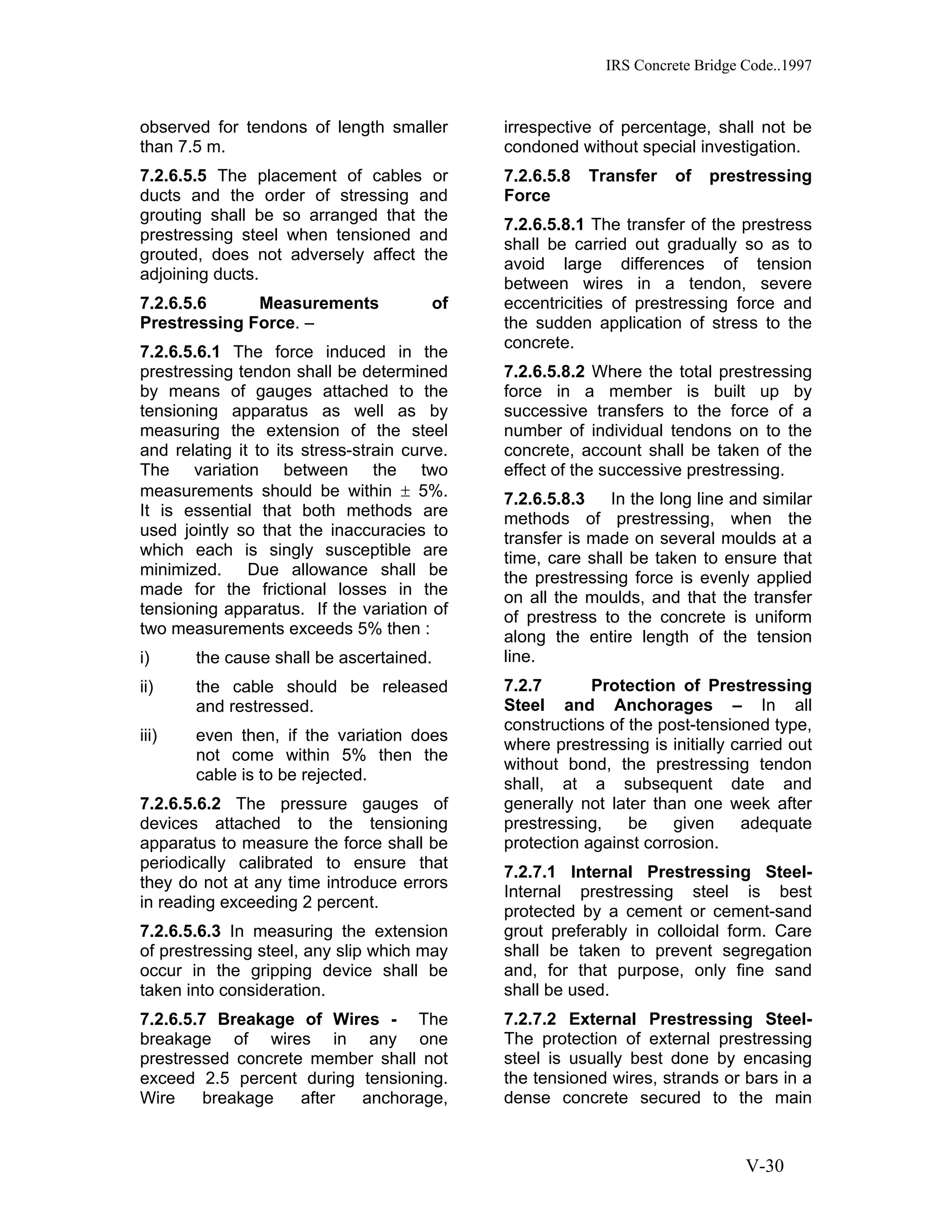
and walls restrained in direction at the
base, the moment transferred to the
footing shall be obtained from 15.6.
The critical section in design of an
isolated footing may be taken as the
face of the column or wall.
The footing moment at any vertical
section passing completely across a
footing shall be taken as that due to all
external ultimate loads and reactions on
one side of that section. No redistribut-
ion of moments shall be made.
15.8.3 Design of Footings.
15.8.3.1 Resistance to Bending -
Footings shall be designed as ‘beam-
and-slab’ or ‘flat-slab’ as appropriate.
Beam-and-slab footing shall be
designed in accordance with 15.4.
Flat-slab sections shall be designed to
resist the total moments and shears at
the sections considered.
Where the width of the section
considered is less than or equal to 1.5
(bcol + 3d), where bcol is the width of the
column and d is the effective depth, to
the tension reinforcement, of the footing,
reinforcement shall be distributed evenly
across the width of the section
considered. For greater widths, two-
thirds of the area of reinforcement shall
be concentrated on a width of (bcol + 3d)
centered on the column.
Pile caps may be designed either by
bending theory or by truss analogy
taking apex of the truss at the centre of
the loaded area and the corners of the
base of the truss at the intersections of
the centre lines of the piles with the
tensile reinforcement.
In pile caps designed as beams the
reinforcement shall be uniformly
distributed across any given section. In
pile caps designed by truss analogy
80% of the reinforcement shall be
concentrated in strips linking the pile
heads and the remainder uniformly
distributed throughout the pile cap.
15.8.3.2 Shear – The design shear is
the algebraic sum of all ultimate vertical
loads acting on one side of or outside
the periphery of the critical section. The
shear strength of flat-slab footing in the
vicinity of concentrated loads is
governed by the more severe of the
following two conditions :-
a) Shear along a vertical section
extending across the full width of the
footing, at a distance equal to the
effective depth from the face of the
IRS Concrete Bridge Code..1997
V-70
loaded area. The recommendations of
15.5.4.1. apply.
b) Punching shear around the loaded
area where the recommendations of
15.5.4.2. apply.
The shear strength of pile caps is
governed by the more severe of the
following two conditions:
1) Shear along any vertical section
extending across the full width of the
cap. The recommendations of 15.5.4.1.
apply except that over portions of the
section where the flexural reinforcement
is fully anchored by passing across the
head of a pile, the allowable ultimate
shear stress may be increased to
(2d/av)svc
Where
av is the distance between the face
of the column or wall and the
critical section;
d is the effective depth to tension
reinforcement of the section.
where av is taken to be the distance
between the face of column or wall and
the nearer edge of the piles it shall be
increased by 20% of the pile diameter.
In applying the recommendations of
15.5.4.1. the allowable ultimate shear
stress shall be taken as the average
over the whole section.
2) Punching shear around loaded
areas, where the recommendations of
15.5.4.2 apply.
15.8.3.3 Bond and Anchorage –
The recommendations of 15.9.6. apply
to reinforcement in footings. The critical
sections for local bond are: -
FIG. 10
a) the critical sections described in
15.9.6.1.
b) sections at which the depth changes
or any reinforcement stops
c) in the vicinity of piles, where all the
bending reinforcement required to
resist the pile load shall be
continued to the pile center line and
provided with an anchorage beyond
the center line of 20 bar diameters.
15.8.4 Deflection of Footings - The
deflection of footings need not be
considered.
15.8.5 Crack Control in Footings –
The recommendations of 15.9.8.2 apply
as appropriate depending on the type of
footing and treatment of design (see
15.8.3.1)
15.9 Considerations Affecting Design
Details
15.9.1.1 Size of Members- The ease of
placement of concrete and vibration
should be considered while deciding the
sizes of members.
15.9.1.2 Accuracy of positions of
Reinforcement – In all normal cases
the design may be based on the
assumption that the reinforcement is in
its nominal position (Refer 7.1.2).
However, when reinforcement is located
the relation to more than one face of a
member (e.g. a stirrup in a beam in
which the nominal cover for all sides is
given ) the actual concrete cover on one
side may be greater and can be derived
from a consideration of:-
a) dimensions and spacing of cover
blocks, spacers and/or chairs
(including the compressibility of
these items and the surfaces they
bear on) ;
b) stiffness, straightness, and accuracy
of cutting, bending and fixing of bars
or reinforcement cage ;
c) accuracy of formwork both in
dimension and plane (this includes
IRS Concrete Bridge Code..1997
V-71
permanent forms such as blinding or
brickwork) ;
d) the size of the structural part and the
relative size of bars of reinforcement
cage.
15.9.1.2.1 In certain cases where bars
or reinforcement cages are positioned
accurately on one face of a structural
member, this may affect the position of
highly stressed reinforcement at the
opposite face of the member. The
consequent possible reduction in
effective depth to this reinforcement
may exceed the percentage allowed for
in the values of the partial safety factors.
In the design of a particularly critical
member, therefore, appropriate
adjustment to the effective depth
assumed may be necessary.
15.9.1.3 Construction joints - The
exact location and details of
construction joints, if any, shall be
indicated in drawing. Construction joints
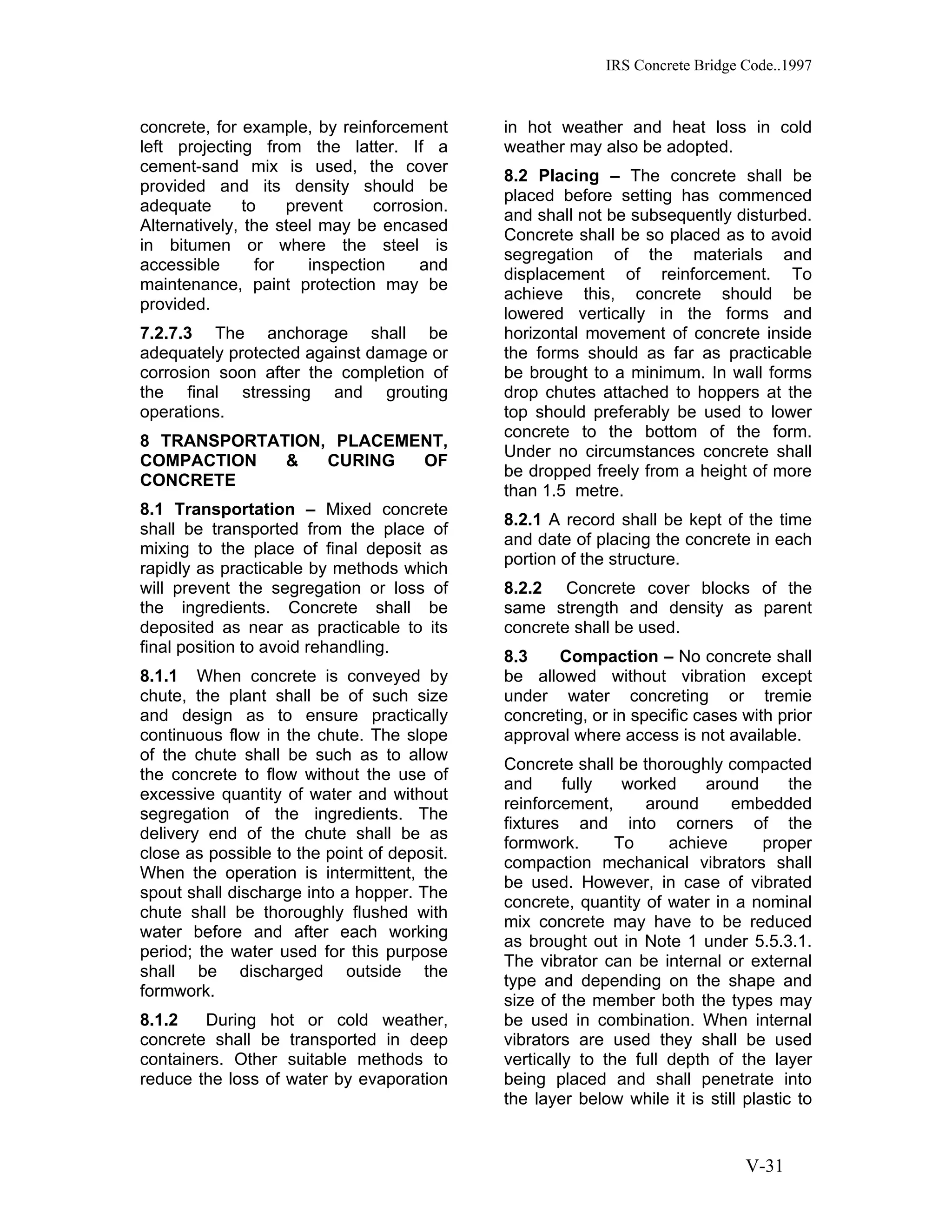
shall be at right angles to the direction of
the member and shall take due account
of the shear and other stresses. If
special preparation of the joint faces is
required it shall be specified (also see
8.5).
15.9.1.4 Movement joints - The
location of all movement joints shall be
clearly indicated on the drawings both
for the individual members and for the
structures as a whole. In general,
movement joints in the structure shall
pass through the whole structure in one
plane. Requirements for the design of
joints shall be ascertained from the
engineer.
15.9.2 Clear Cover to Reinforcement
15.9.2.1 Clear cover is the least
distance from outer most surface of
steel or binding wire or its end to the
face of the concrete.
15.9.2.2 Clear cover is the dimension
used in design and indicated on the
drawings. The clear cover shall not be
less than the size of the bar or
maximum aggregate size plus 5mm ; in
the case of a bundle of bars
(see.15.9.8.1), it shall be equal to or
greater than the size of a single bar of
equivalent area plus 5mm.
From durability consideration, minimum
clear cover shall be as under :
Type of
structure
Extreme
Environ-
ment
Very
severe
environ-
ment
Severe
environ-
ment
Mild &
Moderate
Environ-
ment
Slab 50 50 25 25
Beam/
Girder
60 50 40 35
Column 75 75 75 50
Well,
pile &
footing
75 75 75 50
15.9.2.3 Clear cover should not be
more than 2.5 times diameter of
reinforcing bar. If clear cover is more,
chicken mesh shall be provided in cover
concrete to keep the concrete in its
position.
15.9.2.4 Diameter of reinforcing bar and
maximum size of aggregate shall be
decided based on 15.9.2.2 and 15.9.2.3.
15.9.2.5 The clear cover shall not
exceed 75mm in any type of structure.
15.9.3 Reinforcement: General
Considerations.
15.9.3.1 General – Reinforcing bars of
same type and grade shall be used as
main reinforcement in a structural
member. However, simultaneous use of
two different types or grades of steel for
main and secondary reinforcement
respectively is permissible.
15.9.3.1.1 The recommendations for
detailing for earthquake-resistant
construction given in IS: 4326 shall be
IRS Concrete Bridge Code..1997
V-72
taken into consideration, where
applicable.
15.9.3.2 Groups of Bars – Subject to
the reductions in bond stress, bars may
be arranged as pairs in contact or in
groups of three or four bars bundled in
contact. Bundled bars shall be tied
together to ensure the bars remaining
together. Bars larger than 32 mm
diameter shall not be bundled, except in
columns. Bars shall not be used in a
member without stirrups. Bars in a
bundle should terminate at different
parts spaced at least 40times the bars
size apart except for bundles stopping at
support.
15.9.3.2.1 Bundles shall not be used in
a member without stirrups.
15.9.3.3 Bar schedule dimension -
The dimensions of bars showed on the
schedule shall be the nominal
dimensions in accordance with the
drawings.
15.9.4. Minimum Areas of
Reinforcement in Members.
15.9.4.1 Minimum area of main
reinforcement - The area of tension
reinforcement in a beam or slab shall be
not less than 0.2% of bad when using
Grade Fe 415 reinforcement, or 0.35%
of bad when Grade Fe 250
reinforcement is used,
where
ba is the breadth of section, or average
breadth excluding the compression
flange for nonrectangular sections ;
d is the effective depth to tension
reinforcement.
For a box, T or I section ba shall be
taken as the average breadth of the
concrete below the upper flange.
The minimum number of longitudinal
bars provided in a column shall be four
in rectangular columns and six in
circular columns and their size shall not
be less than 12mm. In a helically
reinforced column, the longitudinal bars
shall be in contact with the helical
reinforcement and equidistant around its
inner circumference. Spacing of
longitudinal bars measured along the
periphery of the columns shall not
exceed 300mm. The total cross
sectional area of these bars shall not be
less than 1 % of the cross sections of
the column or 0.15P/fy, whichever is the
lesser, where P is the ultimate axial load
and fy is the characteristic strength of
the reinforcement.
A wall cannot be considered as a
reinforced concrete wall unless the
percentage of vertical reinforcement
provided is at least 0.4%. This vertical
reinforcement may be in one or two
layers.
15.9.4.2 Minimum area of secondary
reinforcement - In the predominantly
tensile area of a solid slab or wall the
minimum area of secondary
reinforcement shall be not less than
0.12% of btd when using Grade Fe 415
reinforcement, or 0.15% of btd when
Grade Fe 250 reinforcement is used. In
a solid slab or wall where the main
reinforcement is used to resist
compression, the area of secondary
reinforcement provided shall be at least
0.12% of btd in the case of Grade Fe
415 reinforcement and 0.15% of btd in
the case of Grade Fe 250
reinforcement. The diameter shall be not
less than one quarter of the size of the
vertical bars with horizontal spacing not
exceeding 300 mm.
In beams where the depth of the side
face exceeds 600 mm, longitudinal
reinforcement shall be provided having
an area of atleast 0.05% of btd on each
IRS Concrete Bridge Code..1997
V-73
face with a spacing not exceeding
300 mm.
where
bt is the breadth of the section ;
d is the effective depth to tension
reinforcement.
In a voided slab the amount of
transverse reinforcement shall exceed
the lesser of the following: -
a) In the bottom, or predominantly
tensile, flange either 1500
mm2
/m or 1% of the minimum
flange section;
b) In the top, or predominantly
compressive flange either 1000
mm2
/m or 0.7% of the minimum
flange section.
Additional reinforcement may be
required in beams slabs and walls to
control early shrinkage and thermal
cracking (see also 15.9.9).
15.9.4.3 Minimum area of links –
When, in a beam or column, part or all
of the main reinforcement is required to
resist compression, links or ties at least
one quarter the size of the largest
compression bar shall be provided at a
maximum spacing of 12 times the size
of the smallest compression bar. Links
shall be so arranged that every corner
and alternate bar or group in an outer
layer of reinforcement is supported by a
link passing round the bar and having
an included angle of not more than 135o
.
All other bars or groups within a
compression zone shall be within 150
mm of a restrained bar. For circular
columns, where the longitudinal
reinforcement is located round the
periphery of a circle, adequate lateral
support is provided by a circular tie
passing round the bars or groups.
When the designed percentage of
reinforcement in the compression face
of a wall or slab exceeds 1%, links at
least 6 mm or one quarter of the size of
the largest compression bar, whichever
is the greater, shall be provided through
the thickness of the member. The
spacing of these links shall not exceed
twice the member thickness in either of
the two principal direction of the
member and be not greater than 16
times the bar size in the direction of the
compression force.
In all beams shear reinforcement shall
be provided throughout the span to
meet the recommendations given in
15.4.3.
The spacing of stirrups shall not exceed
0.75 times the effective depth of the
beam, nor shall the lateral spacing of
the individual legs of the stirrups exceed
this figure.
Stirrups shall enclose all tension
reinforcement. Also, the spacing of
stirrups shall be restricted to 450 mm.
15.9.5 Maximum areas of
reinforcement in Members.
15.9.5.1 In a beam or slab , neither
the area of tension reinforcement nor
the area of compression reinforcement
shall exceed 4% of the gross cross-
sectional area of the concrete.
15.9.5.2 In a column, the percentage
of longitudinal reinforcement shall not
exceed 6 in vertically cast columns or 8
in horizontally cast columns, except that
at laps percentage may be 8 & 10
respectively.
15.9.5.3 In a wall, the area of vertical
reinforcement shall not exceed 4% of
the gross cross-sectional area of the
concrete.
15.9.6 Bond Anchorage and
Bearing.
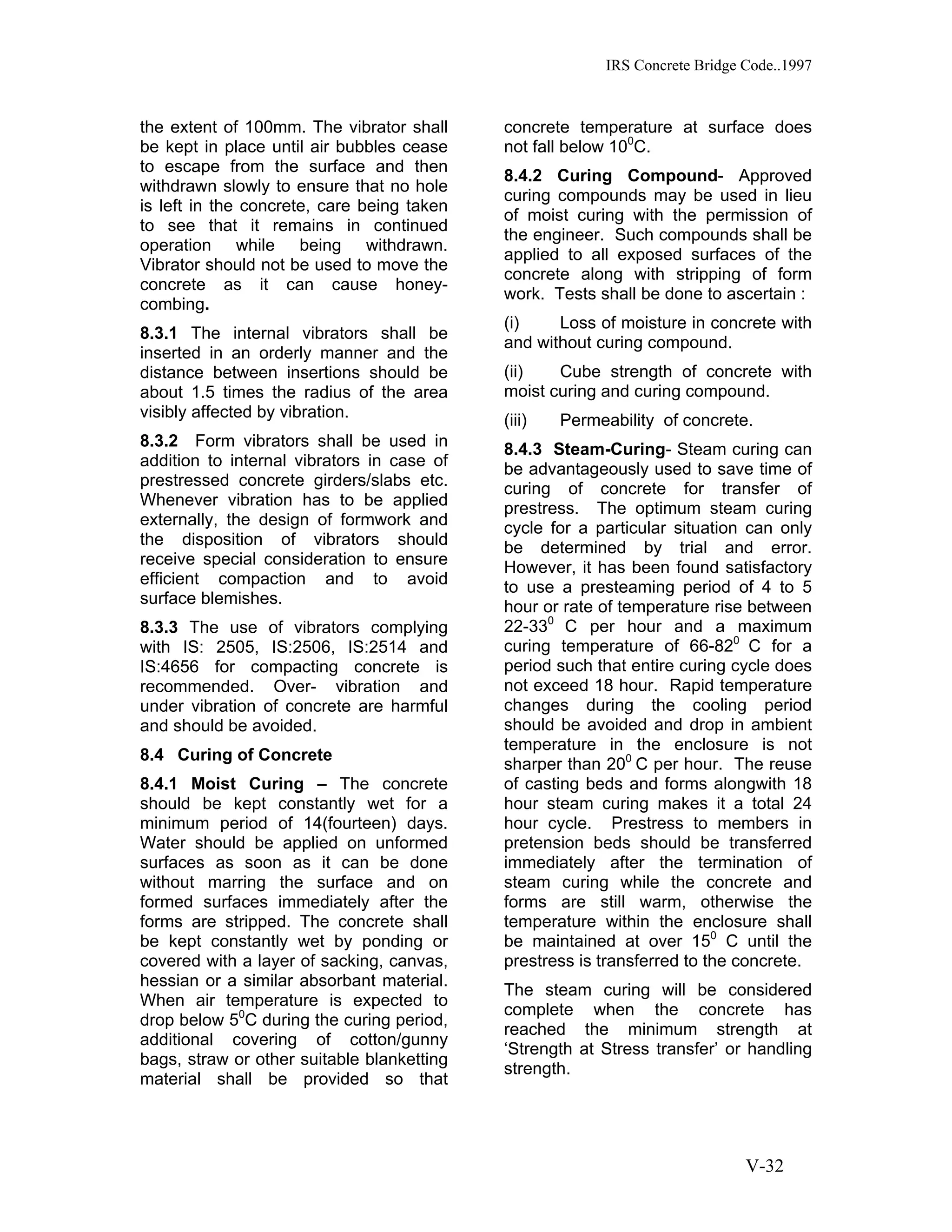
15.9.6.1 Local Bond - To prevent local
bond failure caused by large changes in
IRS Concrete Bridge Code..1997
V-74
tension over short lengths of
reinforcement, the local bond stress fbs
obtained from equation 23 shall not
exceed the appropriate value obtained
from Table 20.
TABLE 20: ULTIMATE LOCAL
BOND STRESSES.
(Clause 15.9.6.1)
CONCRETE GRADEBAR
TYPE M20
N/mm2
M 25
N/mm2
M30
N/mm2
M 40 or
more
N/mm
2
Plain
bars
1.7 2.0 2.2 2.7
NOTE: For deformed bars, the above
values shall be increased by 40%.
∑
±
=
dU
(M/d)tanφV
f
s
S
bs ....(equation 23)
which becomes
∑
=
dU
V
f
s
bs
when the bars are parallel to the
compression face, where
V is the shear force due to ultimate
loads;
ΣUs is the sum of the effective
perimeters of the tension
reinforcement (see 15.9.6.3) ;
d is the effective depth to tension
reinforcement ;
M is the moment at the section due
to ultimate loads ;
Sφ is the angle between the
compression face of the section
and the tension reinforcement.
In equation 23, the negative sign shall
be used when the moment is increasing
numerically in the same direction as the
effective depth of the section.
Critical sections for local bond occur at
the ends of simply supported members,
at points where tension bars stop and at
points of contraflexure. However, points
where tension bars stop and points of
contraflexure need not be considered if
the anchorage bond stresses in the
continuing bars do not exceed 0.8 times
the value in 15.9.6.2.
15.9.6.2 Anchorage bond - To
prevent bond failure the tension or
compression in any bar at any section
due to ultimate loads shall be developed
on each side of the section by an
appropriate embedment length or other
end anchorage. The anchorage bond
stress, assumed to be constant over the
effective anchorage length, taken as the
force in the bar divided by the product of
the effective anchorage length and the
effective perimeter of the bar or group of
bars (see 15.9.6.3), shall not exceed the
appropriate value obtained from Table
21.
TABLE 21 : ULTIMATE ANCHORAGE
BOND STRESSES.
(Clause 15.9.6.2, 17.2.4.2 )
M 20
N/mm2
M 25
N/mm2
M 30
N/mm2
M 40
or
more
N/mm2
Plain bars in
tension
1.2 1.4 1.5 1.9
Plain bars in
compression
1.5 1.7 1.9 2.3
Note : For deformed bars, the above
values shall be increased by 40%.
15.9.6.3 Effective perimeter of a bar
or group of bars - The effective
perimeter of a single bar may be taken
as 3.14 times its nominal size. The
effective perimeter of a group of bars
(see 15.9.3.2) shall be taken as the sum
IRS Concrete Bridge Code..1997
V-75
of the effective perimeters of the
individual bars multiplied by the
appropriate reduction factor given in
Table 22.
TABLE 22 : REDUCTION FACTOR
FOR EFFECTIVE PERIMETER
OF A GROUP OF BARS.
(Clause 15.9.6.3)
------------------------------------------------------
NUMBER OF BARS REDUCTION FACTOR
IN A GROUP
----------------------------------------------------------
2 0.8
------------------------------------------------------
3 0.6
------------------------------------------------------
4 0.4
------------------------------------------------------
15.9.6.4 Anchoring Shear
Reinforcement
15.9.6.4.1 Anchorage of Stirrups –
A stirrup may be considered to be fully
anchored if it passes round another bar
of at least its own size through an angle
of 90o
and continues beyond for a
minimum length of eight times own size,
or when the bar is bent through an angle
of 135o
and is continued beyond the end
of the curve for a lengthy of 6 bars
diameter, or through 180o
and continues
for a minimum length of four times its
own size. In no case shall the radius of
any bend in the stirrup be less than
twice the radius of the test bend
guarantee by the manufacturer of the
bar.
15.9.6.4.2 Anchorage of inclined bars
– The development length shall be as
for bars in tension ; this length shall be
measured as under :
1) In tension zone, from the end of the
sloping or inclined portion of the bar,
and
2) In the compression zone, from the
mid depth of the beam.
15.9.6.5 Laps and Joints – Continuity
of reinforcement may be achieved by a
connection using any of the following
jointing methods:
a) lapping bars
b) butt welding (see 7.1.4 and 13.4 )
c) sleeving (see 7.1.3.5)
d) threading of bars (see 7.1.3.5)
Such connection shall occur, as far as
possible, away from points of high
stress and shall be staggered. It is
recommended that splices in flexural
members shall not be at sections when
the bending moment is more than 50
percent of the moment of resistance and
not more than half the bars shall be
spliced at a section.
Where more than one-half of the bars
are spliced at a section or where splices
are made at points of maximum stress,
special precautions shall be taken, such
as, increasing the length of lap and/or
using spirals or closely spaced stirrups
around the length of the splice.
The use of the joining methods given in
(c) and (d) and any other method not
listed shall be verified by test evidence.
15.9.6.6 Lap Lengths
15.9.6.6.1 Lap splices shall not be
used for bars larger than 32 mm. When
bars are lapped, the length of the lap
shall at least equal the anchorage length
(derived from 15.9.6.2) required to
develop the stress in the smaller of the
two bars lapped. The length of the lap
provided, however, shall neither be less
than 25 times the smaller bar size plus
150 mm in tension reinforcement nor be
less than 20 times the smaller bar size
plus 150 mm in compression
reinforcement.
The lap length calculated in the
preceding paragraph shall be increased
by a factor of 1.4 if any of the following
conditions apply:
IRS Concrete Bridge Code..1997
V-76
a) the nominal cover to the lapped
bars from the top of the section
as intended to bed cast is less
than twice the bar size ;
b) the clear distance between the
lap and another pair of lapped
bars is less than 150 mm ;
c) a corner bar is being lapped and
the nominal cover to either face
is less than twice the bar size.
Where conditions (a) and (b) or
conditions (a) and (c) apply the lap
length shall be increased by a factor of
2.0.
15.9.6.6.2 Lap splices are considered
to be staggered if the centre to centre
distance of the splices is not less than
1.3 times the lap length calculated as
described in 15.9.6.6.1.
15.9.6.6.3 In case of bundled bars,
lapped splices of bundled bars shall be
made by splicing one bar at a time ;
such individual splices within a bundle
shall be so staggered that in any cross-
section there are not more than four
bars in a bundle.
15.9.6.7 Hooks and Bends - Hooks,
bends and other reinforcement
anchorages shall be of such form
dimension and arrangement as to avoid
overstressing the concrete.
The effective anchorage length
of a hook or bend shall be measured
from the start of the bend to a point four
times the bar size beyond the end of the
bend, and may be taken as the lesser of
24 times the bar size or
a) for a hook, eight times the
internal radius of the hook ;
b) for a 90o
bend, four times the
internal radius of the bend.
In no case shall the radius of any
bend be less than twice the radius of the
test bend guaranteed by the
manufacturer of the bar and, in addition,
it shall sufficient to ensure that the
bearing stress at the mid-point of the
curve does not exceed the value given
in 15.9.6.8.
When a hooked bar is used at a
support, the beginning of the hook shall
be atleast four times the bar size inside
the face of the support.
15.9.6.8 Bearing stress inside
bends.- The bearing stress inside a
bend, in a bar which does not extend or
is not assumed to be stressed beyond a
point four times the bar size past the
end of the bend, need not be checked.
The bearing stress inside a bend as
described in IS: 2502 need not be
checked.
The bearing stress inside a bend
in any other bar shall be calculated from
the equation:
Bearing stress =
φr
Fbt
Fbt is the tensile force due to ultimate
loads in a bar or group bars ;
r is the internal radius of the bend ;
φ is the size of the bar or, in a bundle,
the size of a bar of equivalent area.
The stress shall not exceed 1.5fck /
(1+20/a) where a for a particular bar or
group of bars in contact shall be taken
as the centre to centre distance
between bars or groups of bars
perpendicular to the plane of the bend ;
for a bar or group of bars adjacent to the
face of the member, a shall be taken as
the cover plus φ.
15.9.6.9 If a change in direction of
tension or compression reinforcement
induces a resultant force acting outward
tending to split the concrete, such force
IRS Concrete Bridge Code..1997
V-77
shall be taken up by additional links or
stirrups. Bent tension bar at a re-entrant
angle shall be avoided.
15.9.7 Curtailment and anchorage of
reinforcement.
15.9.7.1 In any member subject to
bending every bar shall extend, except
at end supports, beyond the point at
which it is no longer needed for a
distance equal to the effective depth of
the member or 12 times the size of the
bar, whichever is greater. A point at
which reinforcement is no longer
required is where the resistance
moment of the section considering only
the continuing bars, is equal to the
required moment.
In addition, reinforcement shall not be
terminated in a tension zone unless one
of the following conditions is satisfied:
a) the bars extend an anchorage
length appropriate to their design
strength (0.87 fy) from the point
at which they are no longer
required to resist bending ; or
b) the shear capacity at the section
where the reinforcement stops is
greater than twice the shear
force actually present ; or
c) the continuing bars at the section
where the reinforcement stops
provide double the area required
to resist the moment at that
section.
One or other of these conditions
shall be satisfied for all arrangements of
ultimate load considered.
At simply supported end of a
member each tension bar shall be
anchored by one of the following: -
1) an effective anchorage equivalent to
12 times the bar size beyond the
centre line of the support ; no bend
or hook shall begin before the centre
of the support;
2) an effective anchorage equivalent to
12 times the bar size plus d/2 from
the face of the support ;where d is
the effective depth to tension
reinforcement of the member; no
bend shall begin before d/2 from the
face of the support.
15.9.7.2 Curtailment of bundled bars
– Bars in a bundle shall terminate at
different points spaced apart by not less
than 40 times the bar diameter except
for bundled bars stopping at a support.
15.9.8 Spacing of Reinforcement –
15.9.8.1 Minimum distance between
bars – These recommendations are not
related to bar sizes but when a bar
exceeds the maximum size of coarse
aggregate by more than 5 mm, a
spacing smaller than the bar size shall
generally be avoided; if the distance
under consideration is between bars of
unequal diameters, the size of the larger
bar shall be considered for this purpose.
A pair of bars in contact or a bundle of
three or four bars in contact shall be
considered as a single bar of equivalent
area when assessing size.
The spacing of bars shall be
suitable for the proper compaction of
concrete and when an internal vibrator
is likely to be used sufficient space shall
be left between reinforcement to enable
the vibrator to be inserted.
Minimum reinforcement spacing
is best determined by experience or
proper works test, but in the absence of
better information, the following may be
used as a guide:
a) Individual bars - Except where
bars form part of a pair or bundle (see
(b) and (c) the clear distance between
IRS Concrete Bridge Code..1997
V-78
bars shall be not less than hagg + 5mm,
where hagg is the maximum size of
coarse aggregate.
Where there are two or more rows:
1. the gaps between corresponding
bars in each row shall be in line.
2. the clear distance between rows
shall be not less than hagg except for
precast members where it shall be not
less than 0.67 hagg.
b) Pairs of bars - Bars may be
arranged in pairs either touching or
closer than in (a), in which case:
1. the gaps between corresponding
pairs in each row shall be in line and of
width not less than hagg + 5mm;
2. when the bars forming the pairs
are one above the other, the clear
distance between rows shall be not less
than hagg, except for precast members
where it shall be not less than 0.67 hagg.
3. when the bars forming the pair are
side by side, the clear distance between
rows shall be not less than hagg + 5mm.
c) Bundled bars - Horizontal and
vertical distances between bundles shall
be not less than hagg + 15 mm and gaps
between rows of bundles shall be
vertically in line.
15.9.8.2 Maximum distance between
bars in tension.
15.9.8.2.1 The maximum spacing shall
not be greater than 300 mm and be
such that the crack width and calculated
using equations 24 & 26 as appropriate
do not exceed the limits laid down in
10.2.1 under the design loadings given
in 11.3.2.
a) For solid rectangular sections,
stems of T beams and other solid
sections shaped without re-entrant
angles, the design crack widths at the
surface (or, where the cover to the
outermost bar is greater than Cnom, on a
surface at a distance Cnom from
outermost bar) shall be calculated from
the following equation:
Design crack width =
( ) ( )cnomcr
mcr
dh/ca21
ε3a
−−+
…. equation 24)
where
acr is the distance from the point (crack)
considered to the surface of the
nearest longitudinal bar ;
cnom is the required nominal cover to the
tensile reinforcement given in 15.9.2,
where the cover shown or the
drawing is greater than the value
given in 15.9.2, the latter value may
be used;
dc is the depth of the concrete in
compression (if dc = 0 the crack
widths shall be calculated using
equation 26 );
h is the overall depth of the section;
IRS Concrete Bridge Code..1997
V-79
ε m is the calculated strain at the level
where cracking is being considered,
allowing for the stiffening effect of
the concrete in the tension zone; a
negative value of ε m indicates that
the section is uncracked. The value
of ε m shall be obtained from the
equation:
( )
( )
9
g
q
css
ct
1 10
M
M
1
dhAε
dah3.8b
ε −
⎥
⎥
⎦
⎤
⎢
⎢
⎣
⎡
−⎥
⎦
⎤
⎢
⎣
⎡
−
−′
−=mε .
…………….. (equation 25)
but nor greater than 1ε
where
ε1 is the calculated strain at the level
where cracking is being considered,
ignoring the stiffening effect of the
concrete in the tension;
bt is the width of the section at the level
of the centroid of the tension steel ;
a’ is the distance from the compression
face to the point at which the crack
width is being calculated ;
Mg is the moment at the section
considered due to permanent loads ;
Mq is the moment at the section
considered due to live loads ;
ε s is the calculated strain in the tension
reinforcement, ignoring the stiffening
effect of the concrete in the tension
zone;
As is the area of tension reinforcement.
Where the axis of the design
moment and the direction of the tensile
reinforcement resisting that moments
are not normal to each other (e.g. in a
skew slab), As shall be taken as :
As = ∑ (At Cos
4
∝ 1 )
where
At is the area of reinforcement in a
particular direction;
∝1 is the angle between the axis of the
design moment and the direction of
the tensile reinforcement, At,
resisting that moment.
b) For flanges in overall tension,
including tensile zones of box beams
and voided slabs, the design crack width
at the surface (or at a distance Cnom
from the outermost bar) shall be
calculated from the following equation:
Design crack width = 3 acr ε m
…….(equation 26)
where
ε m is obtained from equation 25.
c) Where global and local effects
are calculated separately (see 13.5.3)
the value of ε m may be obtained by
algebraic addition of the strains
calculated separately. The design crack
width shall then be calculated in
accordance with (b) but may, in the case
of a deck slab where a global
compression is being combined with a
local moment, be obtained using (a),
calculating dc on the basis of the local
moment only.
d) The spacing of transverse bars
in slabs with circular voids shall not
exceed twice the minimum flange
thickness.
15.9.9 Shrinkage and temperature
reinforcement. - To prevent excessive
cracking due to shrinkage and thermal
movement, reinforcement shall be
provided in the direction of any restraint
to such movements. In the absence of
any more accurate determination, the
area of reinforcement, As, parallel to the
direction of each restraint, shall be such
that :
As ≥ Kr ( Ac - 0.5 Acor )
IRS Concrete Bridge Code..1997
V-80
where
Kr is 0.005 for Grade Fe 415
reinforcement and 0.006 for
Grade Fe 250 reinforcement;
Ac is the area of the gross concrete
section at right angles to the
direction of the restraint;
Acor is the area of the core of the
concrete section, Ac i.e. that
portion of the section more than
250 mm away from all concrete
surfaces.
Shrinkage & temperature
reinforcement shall be distributed
uniformly around the perimeter of the
concrete section and spaced at not
more than 150 mm.
Reinforcement that is present for
other purposes may be taken into
account for the purpose of this clause.
15.9.10 Arrangement of
reinforcement in Skew Slabs.
15.9.10.1 General - In all types of
skew slab for which the moments and
torsions have been determined by an
elastic analysis, the reinforcement or
prestressing tendons shall be aligned as
close as is practicable to the principal
moment directions. In general, an
orthogonal arrangement is
recommended.
15.9.10.2 Solid Slabs. – Only for
combinations of large skew angle and
low ratio of skew breadth to skew span
is it preferable to place reinforcement in
directions perpendicular and parallel to
the free edges. Usually it is more
efficient to place reinforcement parallel
and perpendicular to the supports,
preferably in combination with bends of
reinforcement positioned adjacent and
parallel to the free edges.
Special attention shall be given
to the provision of adequate anchorage
of bars meeting the free edge at an
angle.
An alternative, but less efficient
method, is to fan out the longitudinal
steel from perpendicular to the supports
to parallel to the free edge at the edge.
15.9.10.3 Voided slabs – The
longitudinal steel will generally be
placed parallel to the voids and it is
recommended that the transverse steel
be placed orthogonal to this steel.
15.9.10.4 Solid composite slabs -
The longitudinal steel will generally be in
the form of prestressing tendons in the
precast units which are parallel to the
free edges. Ideally, the transverse
reinforcement shall be placed at right-
angles to the free edge, since this is the
most efficient arrangement; however, in
practice, the transverse reinforcement
may frequently have to be placed at a
different angle or parallel to the
supports.
15.9.11 Design of diaphragms.
15.9.11.1 The thickness of diaphragms
when provided for connecting two
girders, shall not be less than the
thickness of the web of the girder.
15.9.11.2 The reinforcement to be
provided in the diaphragms shall resist a
tensile force equal to 2.5% of the total
compressive force carried by both the
girders. This reinforcement diaphragm
with additional nominal reinforcement
through the entire depth of the
diaphragm.
15.9.11.3 The end diaphragms, where
required, shall also be strong enough to
resist the load caused by jacking
operations during erection and
IRS Concrete Bridge Code..1997
V-81
maintenance operation like replacement
of bearings.
15.9.11.4 A minimum vertical clearance
of 400 mm shall be provided between
the top of pier/bed block and the jacking
point to facilitate jacking operation.
15.10 Use of lightweight aggregates
Use of lightweight aggregates is
beyond the scope of this code.
Lightweight aggregates can only be
used with the specific approval of the
engineer for which separate
specifications are to be drawn up.
16 DESIGN & DETAILING :
PRESTRESSED CONCRETE
16.1 General –
16.1.1 This clause gives methods of
analysis and design which will in general
ensure that for prestressed concrete
construction, the recommendations set
out in 10.2 & 10.3 are met. Other
methods may be used provided they
can be shown to be satisfactory for the
type of structure or member considered.
In certain cases the assumptions made
in this clause may be inappropriate and
the engineer shall adopt a more suitable
method having regard to the nature of
the structure in question.
This clause does not cover prestress
concrete construction using any of the
following in the permanent works :
a) unbonded tendons,
b) external tendons ( a tendon is
considered external if, after stressing
and incorporating in the permanent
work but before protection, it is
outside the concrete section );
c) lightweight aggregate.
When analysing sections, the
terms ‘strength’, ‘resistance’ and
‘capacity’ are used to describe the
strength of the section.
16.1.2 All prestressed concrete
structures shall be designed for safety,
serviceability and durability
requirements (structural and non-
structural loads caused by
environment).
16.1.3 The bridges shall be designed for
the service life as given below: -
Type of structures Design life in yrs.
Bridges in sea 50
Bridges in Coastal areas 80
Bridges in rest of India 100
16.2 Limit state design of
prestressed concrete
16.2.1 Basis of Design – Clause 16
follows the limit state philosophy set out
in clause 10 but, as it is not possible to
assume that a particular limit state will
always be the critical one, design
methods are given for both the ultimate
and the serviceability limit states.
In general, the design of
prestressed concrete members are
controlled by concrete stress limitations
for serviceability load conditions, but the
ultimate strength in flexure, shear and
torsion shall be checked.
16.2.2 Durability :- A proper drainage
system shall be provided for the deck as
indicated in 15.2.2.1. Guidance is given
in 16.9.2 on the minimum cover to
reinforcement and prestressing tendons.
For other requirements like maximum
water cement ratio, minimum grade of
concrete, minimum cement contents,
maximum crack width etc., Clause 5.4 &
10.2.1 shall be referred.
16.2.3 Loads – In clause 16, the design
load (see 11.3) for the ultimate and
serviceability limit states are referred to
as ‘ultimate loads’ and ‘service loads’
respectively.
IRS Concrete Bridge Code..1997
V-82
Consideration shall be given to the
construction sequence and to the
secondary effects due to prestress
particularly for the serviceability limit
states. For prestressed concrete
members the different stages of
loadings defined below shall be
investigated and the various stresses to
which the member is subjected shall be
maintained within the permissible limits.
a) at transfer of prestress,
b) at handling and erection;
c) at design load.
16.2.4 Strength of Materials –
16.2.4.1 Definition of strengths – In
clause 16 the design strengths of
materials are expressed in all the tables
and equations in terms of the
characteristic strength of the material.
Unless specifically stated otherwise, all
equations and tables include allowances
for Ym, the partial safety factor for
material strength.
16.2.4.2 Characteristic strength of
concrete – The characteristic cube
strengths of concrete for various grades
are given in Table 2. These values
given do not include any allowance for
Ym. Design shall be based on the
characteristic strength, fck, except that
at transfer the calculations shall be
based on the cube strength at transfer.
16.2.4.3 Characteristic strength of
prestressing tendons – Until the
relevant Indian standards specifications
for prestressing steel are modified to
include the concept of characteristic
strength, the characteristic strength shall
be assumed as the minimum ultimate
tensile stress/breaking load for the
prestressing steel specified in the
relevant Indian Standard Specifications.
16.2.4.3.1 The values given in relevant
Indian Standard Specifications do not
include any allowance for Ym.
16.3 Structures & Structural
Frames:
16.3.1 Analysis of structures –
Complete structures and complete
structural frames may be analysed in
accordance with the recommendations
of 13.1 but when appropriate the
methods given in 16.4 may be used for
the design of individual members.
The relative stiffness of members shall
generally be based on the concrete
section as described in 13.1.2.1.
16.3.2. Redistribution of Moments -
Redistribution of moments
obtained by rigorous elastic analysis
under the ultimate limit state may be
carried out provided the following
conditions are met.
a) Appropriate checks are made to
ensure that adequate rotation capacity
exists at sections where moments are
reduced, making reference to
appropriate test data.
In the absence of a special
investigation, the plastic rotation
capacity may be taken as the lesser of :
(1)
⎟⎟
⎠
⎞
⎜⎜
⎝
⎛
−+
e
c
d
d
0.50.0350.008
or
(2)
dcd
10
−
but not less than 0 or more than 0.015
where
dc is the calculated depth of concrete in
compression at the ultimate limit
state (in mm) ;
de is the effective depth for a solid slab
or rectangular beam, otherwise the
overall depth of the compression
flange (in mm);
IRS Concrete Bridge Code..1997
V-83
d is the effective depth to tension
reinforcement (in mm)
b) Proper account is taken of
changes in transverse moments,
transverse deflections and transverse
shears consequent on redistribution of
longitudinal moments by means of an
appropriate non-linear analysis.
c) Shears and reactions used in
design are taken as either those
calculated prior to redistribution or after
redistribution, whichever is greater.
d) The depth of the members or
elements considered is less than 1200
mm.
16.4 Beams
16.4.1 General
16.4.1.1 Definitions - The definitions
and limitations of the geometric
properties for prestressed beams are as
given for reinforced concrete beams in
15.4.1.
16.4.1.2 Slender Beams – In addition
to limiting the slenderness of a beam
(see 15.4.1.3) when under load in its
final position, the possible instability of a
prestressed beam during erection shall
be considered.
16.4.1.2.1 Members may collapse by
tilting about a longitudinal axis through
the lifting points. The initial tilting, which
may be due to imperfections in beam
geometry and in locating the lifting
points, could cause lateral bending
moments and these, if too high, could
result in lateral instability.
The problem is complex and previous
experience shall be relied on in
considering a particular case. The
following factors may require
consideration:
a) beam geometry, i.e. type of
cross section, span/breadth/
depth ratios, etc.
b) location of lifting points ;
c) methods of lifting i.e. inclined or
vertical slings, type of connection
between the beam and the
slings;
d) tolerance in construction, e.g.
maximum lateral bow.
The stress due to the combined
effects of lateral bending, dead load and
prestress can be assessed and, if
cracking is possible, the lifting
arrangements shall be changed or the
beam shall be provided with adequate
lateral support.
16.4.2 Serviceability Limit State :
Flexure.
16.4.2.1 Section Analysis - The
following assumptions may be made
when considering design loads :
a) Plane sections remain plane.
b) Elastic behaviour exists for the
concrete upto stresses given in 16.4.2.2.
c) In general, it may only be
necessary to calculate stresses due to
the load combinations given in 11.3
immediately after the transfer of
prestress and after all losses of
prestress have occurred; in both cases
the effects of dead and imposed loads
on the strain and force in the tendons
may be ignored.
16.4.2.2. Concrete compressive
stress limitations –
a) Load under serviceability limit
state - The compressive stresses in the
concrete in the concrete under the loads
given in Clause-11 shall not exceed the
values given in Table-23.
Higher stresses are permissible for
prestressed members used in
composite construction (see 17.4.3.2).
b) At transfer - The compressive
stresses in the concrete at transfer shall
not exceed the values given in Table 24,
where fci is the concrete strength at
transfer.
IRS Concrete Bridge Code..1997
V-84
TABLE-23: COMPRESSIVE
STRESSES IN CONCRETE FOR
SERVICEABILITY LIMIT STATES
( Clauses 16.4.2.2, 17.4.3.2)
NATURE OF
LOADING
ALLOWABLE
COMPRESSIVE
STRESS
Design load in
bending
0.4 fck
Design Load in
direct compression
0.3 fck
TABLE-24: ALLOWABLE
COMPRESSIVE STRESSES AT
TRANSFER
(Clause 16.4.2.2)
NATURE OF
STRESS
DISTRIBUTION
ALLOWABLE
COMPRESSIVE
STRESS
Triangular or near
triangular
distribution of
prestress
ckci o.4fbut0.5f ≤
Uniform or near
uniform
distribution of
prestress
ckci o.3fbut0.4f ≤
16.4.2.3 Steel stress limitations – The
stress in the prestressing tendons under
the loads given in 11 need not be
checked. The stress at transfer shall be
checked in accordance with 16.8.1.
16.4.2.4 Cracking
a) Under service loads - The
recommendations of 10.2.1 are deemed
to be satisfied provided that the flexural
tensile stresses under the loading given
in 11.3.2 do not produce any tensile
stresses except as indicated in
16.4.2.4 (b).
b) At transfer and During
Construction- The flexural tensile
stress in the concrete shall not exceed 1
N/mm2
due solely to prestress and co-
existent dead and temporary loads
during erection.
16.4.3 Ultimate Limit State : Flexure
16.4.3.1 Section Analysis – When
analysing a cross section to determine
its ultimate strength the following
assumptions shall be made :-
a) The strain distribution in the
concrete in compression is derived from
the assumption that plane sections
remain plane.
b) The stress in the concrete in
compression are derived either from the
stress-strain curve given in Fig.3, with
Ym = 1.5, or, in the case of rectangular
sections or flanged sections with the
neutral axis in the flange, the
compressive stress may be taken as
equal to 0.4 fck over the whole
compression zone ; in both cases the
strain at the outermost compression
fibre is taken as 0.0035.
c) The tensile strength of the
concrete is ignored.
d) The strain in bonded
prestressing tendons and in any
additional reinforcement, whether in
tension or compression, are derived
from the assumption that plane sections
remain plane. In addition, the tendon will
have an initial strain due to prestress
after all losses.
e) The stresses in bonded
prestressing tendons, whether initially
tensioned or untensioned, and in
additional reinforcement, are derived
from the appropriate stress-strain
curves, with Ym = 1.15; the stress strain
curves for prestressing tendons are
given in Fig.2 and the stress-strain
curves for reinforcement are given in
Fig. 4. An empirical approach for
obtaining the stress in the tendons at
failure is given in 16.4.3.2 and Table 24.
IRS Concrete Bridge Code..1997
V-85
TABLE 25: CONDITIONS AT THE
ULTIMATE LIMIT STATE FOR
RECTANGULAR BEAMS WITH
PRETENSIONED TENDONS, OR WITH
POST-TENSIONED TENDONS
HAVING EFFECTIVE BOND.
(Clause 16.4.3)
bdf
Af
ck
pspu
STRESS IN
TENDONS AS A
PROPORTION
OF THE DESIGN
STRENGTH,
fpb/(0.87fpu)
RATIO OF
DEPTH OF
NEUTRAL AXIS
TO THAT OF
THE CENTROID
OF THE
TENDONS IN
THE TENSION
ZONE, X/d
Pre-
Ten-
sioning
Post-ten-
sioning
with
effective
bond
Pre-
Ten-
sioning
Post-
tension-
ing with
effective
bond
0.025 1.0 1.0 0.054 0.054
0.05 1.0 1.0 0.109 0.109
0.10 1.0 1.0 0.217 0.217
0.15 1.0 1.0 0.326 0.326
0.20 1.0 0.95 0.435 0.414*
0.25 1.0 0.90 0.542 0.480*
0.30 1.0 0.85 0.655 0.558*
0.40 0.9 0.75 0.783* 0.653*
NOTE-* The neutral axis depth in these
cases is too low to provide the
elongation given in 16.4.3.1. It is
essential therefore that the strength
provided shall exceed that strictly
required by 15%.
In addition, if the ultimate moment of
resistance calculated as in (a) to (e) is
less than 1.15 times the required value,
the section shall be proportioned such
that the strain in the outermost tendon is
not less than:
ms
pu
YE
f
0.005+
where
fpu is characteristic strength of
prestressing tendon, and
Es is the modulus of elasticity of the
steel.
Where the outermost tendon, or layer of
tendons, provides less than 25% of the
total tendon area, this condition shall
also be met at the centroid of the
outermost 25% of tendon area.
16.4.3.1.1 As an alternative, the strains
in the concrete and the bonded
prestressing tendons and any additional
reinforcement, due to the application of
ultimate loads, may be calculated using
the following assumptions:
(a) The strain distribution in the
concrete in compression and the strains
in bonded prestressing tendons and any
additional reinforcement, whether in
tension or compression, are derived
from the assumption that plane sections
remain plane. In addition, the tendons
will have an initial strain due to prestress
after all losses.
(b) The stresses in the concrete in
compression are derived from the
stress-strain curve given in Fig. 5, with
Ym = 1.5.
(c) The tensile strength of the
concrete is ignored.
(d) The stresses in bonded
prestressing tendons, whether initially
tensioned or untensioned, and in
additional reinforcement are derived
from the appropriate stress-strain curves
with Ym=1.15; the stress strain curve for
prestressing tendons is given in Fig. 2A
& 2B and the stress strain curves for
reinforcement are given in Fig.4. In
using the alternative method of analysis,
the calculated strain due to the
application of ultimate loads at the
IRS Concrete Bridge Code..1997
V-86
outermost compression fibre of the
concrete shall not exceed 0.0035.
In addition the section shall be
proportioned such that the strain at the
centroid of the outermost 25% of the
cross sectional area of the tendons is
not less than 0.005+fpu/(EsYm) except
where the requirement for the calculated
strain in the concrete, due to the
application of 1.15times the ultimate
loads, can be satisfied.
16.4.3.2 Design Formula – In the
absence of an analysis based on the
assumptions given in 16.4.3.1., the
resistance moment of a rectangular
beam, or of a flanged beam in which the
neutral axis lies within the flange, may
be obtained from equation 27.
Mu = fpbAps(d-0.5x)…..(equation 27)
where
Mu is the ultimate moment of resistance
of the section.
fpb is the tensile stress in the tendons
at failure
x is the neutral axis depth;
d is the effective depth to tension
reinforcement
Aps is the area of the prestressing
tendons in the tension zone.
Value for fpb and x may be derived from
Table 25 for pre-tensioned members
and for post-tensioned members with
effective bond between the concrete
and tendons, provided that the effective
prestress after all losses is not less than
0.45fpu. Prestressing tendons and
additional reinforcement in the
compression zone are ignored in
strength calculations when using this
method.
16.4.3.3. Non-rectangular Sections: -
Non-rectangular beams shall be
analysed using the assumptions given in
16.4.3.1.
16.4.4 Shear Resistance of Beams-
16.4.4.1 Calculations for shear are only
required for the ultimate limit state.
16.4.4.1.1 At any section the ultimate
shear resistance of the concrete alone.
Vc shall be considered for the section
both uncracked (see 16.4.4.2) and
cracked (see 16.4.4.3) in flexure, and if
necessary shear reinforcement shall be
provided (see 16.4.4.4.)
16.4.4.1.2 For a cracked section the
conditions of maximum shear with co-
existent bending moment and maximum
bending moment with co-existent shear
shall both be considered.
16.4.4.1.3 Within the transmission
length of pretensioned members (see
16.8.4) the shear resistance of a section
shall be taken as the greater of the
values calculated from:
a) 15.4.3 except that in determining
the area As the area of tendons
shall be ignored: and
b) 16.4.4.2 to 16.4.4.4 using the
appropriate value of prestress at
the section considered,
assuming a parabolic variation of
Fig12:STRESSES IN A RECTANGULAR
BEAM
IRS Concrete Bridge Code..1997
V-87
prestress over the transmission
length.
16.4.4.2 Sections Uncracked in
Flexure – It may be assumed that the
ultimate shear resistance of a section
uncracked in flexure, Vco corresponds to
the occurrence of a maximum principal
tensile stress at the centroidal axis, of
ft = 0.24 ckf
In the calculation of Vco, the
value of fcp shall be derived from the
prestressing force after all losses have
occurred multiplied by the appropriate
value of YfL (see 11.3.3)
The value of Vco is given by:
( ))fff0.67bhV tcpt
2
co +=
…(equation 28 )
where
tf is 0.24 ckf taken as positive;
fcp is the compressive stress at the
centroidal axis due to prestress,
taken as positive
*b is the breadth of the member which
for T, I and L beams shall be
replaced by the breadth of the rib.
h is the overall depth of the member.
NOTE: * Where the position of a duct
coincides with the position of maximum
principal tensile stress, e.g. at or near
the junction of flange and web near a
support, the value of b shall be reduced
by the full diameter of the duct if
ungrouted and by two-thirds of the
diameter if grouted.
16.4.4.2.1 In flanged members where
the centroidal axis occurs in the flange,
the principal tensile stress shall be
limited to 0.24√fck at the intersection of
the flange and web; in this calculation,
the algebraic sum of the stress due to
the bending moment under ultimate
loads and the stress due to prestress at
this intersection shall be used in
calculating Vco.
16.4.4.2.2 For a section with inclined
tendons, the component of prestressing
force (multiplied by the appropriate
value of Yfl) normal to the longitudinal
axis of the member shall be
algebraically added to Vco. This
component shall be taken as positive
where the shear resistance of the
section is increased.
16.4.4.3 Sections Cracked in Flexure-
The ultimate shear resistance of a
section cracked in flexure Vcr may be
calculated using equation 29:
Vcr= 0.037bd V
M
M
f cr
ck +
…...(equation 29 )
Where
d is the distance from the extreme
compression fibre to the centroid
of the tendons at the section
considered.
Mcr is the cracking moment at the
section considered.
)I/yff(0.37M ptckcr +=
in which fpt is the stress due to
prestress only at the tensile fibre y from
the centroid of the concrete section
which has a second moment of area I:
the value of fpt shall be derived from the
prestressing force after all losses have
occurred multiplied by the appropriate
value of YfL (see 11.3.3):
V and M are the shear force and
bending moment (both taken as
positive) at the section considered due
to ultimate loads;
Vcr shall be taken as not less
than 0.1 bd √fck
IRS Concrete Bridge Code..1997
V-88
16.4.4.4 Shear Reinforcement
16.4.4.4.1 Minimum shear reinforcement
shall be provided in the form of
stirrups/links such that:
yvv
sv
0.87f
0.4b
S
A
=
where
fyv is the characteristic strength of
the stirrup/link reinforcement but
not greater than 415 N/mm 2
Asv is the total cross sectional area
of the legs of the stirrups/links
Sv is the stirrup/link spacing along
the length or the beam.
Minimum shear reinforcement shall
also not be less than 0.20% of web area
in plan in the case of mild steel
reinforcement and 0.12% of web area in
plan in the case of HSD bars.
16.4.4.4.2 When the shear force, V,
due to the ultimate loads exceeds Vc the
shear reinforcement provided shall be
such that :
tyv
ct
v
sv
d0.87f
V0.4bdV
S
A −+
=
16.4.4.4.3 Where stirrups/links are
used, the area of longitudinal steel in the
tensile zone shall be such that :-
)2(0.87f
V
A
y
s ≥
Where
As is the area of effectively
anchored longitudinal tensile
reinforcement (see 15.9.7) and
prestressing tendons (excluding
debonded tendons);
fy is the characteristic strength of
the longitudinal reinforcement
and prestressing tendons but not
greater than 415N/mm2
16.4.4.4.4 In rectangular beams, at
both corners in the tensile zone, a
stirrup/link shall pass round a
longitudinal bar, a tendon, or a group of
tendons having a diameter not less than
the stirrup/link diameter. In this clause
on shear reinforcement, the effective
depth, dt, shall be taken as the depth
from the extreme compression fibre
either to these longitudinal bars or to the
centroid of the tendons, whichever is
greater. A stirrup/link shall extend as
close to the tension and compression
faces as possible, with due regard to
cover. The stirrups/links provided at a
cross section shall between them
enclose all the tendons and additional
reinforcement provided at the cross
section and shall be adequately
anchored (see 15.9.6.4).
16.4.4.4.5 The spacing of stirrups/links
along a beam shall not exceed 0.75d,
nor four times the web thickness for
flanged beams. When V exceeds 1.8
Vc, the maximum spacing shall be
reduced to 0.5d. The lateral spacing of
the individual legs of the links provided
at a cross section shall not exceed
0.75dt. In no case shall the spacing
exceed 450mm. Also, the minimum
spacing shall not be less than 75mm.
16.4.4.5 Maximum Shear Force – In
no circumstances shall the shear force,
Va due to ultimate loads, exceed the
appropriate value given by Table 26
multiplied by bd, where b is as defined
in 16.4.4.2 less either the diameter of
the duct for temporarily ungrouted ducts
or two-thirds the diameter of the duct for
grouted ducts; d is the distance from the
compression face to the centroid of the
area of steel in the tension zone,
irrespective of its characteristic strength.
IRS Concrete Bridge Code..1997
V-89
TABLE 26: MAXIMUM SHEAR
STRESS
( Clause 16.4.4.5 , 16.5.2 )
CONCRETE GRADE
30
N/mm2
40
N/mm2
50
N/mm2
60 and
over
N/mm2
Maximum
Shear
Stress
4.1 4.7 5.3 5.8
16.4.4.6 Segmental Construction- In
post-tensioned segmental construction,
the shear force due to ultimate loads
shall be not greater than :
0.7 YfLPh tan ∝2
where
YfL is the partial safety factor for the
prestressing force, to be taken
as 0.87:
Ph is the horizontal component of
the prestressing force after all
losses.
∝2 is the angle of friction at the joint.
Tan ∝2 can vary from 0.7 for a
smooth unprepared joint upto 1.4
for a castellated joint; a value
greater than 0.7 shall only be used
where justified by tests and agreed by
the engineer.
16.4.5 Torsional Resistance of
Beams –
16.4.5.1 General - Torsion does not
usually decide the dimensions of
members; therefore, torsional design
shall be carried out as a check after the
flexural design. This is particularly
relevant to some members in which the
maximum torsional moment does not
occur under the same loading as the
maximum flexural moment. In such
circumstances, reinforcement and
prestress in excess of that required for
flexure and shear may be used in
torsion.
16.4.5.2 Stresses and Reinforcement
– Calculations for torsion are only
required for the ultimate limit state and
the torsional shear stresses shall be
calculated assuming a plastic shear
distribution.
Calculations for torsion shall be
in accordance with 15.4.4 with the
following modifications. When
prestressing steel is used as transverse
torsional steel, in accordance with
equations 10 and 10(a) or as
longitudinal steel, in accordance with
equation 11, the stress assumed in
design shall be the lesser of 415 N/mm2
or (0.87fpu – fpe).
The compressive stress in the
concrete due to prestress shall be taken
into account separately in accordance
with 15.4.4.5
In calculating (v +vt), for
comparison with vtu in Table 17, v shall
be calculated from equation 8,
regardless of whether 16.4.4.2 or
16.4.4.3 is critical in shear.
For concrete grades above M40
the values of vtu given in Table 17 may
be increased to 0.75 √fck but not more
than 5.8 N/mm2
.
16.4.5.3 Segmental Construction-
When a structure to be constructed
segmentally is designed for torsion, and
additional torsional steel is necessary in
accordance with equation 11, the
distribution of this longitudinal steel,
whether by reinforcement or
prestressing tendons, shall comply with
the recommendations of 15.4.4.5. Other
arrangements may be used provided
that the line of action of the longitudinal
elongating force is at the centroid of the
steel.
16.4.5.4 Other Design Methods –
Alternative methods of designing
members subjected to combined
IRS Concrete Bridge Code..1997
V-90
bending, shear and torsion may be used
with the approval of the engineer,
provided that it can be shown that they
satisfy both the ultimate and
serviceability limit state requirements.
16.4.6 Longitudinal Shear – For
flanged beams where shear
reinforcement is required to resist
vertical shear, the longitudinal shear
resistance of the flange and of the
flange web junction shall be checked in
accordance with 17.4.2.3.
16.4.7 Deflection of Beams
16.4.7.1 The instantaneous deflection
due to design loads may be calculated
using elastic analysis based on the
concrete section properties and on the
value for the modulus of elasticity given
in 12.3.1.
The total long term deflection due
to the prestressing force, dead load and
any sustained imposed loading may be
calculated using elastic analysis based
on the concrete section properties and
on an effective modulus of elasticity
based on the creep of the concrete per
unit length for unit applied stress after
the period considered (specific creep).
The values for specific creep given in
16.8.2.5 may in general be used unless
a more accurate assessment is
required. Due allowance shall be made
for the loss of prestress after the period
considered.
16.5 Slabs
16.5.1 The analysis of prestressed
concrete slabs shall be in accordance
with 15.5.1 provided that due allowance
is made for moments due to prestress.
The design shall be in accordance with
16.4.
16.5.2 The design for shear shall be in
accordance with 16.4.4 except that
shear reinforcement need not be
provided if V is less than Vc.
16.5.2.1 In the treatment of shear
stresses under concentrated loads, the
ultimate shear resistance of a section
uncracked in flexure. Vco may be taken
as corresponding to the occurrence of
a maximum principal tensile stress of
ft = 0.24√fck at the centroidal axis around
the critical section which is assumed as
a perimeter h/2 from the loaded area.
The values of Vco given in Table 26 may
be used with b being taken as the length
of the critical perimeter. Reinforcement if
necessary, shall be provided in
accordance with 16.4.4.4.
16.6 Columns
16.6.1 Prestressed concrete columns,
where the mean stress in the concrete
section imposed by the tendons is less
than 2.5N/mm2
, may be analysed as
reinforced columns in accordance with
15.6 otherwise the full effects of the
prestress shall be considered.
16.7 Tension Members
16.7.1 The tensile strength of tension
members shall be based on the design
strength (0.87fpu) of the prestressing
tendons and the strength developed by
any additional reinforcement. The
additional reinforcement may usually be
assumed to be acting at its design
stress (0.87fy): in special cases it may
be necessary to check the stress in the
reinforcement using strain compatibility.
16.7.2 Members subject to axial tension
shall also be checked at the
serviceability limit state to comply with
the appropriate stress limitations of
16.4.2.4.
16.8 Prestressing Requirements –
16.8.1 Maximum Initial Prestress-
Immediately after anchoring the force in
the prestressing tendon shall not exceed
70% of the characteristic strength for
post tensioned tendons, or 75% for pre-
tensioned tendons. The jacking force
may be increased to 80% during
stressing, provided that additional
consideration is given to safety, to the
stress strain characteristics of the
IRS Concrete Bridge Code..1997
V-91
tendon, and to the assessment of the
friction losses.
16.8.1.1 In determining the jacking force
to be used, consideration shall also be
given to the gripping or anchorage
efficiency of the anchorage (see
7.2.5.4.3).
16.8.1.2 Where deflected tendons are
used in pre-tensioning systems,
consideration shall be given, in
determining the maximum initial
prestress, to the possible influence of
the size of the deflector on the strength
of the tendons. Attention shall also be
paid to the effect of any frictional forces
that may occur.
16.8.2 Loss of Prestress, Other Than
Friction Losses
16.8.2.1 General- Allowance shall be
made when calculating the forces in
tendons at the various stages in design
for the appropriate losses of prestress
resulting from:
(a) relaxation of the steel comprising
the tendons:
(b) the elastic deformation and
subsequent shrinkage and creep
of the concrete;
(c) slip or movement of tendons at
anchorage during anchoring;
(d) other causes in special
circumstances, e.g. when steam
curing is used with
pretensioning.
If experimental evidence on
performance is not available, account
shall be taken of the properties of the
steel and of the concrete when
calculating the losses of prestress from
these causes. For a wide range of
structure, the simple recommendations
given in this clause shall be used; it
should be ecognized, however, that
these recommendations are necessarily
general and approximate.
16.8.2.2 Loss of Prestress due
to Relaxation of Steel- The thousand-
hour relaxation loss value shall be
obtained from the manufacturer of
prestressing steel. This data shall be
independently cross-checked to
ascertain its veracity. The
independently checked data shall be
adopted for extrapolating the final
relaxation loss value occurring at about
0.5x10⁶
h which shall be taken as 2.5
times (for low relaxation prestressing
steel strands 3 times) the 1000 hrs
value at 30o
C. The above value shall
be for initial stress level of 70% of the
characteristic strength reducing to 0 at
50% of the characteristic strength. The
intermediate value may be interpolated
linearly.
Where there is no experimental
data available and the force at the time
of transfer in the tendon is less than
70% of the characteristic strength, the
1000 hrs relaxation loss (at 30o
C) may
be assumed to decrease linearly from
4% (2.5% for low relaxation prestressing
steel strand) for an initial prestress of
70% of the characteristic strength to 0
for initial prestress of 50% of the
characteristic strength.
No reduction in the value of the
relaxation loss shall be made for a
tendon when a load equal to or greater
than the relevant jacking force has been
applied for a short time prior to the
anchorage of the tendon.
16.8.2.2.1 In special cases, such as
tendons at high temperatures or
subjected to large lateral loads (e.g.
deflected tendons), greater relaxation
losses will occur. Specialist literature
should be consulted in these cases.
16.8.2.3 Loss of prestress due to
Elastic Deformation of the Concrete -
Calculation of the immediate loss of
force in the tendons due to elastic
deformation of the concrete at transfer
may be based on the values for the
modulus of elasticity of the concrete
IRS Concrete Bridge Code..1997
V-92
given in 5.2.2.1. The modulus of
elasticity of the tendons may be
obtained from 4.6.2.
16.8.2.3.1 For pre-tensioning, the loss
of prestress in the tendons at transfer
shall be calculated on a modular ratio
basis using the stress in the adjacent
concrete.
16.8.2.3.2 For members with post-
tensioning tendons that are not stressed
simultaneously, there is a progressive
loss of prestress during transfer due to
the gradual application of the
prestressing force. The resulting loss of
prestress in the tendons shall be
calculated on the basis of half the
product of the modular ratio and the
stress in the concrete adjacent to the
tendons, averaged along their length;
alternatively, the loss of prestress may
be computed exactly based on the
sequence of tensioning.
16.8.2.3.3 In making these calculations,
it may usually be assumed that the
tendons are located at their centroid.
16.8.2.4 Loss of prestress due to
Shrinkage of the Concrete - The loss
of prestress in the tendons due to
shrinkage of the concrete may be
calculated from the modulus of elasticity
for the tendons given in 4.6.2 assuming
the values for shrinkage per unit length
given in 5.2.3.
16.8.2.4.1 When it is necessary to
determine the loss of prestress and the
deformation of the concrete at some
stage before the total shrinkage is
reached, it may be assumed for normal
aggregate concrete that half the total
shrinkage takes place during the first
month after transfer and that three-
quarters of the total shrinkage takes
place in the first 6 months after transfer.
16.8.2.5 Loss of Prestress due to
Creep of the Concrete - The loss of
prestress in the tendons due to creep of
the concrete shall be calculated on the
assumption that creep is proportional to
stress in the concrete for stress of up to
one-third of the cube strength at
transfer. The loss of prestress is
obtained from the product of the
modulus of elasticity of the tendon (see
4.6.2) and the creep of the concrete
adjacent to the tendons. Usually it is
sufficient to assume, in calculating this
loss, that the tendons are located at
their centroid, Creep of the concrete per
unit length may be taken form 5.2.4.1.
16.8.2.5.1 The figures for creep of the
concrete per unit length relate to the
ultimate creep after a period of years,
When it is necessary to determine the
deformation of the concrete due to
creep at some earlier stage, it may be
assumed that half the total creep takes
place in the first month after transfer and
that three quarters of total creep takes
place in the first 6 months after transfer.
16.8.2.6 Loss of Prestress during
Anchorage – In post tensioning
systems allowance shall be made for
any movement of the tendon at the
anchorage when the prestressing force
is transferred from the tensioning
equipment to the anchorage, The loss
due to this movement is particularly
important in short members, and for
such members the allowance made by
the designer shall be checked on the
site.
16.8.2.7 Loss of Prestress due to
Steam Curing - Where steam curing is
employed in the manufacture of
prestressed concrete units, changes in
the behavior of the material at higher
than normal temperature will need to be
considered. In addition, where the ‘long-
line’ method of pre-tensioning is used
there may be additional losses as a
result of bond developed between the
tendon and the concrete when the
tendon is hot and relaxed. Since the
actual losses of prestress due to steam
curing are a function of the techniques
used by the various manufacturers,
specialist advice should be sought.
IRS Concrete Bridge Code..1997
V-93
16.8.3 Loss of Prestress due to
Friction
16.8.3.1 General – In post-tensioning
systems there will be movement of the
greater part of the tendon relative to the
surrounding duct during the tensioning
operation, and if the tendon is in contact
with either the duct or any spacers
provided, friction will cause a reduction
in the prestressing force as the distance
from the jack increases, in addition, a
certain amount of friction will be
developed in the jack itself and in the
anchorage through which the tendon
passes.
16.8.3.1.1 In the absence of evidence
established to the satisfaction of the
engineer, the stress variation likely to be
expected along the design profile shall
be assessed in accordance with
16.8.3.2 to 16.8.3.5 in order to obtain
the prestressing force at the critical
sections considered in design.
16.8.3.1.2 The extension of the tendon
shall be calculated allowing for the
variation in tension along its length.
16.8.3.2 Friction in the Jack and
Anchorage – This is directly
proportional to the jack pressure, but it
will vary considerably between systems
and shall be ascertained for the type of
jack and the anchorage system to be
used.
16.8.3.3 Friction in the Duct due to
Unintentional variation form the
Specified Profile - Whether the
desired duct profile is straight or curved
or a combination of both, there will be
slight variations in the actual line of the
duct, which may cause additional points
of contact between the tendon and the
sides of the duct, and so produce
friction. The prestressing force, Px at
any distance x from the jack may be
calculated from :
Px = Poe-Kx
…………(equation 31)
and where Kx ≤ 0.2, e-Kx
may be taken
as (1-Kx)
where
Po is the prestressing force in the
tendon at the jacking end:
e is the base of Napierian
logarithms(2.718):
K is the constant depending on the
type of duct or sheath employed,
the nature of its inside surface,
the method of forming it and the
degree of vibration employed in
placing the concrete.
The value of K per meter length in
equation 31 shall generally be taken as
not less than 33x10-4
, but where strong
rigid sheaths or duct formers are used
closely supported so that they are not
displaced during the concreting
operation, the value of K may be taken
as 17x10-4
. Other values may be used
provided they have been established by
tests to the satisfaction of the engineer.
16.8.3.4 Friction in the Duct due to
Curvature of the Tendon- When a
tendon is curved, the loss of tension due
to friction is dependent on the angle
turned through and the coefficient of
friction μ , between the tendon and its
supports.
The prestressing force Px, at any
distance, x along the curve from the
tangent point may be calculated from:
psμx/r
ox ePP
−
= …….(equation 32)
where
Po is the prestressing force in the
tendons at the tangent point near
the jacking end.
rps is the radius of curvature
Where µx/rps < 0.2,
psμx/r
e
−
may be
taken as (1-μx/rps)
IRS Concrete Bridge Code..1997
V-94
Where (Kx + µx/rps) <0.2,
)( psμx/r
e
+− Kx
may be taken as { 1- (Kx + µx/rps)}
Values of µ may be taken as:
0.55 for steel moving on concrete
0.30 for steel moving on steel
0.25 for steel moving on lead.
0.17 for steel moving on HDPE
sheathing.
The value of μ may be reduced where
special precautions are taken and where
results are available to justify the value
assumed. For example, a value of
μ = 0.10 has been observed for strand
moving on rigid steel spacers coated
with molybdenum disulphide. Such
reduced values may be used only with
the prior approval of the engineer if
sufficient evidence is established to his
satisfaction.
16.8.3.5 Friction in Circular
Construction - Where circumferential
tendons are tensioned by means of
jacks the losses due to friction may be
calculated from the formula in 16.8.3.4
but the values of μ may be taken as
0.45 for steel moving in
smooth concrete.
0.25 for steel moving on steel
bearers fixed to the
concrete.
0.17 for steel moving on
HDPE sheathing
0.10 for steel moving on steel
rollers.
16.8.3.6 Lubricants - Lubricants may
be specified to ease the movement of
tendons in the ducts. Lower values of μ
than those given in 16.8.3.4 and
16.8.3.5 may then be used, subject to
their being determined by trial and
agreeable to the engineer.
16.8.4 Transmission Length in Pre-
tensioned Members - The transmission
length is defined as the length over
which a tendon is bonded to concrete to
transmit the initial prestressing force in a
tendon to the concrete.
The transmission length depends on a
number of variables, the most important
being:
(a) the degree of compaction of the
concrete:
(b) the strength of the concrete;
(c) the size and type of tendon;
(d) the deformation (e.g. crimp) of
the tendon;
(e) the stress in the tendon; and
(f) the surface condition of the
tendon.
The transmission lengths for the
tendon towards the top of a unit may be
greater than those at the bottom.
The sudden release of tendons may
also cause a considerable increase in
the transmission lengths.
16.8.4.1 In view of these many
variables, transmission lengths shall be
determined from tests carried out under
the most unfavorable conditions of each
casting yard both under service
conditions and under ultimate loads. In
the absence of values based on actual
tests, the following values may be used
provided the concrete is well compacted
and its strength at transfer is not less
than 35N/mm2
and the tendon is
released gradually:
(1) for plain and indented wires 100φ
(2) for crimped wires 65φ
(3) for strands 35φ
Where φ is the diameter of tendons.
16.8.4.2 The development of stress
form the end of the unit to the point of
maximum stress shall be assumed to
vary parabolically over the transmission
length.
IRS Concrete Bridge Code..1997
V-95
16.8.4.3 If the tendons are prevented
from bonding to the concrete near the
ends of the units by the use of sleeves
or tape, the transmission lengths shall
be taken from the ends of the de-
bonded portions.
16.8.5 End Blocks - The end block
(also known as the anchor block or end
zone) is defined as the highly stressed
zone of concrete around the termination
points of a pre or post tensioned
prestressing tendon. It extends from the
points of application of prestress (i.e. the
end of the bonded part of the tendon in
pre tensioned construction or the
anchorage in post-tensioned
construction) to that section of the
member at which linear distribution of
stress is assumed to occur over the
whole cross-section.
16.8.5.1 The following aspects of
design shall be considered in assessing
the strength of end blocks:
(a) bursting forces around individual
anchorages;
(b) overall equilibrium of the end
block;
(c) spalling of the concrete form the
loaded face around anchorages.
16.8.5.1.1 In considering each of these
aspects, particular attention shall be
given to factor such as the following:
(1) shape, dimensions and position
of anchor plates relative to the
cross-section of the end block:
(2) the magnitude of the
prestressing forces and the
sequence of prestressing;
(3) shape of the end block relative to
the general shape of the
member;
(4) layout of anchorages including
asymmetry group effects and
edge distances;
(5) influence of the support reaction;
(6) forces due to curved or divergent
tendons.]
16.8.5.2 The following
recommendations are appropriate to a
circular, square or rectangular anchor
plate, symmetrically positioned on the
end face of a square or rectangular post
tensioned member, the
recommendations are followed by some
guidance on other aspects.
16.8.5.2.1 The bursting tensile forces
in the end blocks, or end regions of
bonded post-tensioned members, shall
be assessed on the basis of the tendon
jacking load. For temporarily unbonded
members, the bursting tensile forces
shall be assessed on the basis of the
tendon jacking load or the load in the
tendon at the ultimate limit state,
calculated using 16.2.4.3 whichever is
the greater.
16.8.5.2.2 The bursting tensile force ,
Fbst existing in an individual square end
block loaded by a symmetrically placed
square anchorage or bearing plate, may
be derived from Table 27,
Where
Yo is half the side of end block;
Ypo is half the side of loaded area;
Pk is the load in the tendon
assessed in accordance with the
preceding paragraph.
Fbst is the bursting tensile force.
This force, Fbst, will be distributed in
a region extending from 0.2Yo to 2Yo
from the loaded face of the end block.
Reinforcement provided to sustain the
bursting tensile force may be assumed
to be acting at its design strength
(0.87fy) except that the stress shall be
limited to a value corresponding to a
strain of 0.001 when the concrete cover
to the reinforcement is less than 50mm.
16.8.5.2.3 In the rectangular end block,
the bursting tensile forces in the two
IRS Concrete Bridge Code..1997
V-96
principal directions shall be assessed on
the basis of the formulae in Table 27.
TABLE 27: DESIGN BURSTING
TENSILE FORCES IN END BLOCKS
(CLAUSE 16.8.5.2 )
Ypo/Y0 0.3 0.4 0.5 0.6 0.7
Fbst/Pk 0.23 0.20 0.17 0.14 0.11
16.8.5.2.4 When circular anchorage or
bearing plates are used, the side of the
equivalent square area shall be derived.
16.8.5.3 Where groups of anchorages
or bearing plates occur, the end blocks
shall be divided into a series of
symmetrically loaded prisms and each
prism treated in the preceding manner.
In detailing the reinforcement for the end
block as a whole it is necessary to
ensure that the groups of anchorages
are appropriately tied together.
16.8.5.4 Special attention shall be paid
to end blocks having a cross- section
different in shape from that of the
general cross section of the beam;
reference should be made to the
specialist literature:
16.8.5.5 Compliance with the
preceding recommendations will
generally ensure that bursting tensile
forces along the load axis are provided
for. Alternative methods of design,
which use higher values of Fbst/Pk and
allow for the tensile strength of concrete
may be more appropriate in some
cases, particularly where large
concentrated tendon forces are
involved.
16.8.5.6 Consideration shall also be
given to the spalling tensile stresses that
occur in end blocks where the
anchorage or bearing plates are highly
eccentric; these reach a maximum at
the loaded face.
16.9 Considerations Affecting Design
Details:
16.9.1 General- The considerations in
16.9.2 to 16.9.6 are intended to
supplement those for reinforced
concrete given in 15.9.
16.9.2 Cover to Prestressing Tendons
and Reinforcement
16.9.2.1 General- The cover to
prestressing tendons will generally be
governed by considerations of durability.
16.9.2.2 Prestressing Tendons in
Pre-tensioned structures:- For pre-
stressing wires and strands a minimum
cover of 50mm shall be provided for all
types of environment conditions.
16.9.2.2.1 The recommendations of
15.9.2 concerning cover to the
reinforcement may be taken to be
applicable in case of pre-tensioned
members.
16.9.2.3 Tendons in Ducts- The cover
to any duct shall be not less than 75mm.
16.9.2.3.1 Recommendations for the
cover to curved ducts are given in
Appendix E.
16.9.2.3.2 The recommendations as
given in 15.9.2, concerning cover to
reinforcement, may be taken to be
applicable in case of post tensioned
members also.
16.9.3 Spacing of Prestressing
Tendons
16.9.3.1 General- In all prestressed
members there shall be sufficient gaps
between the tendons or bars to allow
the largest size of aggregate used to
IRS Concrete Bridge Code..1997
V-97
move under vibration, to all parts of the
mould. Use of high capacity tendons
shall be preferred to avoid grouping and
reduced the number of cables.
16.9.3.2 Pre-tensioned Tendons-
The recommendations of 15.9.8.1
concerning spacing of reinforcement
may be taken to be applicable. In pre-
tensioned members, where anchorage
is achieved by bond, the spacing of the
wires or strands in the ends of the
members shall be such as to allow the
transmission lengths given in 16.8.4 to
be developed. In addition, if the
tendons are positioned in two or more
widely spaced groups, the possibility of
longitudinal splitting of the member shall
be considered.
16.9.3.3 Tendons in Ducts- The
clear distance between ducts and other
tendons shall be not less than the
following, whichever is the greatest:
(a) hagg+5mm, where hagg is the
maximum size of the coarse
aggregate;
(b) in the vertical direction; the
vertical internal dimension of the
duct;
(c) in the horizontal direction; the
horizontal internal dimension of
the duct; where internal vibrators
are used minimum clear distance
shall be 10mm more than dia of
needle vibrator.
16.9.3.3.1 Where two or more rows of
ducts are used the horizontal gaps
between the ducts shall be vertically in
line wherever possible, for ease of
construction.
16.9.3.3.2 Recommendations for the
spacing of curved tendons in ducts are
given in Appendix E.
16.9.3.4 No cable shall be anchored in
the deck slab.
16.9.4 Longitudinal Reinforcement
in Prestressed Concrete Beams-
Reinforcement may be used in
prestressed concrete members either to
comply with the recommendations of
16.9.4.1 or 16.4.4.4.
16.9.4.1 Reinforcement may be
necessary, particularly where post-
tensioning systems are used to control
any cracking resulting from restraint to
longitudinal shrinkage of members
provided by the formwork during the
time before the prestress is applied.
16.9.5 Stirrups/Links in Prestressed
Concrete Beams- The amount and
disposition of stirrups/links in
rectangular beams and in the webs of
flanged beams will normally be
governed by considerations of shear
(see 16.4.4).
Stirrups/links to resist the bursting
tensile forces in the end zones of post-
tensioned members shall be provided in
accordance with 16.8.5.
Stirrups/links shall be provided in
the transmission lengths of pre-
tensioned members in accordance with
16.4.4. and using the information given
in 16.8.4.
16.9.6 Minimum Dimensions-
16.9.6.1 Deck Slab- The
minimum thickness of the deck slab
shall be 200mm for normal exposure
conditions and 220mm for severe and
very severe exposure conditions. The
thickness at the tip of the cantilever shall
not be less than 150mm.
16.9.6.2 Web Thickness- In the
case of post-tensioned girders, the
minimum web thickness shall be as
under:
(i) for webs having single duct: The
minimum thickness of web in mm should
be:
d+120+2(c+d1+d2)
(ii) for webs having two ducts at the
same level, minimum thickness of web
should be greater of:
IRS Concrete Bridge Code..1997
V-98
(a) 2d+60+2(c+d1+d2)
(b) 3d+150
where
d = external dia of sheath in mm
d1= dia of vertical stirrups in mm
d2= dia of longitudinal reinforcement
in mm
c = clear cover to vertical stirrups in
mm.
16.9.6.3 Bottom Slab Thickness in
Box Girders- In case of post-tensioned
box girders, the minimum bottom slab
thickness shall be 150mm.
16.9.6.4 Deck Width – The
minimum deck width between inside
faces of ballast retainer shall be
4500mm.
16.9.7 Design of Diaphragms
16.9.7.1Design of diaphragms in case of
box girders shall be based on any
rational method approved by the
engineer.
16.9.7.2 Spacing of Diaphragms - The
spacing of diaphragms shall be such as
to ensure even distribution of the live
load.
If the deck is supported on
prestressed concrete beams, two end
diaphragms and a minimum of one
intermediate diaphragm shall be
provided. In case of box girders, at
least two end diaphragms shall be
provided which will have suitable
opening for a man to enter the girder for
inspection.
16.9.7.3 Guidance may also be obtained
from 15.9.11 for detailing of diaphragms
in a prestressed concrete girder.
16.9.8Number of Stages of Prestress-
The number of stages of prestress shall
be reduced to the minimum, preferably
not more than two.
16.9.9 Emergency Cables - Besides
design requirements, additional
cables/strands shall be symmetrically
placed in the structure so as to be
capable of generating a prestressing
force of about 4% of the total design
prestressing force in the structure. Only
those cables which are required to make
up the deficiency shall be stressed and
the remaining pulled out and the duct
holes grouted. This shall be done in
consultation with the designer.
16.9.10 Future Cables - Provision for
easy installation of prestressing steel at
a later date shall be made in the case of
box girders so as to cater for an
increased prestressing force in the
event it is required in service. This
provision shall be made to cater for an
additional minimum prestressing force of
15% of the design prestressing force.
16.9.11 Shock Loading - When a
prestressed concrete beam may be
required to resist shock loading. It shall
be reinforced with closed links and
longitudinal reinforcement preferably of
Grade Fe 250 steel. Other methods of
design and detailing may be used
provided it can be shown that the beam
can develop the required ductility.
16.9.12 Provision should be made at the
design stage for inside, outside and
ends inspection of girder and inspection
of bearings.
16.9.13 Elastomeric Bearings – Use of
elastomeric bearing in prestress
concrete bridges should preferably be
restricted up to maximum clear span of
30.5m.
17 DESIGN AND DETAILING:
PRECAST AND COMPOSITE
CONSTRUCTION
17.1 General
17.1.1 Introduction – This clause is
concerned with the additional
considerations that arise in design and
detailing when precast members or
IRS Concrete Bridge Code..1997
V-99
precast components including large
panels are incorporated into a structure
or when a structure in its entirety is
precast concrete construction. However,
precast segmental bridge construction
shall be done with the prior approval of
Railway Board.
17.1.2 Limit State Design.
17.1.2.1 Basis of Design – The
limit state philosophy set out in clause
10 applies equally to precast and in situ
construction and therefore, in general,
the recommended methods of design
and detailing for reinforced concrete
given in clause 15 and those for
prestressed concrete given in clause 16
apply also to precast and composite
construction.
Sub-clauses in clause 15 or 16 which do
not apply are either specifically worded
for in situ construction or modified by
this clause.
17.1.2.2. Handing Stresses- Precast
units shall be designed to resist without
permanent damage all stresses induced
by handling, storage, transport and
erection ( see also 16.4.1.2.).
The position of lifting and supporting
points shall be specified. Consultation at
the design stage with those responsible
for handling is an advantage.
The design shall take account of the
effect of snatch lifting and placing on to
supports.
17.1.2.3 Connections and Joints-
The design of connections is of
fundamental importance in precast
construction and shall be carefully
considered.
Joints to allow for movements due to
shrinkage, thermal effects and possible
differential settlement of foundations are
of as great importance in precast as in
in-situ construction. The number and
spacing of such joints shall be
determined at an early stage in the
design. In the design of beam and slab
ends on corbels and nibs, particular
care shall be taken to provide overlap
and anchorage, in accordance with
15.9.7. of all reinforcement adjacent to
the contact faces, full regard being paid
to construction tolerances.
17.2 Precast Concrete Construction
17.2.1 Framed Structures and
Continuous Beams – When the
continuity of reinforcement or tendons
through the connections and/or the
interaction between members is such
that the structure will behave as a
frame, or other rigidly interconnected
system, the analysis, redistribution of
moments and the design and detailing
of individual members, may all be in
accordance with clause 15 or 16 as
appropriate.
17.2.2 Other Precast Members – All
other precast concrete members
including large panels shall be designed
and detained in accordance with the
appropriate recommendations of
clauses 14,15and16 shall incorporate
provision for the appropriate
connections as recommended in 17.3.
Precast components intended for use in
composite construction (see 17.4) shall
be designed as such but also checked
or designed for the conditions arising
during handling, transporting and
erecting.
17.2.3 Supports for Precast Members
17.2.3.1 Concrete Corbels- A corbel is
a short cantilever beam in which the
principal load is applied such that the
distance av, between the line of action of
the load and the face of the supporting
member is less than 0.6d and the depth
at the outer edge of the bearing is not
less than one-half of the depth at the
face of the supporting member.
IRS Concrete Bridge Code..1997
V-100
FIG. 14. Horizontal links in corbel
The depth at the face of the
supporting member shall be determined
from shear conditions in accordance
with 15.4.3.2. but using the modified
definition of av given in preceding
paragraph.
17.2.3.1.1 The main tension
reinforcement in a corbel shall be
designed and the strength of the corbel
checked, on the assumption that it
behaves as a simple strut and tie
system.
The reinforcement so obtained, shall
be not less than 0.4% of the section at
the face of the supporting member and
shall be adequately anchored. At the
front face of the corbel, the
reinforcement shall be anchored by
bending back the bars to form a loop;
the bearing area of the load shall not
project beyond the straight portion of the
bars forming the main reinforcement.
17.2.3.1.2 When the corbel is designed
to resist a slated horizontal force
additional reinforcement shall be
provided to transmit this force in its
entirety; the reinforcement shall be
adequately anchored within the
supporting member.
17.2.3.1.3 Shear reinforcement shall be
provided in the form of horizontal
links/stirrups distributed in the upper
two-thirds of the effective depth of the
corbel at column face; this
reinforcement need not be calculated
but shall be not less than one-half of the
area of the main tension reinforcement
and shall be adequately anchored.
17.2.3.1.4 The corbel shall also be
checked at the serviceability limit states.
17.2.3.2 Width of Supports for
Precast Units – The width of supports
for precast units shall be sufficient to
ensure proper anchorage of tension
reinforcement in accordance with
15.9.7.
17.2.3.3 Bearing Stresses - The
compressive stress in the contact area
shall not exceed 0.4 fck under the
ultimate loads. When the members are
made of concretes of different strengths,
the lower concrete strength is
applicable.
Higher bearing stresses may be used
where suitable measures are taken to
prevent splitting or spalling of the
concrete, such as the provision of well-
defined bearing areas and additional
binding reinforcement in the ends of the
members. Bearing stresses due to
ultimate loads shall then be limited to :
supcon
ck
/AA21
1.5f
+
, but not more than fck
Where
Acon is the contact area;
Asup is the supporting area.
17.2.3.3.1 Higher bearing stresses due
to ultimate loads shall be used only
where justified by tests, e.g. concrete
hinges.
17.2.3.4 Horizontal Forces or
Rotations at Bearings – The presence
of significant horizontal forces at a
bearing can reduce the load carrying
capacity of the supporting and
supported member considerably by
causing premature splitting or shearing.
These forces may be due to creep,
shrinkage and temperature effects or
result from misalignment, lack of plumb
or other causes. When they are likely to
be significant these forces shall be
IRS Concrete Bridge Code..1997
V-101
allowed for in designing and detailing
the connection by providing either:
a) sliding bearings: or
b) suitable lateral reinforcement in
the top of supporting member
and
c) continuity reinforcement to tie
together the ends of the
supported members
Where owing to large spans or other
reasons, large rotations are likely to
occur at the end supports of flexural
members, suitable bearings capable of
accommodating these rotations shall be
used.
17.2.4 Joints between Precast
Members
17.2.4.1 General – The critical sections
of members close to joints shall be
designed to resist the worst
combinations of shear, axial force and
bending caused by the ultimate vertical
and horizontal forces. When the design
of the precast members is based on the
assumption that the joint between them
is not capable of transmitting bending
moment, the design of the joint shall
either ensure that this is so ( see
17.2.3.4) or suitable precautions shall
be taken to ensure that if any cracking
develops it will not excessively reduce
the member’s resistance to shear or
axial force and will not be unsightly.
Where a space is left between two or
more precast units, to be filled later with
in situ concrete or mortar the space
shall be large enough for the filling
material to be placed easily and
compacted sufficiently to fill the gap
completely, without abnormally high
standards of workmanship or
supervision. The erection instructions
shall contain definite information as to
the stage during construction when the
gap should be filled.
The majority of joints will incorporate a
structural connection (see 17.3) and
consideration to this aspect should be
given in the design of joint.
17.2.4.2 Halving Joint – It is difficult to
provide access to this type of joint to
reset or replace the bearings, Halving
joints should only be used where it is
absolutely essential.
For the type of joint shown in Fig.15, the
maximum vertical ultimate load, Fv, shall
not exceed 4vcbdo, where b is the shear
breadth of the beam, do is the depth of
additional reinforcement to resist
horizontal loading and vc is the stress
given by Table 15 for the full beam
section. When determining the value of
Fv, consideration shall be given to the
method of erection and the forces
involved.
The joint shall be reinforced by inclined
links so that the vertical component of
force in the link is equal to Fv. i.e. :
Fv = Asv(0.87fyv) cos 45o;
for links at 45°
Where
Asv is the cross sectional area of the
legs of the inclined links.
fyv is the characteristic strength of the
inclined links.
The links and any longitudinal
reinforcement taken into account should
intersect the line of action of Fv.
IRS Concrete Bridge Code..1997
V-102
In the compression face of the
beam the links shall be anchored in
accordance with 15.9.6.4. In the tension
face of the beam the horizontal
component, Fh, which for 45o
links is
equal to Fv, should be transferred to the
main reinforcement, If the main
reinforcement is continued straight on
without hooks or bends the links may be
considered anchored if:
the anchorage bond
stress as given in
Table 20.
Where,
∑us is the sum of the effective
perimeters of the reinforcement.
lsb is the length of the straight
reinforcement beyond the
intersection with the link.
If the main reinforcement is
hooked or bent vertically, the inclined
links shall be anchored by bending them
parallel to the main reinforcement; in
this case, or if inclined links are replaced
by bent-up bars, the bearing stress
inside the bends shall not exceed the
value given in 15.9.6.8.
If there is a possibility of a
horizontal load being applied to the joint
horizontal links shall be provided to
carry the load (as shown in Fig.15);
such links shall also be provided if there
is possibility of the inclined links being
displaced so that they do not intersect
the line of action of Fv.
The joint may alternatively be
reinforced with vertical links, designed in
accordance with 15.4.3, provided the
links are adequately anchored.
The Joint shall also be checked
at the serviceability limit states.
17.3 Structural Connections
Between Units
17.3.1 General
17.3.1.1 Structural Requirements of
Connection – When designing and
detailing the connections across joints
between precast members the overall
stability of the structure including its
stability during construction, shall be
considered.
17.3.1.2 Design Method –
Connections shall where possible be
designed in accordance with the
generally accepted methods applicable
to reinforced concrete (see clause 15)
prestressed concrete (see clause 16) or
structural steel.
17.3.1.3 Consideration Affecting
Design Details – In addition to ultimate
strength requirements the following shall
be considered.
(a) Protection – Connection shall
be designed to maintain the standard of
protection against weather and
corrosion required for the remainder of
the structure.
(b) Appearance - Where
connections are to be exposed, they
shall be so designed that the quality of
appearance required for the remainder
of the structure can be readily achieved.
(c) Manufacture, Assembly and
Erection – Methods of manufacture
and erection shall be considered during
design and the following points should
be given particular attention.
(1) Where projecting bars or sections
are required they shall be kept to a
minimum and made as simple as
possible. The length of such projections
shall be not more than necessary for
security.
(2) Fragile fins and nibs shall be
avoided.
(3) Fixing devices shall be located in
concrete section of adequate strength.
(4) The practicability of both casting and
assembly shall be considered.
〈
∑
sb
l
s
u2
Fh
IRS Concrete Bridge Code..1997
V-103
(5) Most connections require the
introduction of suitable jointing material.
Sufficient space shall be allowed in the
design for such material to ensure that
the proper filling of the joint is
practicable.
17.3.1.4 Factors Affecting
Design and Construction - The
strength and stiffness of any connection
can be significantly affected by
workmanship on site. The following
points shall be considered where
appropriate.
(a) sequence of forming the joint;
(b) critical dimensions allowing for
tolerances. e.g. minimum
permissible bearing.
(c) critical details, e.g. accurate
location required for a particular
reinforcing bars.
(d) method of correcting possible
lack of fit in the joint:
(e) details of temporary propping
and time when it may be
removed;
(f) description of general stability of
the structure with details of any
necessary temporary bracing;
(g) how far the uncompleted
structure may proceed in relation
to the completed and matured
section;
(h) full details of special materials
shall be given;
(i) weld sizes shall be fully specified.
17.3.2 Continuity of Reinforcement
17.3.2.1 General – Where continuity of
reinforcement is required through the
connection the jointing method used
shall be such that the assumption made
in analysing the structure and critical
sections are realised. The following
methods may be used to achieve
continuity of reinforcement:
(a) lapping bars;
(b) butt welding;
(c) sleeving;
(d) threading of bars.
The use of jointing methods given in
(c) and (d) and any other method not
listed shall be verified by test evidence.
17.3.2.2 Sleeving – Three principal
types of sleeve jointing may be used,
with the approval of the engineer,
provided that the strength and
deformation characteristics, including
behaviour under fatigue conditions,
have been determined by tests.
(a) grout or resin filled sleeves
capable of transmitting both
tensile and compressive forces:
(b) sleeves that mechanically align
the square-sawn ends of two
bars to allow the transmissions
of compressive force only;
(c) sleeves that are mechanically
swaged to the bars and are
capable of transmitting both
tensile and compressive forces.
The detailed design of the sleeve
and the method of manufacture and
assembly shall be such as ensure that
at the ends of the two bars can be
accurately aligned into the sleeve. The
concrete cover provided for the sleeve
shall be not less than that specified for
normal reinforcement.
17.3.2.3 Threading – The following
methods may be used with the approval
of the engineer for joining threaded
bars;
(a) the threaded ends of bars may
be joined by a coupler having left
and right-hand threads. This type
of threaded connection requires
a high degree of accuracy in
manufacture in view of the
difficulty of ensuring alignment.
IRS Concrete Bridge Code..1997
V-104
(b) one set of bars may be welded
to a steel plate that is drilled to
receive the threaded ends of the
second set of bars; the second
set of bars are fixed to the plate
by means of nuts.
(c) threaded anchors may be cast
into a pre-cast unit to receive the
threaded ends of reinforcement.
Where there is a risk of the threaded
connection working loose, e.g. during
vibration of in situ concrete, a locking
device shall be used.
The structural design of special
threaded connections shall be based on
tests, including behavior under fatigue
conditions. where tests have shown the
strength of the threaded connection to
be as per 7.1.3.5, the strength of the
joint may be based on 80% of the
specified characteristic strength of the
joined bars in tension and on 100% for
bars in compression divided in each
case by the appropriate Ym factor.
17.3.2.4 Welding of Bars - The design
of welded connection shall be in
accordance with 7.1.3.
17.3.3 Other Types of Connection –
Any other type of connection which can
be capable of carrying the ultimate loads
acting on it may be used with the
approval of the engineer subject to
verification by test evidence.
Amongst those suitable for
resisting shear and flexure are those
made by prestressing across the joint.
Resin adhesives, where tests
have shown their acceptability, may be
used to form joints subjected to
compression but not to resist tension or
shear.
For resin mortar joints, the
flexural stress in the joints shall be
compressive throughout under service
loads, During the jointing operation at
the construction stage the average
compressive stress between the
concrete surfaces to be joined shall be
checked at serviceability limit state and
shall lie between 0.2 N/mm2
and 0.3
N/mm2
measured over the total
projection of the joint surface (locally not
less than 0.15.N/mm2
) and the
difference between flexural stresses
across the section shall be not more
than 0.5 N/mm2 .
For cement mortar joints, the
flexural stresses in the joint shall be
compressive throughout and not less
than 1.5 N/mm2
under service loads.
17.4 Composite Concrete
Constructions
17.4.1 General - The recommendations
of 17.4 apply to flexural members
consisting of pre-cast concrete units
acting in conjunction with added
concrete where provision has been
made for the transfer of horizontal shear
at the contact surface. The precast units
may be of either reinforced or
prestressed concrete.
In general, the analysis and
design of composite concrete structures
and members shall be in accordance
with clause 15 or 16, modified where
appropriate by 17.4.2 and 17.4.3.
Particular attention shall be given in the
design of both the components parts
and the composite section to the effect,
on stress and deflections, of the method
of construction and whether or not props
are used. A check for adequacy shall be
made for each stage of construction.
The relative stiffnesses of members
should be based on the concrete, gross
transformed or net, transformed section
properties as described in 13.1.2.1; if
the concrete strengths in the two
components of the composite members
differ by more than 10 N/mm2
,
allowance for this shall be made in
assessing stiffnesses and stresses.
Differential shrinkage of the added
concrete and precast concrete members
requires consideration in analysis
IRS Concrete Bridge Code..1997
V-105
composite members for the
serviceability limit states (see 17.4.3.4);
it need not be considered for the
ultimate limit state.
When precast prestressed units,
having pretensioned tendons are
designed as continuous members and
continuity is obtained with reinforced
concrete cast in situ over the supports,
the compressive stresses due to
prestress in the ends of the units may
be assumed to vary linearly over the
transmission length for the tendons in
assessing the strength of section.
17.4.2 Ultimate Limit State
17.4.2.1 General – Where the cross-
section of composite members and the
applied loading increase by stages (e.g.
a precast prestressed unit initially
supporting self weight and the weight of
added concrete and subsequently acting
compositely for live loading), the entire
load may be assumed to act on the
cross-section appropriate to the stage
being considered.
17.4.2.2 Vertical Shear - The
assessment of the resistance of
composite section to vertical shear and
the provision of the shear reinforcement
shall be in accordance with 15.4.3 for
reinforced concrete and 16.4.4 for
prestressed concrete (except that in
determining the area As, the area of the
tendons within the transmission length
shall be ignored) modified where
appropriate as follows:
(a) for I,T T,T,U and box beam
precast prestressed concrete units with
an in situ reinforced concrete top slab
cast over the precast units (including
pseudo box construction), the shear
resistance shall be based on either of
the following :
(1) the vertical shear force, V,
due to ultimate loads may be assumed
to be resisted by the precast unit acting
alone and the shear resistance
assessed in accordance with 16.4.4.
(2) the vertical shear force, V,
due to ultimate loads may be assumed
to be resisted by the composite section
and the shear resistance assessed in
accordance with 16.4.4. In this case
section properties shall be based on
those of the composite section with due
allowance for the different grades of
concrete where appropriate.
(b) For inverted T beam precast
prestressed concrete units with
transverse reinforcement placed through
standard holes in the bottom of the
webs of the units, completely in filled
with concrete placed between and over
the units to form a solid deck slab, the
shear resistance and provision of shear
reinforcement shall be based on either
of the following:
(1) as in (a) (1) :
(2) the vertical shear force, V ,
due to ultimate loads may be
apportioned between the infill concrete
and the precast prestressed units on the
basis of cross-sectional area with due
allowance for the different grades of
concrete where appropriate. The shear
resistance for the infill concrete section
and the precast prestressed section
shall be assessed separately in
accordance with 15.4.3 and 16.4.4
respectively.
FIG. 16: POTENTIAL SHEAR PLANES
In applying 15.4.3, the breadth of
the infill concrete shall be taken as the
distance between adjacent precast
webs and the depth as the mean depth
IRS Concrete Bridge Code..1997
V-106
of infill concrete, or the mean effective
depth to the longitudinal reinforcement
where this is provided in the infill
section.
In applying 16.4.4, the breadth of the
precast section shall be taken as the
web thickness and the depth as the
depth of the precast unit.
(c) in applying 16.4.4.4. dt shall be
derived for the composite section.
17.4.2.3 Longitudinal Shear - The
longitudinal shear force, V1 , per unit
length of a composite member, whether
simply supported or continuous, shall be
calculated at the interface of the precast
unit and the in situ concrete and at other
potential shear planes (see Fig16)by an
elastic method using properties of the
composite concrete section (see
13.1.2.1) with due allowance for
different grades of concrete where
appropriate.
V1 shall not exceed the lesser of the
following:
(a) k1fckLs
(b) 0.7Aefy
Where,
k1 is a constant depending on the
concrete bond across the shear
plane under consideration, taken
as 0.09.
fck is the characteristic cube strength
of concrete.
Ls is the length of the shear plane
under consideration:
Ae is the area of fully anchored (see
15.9.6) reinforcement per unit
length crossing the shear plane
under consideration, but
excluding reinforcement required
for coexistent bending effects.
Shear reinforcement crossing
the shear plane and provided to
resist vertical shear (see
17.4.2.2) may be included
provided it is fully anchored;
fy is the characteristic strength of
the reinforcement.
For composite beam and slab
construction a minimum area of fully
anchored reinforcement of 0.15% of the
area of contact shall cross this surface;
the spacing of this reinforcement shall
not exceed the lesser of the following:
(a) four times the minimum
thickness of the in situ concrete
flange;
(b) 600mm
For inverted T beams defined in
17.4.2.2(b) no longitudinal shear
strength is required.
17.4.3 Serviceability Limit State –
17.4.3.1 General – In addition to the
recommendations given in clauses 15 &
16 concerned with control of cracking
the design of composite construction will
be affected by 17.4.3.4 and 17.4.3.5 and
where precast prestressed units are
used also by 17.4.3.2, 17.4.3.3.
17.4.3.2 Compression in the
Concrete- For composite members
comprising precast prestressed units
and in situ concrete the methods of
analysis may be as given in 16.4.2.
However, where ultimate failure of the
composite unit would occur due to
excessive elongation of the steel the
maximum concrete compressive stress
at the upper surface of the precast unit
may be increased above the values
given in Table 23 by upto 25%.
17.4.3.3 Tension in the concrete –
When the composite member
considered in the design comprises
prestressed precast concrete units and
in situ concrete, and flexural tensile
stresses are induced in the in situ
concrete by sagging moments due to
imposed service loading, the tensile
stresses in the in situ concrete at the
IRS Concrete Bridge Code..1997
V-107
contact surface shall be limited to the
value given in Table 28.
TABLE 28: FLEXURAL TENSILE
STRESSES IN-SITU CONCRETE
(Clause 17.4.3.3.)
Grade of
in-situ
concrete
M25 M30 M40 M50
Maximum
Tensile
Stress
(N/mm2
)
3.2 3.6 4.4 5.0
When the in situ concrete is not
in direct contact with a prestressed
precast unit the flexural tensile stresses
in the in situ concrete shall be limited by
cracking considerations in accordance
with 15.9.8.2.
Where continuity is obtained with
reinforced concrete cast in situ over the
supports, the flexural tensile stresses or
the hypothetical tensile stresses in the
prestressed precast units at the
supports shall be limited in accordance
with 16.4.2.4.
17.4.3.4 Differential Shrinkage- The
effect of differential shrinkage shall be
considered for composite concrete
construction where there is a difference
between the age and the quality of
concrete in components. Differential
shrinkage may lead to increase stresses
in the composite section and these shall
be investigated. The effect of differential
shrinkage are likely to be more severe
when the precast unit is of reinforce
concrete or of prestressed concrete with
an approximately triangular distribution
of stresses due to prestress, the stress
resulting from the effects of differential
shrinkage may be neglected in inverted
T beams with a solid infill deck, provided
that the difference in concrete strengths
between the precast and infill
components is not more than 10 N/mm2
.
For other forms of composite
constructions, the effects of differential
shrinkage shall be considered in design.
In computing the tensile
stresses, a value will be required for the
differential shrinkage strain (the
difference in the free strain between the
two components of the composite
member), the magnitude of which will
depend on a great many variables.
For bridges in a normal
environment and in the absence of more
exact data, the value of shrinkage strain
given in 5.2.3 shall be used to compute
stresses in composite construction.
The effects of differential
shrinkage will be reduced by creep and
the reduction coefficient may be taken
as 0.43.
17.4.3.5. Continuity in the Composite
Construction – When continuity is
obtained in composite construction by
providing reinforcement over the
supports, considerations shall be given
to the secondary effects of differential
shrinkage and creep on the moments in
continuous beams and on the reactions
at the supports.
The hogging restraint moment,
Mcs, at an internal support of a
continuous section due to differential
shrinkage shall be taken as :
Mcs=εdiffEcfAcfacentφ ….(equation-33)
Where
ε diff is the differential shrinkage
strain
Ecf is the modulus of the
elasticity of flange concrete.
Acf is the area of the effective
concrete flange
acent is the distance of the centroid
of the concrete flange from
the centroid of the composite
section.
φ is a reduction co-efficient to
allow for creep taken as 0.43
IRS Concrete Bridge Code..1997
V-108
The restraint moment, Mcs will be
modified with time by creep due to dead
load and creep due to any prestressed
in the precast unit. The resultant
moment due to prestressed may be
taken as the restraint moment which
would have been set up if composite
section as a whole had been
prestressed, multiplied by a creep
coefficient φ taken as 0.87.
The expression given in the
preceding paragraphs for calculating the
restraint moments due to creep and
differential shrinkage are based on an
assumed value of 2.0 for the ratio, βcc of
total creep to elastic deformation. If the
design conditions are such that this
value is significantly low, then the
engineer shall calculate values for the
reduction co-efficients from the
expressions: -
φ = {1 - cc
e β−
}/βcc ….(equation 34)
φ1 = {1 - cc
e β−
} .…(equation 35)
Where e is the base of Napierian
logarithms.
18 LOAD TESTING
18.1 Load Tests on individual Precast
Units
18.1.1 General – The load tests
described in this clause are intended as
checks on the quality of the units and
should not be used as a substitute for
normal design procedures. Where
members require special testing, such
special testing procedures should be in
accordance with the specification. Test
loads are to be applied and removed
incrementally.
18.1.2 Non-destructive Test – The unit
should be supported at its designed
points of support and loaded for 5 min.
with a load equal to the sum of the
characteristic dead load plus 1.25 times
the characteristic imposed load. The
deflection should then be recorded. The
maximum deflection measured after
application of the load should be in
accordance with the requirements that
should be defined by the engineer.
The recovery should be
measured 5 min. after the removal of
the applied load and the load then
reimposed. The percentage recovery
after the second loading should be not
less than that after the first loading nor
less than 90% of the deflection recorded
during the second loading. At no time
during the test should the unit show any
sign of weakness or faulty construction
as defined by the engineer in the light of
reasonable interpretation of relevant
data.
18.1.3 Special Test – For very large
units, or units not readily amenable to
tests (such as columns, the precast
parts of composite beams, and
members designed for continuity or
fixity) the testing arrangements should
be agreed before such units are cast.
18.2 Load Test of Structures or
Parts of Structures
18.2.1 General- The tests described in
this clause are intended as a check on
structures other than those covered by
serviceability or strength.
18.2.2 Age at Test - The test should
be carried out as soon as possible after
the expiry of 28 days from the time of
placing the concrete. When the test is
for a reason other than the quality of the
concrete in the structure being in doubt,
the test may be carried out earlier
provided that the concrete has already
reached its specified characteristic
strength.
When testing prestressed
concrete, allowance should be made for
the effect of prestress at the time of
testing being above its final value.
18.2.3 Test Loads – The test loads to
be applied for the limit states of deflection
and local damage are the appropriate
design loads, i.e. the characteristic dead
IRS Concrete Bridge Code..1997
V-109
and imposed loads. When the ultimate
limit state is being considered, the test
load should be equal to the sum of the
characteristic dead load plus 1.25 times
the characteristic imposed load and
should be maintained for a period of 24h.
If any of the final dead load is not in
position on the structure, compensating
loads should be added as necessary.
During the tests, struts and
bracing strong enough to support the
whole load should be placed in position
leaving a gap under the members to be
tested and adequate precautions should
be taken to safeguard persons in the
vicinity of the structure.
18.2.4 Measurements during the Tests
– Measurements of deflection and crack
width should be taken immediately after
the application of load and in the case of
the 24h sustained load test at the end of
the 24h-loaded period after removal of
the load and after the 24h recovery
period. Sufficient measurements should
be taken to enable side effects to be
taken into account. Temperature and
weather conditions should be recorded
during the test.
18.2.5 Assessment of Results – In
assessing the serviceability of a structure
or part of a structure following a loading
test, the possible effects of variation in
temperature and humidity during the
period of the test should be considered.
The following recommendations
should be met.
18.2.5.1 For reinforced concrete
structures, the maximum width of any
crack measured immediately on
application of the test load for local
damage should not be more than two-
thirds of the value for the limit state
requirement given in 10.2.1. For
prestressed concrete structures, no
visible cracks should occur under the test
load for local damage.
18.2.5.2. For members spanning
between two supports, the deflection
measure immediately after application of
the test load for deflections should not
be more than 1/500 of the effective
span. Limits should be agreed before
testing cantilever portions of structures.
18.2.5.3 If the maximum deflection (in
millimeters) shown during the 24h under
load is less than 40 L2
/h where L is the
effective span (in metres) and h is the
overall depth of construction in
(millimeters), it is not necessary for the
recovery to be measured and 18.2.5.4
and 18.2.5.5 do not apply.
18.2.5.4 If within 24h of the removal of
the test load for the ultimate limit state
as calculated in 18.2.3 a reinforced
concrete structure does not show a
recovery of at least 75% of the
maximum deflection shown during the
24h under load. The loading should be
repeated the structure should be
considered to have failed to pass the
test if the recovery after the second
loading is not at least 75% of the
maximum deflection shown during the
second loading;
18.2.5.5 If within 24 h of the removal of
the test load for the ultimate limit state
as calculated in 18.2.3 a prestressed
concrete structures does not a recovery
of at least 85% of the maximum
deflection shown during the 24h under
load. The loading should be repeated.
The structure should be considered to
have failed to pass the test if the
recovery after the second loading is not
at least 85% of the maximum deflection
shown during the second loading.
18.3 Non-destructive Tests (NDT)
Additional non destructive tests on the
hardened concrete in the structure as a
whole or any finished part of the
structure where necessary may be
carried out to as certain its integrity of
strength. Details of few non-destructive
techniques are given in Appendix-F

Irs concrete bridge code

  • 1.
    IRS Concrete BridgeCode..1997 V-i For Official use only GOVERNMENT OF INDIA MINISTRY OF RAILWAYS (Railway Board) INDIAN RAILWAY STANDARD CODE OF PRACTICE FOR PLAIN, REINFORCED & PRESTRESSED CONCRETE FOR GENERAL BRIDGE CONSTRUCTION (CONCRETE BRIDGE CODE) ADOPTED –1936 INCORPORATING A & C SLIP NO. 7, YEAR : 2003 ISSUED BY RESEARCH DESIGNS AND STANDARDS ORGANISATION LUCKNOW - 226011 Contents
  • 2.
    IRS Concrete BridgeCode..1997 V-ii Page 1. SCOPE 1 2. TERMINOLOGY 1 3. SYMBOLS 5 4. MATERIALS 8 4.1 Cement 8 4.2 Aggregates 9 4.3 Water 10 4.4 Admixtures 11 4.5 Reinforcement 11 4.6 Prestressing steel 11 4.7 Handling and storage of materials 12 5. CONCRETE 12 5.1 Grades 12 5.2 Properties of concrete 12 5.3 Workability of concrete 14 5.4 Durability 14 5.5 Concrete mix proportioning 16 5.6 Production and control of concrete 18 5.7 Ready Mixed Concrete 19 6. FALSEWORK AND FORM WORK 20 6.1 False work 20 6.2 Formwork 21 6.3 Cleaning and treatment of forms 21 6.4 Stripping time 21 6.5 Tolerances for finished concrete bridge structure 22 7. REINFORCEMENT & PRESTRESSING TENDONS 23 7.1 Ordinary reinforcement 23 7.2 Prestressing tendons 25 8. TRANSPORTATION, PLACEMENT, COMPACTION 31 & CURING OF CONCRETE 8.1 Transportation 31 8.2 Placing 31 8.3 Compaction 31 8.4 Curing of concrete 32 8.5 Construction joints 33 8.6 Concreting under special conditions 33 8.7 Sampling, strength tests and acceptance criteria 34 8.8 Supervision 37 8.9 Pumpable concrete 37 Page
  • 3.
    IRS Concrete BridgeCode..1997 V-iii 9. GROUTING OF PRESTRESSING CABLE 38 10. LIMIT STATE REQUIREMENTS 38 10.1 General 38 10.2 Serviceability limit states 38 10.3 Ultimate limit states 39 10.4 Other considerations 40 11. LOADS, LOAD COMBINATIONS AND PARTIAL LOAD FACTORS 40 11.1 Loads 40 11.2 Combination of loads 40 11.3 Partial load factors 40 12. CHARACTERSTIC STRENGTHS AND PARTIAL SAFETY 43 FACTORS FOR MATERIALS 12.1 Characterstic strengths 43 12.2 Materials properties for analysis 43 12.3 Material properties for concrete and steel 43 12.4 Value of Ym 44 13. ANALYSIS OF STRUCTURE AND SECTION 44 13.1 Analysis of structure 44 13.2 Analysis of section 45 13.3 Deflection 45 13.4 Fatigue 46 13.5 Combined global and local effects 46 14. PLAIN CONCRETE WALLS 46 14.1 General 46 14.2 Moments and forces in walls 46 14.3 Eccentricity in the plane of the wall 47 14.4 Eccentricity at right angles to walls or abutments 47 14.5 Analysis of section 47 14.6 Shear 48 14.7 Bearing 48 14.8 Deflection of plain concrete walls 48 14.9 Shrinkage and temperature reinforcement 48 14.10 Stress limitations for serviceability limit state 48 15. DESIGN AND DETAILING: REINFORCEMENT CONCRETE 48 15.1 General 48 15.2 Limit state design of reinforced concrete 48 15.3 Structures and structural frames 49 15.4 Beams 50 15.5 Slabs 57 15.6 Columns 59 15.7 Reinforced concrete walls 67 15.8 Footings 69 15.9 Considerations affecting design details 70 15.10 Use of light weight aggregates 81
  • 4.
    IRS Concrete BridgeCode..1997 V-iv Page DESIGN AND DETAILING: PRESTRESSED CONCRETE 81 16.1 General 81 16.2 Limit state design of prestressed concrete 81 16.3 Structures and structural frames 82 16.4 Beams 83 16.5 Slabs 90 16.6 Columns 90 16.7 Tension members 90 16.8 Prestressing requirements 90 16.9 Considerations affecting design details 96 17. DESIGN AND DETAILING: PRECAST AND COMPOSITE 98 CONSTRUCTION 17.1 General 98 17.2 Precast concrete construction 99 17.3 Structural connections between units 102 17.4 Composite concrete constructions 104 18. LOAD TESTING 108 18.1 Load tests of individual precast units 108 18.2 Load tests of structures or parts of structures 108 18.3 Non-destructive tests (NDT) 109 APPENDICES APPENDIX-A Specification for construction joints 110 APPENDIX-B Tests on sheathing ducts 112 APPENDIX-B 1 Additional test for corrugated HDPE sheathing 117 APPENDIX-C Specification for sheathing duct joints 119 APPENDIX-D Recommended practice for grouting of cables in 120 prestressed concrete bridges APPENDIX-E Cover and spacing of curved ducts for prestressed concrete 124 APPENDIX-F Non-destructive testing of concrete 127 APPENDIX-G Test procedure for measuring permeability of concrete 128 APPENDIX-H Fatigue assessment of details of welded reinforcement bars 129 TABLES TABLE-1 Permissible limit for solids 10 TABLE-2 Grades of concrete 12 TABLE-3 Shrinkage of post-tensioned prestressed concrete 13 TABLE-4a Maximum water cement ratio 15 TABLE-4b Minimum grade of concrete 16 TABLE-4c Minimum cementitious material content 16 TABLE-5 Proportions for nominal mix concrete 17 TABLE-6 Surface water carried by aggregate 19 TABLE-7 Optional tests requirements of concrete 35 TABLE-8 Assumed standard deviation 36 TABLE-9 Characteristic compressive strength compliance requirements 37
  • 5.
    IRS Concrete BridgeCode..1997 V-v TABLE-10 Design crack widths 38 TABLE-11 Stress limitations for the serviceability limit state 39 TABLE-12 Loads to be taken in each combination with appropriate YfL 42 TABLE-13 Values of Ym for the serviceability stress limitations 44 TABLE-14 Form and area of shear reinforcement in beams 53 TABLE-15 Ultimate shear stress in concrete; Vc 54 TABLE-16 Values of s 54 TABLE-17 Ultimate torsion shear stress 55 TABLE-18 Effective height le for columns 61 TABLE-19 Relationship of P/Puz to ∝ n 65 TABLE-20 Ultimate local bond stresses 74 TABLE-21 Ultimate anchorage bond stresses 74 TABLE-22 Reduction factor for effective perimeter of a group of bars 75 TABLE-23 Compressive stresses in concrete for serviceability limit states 84 TABLE-24 Allowable compressive stresses at transfer 84 TABLE-25 Conditions at the ultimate limit state for rectangular beams 85 with pre-tensioned tendons, or with post-tensioned tendons having effective bond TABLE-26 Maximum shear stress 89 TABLE-27 Design bursting tensile forces in end blocks 96 TABLE-28 Flexural tensile stresses in-situ concrete 107
  • 6.
    IRS Concrete BridgeCode..1997 V-1 INDIAN RAILWAY STANDARD CODE OF PRACTICE FOR PLAIN, REINFORCED AND PRESTRESSED CONCRETE FOR GENERAL BRIDGE CONSTRUCTION (CONCRETE BRIDGE CODE) 1. SCOPE 1.1 This Code of Practice applies to the use of plain, reinforced and prestressed concrete in railway bridge construction. It covers both in-situ construction and manufacture of precast units. The Code gives detailed specifications for materials and workmanship for concrete, reinforcement and pres tressing tendons used in the construction of railway bridges. After defining the loads, forces and their combinations and requirements for the limit state design, particular recommendations are given for plain concrete, reinforced concrete and prestressed concrete bridge construction. 1.2 For road bridges, the design and construction shall comply with the standard specifications and codes of practice for road bridges issued by Indian Roads Congress. 1.3 It is recommended that the officials involved in the construction of concrete bridges are in possession of the codes/specification referred in this code. 1.4 Any revision or addition or deletion of the provisions of this Code shall be issued only through the correction slip to this Code. No cognizance shall be given to any policy directives issued through other means. 2. TERMINOLOGY 2.1 For the purpose of this code, the definitions given in IS: 4845 and IS: 6461 (Parts I to XII) shall generally apply. However, the commonly used definitions are reproduced below. Access Door- (Access Trap or Inspection Door or Porthole or Trap Door)- A removable panel in the form work for a high lift to give access for inspection or for placing or compacting concrete. Admixture – A material other than water, aggregates and hydraulic cement, used as an ingredient of concrete or mortar, and added to the batch immediately before or during its mixing to modify one or more of the properties of concrete. Aggregate, coarse – Crushed stone or crushed boulders, gravel or such other inert materials, conforming generally to IS: 383. Aggregate Fine – Natural sand or sand prepared from crushed stone, gravel or such other inert materials, conforming generally to IS: 383. Air-Entraining- The capability of a material or process to develop a system of minute bubbles of air in cement paste, mortar or concrete. Anchorage - A device or provision enabling the prestressing tendon to impart and maintain the prestress in the concrete. Anchorage Zone - In post tensioning, the region adjacent to the anchorage subjected to secondary stresses resulting from the distribution of the prestressing force, in pre- tensioning, the region in which the transfer bond stresses are developed. Bar, Deformed - A reinforcing bar with manufactured surface deformations, which provide a locking anchorage with surrounding concrete. Batching - Weighing or volumetrically measuring and introducing into the mixer the ingredients for a batch of concrete or mortar. Bleeding - The autogenous flow of mixing water within or its emergence from newly placed concrete or mortar caused by the settlement of the solid materials within the mass or drainage of mixing water also called water gain.
  • 7.
    IRS Concrete BridgeCode..1997 V-2 Camber- The intentional curvature of a beam or formwork, either formed initially to compensate for subsequent deflection under load or produced as a permanent effect for aesthetic reasons. Cementitious Material - Cementitious material means cement or cement mixed with mineral admixtures like Pozzolanic Fly Ash (PFA), Grounded granulated blast furnace slag (GGBFS), micro silica etc. Chamfer- (a) The surface produced by the removal, usually symmetrically of an external edge. (b) Beveled corner, which is formed in concrete work by placing a three-corner piece of wood (cant strip or skew back) in the form corner. Chute - A sloping trough or tube for conducting concrete cement aggregate or other free flowing materials from a higher to a lower point. Coating - Material applied to a surface by brushing, dipping, mopping, spraying, toweling etc. such as to preserve, protect, decorate, seal, or smooth the substrate. Cold Joint – A joint or discontinuity formed when a concrete surface hardens before the next batch is placed against it, characterized by poor bond unless necessary procedures are observed. Column Long — A column having a ratio of effective column length to least lateral dimension greater than 12. Column or Strut— A compression member the length of which exceeds three times its least lateral dimension. Column Short — A column having a ratio of effective column length to least lateral dimension not exceeding12. Column Composite - A concrete column with a core of structural steel or cast iron designed to carry portion of the column load. Column, Effective Length - The effective length of column determined as under 15.6.1.2 and table-18. Composite Construction - A type of construction made up of different materials, for example, concrete and structural steel or of members produced by different methods, for example, in situ concrete and precast concrete. Concrete - A mixture of cementitious material, water, fine and coarse aggregates with or without admixtures. Concrete Pump - An apparatus which forces concrete to the placing position through a pipe line or hose. Concrete Vibrating Machine – A machine commonly carried on side forms or on rails parallel thereto, which compacts a layer of freshly mixed concrete by vibration. Consistency – The relative plasticity of freshly mixed concrete or mortar, and a measure of its workability. Construction Joint - The interface between adjacent concrete pours which are designed to act monolithically in the completed structure. Contraction Joint - A plane, usually vertical, separating concrete in a structure or pavement, at designed location such as to interfere least with performance of the structure, yet such as to prevent formation of objectionable shrinkage cracks elsewhere in the concrete. Core of Helically Reinforced Column- The portion of the concrete enclosed within the central line of the helical reinforcement. Coring – The act of obtaining cores from concrete structures or rock foundations. Corrosion – Disintegration or deterioration of concrete or reinforcement by electrolysis or by chemical attack. Cover (Reinforced Concrete) – The least distance between the surface of the reinforcement and the face of the concrete.
  • 8.
    IRS Concrete BridgeCode..1997 V-3 Cracking Load - The total load causing the first visible crack. Creep in Concrete – Progressive increase in the plastic deformation of concrete under sustained loading. Creep in Steel – Progressive decrease of stress in steel at constant strain. Cube Strength – The load per unit area at which a standard cube fails when tested in a specified manner. Curing of Concrete – Maintenance of moisture conditions to promote continued hydration of cement in the concrete. Cyclopean Concrete – Mass concrete in which large stones, each of 50 kg or more, are placed and embedded in the concrete as it is deposited; the stones are called ‘pudding stones’ or ‘plums’, preferably not less than 15cm apart and not closer than 20cm to any exposed surface. Dead Load – The dead load is the weight of structure itself together with permanent load carried thereon. Effective Area of Reinforcement –The area obtained by multiplying the normal cross-sectional area of the reinforcement by the cosine of the angle between the direction of the reinforcement and the direction in which the effectiveness is required. Effective Depth of a Beam -- The distance between the centroid of the area of tensile reinforcement and the maximum compression fibre. Falsework – (a) Falsework is the temporary structure erected to support work in the process of construction. It is composed of shores, formwork for beams or slabs (or both), and lateral bracing. (b) That part of formwork, which supports the forms usually for a large structure, such as a bridge. Fatigue Strength – The greatest stress, which can be sustained for a given number of stress cycles without failure. Final Prestress – The residual prestress in the concrete after deduction of all losses, such as those due to shrinkage, creep, slip, friction and elastic compression, from the initial prestress. Final Tension – The tension in the steel corresponding to the state of the final prestress. Formwork (Shuttering) – Complete system of temporary structure built to contain fresh concrete so as to form it to the required shape and dimensions and to support it until it hardens sufficiently to become self- supporting. Formwork includes the surface in contact with the concrete and all necessary supporting structure. Free Fall – Descent of freshly mixed concrete into forms without drop chutes or other means of confinement; also the distance through which such descent occurs: also uncontrolled fall of aggregate. Live Load – The temporary forces applied to formwork by the weights of men and construction equipment or the service load due to railway loading or roadway loading. Loss of Prestress – The reduction of the prestressing force which results from the combined effects of creep in the steel and creep and shrinkage of the concrete, including friction losses and losses due to elastic deformation of the concrete. Membrane Curing – A process that involves either liquid sealing compound (for example, bituminous and paraffinic emulsions, coal tar cut backs, pigmented and non-pigmented resin suspensions, or suspensions of wax and drying oil) or non- liquid protective coating (for example, sheet plastics or water proof paper), both of which types function as films to restrict evaporation of mixing water from the fresh concrete surface. Mixing Time – The period during which the constituents of a batch of concrete as mixed by a mixer, for a stationary mixture, time is given in minutes from the completion of mixer charging until the beginning of
  • 9.
    IRS Concrete BridgeCode..1997 V-4 discharge; for a truck mixer, time is given in total minutes at a specified mixing speed or expressed in terms of total revolutions at a specified mixing speed or expressed in terms of total revolutions at a specified mixing speed. Plain Concrete – Concrete without reinforcement; or concrete that does not conform to the definition of reinforced concrete. Plum – A large random shaped stone dropped into freshly placed mass concrete. Pumped Concrete – Concrete which is transported through hose or pipe by means of a pump. Ready Mixed Concrete (RMC) – Concrete produced by completely mixing cement, aggregates, admixtures, if any, and water at a Central Batching and Mixing Plant and delivered in fresh condition at site of construction. Reinforcement – Metal bars, wires or other slender members, which are embedded in concrete in such a manner that the metal and the concrete act together in resisting forces. Rubble – Rough stone of irregular shape and size broken from larger masses by geological process or by quarrying. Segregation – The differential concentration of the components of mixed concrete, resulting in non-uniform proportions in the mass. Sheath – An enclosure in which post- tensioned tendons are encased to prevent bonding during concrete placement. Slump – A measure of consistency of freshly mixed concrete mortar, or stucco equal to the subsidence measured to the nearest 6mm of the moulded truncated cone immediately after removal of the slump cone. Splice – Connection of one reinforcing bar to another by overlapping, welding, mechanical end connectors, or other means. Strand – A prestressing tendon composed of a number of wires most of which are twisted about a center wire of core. Stress Corrosion – Corrosion of a metal accelerated by stress. Sulphate Attack – Harmful or deleterious chemical or physical reaction or both between sulphates in soil or groundwater and concrete or mortar, primarily the cement paste matrix. Sulphate Resistance – Ability of concrete or mortar to withstand sulphate attack. Tamper – A timber or metal beam spanning between edge forms or screed rails and used for compacting concrete. Tensile Strength – The maximum load reached in a tensile test divided by the original cross-sectional area of the gauge length portion of the test piece. Also termed as maximum stress, or ultimate tensile stress. Tremie – A pipe or tube through which concrete is deposited under water, having at its upper end a hopper for filling and a bail by means of which the assembly can be handled by a derrick. Vibrator – An oscillating machine used to agitate fresh concrete so as to eliminate gross voids including entrapped air but not entrained air and produce intimate contact with form surfaces and embedded materials. Water Cement Ratio – The ratio of amount of water, exclusive only of that absorbed by the aggregates, to the amount of cement in a concrete or mortar mixture; preferably stated as a decimal by weight. Wobble Coefficient – A coefficient used in determining the friction loss occurring in post-tensioning, which is assumed to accounts for the secondary curvature of the tendons. Yield Strength – The stress, less than the maximum attainable stress, at which the ratio of stress to strain has dropped well below its value at low stress, or at which a
  • 10.
    IRS Concrete BridgeCode..1997 V-5 material exhibits a specified limiting deviation from the usual proportionality of stress to strain. Yield Stress – Stress (that is, load per unit cross-sectional area) at which elongation first occurs in the test piece without increasing the load during tensile test. In the case of steels with no such definite yield point, the yield stress is the stress under the prescribed testing conditions at which the observed increase in the gauge length is 1/200 of the gauge length when the rate at which the load is applied is not more than 0.5 kg/mm2 when approaching the yield stress. 3. SYMBOLS Ac area of concrete Acf area of effective concrete flange Acon contact area Acor area of core of the concrete section Ae area of fully anchored reinforcement per unit length crossing the shear plane Ao area enclosed by the median wall line Aps area of prestressing tendons in the tension zone As area of tension reinforcement As’ area of compression reinforcement Asl’ area of compression reinforcement in the more highly compressed face As2 area of reinforcement in other face Asc area of longitudinal reinforcement (for columns) AsL Cross-sectional area of one bar of longitudinal reinforcement provided for torsion. Ast Cross-sectional area of one leg of a closed link Asup supporting area Asv Cross-sectional area of the legs of a link At area of reinforcement in a particular direction a Centre to center distance between bars a’ distance from compression face to point at which the crack width is being calculated acent distance of the centroid of the concrete flange from the centroid of the composite section acr distance from the point(crack) considered to surface of the nearest longitudinal bar av distance between the line of action or point of application of the load and the critical section or supporting member b width or breadth of section ba average breadth of section excluding the compression flange bc breadth of compression face bcol width of column bs width of section containing effective reinforcement for punching shear bt breadth of section a level of tension reinforcement bw breadth of web or rib of a member cnom nominal cover d effective depth to tension reinforcement d’ depth of compression reinforcement dc depth of concrete in compression de effective depth for a solid slab or rectangular beam, otherwise the overall depth of the compression flange do depth to additional reinforcement to resist horizontal loading dt effective depth from the extreme compression fiber to either the longitudinal bars around which the
  • 11.
    IRS Concrete BridgeCode..1997 V-6 stirrups pass or the centroid of the tendons, whichever is the greater d2 depth from the surface to the reinforcement in the other face Ec static secant modulus of elasticity of concrete Ecf modulus of elasticity of flange concrete Es modulus of elasticity of steel (EI)c flexural rigidity of the column cross- section E28 secant modulus of elasticity of the concrete at the age of 28 days e eccentricity ex resultant eccentricity of load at right- angels to plane of wall Fbst tensile bursting force Fbt tensile force due to ultimate loads in bar or group of bars Fh maximum horizontal ultimate load Fv maximum vertical ultimate load f stress fbs local bond stress fcav average compressive stress in the flexural compressive zone fci concrete strength at(initial) transfer fcj stress in concrete at application of an increment of stress at time j fck characteristic compressive strength of concrete fcp compressive stress at the centroidal axis due to prestress fcr flexural strength of concrete fpb tensile stress in tendons at (beam) failure fpe effective prestress (in tendon) fpt stress due to prestress fpu characteristic strength of prestressing tendons fs2 stress in reinforcement in other face fi maximum principal tensile stress fy characteristic strength of reinforcement fyc design strength of longitudinal steel in compression fyl characteristic strength of longitudinal reinforcement fyv characteristic strength of link reinforcement h overall depth (thickness) of section (in plane of bending) hagg maximum size of aggregate he effective thickness hf thickness of flange hmax larger dimension of section hmin smaller dimension of section hwo wall thickness where the stress is determined hx overall depth of the cross-section in the plane of bending Miy hy overall depth of the cross-section in the plane of bending Mix I second moment of area K a factor depending on the type of duct or sheath used kr depends on grade of reinforcement kl depends on the concrete bond across the shear plane Ls length of shear plane l distance from face of support at the end of a cantilever, or effective span of a member l length of the specimen le effective height of a column or wall lex effective height for bending about the major axis ley effective height for bending about the minor axis
  • 12.
    IRS Concrete BridgeCode..1997 V-7 lo clear height of column between end restraints lsb length of straight reinforcement beyond the intersection with the link lt transmission length M bending moment due to ultimate loads Ma increased moment in column Mcr cracking moment at the section considered Mcs hogging restraint moment at an internal support of a continuous composite beam and slab section due to differential shrinkage Mg moment due to permanent load Mi maximum initial moment in a column due to ultimate loads Mix initial moment about the major axis of a slender column due to ultimate loads Miy initial moment about the minor axis of a slender column due to ultimate loads Mq moment due to live loads Mtx total moment about the major axis of a slender column due to ultimate loads. Mty total moment about the minor axis of a slender column due to ultimate loads. Mu ultimate moment of resistance Mux ultimate moment capacity in a short column assuming ultimate axial loads and bending about the major axis only Muy ultimate moment capacity in a short column assuming ultimate axial loads and bending about the minor axis only Mx,My moment about the major and minor axis of a short column due to ultimate loads M1 smaller initial end moment due to ultimate loads (assumed negative if the column is bent in double curvature) M2 larger initial end moment due ultimate loads (assumed positive) n number of sample test results nw ultimate axial load per unit length of wall P ultimate axial load on the section considered Ph horizontal component of the prestressing force after all losses Pk basic load in tendon Po initial prestressing force in the tendon at jacking end on at tangent point near jacking end Pu ultimate axial load resistance Px Prestressing force at distance x from jack Puz axial loading capacity of column ignoring all bending Q* design load Qk nominal load r internal radius of bend rps radius of curvature of a tendon S* design load effects s depth factor Sd estimated standard deviation SL spacing of longitudinal reinforcement Sv spacing of links along the member T torsional moment due to ultimate loads. u perimeter us effective perimeter of tension reinforcement V shear force due to ultimate loads Va premeasured quantity of water in a measuring cylinder
  • 13.
    IRS Concrete BridgeCode..1997 V-8 Vb balance quantity of water left in the cylinder after completely filling of the test sample Vc ultimate shear resistance of concrete Vp actual volume Vco ultimate shear resistance of a section un-cracked in flexure Vcr ultimate shear resistance of a section cracked in flexure Vl longitudinal shear force due to ultimate load Vux ultimate shear capacity of a section for the x-x axis Vuy ultimate shear capacity of a section for the y-y axis Vx applied shear due to ultimate loads for the x-x axis Vy applied shear due to ultimate loads for the y-y axis v shear stress vc ultimate shear stress in concrete vt torsional shear stress vtmin minimum ultimate torsional shear stress for which reinforcement is required vtu ultimate torsional shear stress x neutral axis depth xl smaller center line dimension of a link y distance of the fibre considered in the plane of bending from the centroid of the concrete section yo half the side of end block ypo half the side of loaded area yl larger center line dimension of a link z lever arm ∝n Coefficient as a function of column axial load ∝1 Angle between the axis of the design moment and the direction of the tensile reinforcement ∝2 Angle of friction at the joint βcc Ration of total creep to elastic deformation Yf1 Yf2 Yf3 partial load factors YfL product of Yf1 Yf2 Ym partial safety factor for strength Δ deviation of individual test strength from the average strength of n samples ε strain εdiff differential shrinkage strain εm average strain εs strain in tension reinforcement εl strain at level considered Sφ angle between the compression face and the tension reinforcement Yw coefficient for wall dependent upon concrete used μ coefficient of friction ΣAsv area of shear reinforcement Σus sum of the effective perimeters of the tension reinforcement φ size (Nominal diameter) of bar or tendon or internal diameter of the sheathing Q creep coefficient Q1 creep coefficient for prestressed construction 4. MATERIALS 4.1 Cement 4.1.1 The cement used shall be any of the following, with the prior approval of the engineer:
  • 14.
    IRS Concrete BridgeCode..1997 V-9 a) 33 Grade Ordinary Portland cement conforming to IS:269 b) 43 Grade Ordinary Portland cement conforming to IS:8112 c) 53 Grade Ordinary Portland cement conforming to IS:12269 d) Rapid hardening Ordinary Portland cement conforming to IS:8041 e) High strength Portland cement conforming to IRS:T:40 f) Portland slag cement conforming to IS:455(see Note 1&4 below) g) Portland pozzolana cement conforming to IS:1489(see Note 2&4 below) h) Sulphate resistance cement conforming to IS:12330(see Note 3 below) Note: 1 Portland slag cement conforming to IS:455 may be used for prestressed concrete work, provided slag content in cement is not more the 50% Note: 2 Portland Pozzolana cement shall not be used for RCC & PSC works. Portland Pozzolana Cement can be used only for foundation concrete and concrete works in bridge substructures where reinforcement is not provided for structural strength or reinforcement provided is only nominal for temperature stresses etc. When Portland Pozzolana cement is used, it is to be insured that proper damp curing of concrete is done at least for 14 days and supporting form work shall not be removed till concrete attains at least 75% of the design strength. Note: 3 The sulphate resisting cement conforming to IS:12330 shall be used only in such conditions where the concrete is exposed to the risk of excessive sulphate attack e.g. concrete in contact with soil or ground water containing excessive amount of sulphate. It shall not be used under such conditions where concrete is exposed to risk of excessive chlorides and sulphate attack both. Note: 4 The rate of development of strength is slow in case of blended cement i.e. Portland pozzolana cement and Portland slag cement, as compared to ordinary Portland cement. This aspect should be taken care while planning to use blended cement. Accordingly stage of prestressing, period of removal of form work and period of curing etc. should be suitably increased. 4.2 Aggregates- Aggregates shall comply with the requirements of IS: 383. Where required by the engineer, aggregates shall be subjected to the tests specified in IS:383. These tests shall be done in accordance with IS: 2386 (Part I) to IS: 2386 (Part VIII) 4.2.1 Size of Aggregate – The nominal maximum size of the aggregate should be as large as possible within the limits specified but in no case greater than one fourth of the minimum thickness of the member, provided that the concrete can be placed without difficulty so as to surround all reinforcement and prestressing tendons thoroughly and fill the corners of the form work. 4.2.1.1 For heavily reinforced concrete members as in the case of ribs of main beams, the nominal maximum size of the aggregates should usually be restricted to 5mm less than minimum clear distance between the main bars, cables, strands or sheathings where provided or 5mm less than minimum cover to the reinforcement, Whichever is smaller. However, in lightly reinforced concrete members such as solid slabs with widely spaced reinforcement, limitation of the size the aggregate may not be so important and the nominal maximum size may sometimes be as great as or even greater than the minimum cover. 4.2.1.2 For reinforced concrete and prestressed concrete works a nominal maximum size of 20mm is generally considered satisfactory. In special cases larger size aggregate may be specifically permitted by the engineer, but in no case, the nominal maximum size shall be more than 40mm.
  • 15.
    IRS Concrete BridgeCode..1997 V-10 4.2.2 In general, marine aggregate shall not be used for reinforced concrete and prestressed concrete bridges. However, in special cases, use of marine aggregates may be permitted by the engineer subject to the following: - a) The marine aggregates shall be thoroughly washed. b) Generally, the limits for chloride content and sulphate content in aggregates after washing will be as under: Fine Aggregate Coarse Aggregate i) Chloride contents (Cl) max. 0.04% by wt. acid soluble 0.02% by wt. acid soluble ii) Sulphates (SO3) max 0.4% by wt. acid soluble 0.4% by wt. acid soluble c) After washing and drying, the aggregates should conform to IS: 383. The designer should take into account grading of aggregates after washing. 4.3 Water – Water for washing of aggregates and for mixing and curing concrete shall be clean and free from injurious amounts of oils, acids, alkalis, salts, sugar, organic materials or other substances that may be deleterious to concrete or steel. As a guide the following concentrations represent the maximum permissible values: - a) To neutralize 200ml sample of water, using phenolphthalein as an indicator, it should not require more than 2ml of 0.1 normal NaOH. The details of test shall be as given in IS: 3025. b) To neutralize 200ml sample of water using methyl orange as and indicator, it should not require more than 10ml of 0.1 normal HCl. The details of test shall be as given in IS: 3025. c) Permissible limits for solids when tested in accordance with IS: 3025 shall be as given in Table 1. TABLE 1: PERMISSIBLE LIMIT FOR SOLIDS (Clause 4.3) ___________________________________ Maximum permissible Limit Organic 200mg/I Inorganic 3000mg/I Sulphate (as SO4) 500mg/I Chlorides (as Cl) 2000 mg/I for plain concrete works, 1000 mg/I for reinforced concrete works and 500 mg/I for prestressed concrete works. Suspended matter 2000mg/I 4.3.1 In case of doubt regarding development of strength, the suitability of water for making concrete shall be ascertained by the compressive strength and initial setting time tests specified in 4.3.1.2 and 4.3.1.3. 4.3.1.1 The sample of water taken for testing shall represent the water proposed to be used for concreting, due account being paid to seasonal variation. The sample shall not receive any treatment before testing other than that envisaged in the regular supply of water proposed for use in concrete. The sample shall be stored in a clean container previously rinsed out with similar water. 4.3.1.2 Average 28 days compressive strength of at least three 15cm concrete cubes prepared with water proposed to be used shall not be less than 90 percent of the average of strength of three similar concrete cubes prepared with distilled water. The cubes shall be prepared, cured and tested in accordance with the requirements of IS:516. 4.3.1.3 The initial setting time of test block made with the appropriate cement and the water proposed to be used shall not be less than 30 minutes and shall not differ by ± 30 minutes from the initial setting time of control test block prepared and tested in
  • 16.
    IRS Concrete BridgeCode..1997 V-11 accordance with the requirements of IS:4031. 4.3.2 The pH value of water shall generally be not less than 6. 4.3.3 Water found satisfactory for mixing is also suitable for curing concrete. However, water used for curing should not produce any objectionable stain or unsightly deposit on the concrete surface. The presence of tannic acid or iron compounds is objectionable. 4.4 Admixtures – The Chief Engineer may permit the use of admixtures for imparting special characteristics to the concrete or mortar on satisfactory evidence that the use of such admixtures does not adversely affect the properties of concrete or mortar particularly with respect to strength, volume change, durability and has no deleterious effect on reinforcement. 4.4.1 the admixtures, when permitted, shall conform to IS:9103. 4.4.2 Calcium chloride or admixtures containing calcium chloride shall not be used in structural concrete containing reinforcement, prestressing tendons or other embedded metal. 4.4.3 The admixture containing Cl & SO3 ions shall not be used. Admixtures containing nitrates shall also not be used. Admixtures based on thiocyanate may promote corrosion and therefore shall be prohibited. 4.5 Reinforcement 4.5.1 The reinforcement shall be any of the following : a) Grade-I mild steel and medium tensile steel bars conforming to IS:432 (Part-I) b) High strength deformed steel bars conforming toIS:1786. c) Thermo-mechanically Treated (TMT) Bars satisfying requirements of IS:1786. d) Rolled steel made from structural steel conforming to IS:2062 Gr.A and Gr.B. 4.5.2 Independent test check on quality of steel from each lot shall be conducted. All reinforcement shall be free form loose small scales, rust and coats of paints, oil, mud etc. 4.5.3 The modulus of elasticity of steel shall be taken as 200kN/mm2 . 4.6 Prestressing Steel 4.6.1 The prestressing steel shall be any of the following :- a) Plain hard-drawn steel wire conforming to IS:1785 (part-I) b) Uncoated stress-relieved strand conforming to IS:6006. c) High tensile steel bars conforming to IS:2090. d) Uncoated stress relieved low relaxation strands conforming to IS:14268. 4.6.1.1 All prestressing steel shall be free from splits, harmful scratches, surface flaws, rough, jagged and imperfect edges and other defects likely to impair its use in prestressed concrete. 4.6.2 Modulus of Elasticity – The value of the modulus of elasticity of steel used for the design of prestressed concrete members shall preferably be determined by tests on samples of steel to be used for the construction. For the purposes of this clause, a value given by the manufacturer of the prestressing steel shall be considered as fulfilling the necessary requirements. 4.6.2.1 Where it is not possible to ascertain the modulus of elasticity by test or from the manufacturer of the steel, the following values may be adopted : Type of Steel Modulus of Elasticity Es kN/mm 2 Plain cold-drawn wi res 210 Conforming to IS:1785 (Part-I) High tensile alloy steel bars 200 Conforming to IS: 2090 Strands conforming to IS: 6006 195 Strands conforming to IS: 14268 195
  • 17.
    IRS Concrete BridgeCode..1997 V-12 4.6.3 Coupling units and other similar fixtures used in conjunction with the wires or bars shall have an ultimate tensile strength of not less than the individual strength of the wires or bars being joined. 4.7 Handling & Storage of Materials – Storage of materials shall be as per IS: 4082. 4.7.1 Cement – Cement of different specifications shall be stacked separately and quality of stored cement actually used in any member or part of the structure shall fulfill the design and construction requirement of the same. Cement shall be stored at the work site in such a manner as to prevent deterioration either through moisture or intrusion of foreign matter. Cement older than 3 months should normally not be used for PSC works unless the quality is confirmed by tests. 4.7.2 Aggregates – Coarse aggregates supplied in different sizes shall be stacked in separate stockpiles and shall be mixed only after the quantity required for each size has been separately weighed or measured. The quantity of coarse aggregates, thus recombined shall be that required for a single batch of concrete. 4.7.3 Steel – The storage of all reinforcing steel shall be done in such a manner as will assure that no deterioration in its quality takes place. The coil of HTS wires & strands shall be given anti-corrosive treatment such as water soluble oil coating before wrapping it in hession cloth or other suitable packing. During transportation, it shall be ensured that no damage is done to coils while loading and unloading. Care shall be taken to avoid mechanically damaging ,work hardening or heating prestressing tendons while handling. 4.7.4 Any material, which has deteriorated or has been damaged, corroded or contaminated, shall not be used for concrete work. 5. CONCRETE 5.1 Grades – Concrete shall be in grades as designated as per Table 2. 5.1.1 The characteristic strength is defined as the strength of material below which not more than 5 percent of the test results are expected to fall. TABLE : 2 GRADES OF CONCRETE (Clause 5.1) GRADE DESIGNATION SPECIFIED CHARACTRISTIC COMPRESSIVE STRENGTH AT 28 DAYS N/mm2 M 20 20 M 25 25 M 30 30 M 35 35 M 40 40 M 45 45 M 50 50 M 55 55 M 60 60 NOTE – In the designation of concrete mix, the letter M refers to the mix and the number to the specified characteristic compressive strength of 150mm cube at 28 days, expressed in N/mm2 5.2 Properties of Concrete 5.2.1 Tensile Strength of Concrete – The flexural and split tensile strengths shall be obtained as described in IS: 516 and IS: 5816 respectively. When the designer wishes to have an estimate of the tensile strength from compressive strength, the following expression may be used. fcr = 0.7 ckf where,
  • 18.
    IRS Concrete BridgeCode..1997 V-13 fcr is the flexural strength in N/mm2 ; and fck is the characteristic compressive strength of concrete in N/mm2 . 5.2.2 Elastic Deformation – The modulus of elasticity is primarily influenced by the elastic properties of the aggregate and to a lesser extent by the conditions of curing and age of the concrete, the mix proportions and the type of cement. The modulus of elasticity is normally related to the compressive strength of concrete. 5.2.2.1 In the absence of test data, the modulus of elasticity for structural concrete may be taken as follows :- GRADE OF CONCRETE (N/mm2 ) MODULUS OF ELASTICITY (kN/mm2 ) 20 25 25 26 30 28 40 31 50 34 60 36 5.2.3 Shrinkage – The shrinkage of concrete depends upon the constituents of concrete, size of the member and environmental conditions. For a given environment the shrinkage of concrete is most influenced by the total amount of water present in the concrete at the time of mixing and to a lesser extent, by the cement content. 5.2.3.1 In the absence of test data, the approximate value of shrinkage strain for design may be taken as follows: - Total shrinkage strain in plain concrete, reinforced concrete and pre-tensioned prestressed concrete: 0.0003 Residual shrinkage strain in post-tensioned prestressed concrete: as per table 3 TABLE 3 : SHRINKAGE OF POST- TENSIONED PRESTRESSED CONCRETE (clause 5.2.3) AGE OF CONCRETE AT THE TIME OF STRESSING IN DAYS STRAIN DUE TO RESIDUAL SHRINKAGE 3 0.00043 7 0.00035 10 0.00030 14 0.00025 21 0.00020 28 0.00019 90 0.00015 NOTE: The above values of strain are for Ordinary Portland cement. 5.2.4 Creep of Concrete – Creep of the concrete depends, in addition to the factors in 5.2.3, on the stress in the concrete, age at loading and the duration of loading. As long as the stress in concrete does not exceed one third of cube strength at transfer, creep may be assumed to be proportional to the stress. 5.2.4.1 Creep in concrete shall be taken as 43x10-6 per N/mm2 of stress at the centroid of prestressing steel in case of prestressed concrete structures. 5.2.4.2 In the absence of experimental data and detailed information on the effect of the variables, the ultimate creep strain may be estimated from the following values of creep co-efficient that is ultimate creep strain/elastic strain at the age of loading. Age of loading Creep coefficient 7 Days 2.2 28 Days 1.6 1 year 1.1
  • 19.
    IRS Concrete BridgeCode..1997 V-14 Note : The Ultimate creep strain estimated as above does not include the elastic strain. 5.2.4.3 For the calculation of deformation at some stage before the total creep is reached, it may be assumed about half the total creep takes place in first month after loading and that about three-quarter of the total creep takes place in the first six months after loading. 5.2.5 Thermal Expansion – The coefficient of thermal expansion depends on nature of cement, the aggregate, the cement content, the relative humidity and the size of sections. The value of coefficient of thermal expansion for concrete with different aggregates may be taken as below :- Type of Aggregate Coefficient of Thermal Expansion for Concrete/0 C Quartzite 1.2 to 1.3 x 10⁻⁵ Sandstone 0.9 to 1.2x 10⁻⁵ Granite 0.7 to 0.95x10⁻⁵ Basalt 0.8 to 0.95x 10⁻⁵ Limestone 0.6 to 0.9 x 10⁻⁵ 5.2.6 Modular Ratio – In elastic analysis modular ratio shall be taken as 280/fck. This expression takes into account the effect of long term loading on elastic modulus such as creep. 5.3 Workability of Concrete 5.3.1 The concrete mix proportions chosen should be such that the concrete is of adequate workability for the placing conditions of the concrete and can properly be compacted with the means available. Placing Conditions (1) Degree of workability (2) Values of workability (3) Concreting of shallow sections with vibration Very low 20-10 seconds, vee- bee time or 0.75-0.80, compacting factor Concreting of Low 10-5 seconds, lightly reinforced sections with vibration vee-bee time or 0.80-0.85, compacting factor Concreting of lightly reinforced sections without vibrations, or heavily reinforced section with vibration Medium 5-2 seconds, vee-bee time or 0.85-0.92, compacting factor or 25- 75mm, slump for 20mm* aggregate Concreting of heavily reinforced sections without vibration High Above 0.92 compacting factor or 75- 125mm, slump for 20mm* aggregate * For smaller aggregates the values will be lower 5.4 Durability 5.4.1 The durability of concrete depends on its resistance to deterioration and the environment in which it is placed. The resistance of concrete to weathering, chemical attack, abrasion, frost and fire depends largely upon its quality and constituents materials. Susceptibility to corrosion of the steel is governed by the cover provided and the permeability of concrete. The cube crushing strength alone is not a reliable guide to the quality and durability of concrete; it must also have an adequate cement content and a low water- cement ratio. The general environment to which the concrete will be exposed during its working life is classified in five levels of severity that is mild, moderate, severe, very severe and extreme, as described below:
  • 20.
    IRS Concrete BridgeCode..1997 V-15 5.4.2 Permeability : 5.4.2.1 One of the main characteristics influencing the durability of any concrete is its permeability. Therefore, tests for permeability shall be carried out for concrete bridges as recommended in clause 5.4.2.2. With Strong, dense aggregates, a suitably low permeability is achieved by having a sufficiently low water-cement ratio, by ensuring as thorough compaction of the concrete as possible and by ensuring sufficient hydration of cement through proper curing methods. Therefore, for given aggregates, the cement content should be sufficient to provide adequate workability with a low water-cement ratio so that concrete can be completely compacted by vibration. Test procedure for penetration measuring permeability has been given in Appendix-G. The depth of penetration of moisture shall not exceed 25mm. 5.4.2.2 : Permeability test : i) Permeability test shall be mandatory for all RCC/PSC bridges under severe, very severe and extreme environment. ii) Under mild and moderate environment, permeability test shall be mandatory for all major bridges and for other bridges permeability test is desirable to the extent possible. iii) Permeability test is required for RCC/PSC structural element only. 5.4.3 Maximum Water Cement Ratio – The limits for maximum water cement ratio for design mix shall be based on environmental conditions as defined in Clause 5.4.1 . The limits for maximum water-cement ratio for different environmental conditions shall be as given in Table No.4 (a). TABLE 4 (a) : MAXIMUM WATER CEMENT RATIO (Clause 5.4.3) Environ- ment Maximum Water-Cement Ratio Plain Reinforced Prestressed Conc. concrete Concrete (PCC) (RCC) (PSC) Mild 0.55 0.45 040 Moderate 0.50 0.40 0.40 Severe 0.45 0.40 0.40 Very Severe 0.45 0.38 0.35 Extreme 0.40 0.35 0.35 5.4.4 Minimum Grade of Concrete – From durability consideration, depending upon the environment to which the structure is likely to be exposed during its service life, minimum grade of concrete shall be as given in Table 4(b). ENVIRONMENT EXPOSURE CONDITION Mild Concrete surface protected against weather or aggressive conditions. Moderate Concrete surface sheltered from severe rain or freezing whilst wet concrete exposed to condensation, concrete structure continuously under water, concrete in contact with non-aggressive soil/ground water. Severe Concrete surface exposed to severe rain, alternate wetting and drying or occasional freezing or severe condensation. Concrete exposed to aggressive sub-soil/ ground water or coastal environment. Very Severe Concrete surface exposed to sea water spray, corrosive fumes or severe freezing conditions whilst wet. Extreme Concrete structure surfaces exposed to abrasive action, surfaces of members in tidal zone.
  • 21.
    IRS Concrete BridgeCode..1997 V-16 TABLE 4(b) : MINIMUM GRADE OF CONCRETE (Clause 5.4.4) Environ- ment Minimum Grade of Concrete Plain Reinforced prestressed Concrete Concrete Concrete (PCC) (RCC) (PSC) Mild M-20 M-25 M-35* Moderate M-25 M-30 M-35* Severe M-25 M-35 M-45 Very Severe M-30 M-40 M-50 Extreme M-30 M-45 M-50 • Minimum grade of concrete shall be M- 40 for pre-tensioned prestressed concrete structures. 5.4.5 Cementitious Material Content : Depending upon the environment to which the structure is likely to be exposed during its service life, minimum cementitious material content in concrete shall be as given in Table 4(C). Maximum cementitious material content shall be limited to 500kg/m3 . TABLE 4(c) : MIN. CEMENTITIOUS MATERIAL CONTENT (Clause 5.4.5) Environment Minimum Cementitious material content in Kg/m3 Plain Conc. (PCC) Reinforced Concrete (RCC) Prestressed Concrete (PSC) Mild 300 350 400 Moderate 350 400 400 Severe 380 400 430 Very Severe 400 430 440 Extreme 400 430 440 5.4.6 Total Chloride contents: - The total chloride content by weight of cement shall not exceed the following values: - a) For prestressed concrete work – i) Under extreme and 0.06% very severe environment ii) Under severe moderate 0.10% and mild environment b) For RCC works 0.15% 5.4.7 Coatings for Concrete 5.4.7.1 In order to provide adequate resistance against corrosion of embedded material in RCC structures, concrete shall be provided with suitable coating depending upon the environmental conditions. The recommended coating is as under : Aggressive Environment (Severe, Very Severe & Extreme) Non aggressive environment (Mild & Moderate) Super structure of bridges Substructure of bridges (in affected part only) All structures Epoxy- Phenolic IPN coating Or CECRI Integrated four coat system Coaltar epoxy Coating No coating is necessary 5.4.7.2 The frequency of coating shall depend upon the condition of the existing coatings. 5.5 Concrete Mix Proportioning 5.5.1 Mix Proportion – The mix proportions shall be selected to ensure that the workability of the fresh concrete is
  • 22.
    IRS Concrete BridgeCode..1997 V-17 suitable for the conditions of handling and placing, so that after compaction its surrounds all reinforcements are completely fills the formwork. When concrete gets hardened, it shall have the required strength, durability and surface finish. 5.5.1.1 The determination of the proportions of cement, aggregates and water to attain the required strengths shall be made as follows: a) By designing the concrete mix; such concrete shall be called ‘Design mix Concrete’ ; or b) By adopting nominal concrete mix; such concrete shall be called ‘Nominal mix concrete’. Design mix concrete is preferred to nominal mix. Nominal mixes, when used, are likely to involve higher cement content. Concretes of grades richer than M 20 shall only be design mix concretes. 5.5.1.2 Information Required – In specifying a particular grade of concrete, the following information shall be included: - a) Type of mix, i.e. design mix concrete or nominal mix concrete; b) Grade designation; c) Type of cement; d) Maximum nominal size of aggregate; e) Workability f) Mix proportion (for nominal mix concrete); g) Type of aggregate; h) Whether an admixture shall or shall not be used and the type of admixture and the conditions of use; and i) Exposure condition. 5.5.2 Design Mix Concrete 5.5.2.1 The mix shall be designed to produce the grade of concrete having the required workability, durability and a characteristic strength not less than appropriate values given in Table 2. The procedure given in IS:10262 may be followed for mix design. 5.5.3 Nominal Mix Concrete – Nominal mix concrete may be used for concrete of grade M 20. The proportions of materials for nominal mix concrete shall be in accordance with Table 5. TABLE 5. PROPORTIONS FOR NOMINAL MIX CONCRETE (Clause 5.5.3) Grade of conc. Total quantity of dry aggregates by mass per 50 kg of cement, to be taken as the sum of the individual masses of fine & coarse aggregates (kg) Proportion of fine aggregate to coarse aggregates (By Mass) Qty of water per 50 kg of cement Max. (liters) (1) (2) (3) (4) Fine aggregates grading Zone Zone Zone Zone I II III IV M20 250 1:1.5 1:2 1:2.25 1:2.5 25 Note: It is recommended that fine aggregate conforming to grading zone IV should not be used in reinforced concrete unless tests have been made to ascertain the suitability of proposed mixed proportions. 5.5.3.1 The cement content of the mix specified in table 5 for any nominal mix shall be proportionately increased if the quantity of water in a mix has to be increased to overcome the difficulties of placement and compaction, so that water-cement ratio as specified is not exceeded.
  • 23.
    IRS Concrete BridgeCode..1997 V-18 Note1: In case of vibrated concrete the limit specified may be suitably reduced to avoid segregation. Note2: The quantity of water used in the concrete mix for reinforced concrete work should be sufficient, but not more than sufficient to produce a dense concrete of adequate workability for its purpose, which will surround and properly grip all the reinforcement. Workability of the concrete should be controlled by maintaining a water content that is found to give a concrete, which is just sufficiently wet to be placed and compacted without difficulty by means available. 5.5.3.2 If nominal mix concrete made in accordance with the proportions given for a particular grade does not yield the specified strength, such concrete shall be specified as belonging to the appropriate lower grade. Nominal mix concrete proportioned for a given grade in accordance with Table 5 shall not, however, be placed in higher grade on the ground that the test strengths are higher than the minimum specified. 5.6 Production and Control of Concrete 5.6.1 General – To avoid confusion and error in batching, consideration should be given to using the smallest practical number of different concrete mixes on any site or in any one plant. 5.6.1.1 A competent person shall supervise all stages of production of concrete. Competent person is one who has been issued competency certificate by Divisional Engineer/Senior Engineer for executing and supervising relevant aspect of concreting. Preparation of test specimens and site tests shall be properly supervised. 5.6.1.2 The engineer shall be afforded all reasonable opportunity and facility to inspect the materials and the manufacture of concrete and to take any samples or to make any tests. 5.6.2 Batching – In proportioning concrete, the quantity of both cement and aggregate should be determined by mass. Water should be either measured by volume in calibrated tanks or weighed. Any solid admixture that may be added, may be measured by mass, liquid and paste admixtures by volume or mass. Batching plant where used should conform to IS: 4925. All measuring equipment should be maintained in a clean serviceable condition, and their accuracy periodically checked, Coarse and fine aggregates shall be batched separately. 5.6.2.1 Except where it can be shown to the satisfaction of the engineer that supply of properly graded aggregate of uniform quality can be maintained over the period of work, the grading of aggregate should be controlled by obtaining the coarse aggregate in different sizes and blending them in the right proportions when required, the different sizes being stocked in separate stock piles. The material should be stock- piled for several hours preferably a day before use. The grading of coarse and fine aggregate should be checked as frequently as possible, the frequency for a given job being determined by the engineer to ensure that the specified grading is maintained. The grading of fine and coarse aggregate shall be as per IS:383. The combined aggregate shall also conform to all in-aggregate grading curve as per IS:383. 5.6.2.2 In case uniformity in the materials used for concrete making has been established over a period of time, the proportioning may be done by volume batching for M20 grade concrete with the approval of the engineer, provided the materials and aggregates conform to the grading as per IS:383. Where weigh- batching is not practicable, the quantities of fine and coarse aggregate (not cement) may be determined by volume batching for concrete of grade upto M25. If the fine aggregate is moist and volume batching is
  • 24.
    IRS Concrete BridgeCode..1997 V-19 adopted, allowance shall be made for bulking in accordance with IS:2386 (part III). 5.6.2.3 It is important to maintain the water- cement ratio constant at its correct value. To this end, determination of moisture contents in both fine and coarse aggregates shall be made as frequently as possible, the frequency for a given job being determined by the engineer according to weather condition. The amount of the added water shall be adjusted to compensate for any observed variations in the moisture contents. For the determination of moisture content in the aggregates, IS:2386 (Part-III) may be referred to. To allow for the variation in mass of aggregate due to variation in their moisture content, suitable adjustments in the masses of aggregate shall also be made. In the absence of exact data, only in the case of nominal mixes, the amount of surface water may be estimated from the values given in Table-6. Table-6 SURFACE WATER CARRIED BY AGGREGATE ( Clause 5.6.2.3) AGGREGATE APPROXIMATE QUANTITY OF SURFACE WATER PERCENT BY MASS l/m3 1 2 3 Very wet sand 7.5 120 Moderately wet sand 5.0 80 Moist sand 2.5 40 Moist coarse aggregate 1.25-2.5 20-40 * coarser the aggregate, less that water it will carry. 5.6.2.4 No substitutions in materials used on the work or alterations in the established proportions, except as permitted in 5.6.2.2 and 5.6.2.3 shall be made without additional tests to show that the quality and strength of concrete are satisfactory. 5.6.3 Mixing - Concrete shall be mixed in a mechanical mixer. The mixer should comply with IS:1791. The mixing shall be continued until there is a uniform distribution of the materials in the mass is uniform in colour and consistency. If, there is segregation after unloading from the mixer, the concrete should be remixed. Note 1: For guidance, the mixing time may be taken as 1.5 to 2 minutes for normal mixer and 45 to 60 seconds for high rated batching plant. 5.6.3.1 Workability of the concrete – Should be controlled by direct-measurement of water content with/without admixtures. Workability should be checked at frequent intervals (refer to IS:1199). 5.7 Ready Mixed Concrete 5.7.1 Use of Ready Mixed Concrete – Ready mixed concrete may be used, wherever required. It shall conform to the specifications of concrete, as laid down in this Code. For other aspects, which are not covered in this Code, IS:4926 (Specifications for Ready Mixed Concrete) may be referred to. 5.7.2. Effect of transit (transportation) time on Ready Mixed Concrete: As ready mixed concrete is available for placement after lapse of transit time, reduction in workability occurs, which may lead to difficulty in placement of concrete. In addition, in case of longer transit time, initial setting of concrete may also takes place, which may render it unusable. Thus, while planning for using of Ready Mixed Concrete, these aspects should be kept in view. 5.7.3 Checking suitability of Admixtures:- Generally admixtures like water reducing agent, retarder etc. are used in Ready Mixed Concrete for retention of desired workability and to avoid setting of concrete. In such cases, admixtures should be tested for their suitability as per IS:9103 at the time of finalizing the mix design. Regarding specification of admixtures, clause 4.4 of this Code may be referred to.
  • 25.
    IRS Concrete BridgeCode..1997 V-20 5.7.4 Re-tempering with Concrete – Under any circumstances, retempering i.e. addition of water after initial mixing shall not be allowed, as it may affect the strength and other properties of concrete. 5.7.5 Time Period for delivery of concrete: The concrete shall be delivered completely to the site of work within 1½ hours (when the atmospheric temperature is above 200 C) and within 2 hours (when the atmospheric temperature is at or below 200 C) of adding the mixing water to the dry mix of cement and aggregate or adding the cement to the aggregate, whichever is earlier. In case, location of site of construction is such that this time period is considered inadequate, increased time period may be specified provided that properties of concrete have been tested after lapse of the proposed delivery period at the time of finalising mix design. 5.7.6 Transportation of Ready Mixed Concrete: The Ready Mixed Concrete shall be transported in concrete transit agitators conforming to IS: 5892 (Specification for concrete transit mixers and agitators). Agitating speed of the agitators during transit shall not be less than 2 revolutions per minute not more than 6 revolution per minute. 6 FALSE WORK & FORM WORK 6.1 Falsework 6.1.1 General 6.1.1.1 Falsework shall be designed to meet the requirements of the permanent structure, taking into account the actual conditions of materials, environment and site conditions. 6.1.1.2 Careful attention shall be paid to the detailing of connections and function with a view to avoiding gross errors leading to significant damage or failure. 6.1.2 Loads: 6.1.2.1 Falsework shall be designed to cater for following loads: a) Dead load of wet concrete and reinforcement; b) Weight of form work; c) Plant and equipment including impact; d) Impact due to deposition of concrete; e) Construction personnel; f) Prestressing loads; g) Lateral loads; h) Wind loads; i) Force due to water current, if any. 6.1.3 Materials –All the materials shall conform to the specified quality consistent with the intended purpose and actual site condition as applicable. 6.1.4 Falsework Plans – Falsework plans shall include the following information: a) Design Assumptions – All major design values and loading conditions shall be shown on these drawings. They include assumed values of superimposed load, rate of placement, mass of moving equipment which may be operated on formwork, foundation pressures, camber diagram and other pertinent information, if applicable. b) Types of materials, sizes, lengths and connection details. c) Sequence of removal of forms and shores. d) Anchors, form ties, shores and braces e) Field adjustment of the form during placing of concrete. f) Working scaffolds and gangways. g) Weep holes, vibrator holes or access doors for inspection and placing of concrete. h) Construction joints, expansion joints. i) Sequence of concrete placements and minimum/maximum elapsed time between adjacent placements. j) Chamfer strips or grade strips for exposed corners and construction joints. k) Foundation details for falsework.
  • 26.
    IRS Concrete BridgeCode..1997 V-21 l) Special provisions such as protection from water, ice and debris at stream crossings. m) Form coatings and release agents. n) Means of obtaining specified concrete. o) Location of box outs, pipes, ducts, conduits and miscellaneous inserts in the concrete attached to or penetrating the forms. p) Location and spacing of rubber pads where shutter vibrators are used. 6.2 Formwork 6.2.1 General – The formwork shall conform to the shapes, lines and dimensions shown on the drawings such that the relevant tolerances of finished concrete as specified in 6.5 are achieved. 6.2.2 Formwork shall be so constructed and supported as to remain sufficiently rigid during the placement and compaction of the concrete and shall be sufficiently watertight to prevent loss of water or mortar from concrete. The formwork and false work must be designed keeping in view all loads and forces. 6.2.3 Forms for finished surfaces should be smooth and mortar tight. If wood forms are used, the boards must be uniform in the thickness, tongued and grooved, smoothly finished on the surface next to the concrete, evenly matched and tightly placed, except where the desired surface or appearance requires special treatment. The use of forms of ply-wood/similar product, which can absorb water, is not recommended. 6.2.4 Finishing: No surface finishing will normally be provided. If minor defects are noticed, the surface should be rendered. The required finish shall be obtained by use of properly designed formwork of closely jointed boards. The surface may be improved by carefully removing all fins and other projections, thoroughly washing down and then filling the most noticeable surface blemished with a cement and fine aggregate paste. For major defects, if noticed any repairs should be carried out with prior approval of the engineer. 6.2.5 Moulds for pretension works shall be sufficiently strong and rigid to withstand, without distortion, the effects of placing and compacting concrete as well as those prestressing in case of manufacture by the individual mould process where the prestressing tendon is supported by the mould before transfer. 6.3 Cleaning and Treatment of Forms- All rubbish particularly chippings, shavings and sawdust shall be removed from the interior of the forms before the concrete is placed and the formwork in contact with the concrete shall be cleaned and thoroughly wetted or treated with an approved release agent. Care shall be taken that such approved release agent is kept out of contact with the reinforcement. 6.4 Stripping Time - Forms shall not be struck until the concrete has reached a strength at least twice the stress to which the concrete may be subjected at the time of removal of formwork. The strength referred to shall be that of concrete using the same cement and aggregates, with the same propositions and cured under conditions of temperature and moisture similar to those existing on the work. Where possible, the formwork shall be left longer as it would assist the curing. 6.4.1 In normal circumstances and where ordinary Portland cement is used, forms may generally be removed after the expiry of the following periods: a) Walls, columns & vertical faces of all structural members. 24 to 48 hrs. as may be decided by the Engineer. b) Slabs (props left under) 3 days c) Beam soffits (props left under) 7 days
  • 27.
    IRS Concrete BridgeCode..1997 V-22 d) Removal of props under slabs: i) Spanning up to 4.5m ii) Spanning over 4.5m 7 days 14 days e) Removal of props under beams: i) Spanning upto 6 m. ii) Spanning over 6m 14 days 21 days For other cements, the stripping time recommended for ordinary Portland cement may be suitably modified. 6.4.1.1 The number of props left under, their sizes and disposition shall be such as to be able to safely carry the full dead load of the slab or beam as the case may be together with any live load likely to occur during curing or further construction. 6.4.2 Where the shape of the element is such that the formwork has reentrants angles, the formwork shall be removed as soon as possible after the concrete has set, to avoid shrinkage cracking occuring due to the restraint imposed. 6.4.3 The forms should be so constructed as to be removable in the sections without marring or damaging the surface of the concrete. Forms should be removed as soon as possible in order to make necessary repairs and finish the surface. As soon as forms are removed, list of major/minor defects noticed in concrete should be prepared. Repairing methodology should be approved by Engineer- In charge. After making necessary repairs, the surface should be finished with wood float so as to free from streaks, discolourations or other imperfections. Plastering should not be permitted and a steel trowel should not be used to finish surfaces. 6.5 The Tolerances for Finished Concrete Bridge Structures:- 1. Shift from alignment ± 25mm 2. Deviation from plumb or specified, batter for face of exposed piers. 1 in 250, subjected to a maximum value of .05 times the least lateral dimension of pier. 3. Deviation from plumb or specified, batter for face of backfilled abutments 1 in 125 4. Cross-sectional dimensions of piers, abutments and girders -5 mm +20mm 5. Thickness of deck slab of bridges +6mm -3mm 6. Size and locations of openings ±12mm 7. Plan dimensions of footings (formed) +50mm -25mm 8. Plan dimensions of footings (Unformed excavations) +75mm -00mm 9. Thickness of footings +No limit - 5% 10 Footing eccentricity 0.02 times the width of the footing in the direction of deviation but not more than 50mm.
  • 28.
    IRS Concrete BridgeCode..1997 V-23 11 Reduced level of top of footing/pier/bed block ±5mm 12 Centre to centre distance of pier and abutments at pier top ±30mm 13 Centre to centre distance of bearings along span ±5mm 14 Centre to centre distance of bearings across span ±5mm 7 REINFORCEMENT AND PRESTRESSING TENDONS 7.1 Ordinary Reinforcement- Any reinforcement, which is bent, should not be rebent at the location of the original bend. Where the temperature of steel is below 50 C, special precautions may be necessary such as reducing the speed of bending or with the engineer’s approval, increasing the radius of bending. 7.1.1. Straightening, Cutting & Bending- Reinforcement shall be bent and fixed in accordance with the procedure specified in IS: 2502 and shall not be straightened in a manner that will injure the material. All reinforcement shall be bent cold. 7.1.2 Special precautions like coating of reinforcement bars shall be taken for reinforced concrete elements exposed to severe and very severe exposure conditions. 7.1.3 Placing – All reinforcement shall be placed and maintained in the position shown in the drawings. 7.1.3.1 Crossing bars should not be tack- welded for assembly of reinforcement unless permitted by the engineer. At all intersections, reinforcing bars shall be securely bound together with 1.6mm dia mild steel wire in accordance with IS:280 or with approved reinforcement clips. The free ends of the binding wire shall be bent inwards. For aggressive environment, galvanized binding wire shall be used. 7.1.3.2 All steel fabrics shall be lapped two meshes unless otherwise shown on the drawing and securely bound to the supporting bars with 1.6mm dia mild steel wire (IS:280) or approved reinforcement clips. The free ends of the binding wire shall be bent inwards. Proper cutting pliers shall be used and the wire binding and tying shall be done as tightly as possible. 7.1.3.3 Tolerance on placing of Reinforcement- Unless otherwise specified by the engineer, reinforcement shall be placed within the following tolerances: a) For over all depth 200mm or less: ±10mm b) For over all depth more than 200mm: ±15mm The cover shall, in no case, be reduced by more than one-third of specified cover or 5mm whichever is less. 7.1.3.4 Sufficient precast concrete spacers shall be provided as shall, in the opinion of the engineer, be necessary to maintain specified concrete cover to the reinforcement and preventing displacement before and during the placement of the concrete. These spacers shall be accurately fixed to the reinforcement to ensure that they will not be displaced during placement, tamping or vibrating of concrete. The composition of concrete of spacer blocks shall be same as that of surrounding concrete. 7.1.3.5 Binding wires, used for binding / fixing reinforcement bars, shall be Galvanized Iron wires. 7.1.4 Welded Joints or Mechanical Connections – Welded joints or mechanical connections in reinforcement may be used with the approval of the engineer but in the case of important connections, test shall be made to prove that the joints are of the full strength of bars connected.
  • 29.
    IRS Concrete BridgeCode..1997 V-24 7.1.4.1 Welding of mild steel bars conforming to IS:432(Part I) may be permitted with the approval of the engineer. Welding of mild steel reinforcement shall be done in accordance with the recommendations of IS:2751. All welders and welding operators to be employed shall have to be qualified by tests prescribed in IS: 2751. Inspection of welds shall conform to IS:822 and destructive and non- destructive testing may be undertaken when deemed necessary. Joints with weld defects detected by visual inspection or dimensional inspection shall not be accepted. 7.1.4.2 Welded joints may be permitted in cold worked bars conforming to IS:1786 provided that the carbon equivalent calculated from the chemical composition of the bar is 0.4% or less. Welding of the cold- worked bars may be done in accordance with the recommendations of IS:9417. When cold-worked bars are welded, the stress at the weld should be limited to the strength of mild steel bars without cold-working. 7.1.4.3 Butt welding between the ends of a bar in line, whereby the stress is transferred across the section, is to be allowed for mild steel bars only. 7.1.4.4 Welded joints should not be located near the bends in the reinforcement. Wherever possible, joints in the parallel bars of principal tensile reinforcement should be staggered. The welded joints may preferably, be placed in regions of low stresses. 7.1.4.5 Bars may be joined with mechanical devices e.g. by special grade steel swaged on to bars in end to end contact or by screwed couplers or using bottle nuts, if permitted by the engineer. Patented systems with approved use shall only be permitted to be used on production of test results showing the adequacy of the device to the satisfaction of the Engineer- In charge. The effectiveness for such joints shall invariably be proved by static and fatigue strength tests. Such joints should preferably be located at sections where the bending moment is not more than 50 percent of the moment of resistance and such joints should be so disposed that at any section not more than 50% of the bars are connected by mechanical devices, bottlenuts or couplings (see 15.9.6.5). 7.1.4.6 Reinforcement temporarily left projecting from the concrete at construction joints or other joints shall not be bent during the period in which concreting is suspended except with the approval of the engineer. Where reinforcement bars are bent aside at construction joints and afterwards bent back to the original positions, care should be taken to ensure that at no time is the radius of the bend less than 4 bar diameters for plain mild steel or 6 bar diameters for the deformed bars. Care shall also be taken when bending back bar to ensure that the concrete around the bar is not damaged. 7.1.4.7 No concreting shall be done until the reinforcement has been inspected and approved by the Engineer. 7.1.5 Protective Coatings: - In order to offer adequate resistance against corrosion reinforcement bars shall be provided with suitable protective coatings depending upon the environmental conditions. The recommended coatings are as under: - Aggressive Environment (Severe, Very severe and Extreme) Non aggressive environment (Mild and Moderate) Important and major bridges Minor bridges and structures All structures Cement Polymer Composite Coating Or Fusion Bonded Epoxy Coating. Cement Polymer Composite Coating Or Inhibited Cement Slurry Coating. Truncated Inhibited Cement Slurry
  • 30.
    IRS Concrete BridgeCode..1997 V-25 7.2 Prestressing Tendons 7.2.1 Straightening 7.2.1.1 The wire and strands as supplied, shall be self-straightening when uncoiled. 7.2.1.2 In the case of high tensile steel bars, any straightening (or bending if the design provides for curved bars) shall be carried out by means of a bar-bending machine. Bars shall not be bent when their temperature is less than 10o C. Bars bent in threaded portion shall be rejected. 7.2.1.3 In no case, heat shall be applied to facilitate straightening or bending of prestressing steel. 7.2.2 Special precautions like coating of prestressing wires/strands/ bars/tendons shall be taken for post-tensioned pre- stressed concrete elements exposed to severe and very severe exposure conditions. 7.2.3 Cutting 7.2.3.1 All cutting to length and trimming of the ends of wires shall be done by suitable mechanical cutters. 7.2.3.2 Bars shall preferably be ordered to the exact length required. Any trimming required shall be done only after the bar has been tensioned and the grout has set; it shall then be carried out in accordance with 7.2.3.1. 7.2.4 Jointing 7.2.4.1 Strands and hard-drawn wires, used in prestressed concrete work shall be continuous over the entire length of the tendon. 7.2.4.2 High tensile steel bars may be joined together by means of couplings, provided the strength of the coupling is such that in a test to destruction, the bar shall fail before the coupling. 7.2.4.3 Welding shall not be permitted in prestressing steel. 7.2.5 Arrangement of Tendons and Positioning. 7.2.5.1 All prestressing steel shall be carefully and accurately located in the exact positions shown in design drawings. The permissible tolerance in the location of the prestressing tendon shall be ± 5mm.Curves or bends in prestressing tendon required by the designer shall be gradual and the prestressing tendon shall not be forced around sharp bends or be formed in any manner which is likely to set up undesirable secondary stresses. 7.2.5.2 The relative position of wires in a cable, whether curved or straight, shall be accurately maintained by suitable means such as sufficiently rigid and adequately distributed spacers. 7.2.5.3 In the case of post-tensioned work, the spacing of wires in a cable shall be adequate to ensure the free flow of grout. 7.2.5.4 The method of supporting and fixing the tendons (or the sheaths or duct formers) in position should be such that they will not be displaced by heavy or prolonged vibration, by pressure of the wet concrete, including upwards thrust of concrete, by workmen or by construction traffic. 7.2.5.5 The means of locating prestressing tendons should not unnecessarily increase the friction greater than that assumed in the design, when they are being tensioned. 7.2.6 Tensioning the Tendons. 7.2.6.1 General – All wires, strands or bars stressed in one operation shall be taken, where possible, from the same parcel. Each cable shall be tagged with its number from which the coil numbers of the steel used can be identified. Cables shall not be kinked or twisted. Individual wires or strands for which extensions are to be measured shall be readily identifiable at each end of the member. No strand that has become unravelled shall be used. The order in which wires or cables forming a part of prestressing tendon are to stressed should be in such a way that stresses permitted are not exceeded at any stage. The order should be decided by the engineer responsible for the design and
  • 31.
    IRS Concrete BridgeCode..1997 V-26 should be shown on the working drawings. Similarly, where there are a large number of separate tendons, the order in which the tendons are to be stressed should be decided by the engineer and shown on the working drawings. The tensioning of each tendon should be such as to cause as little eccentric stress as possible and to ensure this, symmetrical tendons should be successively stressed. 7.2.6.2 Tensioning Apparatus. 7.2.6.2.1 The requirements of 7.2.6.2 shall apply to both the pre-tensioned and the post-tensioned methods of prestressed concrete except where specifically mentioned otherwise. 7.2.6.2.2 Prestressing steel may be tensioned by means of hydraulic jacks of similar mechanical apparatus. The method of tensioning steel covered by this code is generally by means of hydraulic or similar mechanical jacks. The type of tensioning apparatus shall be such that a controlled force can be applied. It shall not induce dangerous secondary stresses or torsional effects on steel, concrete or on the anchorages. 7.2.6.2.3 The means of attachment of the tendon to the jack or tensioning device shall be safe and secure and such as not to damage the wire or bar. 7.2.6.2.4 The force in the tendons during the tensioning shall be measured by direct- reading load cells or obtained indirectly from gauges fitted in the hydraulic system to determine the pressure in the jacks. Facilities shall be provided for the measurement of the extension of the tendon and of any movement of the tendon in the gripping devices. The load-measuring device shall be calibrated to an accuracy with +2% and checked at intervals to the approval of the engineer. Elongation of the tendon shall be measured to an accuracy within ± 2% or 2mm, whichever is more accurate. 7.2.6.2.5 The tensioning equipment shall be calibrated before the tensioning operation and at intervals to the approval of the engineer. 7.2.6.2.6 Temporary Gripping Device – Prestressing tendons may be gripped by wedges, yokes, double cones or any other approved type of gripping devices. The prestressing wires may be gripped singly or in groups. Gripping devices shall be such that in a tensile test, the wire or wires fixed by them would break before failure of the grip itself. 7.2.6.2.7 Releasing Device - The releasing device shall be so designed that during the period between the tensioning and release, the tension in the prestressing elements is fully maintained by positive means, such as external anchorages. The device shall enable the transfer or prestress to be carried out gradually so as to avoid large difference of tension between wires in a tendon, severe eccentricities of prestress or the sudden application of stress to the concrete. 7.2.6.3 Pretensioning. 7.2.6.3.1 Straight Tendons- In the long- line method of pre-tensioning sufficient locator plates shall be distributed throughout the length of the bed to ensure that the wires or strands are maintained in their proper position during concreting. Where a number of units are made in line, they shall be free to slide in the direction of their length and thus permit transfer of the prestressing force to the concrete along the whole line. In the individual mould system, the moulds shall be sufficiently rigid to provide the reaction to the prestressing force without distortion. 7.2.6.3.2 Deflected Tendons – Where possible the mechanisms for holding down or holding up tendons shall ensure that the part in contact with the tendon is free to move in the line of the tendon so that frictional losses are nullified. If, however, a system is used that develops a frictional
  • 32.
    IRS Concrete BridgeCode..1997 V-27 force, this force shall be determined by test and due allowance made. For single tendons, the deflector in contact with the tendon shall have a radius of not less than 5 times the tendon diameter for wire or 10 times the tendon diameter for a strand, and the angle of deflection shall not exceed 15 degrees. The transfer of the prestressing force to the concrete shall be effected in conjunction with the release of hold-down and hold-up forces as approved by the engineer. 7.2.6.4 Post-tensioning. 7.2.6.4.1 Arrangement of Tendons – Where wires, strands or bars in a tendon are not stressed simultaneously, the use of spacers shall be in accordance with the recommendations of the system manufacturer. 7.2.6.4.2 Sheathing - The sheathings shall be in mild steel as per the sub-clause 7.2.6.4.2.3. However, as an alternative, HDPE sheathings as per sub-clause 7.2.6.4.2.4 may be used subject to its being cost effective as compared to metal sheathing. The sheaths shall be in as long lengths as practical so as not to be dented or deformed during handling and transporting. These shall conform to the requirements as per tests specified in Appendix-B and B1 and the manufacturer shall furnish a test certificate to this effect. The tests specified in Appendix B1 are to be performed as part of additional acceptance tests for prestressing system employing corrugated HDPE sheathing ducts and are not meant for routine site testing purpose. 7.2.6.4.2.1The sheaths shall be sufficiently watertight to prevent concrete laitance penetrating in them in quantities likely to increase friction. Special care shall be taken to ensure water-tightness at the joints. 7.2.6.4.2.2. The alignment of all sheaths and extractable cores shall be correct to the requirements of the drawings and maintained securely to prevent displacement during placement and compaction of concrete. The permissible tolerance in the location of the sheaths and extractable cores shall be 5 mm. Any distortion of the sheath during concreting may lead to additional friction. 7.2.6.4.2.3. Mild Steel Sheathing 7.2.6.4.2.3.1 Unless otherwise specified, the material shall be Cold Rolled Cold Annealed (CRCA) mild steel intended for mechanical treatment and surface refining but not for quench hardening or tempering. The material shall be clean and free from rust and normally of bright metal finish. However, in case of use in aggressive environment (severe, very severe and extreme as defined in clause 5.4.1), galvanized or lead coated mild steel strips may be used. 7.2.6.4.2.3.2 The thickness of the strips shall be a minimum of 0.24 mm ± 0.02 mm for internal diameter of sheathing ducts upto and including 51mm and shall be 0.30 mm±0.02 mm for diameter beyond 51mm and upto 91 mm. 7.2.6.4.2.3.3 The joints of all sheathing shall conform to the provisions contained in Appendix “C”. 7.2.6.4.2.4. Corrugated HDPE sheathing 7.2.6.4.2.4.1 Unless otherwise specified, the material for the high-density polyethylene (HDPE) sheathing shall have the following properties:
  • 33.
    IRS Concrete BridgeCode..1997 V-28 Property Unit Applicable Standard Temperature Acceptance Values Min Max Carbon content % 2 - Density gm/cc IS2530 23O C 0.94 0.96 Tensile strength at Yield MPa BS EN ISO 527-3 20 26 Shore ’D’ Hardness BS EN ISO 2039-1 55 65 Elongation at Yield % BS EN ISO 527-3 7 10 Melt Flow Index (MFI) g/10 minutes IS:2530 190 O C under a mss of 5 kg 0.5 1.2 Environmental Stress Crack Resistance Hrs ASTMD-1693 70 O C 192 Coefficient of Thermal Expansion for 20 O C - 80 O C / O C DIN 53 752 1.50x 10⁻⁴ Charpy impact strength of notched specimen (i)at 23 O C (ii) at -40 O C kJ/m2 BS EN ISO 179 1.0kJ/m2 4 kJ/m2 7.2.6.4.2.4.2 The thickness of the wall shall be 2.3±0.3 mm as manufactured and 1.5mm after loss in the compression test as per clause B1-2 at Appendix B1, for sheathing upto 160 mm Outer Diameter. 7.2.6.4.2.4.3 The sheathing shall be corrugated on both the sides. The sheathings shall transmit full tendon strength from the tendon to the surrounding concrete over a length not greater than 40 times the sheathing diameter. 7.2.6.4.2.4.4 Sheathings shall be joined by adopting any one of the following methods, as convenient to suit the individual requirements of the location, subject to the satisfactory pressure tests, before adoption. • Screwed together with male and female threads. • Jointing with thick walled HDPE shrink couplers with glue. • Welding with electrofusion couplers. The joints shall be able to withstand an internal pressure of 0.5 bar (0.05Mpa) for 5 minutes as per water loss test procedure given in clause B-7 at Appendix B. 7.2.6.4.3 Anchorages – The anchorage system in general comprises the anchorage itself and the arrangement of tendons and reinforcement designed to act with the anchorage. 7.2.6.4.3.1 The anchorage may consist of any device patented or otherwise, which complies with the requirements laid down in 7.2.6.4.3.2 to 7.2.6.4.3.6. Proprietary anchorages shall be handled and used strictly in accordance with the
  • 34.
    IRS Concrete BridgeCode..1997 V-29 manufacturer’s instructions and recommendations. 7.2.6.4.3.2 The anchoring device shall be capable of holding without more than nominal slip the prestressing tendon subjected to a load midway between the proposed initial prestressing load and the ultimate strength of the prestressing tendon. 7.2.6.4.3.3 The anchoring device shall be strong enough to resist in all respects a force equal to at least the breaking strength of the prestressing tendon it anchors. 7.2.6.4.3.4 The anchorage shall transfer effectively and distribute, as evenly as possible, the entire force from the prestressing tendon to the concrete without inducing undesirable secondary or local stresses. 7.2.6.4.3.5 The anchorage shall be safe and secure against both dynamic and static loads as well as against impact. 7.2.6.4.3.6 The anchorage shall have provision for the introduction of a suitable protective medium, such as cement grout, for the protection of the prestressing steel unless alternate arrangements are made. 7.2.6.4.4 Deflected Tendons – The deflector in contact with the tendon shall, where possible, have a radius of not less than 50 times the diameter of the tendon and the total angle of the deflection shall not exceed 15 degree. Where the radius is less than 50 times the diameter of the tendon, and the angle of deflection exceeds 15 degree, the loss of strength of the tendon shall be determined by test and due allowance made. 7.2.6.5 Stressing. 7.2.6.5.1 The tensioning of prestressing tendons shall be carried out in manner that will induce a smooth and even rate of increase of stress in the tendons. All wires/strands in a tendon shall be stressed simultaneously. 7.2.6.5.2 The total tension imparted to each tendon shall conform to the requirement of the design. No alteration in the prestressing force in any tendon shall be allowed unless specifically approved by the designer. 7.2.6.5.3 Any slack in the prestressing tendon shall first be taken up by applying in a small initial tension. The initial tension required to remove slackness shall be taken as the starting point for measuring the elongation and a correction shall be applied to the total required elongation to compensate for the initial tensioning of the wire. The extent of correction shall be arrived at by plotting on a graph the gauge reading as abscissae and extensions as ordinates; the intersection of the curve with the Y axis when extended shall be taken to give the effective elongation during initial tensioning and this effective elongation shall be added to the measured elongation to arrive at the actual total elongation as shown in Fig.1. FIG 1 : ACTUAL ELONGATION 7.2.6.5.4 When two or more prestressing tendons are to be tensioned simultaneously, care shall be taken to ensure that all such tendons are of the same length from grip to grip. The provision shall be more carefully
  • 35.
    IRS Concrete BridgeCode..1997 V-30 observed for tendons of length smaller than 7.5 m. 7.2.6.5.5 The placement of cables or ducts and the order of stressing and grouting shall be so arranged that the prestressing steel when tensioned and grouted, does not adversely affect the adjoining ducts. 7.2.6.5.6 Measurements of Prestressing Force. – 7.2.6.5.6.1 The force induced in the prestressing tendon shall be determined by means of gauges attached to the tensioning apparatus as well as by measuring the extension of the steel and relating it to its stress-strain curve. The variation between the two measurements should be within ± 5%. It is essential that both methods are used jointly so that the inaccuracies to which each is singly susceptible are minimized. Due allowance shall be made for the frictional losses in the tensioning apparatus. If the variation of two measurements exceeds 5% then : i) the cause shall be ascertained. ii) the cable should be released and restressed. iii) even then, if the variation does not come within 5% then the cable is to be rejected. 7.2.6.5.6.2 The pressure gauges of devices attached to the tensioning apparatus to measure the force shall be periodically calibrated to ensure that they do not at any time introduce errors in reading exceeding 2 percent. 7.2.6.5.6.3 In measuring the extension of prestressing steel, any slip which may occur in the gripping device shall be taken into consideration. 7.2.6.5.7 Breakage of Wires - The breakage of wires in any one prestressed concrete member shall not exceed 2.5 percent during tensioning. Wire breakage after anchorage, irrespective of percentage, shall not be condoned without special investigation. 7.2.6.5.8 Transfer of prestressing Force 7.2.6.5.8.1 The transfer of the prestress shall be carried out gradually so as to avoid large differences of tension between wires in a tendon, severe eccentricities of prestressing force and the sudden application of stress to the concrete. 7.2.6.5.8.2 Where the total prestressing force in a member is built up by successive transfers to the force of a number of individual tendons on to the concrete, account shall be taken of the effect of the successive prestressing. 7.2.6.5.8.3 In the long line and similar methods of prestressing, when the transfer is made on several moulds at a time, care shall be taken to ensure that the prestressing force is evenly applied on all the moulds, and that the transfer of prestress to the concrete is uniform along the entire length of the tension line. 7.2.7 Protection of Prestressing Steel and Anchorages – In all constructions of the post-tensioned type, where prestressing is initially carried out without bond, the prestressing tendon shall, at a subsequent date and generally not later than one week after prestressing, be given adequate protection against corrosion. 7.2.7.1 Internal Prestressing Steel- Internal prestressing steel is best protected by a cement or cement-sand grout preferably in colloidal form. Care shall be taken to prevent segregation and, for that purpose, only fine sand shall be used. 7.2.7.2 External Prestressing Steel- The protection of external prestressing steel is usually best done by encasing the tensioned wires, strands or bars in a dense concrete secured to the main
  • 36.
    IRS Concrete BridgeCode..1997 V-31 concrete, for example, by reinforcement left projecting from the latter. If a cement-sand mix is used, the cover provided and its density should be adequate to prevent corrosion. Alternatively, the steel may be encased in bitumen or where the steel is accessible for inspection and maintenance, paint protection may be provided. 7.2.7.3 The anchorage shall be adequately protected against damage or corrosion soon after the completion of the final stressing and grouting operations. 8 TRANSPORTATION, PLACEMENT, COMPACTION & CURING OF CONCRETE 8.1 Transportation – Mixed concrete shall be transported from the place of mixing to the place of final deposit as rapidly as practicable by methods which will prevent the segregation or loss of the ingredients. Concrete shall be deposited as near as practicable to its final position to avoid rehandling. 8.1.1 When concrete is conveyed by chute, the plant shall be of such size and design as to ensure practically continuous flow in the chute. The slope of the chute shall be such as to allow the concrete to flow without the use of excessive quantity of water and without segregation of the ingredients. The delivery end of the chute shall be as close as possible to the point of deposit. When the operation is intermittent, the spout shall discharge into a hopper. The chute shall be thoroughly flushed with water before and after each working period; the water used for this purpose shall be discharged outside the formwork. 8.1.2 During hot or cold weather, concrete shall be transported in deep containers. Other suitable methods to reduce the loss of water by evaporation in hot weather and heat loss in cold weather may also be adopted. 8.2 Placing – The concrete shall be placed before setting has commenced and shall not be subsequently disturbed. Concrete shall be so placed as to avoid segregation of the materials and displacement of reinforcement. To achieve this, concrete should be lowered vertically in the forms and horizontal movement of concrete inside the forms should as far as practicable be brought to a minimum. In wall forms drop chutes attached to hoppers at the top should preferably be used to lower concrete to the bottom of the form. Under no circumstances concrete shall be dropped freely from a height of more than 1.5 metre. 8.2.1 A record shall be kept of the time and date of placing the concrete in each portion of the structure. 8.2.2 Concrete cover blocks of the same strength and density as parent concrete shall be used. 8.3 Compaction – No concrete shall be allowed without vibration except under water concreting or tremie concreting, or in specific cases with prior approval where access is not available. Concrete shall be thoroughly compacted and fully worked around the reinforcement, around embedded fixtures and into corners of the formwork. To achieve proper compaction mechanical vibrators shall be used. However, in case of vibrated concrete, quantity of water in a nominal mix concrete may have to be reduced as brought out in Note 1 under 5.5.3.1. The vibrator can be internal or external type and depending on the shape and size of the member both the types may be used in combination. When internal vibrators are used they shall be used vertically to the full depth of the layer being placed and shall penetrate into the layer below while it is still plastic to
  • 37.
    IRS Concrete BridgeCode..1997 V-32 the extent of 100mm. The vibrator shall be kept in place until air bubbles cease to escape from the surface and then withdrawn slowly to ensure that no hole is left in the concrete, care being taken to see that it remains in continued operation while being withdrawn. Vibrator should not be used to move the concrete as it can cause honey- combing. 8.3.1 The internal vibrators shall be inserted in an orderly manner and the distance between insertions should be about 1.5 times the radius of the area visibly affected by vibration. 8.3.2 Form vibrators shall be used in addition to internal vibrators in case of prestressed concrete girders/slabs etc. Whenever vibration has to be applied externally, the design of formwork and the disposition of vibrators should receive special consideration to ensure efficient compaction and to avoid surface blemishes. 8.3.3 The use of vibrators complying with IS: 2505, IS:2506, IS:2514 and IS:4656 for compacting concrete is recommended. Over- vibration and under vibration of concrete are harmful and should be avoided. 8.4 Curing of Concrete 8.4.1 Moist Curing – The concrete should be kept constantly wet for a minimum period of 14(fourteen) days. Water should be applied on unformed surfaces as soon as it can be done without marring the surface and on formed surfaces immediately after the forms are stripped. The concrete shall be kept constantly wet by ponding or covered with a layer of sacking, canvas, hessian or a similar absorbant material. When air temperature is expected to drop below 50 C during the curing period, additional covering of cotton/gunny bags, straw or other suitable blanketting material shall be provided so that concrete temperature at surface does not fall below 100 C. 8.4.2 Curing Compound- Approved curing compounds may be used in lieu of moist curing with the permission of the engineer. Such compounds shall be applied to all exposed surfaces of the concrete along with stripping of form work. Tests shall be done to ascertain : (i) Loss of moisture in concrete with and without curing compound. (ii) Cube strength of concrete with moist curing and curing compound. (iii) Permeability of concrete. 8.4.3 Steam-Curing- Steam curing can be advantageously used to save time of curing of concrete for transfer of prestress. The optimum steam curing cycle for a particular situation can only be determined by trial and error. However, it has been found satisfactory to use a presteaming period of 4 to 5 hour or rate of temperature rise between 22-330 C per hour and a maximum curing temperature of 66-820 C for a period such that entire curing cycle does not exceed 18 hour. Rapid temperature changes during the cooling period should be avoided and drop in ambient temperature in the enclosure is not sharper than 200 C per hour. The reuse of casting beds and forms alongwith 18 hour steam curing makes it a total 24 hour cycle. Prestress to members in pretension beds should be transferred immediately after the termination of steam curing while the concrete and forms are still warm, otherwise the temperature within the enclosure shall be maintained at over 150 C until the prestress is transferred to the concrete. The steam curing will be considered complete when the concrete has reached the minimum strength at ‘Strength at Stress transfer’ or handling strength.
  • 38.
    IRS Concrete BridgeCode..1997 V-33 8.5 Construction Joints: 8.5.1 Concreting shall be carried out continuously upto the construction joints, the position and arrangement of which shall be predetermined by the designer. 8.5.2 The use of construction joints in prestressed concrete work should preferably be avoided. However, if found necessary, they shall be kept to the minimum by adopting proper construction techniques. 8.5.3 The construction joints shall comply with the provisions given at Appendix-A. Properly designed reinforcement shall be provided for transfer of full tensile stress across the joints prior to casting of the next lift. 8.6 Concreting Under Special Conditions: 8.6.1 Work in Extreme Weather Conditions- During hot or cold weather, the concreting should be done as per the procedure set out in IS: 7861 (Part I) or IS: 7861 (Part II) with the approval of the engineer. However, calcium chloride or admixtures containing calcium chloride shall not be used. 8.6.2 Under-water Concreting 8.6.2.1 When it is necessary to deposit concrete under water, Tremie method shall be used. The equipment materials and proportions of the mix to be used shall be submitted to and approved by the engineer before the work is started. The volume or mass of the coarse aggregate shall be not less than one and a half times, not more than twice that of the fine aggregate. 8.6.2.2 Coffer-dams or forms shall be sufficiently tight to ensure still water if practicable, and in any case to reduce the flow of water to less than 3m per minute through the space into which concrete is to be deposited. Coffer- dams or forms in still water shall be sufficiently tight to prevent loss of mortar through the walls. Dewatering by pumping shall not be done while concrete is being placed or untill 24 hours thereafter. 8.6.2.3 Concrete shall be deposited continuously until it is brought to the required height. While depositing, the top surface shall be kept as nearly level as possible and the formation of seams avoided. In the exceptional cases of interruption of concreting which can be resumed within 2 hours, the tremie shall not be taken out of the concrete. Instead it shall be raised and lowered slowly from time to time to prevent the concrete around tremie from setting. Concreting should be resumed by introducing a little richer concrete with a slump of about 200mm for easy displacement of partly set concrete. All tremie tubes shall be properly cleaned before and after use. 8.6.2.3.1 Tremie – The concrete should be coherent and slump shall be more than 150mm but it should not exceed 180mm. When concrete is carried out under water a temporary casing should be installed to the full depth of bore hole or 2m in to non- collapsible stratum, so that fragments of ground cannot drop from the sides of the hole in the concrete as it is placed. The temporary casing may not be required except near the top when concreting under drilling mud. The top section of tremie shall be a hopper large enough to hold one entire batch of the mix or the entire contents of the transporting bucket if any. The tremie pipe shall be not less than 200mm in diameter and shall be large enough to allow a free flow of concrete and strong enough to withstand the external pressure of the water in which it is suspended, even if a partial vacuum develops inside the pipe. Preferably, flanged steel pipe of adequate strength for the job should be used. A separate lifting device shall be provided for each tremie pipe with its hopper at the upper end. Unless the lower end of the pipe is
  • 39.
    IRS Concrete BridgeCode..1997 V-34 equipped with an approved automatic check valve, the upper end of the pipe shall be plugged before delivering the concrete to the tremie pipe through the hopper, so that when the concrete is forced down from the hopper to the pipe, it will force the plug (and alongwith it any water in the pipe) down the pipe and out of the bottom end, thus establishing a continuous stream of concrete. It will be necessary to raise the tremie pipe by 25cm to 30cm slowly in order to cause a uniform flow of the concrete, but the tremie shall not be emptied to avoid flow of water into the pipe. At all times even while changing/adding pipes to tremie, the bottom of tremie pipe shall be atleast 600mm below the top of concrete as ascertained by sounding. This will cause the concrete to build up from below instead of flowing out over the surface, and thus avoid formation of laitance layers. If the charge in the tremie is lost while depositing, the tremie shall be raised above the concrete surface, and unless sealed bye a check value, it shall be replugged at the top end, as at the beginning, before refilling for depositing concrete. 8.6.2.4 To minimise the formation of laitance, great care shall be exercised not to disturb the concrete as far as possible while it is being deposited. 8.6.3 Concrete in Sea Water 8.6.3.1 Special attention shall be given to the design of the mix to obtain the densest possible concrete; slag, broken brick, soft limestone, soft sandstone, or other porous or weak aggregates shall not be used. 8.6.3.2 As far as possible, preference shall be given to precast members unreinforced, well cured and hardened, without sharp corners, and having trowel-smooth finished surfaces free from crazing, cracks or other defects; plastering should be avoided. 8.6.3.3 No construction joints shall be allowed within 600mm below low water level or within 600mm of the upper and lower planes of wave action. Where unusually severe conditions or abrasion are anticipated such parts of the work shall be protected by bituminous or silico-fluoride coating or stone facing bedded with bitumen. 8.6.3.4 In reinforced concrete structures, care shall be taken to protect the reinforcement from exposure to saline atmosphere during storage and fabrication. 8.6.4 Concrete in Aggressive Soils and Water 8.6.4.1 General - The destructive action of aggressive waters on concrete is progressive. The rate of deterioration which varies with the alkali resisting property of the cement used, decreases as the concrete is made stronger and more impermeable and increases as the salt content of the water increases. Where structures are only partially immersed or are in contact with aggressive soils or waters on one side only, evaporation may cause serious concentrations of salts with subsequent deterioration, even where the original salt content of the soils or water is not high. The selection of type of cement, therefore, should be made after thorough investigation. For particular problems, engineer-incharge should decide upon the method. 8.6.4.2 No concrete shall be allowed to come in contact with sea water within 72 hours of casting. 8.7 Sampling, Strength Tests and Acceptance Criteria 8.7.1 General – Samples from fresh concrete shall be taken as per IS:1199 and cubes shall be made, cured and tested at 28 days in accordance with IS: 516.
  • 40.
    IRS Concrete BridgeCode..1997 V-35 8.7.1.1 In order to get a relatively quick idea of the quality of concrete, optional tests on beams for modulus of rupture at 72±2 hours or at 7 days, or compressive strength tests at 7 days may be carried out in addition to 28 days compressive strength tests. For this purpose, the values given in table 7 may be taken for general guidance in case of concrete made with ordinary Portland cement. In all cases, the 28 days compressive strength specified in Table 2 shall alone be the criterion for acceptance or rejection of the concrete. TABLE 7 : OPTIONAL TESTS REQUIREMENTS OF CONCRETE (Clause 8.8.1.1) GRADE OF CONCrete COMPRESSIVE STRENGTH ON 15 cm CUBES MODULUS OF RUPTURE BY BEAM TEST Min. Min. at 7 days Min. at 72±2h Min. at 7 days (1) (2) (3) (4) N/mm2 N/mm2 N/mm2 M 20 13.5 1.7 2.4 M 25 17.0 1.9 2.7 M 30 20.0 2.1 3.0 M 35 23.5 2.3 3.2 M 40 27.0 2.5 3.4 M 45 30.0 2.7 3.6 M 50 33.5 2.9 3.8 M 55 37.0 3.1 4.0 M 60 40.0 3.3 4.2 8.7.2 Frequency of sampling. 8.7.2.1 Sampling Procedure – A random sampling procedure shall be adopted to ensure that each concrete batch shall have a reasonable chance of being tested; that is, the sampling should be spread over the entire period of concreting and cover all mixing units. 8.7.2.2 Frequency - The minimum frequency of sampling of concrete of each grade shall be in accordance with the following :- Quantity of concrete in the work, m3 Number of samples 1-5 1 6-15 2 16-30 3 31-50 4 51 & above 4 plus one additional sample for each addl. 50 m3 or part thereof. Note- At least one sample comprising of 3 cubes shall be taken from each shift. 8.7.3 Test Specimen- Three test specimens shall be made from each sample for testing at 28 days. Additional cubes may be required for various purposes such as to determine the strength of concrete at 7 days or at the time of striking the formwork, or to check the testing error. Additional cubes may also be required for testing cubes cured by accelerated methods as described in IS:9013. The specimen shall be tested as described in IS:516. 8.7.4 Test Strength of Sample – The test strength of the sample shall be the average of the strength of three specimens. The individual variation should not be more than ±15 per cent of the average. If more, the test results of the sample are invalid. When individual variation exceeds this limit, the procedure for the fabrication of specimen and calibration of the testing machine should be checked.
  • 41.
    IRS Concrete BridgeCode..1997 V-36 8.7.5 Standard Deviation 8.7.5.1 Standard Deviation Bases on Test Results. a) Number of Test Results- The total number of test results required to constitute an acceptable record for calculation of standard deviation shall not be less than 30. Attempts should be made to obtain 30 test results, as early as possible, when a mix is used for the first time. b) Standard Deviation to be brought up to date- The calculation of the standard deviation shall be brought up to date after every change of mix design and at least once a month. 8.7.5.2 Determination of Standard Deviation a) Concrete of each grade shall be analysed separately to determine its standard deviation. b) The standard deviation of concrete of a given grade shall be calculated using the following formula from the results of individual tests of concrete of that grade obtained as specified in 8.7.4: Estimated standard deviation, Sd = 1n Δ2 − ∑ Where, Δ is the deviation of the individual test strength from the average strength of n samples ; and n is the number of sample test results. c) When significant changes are made in the production of concrete batches(for example changes in the materials used, mix design, equipment or technical control), the standard deviation value shall be separately calculated for such batches of concrete. 8.7.5.3 Assumed Standard Deviation – Where sufficient test results for a particular grade of concrete are not available, the value of standard deviation given in Table 8 may be assumed. TABLE 8: ASSUMED STANDARD DEVIATION (Clause 8.7.5.3) GRADE OF CONCRETE ASSUMED STANDARD DEVIATION N/mm2 M 20 4.6 M 25 5.3 M 30 6.0 M 35 6.3 M 40 6.6 M 45 7.0 M 50 7.4 M 55 7.6 M 60 7.8 However, when adequate past records for a similar grade exist and justify to the designer a value of standard deviation different from that shown in Table 8, it shall be permissible to use that value. 8.7.6 Acceptance Criteria 8.7.6.1 Compressive strength. When both the following conditions are met, the concrete complies with the specified compressive strength: a) The mean strength determined from any group of four consecutive test results complies with the appropriate limits in column A of table 9 ; b) Any individual test results complies with the appropriate limits in Column B of table 9. 8.7.6.2 Flexural strength when both the following conditions are met, the
  • 42.
    IRS Concrete BridgeCode..1997 V-37 concrete complies with the specified flexural strength: (a) The mean strength determined from any group of four consecutive test results exceeds the specified characteristic strength by at least 0.3 N/mm2. (b) The strength determine from any test result is not less than the specified characteristic strength less 0.3 N/mm2. TABLE-9: CHARACTERISTIC COMPRESSIVE STRENGTH COMPLIANCE REQUIREMENTS (Clause 8.7.6.1, 8.7.6.2) A The mean of the group of test result exceeds the specified characteristic compressive strength by at least: B Any individual test result is not less than the characteristic compressive strength less: Specified grade Group of test results N/mm2 N/mm2 M 20 & above Any con- secutive 4 3 3 8.7.6.3 Quantity of Concrete Represented by Strength Test Results- The quantity of concrete represented by a group of 4 consecutive test results shall include the batches from which the first and last samples where taken together with all intervening batches. For the individual test result requirements given in column B of table- 9 or in item (b) of 8.7.6.2 only the particular batch from which the sample was taken shall be at risk. Where the mean rate of sampling is not specified the maximum quantity of concrete that four consecutive test results represent shall be limited to 60m3 . 8.7.6.4 If the concrete is deemed not to comply pursuant to 8.7.6.2, the structural adequacy of the parts affected shall be investigated and any consequential action as needed shall be taken. 8.7.6.5 Concrete of each grade shall be assessed separately. 8.7.6.6 Concrete shall be assessed daily for compliance. 8.7.6.7 Concrete is liable to be rejected if it is porous or honey combed; its placing has been interrupted without providing a proper construction joint. The reinforcement has been displaced beyond the tolerances specified; or construction tolerances have not been met. However, the hardened concrete may be accepted after carrying out suitable remedial measures to the satisfaction of the engineer. 8.8 Supervision- It is exceedingly difficult and costly to alter concrete once placed. Hence, constant and strict supervision by a competent person of all the items of the construction is necessary during the progress of the work, including the proportioning and mixing of the concrete. Supervision by a competent person is also of extreme importance to check the reinforcement and its placing before being covered. 8.8.1 Before any important operation, such as concreting or stripping of the formwork is started, adequate notice shall be given to the engineer. 8.9 Pumpable Concrete: 8.9.1 General- Pumpable concrete is the concrete which is conveyed by pressure through either rigid pipe or flexible hose and discharged directly into the desired area, it is especially used where space for construction equipment is very limited. 8.9.2 Pumping Rate and Range- Depending on the equipment, pumping rate should be 10 to 70m3 per hour.
  • 43.
    IRS Concrete BridgeCode..1997 V-38 Effective pumping range is upto 300m horizontally and 90m vertically. 8.9.3 Proportioning Pumpable Concrete 8.9.3.1 Basic Consideration- More emphasis on quality control is essential to the proportioning and use of a dependable pump mix. Concrete mixes for pumping must be plastic. Particular attention must be given to the mortar and to the amounts and sizes of coarse aggregates. 8.9.3.2 The maximum size of angular coarse aggregate is limited to one-third of smallest inside diameter of the hose or pipe. Provisions should be made for elimination of oversized particles in the concrete by finish screening or by careful selection of aggregates. 8.9.4 Pumping Concrete – Proper planning of concrete supply, pump locations, line layout, placing sequences and the entire pumping operation will result in saving of cost and time. The pump should be placed as near the placing area as practicable and the entire surrounding area must have adequate bearing strength. Lines from the pump to the placing area should be laid out with a minimum of bends. The pipe line shall be rigidly supported. 8.9.4.1 While pumping downward 15m or more, it is desirable to provide an air release valve at the middle of the top bend to prevent vacuum or air build-up. When pumping upward, it is desirable to have a valve near the pump to prevent reverse flow. 9 GROUTING OF PRE-STRESSING CABLES. 9.1 A recommended practice for grouting of cables is given at Appendix D. 10. LIMIT STATE REQUIREMENTS 10.1 General – In the method of design based on limit state concept, the structure shall be designed so as to ensure an adequate degree of safety and serviceability. The acceptable limit for each of the safety and serviceability requirements is called a ‘Limit State’. For this purpose the limit states of 10.2 and 10.3 shall be considered. The usual approach will be to design on the basis of the limit state expected to be most critical and then to check that the remaining limit states will not be reached and that all other requirements will be met. Consideration of other factors, such as, deflection, fatigue and durability, will need to be made as referred to in 10.4. 10.2 Serviceability Limit States – The design shall be such that the structure will not suffer local damage which would shorten its intended life or incur expensive maintenance costs. In particular, calculated crack widths shall not exceed those permitted in 10.2.1. 10.2.1 Cracking- Cracking of concrete shall not adversely affect the appearance of durability of the structure. The engineer should satisfy himself that any cracking will not be excessive, having regard to the requirements of the particular structure and the conditions of exposure. In the absence of special investigations, the following limit shall be adopted. 10.2.1(a) Reinforced concrete – Design crack widths, as calculated in accordance with 15.9.8.2, shall not exceed the values given in Table 10 under the loading given in 11.3.2 : TABLE 10: DESIGN CRACK WIDTHS [Cl. 10.2.1 (a) ] Environment Design crack width in mm Mild 0.20 Moderate 0.20 Severe 0.10* 0.20** Very severe 0.10* 0.20** Extreme 0.10* 0.20** *Surfaces exposed to weather.
  • 44.
    IRS Concrete BridgeCode..1997 V-39 **Surfaces protected against weather. Note – Exposure conditions are as defined in 5.4.1. 10.2.1(b) Prestressed Concrete Structures and Elements – No tensile stresses are permitted and therefore, no cracks shall occur under the loading given in 11.3.2. 10.2.2. Stress Limitations- To prevent unacceptable deformations from occurring, compressive stresses in concrete and stresses in steel should be calculated by linear elastic analysis for the load combinations given under 11.2 in any of the following applications : a) for all prestressed concrete construction; b) for all composite construction; c) where the effects of differential settlement, temperature difference, the creep and shrinkage of concrete are not considered at the ultimate state : 10.2.2.1 For reinforced concrete and prestressed concrete, the compressive and tensile stress limitations are as specified in Table 11. TABLE 11. STRESS LIMTATIONS FOR THE SERVICEABILITY LIMIT STATE. (Clause 10.2.2) Type of construction Material Type of stress under design loading RCC PSC Triangular or near triangular compressive stress distribution (e.g. due to bending) 0.50 fck 0.40fckConcrete Uniform or near uniform compressive stress (e.g. due to axial loading) 0.38 fck 0.30fck Reinforc ement Compression Tension 0.75 fy Not appli- cable Pre- stressing tendons Tension Not appli- cable Deemed to be satisfied by 16.8.1 NOTE 1– The above stress limitations have been derived from 12.2 after making allowance according to Table 13 (see 12.4.2). NOTE 2 - See 17.3.3 for limiting flexural stresses in joints for post- tensioned segmental construction. 10.3 Ultimate Limit States 10.3.1 Rupture or Instability – The assessment of the structure under design loads appropriate to this limit shall ensure that prior collapse of the structure does not take place as a result of rupture of one or more critical sections, buckling caused by elastic or plastic instability or overturning. The effects of creep and shrinkage of concrete, temperature difference and differential settlement need not be considered at the ultimate limit state provided that these effects have been included in the appropriate load combinations to check the stress limitations given in 10.2.2.1 for the serviceability limit state. 10.4 Other Considerations 10.4.1 Deflections- The deflection of the structure or any part of it, shall not such as to affect adversely the appearance or efficiency of the structure. 10.4.1.1 The appearance and function of concrete superstructures are normally unaffected although calculations may be required in the following circumstances :
  • 45.
    IRS Concrete BridgeCode..1997 V-40 (a) where minimum specified clearances may be violated; (b) where drainage difficulties might ensure; (c) where method of construction may require careful control of profile, e.g. at discontinuities in serial construction, and where decks comprise abutting prestressed concrete beams. 10.4.2 Fatigue – The fatigue life shall comply with the requirements of 13.4. 10.4.3 Durability – The specifications in this code regarding drainage for the deck (see 15.2.2.1), concrete cover to the reinforcement (see 15.9.2) and acceptable crack widths (see 10.2.1) in association with the limits given in 5.4 are intended to meet the durability requirements of almost all bridge structures. Where more severe environments are encountered, however, additional precautions may be necessary, and specialist literature shall be referred to. 11. LOADS, LOAD COMBINATIONS AND PARTIAL LOAD FACTORS 11.1 Loads – The values of loads as given in IRS Bridge rules shall be taken as characteristic loads for the purpose of this code. 11.1.1 For design of concrete bridges of span 30m and larger, an appropriate temperature gradient shall be considered. In the absence of any data in this regard, depending on the environmental conditions, a linear gradient of temperature of 50 C to 100 C between the top and bottom fibres may be considered for design. The effect of difference in temperature between outside and inside of box girders shall also be considered in design. 11.1.2 Creep and shrinkage of concrete and prestress (including secondary effects in statically in determinate structures) are load effects associated with the nature of structural material being used; where they occur, they shall be regarded as permanent loads. 11.2 Combinations of Loads 11.2.1 Combinations of loads – Following five combinations of loads are considered. 11.2.1.1 Combinations 1 – The permanent loads i.e. dead load, superimposed loads etc. together with the appropriate live loads. 11.2.1.2 Combinations 2 – The load to be considered are the loads in combination 1, together with those due to wind/earthquake, and where erection is being considered temporary erection loads. 11.2.1.3 Combinations 3 –The load to be considered are the loads in combination 1, together with those arising from restraint due to the effect of temperature range and difference and where erection is being considered temporary erection loads. 11.2.1.4 Combinations 4 – The load to be considered are the permanent loads, together with the loads due to friction at bearings. 11.2.1.5 Combinations 5- Dead load, superimposed dead load, together with derailment loads. 11.3 Partial Load Factors – The factors by which the design loads are obtained from the characteristic loads are specified in 11.3.1. 11.3.1 Design loads, Q* are the loads obtained by multiplying the characteristics load, Qk by Yfl the partial safety factor for loads which takes into account the following: - 1. Possible unfavourable deviations of the loads from their characteristic values.
  • 46.
    IRS Concrete BridgeCode..1997 V-41 2. Inaccurate assessment of the loading, unforeseen stress distribution in the structure and variation in dimensional accuracy achieved in construction. 3. Reduced probability that various loads acting together will all attain their characteristic values simultaneously. The values of the function Yfl for the various loads are given in Table 12. 11.3.2 Serviceability Limit State – For the limitations given in 10.2.1. load combination only shall be considered. For the stress limitations given in 10.2.2, load combinations 1 to 5 shall be considered. The value of YfL. for creep and shrinkage of concrete and prestress (including secondary effects in statically indeterminate structures) shall be taken as 1.0. 11.3.3 Ultimate Limit State – To check the provisions of 10.3 load combinations 1 to 4 shall be considered. The value of YfL for the effects of shrinkage and, where relevant, of creep shall be taken as 1.2. In calculating the resistance of members to vertical shear and torsion YfL for the prestressing force shall be taken as 1.15 where it adversely affects the resistance and 0.87 in other cases. In calculating secondary effects in statically indeterminate structures YfL for prestressing force may be taken as 1.0. 11.3.4 Deflection – Minimum specified clearances shall be maintained under the action of load combination 1. The appearance and drainage characteristics of the structure shall be considered under the action of permanent loads only. 11.3.4.1 The values of YfL for the individual loads shall be those appropriate to the serviceability limit state.
  • 47.
    IRS Concrete BridgeCode..1997 V-42 TABLE 12 LOADS TO BE TAKEN IN EACH COMBINATION WITH APPROPRIATE YfL (Clauses 11.2 and 11.3) LOAD LIMIT STATE YfL TO BE CONSIDERED IN COMBINATION 1 2 3 4 5 Dead weight of concrete ULS SLS 1.40 1.00 1.40 1.00 1.40 1.00 1.40 1.00 - 1.00 Superimposed dead load ULS SLS* 2.00 1.20 2.00 1.20 2.00 1.20 2.00 1.20 - 1.00 During erection ULS SLS - - 1.25 1.00 - - - - - - with dead and superimposed dead loads only and for members primarily resisting wind loads. ULS SLS - - 1.60 1.00 - - - - - - With dead plus superimposed dead plus other appropriate combination 2 loads. ULS SLS - - 1.25 1.00 - - - - - - Wind Relieving effect of wind ULS SLS - - 1.00 1.00 - - - - - - Earth quake With dead and superimposed dead loads only ULS SLS - - 1.60 1.00 - - - - - - With dead plus superimposed dead plus other appropriate combination 2 loads. ULS SLS - - 1.25 1.00 - - - - - - Restraint against movement except frictional ULS SLS - - - - 1.50 1.00 - - - - Frictional restraint ULS SLS - - - - - - 1.50 1.00 - - Tempe rature Differential temperature effect ULS SLS - - - - 1.15 0.80 - - - - Differential settlement ULS SLS As specified by engineer Fill retained and or live load surcharge ULS SLS 1.70 1.00 1.70 1.00 1.70 1.00 1.70 1.00 - -Earth Pressure relieving effect ULS 1.00 1.00 1.00 1.00 - Erection temporary loads (when being considered) ULS - 1.30 1.30 - - Live load on foot path ULS SLS 1.50 1.00 1.25 1.00 1.25 1.00 - - - - Live load ULS SLS 2.00 1.10 1.75 1.00 1.75 1.00 - - - - Derailment loads SLS (As specified by bridge rules for combination 5 only) NOTE 1-ULS : Ultimate limit state SLS : serviceability limit state NOTE 2-Wind and earth quake loads shall not be assumed to be acting simultaneously. NOTE 3- Live load shall also include dynamic effect, forces due to curvature exerted on track, longitudinal forces, braking forces and forces on parapets.
  • 48.
    IRS Concrete BridgeCode..1997 V-43 12 CHARACTERISTIC STRENGTHS AND PARTIAL SAFETY FACTORS FOR MATERIALS 12.1 Characteristic Strengths 12.1.1 Characteristic strengths is that strength below which not more than 5% of possible test results may be expected to fall. 12.1.2 The characteristic cube strengths of concrete are given in 5.1. Until the relevant Indian Standard Specifications for reinforcing steel and prestressing steel are modified to include the concept of characteristics strength, the characteristic strength shall be assumed as the minimum yield/0.2 percent proof stress for reinforcing steel and as the minimum ultimate tensile stress/breaking load for prestressing steel, specified in the relevant Indian Standard Specifications (see 4.5 and 4.6). 12.2 Material properties for Analysis 12.2.1 In general in analysing a structure to determine the load effects, the material properties appropriate to the characteristic strength shall be used, irrespective of the limit state being considered. 12.2.2 For the analysis of sections, the material properties to be used for the individual limit states are as follows: (a) Serviceability limit state- The characteristic stresses, which shall be taken as 0.75fy. for reinforcement and 0.5 fck for concrete in compression. (b) Ultimate limit state- Characteristic strengths given in 12.3.1. The appropriate Ym values are given in 12.4. 12.3 Material Properties for Concrete and Steel 12.3.1 Concrete – In assessing the strength of sections at the ultimate limit state, the design stress-strain curve for concrete may be taken from Fig. 3, using the value of Ym for concrete given in 12.4. Equation for the parabolic curve between 0ε = and mck 4 /Yf2.44x10ε − = may be taken as f = ⎥ ⎦ ⎤ ⎢ ⎣ ⎡ m ck Y f 5500 2 2 ε 2.68 5500 ε ⎥ ⎦ ⎤ ⎢ ⎣ ⎡ − Where f is stress and ε is the strain. 12.3.1.1. Modulus of Elasticity – The modulus of elasticity to be used for elastic analysis shall be appropriate to the cube strength of the concrete at the age considered and in the absence of special investigations may be taken as given in 5.2.2.1. 12.3.2 Reinforcement and prestressing Steel – The design stress- strain curves may be taken as follows: (a) for reinforcement, from Fig.4A or 4B, using the values of Ym given in 12.4; (b) for prestressing steel, from Fig.2A or 2B, using the values of Ym given in 12.4. FIG 2A: WIRES (STRESS RELIEVED) STRANDS & BARS.
  • 49.
    IRS Concrete BridgeCode..1997 V-44 FIG 2B: WIRES (AS DRAWN) REPRESENTATIVE STRESS STRAIN CURVES FOR PRE-STRESSING STEEL 12.3.2.1 For reinforcement, modulus of elasticity may be taken from 4.5.3. 12.3.2.2 For prestressing steel, the modulus of elasticity may be taken from 4.6.2. 12.4 Values of Ym 12.4.1 General – For the analysis of sections, the values of Ym are given in 12.4.2. and 12.4.3. 12.4.2 Serviceability Limit State – The values of Ym applied to the characteristic stresses defined in 12.2.2 are given in Table 13 and have been allowed in deriving the compressive and tensile stresses given in Table 11. TABLE 13: VALUES OF YmFOR THE SERVICEABILITY STRESS LIMITATIONS ( Clause 12.4.2 ) Type of Construction Material Type of Stress RCC PSC Concrete Triangular or near Triangular compressive stress distribution (e.g. due to bending 1.00 1.25 Uniform or near uniform compressive stress distribution (e.g. due to axial loading) 1.33 1.67 Tension Not applicable Reinforc e-ment Compre- ssion Tension 1.00 N.A. Pre- Stress- ing tendons Tension NA Not requir- ed The higher values for prestressed concrete arise because the whole concrete cross section is normally in compression and therefore creep will be greater than in reinforced concrete. Similarly in reinforced concrete creep will be greater where the compressive stress distribution is uniform over the whole cross section. 12.4.3 Ultimate Limit State- For both reinforced concrete and prestressed concrete, the values of Ym applied to the characteristic strengths are 1.5 for concrete and 1.15 for reinforcement and prestressing tendons. 12.4.4 Fatigue- For reinforced concrete, the value of Ym applied to the stress range limitations given in 13.4 for reinforcement is 1.0. 12.4.5 Unless specifically stated otherwise all equations, figures and tables given in this code include allowances for Ym the partial safety factor for material strength. 13 ANALYSIS OF STRUCTURE AND SECTION: 13.1 Analysis of Structure- 13.1.1 General- Global analysis of action shall be undertaken for each of the most severe conditions appropriate to the part under consideration for all the load combinations prescribed in Table 12. The methods of analysis shall satisfy equilibrium requirements, all load effects being shown to be in equilibrium with the
  • 50.
    IRS Concrete BridgeCode..1997 V-45 applied loads. They shall be capable of predicting all loading effects including, where appropriate, those that cannot be predicted by simple bending theory. The requirements of methods of analysis appropriate to the distribution of forces and deformations, which are to be used in ascertaining that the limit state criteria are satisfied, are given in 13.1.2 and 13.1.3. 13.1.2 Analysis for Serviceability Limit State 13.1.2.1. General- Load effects under each of the prescribed design loadings appropriate to the serviceability limit state shall where relevant, be calculated by elastic methods, The flexural stiffness constants (second moment of area) for sections of discrete members or unit widths of slab elements may be based on any of the following: (a) Concrete section-The entire member cross section, ignoring the presence of reinforcement. (b) Gross transformed section-The entire member cross section including the reinforcement transformed on the basis of modular ratio. (c) Net transformed section-The area of the cross section, which is in compression together with the tensile reinforcement transformed on the basis of modular ratio. Consistent approach shall be used which reflects the different behaviour of various parts of the structure. Axial torsional and shearing stiffness constants, when required by the method of analysis, shall be based on the concrete section and used with (a) or (b). Moduli of elasticity and shear moduli values shall be appropriate to the characteristic strength of the concrete. 13.1.2.2. Method of Analysis and their Requirements – The method of analysis shall ideally take account of all the significant aspects of behaviors of a structure governing its response to loads and imposed deformations. 13.1.3 Analysis for Ultimate Limit State 13.1.3.1 General – Elastic methods may be used to determine the distribution of forces and deformations throughout the structure. Stiffness constants shall be based on the section properties as used for the analysis of the structure at the serviceability limit state (See 13.1.2.1) 13.1.3.2 Method of Analysis and their Requirements – The application of elastic methods of analysis in association with the design loads for the ultimate limit state in general leads to safe lower bound solutions. When treating local effects, elastic methods may be applied to derive the in plane forces and moments due to out of plane loading. 13.1.3.3 Other methods of analysis (e.g. plastic hinge methods for beams or yield line method for slabs) are beyond the scope of this code. Use of such methods requires the prior approval of the engineer and reference to specialist literature. 13.2 Analysis of Section. 13.2.1 Serviceability Limit State – At any section, an elastic analysis shall be carried out to satisfy the recommendations of 10.2 In-plane shear flexibility in concrete flanges (shear lag effects) may be allowed for. This may be done by taking an effective width of flange as given in 15.4.1.2. 13.2.2 Ultimate Limit State – The strength of critical sections shall be assessed in accordance with clauses 15 or 16 to satisfy the recommendations of 10.3. In- plane shear flexibility in concrete flanges (shear lag effects) may be ignored. 13.3 Deflection – Deflection shall be calculated for the most unfavourable distributions of loading for the member (or strip of slab) and may be derived from
  • 51.
    IRS Concrete BridgeCode..1997 V-46 an elastic analysis of the structure. The material properties, stiffness constants and calculation of deflection may be based on 12.3.1. 13.4 Fatigue - The effect of repeated live loading on the fatigue strength of a bridge shall be considered in respect of reinforcing bars that have been subject to welding. Welding may be used to connect bars subjected to fatigue loading provided that : a) the connection is made to standard workmanship levels as given in 7.1.3 ; b) the welded bar is not part of a deck slab spanning between longitudinal and/or transverse members and subjected to the effect of concentrated loads ; c) the detail has an acceptable fatigue life determined as described in Appendix-H; d) lap welding is not used. 13.4.1 For unwelded reinforcing bars, the stress range under various load combinations for the serviceability limit state shall be limited to 300 N/mm2 for Fe 415 grade bars and to 265 N/mm2 for Fe 250 grade bars. 13.5 Combined Global and Local Effects- 13.5.1 General – In addition to the design of individual primary and secondary elements to resist loading applied directly to them, it is also necessary to consider the loading combination that produces the most adverse effects due to global and local loading where these co-exist in an element. 13.5.2 Analysis of Structure – Analysis of the structure may be accompanied either by one overall analysis (e.g. using finite elements) or by separate analysis for local and global effects. In the latter case the forces and moments acting on the element from local and global effects shall be combined as appropriate. 13.5.3 Analysis of section – Section analysis for the combined global and local effects shall be carried out in accordance with 13.2 to satisfy the recommendations of 10. a) Serviceability Limit State 1) For reinforced concrete elements, the total crack width due to combined global and local effects shall be determined in accordance with 15.9.8.2. 2) For prestressed concrete elements, co-existent stresses, acting in the direction of prestress, may be added algebraically in checking stress limitations: b) Ultimate Limit State –The resistance of the section to direct and flexural effects shall be derived from the direct strain due to global effects combined with the flexure strain due to local effects. However, in the case of a deck slab the resistance to combined global and local effects is deemed to be satisfactory if each of these effects is considered separately. 14. PLAIN CONCRETE WALLS 14.1 General – A plain concrete wall is a vertical load bearing concrete member whose greatest lateral dimension is more than four times its least lateral dimension and which is assumed to be without reinforcement when considering its strength. The recommendations given in 14.2 to 14.11 refer to the design of a plain concrete wall that has a height not exceeding five times its average thickness. 14.2 Moments and Forces in Walls – Moments, shear forces and axial forces in a wall shall be determined in accordance with 13.1. The axial force may be calculated on the assumption that the beams and slabs
  • 52.
    IRS Concrete BridgeCode..1997 V-47 transmitting forces into it are simply supported. The resultant axial force in a member may act eccentrically due to vertical loads not being applied at the centre of the member or due to the action of horizontal forces. Such eccentricities shall be treated as indicated in 14.3 and 14.4. The minimum moment in a direction at right angles to the wall shall be taken as not less than that produced by considering the ultimate axial load per unit length acting at an eccentricity of 0.05 times the thickness of the wall. 14.3 Eccentricity in the Plane of the Wall In the case of a single member this eccentricity can be calculated from statics alone. Where a horizontal force is resisted by several members, the amount allocated to each member shall be in proportion to its relative stiffness provided the resultant eccentricity in any individual member is not greater than one-third of the length of the member. Where a shear connection is assumed between vertical edges of adjacent members an appropriate elastic analysis may be used, provided the shear connection is designed to withstand the calculated forces. 14.4 Eccentricity at Right Angles to Walls or Abutments – The load transmitted to a wall by a concrete deck may be assumed to act at the one-third the depth of the bearing area from the loaded face. Where there is an in situ concrete deck on either side of the member the common bearing area may be assumed to be shared equally by each deck. The resultant eccentricity of the total load on a member unrestrained in position at any level shall be calculated making full allowance for the eccentricity of all vertical loads and the overturning moments produced by any lateral forces above the level. The resultant eccentricity of the total load on a member restrained in position at any level may be calculated on the assumption that immediately above a lateral support the resultant eccentricity of all the vertical loads above that level is zero. 14.5 Analysis of Section – Loads of a purely local (as a beam bearings or column bases) may be assumed to be immediately dispersed provided the local stress under the load does not exceed that given in 14.7. Where the resultant of all the axial loads acts eccentrically in the plane of the member, the ultimate axial load per unit length of wall nw shall be assessed on the basis of an elastic analysis assuming a linear distribution of load along the length of the member assuming no tensile resistance. Consideration shall first be given to the axial force and bending in the plane of the wall to determine the distribution of tension and compression along the wall. The bending moment at right angles to the wall shall then be considered and the section checked for this moment and the compression or tension per unit length at various positions along the wall. Where the eccentricity of load in the plane of the member is zero, a uniform distribution of nw may be assumed. For members restrained in position, the axial load per unit length of member, nw due to ultimate loads shall be such that nw ckwx f)Y2e(h −≤ Where nw is the maximum axial load per unit length of member due to ultimate loads. h is the overall thickness of the section; ex is the resultant eccentricity of load at right angles to the plane of the member (see 14.2) (minimum value 0.05h). fck is the characteristic cube strength of the concrete.
  • 53.
    IRS Concrete BridgeCode..1997 V-48 Yw is a coefficient, taken as 0.35 for concretes of grade M 20 and 0.4 for concrete of grades M 25 and above. 14.6 Shear – The resistance to shear forces in the plane of the member may be assumed to be adequate provided the horizontal shear force due to ultimate loads is less than either one-quarter of the vertical load, or the force to produce an average shear stress of 0.45 N/mm2 over the whole cross section of the member in the case of concretes of Grade M 25 or above; where Grade M 20 concrete is used, a figure of 0.3 N/mm2 is appropriate. 14.7 Bearing –Bearing stresses due to ultimate loads of a purely local nature, as at girder bearing, shall be limited in accordance with 17.2.3.3. 14.8 Deflection of Plain Concrete Walls – The deflection in a plain concrete member will be within acceptable limits if the preceding recommendations have been followed. 14.9 Shrinkage and Temperature Reinforcement – For plain concrete members exceeding 2m in length and cast in situ it is necessary to control cracking arising from shrinkage and temperature effects, including temperature rises caused by the heat of hydration released by the cement. Reinforcement shall be provided in the direction of any restraint to such movement. The area of reinforcement As parallel to the direction of each restraint shall be such that. As ≥ Kr (Ac-0.5 Acor) Where Kr is 0.005 for Grade Fe 415 reinforcement and 0.006 for Grade Fe 250 reinforcement; Ac is the area of the gross concrete section at right-angles to the direction of the restraint; Acor is the area of the core of the concrete section, Ac i.e. that portion of the section more than 250mm from all concrete surfaces. 14.9.1 Shrinkage and Temperature Reinforcement- shall be distributed uniformly around the perimeter of the concrete sections and spaced at not more than 150mm. 14.10 Stress Limitations for Serviceability Limit State – The wall shall be designed so that the concrete compressive stresses comply with Table 11 and concrete tensile stresses do not increase 0.034 fck. 15. DESIGN AND DETAILING; REINFORCED CONCRETE 15.1 General; 15.1.1 This clause gives methods of analysis and design, which in general ensure that, for reinforced concrete structures, the recommendations set out in 10.2 & 10.3, are met. In certain cases the assumptions made in this clause may be inappropriate and the engineer shall adopt a more suitable method having regard to the nature of the structure in question. 15.1.2 All RCC structures shall be designed for safety, serviceability and durability requirements (structural and non-structural loads caused by environment). 15.1.3 The bridges shall be designed for the service life as given below :- Type of Structure Design life in Yrs Bridges in sea 50 Bridges in coastal areas 80 Bridges in rest of India 100 15.2 Limit State Design of Reinforced Concrete- 15.2.1 Basis of Design- Clause 15 follows the limit state philosophy set out in clause 10 but as it is not possible to assume that a particular limit will always be the critical one, design methods are
  • 54.
    IRS Concrete BridgeCode..1997 V-49 given for both the ultimate and serviceability limit states. In general, the design of reinforced concrete members is governed by the ultimate limit state, but the limitations on crack width and, where applicable, stresses at the serviceability limit state given in 10.2.3 shall also be met. 15.2.1.1 Where a plastic method or redistribution of moments is used for the analysis of the structure at the ultimate limit state, or where critical parts of the structure are subjected to the ‘severe’ category of exposure, the design is likely to be controlled by the serviceability limit state of cracking. 15.2.2 Durability- A proper drainage system shall be provided on the deck as indicated in 15.2.2.1. In 15.9.2 guidance is given on the nominal cover to reinforcement that shall be provided to ensure durability. For other durability requirements of concrete like maximum water cement ratio, minimum grade of concrete, minimum cement contents, maximum crack width etc., Clause 5.4 and 10.2.1 shall be referred. 15.2.2.1 Drainage for the Deck – A complete drainage system for the entire deck shall be provided to ensure that the drainage water is disposed off quickly from the deck to a safe location. For bridges level in longitudinal profile, minimum cross slopes in the deck shall be kept at 2.5%. 15.2.3 Loads – In clause 15, the design load (see 11.3) for the ultimate and serviceability limit states are referred to as ‘ultimate loads’ and ‘service loads’ respectively. In clause 15, when analysing sections, the terms ‘strength’, ‘resistance’ and ‘capacity’ are used to describe the design strength of the section. 15.2.4 Strength of Materials 15.2.4.1 Definition of Strengths- In clause 15, the design strengths of materials for the ultimate limit state are expressed in all the tables and equations in terms of the ‘characteristic strength’ of the material. Unless specifically stated otherwise, all equations, figures and tables include allowances for Ym, the partial safety factor for material strength (see 12.4.5.) 15.2.4.2 Characteristic Strength of Concrete- The characteristic cube strengths of concrete for various grades are given in Table 2. These values do not include any allowance for Ym. 15.2.4.3 Characteristic Strengths of Reinforcement- Until the relevant Indian Standard Specifications for reinforcing steel are modified to include the concept of characteristic strength, the characteristic value for various grades of steel shall be assumed as the minimum yield/0.2 percent proof stress specified in the relevant Indian Standard Specifications (see 4.5). These values do not include any allowance for Ym. The characteristic strength of Thermo Mechanically Treated bars shall be assumed at par with reinforcement bars conforming to IS: 1786. 15.3 Structures and Structural Frames 15.3.1 Analysis of Structures- Structures shall be analysed in accordance with the recommendations of 13.1 15.3.2 Redistribution of Moments – Redistribution of moments obtained by rigorous elastic analysis under the limit state may be carried out provided the following conditions are met; a) Checks are made to ensure that adequate rotation capacity exists at sections where moments are reduced, making reference to appropriate test data. In the absence of a special investigations, the plastic rotation capacity may be taken as the lesser of:-
  • 55.
    IRS Concrete BridgeCode..1997 V-50 (1) 0.008+0.035 (0.5- ) d d e c or (2) Φ dd 0.6 c− but not less than 0 or more than 0.015. where dc is the calculated depth of concrete in compression at the ultimate limit state de is the effective depth for a solid slab or rectangular beam, otherwise the overall depth of the compression flange. ϕ is the diameter of the smallest tensile reinforcing bar d is the effective depth to tension reinforcement. (b) Proper account is taken of changes in transverse moments, transverse deflections and transverse shears consequent on redistribution of longitudinal moments by means of a special investigation based on a non- linear analysis. (c) Shears and reactions used in design are taken as those calculated either prior to redistribution or other redistribution, whichever is greater. (d) The depth of the members of elements considered is less than 1200mm. 15.4 Beams 15.4.1 General 15.4.1.1 Effective Span- The effective span of a simply supported member shall be taken as the smaller of; a) the distance between the centers of bearings or other supports; or b) the clear distance between supports plus the effective depth. 15.4.1.1.1 The effective span of a member framing into supporting members shall be taken as the distance between the shear centers of the supporting member. 15.4.1.1.2 The effective span of a continuous member shall be taken as the distance between centers of supports except where, in the case of beams on wide columns, the effect of column width is included in the analysis. 15.4.1.1.3 The effective length of a cantilever shall be taken as its length from the face of the support plus half its effective depth except where it is an extension of a continuous beam when the length to the centre of the support shall be used. 15.4.1.2 Effective Width of Flanged Beams 15.4.1.2.1 In analysing structures, the full width of flanges may be taken as effective. 15.4.1.2.2 In analysing sections at the serviceability limit state, and in the absence of any more accurate determination, the effective flange width shall be taken as the width of the web plus one-tenth of the distance between the points of zero moment (or the actual width of the outstand if this is less) on each side of the web. For a continuous beam the points of zero moment may be taken to be at a distance of 0.15 times the effective span from the support. In analysing sections at the ultimate limit state the full width of the flanges may be taken as effective. 15.4.1.3 Slenderness Limits for Beams To ensure lateral stability, a simply supported or continuous beam shall be so proportioned that the clear distance between lateral restraints does not exceed 60bc or 250bc 2 /d, whichever is the lesser, Where d is the effective depth to tension reinforcement; and
  • 56.
    IRS Concrete BridgeCode..1997 V-51 bc is the breadth of the compression face of the beam midway between restraints. 15.4.1.3.1 For cantilevers with lateral restraint provided only at the support, the clear distance from the end of the cantilever to the face of the support shall not exceed 25bc or 100bc 2 /d whichever is lesser. 15.4.2 Resistance Moment of Beams 15.4.2.1 Analysis of Sections – When analysing a cross section to determine its ultimate moment of resistance, the following assumptions shall be made : (a) The strain distribution in the concrete in compression and the strains in the reinforcement, whether in tension or compression, are derived from the assumption that plane sections remain plane; (b) The stresses in the concrete in compression are either derived from the stress-strain curve in Fig.3 with Y = 1.5 or, in the case of rectangular sections and in flanged, ribbed and voided sections where the neutral axis lies within the flange, the compressive strength may be taken as equal to 0.4 fck over the whole compression zone. In both the cases the strain at the outermost compression fibre at failure is taken as 0.0035; FIG3: SHORT TERM DESIGN STRESS STRAIN CURVE FOR NORMAL WEIGHT CONCRETE FIG 4: REPRESENTATIVE STRESS STRAIN CURVE FOR REINFORCEMENT (c) The tensile strength of the concrete is ignored; and (d) The stresses in the reinforcement are derived from the stress-strain curves in Fig. 4 with Ym = 1.15. In addition, if the ultimate moment of resistance, calculated in accordance with this clause, is less than 1.15 times the required value, the section shall be proportioned such that the strain at the centroid of the tensile reinforcement is not less than: ms y YE f +002.0
  • 57.
    IRS Concrete BridgeCode..1997 V-52 Where Es is the modulus of elasticity of the steel. As an alternative, the strains in the concrete and the reinforcement, due to the application of ultimate loads, may be calculated using the following assumptions : e) The strain distribution in the concrete in compression and the strains in the reinforcement, whether in tension or compression, are derived from the assumption that plane sections remain plane ; f) The stresses in the concrete in compression are derived from the stress- strain curve given in Fig.3 with Ym=1.5 ; g) The tensile strength of the concrete is ignored ; and h) The stresses in the reinforcement are derived from the stress-strain curves in Fig.4 with Ym=1.15. In using the alternative method of analysis, the calculated strain due to the application of ultimate loads at the outermost compression fibre of the concrete shall not exceed 0.0035 and the strain at the centroid of the tensile reinforcement shall be not less than 0.002+fy/(EsYm) except where the requirement for the calculated strain in the concrete, due to the application of 1.15 times the ultimate loads, can be satisfied. 15.4.2.1.2 In the analysis of a cross section of a beam that has to resist a small axial thrust, the effect of the ultimate axial force may be ignored if it does not exceed 0.1 fck times the cross- sectional area. 15.4.2.2 Design Formulae – Provided that the amount of redistribution of the elastic ultimate moments has been less than 10%, the following formulae may be used to calculate the ultimate moment of resistance of a solid slab or rectangular beam, or of a flanged beam, ribbed slab or voided slab when the neutral axis lies within the flange. 15.4.2.2.1 For sections without compression reinforcement the ultimate moment of resistance may be taken as the lesser of the values obtained from equations 1 and 2. Equations 3 & 4 may be used for sections with compression reinforcement. A rectangular stress block of maximum depth 0.5d and a uniform compression stress of 0.4fck has been assumed (Fig.5). Mu = (0.87fy)Asz …..(equation 1) Mu = 0.15fckbd2 ….. (equation 2) Mu = ( )ddA72f.0bd.15f0 sy 2 ck ′−+ ′ …(equ-3) (0.87fy)As=0.2fckbd+0.72fyAs′…(equ. 4) where Mu is the ultimate resistance moment As is the area of tension reinforcement sA ′ is the area of compression reinforcement b is the width of the section d is the effective depth to the tension reinforcement d’ is the depth to the compression reinforcement fy is the characteristic strength of the reinforcement z is the lever arm; and fck is the characteristic strength of the concrete When d'/d is greater than 0.2, equation 3 should not be used and the resistance moment shall be calculated with the aid of 15.4.2.1. The lever arm, z, in equation 1 may be calculated from the equation:
  • 58.
    IRS Concrete BridgeCode..1997 V-53 z = d bdf A1.1f 1 ck sy − ……….. (equation 5) The value z shall not be normal taken as greater than 0.95d. 15.4.2.2.2. The ultimate resistance moment of a flanged beam may be taken as the lesser of the values given by equations 6 & 7 where hf is the thickness of the flange. FIG 5 : STRESS BLOCK OF RECTANGULAR BEAM Mu = (0.87fy) As(d-hf/2)…equation 6 Mu = (0.4fck)bhf (d-hf/2)…equation 7 Where it is necessary for the resistance moment to exceed the value given by equation7, the section shall be analysed in accordance with 15.4.2.1. 15.4.3 Shear Resistance of Beams 15.4.3.1 Shear Stress – The shear stress, v, at any cross section shall be calculated from:- v = bd V ……….(equation.8) Where V is the shear force due to ultimate loads. b is the breadth of the section which, for a flanged beam, shall be taken as the rib width; d is the effective depth to tension reinforcement. In no case shall v exceed 0.75 ckf or 4.75 N/mm2 whichever is the lesser, whatever shear reinforcement is provided. 15.4.3.2 Shear Reinforcement –Shear reinforcement shall be provided as given in Table 14. TABLE 14: FORM AND AREA OF SHEAR REINFORCEMENT IN BEAMS (CLAUSE 15.4.3.2.) Value of v Area of Vertical shear (N/mm2 ) Reinforcement to be provided (mm2 ) v≤ svc Asv ≥ 0.4bsv/ 0.87 fyv v > svc Asv ≥ bsv(v+0.4-svc)/0.87fyv Note – In the above Table : v is the shear stress s is the depth factor (see table 16) vc is the ultimate shear stress in concrete (see table 15) Asv is the cross sectional area of all the legs of the stirrups/links at a particular cross section; sv is the spacing of the stirrups along the member fyv is the characteristic strength of strirrup reinforcement but not greater than 415 N/mm2 15.4.3.2.1 Where stirrups combined with bent up bars are used for shear reinforcement, not more than 50% of the shear force (v+0.4-svc)bd shall be resisted by bent-up bars. These bars shall be assumed to form the tension members of one or more single systems of lattice girders in which the concrete forms the compression members. The maximum stress in any bar shall be taken as 0.87fy. The shear resistance at any vertical section shall be taken as the sum of the vertical components of the tension and compression forces cut by section. Bars shall be checked for anchorage (see 15.9.6.2) and bearing (see 15.9.6.7).
  • 59.
    IRS Concrete BridgeCode..1997 V-54 TABLE 15 ULTIMATE SHEAR STRESS IN CONCRETE, vc (Clause 15.4.3.2., 15.5.4, 15.6.6. 15.7.5., 17.2.4) CONCRETE GRADE bd As100 M20 M25 M30 M35 M40 or more % N/mm 2 N/mm 2 N/mm 2 N/mm 2 N/mm 2 <0.15 0.31 0.31 0.36 0.37 0.39 0.25 0.37 0.40 0.42 0.44 0.47 0.50 0.47 0.50 0.53 0.56 0.59 1.00 0.59 0.63 0.67 0.70 0.74 2.00 0.74 0.80 0.85 0.89 0.93 >3.0 0.85 0.91 0.97 1.01 1.06 NOTE 1:b = bs for punching shear cases (see figure 6) NOTE 2: TABLE 14 is derived from the following relationship: { }1/3 ck 1/3 w s m c f db 100A Y 0.27 v ⎭ ⎬ ⎫ ⎩ ⎨ ⎧ = Where Ym is taken as 1.25 and fck shall not exceed 40. 15.4.3.2.2 The term As in Table 15 is that area of longitudinal reinforcement which continues at least a distance equal to the effective depth beyond the section being considered, except at supports where the full area of tension reinforcement may be used provided the recommendations of 15.9.7 are met. Where both top and bottom reinforcement is provided the area of As used shall be that which is in tension under the loading which produces the shear force being considered. 15.4.3.2.3 The area of longitudinal reinforcement in the tensile zone shall be such that : As ≥ )2(0.87f V y where, As is the area of effectively anchored longitudinal tension reinforcement (see 15.9.7) ; fy is the characteristic strength of the reinforcement ; V is the shear force due to ultimate loads at the point considered. 15.4.3.2.4 The maximum spacing of the legs of stirrups in the direction of the span and at right angles to it shall not exceed 0.75d and d for 45° inclined stirrups where d is the effective depth under consideration. In no case shall the spacing exceed 450mm. 15.4.3.3 Enhanced shear strength of sections close to supports - An enhancement of shear strength may be allowed for sections within a distance αy < 2d from the face of a support, front edge of a rigid bearing or centre line of a flexible bearing. This enhancement shall take the form of an increase in the allowable shear stress, svc to svcx 2d/ay but shall not exceed 0.75 ckf or 4.75 N/mm2 whichever is the lesser. Where this enhancement is used the main reinforcement at the section considered shall continue to the support and be provided with an anchorage equivalent to 20 times the bar size. TABLE 16 VALUES OF s (Clause 15.4.3.2, 15.5.4.1., 15.6.6, 15.7.5) Effectiv e Depth, d (mm) >2000 15001000 500 400 400 300 200 100 <100 Depth Factors 0.70 0.75 0.85 1.00 1.05 1.151.20 1.25 1.35 1.50 NOTE Table 16 is derived from the following relationship: s = (500/d)1/4 or 0.70, whichever is the greater. 15.4.3.4 Bottom Loaded Beams – Where load is applied near the bottom of
  • 60.
    IRS Concrete BridgeCode..1997 V-55 a section, sufficient vertical reinforcement to carry the load to the top of the section shall be provided in addition to any reinforcement required to resist shear. 15.4.4 Torsion 15.4.4.1 General - Torsion does not usually decide the dimensions of members, therefore torsion design shall be carried out as a check, after the flexural design. This is particularly relevant to some members in which the maximum torsional moment does not occur under the same loading as the maximum flexural moment. In such circumstances reinforcement in excess of that required for flexure and other forces may be used in torsion. 15.4.4.2 Torsionless Systems - In general, where the torsional resistance or stiffness of members has not been taken into account in the analysis of the structure, no specific calculations for torsion will be necessary, adequate control of any torsional cracking being provided by the required nominal shear reinforcement. However, in applying this clause it is essential that sound engineering judgment has shown that torsion plays only a minor role in the behaviour of the structure, otherwise torsional stiffness shall be used in analysis. 15.4.4.3 Stresses and Reinforcement- Where torsion in a section increases substantially the shear stresses, the torsional shear stress shall be calculated assuming a plastic stress distribution. Where the torsional shear stress vt exceeds the value vt min from Table 17, reinforcement shall be provided. In no case shall the sum of the shear stresses resulting from shear force and torsion (v+vt) exceed the value of the ultimate shear stress, vtu from Table 17 nor in the case of small section (y1 < 550mm), shall the torsional shear, vt exceed vtuv1/550, where y1 is the larger centerline dimension of a stirrup/link. TABLE 17: ULTIMATE TORSION SHEAR STRESS (Clause 15.4.4.3) CONCRETE GRADE _________________________________ M20 M25 M30 M35 M40 or N/mm2 N/mm2 N/mm2 N/mm2 more Nmm2 vt min 0.30 0.33 0.37 0.38 0.42 vtu 3.35 3.75 4.10 4.43 4.75 15.4.4.3.1 Torsion reinforcement shall consist of rectangular closed stirrups in accordance with 15.9.6.4 together with longitudinal reinforcement. It shall be calculated assuming that the closed stirrups form a thin walled tube, the shear stresses in which are balanced by longitudinal and transverse forces provided by the resistance of the reinforcement. This reinforcement is additional to any requirements for shear or bending. 15.4.4.4 Treatment of various cross sections : a) Box sections- The torsional shear stress shall be calculated as : owo t Ah T v 2 = ……. (equation-9) where h wo is the wall thickness where the stress is determined; Ao is the area enclosed by the median wall line.. Torsion reinforcement shall be provided such that: )(0.87f2A T S A yvov st ≥ ……(equation 10) ⎥ ⎥ ⎦ ⎤ ⎢ ⎢ ⎣ ⎡ ≥ yL yv v st L sL f f S A S A ……(equation 11) Where T is the torsional moment due to the ultimate loads;
  • 61.
    IRS Concrete BridgeCode..1997 V-56 Ast is the area of one leg of a closed stirrup of a section; AsL is the area of one bar of longitudinal reinforcement; fyv is the characteristics strength of stirrups. fYL is the characteristic strength of the longitudinal reinforcement; Sv is the spacing of the stirrups along the member; SL is the spacing of the longitudinal reinforcement ; In equations 10 and 11, fyv and fyl shall not taken as greater than 415 N/mm2 . (b) Rectangular sections- The torsional stresses shall be calculated from the equation : vt = /3)h(hh 2T minmaxmin 2 − ……(equation 9a) where hmin is the smaller dimension of the section; hmax is the larger dimension of the section; Torsion reinforcement shall be provided such that: v st S A ≥ )(0.87fy1.6x T yv11 ..….(equation 10a) where x1 is the smaller centre line dimension of the stirrups; y1 is the larger centre line dimension of the stirrups; and sLA satisfies equation 11 with the value of Ast calculated as in equation 10(a). c) T,L & I –sections:- such section shall be divided into component rectangles for purpose of torsional design. This shall be done in such a way as to maximise function Σ (hmaxh3 min), where hmax and hmin are the larger and smaller dimensions of each components rectangle. Each rectangle shall then be considered subject to a torque : ∑ × × )( )( min 3 max min 3 max hh hhT Reinforcement shall be so detailed as to tie the individual rectangles together. Where the torsional shear stress in a minor rectangle is less than vtmin no torsion reinforcement need be provided in that rectangle. 15.4.4.5 Detailing – Care shall be taken in detailing to prevent the diagonal compressive forces in adjacent faces of a beam sapling the section corner. The closed stirrups shall be detailed to have minimum cover, and a pitch less than the smallest of (x1+y1)/4, 16x longitudinal corner bar diameters over 300mm. The longitudinal reinforcement shall be positioned uniformly and such that there is a bar at each corner of the stirrups. The diameters of the corner bars shall be not less than the diameters of the stirrups. In detailing the longitudinal reinforcement to cater for torsional stresses account may be taken of those areas of the cross section subjected to simultaneous flexural compressive stresses and a lesser amount of reinforcement provided. The reduction in the amount of reinforcement in the compressive zone may be taken as fcav(Area of section subject to flexural compression) Reduction of = Steel area 0.87 fyL where fcav is the average compressive stress in the flexural compressive zone. In the case of beams, the depth of the compressive zone used to calculate the area of section subject to flexural compression shall be taken as twice the cover to the closed stirrups. The area of either the stirrups or the longitudinal reinforcement may be
  • 62.
    IRS Concrete BridgeCode..1997 V-57 reduced by 20% provided that the product. L sl v sv S A S A × remains unchanged. 15.4.5 Longitudinal Shear- For flanged beams where shear reinforcement is required to resist vertical shear the longitudinal shear resistance of the flange and of the flange web junction shall be checked in accordance with 17.4.2.3. 15.4.6 Deflection in Beams- Deflection may be calculated in accordance with clause 10. 15.4.7 Crack Control in Beams- Flexural cracking beams shall be controlled by checking crack widths in accordance with 15.9.8.2. 15.5 Slabs: 15.5.1 Moments and Shear Forces in Slabs- Moments and shear forces in slab bridges and in the top slabs of beam and slab, voided slab and box beam bridges may be obtained from a general elastic analysis or such particular elastic analysis as those due to Westergard or Pucher; alternatively, Johansen’s yield line method may be used to obtain required ultimate moments of resistance subject to 13.1.3.3. The effective spans shall be in accordance with 15.4.1.1. 15.5.2 Resistance Moments of Slabs- The ultimate resistance moment in a reinforcement direction may be determined by the methods given in 15.4.2. If reinforcement is being provided to resist a combination of two bending moments and a twisting moment at a point in a slab, allowance shall be made for the fact that the principal moment and reinforcement directions do not generally coincide. Allowance can be made by calculating moments of resistance in the reinforcement directions, such that adequate strength is provided in all directions. In voided slabs, the stresses in the transverse flexural reinforcement due to transverse shear effects shall be calculated by an appropriate analysis (e.g. an analysis based on the assumption that the transverse sections acts as a Vierendeel frame). 15.5.3 Resistance to In-plane Forces –If reinforcement is to be provided to resist a combination of in-plane direct and shear forces at a point in a slab, allowance shall be made for the fact that the principal stress and reinforcement directions do not generally coincide. Such allowance can be made by calculating required forces in the reinforcement directions, such that adequate strength is provided in all directions. 15.5.4 Shear Resistance of Slabs 15.5.4.1 Shear Stress in Solid Slabs – The shear stress v, at any cross section in a solid slab, shall be calculated from : v = V ………(equation 12) bd where V is the shear force due to ultimate loads; b is the width of slab under consideration; d is the effective depth in tension reinforcement. 15.5.4.1.1 No shear reinforcement is required when the stress, v, is less than svc where s has the value shown in Table 16 and vc is obtained from Table 15. 15.5.4.1.2 The shear stress, v, in a solid slab less than 200 mm thick shall not exceed svc. 15.5.4.1.3 In solid slabs at least 200mm thick, when v is greater than svc shear reinforcement shall be provided as for a beam (see 15.4.3.2.) except that the space between stirrups may be increased to d. 15.5.4.1.4 The maximum shear stress due to ultimate loads shall not exceed the appropriate value given in 15.4.3.1. for a
  • 63.
    IRS Concrete BridgeCode..1997 V-58 beam even when shear reinforcement is provided. 15.5.4.2 Shear stresses in solid slabs under concentrated loads—When considering this clause the dispersal of concentrated loads allowed in Bridge Rules shall be taken to the top surface of the concrete slab. only and not through the concrete slab. 15.5.4.2.1 The critical section for calculating shear shall be taken on perimeter 1.5d from the boundary of the loaded area, as shown in Fig.6 where d is the effective depth to the flexural tension reinforcement. Where concentrated loads occur on a cantilever slab or near unsupported edges, the relevant portions of the critical section shall be taken as the worst case from (a), (b) or (c) of Fig.6. For a group of concentrated loads, adjacent loaded areas shall be considered singly and in combination using the preceding recommendation. 15.5.4.2.2 No shear reinforcement is required when the ultimate shear force, V, due to concentrated loads, is less than the ultimate shear resistance of the concrete Vc, at the critical section, as given in Fig.6. 15.5.4.2.3 The overall ultimate shear resistance at the critical section shall be taken as the sum of the shear resistance of each portion of the critical section. The value of 100 As/(bd) to be used in Table- 15 for each portion shall be derived by considering the effectively anchored flexural tensile reinforcement associated with each portion as shown in Fig.6. 15.5.4.2.4 In solid slabs at least 200mm thick, where V lies between Vc and the maximum shear resistance based on that allowed for a beam in 15.4.3.1, an area of shear reinforcement shall be provided on the critical perimeter and a similar amount on a parallel perimeter at a distance of 0.75d inside it, such that ; 0.4 ∑ bd ≤ ∑ Asv(0.87fyv)≥(V-Vc) ………..(equation 13) where ∑ bd is the area of the critical section ∑ Asv is the area of shear reinforcement. fyv is the characteristic strength of the shear reinforcement which shall be taken as not greater than 415N/mm2 . The overall ultimate shear resistance shall be calculated on perimeters progressively 0.75d out from the critical perimeter and, if the resistance continues to be exceeded, further shear reinforcement shall be provided on each perimeter in accordance with equation 13, substituting the appropriate values for V and ∑ bd. Shear reinforcement shall be considered effective only in those places where the slab depth is greater than or equal to 200mm. Shear reinforcement may be in the form of vertical or inclined stirrups anchored at both ends passing round the main reinforcement. Stirrups shall be spaced no further apart than 0.75d and, if inclined stirrups are used, the area of shear reinforcement shall be adjusted to give the equivalent shear resistance. 15.5.4.2.5 When openings in slabs and footings (see Fig.7) are located at a distance less than 6d from the edge of FIG 7: OPENINGS IN SLAB concentrated load or reaction, then that part of the periphery of the critical section, which is enclosed by radial projections of the openings to the centroid of the loaded area, shall be considered ineffective. Where one hole is adjacent to the column and its greatest
  • 64.
    IRS Concrete BridgeCode..1997 V-59 width is less than one-quarter of the column side or one-half of the slab depth, whichever is the lesser, its presence may be ignored. 15.5.4.3 Shear in Voided Slabs- The longitudinal ribs between the voids shall be designed as beams (see 15.4.3) for the shear forces in the longitudinal direction including any shear due to torsional effects. The top and bottom flanges shall be designed as solid slabs (see 15.5.4.1), each to carry a part of the global transverse shear forces and any shear forces due to torsional effects proportional to the flange thickness. The top flange of a rectangular voided slab shall be designed to resist the punching effect due to concentrated loads (see 15.5.4.2). Where concentrated loads may punch through the slab as a whole, this shall also be checked. 15.5.5 Crack Control in Slabs- Cracking in slabs shall be checked in accordance with 15.9.8.2. 15.6 Columns 15.6.1 General 15.6.1.1 Definitions – A reinforced concrete column is a compression member whose greater lateral dimension is less than or equal to four times its lesser lateral dimensions, and in which the reinforcement is taken into account when considering its strength. A column shall be considered as short if the ratio le/h in each plane of buckling is less than 12; where: le is the effective height in the plane of buckling under consideration. h is the depth of the cross section in the plane of buckling under consideration. It shall otherwise be considered as slender.
  • 65.
    IRS Concrete BridgeCode..1997 1. 60
  • 66.
    IRS Concrete BridgeCode..1997 61
  • 67.
    IRS Concrete BridgeCode..1997 15.6.1.2 Effective Height of a Column- The effective height, le, in a given plane may be obtained from Table 18, where lo is the clear height between end restraints. The values given in Table 18 are based on the following assumptions: a) rotational restraint is at least 4(EI)c/lo for cases 1,2 and 4 to 6 and 8(EI)c/lo for case 7, (EI)c being the flexural rigidity of the column cross section. b) Lateral and rotational rigidity of elastomeric bearings are zero. 15.6.1.2.1 Where a more accurate evaluation of the effective height is required or where the end stiffness values are less than those values given in (a), the effective heights shall be derived from first principles. The procedure given in IS: 456 Appendix-D may be adopted. 15.6.1.2.2 The accommodation of movements and the method of articulation chosen for the bridge will influence the degree of restraint developed for columns. These factors shall be assessed as accurately as possible using engineering principles based on elastic theory and taking into account all relevant factors such as foundation flexibility, type of bearings, articulation system etc. 15.6.1.3 Slenderness Limits for Columns – In each plane of buckling, the ratio le/h shall not exceed 40, except that where the column is not restrained in position at one end, the ratio le/h shall not exceed 30; le and h are as defined in 15.6.1.1. 15.6.1.4 Assessment of Strength- Sub clauses 15.6.2. to 15.6.7 give methods, for assessing the strength of columns at the ultimate limit state, which are based on a number of assumptions. These methods may be used provided the assumptions are realised for the case being considered and the effective height is determined accurately. In addition, for columns subject to applied bending moments the serviceability limit state for cracking given in 10.2.1(a) shall be met. 15.6.2 Moments and Forces in Columns – The moments, shear forces and axial forces in a column shall be determined in accordance with 13.1 except that if the column is slender the moments induced by deflection shall be considered. An allowance for these additional moments is made in the design recommendations for slender columns, which follow, and the bases or other members connected to the ends of such columns shall also be designed to resist these additional moments. In columns with end moments it is generally necessary to consider the maximum and minimum ratios of moment to axial load in designing reinforcement areas and concrete sections. 15.6.3 Short Columns Subject to Axial Load and Bending about the Minor Axis. 15.6.3.1 General – A short column shall be designed for the ultimate limit state in accordance with the following recommendations provided that the moment at any cross section has been increased by that moment produced by considering the ultimate axial load as acting at an eccentricity equal to 0.05 times the overall depth of the cross section in the plane of bending, but not more than 20mm. This is a nominal allowance for eccentricity due to construction tolerances. 15.6.3.2 Analysis of Sections – When analysing a column cross-section to determine its ultimate resistance to moment axial load, the following assumptions should be made: a) The strain distribution in the concrete in compression and the compressive and tensile strains in the reinforcement are derived from the assumption that plane sections remain plane. b) The stresses in the concrete in compression are either derived from the stress-strain curve in Fig.3 62
  • 68.
    IRS Concrete BridgeCode..1997 V-63 FIG 8: REINFORCED COLUMN compression zone where this is rectangular or circular. In both cases, the concrete strain at the outermost compression fibre at failure is compression are either derived from the stress-strain curve in Fig.3 with Ym = 1.50, or taken as equal to 0.4 fck over the whole taken as 0.0035. c) The tensile strength of the concrete is ignored. d) The stresses in the reinforcement are derived from the stress- strain curves in Fig.4 with Ym=1.15. 15.6.3.2.1 For rectangular columns the following design methods, based on the preceding assumptions, may be used. For other column shapes, design methods shall be derived from first principles using the preceding assumption. 15.6.3.3. Design Formulae for Rectangular Columns- The following formulae (based on a concrete stress of 0.4fck over the whole compression zone and the assumptions in 15.6.3.2) may be used for the design of rectangular column having longitudinal reinforcement in the two faces parallel to the axis of bending whether that reinforcement is symmetrical or not. Both the ultimate axial load, P, and the ultimate moment, M, sha not exceed the values of Pu and Mu given by equations 14 and 15 for the appropriate value of dc. Pu = 0.4fckbdc+fycA’s1+fs2A’s2…(equation14) Mu=0.2fckbdc(h-dc)+fycA’sl(h/2-d’) -fs2As2(h/2-dc) ………..(equation 15) Where Pu is the ultimate axial load applied on the section considered. M is the moment applied about the axis considered due to ultimate loads including the nominal allowance for construction tolerances (see 15.6.3.1) PuMu are the ultimate axial load and bending capacities of the section for the particular value of dc assumed. fck is the characteristic cube strength of the concrete. b is the breadth of the section. dc is the depth of concrete in compression assumed subject to a minimum value of 2d’ fyc is the design compressive strength of the reinforcement (in N/mm2 ) taken as: ⎟ ⎠ ⎞ ⎜ ⎝ ⎛ + 2000 f Y/f v my A’s1 is the area of compression reinforcement in the more highly compressed face. fs2 is the stress in the reinforcement in the other face, derived from Fig.3 and taken as negative if tensile; A’s2 is the area of reinforcement in the other face which may be considered as being’ (1) in compression (2) inactive or (3) in tension
  • 69.
    IRS Concrete BridgeCode..1997 V-64 as the resultant eccentricity of load increased and dc decreases from h to 2 d’ h is the overall depth of the section in the plane of bending d’ is the depth from the surface to the reinforcement in the more highly compressed face; d2 is the depth from the surface to the reinforcement in the other face. 15.6.3.4 Simplified Design Formulae for Rectangular Columns:- The following simplified formulae may be used, as appropriate, for the design of a rectangular column having longitudinal reinforcement in the two faces parallel to the axis of bending, whether that reinforcement is symmetrical or not; a) Where the resultant eccentricity=M/P, does not exceed (h/2-d’)and where the ultimate axial load, P, does not exceed 0.45 fckb(h-2e), only nominal reinforcement is required (see 15.9.,4.1 for minimum provision of longitudinal reinforcement), where M, P, h,d’,fck and b are as defined in 15.6.3.3. b) Where the resultant eccentricity is not less than (h/2-d2) the axial load may be ignored and the column section designed to resist an increased moment Ma = M + P(h/2-d2) Where M, P, h and d2 are as defined in 15.6.3.3. The area of tension reinforcement necessary to provide resistance to this increased moment may be reduced by the amount P/(0.87fy). 15.6.4 Short Columns Subject to Axial Load and Either Bending About the Major Axis or Biaxial Bending- The moment about each axis due to ultimate loads shall be increased by that moment produced by considering the ultimate axial load as acting at an eccentricity equal to 0.03 times the overall depth of the cross section in the appropriate plane of bending, but not more than 20mm. This is a nominal allowance for eccentricity due to construction tolerances. For square, rectangular and circular columns having a symmetrical arrangement of reinforcement about each axis, the section may be analysed for axial load and bending about each axis in accordance with any one of the methods of design given in 15.6.3.2 or 15.6.3.3. such that: (Mx/Mux)∝n + (My/Muy)∝n ≤ 1.0 ….(equ. 16) Where Mx and My are the moments about the major x-x axis and minor y-y axis respectively due to ultimate loads, including the nominal allowance for construction tolerances given in the preceding paragraph. Mxu is the ultimate moment capacity about the major x-x axis assuming an ultimate axial load capacity, Pu, not less than the value of ultimate axial load P. Muy is the ultimate moment capacity about the major y-y axis assuming an ultimate axial load capacity, Pu, not less than the value of ultimate axial load P; ∝n is related to P/Puz as given in Table 19, where Puz is axial loading capacity of a column ignoring all
  • 70.
    IRS Concrete BridgeCode..1997 bending, taken as: Puz= 0.45fck Ac + fyc Asc …...(equation 17) Where: fck and fyc are as defined in 15.6.3 Ac is the area of concrete and Asc is the area of longitudinal reinforcement. TABLE 19: RELATIONSHIP OF P/Puz TO ∝n ( Clause 15.6.4 ) P/Puz ≤0.2 0.4 0.6 >0.8 ∝n 1.00 1.33 1.67 2.00 For other column sections, design shall be in accordance with 15.6.3.2. 15.6.5 Slender Columns 15.6.5.1 General - A cross section of a slender column may be designed by the methods given for a short column (see 15.6.3 and 15.6.4) but, in the design, account shall be taken of the additional moments induced in the column by its deflection. For slender columns of constant rectangular or circular cross section having a symmetrical arrangement of reinforcement, the column shall be designed to resist the ultimate axial load, P, together with the moments Mtx and Mty derived in accordance with Alternatively, the simplified formulae given in 15.6.5.2 and 15.6.5.3 may be used where appropriate; in this case the moment due to ultimate loads need not be increased by the nominal allowance for construction tolerances given in 15.6.3.1. It will be sufficient to limit the minimum value of moment to not less than the nominal allowance given 15.6.3.1. 15.6.5.2 Slender Columns Bent About A Minor Axis – A slender column of constant cross-section bent about the minor y-y axis shall be designed for its ultimate axial load, P together with the moment Mty given by : ( ) ⎟⎟ ⎠ ⎞ ⎜⎜ ⎝ ⎛ −+= x e2 xe x iy h l0.0035 1/hl 1750 Ph MtyM …..(equation 18) where tyM is the initial moment due to ultimate loads, but not less than that corresponding to the nominal allowance for construction tolerances as given in 15.6.3.1 ;
  • 71.
    IRS Concrete BridgeCode..1997 V-66 hx is the overall depth of the cross section in the plane of bending Mty ; le is the effective height either in the plane of bending or in the plane at right angles, whichever is greater. For a column fixed in position at both ends where no transverse loads occur in its height the value of Miy may be reduced to : 21 6.04.0 MMMty += …(equation 19) Where M1 is the smaller initial end moment due to ultimate loads (assumed negative if the column is bent in double curvature) ; M2 is the larger initial end moment due to ultimate loads (assumed positive). In no case, however, shall Miy be taken as less than 0.4 M2 or such that Mty is less than M2. 15.6.5.3 Slender Columns Bent About a Major Axis - When the overall depth of its cross section, hy, is less than three times the width, hx, a slender column bent about the major x-x axis shall be designed for its ultimate axial load P, together with the moment Mtx given by : ( ) ⎟ ⎟ ⎠ ⎞ ⎜ ⎜ ⎝ ⎛ −+= x xe y ixtx h l hl Ph MM e0035.0 1/ 1750 2 ……. (equation 20) where le & hx are defined in 15.6.5.2 : Mix is the initial moment due to ultimate loads, but not less than that corresponding to the nominal allowance for construction tolerances as given in 15.6.3.1 ; hy is the overall depth of the cross section in the plane of bending Mix. Where hy is equal to or greater than three times, hx, the column shall be considered as biaxially loaded with a nominal initial moment about the minor axis. 15.6.5.4 Slender Columns Bent About Both Axis - A slender column bent about both axis shall be designed for its ultimate axial load, P, together with the moments, Mtx about its major axis and Mty about its minor axis, given by : ( ) ⎟ ⎟ ⎠ ⎞ ⎜ ⎜ ⎝ ⎛ −+= y ex2 yex y ix h 0.0035l 1/hl 1750 Ph MtxM ………(equation 21) ( ) ⎟ ⎟ ⎠ ⎞ ⎜ ⎜ ⎝ ⎛ −+= x ey2 yey x iyty h 0.0035l 1/hl 1750 Ph MM ……(equation 22) where hx and hy are as defined in 15.6.5.2 and 15.6 respectively: Mix is the initial moment due to ultimate loads about the x-x axis, including the nominal allowance for construction tolerance (see 15.6.4.): Miy is the initial moment due to ultimate loads about the y-y axis, including the nominal allowance for construction tolerance (see 15.6.4); lex is the effective height in respect of bending about the major axis; ley is the effective in respect of bending about the minor axis; 15.6.6 Shear Resistance of Columns- A column subject to unaxial shear due to ultimate loads shall be designed in accordance with 15.4.3 except that the ultimate shear stress, Svc obtained from
  • 72.
    IRS Concrete BridgeCode..1997 V-67 Table 15 and Table 16 may be multiplied by: 1+ 0.05 P Ac where P is the ultimate axial load(in Newtons); Ac is the area of the entire concrete section ( in mm2 ) A column subject to biaxial shear due to ultimate loads for shall be designed such that: - 0.1/VV/VV uyyuxx ≤+ where, Vx and Vy are the applied shears due to ultimate loads for the x-x axis and y-y axis respectively. Vux and Vuy are the corresponding ultimate shear capacities of the concrete and stirrup reinforcement for the x-x axis and y-y axis respectively derived in accordance with this clause. 15.6.7. Crack control in columns- A column subjected to bending shall be considered as a beam for the purpose of crack control (see 15.9.8.2) 15.7 Reinforced Concrete Walls 15.7.1 General 15.7.1.1 Definition- A reinforced wall is a vertical load-bearing concrete member whose greater lateral dimension is more than four times its lesser lateral dimensions, and in which the reinforcement is taken into account when considering its strength. Retaining walls, wing walls, abutments, piers and other similar elements subjected principally to bending moment and where the ultimate axial load is less than 0.1 fck Ac shall be treated as cantilever slabs and designed in accordance with 15.5. In other cases, this clause applies. A reinforced wall shall be considered as either short of slender. In a similar manner to columns, a wall may be considered as short where the ratio of its effective height to its thickness does not exceed 12. It shall otherwise be considered as slender. 15.7.1.2 Limits to Slenderness – The slenderness ratio is the ratio of the effective height of the wall to its thickness. The effective height shall be obtained from Table 18. When the wall is restrained in position at both ends and the reinforcement complies with the recommendations 15.9.4, the slenderness ratio shall not exceed 40 unless more than 1% of vertical reinforcement is provided, when the slenderness ratio may be up to 45. When the wall is not restrained in position at one end the slenderness ratio shall not exceed 30. 15.7.2 Forces and Moments in Reinforced Concrete walls- Forces and moments shall be calculated in accordance with 13.1 except that, if the wall is slender, the moments induced by deflection shall also be considered. The distribution of axial and horizontal forces along a wall from the loads on the super structure shall be determined by analysis and their points of application decided by the nature and location of the bearings. For walls fixed to the deck, the moments shall similarly be determined by elastic analysis.
  • 73.
    IRS Concrete BridgeCode..1997 V-68 The moment/unit length in the direction at right angles to a wall shall be taken as not less than 0.05nwh, where nw is the ultimate axial load per unit length and h is the thickness of the wall. Moments in the plane of a wall can be calculated from statics for the most severe positioning of the relevant loads. Where the axial load is non-uniform, consideration shall be given to deep beam effects and the distribution of axial loads per unit length of wall. It will generally be necessary to consider the maximum and minimum ratios of moment to axial load in designing reinforcement areas and concrete sections. 15.7.3 Short Reinforced Walls Resisting Moments and Axial Forces – The cross section of various portions of the wall shall be designed to resist the appropriate ultimate axial load and the transverse moment per unit length calculated in accordance with 15.7.2. The assumption made when analysing beam sections (see 15.4.2) apply and also when the wall is subject to significant bending only in the plane of the wall. When the wall is subjected to significant bending both in the plane of the wall and at right angles to it consideration shall be given first to bending in the plane of the wall in order to establish a distribution of tension and compression along the length of the wall. The resulting tension and compression± shall then be combined with the compression due to the ultimate axial load to determine the combined axial load per unit length of wall. This may be done by an elastic analysis assuming a linear distribution along the wall. The bending moment at right angles to the wall shall then be considered and the section checked for this moment and the resulting compression or tension per unit length at various points along the wall length, using the assumptions of 15.4.2. 15.7.4 Slender Reinforced Walls- The distribution of axial load along a slender reinforced wall shall be determined as for a short wall. The critical portion of wall shall then be considered as a slender column of unit width and designed as such as in accordance with 15.6.5. 15.7.5 Shear Resistance of Reinforced Walls – A wall subject to uniaxial shear due to ultimate loads shall be designed in accordance with 15.5.4.1 except that the ultimate shear stress, Svc, obtained from Table 15 and Table 16 may be multiplied by cA 0.05P 1+ where P is the ultimate axial load (in Newtons) Ac is the area of entire concrete section ( in mm2 ) A wall subject to biaxial shear due to ultimate loads shall be designed such that- 01. V V V V uy y ux x ≤+ where Vx and Vy are the applied shears due to ultimate loads for the x-x axis and y-y axis respectively. Vux and Vuy are the corresponding ultimate shear capacities of the concrete and stirrup/link reinforcement for the x-x axis and y-y axis respectively, derived in accordance with this clause. 15.7.6 Deflection of Reinforced Walls –The deflection of a reinforced concrete wall will be within acceptable limits if the recommendations given in 15.7.1 to 15.7.5 have been followed.
  • 74.
    IRS Concrete BridgeCode..1997 V-69 15.7.7 Crack Control in Reinforced Walls – Where walls are subject to bending, design crack widths shall be calculated in accordance with 15.9.8.2. 15.8 Footings 15.8.1 General - Where pockets are left for precast members allowance shall be made, when computing the flexural and shear strength of base section, for the effects of these pockets unless they are to be subsequently grouted up using a cement mortar of compressive strength not less than that of the concrete in the base. 15.8.2 Moments and Forces in Footing Except where the reactions to the applied loads and moments are derived by more accurate methods, e.g. an elastic analysis of a pile group or the application of established principles of soil mechanics, the following assumptions should be made. a) Where the footing is axially loaded, the reactions to ultimate loads are uniformly distributed per unit area or per pile ; b) Where the footing is eccentrically loaded, the reactions vary linearly across the footing. For columns and walls restrained in direction at the base, the moment transferred to the footing shall be obtained from 15.6. The critical section in design of an isolated footing may be taken as the face of the column or wall. The footing moment at any vertical section passing completely across a footing shall be taken as that due to all external ultimate loads and reactions on one side of that section. No redistribut- ion of moments shall be made. 15.8.3 Design of Footings. 15.8.3.1 Resistance to Bending - Footings shall be designed as ‘beam- and-slab’ or ‘flat-slab’ as appropriate. Beam-and-slab footing shall be designed in accordance with 15.4. Flat-slab sections shall be designed to resist the total moments and shears at the sections considered. Where the width of the section considered is less than or equal to 1.5 (bcol + 3d), where bcol is the width of the column and d is the effective depth, to the tension reinforcement, of the footing, reinforcement shall be distributed evenly across the width of the section considered. For greater widths, two- thirds of the area of reinforcement shall be concentrated on a width of (bcol + 3d) centered on the column. Pile caps may be designed either by bending theory or by truss analogy taking apex of the truss at the centre of the loaded area and the corners of the base of the truss at the intersections of the centre lines of the piles with the tensile reinforcement. In pile caps designed as beams the reinforcement shall be uniformly distributed across any given section. In pile caps designed by truss analogy 80% of the reinforcement shall be concentrated in strips linking the pile heads and the remainder uniformly distributed throughout the pile cap. 15.8.3.2 Shear – The design shear is the algebraic sum of all ultimate vertical loads acting on one side of or outside the periphery of the critical section. The shear strength of flat-slab footing in the vicinity of concentrated loads is governed by the more severe of the following two conditions :- a) Shear along a vertical section extending across the full width of the footing, at a distance equal to the effective depth from the face of the
  • 75.
    IRS Concrete BridgeCode..1997 V-70 loaded area. The recommendations of 15.5.4.1. apply. b) Punching shear around the loaded area where the recommendations of 15.5.4.2. apply. The shear strength of pile caps is governed by the more severe of the following two conditions: 1) Shear along any vertical section extending across the full width of the cap. The recommendations of 15.5.4.1. apply except that over portions of the section where the flexural reinforcement is fully anchored by passing across the head of a pile, the allowable ultimate shear stress may be increased to (2d/av)svc Where av is the distance between the face of the column or wall and the critical section; d is the effective depth to tension reinforcement of the section. where av is taken to be the distance between the face of column or wall and the nearer edge of the piles it shall be increased by 20% of the pile diameter. In applying the recommendations of 15.5.4.1. the allowable ultimate shear stress shall be taken as the average over the whole section. 2) Punching shear around loaded areas, where the recommendations of 15.5.4.2 apply. 15.8.3.3 Bond and Anchorage – The recommendations of 15.9.6. apply to reinforcement in footings. The critical sections for local bond are: - FIG. 10 a) the critical sections described in 15.9.6.1. b) sections at which the depth changes or any reinforcement stops c) in the vicinity of piles, where all the bending reinforcement required to resist the pile load shall be continued to the pile center line and provided with an anchorage beyond the center line of 20 bar diameters. 15.8.4 Deflection of Footings - The deflection of footings need not be considered. 15.8.5 Crack Control in Footings – The recommendations of 15.9.8.2 apply as appropriate depending on the type of footing and treatment of design (see 15.8.3.1) 15.9 Considerations Affecting Design Details 15.9.1.1 Size of Members- The ease of placement of concrete and vibration should be considered while deciding the sizes of members. 15.9.1.2 Accuracy of positions of Reinforcement – In all normal cases the design may be based on the assumption that the reinforcement is in its nominal position (Refer 7.1.2). However, when reinforcement is located the relation to more than one face of a member (e.g. a stirrup in a beam in which the nominal cover for all sides is given ) the actual concrete cover on one side may be greater and can be derived from a consideration of:- a) dimensions and spacing of cover blocks, spacers and/or chairs (including the compressibility of these items and the surfaces they bear on) ; b) stiffness, straightness, and accuracy of cutting, bending and fixing of bars or reinforcement cage ; c) accuracy of formwork both in dimension and plane (this includes
  • 76.
    IRS Concrete BridgeCode..1997 V-71 permanent forms such as blinding or brickwork) ; d) the size of the structural part and the relative size of bars of reinforcement cage. 15.9.1.2.1 In certain cases where bars or reinforcement cages are positioned accurately on one face of a structural member, this may affect the position of highly stressed reinforcement at the opposite face of the member. The consequent possible reduction in effective depth to this reinforcement may exceed the percentage allowed for in the values of the partial safety factors. In the design of a particularly critical member, therefore, appropriate adjustment to the effective depth assumed may be necessary. 15.9.1.3 Construction joints - The exact location and details of construction joints, if any, shall be indicated in drawing. Construction joints shall be at right angles to the direction of the member and shall take due account of the shear and other stresses. If special preparation of the joint faces is required it shall be specified (also see 8.5). 15.9.1.4 Movement joints - The location of all movement joints shall be clearly indicated on the drawings both for the individual members and for the structures as a whole. In general, movement joints in the structure shall pass through the whole structure in one plane. Requirements for the design of joints shall be ascertained from the engineer. 15.9.2 Clear Cover to Reinforcement 15.9.2.1 Clear cover is the least distance from outer most surface of steel or binding wire or its end to the face of the concrete. 15.9.2.2 Clear cover is the dimension used in design and indicated on the drawings. The clear cover shall not be less than the size of the bar or maximum aggregate size plus 5mm ; in the case of a bundle of bars (see.15.9.8.1), it shall be equal to or greater than the size of a single bar of equivalent area plus 5mm. From durability consideration, minimum clear cover shall be as under : Type of structure Extreme Environ- ment Very severe environ- ment Severe environ- ment Mild & Moderate Environ- ment Slab 50 50 25 25 Beam/ Girder 60 50 40 35 Column 75 75 75 50 Well, pile & footing 75 75 75 50 15.9.2.3 Clear cover should not be more than 2.5 times diameter of reinforcing bar. If clear cover is more, chicken mesh shall be provided in cover concrete to keep the concrete in its position. 15.9.2.4 Diameter of reinforcing bar and maximum size of aggregate shall be decided based on 15.9.2.2 and 15.9.2.3. 15.9.2.5 The clear cover shall not exceed 75mm in any type of structure. 15.9.3 Reinforcement: General Considerations. 15.9.3.1 General – Reinforcing bars of same type and grade shall be used as main reinforcement in a structural member. However, simultaneous use of two different types or grades of steel for main and secondary reinforcement respectively is permissible. 15.9.3.1.1 The recommendations for detailing for earthquake-resistant construction given in IS: 4326 shall be
  • 77.
    IRS Concrete BridgeCode..1997 V-72 taken into consideration, where applicable. 15.9.3.2 Groups of Bars – Subject to the reductions in bond stress, bars may be arranged as pairs in contact or in groups of three or four bars bundled in contact. Bundled bars shall be tied together to ensure the bars remaining together. Bars larger than 32 mm diameter shall not be bundled, except in columns. Bars shall not be used in a member without stirrups. Bars in a bundle should terminate at different parts spaced at least 40times the bars size apart except for bundles stopping at support. 15.9.3.2.1 Bundles shall not be used in a member without stirrups. 15.9.3.3 Bar schedule dimension - The dimensions of bars showed on the schedule shall be the nominal dimensions in accordance with the drawings. 15.9.4. Minimum Areas of Reinforcement in Members. 15.9.4.1 Minimum area of main reinforcement - The area of tension reinforcement in a beam or slab shall be not less than 0.2% of bad when using Grade Fe 415 reinforcement, or 0.35% of bad when Grade Fe 250 reinforcement is used, where ba is the breadth of section, or average breadth excluding the compression flange for nonrectangular sections ; d is the effective depth to tension reinforcement. For a box, T or I section ba shall be taken as the average breadth of the concrete below the upper flange. The minimum number of longitudinal bars provided in a column shall be four in rectangular columns and six in circular columns and their size shall not be less than 12mm. In a helically reinforced column, the longitudinal bars shall be in contact with the helical reinforcement and equidistant around its inner circumference. Spacing of longitudinal bars measured along the periphery of the columns shall not exceed 300mm. The total cross sectional area of these bars shall not be less than 1 % of the cross sections of the column or 0.15P/fy, whichever is the lesser, where P is the ultimate axial load and fy is the characteristic strength of the reinforcement. A wall cannot be considered as a reinforced concrete wall unless the percentage of vertical reinforcement provided is at least 0.4%. This vertical reinforcement may be in one or two layers. 15.9.4.2 Minimum area of secondary reinforcement - In the predominantly tensile area of a solid slab or wall the minimum area of secondary reinforcement shall be not less than 0.12% of btd when using Grade Fe 415 reinforcement, or 0.15% of btd when Grade Fe 250 reinforcement is used. In a solid slab or wall where the main reinforcement is used to resist compression, the area of secondary reinforcement provided shall be at least 0.12% of btd in the case of Grade Fe 415 reinforcement and 0.15% of btd in the case of Grade Fe 250 reinforcement. The diameter shall be not less than one quarter of the size of the vertical bars with horizontal spacing not exceeding 300 mm. In beams where the depth of the side face exceeds 600 mm, longitudinal reinforcement shall be provided having an area of atleast 0.05% of btd on each
  • 78.
    IRS Concrete BridgeCode..1997 V-73 face with a spacing not exceeding 300 mm. where bt is the breadth of the section ; d is the effective depth to tension reinforcement. In a voided slab the amount of transverse reinforcement shall exceed the lesser of the following: - a) In the bottom, or predominantly tensile, flange either 1500 mm2 /m or 1% of the minimum flange section; b) In the top, or predominantly compressive flange either 1000 mm2 /m or 0.7% of the minimum flange section. Additional reinforcement may be required in beams slabs and walls to control early shrinkage and thermal cracking (see also 15.9.9). 15.9.4.3 Minimum area of links – When, in a beam or column, part or all of the main reinforcement is required to resist compression, links or ties at least one quarter the size of the largest compression bar shall be provided at a maximum spacing of 12 times the size of the smallest compression bar. Links shall be so arranged that every corner and alternate bar or group in an outer layer of reinforcement is supported by a link passing round the bar and having an included angle of not more than 135o . All other bars or groups within a compression zone shall be within 150 mm of a restrained bar. For circular columns, where the longitudinal reinforcement is located round the periphery of a circle, adequate lateral support is provided by a circular tie passing round the bars or groups. When the designed percentage of reinforcement in the compression face of a wall or slab exceeds 1%, links at least 6 mm or one quarter of the size of the largest compression bar, whichever is the greater, shall be provided through the thickness of the member. The spacing of these links shall not exceed twice the member thickness in either of the two principal direction of the member and be not greater than 16 times the bar size in the direction of the compression force. In all beams shear reinforcement shall be provided throughout the span to meet the recommendations given in 15.4.3. The spacing of stirrups shall not exceed 0.75 times the effective depth of the beam, nor shall the lateral spacing of the individual legs of the stirrups exceed this figure. Stirrups shall enclose all tension reinforcement. Also, the spacing of stirrups shall be restricted to 450 mm. 15.9.5 Maximum areas of reinforcement in Members. 15.9.5.1 In a beam or slab , neither the area of tension reinforcement nor the area of compression reinforcement shall exceed 4% of the gross cross- sectional area of the concrete. 15.9.5.2 In a column, the percentage of longitudinal reinforcement shall not exceed 6 in vertically cast columns or 8 in horizontally cast columns, except that at laps percentage may be 8 & 10 respectively. 15.9.5.3 In a wall, the area of vertical reinforcement shall not exceed 4% of the gross cross-sectional area of the concrete. 15.9.6 Bond Anchorage and Bearing. 15.9.6.1 Local Bond - To prevent local bond failure caused by large changes in
  • 79.
    IRS Concrete BridgeCode..1997 V-74 tension over short lengths of reinforcement, the local bond stress fbs obtained from equation 23 shall not exceed the appropriate value obtained from Table 20. TABLE 20: ULTIMATE LOCAL BOND STRESSES. (Clause 15.9.6.1) CONCRETE GRADEBAR TYPE M20 N/mm2 M 25 N/mm2 M30 N/mm2 M 40 or more N/mm 2 Plain bars 1.7 2.0 2.2 2.7 NOTE: For deformed bars, the above values shall be increased by 40%. ∑ ± = dU (M/d)tanφV f s S bs ....(equation 23) which becomes ∑ = dU V f s bs when the bars are parallel to the compression face, where V is the shear force due to ultimate loads; ΣUs is the sum of the effective perimeters of the tension reinforcement (see 15.9.6.3) ; d is the effective depth to tension reinforcement ; M is the moment at the section due to ultimate loads ; Sφ is the angle between the compression face of the section and the tension reinforcement. In equation 23, the negative sign shall be used when the moment is increasing numerically in the same direction as the effective depth of the section. Critical sections for local bond occur at the ends of simply supported members, at points where tension bars stop and at points of contraflexure. However, points where tension bars stop and points of contraflexure need not be considered if the anchorage bond stresses in the continuing bars do not exceed 0.8 times the value in 15.9.6.2. 15.9.6.2 Anchorage bond - To prevent bond failure the tension or compression in any bar at any section due to ultimate loads shall be developed on each side of the section by an appropriate embedment length or other end anchorage. The anchorage bond stress, assumed to be constant over the effective anchorage length, taken as the force in the bar divided by the product of the effective anchorage length and the effective perimeter of the bar or group of bars (see 15.9.6.3), shall not exceed the appropriate value obtained from Table 21. TABLE 21 : ULTIMATE ANCHORAGE BOND STRESSES. (Clause 15.9.6.2, 17.2.4.2 ) M 20 N/mm2 M 25 N/mm2 M 30 N/mm2 M 40 or more N/mm2 Plain bars in tension 1.2 1.4 1.5 1.9 Plain bars in compression 1.5 1.7 1.9 2.3 Note : For deformed bars, the above values shall be increased by 40%. 15.9.6.3 Effective perimeter of a bar or group of bars - The effective perimeter of a single bar may be taken as 3.14 times its nominal size. The effective perimeter of a group of bars (see 15.9.3.2) shall be taken as the sum
  • 80.
    IRS Concrete BridgeCode..1997 V-75 of the effective perimeters of the individual bars multiplied by the appropriate reduction factor given in Table 22. TABLE 22 : REDUCTION FACTOR FOR EFFECTIVE PERIMETER OF A GROUP OF BARS. (Clause 15.9.6.3) ------------------------------------------------------ NUMBER OF BARS REDUCTION FACTOR IN A GROUP ---------------------------------------------------------- 2 0.8 ------------------------------------------------------ 3 0.6 ------------------------------------------------------ 4 0.4 ------------------------------------------------------ 15.9.6.4 Anchoring Shear Reinforcement 15.9.6.4.1 Anchorage of Stirrups – A stirrup may be considered to be fully anchored if it passes round another bar of at least its own size through an angle of 90o and continues beyond for a minimum length of eight times own size, or when the bar is bent through an angle of 135o and is continued beyond the end of the curve for a lengthy of 6 bars diameter, or through 180o and continues for a minimum length of four times its own size. In no case shall the radius of any bend in the stirrup be less than twice the radius of the test bend guarantee by the manufacturer of the bar. 15.9.6.4.2 Anchorage of inclined bars – The development length shall be as for bars in tension ; this length shall be measured as under : 1) In tension zone, from the end of the sloping or inclined portion of the bar, and 2) In the compression zone, from the mid depth of the beam. 15.9.6.5 Laps and Joints – Continuity of reinforcement may be achieved by a connection using any of the following jointing methods: a) lapping bars b) butt welding (see 7.1.4 and 13.4 ) c) sleeving (see 7.1.3.5) d) threading of bars (see 7.1.3.5) Such connection shall occur, as far as possible, away from points of high stress and shall be staggered. It is recommended that splices in flexural members shall not be at sections when the bending moment is more than 50 percent of the moment of resistance and not more than half the bars shall be spliced at a section. Where more than one-half of the bars are spliced at a section or where splices are made at points of maximum stress, special precautions shall be taken, such as, increasing the length of lap and/or using spirals or closely spaced stirrups around the length of the splice. The use of the joining methods given in (c) and (d) and any other method not listed shall be verified by test evidence. 15.9.6.6 Lap Lengths 15.9.6.6.1 Lap splices shall not be used for bars larger than 32 mm. When bars are lapped, the length of the lap shall at least equal the anchorage length (derived from 15.9.6.2) required to develop the stress in the smaller of the two bars lapped. The length of the lap provided, however, shall neither be less than 25 times the smaller bar size plus 150 mm in tension reinforcement nor be less than 20 times the smaller bar size plus 150 mm in compression reinforcement. The lap length calculated in the preceding paragraph shall be increased by a factor of 1.4 if any of the following conditions apply:
  • 81.
    IRS Concrete BridgeCode..1997 V-76 a) the nominal cover to the lapped bars from the top of the section as intended to bed cast is less than twice the bar size ; b) the clear distance between the lap and another pair of lapped bars is less than 150 mm ; c) a corner bar is being lapped and the nominal cover to either face is less than twice the bar size. Where conditions (a) and (b) or conditions (a) and (c) apply the lap length shall be increased by a factor of 2.0. 15.9.6.6.2 Lap splices are considered to be staggered if the centre to centre distance of the splices is not less than 1.3 times the lap length calculated as described in 15.9.6.6.1. 15.9.6.6.3 In case of bundled bars, lapped splices of bundled bars shall be made by splicing one bar at a time ; such individual splices within a bundle shall be so staggered that in any cross- section there are not more than four bars in a bundle. 15.9.6.7 Hooks and Bends - Hooks, bends and other reinforcement anchorages shall be of such form dimension and arrangement as to avoid overstressing the concrete. The effective anchorage length of a hook or bend shall be measured from the start of the bend to a point four times the bar size beyond the end of the bend, and may be taken as the lesser of 24 times the bar size or a) for a hook, eight times the internal radius of the hook ; b) for a 90o bend, four times the internal radius of the bend. In no case shall the radius of any bend be less than twice the radius of the test bend guaranteed by the manufacturer of the bar and, in addition, it shall sufficient to ensure that the bearing stress at the mid-point of the curve does not exceed the value given in 15.9.6.8. When a hooked bar is used at a support, the beginning of the hook shall be atleast four times the bar size inside the face of the support. 15.9.6.8 Bearing stress inside bends.- The bearing stress inside a bend, in a bar which does not extend or is not assumed to be stressed beyond a point four times the bar size past the end of the bend, need not be checked. The bearing stress inside a bend as described in IS: 2502 need not be checked. The bearing stress inside a bend in any other bar shall be calculated from the equation: Bearing stress = φr Fbt Fbt is the tensile force due to ultimate loads in a bar or group bars ; r is the internal radius of the bend ; φ is the size of the bar or, in a bundle, the size of a bar of equivalent area. The stress shall not exceed 1.5fck / (1+20/a) where a for a particular bar or group of bars in contact shall be taken as the centre to centre distance between bars or groups of bars perpendicular to the plane of the bend ; for a bar or group of bars adjacent to the face of the member, a shall be taken as the cover plus φ. 15.9.6.9 If a change in direction of tension or compression reinforcement induces a resultant force acting outward tending to split the concrete, such force
  • 82.
    IRS Concrete BridgeCode..1997 V-77 shall be taken up by additional links or stirrups. Bent tension bar at a re-entrant angle shall be avoided. 15.9.7 Curtailment and anchorage of reinforcement. 15.9.7.1 In any member subject to bending every bar shall extend, except at end supports, beyond the point at which it is no longer needed for a distance equal to the effective depth of the member or 12 times the size of the bar, whichever is greater. A point at which reinforcement is no longer required is where the resistance moment of the section considering only the continuing bars, is equal to the required moment. In addition, reinforcement shall not be terminated in a tension zone unless one of the following conditions is satisfied: a) the bars extend an anchorage length appropriate to their design strength (0.87 fy) from the point at which they are no longer required to resist bending ; or b) the shear capacity at the section where the reinforcement stops is greater than twice the shear force actually present ; or c) the continuing bars at the section where the reinforcement stops provide double the area required to resist the moment at that section. One or other of these conditions shall be satisfied for all arrangements of ultimate load considered. At simply supported end of a member each tension bar shall be anchored by one of the following: - 1) an effective anchorage equivalent to 12 times the bar size beyond the centre line of the support ; no bend or hook shall begin before the centre of the support; 2) an effective anchorage equivalent to 12 times the bar size plus d/2 from the face of the support ;where d is the effective depth to tension reinforcement of the member; no bend shall begin before d/2 from the face of the support. 15.9.7.2 Curtailment of bundled bars – Bars in a bundle shall terminate at different points spaced apart by not less than 40 times the bar diameter except for bundled bars stopping at a support. 15.9.8 Spacing of Reinforcement – 15.9.8.1 Minimum distance between bars – These recommendations are not related to bar sizes but when a bar exceeds the maximum size of coarse aggregate by more than 5 mm, a spacing smaller than the bar size shall generally be avoided; if the distance under consideration is between bars of unequal diameters, the size of the larger bar shall be considered for this purpose. A pair of bars in contact or a bundle of three or four bars in contact shall be considered as a single bar of equivalent area when assessing size. The spacing of bars shall be suitable for the proper compaction of concrete and when an internal vibrator is likely to be used sufficient space shall be left between reinforcement to enable the vibrator to be inserted. Minimum reinforcement spacing is best determined by experience or proper works test, but in the absence of better information, the following may be used as a guide: a) Individual bars - Except where bars form part of a pair or bundle (see (b) and (c) the clear distance between
  • 83.
    IRS Concrete BridgeCode..1997 V-78 bars shall be not less than hagg + 5mm, where hagg is the maximum size of coarse aggregate. Where there are two or more rows: 1. the gaps between corresponding bars in each row shall be in line. 2. the clear distance between rows shall be not less than hagg except for precast members where it shall be not less than 0.67 hagg. b) Pairs of bars - Bars may be arranged in pairs either touching or closer than in (a), in which case: 1. the gaps between corresponding pairs in each row shall be in line and of width not less than hagg + 5mm; 2. when the bars forming the pairs are one above the other, the clear distance between rows shall be not less than hagg, except for precast members where it shall be not less than 0.67 hagg. 3. when the bars forming the pair are side by side, the clear distance between rows shall be not less than hagg + 5mm. c) Bundled bars - Horizontal and vertical distances between bundles shall be not less than hagg + 15 mm and gaps between rows of bundles shall be vertically in line. 15.9.8.2 Maximum distance between bars in tension. 15.9.8.2.1 The maximum spacing shall not be greater than 300 mm and be such that the crack width and calculated using equations 24 & 26 as appropriate do not exceed the limits laid down in 10.2.1 under the design loadings given in 11.3.2. a) For solid rectangular sections, stems of T beams and other solid sections shaped without re-entrant angles, the design crack widths at the surface (or, where the cover to the outermost bar is greater than Cnom, on a surface at a distance Cnom from outermost bar) shall be calculated from the following equation: Design crack width = ( ) ( )cnomcr mcr dh/ca21 ε3a −−+ …. equation 24) where acr is the distance from the point (crack) considered to the surface of the nearest longitudinal bar ; cnom is the required nominal cover to the tensile reinforcement given in 15.9.2, where the cover shown or the drawing is greater than the value given in 15.9.2, the latter value may be used; dc is the depth of the concrete in compression (if dc = 0 the crack widths shall be calculated using equation 26 ); h is the overall depth of the section;
  • 84.
    IRS Concrete BridgeCode..1997 V-79 ε m is the calculated strain at the level where cracking is being considered, allowing for the stiffening effect of the concrete in the tension zone; a negative value of ε m indicates that the section is uncracked. The value of ε m shall be obtained from the equation: ( ) ( ) 9 g q css ct 1 10 M M 1 dhAε dah3.8b ε − ⎥ ⎥ ⎦ ⎤ ⎢ ⎢ ⎣ ⎡ −⎥ ⎦ ⎤ ⎢ ⎣ ⎡ − −′ −=mε . …………….. (equation 25) but nor greater than 1ε where ε1 is the calculated strain at the level where cracking is being considered, ignoring the stiffening effect of the concrete in the tension; bt is the width of the section at the level of the centroid of the tension steel ; a’ is the distance from the compression face to the point at which the crack width is being calculated ; Mg is the moment at the section considered due to permanent loads ; Mq is the moment at the section considered due to live loads ; ε s is the calculated strain in the tension reinforcement, ignoring the stiffening effect of the concrete in the tension zone; As is the area of tension reinforcement. Where the axis of the design moment and the direction of the tensile reinforcement resisting that moments are not normal to each other (e.g. in a skew slab), As shall be taken as : As = ∑ (At Cos 4 ∝ 1 ) where At is the area of reinforcement in a particular direction; ∝1 is the angle between the axis of the design moment and the direction of the tensile reinforcement, At, resisting that moment. b) For flanges in overall tension, including tensile zones of box beams and voided slabs, the design crack width at the surface (or at a distance Cnom from the outermost bar) shall be calculated from the following equation: Design crack width = 3 acr ε m …….(equation 26) where ε m is obtained from equation 25. c) Where global and local effects are calculated separately (see 13.5.3) the value of ε m may be obtained by algebraic addition of the strains calculated separately. The design crack width shall then be calculated in accordance with (b) but may, in the case of a deck slab where a global compression is being combined with a local moment, be obtained using (a), calculating dc on the basis of the local moment only. d) The spacing of transverse bars in slabs with circular voids shall not exceed twice the minimum flange thickness. 15.9.9 Shrinkage and temperature reinforcement. - To prevent excessive cracking due to shrinkage and thermal movement, reinforcement shall be provided in the direction of any restraint to such movements. In the absence of any more accurate determination, the area of reinforcement, As, parallel to the direction of each restraint, shall be such that : As ≥ Kr ( Ac - 0.5 Acor )
  • 85.
    IRS Concrete BridgeCode..1997 V-80 where Kr is 0.005 for Grade Fe 415 reinforcement and 0.006 for Grade Fe 250 reinforcement; Ac is the area of the gross concrete section at right angles to the direction of the restraint; Acor is the area of the core of the concrete section, Ac i.e. that portion of the section more than 250 mm away from all concrete surfaces. Shrinkage & temperature reinforcement shall be distributed uniformly around the perimeter of the concrete section and spaced at not more than 150 mm. Reinforcement that is present for other purposes may be taken into account for the purpose of this clause. 15.9.10 Arrangement of reinforcement in Skew Slabs. 15.9.10.1 General - In all types of skew slab for which the moments and torsions have been determined by an elastic analysis, the reinforcement or prestressing tendons shall be aligned as close as is practicable to the principal moment directions. In general, an orthogonal arrangement is recommended. 15.9.10.2 Solid Slabs. – Only for combinations of large skew angle and low ratio of skew breadth to skew span is it preferable to place reinforcement in directions perpendicular and parallel to the free edges. Usually it is more efficient to place reinforcement parallel and perpendicular to the supports, preferably in combination with bends of reinforcement positioned adjacent and parallel to the free edges. Special attention shall be given to the provision of adequate anchorage of bars meeting the free edge at an angle. An alternative, but less efficient method, is to fan out the longitudinal steel from perpendicular to the supports to parallel to the free edge at the edge. 15.9.10.3 Voided slabs – The longitudinal steel will generally be placed parallel to the voids and it is recommended that the transverse steel be placed orthogonal to this steel. 15.9.10.4 Solid composite slabs - The longitudinal steel will generally be in the form of prestressing tendons in the precast units which are parallel to the free edges. Ideally, the transverse reinforcement shall be placed at right- angles to the free edge, since this is the most efficient arrangement; however, in practice, the transverse reinforcement may frequently have to be placed at a different angle or parallel to the supports. 15.9.11 Design of diaphragms. 15.9.11.1 The thickness of diaphragms when provided for connecting two girders, shall not be less than the thickness of the web of the girder. 15.9.11.2 The reinforcement to be provided in the diaphragms shall resist a tensile force equal to 2.5% of the total compressive force carried by both the girders. This reinforcement diaphragm with additional nominal reinforcement through the entire depth of the diaphragm. 15.9.11.3 The end diaphragms, where required, shall also be strong enough to resist the load caused by jacking operations during erection and
  • 86.
    IRS Concrete BridgeCode..1997 V-81 maintenance operation like replacement of bearings. 15.9.11.4 A minimum vertical clearance of 400 mm shall be provided between the top of pier/bed block and the jacking point to facilitate jacking operation. 15.10 Use of lightweight aggregates Use of lightweight aggregates is beyond the scope of this code. Lightweight aggregates can only be used with the specific approval of the engineer for which separate specifications are to be drawn up. 16 DESIGN & DETAILING : PRESTRESSED CONCRETE 16.1 General – 16.1.1 This clause gives methods of analysis and design which will in general ensure that for prestressed concrete construction, the recommendations set out in 10.2 & 10.3 are met. Other methods may be used provided they can be shown to be satisfactory for the type of structure or member considered. In certain cases the assumptions made in this clause may be inappropriate and the engineer shall adopt a more suitable method having regard to the nature of the structure in question. This clause does not cover prestress concrete construction using any of the following in the permanent works : a) unbonded tendons, b) external tendons ( a tendon is considered external if, after stressing and incorporating in the permanent work but before protection, it is outside the concrete section ); c) lightweight aggregate. When analysing sections, the terms ‘strength’, ‘resistance’ and ‘capacity’ are used to describe the strength of the section. 16.1.2 All prestressed concrete structures shall be designed for safety, serviceability and durability requirements (structural and non- structural loads caused by environment). 16.1.3 The bridges shall be designed for the service life as given below: - Type of structures Design life in yrs. Bridges in sea 50 Bridges in Coastal areas 80 Bridges in rest of India 100 16.2 Limit state design of prestressed concrete 16.2.1 Basis of Design – Clause 16 follows the limit state philosophy set out in clause 10 but, as it is not possible to assume that a particular limit state will always be the critical one, design methods are given for both the ultimate and the serviceability limit states. In general, the design of prestressed concrete members are controlled by concrete stress limitations for serviceability load conditions, but the ultimate strength in flexure, shear and torsion shall be checked. 16.2.2 Durability :- A proper drainage system shall be provided for the deck as indicated in 15.2.2.1. Guidance is given in 16.9.2 on the minimum cover to reinforcement and prestressing tendons. For other requirements like maximum water cement ratio, minimum grade of concrete, minimum cement contents, maximum crack width etc., Clause 5.4 & 10.2.1 shall be referred. 16.2.3 Loads – In clause 16, the design load (see 11.3) for the ultimate and serviceability limit states are referred to as ‘ultimate loads’ and ‘service loads’ respectively.
  • 87.
    IRS Concrete BridgeCode..1997 V-82 Consideration shall be given to the construction sequence and to the secondary effects due to prestress particularly for the serviceability limit states. For prestressed concrete members the different stages of loadings defined below shall be investigated and the various stresses to which the member is subjected shall be maintained within the permissible limits. a) at transfer of prestress, b) at handling and erection; c) at design load. 16.2.4 Strength of Materials – 16.2.4.1 Definition of strengths – In clause 16 the design strengths of materials are expressed in all the tables and equations in terms of the characteristic strength of the material. Unless specifically stated otherwise, all equations and tables include allowances for Ym, the partial safety factor for material strength. 16.2.4.2 Characteristic strength of concrete – The characteristic cube strengths of concrete for various grades are given in Table 2. These values given do not include any allowance for Ym. Design shall be based on the characteristic strength, fck, except that at transfer the calculations shall be based on the cube strength at transfer. 16.2.4.3 Characteristic strength of prestressing tendons – Until the relevant Indian standards specifications for prestressing steel are modified to include the concept of characteristic strength, the characteristic strength shall be assumed as the minimum ultimate tensile stress/breaking load for the prestressing steel specified in the relevant Indian Standard Specifications. 16.2.4.3.1 The values given in relevant Indian Standard Specifications do not include any allowance for Ym. 16.3 Structures & Structural Frames: 16.3.1 Analysis of structures – Complete structures and complete structural frames may be analysed in accordance with the recommendations of 13.1 but when appropriate the methods given in 16.4 may be used for the design of individual members. The relative stiffness of members shall generally be based on the concrete section as described in 13.1.2.1. 16.3.2. Redistribution of Moments - Redistribution of moments obtained by rigorous elastic analysis under the ultimate limit state may be carried out provided the following conditions are met. a) Appropriate checks are made to ensure that adequate rotation capacity exists at sections where moments are reduced, making reference to appropriate test data. In the absence of a special investigation, the plastic rotation capacity may be taken as the lesser of : (1) ⎟⎟ ⎠ ⎞ ⎜⎜ ⎝ ⎛ −+ e c d d 0.50.0350.008 or (2) dcd 10 − but not less than 0 or more than 0.015 where dc is the calculated depth of concrete in compression at the ultimate limit state (in mm) ; de is the effective depth for a solid slab or rectangular beam, otherwise the overall depth of the compression flange (in mm);
  • 88.
    IRS Concrete BridgeCode..1997 V-83 d is the effective depth to tension reinforcement (in mm) b) Proper account is taken of changes in transverse moments, transverse deflections and transverse shears consequent on redistribution of longitudinal moments by means of an appropriate non-linear analysis. c) Shears and reactions used in design are taken as either those calculated prior to redistribution or after redistribution, whichever is greater. d) The depth of the members or elements considered is less than 1200 mm. 16.4 Beams 16.4.1 General 16.4.1.1 Definitions - The definitions and limitations of the geometric properties for prestressed beams are as given for reinforced concrete beams in 15.4.1. 16.4.1.2 Slender Beams – In addition to limiting the slenderness of a beam (see 15.4.1.3) when under load in its final position, the possible instability of a prestressed beam during erection shall be considered. 16.4.1.2.1 Members may collapse by tilting about a longitudinal axis through the lifting points. The initial tilting, which may be due to imperfections in beam geometry and in locating the lifting points, could cause lateral bending moments and these, if too high, could result in lateral instability. The problem is complex and previous experience shall be relied on in considering a particular case. The following factors may require consideration: a) beam geometry, i.e. type of cross section, span/breadth/ depth ratios, etc. b) location of lifting points ; c) methods of lifting i.e. inclined or vertical slings, type of connection between the beam and the slings; d) tolerance in construction, e.g. maximum lateral bow. The stress due to the combined effects of lateral bending, dead load and prestress can be assessed and, if cracking is possible, the lifting arrangements shall be changed or the beam shall be provided with adequate lateral support. 16.4.2 Serviceability Limit State : Flexure. 16.4.2.1 Section Analysis - The following assumptions may be made when considering design loads : a) Plane sections remain plane. b) Elastic behaviour exists for the concrete upto stresses given in 16.4.2.2. c) In general, it may only be necessary to calculate stresses due to the load combinations given in 11.3 immediately after the transfer of prestress and after all losses of prestress have occurred; in both cases the effects of dead and imposed loads on the strain and force in the tendons may be ignored. 16.4.2.2. Concrete compressive stress limitations – a) Load under serviceability limit state - The compressive stresses in the concrete in the concrete under the loads given in Clause-11 shall not exceed the values given in Table-23. Higher stresses are permissible for prestressed members used in composite construction (see 17.4.3.2). b) At transfer - The compressive stresses in the concrete at transfer shall not exceed the values given in Table 24, where fci is the concrete strength at transfer.
  • 89.
    IRS Concrete BridgeCode..1997 V-84 TABLE-23: COMPRESSIVE STRESSES IN CONCRETE FOR SERVICEABILITY LIMIT STATES ( Clauses 16.4.2.2, 17.4.3.2) NATURE OF LOADING ALLOWABLE COMPRESSIVE STRESS Design load in bending 0.4 fck Design Load in direct compression 0.3 fck TABLE-24: ALLOWABLE COMPRESSIVE STRESSES AT TRANSFER (Clause 16.4.2.2) NATURE OF STRESS DISTRIBUTION ALLOWABLE COMPRESSIVE STRESS Triangular or near triangular distribution of prestress ckci o.4fbut0.5f ≤ Uniform or near uniform distribution of prestress ckci o.3fbut0.4f ≤ 16.4.2.3 Steel stress limitations – The stress in the prestressing tendons under the loads given in 11 need not be checked. The stress at transfer shall be checked in accordance with 16.8.1. 16.4.2.4 Cracking a) Under service loads - The recommendations of 10.2.1 are deemed to be satisfied provided that the flexural tensile stresses under the loading given in 11.3.2 do not produce any tensile stresses except as indicated in 16.4.2.4 (b). b) At transfer and During Construction- The flexural tensile stress in the concrete shall not exceed 1 N/mm2 due solely to prestress and co- existent dead and temporary loads during erection. 16.4.3 Ultimate Limit State : Flexure 16.4.3.1 Section Analysis – When analysing a cross section to determine its ultimate strength the following assumptions shall be made :- a) The strain distribution in the concrete in compression is derived from the assumption that plane sections remain plane. b) The stress in the concrete in compression are derived either from the stress-strain curve given in Fig.3, with Ym = 1.5, or, in the case of rectangular sections or flanged sections with the neutral axis in the flange, the compressive stress may be taken as equal to 0.4 fck over the whole compression zone ; in both cases the strain at the outermost compression fibre is taken as 0.0035. c) The tensile strength of the concrete is ignored. d) The strain in bonded prestressing tendons and in any additional reinforcement, whether in tension or compression, are derived from the assumption that plane sections remain plane. In addition, the tendon will have an initial strain due to prestress after all losses. e) The stresses in bonded prestressing tendons, whether initially tensioned or untensioned, and in additional reinforcement, are derived from the appropriate stress-strain curves, with Ym = 1.15; the stress strain curves for prestressing tendons are given in Fig.2 and the stress-strain curves for reinforcement are given in Fig. 4. An empirical approach for obtaining the stress in the tendons at failure is given in 16.4.3.2 and Table 24.
  • 90.
    IRS Concrete BridgeCode..1997 V-85 TABLE 25: CONDITIONS AT THE ULTIMATE LIMIT STATE FOR RECTANGULAR BEAMS WITH PRETENSIONED TENDONS, OR WITH POST-TENSIONED TENDONS HAVING EFFECTIVE BOND. (Clause 16.4.3) bdf Af ck pspu STRESS IN TENDONS AS A PROPORTION OF THE DESIGN STRENGTH, fpb/(0.87fpu) RATIO OF DEPTH OF NEUTRAL AXIS TO THAT OF THE CENTROID OF THE TENDONS IN THE TENSION ZONE, X/d Pre- Ten- sioning Post-ten- sioning with effective bond Pre- Ten- sioning Post- tension- ing with effective bond 0.025 1.0 1.0 0.054 0.054 0.05 1.0 1.0 0.109 0.109 0.10 1.0 1.0 0.217 0.217 0.15 1.0 1.0 0.326 0.326 0.20 1.0 0.95 0.435 0.414* 0.25 1.0 0.90 0.542 0.480* 0.30 1.0 0.85 0.655 0.558* 0.40 0.9 0.75 0.783* 0.653* NOTE-* The neutral axis depth in these cases is too low to provide the elongation given in 16.4.3.1. It is essential therefore that the strength provided shall exceed that strictly required by 15%. In addition, if the ultimate moment of resistance calculated as in (a) to (e) is less than 1.15 times the required value, the section shall be proportioned such that the strain in the outermost tendon is not less than: ms pu YE f 0.005+ where fpu is characteristic strength of prestressing tendon, and Es is the modulus of elasticity of the steel. Where the outermost tendon, or layer of tendons, provides less than 25% of the total tendon area, this condition shall also be met at the centroid of the outermost 25% of tendon area. 16.4.3.1.1 As an alternative, the strains in the concrete and the bonded prestressing tendons and any additional reinforcement, due to the application of ultimate loads, may be calculated using the following assumptions: (a) The strain distribution in the concrete in compression and the strains in bonded prestressing tendons and any additional reinforcement, whether in tension or compression, are derived from the assumption that plane sections remain plane. In addition, the tendons will have an initial strain due to prestress after all losses. (b) The stresses in the concrete in compression are derived from the stress-strain curve given in Fig. 5, with Ym = 1.5. (c) The tensile strength of the concrete is ignored. (d) The stresses in bonded prestressing tendons, whether initially tensioned or untensioned, and in additional reinforcement are derived from the appropriate stress-strain curves with Ym=1.15; the stress strain curve for prestressing tendons is given in Fig. 2A & 2B and the stress strain curves for reinforcement are given in Fig.4. In using the alternative method of analysis, the calculated strain due to the application of ultimate loads at the
  • 91.
    IRS Concrete BridgeCode..1997 V-86 outermost compression fibre of the concrete shall not exceed 0.0035. In addition the section shall be proportioned such that the strain at the centroid of the outermost 25% of the cross sectional area of the tendons is not less than 0.005+fpu/(EsYm) except where the requirement for the calculated strain in the concrete, due to the application of 1.15times the ultimate loads, can be satisfied. 16.4.3.2 Design Formula – In the absence of an analysis based on the assumptions given in 16.4.3.1., the resistance moment of a rectangular beam, or of a flanged beam in which the neutral axis lies within the flange, may be obtained from equation 27. Mu = fpbAps(d-0.5x)…..(equation 27) where Mu is the ultimate moment of resistance of the section. fpb is the tensile stress in the tendons at failure x is the neutral axis depth; d is the effective depth to tension reinforcement Aps is the area of the prestressing tendons in the tension zone. Value for fpb and x may be derived from Table 25 for pre-tensioned members and for post-tensioned members with effective bond between the concrete and tendons, provided that the effective prestress after all losses is not less than 0.45fpu. Prestressing tendons and additional reinforcement in the compression zone are ignored in strength calculations when using this method. 16.4.3.3. Non-rectangular Sections: - Non-rectangular beams shall be analysed using the assumptions given in 16.4.3.1. 16.4.4 Shear Resistance of Beams- 16.4.4.1 Calculations for shear are only required for the ultimate limit state. 16.4.4.1.1 At any section the ultimate shear resistance of the concrete alone. Vc shall be considered for the section both uncracked (see 16.4.4.2) and cracked (see 16.4.4.3) in flexure, and if necessary shear reinforcement shall be provided (see 16.4.4.4.) 16.4.4.1.2 For a cracked section the conditions of maximum shear with co- existent bending moment and maximum bending moment with co-existent shear shall both be considered. 16.4.4.1.3 Within the transmission length of pretensioned members (see 16.8.4) the shear resistance of a section shall be taken as the greater of the values calculated from: a) 15.4.3 except that in determining the area As the area of tendons shall be ignored: and b) 16.4.4.2 to 16.4.4.4 using the appropriate value of prestress at the section considered, assuming a parabolic variation of Fig12:STRESSES IN A RECTANGULAR BEAM
  • 92.
    IRS Concrete BridgeCode..1997 V-87 prestress over the transmission length. 16.4.4.2 Sections Uncracked in Flexure – It may be assumed that the ultimate shear resistance of a section uncracked in flexure, Vco corresponds to the occurrence of a maximum principal tensile stress at the centroidal axis, of ft = 0.24 ckf In the calculation of Vco, the value of fcp shall be derived from the prestressing force after all losses have occurred multiplied by the appropriate value of YfL (see 11.3.3) The value of Vco is given by: ( ))fff0.67bhV tcpt 2 co += …(equation 28 ) where tf is 0.24 ckf taken as positive; fcp is the compressive stress at the centroidal axis due to prestress, taken as positive *b is the breadth of the member which for T, I and L beams shall be replaced by the breadth of the rib. h is the overall depth of the member. NOTE: * Where the position of a duct coincides with the position of maximum principal tensile stress, e.g. at or near the junction of flange and web near a support, the value of b shall be reduced by the full diameter of the duct if ungrouted and by two-thirds of the diameter if grouted. 16.4.4.2.1 In flanged members where the centroidal axis occurs in the flange, the principal tensile stress shall be limited to 0.24√fck at the intersection of the flange and web; in this calculation, the algebraic sum of the stress due to the bending moment under ultimate loads and the stress due to prestress at this intersection shall be used in calculating Vco. 16.4.4.2.2 For a section with inclined tendons, the component of prestressing force (multiplied by the appropriate value of Yfl) normal to the longitudinal axis of the member shall be algebraically added to Vco. This component shall be taken as positive where the shear resistance of the section is increased. 16.4.4.3 Sections Cracked in Flexure- The ultimate shear resistance of a section cracked in flexure Vcr may be calculated using equation 29: Vcr= 0.037bd V M M f cr ck + …...(equation 29 ) Where d is the distance from the extreme compression fibre to the centroid of the tendons at the section considered. Mcr is the cracking moment at the section considered. )I/yff(0.37M ptckcr += in which fpt is the stress due to prestress only at the tensile fibre y from the centroid of the concrete section which has a second moment of area I: the value of fpt shall be derived from the prestressing force after all losses have occurred multiplied by the appropriate value of YfL (see 11.3.3): V and M are the shear force and bending moment (both taken as positive) at the section considered due to ultimate loads; Vcr shall be taken as not less than 0.1 bd √fck
  • 93.
    IRS Concrete BridgeCode..1997 V-88 16.4.4.4 Shear Reinforcement 16.4.4.4.1 Minimum shear reinforcement shall be provided in the form of stirrups/links such that: yvv sv 0.87f 0.4b S A = where fyv is the characteristic strength of the stirrup/link reinforcement but not greater than 415 N/mm 2 Asv is the total cross sectional area of the legs of the stirrups/links Sv is the stirrup/link spacing along the length or the beam. Minimum shear reinforcement shall also not be less than 0.20% of web area in plan in the case of mild steel reinforcement and 0.12% of web area in plan in the case of HSD bars. 16.4.4.4.2 When the shear force, V, due to the ultimate loads exceeds Vc the shear reinforcement provided shall be such that : tyv ct v sv d0.87f V0.4bdV S A −+ = 16.4.4.4.3 Where stirrups/links are used, the area of longitudinal steel in the tensile zone shall be such that :- )2(0.87f V A y s ≥ Where As is the area of effectively anchored longitudinal tensile reinforcement (see 15.9.7) and prestressing tendons (excluding debonded tendons); fy is the characteristic strength of the longitudinal reinforcement and prestressing tendons but not greater than 415N/mm2 16.4.4.4.4 In rectangular beams, at both corners in the tensile zone, a stirrup/link shall pass round a longitudinal bar, a tendon, or a group of tendons having a diameter not less than the stirrup/link diameter. In this clause on shear reinforcement, the effective depth, dt, shall be taken as the depth from the extreme compression fibre either to these longitudinal bars or to the centroid of the tendons, whichever is greater. A stirrup/link shall extend as close to the tension and compression faces as possible, with due regard to cover. The stirrups/links provided at a cross section shall between them enclose all the tendons and additional reinforcement provided at the cross section and shall be adequately anchored (see 15.9.6.4). 16.4.4.4.5 The spacing of stirrups/links along a beam shall not exceed 0.75d, nor four times the web thickness for flanged beams. When V exceeds 1.8 Vc, the maximum spacing shall be reduced to 0.5d. The lateral spacing of the individual legs of the links provided at a cross section shall not exceed 0.75dt. In no case shall the spacing exceed 450mm. Also, the minimum spacing shall not be less than 75mm. 16.4.4.5 Maximum Shear Force – In no circumstances shall the shear force, Va due to ultimate loads, exceed the appropriate value given by Table 26 multiplied by bd, where b is as defined in 16.4.4.2 less either the diameter of the duct for temporarily ungrouted ducts or two-thirds the diameter of the duct for grouted ducts; d is the distance from the compression face to the centroid of the area of steel in the tension zone, irrespective of its characteristic strength.
  • 94.
    IRS Concrete BridgeCode..1997 V-89 TABLE 26: MAXIMUM SHEAR STRESS ( Clause 16.4.4.5 , 16.5.2 ) CONCRETE GRADE 30 N/mm2 40 N/mm2 50 N/mm2 60 and over N/mm2 Maximum Shear Stress 4.1 4.7 5.3 5.8 16.4.4.6 Segmental Construction- In post-tensioned segmental construction, the shear force due to ultimate loads shall be not greater than : 0.7 YfLPh tan ∝2 where YfL is the partial safety factor for the prestressing force, to be taken as 0.87: Ph is the horizontal component of the prestressing force after all losses. ∝2 is the angle of friction at the joint. Tan ∝2 can vary from 0.7 for a smooth unprepared joint upto 1.4 for a castellated joint; a value greater than 0.7 shall only be used where justified by tests and agreed by the engineer. 16.4.5 Torsional Resistance of Beams – 16.4.5.1 General - Torsion does not usually decide the dimensions of members; therefore, torsional design shall be carried out as a check after the flexural design. This is particularly relevant to some members in which the maximum torsional moment does not occur under the same loading as the maximum flexural moment. In such circumstances, reinforcement and prestress in excess of that required for flexure and shear may be used in torsion. 16.4.5.2 Stresses and Reinforcement – Calculations for torsion are only required for the ultimate limit state and the torsional shear stresses shall be calculated assuming a plastic shear distribution. Calculations for torsion shall be in accordance with 15.4.4 with the following modifications. When prestressing steel is used as transverse torsional steel, in accordance with equations 10 and 10(a) or as longitudinal steel, in accordance with equation 11, the stress assumed in design shall be the lesser of 415 N/mm2 or (0.87fpu – fpe). The compressive stress in the concrete due to prestress shall be taken into account separately in accordance with 15.4.4.5 In calculating (v +vt), for comparison with vtu in Table 17, v shall be calculated from equation 8, regardless of whether 16.4.4.2 or 16.4.4.3 is critical in shear. For concrete grades above M40 the values of vtu given in Table 17 may be increased to 0.75 √fck but not more than 5.8 N/mm2 . 16.4.5.3 Segmental Construction- When a structure to be constructed segmentally is designed for torsion, and additional torsional steel is necessary in accordance with equation 11, the distribution of this longitudinal steel, whether by reinforcement or prestressing tendons, shall comply with the recommendations of 15.4.4.5. Other arrangements may be used provided that the line of action of the longitudinal elongating force is at the centroid of the steel. 16.4.5.4 Other Design Methods – Alternative methods of designing members subjected to combined
  • 95.
    IRS Concrete BridgeCode..1997 V-90 bending, shear and torsion may be used with the approval of the engineer, provided that it can be shown that they satisfy both the ultimate and serviceability limit state requirements. 16.4.6 Longitudinal Shear – For flanged beams where shear reinforcement is required to resist vertical shear, the longitudinal shear resistance of the flange and of the flange web junction shall be checked in accordance with 17.4.2.3. 16.4.7 Deflection of Beams 16.4.7.1 The instantaneous deflection due to design loads may be calculated using elastic analysis based on the concrete section properties and on the value for the modulus of elasticity given in 12.3.1. The total long term deflection due to the prestressing force, dead load and any sustained imposed loading may be calculated using elastic analysis based on the concrete section properties and on an effective modulus of elasticity based on the creep of the concrete per unit length for unit applied stress after the period considered (specific creep). The values for specific creep given in 16.8.2.5 may in general be used unless a more accurate assessment is required. Due allowance shall be made for the loss of prestress after the period considered. 16.5 Slabs 16.5.1 The analysis of prestressed concrete slabs shall be in accordance with 15.5.1 provided that due allowance is made for moments due to prestress. The design shall be in accordance with 16.4. 16.5.2 The design for shear shall be in accordance with 16.4.4 except that shear reinforcement need not be provided if V is less than Vc. 16.5.2.1 In the treatment of shear stresses under concentrated loads, the ultimate shear resistance of a section uncracked in flexure. Vco may be taken as corresponding to the occurrence of a maximum principal tensile stress of ft = 0.24√fck at the centroidal axis around the critical section which is assumed as a perimeter h/2 from the loaded area. The values of Vco given in Table 26 may be used with b being taken as the length of the critical perimeter. Reinforcement if necessary, shall be provided in accordance with 16.4.4.4. 16.6 Columns 16.6.1 Prestressed concrete columns, where the mean stress in the concrete section imposed by the tendons is less than 2.5N/mm2 , may be analysed as reinforced columns in accordance with 15.6 otherwise the full effects of the prestress shall be considered. 16.7 Tension Members 16.7.1 The tensile strength of tension members shall be based on the design strength (0.87fpu) of the prestressing tendons and the strength developed by any additional reinforcement. The additional reinforcement may usually be assumed to be acting at its design stress (0.87fy): in special cases it may be necessary to check the stress in the reinforcement using strain compatibility. 16.7.2 Members subject to axial tension shall also be checked at the serviceability limit state to comply with the appropriate stress limitations of 16.4.2.4. 16.8 Prestressing Requirements – 16.8.1 Maximum Initial Prestress- Immediately after anchoring the force in the prestressing tendon shall not exceed 70% of the characteristic strength for post tensioned tendons, or 75% for pre- tensioned tendons. The jacking force may be increased to 80% during stressing, provided that additional consideration is given to safety, to the stress strain characteristics of the
  • 96.
    IRS Concrete BridgeCode..1997 V-91 tendon, and to the assessment of the friction losses. 16.8.1.1 In determining the jacking force to be used, consideration shall also be given to the gripping or anchorage efficiency of the anchorage (see 7.2.5.4.3). 16.8.1.2 Where deflected tendons are used in pre-tensioning systems, consideration shall be given, in determining the maximum initial prestress, to the possible influence of the size of the deflector on the strength of the tendons. Attention shall also be paid to the effect of any frictional forces that may occur. 16.8.2 Loss of Prestress, Other Than Friction Losses 16.8.2.1 General- Allowance shall be made when calculating the forces in tendons at the various stages in design for the appropriate losses of prestress resulting from: (a) relaxation of the steel comprising the tendons: (b) the elastic deformation and subsequent shrinkage and creep of the concrete; (c) slip or movement of tendons at anchorage during anchoring; (d) other causes in special circumstances, e.g. when steam curing is used with pretensioning. If experimental evidence on performance is not available, account shall be taken of the properties of the steel and of the concrete when calculating the losses of prestress from these causes. For a wide range of structure, the simple recommendations given in this clause shall be used; it should be ecognized, however, that these recommendations are necessarily general and approximate. 16.8.2.2 Loss of Prestress due to Relaxation of Steel- The thousand- hour relaxation loss value shall be obtained from the manufacturer of prestressing steel. This data shall be independently cross-checked to ascertain its veracity. The independently checked data shall be adopted for extrapolating the final relaxation loss value occurring at about 0.5x10⁶ h which shall be taken as 2.5 times (for low relaxation prestressing steel strands 3 times) the 1000 hrs value at 30o C. The above value shall be for initial stress level of 70% of the characteristic strength reducing to 0 at 50% of the characteristic strength. The intermediate value may be interpolated linearly. Where there is no experimental data available and the force at the time of transfer in the tendon is less than 70% of the characteristic strength, the 1000 hrs relaxation loss (at 30o C) may be assumed to decrease linearly from 4% (2.5% for low relaxation prestressing steel strand) for an initial prestress of 70% of the characteristic strength to 0 for initial prestress of 50% of the characteristic strength. No reduction in the value of the relaxation loss shall be made for a tendon when a load equal to or greater than the relevant jacking force has been applied for a short time prior to the anchorage of the tendon. 16.8.2.2.1 In special cases, such as tendons at high temperatures or subjected to large lateral loads (e.g. deflected tendons), greater relaxation losses will occur. Specialist literature should be consulted in these cases. 16.8.2.3 Loss of prestress due to Elastic Deformation of the Concrete - Calculation of the immediate loss of force in the tendons due to elastic deformation of the concrete at transfer may be based on the values for the modulus of elasticity of the concrete
  • 97.
    IRS Concrete BridgeCode..1997 V-92 given in 5.2.2.1. The modulus of elasticity of the tendons may be obtained from 4.6.2. 16.8.2.3.1 For pre-tensioning, the loss of prestress in the tendons at transfer shall be calculated on a modular ratio basis using the stress in the adjacent concrete. 16.8.2.3.2 For members with post- tensioning tendons that are not stressed simultaneously, there is a progressive loss of prestress during transfer due to the gradual application of the prestressing force. The resulting loss of prestress in the tendons shall be calculated on the basis of half the product of the modular ratio and the stress in the concrete adjacent to the tendons, averaged along their length; alternatively, the loss of prestress may be computed exactly based on the sequence of tensioning. 16.8.2.3.3 In making these calculations, it may usually be assumed that the tendons are located at their centroid. 16.8.2.4 Loss of prestress due to Shrinkage of the Concrete - The loss of prestress in the tendons due to shrinkage of the concrete may be calculated from the modulus of elasticity for the tendons given in 4.6.2 assuming the values for shrinkage per unit length given in 5.2.3. 16.8.2.4.1 When it is necessary to determine the loss of prestress and the deformation of the concrete at some stage before the total shrinkage is reached, it may be assumed for normal aggregate concrete that half the total shrinkage takes place during the first month after transfer and that three- quarters of the total shrinkage takes place in the first 6 months after transfer. 16.8.2.5 Loss of Prestress due to Creep of the Concrete - The loss of prestress in the tendons due to creep of the concrete shall be calculated on the assumption that creep is proportional to stress in the concrete for stress of up to one-third of the cube strength at transfer. The loss of prestress is obtained from the product of the modulus of elasticity of the tendon (see 4.6.2) and the creep of the concrete adjacent to the tendons. Usually it is sufficient to assume, in calculating this loss, that the tendons are located at their centroid, Creep of the concrete per unit length may be taken form 5.2.4.1. 16.8.2.5.1 The figures for creep of the concrete per unit length relate to the ultimate creep after a period of years, When it is necessary to determine the deformation of the concrete due to creep at some earlier stage, it may be assumed that half the total creep takes place in the first month after transfer and that three quarters of total creep takes place in the first 6 months after transfer. 16.8.2.6 Loss of Prestress during Anchorage – In post tensioning systems allowance shall be made for any movement of the tendon at the anchorage when the prestressing force is transferred from the tensioning equipment to the anchorage, The loss due to this movement is particularly important in short members, and for such members the allowance made by the designer shall be checked on the site. 16.8.2.7 Loss of Prestress due to Steam Curing - Where steam curing is employed in the manufacture of prestressed concrete units, changes in the behavior of the material at higher than normal temperature will need to be considered. In addition, where the ‘long- line’ method of pre-tensioning is used there may be additional losses as a result of bond developed between the tendon and the concrete when the tendon is hot and relaxed. Since the actual losses of prestress due to steam curing are a function of the techniques used by the various manufacturers, specialist advice should be sought.
  • 98.
    IRS Concrete BridgeCode..1997 V-93 16.8.3 Loss of Prestress due to Friction 16.8.3.1 General – In post-tensioning systems there will be movement of the greater part of the tendon relative to the surrounding duct during the tensioning operation, and if the tendon is in contact with either the duct or any spacers provided, friction will cause a reduction in the prestressing force as the distance from the jack increases, in addition, a certain amount of friction will be developed in the jack itself and in the anchorage through which the tendon passes. 16.8.3.1.1 In the absence of evidence established to the satisfaction of the engineer, the stress variation likely to be expected along the design profile shall be assessed in accordance with 16.8.3.2 to 16.8.3.5 in order to obtain the prestressing force at the critical sections considered in design. 16.8.3.1.2 The extension of the tendon shall be calculated allowing for the variation in tension along its length. 16.8.3.2 Friction in the Jack and Anchorage – This is directly proportional to the jack pressure, but it will vary considerably between systems and shall be ascertained for the type of jack and the anchorage system to be used. 16.8.3.3 Friction in the Duct due to Unintentional variation form the Specified Profile - Whether the desired duct profile is straight or curved or a combination of both, there will be slight variations in the actual line of the duct, which may cause additional points of contact between the tendon and the sides of the duct, and so produce friction. The prestressing force, Px at any distance x from the jack may be calculated from : Px = Poe-Kx …………(equation 31) and where Kx ≤ 0.2, e-Kx may be taken as (1-Kx) where Po is the prestressing force in the tendon at the jacking end: e is the base of Napierian logarithms(2.718): K is the constant depending on the type of duct or sheath employed, the nature of its inside surface, the method of forming it and the degree of vibration employed in placing the concrete. The value of K per meter length in equation 31 shall generally be taken as not less than 33x10-4 , but where strong rigid sheaths or duct formers are used closely supported so that they are not displaced during the concreting operation, the value of K may be taken as 17x10-4 . Other values may be used provided they have been established by tests to the satisfaction of the engineer. 16.8.3.4 Friction in the Duct due to Curvature of the Tendon- When a tendon is curved, the loss of tension due to friction is dependent on the angle turned through and the coefficient of friction μ , between the tendon and its supports. The prestressing force Px, at any distance, x along the curve from the tangent point may be calculated from: psμx/r ox ePP − = …….(equation 32) where Po is the prestressing force in the tendons at the tangent point near the jacking end. rps is the radius of curvature Where µx/rps < 0.2, psμx/r e − may be taken as (1-μx/rps)
  • 99.
    IRS Concrete BridgeCode..1997 V-94 Where (Kx + µx/rps) <0.2, )( psμx/r e +− Kx may be taken as { 1- (Kx + µx/rps)} Values of µ may be taken as: 0.55 for steel moving on concrete 0.30 for steel moving on steel 0.25 for steel moving on lead. 0.17 for steel moving on HDPE sheathing. The value of μ may be reduced where special precautions are taken and where results are available to justify the value assumed. For example, a value of μ = 0.10 has been observed for strand moving on rigid steel spacers coated with molybdenum disulphide. Such reduced values may be used only with the prior approval of the engineer if sufficient evidence is established to his satisfaction. 16.8.3.5 Friction in Circular Construction - Where circumferential tendons are tensioned by means of jacks the losses due to friction may be calculated from the formula in 16.8.3.4 but the values of μ may be taken as 0.45 for steel moving in smooth concrete. 0.25 for steel moving on steel bearers fixed to the concrete. 0.17 for steel moving on HDPE sheathing 0.10 for steel moving on steel rollers. 16.8.3.6 Lubricants - Lubricants may be specified to ease the movement of tendons in the ducts. Lower values of μ than those given in 16.8.3.4 and 16.8.3.5 may then be used, subject to their being determined by trial and agreeable to the engineer. 16.8.4 Transmission Length in Pre- tensioned Members - The transmission length is defined as the length over which a tendon is bonded to concrete to transmit the initial prestressing force in a tendon to the concrete. The transmission length depends on a number of variables, the most important being: (a) the degree of compaction of the concrete: (b) the strength of the concrete; (c) the size and type of tendon; (d) the deformation (e.g. crimp) of the tendon; (e) the stress in the tendon; and (f) the surface condition of the tendon. The transmission lengths for the tendon towards the top of a unit may be greater than those at the bottom. The sudden release of tendons may also cause a considerable increase in the transmission lengths. 16.8.4.1 In view of these many variables, transmission lengths shall be determined from tests carried out under the most unfavorable conditions of each casting yard both under service conditions and under ultimate loads. In the absence of values based on actual tests, the following values may be used provided the concrete is well compacted and its strength at transfer is not less than 35N/mm2 and the tendon is released gradually: (1) for plain and indented wires 100φ (2) for crimped wires 65φ (3) for strands 35φ Where φ is the diameter of tendons. 16.8.4.2 The development of stress form the end of the unit to the point of maximum stress shall be assumed to vary parabolically over the transmission length.
  • 100.
    IRS Concrete BridgeCode..1997 V-95 16.8.4.3 If the tendons are prevented from bonding to the concrete near the ends of the units by the use of sleeves or tape, the transmission lengths shall be taken from the ends of the de- bonded portions. 16.8.5 End Blocks - The end block (also known as the anchor block or end zone) is defined as the highly stressed zone of concrete around the termination points of a pre or post tensioned prestressing tendon. It extends from the points of application of prestress (i.e. the end of the bonded part of the tendon in pre tensioned construction or the anchorage in post-tensioned construction) to that section of the member at which linear distribution of stress is assumed to occur over the whole cross-section. 16.8.5.1 The following aspects of design shall be considered in assessing the strength of end blocks: (a) bursting forces around individual anchorages; (b) overall equilibrium of the end block; (c) spalling of the concrete form the loaded face around anchorages. 16.8.5.1.1 In considering each of these aspects, particular attention shall be given to factor such as the following: (1) shape, dimensions and position of anchor plates relative to the cross-section of the end block: (2) the magnitude of the prestressing forces and the sequence of prestressing; (3) shape of the end block relative to the general shape of the member; (4) layout of anchorages including asymmetry group effects and edge distances; (5) influence of the support reaction; (6) forces due to curved or divergent tendons.] 16.8.5.2 The following recommendations are appropriate to a circular, square or rectangular anchor plate, symmetrically positioned on the end face of a square or rectangular post tensioned member, the recommendations are followed by some guidance on other aspects. 16.8.5.2.1 The bursting tensile forces in the end blocks, or end regions of bonded post-tensioned members, shall be assessed on the basis of the tendon jacking load. For temporarily unbonded members, the bursting tensile forces shall be assessed on the basis of the tendon jacking load or the load in the tendon at the ultimate limit state, calculated using 16.2.4.3 whichever is the greater. 16.8.5.2.2 The bursting tensile force , Fbst existing in an individual square end block loaded by a symmetrically placed square anchorage or bearing plate, may be derived from Table 27, Where Yo is half the side of end block; Ypo is half the side of loaded area; Pk is the load in the tendon assessed in accordance with the preceding paragraph. Fbst is the bursting tensile force. This force, Fbst, will be distributed in a region extending from 0.2Yo to 2Yo from the loaded face of the end block. Reinforcement provided to sustain the bursting tensile force may be assumed to be acting at its design strength (0.87fy) except that the stress shall be limited to a value corresponding to a strain of 0.001 when the concrete cover to the reinforcement is less than 50mm. 16.8.5.2.3 In the rectangular end block, the bursting tensile forces in the two
  • 101.
    IRS Concrete BridgeCode..1997 V-96 principal directions shall be assessed on the basis of the formulae in Table 27. TABLE 27: DESIGN BURSTING TENSILE FORCES IN END BLOCKS (CLAUSE 16.8.5.2 ) Ypo/Y0 0.3 0.4 0.5 0.6 0.7 Fbst/Pk 0.23 0.20 0.17 0.14 0.11 16.8.5.2.4 When circular anchorage or bearing plates are used, the side of the equivalent square area shall be derived. 16.8.5.3 Where groups of anchorages or bearing plates occur, the end blocks shall be divided into a series of symmetrically loaded prisms and each prism treated in the preceding manner. In detailing the reinforcement for the end block as a whole it is necessary to ensure that the groups of anchorages are appropriately tied together. 16.8.5.4 Special attention shall be paid to end blocks having a cross- section different in shape from that of the general cross section of the beam; reference should be made to the specialist literature: 16.8.5.5 Compliance with the preceding recommendations will generally ensure that bursting tensile forces along the load axis are provided for. Alternative methods of design, which use higher values of Fbst/Pk and allow for the tensile strength of concrete may be more appropriate in some cases, particularly where large concentrated tendon forces are involved. 16.8.5.6 Consideration shall also be given to the spalling tensile stresses that occur in end blocks where the anchorage or bearing plates are highly eccentric; these reach a maximum at the loaded face. 16.9 Considerations Affecting Design Details: 16.9.1 General- The considerations in 16.9.2 to 16.9.6 are intended to supplement those for reinforced concrete given in 15.9. 16.9.2 Cover to Prestressing Tendons and Reinforcement 16.9.2.1 General- The cover to prestressing tendons will generally be governed by considerations of durability. 16.9.2.2 Prestressing Tendons in Pre-tensioned structures:- For pre- stressing wires and strands a minimum cover of 50mm shall be provided for all types of environment conditions. 16.9.2.2.1 The recommendations of 15.9.2 concerning cover to the reinforcement may be taken to be applicable in case of pre-tensioned members. 16.9.2.3 Tendons in Ducts- The cover to any duct shall be not less than 75mm. 16.9.2.3.1 Recommendations for the cover to curved ducts are given in Appendix E. 16.9.2.3.2 The recommendations as given in 15.9.2, concerning cover to reinforcement, may be taken to be applicable in case of post tensioned members also. 16.9.3 Spacing of Prestressing Tendons 16.9.3.1 General- In all prestressed members there shall be sufficient gaps between the tendons or bars to allow the largest size of aggregate used to
  • 102.
    IRS Concrete BridgeCode..1997 V-97 move under vibration, to all parts of the mould. Use of high capacity tendons shall be preferred to avoid grouping and reduced the number of cables. 16.9.3.2 Pre-tensioned Tendons- The recommendations of 15.9.8.1 concerning spacing of reinforcement may be taken to be applicable. In pre- tensioned members, where anchorage is achieved by bond, the spacing of the wires or strands in the ends of the members shall be such as to allow the transmission lengths given in 16.8.4 to be developed. In addition, if the tendons are positioned in two or more widely spaced groups, the possibility of longitudinal splitting of the member shall be considered. 16.9.3.3 Tendons in Ducts- The clear distance between ducts and other tendons shall be not less than the following, whichever is the greatest: (a) hagg+5mm, where hagg is the maximum size of the coarse aggregate; (b) in the vertical direction; the vertical internal dimension of the duct; (c) in the horizontal direction; the horizontal internal dimension of the duct; where internal vibrators are used minimum clear distance shall be 10mm more than dia of needle vibrator. 16.9.3.3.1 Where two or more rows of ducts are used the horizontal gaps between the ducts shall be vertically in line wherever possible, for ease of construction. 16.9.3.3.2 Recommendations for the spacing of curved tendons in ducts are given in Appendix E. 16.9.3.4 No cable shall be anchored in the deck slab. 16.9.4 Longitudinal Reinforcement in Prestressed Concrete Beams- Reinforcement may be used in prestressed concrete members either to comply with the recommendations of 16.9.4.1 or 16.4.4.4. 16.9.4.1 Reinforcement may be necessary, particularly where post- tensioning systems are used to control any cracking resulting from restraint to longitudinal shrinkage of members provided by the formwork during the time before the prestress is applied. 16.9.5 Stirrups/Links in Prestressed Concrete Beams- The amount and disposition of stirrups/links in rectangular beams and in the webs of flanged beams will normally be governed by considerations of shear (see 16.4.4). Stirrups/links to resist the bursting tensile forces in the end zones of post- tensioned members shall be provided in accordance with 16.8.5. Stirrups/links shall be provided in the transmission lengths of pre- tensioned members in accordance with 16.4.4. and using the information given in 16.8.4. 16.9.6 Minimum Dimensions- 16.9.6.1 Deck Slab- The minimum thickness of the deck slab shall be 200mm for normal exposure conditions and 220mm for severe and very severe exposure conditions. The thickness at the tip of the cantilever shall not be less than 150mm. 16.9.6.2 Web Thickness- In the case of post-tensioned girders, the minimum web thickness shall be as under: (i) for webs having single duct: The minimum thickness of web in mm should be: d+120+2(c+d1+d2) (ii) for webs having two ducts at the same level, minimum thickness of web should be greater of:
  • 103.
    IRS Concrete BridgeCode..1997 V-98 (a) 2d+60+2(c+d1+d2) (b) 3d+150 where d = external dia of sheath in mm d1= dia of vertical stirrups in mm d2= dia of longitudinal reinforcement in mm c = clear cover to vertical stirrups in mm. 16.9.6.3 Bottom Slab Thickness in Box Girders- In case of post-tensioned box girders, the minimum bottom slab thickness shall be 150mm. 16.9.6.4 Deck Width – The minimum deck width between inside faces of ballast retainer shall be 4500mm. 16.9.7 Design of Diaphragms 16.9.7.1Design of diaphragms in case of box girders shall be based on any rational method approved by the engineer. 16.9.7.2 Spacing of Diaphragms - The spacing of diaphragms shall be such as to ensure even distribution of the live load. If the deck is supported on prestressed concrete beams, two end diaphragms and a minimum of one intermediate diaphragm shall be provided. In case of box girders, at least two end diaphragms shall be provided which will have suitable opening for a man to enter the girder for inspection. 16.9.7.3 Guidance may also be obtained from 15.9.11 for detailing of diaphragms in a prestressed concrete girder. 16.9.8Number of Stages of Prestress- The number of stages of prestress shall be reduced to the minimum, preferably not more than two. 16.9.9 Emergency Cables - Besides design requirements, additional cables/strands shall be symmetrically placed in the structure so as to be capable of generating a prestressing force of about 4% of the total design prestressing force in the structure. Only those cables which are required to make up the deficiency shall be stressed and the remaining pulled out and the duct holes grouted. This shall be done in consultation with the designer. 16.9.10 Future Cables - Provision for easy installation of prestressing steel at a later date shall be made in the case of box girders so as to cater for an increased prestressing force in the event it is required in service. This provision shall be made to cater for an additional minimum prestressing force of 15% of the design prestressing force. 16.9.11 Shock Loading - When a prestressed concrete beam may be required to resist shock loading. It shall be reinforced with closed links and longitudinal reinforcement preferably of Grade Fe 250 steel. Other methods of design and detailing may be used provided it can be shown that the beam can develop the required ductility. 16.9.12 Provision should be made at the design stage for inside, outside and ends inspection of girder and inspection of bearings. 16.9.13 Elastomeric Bearings – Use of elastomeric bearing in prestress concrete bridges should preferably be restricted up to maximum clear span of 30.5m. 17 DESIGN AND DETAILING: PRECAST AND COMPOSITE CONSTRUCTION 17.1 General 17.1.1 Introduction – This clause is concerned with the additional considerations that arise in design and detailing when precast members or
  • 104.
    IRS Concrete BridgeCode..1997 V-99 precast components including large panels are incorporated into a structure or when a structure in its entirety is precast concrete construction. However, precast segmental bridge construction shall be done with the prior approval of Railway Board. 17.1.2 Limit State Design. 17.1.2.1 Basis of Design – The limit state philosophy set out in clause 10 applies equally to precast and in situ construction and therefore, in general, the recommended methods of design and detailing for reinforced concrete given in clause 15 and those for prestressed concrete given in clause 16 apply also to precast and composite construction. Sub-clauses in clause 15 or 16 which do not apply are either specifically worded for in situ construction or modified by this clause. 17.1.2.2. Handing Stresses- Precast units shall be designed to resist without permanent damage all stresses induced by handling, storage, transport and erection ( see also 16.4.1.2.). The position of lifting and supporting points shall be specified. Consultation at the design stage with those responsible for handling is an advantage. The design shall take account of the effect of snatch lifting and placing on to supports. 17.1.2.3 Connections and Joints- The design of connections is of fundamental importance in precast construction and shall be carefully considered. Joints to allow for movements due to shrinkage, thermal effects and possible differential settlement of foundations are of as great importance in precast as in in-situ construction. The number and spacing of such joints shall be determined at an early stage in the design. In the design of beam and slab ends on corbels and nibs, particular care shall be taken to provide overlap and anchorage, in accordance with 15.9.7. of all reinforcement adjacent to the contact faces, full regard being paid to construction tolerances. 17.2 Precast Concrete Construction 17.2.1 Framed Structures and Continuous Beams – When the continuity of reinforcement or tendons through the connections and/or the interaction between members is such that the structure will behave as a frame, or other rigidly interconnected system, the analysis, redistribution of moments and the design and detailing of individual members, may all be in accordance with clause 15 or 16 as appropriate. 17.2.2 Other Precast Members – All other precast concrete members including large panels shall be designed and detained in accordance with the appropriate recommendations of clauses 14,15and16 shall incorporate provision for the appropriate connections as recommended in 17.3. Precast components intended for use in composite construction (see 17.4) shall be designed as such but also checked or designed for the conditions arising during handling, transporting and erecting. 17.2.3 Supports for Precast Members 17.2.3.1 Concrete Corbels- A corbel is a short cantilever beam in which the principal load is applied such that the distance av, between the line of action of the load and the face of the supporting member is less than 0.6d and the depth at the outer edge of the bearing is not less than one-half of the depth at the face of the supporting member.
  • 105.
    IRS Concrete BridgeCode..1997 V-100 FIG. 14. Horizontal links in corbel The depth at the face of the supporting member shall be determined from shear conditions in accordance with 15.4.3.2. but using the modified definition of av given in preceding paragraph. 17.2.3.1.1 The main tension reinforcement in a corbel shall be designed and the strength of the corbel checked, on the assumption that it behaves as a simple strut and tie system. The reinforcement so obtained, shall be not less than 0.4% of the section at the face of the supporting member and shall be adequately anchored. At the front face of the corbel, the reinforcement shall be anchored by bending back the bars to form a loop; the bearing area of the load shall not project beyond the straight portion of the bars forming the main reinforcement. 17.2.3.1.2 When the corbel is designed to resist a slated horizontal force additional reinforcement shall be provided to transmit this force in its entirety; the reinforcement shall be adequately anchored within the supporting member. 17.2.3.1.3 Shear reinforcement shall be provided in the form of horizontal links/stirrups distributed in the upper two-thirds of the effective depth of the corbel at column face; this reinforcement need not be calculated but shall be not less than one-half of the area of the main tension reinforcement and shall be adequately anchored. 17.2.3.1.4 The corbel shall also be checked at the serviceability limit states. 17.2.3.2 Width of Supports for Precast Units – The width of supports for precast units shall be sufficient to ensure proper anchorage of tension reinforcement in accordance with 15.9.7. 17.2.3.3 Bearing Stresses - The compressive stress in the contact area shall not exceed 0.4 fck under the ultimate loads. When the members are made of concretes of different strengths, the lower concrete strength is applicable. Higher bearing stresses may be used where suitable measures are taken to prevent splitting or spalling of the concrete, such as the provision of well- defined bearing areas and additional binding reinforcement in the ends of the members. Bearing stresses due to ultimate loads shall then be limited to : supcon ck /AA21 1.5f + , but not more than fck Where Acon is the contact area; Asup is the supporting area. 17.2.3.3.1 Higher bearing stresses due to ultimate loads shall be used only where justified by tests, e.g. concrete hinges. 17.2.3.4 Horizontal Forces or Rotations at Bearings – The presence of significant horizontal forces at a bearing can reduce the load carrying capacity of the supporting and supported member considerably by causing premature splitting or shearing. These forces may be due to creep, shrinkage and temperature effects or result from misalignment, lack of plumb or other causes. When they are likely to be significant these forces shall be
  • 106.
    IRS Concrete BridgeCode..1997 V-101 allowed for in designing and detailing the connection by providing either: a) sliding bearings: or b) suitable lateral reinforcement in the top of supporting member and c) continuity reinforcement to tie together the ends of the supported members Where owing to large spans or other reasons, large rotations are likely to occur at the end supports of flexural members, suitable bearings capable of accommodating these rotations shall be used. 17.2.4 Joints between Precast Members 17.2.4.1 General – The critical sections of members close to joints shall be designed to resist the worst combinations of shear, axial force and bending caused by the ultimate vertical and horizontal forces. When the design of the precast members is based on the assumption that the joint between them is not capable of transmitting bending moment, the design of the joint shall either ensure that this is so ( see 17.2.3.4) or suitable precautions shall be taken to ensure that if any cracking develops it will not excessively reduce the member’s resistance to shear or axial force and will not be unsightly. Where a space is left between two or more precast units, to be filled later with in situ concrete or mortar the space shall be large enough for the filling material to be placed easily and compacted sufficiently to fill the gap completely, without abnormally high standards of workmanship or supervision. The erection instructions shall contain definite information as to the stage during construction when the gap should be filled. The majority of joints will incorporate a structural connection (see 17.3) and consideration to this aspect should be given in the design of joint. 17.2.4.2 Halving Joint – It is difficult to provide access to this type of joint to reset or replace the bearings, Halving joints should only be used where it is absolutely essential. For the type of joint shown in Fig.15, the maximum vertical ultimate load, Fv, shall not exceed 4vcbdo, where b is the shear breadth of the beam, do is the depth of additional reinforcement to resist horizontal loading and vc is the stress given by Table 15 for the full beam section. When determining the value of Fv, consideration shall be given to the method of erection and the forces involved. The joint shall be reinforced by inclined links so that the vertical component of force in the link is equal to Fv. i.e. : Fv = Asv(0.87fyv) cos 45o; for links at 45° Where Asv is the cross sectional area of the legs of the inclined links. fyv is the characteristic strength of the inclined links. The links and any longitudinal reinforcement taken into account should intersect the line of action of Fv.
  • 107.
    IRS Concrete BridgeCode..1997 V-102 In the compression face of the beam the links shall be anchored in accordance with 15.9.6.4. In the tension face of the beam the horizontal component, Fh, which for 45o links is equal to Fv, should be transferred to the main reinforcement, If the main reinforcement is continued straight on without hooks or bends the links may be considered anchored if: the anchorage bond stress as given in Table 20. Where, ∑us is the sum of the effective perimeters of the reinforcement. lsb is the length of the straight reinforcement beyond the intersection with the link. If the main reinforcement is hooked or bent vertically, the inclined links shall be anchored by bending them parallel to the main reinforcement; in this case, or if inclined links are replaced by bent-up bars, the bearing stress inside the bends shall not exceed the value given in 15.9.6.8. If there is a possibility of a horizontal load being applied to the joint horizontal links shall be provided to carry the load (as shown in Fig.15); such links shall also be provided if there is possibility of the inclined links being displaced so that they do not intersect the line of action of Fv. The joint may alternatively be reinforced with vertical links, designed in accordance with 15.4.3, provided the links are adequately anchored. The Joint shall also be checked at the serviceability limit states. 17.3 Structural Connections Between Units 17.3.1 General 17.3.1.1 Structural Requirements of Connection – When designing and detailing the connections across joints between precast members the overall stability of the structure including its stability during construction, shall be considered. 17.3.1.2 Design Method – Connections shall where possible be designed in accordance with the generally accepted methods applicable to reinforced concrete (see clause 15) prestressed concrete (see clause 16) or structural steel. 17.3.1.3 Consideration Affecting Design Details – In addition to ultimate strength requirements the following shall be considered. (a) Protection – Connection shall be designed to maintain the standard of protection against weather and corrosion required for the remainder of the structure. (b) Appearance - Where connections are to be exposed, they shall be so designed that the quality of appearance required for the remainder of the structure can be readily achieved. (c) Manufacture, Assembly and Erection – Methods of manufacture and erection shall be considered during design and the following points should be given particular attention. (1) Where projecting bars or sections are required they shall be kept to a minimum and made as simple as possible. The length of such projections shall be not more than necessary for security. (2) Fragile fins and nibs shall be avoided. (3) Fixing devices shall be located in concrete section of adequate strength. (4) The practicability of both casting and assembly shall be considered. 〈 ∑ sb l s u2 Fh
  • 108.
    IRS Concrete BridgeCode..1997 V-103 (5) Most connections require the introduction of suitable jointing material. Sufficient space shall be allowed in the design for such material to ensure that the proper filling of the joint is practicable. 17.3.1.4 Factors Affecting Design and Construction - The strength and stiffness of any connection can be significantly affected by workmanship on site. The following points shall be considered where appropriate. (a) sequence of forming the joint; (b) critical dimensions allowing for tolerances. e.g. minimum permissible bearing. (c) critical details, e.g. accurate location required for a particular reinforcing bars. (d) method of correcting possible lack of fit in the joint: (e) details of temporary propping and time when it may be removed; (f) description of general stability of the structure with details of any necessary temporary bracing; (g) how far the uncompleted structure may proceed in relation to the completed and matured section; (h) full details of special materials shall be given; (i) weld sizes shall be fully specified. 17.3.2 Continuity of Reinforcement 17.3.2.1 General – Where continuity of reinforcement is required through the connection the jointing method used shall be such that the assumption made in analysing the structure and critical sections are realised. The following methods may be used to achieve continuity of reinforcement: (a) lapping bars; (b) butt welding; (c) sleeving; (d) threading of bars. The use of jointing methods given in (c) and (d) and any other method not listed shall be verified by test evidence. 17.3.2.2 Sleeving – Three principal types of sleeve jointing may be used, with the approval of the engineer, provided that the strength and deformation characteristics, including behaviour under fatigue conditions, have been determined by tests. (a) grout or resin filled sleeves capable of transmitting both tensile and compressive forces: (b) sleeves that mechanically align the square-sawn ends of two bars to allow the transmissions of compressive force only; (c) sleeves that are mechanically swaged to the bars and are capable of transmitting both tensile and compressive forces. The detailed design of the sleeve and the method of manufacture and assembly shall be such as ensure that at the ends of the two bars can be accurately aligned into the sleeve. The concrete cover provided for the sleeve shall be not less than that specified for normal reinforcement. 17.3.2.3 Threading – The following methods may be used with the approval of the engineer for joining threaded bars; (a) the threaded ends of bars may be joined by a coupler having left and right-hand threads. This type of threaded connection requires a high degree of accuracy in manufacture in view of the difficulty of ensuring alignment.
  • 109.
    IRS Concrete BridgeCode..1997 V-104 (b) one set of bars may be welded to a steel plate that is drilled to receive the threaded ends of the second set of bars; the second set of bars are fixed to the plate by means of nuts. (c) threaded anchors may be cast into a pre-cast unit to receive the threaded ends of reinforcement. Where there is a risk of the threaded connection working loose, e.g. during vibration of in situ concrete, a locking device shall be used. The structural design of special threaded connections shall be based on tests, including behavior under fatigue conditions. where tests have shown the strength of the threaded connection to be as per 7.1.3.5, the strength of the joint may be based on 80% of the specified characteristic strength of the joined bars in tension and on 100% for bars in compression divided in each case by the appropriate Ym factor. 17.3.2.4 Welding of Bars - The design of welded connection shall be in accordance with 7.1.3. 17.3.3 Other Types of Connection – Any other type of connection which can be capable of carrying the ultimate loads acting on it may be used with the approval of the engineer subject to verification by test evidence. Amongst those suitable for resisting shear and flexure are those made by prestressing across the joint. Resin adhesives, where tests have shown their acceptability, may be used to form joints subjected to compression but not to resist tension or shear. For resin mortar joints, the flexural stress in the joints shall be compressive throughout under service loads, During the jointing operation at the construction stage the average compressive stress between the concrete surfaces to be joined shall be checked at serviceability limit state and shall lie between 0.2 N/mm2 and 0.3 N/mm2 measured over the total projection of the joint surface (locally not less than 0.15.N/mm2 ) and the difference between flexural stresses across the section shall be not more than 0.5 N/mm2 . For cement mortar joints, the flexural stresses in the joint shall be compressive throughout and not less than 1.5 N/mm2 under service loads. 17.4 Composite Concrete Constructions 17.4.1 General - The recommendations of 17.4 apply to flexural members consisting of pre-cast concrete units acting in conjunction with added concrete where provision has been made for the transfer of horizontal shear at the contact surface. The precast units may be of either reinforced or prestressed concrete. In general, the analysis and design of composite concrete structures and members shall be in accordance with clause 15 or 16, modified where appropriate by 17.4.2 and 17.4.3. Particular attention shall be given in the design of both the components parts and the composite section to the effect, on stress and deflections, of the method of construction and whether or not props are used. A check for adequacy shall be made for each stage of construction. The relative stiffnesses of members should be based on the concrete, gross transformed or net, transformed section properties as described in 13.1.2.1; if the concrete strengths in the two components of the composite members differ by more than 10 N/mm2 , allowance for this shall be made in assessing stiffnesses and stresses. Differential shrinkage of the added concrete and precast concrete members requires consideration in analysis
  • 110.
    IRS Concrete BridgeCode..1997 V-105 composite members for the serviceability limit states (see 17.4.3.4); it need not be considered for the ultimate limit state. When precast prestressed units, having pretensioned tendons are designed as continuous members and continuity is obtained with reinforced concrete cast in situ over the supports, the compressive stresses due to prestress in the ends of the units may be assumed to vary linearly over the transmission length for the tendons in assessing the strength of section. 17.4.2 Ultimate Limit State 17.4.2.1 General – Where the cross- section of composite members and the applied loading increase by stages (e.g. a precast prestressed unit initially supporting self weight and the weight of added concrete and subsequently acting compositely for live loading), the entire load may be assumed to act on the cross-section appropriate to the stage being considered. 17.4.2.2 Vertical Shear - The assessment of the resistance of composite section to vertical shear and the provision of the shear reinforcement shall be in accordance with 15.4.3 for reinforced concrete and 16.4.4 for prestressed concrete (except that in determining the area As, the area of the tendons within the transmission length shall be ignored) modified where appropriate as follows: (a) for I,T T,T,U and box beam precast prestressed concrete units with an in situ reinforced concrete top slab cast over the precast units (including pseudo box construction), the shear resistance shall be based on either of the following : (1) the vertical shear force, V, due to ultimate loads may be assumed to be resisted by the precast unit acting alone and the shear resistance assessed in accordance with 16.4.4. (2) the vertical shear force, V, due to ultimate loads may be assumed to be resisted by the composite section and the shear resistance assessed in accordance with 16.4.4. In this case section properties shall be based on those of the composite section with due allowance for the different grades of concrete where appropriate. (b) For inverted T beam precast prestressed concrete units with transverse reinforcement placed through standard holes in the bottom of the webs of the units, completely in filled with concrete placed between and over the units to form a solid deck slab, the shear resistance and provision of shear reinforcement shall be based on either of the following: (1) as in (a) (1) : (2) the vertical shear force, V , due to ultimate loads may be apportioned between the infill concrete and the precast prestressed units on the basis of cross-sectional area with due allowance for the different grades of concrete where appropriate. The shear resistance for the infill concrete section and the precast prestressed section shall be assessed separately in accordance with 15.4.3 and 16.4.4 respectively. FIG. 16: POTENTIAL SHEAR PLANES In applying 15.4.3, the breadth of the infill concrete shall be taken as the distance between adjacent precast webs and the depth as the mean depth
  • 111.
    IRS Concrete BridgeCode..1997 V-106 of infill concrete, or the mean effective depth to the longitudinal reinforcement where this is provided in the infill section. In applying 16.4.4, the breadth of the precast section shall be taken as the web thickness and the depth as the depth of the precast unit. (c) in applying 16.4.4.4. dt shall be derived for the composite section. 17.4.2.3 Longitudinal Shear - The longitudinal shear force, V1 , per unit length of a composite member, whether simply supported or continuous, shall be calculated at the interface of the precast unit and the in situ concrete and at other potential shear planes (see Fig16)by an elastic method using properties of the composite concrete section (see 13.1.2.1) with due allowance for different grades of concrete where appropriate. V1 shall not exceed the lesser of the following: (a) k1fckLs (b) 0.7Aefy Where, k1 is a constant depending on the concrete bond across the shear plane under consideration, taken as 0.09. fck is the characteristic cube strength of concrete. Ls is the length of the shear plane under consideration: Ae is the area of fully anchored (see 15.9.6) reinforcement per unit length crossing the shear plane under consideration, but excluding reinforcement required for coexistent bending effects. Shear reinforcement crossing the shear plane and provided to resist vertical shear (see 17.4.2.2) may be included provided it is fully anchored; fy is the characteristic strength of the reinforcement. For composite beam and slab construction a minimum area of fully anchored reinforcement of 0.15% of the area of contact shall cross this surface; the spacing of this reinforcement shall not exceed the lesser of the following: (a) four times the minimum thickness of the in situ concrete flange; (b) 600mm For inverted T beams defined in 17.4.2.2(b) no longitudinal shear strength is required. 17.4.3 Serviceability Limit State – 17.4.3.1 General – In addition to the recommendations given in clauses 15 & 16 concerned with control of cracking the design of composite construction will be affected by 17.4.3.4 and 17.4.3.5 and where precast prestressed units are used also by 17.4.3.2, 17.4.3.3. 17.4.3.2 Compression in the Concrete- For composite members comprising precast prestressed units and in situ concrete the methods of analysis may be as given in 16.4.2. However, where ultimate failure of the composite unit would occur due to excessive elongation of the steel the maximum concrete compressive stress at the upper surface of the precast unit may be increased above the values given in Table 23 by upto 25%. 17.4.3.3 Tension in the concrete – When the composite member considered in the design comprises prestressed precast concrete units and in situ concrete, and flexural tensile stresses are induced in the in situ concrete by sagging moments due to imposed service loading, the tensile stresses in the in situ concrete at the
  • 112.
    IRS Concrete BridgeCode..1997 V-107 contact surface shall be limited to the value given in Table 28. TABLE 28: FLEXURAL TENSILE STRESSES IN-SITU CONCRETE (Clause 17.4.3.3.) Grade of in-situ concrete M25 M30 M40 M50 Maximum Tensile Stress (N/mm2 ) 3.2 3.6 4.4 5.0 When the in situ concrete is not in direct contact with a prestressed precast unit the flexural tensile stresses in the in situ concrete shall be limited by cracking considerations in accordance with 15.9.8.2. Where continuity is obtained with reinforced concrete cast in situ over the supports, the flexural tensile stresses or the hypothetical tensile stresses in the prestressed precast units at the supports shall be limited in accordance with 16.4.2.4. 17.4.3.4 Differential Shrinkage- The effect of differential shrinkage shall be considered for composite concrete construction where there is a difference between the age and the quality of concrete in components. Differential shrinkage may lead to increase stresses in the composite section and these shall be investigated. The effect of differential shrinkage are likely to be more severe when the precast unit is of reinforce concrete or of prestressed concrete with an approximately triangular distribution of stresses due to prestress, the stress resulting from the effects of differential shrinkage may be neglected in inverted T beams with a solid infill deck, provided that the difference in concrete strengths between the precast and infill components is not more than 10 N/mm2 . For other forms of composite constructions, the effects of differential shrinkage shall be considered in design. In computing the tensile stresses, a value will be required for the differential shrinkage strain (the difference in the free strain between the two components of the composite member), the magnitude of which will depend on a great many variables. For bridges in a normal environment and in the absence of more exact data, the value of shrinkage strain given in 5.2.3 shall be used to compute stresses in composite construction. The effects of differential shrinkage will be reduced by creep and the reduction coefficient may be taken as 0.43. 17.4.3.5. Continuity in the Composite Construction – When continuity is obtained in composite construction by providing reinforcement over the supports, considerations shall be given to the secondary effects of differential shrinkage and creep on the moments in continuous beams and on the reactions at the supports. The hogging restraint moment, Mcs, at an internal support of a continuous section due to differential shrinkage shall be taken as : Mcs=εdiffEcfAcfacentφ ….(equation-33) Where ε diff is the differential shrinkage strain Ecf is the modulus of the elasticity of flange concrete. Acf is the area of the effective concrete flange acent is the distance of the centroid of the concrete flange from the centroid of the composite section. φ is a reduction co-efficient to allow for creep taken as 0.43
  • 113.
    IRS Concrete BridgeCode..1997 V-108 The restraint moment, Mcs will be modified with time by creep due to dead load and creep due to any prestressed in the precast unit. The resultant moment due to prestressed may be taken as the restraint moment which would have been set up if composite section as a whole had been prestressed, multiplied by a creep coefficient φ taken as 0.87. The expression given in the preceding paragraphs for calculating the restraint moments due to creep and differential shrinkage are based on an assumed value of 2.0 for the ratio, βcc of total creep to elastic deformation. If the design conditions are such that this value is significantly low, then the engineer shall calculate values for the reduction co-efficients from the expressions: - φ = {1 - cc e β− }/βcc ….(equation 34) φ1 = {1 - cc e β− } .…(equation 35) Where e is the base of Napierian logarithms. 18 LOAD TESTING 18.1 Load Tests on individual Precast Units 18.1.1 General – The load tests described in this clause are intended as checks on the quality of the units and should not be used as a substitute for normal design procedures. Where members require special testing, such special testing procedures should be in accordance with the specification. Test loads are to be applied and removed incrementally. 18.1.2 Non-destructive Test – The unit should be supported at its designed points of support and loaded for 5 min. with a load equal to the sum of the characteristic dead load plus 1.25 times the characteristic imposed load. The deflection should then be recorded. The maximum deflection measured after application of the load should be in accordance with the requirements that should be defined by the engineer. The recovery should be measured 5 min. after the removal of the applied load and the load then reimposed. The percentage recovery after the second loading should be not less than that after the first loading nor less than 90% of the deflection recorded during the second loading. At no time during the test should the unit show any sign of weakness or faulty construction as defined by the engineer in the light of reasonable interpretation of relevant data. 18.1.3 Special Test – For very large units, or units not readily amenable to tests (such as columns, the precast parts of composite beams, and members designed for continuity or fixity) the testing arrangements should be agreed before such units are cast. 18.2 Load Test of Structures or Parts of Structures 18.2.1 General- The tests described in this clause are intended as a check on structures other than those covered by serviceability or strength. 18.2.2 Age at Test - The test should be carried out as soon as possible after the expiry of 28 days from the time of placing the concrete. When the test is for a reason other than the quality of the concrete in the structure being in doubt, the test may be carried out earlier provided that the concrete has already reached its specified characteristic strength. When testing prestressed concrete, allowance should be made for the effect of prestress at the time of testing being above its final value. 18.2.3 Test Loads – The test loads to be applied for the limit states of deflection and local damage are the appropriate design loads, i.e. the characteristic dead
  • 114.
    IRS Concrete BridgeCode..1997 V-109 and imposed loads. When the ultimate limit state is being considered, the test load should be equal to the sum of the characteristic dead load plus 1.25 times the characteristic imposed load and should be maintained for a period of 24h. If any of the final dead load is not in position on the structure, compensating loads should be added as necessary. During the tests, struts and bracing strong enough to support the whole load should be placed in position leaving a gap under the members to be tested and adequate precautions should be taken to safeguard persons in the vicinity of the structure. 18.2.4 Measurements during the Tests – Measurements of deflection and crack width should be taken immediately after the application of load and in the case of the 24h sustained load test at the end of the 24h-loaded period after removal of the load and after the 24h recovery period. Sufficient measurements should be taken to enable side effects to be taken into account. Temperature and weather conditions should be recorded during the test. 18.2.5 Assessment of Results – In assessing the serviceability of a structure or part of a structure following a loading test, the possible effects of variation in temperature and humidity during the period of the test should be considered. The following recommendations should be met. 18.2.5.1 For reinforced concrete structures, the maximum width of any crack measured immediately on application of the test load for local damage should not be more than two- thirds of the value for the limit state requirement given in 10.2.1. For prestressed concrete structures, no visible cracks should occur under the test load for local damage. 18.2.5.2. For members spanning between two supports, the deflection measure immediately after application of the test load for deflections should not be more than 1/500 of the effective span. Limits should be agreed before testing cantilever portions of structures. 18.2.5.3 If the maximum deflection (in millimeters) shown during the 24h under load is less than 40 L2 /h where L is the effective span (in metres) and h is the overall depth of construction in (millimeters), it is not necessary for the recovery to be measured and 18.2.5.4 and 18.2.5.5 do not apply. 18.2.5.4 If within 24h of the removal of the test load for the ultimate limit state as calculated in 18.2.3 a reinforced concrete structure does not show a recovery of at least 75% of the maximum deflection shown during the 24h under load. The loading should be repeated the structure should be considered to have failed to pass the test if the recovery after the second loading is not at least 75% of the maximum deflection shown during the second loading; 18.2.5.5 If within 24 h of the removal of the test load for the ultimate limit state as calculated in 18.2.3 a prestressed concrete structures does not a recovery of at least 85% of the maximum deflection shown during the 24h under load. The loading should be repeated. The structure should be considered to have failed to pass the test if the recovery after the second loading is not at least 85% of the maximum deflection shown during the second loading. 18.3 Non-destructive Tests (NDT) Additional non destructive tests on the hardened concrete in the structure as a whole or any finished part of the structure where necessary may be carried out to as certain its integrity of strength. Details of few non-destructive techniques are given in Appendix-F