FAST TRACKTECHNOLOGIES
INBRIDGE CONSTRUCTION
PRESENTED BY
SANDYA RANI. KALVAPALLI
(14BC1A0134)
KORMCE
1
INTRODUCTION
 The bridge projects described illustrate how existing
structural systems can be developed and original design
revised to save costs.
 This was done without sacrificing durability, while
maintaining the quality and elegance prevalent in
successful bridges
 High construction projects encompass the entire range of
planning, design, management, and construction activities
that comprise highway rehabilitation or reconstruction
projects.
 Reconceptualization of the problem during planning phase,
for example, might lead to alternative designs or
approaches to construction that could yield greater benefits
in terms of reduced delay and disruption that could be
achieved through typical approaches to minimizing
contractor lane occupancy
KORMCE
2
BENEFITS OF
FAST TRACK
CONSTRUCTION
 Reduced construction time
 Minimum traffic disruption
 Durable structures
 Increased safety by decreasing the time that
drivers and workers are exposed in work zone
KORMCE
3
INNOVATIVETECHNOLOGIES
KORMCE
4
INNOVATIVE
TECHNOLOGIES
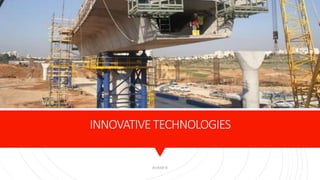
 It is possible to precast column caps, girders and beams
,decks, complete bridge sub- or super structures,
complete bridge spans ,and complete bridges
 Precast concrete work, both shop cast and site cast,
occurs away from traffic
 High performance concrete (HPC), for example, which
increases both the durability and longevity of bridges, is
currently specified for bridge projects
 In addition, self-consolidating concrete (SCC) mixes are
being promoted to cast deck replacements because of
their high quality and durability and because they
develop strength very quickly, limiting the need to close
areas while structural components cure and develop
strength
KORMCE
5
 In the future, bridges will be finished in less time than in
the past, and they will last much longer than the current
42-year average
 .HPC mixes are becoming common place because they
result in concrete with low permeability and high
durability that is able to quickly develop high strength.
 Pre-stressed and post-tensioned reinforcement is used
currently in almost in all new bridge projects. Segmental
bridges, either precast or cast-in-place, are economical and
quick to construct.
 The ideal method depends on the span, with spans 0 to 150
feet using cast-in –place segmental methods. When
segmental construction is used as the deck of a cable-
stayed bridge, span lengths can be much longer.
KORMCE
6
HIGH TRAFFIC
BRIDGE BUILT
IN RECORD
TIME
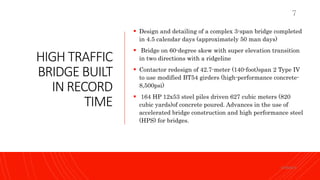
 Design and detailing of a complex 3-span bridge completed
in 4.5 calendar days (approximately 50 man days)
 Bridge on 60-degree skew with super elevation transition
in two directions with a ridgeline
 Contactor redesign of 42.7-meter (140-foot)span 2 Type IV
to use modified BT54 girders (high-performance concrete-
8,500psi)
 164 HP 12x53 steel piles driven 627 cubic meters (820
cubic yards)of concrete poured. Advances in the use of
accelerated bridge construction and high performance steel
(HPS) for bridges.
KORMCE
7
HIGHPERFORMANCESTEEL
KORMCE
8
HIGH
PERFORMANCE
STEEL
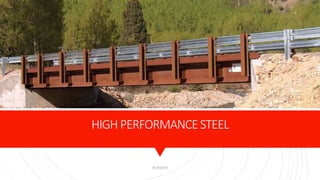
 HPS is stronger and tougher than conventional
steel. It also offers greater resistance to cracking
 The use of HPS in bridge construction saves money
,gets projects built faster , and results in bridges
that are more durable and last longer
 HPS has also provided a new horizon for steel
bridges in that it opens the door to using more
innovative system. Although the HPS material is
slightly more expensive than conventional steel, a
designer can use less and therefore save overall on
the material cost of the project
KORMCE
9
SELFCONSOLIDATINGCONCRETE
KORMCE
10
SELF
CONSOLIDATING
CONCTETE
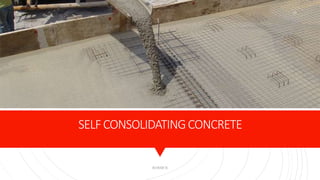
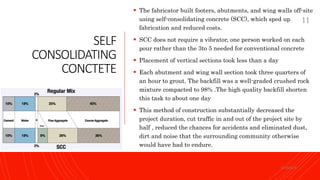
 The fabricator built footers, abutments, and wing walls off-site
using self-consolidating concrete (SCC), which sped up
fabrication and reduced costs.
 SCC does not require a vibrator, one person worked on each
pour rather than the 3to 5 needed for conventional concrete
 Placement of vertical sections took less than a day
 Each abutment and wing wall section took three quarters of
an hour to grout. The backfill was a well-graded crushed rock
mixture compacted to 98% .The high quality backfill shorten
this task to about one day
 This method of construction substantially decreased the
project duration, cut traffic in and out of the project site by
half , reduced the chances for accidents and eliminated dust,
dirt and noise that the surrounding community otherwise
would have had to endure.
KORMCE
11
PREFABRICATEDDECKPANELS
KORMCE
12
PREFABRICATED
DECK PANELS
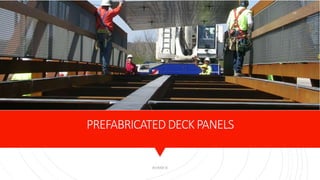
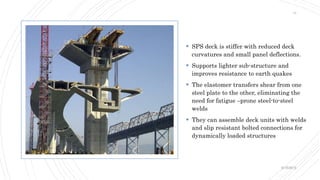
 Sandwich plate system (SPS) is a way to pre fabricated steel
decks for bridges to reduce construction time
 2-inch thick compact polyurethane elastomer core sits
between two steel 1/4-inch-thick steel plates, forming a
sandwich-like deck structure
 Elastomer is injected as a two part liquid into closed cavities
formed by the steel faceplates and perimeter steel bars
KORMCE
13
 SPS deck is stiffer with reduced deck
curvatures and small panel deflections.
 Supports lighter sub-structure and
improves resistance to earth quakes
 The elastomer transfers shear from one
steel plate to the other, eliminating the
need for fatigue –prone steel-to-steel
welds
 They can assemble deck units with welds
and slip resistant bolted connections for
dynamically loaded structures
KORMCE
14
PREFABRICATION
ADVANTAGES
 New ways to prefabricate superstructures offer opportunities
for bridge designers and contractors to significantly reduce
construction time
 improve worker safety, lessen environmental impact, and cut
costs
 Prefabrication lessens the time that heavy equipment must
spend on site, reducing adverse effects on the environment
 Using prefabricated bridge elements and systems relieves
constructability pressures.
KORMCE
15
HIGHSPEEDWELDINGTECHNOLOGY
KORMCE
16
HIGHSPEEDWELDINGTECHNOLOGY
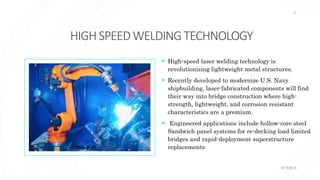
 High-speed laser welding technology is
revolutionizing lightweight metal structures.
 Recently developed to modernize U.S. Navy
shipbuilding, laser-fabricated components will find
their way into bridge construction where high-
strength, lightweight, and corrosion resistant
characteristics are a premium.
 Engineered applications include hollow-core steel
Sandwich panel systems for re-decking load limited
bridges and rapid-deployment superstructure
replacements
KORMCE
17
GSSI’BRIDGESCAN
GEOPHYSICAL SURVEY SYSTEM INC
KORMCE
18
GSSI’S
BRIDGE SCAN
SYSTEM
 GSSI’s Bridge scan system performs non destructive bridge
deck condition assessment, and provides concrete cover
depth on new construction.
 Using ground penetrating radar, the system produces
quantifiable data to accurately estimate repair costs with
demonstrated correlation with conventional acoustical
techniques.
 Results are available as Color-coded contour maps easily
identifying areas of deterioration.
KORMCE
19
HYBRID
SUPERSTRUCTURE
BENIFITS
 Prefabricated
 High strength
 Low weight
 High Resistance to corrosion
 Low Life-Cycle Costs
 Versatility
KORMCE
20
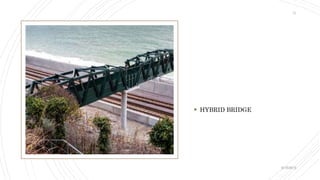
 HYBRID BRIDGE
KORMCE
21
CONCLUSION
 Identify innovative, time-reducing design concepts and
construction technologies, including design configurations,
materials, construction equipment's, design and construction
sequences, repair methods, automated systems, modularization
and preassembly.
 Examine the effects on project performance of various
approaches to traffic control measures (e.g., complete closure
with short-term detour vs. partial closure with longer duration
)
 Develop mechanisms for evaluating project site operations
plans, addressing such factors as field organization structures;
optimal work calendar and day ;number of concurrent work
locations; number, size, and makeup of crews; and equipment
selection.
 Benchmark schedule performance for highway construction
projects, taking account of type and size of project and
associated causal and enabling factors. Information on effects of
user delays should be included.
KORMCE
22
REFERENCE’S
 Deitz, D.H. (1998), “GFRP Reinforced Concrete Bridge
Decks,” Ph.D. Thesis, University of Kentucky, Lexington,
USA.
 Construction Industry Institute, Concepts and Methods of
Schedule Compression. Publication. 6-7, Austin, Texas,
November 1998.
 EI-Diraby, T.E., System for Evaluating Bridge Construction
Plans. Dissertation, University of Texas at Austin, May 1997.
 Carr, R.I.1997.Engineering and Construction Management:
Leadership and Opportunity, ASCE Journal of Construction
Management, September.pp.292-296.
 Construction Industry Institute, Concepts and Methods of
Schedule Compression .Publication. 6-7, Austin, Texas,
November 1988
KORMCE
23
THANK YOU
KORMCE
24

fastrack technologies in bridges ppt

  • 1.
    FAST TRACKTECHNOLOGIES INBRIDGE CONSTRUCTION PRESENTEDBY SANDYA RANI. KALVAPALLI (14BC1A0134) KORMCE 1
  • 2.
    INTRODUCTION  The bridgeprojects described illustrate how existing structural systems can be developed and original design revised to save costs.  This was done without sacrificing durability, while maintaining the quality and elegance prevalent in successful bridges  High construction projects encompass the entire range of planning, design, management, and construction activities that comprise highway rehabilitation or reconstruction projects.  Reconceptualization of the problem during planning phase, for example, might lead to alternative designs or approaches to construction that could yield greater benefits in terms of reduced delay and disruption that could be achieved through typical approaches to minimizing contractor lane occupancy KORMCE 2
  • 3.
    BENEFITS OF FAST TRACK CONSTRUCTION Reduced construction time  Minimum traffic disruption  Durable structures  Increased safety by decreasing the time that drivers and workers are exposed in work zone KORMCE 3
  • 4.
  • 5.
    INNOVATIVE TECHNOLOGIES  It ispossible to precast column caps, girders and beams ,decks, complete bridge sub- or super structures, complete bridge spans ,and complete bridges  Precast concrete work, both shop cast and site cast, occurs away from traffic  High performance concrete (HPC), for example, which increases both the durability and longevity of bridges, is currently specified for bridge projects  In addition, self-consolidating concrete (SCC) mixes are being promoted to cast deck replacements because of their high quality and durability and because they develop strength very quickly, limiting the need to close areas while structural components cure and develop strength KORMCE 5
  • 6.
     In thefuture, bridges will be finished in less time than in the past, and they will last much longer than the current 42-year average  .HPC mixes are becoming common place because they result in concrete with low permeability and high durability that is able to quickly develop high strength.  Pre-stressed and post-tensioned reinforcement is used currently in almost in all new bridge projects. Segmental bridges, either precast or cast-in-place, are economical and quick to construct.  The ideal method depends on the span, with spans 0 to 150 feet using cast-in –place segmental methods. When segmental construction is used as the deck of a cable- stayed bridge, span lengths can be much longer. KORMCE 6
  • 7.
    HIGH TRAFFIC BRIDGE BUILT INRECORD TIME  Design and detailing of a complex 3-span bridge completed in 4.5 calendar days (approximately 50 man days)  Bridge on 60-degree skew with super elevation transition in two directions with a ridgeline  Contactor redesign of 42.7-meter (140-foot)span 2 Type IV to use modified BT54 girders (high-performance concrete- 8,500psi)  164 HP 12x53 steel piles driven 627 cubic meters (820 cubic yards)of concrete poured. Advances in the use of accelerated bridge construction and high performance steel (HPS) for bridges. KORMCE 7
  • 8.
  • 9.
    HIGH PERFORMANCE STEEL  HPS isstronger and tougher than conventional steel. It also offers greater resistance to cracking  The use of HPS in bridge construction saves money ,gets projects built faster , and results in bridges that are more durable and last longer  HPS has also provided a new horizon for steel bridges in that it opens the door to using more innovative system. Although the HPS material is slightly more expensive than conventional steel, a designer can use less and therefore save overall on the material cost of the project KORMCE 9
  • 10.
  • 11.
    SELF CONSOLIDATING CONCTETE  The fabricatorbuilt footers, abutments, and wing walls off-site using self-consolidating concrete (SCC), which sped up fabrication and reduced costs.  SCC does not require a vibrator, one person worked on each pour rather than the 3to 5 needed for conventional concrete  Placement of vertical sections took less than a day  Each abutment and wing wall section took three quarters of an hour to grout. The backfill was a well-graded crushed rock mixture compacted to 98% .The high quality backfill shorten this task to about one day  This method of construction substantially decreased the project duration, cut traffic in and out of the project site by half , reduced the chances for accidents and eliminated dust, dirt and noise that the surrounding community otherwise would have had to endure. KORMCE 11
  • 12.
  • 13.
    PREFABRICATED DECK PANELS  Sandwichplate system (SPS) is a way to pre fabricated steel decks for bridges to reduce construction time  2-inch thick compact polyurethane elastomer core sits between two steel 1/4-inch-thick steel plates, forming a sandwich-like deck structure  Elastomer is injected as a two part liquid into closed cavities formed by the steel faceplates and perimeter steel bars KORMCE 13
  • 14.
     SPS deckis stiffer with reduced deck curvatures and small panel deflections.  Supports lighter sub-structure and improves resistance to earth quakes  The elastomer transfers shear from one steel plate to the other, eliminating the need for fatigue –prone steel-to-steel welds  They can assemble deck units with welds and slip resistant bolted connections for dynamically loaded structures KORMCE 14
  • 15.
    PREFABRICATION ADVANTAGES  New waysto prefabricate superstructures offer opportunities for bridge designers and contractors to significantly reduce construction time  improve worker safety, lessen environmental impact, and cut costs  Prefabrication lessens the time that heavy equipment must spend on site, reducing adverse effects on the environment  Using prefabricated bridge elements and systems relieves constructability pressures. KORMCE 15
  • 16.
  • 17.
    HIGHSPEEDWELDINGTECHNOLOGY  High-speed laserwelding technology is revolutionizing lightweight metal structures.  Recently developed to modernize U.S. Navy shipbuilding, laser-fabricated components will find their way into bridge construction where high- strength, lightweight, and corrosion resistant characteristics are a premium.  Engineered applications include hollow-core steel Sandwich panel systems for re-decking load limited bridges and rapid-deployment superstructure replacements KORMCE 17
  • 18.
  • 19.
    GSSI’S BRIDGE SCAN SYSTEM  GSSI’sBridge scan system performs non destructive bridge deck condition assessment, and provides concrete cover depth on new construction.  Using ground penetrating radar, the system produces quantifiable data to accurately estimate repair costs with demonstrated correlation with conventional acoustical techniques.  Results are available as Color-coded contour maps easily identifying areas of deterioration. KORMCE 19
  • 20.
    HYBRID SUPERSTRUCTURE BENIFITS  Prefabricated  Highstrength  Low weight  High Resistance to corrosion  Low Life-Cycle Costs  Versatility KORMCE 20
  • 21.
  • 22.
    CONCLUSION  Identify innovative,time-reducing design concepts and construction technologies, including design configurations, materials, construction equipment's, design and construction sequences, repair methods, automated systems, modularization and preassembly.  Examine the effects on project performance of various approaches to traffic control measures (e.g., complete closure with short-term detour vs. partial closure with longer duration )  Develop mechanisms for evaluating project site operations plans, addressing such factors as field organization structures; optimal work calendar and day ;number of concurrent work locations; number, size, and makeup of crews; and equipment selection.  Benchmark schedule performance for highway construction projects, taking account of type and size of project and associated causal and enabling factors. Information on effects of user delays should be included. KORMCE 22
  • 23.
    REFERENCE’S  Deitz, D.H.(1998), “GFRP Reinforced Concrete Bridge Decks,” Ph.D. Thesis, University of Kentucky, Lexington, USA.  Construction Industry Institute, Concepts and Methods of Schedule Compression. Publication. 6-7, Austin, Texas, November 1998.  EI-Diraby, T.E., System for Evaluating Bridge Construction Plans. Dissertation, University of Texas at Austin, May 1997.  Carr, R.I.1997.Engineering and Construction Management: Leadership and Opportunity, ASCE Journal of Construction Management, September.pp.292-296.  Construction Industry Institute, Concepts and Methods of Schedule Compression .Publication. 6-7, Austin, Texas, November 1988 KORMCE 23
  • 24.