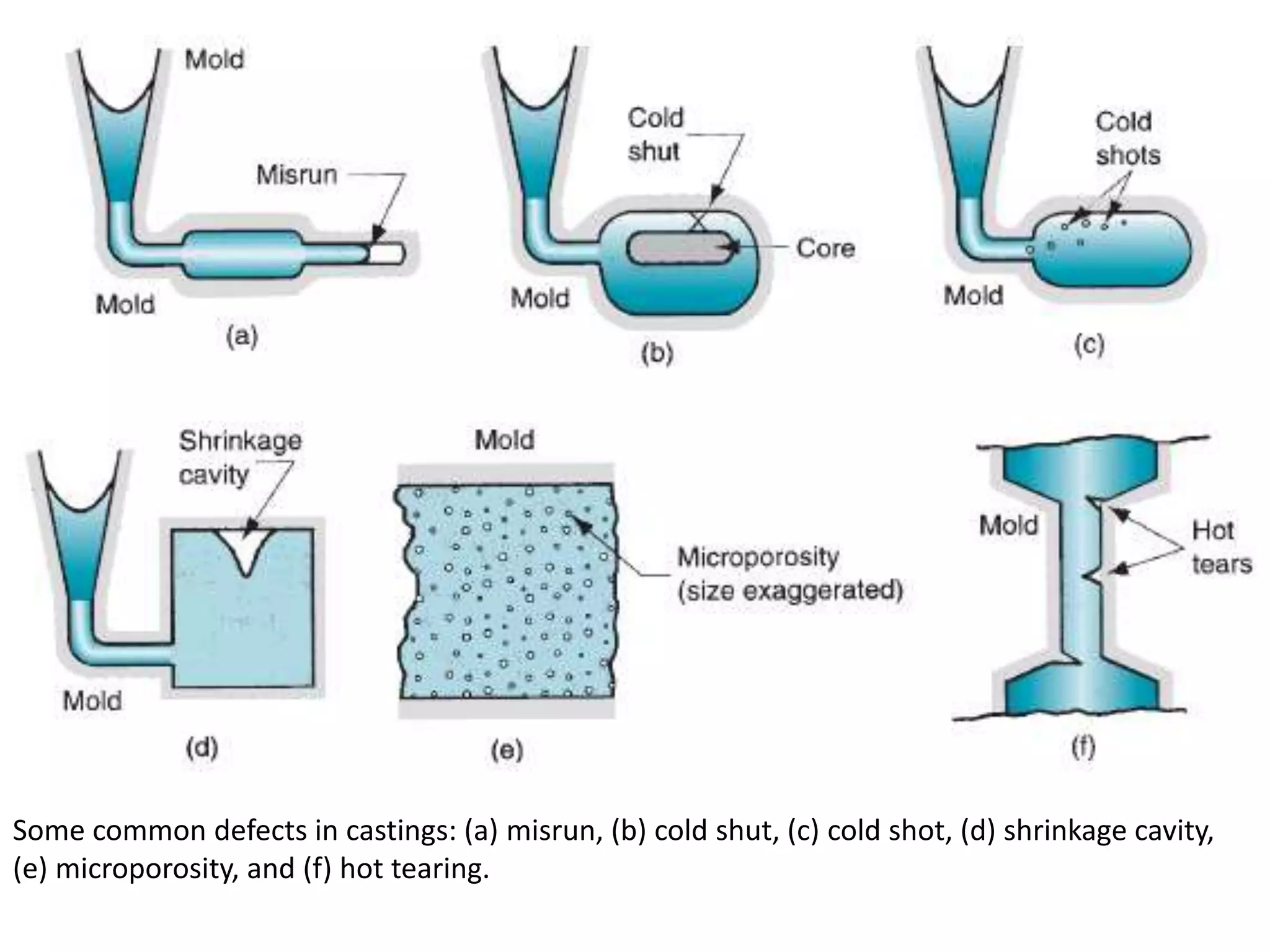
Some common defects in castings: (a) misrun, (b) cold shut, (c) cold shot, (d) shrinkage cavity,
(e) microporosity, and (f) hot tearing.
(a) Misruns, which are castings that solidify before completely filling the mold cavity.
Typical causes include
(1) fluidity of the molten metal is insufficient,
(2) pouring temperature is too low
(3) pouring is done too slowly
(4) cross-section of the mold cavity is too thin.
(b) Cold Shuts, which occur when two portions of the metal flow together but there is
a lack of fusion between them due to premature freezing.
Its causes are similar to those of a misrun.
(c) Cold shots, which result from splattering during pouring, causing the formation of
solid globules of metal that become entrapped in the casting
Pouring procedures and gating system designs that avoid splattering can prevent
this defect.
(d) Shrinkage cavity is a depression in the surface or an internal void in the casting,
1. caused by solidification shrinkage that restricts the amount of molten metal
available in the last region to freeze.
2. It often occurs near the top of the casting, in which case it is referred to as a pipe
3. The problem can often be solved by proper riser design.
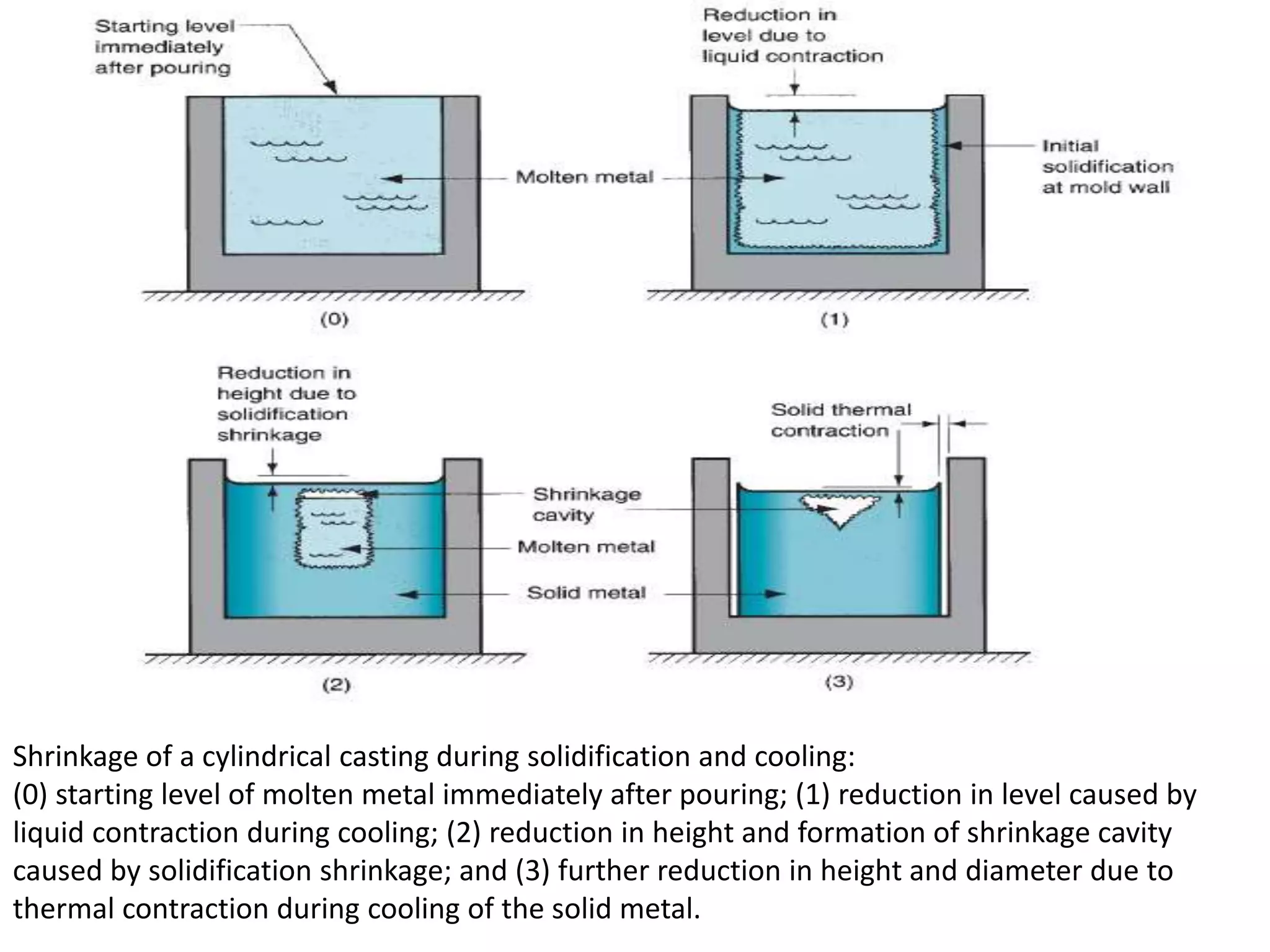
Shrinkage of a cylindrical casting during solidification and cooling:
(0) starting level of molten metal immediately after pouring; (1) reduction in level caused by
liquid contraction during cooling; (2) reduction in height and formation of shrinkage cavity
caused by solidification shrinkage; and (3) further reduction in height and diameter due to
thermal contraction during cooling of the solid metal.
(e) Microporosity consists of a network of small voids distributed throughout the
casting caused by localized solidification shrinkage of the final molten metal in the
dendritic structure
The defect is usually associated with alloys, because of the protracted manner in
which freezing occurs in these metals.
(f) Hot tearing, also called hot cracking, occurs when the casting is restrained from
contraction by an unyielding mold during the final stages of solidification or early
stages of cooling after solidification.
The defect is manifested as a separation of the metal (hence, the terms tearing and
cracking) at a point of high tensile stress caused by the metal’s inability to shrink
naturally
In sand casting and other expendable-mold processes, it is prevented by
compounding the mold to be collapsible
In permanent-mold processes, hot tearing is reduced by removing the part from
the mold immediately after solidification.
Some defects are related to the use of sand molds, and therefore they occur only in
sand castings
To a lesser degree, other expendable-mold processes are also susceptible to these
problems
(a) Sand blow is a defect consisting of a balloon-shaped gas cavity caused by release of
mold gases during pouring
It occurs at or below the casting surface near the top of the casting
Low permeability, poor venting, and high moisture content of the sand mold are
the usual causes.
Common defects in sand castings: (a) sand blow, (b) pin holes, (c) sand wash, (d) scabs,
(e) penetration, (f) mold shift, (g) core shift, and (h) mold crack.
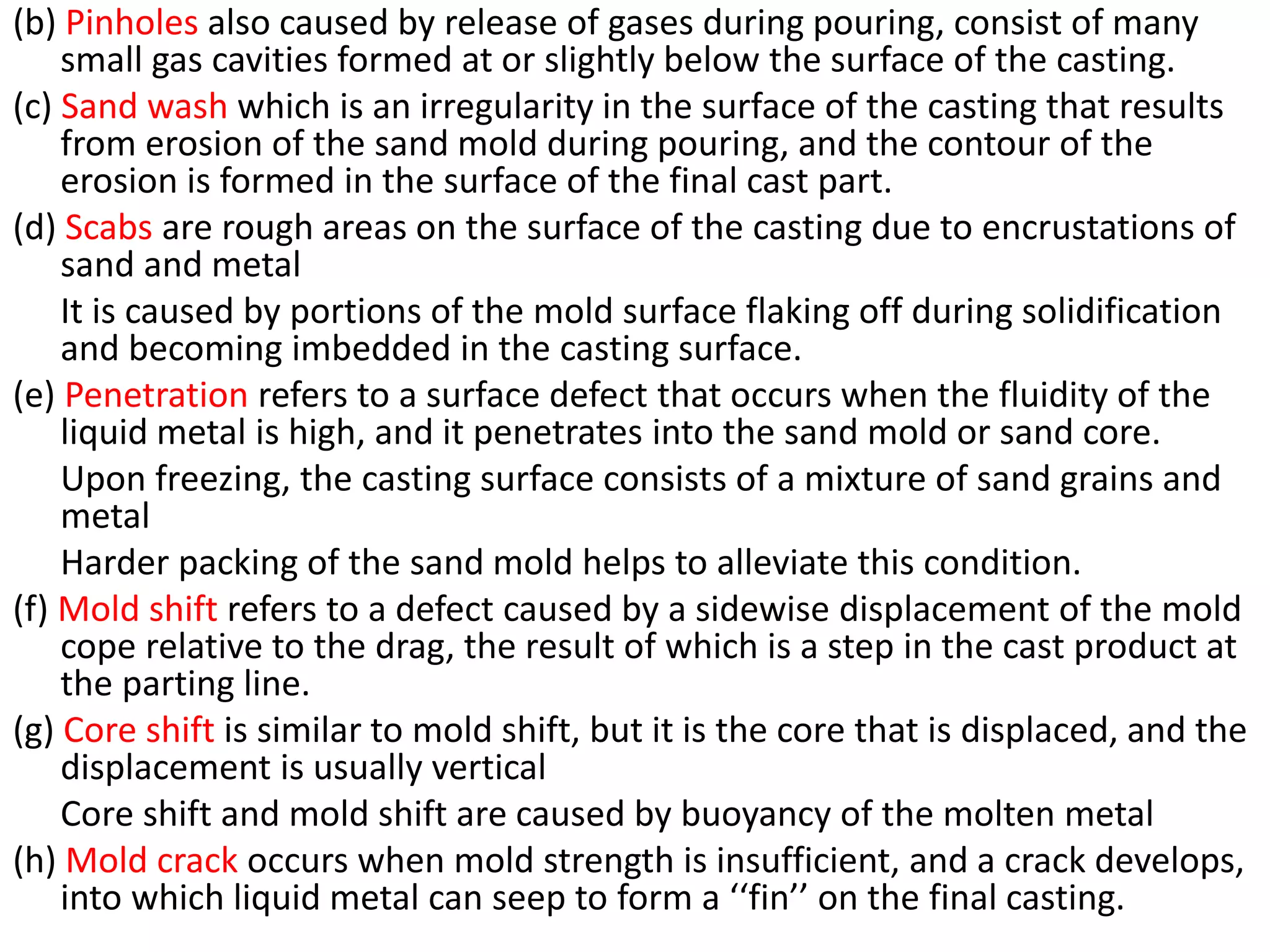
(b) Pinholes also caused by release of gases during pouring, consist of many
small gas cavities formed at or slightly below the surface of the casting.
(c) Sand wash which is an irregularity in the surface of the casting that results
from erosion of the sand mold during pouring, and the contour of the
erosion is formed in the surface of the final cast part.
(d) Scabs are rough areas on the surface of the casting due to encrustations of
sand and metal
It is caused by portions of the mold surface flaking off during solidification
and becoming imbedded in the casting surface.
(e) Penetration refers to a surface defect that occurs when the fluidity of the
liquid metal is high, and it penetrates into the sand mold or sand core.
Upon freezing, the casting surface consists of a mixture of sand grains and
metal
Harder packing of the sand mold helps to alleviate this condition.
(f) Mold shift refers to a defect caused by a sidewise displacement of the mold
cope relative to the drag, the result of which is a step in the cast product at
the parting line.
(g) Core shift is similar to mold shift, but it is the core that is displaced, and the
displacement is usually vertical
Core shift and mold shift are caused by buoyancy of the molten metal
(h) Mold crack occurs when mold strength is insufficient, and a crack develops,
into which liquid metal can seep to form a ‘‘fin’’ on the final casting.
Casting defects
Casting defects
Casting defects
Casting defects
Casting defects

Casting defects

  • 2.
    Some common defectsin castings: (a) misrun, (b) cold shut, (c) cold shot, (d) shrinkage cavity, (e) microporosity, and (f) hot tearing.
  • 3.
    (a) Misruns, whichare castings that solidify before completely filling the mold cavity. Typical causes include (1) fluidity of the molten metal is insufficient, (2) pouring temperature is too low (3) pouring is done too slowly (4) cross-section of the mold cavity is too thin. (b) Cold Shuts, which occur when two portions of the metal flow together but there is a lack of fusion between them due to premature freezing. Its causes are similar to those of a misrun. (c) Cold shots, which result from splattering during pouring, causing the formation of solid globules of metal that become entrapped in the casting Pouring procedures and gating system designs that avoid splattering can prevent this defect. (d) Shrinkage cavity is a depression in the surface or an internal void in the casting, 1. caused by solidification shrinkage that restricts the amount of molten metal available in the last region to freeze. 2. It often occurs near the top of the casting, in which case it is referred to as a pipe 3. The problem can often be solved by proper riser design.
  • 4.
    Shrinkage of acylindrical casting during solidification and cooling: (0) starting level of molten metal immediately after pouring; (1) reduction in level caused by liquid contraction during cooling; (2) reduction in height and formation of shrinkage cavity caused by solidification shrinkage; and (3) further reduction in height and diameter due to thermal contraction during cooling of the solid metal.
  • 5.
    (e) Microporosity consistsof a network of small voids distributed throughout the casting caused by localized solidification shrinkage of the final molten metal in the dendritic structure The defect is usually associated with alloys, because of the protracted manner in which freezing occurs in these metals. (f) Hot tearing, also called hot cracking, occurs when the casting is restrained from contraction by an unyielding mold during the final stages of solidification or early stages of cooling after solidification. The defect is manifested as a separation of the metal (hence, the terms tearing and cracking) at a point of high tensile stress caused by the metal’s inability to shrink naturally In sand casting and other expendable-mold processes, it is prevented by compounding the mold to be collapsible In permanent-mold processes, hot tearing is reduced by removing the part from the mold immediately after solidification. Some defects are related to the use of sand molds, and therefore they occur only in sand castings To a lesser degree, other expendable-mold processes are also susceptible to these problems (a) Sand blow is a defect consisting of a balloon-shaped gas cavity caused by release of mold gases during pouring It occurs at or below the casting surface near the top of the casting Low permeability, poor venting, and high moisture content of the sand mold are the usual causes.
  • 6.
    Common defects insand castings: (a) sand blow, (b) pin holes, (c) sand wash, (d) scabs, (e) penetration, (f) mold shift, (g) core shift, and (h) mold crack.
  • 7.
    (b) Pinholes alsocaused by release of gases during pouring, consist of many small gas cavities formed at or slightly below the surface of the casting. (c) Sand wash which is an irregularity in the surface of the casting that results from erosion of the sand mold during pouring, and the contour of the erosion is formed in the surface of the final cast part. (d) Scabs are rough areas on the surface of the casting due to encrustations of sand and metal It is caused by portions of the mold surface flaking off during solidification and becoming imbedded in the casting surface. (e) Penetration refers to a surface defect that occurs when the fluidity of the liquid metal is high, and it penetrates into the sand mold or sand core. Upon freezing, the casting surface consists of a mixture of sand grains and metal Harder packing of the sand mold helps to alleviate this condition. (f) Mold shift refers to a defect caused by a sidewise displacement of the mold cope relative to the drag, the result of which is a step in the cast product at the parting line. (g) Core shift is similar to mold shift, but it is the core that is displaced, and the displacement is usually vertical Core shift and mold shift are caused by buoyancy of the molten metal (h) Mold crack occurs when mold strength is insufficient, and a crack develops, into which liquid metal can seep to form a ‘‘fin’’ on the final casting.