STATISTICAL MODELING: THE
TWO CULTURES
Based on Leo Breiman's paper

Christoph Molnar
Department of Statistics,
LMU Munich
2014-01-20

.

.
Statistical Modeling: The Two Cultures

STATISTICAL MODELING: THE
TWO CULTURES
Based on Leo Breiman's paper

.

Christoph Molnar
Department of Statistics,
LMU Munich

.

Abstract:
This presentation compares two cultures of statistical
modeling: the data modeling culture, which assumes a
stochastic process that produced the data. This culture is
associated with traditional statistics. The other culture is called
algorithmic modeling culture, which can be reduced to
optimization of a loss function with an algorithm. This culture is
associated with Machine Learning. It is argued to use
algorithmic modeling more often in statistics.
Data Modeling

Algorithmic Modeling

Principles

Experiences

Conclusions

OUTLINE

1. Statistics: Data Modeling Culture
2. Machine Learning: Algorithmic Modeling Culture
3. Statistical Learning Principles
4. Personal Experience
5. Summary

Content heavily based on: ``Statistical Modeling: The two cultures''
from Leo Breiman [1]
1 / 19
2014-01-20

.

.
Statistical Modeling: The Two Cultures

OUTLINE

1. Statistics: Data Modeling Culture
2. Machine Learning: Algorithmic Modeling Culture
3. Statistical Learning Principles
4. Personal Experience

Outline

5. Summary

.

Content heavily based on: ``Statistical Modeling: The two cultures''
from Leo Breiman [1]

.

This presentation is based on ``Statistical Modeling: The two
cultures'' from Leo Breiman [1].
The first segment introduces the data modeling culture and
analogously the second segment explains the algorithmic
modeling culture together with the presentation of three
algorithms. The part about statistical learning principals
presents aspects which help to compare both of cultures.
Personal experiences in both cultures are addressed. The
conclusion summarizes the message of the paper [1].
DATA MODELING CULTURE
Data Modeling

Algorithmic Modeling

Principles

Experiences

Conclusions

WORK OF A DATA ANALYST

→ Predict
→ Reveal associations
→ Munge data, design experiments, visualize data, …

2 / 19
2014-01-20

.

.
Statistical Modeling: The Two Cultures

WORK OF A DATA ANALYST

Data Modeling

→ Predict
→ Reveal associations
→ Munge data, design experiments, visualize data, …

Work of a Data Analyst
.
.

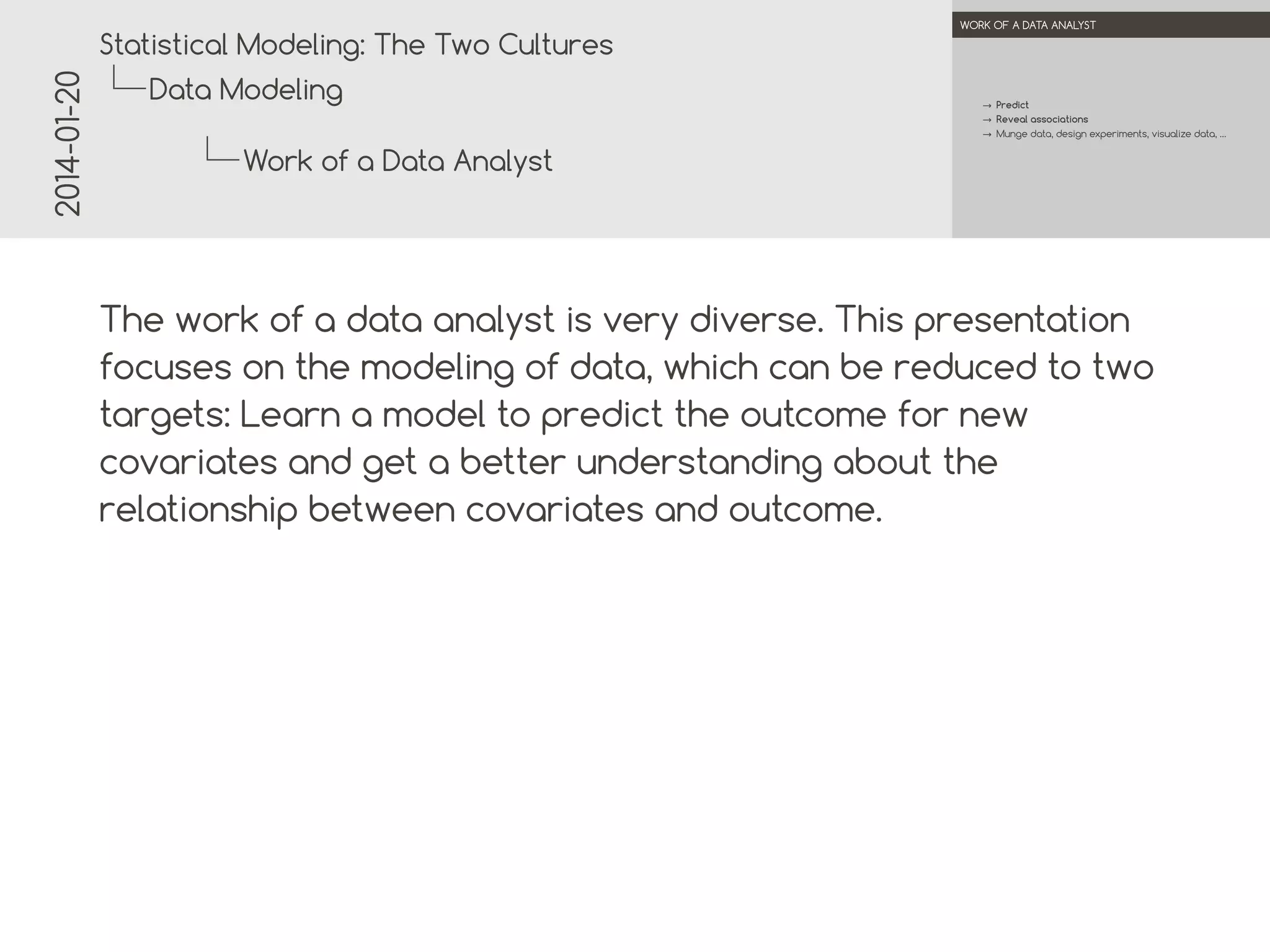
The work of a data analyst is very diverse. This presentation
focuses on the modeling of data, which can be reduced to two
targets: Learn a model to predict the outcome for new
covariates and get a better understanding about the
relationship between covariates and outcome.
Data Modeling

Algorithmic Modeling

Principles

Experiences

Conclusions

SIMPLIFIED WORLDVIEW

y

.
nature

x

3 / 19
2014-01-20

.

.
Statistical Modeling: The Two Cultures

SIMPLIFIED WORLDVIEW

Data Modeling
y

.
nature

Simplified worldview
.
.

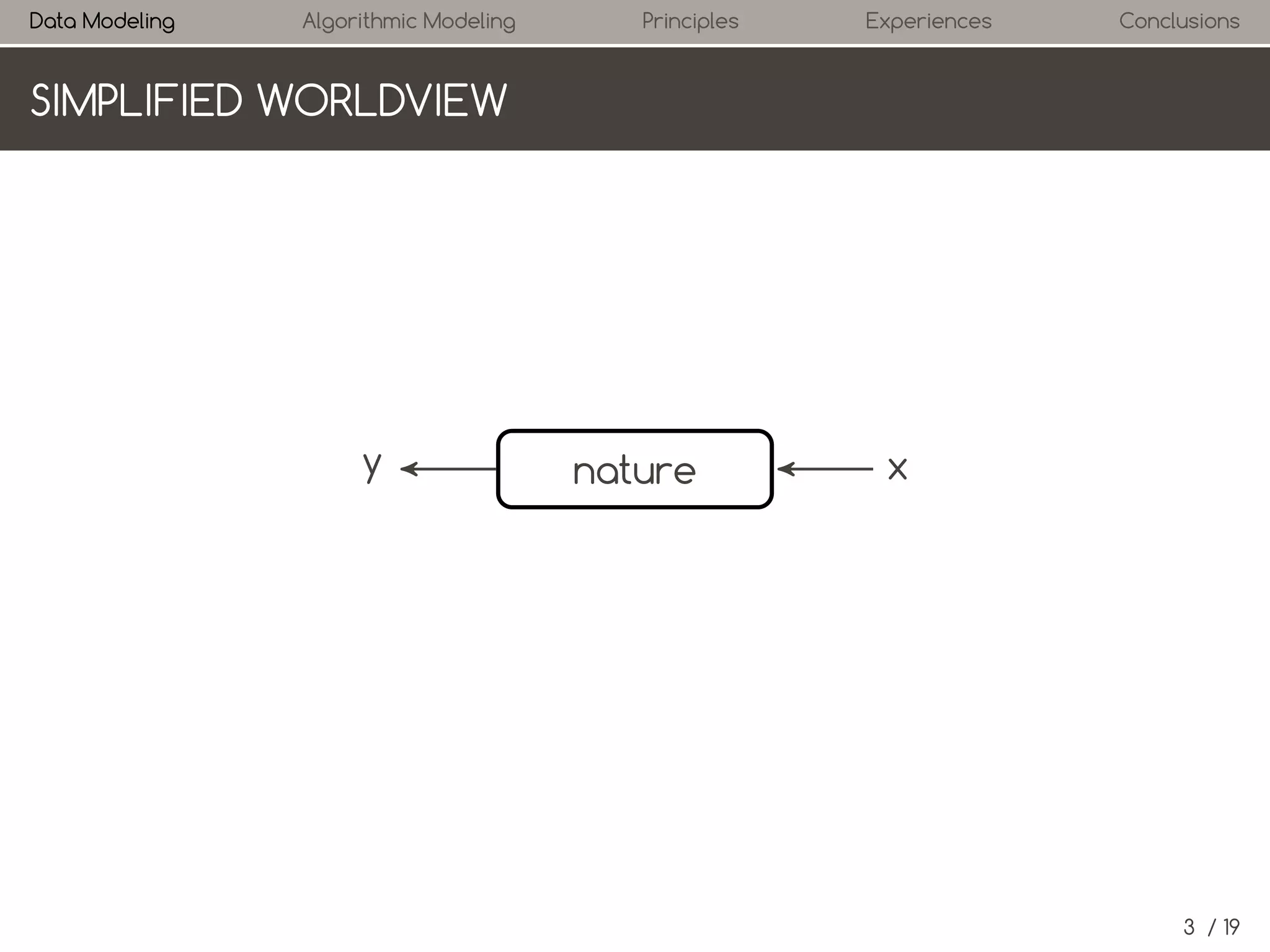
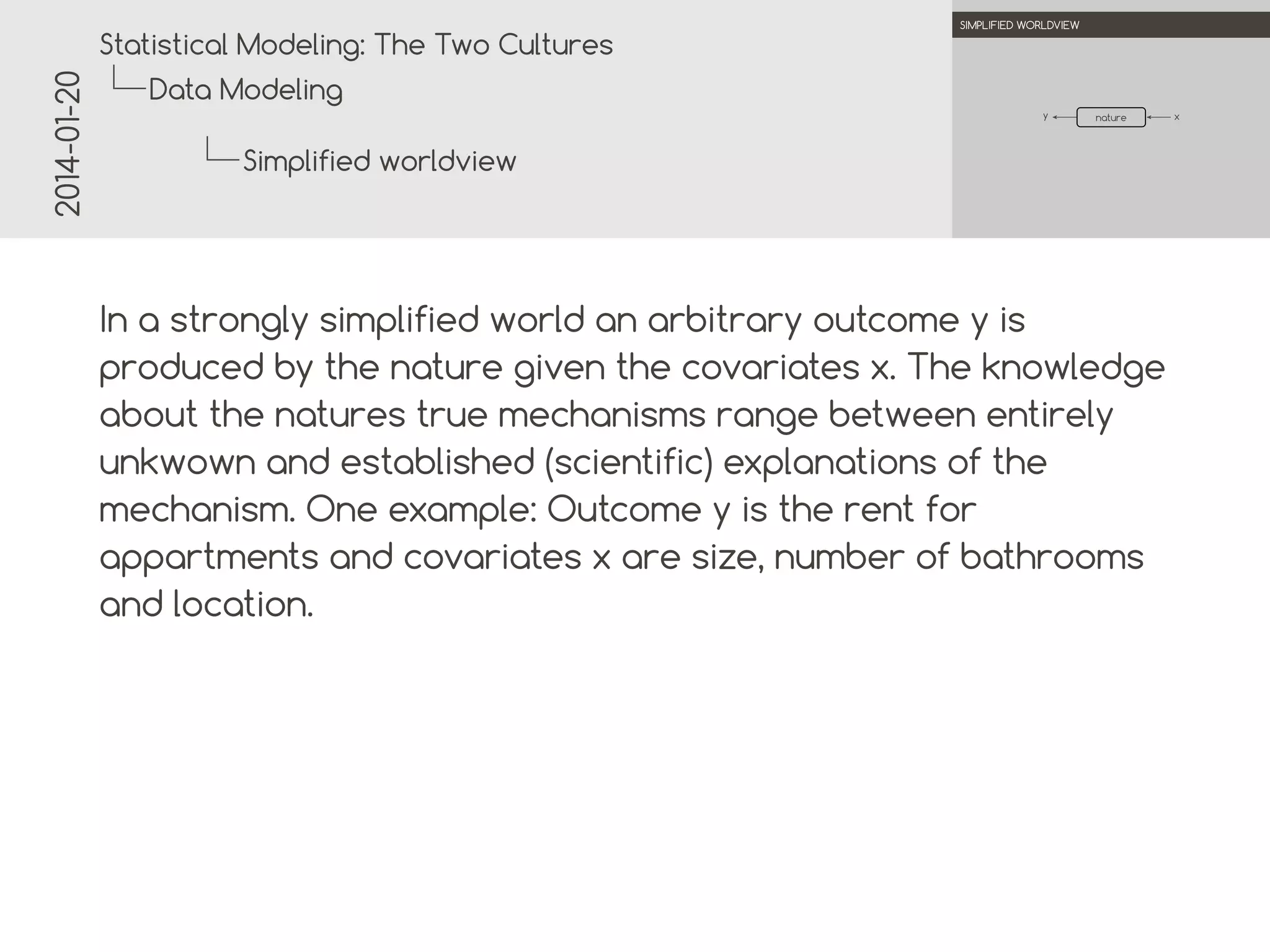
In a strongly simplified world an arbitrary outcome y is
produced by the nature given the covariates x. The knowledge
about the natures true mechanisms range between entirely
unknown and established (scientific) explanations of the
mechanism. One example: Outcome y is the rent for
apartments and covariates x are size, number of bathrooms
and location.

x
Data Modeling

Algorithmic Modeling

Principles

Experiences

Conclusions

DATA MODELING CULTURE

y

Logistic
Regression,
.
Cox Model,
GEE,
…

x

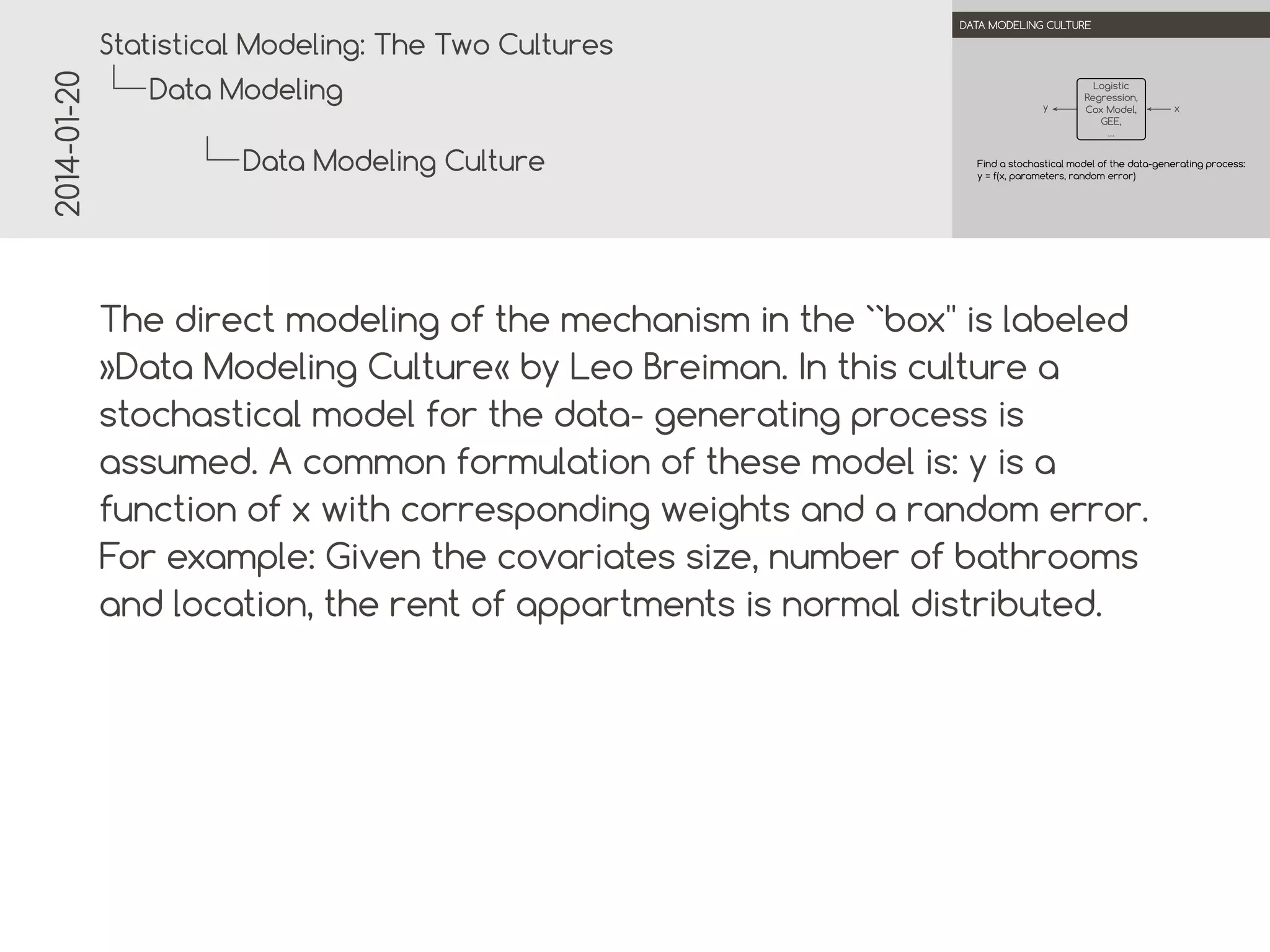
Find a stochastic model of the data-generating process:
y = f(x, parameters, random error)

4 / 19
2014-01-20

.

.
Statistical Modeling: The Two Cultures

DATA MODELING CULTURE

Data Modeling

y

Data Modeling Culture

Logistic
Regression,
.
Cox Model,
GEE,
…

x

Find a stochastic model of the data-generating process:
y = f(x, parameters, random error)

.
.

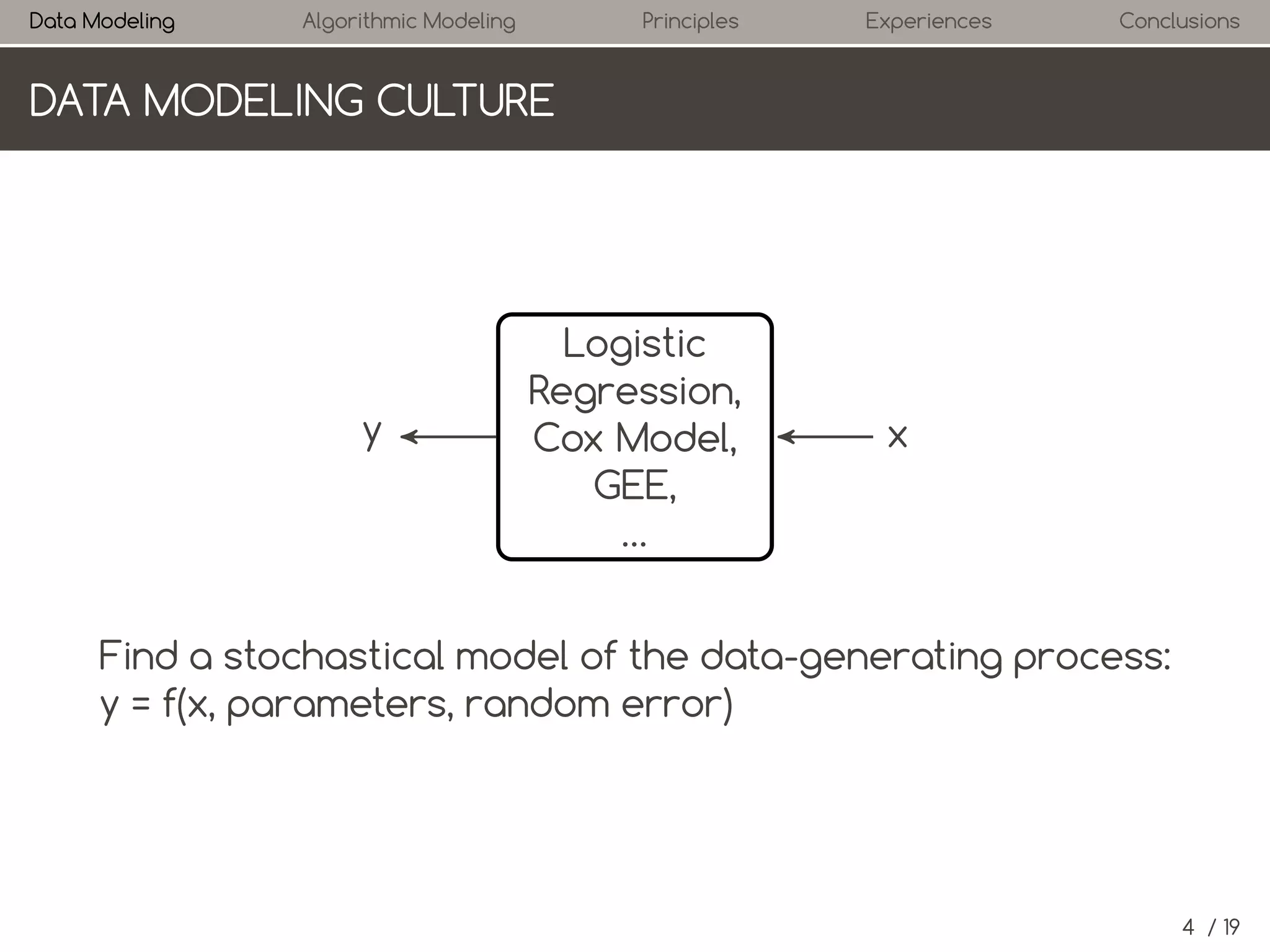
The direct modeling of the mechanism in the ``box'' is labeled
»Data Modeling Culture« by Leo Breiman. In this culture a
stochastic model for the data- generating process is assumed.
A common formulation of these model is: y is a function of x
with corresponding weights and a random error. For example:
Given the covariates size, number of bathrooms and location,
the rent of apartments is normal distributed.
Data Modeling

Algorithmic Modeling

Principles

Experiences

Conclusions

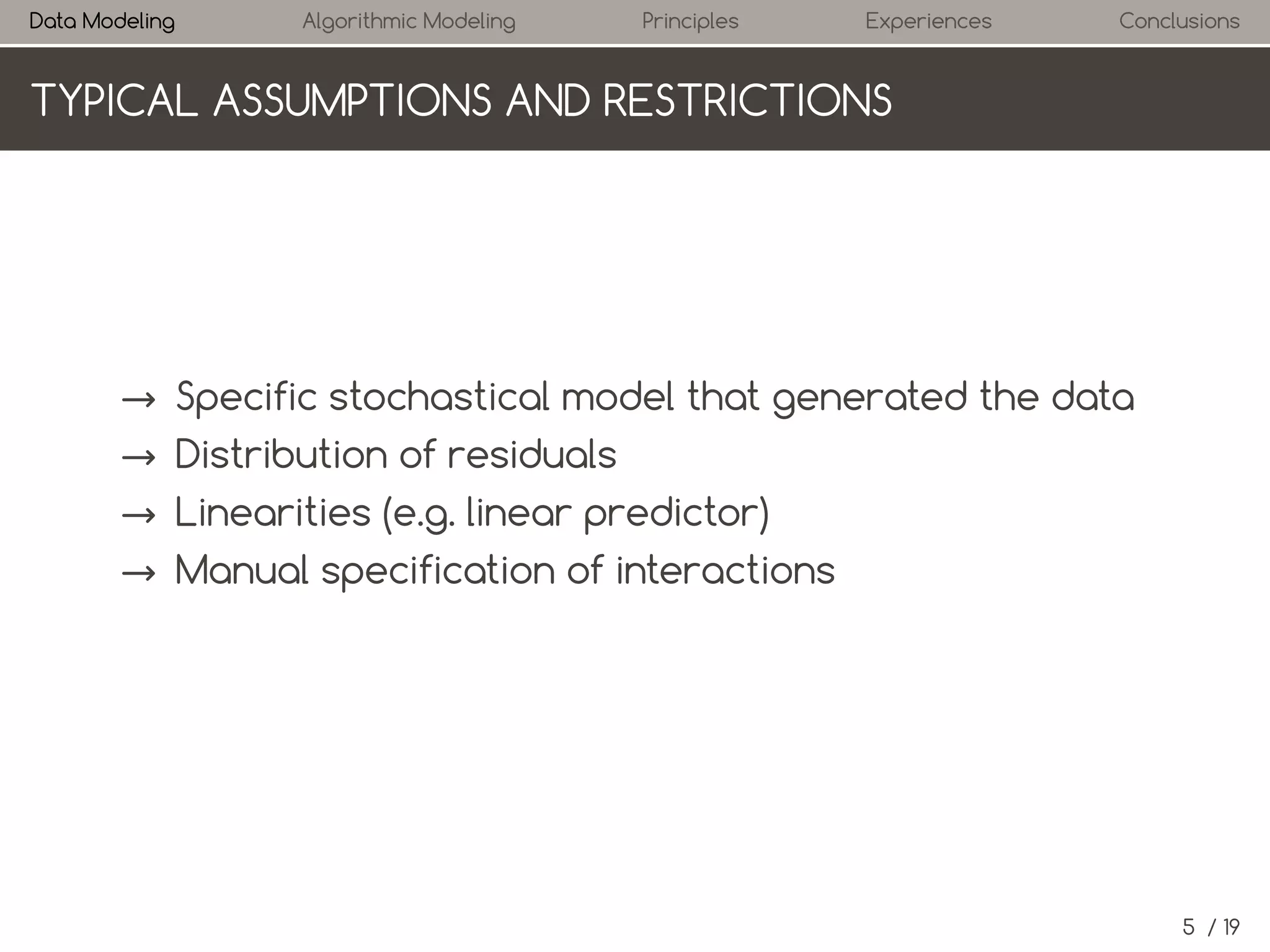
TYPICAL ASSUMPTIONS AND RESTRICTIONS

→ Specific stochastic model that generated the data
→ Distribution of residuals
→ Linearity (e.g. linear predictor)
→ Manual specification of interactions

5 / 19
Data Modeling

Algorithmic Modeling

Principles

Experiences

Conclusions

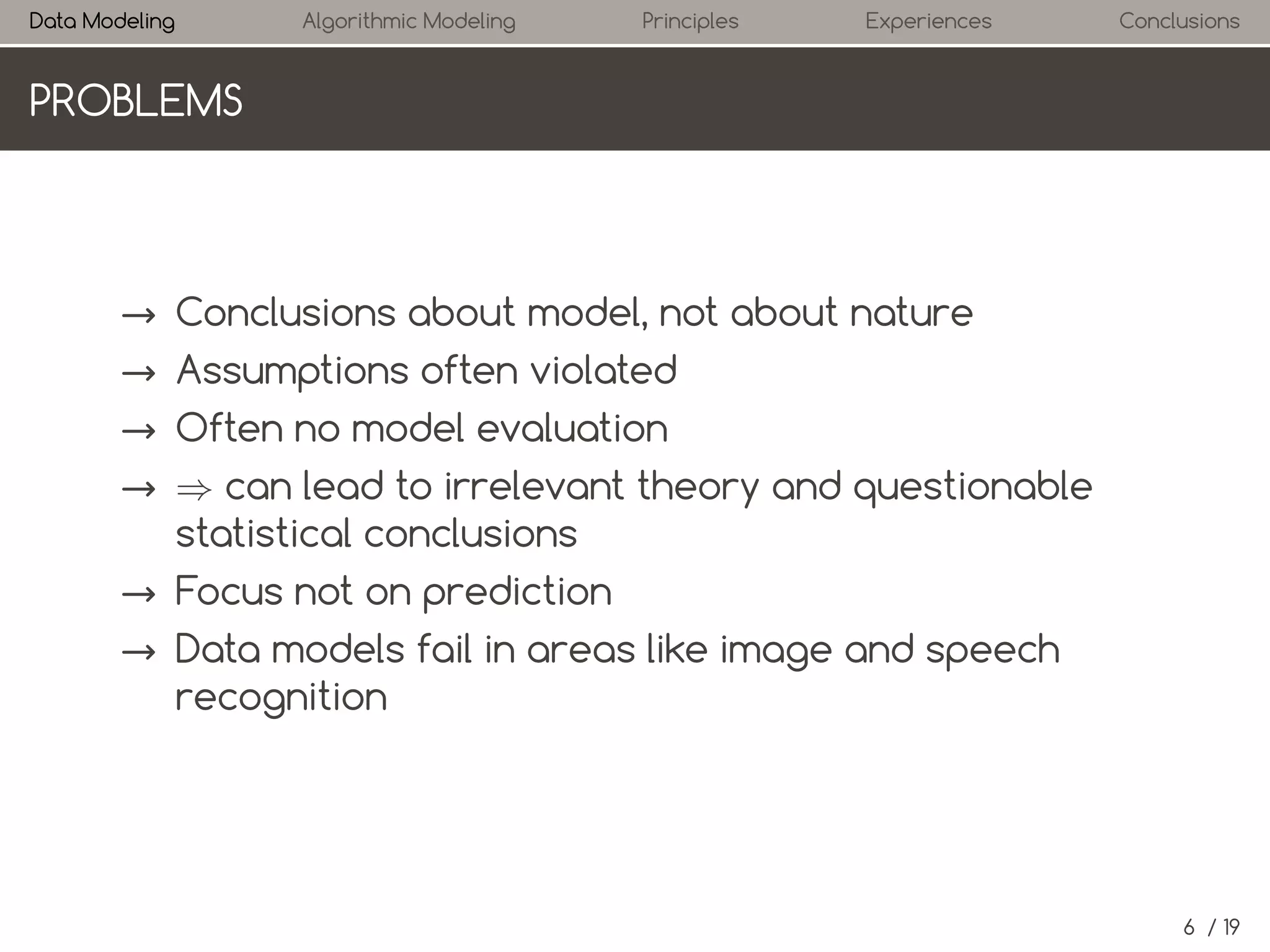
PROBLEMS

→ Conclusions about model, not about nature
→ Assumptions often violated
→ Often no model evaluation
→ ⇒ can lead to irrelevant theory and questionable
statistical conclusions
→ Focus not on prediction
→ Data models fail in areas like image and speech
recognition

6 / 19
ALGORITHMIC MODELING CULTURE
Data Modeling

Algorithmic Modeling

Principles

Experiences

Conclusions

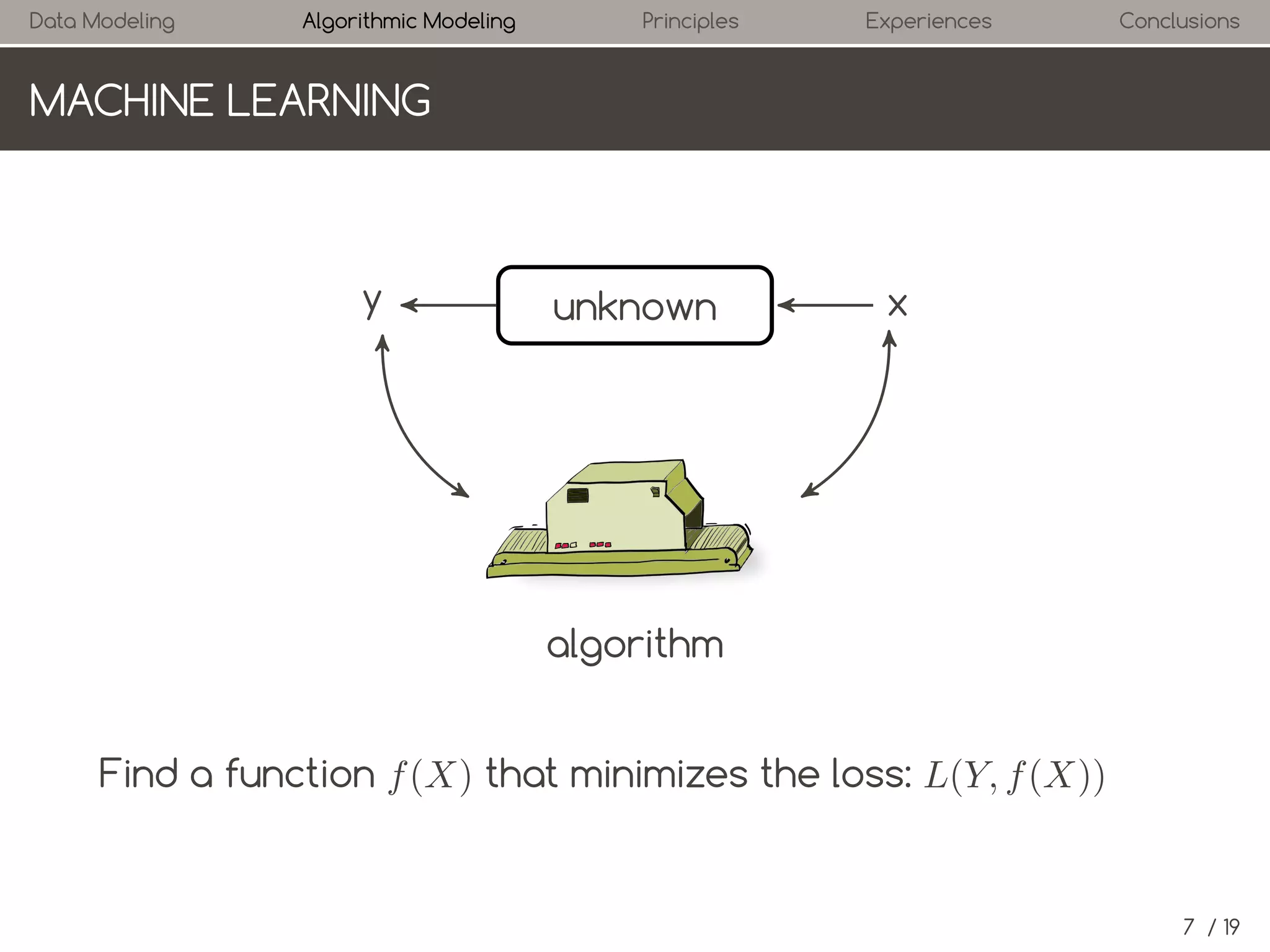
MACHINE LEARNING

y

.
unknown

x

algorithm
Find a function f (X) that minimizes the loss: L(Y, f (X))

7 / 19
2014-01-20

.

.
Statistical Modeling: The Two Cultures

MACHINE LEARNING

y

Algorithmic Modeling
Machine Learning

.
unknown

x

algorithm
Find a function f (X) that minimizes the loss: L(Y, f (X))

.
.

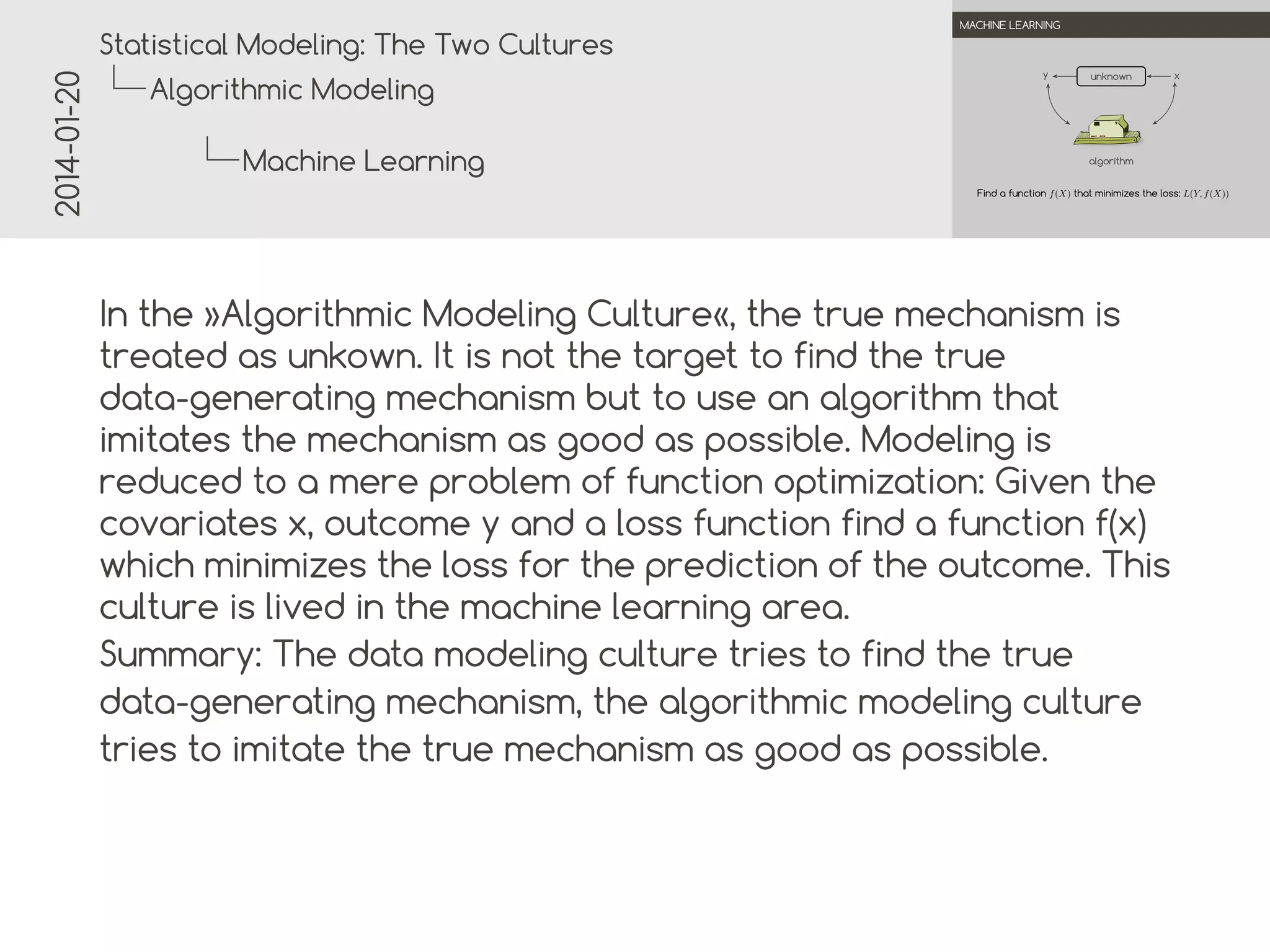
In the »Algorithmic Modeling Culture«, the true mechanism is
treated as unknown. It is not the target to find the true
data-generating mechanism but to use an algorithm that
imitates the mechanism as good as possible. Modeling is
reduced to a mere problem of function optimization: Given the
covariates x, outcome y and a loss function find a function f(x)
which minimizes the loss for the prediction of the outcome. This
culture is lived in the machine learning area.
Summary: The data modeling culture tries to find the true
data-generating mechanism, the algorithmic modeling culture
tries to imitate the true mechanism as good as possible.
Data Modeling

Algorithmic Modeling

Principles

Experiences

Conclusions

ALGORITHM IN MACHINE LEARNING

→ Boosting
→ Support Vector Machines
→ Artificial neural networks
→ Random Forests
→ Hidden Markov
→ Bayes-Nets
→ …1

1

Details and more algorithms in ``Elements of statistical learning''[2]
8 / 19
2014-01-20

.

.
Statistical Modeling: The Two Cultures

ALGORITHM IN MACHINE LEARNING

→ Boosting

Algorithmic Modeling

→ Support Vector Machines
→ Artificial neural networks
→ Random Forests
→ Hidden Markov
→ Bayes-Nets

Algorithm in Machine Learning

→ …1

.

1

Details and more algorithms in ``Elements of statistical learning''[2]

.

The algorithms used in machine learning are motivated
differently. Three algorithms are presented in short.
Data Modeling

Algorithmic Modeling

Principles

Experiences

Conclusions

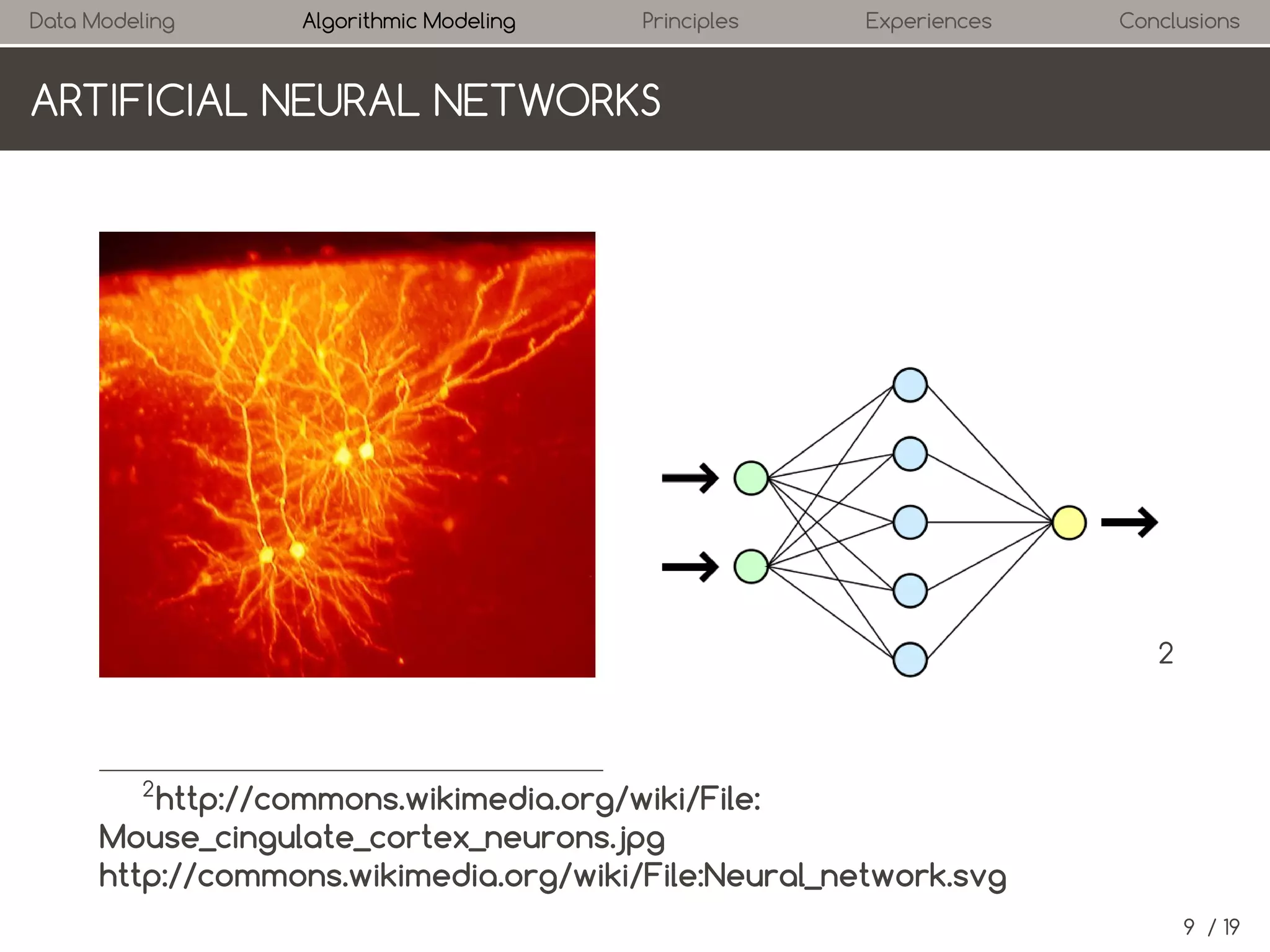
ARTIFICIAL NEURAL NETWORKS

2

2

http://commons.wikimedia.org/wiki/File:
Mouse_cingulate_cortex_neurons.jpg
http://commons.wikimedia.org/wiki/File:Neural_network.svg
9 / 19
2014-01-20

.

.
Statistical Modeling: The Two Cultures

ARTIFICIAL NEURAL NETWORKS

Algorithmic Modeling
Artificial neural networks

2

.

2
http://commons.wikimedia.org/wiki/File:
Mouse_cingulate_cortex_neurons.jpg
http://commons.wikimedia.org/wiki/File:Neural_network.svg

.

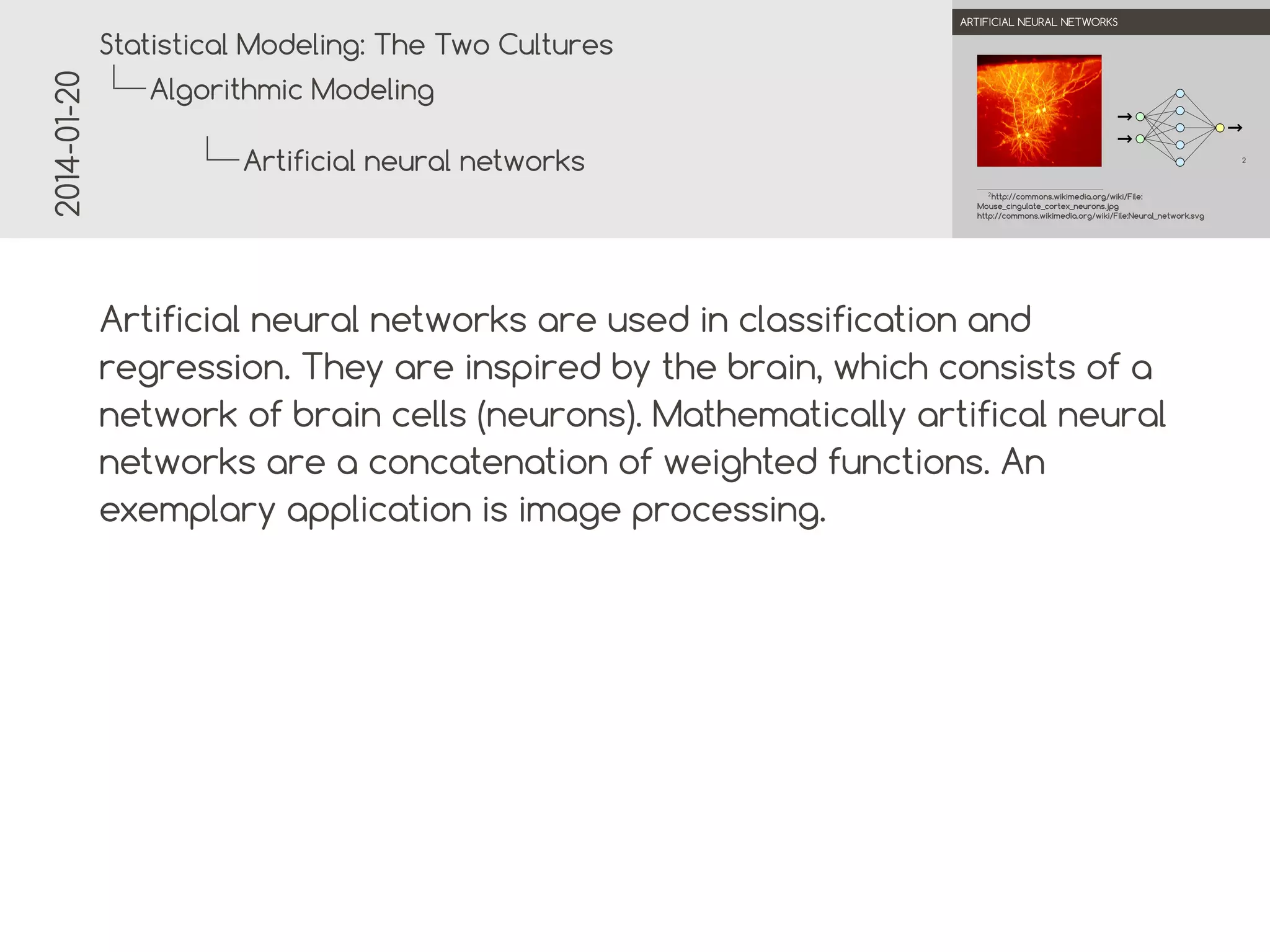
Artificial neural networks are used in classification and
regression. They are inspired by the brain, which consists of a
network of brain cells (neurons). Mathematically artificial
neural networks are a concatenation of weighted functions. An
exemplary application is image processing.
Data Modeling

Algorithmic Modeling

Principles

Experiences

Conclusions

SUPPORT VECTOR MACHINES

3
3

http://commons.wikimedia.org/wiki/File:Svm_10_perceptron.JPG

10 / 19
2014-01-20

.

.
Statistical Modeling: The Two Cultures

SUPPORT VECTOR MACHINES

Algorithmic Modeling
Support Vector Machines
3

.

3

http://commons.wikimedia.org/wiki/File:Svm_10_perceptron.JPG

.

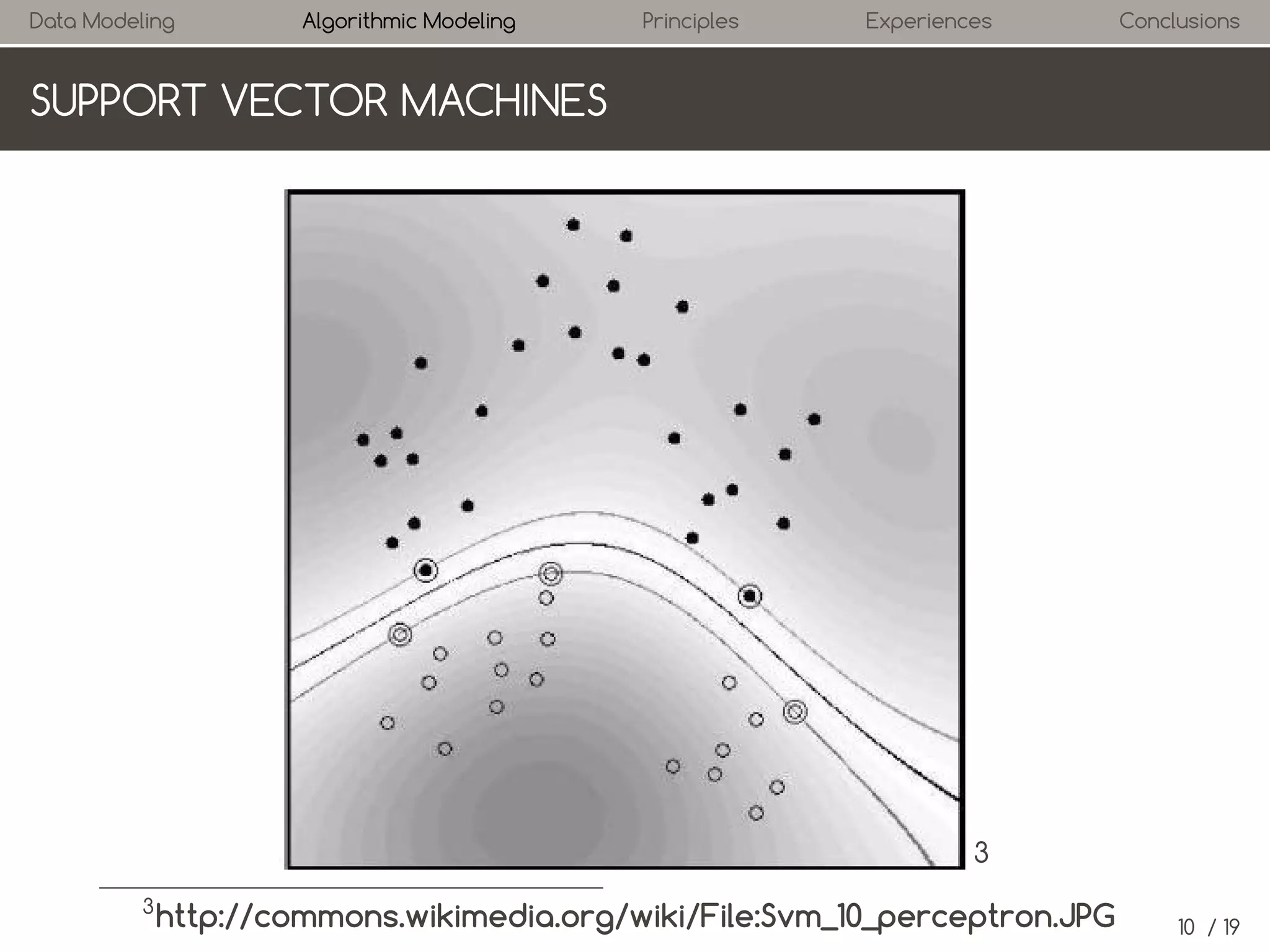
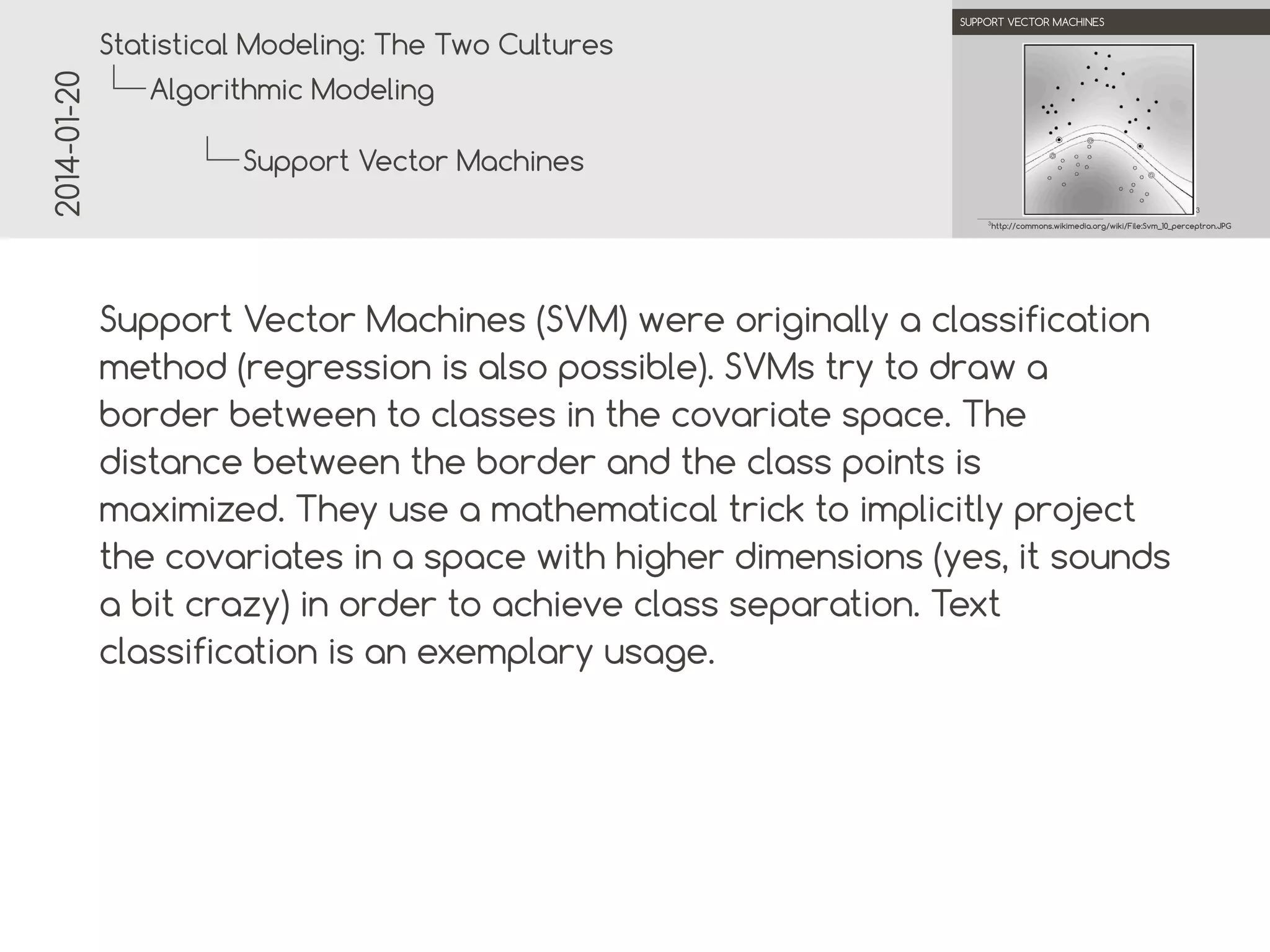
Support Vector Machines (SVM) were originally a classification
method (regression is also possible). SVMs try to draw a
border between two classes in the covariate space. The
distance between the border and the class points is
maximized. They use a mathematical trick to implicitly project
the covariates in a space with higher dimensions (yes, it sounds
a bit crazy) in order to achieve class separation. Text
classification is an exemplary usage.
Data Modeling

Algorithmic Modeling

Principles

Experiences

Conclusions

RANDOM FORESTS

4

11 / 19
2014-01-20

.

.
Statistical Modeling: The Two Cultures

RANDOM FORESTS

Algorithmic Modeling
Random Forests
.
.

4
4

http://openclipart.org/detail/175304/forest-by-z-175304

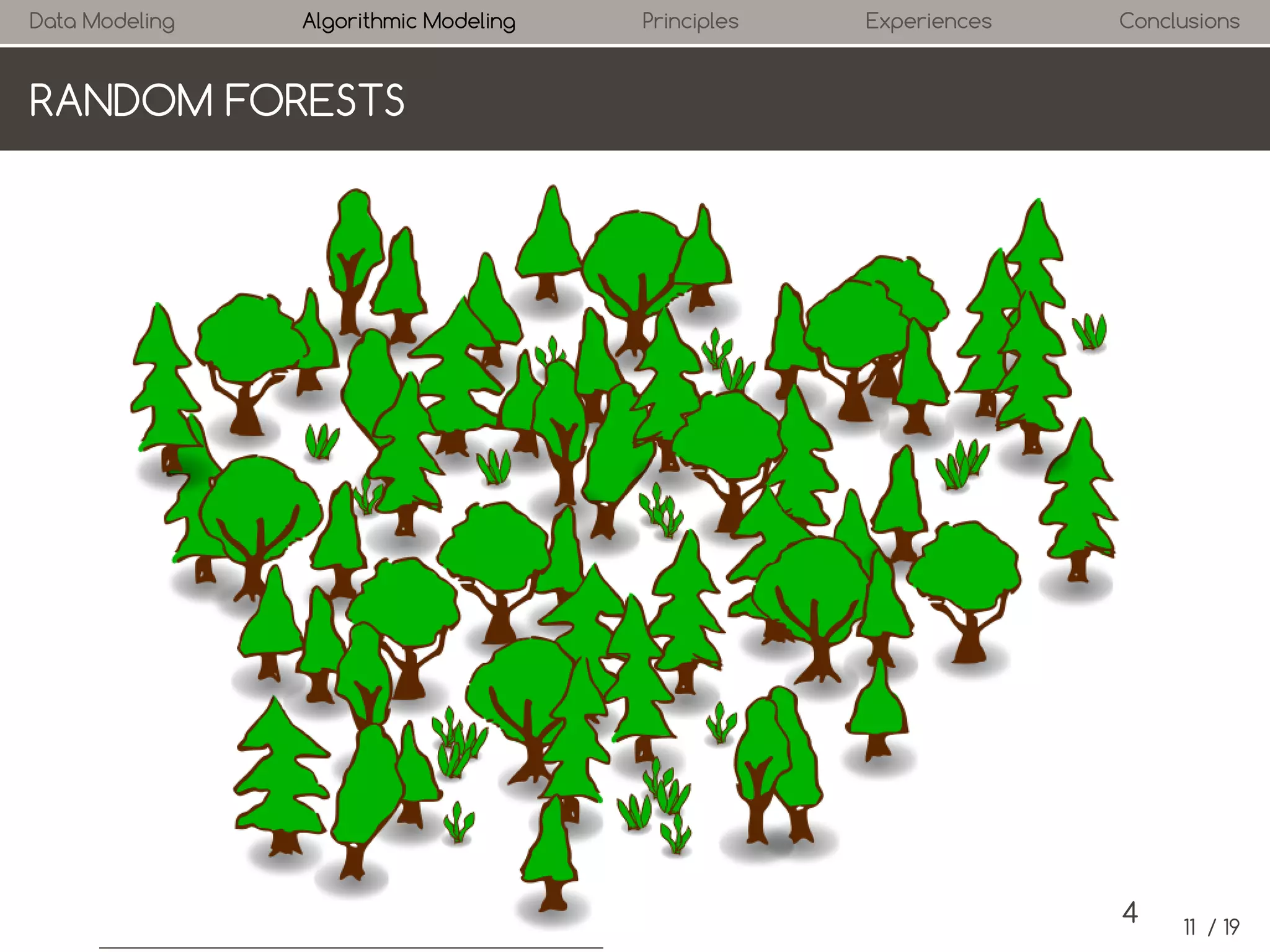
Random Forests™(invented by Leo Breiman) are used for
regression and classification. A Random Forest consists of
many decision trees. Two random mechanisms are used to
train different trees on the data. Results from all trees are
averaged for the prediction.
STATISTICAL LEARNING PRINCIPLES
Data Modeling

Algorithmic Modeling

Principles

Experiences

Conclusions

RASHOMON EFFECT

(Often) Many different models describe a situation
equally accurate.

12 / 19
2014-01-20

.

.
Statistical Modeling: The Two Cultures

RASHOMON EFFECT

Principles
(Often) Many different models describe a situation
equally accurate.

Rashomon Effect
.
.

Rashomon is a Japanese movie in which four witnesses tell
different versions of a crime. All versions account for the facts
but they contradict each other. In terms of statistical learning
this means, that often different models (e.g. same y but
different covariates) can be equally accurate. Each model has
a different interpretation which makes it difficult to find the
true mechanism in the data modeling cultures. In the
algorithmic modeling culture the Rashomon effect is exploited
by aggregating over many models. Random forests use this
effect by aggregating over many trees. It is also common to
average the predictions of different algorithms.
Data Modeling

Algorithmic Modeling

Principles

Experiences

Conclusions

DIMENSIONALITY OF THE DATA

→ The higher the dimensionality of the data (#
covariates) the more difficult is the separation of
signal and noise
→ Common practice in data modeling: variable selection
(by expert selection or data driven) and reduction of
dimensionality (e.g. PCA)
→ Common practice in algorithmic modeling:
Engineering of new features (covariates) to increase
predictive accuracy; algorithms robust for many
covariates

13 / 19
Data Modeling

Algorithmic Modeling

Principles

Experiences

Conclusions

PREDICTION VS. INTERPRETATION

Predictive accuracy
Interpretability

.

Tree
Logist. Regression
…

Random Forest
Neuronal networks
…

14 / 19
2014-01-20

.

.
Statistical Modeling: The Two Cultures

PREDICTION VS. INTERPRETATION

Principles

Predictive accuracy
Interpretability

.

Tree
Logist. Regression

Prediction vs. Interpretation

…

.
.

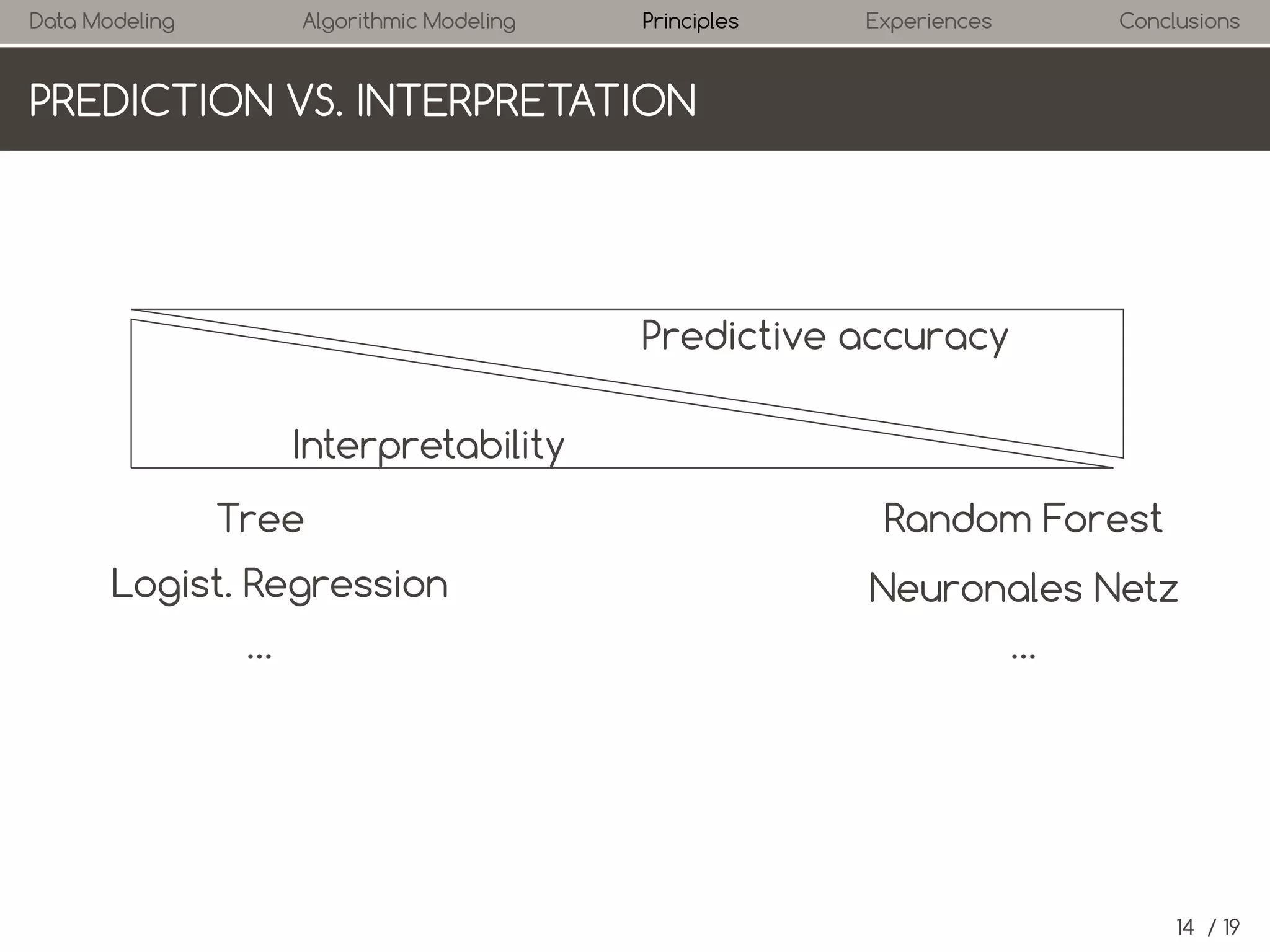
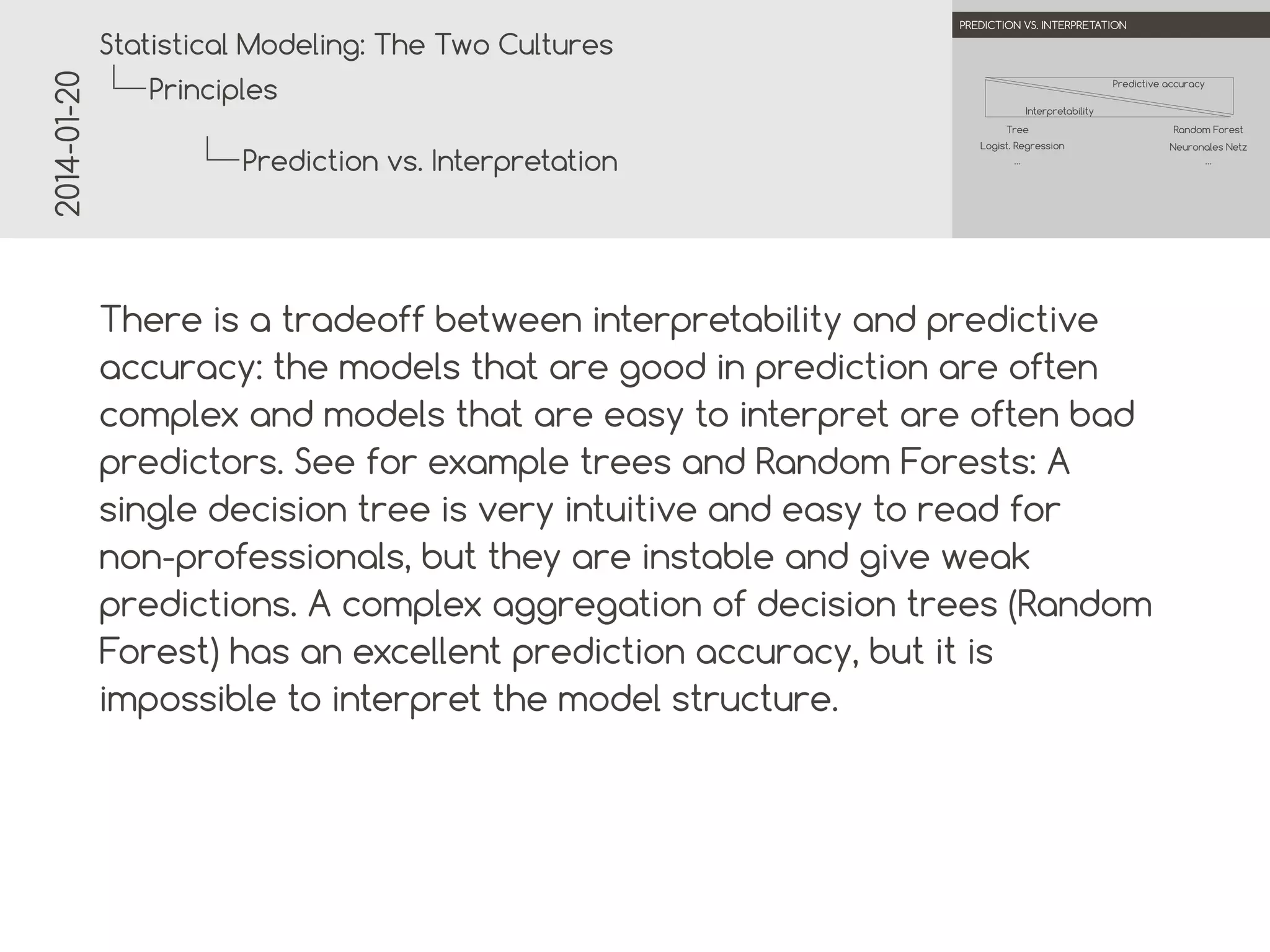
There is a trade-off between interpretability and predictive
accuracy: the models that are good in prediction are often
complex and models that are easy to interpret are often bad
predictors. See for example trees and Random Forests: A
single decision tree is very intuitive and easy to read for
non-professionals, but they are unstable and give weak
predictions. A complex aggregation of decision trees (Random
Forest) has an excellent prediction accuracy, but it is
impossible to interpret the model structure.

Random Forest
Neuronal networks
…
Data Modeling

Algorithmic Modeling

Principles

Experiences

Conclusions

GOODNESS OF MODEL

→ Data modeling culture: Goodness of fit often based
on model assumptions (e.g. AIC) and calculated on
training data.
→ Algorithmic modeling culture: Evaluation of predictive
accuracy with an extra test set or cross validation.
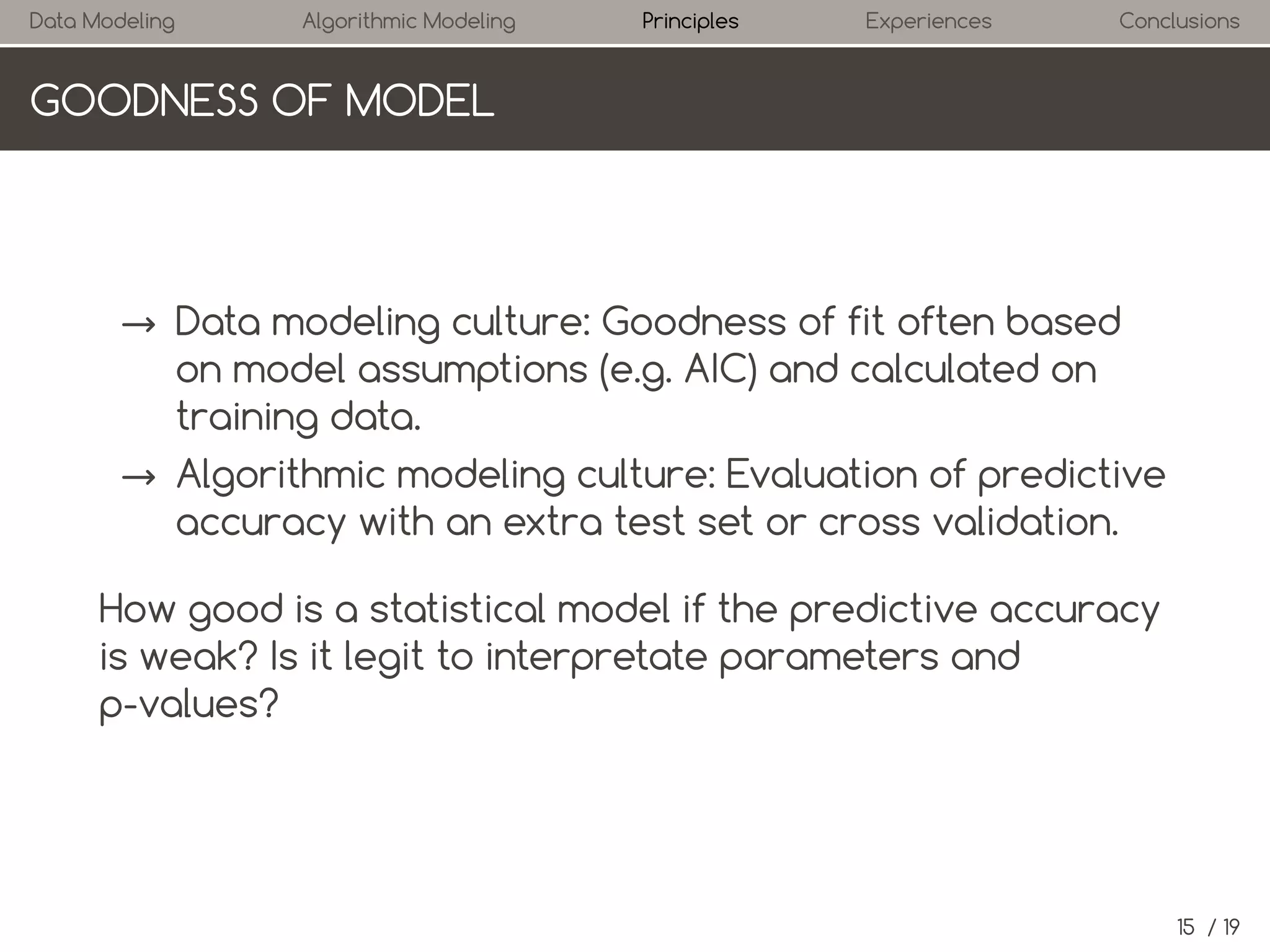
How good is a statistical model if the predictive accuracy
is weak? Is it legit to interpret parameters and p-values?

15 / 19
PERSONAL EXPERIENCES
Data Modeling

Algorithmic Modeling

Principles

Experiences

Conclusions

STATISTICAL CONSULTING

Stereotypical user ...
→ are e.g. veterinarians, linguists, biologists, …
→ crave p-values
→ want interpretability
→ ignore model diagnosis

16 / 19
2014-01-20

.

.
Statistical Modeling: The Two Cultures

STATISTICAL CONSULTING

Experiences

Stereotypical user ...
→ are e.g. veterinarians, linguists, biologists, …
→ crave p-values
→ want interpretability
→ ignore model diagnosis

Statistical Consulting
.
.

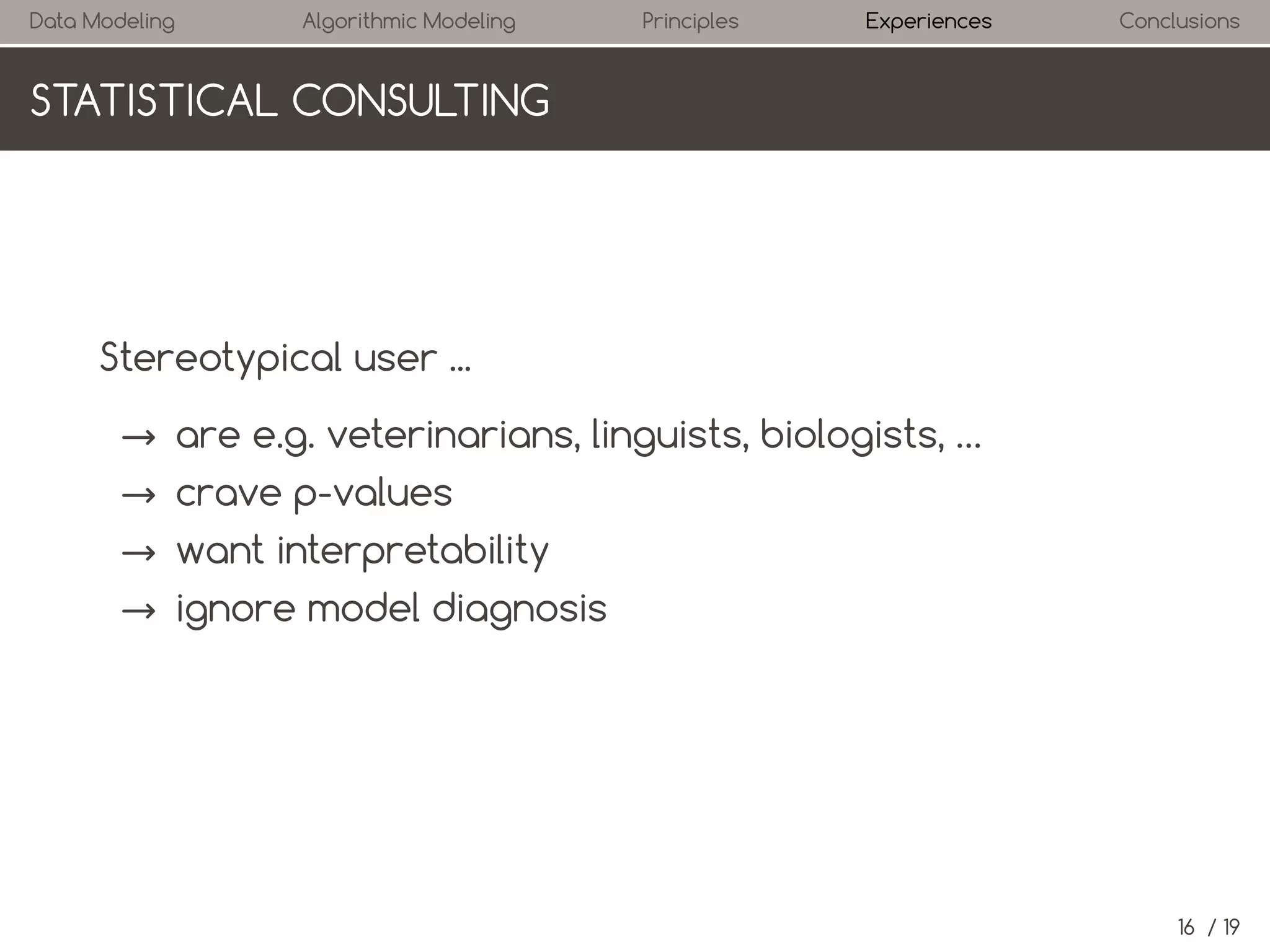
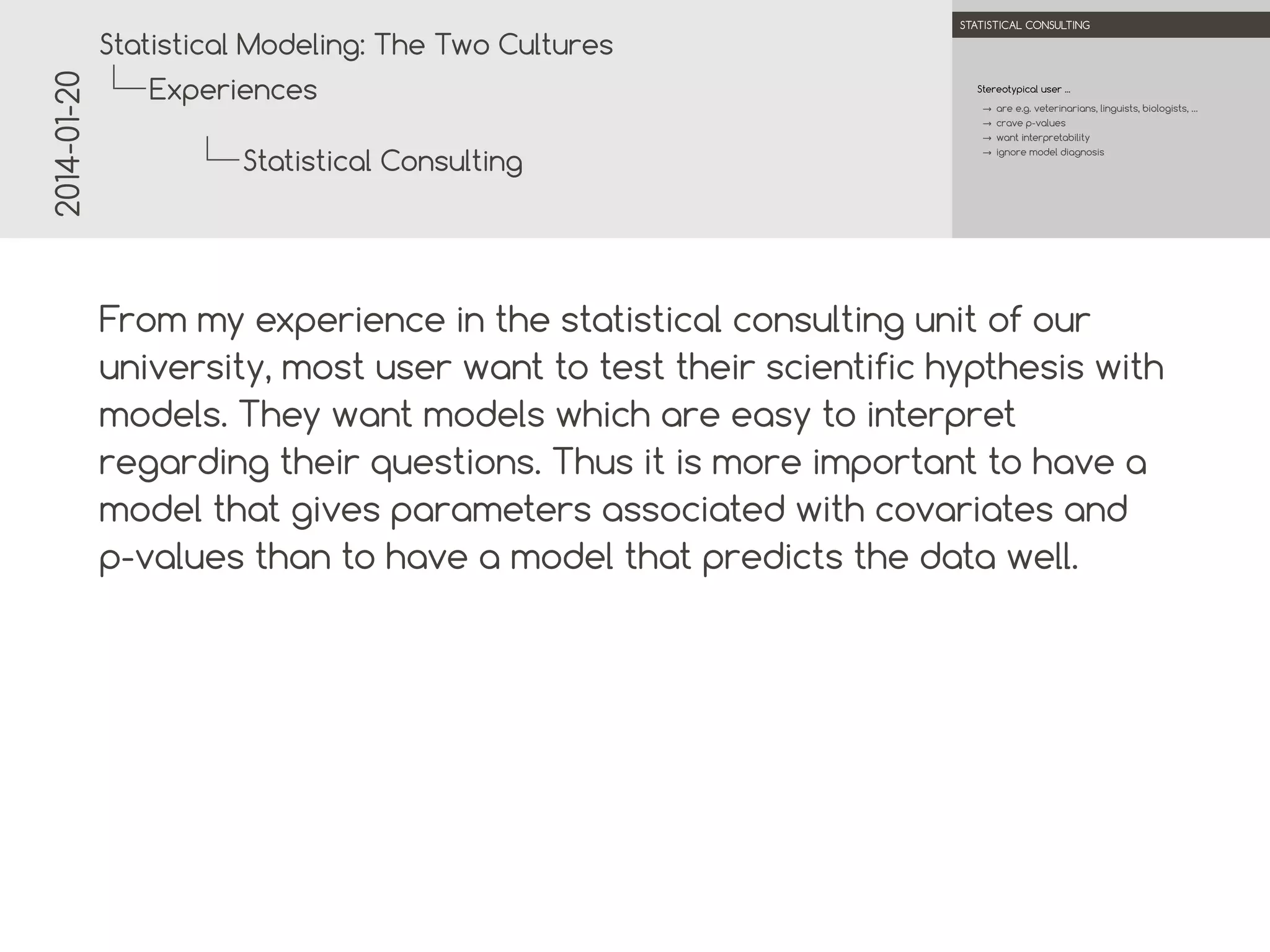
From my experience in the statistical consulting unit of our
university, most user want to test their scientific hypothesis
with models. They want models which are easy to interpret
regarding their questions. Thus it is more important to have a
model that gives parameters associated with covariates and
p-values than to have a model that predicts the data well.
Data Modeling

Algorithmic Modeling

Principles

Experiences

Conclusions

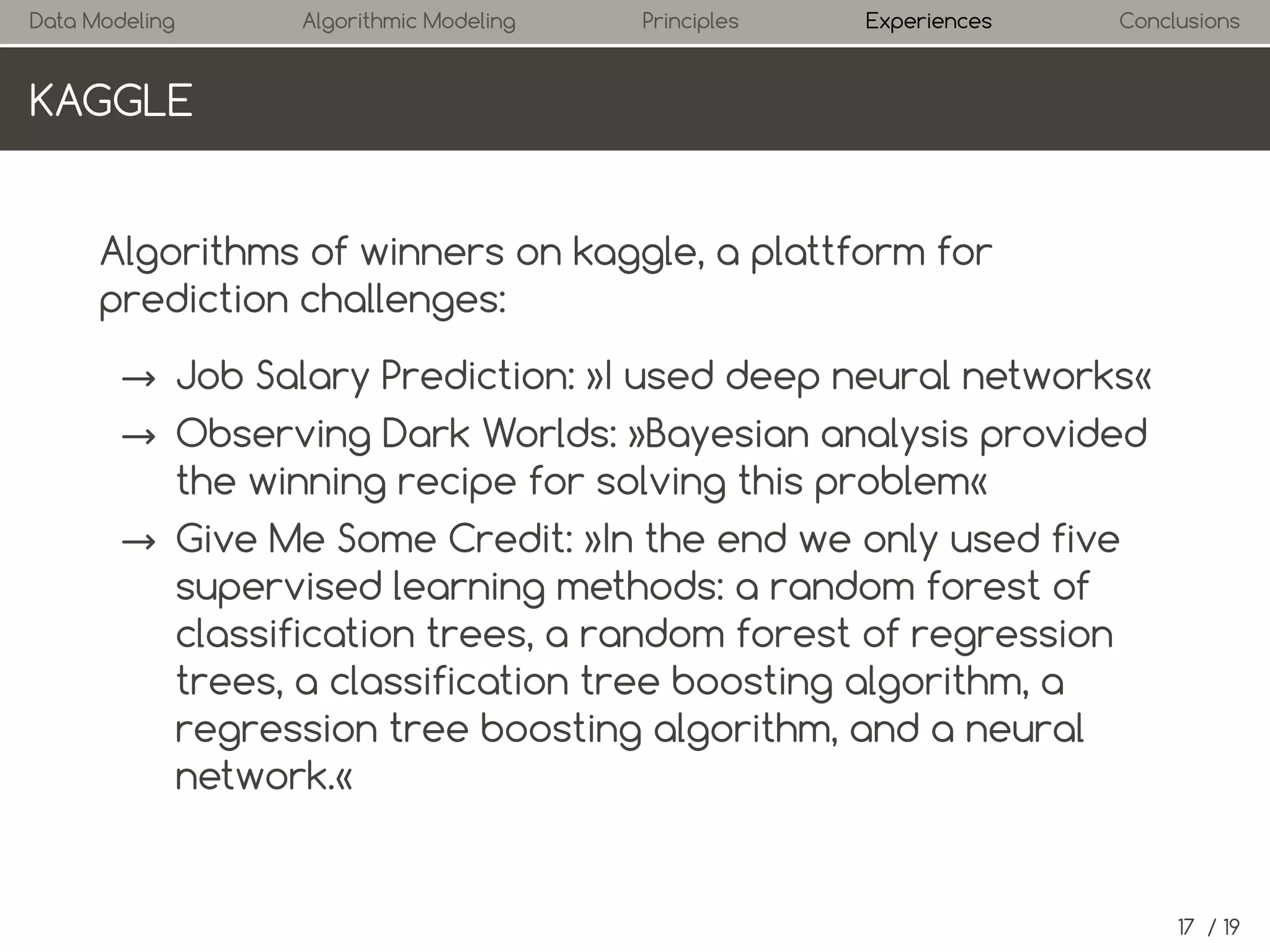
KAGGLE

Algorithms of winners on kaggle, a platform for
prediction challenges:
→ Job Salary Prediction: »I used deep neural networks«
→ Observing Dark Worlds: »Bayesian analysis provided
the winning recipe for solving this problem«
→ Give Me Some Credit: »In the end we only used five
supervised learning methods: a random forest of
classification trees, a random forest of regression
trees, a classification tree boosting algorithm, a
regression tree boosting algorithm, and a neural
network.«

17 / 19
2014-01-20

.

.
Statistical Modeling: The Two Cultures

KAGGLE

Algorithms of winners on kaggle, a platform for
prediction challenges:

Experiences

→ Job Salary Prediction: »I used deep neural networks«
→ Observing Dark Worlds: »Bayesian analysis provided
the winning recipe for solving this problem«
→ Give Me Some Credit: »In the end we only used five
supervised learning methods: a random forest of
classification trees, a random forest of regression
trees, a classification tree boosting algorithm, a
regression tree boosting algorithm, and a neural
network.«

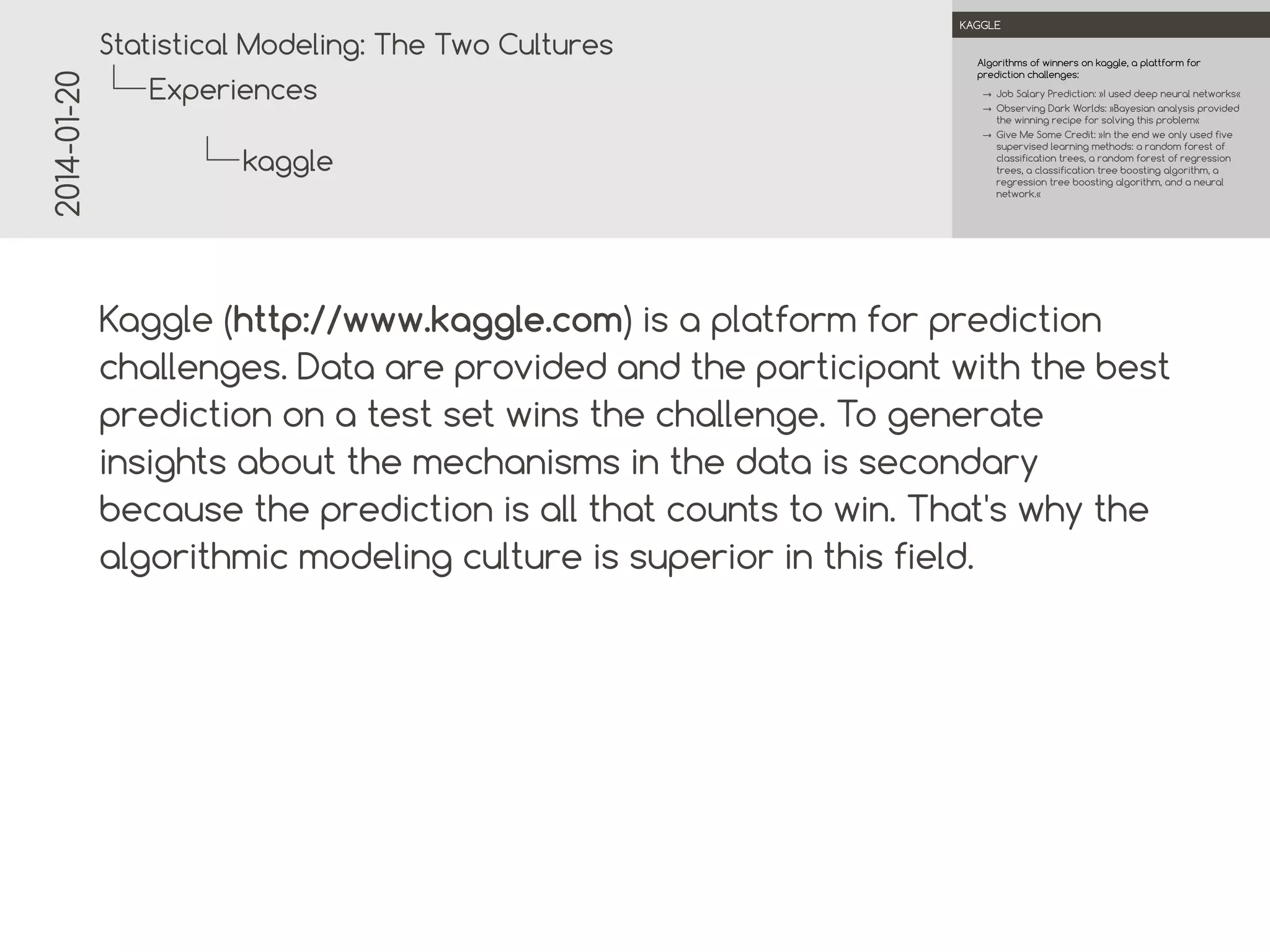
kaggle
.
.

Kaggle (http://www.kaggle.com) is a platform for prediction
challenges. Data are provided and the participant with the best
prediction on a test set wins the challenge. To generate
insights about the mechanisms in the data is secondary
because the prediction is all that counts to win. That's why the
algorithmic modeling culture is superior in this field.
Data Modeling

Algorithmic Modeling

Principles

Experiences

Conclusions

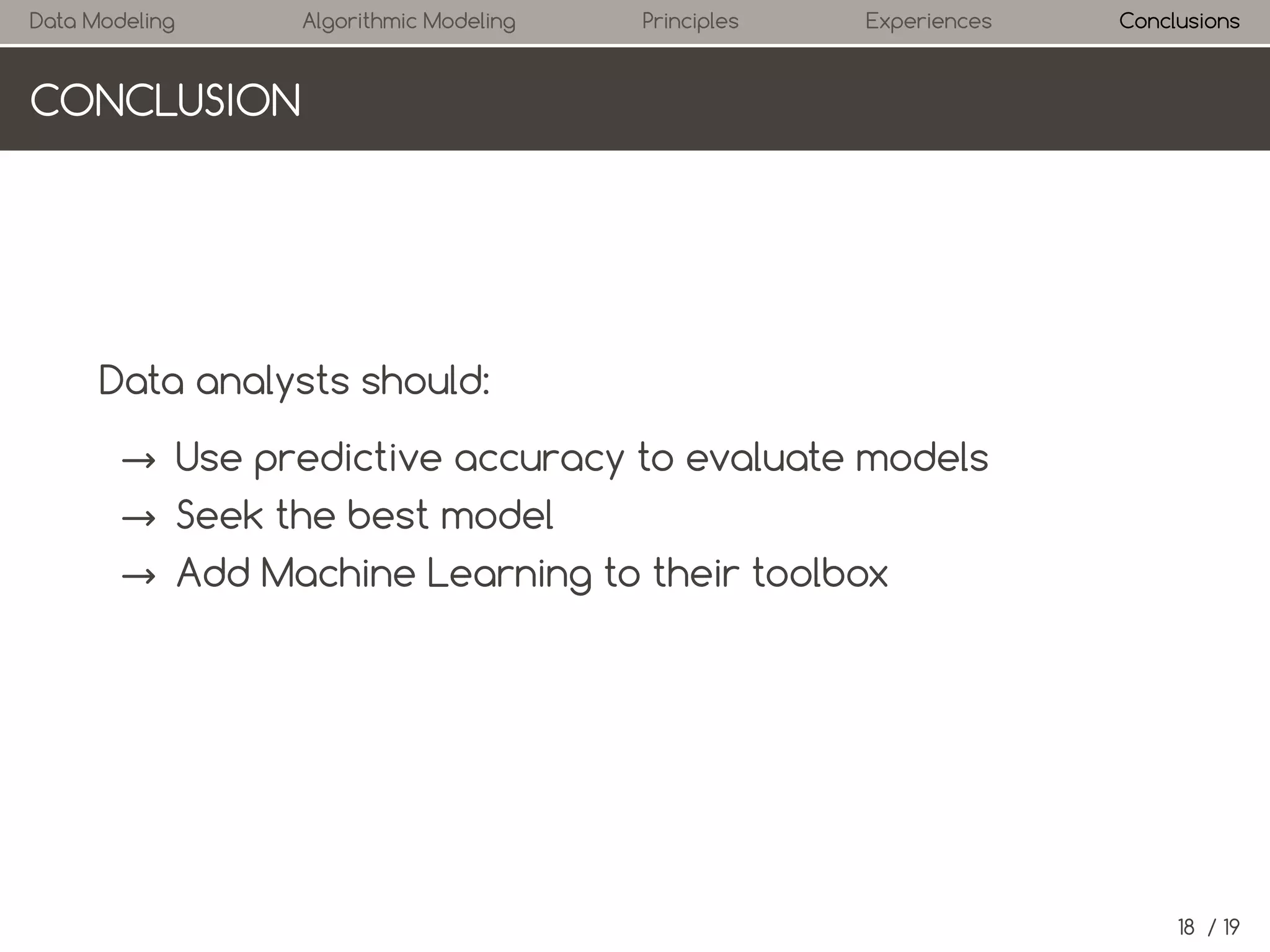
CONCLUSION

Data analysts should:
→ Use predictive accuracy to evaluate models
→ Seek the best model
→ Add Machine Learning to their toolbox

18 / 19
Data Modeling

Algorithmic Modeling

Principles

Experiences

Conclusions

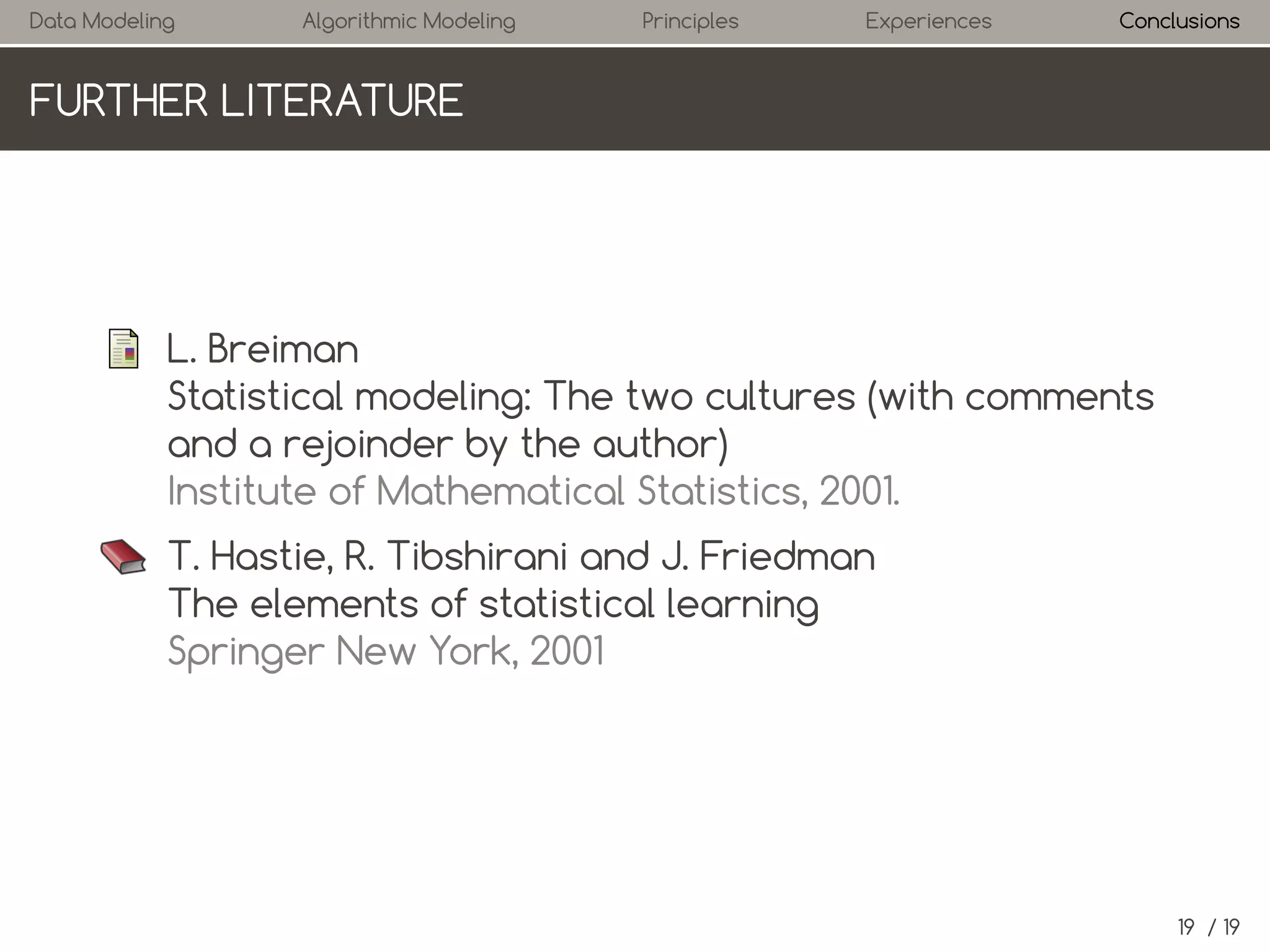
FURTHER LITERATURE

L. Breiman
Statistical modeling: The two cultures (with comments
and a rejoinder by the author)
Institute of Mathematical Statistics, 2001.
T. Hastie, R. Tibshirani and J. Friedman
The elements of statistical learning
Springer New York, 2001

19 / 19
»All models are wrong, but some are useful« (G. Box)

Statistical Modeling: The Two Cultures

  • 1.
    STATISTICAL MODELING: THE TWOCULTURES Based on Leo Breiman's paper Christoph Molnar Department of Statistics, LMU Munich
  • 2.
    2014-01-20 . . Statistical Modeling: TheTwo Cultures STATISTICAL MODELING: THE TWO CULTURES Based on Leo Breiman's paper . Christoph Molnar Department of Statistics, LMU Munich . Abstract: This presentation compares two cultures of statistical modeling: the data modeling culture, which assumes a stochastic process that produced the data. This culture is associated with traditional statistics. The other culture is called algorithmic modeling culture, which can be reduced to optimization of a loss function with an algorithm. This culture is associated with Machine Learning. It is argued to use algorithmic modeling more often in statistics.
  • 3.
    Data Modeling Algorithmic Modeling Principles Experiences Conclusions OUTLINE 1.Statistics: Data Modeling Culture 2. Machine Learning: Algorithmic Modeling Culture 3. Statistical Learning Principles 4. Personal Experience 5. Summary Content heavily based on: ``Statistical Modeling: The two cultures'' from Leo Breiman [1] 1 / 19
  • 4.
    2014-01-20 . . Statistical Modeling: TheTwo Cultures OUTLINE 1. Statistics: Data Modeling Culture 2. Machine Learning: Algorithmic Modeling Culture 3. Statistical Learning Principles 4. Personal Experience Outline 5. Summary . Content heavily based on: ``Statistical Modeling: The two cultures'' from Leo Breiman [1] . This presentation is based on ``Statistical Modeling: The two cultures'' from Leo Breiman [1]. The first segment introduces the data modeling culture and analogously the second segment explains the algorithmic modeling culture together with the presentation of three algorithms. The part about statistical learning principals presents aspects which help to compare both of cultures. Personal experiences in both cultures are addressed. The conclusion summarizes the message of the paper [1].
  • 5.
  • 6.
    Data Modeling Algorithmic Modeling Principles Experiences Conclusions WORKOF A DATA ANALYST → Predict → Reveal associations → Munge data, design experiments, visualize data, … 2 / 19
  • 7.
    2014-01-20 . . Statistical Modeling: TheTwo Cultures WORK OF A DATA ANALYST Data Modeling → Predict → Reveal associations → Munge data, design experiments, visualize data, … Work of a Data Analyst . . The work of a data analyst is very diverse. This presentation focuses on the modeling of data, which can be reduced to two targets: Learn a model to predict the outcome for new covariates and get a better understanding about the relationship between covariates and outcome.
  • 8.
  • 9.
    2014-01-20 . . Statistical Modeling: TheTwo Cultures SIMPLIFIED WORLDVIEW Data Modeling y . nature Simplified worldview . . In a strongly simplified world an arbitrary outcome y is produced by the nature given the covariates x. The knowledge about the natures true mechanisms range between entirely unknown and established (scientific) explanations of the mechanism. One example: Outcome y is the rent for apartments and covariates x are size, number of bathrooms and location. x
  • 10.
    Data Modeling Algorithmic Modeling Principles Experiences Conclusions DATAMODELING CULTURE y Logistic Regression, . Cox Model, GEE, … x Find a stochastic model of the data-generating process: y = f(x, parameters, random error) 4 / 19
  • 11.
    2014-01-20 . . Statistical Modeling: TheTwo Cultures DATA MODELING CULTURE Data Modeling y Data Modeling Culture Logistic Regression, . Cox Model, GEE, … x Find a stochastic model of the data-generating process: y = f(x, parameters, random error) . . The direct modeling of the mechanism in the ``box'' is labeled »Data Modeling Culture« by Leo Breiman. In this culture a stochastic model for the data- generating process is assumed. A common formulation of these model is: y is a function of x with corresponding weights and a random error. For example: Given the covariates size, number of bathrooms and location, the rent of apartments is normal distributed.
  • 12.
    Data Modeling Algorithmic Modeling Principles Experiences Conclusions TYPICALASSUMPTIONS AND RESTRICTIONS → Specific stochastic model that generated the data → Distribution of residuals → Linearity (e.g. linear predictor) → Manual specification of interactions 5 / 19
  • 13.
    Data Modeling Algorithmic Modeling Principles Experiences Conclusions PROBLEMS →Conclusions about model, not about nature → Assumptions often violated → Often no model evaluation → ⇒ can lead to irrelevant theory and questionable statistical conclusions → Focus not on prediction → Data models fail in areas like image and speech recognition 6 / 19
  • 14.
  • 15.
    Data Modeling Algorithmic Modeling Principles Experiences Conclusions MACHINELEARNING y . unknown x algorithm Find a function f (X) that minimizes the loss: L(Y, f (X)) 7 / 19
  • 16.
    2014-01-20 . . Statistical Modeling: TheTwo Cultures MACHINE LEARNING y Algorithmic Modeling Machine Learning . unknown x algorithm Find a function f (X) that minimizes the loss: L(Y, f (X)) . . In the »Algorithmic Modeling Culture«, the true mechanism is treated as unknown. It is not the target to find the true data-generating mechanism but to use an algorithm that imitates the mechanism as good as possible. Modeling is reduced to a mere problem of function optimization: Given the covariates x, outcome y and a loss function find a function f(x) which minimizes the loss for the prediction of the outcome. This culture is lived in the machine learning area. Summary: The data modeling culture tries to find the true data-generating mechanism, the algorithmic modeling culture tries to imitate the true mechanism as good as possible.
  • 17.
    Data Modeling Algorithmic Modeling Principles Experiences Conclusions ALGORITHMIN MACHINE LEARNING → Boosting → Support Vector Machines → Artificial neural networks → Random Forests → Hidden Markov → Bayes-Nets → …1 1 Details and more algorithms in ``Elements of statistical learning''[2] 8 / 19
  • 18.
    2014-01-20 . . Statistical Modeling: TheTwo Cultures ALGORITHM IN MACHINE LEARNING → Boosting Algorithmic Modeling → Support Vector Machines → Artificial neural networks → Random Forests → Hidden Markov → Bayes-Nets Algorithm in Machine Learning → …1 . 1 Details and more algorithms in ``Elements of statistical learning''[2] . The algorithms used in machine learning are motivated differently. Three algorithms are presented in short.
  • 19.
    Data Modeling Algorithmic Modeling Principles Experiences Conclusions ARTIFICIALNEURAL NETWORKS 2 2 http://commons.wikimedia.org/wiki/File: Mouse_cingulate_cortex_neurons.jpg http://commons.wikimedia.org/wiki/File:Neural_network.svg 9 / 19
  • 20.
    2014-01-20 . . Statistical Modeling: TheTwo Cultures ARTIFICIAL NEURAL NETWORKS Algorithmic Modeling Artificial neural networks 2 . 2 http://commons.wikimedia.org/wiki/File: Mouse_cingulate_cortex_neurons.jpg http://commons.wikimedia.org/wiki/File:Neural_network.svg . Artificial neural networks are used in classification and regression. They are inspired by the brain, which consists of a network of brain cells (neurons). Mathematically artificial neural networks are a concatenation of weighted functions. An exemplary application is image processing.
  • 21.
    Data Modeling Algorithmic Modeling Principles Experiences Conclusions SUPPORTVECTOR MACHINES 3 3 http://commons.wikimedia.org/wiki/File:Svm_10_perceptron.JPG 10 / 19
  • 22.
    2014-01-20 . . Statistical Modeling: TheTwo Cultures SUPPORT VECTOR MACHINES Algorithmic Modeling Support Vector Machines 3 . 3 http://commons.wikimedia.org/wiki/File:Svm_10_perceptron.JPG . Support Vector Machines (SVM) were originally a classification method (regression is also possible). SVMs try to draw a border between two classes in the covariate space. The distance between the border and the class points is maximized. They use a mathematical trick to implicitly project the covariates in a space with higher dimensions (yes, it sounds a bit crazy) in order to achieve class separation. Text classification is an exemplary usage.
  • 23.
  • 24.
    2014-01-20 . . Statistical Modeling: TheTwo Cultures RANDOM FORESTS Algorithmic Modeling Random Forests . . 4 4 http://openclipart.org/detail/175304/forest-by-z-175304 Random Forests™(invented by Leo Breiman) are used for regression and classification. A Random Forest consists of many decision trees. Two random mechanisms are used to train different trees on the data. Results from all trees are averaged for the prediction.
  • 25.
  • 26.
    Data Modeling Algorithmic Modeling Principles Experiences Conclusions RASHOMONEFFECT (Often) Many different models describe a situation equally accurate. 12 / 19
  • 27.
    2014-01-20 . . Statistical Modeling: TheTwo Cultures RASHOMON EFFECT Principles (Often) Many different models describe a situation equally accurate. Rashomon Effect . . Rashomon is a Japanese movie in which four witnesses tell different versions of a crime. All versions account for the facts but they contradict each other. In terms of statistical learning this means, that often different models (e.g. same y but different covariates) can be equally accurate. Each model has a different interpretation which makes it difficult to find the true mechanism in the data modeling cultures. In the algorithmic modeling culture the Rashomon effect is exploited by aggregating over many models. Random forests use this effect by aggregating over many trees. It is also common to average the predictions of different algorithms.
  • 28.
    Data Modeling Algorithmic Modeling Principles Experiences Conclusions DIMENSIONALITYOF THE DATA → The higher the dimensionality of the data (# covariates) the more difficult is the separation of signal and noise → Common practice in data modeling: variable selection (by expert selection or data driven) and reduction of dimensionality (e.g. PCA) → Common practice in algorithmic modeling: Engineering of new features (covariates) to increase predictive accuracy; algorithms robust for many covariates 13 / 19
  • 29.
    Data Modeling Algorithmic Modeling Principles Experiences Conclusions PREDICTIONVS. INTERPRETATION Predictive accuracy Interpretability . Tree Logist. Regression … Random Forest Neuronal networks … 14 / 19
  • 30.
    2014-01-20 . . Statistical Modeling: TheTwo Cultures PREDICTION VS. INTERPRETATION Principles Predictive accuracy Interpretability . Tree Logist. Regression Prediction vs. Interpretation … . . There is a trade-off between interpretability and predictive accuracy: the models that are good in prediction are often complex and models that are easy to interpret are often bad predictors. See for example trees and Random Forests: A single decision tree is very intuitive and easy to read for non-professionals, but they are unstable and give weak predictions. A complex aggregation of decision trees (Random Forest) has an excellent prediction accuracy, but it is impossible to interpret the model structure. Random Forest Neuronal networks …
  • 31.
    Data Modeling Algorithmic Modeling Principles Experiences Conclusions GOODNESSOF MODEL → Data modeling culture: Goodness of fit often based on model assumptions (e.g. AIC) and calculated on training data. → Algorithmic modeling culture: Evaluation of predictive accuracy with an extra test set or cross validation. How good is a statistical model if the predictive accuracy is weak? Is it legit to interpret parameters and p-values? 15 / 19
  • 32.
  • 33.
    Data Modeling Algorithmic Modeling Principles Experiences Conclusions STATISTICALCONSULTING Stereotypical user ... → are e.g. veterinarians, linguists, biologists, … → crave p-values → want interpretability → ignore model diagnosis 16 / 19
  • 34.
    2014-01-20 . . Statistical Modeling: TheTwo Cultures STATISTICAL CONSULTING Experiences Stereotypical user ... → are e.g. veterinarians, linguists, biologists, … → crave p-values → want interpretability → ignore model diagnosis Statistical Consulting . . From my experience in the statistical consulting unit of our university, most user want to test their scientific hypothesis with models. They want models which are easy to interpret regarding their questions. Thus it is more important to have a model that gives parameters associated with covariates and p-values than to have a model that predicts the data well.
  • 35.
    Data Modeling Algorithmic Modeling Principles Experiences Conclusions KAGGLE Algorithmsof winners on kaggle, a platform for prediction challenges: → Job Salary Prediction: »I used deep neural networks« → Observing Dark Worlds: »Bayesian analysis provided the winning recipe for solving this problem« → Give Me Some Credit: »In the end we only used five supervised learning methods: a random forest of classification trees, a random forest of regression trees, a classification tree boosting algorithm, a regression tree boosting algorithm, and a neural network.« 17 / 19
  • 36.
    2014-01-20 . . Statistical Modeling: TheTwo Cultures KAGGLE Algorithms of winners on kaggle, a platform for prediction challenges: Experiences → Job Salary Prediction: »I used deep neural networks« → Observing Dark Worlds: »Bayesian analysis provided the winning recipe for solving this problem« → Give Me Some Credit: »In the end we only used five supervised learning methods: a random forest of classification trees, a random forest of regression trees, a classification tree boosting algorithm, a regression tree boosting algorithm, and a neural network.« kaggle . . Kaggle (http://www.kaggle.com) is a platform for prediction challenges. Data are provided and the participant with the best prediction on a test set wins the challenge. To generate insights about the mechanisms in the data is secondary because the prediction is all that counts to win. That's why the algorithmic modeling culture is superior in this field.
  • 37.
    Data Modeling Algorithmic Modeling Principles Experiences Conclusions CONCLUSION Dataanalysts should: → Use predictive accuracy to evaluate models → Seek the best model → Add Machine Learning to their toolbox 18 / 19
  • 38.
    Data Modeling Algorithmic Modeling Principles Experiences Conclusions FURTHERLITERATURE L. Breiman Statistical modeling: The two cultures (with comments and a rejoinder by the author) Institute of Mathematical Statistics, 2001. T. Hastie, R. Tibshirani and J. Friedman The elements of statistical learning Springer New York, 2001 19 / 19
  • 39.
    »All models arewrong, but some are useful« (G. Box)