Data Mining
Data Mining
Gary M. Weiss, Ph.D., Department of Computer and Information Science, Fordham University
Brian D. Davison, Ph.D., Department of Computer Science and Engineering, Lehigh University
Data Mining- Introduction
Data mining is a process that takes data as input and
outputs knowledge.
“the nontrivial process of identifying valid, novel,
potentially useful, and ultimately understandable patterns
in data.”
Note that because the process must be non-trivial,
simple computations and statistical measures are not
considered data mining.
Data Mining- Introduction
Thus predicting which salesperson will make the most
future sales by calculating who made the most sales in
the previous year would not be considered data mining.
It is understood that the process must be at least partially
automated, relying heavily on specialized computer
algorithms (i.e., data mining algorithms) that search for
patterns in the data.
Data Mining- Introduction
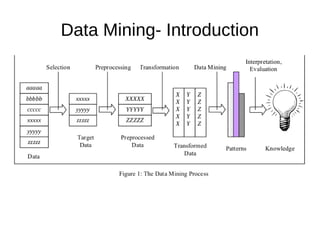
The first three steps in Figure 1 involve preparing the
data for mining. The relevant data must be selected from
a potentially large and diverse set of data, any necessary
preprocessing must then be performed, and finally the
data must be transformed into a representation suitable
for the data mining algorithm that is applied in the data
mining step.
In practice it is common for the data preparations steps
to take more time and effort than the actual data mining
step.
Data Mining- Introduction
The fourth step in the data mining process is the data
mining step. This step involves applying specialized
computer algorithms to identify patterns in the data.
Many of the most common data mining algorithms
including decision tree algorithms and neural network
algorithms etc.....
Thus, anyone undertaking a data mining project should
ensure that sufficient time and effort is allocated to the
data preparation steps.
Data Mining- Introduction
For example, if a decision tree algorithm is used to
predict who will respond to a direct marketing offer, we
can say that the decision tree models how a consumer
will respond to a direct mail offer.
Finally, the results of data mining cannot simply be
accepted,but must be carefully evaluated and
interpreted. As a simple example, in the case of the
direct-mail example just described, we could evaluate the
decision tree based on its accuracy—the percentage of
its predictions that are correct. However, many other
evaluation or performance metrics are possible and for
this specific example return on investment might actually
be a better metric.
The data mining process is an iterative process.
Motivation and Challenges
Data Mining developed as a new discipline for several
reasons. First, the amount of data available for mining
grew at a tremendous pace as computing technology
became widely deployed. Specifically, high speed
networks allowed enormous amount of data to be
transferred and rapidly decreasing disk costs permitted
this data to be stored cost-effectively. The size and scope
of these new datasets is remarkable.
Motivation and Challenges
Data Mining developed as a new discipline for several
reasons. First, the amount of data available for mining
grew at a tremendous pace as computing technology
became widely deployed. Specifically, high speed
networks allowed enormous amount of data to be
transferred and rapidly decreasing disk costs permitted
this data to be stored cost-effectively. The size and scope
of these new datasets is remarkable.
This remarkable growth in the data that is collected and
stored presents many problems.
Motivation and Challenges
1. The scalability of traditional statistical techniques,
which often cannot handle data sets with millions or
billions of records and hundreds or thousands of
variables.
2. A second problem is that much of the data that is
available for analysis, such as text,audio, video and
images, is non-numeric and highly unstructured (i.e.,
cannot be represented by a fixed set of variables). This
data cannot easily be analyzed using traditional statistical
techniques.
3. A third problem is that the number of data analysts has
not matched the exponential growth in the amount of
data, which has caused much of this data to remain
unanalyzed in a “data tomb”.
Motivation and Challenges
Data mining strives to address these challenges.
1. Many data mining algorithms are specifically designed
to be scalable and perform well on very large data sets,
without fixed size limitations, and degrade gracefully as
the size of the data set and the number of variables
increases. Scalable data mining algorithms, unlike many
early machine learning algorithms, should not require
that all data be loaded into and remain in main memory,
since this would prevent very large data sets from being
mined.
Motivation and Challenges
2. A great deal of effort has also been expended to
develop data mining methods to handle non-numeric
data. This includes mining of spatial data ,images, video,
text documents, and the World Wide Web.
3. Data mining also attempts to offload some of the work
from the data analyst so that more of the collected data
can be analyzed.
Statistician -> hypothesis-driven and deductive
Data Mining Process ->data-driven and inductive
Overview of Data Mining Tasks
The best way to gain an understanding of data mining is
to understand the types of tasks, or problems, that it can
address.
Data mining tasks can be categorized into predictive or
descriptive.
Predictive tasks allow one to predict the value of a
variable based on other existing information.
Examples of predictive tasks include predicting when a
customer will leave a company, predicting whether a
transaction is fraudulent or not and identifying the best
customers to receive direct marketing offers.
Overview of Data Mining Tasks
Descriptive tasks summarize the data in some manner.
Examples of such tasks include automatically
segmenting customers based on their similarities and
differences and finding associations between products in
market basket data.
Overview of Data Mining Tasks
Classification and Regression
Classification and regression tasks are predictive tasks
that involve building a model to predict a target, or
dependent, variable from a set of explanatory, or
independent, variables.
Classification tasks the target variable usually has a
small number of discrete values (e.g., “high” and “low”).
eg: Identifying fraudulent credit card transactions
Regression tasks the target variable is continuous.
eg: Predicting future prices of a stock
Overview of Data Mining Tasks
Association Rule Analysis
Association rule analysis is a descriptive data mining task
that involves discovering patterns, or associations,
between elements in a data set. The associations are
represented in the form of rules, or implications. The
most common association rule task is market basket
analysis.
Eg: In this case each data record corresponds to a
transaction (e.g., from a supermarket checkout) and lists
the items that have been purchased as part of the
transaction. One possible association rule from
supermarket data is {Hamburger Meat} -> {Ketchup}
which indicates that those transactions that include
Hamburger Meat tend to also include Ketchup.
Overview of Data Mining Tasks
Cluster Analysis
Cluster analysis is a descriptive data mining task where
the goal is to group similar objects in the same cluster
and dissimilar objects in different clusters.
Applications of clustering include clustering customers for
the purpose of market segmentation and grouping similar
documents together in response to a search engine
request.
Overview of Data Mining Tasks
Text Mining Tasks
Much available data is in the form of unstructured or
semi-structured text, which is very different from
conventional data, which is completely structured.
Text is unstructured if there is no predetermined format,
or structure, to the data. Text is semi-structured if there is
structure associated with some of the data, as in the
case for web pages.
While text mining tasks often fall into the classification,
clustering and association rule mining categories.
Overview of Data Mining Tasks
Text Mining Tasks
Example applications of text mining includes the
identification of specific noun phrases such as people,
products and companies, which can then be used in
more sophisticated co-occurrence analysis to find non-
obvious relationships among people or organizations.
A second application area that is growing in importance is
sentiment analysis, in which blogs, discussion boards,
and reviews are analyzed for opinions about products or
brands.
Overview of Data Mining Tasks
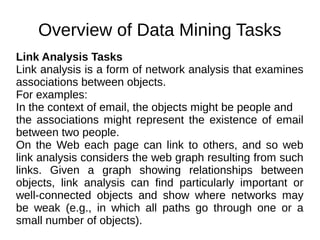
Link Analysis Tasks
Link analysis is a form of network analysis that examines
associations between objects.
For examples:
In the context of email, the objects might be people and
the associations might represent the existence of email
between two people.
On the Web each page can link to others, and so web
link analysis considers the web graph resulting from such
links. Given a graph showing relationships between
objects, link analysis can find particularly important or
well-connected objects and show where networks may
be weak (e.g., in which all paths go through one or a
small number of objects).
Overview of Data Mining Tasks
PREDICTION TASKS: CLASSIFICATION AND
REGRESSION
Classification and regression tasks are the most
commonly encountered data mining tasks. These tasks
involve mapping an object to either one of a set of
predefined classes (classification) or to a numerical value
(regression).
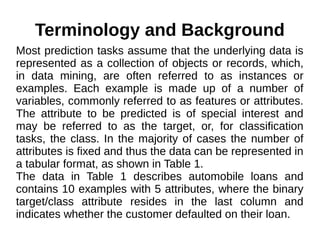
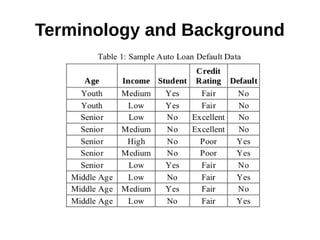
Terminology and Background
Most prediction tasks assume that the underlying data is
represented as a collection of objects or records, which,
in data mining, are often referred to as instances or
examples. Each example is made up of a number of
variables, commonly referred to as features or attributes.
The attribute to be predicted is of special interest and
may be referred to as the target, or, for classification
tasks, the class. In the majority of cases the number of
attributes is fixed and thus the data can be represented in
a tabular format, as shown in Table 1.
The data in Table 1 describes automobile loans and
contains 10 examples with 5 attributes, where the binary
target/class attribute resides in the last column and
indicates whether the customer defaulted on their loan.
Terminology and Background
This data in Table 1 can be used to build a predictive
model to classify customers based on whether they will
default on their loan. That is, the model generated by the
data mining algorithm will take the values for the age,
income, student, and credit-rating attributes and map
them to “Yes” or “No”. The induced classification model
could take many forms and Figure 2 provides a plausible
result for a rule-based learning algorithm.
Terminology and Background
In this case each rule in Figure 2 is evaluated in order
and the classification is determined by the first rule for
which the left-hand side evaluates to true. In this case, if
the first two rules do not fire, then the third one is
guaranteed to fire and thus acts as a default rule. Note
that the three rules in Figure 2 can be used to correctly
classify all ten examples in Table 1.
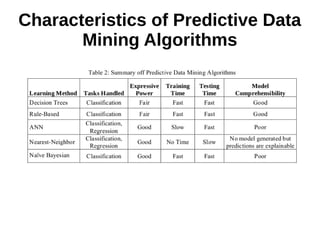
Characteristics of Predictive Data
Mining Algorithms
Predictive Data Mining
Algorithms
Decision Trees
Decision tree algorithms are a very popular class of
learning algorithms for classification tasks.
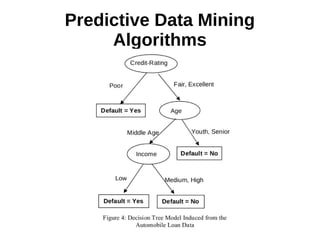
A sample decision tree, generated from the automobile
loan data in Table 1, is shown in Figure 4. The internal
nodes of the decision tree each represent an attribute
while the terminal nodes (i.e., leaf nodes displayed as
rectangles) are labeled with a class value. Each branch is
labeled with an attribute value, and, when presented with
an example, one follows the branches that match the
attribute values for the example, until a leaf node is
reached.
Predictive Data Mining
Algorithms
Decision Trees
The class value assigned to the leaf node is then used as
the predicted value for the example. In this simple
example the decision tree will predict that a customer will
default on their automobile loan if their credit rating is
“poor” or it is not “poor” (i.e., “fair” or “excellent”) but the
person is “middle aged” and their income level is “low”.
Predictive Data Mining
Algorithms
Decision Trees
The class value assigned to the leaf node is then used as
the predicted value for the example. In this simple
example the decision tree will predict that a customer will
default on their automobile loan if their credit rating is
“poor” or it is not “poor” (i.e., “fair” or “excellent”) but the
person is “middle aged” and their income level is “low”.
Predictive Data Mining
Algorithms
Predictive Data Mining
Algorithms
Decision Trees
Advantages:
● The main reason for this is that the induced decision
tree model is easy to understand.
● The decision tree model can be generated quickly and
new examples can be classified quickly using the
induced model.
Disadvantages:
● The primary disadvantage of a decision tree algorithm
is that it has limited expressive power, namely because
only one attribute can be considered at a time.
● Decision trees cannot handle regression tasks,
Predictive Data Mining
Algorithms
Rule-based Classifiers
Rule-based classifiers generate classification rules, such
as the rule set shown earlier in Figure 2. The way in
which classifications are made from a rule set varies. For
some rule-based systems the first rule to fire (i.e., have
the left-hand side of the rule satisfied) determines the
classification, whereas in other cases all rules are
evaluated and the final classification is made based on a
voting scheme.
Predictive Data Mining
Algorithms
Rule-based Classifiers
Rule-based classifiers are very similar to decision-tree
learners and have similar expressive power, computation
time, and comprehensibility. The connection between
these two classification methods is even more direct
since any decision tree can trivially be converted into a
set of mutually exclusive rules, by creating one rule
corresponding to the path from the root of the tree to
each leaf.
Predictive Data Mining
Algorithms
Artificial Neural Networks
Artificial Neural Networks (ANNs) were originally inspired
by attempts to simulate some of the functions of the brain
and can be used for both classification and regression
tasks.
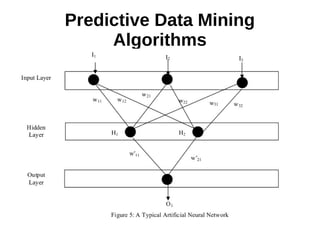
An ANN is composed of an interconnected set of nodes
that includes an input layer, zero or more hidden layers,
and an output layer. The links between nodes have
weights associated with them.
Predictive Data Mining
Algorithms
Predictive Data Mining
Algorithms
Artificial Neural Networks
The ANN in Figure 5 accepts three inputs, I 1 , I 2 , and I
3 and generates a single output O 1 . The ANN computes
the output value from the input values as follows.
First, the input values are taken from the attributes of the
training example, as it is inputted to the ANN. These
values are then weighted and fed into the next set of
nodes, which in this example are H 1 and H 2.
Predictive Data Mining
Algorithms
Artificial Neural Networks
A non-linear activation function is then applied to this
weighted sum and then the resulting value is passed to
the next layer, where this process is repeated, until the
final value(s) are outputted.
The ANN learns by incrementally modifying its weights so
that, during the training phase, the predicted output value
moves closer to the observed value.
The most popular algorithm for modifying the weights is
the backpropagation algorithm.
Predictive Data Mining
Algorithms
Artificial Neural Networks
ANNs can naturally handle regression tasks, since
numerical values are passed through the nodes and are
ultimately passed through to the output layer. However,
ANNs can also handle classification tasks by
thresholding on the output values.
ANNs have a great deal of expressive power and are not
subject to the same limitations as decision trees.
In fact, most ANNs are universal approximators in that
they can approximate any continuous function to any
degree of accuracy.
Predictive Data Mining
Algorithms
Artificial Neural Networks
However, this power comes at a cost. While the induced
ANN can be used to quickly predict the values for
unlabelled examples, training the model takes much
more time than training a decision tree or rule-based
learner and, perhaps most significantly, the ANN model is
virtually incomprehensible and therefore cannot be used
to explain or justify its predictions.
Predictive Data Mining
Algorithms
Nearest-Neighbor
Nearest-neighbor learners are very different from any of
the learning methods just described in that no explicit
model is ever built.
That is, there is no training phase and instead all of the
work associated with making the prediction is done at the
time an example is presented.
Given an example the nearest-neighbor method first
determines the k most similar examples in the training
data and then determines the prediction based on the
class values associated with these k examples, where k
is a user-specified parameter.
Predictive Data Mining
Algorithms
Nearest-Neighbor
The simplest scheme is to predict the class value that
occurs most frequently in the k examples, while more
sophisticated schemes might use weighted voting, where
those examples most similar to the example to be
classified are more heavily weighted.
For example, realtors typically base the sales price of a
new home on the sales price of similar homes that were
recently sold in the area.
Nearest-neighbor learning is sometimes referred to as
instance-based learning.
Predictive Data Mining
Algorithms
Nearest-Neighbor
Nearest-neighbor algorithms are typically used for
classification tasks, although they can also be used for
regression tasks.
These algorithms also have a great deal of expressive
power.
Nearest-neighbor algorithms generate no explicit model
and hence have no training time.
Instead, all of the computation is performed at testing
time and this process may be relatively slow
Predictive Data Mining
Algorithms
Nearest-Neighbor
since all training examples may need to be examined. It
is difficult to evaluate the comprehensibility of the model
since none is produced.
However, individual predictions can easily be explained
and justified in a very natural way, by referring to the
nearest-neighbors.
not produce a comprehensible model but its predictions
are explainable.
Predictive Data Mining
Algorithms
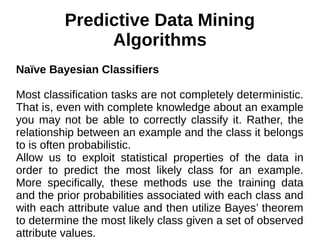
Naïve Bayesian Classifiers
Most classification tasks are not completely deterministic.
That is, even with complete knowledge about an example
you may not be able to correctly classify it. Rather, the
relationship between an example and the class it belongs
to is often probabilistic.
Allow us to exploit statistical properties of the data in
order to predict the most likely class for an example.
More specifically, these methods use the training data
and the prior probabilities associated with each class and
with each attribute value and then utilize Bayes’ theorem
to determine the most likely class given a set of observed
attribute values.
Predictive Data Mining
Algorithms
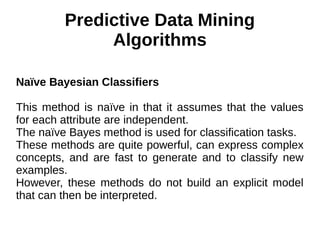
Naïve Bayesian Classifiers
This method is naïve in that it assumes that the values
for each attribute are independent.
The naïve Bayes method is used for classification tasks.
These methods are quite powerful, can express complex
concepts, and are fast to generate and to classify new
examples.
However, these methods do not build an explicit model
that can then be interpreted.
Predictive Data Mining
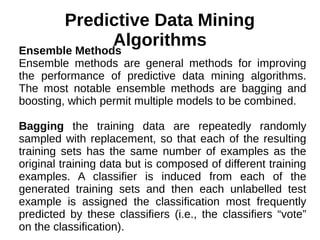
AlgorithmsEnsemble Methods
Ensemble methods are general methods for improving
the performance of predictive data mining algorithms.
The most notable ensemble methods are bagging and
boosting, which permit multiple models to be combined.
Bagging the training data are repeatedly randomly
sampled with replacement, so that each of the resulting
training sets has the same number of examples as the
original training data but is composed of different training
examples. A classifier is induced from each of the
generated training sets and then each unlabelled test
example is assigned the classification most frequently
predicted by these classifiers (i.e., the classifiers “vote”
on the classification).
Predictive Data Mining
Algorithms
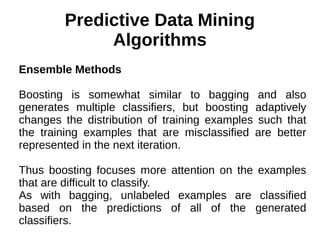
Ensemble Methods
Boosting is somewhat similar to bagging and also
generates multiple classifiers, but boosting adaptively
changes the distribution of training examples such that
the training examples that are misclassified are better
represented in the next iteration.
Thus boosting focuses more attention on the examples
that are difficult to classify.
As with bagging, unlabeled examples are classified
based on the predictions of all of the generated
classifiers.
Predictive Data Mining
Algorithms
Ensemble Methods
Most data mining packages now implement a variety of
ensemble methods, including boosting and bagging.
Most of these packages also permit different models
(e.g., a neural network model and a decision tree model)
to be combined so that, in theory, one can get the best
aspects of each.
ASSOCIATION ANALYSIS
Many businesses maintain huge databases of
transactional data, which might include all purchases
made from suppliers or all customer sales.
Association analysis attempts to find patterns either
within or between these transactions.
Simple Example using Market Basket Data
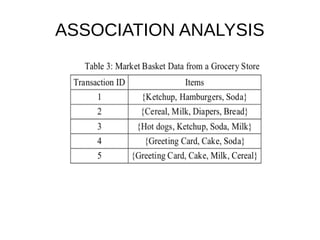
Consider the data in Table 3, which includes five
transactions associated with purchases at a grocery
store. These data are referred to as market basket data
since each transaction includes the items found in a
customer’s shopping “basket” during checkout. Each
record contains a transaction identifier and then a list all
of the items purchased as part of the transaction.
ASSOCIATION ANALYSIS
The data in Table 3 are very different from the relational
data used for predictive data mining, such as the data in
Table 1, where each record is composed of a fixed
number of fields. Here the key piece of data is a variable-
length list of items, in which the list only indicates the
presence or absence of an item—not the number of
instances purchased.
In market basket analysis, a specific instance of
association analysis, the goal is to find patterns between
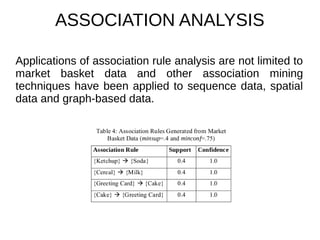
items purchased in the same transaction. As an example,
using the limited data in Table 3, a data mining algorithm
might generate the association rule {Ketchup} -> {Soda},
indicating that a customer that purchases Ketchup is
likely to also purchase Soda.
ASSOCIATION ANALYSIS
Applications of association rule analysis are not limited to
market basket data and other association mining
techniques have been applied to sequence data, spatial
data and graph-based data.
ASSOCIATION ANALYSIS
Generation and Evaluation of Association Rules
There are many algorithms for performing association
rule analysis, but the earliest and most popular such
algorithm is the Apriori algorithm.
This algorithm, as well as most others, utilizes two
stages.
In the first stage, the sets of items that co-occur
frequently are identified.
In the second stage association rules are generated from
these “frequent itemsets.”
As an example, the frequent itemset {Ketchup, Soda}
could be generated from the data in Table 3, since it
occurs in two transactions, and from this the association
rule {Ketchup} -> {Soda} could be generated.
Sequential Pattern Mining
Sequential pattern mining in transactional data is a
variant of association analysis, in that one is looking for
pattern between items in a sequence, rather than in a set
of items.
As an example, suppose a company rents movies and
keeps records of all of the rental transactions. The
company can then mine these data to determine patterns
within the sequences of movie rentals. Some patterns will
be expected and hence may not have much business
value, such as Star Wars
Episode I -> Star Wars Episode II, but less obvious
patterns may also be found.
Sequential Pattern Mining
Sequential patterns abound and sequence mining
algorithms have been applied to a variety of domains.
For example,
sequence mining has been applied
* to sequences of network alarms in order to predict
network equipment failures
* to computer audit data in order to identify network
intrusions
* to biological sequences to find regions of local
similarity
* to web clickstream data to find web pages that are
frequently accessed together
CLUSTER ANALYSIS
Cluster analysis automatically partitions data into
meaningful groups based on the characteristics of the
data. Similar objects are placed into the same cluster and
dissimilar objects are placed into different clusters.
Clustering is an unsupervised learning task in that the
training data do not include the “answer” (i.e., a mapping
from example to cluster).
Clustering algorithms operate by measuring the similarity
and dissimilarity between objects and then finding a
clustering scheme that maximizes intra-cluster similarity
and inter-cluster dissimilarity.
Clustering requires that a similarity measure be defined
between objects, which, for objects with numerical
attributes, may be the Euclidean distance between the
points.
CLUSTER ANALYSIS
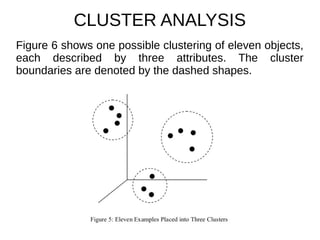
Figure 6 shows one possible clustering of eleven objects,
each described by three attributes. The cluster
boundaries are denoted by the dashed shapes.
Uses of Clustering
• It allows us to build simpler, more understandable
models of the world, which can be acted upon more
easily. People naturally cluster objects for this reason all
the time.
For example, we are able to identify objects as a “chair”
even if they look quite different and this allows us to
ignore the specific characteristics of a chair if they are
irrelevant.
• Dimensional reduction or data compression.
For example, one could identify ten attributes for a data
set, cluster the examples using these attributes, and then
replace the ten attributes with one new attribute that
specifies the cluster number. Reducing the number of
dimensions (i.e., attributes) can simplify the data mining
process.
There are many specific applications of clustering
Clustering can be used to automatically segment
customers into meaningful groups
(e.g., students, retirees, etc.), so that more effective,
customized, marketing plans can be developed for each
group.
In document retrieval tasks the returned documents may
be clustered and presented to the users grouped by
these clusters in order to present the documents to the
user in a more organized and meaningful way.
For example, clustering can be employed by a search
engine so that the documents retrieved from the search
term “jaguar” cluster the documents related to the jaguar
animal separately from those related to the Jaguar
automobile (the ask.com search engine currently
provides this capability).
The clustering algorithm can work effectively in this case
because one set of returned documents will repeatedly
have the term “car”, “automobile” or “S-type” in it while
the other set may have the terms “jungle” or “animal”
appear repeatedly.
Categories of Clustering Algorithms
The two main types of clusterings are hierarchical and
non-hierarchical.
A hierarchical clustering has multiple levels while a non-
hierarchical clustering has only a single level.
An example of a hierarchical clustering is the taxonomy
used by biologists to classify living organisms.
The non-hierarchical clustering algorithms will take
the presented objects and place each into one of k
clusters, where each cluster must have at least one
object. Most of these algorithms require the user to
specify the value of k, which is often a liability, since the
user will generally not know ahead of time the optimal
number of meaningful clusters. The framework used by
many of these algorithms is to form an initial random
clustering of the objects and then repeatedly move
objects between clusters to improve the overall quality of
the clusters. One of the oldest and most notable of these
methods is the K-means clustering algorithm.
This algorithm randomly assigns each object to one of
the k clusters and then computes the mean (i.e., center
or centroids) of the points in the cluster. Then each object
is reassigned to the cluster based on which centroid it is
closest to and then the centroids of each cluster are
recomputed. This cycle continues until no changes are
made. This very simple method sometimes works well.
Another way to generate non-hierarchical clusterings is
via density-based clustering methods, such as DBSCAN,
which find regions of high density that are separated from
regions of low density. One advantage of DBSCAN is that
because it is sensitive to the density differences it can
form clusters with arbitrary shapes.
Hierarchical clustering algorithms are the next type of
clustering algorithms.
These algorithms can be divided into agglomerative and
divisive algorithms.
The agglomerative algorithms start with each object as
an individual cluster and then at each iteration merge the
most similar pair of clusters.
The agglomerative techniques are by far the more
popular method.
The divisive algorithms take the opposite approach and
start with all objects in a single partition and then
iteratively split one cluster into two.

Data mining

  • 1.
    Data Mining Data Mining GaryM. Weiss, Ph.D., Department of Computer and Information Science, Fordham University Brian D. Davison, Ph.D., Department of Computer Science and Engineering, Lehigh University
  • 2.
    Data Mining- Introduction Datamining is a process that takes data as input and outputs knowledge. “the nontrivial process of identifying valid, novel, potentially useful, and ultimately understandable patterns in data.” Note that because the process must be non-trivial, simple computations and statistical measures are not considered data mining.
  • 3.
    Data Mining- Introduction Thuspredicting which salesperson will make the most future sales by calculating who made the most sales in the previous year would not be considered data mining. It is understood that the process must be at least partially automated, relying heavily on specialized computer algorithms (i.e., data mining algorithms) that search for patterns in the data.
  • 4.
  • 5.
    Data Mining- Introduction Thefirst three steps in Figure 1 involve preparing the data for mining. The relevant data must be selected from a potentially large and diverse set of data, any necessary preprocessing must then be performed, and finally the data must be transformed into a representation suitable for the data mining algorithm that is applied in the data mining step. In practice it is common for the data preparations steps to take more time and effort than the actual data mining step.
  • 6.
    Data Mining- Introduction Thefourth step in the data mining process is the data mining step. This step involves applying specialized computer algorithms to identify patterns in the data. Many of the most common data mining algorithms including decision tree algorithms and neural network algorithms etc..... Thus, anyone undertaking a data mining project should ensure that sufficient time and effort is allocated to the data preparation steps.
  • 7.
    Data Mining- Introduction Forexample, if a decision tree algorithm is used to predict who will respond to a direct marketing offer, we can say that the decision tree models how a consumer will respond to a direct mail offer. Finally, the results of data mining cannot simply be accepted,but must be carefully evaluated and interpreted. As a simple example, in the case of the direct-mail example just described, we could evaluate the decision tree based on its accuracy—the percentage of its predictions that are correct. However, many other evaluation or performance metrics are possible and for this specific example return on investment might actually be a better metric. The data mining process is an iterative process.
  • 8.
    Motivation and Challenges DataMining developed as a new discipline for several reasons. First, the amount of data available for mining grew at a tremendous pace as computing technology became widely deployed. Specifically, high speed networks allowed enormous amount of data to be transferred and rapidly decreasing disk costs permitted this data to be stored cost-effectively. The size and scope of these new datasets is remarkable.
  • 9.
    Motivation and Challenges DataMining developed as a new discipline for several reasons. First, the amount of data available for mining grew at a tremendous pace as computing technology became widely deployed. Specifically, high speed networks allowed enormous amount of data to be transferred and rapidly decreasing disk costs permitted this data to be stored cost-effectively. The size and scope of these new datasets is remarkable. This remarkable growth in the data that is collected and stored presents many problems.
  • 10.
    Motivation and Challenges 1.The scalability of traditional statistical techniques, which often cannot handle data sets with millions or billions of records and hundreds or thousands of variables. 2. A second problem is that much of the data that is available for analysis, such as text,audio, video and images, is non-numeric and highly unstructured (i.e., cannot be represented by a fixed set of variables). This data cannot easily be analyzed using traditional statistical techniques. 3. A third problem is that the number of data analysts has not matched the exponential growth in the amount of data, which has caused much of this data to remain unanalyzed in a “data tomb”.
  • 11.
    Motivation and Challenges Datamining strives to address these challenges. 1. Many data mining algorithms are specifically designed to be scalable and perform well on very large data sets, without fixed size limitations, and degrade gracefully as the size of the data set and the number of variables increases. Scalable data mining algorithms, unlike many early machine learning algorithms, should not require that all data be loaded into and remain in main memory, since this would prevent very large data sets from being mined.
  • 12.
    Motivation and Challenges 2.A great deal of effort has also been expended to develop data mining methods to handle non-numeric data. This includes mining of spatial data ,images, video, text documents, and the World Wide Web. 3. Data mining also attempts to offload some of the work from the data analyst so that more of the collected data can be analyzed. Statistician -> hypothesis-driven and deductive Data Mining Process ->data-driven and inductive
  • 13.
    Overview of DataMining Tasks The best way to gain an understanding of data mining is to understand the types of tasks, or problems, that it can address. Data mining tasks can be categorized into predictive or descriptive. Predictive tasks allow one to predict the value of a variable based on other existing information. Examples of predictive tasks include predicting when a customer will leave a company, predicting whether a transaction is fraudulent or not and identifying the best customers to receive direct marketing offers.
  • 14.
    Overview of DataMining Tasks Descriptive tasks summarize the data in some manner. Examples of such tasks include automatically segmenting customers based on their similarities and differences and finding associations between products in market basket data.
  • 15.
    Overview of DataMining Tasks Classification and Regression Classification and regression tasks are predictive tasks that involve building a model to predict a target, or dependent, variable from a set of explanatory, or independent, variables. Classification tasks the target variable usually has a small number of discrete values (e.g., “high” and “low”). eg: Identifying fraudulent credit card transactions Regression tasks the target variable is continuous. eg: Predicting future prices of a stock
  • 16.
    Overview of DataMining Tasks Association Rule Analysis Association rule analysis is a descriptive data mining task that involves discovering patterns, or associations, between elements in a data set. The associations are represented in the form of rules, or implications. The most common association rule task is market basket analysis. Eg: In this case each data record corresponds to a transaction (e.g., from a supermarket checkout) and lists the items that have been purchased as part of the transaction. One possible association rule from supermarket data is {Hamburger Meat} -> {Ketchup} which indicates that those transactions that include Hamburger Meat tend to also include Ketchup.
  • 17.
    Overview of DataMining Tasks Cluster Analysis Cluster analysis is a descriptive data mining task where the goal is to group similar objects in the same cluster and dissimilar objects in different clusters. Applications of clustering include clustering customers for the purpose of market segmentation and grouping similar documents together in response to a search engine request.
  • 18.
    Overview of DataMining Tasks Text Mining Tasks Much available data is in the form of unstructured or semi-structured text, which is very different from conventional data, which is completely structured. Text is unstructured if there is no predetermined format, or structure, to the data. Text is semi-structured if there is structure associated with some of the data, as in the case for web pages. While text mining tasks often fall into the classification, clustering and association rule mining categories.
  • 19.
    Overview of DataMining Tasks Text Mining Tasks Example applications of text mining includes the identification of specific noun phrases such as people, products and companies, which can then be used in more sophisticated co-occurrence analysis to find non- obvious relationships among people or organizations. A second application area that is growing in importance is sentiment analysis, in which blogs, discussion boards, and reviews are analyzed for opinions about products or brands.
  • 20.
    Overview of DataMining Tasks Link Analysis Tasks Link analysis is a form of network analysis that examines associations between objects. For examples: In the context of email, the objects might be people and the associations might represent the existence of email between two people. On the Web each page can link to others, and so web link analysis considers the web graph resulting from such links. Given a graph showing relationships between objects, link analysis can find particularly important or well-connected objects and show where networks may be weak (e.g., in which all paths go through one or a small number of objects).
  • 21.
    Overview of DataMining Tasks PREDICTION TASKS: CLASSIFICATION AND REGRESSION Classification and regression tasks are the most commonly encountered data mining tasks. These tasks involve mapping an object to either one of a set of predefined classes (classification) or to a numerical value (regression).
  • 22.
    Terminology and Background Mostprediction tasks assume that the underlying data is represented as a collection of objects or records, which, in data mining, are often referred to as instances or examples. Each example is made up of a number of variables, commonly referred to as features or attributes. The attribute to be predicted is of special interest and may be referred to as the target, or, for classification tasks, the class. In the majority of cases the number of attributes is fixed and thus the data can be represented in a tabular format, as shown in Table 1. The data in Table 1 describes automobile loans and contains 10 examples with 5 attributes, where the binary target/class attribute resides in the last column and indicates whether the customer defaulted on their loan.
  • 23.
  • 24.
    Terminology and Background Thisdata in Table 1 can be used to build a predictive model to classify customers based on whether they will default on their loan. That is, the model generated by the data mining algorithm will take the values for the age, income, student, and credit-rating attributes and map them to “Yes” or “No”. The induced classification model could take many forms and Figure 2 provides a plausible result for a rule-based learning algorithm.
  • 25.
    Terminology and Background Inthis case each rule in Figure 2 is evaluated in order and the classification is determined by the first rule for which the left-hand side evaluates to true. In this case, if the first two rules do not fire, then the third one is guaranteed to fire and thus acts as a default rule. Note that the three rules in Figure 2 can be used to correctly classify all ten examples in Table 1.
  • 26.
    Characteristics of PredictiveData Mining Algorithms
  • 27.
    Predictive Data Mining Algorithms DecisionTrees Decision tree algorithms are a very popular class of learning algorithms for classification tasks. A sample decision tree, generated from the automobile loan data in Table 1, is shown in Figure 4. The internal nodes of the decision tree each represent an attribute while the terminal nodes (i.e., leaf nodes displayed as rectangles) are labeled with a class value. Each branch is labeled with an attribute value, and, when presented with an example, one follows the branches that match the attribute values for the example, until a leaf node is reached.
  • 28.
    Predictive Data Mining Algorithms DecisionTrees The class value assigned to the leaf node is then used as the predicted value for the example. In this simple example the decision tree will predict that a customer will default on their automobile loan if their credit rating is “poor” or it is not “poor” (i.e., “fair” or “excellent”) but the person is “middle aged” and their income level is “low”.
  • 29.
    Predictive Data Mining Algorithms DecisionTrees The class value assigned to the leaf node is then used as the predicted value for the example. In this simple example the decision tree will predict that a customer will default on their automobile loan if their credit rating is “poor” or it is not “poor” (i.e., “fair” or “excellent”) but the person is “middle aged” and their income level is “low”.
  • 30.
  • 31.
    Predictive Data Mining Algorithms DecisionTrees Advantages: ● The main reason for this is that the induced decision tree model is easy to understand. ● The decision tree model can be generated quickly and new examples can be classified quickly using the induced model. Disadvantages: ● The primary disadvantage of a decision tree algorithm is that it has limited expressive power, namely because only one attribute can be considered at a time. ● Decision trees cannot handle regression tasks,
  • 32.
    Predictive Data Mining Algorithms Rule-basedClassifiers Rule-based classifiers generate classification rules, such as the rule set shown earlier in Figure 2. The way in which classifications are made from a rule set varies. For some rule-based systems the first rule to fire (i.e., have the left-hand side of the rule satisfied) determines the classification, whereas in other cases all rules are evaluated and the final classification is made based on a voting scheme.
  • 33.
    Predictive Data Mining Algorithms Rule-basedClassifiers Rule-based classifiers are very similar to decision-tree learners and have similar expressive power, computation time, and comprehensibility. The connection between these two classification methods is even more direct since any decision tree can trivially be converted into a set of mutually exclusive rules, by creating one rule corresponding to the path from the root of the tree to each leaf.
  • 34.
    Predictive Data Mining Algorithms ArtificialNeural Networks Artificial Neural Networks (ANNs) were originally inspired by attempts to simulate some of the functions of the brain and can be used for both classification and regression tasks. An ANN is composed of an interconnected set of nodes that includes an input layer, zero or more hidden layers, and an output layer. The links between nodes have weights associated with them.
  • 35.
  • 36.
    Predictive Data Mining Algorithms ArtificialNeural Networks The ANN in Figure 5 accepts three inputs, I 1 , I 2 , and I 3 and generates a single output O 1 . The ANN computes the output value from the input values as follows. First, the input values are taken from the attributes of the training example, as it is inputted to the ANN. These values are then weighted and fed into the next set of nodes, which in this example are H 1 and H 2.
  • 37.
    Predictive Data Mining Algorithms ArtificialNeural Networks A non-linear activation function is then applied to this weighted sum and then the resulting value is passed to the next layer, where this process is repeated, until the final value(s) are outputted. The ANN learns by incrementally modifying its weights so that, during the training phase, the predicted output value moves closer to the observed value. The most popular algorithm for modifying the weights is the backpropagation algorithm.
  • 38.
    Predictive Data Mining Algorithms ArtificialNeural Networks ANNs can naturally handle regression tasks, since numerical values are passed through the nodes and are ultimately passed through to the output layer. However, ANNs can also handle classification tasks by thresholding on the output values. ANNs have a great deal of expressive power and are not subject to the same limitations as decision trees. In fact, most ANNs are universal approximators in that they can approximate any continuous function to any degree of accuracy.
  • 39.
    Predictive Data Mining Algorithms ArtificialNeural Networks However, this power comes at a cost. While the induced ANN can be used to quickly predict the values for unlabelled examples, training the model takes much more time than training a decision tree or rule-based learner and, perhaps most significantly, the ANN model is virtually incomprehensible and therefore cannot be used to explain or justify its predictions.
  • 40.
    Predictive Data Mining Algorithms Nearest-Neighbor Nearest-neighborlearners are very different from any of the learning methods just described in that no explicit model is ever built. That is, there is no training phase and instead all of the work associated with making the prediction is done at the time an example is presented. Given an example the nearest-neighbor method first determines the k most similar examples in the training data and then determines the prediction based on the class values associated with these k examples, where k is a user-specified parameter.
  • 41.
    Predictive Data Mining Algorithms Nearest-Neighbor Thesimplest scheme is to predict the class value that occurs most frequently in the k examples, while more sophisticated schemes might use weighted voting, where those examples most similar to the example to be classified are more heavily weighted. For example, realtors typically base the sales price of a new home on the sales price of similar homes that were recently sold in the area. Nearest-neighbor learning is sometimes referred to as instance-based learning.
  • 42.
    Predictive Data Mining Algorithms Nearest-Neighbor Nearest-neighboralgorithms are typically used for classification tasks, although they can also be used for regression tasks. These algorithms also have a great deal of expressive power. Nearest-neighbor algorithms generate no explicit model and hence have no training time. Instead, all of the computation is performed at testing time and this process may be relatively slow
  • 43.
    Predictive Data Mining Algorithms Nearest-Neighbor sinceall training examples may need to be examined. It is difficult to evaluate the comprehensibility of the model since none is produced. However, individual predictions can easily be explained and justified in a very natural way, by referring to the nearest-neighbors. not produce a comprehensible model but its predictions are explainable.
  • 44.
    Predictive Data Mining Algorithms NaïveBayesian Classifiers Most classification tasks are not completely deterministic. That is, even with complete knowledge about an example you may not be able to correctly classify it. Rather, the relationship between an example and the class it belongs to is often probabilistic. Allow us to exploit statistical properties of the data in order to predict the most likely class for an example. More specifically, these methods use the training data and the prior probabilities associated with each class and with each attribute value and then utilize Bayes’ theorem to determine the most likely class given a set of observed attribute values.
  • 45.
    Predictive Data Mining Algorithms NaïveBayesian Classifiers This method is naïve in that it assumes that the values for each attribute are independent. The naïve Bayes method is used for classification tasks. These methods are quite powerful, can express complex concepts, and are fast to generate and to classify new examples. However, these methods do not build an explicit model that can then be interpreted.
  • 46.
    Predictive Data Mining AlgorithmsEnsembleMethods Ensemble methods are general methods for improving the performance of predictive data mining algorithms. The most notable ensemble methods are bagging and boosting, which permit multiple models to be combined. Bagging the training data are repeatedly randomly sampled with replacement, so that each of the resulting training sets has the same number of examples as the original training data but is composed of different training examples. A classifier is induced from each of the generated training sets and then each unlabelled test example is assigned the classification most frequently predicted by these classifiers (i.e., the classifiers “vote” on the classification).
  • 47.
    Predictive Data Mining Algorithms EnsembleMethods Boosting is somewhat similar to bagging and also generates multiple classifiers, but boosting adaptively changes the distribution of training examples such that the training examples that are misclassified are better represented in the next iteration. Thus boosting focuses more attention on the examples that are difficult to classify. As with bagging, unlabeled examples are classified based on the predictions of all of the generated classifiers.
  • 48.
    Predictive Data Mining Algorithms EnsembleMethods Most data mining packages now implement a variety of ensemble methods, including boosting and bagging. Most of these packages also permit different models (e.g., a neural network model and a decision tree model) to be combined so that, in theory, one can get the best aspects of each.
  • 49.
    ASSOCIATION ANALYSIS Many businessesmaintain huge databases of transactional data, which might include all purchases made from suppliers or all customer sales. Association analysis attempts to find patterns either within or between these transactions. Simple Example using Market Basket Data Consider the data in Table 3, which includes five transactions associated with purchases at a grocery store. These data are referred to as market basket data since each transaction includes the items found in a customer’s shopping “basket” during checkout. Each record contains a transaction identifier and then a list all of the items purchased as part of the transaction.
  • 50.
  • 51.
    ASSOCIATION ANALYSIS The datain Table 3 are very different from the relational data used for predictive data mining, such as the data in Table 1, where each record is composed of a fixed number of fields. Here the key piece of data is a variable- length list of items, in which the list only indicates the presence or absence of an item—not the number of instances purchased. In market basket analysis, a specific instance of association analysis, the goal is to find patterns between items purchased in the same transaction. As an example, using the limited data in Table 3, a data mining algorithm might generate the association rule {Ketchup} -> {Soda}, indicating that a customer that purchases Ketchup is likely to also purchase Soda.
  • 52.
    ASSOCIATION ANALYSIS Applications ofassociation rule analysis are not limited to market basket data and other association mining techniques have been applied to sequence data, spatial data and graph-based data.
  • 53.
    ASSOCIATION ANALYSIS Generation andEvaluation of Association Rules There are many algorithms for performing association rule analysis, but the earliest and most popular such algorithm is the Apriori algorithm. This algorithm, as well as most others, utilizes two stages. In the first stage, the sets of items that co-occur frequently are identified. In the second stage association rules are generated from these “frequent itemsets.” As an example, the frequent itemset {Ketchup, Soda} could be generated from the data in Table 3, since it occurs in two transactions, and from this the association rule {Ketchup} -> {Soda} could be generated.
  • 54.
    Sequential Pattern Mining Sequentialpattern mining in transactional data is a variant of association analysis, in that one is looking for pattern between items in a sequence, rather than in a set of items. As an example, suppose a company rents movies and keeps records of all of the rental transactions. The company can then mine these data to determine patterns within the sequences of movie rentals. Some patterns will be expected and hence may not have much business value, such as Star Wars Episode I -> Star Wars Episode II, but less obvious patterns may also be found.
  • 55.
    Sequential Pattern Mining Sequentialpatterns abound and sequence mining algorithms have been applied to a variety of domains. For example, sequence mining has been applied * to sequences of network alarms in order to predict network equipment failures * to computer audit data in order to identify network intrusions * to biological sequences to find regions of local similarity * to web clickstream data to find web pages that are frequently accessed together
  • 56.
    CLUSTER ANALYSIS Cluster analysisautomatically partitions data into meaningful groups based on the characteristics of the data. Similar objects are placed into the same cluster and dissimilar objects are placed into different clusters. Clustering is an unsupervised learning task in that the training data do not include the “answer” (i.e., a mapping from example to cluster). Clustering algorithms operate by measuring the similarity and dissimilarity between objects and then finding a clustering scheme that maximizes intra-cluster similarity and inter-cluster dissimilarity. Clustering requires that a similarity measure be defined between objects, which, for objects with numerical attributes, may be the Euclidean distance between the points.
  • 57.
    CLUSTER ANALYSIS Figure 6shows one possible clustering of eleven objects, each described by three attributes. The cluster boundaries are denoted by the dashed shapes.
  • 58.
    Uses of Clustering •It allows us to build simpler, more understandable models of the world, which can be acted upon more easily. People naturally cluster objects for this reason all the time. For example, we are able to identify objects as a “chair” even if they look quite different and this allows us to ignore the specific characteristics of a chair if they are irrelevant. • Dimensional reduction or data compression. For example, one could identify ten attributes for a data set, cluster the examples using these attributes, and then replace the ten attributes with one new attribute that specifies the cluster number. Reducing the number of dimensions (i.e., attributes) can simplify the data mining process.
  • 59.
    There are manyspecific applications of clustering Clustering can be used to automatically segment customers into meaningful groups (e.g., students, retirees, etc.), so that more effective, customized, marketing plans can be developed for each group. In document retrieval tasks the returned documents may be clustered and presented to the users grouped by these clusters in order to present the documents to the user in a more organized and meaningful way. For example, clustering can be employed by a search engine so that the documents retrieved from the search term “jaguar” cluster the documents related to the jaguar animal separately from those related to the Jaguar automobile (the ask.com search engine currently provides this capability).
  • 60.
    The clustering algorithmcan work effectively in this case because one set of returned documents will repeatedly have the term “car”, “automobile” or “S-type” in it while the other set may have the terms “jungle” or “animal” appear repeatedly. Categories of Clustering Algorithms The two main types of clusterings are hierarchical and non-hierarchical. A hierarchical clustering has multiple levels while a non- hierarchical clustering has only a single level. An example of a hierarchical clustering is the taxonomy used by biologists to classify living organisms.
  • 61.
    The non-hierarchical clusteringalgorithms will take the presented objects and place each into one of k clusters, where each cluster must have at least one object. Most of these algorithms require the user to specify the value of k, which is often a liability, since the user will generally not know ahead of time the optimal number of meaningful clusters. The framework used by many of these algorithms is to form an initial random clustering of the objects and then repeatedly move objects between clusters to improve the overall quality of the clusters. One of the oldest and most notable of these methods is the K-means clustering algorithm.
  • 62.
    This algorithm randomlyassigns each object to one of the k clusters and then computes the mean (i.e., center or centroids) of the points in the cluster. Then each object is reassigned to the cluster based on which centroid it is closest to and then the centroids of each cluster are recomputed. This cycle continues until no changes are made. This very simple method sometimes works well. Another way to generate non-hierarchical clusterings is via density-based clustering methods, such as DBSCAN, which find regions of high density that are separated from regions of low density. One advantage of DBSCAN is that because it is sensitive to the density differences it can form clusters with arbitrary shapes.
  • 63.
    Hierarchical clustering algorithmsare the next type of clustering algorithms. These algorithms can be divided into agglomerative and divisive algorithms. The agglomerative algorithms start with each object as an individual cluster and then at each iteration merge the most similar pair of clusters. The agglomerative techniques are by far the more popular method. The divisive algorithms take the opposite approach and start with all objects in a single partition and then iteratively split one cluster into two.