
Challenges & Lessons Learned in
Implementing KM Program in a
Construction Company
By: Mustafa Abusalah, PhD
April 2012
CCC Pre KM
 WAN: Company headquarters, projects, offices and areas are connected
via WAN/VPN.
 Communications: Communication channel is mainly through email, IP
Telephony and TDM.
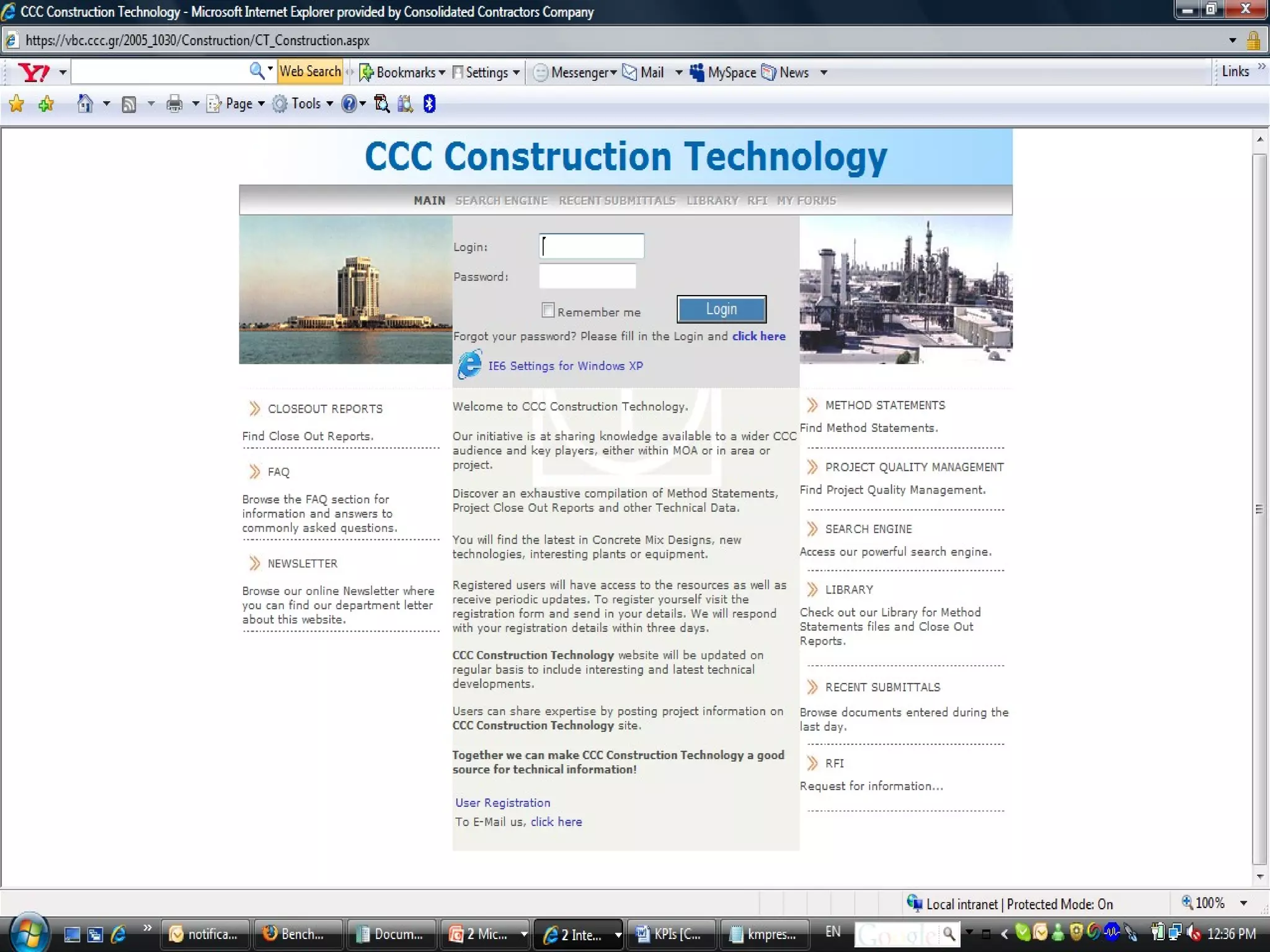
 Document and Content Management: CCC has an in house developed
Document Management System (VBC) which is the repository for all CCC
content.
 VBC Central: VBC central is the framework where projects, departments,
etc. Can create there own content management portals.
 One Repository: As VBC is the repository for all CCC content, all
applications running at CCC stores and retrieves documents to/from VBC.
This allowed different applications to work on the same content when
needed.
Why Knowledge Management (1)
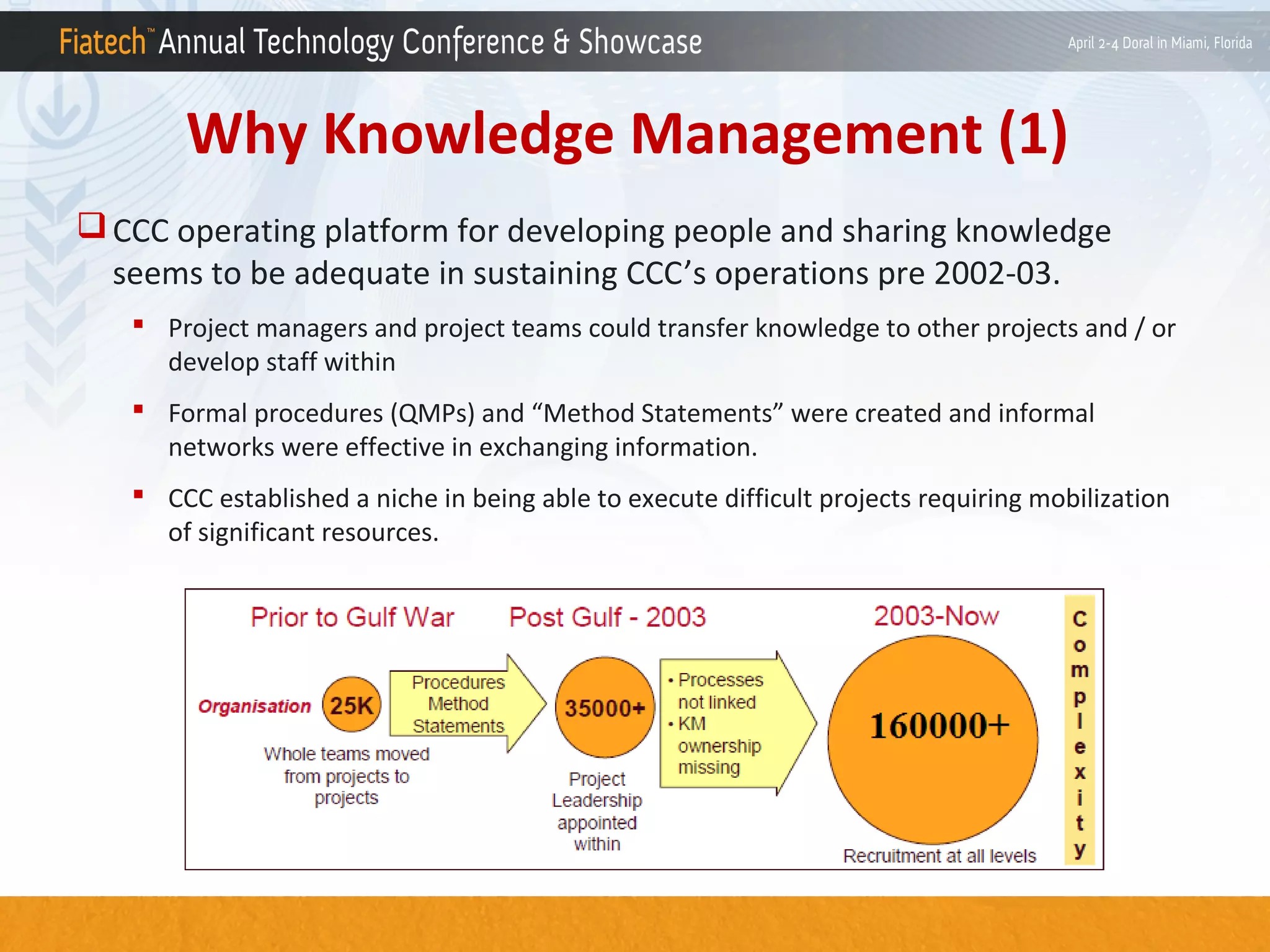
 CCC operating platform for developing people and sharing knowledge
seems to be adequate in sustaining CCC’s operations pre 2002-03.
 Project managers and project teams could transfer knowledge to other projects and / or
develop staff within
 Formal procedures (QMPs) and “Method Statements” were created and informal
networks were effective in exchanging information.
 CCC established a niche in being able to execute difficult projects requiring mobilization
of significant resources.
Why Knowledge Management (2)
 Magnitude and Rate of Growth are causing “Cracks”
 Management time is being diverted from addressing strategic issues “to shoring up partners
and client’s concerns due to being behind schedule in up to 80% of our projects”.
 Inconsistencies are appearing within our operations and execution of projects.
 Roles, responsibilities, accountabilities, communications channels were becoming fragmented
across the group.

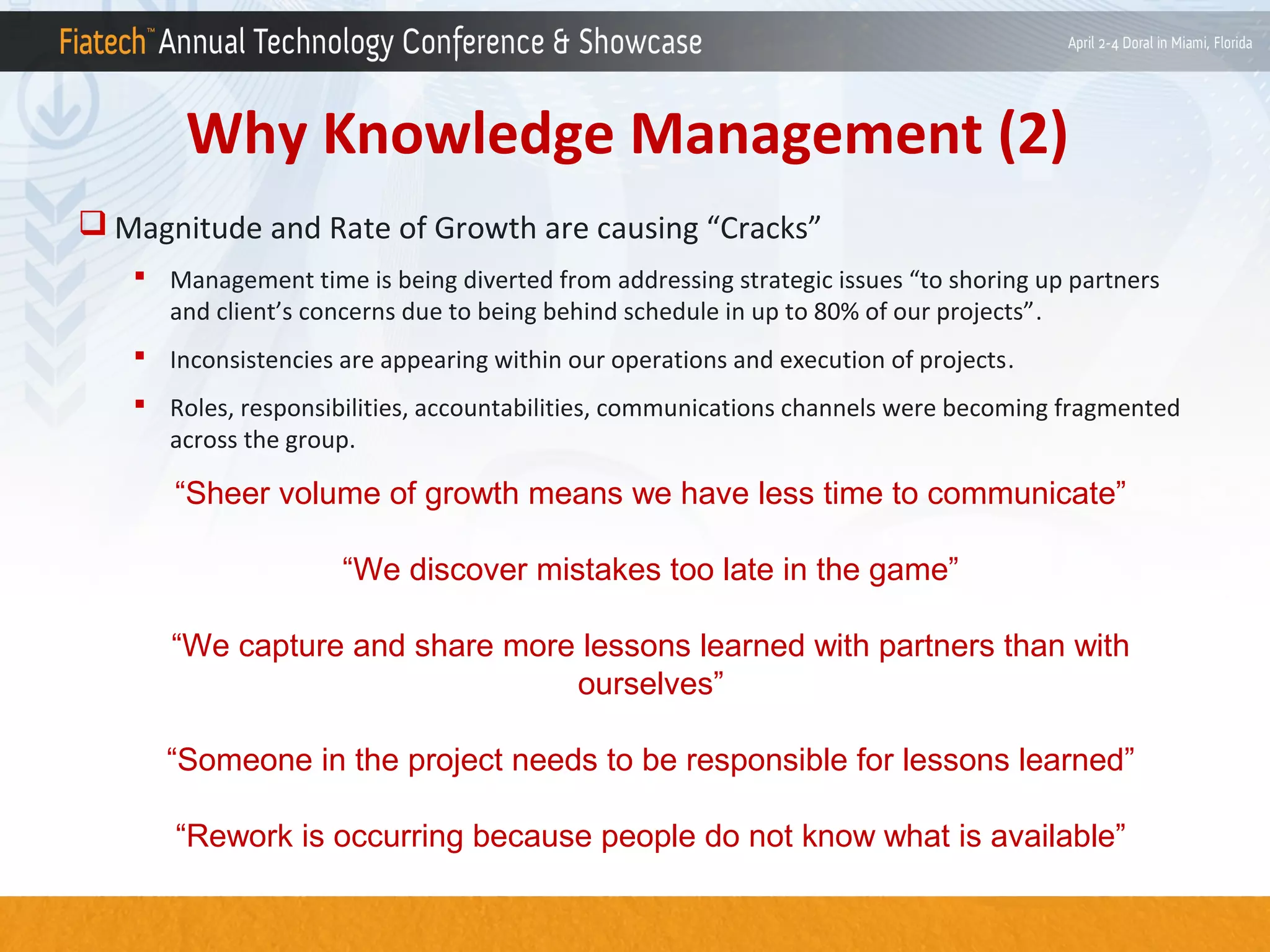
“Sheer volume of growth means we have less time to communicate”
“We discover mistakes too late in the game”
“We capture and share more lessons learned with partners than with
ourselves”
“Someone in the project needs to be responsible for lessons learned”
“Rework is occurring because people do not know what is available”
Why Knowledge Management (3)
Conclusions
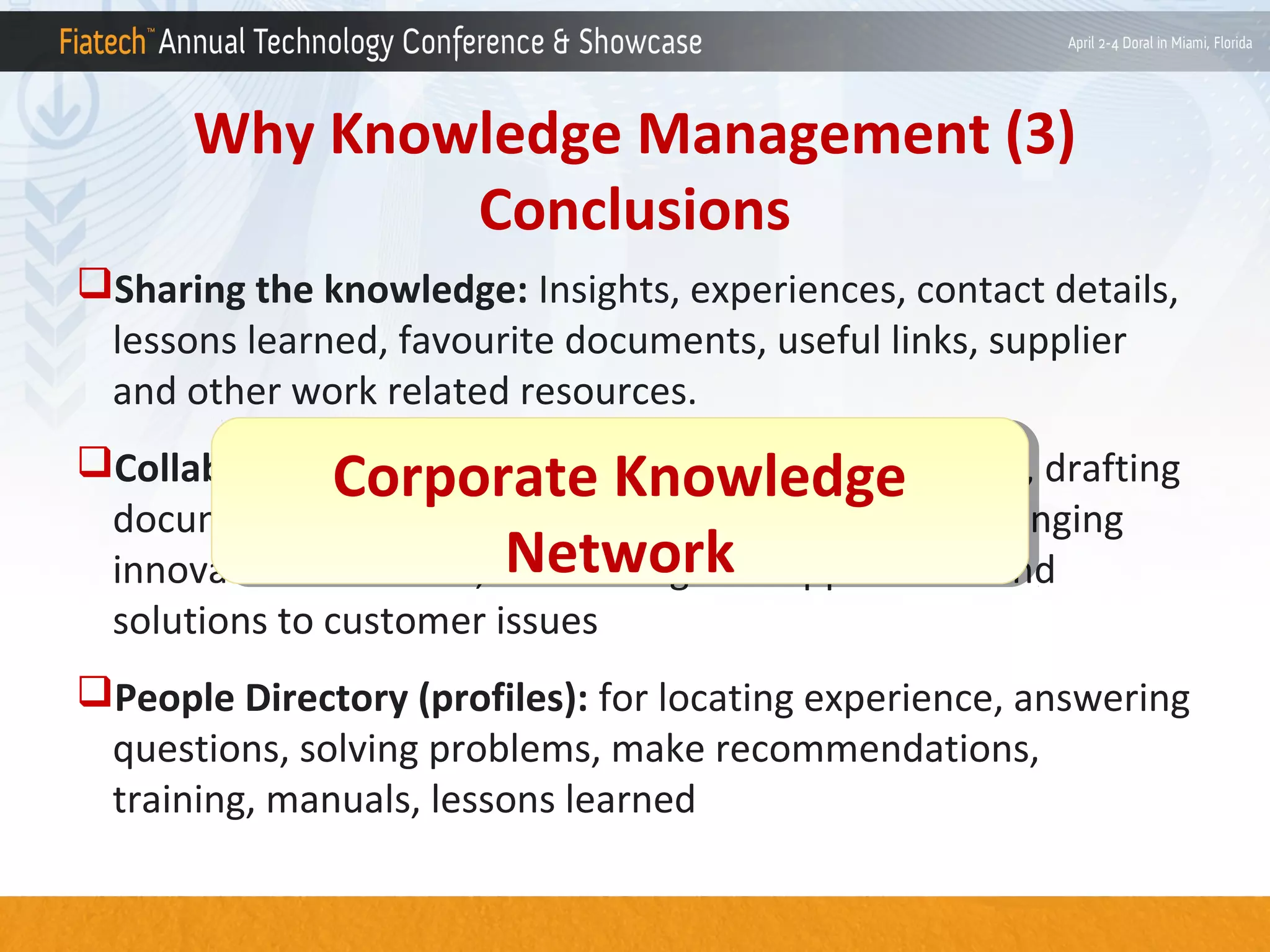
Sharing the knowledge: Insights, experiences, contact details,
lessons learned, favourite documents, useful links, supplier
and other work related resources.
Collaboration platform: On bridging knowledge gaps, drafting
Corporate Knowledge
Corporate Knowledge
documents, developing new areas of practices, on bringing
Network
Network
innovation to market, on defining new approaches and
solutions to customer issues
People Directory (profiles): for locating experience, answering
questions, solving problems, make recommendations,
training, manuals, lessons learned
Definition of Knowledge Management

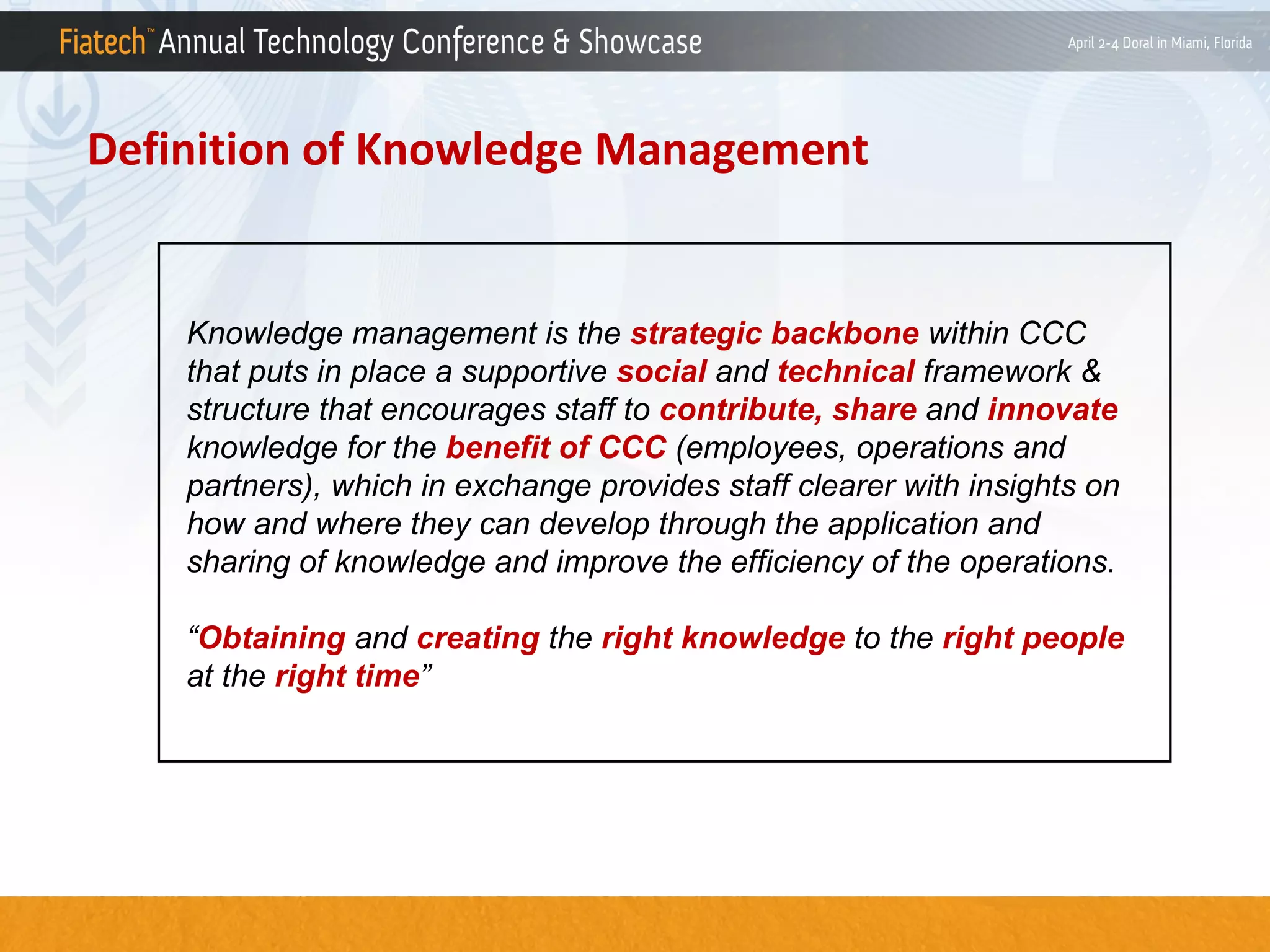
Knowledge management is the strategic backbone within CCC
that puts in place a supportive social and technical framework &
structure that encourages staff to contribute, share and innovate
knowledge for the benefit of CCC (employees, operations and
partners), which in exchange provides staff clearer with insights on
how and where they can develop through the application and
sharing of knowledge and improve the efficiency of the operations.
“Obtaining and creating the right knowledge to the right people
at the right time”
CCC KM Strategy
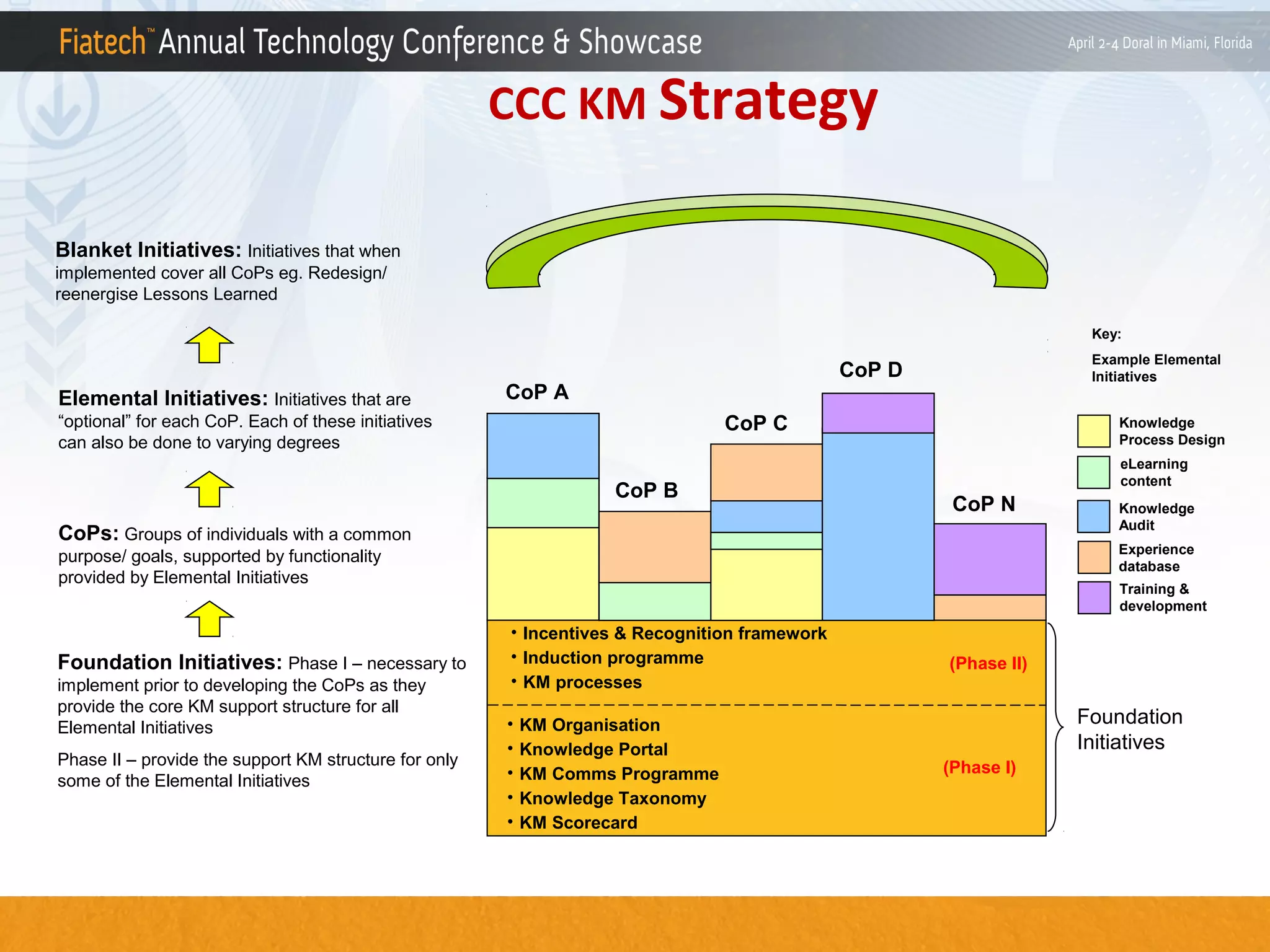
Blanket Initiatives: Initiatives that when
implemented cover all CoPs eg. Redesign/
reenergise Lessons Learned
Key:

Elemental Initiatives: Initiatives that are

Example Elemental
Initiatives

CoP D

CoP A
CoP C

“optional” for each CoP. Each of these initiatives
can also be done to varying degrees

CoP B

Knowledge
Process Design
eLearning
content

CoP N

CoPs: Groups of individuals with a common

Experience
database

purpose/ goals, supported by functionality
provided by Elemental Initiatives

Foundation Initiatives: Phase I – necessary to
implement prior to developing the CoPs as they
provide the core KM support structure for all
Elemental Initiatives
Phase II – provide the support KM structure for only
some of the Elemental Initiatives

Knowledge
Audit

Training &
development

• Incentives & Recognition framework
• Induction programme
• KM processes
•
•
•
•
•

KM Organisation
Knowledge Portal
KM Comms Programme
Knowledge Taxonomy
KM Scorecard

(Phase II)

Foundation
Initiatives
(Phase I)
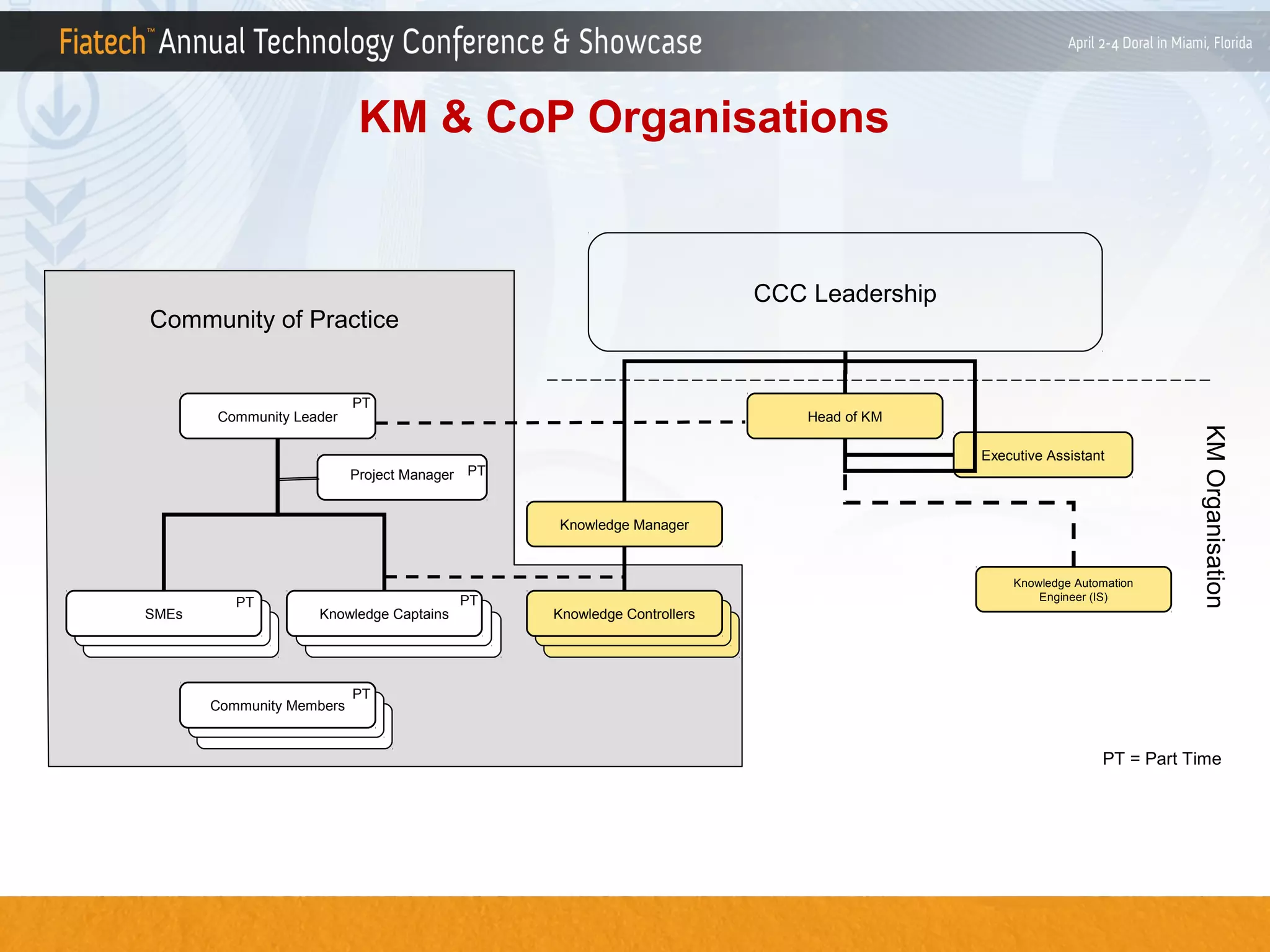
KM & CoP Organisations

CCC Leadership

Community of Practice

Community Leader

PT

Head of KM

Knowledge Manager

SMEs

PT

Knowledge Captains

Community Members

PT

Knowledge Automation
Engineer (IS)

Knowledge Controllers

KM Organisation

Executive Assistant

Project Manager PT

PT

PT = Part Time
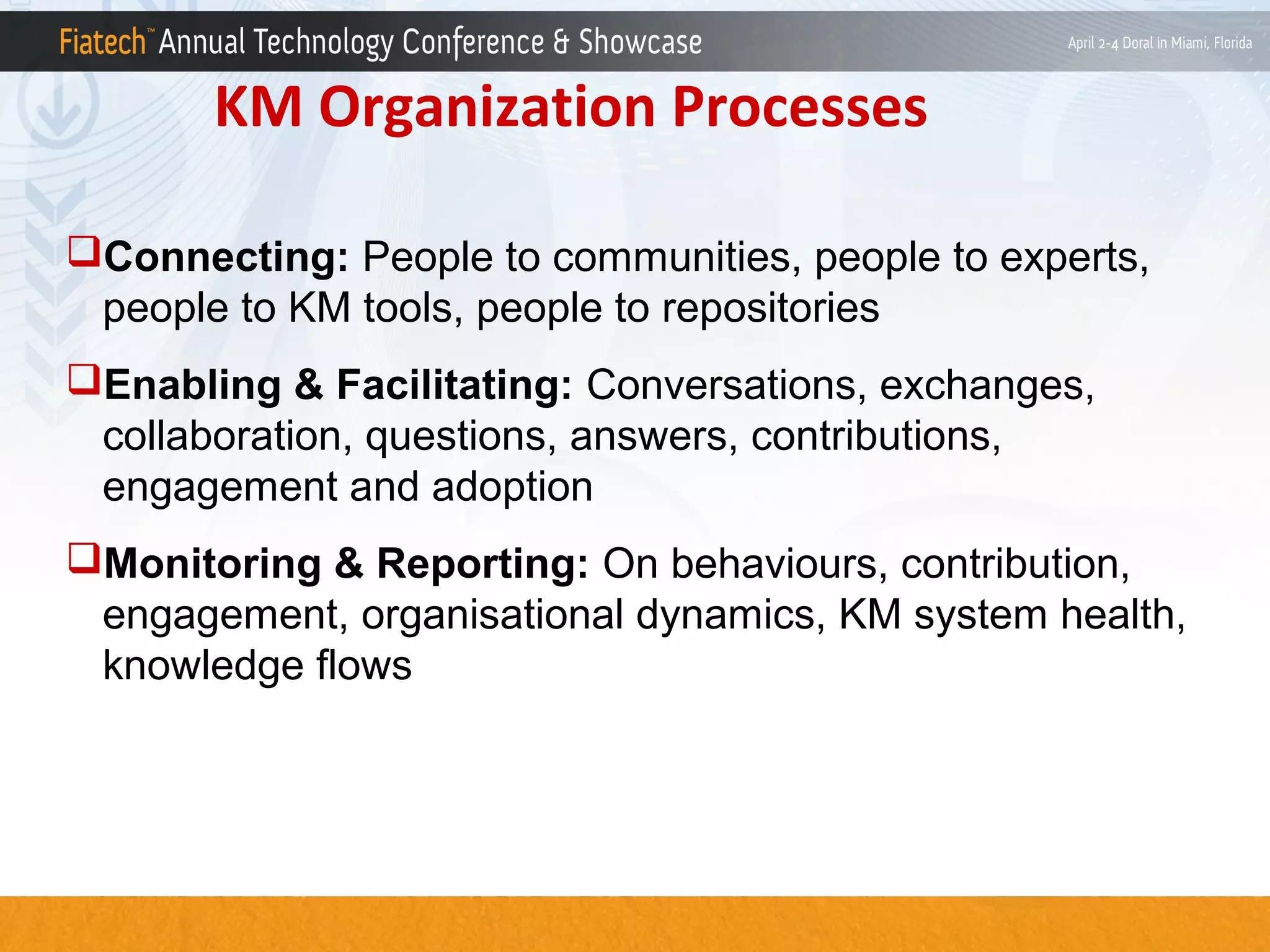
KM Organization Processes
Connecting: People to communities, people to experts,
people to KM tools, people to repositories
Enabling & Facilitating: Conversations, exchanges,
collaboration, questions, answers, contributions,
engagement and adoption
Monitoring & Reporting: On behaviours, contribution,
engagement, organisational dynamics, KM system health,
knowledge flows
What is a Community of Practice (CoP)?
 CoPs are either formal or informal groups of people with a
common purpose and common goals. A few characteristics of
CoPs are:
 The “members” share common pursuits and problems
 They share common practices and language – eg. They use the same
methodologies and express themselves in a similar fashion (eg.
technical jargon)
 They share similar interests
 Most people belong to more than one CoP
 Members of a CoP often have the same or similar roles but are not
located in the same location (or same project)

11
CoP Processes
Search: for answers, experts, knowledge, experience, lessons
learned, documents, images, perspectives
Collaborate: On bridging knowledge gaps, drafting
documents, developing new areas of practices, on bringing
innovation to market, on defining new approaches and
solutions to customer issues
Share: Insights, experiences, contact details, lessons learned,
favourite documents, useful links, supplier and other work
related resources
KM Portal
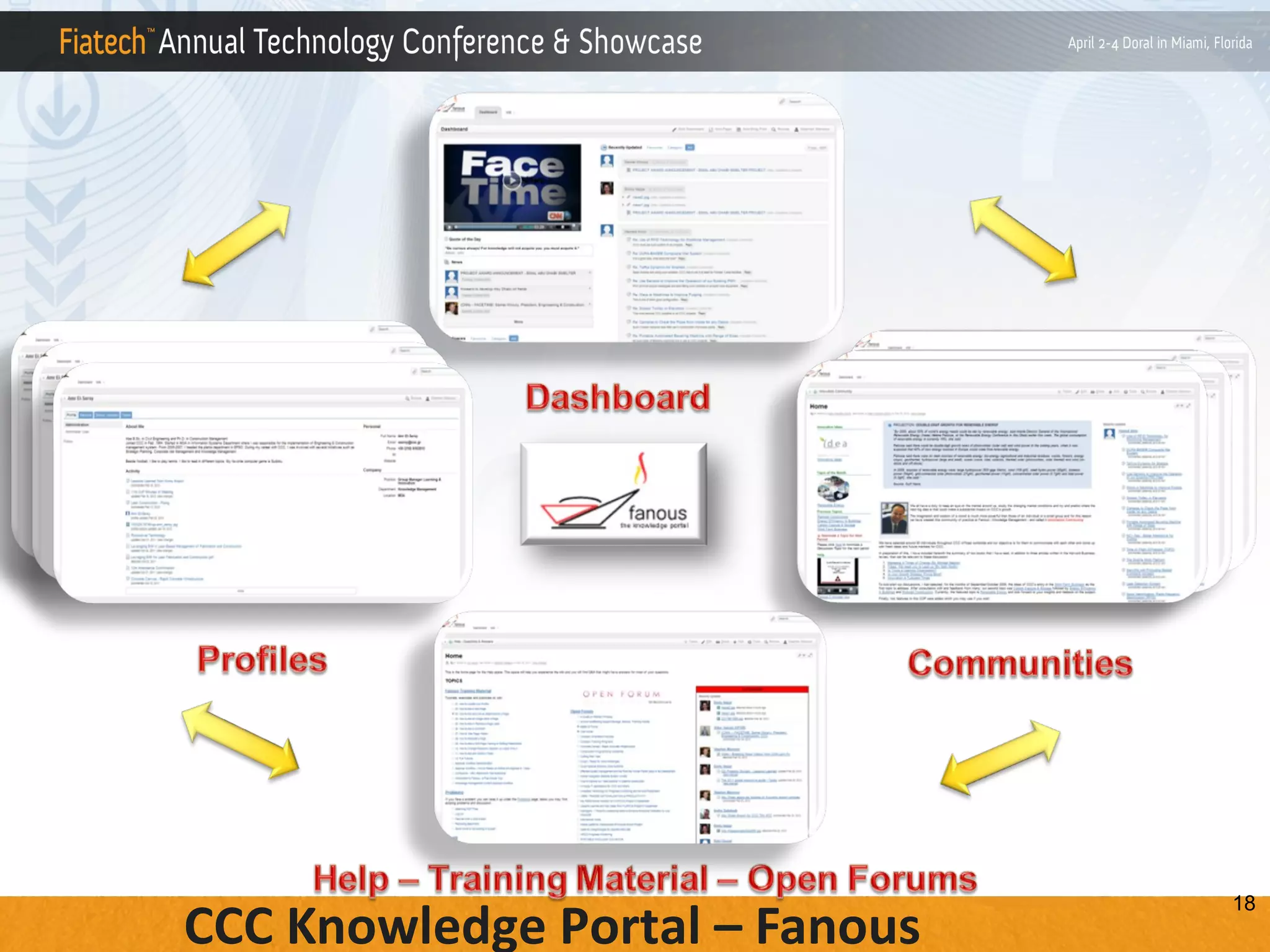
 Wiki Collaboration and Knowledge Sharing platform:
bridging knowledge gaps, drafting documents, developing new
areas of practices, bringing innovation to market, defining new
approaches and solutions to customer issues. Insights,
experiences, contact details, lessons learned, favourite
documents, useful links, supplier and other work related
resources.
People Directory (profiles): for locating experience, answering
questions, solving problems, make recommendations,
training, manuals, lessons learned.
VBC Repository: Formal Knowledge, KAudit
Community of Practice (CoP)
Planning Phase*
 Establish founding members
 Develop business case
 Establish Taxonomy Framework & high level breakdown
 Perform knowledge Audit: Content + People
 Build knowledge maps

*Source: American Productivity & Quality Center (APQC)
Community of Practice (CoP)
CoP - Design Phase*

 Design knowledge sharing processes/ workflows
 Identify roles and responsibilities
 Identify required IT capabilities
 Develop Initial learning and development plan and content
 Create measures, indicators, and scorecard
 Establish reward and recognition plans
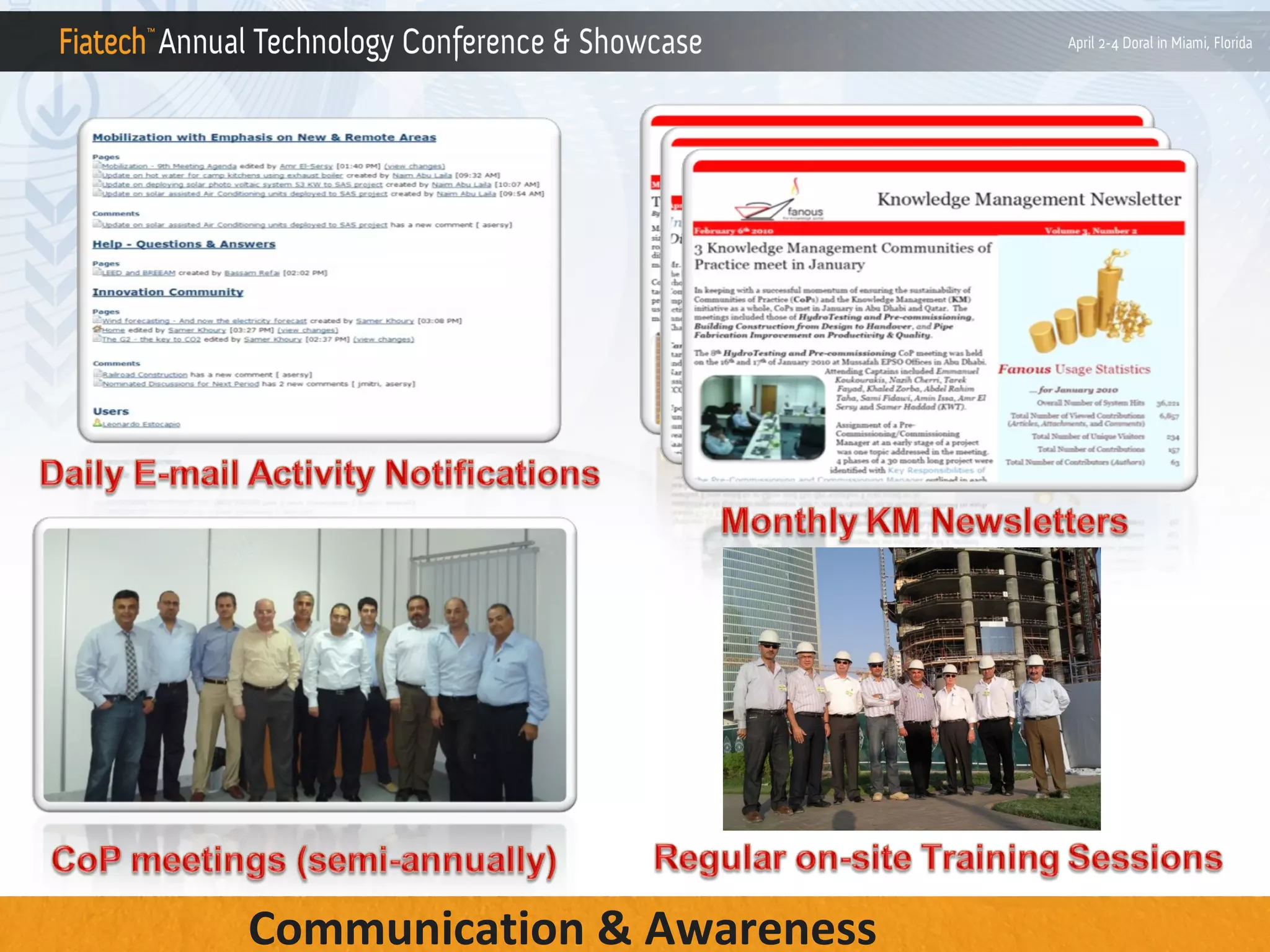
 Develop change management plan ( Monthly newsletters,
announcements, surveys, Bulletin etc.)
*Source: American Productivity & Quality Center (APQC)
Meetings Highlights
 First Year: 6 Meetings were held with each CoP

 Meeting No. 1: Business Case Requirements
 Meeting No. 2: Business Case follow-up & KM Roll out plan
 Meeting No. 3: Founding Members’ CoP Kick-off Meeting
and agree on roles and responsibilities
 Meeting No. 4: Business Case Presentation to Top
Management
 Meeting No. 5: Review KAudit report, agree on launching
content, and membership guides.
 Meeting No. 6: Review new contributions, agree on future
contributions and presentations by invited speakers and
members.
 Then Two yearly follow up meetings are held.
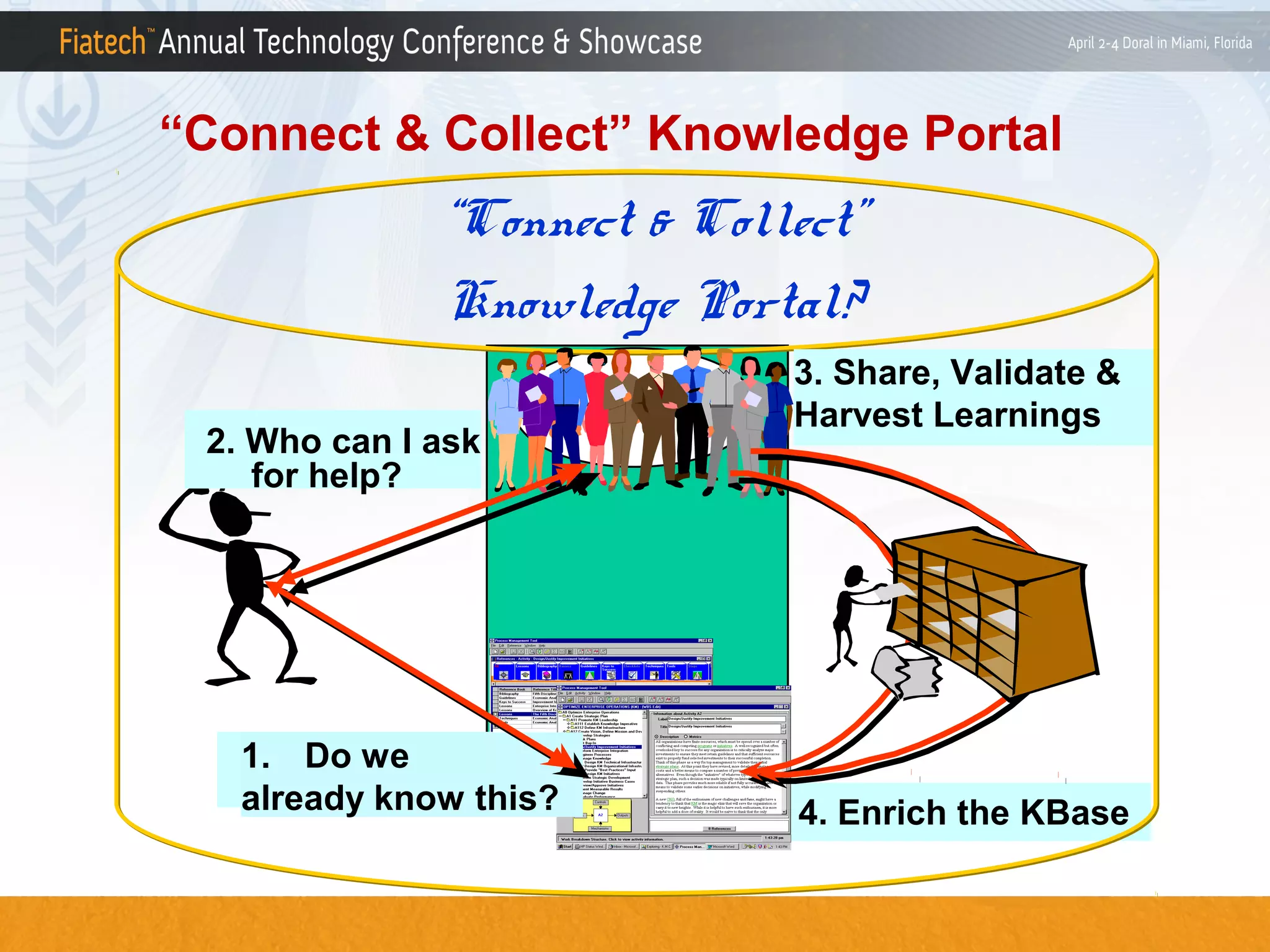
“Connect & Collect” Knowledge Portal

“Connect & Collect”
Knowledge Portal?
Connect People

3. Share, Validate &
Harvest Learnings

KnowledgeBase
1. Do we
already know this?

4. Enrich the KBase

2. Who can I ask
for help?
CCC Knowledge Portal – Fanous

18
19

Communication & Awareness
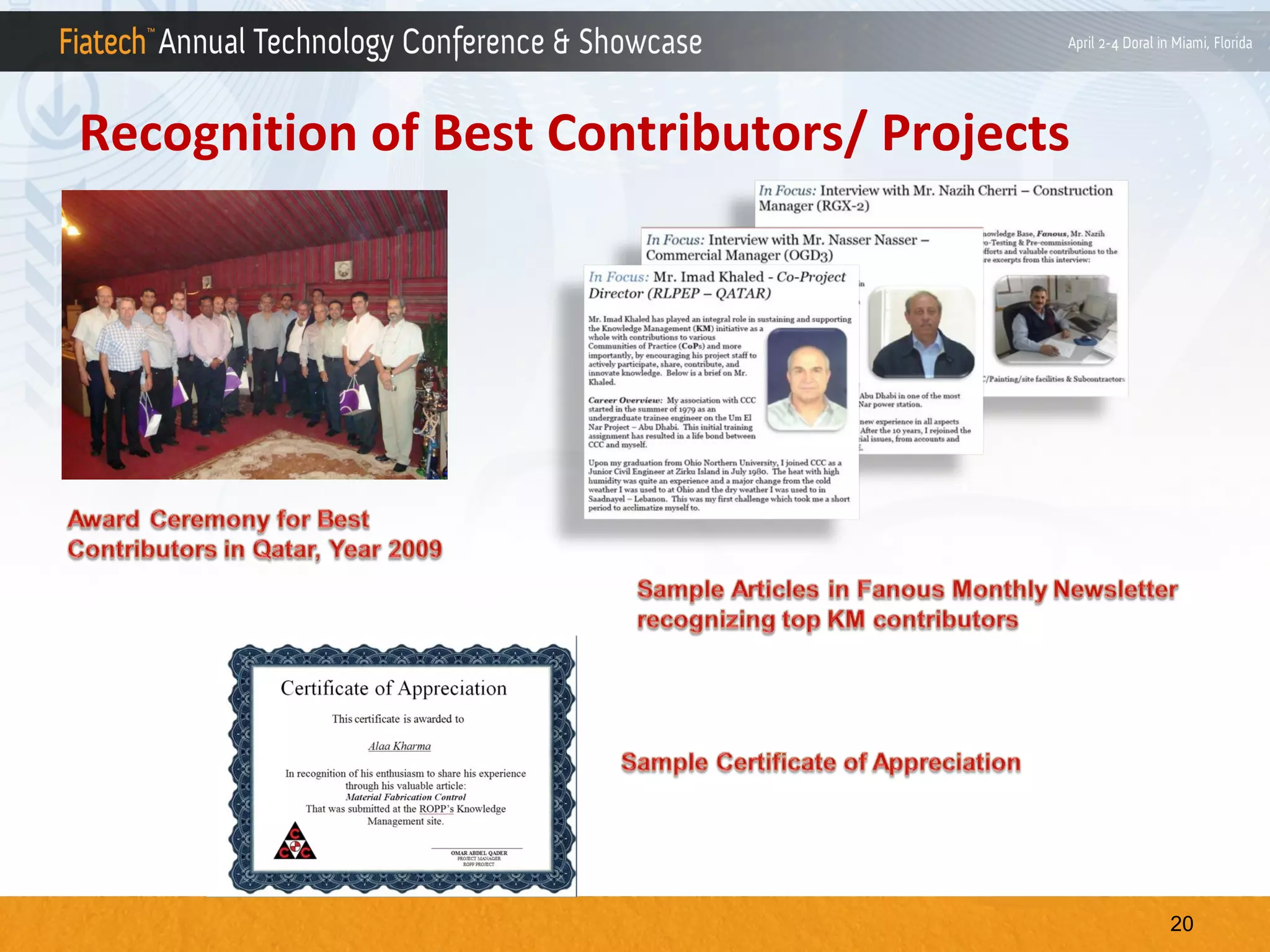
Recognition of Best Contributors/ Projects

20
Members Behavior
 Knowledge Culture: contribute in the definition of the company’s
vision and strategy, contribute to innovative processes consider and
recognize members ideas and skills. Encourage members to play
challenging roles and tasks, which go beyond their current
capabilities. Encourage members to learn, knowing that they will
acquire new skills. And finally understand that the members want to
see the company’s values fit their own.
 Motivation: Recognition for best contributions, elitism could be
strong social motivation factor, providing members with challenging
and constantly changing tasks seems to be critical to increase their
motivation.
 Training & Workshops: Members training, running knowledge
capture session in projects, awards for best contributions per project.
Measuring & Monitoring
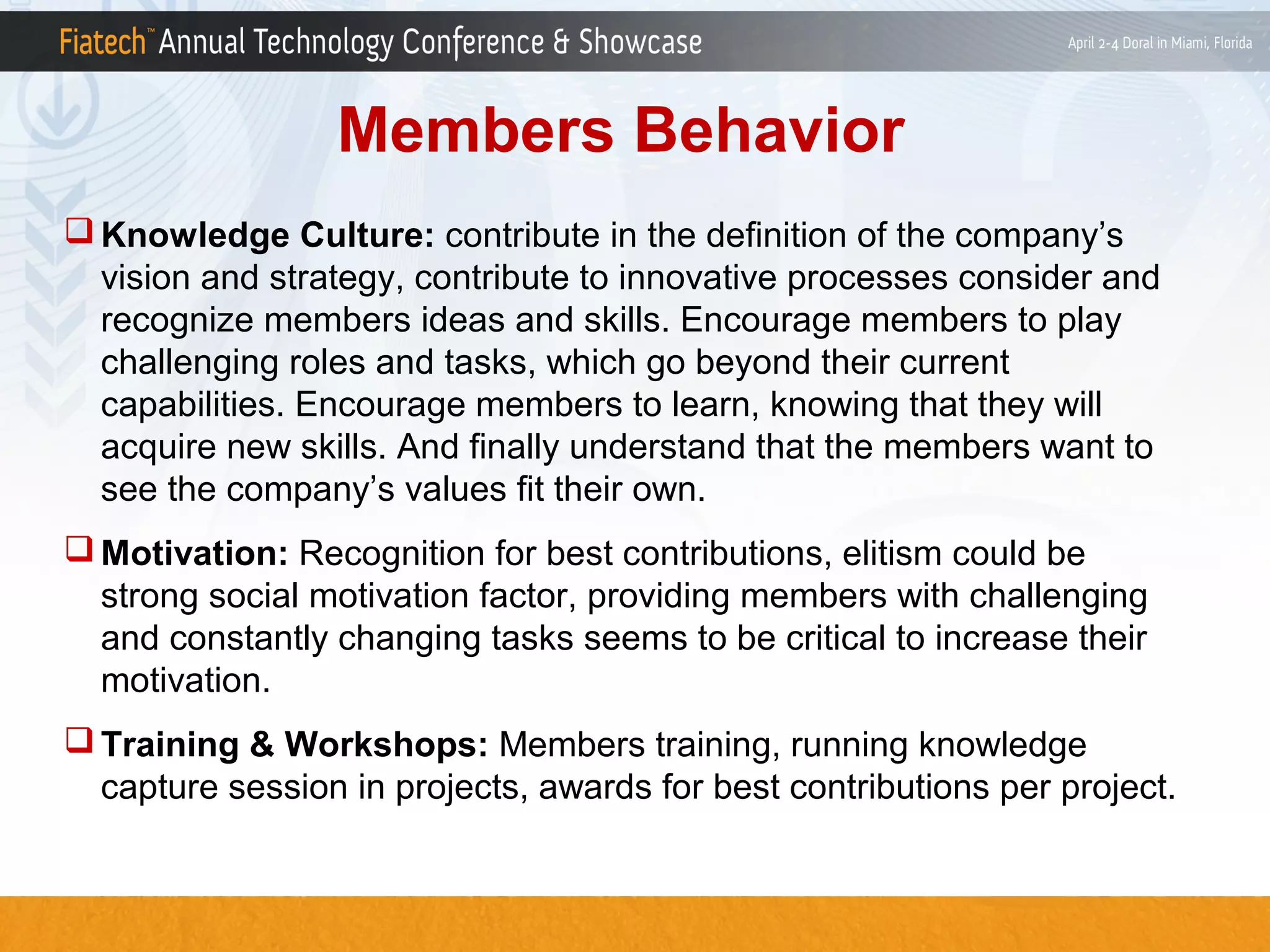
 Monitoring Investment: Time, money and effort (Department
budget, Meetings cost, Time spent in KM-related activities, etc.)
 Monitoring Adoption: whether or not the activity is being taken up
according to plan (Staff time invested in sharing activities, Frequency
of activity per division, etc.)
 Monitoring Health: KM System, repository, search, etc. (#
Knowledge assets created, Frequency of use of knowledge assets
created, etc.)
 Case studies of knowledge re-use. (Ex:
Guidelines For Fabrication Shop Equipment)
 Excavation simulation program
 Participants’ assessment of CoP value for work effectiveness
and/or knowledge development.
Knowledge Creation- Innovative Ideas
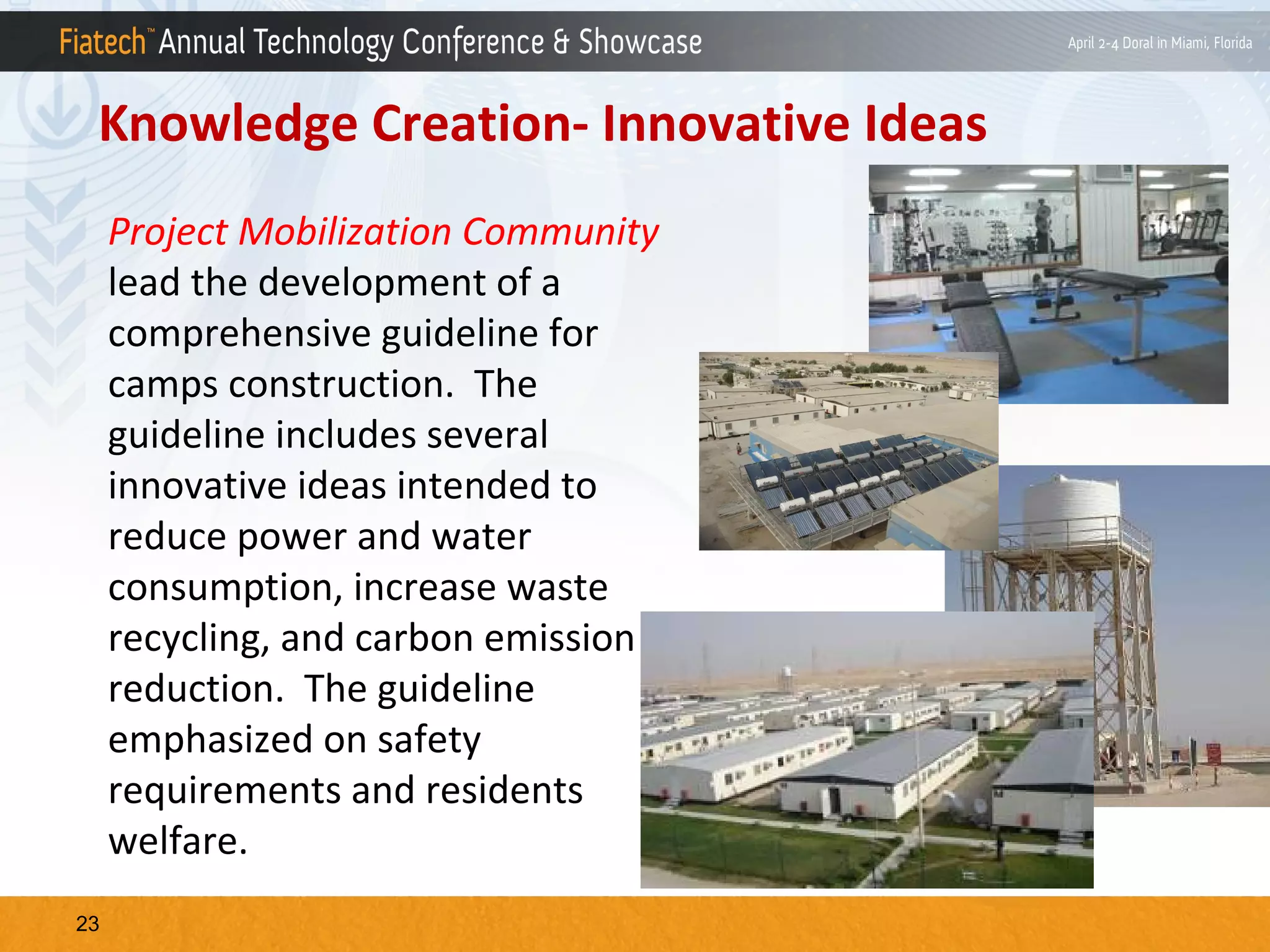
Project Mobilization Community
lead the development of a
comprehensive guideline for
camps construction. The
guideline includes several
innovative ideas intended to
reduce power and water
consumption, increase waste
recycling, and carbon emission
reduction. The guideline
emphasized on safety
requirements and residents
welfare.
23
Collecting & Connecting– Delivering Value
A project engineer in Kazakhstan inquired about best
practice for selection of compressors and dryers for
pressure testing. He found a guideline in Fanous
developed by an SME on the subject, based in Qatar. He
communicated with the SME on his project requirement.
The SME helped him in specifying the equipment. This
resulted on more than US$ 60,000 saving on direct
equipment cost.

24
Collecting & Connecting – Delivering Value
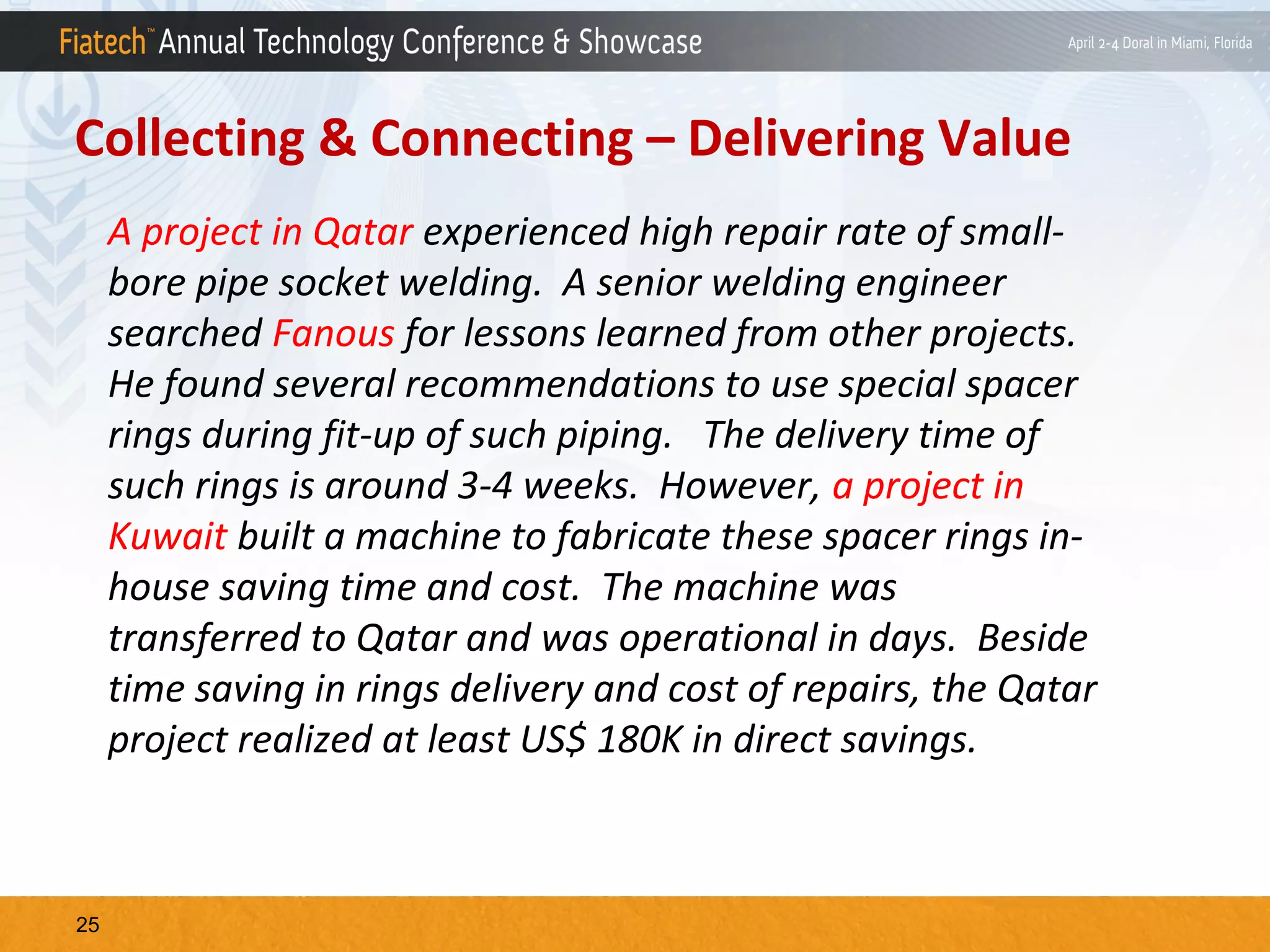
A project in Qatar experienced high repair rate of smallbore pipe socket welding. A senior welding engineer
searched Fanous for lessons learned from other projects.
He found several recommendations to use special spacer
rings during fit-up of such piping. The delivery time of
such rings is around 3-4 weeks. However, a project in
Kuwait built a machine to fabricate these spacer rings inhouse saving time and cost. The machine was
transferred to Qatar and was operational in days. Beside
time saving in rings delivery and cost of repairs, the Qatar
project realized at least US$ 180K in direct savings.

25
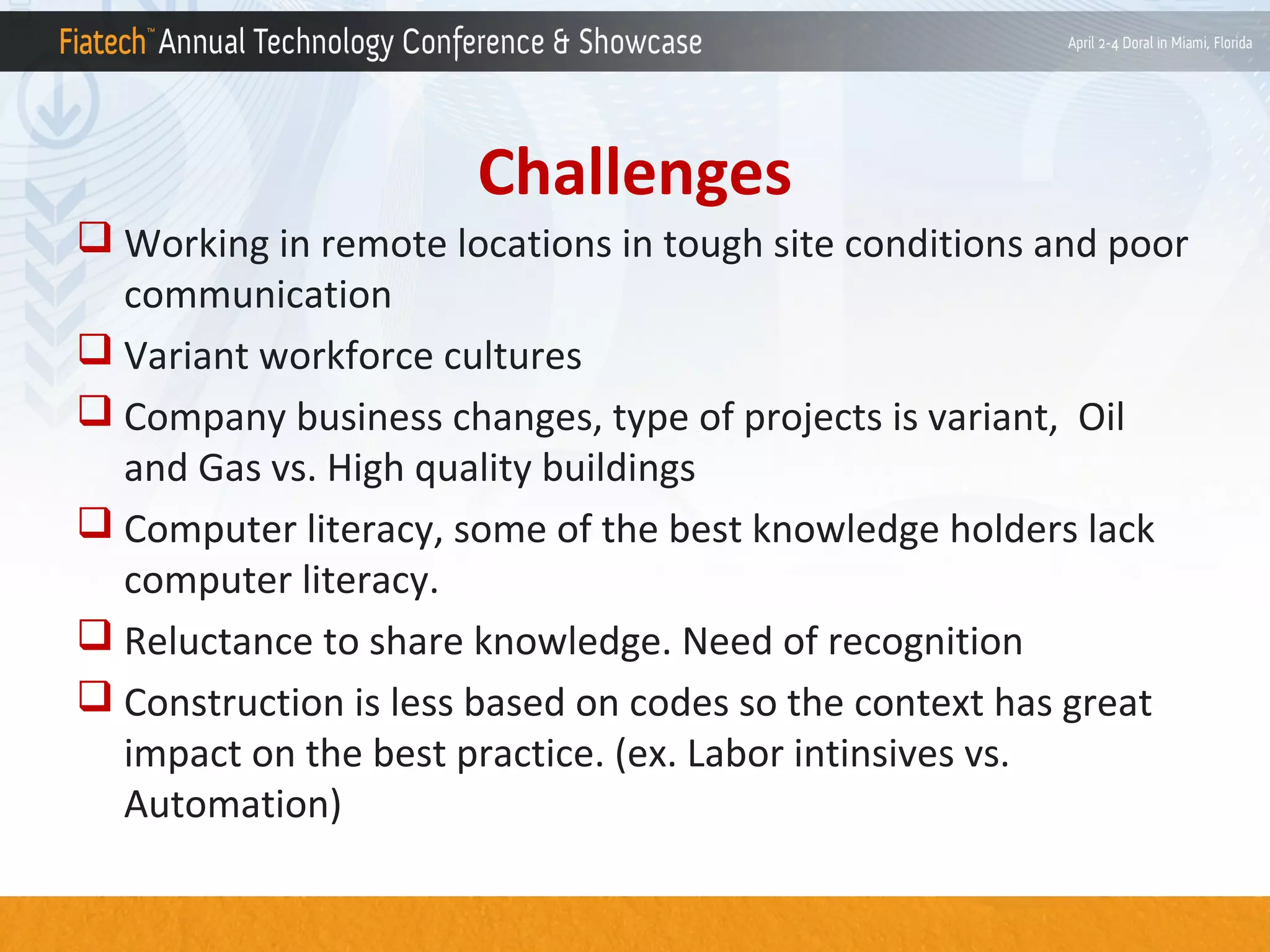
Challenges
 Working in remote locations in tough site conditions and poor
communication
 Variant workforce cultures
 Company business changes, type of projects is variant, Oil
and Gas vs. High quality buildings
 Computer literacy, some of the best knowledge holders lack
computer literacy.
 Reluctance to share knowledge. Need of recognition
 Construction is less based on codes so the context has great
impact on the best practice. (ex. Labor intinsives vs.
Automation)
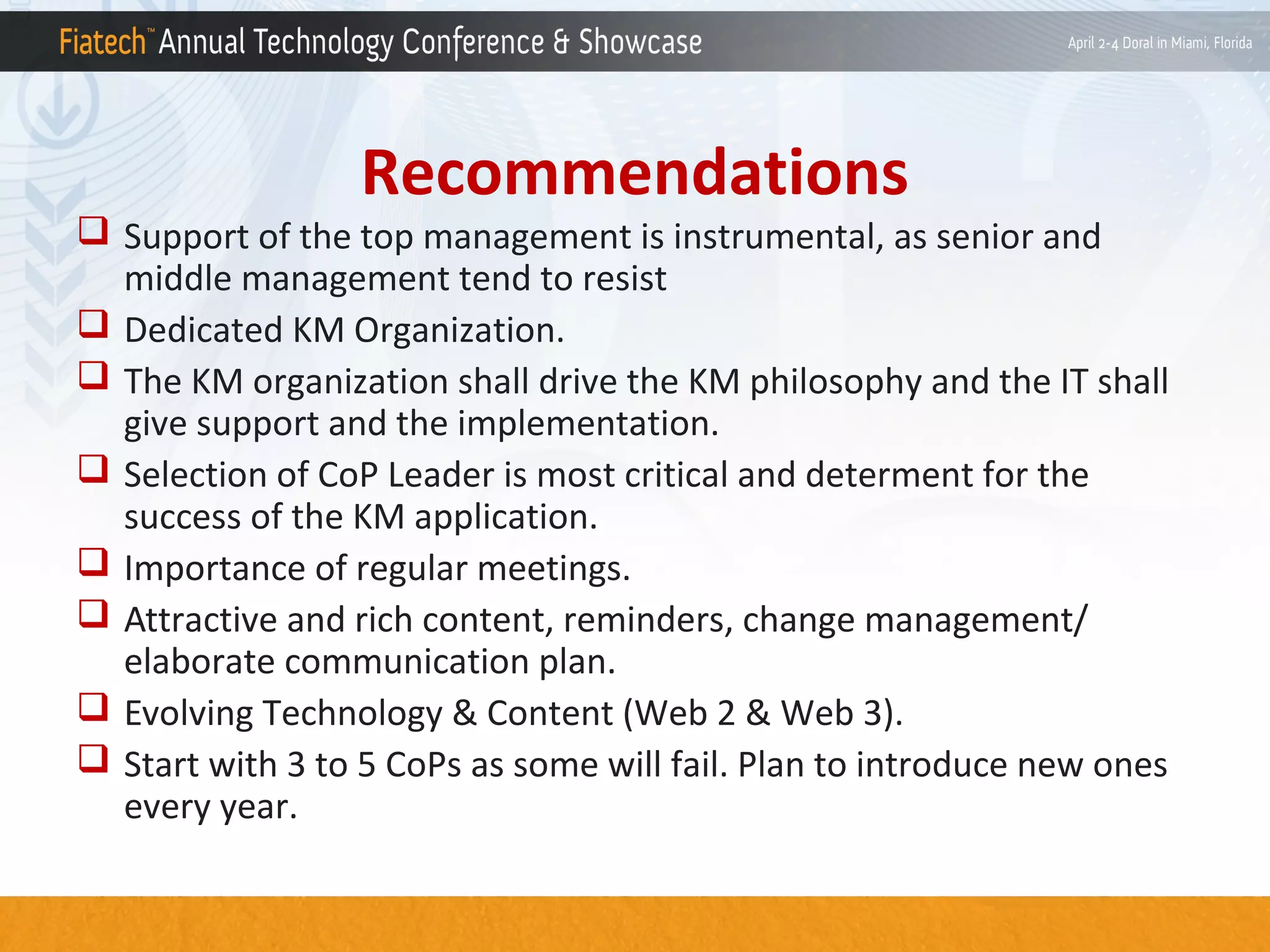
Recommendations

 Support of the top management is instrumental, as senior and
middle management tend to resist
 Dedicated KM Organization.
 The KM organization shall drive the KM philosophy and the IT shall
give support and the implementation.
 Selection of CoP Leader is most critical and determent for the
success of the KM application.
 Importance of regular meetings.
 Attractive and rich content, reminders, change management/
elaborate communication plan.
 Evolving Technology & Content (Web 2 & Web 3).
 Start with 3 to 5 CoPs as some will fail. Plan to introduce new ones
every year.
Thank You Q&A
Discussion Thoughts
 Taxonomy and Ontology Construction (Experiences and per
community)
 Establish/share some benchmarks
 Good size of a community
 Community benchmarks
 Success measures

Challenges & Lessons Learned in Implementing KM Program in a Construction Company

  • 1.
    Challenges & LessonsLearned in Implementing KM Program in a Construction Company By: Mustafa Abusalah, PhD April 2012
  • 2.
    CCC Pre KM WAN: Company headquarters, projects, offices and areas are connected via WAN/VPN.  Communications: Communication channel is mainly through email, IP Telephony and TDM.  Document and Content Management: CCC has an in house developed Document Management System (VBC) which is the repository for all CCC content.  VBC Central: VBC central is the framework where projects, departments, etc. Can create there own content management portals.  One Repository: As VBC is the repository for all CCC content, all applications running at CCC stores and retrieves documents to/from VBC. This allowed different applications to work on the same content when needed.
  • 4.
    Why Knowledge Management(1)  CCC operating platform for developing people and sharing knowledge seems to be adequate in sustaining CCC’s operations pre 2002-03.  Project managers and project teams could transfer knowledge to other projects and / or develop staff within  Formal procedures (QMPs) and “Method Statements” were created and informal networks were effective in exchanging information.  CCC established a niche in being able to execute difficult projects requiring mobilization of significant resources.
  • 5.
    Why Knowledge Management(2)  Magnitude and Rate of Growth are causing “Cracks”  Management time is being diverted from addressing strategic issues “to shoring up partners and client’s concerns due to being behind schedule in up to 80% of our projects”.  Inconsistencies are appearing within our operations and execution of projects.  Roles, responsibilities, accountabilities, communications channels were becoming fragmented across the group. “Sheer volume of growth means we have less time to communicate” “We discover mistakes too late in the game” “We capture and share more lessons learned with partners than with ourselves” “Someone in the project needs to be responsible for lessons learned” “Rework is occurring because people do not know what is available”
  • 6.
    Why Knowledge Management(3) Conclusions Sharing the knowledge: Insights, experiences, contact details, lessons learned, favourite documents, useful links, supplier and other work related resources. Collaboration platform: On bridging knowledge gaps, drafting Corporate Knowledge Corporate Knowledge documents, developing new areas of practices, on bringing Network Network innovation to market, on defining new approaches and solutions to customer issues People Directory (profiles): for locating experience, answering questions, solving problems, make recommendations, training, manuals, lessons learned
  • 7.
    Definition of KnowledgeManagement Knowledge management is the strategic backbone within CCC that puts in place a supportive social and technical framework & structure that encourages staff to contribute, share and innovate knowledge for the benefit of CCC (employees, operations and partners), which in exchange provides staff clearer with insights on how and where they can develop through the application and sharing of knowledge and improve the efficiency of the operations. “Obtaining and creating the right knowledge to the right people at the right time”
  • 8.
    CCC KM Strategy BlanketInitiatives: Initiatives that when implemented cover all CoPs eg. Redesign/ reenergise Lessons Learned Key: Elemental Initiatives: Initiatives that are Example Elemental Initiatives CoP D CoP A CoP C “optional” for each CoP. Each of these initiatives can also be done to varying degrees CoP B Knowledge Process Design eLearning content CoP N CoPs: Groups of individuals with a common Experience database purpose/ goals, supported by functionality provided by Elemental Initiatives Foundation Initiatives: Phase I – necessary to implement prior to developing the CoPs as they provide the core KM support structure for all Elemental Initiatives Phase II – provide the support KM structure for only some of the Elemental Initiatives Knowledge Audit Training & development • Incentives & Recognition framework • Induction programme • KM processes • • • • • KM Organisation Knowledge Portal KM Comms Programme Knowledge Taxonomy KM Scorecard (Phase II) Foundation Initiatives (Phase I)
  • 9.
    KM & CoPOrganisations CCC Leadership Community of Practice Community Leader PT Head of KM Knowledge Manager SMEs PT Knowledge Captains Community Members PT Knowledge Automation Engineer (IS) Knowledge Controllers KM Organisation Executive Assistant Project Manager PT PT PT = Part Time
  • 10.
    KM Organization Processes Connecting:People to communities, people to experts, people to KM tools, people to repositories Enabling & Facilitating: Conversations, exchanges, collaboration, questions, answers, contributions, engagement and adoption Monitoring & Reporting: On behaviours, contribution, engagement, organisational dynamics, KM system health, knowledge flows
  • 11.
    What is aCommunity of Practice (CoP)?  CoPs are either formal or informal groups of people with a common purpose and common goals. A few characteristics of CoPs are:  The “members” share common pursuits and problems  They share common practices and language – eg. They use the same methodologies and express themselves in a similar fashion (eg. technical jargon)  They share similar interests  Most people belong to more than one CoP  Members of a CoP often have the same or similar roles but are not located in the same location (or same project) 11
  • 12.
    CoP Processes Search: foranswers, experts, knowledge, experience, lessons learned, documents, images, perspectives Collaborate: On bridging knowledge gaps, drafting documents, developing new areas of practices, on bringing innovation to market, on defining new approaches and solutions to customer issues Share: Insights, experiences, contact details, lessons learned, favourite documents, useful links, supplier and other work related resources
  • 13.
    KM Portal  WikiCollaboration and Knowledge Sharing platform: bridging knowledge gaps, drafting documents, developing new areas of practices, bringing innovation to market, defining new approaches and solutions to customer issues. Insights, experiences, contact details, lessons learned, favourite documents, useful links, supplier and other work related resources. People Directory (profiles): for locating experience, answering questions, solving problems, make recommendations, training, manuals, lessons learned. VBC Repository: Formal Knowledge, KAudit
  • 14.
    Community of Practice(CoP) Planning Phase*  Establish founding members  Develop business case  Establish Taxonomy Framework & high level breakdown  Perform knowledge Audit: Content + People  Build knowledge maps *Source: American Productivity & Quality Center (APQC)
  • 15.
    Community of Practice(CoP) CoP - Design Phase*  Design knowledge sharing processes/ workflows  Identify roles and responsibilities  Identify required IT capabilities  Develop Initial learning and development plan and content  Create measures, indicators, and scorecard  Establish reward and recognition plans  Develop change management plan ( Monthly newsletters, announcements, surveys, Bulletin etc.) *Source: American Productivity & Quality Center (APQC)
  • 16.
    Meetings Highlights  FirstYear: 6 Meetings were held with each CoP  Meeting No. 1: Business Case Requirements  Meeting No. 2: Business Case follow-up & KM Roll out plan  Meeting No. 3: Founding Members’ CoP Kick-off Meeting and agree on roles and responsibilities  Meeting No. 4: Business Case Presentation to Top Management  Meeting No. 5: Review KAudit report, agree on launching content, and membership guides.  Meeting No. 6: Review new contributions, agree on future contributions and presentations by invited speakers and members.  Then Two yearly follow up meetings are held.
  • 17.
    “Connect & Collect”Knowledge Portal “Connect & Collect” Knowledge Portal? Connect People 3. Share, Validate & Harvest Learnings KnowledgeBase 1. Do we already know this? 4. Enrich the KBase 2. Who can I ask for help?
  • 18.
    CCC Knowledge Portal– Fanous 18
  • 19.
  • 20.
    Recognition of BestContributors/ Projects 20
  • 21.
    Members Behavior  KnowledgeCulture: contribute in the definition of the company’s vision and strategy, contribute to innovative processes consider and recognize members ideas and skills. Encourage members to play challenging roles and tasks, which go beyond their current capabilities. Encourage members to learn, knowing that they will acquire new skills. And finally understand that the members want to see the company’s values fit their own.  Motivation: Recognition for best contributions, elitism could be strong social motivation factor, providing members with challenging and constantly changing tasks seems to be critical to increase their motivation.  Training & Workshops: Members training, running knowledge capture session in projects, awards for best contributions per project.
  • 22.
    Measuring & Monitoring Monitoring Investment: Time, money and effort (Department budget, Meetings cost, Time spent in KM-related activities, etc.)  Monitoring Adoption: whether or not the activity is being taken up according to plan (Staff time invested in sharing activities, Frequency of activity per division, etc.)  Monitoring Health: KM System, repository, search, etc. (# Knowledge assets created, Frequency of use of knowledge assets created, etc.)  Case studies of knowledge re-use. (Ex: Guidelines For Fabrication Shop Equipment)  Excavation simulation program  Participants’ assessment of CoP value for work effectiveness and/or knowledge development.
  • 23.
    Knowledge Creation- InnovativeIdeas Project Mobilization Community lead the development of a comprehensive guideline for camps construction. The guideline includes several innovative ideas intended to reduce power and water consumption, increase waste recycling, and carbon emission reduction. The guideline emphasized on safety requirements and residents welfare. 23
  • 24.
    Collecting & Connecting–Delivering Value A project engineer in Kazakhstan inquired about best practice for selection of compressors and dryers for pressure testing. He found a guideline in Fanous developed by an SME on the subject, based in Qatar. He communicated with the SME on his project requirement. The SME helped him in specifying the equipment. This resulted on more than US$ 60,000 saving on direct equipment cost. 24
  • 25.
    Collecting & Connecting– Delivering Value A project in Qatar experienced high repair rate of smallbore pipe socket welding. A senior welding engineer searched Fanous for lessons learned from other projects. He found several recommendations to use special spacer rings during fit-up of such piping. The delivery time of such rings is around 3-4 weeks. However, a project in Kuwait built a machine to fabricate these spacer rings inhouse saving time and cost. The machine was transferred to Qatar and was operational in days. Beside time saving in rings delivery and cost of repairs, the Qatar project realized at least US$ 180K in direct savings. 25
  • 26.
    Challenges  Working inremote locations in tough site conditions and poor communication  Variant workforce cultures  Company business changes, type of projects is variant, Oil and Gas vs. High quality buildings  Computer literacy, some of the best knowledge holders lack computer literacy.  Reluctance to share knowledge. Need of recognition  Construction is less based on codes so the context has great impact on the best practice. (ex. Labor intinsives vs. Automation)
  • 27.
    Recommendations  Support ofthe top management is instrumental, as senior and middle management tend to resist  Dedicated KM Organization.  The KM organization shall drive the KM philosophy and the IT shall give support and the implementation.  Selection of CoP Leader is most critical and determent for the success of the KM application.  Importance of regular meetings.  Attractive and rich content, reminders, change management/ elaborate communication plan.  Evolving Technology & Content (Web 2 & Web 3).  Start with 3 to 5 CoPs as some will fail. Plan to introduce new ones every year.
  • 28.
  • 29.
    Discussion Thoughts  Taxonomyand Ontology Construction (Experiences and per community)  Establish/share some benchmarks  Good size of a community  Community benchmarks  Success measures

Editor's Notes

  • #6 These are comments by PMs based on survey prior to KM
  • #9 The Balanced Scorecard (BSC) is a performance management tool which began as a concept for measuring whether the smaller-scale operational activities of a company are aligned with its larger-scale objectives in terms of vision and strategy.
  • #11 This solution should provide an effective means to: From launch, encourage community members to contribute knowledge, experience and their network of contacts to the community Enable continuous review and fine tuning of the CoP’s behaviours and engagement levels Enable continuous review of knowledge contribution levels by CoP/Region/Project Integrate best practice elements: Notification of most recent contributions by knowledge type Profiling of frequency of contribution and number of members contribution Statistics recording individual CoP member contribution totals Track indicators of cross CoP sharing activities (Wave 3.) Measure and report on contribution rates and boundary sharing for by CoP/tool/knowledge object The ‘Enabling & Facilitating’ process presumes CoPs enjoy a vibrant and dynamic knowledge sharing culture, where members feel encouraged to discuss issues, share experiences, and network together – assisted by an easy-to-use knowledge infrastructure. The ‘Enabling & Facilitating’ process (Level 0) can be decomposed into three Level 1 sub-processes, which are: The Synthesize KM/CoP Enabling & Facilitating Criteria sub-process articulates the conditions required for an intervention from the KM Organization into a systematic format that can be used to establish the typical ‘Enabling & Facilitating’ context. It presumes the CoPs are open to receiving ‘Enabling & Facilitating’ type support from the KM Organization. The Develop KM/CoP Enabling & Facilitating Intervention Model sub-process integrates ‘Enabling & Facilitating’ behaviours from the prior sub-process into a simple, process capable of being adapted to a range of facilitation techniques such as Appreciative Enquiry, while being simple to implement by the KM Organization. 3. The Develop & Initiate KM/CoP Enabling & Facilitation Outcomes translates the second level activities of ‘Enabling & Facilitating’ into a derived answer or facilitated solution set. The objective of the KM ‘Monitoring & Reporting’ process is to ensure the KM Organization is effectively monitoring the health of KM system and the CoPs and is identifying issues and opportunities in a timely and efficient manner. This process also drives the KM Organization's routine management reporting activity and provides outputs for benchmarking.
  • #16 Regular meetings and newsletters for heavy left.
  • #23 VIA System KPIs and Surveys. Active communities (Mobilization) Not active (Stable Knowledge) Earthworks. Loyalty. Employees who worked for longtime they have more well to share , new employees reluctant to share. PM’s Encourage KM share produces more traffic. Earthwork (Simulation software) Tendering and projects in Oman/Saudi (Several hundreds of thousands of savings in each tender for the mix of equipments. Some tenders saved 0.5 million dollars (SAS Project) used different mix of equipment saved time and money. Hydrotest (General Procedures, pneumatic pressure) Rules of thumps changed the compressor and rather than working in two shifts now it is done in one shift based on certain equations. How long until I reach this pressure. Building: Postensioning concrete Middle east what are the (used to be done by subcontractors), precursiones were posted on the wiki and saved a lot of issues with subcontractors. Pipe Fabrication: Type of equipment in the fab shop. Mobilization: guideline for camps standard rooms furniture type of equipment, this helped people in estimation and helped in building new camps helped in power and water consumption and water treatment unit etc.