1
KM STRATEGY FOR
WIPRO CONSULTING
NOVEMBER 2019
2
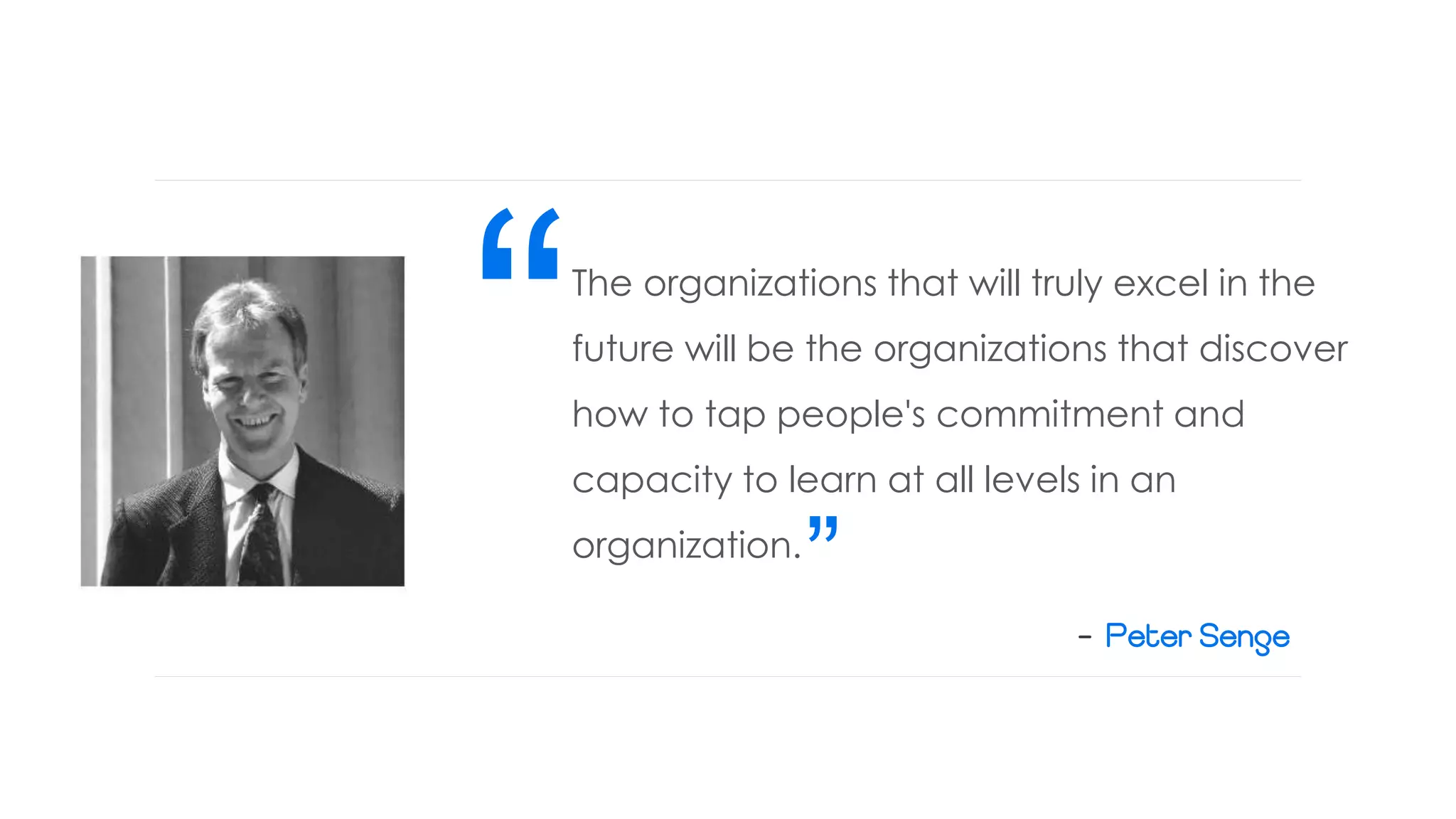
The organizations that will truly excel in the
future will be the organizations that discover
how to tap people's commitment and
capacity to learn at all levels in an
organization.
“
- Peter Senge
“
3
Through this presentation, we will explore the following:
• The Why – We talk about the need for Knowledge Management
• The What – We look at what aspects need to be considered in order to have the right KM
implementation strategy in place
• The How – We discuss a few high-level ways in which our specific challenges can be
addressed through various KM initiatives, and also how our success can be measured
4
5
Because knowledge is power, and it will play a major role in
driving the economy of the future.
Knowledge Management is a disciplined approach to promoting a culture of reuse,
collaboration, and knowledge-sharing within the organization, to ensure that all the
knowledge capital that exists within the organization is codified, organized and disseminated
to employees at all levels, in order to enable quicker decision-making and rapid innovation.
6
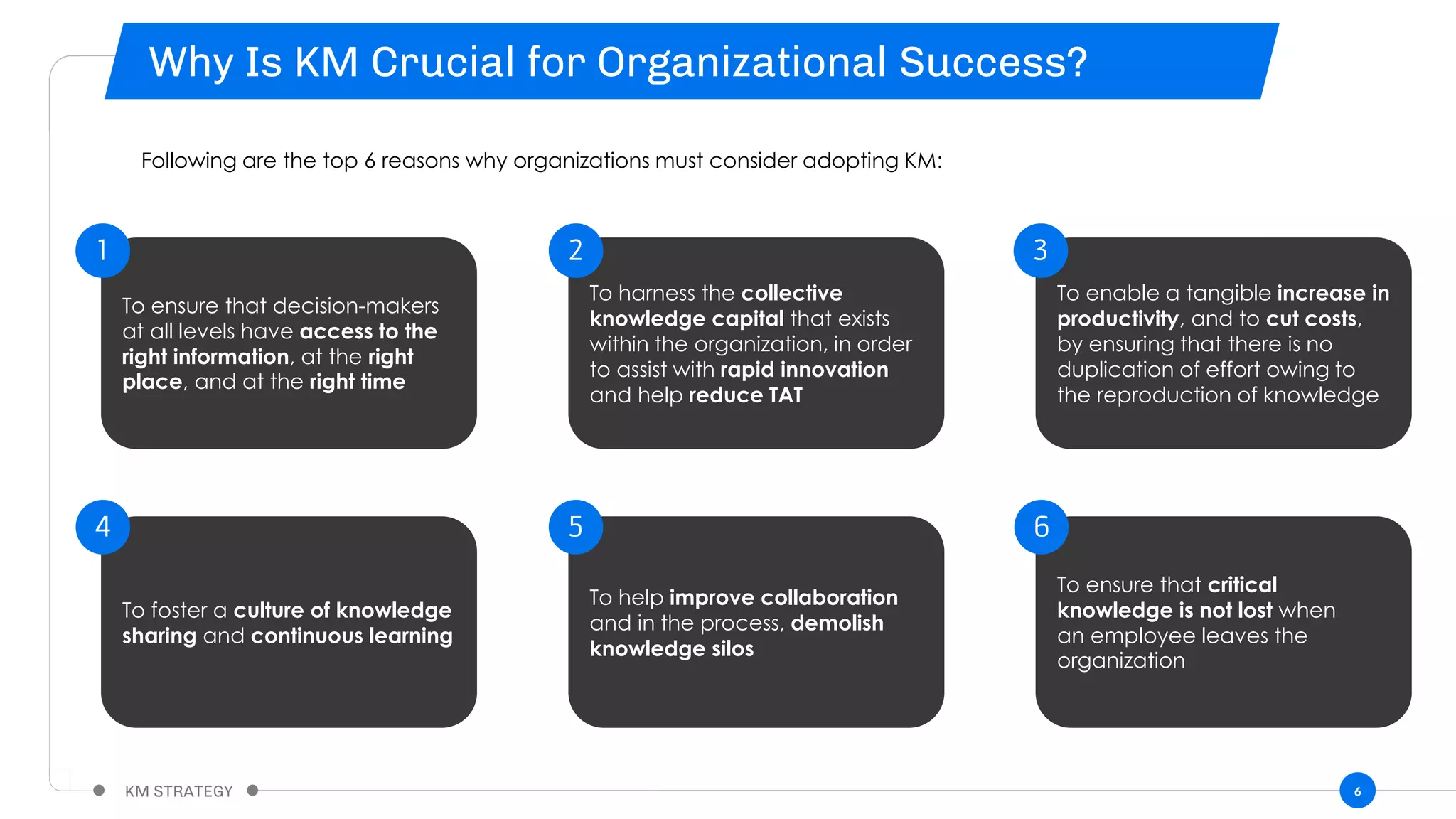
Following are the top 6 reasons why organizations must consider adopting KM:
To ensure that decision-makers
at all levels have access to the
right information, at the right
place, and at the right time
To harness the collective
knowledge capital that exists
within the organization, in order
to assist with rapid innovation
and help reduce TAT
To enable a tangible increase in
productivity, and to cut costs,
by ensuring that there is no
duplication of effort owing to
the reproduction of knowledge
To foster a culture of knowledge
sharing and continuous learning
To help improve collaboration
and in the process, demolish
knowledge silos
To ensure that critical
knowledge is not lost when
an employee leaves the
organization
1 2 3
4 5 6
7
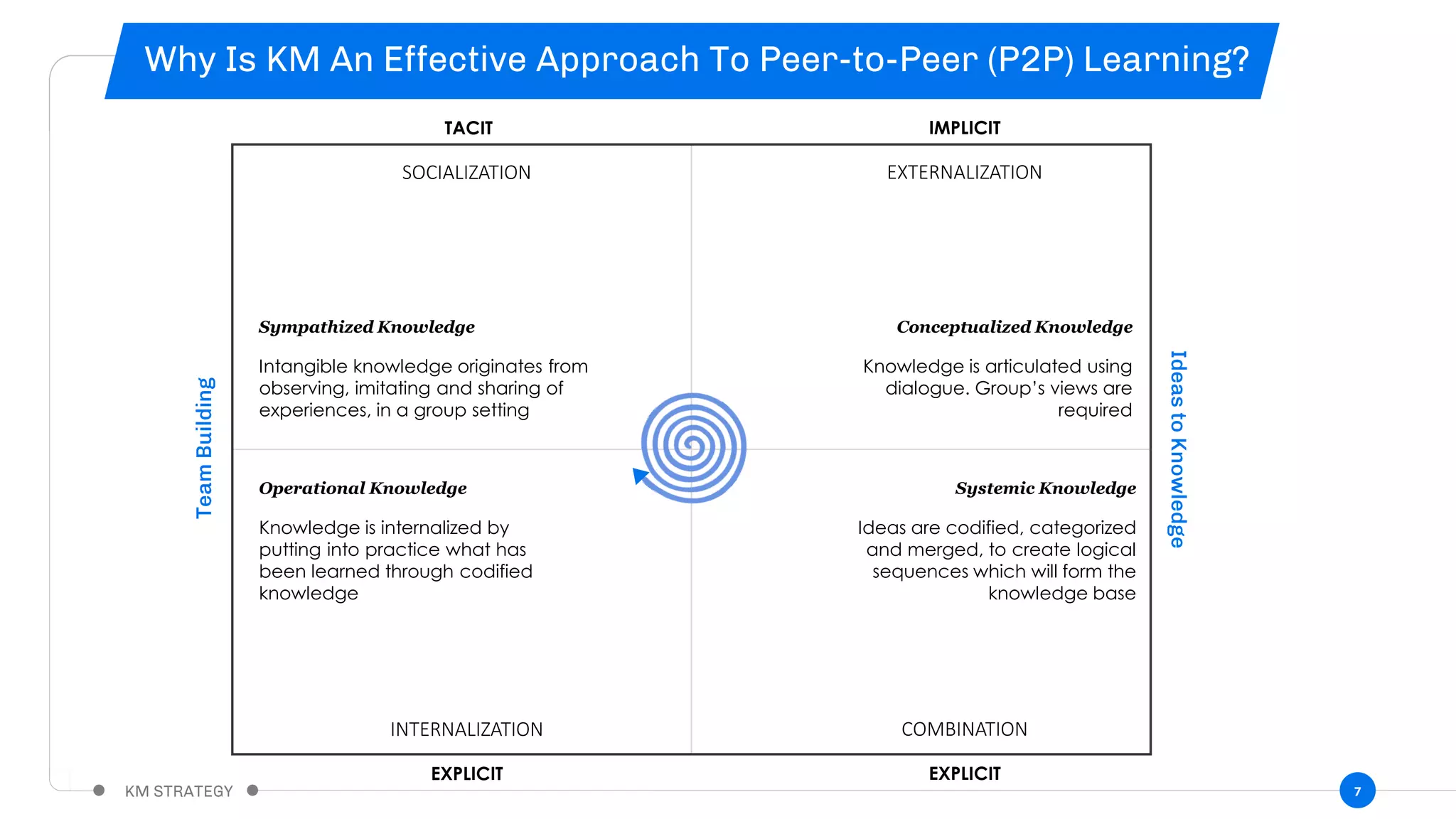
TACIT IMPLICIT
EXPLICIT EXPLICIT
INTERNALIZATION COMBINATION
SOCIALIZATION EXTERNALIZATION
Sympathized Knowledge
Intangible knowledge originates from
observing, imitating and sharing of
experiences, in a group setting
Conceptualized Knowledge
Knowledge is articulated using
dialogue. Group’s views are
required
Operational Knowledge
Knowledge is internalized by
putting into practice what has
been learned through codified
knowledge
Systemic Knowledge
Ideas are codified, categorized
and merged, to create logical
sequences which will form the
knowledge base
8
9
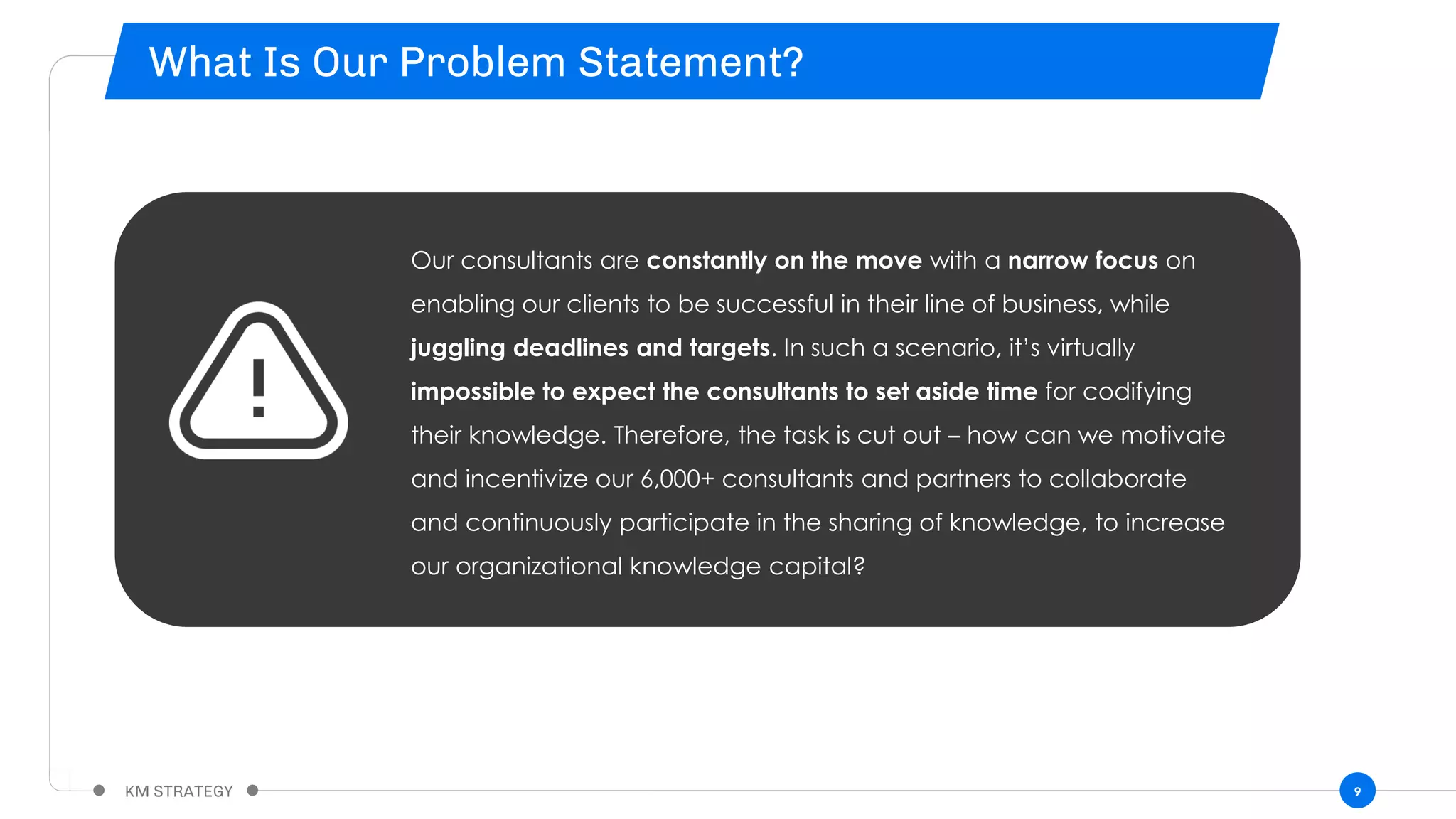
Our consultants are constantly on the move with a narrow focus on
enabling our clients to be successful in their line of business, while
juggling deadlines and targets. In such a scenario, it’s virtually
impossible to expect the consultants to set aside time for codifying
their knowledge. Therefore, the task is cut out – how can we motivate
and incentivize our 6,000+ consultants and partners to collaborate
and continuously participate in the sharing of knowledge, to increase
our organizational knowledge capital?
10
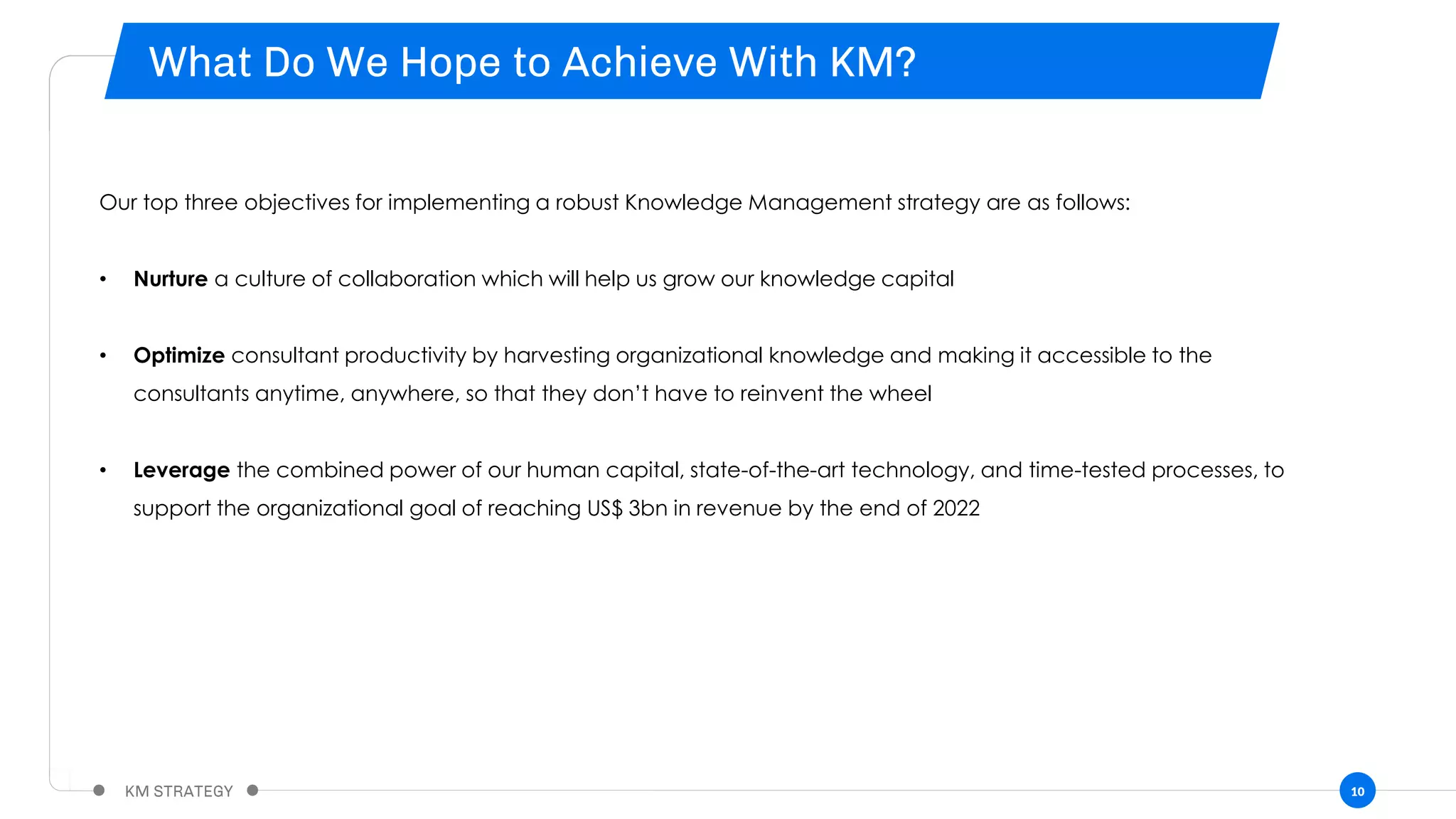
Our top three objectives for implementing a robust Knowledge Management strategy are as follows:
• Nurture a culture of collaboration which will help us grow our knowledge capital
• Optimize consultant productivity by harvesting organizational knowledge and making it accessible to the
consultants anytime, anywhere, so that they don’t have to reinvent the wheel
• Leverage the combined power of our human capital, state-of-the-art technology, and time-tested processes, to
support the organizational goal of reaching US$ 3bn in revenue by the end of 2022
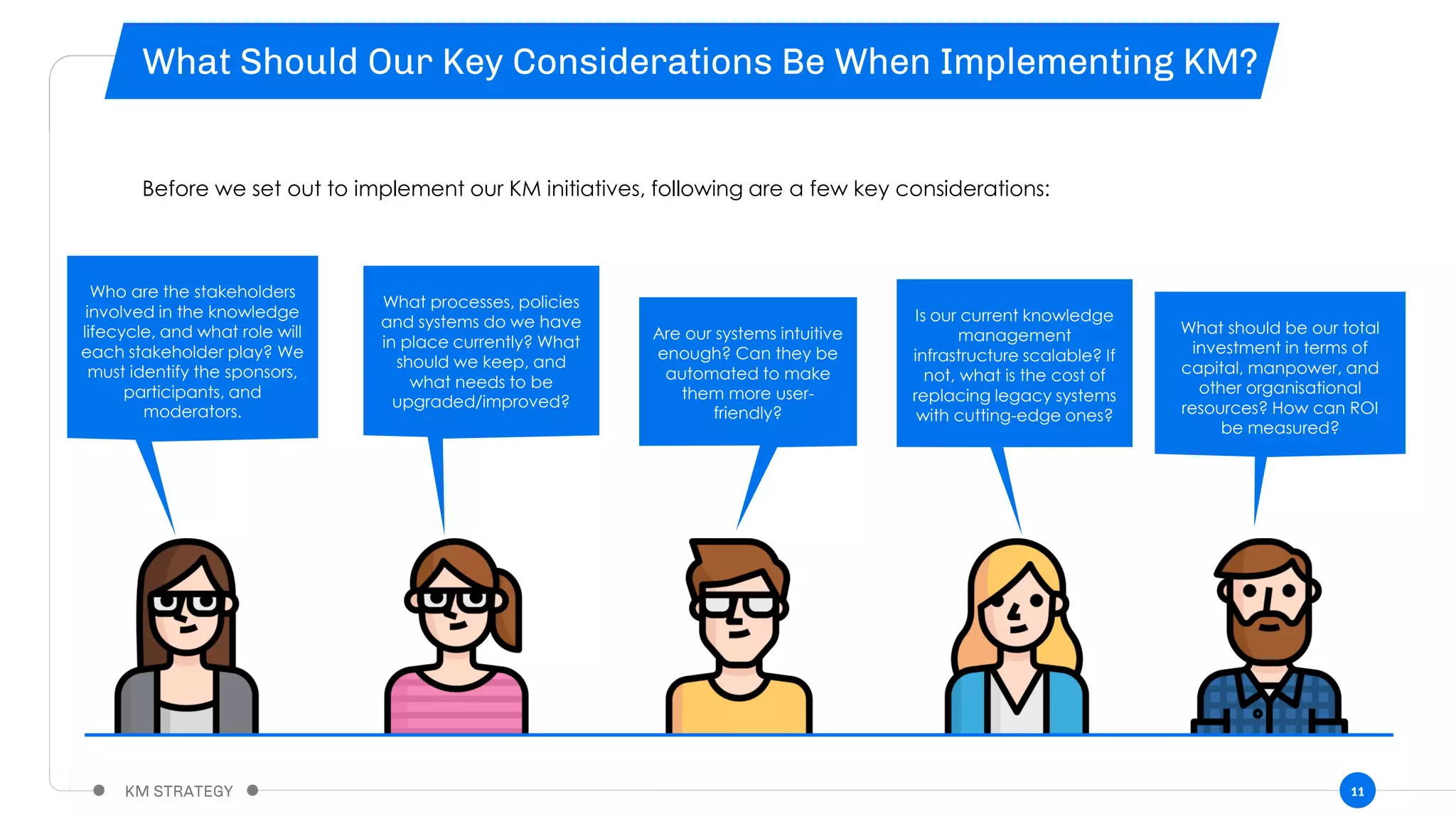
11
Who are the stakeholders
involved in the knowledge
lifecycle, and what role will
each stakeholder play? We
must identify the sponsors,
participants, and
moderators.
What should be our total
investment in terms of
capital, manpower, and
other organisational
resources? How can ROI
be measured?
What processes, policies
and systems do we have
in place currently? What
should we keep, and
what needs to be
upgraded/improved?
Are our systems intuitive
enough? Can they be
automated to make
them more user-
friendly?
Before we set out to implement our KM initiatives, following are a few key considerations:
Is our current knowledge
management
infrastructure scalable? If
not, what is the cost of
replacing legacy systems
with cutting-edge ones?
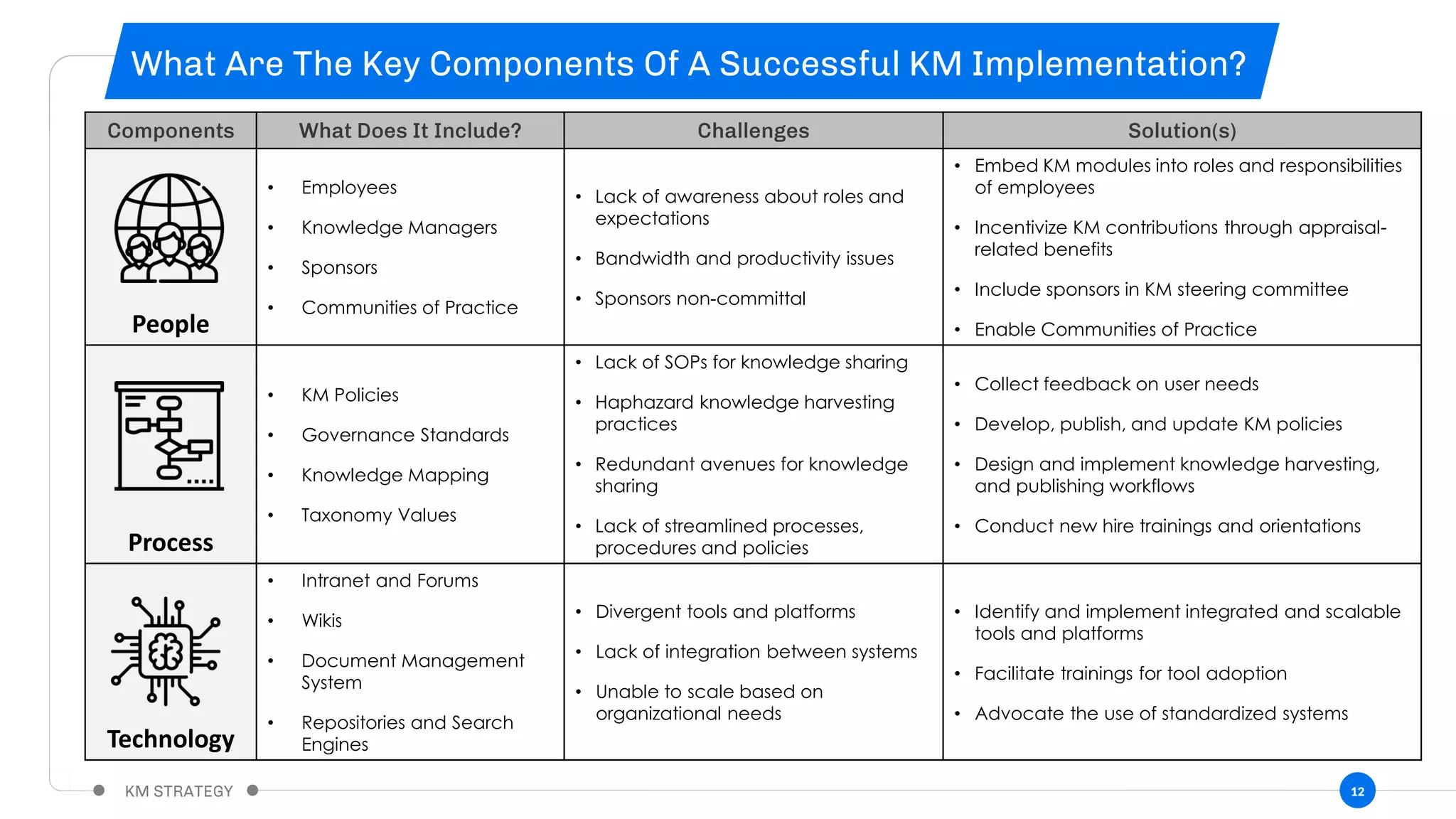
12
People
• Employees
• Knowledge Managers
• Sponsors
• Communities of Practice
• Lack of awareness about roles and
expectations
• Bandwidth and productivity issues
• Sponsors non-committal
• Embed KM modules into roles and responsibilities
of employees
• Incentivize KM contributions through appraisal-
related benefits
• Include sponsors in KM steering committee
• Enable Communities of Practice
Process
• KM Policies
• Governance Standards
• Knowledge Mapping
• Taxonomy Values
• Lack of SOPs for knowledge sharing
• Haphazard knowledge harvesting
practices
• Redundant avenues for knowledge
sharing
• Lack of streamlined processes,
procedures and policies
• Collect feedback on user needs
• Develop, publish, and update KM policies
• Design and implement knowledge harvesting,
and publishing workflows
• Conduct new hire trainings and orientations
Technology
• Intranet and Forums
• Wikis
• Document Management
System
• Repositories and Search
Engines
• Divergent tools and platforms
• Lack of integration between systems
• Unable to scale based on
organizational needs
• Identify and implement integrated and scalable
tools and platforms
• Facilitate trainings for tool adoption
• Advocate the use of standardized systems
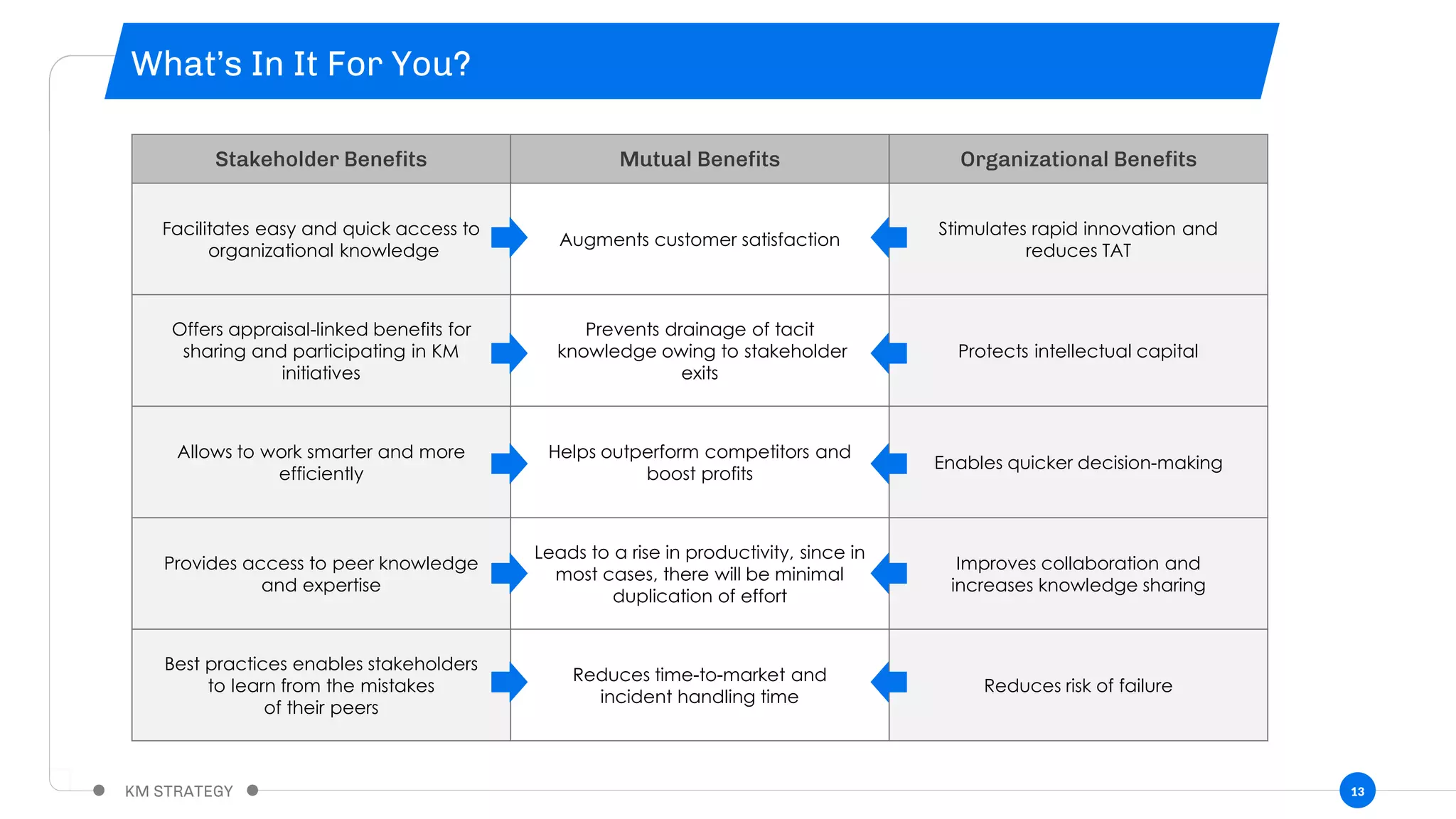
13
Facilitates easy and quick access to
organizational knowledge
Augments customer satisfaction
Stimulates rapid innovation and
reduces TAT
Offers appraisal-linked benefits for
sharing and participating in KM
initiatives
Prevents drainage of tacit
knowledge owing to stakeholder
exits
Protects intellectual capital
Allows to work smarter and more
efficiently
Helps outperform competitors and
boost profits
Enables quicker decision-making
Provides access to peer knowledge
and expertise
Leads to a rise in productivity, since in
most cases, there will be minimal
duplication of effort
Improves collaboration and
increases knowledge sharing
Best practices enables stakeholders
to learn from the mistakes
of their peers
Reduces time-to-market and
incident handling time
Reduces risk of failure
14
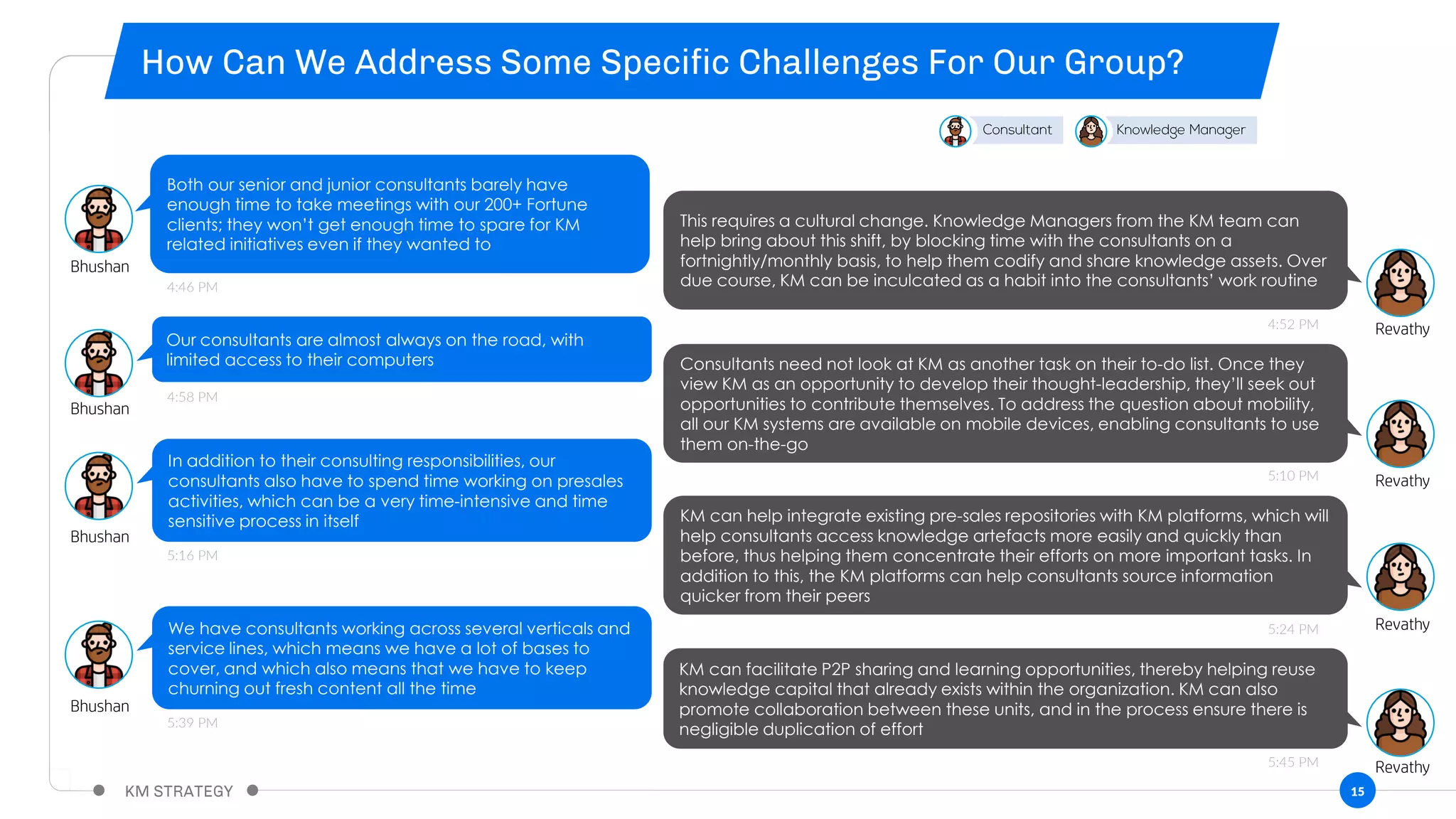
15
This requires a cultural change. Knowledge Managers from the KM team can
help bring about this shift, by blocking time with the consultants on a
fortnightly/monthly basis, to help them codify and share knowledge assets. Over
due course, KM can be inculcated as a habit into the consultants’ work routine
Both our senior and junior consultants barely have
enough time to take meetings with our 200+ Fortune
clients; they won’t get enough time to spare for KM
related initiatives even if they wanted to
Our consultants are almost always on the road, with
limited access to their computers Consultants need not look at KM as another task on their to-do list. Once they
view KM as an opportunity to develop their thought-leadership, they’ll seek out
opportunities to contribute themselves. To address the question about mobility,
all our KM systems are available on mobile devices, enabling consultants to use
them on-the-go
In addition to their consulting responsibilities, our
consultants also have to spend time working on presales
activities, which can be a very time-intensive and time
sensitive process in itself KM can help integrate existing pre-sales repositories with KM platforms, which will
help consultants access knowledge artefacts more easily and quickly than
before, thus helping them concentrate their efforts on more important tasks. In
addition to this, the KM platforms can help consultants source information
quicker from their peers
We have consultants working across several verticals and
service lines, which means we have a lot of bases to
cover, and which also means that we have to keep
churning out fresh content all the time
KM can facilitate P2P sharing and learning opportunities, thereby helping reuse
knowledge capital that already exists within the organization. KM can also
promote collaboration between these units, and in the process ensure there is
negligible duplication of effort
Bhushan
Revathy
Revathy
Revathy
Revathy
Bhushan
Bhushan
Bhushan
4:46 PM
4:58 PM
5:16 PM
5:39 PM
4:52 PM
5:10 PM
5:24 PM
5:45 PM
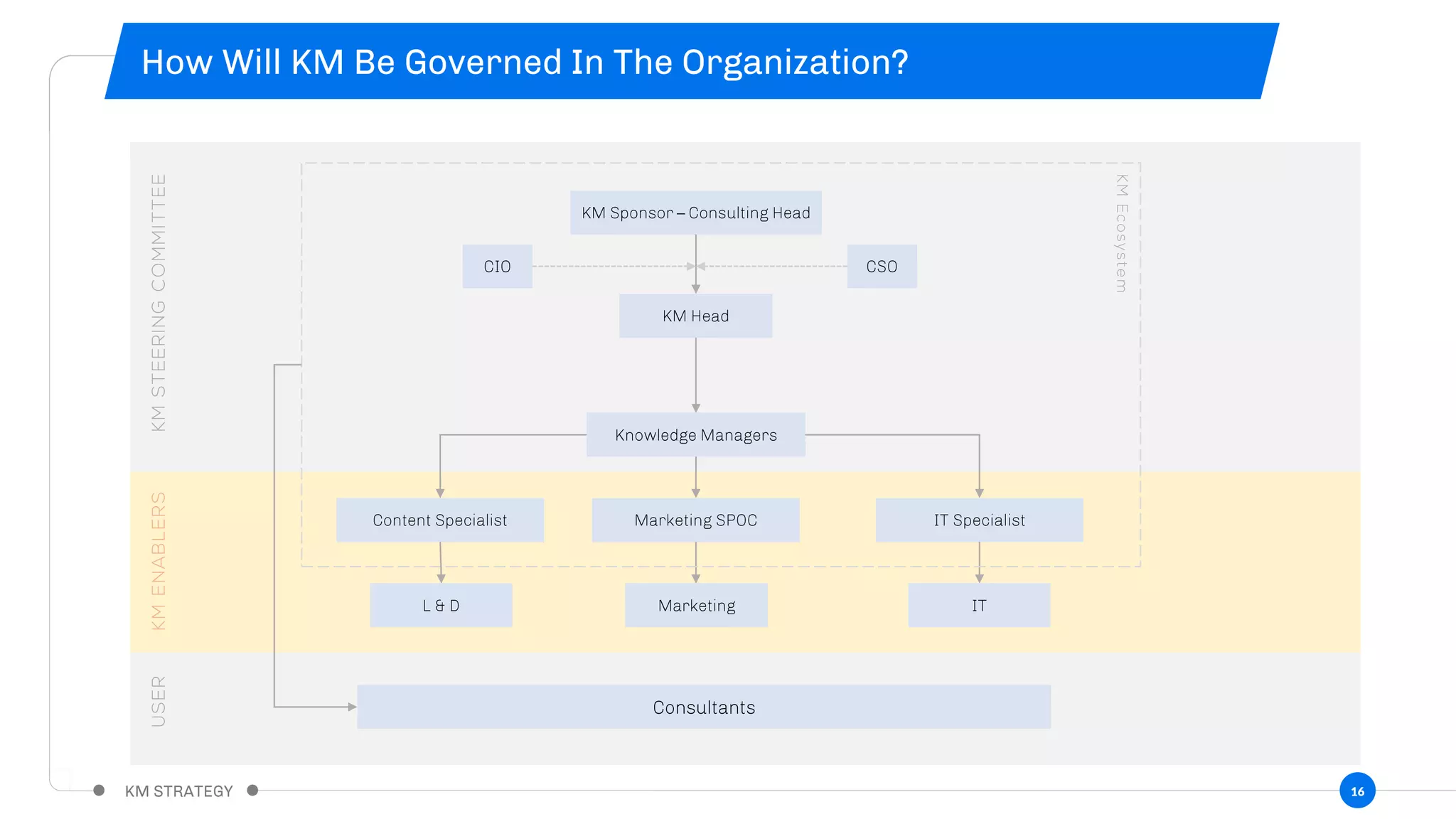
16
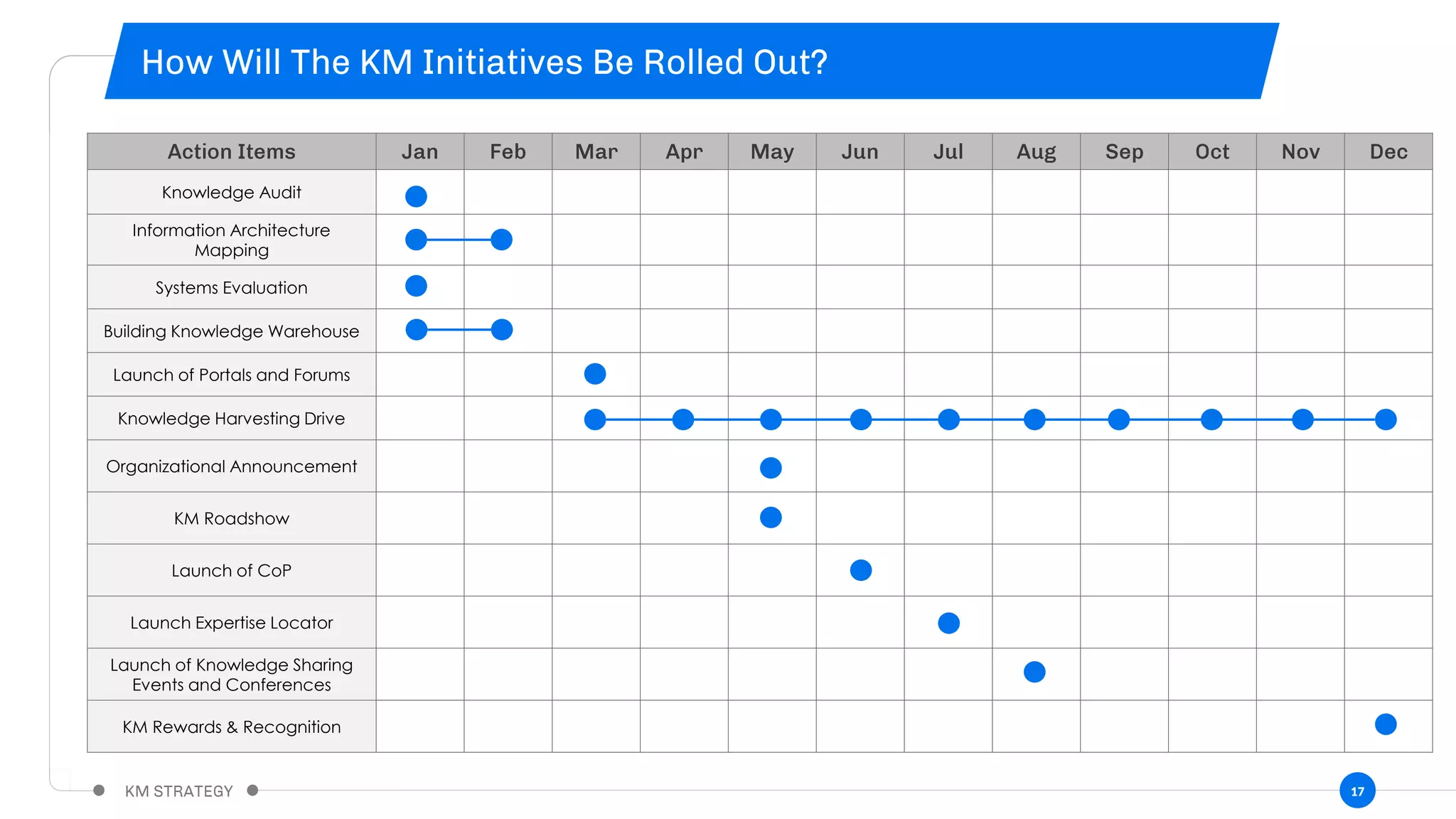
17
Knowledge Audit
Information Architecture
Mapping
Systems Evaluation
Building Knowledge Warehouse
Launch of Portals and Forums
Knowledge Harvesting Drive
Organizational Announcement
KM Roadshow
Launch of CoP
Launch Expertise Locator
Launch of Knowledge Sharing
Events and Conferences
KM Rewards & Recognition
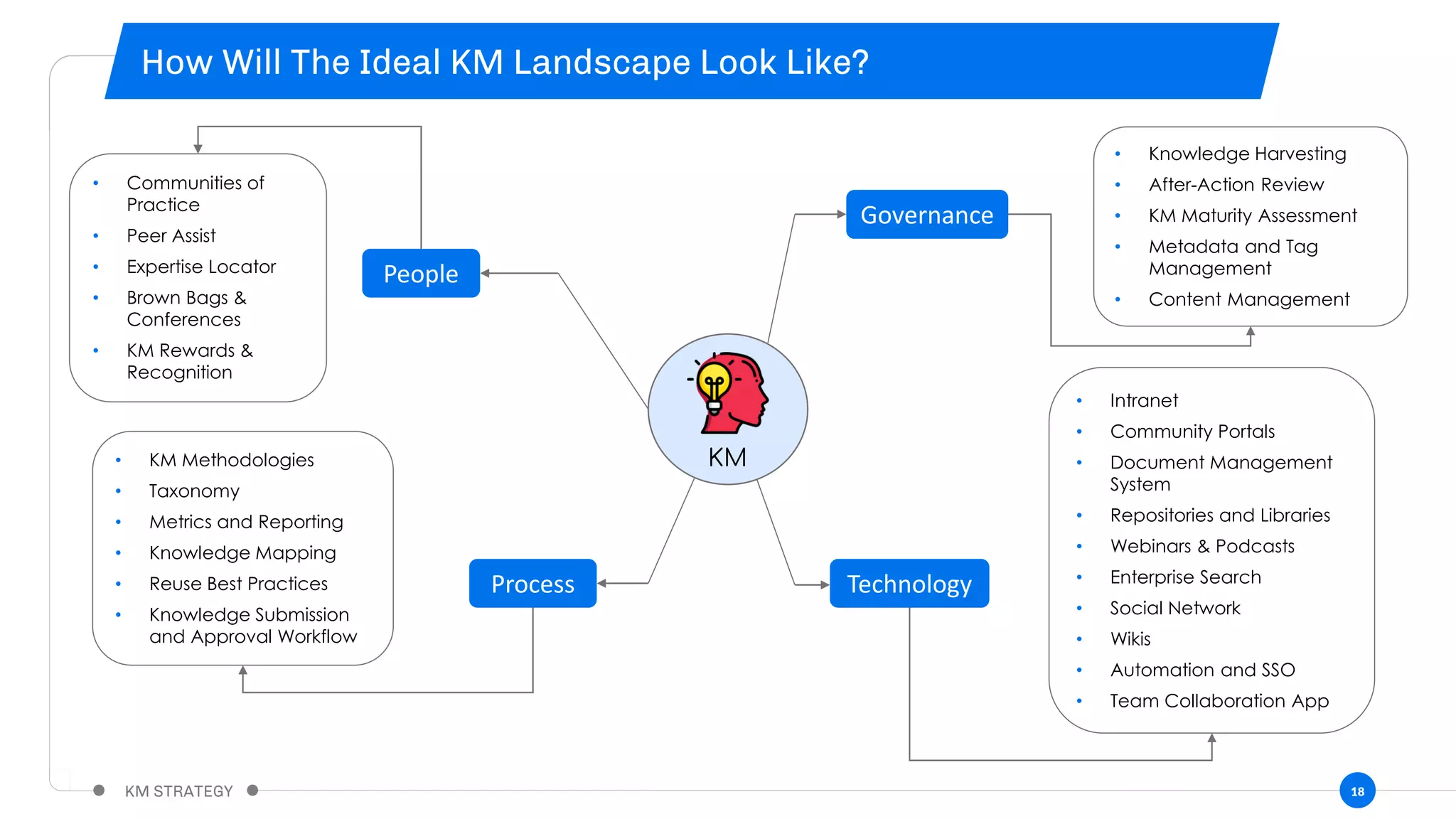
18
People
Governance
TechnologyProcess
• Communities of
Practice
• Peer Assist
• Expertise Locator
• Brown Bags &
Conferences
• KM Rewards &
Recognition
• Knowledge Harvesting
• After-Action Review
• KM Maturity Assessment
• Metadata and Tag
Management
• Content Management
• Intranet
• Community Portals
• Document Management
System
• Repositories and Libraries
• Webinars & Podcasts
• Enterprise Search
• Social Network
• Wikis
• Automation and SSO
• Team Collaboration App
• KM Methodologies
• Taxonomy
• Metrics and Reporting
• Knowledge Mapping
• Reuse Best Practices
• Knowledge Submission
and Approval Workflow
KM
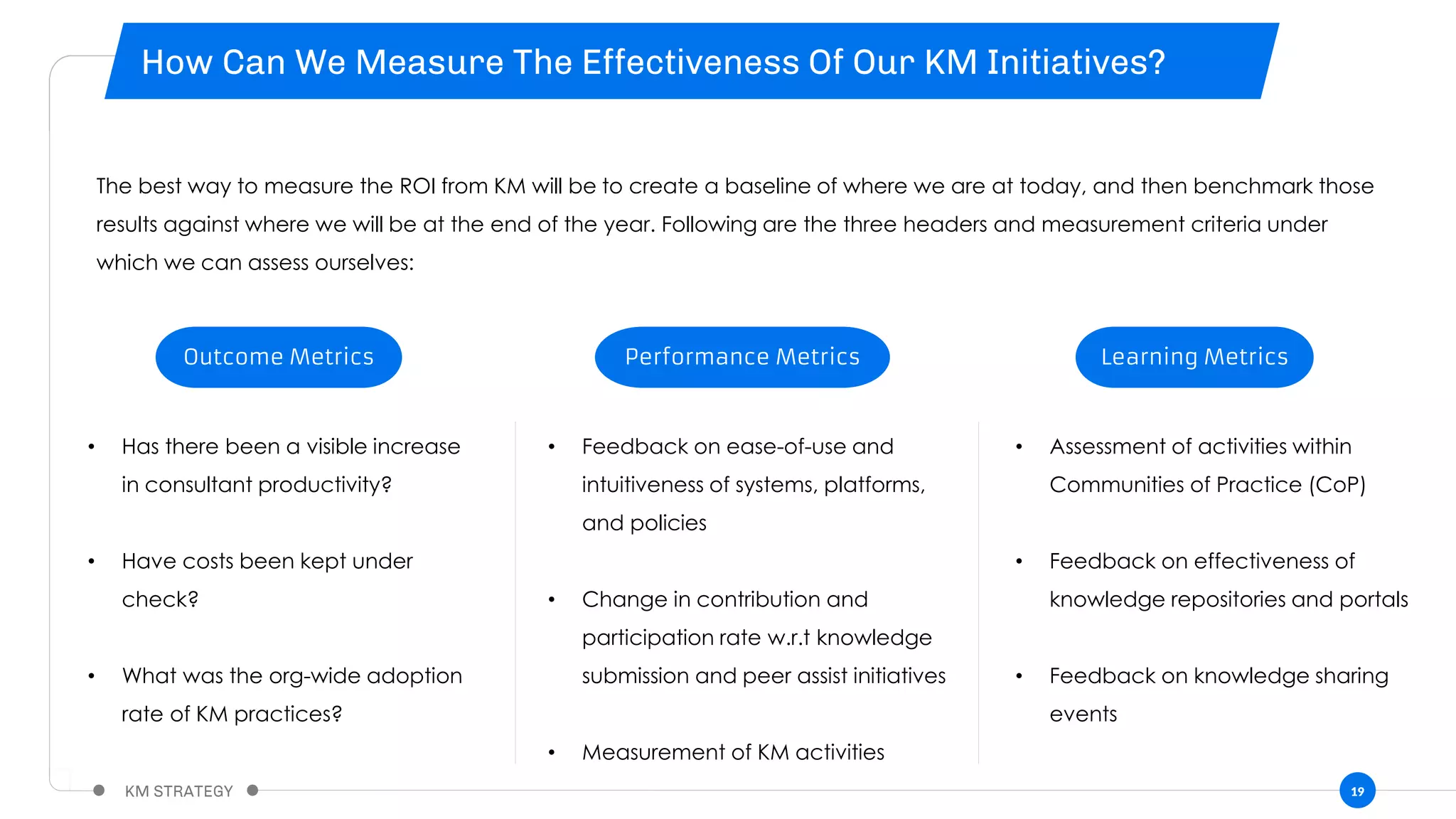
19
Outcome Metrics
• Has there been a visible increase
in consultant productivity?
• Have costs been kept under
check?
• What was the org-wide adoption
rate of KM practices?
• Feedback on ease-of-use and
intuitiveness of systems, platforms,
and policies
• Change in contribution and
participation rate w.r.t knowledge
submission and peer assist initiatives
• Measurement of KM activities
• Assessment of activities within
Communities of Practice (CoP)
• Feedback on effectiveness of
knowledge repositories and portals
• Feedback on knowledge sharing
events
Performance Metrics Learning Metrics
The best way to measure the ROI from KM will be to create a baseline of where we are at today, and then benchmark those
results against where we will be at the end of the year. Following are the three headers and measurement criteria under
which we can assess ourselves:
20
11
12
13
14
15
16
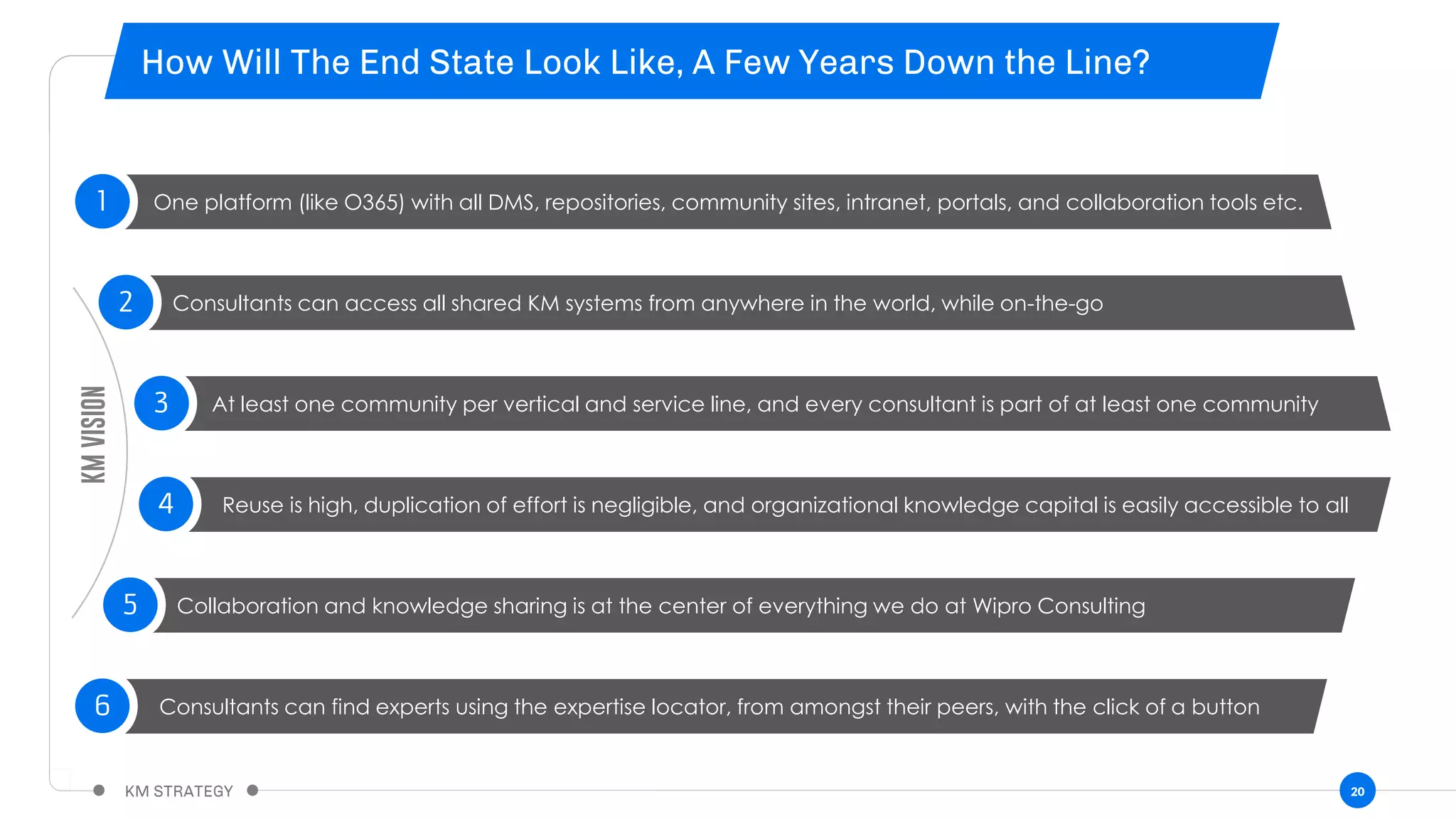
One platform (like O365) with all DMS, repositories, community sites, intranet, portals, and collaboration tools etc.
Consultants can access all shared KM systems from anywhere in the world, while on-the-go
At least one community per vertical and service line, and every consultant is part of at least one community
Reuse is high, duplication of effort is negligible, and organizational knowledge capital is easily accessible to all
Consultants can find experts using the expertise locator, from amongst their peers, with the click of a button
Collaboration and knowledge sharing is at the center of everything we do at Wipro Consulting
KMVISION
21
R A G E S H N A I R
+91 9972 694 676

Knowledge Management (KM) Strategy for Wipro Consulting

  • 1.
    1 KM STRATEGY FOR WIPROCONSULTING NOVEMBER 2019
  • 2.
    2 The organizations thatwill truly excel in the future will be the organizations that discover how to tap people's commitment and capacity to learn at all levels in an organization. “ - Peter Senge “
  • 3.
    3 Through this presentation,we will explore the following: • The Why – We talk about the need for Knowledge Management • The What – We look at what aspects need to be considered in order to have the right KM implementation strategy in place • The How – We discuss a few high-level ways in which our specific challenges can be addressed through various KM initiatives, and also how our success can be measured
  • 4.
  • 5.
    5 Because knowledge ispower, and it will play a major role in driving the economy of the future. Knowledge Management is a disciplined approach to promoting a culture of reuse, collaboration, and knowledge-sharing within the organization, to ensure that all the knowledge capital that exists within the organization is codified, organized and disseminated to employees at all levels, in order to enable quicker decision-making and rapid innovation.
  • 6.
    6 Following are thetop 6 reasons why organizations must consider adopting KM: To ensure that decision-makers at all levels have access to the right information, at the right place, and at the right time To harness the collective knowledge capital that exists within the organization, in order to assist with rapid innovation and help reduce TAT To enable a tangible increase in productivity, and to cut costs, by ensuring that there is no duplication of effort owing to the reproduction of knowledge To foster a culture of knowledge sharing and continuous learning To help improve collaboration and in the process, demolish knowledge silos To ensure that critical knowledge is not lost when an employee leaves the organization 1 2 3 4 5 6
  • 7.
    7 TACIT IMPLICIT EXPLICIT EXPLICIT INTERNALIZATIONCOMBINATION SOCIALIZATION EXTERNALIZATION Sympathized Knowledge Intangible knowledge originates from observing, imitating and sharing of experiences, in a group setting Conceptualized Knowledge Knowledge is articulated using dialogue. Group’s views are required Operational Knowledge Knowledge is internalized by putting into practice what has been learned through codified knowledge Systemic Knowledge Ideas are codified, categorized and merged, to create logical sequences which will form the knowledge base
  • 8.
  • 9.
    9 Our consultants areconstantly on the move with a narrow focus on enabling our clients to be successful in their line of business, while juggling deadlines and targets. In such a scenario, it’s virtually impossible to expect the consultants to set aside time for codifying their knowledge. Therefore, the task is cut out – how can we motivate and incentivize our 6,000+ consultants and partners to collaborate and continuously participate in the sharing of knowledge, to increase our organizational knowledge capital?
  • 10.
    10 Our top threeobjectives for implementing a robust Knowledge Management strategy are as follows: • Nurture a culture of collaboration which will help us grow our knowledge capital • Optimize consultant productivity by harvesting organizational knowledge and making it accessible to the consultants anytime, anywhere, so that they don’t have to reinvent the wheel • Leverage the combined power of our human capital, state-of-the-art technology, and time-tested processes, to support the organizational goal of reaching US$ 3bn in revenue by the end of 2022
  • 11.
    11 Who are thestakeholders involved in the knowledge lifecycle, and what role will each stakeholder play? We must identify the sponsors, participants, and moderators. What should be our total investment in terms of capital, manpower, and other organisational resources? How can ROI be measured? What processes, policies and systems do we have in place currently? What should we keep, and what needs to be upgraded/improved? Are our systems intuitive enough? Can they be automated to make them more user- friendly? Before we set out to implement our KM initiatives, following are a few key considerations: Is our current knowledge management infrastructure scalable? If not, what is the cost of replacing legacy systems with cutting-edge ones?
  • 12.
    12 People • Employees • KnowledgeManagers • Sponsors • Communities of Practice • Lack of awareness about roles and expectations • Bandwidth and productivity issues • Sponsors non-committal • Embed KM modules into roles and responsibilities of employees • Incentivize KM contributions through appraisal- related benefits • Include sponsors in KM steering committee • Enable Communities of Practice Process • KM Policies • Governance Standards • Knowledge Mapping • Taxonomy Values • Lack of SOPs for knowledge sharing • Haphazard knowledge harvesting practices • Redundant avenues for knowledge sharing • Lack of streamlined processes, procedures and policies • Collect feedback on user needs • Develop, publish, and update KM policies • Design and implement knowledge harvesting, and publishing workflows • Conduct new hire trainings and orientations Technology • Intranet and Forums • Wikis • Document Management System • Repositories and Search Engines • Divergent tools and platforms • Lack of integration between systems • Unable to scale based on organizational needs • Identify and implement integrated and scalable tools and platforms • Facilitate trainings for tool adoption • Advocate the use of standardized systems
  • 13.
    13 Facilitates easy andquick access to organizational knowledge Augments customer satisfaction Stimulates rapid innovation and reduces TAT Offers appraisal-linked benefits for sharing and participating in KM initiatives Prevents drainage of tacit knowledge owing to stakeholder exits Protects intellectual capital Allows to work smarter and more efficiently Helps outperform competitors and boost profits Enables quicker decision-making Provides access to peer knowledge and expertise Leads to a rise in productivity, since in most cases, there will be minimal duplication of effort Improves collaboration and increases knowledge sharing Best practices enables stakeholders to learn from the mistakes of their peers Reduces time-to-market and incident handling time Reduces risk of failure
  • 14.
  • 15.
    15 This requires acultural change. Knowledge Managers from the KM team can help bring about this shift, by blocking time with the consultants on a fortnightly/monthly basis, to help them codify and share knowledge assets. Over due course, KM can be inculcated as a habit into the consultants’ work routine Both our senior and junior consultants barely have enough time to take meetings with our 200+ Fortune clients; they won’t get enough time to spare for KM related initiatives even if they wanted to Our consultants are almost always on the road, with limited access to their computers Consultants need not look at KM as another task on their to-do list. Once they view KM as an opportunity to develop their thought-leadership, they’ll seek out opportunities to contribute themselves. To address the question about mobility, all our KM systems are available on mobile devices, enabling consultants to use them on-the-go In addition to their consulting responsibilities, our consultants also have to spend time working on presales activities, which can be a very time-intensive and time sensitive process in itself KM can help integrate existing pre-sales repositories with KM platforms, which will help consultants access knowledge artefacts more easily and quickly than before, thus helping them concentrate their efforts on more important tasks. In addition to this, the KM platforms can help consultants source information quicker from their peers We have consultants working across several verticals and service lines, which means we have a lot of bases to cover, and which also means that we have to keep churning out fresh content all the time KM can facilitate P2P sharing and learning opportunities, thereby helping reuse knowledge capital that already exists within the organization. KM can also promote collaboration between these units, and in the process ensure there is negligible duplication of effort Bhushan Revathy Revathy Revathy Revathy Bhushan Bhushan Bhushan 4:46 PM 4:58 PM 5:16 PM 5:39 PM 4:52 PM 5:10 PM 5:24 PM 5:45 PM
  • 16.
  • 17.
    17 Knowledge Audit Information Architecture Mapping SystemsEvaluation Building Knowledge Warehouse Launch of Portals and Forums Knowledge Harvesting Drive Organizational Announcement KM Roadshow Launch of CoP Launch Expertise Locator Launch of Knowledge Sharing Events and Conferences KM Rewards & Recognition
  • 18.
    18 People Governance TechnologyProcess • Communities of Practice •Peer Assist • Expertise Locator • Brown Bags & Conferences • KM Rewards & Recognition • Knowledge Harvesting • After-Action Review • KM Maturity Assessment • Metadata and Tag Management • Content Management • Intranet • Community Portals • Document Management System • Repositories and Libraries • Webinars & Podcasts • Enterprise Search • Social Network • Wikis • Automation and SSO • Team Collaboration App • KM Methodologies • Taxonomy • Metrics and Reporting • Knowledge Mapping • Reuse Best Practices • Knowledge Submission and Approval Workflow KM
  • 19.
    19 Outcome Metrics • Hasthere been a visible increase in consultant productivity? • Have costs been kept under check? • What was the org-wide adoption rate of KM practices? • Feedback on ease-of-use and intuitiveness of systems, platforms, and policies • Change in contribution and participation rate w.r.t knowledge submission and peer assist initiatives • Measurement of KM activities • Assessment of activities within Communities of Practice (CoP) • Feedback on effectiveness of knowledge repositories and portals • Feedback on knowledge sharing events Performance Metrics Learning Metrics The best way to measure the ROI from KM will be to create a baseline of where we are at today, and then benchmark those results against where we will be at the end of the year. Following are the three headers and measurement criteria under which we can assess ourselves:
  • 20.
    20 11 12 13 14 15 16 One platform (likeO365) with all DMS, repositories, community sites, intranet, portals, and collaboration tools etc. Consultants can access all shared KM systems from anywhere in the world, while on-the-go At least one community per vertical and service line, and every consultant is part of at least one community Reuse is high, duplication of effort is negligible, and organizational knowledge capital is easily accessible to all Consultants can find experts using the expertise locator, from amongst their peers, with the click of a button Collaboration and knowledge sharing is at the center of everything we do at Wipro Consulting KMVISION
  • 21.
    21 R A GE S H N A I R +91 9972 694 676