

LESSONS
LEARNED
Tips & tricks for your lessons learned programme
Nirmala Palaniappan, feb 2021
1
2
Little things add up to make a BIG difference!
■ A little bit of theory
■ Some holistic aspects
■ Some specific ideas
■ Discussion & sharing of experiences
3
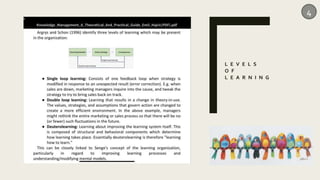
L E V E L S
O F
L E A R N I N G
4
Lessons Learned Passive Collection Active Collection
Passive
Distribution (Pull)
Knowledge Attic Knowledge Sponge
Active
Distribution (Push)
Knowledge Publisher Knowledge Pump
5
Source: Journal of Knowledge Management Practice, March 2005 - Facilitating Knowledge Sharing Through Lessons
Learned System (Sharif, Zakaria, Ching, Fung)
Something to chew on!
■ What business problem(s) are we solving?
■ Are there specific divisions/domains where
we need to focus, to start with?
■ Fishing rod or fishing net approach?
■ Should we use methodologies and
frameworks to capture lessons or leave
people to their own methods and tools?
6
Customise existing
software/processes
As far as possible, it is a good idea to extend and
enhance existing systems to capture lessons learned
on the go as opposed to setting up a separate
technology platform.
For example, if you have a product management
system or a CRM platform, it may be more effective to
upgrade/customise them to include lessons learned
7
Integrate the Search
Mechanism
If you have no option to customise existing
systems and are setting up a separate system,
integrate it with existing systems and bring it
under a common search umbrella
8
Collective inputs are essential to refine the
taxonomy/hashtags
Conduct brainstorming sessions with subject matter
experts and key users to decide on the metadata for
lessons learned.
Map it to the processes, type of knowledge, expected
benefits, whether it is conceptual or practical, time frame
and so on
9
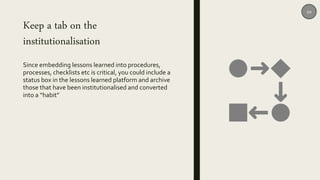
Keep a tab on the
institutionalisation
Since embedding lessons learned into procedures,
processes, checklists etc is critical, you could include a
status box in the lessons learned platform and archive
those that have been institutionalised and converted
into a “habit”
10
Videos are fun!
It is NOT always necessary to document lessons learned
in a conventional manner. Some lessons learned can be
curated into an impactful video
11
Content writing can add colour and catch
attention
If you can afford it, have content writers work on
polishing and making the lessons learned
consumable and enjoyable
12
Standardise where possible
Create and provide templates to bring in some amount of
standardisation of content.You can choose to do this a
few months after the practice is ushered in, if your
audience prefers that
13
Machine Learning to understand
patterns
When you have a substantial volume of content, it might
make sense to leverage on Machine Learning/NLP
algorithms to discover patterns, analyse them and use
them as inputs for decision-making (for Management
Reports)
Clustering, Recommendations*
14
Curation of Lessons Learned and tracking
their impact
If feasible, identify and employ champions and give
them the responsibility of “managing” lessons
learned in business critical and/or evolving areas.
Engage them in curating and assisting in the
application of lessons learned in the said areas
15
BRANDING,
PROMOTION
Get creative in the way you brand the programme
and make it enjoyable and rewarding
16
* C & H B Y B I L L W A T T E R S O N *
Encourage usage of the
transmogrifier rather than the
duplicator
17
I F Y O U W E R E T O A S K H O B B E S …
Collective
Learning
■ Choose three of the tips
■ Please share your
experiences/thoughts/concerns and let’s discuss
at length
18
Nirmala Palaniappan
nirmala.pal@gmail.com
@nimmypal
Thank you!
19

Tips & Tricks for Your Lessons Learned Program

  • 1.
    LESSONS LEARNED Tips & tricksfor your lessons learned programme Nirmala Palaniappan, feb 2021 1
  • 2.
    2 Little things addup to make a BIG difference!
  • 3.
    ■ A littlebit of theory ■ Some holistic aspects ■ Some specific ideas ■ Discussion & sharing of experiences 3
  • 4.
    L E VE L S O F L E A R N I N G 4
  • 5.
    Lessons Learned PassiveCollection Active Collection Passive Distribution (Pull) Knowledge Attic Knowledge Sponge Active Distribution (Push) Knowledge Publisher Knowledge Pump 5 Source: Journal of Knowledge Management Practice, March 2005 - Facilitating Knowledge Sharing Through Lessons Learned System (Sharif, Zakaria, Ching, Fung)
  • 6.
    Something to chewon! ■ What business problem(s) are we solving? ■ Are there specific divisions/domains where we need to focus, to start with? ■ Fishing rod or fishing net approach? ■ Should we use methodologies and frameworks to capture lessons or leave people to their own methods and tools? 6
  • 7.
    Customise existing software/processes As faras possible, it is a good idea to extend and enhance existing systems to capture lessons learned on the go as opposed to setting up a separate technology platform. For example, if you have a product management system or a CRM platform, it may be more effective to upgrade/customise them to include lessons learned 7
  • 8.
    Integrate the Search Mechanism Ifyou have no option to customise existing systems and are setting up a separate system, integrate it with existing systems and bring it under a common search umbrella 8
  • 9.
    Collective inputs areessential to refine the taxonomy/hashtags Conduct brainstorming sessions with subject matter experts and key users to decide on the metadata for lessons learned. Map it to the processes, type of knowledge, expected benefits, whether it is conceptual or practical, time frame and so on 9
  • 10.
    Keep a tabon the institutionalisation Since embedding lessons learned into procedures, processes, checklists etc is critical, you could include a status box in the lessons learned platform and archive those that have been institutionalised and converted into a “habit” 10
  • 11.
    Videos are fun! Itis NOT always necessary to document lessons learned in a conventional manner. Some lessons learned can be curated into an impactful video 11
  • 12.
    Content writing canadd colour and catch attention If you can afford it, have content writers work on polishing and making the lessons learned consumable and enjoyable 12
  • 13.
    Standardise where possible Createand provide templates to bring in some amount of standardisation of content.You can choose to do this a few months after the practice is ushered in, if your audience prefers that 13
  • 14.
    Machine Learning tounderstand patterns When you have a substantial volume of content, it might make sense to leverage on Machine Learning/NLP algorithms to discover patterns, analyse them and use them as inputs for decision-making (for Management Reports) Clustering, Recommendations* 14
  • 15.
    Curation of LessonsLearned and tracking their impact If feasible, identify and employ champions and give them the responsibility of “managing” lessons learned in business critical and/or evolving areas. Engage them in curating and assisting in the application of lessons learned in the said areas 15
  • 16.
    BRANDING, PROMOTION Get creative inthe way you brand the programme and make it enjoyable and rewarding 16
  • 17.
    * C &H B Y B I L L W A T T E R S O N * Encourage usage of the transmogrifier rather than the duplicator 17 I F Y O U W E R E T O A S K H O B B E S …
  • 18.
    Collective Learning ■ Choose threeof the tips ■ Please share your experiences/thoughts/concerns and let’s discuss at length 18
  • 19.