Knowledge
Management
Explained..
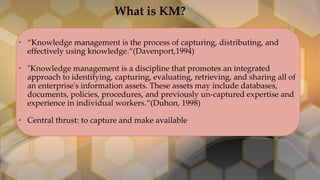
• “Knowledge management is the process of capturing, distributing, and
effectively using knowledge.“(Davenport,1994)
• "Knowledge management is a discipline that promotes an integrated
approach to identifying, capturing, evaluating, retrieving, and sharing all of
an enterprise's information assets. These assets may include databases,
documents, policies, procedures, and previously un-captured expertise and
experience in individual workers.“(Duhon, 1998)
• Central thrust: to capture and make available
What is KM?
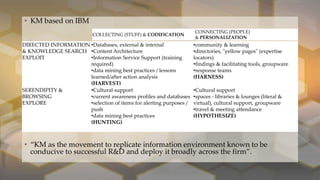
• KM based on IBM
• “KM as the movement to replicate information environment known to be
conducive to successful R&D and deploy it broadly across the firm”.
COLLECTING (STUFF) & CODIFICATION
CONNECTING (PEOPLE)
& PERSONALIZATION
COLLECTING (STUFF) & CODIFICATION
CONNECTING (PEOPLE)
& PERSONALIZATION
DIRECTED INFORMATION
& KNOWLEDGE SEARCH
EXPLOIT
•Databases, external & internal
•Content Architecture
•Information Service Support (training
required)
•data mining best practices / lessons
learned/after action analysis
(HARVEST)
•community & learning
•directories, "yellow pages" (expertise
locators)
•findings & facilitating tools, groupware
•response teams
(HARNESS)
SERENDIPITY &
BROWSING
EXPLORE
•Cultural support
•current awareness profiles and databases
•selection of items for alerting purposes /
push
•data mining best practices
(HUNTING)
•Cultural support
•spaces - libraries & lounges (literal &
virtual), cultural support, groupware
•travel & meeting attendance
(HYPOTHESIZE)
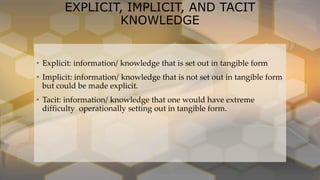
EXPLICIT, IMPLICIT, AND TACIT
KNOWLEDGE
• Explicit: information/ knowledge that is set out in tangible form
• Implicit: information/ knowledge that is not set out in tangible form
but could be made explicit.
• Tacit: information/ knowledge that one would have extreme
difficulty operationally setting out in tangible form.
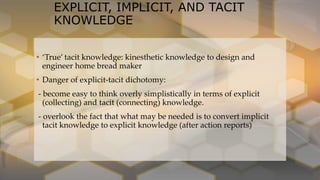
EXPLICIT, IMPLICIT, AND TACIT
KNOWLEDGE
• ‘True’ tacit knowledge: kinesthetic knowledge to design and
engineer home bread maker
• Danger of explicit-tacit dichotomy:
- become easy to think overly simplistically in terms of explicit
(collecting) and tacit (connecting) knowledge.
- overlook the fact that what may be needed is to convert implicit
tacit knowledge to explicit knowledge (after action reports)
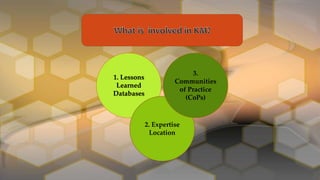
1. Lessons
Learned
Databases
2. Expertise
Location
3.
Communities
of Practice
(CoPs)
LESSONS LEARNED
DATABASES
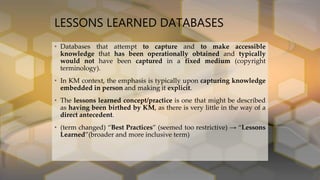
LESSONS LEARNED DATABASES
• Databases that attempt to capture and to make accessible
knowledge that has been operationally obtained and typically
would not have been captured in a fixed medium (copyright
terminology).
• In KM context, the emphasis is typically upon capturing knowledge
embedded in person and making it explicit.
• The lessons learned concept/practice is one that might be described
as having been birthed by KM, as there is very little in the way of a
direct antecedent.
• (term changed) “Best Practices” (seemed too restrictive) → “Lessons
Learned”(broader and more inclusive term)
LESSONS LEARNED DATABASES
• One such possible antecedent was the World War II debriefing of
pilots after a mission.
• primary purpose = to gather military intelligence,
• secondary purpose = to identify lessons learned
• U. S. Navy Submarine Service, after the lengthy fiasco of torpedo
failure to detonate properly and follow up on sub captain consistent
torpedo failure report, instituted a system of widely disseminated
“Captain’s Patrol Report” with the intent of avoiding any such
fiasco in the future.
• The Captain’s Patrol Report were very designed to encourage
analytical reporting, with reasoned analyses of the reasons for
failure and success.
• The military has become an avid proponent of the lessons learned
concept.
LESSONS LEARNED DATABASES
• The concept is by no means limited to the military.
• KM department at Wyeth Pharmaceuticals.
• Wyeth had recently introduced a new pharmaceutical agent
primarily for pediatric use.
• Expectation → substantial success
• Sales of the drug started well, but, soon turned disappointing.
• Problem → the kid objected strenuously to the taste of the drug.
• Solution → Orange juice. Give a glass of orange juice with the pill to
kid. Orange juice quite effectively masked the offensive taste.
LESSONS LEARNED DATABASES
• The implementation of a lessons learned system is complex both
politically and operationally.
• Most successful lessons learned systems have an active weeding or
stratification process.
• Without a clearly designed process for weeding, the proportion of
new and crisp items inevitably declines, the system begins to look
stale and usage and utility falls.
• DELETION, of course, is not necessarily loss and destruction.
• Using stratification principles, items removed from the foreground
can be achieved and moved to the background but still made
available.
2. Expertise Location
• Best ways to learn from experts – Talk to that experts.
• Problem? To find the right experts.
• Before this in the early days of KM, we have “Yellow Page” systems
• Today, the term expertise locator / expertise location have become more precise.
• There are 3 areas
1. typically supply data for an expertise locator system, employee resumes, employee
self identification of areas of expertise,
2. typically by being requested to fill out a form online, or by algorithmic analysis of
electronic communications from and to the employee.
3. typically based on email traffic but can include other social networking electronic
communications such as Twitter and Facebook.
3.Communities of Practice (CoPs)
• What is CoPs? –
Groups of individuals with shared interests that come together in person or
virtually to tell stories, to share and discuss problems and opportunities, discuss
best practices, and talk over lessons learned.
(Wenger, 1998; Wenger & Synder, 1999)
• In the old days, they always sharing the knowledge in informal ways during their working
hours and often taken for granted but this need to be virtual.
• But now, the workers give up a company office to work online from home or on the road
• In context of KM, CoPs are generally understood to mean electronically linked communities
(not essential, but understandable and inevitable)
Cont…
• The organization and maintenance of CoPs is not easy.
• For a CoP some questions that need to be thought about are;
1. Who fills the various roles of: manager, moderator and thought leader? (can be
separate person in certain cases)
2. How is CoP managed?
3. Are postings open or does someone vet or edit the postings?
4. How is CoP kept fresh and vital?
5. When and how (under what rules) are items removed?
6. How are those items archived?
7. Who reviews the CoP for activity?
8. Who looks for a new members or suggests that the CoP may have outlived its
usefulness?
The stages of Development
of knowledge management
First stage of knowledge management
• Driven by information technology, IT
• Also can be describe as the internet out of intellectual capital
• Intellectual capital provides :
 Justification and the framework
 The seed
 The abilities of the internet provide the tool
• The provided of internet can make organizations become more effectively by
sharing knowledge
• Sharing knowledge
 Avoid reinventing the wheel
 Underbid with competitor
 Make more profits
• The important of KM in early stage – how to deploy new technology to
accomplish more effective use of information and knowledge
Second stage of KM: HR and corporate culture
• Human and cultural dimension need to be
addressed.
• This happened because deploying the new
technology was not sufficient enough to effectively
enable information & knowledge sharing.
• KM implementation involve changes in corporate
culture rather than in significant changes.
• There are 2 major themes from business literature
were brought into KM fold, which is about KM
implementation and use, knowledge creation as
well as knowledge sharing & communication:
a. Senges: work on learning organization
b. Nonaka’s: work on ‘tacit’ knowledge and how to
discover & cultivate it.
Taxonomy and Content
Management
Third Stage of Knowledge
Management
The importance of the
arrangement, description and
structure of a content
“it’s no good if they try to
use it but can’t find it”
Taxonomy is the practice
and science of
classification
• The need to retain the knowledge of retirees. #babyboomer
• Keep the retirees involved and findable through expertise locater
systems.
• Interaction between the retiree and the current employees.
• The solutions arises from the interaction.
• KM is seen ideally encompassing the bandwidth of information &
knowledge.
• KM extends into environmental scanning and competitive
intelligence.
Other KM issues
• Bibliographic analysis – comparing the number of articles in the
business literature (accounting, banking, retail trade etc) with the
other business enthusiasms.
• Most business enthusiasms grow rapidly and reach peak for about
five years, then decline almost as rapidly as they grow.
• The power of the phrase “knowledge management” in the title.
• KM is no mere enthusiasm.
KM is here to stay
Thank you
#bookrecommendation
Knowledge Management (KM)
Process in Organizations:
Theoretical Foundations and
Practice
By.. Claire R. Mclnerney &
Mchael E. D. Koenig

Knowledge management explained

  • 1.
  • 2.
    • “Knowledge managementis the process of capturing, distributing, and effectively using knowledge.“(Davenport,1994) • "Knowledge management is a discipline that promotes an integrated approach to identifying, capturing, evaluating, retrieving, and sharing all of an enterprise's information assets. These assets may include databases, documents, policies, procedures, and previously un-captured expertise and experience in individual workers.“(Duhon, 1998) • Central thrust: to capture and make available What is KM?
  • 3.
    • KM basedon IBM • “KM as the movement to replicate information environment known to be conducive to successful R&D and deploy it broadly across the firm”. COLLECTING (STUFF) & CODIFICATION CONNECTING (PEOPLE) & PERSONALIZATION COLLECTING (STUFF) & CODIFICATION CONNECTING (PEOPLE) & PERSONALIZATION DIRECTED INFORMATION & KNOWLEDGE SEARCH EXPLOIT •Databases, external & internal •Content Architecture •Information Service Support (training required) •data mining best practices / lessons learned/after action analysis (HARVEST) •community & learning •directories, "yellow pages" (expertise locators) •findings & facilitating tools, groupware •response teams (HARNESS) SERENDIPITY & BROWSING EXPLORE •Cultural support •current awareness profiles and databases •selection of items for alerting purposes / push •data mining best practices (HUNTING) •Cultural support •spaces - libraries & lounges (literal & virtual), cultural support, groupware •travel & meeting attendance (HYPOTHESIZE)
  • 4.
    EXPLICIT, IMPLICIT, ANDTACIT KNOWLEDGE • Explicit: information/ knowledge that is set out in tangible form • Implicit: information/ knowledge that is not set out in tangible form but could be made explicit. • Tacit: information/ knowledge that one would have extreme difficulty operationally setting out in tangible form.
  • 5.
    EXPLICIT, IMPLICIT, ANDTACIT KNOWLEDGE • ‘True’ tacit knowledge: kinesthetic knowledge to design and engineer home bread maker • Danger of explicit-tacit dichotomy: - become easy to think overly simplistically in terms of explicit (collecting) and tacit (connecting) knowledge. - overlook the fact that what may be needed is to convert implicit tacit knowledge to explicit knowledge (after action reports)
  • 6.
  • 7.
  • 8.
    LESSONS LEARNED DATABASES •Databases that attempt to capture and to make accessible knowledge that has been operationally obtained and typically would not have been captured in a fixed medium (copyright terminology). • In KM context, the emphasis is typically upon capturing knowledge embedded in person and making it explicit. • The lessons learned concept/practice is one that might be described as having been birthed by KM, as there is very little in the way of a direct antecedent. • (term changed) “Best Practices” (seemed too restrictive) → “Lessons Learned”(broader and more inclusive term)
  • 9.
    LESSONS LEARNED DATABASES •One such possible antecedent was the World War II debriefing of pilots after a mission. • primary purpose = to gather military intelligence, • secondary purpose = to identify lessons learned • U. S. Navy Submarine Service, after the lengthy fiasco of torpedo failure to detonate properly and follow up on sub captain consistent torpedo failure report, instituted a system of widely disseminated “Captain’s Patrol Report” with the intent of avoiding any such fiasco in the future. • The Captain’s Patrol Report were very designed to encourage analytical reporting, with reasoned analyses of the reasons for failure and success. • The military has become an avid proponent of the lessons learned concept.
  • 10.
    LESSONS LEARNED DATABASES •The concept is by no means limited to the military. • KM department at Wyeth Pharmaceuticals. • Wyeth had recently introduced a new pharmaceutical agent primarily for pediatric use. • Expectation → substantial success • Sales of the drug started well, but, soon turned disappointing. • Problem → the kid objected strenuously to the taste of the drug. • Solution → Orange juice. Give a glass of orange juice with the pill to kid. Orange juice quite effectively masked the offensive taste.
  • 11.
    LESSONS LEARNED DATABASES •The implementation of a lessons learned system is complex both politically and operationally. • Most successful lessons learned systems have an active weeding or stratification process. • Without a clearly designed process for weeding, the proportion of new and crisp items inevitably declines, the system begins to look stale and usage and utility falls. • DELETION, of course, is not necessarily loss and destruction. • Using stratification principles, items removed from the foreground can be achieved and moved to the background but still made available.
  • 12.
    2. Expertise Location •Best ways to learn from experts – Talk to that experts. • Problem? To find the right experts. • Before this in the early days of KM, we have “Yellow Page” systems • Today, the term expertise locator / expertise location have become more precise. • There are 3 areas 1. typically supply data for an expertise locator system, employee resumes, employee self identification of areas of expertise, 2. typically by being requested to fill out a form online, or by algorithmic analysis of electronic communications from and to the employee. 3. typically based on email traffic but can include other social networking electronic communications such as Twitter and Facebook.
  • 13.
    3.Communities of Practice(CoPs) • What is CoPs? – Groups of individuals with shared interests that come together in person or virtually to tell stories, to share and discuss problems and opportunities, discuss best practices, and talk over lessons learned. (Wenger, 1998; Wenger & Synder, 1999) • In the old days, they always sharing the knowledge in informal ways during their working hours and often taken for granted but this need to be virtual. • But now, the workers give up a company office to work online from home or on the road • In context of KM, CoPs are generally understood to mean electronically linked communities (not essential, but understandable and inevitable)
  • 14.
    Cont… • The organizationand maintenance of CoPs is not easy. • For a CoP some questions that need to be thought about are; 1. Who fills the various roles of: manager, moderator and thought leader? (can be separate person in certain cases) 2. How is CoP managed? 3. Are postings open or does someone vet or edit the postings? 4. How is CoP kept fresh and vital? 5. When and how (under what rules) are items removed? 6. How are those items archived? 7. Who reviews the CoP for activity? 8. Who looks for a new members or suggests that the CoP may have outlived its usefulness?
  • 15.
    The stages ofDevelopment of knowledge management
  • 16.
    First stage ofknowledge management • Driven by information technology, IT • Also can be describe as the internet out of intellectual capital • Intellectual capital provides :  Justification and the framework  The seed  The abilities of the internet provide the tool • The provided of internet can make organizations become more effectively by sharing knowledge • Sharing knowledge  Avoid reinventing the wheel  Underbid with competitor  Make more profits • The important of KM in early stage – how to deploy new technology to accomplish more effective use of information and knowledge
  • 17.
    Second stage ofKM: HR and corporate culture • Human and cultural dimension need to be addressed. • This happened because deploying the new technology was not sufficient enough to effectively enable information & knowledge sharing. • KM implementation involve changes in corporate culture rather than in significant changes. • There are 2 major themes from business literature were brought into KM fold, which is about KM implementation and use, knowledge creation as well as knowledge sharing & communication: a. Senges: work on learning organization b. Nonaka’s: work on ‘tacit’ knowledge and how to discover & cultivate it.
  • 18.
    Taxonomy and Content Management ThirdStage of Knowledge Management
  • 19.
    The importance ofthe arrangement, description and structure of a content “it’s no good if they try to use it but can’t find it” Taxonomy is the practice and science of classification
  • 20.
    • The needto retain the knowledge of retirees. #babyboomer • Keep the retirees involved and findable through expertise locater systems. • Interaction between the retiree and the current employees. • The solutions arises from the interaction. • KM is seen ideally encompassing the bandwidth of information & knowledge. • KM extends into environmental scanning and competitive intelligence. Other KM issues
  • 21.
    • Bibliographic analysis– comparing the number of articles in the business literature (accounting, banking, retail trade etc) with the other business enthusiasms. • Most business enthusiasms grow rapidly and reach peak for about five years, then decline almost as rapidly as they grow. • The power of the phrase “knowledge management” in the title. • KM is no mere enthusiasm. KM is here to stay
  • 22.
    Thank you #bookrecommendation Knowledge Management(KM) Process in Organizations: Theoretical Foundations and Practice By.. Claire R. Mclnerney & Mchael E. D. Koenig