1
www.straitsknowledge.com
Knowledge Audit Workshop for IFAD
Patrick Lambe
Edgar Tan
www.straitsknowledge.com - 2
About Us
© Straits Knowledge 2014
2
www.straitsknowledge.com - 3
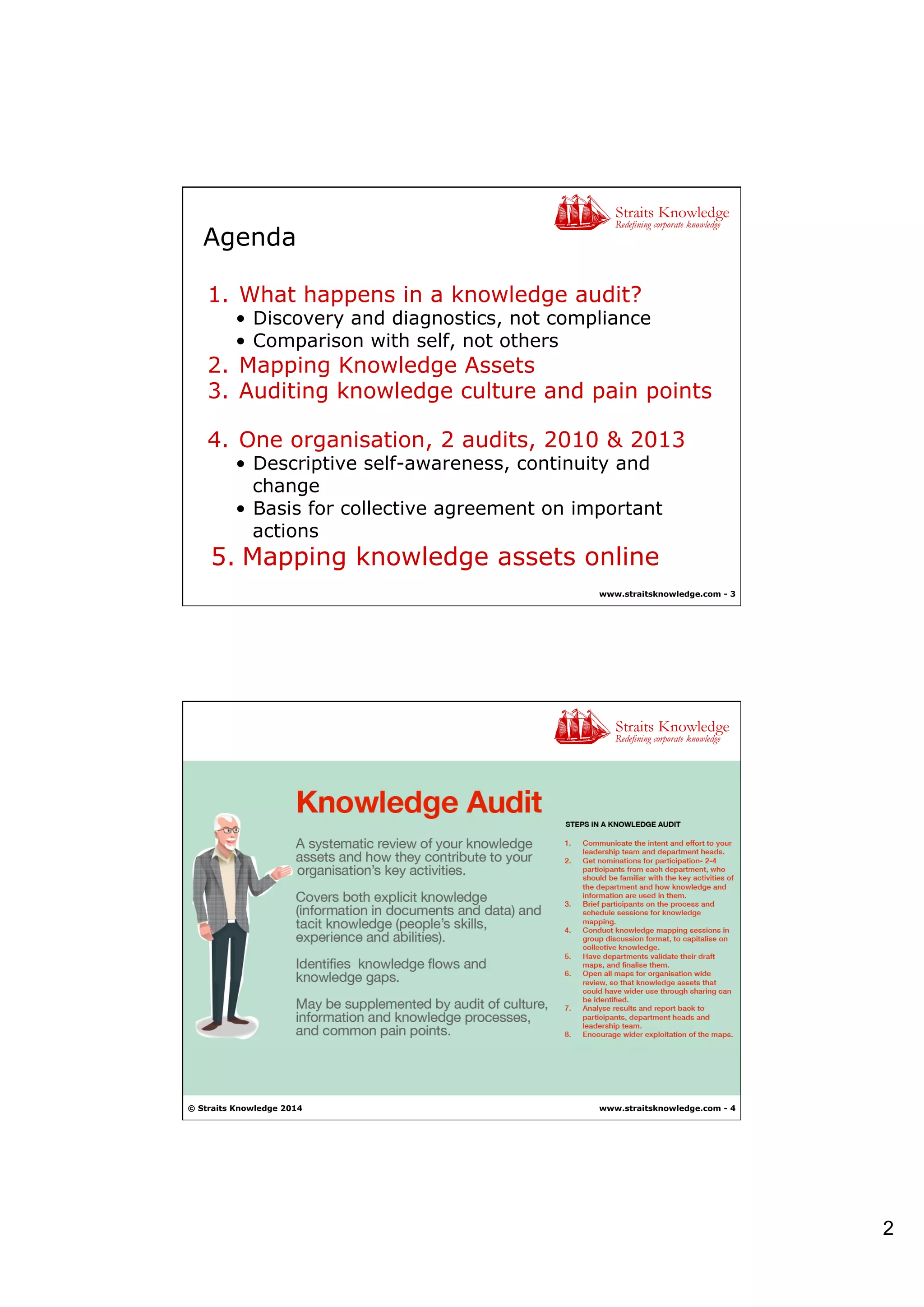
Agenda
1.  What happens in a knowledge audit?
•  Discovery and diagnostics, not compliance
•  Comparison with self, not others
2.  Mapping Knowledge Assets
3.  Auditing knowledge culture and pain points
4.  One organisation, 2 audits, 2010 & 2013
•  Descriptive self-awareness, continuity and
change
•  Basis for collective agreement on important
actions
5. Mapping knowledge assets online
www.straitsknowledge.com - 4© Straits Knowledge 2014
3
www.straitsknowledge.com - 5© Straits Knowledge 2014
Mapping Knowledge Assets
Adapted from Dave Snowden, ‘The ASHEN model: an enabler
of action’ Knowledge Management vol.3 issue 7 2000.
www.straitsknowledge.com - 6
KM Interventions
6
Document/records/ information
management
Document/data sharing
platforms
Training
Sharing through
communities of practice,
Documentation by SOPs
Training provision incl OJT
Sharing through
communities of practice
Mentoring, Coaching
Sharing through
communities of practice
Team building
Sharing sessions
Networking sessions
Sharing through
communities of practice,
Mentoring, Coaching
Job placement
Expertise interviews,
small group sharing,
storytellingFind & keep happy!
Natural
4
www.straitsknowledge.com - 7
Potential Knowledge Flows
Example of a gallery viewing exercise
© Straits Knowledge 2014
www.straitsknowledge.com - 8
Exploiting the Knowledge Maps
© Straits Knowledge 2014
5
www.straitsknowledge.com - 9
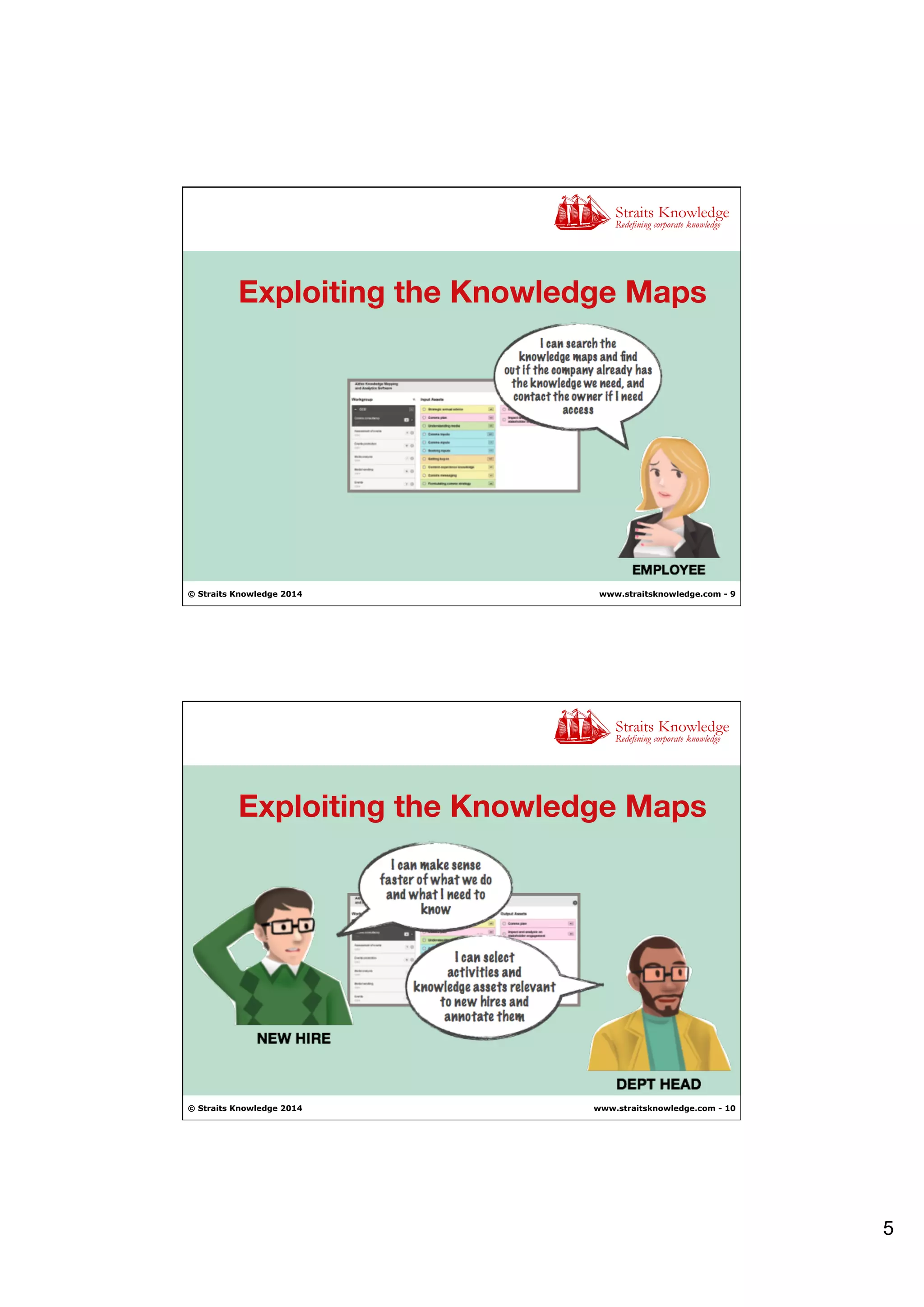
Exploiting the Knowledge Maps
© Straits Knowledge 2014
www.straitsknowledge.com - 10
Exploiting the Knowledge Maps
© Straits Knowledge 2014
6
www.straitsknowledge.com - 11
Exploiting the Knowledge Maps
© Straits Knowledge 2014
www.straitsknowledge.com - 12
Exploiting the Knowledge Maps
© Straits Knowledge 2014
7
www.straitsknowledge.com - 13
Culture Audit
© Straits Knowledge 2014
www.straitsknowledge.com - 14
Pain Points Audit
© Straits Knowledge 2014
Coordination
Learning Remembering
8
www.straitsknowledge.com
© Straits Knowledge 2013
Knowledge Audit Case Study
One organisation, two audits – 2010
and 2013
www.straitsknowledge.com - 16© Straits Knowledge 2013
Case Profile
International organisation
• Specialised in company
match-making services
• Small offices in 40 countries
• About 500 people in HQ
• High, rapid turnover of staff
• Low motivation to do KM
among senior management
• History of federalised
working – “we’re all different,
no point forcing us to share”
• IT group felt improvements
could be made, but wanted a
basis for focusing effort
Post K-audit interventions 2010
• High value sharable information
(non-sensitive) moved to intranet;
taxonomy created to improve
findability
• Experimented with corporate
microblogging tool (on front page
of intranet
• Used storytelling, interviews and
knowledge capture writeups in
magazine format for country
managers as they cycled through
HQ – used as input to tip sheets,
FAQs, industry guides, procedures,
etc.
9
www.straitsknowledge.com - 17© Straits Knowledge 2013
Culture Profile - 2010
13/20 groups 11/20 groups
10/20 groups 9/20 groups 8/20 groups
www.straitsknowledge.com - 18© Straits Knowledge 2013
Culture Shifts - 2010-13
13/20 groups 11/20 groups
10/20 groups 9/20 groups 8/20 groups
10
www.straitsknowledge.com - 19© Straits Knowledge 2013
Culture Profile 2013
18/23 groups
16/23 groups 15/23 groups
14/23 groups 13/23 groups 12/23 groups
www.straitsknowledge.com - 20© Straits Knowledge 2013
Focus Groups 2013
Culture of sharing
creates more work
Need to give more
context and understand
stresses
Helpful but knowledge
should be documented
Well-organised
Busy Bees
Help make life
bearable
11
www.straitsknowledge.com
© Straits Knowledge 2013
KM Pain Points
Groups were asked to identify knowledge and information
management “pain points” that they considered significant
www.straitsknowledge.com - 22© Straits Knowledge 2013
KM Pain Points 2010-2013
2010 2013
12
www.straitsknowledge.com - 23© Straits Knowledge 2013
KM Pain Points Legend
CM- COORDINATION-MISTAKES: Tasks that involve multiple workgroups are prone to
mistakes, errors, and speed issues especially in task handoffs, because of poor
information flows
CD- COORDINATION-DECISIONS: Decisionmaking is compromised because
decisionmakers do not have easy and timely access to relevant and accurate information
CC- COORDINATION-CONFLICT: Conflict can arise between workgroups because they
have inaccurate expectations and have a poor understanding of each others’ work and
deliverables
CE- COORDINATION-EXTERNAL: External parties receive different messages from
different parts of the organisation
CS- COORDINATION-SILOS: It is difficult for workgroups to collaborate because they
cannot gain access to each other’s information so have to search or find the right people
to talk to
RE- REMEMBERING-EXTERNAL: Internal institutional memory processes are so poor
that you rely on external partners/consultants to brief you on your own past projects and
activities
RS- REMEMBERING-SILOS: Silo-based working means that solutions derived in one
part of the organisation do not transfer into the organisational memory and cannot be
reused by others
RL- REMEMBERING-LOSS: Tacit knowledge in people’s heads is not captured or
transferred effectively, meaning it is lost when those people leave
RR- REMEMBERING-RECORDS: There is insufficient documentation of activities and
decisions, and poor recordkeeping means it is difficult to reconstruct why things were
done a certain way
RP- REMEMBERING-PROGRESS: Institutional memory processes are so poor that the
organisation keeps solving the same old problems again and again and cannot progress
LE- LEARNING-EXTERNAL: The organisation does not adequately monitor the external
environment so as to be able to anticipate change and adapt to it
LN- LEARNING-NEW HIRES: New hires are not well looked after, and their learning
curves are stressful and slow before they come up to speed in their jobs
LS- LEARNING-SKILLS: The skills and competencies of staff do not keep up with the
demands of the job and so the organisation cannot respond effectively to new needs or
opportunities
LC- LEARNING-CHANGE: The culture is resistant to changes that are required for the
organisation to remain effective
LR- LEARNING-RESPONSIVENESS: The organisation is seen as reactive and slow to
respond to changing needs and opportunities in the environment
Pain points highlighted in red
indicate current 2013 negative
issues. Pain points highlighted
in green indicate
improvements since 2010.
www.straitsknowledge.com - 24© Straits Knowledge 2013
KM Pain Points - Shifts
Major 2010 issues:
• Silos accentuate memory
loss and poor internal
coordination – silo issues
appear in every response
• Lack of knowledge retention
processes - loses critical
knowledge when people leave
• Lack of learning and memory
processes - cannot easily
make improvements and
progress
Major 2013 issues:
• Silo issues have increased
and coordination issues are
now more keenly felt - silo
issues still appear in every
Group
• Focus shifted from retention
of tacit knowledge to poor
documentation of processes
and decisions
• Slight improvement in using
learning to make
improvements, focus has
shifted to lack of support for
new hires
13
www.straitsknowledge.com
© Straits Knowledge 2013
KM Satisfaction
Groups were asked a series of questions to help identify
patterns of knowledge and information use
www.straitsknowledge.com - 26© Straits Knowledge 2013
Satisfaction with Organizational KM
2010 2013
LOW
MEDIUM
HIGH
14
www.straitsknowledge.com
© Straits Knowledge 2013
Knowledge Map Analysis
www.straitsknowledge.com - 28© Straits Knowledge 2013
Knowledge Maps 2010-13
2010 2013
Business Activities 279 251 (some divisions
consolidated their
maps)
Knowledge Assets Total 2398 2273
Knowledge Assets
(Existing)
2145 2155
Knowledge Gaps 253 118
Subscriptions 2709 subs to 830
knowledge assets
(35%)
3531 subs to 1335
knowledge assets
(59%)
High Value Subscriptions 140 knowledge assets
3+ groups (6%)
264 knowledge assets
3+ groups (12%)
15
www.straitsknowledge.com - 29© Straits Knowledge 2013
What the Knowledge Maps Tell Us
2010 2013
2010 2013
Subscriptions 2709 subs to 830
knowledge assets
(35%)
3531 subs to 1335
knowledge assets
(59%)
High Value Subscriptions 140 knowledge assets
3+ groups (6%)
264 knowledge assets
3+ groups (12%)
All knowledge requests All knowledge requests
www.straitsknowledge.com - 30© Straits Knowledge 2013
264 Most Subscribed Knowledge
Assets by Type
2010 2013
16
www.straitsknowledge.com - 31© Straits Knowledge 2013
Relationship Needs
2010 2013
www.straitsknowledge.com - 32© Straits Knowledge 2013
2013 Recommendations
1. Focus on org-wide sharing of high-demand
records eg past and current decisions around
policies and strategies
2. Work on improving:
!  stresses arising from cultural issues - leadership
behaviours related to information tasks
!  stresses of information working (all staff) in a very silo-
based environment – greater exposure to different groups
and socialisation
!  stresses imposed on new hires caused by cultural/
leadership style factors and the complex, silo-based
information environment
17
www.straitsknowledge.com - 33
www.aithinsoftware.com
© Straits Knowledge 2014
HKKMS – 2014 – Patrick
Lambe
www.straitsknowledge.com - 34© Straits Knowledge 2014
Any Questions?
plambe@straitsknowledge.com
etan@straitsknowledge.com
ari@straitsknowledge.com

What is knowledge audit

  • 1.
    1 www.straitsknowledge.com Knowledge Audit Workshopfor IFAD Patrick Lambe Edgar Tan www.straitsknowledge.com - 2 About Us © Straits Knowledge 2014
  • 2.
    2 www.straitsknowledge.com - 3 Agenda 1. What happens in a knowledge audit? •  Discovery and diagnostics, not compliance •  Comparison with self, not others 2.  Mapping Knowledge Assets 3.  Auditing knowledge culture and pain points 4.  One organisation, 2 audits, 2010 & 2013 •  Descriptive self-awareness, continuity and change •  Basis for collective agreement on important actions 5. Mapping knowledge assets online www.straitsknowledge.com - 4© Straits Knowledge 2014
  • 3.
    3 www.straitsknowledge.com - 5©Straits Knowledge 2014 Mapping Knowledge Assets Adapted from Dave Snowden, ‘The ASHEN model: an enabler of action’ Knowledge Management vol.3 issue 7 2000. www.straitsknowledge.com - 6 KM Interventions 6 Document/records/ information management Document/data sharing platforms Training Sharing through communities of practice, Documentation by SOPs Training provision incl OJT Sharing through communities of practice Mentoring, Coaching Sharing through communities of practice Team building Sharing sessions Networking sessions Sharing through communities of practice, Mentoring, Coaching Job placement Expertise interviews, small group sharing, storytellingFind & keep happy! Natural
  • 4.
    4 www.straitsknowledge.com - 7 PotentialKnowledge Flows Example of a gallery viewing exercise © Straits Knowledge 2014 www.straitsknowledge.com - 8 Exploiting the Knowledge Maps © Straits Knowledge 2014
  • 5.
    5 www.straitsknowledge.com - 9 Exploitingthe Knowledge Maps © Straits Knowledge 2014 www.straitsknowledge.com - 10 Exploiting the Knowledge Maps © Straits Knowledge 2014
  • 6.
    6 www.straitsknowledge.com - 11 Exploitingthe Knowledge Maps © Straits Knowledge 2014 www.straitsknowledge.com - 12 Exploiting the Knowledge Maps © Straits Knowledge 2014
  • 7.
    7 www.straitsknowledge.com - 13 CultureAudit © Straits Knowledge 2014 www.straitsknowledge.com - 14 Pain Points Audit © Straits Knowledge 2014 Coordination Learning Remembering
  • 8.
    8 www.straitsknowledge.com © Straits Knowledge2013 Knowledge Audit Case Study One organisation, two audits – 2010 and 2013 www.straitsknowledge.com - 16© Straits Knowledge 2013 Case Profile International organisation • Specialised in company match-making services • Small offices in 40 countries • About 500 people in HQ • High, rapid turnover of staff • Low motivation to do KM among senior management • History of federalised working – “we’re all different, no point forcing us to share” • IT group felt improvements could be made, but wanted a basis for focusing effort Post K-audit interventions 2010 • High value sharable information (non-sensitive) moved to intranet; taxonomy created to improve findability • Experimented with corporate microblogging tool (on front page of intranet • Used storytelling, interviews and knowledge capture writeups in magazine format for country managers as they cycled through HQ – used as input to tip sheets, FAQs, industry guides, procedures, etc.
  • 9.
    9 www.straitsknowledge.com - 17©Straits Knowledge 2013 Culture Profile - 2010 13/20 groups 11/20 groups 10/20 groups 9/20 groups 8/20 groups www.straitsknowledge.com - 18© Straits Knowledge 2013 Culture Shifts - 2010-13 13/20 groups 11/20 groups 10/20 groups 9/20 groups 8/20 groups
  • 10.
    10 www.straitsknowledge.com - 19©Straits Knowledge 2013 Culture Profile 2013 18/23 groups 16/23 groups 15/23 groups 14/23 groups 13/23 groups 12/23 groups www.straitsknowledge.com - 20© Straits Knowledge 2013 Focus Groups 2013 Culture of sharing creates more work Need to give more context and understand stresses Helpful but knowledge should be documented Well-organised Busy Bees Help make life bearable
  • 11.
    11 www.straitsknowledge.com © Straits Knowledge2013 KM Pain Points Groups were asked to identify knowledge and information management “pain points” that they considered significant www.straitsknowledge.com - 22© Straits Knowledge 2013 KM Pain Points 2010-2013 2010 2013
  • 12.
    12 www.straitsknowledge.com - 23©Straits Knowledge 2013 KM Pain Points Legend CM- COORDINATION-MISTAKES: Tasks that involve multiple workgroups are prone to mistakes, errors, and speed issues especially in task handoffs, because of poor information flows CD- COORDINATION-DECISIONS: Decisionmaking is compromised because decisionmakers do not have easy and timely access to relevant and accurate information CC- COORDINATION-CONFLICT: Conflict can arise between workgroups because they have inaccurate expectations and have a poor understanding of each others’ work and deliverables CE- COORDINATION-EXTERNAL: External parties receive different messages from different parts of the organisation CS- COORDINATION-SILOS: It is difficult for workgroups to collaborate because they cannot gain access to each other’s information so have to search or find the right people to talk to RE- REMEMBERING-EXTERNAL: Internal institutional memory processes are so poor that you rely on external partners/consultants to brief you on your own past projects and activities RS- REMEMBERING-SILOS: Silo-based working means that solutions derived in one part of the organisation do not transfer into the organisational memory and cannot be reused by others RL- REMEMBERING-LOSS: Tacit knowledge in people’s heads is not captured or transferred effectively, meaning it is lost when those people leave RR- REMEMBERING-RECORDS: There is insufficient documentation of activities and decisions, and poor recordkeeping means it is difficult to reconstruct why things were done a certain way RP- REMEMBERING-PROGRESS: Institutional memory processes are so poor that the organisation keeps solving the same old problems again and again and cannot progress LE- LEARNING-EXTERNAL: The organisation does not adequately monitor the external environment so as to be able to anticipate change and adapt to it LN- LEARNING-NEW HIRES: New hires are not well looked after, and their learning curves are stressful and slow before they come up to speed in their jobs LS- LEARNING-SKILLS: The skills and competencies of staff do not keep up with the demands of the job and so the organisation cannot respond effectively to new needs or opportunities LC- LEARNING-CHANGE: The culture is resistant to changes that are required for the organisation to remain effective LR- LEARNING-RESPONSIVENESS: The organisation is seen as reactive and slow to respond to changing needs and opportunities in the environment Pain points highlighted in red indicate current 2013 negative issues. Pain points highlighted in green indicate improvements since 2010. www.straitsknowledge.com - 24© Straits Knowledge 2013 KM Pain Points - Shifts Major 2010 issues: • Silos accentuate memory loss and poor internal coordination – silo issues appear in every response • Lack of knowledge retention processes - loses critical knowledge when people leave • Lack of learning and memory processes - cannot easily make improvements and progress Major 2013 issues: • Silo issues have increased and coordination issues are now more keenly felt - silo issues still appear in every Group • Focus shifted from retention of tacit knowledge to poor documentation of processes and decisions • Slight improvement in using learning to make improvements, focus has shifted to lack of support for new hires
  • 13.
    13 www.straitsknowledge.com © Straits Knowledge2013 KM Satisfaction Groups were asked a series of questions to help identify patterns of knowledge and information use www.straitsknowledge.com - 26© Straits Knowledge 2013 Satisfaction with Organizational KM 2010 2013 LOW MEDIUM HIGH
  • 14.
    14 www.straitsknowledge.com © Straits Knowledge2013 Knowledge Map Analysis www.straitsknowledge.com - 28© Straits Knowledge 2013 Knowledge Maps 2010-13 2010 2013 Business Activities 279 251 (some divisions consolidated their maps) Knowledge Assets Total 2398 2273 Knowledge Assets (Existing) 2145 2155 Knowledge Gaps 253 118 Subscriptions 2709 subs to 830 knowledge assets (35%) 3531 subs to 1335 knowledge assets (59%) High Value Subscriptions 140 knowledge assets 3+ groups (6%) 264 knowledge assets 3+ groups (12%)
  • 15.
    15 www.straitsknowledge.com - 29©Straits Knowledge 2013 What the Knowledge Maps Tell Us 2010 2013 2010 2013 Subscriptions 2709 subs to 830 knowledge assets (35%) 3531 subs to 1335 knowledge assets (59%) High Value Subscriptions 140 knowledge assets 3+ groups (6%) 264 knowledge assets 3+ groups (12%) All knowledge requests All knowledge requests www.straitsknowledge.com - 30© Straits Knowledge 2013 264 Most Subscribed Knowledge Assets by Type 2010 2013
  • 16.
    16 www.straitsknowledge.com - 31©Straits Knowledge 2013 Relationship Needs 2010 2013 www.straitsknowledge.com - 32© Straits Knowledge 2013 2013 Recommendations 1. Focus on org-wide sharing of high-demand records eg past and current decisions around policies and strategies 2. Work on improving: !  stresses arising from cultural issues - leadership behaviours related to information tasks !  stresses of information working (all staff) in a very silo- based environment – greater exposure to different groups and socialisation !  stresses imposed on new hires caused by cultural/ leadership style factors and the complex, silo-based information environment
  • 17.
    17 www.straitsknowledge.com - 33 www.aithinsoftware.com ©Straits Knowledge 2014 HKKMS – 2014 – Patrick Lambe www.straitsknowledge.com - 34© Straits Knowledge 2014 Any Questions? plambe@straitsknowledge.com etan@straitsknowledge.com ari@straitsknowledge.com