

Making collaboration happen:  Communities, change and lessons learned Keith De La Rue http://www.flickr.com/photos/mckaysavage/
Outline Dynamics of collaboration and CoPs Which tools to use for effective collaboration? Notes from the field The OzCollab survey of collaboration technology Complexity and engaging people Recent insights into effective organisational change Creativity, trust and openness http://www.flickr.com/photos/eamoncurry/
Questions Can you “make” collaboration happen? What are your collaborative needs? http://www.flickr.com/photos/mitosettembremusica/
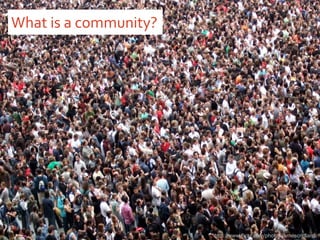
What is a community? http://www.flickr.com/photos/jamescridland/
Community A group of people living in a particular local area  A group of people having ethnic or cultural or religious characteristics in common Common ownership  (“A community of possessions”) Agreement as to goals (“A community of interests”)  The body of people in a learned occupation From Latin: “common, public, shared by many” http://www.onelook.com/?w=community&ls=a http://www.flickr.com/photos/MrTopf/
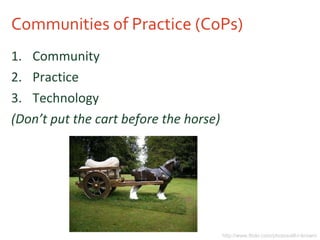
Communities of Practice (CoPs) Community Practice Technology (Don’t put the cart before the horse) http://www.flickr.com/photos/ell-r-brown/
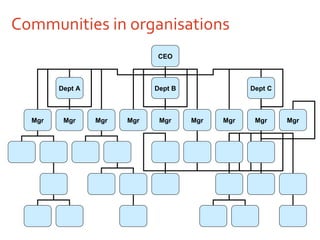
Communities in organisations CEO Dept A Dept B Dept C Mgr Mgr Mgr Mgr Mgr Mgr Mgr Mgr Mgr
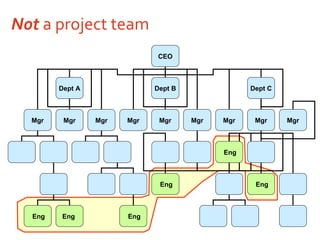
Not  a project team CEO Dept A Dept B Dept C Mgr Mgr Mgr Mgr Mgr Mgr Mgr Mgr Mgr Eng Eng Eng Eng Eng Eng
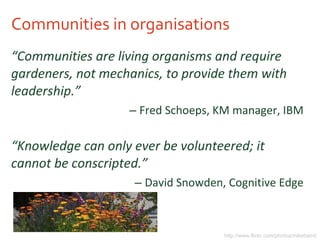
Communities in organisations “ Communities are living organisms and require gardeners, not mechanics, to provide them with leadership.” Fred Schoeps, KM manager, IBM “ Knowledge can only ever be volunteered; it cannot be conscripted.” David Snowden, Cognitive Edge http://www.flickr.com/photos/mikebaird/
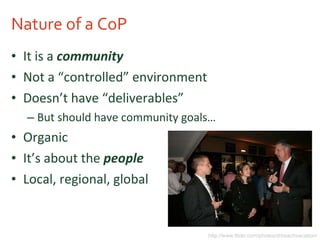
Nature of a CoP It is a  community Not a “controlled” environment Doesn’t have “deliverables” But should have community goals… Organic It’s about the  people Local, regional, global http://www.flickr.com/photos/drbeachvacation/
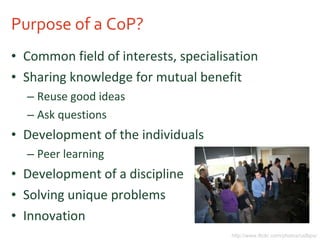
Purpose of a CoP? Common field of interests, specialisation Sharing knowledge for mutual benefit Reuse good ideas Ask questions Development of the individuals Peer learning Development of a discipline Solving unique problems Innovation http://www.flickr.com/photos/usfbps/
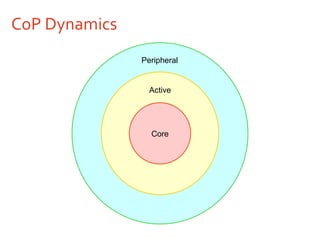
CoP Dynamics Core Active Peripheral
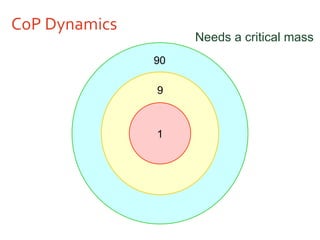
CoP Dynamics 1 9 90 Needs a critical mass
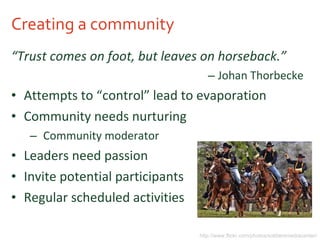
Creating a community “ Trust comes on foot, but leaves on horseback.” Johan Thorbecke Attempts to “control” lead to evaporation Community needs nurturing Community moderator Leaders need passion Invite potential participants  Regular scheduled activities http://www.flickr.com/photos/soldiersmediacenter/
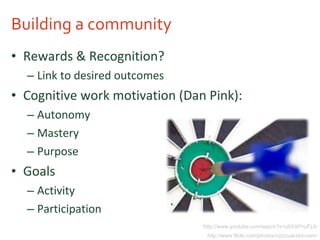
Building a community Rewards & Recognition? Link to desired outcomes Cognitive work motivation (Dan Pink): Autonomy Mastery Purpose Goals Activity Participation http://www.youtube.com/watch?v=u6XAPnuFjJc http://www.flickr.com/photos/vizzzual-dot-com/
Practice – group identity A shared common practice “ I am a …” Not too broad or too narrow Need to recognise affinity Mutual understanding Avoid redundant communities Be able to both  learn  and  contribute http://anecdote.com.au/ http://www.flickr.com/photos/europedistrict/
Practice – group utility Relationship to day-to-day work Community must become  part  of the practice Obvious direct benefits WIIFM? Assistance with work issues Problem solving Professional support http://delarue.net/blog/2008/09/practice-makes-perfect/
Technology? May not need  any  technology! Start with people first Starting with technology may lead to failure Field of Dreams  does not necessarily apply Deprive of technology until needs expressed? Make it as easy as possible to use If not all face-to-face, communication first Social Media principles apply – trust, openness http://www.flickr.com/photos/ivyfield/
Supporting member interaction – ‘SCENT’ S ite: home page - information C alendar: community events - interaction E vents: F2F, conference calls, webinars N ews: newsletter or blog - comms & publicity T hreads: discussion board - virtual interaction http://sites.google.com/site/stangarfield/home/ http://www.flickr.com/photos/misteraitch/
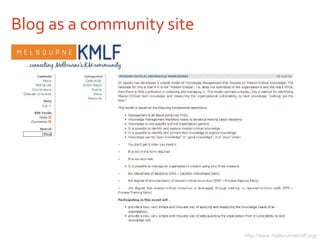
Blog as a community site http://www.melbournekmlf.org/
Calendar of events http://www.melbournekmlf.org/?page_id=84
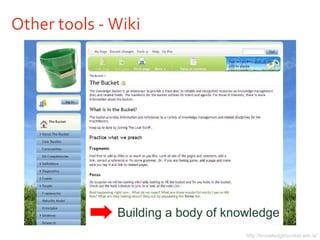
Other tools - Wiki http://knowledgebucket.wik.is/ Building a body of knowledge
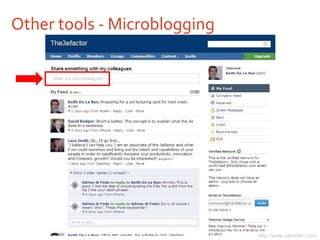
Other tools - Microblogging http://www.yammer.com/
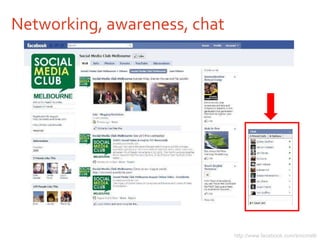
Networking, awareness, chat http://www.facebook.com/smcmelb
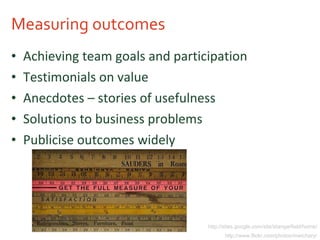
Measuring outcomes Achieving team goals and participation Testimonials on value Anecdotes – stories of usefulness Solutions to business problems Publicise outcomes widely http://sites.google.com/site/stangarfield/home/ http://www.flickr.com/photos/mwichary/
Fluor Corporation Construction and Project Management 2007 Case Study 44 global knowledge communities Total 25,000 active members 12,000 forum submissions Voluntary membership Community leaders trained ‘ Knowvember’ – Annual celebration and awards http://www.ikmagazine.com/bookshop.asp http://www.fluor.com/
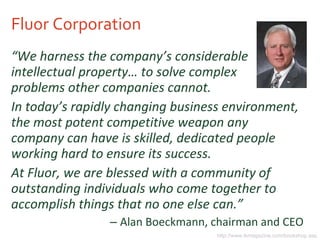
Fluor Corporation “ We harness the company’s considerable intellectual property… to solve complex problems other companies cannot.  In today’s rapidly changing business environment, the most potent competitive weapon any company can have is skilled, dedicated people working hard to ensure its success.  At Fluor, we are blessed with a community of outstanding individuals who come together to accomplish things that no one else can.” Alan Boeckmann, chairman and CEO http://www.ikmagazine.com/bookshop.asp
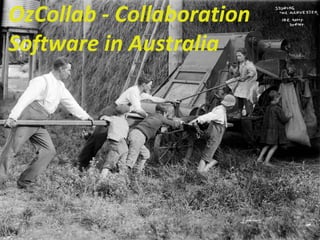
OzCollab - Collaboration Software in Australia
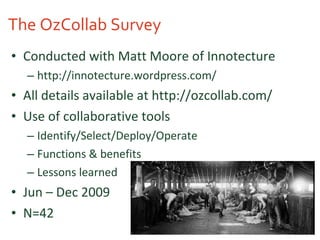
The OzCollab Survey Conducted with Matt Moore of Innotecture http://innotecture.wordpress.com/ All details available at http://ozcollab.com/ Use of collaborative tools Identify/Select/Deploy/Operate Functions & benefits Lessons learned Jun – Dec 2009 N=42
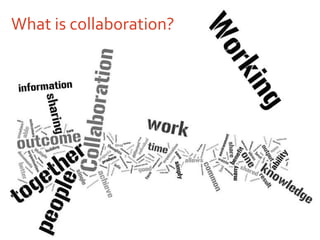
What is collaboration?
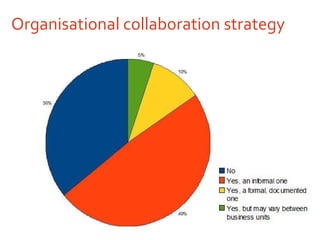
Organisational collaboration strategy
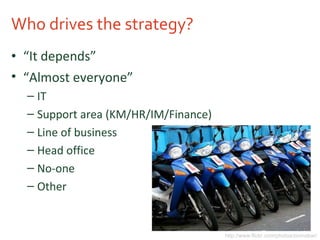
Who drives the strategy? “ It depends” http://www.flickr.com/photos/zoonabar/ “ Almost everyone” IT Support area (KM/HR/IM/Finance) Line of business Head office No-one Other
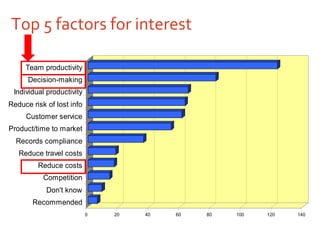
Top 5 factors for interest
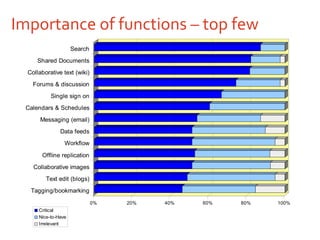
Importance of functions – top few
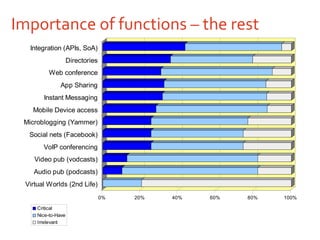
Importance of functions – the rest
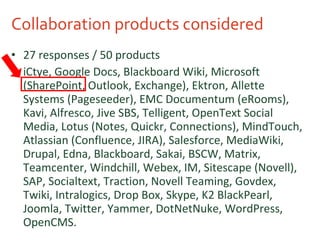
Collaboration products considered 27 responses / 50 products iCtye, Google Docs, Blackboard Wiki, Microsoft (SharePoint, Outlook, Exchange), Ektron, Allette Systems (Pageseeder), EMC Documentum (eRooms), Kavi, Alfresco, Jive SBS, Telligent, OpenText Social Media, Lotus (Notes, Quickr, Connections), MindTouch, Atlassian (Confluence, JIRA), Salesforce, MediaWiki, Drupal, Edna, Blackboard, Sakai, BSCW, Matrix, Teamcenter, Windchill, Webex, IM, Sitescape (Novell), SAP, Socialtext, Traction, Novell Teaming, Govdex, Twiki, Intralogics, Drop Box, Skype, K2 BlackPearl, Joomla, Twitter, Yammer, DotNetNuke, WordPress, OpenCMS.
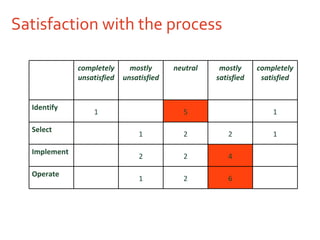
Satisfaction with the process completely unsatisfied mostly unsatisfied neutral mostly satisfied completely satisfied Identify 1 5 1 Select 1 2 2 1 Implement 2 2 4 Operate 1 2 6
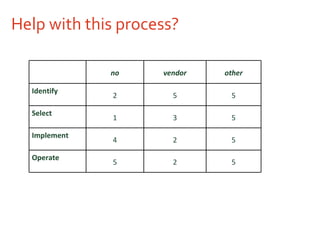
Help with this process? no vendor other Identify 2 5 5 Select 1 3 5 Implement 4 2 5 Operate 5 2 5
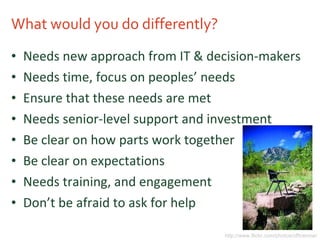
What would you do differently? Needs new approach from IT & decision-makers Needs time, focus on peoples’ needs Ensure that these needs are met Needs senior-level support and investment Be clear on how parts work together Be clear on expectations Needs training, and engagement Don’t be afraid to ask for help http://www.flickr.com/photos/officenow/
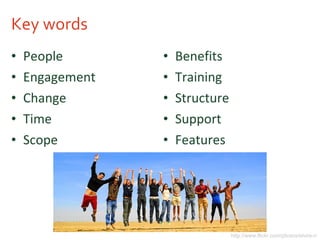
Key words People Engagement Change Time Scope Benefits Training Structure Support Features http://www.flickr.com/photos/elvire-r/
Collaborative exercise What approaches, methods or tools apply to your collaborative environment? KM Method Cards From Straits Knowledge, Singapore http://www.flickr.com/photos/mikebaird/
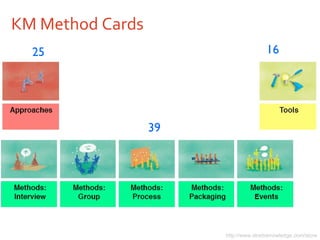
KM Method Cards 25 39 16 http://www.straitsknowledge.com/store
The exercise You will be dealt a card 3 Approaches 5 Methods 5 Tools Find one partner with a card you can connect to yours in some way Think about how you can use this Explain the connection and the application to the group http://www.flickr.com/photos/recoverling/
The Idea Monopoly? http://www.flickr.com/photos/http2007/
Or… Orgsourcing? http://www.flickr.com/photos/jamescridland/
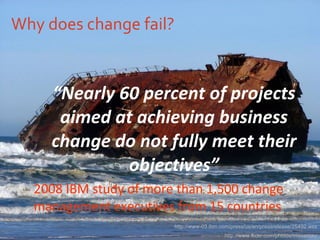
Why does change fail? “ Nearly 60 percent of projects aimed at achieving business change do not fully meet their objectives” 2008 IBM study of more than 1,500 change management executives from 15 countries http://www.flickr.com/photos/misserion/ http://www-03.ibm.com/press/us/en/pressrelease/25492.wss
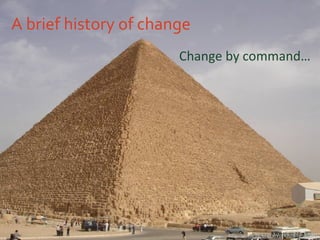
A brief history of change Change by command… http://www.flickr.com/photos/lyng883/
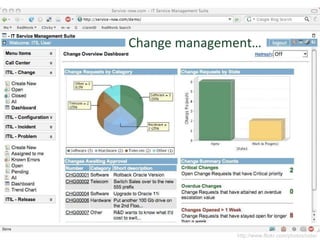
Change management… http://www.flickr.com/photos/cote/
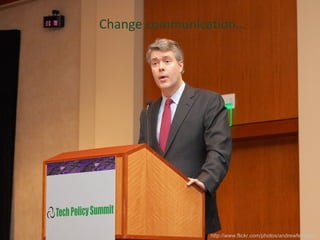
Change communication… http://www.flickr.com/photos/andrewfeinberg/
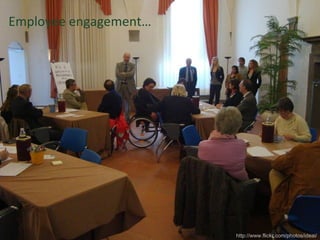
Employee engagement… http://www.flickr.com/photos/ideai/
But aren’t we forgetting something? http://www.flickr.com/photos/pookhy/
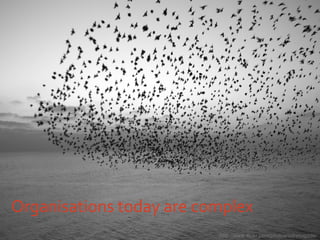
Organisations today are complex http://www.flickr.com/photos/odreiuqzide/
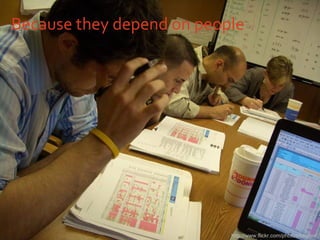
Because they depend on people http://www.flickr.com/photos/beglen/
Complexity theory? We need to understand how organisations work, before we can effectively change them People are: Complex, unpredictable, dynamic Resistant to engineering Change is only made possible by people http://www.flickr.com/photos/kevindooley/
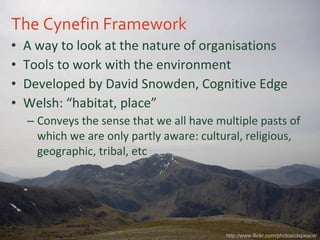
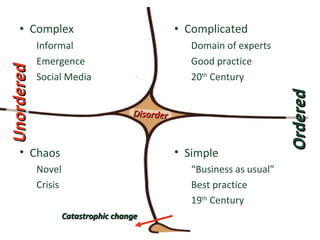
The Cynefin Framework A way to look at the nature of organisations Tools to work with the environment Developed by David Snowden, Cognitive Edge Welsh: “habitat, place” Conveys the sense that we all have multiple pasts of which we are only partly aware: cultural, religious, geographic, tribal, etc http://www.flickr.com/photos/clspeace/
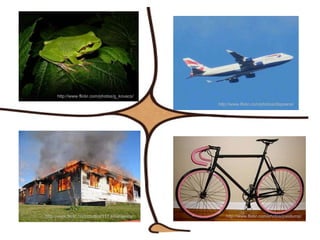
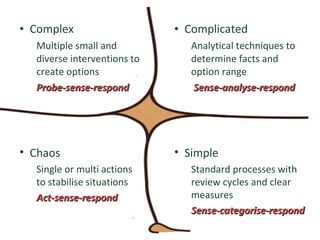
Complex Cause and effect coherent in retrospect, repeat accidentally – unpredictable Complicated Cause and effect separated over time & space, but repeat – analysable Knowable Simple Cause & effect relations repeatable & predictable Known Chaos No cause and effect relationships generally perceivable http://www.flickr.com/photos/joestump/ http://www.flickr.com/photos/clspeace/ http://www.flickr.com/photos/g_kovacs/ http://www.flickr.com/photos/111 emergency/
Complex Informal Emergence Social Media Complicated Domain of experts Good practice 20 th  Century Simple “ Business as usual” Best practice 19 th  Century Chaos Novel Crisis Catastrophic change Ordered Unordered Disorder
Complex Multiple small and diverse interventions to create options Probe-sense-respond Complicated Analytical techniques to determine facts and option range Sense-analyse-respond Simple Standard processes with review cycles and clear measures Sense-categorise-respond Chaos Single or multi actions to stabilise situations Act-sense-respond
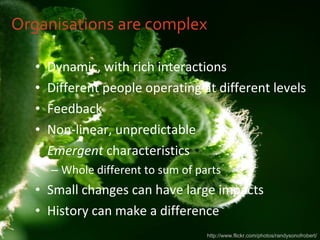
Organisations are complex Dynamic, with rich interactions Different people operating at different levels Feedback Non-linear, unpredictable Emergent  characteristics Whole different to sum of parts Small changes can have large impacts History can make a difference http://www.flickr.com/photos/randysonofrobert/
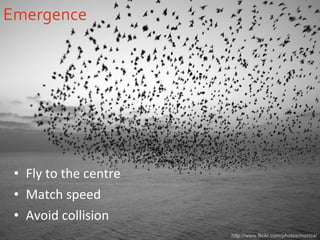
Emergence Fly to the centre Match speed Avoid collision http://www.flickr.com/photos/moriza/
Simple wisdom doesn’t apply  “ The definition of insanity is doing the same thing twice and expecting a different result” In a complex environment, doing the same thing twice  will  give a different result “ You can't fix what you can't measure” You  can  intervene in a complex environment, even though you  can’t  measure it reliably http://www.flickr.com/photos/emmettanderson/
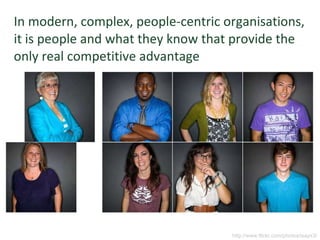
In modern, complex, people-centric organisations, it is people and what they know that provide the only real competitive advantage http://www.flickr.com/photos/isayx3/
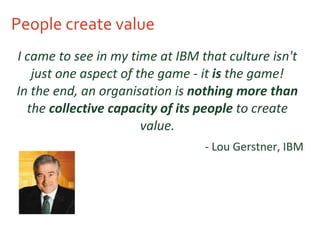
People create value I came to see in my time at IBM that culture isn't just one aspect of the game - it  is  the game! In the end, an organisation is  nothing more than  the  collective capacity of its people  to create value. - Lou Gerstner, IBM
There is no monopoly on ideas! http://www.flickr.com/photos/gaetanlee/
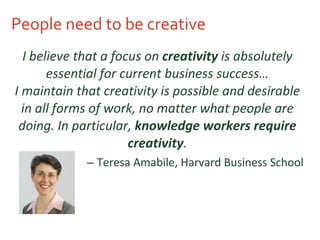
People need to be creative I believe that a focus on  creativity  is absolutely essential for current business success… I maintain that creativity is possible and desirable in all forms of work, no matter what people are doing. In particular,  knowledge workers require creativity . Teresa Amabile, Harvard Business School
How to encourage creativity Support people emotionally Monitor work in a positive way Recognise good performance, in public Consult with people on the team Collaborate –spend time with team on tasks
Cognitive rewards Monetary rewards don't work where more cognitive work required: Autonomy Mastery Purpose Self-directed = better engagement eg Atlassian Dan Pink,  Drive
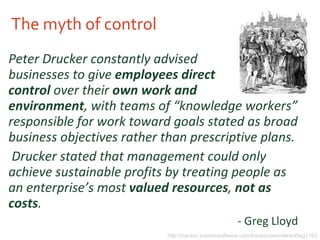
The myth of control Peter Drucker constantly advised businesses to give  employees   direct control   over their  own work and environment , with teams of “knowledge workers” responsible for work toward goals stated as broad business objectives rather than prescriptive plans. Drucker stated that management could only achieve sustainable profits by treating people as an enterprise’s most  valued resources ,  not as costs .   - Greg Lloyd  http://traction.tractionsoftware.com/traction/permalink/Blog1163
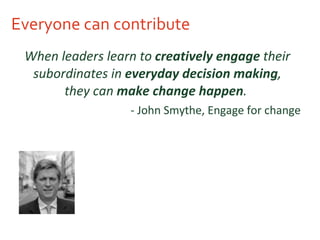
Everyone can contribute When leaders learn to  creatively engage  their subordinates in  everyday decision making , they can  make change happen .   - John Smythe, Engage for change
McKinsey Research 2008 report 59 organisations researched globally Single, most influential cause of more engaged employees: The appetite and ability of leaders at every level to   engage their subordinates in everyday decision making and bigger-ticket change   http://www.flickr.com/photos/cell105/
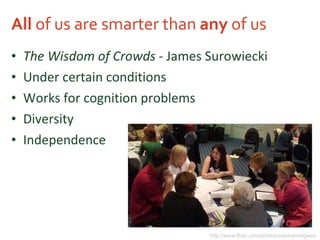
All  of us are smarter than  any  of us The Wisdom of Crowds  - James Surowiecki Under certain conditions Works for cognition problems Diversity Independence http://www.flickr.com/photos/stephanridgway/
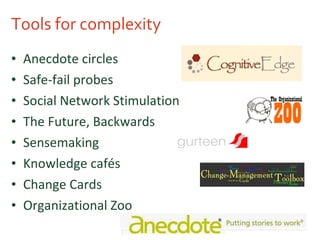
Tools for complexity Anecdote circles Safe-fail probes Social Network Stimulation The Future, Backwards Sensemaking Knowledge cafés Change Cards Organizational Zoo
Build trust through social media
What is the result? Leaders who  engage the right groups  in everyday decisions and in  designing and executing change  will benefit both in terms of the  quality  of decisions and the  speed  of execution that derives from people who feel  ownership of the outcome . - John Smythe, Engage for change
The theory and practice of communities http://delarue.net/blog/2009/03/the-theory-and-practice-of-communities/ The communities manifesto (Stan Garfield) https://docs.google.com/View?id=ddj598qm_44fx54rbg5 Being a Successful Knowledge Leader (Arthur Shelley, Ark Group)  http://www.ikmagazine.com/bookshop.asp Surveying the collaboration battleground http://idm.net.au/article/007933-surveying-collaboration-battleground @kdelarue 0418 51 7676 [email_address] http://acknowledgeconsulting.com/

Making collaboration happen: communities, change and lessons learned

  • 1.
    Making collaboration happen: Communities, change and lessons learned Keith De La Rue http://www.flickr.com/photos/mckaysavage/
  • 2.
    Outline Dynamics ofcollaboration and CoPs Which tools to use for effective collaboration? Notes from the field The OzCollab survey of collaboration technology Complexity and engaging people Recent insights into effective organisational change Creativity, trust and openness http://www.flickr.com/photos/eamoncurry/
  • 3.
    Questions Can you“make” collaboration happen? What are your collaborative needs? http://www.flickr.com/photos/mitosettembremusica/
  • 4.
    What is acommunity? http://www.flickr.com/photos/jamescridland/
  • 5.
    Community A groupof people living in a particular local area A group of people having ethnic or cultural or religious characteristics in common Common ownership (“A community of possessions”) Agreement as to goals (“A community of interests”) The body of people in a learned occupation From Latin: “common, public, shared by many” http://www.onelook.com/?w=community&ls=a http://www.flickr.com/photos/MrTopf/
  • 6.
    Communities of Practice(CoPs) Community Practice Technology (Don’t put the cart before the horse) http://www.flickr.com/photos/ell-r-brown/
  • 7.
    Communities in organisationsCEO Dept A Dept B Dept C Mgr Mgr Mgr Mgr Mgr Mgr Mgr Mgr Mgr
  • 8.
    Not aproject team CEO Dept A Dept B Dept C Mgr Mgr Mgr Mgr Mgr Mgr Mgr Mgr Mgr Eng Eng Eng Eng Eng Eng
  • 9.
    Communities in organisations“ Communities are living organisms and require gardeners, not mechanics, to provide them with leadership.” Fred Schoeps, KM manager, IBM “ Knowledge can only ever be volunteered; it cannot be conscripted.” David Snowden, Cognitive Edge http://www.flickr.com/photos/mikebaird/
  • 10.
    Nature of aCoP It is a community Not a “controlled” environment Doesn’t have “deliverables” But should have community goals… Organic It’s about the people Local, regional, global http://www.flickr.com/photos/drbeachvacation/
  • 11.
    Purpose of aCoP? Common field of interests, specialisation Sharing knowledge for mutual benefit Reuse good ideas Ask questions Development of the individuals Peer learning Development of a discipline Solving unique problems Innovation http://www.flickr.com/photos/usfbps/
  • 12.
    CoP Dynamics CoreActive Peripheral
  • 13.
    CoP Dynamics 19 90 Needs a critical mass
  • 14.
    Creating a community“ Trust comes on foot, but leaves on horseback.” Johan Thorbecke Attempts to “control” lead to evaporation Community needs nurturing Community moderator Leaders need passion Invite potential participants Regular scheduled activities http://www.flickr.com/photos/soldiersmediacenter/
  • 15.
    Building a communityRewards & Recognition? Link to desired outcomes Cognitive work motivation (Dan Pink): Autonomy Mastery Purpose Goals Activity Participation http://www.youtube.com/watch?v=u6XAPnuFjJc http://www.flickr.com/photos/vizzzual-dot-com/
  • 16.
    Practice – groupidentity A shared common practice “ I am a …” Not too broad or too narrow Need to recognise affinity Mutual understanding Avoid redundant communities Be able to both learn and contribute http://anecdote.com.au/ http://www.flickr.com/photos/europedistrict/
  • 17.
    Practice – grouputility Relationship to day-to-day work Community must become part of the practice Obvious direct benefits WIIFM? Assistance with work issues Problem solving Professional support http://delarue.net/blog/2008/09/practice-makes-perfect/
  • 18.
    Technology? May notneed any technology! Start with people first Starting with technology may lead to failure Field of Dreams does not necessarily apply Deprive of technology until needs expressed? Make it as easy as possible to use If not all face-to-face, communication first Social Media principles apply – trust, openness http://www.flickr.com/photos/ivyfield/
  • 19.
    Supporting member interaction– ‘SCENT’ S ite: home page - information C alendar: community events - interaction E vents: F2F, conference calls, webinars N ews: newsletter or blog - comms & publicity T hreads: discussion board - virtual interaction http://sites.google.com/site/stangarfield/home/ http://www.flickr.com/photos/misteraitch/
  • 20.
    Blog as acommunity site http://www.melbournekmlf.org/
  • 21.
    Calendar of eventshttp://www.melbournekmlf.org/?page_id=84
  • 22.
    Other tools -Wiki http://knowledgebucket.wik.is/ Building a body of knowledge
  • 23.
    Other tools -Microblogging http://www.yammer.com/
  • 24.
    Networking, awareness, chathttp://www.facebook.com/smcmelb
  • 25.
    Measuring outcomes Achievingteam goals and participation Testimonials on value Anecdotes – stories of usefulness Solutions to business problems Publicise outcomes widely http://sites.google.com/site/stangarfield/home/ http://www.flickr.com/photos/mwichary/
  • 26.
    Fluor Corporation Constructionand Project Management 2007 Case Study 44 global knowledge communities Total 25,000 active members 12,000 forum submissions Voluntary membership Community leaders trained ‘ Knowvember’ – Annual celebration and awards http://www.ikmagazine.com/bookshop.asp http://www.fluor.com/
  • 27.
    Fluor Corporation “We harness the company’s considerable intellectual property… to solve complex problems other companies cannot. In today’s rapidly changing business environment, the most potent competitive weapon any company can have is skilled, dedicated people working hard to ensure its success. At Fluor, we are blessed with a community of outstanding individuals who come together to accomplish things that no one else can.” Alan Boeckmann, chairman and CEO http://www.ikmagazine.com/bookshop.asp
  • 28.
    OzCollab - CollaborationSoftware in Australia
  • 29.
    The OzCollab SurveyConducted with Matt Moore of Innotecture http://innotecture.wordpress.com/ All details available at http://ozcollab.com/ Use of collaborative tools Identify/Select/Deploy/Operate Functions & benefits Lessons learned Jun – Dec 2009 N=42
  • 30.
  • 31.
  • 32.
    Who drives thestrategy? “ It depends” http://www.flickr.com/photos/zoonabar/ “ Almost everyone” IT Support area (KM/HR/IM/Finance) Line of business Head office No-one Other
  • 33.
    Top 5 factorsfor interest
  • 34.
  • 35.
  • 36.
    Collaboration products considered27 responses / 50 products iCtye, Google Docs, Blackboard Wiki, Microsoft (SharePoint, Outlook, Exchange), Ektron, Allette Systems (Pageseeder), EMC Documentum (eRooms), Kavi, Alfresco, Jive SBS, Telligent, OpenText Social Media, Lotus (Notes, Quickr, Connections), MindTouch, Atlassian (Confluence, JIRA), Salesforce, MediaWiki, Drupal, Edna, Blackboard, Sakai, BSCW, Matrix, Teamcenter, Windchill, Webex, IM, Sitescape (Novell), SAP, Socialtext, Traction, Novell Teaming, Govdex, Twiki, Intralogics, Drop Box, Skype, K2 BlackPearl, Joomla, Twitter, Yammer, DotNetNuke, WordPress, OpenCMS.
  • 37.
    Satisfaction with theprocess completely unsatisfied mostly unsatisfied neutral mostly satisfied completely satisfied Identify 1 5 1 Select 1 2 2 1 Implement 2 2 4 Operate 1 2 6
  • 38.
    Help with thisprocess? no vendor other Identify 2 5 5 Select 1 3 5 Implement 4 2 5 Operate 5 2 5
  • 39.
    What would youdo differently? Needs new approach from IT & decision-makers Needs time, focus on peoples’ needs Ensure that these needs are met Needs senior-level support and investment Be clear on how parts work together Be clear on expectations Needs training, and engagement Don’t be afraid to ask for help http://www.flickr.com/photos/officenow/
  • 40.
    Key words PeopleEngagement Change Time Scope Benefits Training Structure Support Features http://www.flickr.com/photos/elvire-r/
  • 41.
    Collaborative exercise Whatapproaches, methods or tools apply to your collaborative environment? KM Method Cards From Straits Knowledge, Singapore http://www.flickr.com/photos/mikebaird/
  • 42.
    KM Method Cards25 39 16 http://www.straitsknowledge.com/store
  • 43.
    The exercise Youwill be dealt a card 3 Approaches 5 Methods 5 Tools Find one partner with a card you can connect to yours in some way Think about how you can use this Explain the connection and the application to the group http://www.flickr.com/photos/recoverling/
  • 44.
    The Idea Monopoly?http://www.flickr.com/photos/http2007/
  • 45.
  • 46.
    Why does changefail? “ Nearly 60 percent of projects aimed at achieving business change do not fully meet their objectives” 2008 IBM study of more than 1,500 change management executives from 15 countries http://www.flickr.com/photos/misserion/ http://www-03.ibm.com/press/us/en/pressrelease/25492.wss
  • 47.
    A brief historyof change Change by command… http://www.flickr.com/photos/lyng883/
  • 48.
  • 49.
  • 50.
  • 51.
    But aren’t weforgetting something? http://www.flickr.com/photos/pookhy/
  • 52.
    Organisations today arecomplex http://www.flickr.com/photos/odreiuqzide/
  • 53.
    Because they dependon people http://www.flickr.com/photos/beglen/
  • 54.
    Complexity theory? Weneed to understand how organisations work, before we can effectively change them People are: Complex, unpredictable, dynamic Resistant to engineering Change is only made possible by people http://www.flickr.com/photos/kevindooley/
  • 55.
    The Cynefin FrameworkA way to look at the nature of organisations Tools to work with the environment Developed by David Snowden, Cognitive Edge Welsh: “habitat, place” Conveys the sense that we all have multiple pasts of which we are only partly aware: cultural, religious, geographic, tribal, etc http://www.flickr.com/photos/clspeace/
  • 56.
    Complex Cause andeffect coherent in retrospect, repeat accidentally – unpredictable Complicated Cause and effect separated over time & space, but repeat – analysable Knowable Simple Cause & effect relations repeatable & predictable Known Chaos No cause and effect relationships generally perceivable http://www.flickr.com/photos/joestump/ http://www.flickr.com/photos/clspeace/ http://www.flickr.com/photos/g_kovacs/ http://www.flickr.com/photos/111 emergency/
  • 57.
    Complex Informal EmergenceSocial Media Complicated Domain of experts Good practice 20 th Century Simple “ Business as usual” Best practice 19 th Century Chaos Novel Crisis Catastrophic change Ordered Unordered Disorder
  • 58.
    Complex Multiple smalland diverse interventions to create options Probe-sense-respond Complicated Analytical techniques to determine facts and option range Sense-analyse-respond Simple Standard processes with review cycles and clear measures Sense-categorise-respond Chaos Single or multi actions to stabilise situations Act-sense-respond
  • 59.
    Organisations are complexDynamic, with rich interactions Different people operating at different levels Feedback Non-linear, unpredictable Emergent characteristics Whole different to sum of parts Small changes can have large impacts History can make a difference http://www.flickr.com/photos/randysonofrobert/
  • 60.
    Emergence Fly tothe centre Match speed Avoid collision http://www.flickr.com/photos/moriza/
  • 61.
    Simple wisdom doesn’tapply “ The definition of insanity is doing the same thing twice and expecting a different result” In a complex environment, doing the same thing twice will give a different result “ You can't fix what you can't measure” You can intervene in a complex environment, even though you can’t measure it reliably http://www.flickr.com/photos/emmettanderson/
  • 62.
    In modern, complex,people-centric organisations, it is people and what they know that provide the only real competitive advantage http://www.flickr.com/photos/isayx3/
  • 63.
    People create valueI came to see in my time at IBM that culture isn't just one aspect of the game - it is the game! In the end, an organisation is nothing more than the collective capacity of its people to create value. - Lou Gerstner, IBM
  • 64.
    There is nomonopoly on ideas! http://www.flickr.com/photos/gaetanlee/
  • 65.
    People need tobe creative I believe that a focus on creativity is absolutely essential for current business success… I maintain that creativity is possible and desirable in all forms of work, no matter what people are doing. In particular, knowledge workers require creativity . Teresa Amabile, Harvard Business School
  • 66.
    How to encouragecreativity Support people emotionally Monitor work in a positive way Recognise good performance, in public Consult with people on the team Collaborate –spend time with team on tasks
  • 67.
    Cognitive rewards Monetaryrewards don't work where more cognitive work required: Autonomy Mastery Purpose Self-directed = better engagement eg Atlassian Dan Pink, Drive
  • 68.
    The myth ofcontrol Peter Drucker constantly advised businesses to give employees direct control over their own work and environment , with teams of “knowledge workers” responsible for work toward goals stated as broad business objectives rather than prescriptive plans. Drucker stated that management could only achieve sustainable profits by treating people as an enterprise’s most valued resources , not as costs . - Greg Lloyd http://traction.tractionsoftware.com/traction/permalink/Blog1163
  • 69.
    Everyone can contributeWhen leaders learn to creatively engage their subordinates in everyday decision making , they can make change happen . - John Smythe, Engage for change
  • 70.
    McKinsey Research 2008report 59 organisations researched globally Single, most influential cause of more engaged employees: The appetite and ability of leaders at every level to engage their subordinates in everyday decision making and bigger-ticket change http://www.flickr.com/photos/cell105/
  • 71.
    All ofus are smarter than any of us The Wisdom of Crowds - James Surowiecki Under certain conditions Works for cognition problems Diversity Independence http://www.flickr.com/photos/stephanridgway/
  • 72.
    Tools for complexityAnecdote circles Safe-fail probes Social Network Stimulation The Future, Backwards Sensemaking Knowledge cafés Change Cards Organizational Zoo
  • 73.
    Build trust throughsocial media
  • 74.
    What is theresult? Leaders who engage the right groups in everyday decisions and in designing and executing change will benefit both in terms of the quality of decisions and the speed of execution that derives from people who feel ownership of the outcome . - John Smythe, Engage for change
  • 75.
    The theory andpractice of communities http://delarue.net/blog/2009/03/the-theory-and-practice-of-communities/ The communities manifesto (Stan Garfield) https://docs.google.com/View?id=ddj598qm_44fx54rbg5 Being a Successful Knowledge Leader (Arthur Shelley, Ark Group) http://www.ikmagazine.com/bookshop.asp Surveying the collaboration battleground http://idm.net.au/article/007933-surveying-collaboration-battleground @kdelarue 0418 51 7676 [email_address] http://acknowledgeconsulting.com/