


Using technology for maths teaching
and learning:
Instructional design, digital books
and automated feedback
Dr. Christian Bokhove
University of Southampton
United Kingdom
Overview
• Technology in general
• Technology in maths
• Features for maths technology
– Instructional design, feedback, gamification
• Integrated design: digital books
– Some projects
• Future developments
I will discuss these elements by frequently referring to own
projects and research of the last decade. Sometimes I will
demo some features in real time (see yellow vertical bars).
If you have any questions during the talk, ask!!
Note that during the plenary I did not cover all these slides (37-51).
Nevertheless I left them in because they might be useful.
Who am I
• Dr. Christian Bokhove
• From 1998-2012 teacher maths, computer science, head of
ICT secondary school Netherlands
• National projects Maths & ICT at Freudenthal Instituut,
Utrecht University
• PhD ‘Use of ICT for acquiring, practicing and
assessing algebraic expertise’ with
Prof. Van Maanen and Prof. Drijvers
• Lecturer at University of
Southampton
– Maths education
– Technology use
– Large-scale assessment
Maths education and technology
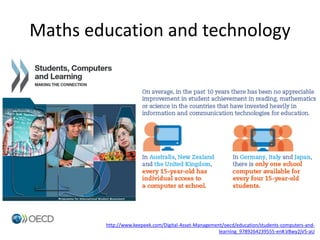
• OECD report
• Ma overview
http://www.keepeek.com/Digital-Asset-Management/oecd/education/students-computers-and-
learning_9789264239555-en#.V8wy2jV5-aU
Maths education and technology
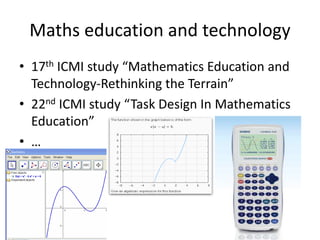
• 17th ICMI study “Mathematics Education and
Technology-Rethinking the Terrain”
• 22nd ICMI study “Task Design In Mathematics
Education”
• …
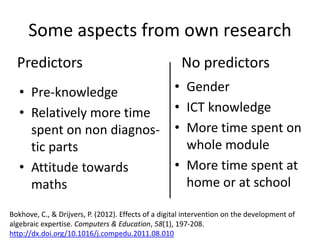
Some aspects from own research
• Pre-knowledge
• Relatively more time
spent on non diagnos-
tic parts
• Attitude towards
maths
Predictors No predictors
• Gender
• ICT knowledge
• More time spent on
whole module
• More time spent at
home or at school
Bokhove, C., & Drijvers, P. (2012). Effects of a digital intervention on the development of
algebraic expertise. Computers & Education, 58(1), 197-208.
http://dx.doi.org/10.1016/j.compedu.2011.08.010
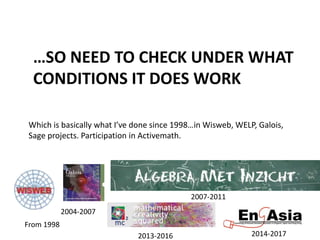
…SO NEED TO CHECK UNDER WHAT
CONDITIONS IT DOES WORK
Which is basically what I’ve done since 1998…in Wisweb, WELP, Galois,
Sage projects. Participation in Activemath.
2004-2007
From 1998
2007-2011
2014-20172013-2016
Could be characterized as
• From distinct, separate tools to integrated
• From offline towards online
• From not storing data to storing data
So not only is it important to know under what
conditions technology works, but also what
features might be potentially beneficial.
Software characteristics
Results externally validated instrument.
Eerst formulate what we need, then look for
software.
Selected criteria:
–Storage of student results;
–In-between steps when solving equations;
–Authoring;
–Intuitive user interface;
–60+ tools tried and evaluated;
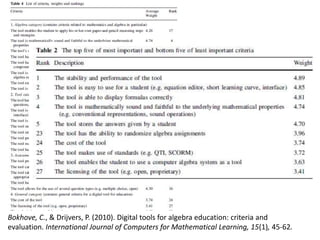
Bokhove, C., & Drijvers, P. (2010). Digital tools for algebra education: criteria and
evaluation. International Journal of Computers for Mathematical Learning, 15(1), 45-62.
INTEGRATED DESIGN: DIGITAL
BOOKS
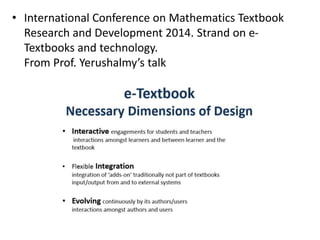
• International Conference on Mathematics Textbook
Research and Development 2014. Strand on e-
Textbooks and technology.
From Prof. Yerushalmy’s talk
Examples
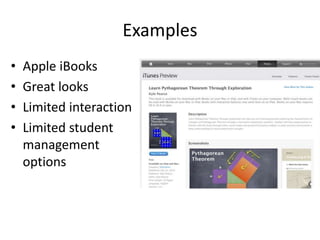
• Apple iBooks
• Great looks
• Limited interaction
• Limited student
management
options
Overview affordances
• Also see beginning of chapter with Kate
Mackrell
• Two years ago Back’s keynote on e-math
project with structured derivations
(interactive e-books). E-book architrecture on-
and off-line
• Activemath-EU, LeActivemath, Mathbridge
Integrated in c-books
The research leading to these results has received funding from the European Union
Seventh Framework Programme (FP7/2007-2013) under grant agreement n° 610467
- project “M C Squared”. This publication reflects only the author’s views and Union
is not liable for any use that may be made of the information contained therein.
Towards digital textbooks
• Digital textbook: theory, examples,
explanations
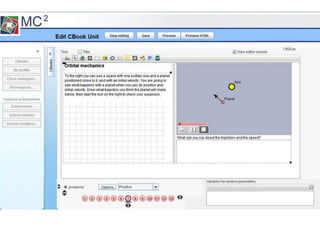
• Interactive content (in MC-squared widgets)
• Interactive quizzes (formative assessment,
feedback)
• Integrated workbook
Aims MC-squared
• Design and develop a new genre of authorable e-book,
which we call 'the c-book' (c for creative)
– Creative Mathematical Thinking (CMT)
• Initiate a ‘Community of Interest’ (CoI) (Fischer, 2001)
– A community of interest consists of several stakeholders
from various ‘Communities of Practice’ (Wenger, 1998).
– England, Spain, Greece, France
– Within these teachers who co-design and use resources for
teaching, can contribute to their own professional
development (e.g., Jaworski, 2006).
– Social Creativity, Boundary objects
• UK CoI: learning analytics
More than sum of the parts
• Widgets
• Interaction (feedback)
• Interoperability
• Storing results
• Standards
• Authorability
WIDGETS
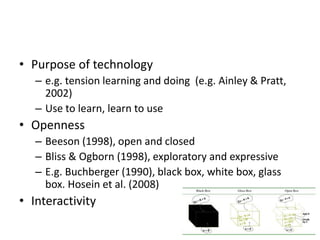
• Purpose of technology
– e.g. tension learning and doing (e.g. Ainley & Pratt,
2002)
– Use to learn, learn to use
• Openness
– Beeson (1998), open and closed
– Bliss & Ogborn (1998), exploratory and expressive
– E.g. Buchberger (1990), black box, white box, glass
box. Hosein et al. (2008)
• Interactivity
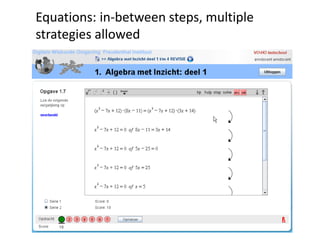
Equations: in-between steps, multiple
strategies allowed
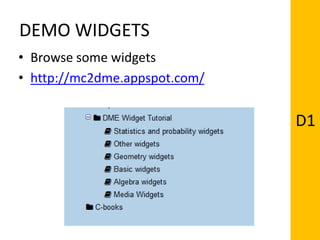
DEMO WIDGETS
• Browse some widgets
• http://mc2dme.appspot.com/
D1
More ‘open’ widgets
• Visualizing
students can “see” abstract concepts
• Representations
students can make connections
• Experiments
students can discover mathematics
INTERACTION: FEEDBACK
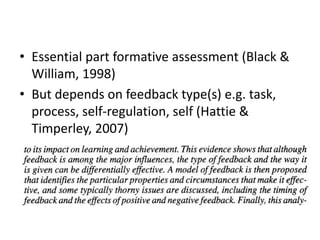
• Essential part formative assessment (Black &
William, 1998)
• But depends on feedback type(s) e.g. task,
process, self-regulation, self (Hattie &
Timperley, 2007)
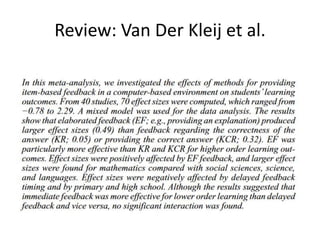
Review: Van Der Kleij et al.
Feedback
• Embedded feedback
• Authored by the teacher, based on student
domain knowledge
• Rule-based (e.g. IDEAS feedback)
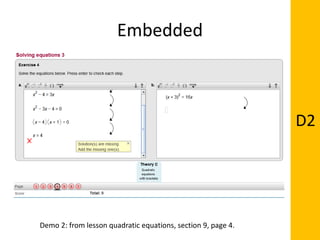
Embedded
D2
Demo 2: from lesson quadratic equations, section 9, page 4.
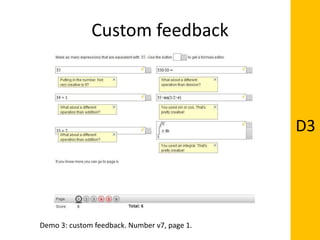
Custom feedback
D3
Demo 3: custom feedback. Number v7, page 1.
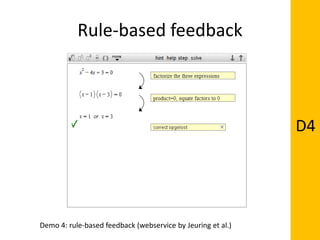
Rule-based feedback
D4
Demo 4: rule-based feedback (webservice by Jeuring et al.)
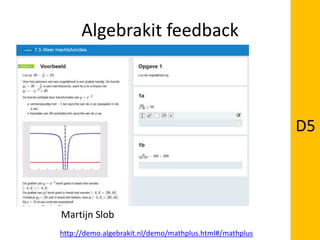
Algebrakit feedback
http://demo.algebrakit.nl/demo/mathplus.html#/mathplus
D5
Martijn Slob
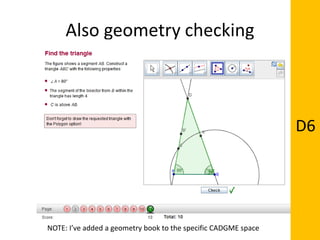
Also geometry checking
NOTE: I’ve added a geometry book to the specific CADGME space
D6
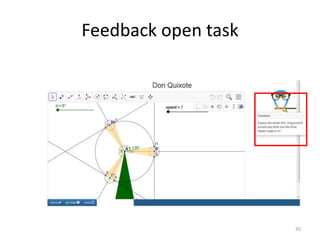
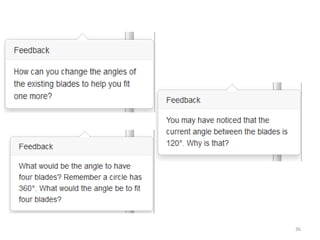
Feedback open task
35
36
INTEROPERABILITY AND
STANDARDS
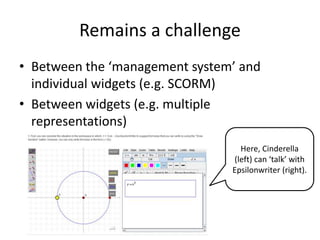
Remains a challenge
• Between the ‘management system’ and
individual widgets (e.g. SCORM)
• Between widgets (e.g. multiple
representations)
Here, Cinderella
(left) can ‘talk’ with
Epsilonwriter (right).
HTML5 player
STORING RESULTS
Storing results
• Imagine 10 classes with 30 students and
numerous tasks: management system
• But diversity of data types, ranging from
simple checkbox to complexity of geometry
widget
• Useful for Learning Analytics and studying
misconceptions
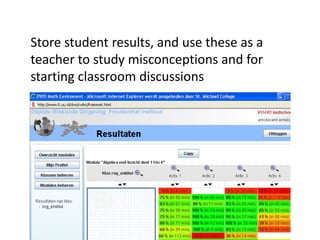
Store student results, and use these as a
teacher to study misconceptions and for
starting classroom discussions
ASPECTS OF INSTRUCTIONAL DESIGN:
TOWARDS AN INTEGRATED APPROACH
(i) students learn a lot from what goes wrong,
(ii) but students will not always overcome these if
no feedback is provided, and
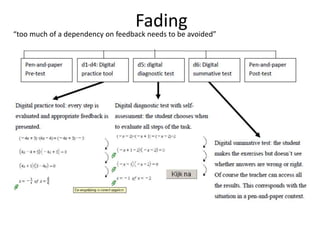
(iii) that too much of a dependency on feedback
needs to be avoided, as summative assessment
typically does not provide feedback.
These three challenges are addressed by principles
for crises, feedback and fading, respectively.
Bokhove, C. (2016). Chapter in Springer book on variation. Series Mathematics Education in
the Digital Era.
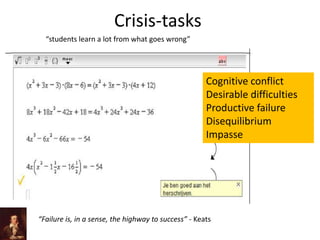
Crisis-tasks
“students learn a lot from what goes wrong”
“Failure is, in a sense, the highway to success” - Keats
Cognitive conflict
Desirable difficulties
Productive failure
Disequilibrium
Impasse
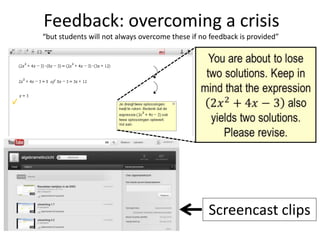
Feedback: overcoming a crisis
Screencast clips
“but students will not always overcome these if no feedback is provided”
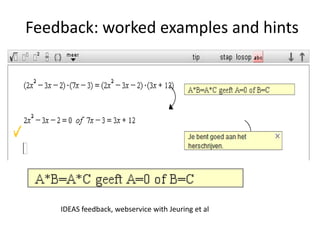
Feedback: worked examples and hints
IDEAS feedback, webservice with Jeuring et al
Fading
“too much of a dependency on feedback needs to be avoided”
AUTHORABILITY
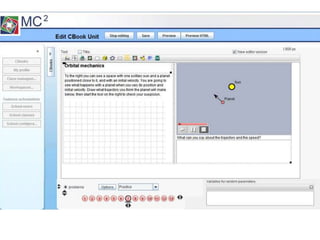
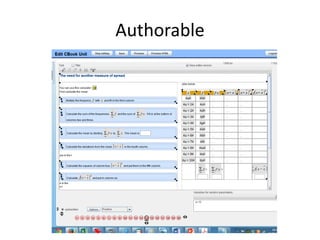
Authorable
To recap: technology-added value of the c-books
• Creative and interactive activities made by
designers (creative process authoring)
• Collaboration within CoI between designers,
teachers and computer scientists. Feeds into DA
component (see later section)
• Interactivity: feedback design
• More than one widget factories used
• All student data stored
• Sum is more than the parts…
enGasia project
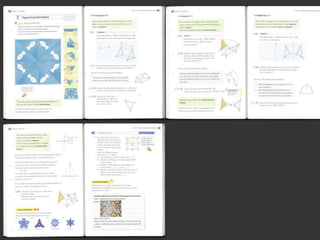
1. Compare geometry education in England, Japan and
Hong Kong → some shown now.
2. two digital resources (electronic books) will be
designed. They are then implemented in classrooms
in those countries.
3. The methodology will include a more qualitative
approach based on lesson observations and a quasi-
experimental element.
The design process
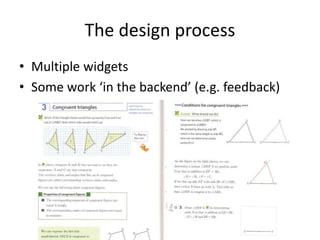
• Multiple widgets
• Some work ‘in the backend’ (e.g. feedback)
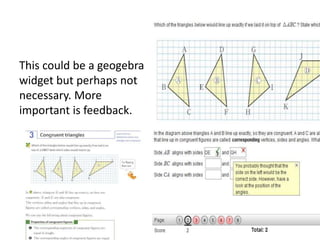
This could be a geogebra
widget but perhaps not
necessary. More
important is feedback.
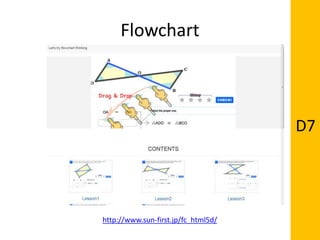
Flowchart
http://www.sun-first.jp/fc_html5d/
D7
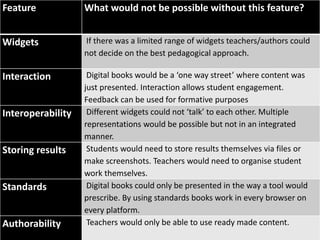
Feature What would not be possible without this feature?
Widgets If there was a limited range of widgets teachers/authors could
not decide on the best pedagogical approach.
Interaction Digital books would be a ‘one way street’ where content was
just presented. Interaction allows student engagement.
Feedback can be used for formative purposes
Interoperability Different widgets could not ‘talk’ to each other. Multiple
representations would be possible but not in an integrated
manner.
Storing results Students would need to store results themselves via files or
make screenshots. Teachers would need to organise student
work themselves.
Standards Digital books could only be presented in the way a tool would
prescribe. By using standards books work in every browser on
every platform.
Authorability Teachers would only be able to use ready made content.
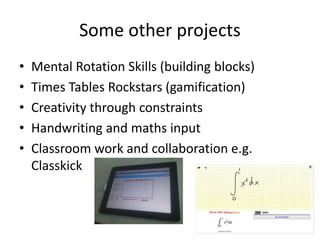
Some other projects
• Mental Rotation Skills (building blocks)
• Times Tables Rockstars (gamification)
• Creativity through constraints
• Handwriting and maths input
• Classroom work and collaboration e.g.
Classkick
Conclusions
• Need to look at integrated design: sum more
than the parts
• This means designers need multiple qualities
or need to work in collaborative teams
(Communities of Interest)
• Need a research pipeline from small-scale
qualitative towards rigorous large-scale.
• Happy to collaborate. You?
Try out
• Browse some c-books.
• I can show some of the authoring back-end
• Log in as guest all kinds of resources
• Log in with
cadgme2016_## with ## a number 1 to 50
password ‘pass’ to demo those mentioned in
lecture
(plus one on complex numbers)
• http://mc2dme.appspot.com/
D8
Thank you
• Questions/comments?
• More information:
C.Bokhove@soton.ac.uk
• www.bokhove.net
• Twitter: @cbokhove
61

Cadgme2016 keynote final

  • 1.
    Using technology formaths teaching and learning: Instructional design, digital books and automated feedback Dr. Christian Bokhove University of Southampton United Kingdom
  • 2.
    Overview • Technology ingeneral • Technology in maths • Features for maths technology – Instructional design, feedback, gamification • Integrated design: digital books – Some projects • Future developments I will discuss these elements by frequently referring to own projects and research of the last decade. Sometimes I will demo some features in real time (see yellow vertical bars). If you have any questions during the talk, ask!! Note that during the plenary I did not cover all these slides (37-51). Nevertheless I left them in because they might be useful.
  • 3.
    Who am I •Dr. Christian Bokhove • From 1998-2012 teacher maths, computer science, head of ICT secondary school Netherlands • National projects Maths & ICT at Freudenthal Instituut, Utrecht University • PhD ‘Use of ICT for acquiring, practicing and assessing algebraic expertise’ with Prof. Van Maanen and Prof. Drijvers • Lecturer at University of Southampton – Maths education – Technology use – Large-scale assessment
  • 4.
    Maths education andtechnology • OECD report • Ma overview http://www.keepeek.com/Digital-Asset-Management/oecd/education/students-computers-and- learning_9789264239555-en#.V8wy2jV5-aU
  • 5.
    Maths education andtechnology • 17th ICMI study “Mathematics Education and Technology-Rethinking the Terrain” • 22nd ICMI study “Task Design In Mathematics Education” • …
  • 6.
    Some aspects fromown research • Pre-knowledge • Relatively more time spent on non diagnos- tic parts • Attitude towards maths Predictors No predictors • Gender • ICT knowledge • More time spent on whole module • More time spent at home or at school Bokhove, C., & Drijvers, P. (2012). Effects of a digital intervention on the development of algebraic expertise. Computers & Education, 58(1), 197-208. http://dx.doi.org/10.1016/j.compedu.2011.08.010
  • 7.
    …SO NEED TOCHECK UNDER WHAT CONDITIONS IT DOES WORK Which is basically what I’ve done since 1998…in Wisweb, WELP, Galois, Sage projects. Participation in Activemath. 2004-2007 From 1998 2007-2011 2014-20172013-2016
  • 8.
    Could be characterizedas • From distinct, separate tools to integrated • From offline towards online • From not storing data to storing data So not only is it important to know under what conditions technology works, but also what features might be potentially beneficial.
  • 9.
    Software characteristics Results externallyvalidated instrument. Eerst formulate what we need, then look for software. Selected criteria: –Storage of student results; –In-between steps when solving equations; –Authoring; –Intuitive user interface; –60+ tools tried and evaluated;
  • 10.
    Bokhove, C., &Drijvers, P. (2010). Digital tools for algebra education: criteria and evaluation. International Journal of Computers for Mathematical Learning, 15(1), 45-62.
  • 11.
  • 12.
    • International Conferenceon Mathematics Textbook Research and Development 2014. Strand on e- Textbooks and technology. From Prof. Yerushalmy’s talk
  • 13.
    Examples • Apple iBooks •Great looks • Limited interaction • Limited student management options
  • 14.
    Overview affordances • Alsosee beginning of chapter with Kate Mackrell • Two years ago Back’s keynote on e-math project with structured derivations (interactive e-books). E-book architrecture on- and off-line • Activemath-EU, LeActivemath, Mathbridge
  • 15.
    Integrated in c-books Theresearch leading to these results has received funding from the European Union Seventh Framework Programme (FP7/2007-2013) under grant agreement n° 610467 - project “M C Squared”. This publication reflects only the author’s views and Union is not liable for any use that may be made of the information contained therein.
  • 16.
    Towards digital textbooks •Digital textbook: theory, examples, explanations • Interactive content (in MC-squared widgets) • Interactive quizzes (formative assessment, feedback) • Integrated workbook
  • 17.
    Aims MC-squared • Designand develop a new genre of authorable e-book, which we call 'the c-book' (c for creative) – Creative Mathematical Thinking (CMT) • Initiate a ‘Community of Interest’ (CoI) (Fischer, 2001) – A community of interest consists of several stakeholders from various ‘Communities of Practice’ (Wenger, 1998). – England, Spain, Greece, France – Within these teachers who co-design and use resources for teaching, can contribute to their own professional development (e.g., Jaworski, 2006). – Social Creativity, Boundary objects • UK CoI: learning analytics
  • 19.
    More than sumof the parts • Widgets • Interaction (feedback) • Interoperability • Storing results • Standards • Authorability
  • 20.
  • 22.
    • Purpose oftechnology – e.g. tension learning and doing (e.g. Ainley & Pratt, 2002) – Use to learn, learn to use • Openness – Beeson (1998), open and closed – Bliss & Ogborn (1998), exploratory and expressive – E.g. Buchberger (1990), black box, white box, glass box. Hosein et al. (2008) • Interactivity
  • 23.
    Equations: in-between steps,multiple strategies allowed
  • 24.
    DEMO WIDGETS • Browsesome widgets • http://mc2dme.appspot.com/ D1
  • 25.
    More ‘open’ widgets •Visualizing students can “see” abstract concepts • Representations students can make connections • Experiments students can discover mathematics
  • 26.
  • 27.
    • Essential partformative assessment (Black & William, 1998) • But depends on feedback type(s) e.g. task, process, self-regulation, self (Hattie & Timperley, 2007)
  • 28.
    Review: Van DerKleij et al.
  • 29.
    Feedback • Embedded feedback •Authored by the teacher, based on student domain knowledge • Rule-based (e.g. IDEAS feedback)
  • 30.
    Embedded D2 Demo 2: fromlesson quadratic equations, section 9, page 4.
  • 31.
    Custom feedback D3 Demo 3:custom feedback. Number v7, page 1.
  • 32.
    Rule-based feedback D4 Demo 4:rule-based feedback (webservice by Jeuring et al.)
  • 33.
  • 34.
    Also geometry checking NOTE:I’ve added a geometry book to the specific CADGME space D6
  • 35.
  • 36.
  • 37.
  • 38.
    Remains a challenge •Between the ‘management system’ and individual widgets (e.g. SCORM) • Between widgets (e.g. multiple representations) Here, Cinderella (left) can ‘talk’ with Epsilonwriter (right).
  • 39.
  • 40.
  • 41.
    Storing results • Imagine10 classes with 30 students and numerous tasks: management system • But diversity of data types, ranging from simple checkbox to complexity of geometry widget • Useful for Learning Analytics and studying misconceptions
  • 42.
    Store student results,and use these as a teacher to study misconceptions and for starting classroom discussions
  • 43.
    ASPECTS OF INSTRUCTIONALDESIGN: TOWARDS AN INTEGRATED APPROACH
  • 44.
    (i) students learna lot from what goes wrong, (ii) but students will not always overcome these if no feedback is provided, and (iii) that too much of a dependency on feedback needs to be avoided, as summative assessment typically does not provide feedback. These three challenges are addressed by principles for crises, feedback and fading, respectively. Bokhove, C. (2016). Chapter in Springer book on variation. Series Mathematics Education in the Digital Era.
  • 45.
    Crisis-tasks “students learn alot from what goes wrong” “Failure is, in a sense, the highway to success” - Keats Cognitive conflict Desirable difficulties Productive failure Disequilibrium Impasse
  • 46.
    Feedback: overcoming acrisis Screencast clips “but students will not always overcome these if no feedback is provided”
  • 47.
    Feedback: worked examplesand hints IDEAS feedback, webservice with Jeuring et al
  • 48.
    Fading “too much ofa dependency on feedback needs to be avoided”
  • 49.
  • 50.
  • 51.
    To recap: technology-addedvalue of the c-books • Creative and interactive activities made by designers (creative process authoring) • Collaboration within CoI between designers, teachers and computer scientists. Feeds into DA component (see later section) • Interactivity: feedback design • More than one widget factories used • All student data stored • Sum is more than the parts…
  • 52.
    enGasia project 1. Comparegeometry education in England, Japan and Hong Kong → some shown now. 2. two digital resources (electronic books) will be designed. They are then implemented in classrooms in those countries. 3. The methodology will include a more qualitative approach based on lesson observations and a quasi- experimental element.
  • 54.
    The design process •Multiple widgets • Some work ‘in the backend’ (e.g. feedback)
  • 55.
    This could bea geogebra widget but perhaps not necessary. More important is feedback.
  • 56.
  • 57.
    Feature What wouldnot be possible without this feature? Widgets If there was a limited range of widgets teachers/authors could not decide on the best pedagogical approach. Interaction Digital books would be a ‘one way street’ where content was just presented. Interaction allows student engagement. Feedback can be used for formative purposes Interoperability Different widgets could not ‘talk’ to each other. Multiple representations would be possible but not in an integrated manner. Storing results Students would need to store results themselves via files or make screenshots. Teachers would need to organise student work themselves. Standards Digital books could only be presented in the way a tool would prescribe. By using standards books work in every browser on every platform. Authorability Teachers would only be able to use ready made content.
  • 58.
    Some other projects •Mental Rotation Skills (building blocks) • Times Tables Rockstars (gamification) • Creativity through constraints • Handwriting and maths input • Classroom work and collaboration e.g. Classkick
  • 59.
    Conclusions • Need tolook at integrated design: sum more than the parts • This means designers need multiple qualities or need to work in collaborative teams (Communities of Interest) • Need a research pipeline from small-scale qualitative towards rigorous large-scale. • Happy to collaborate. You?
  • 60.
    Try out • Browsesome c-books. • I can show some of the authoring back-end • Log in as guest all kinds of resources • Log in with cadgme2016_## with ## a number 1 to 50 password ‘pass’ to demo those mentioned in lecture (plus one on complex numbers) • http://mc2dme.appspot.com/ D8
  • 61.
    Thank you • Questions/comments? •More information: C.Bokhove@soton.ac.uk • www.bokhove.net • Twitter: @cbokhove 61

Editor's Notes

  • #2 Abstract : In this talk I will give an overview of research on the affordances of using technology in teaching and learning mathematics. In particular I will: • Give an overview of specific affordances of technology and its role in instructional designs for teaching and learning maths. • Describe how technology is more and more integrated in instructional materials, allowing for digital maths books. I will show what affordances technology can have in the design of these books, through examples from the MC-squared and enGasia projects. • Emphasise some features of these digital maths books, for example the feature to provide customised automatic feedback, check geometric constructions and store student data. Attendees can bring their own technology to try out some of the software.
  • #34 Mathspace is another one.
  • #53 In international comparisons for mathematics like PISA and TIMSS, Asia outperforms England considerably. For geometry this difference is even greater. With a new maths curriculum coming into play in England in 2014, this project aims to compare geometry education in England, Japan and Hong Kong and to find out how an interactive electronic book could improve geometry teaching. Based on specific characteristics of the participating countries two digital resources (electronic books) will be designed. They are then implemented in classrooms in those countries. The methodology will include a more qualitative approach based on lesson observations and a quasi-experimental element. The results of this will be disseminated in several publications, public workshops and a dedicated weblog. The proposed project will result in a close collaborative network between England, Japan and Hong Kong.