Visual learning analytics
Joris Klerkx
Research Expert, PhD.
@jkofmsk
Sven Charleer
Phd candidate
@svencharleer
Erik Duval
Professor
@erikduval
http://www.slideshare.net/jkofmsk
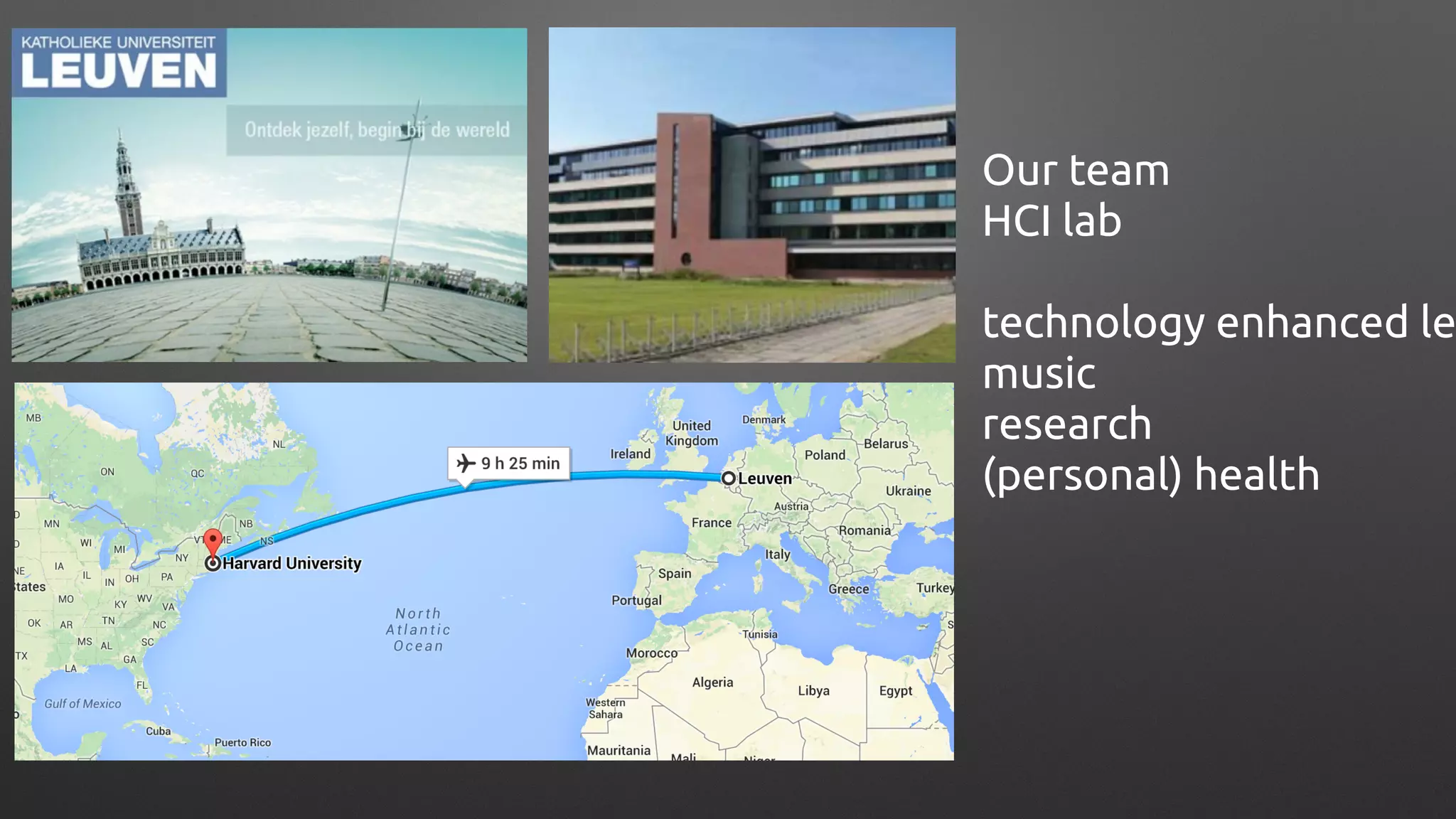
Our team

HCI lab
!
technology enhanced le
music
research
(personal) health
3 http://eng.kuleuven.be/datavislab/
About you…
Why are you interested in this workshop?
Agenda (more or less)
• BEFORE THE BREAK:
• Information visualization (theory)
• Group work - Design & Sketch your first visualizations
• AFTER THE BREAK:
• (Visual) Learning Analytics Dashboards
• Tips `n tricks
• Group work - Design your own learning analytics dashboard
WHAT?
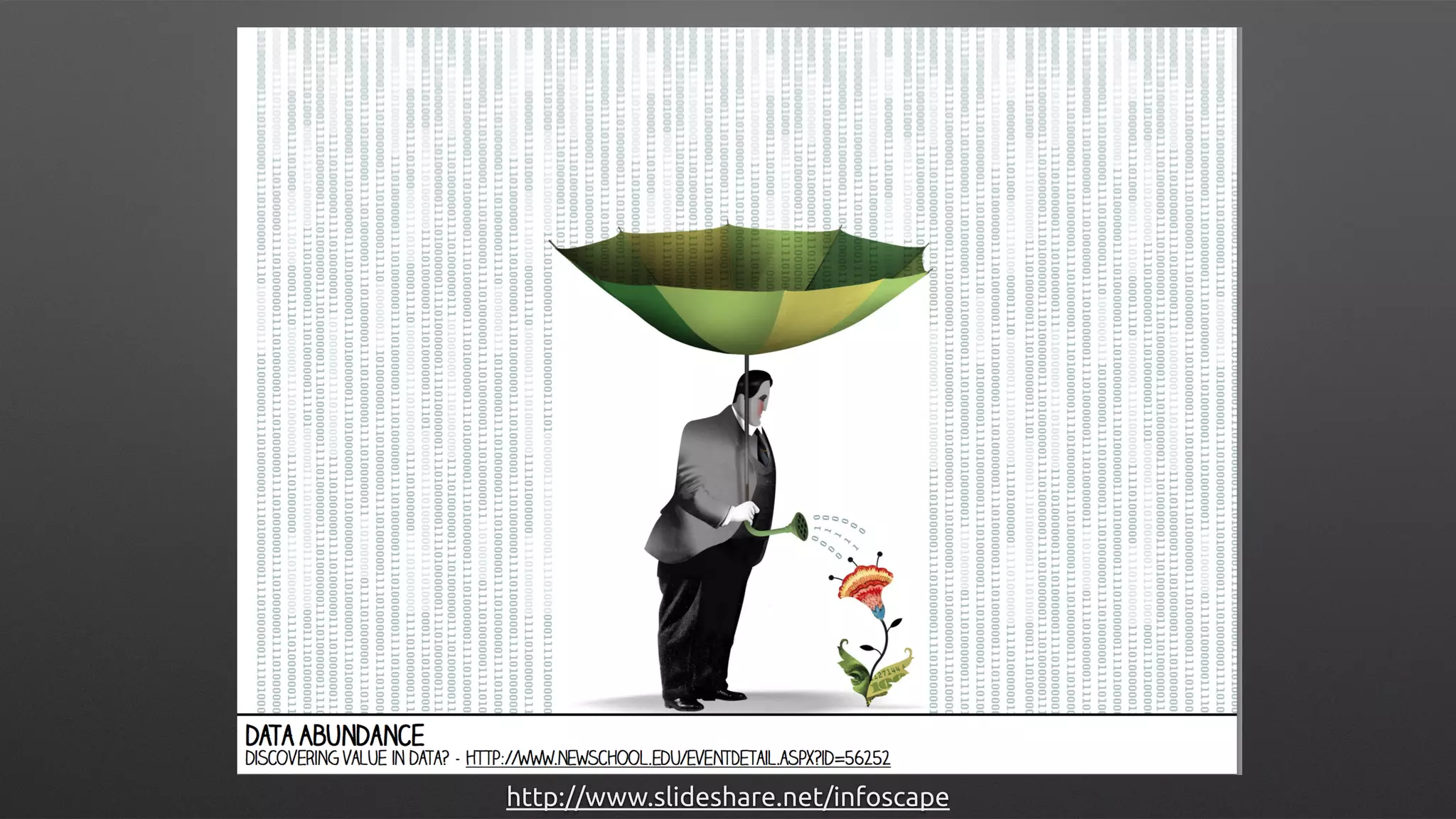
http://www.slideshare.net/infoscape
Information Visualisation is the use of
interactive visual representations to amplify
cognition [Card. et. al]
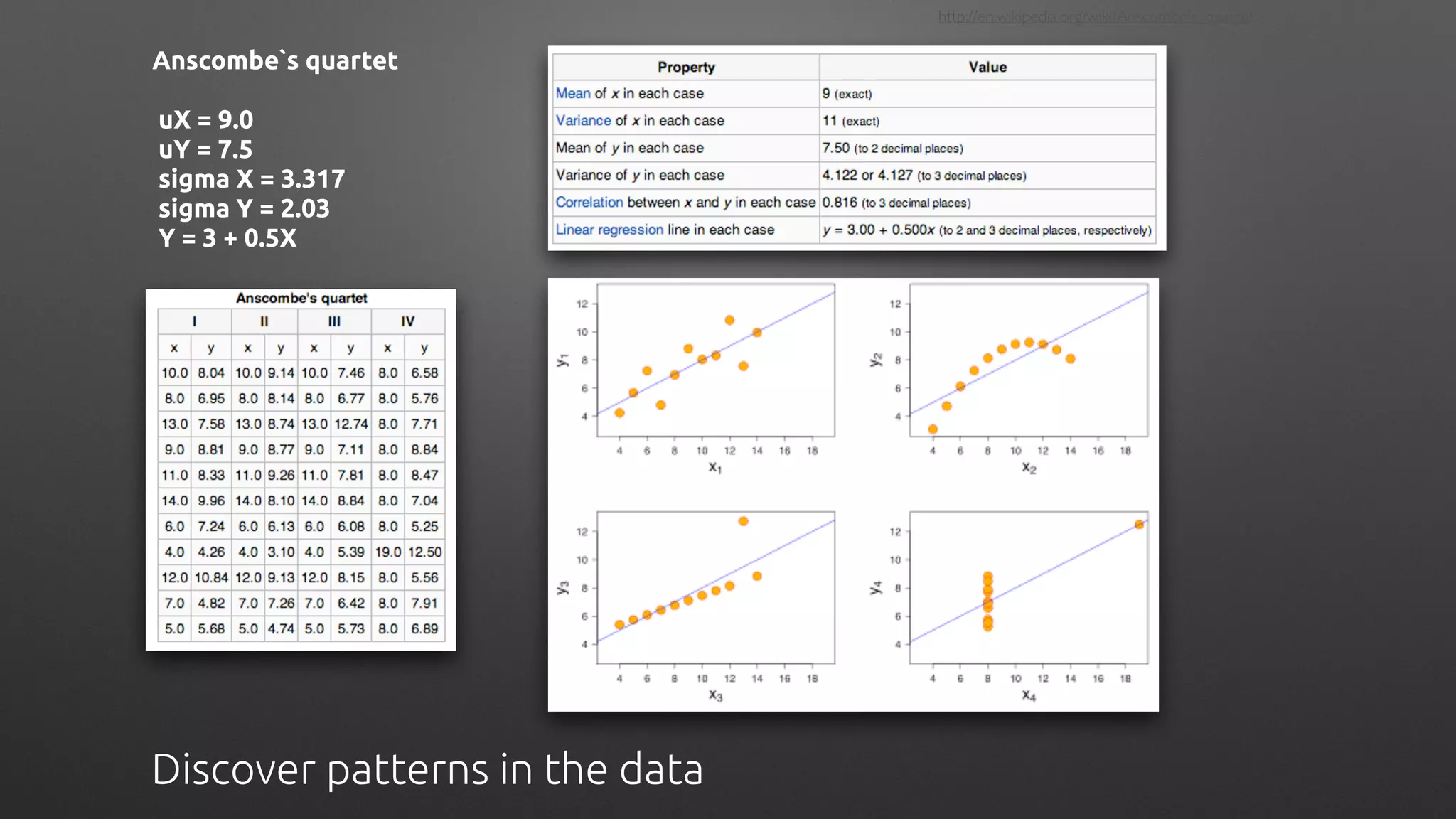
Anscombe`s quartet
!
uX = 9.0
uY = 7.5
sigma X = 3.317
sigma Y = 2.03
Y = 3 + 0.5X
Discover patterns in the data
http://en.wikipedia.org/wiki/Anscombe's_quartet
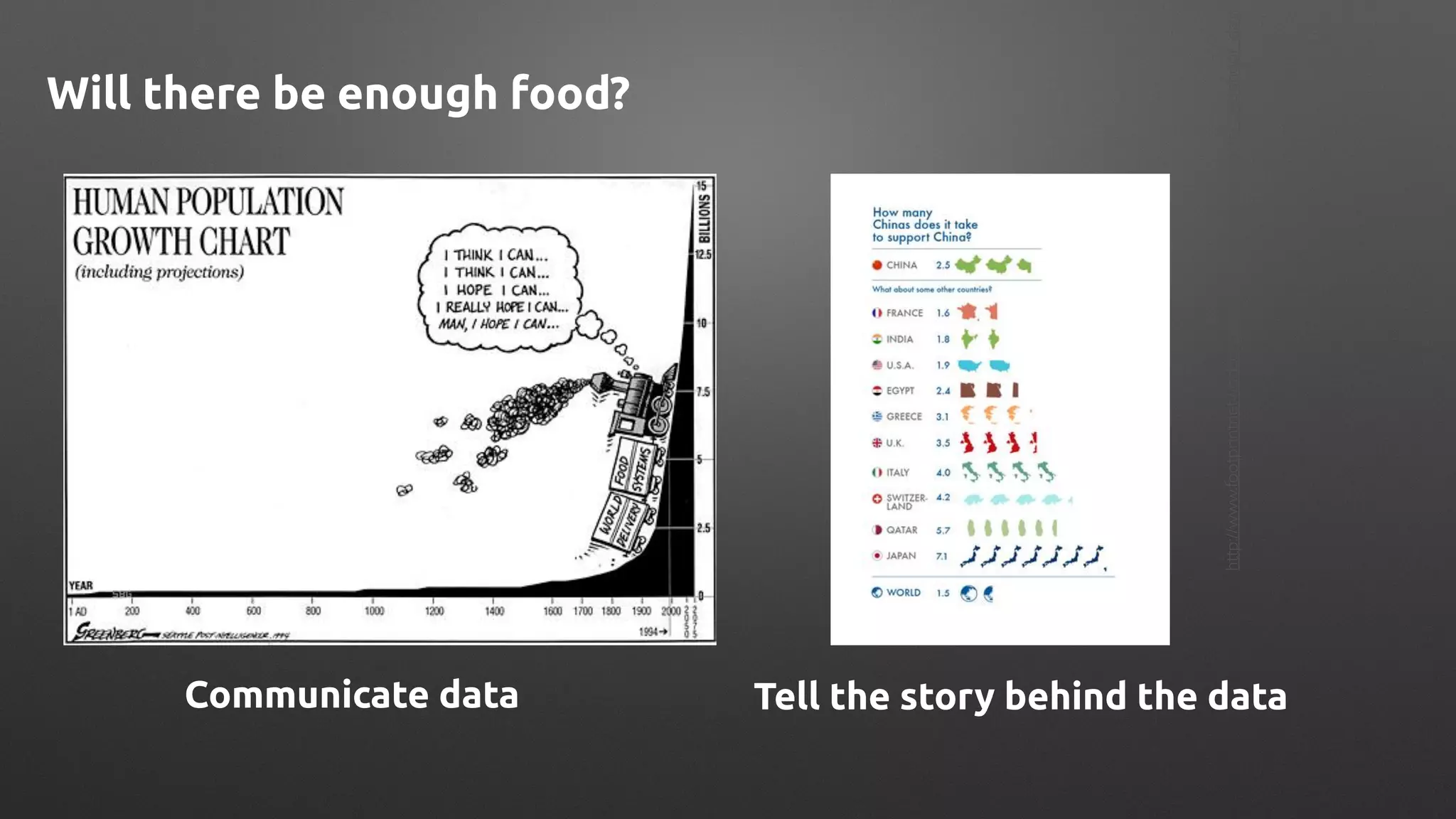
Tell the story behind the data
Will there be enough food?
Communicate data
http://www.footprintnetwork.org/en/index.php/gfn/page/earth_overshoot_day/
http://infosthetics.com/
http://visualizing.org
http://www.visualcomplexity.com/vc/
http://visual.ly/
http://flowingdata.com
http://www.infovis-wiki.net
http://datastori.es/
http://helpmeviz.com/
…
(Just enough) THEORY
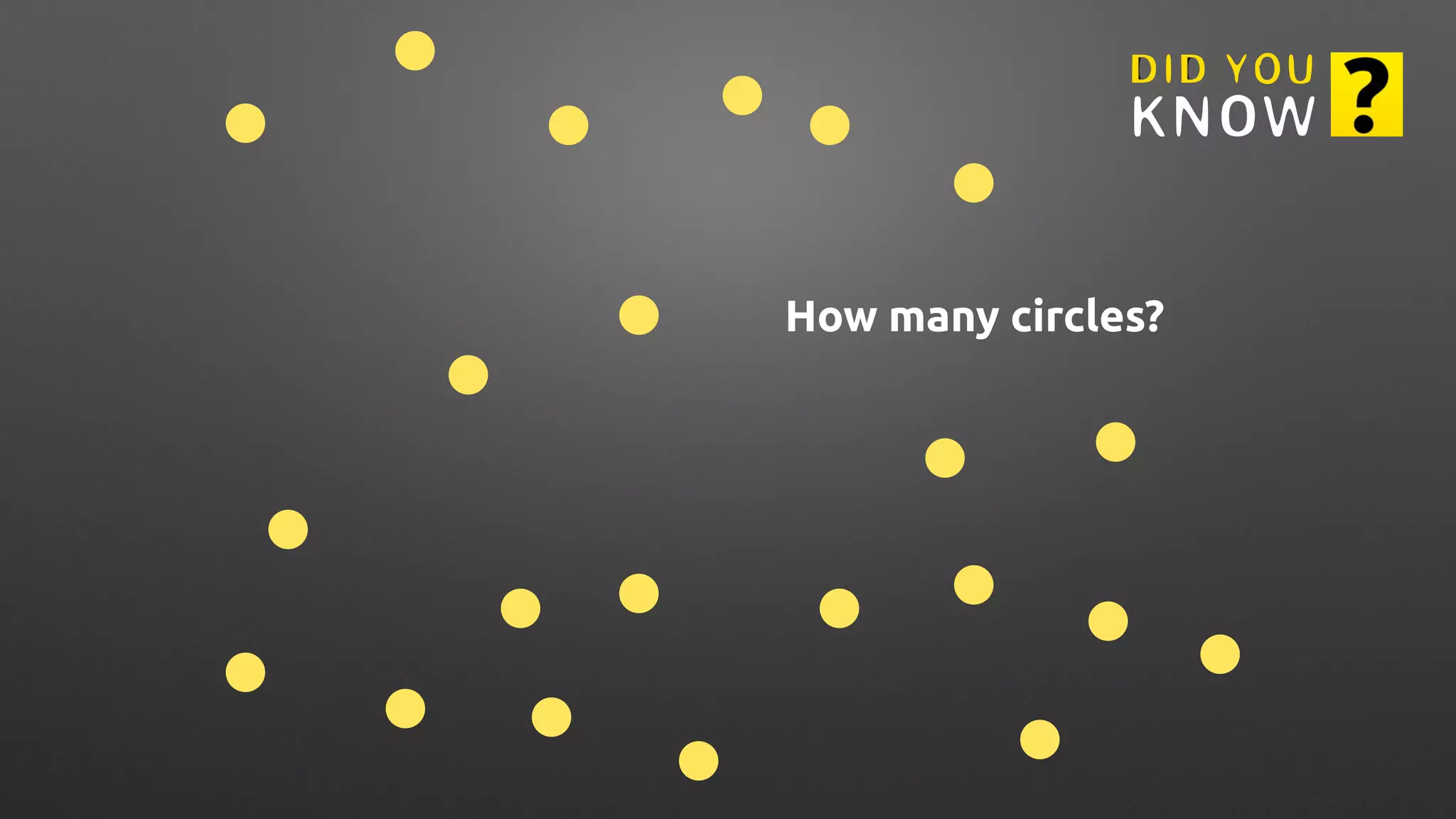
How many circles?
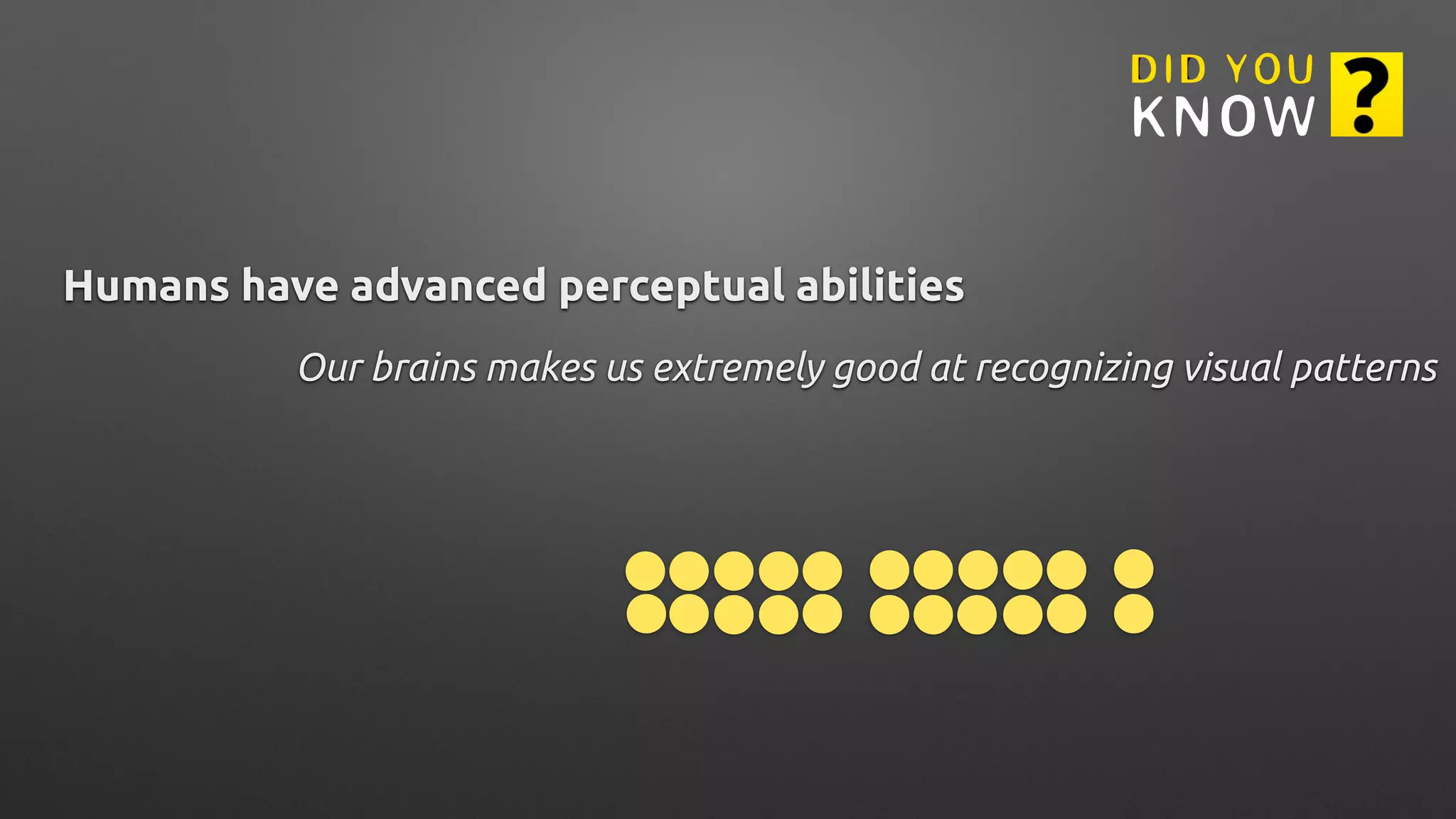
Humans have advanced perceptual abilities
Our brains makes us extremely good at recognizing visual patterns
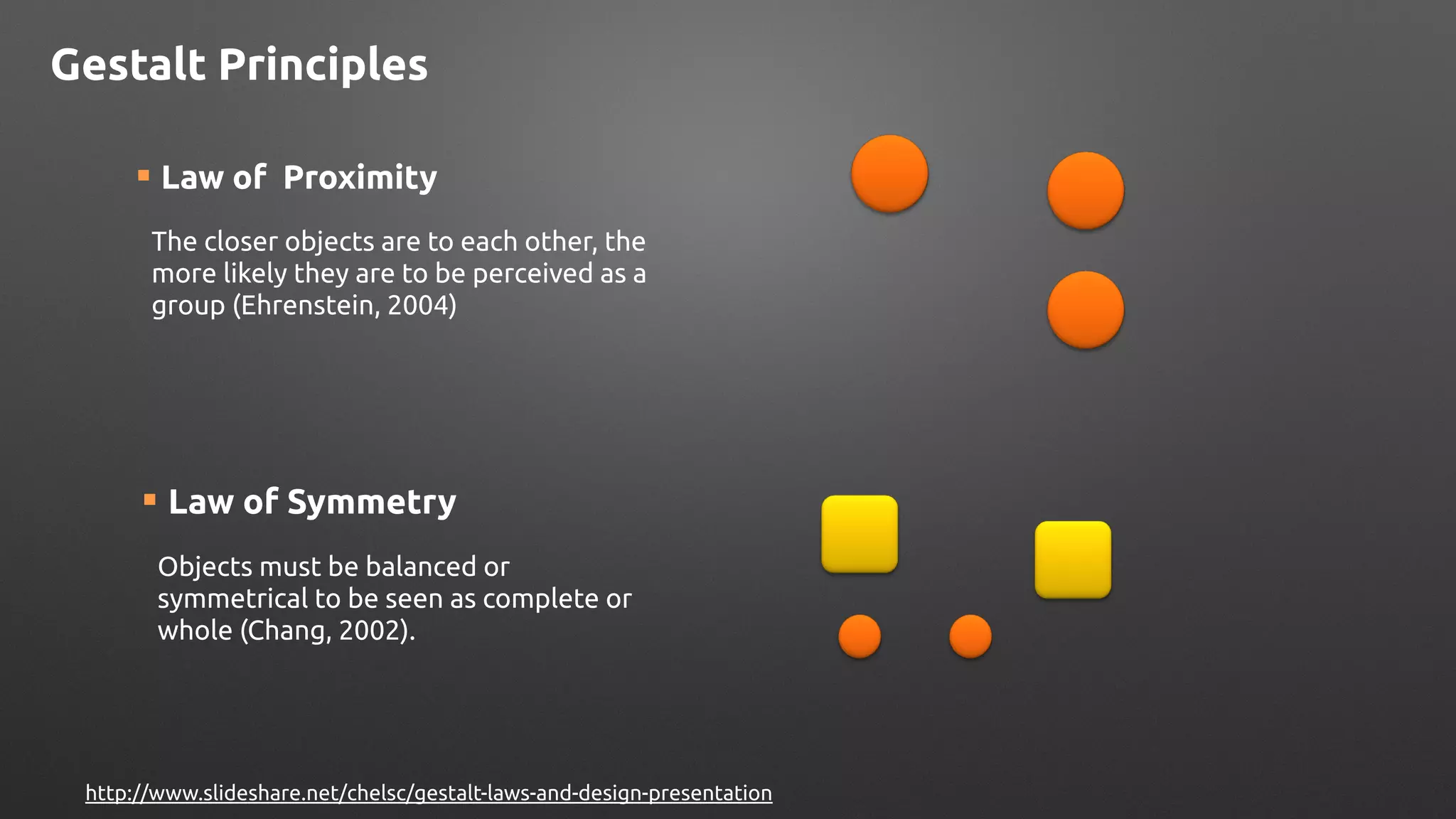
¡ Law of Symmetry
Objects must be balanced or
symmetrical to be seen as complete or
whole (Chang, 2002).
Gestalt Principles
http://www.slideshare.net/chelsc/gestalt-laws-and-design-presentation
¡ Law of Proximity
The closer objects are to each other, the
more likely they are to be perceived as a
group (Ehrenstein, 2004)
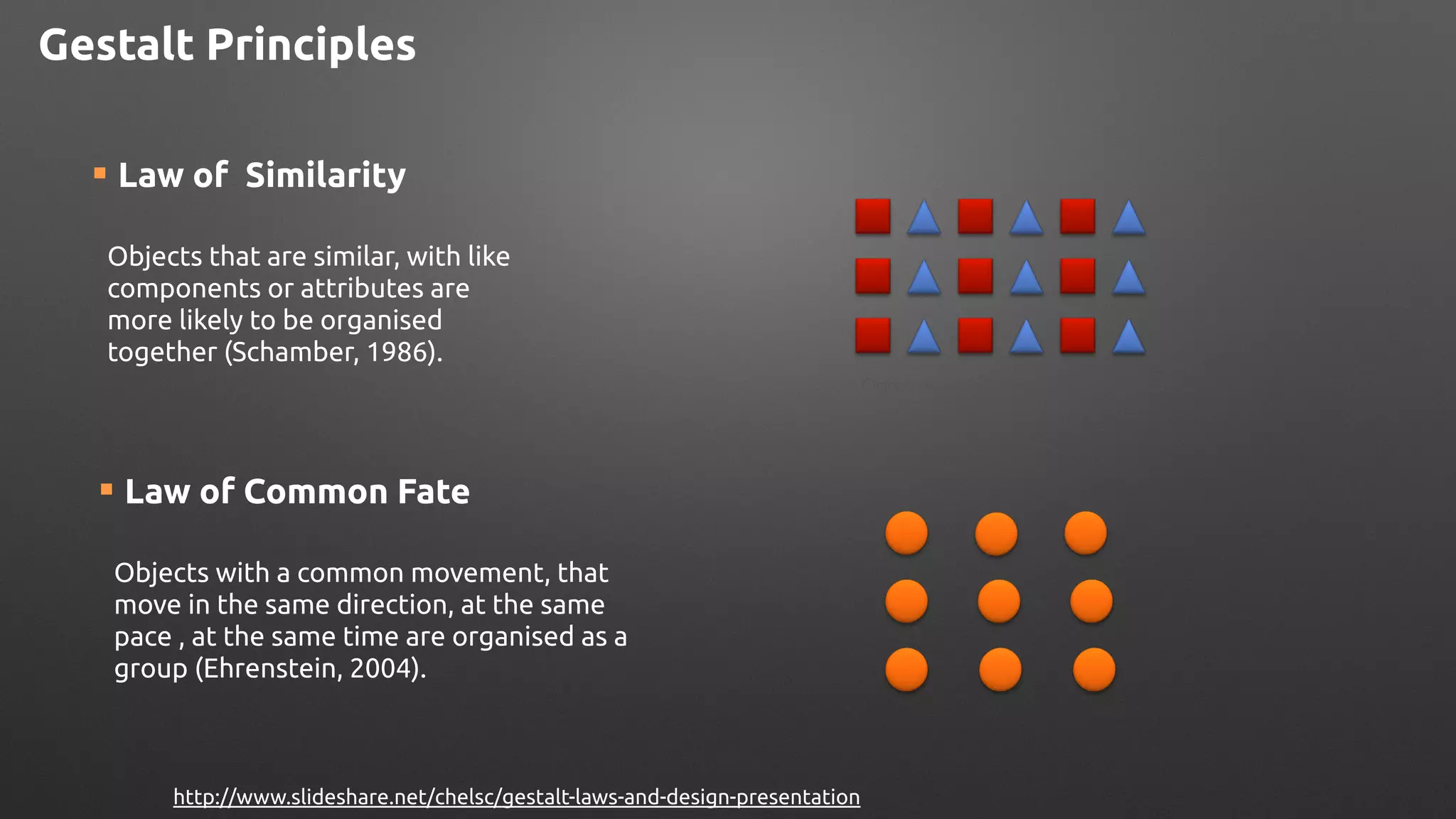
¡ Law of Similarity

Objects that are similar, with like
components or attributes are
more likely to be organised
together (Schamber, 1986).
Objects are viewed in vertical rows because of
their similar attributes.
¡ Law of Common Fate

Objects with a common movement, that
move in the same direction, at the same
pace , at the same time are organised as a
group (Ehrenstein, 2004).
Gestalt Principles
http://www.slideshare.net/chelsc/gestalt-laws-and-design-presentation
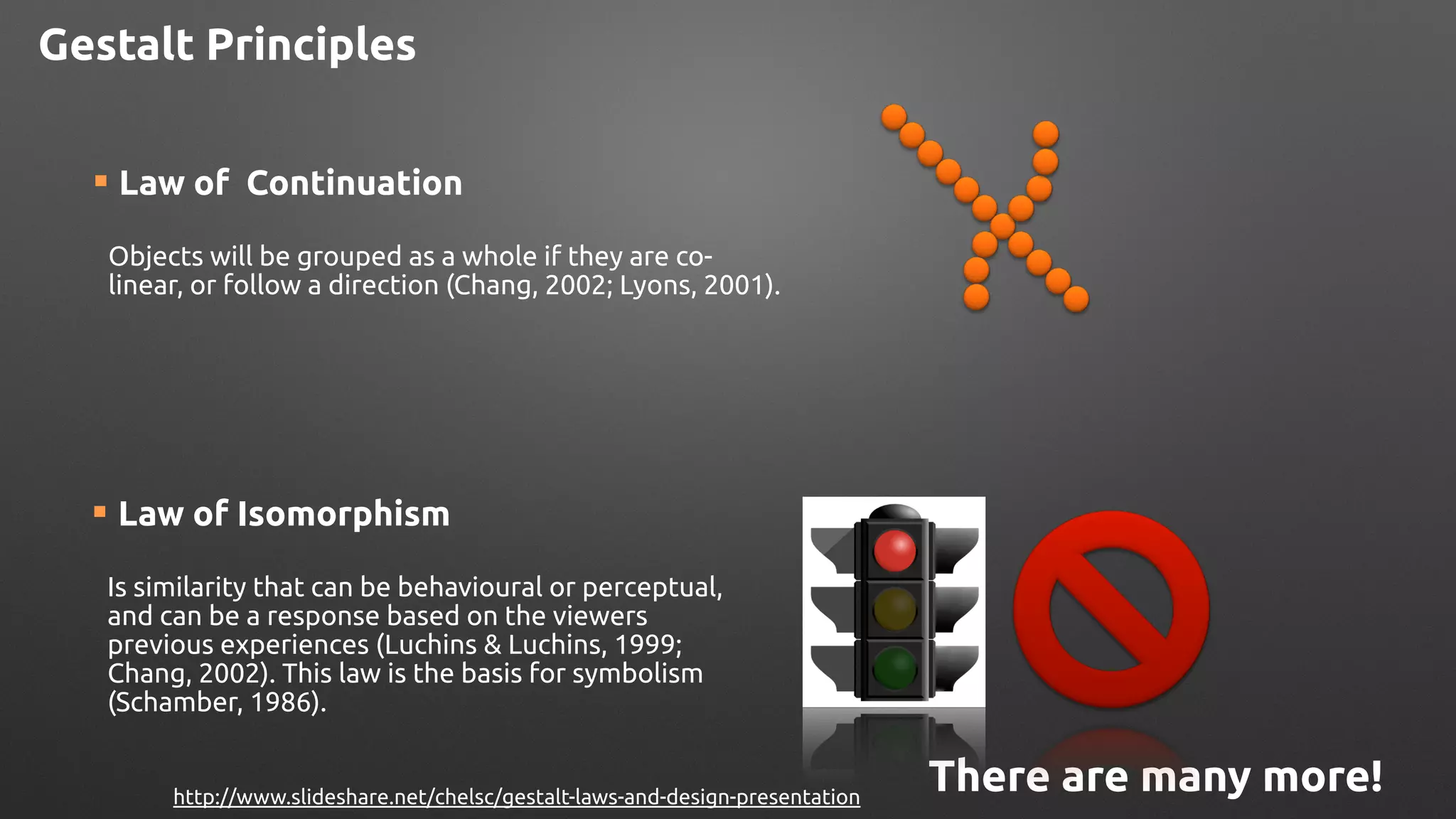
¡ Law of Continuation

Objects will be grouped as a whole if they are co-
linear, or follow a direction (Chang, 2002; Lyons, 2001).
¡ Law of Isomorphism
!
Is similarity that can be behavioural or perceptual,
and can be a response based on the viewers
previous experiences (Luchins & Luchins, 1999;
Chang, 2002). This law is the basis for symbolism
(Schamber, 1986).
There are many more!http://www.slideshare.net/chelsc/gestalt-laws-and-design-presentation
Gestalt Principles
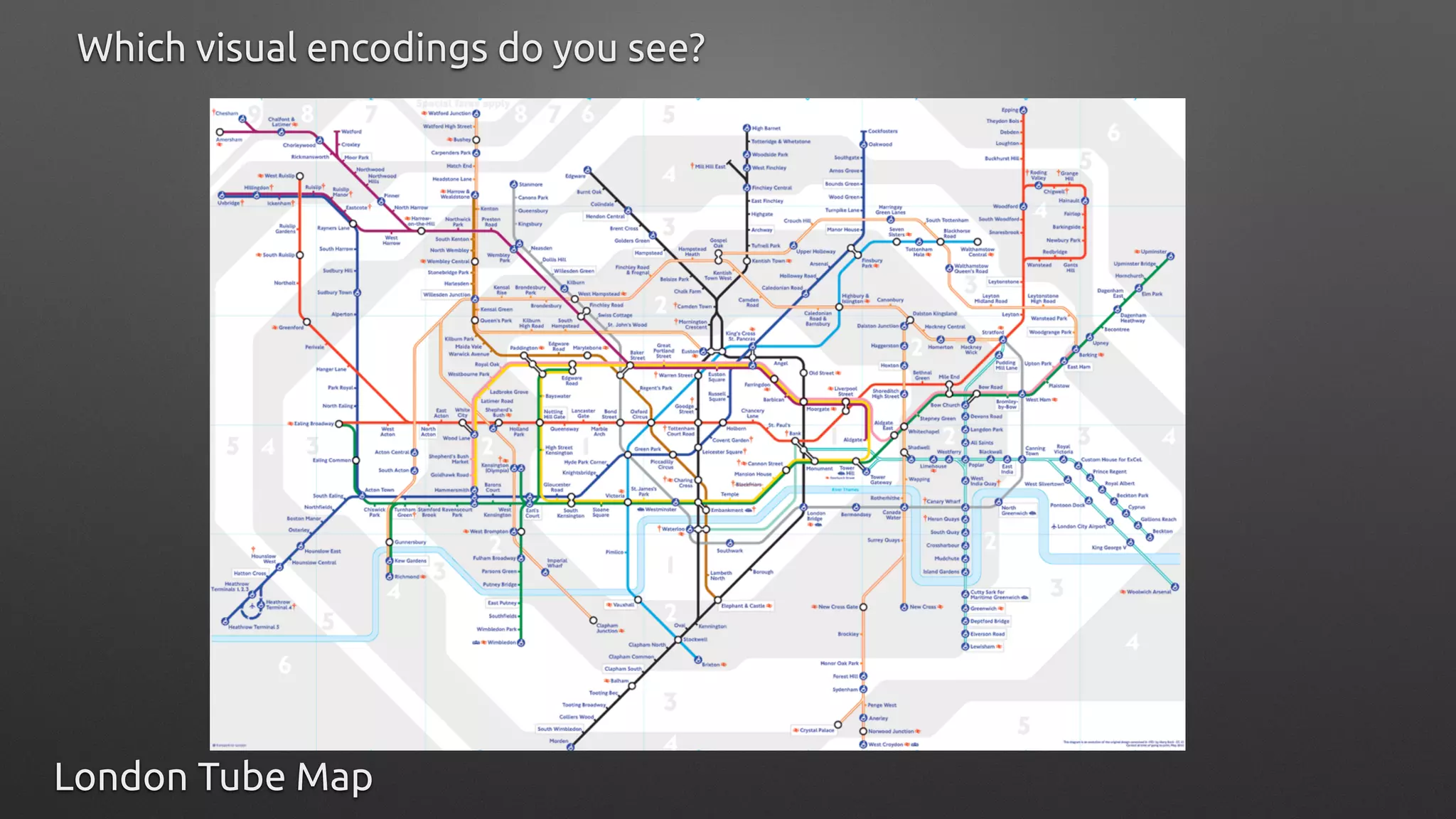
Which visual encodings do you see?
London Tube Map
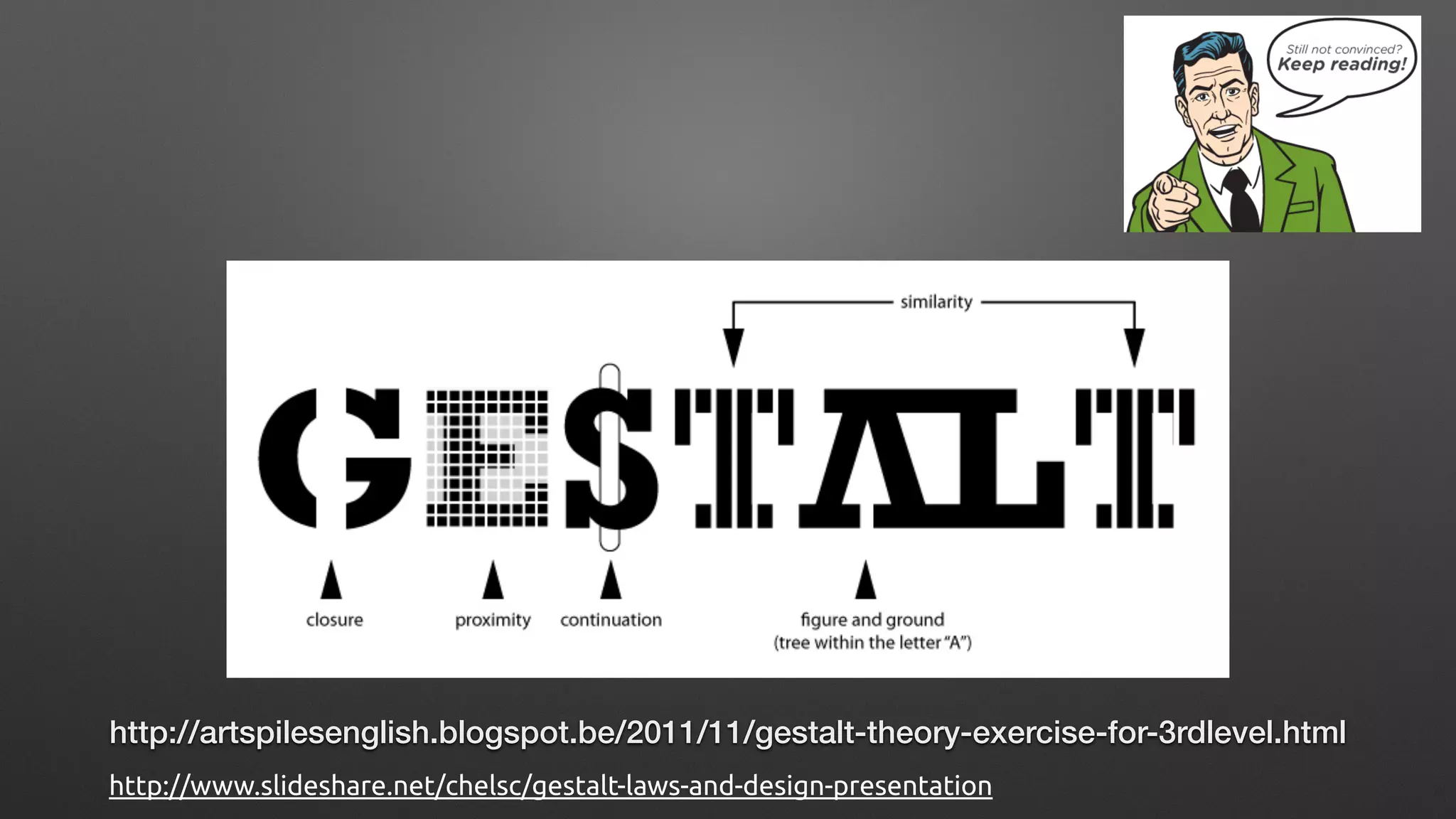
http://artspilesenglish.blogspot.be/2011/11/gestalt-theory-exercise-for-3rdlevel.html
http://www.slideshare.net/chelsc/gestalt-laws-and-design-presentation
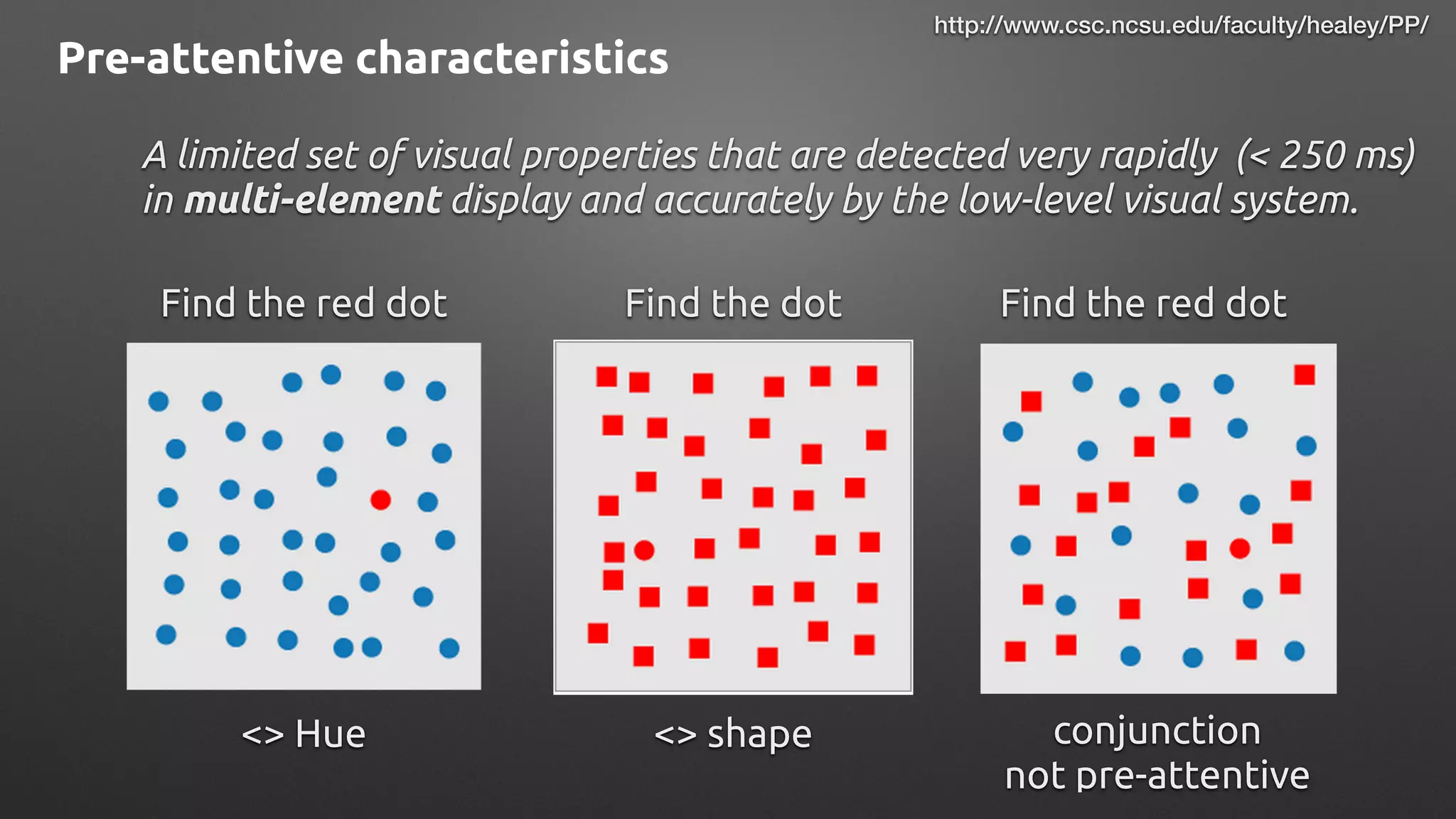
A limited set of visual properties that are detected very rapidly (< 250 ms)
in multi-element display and accurately by the low-level visual system.
Pre-attentive characteristics
Find the red dot
<> Hue
Find the dot
<> shape
Find the red dot
conjunction
not pre-attentive
http://www.csc.ncsu.edu/faculty/healey/PP/
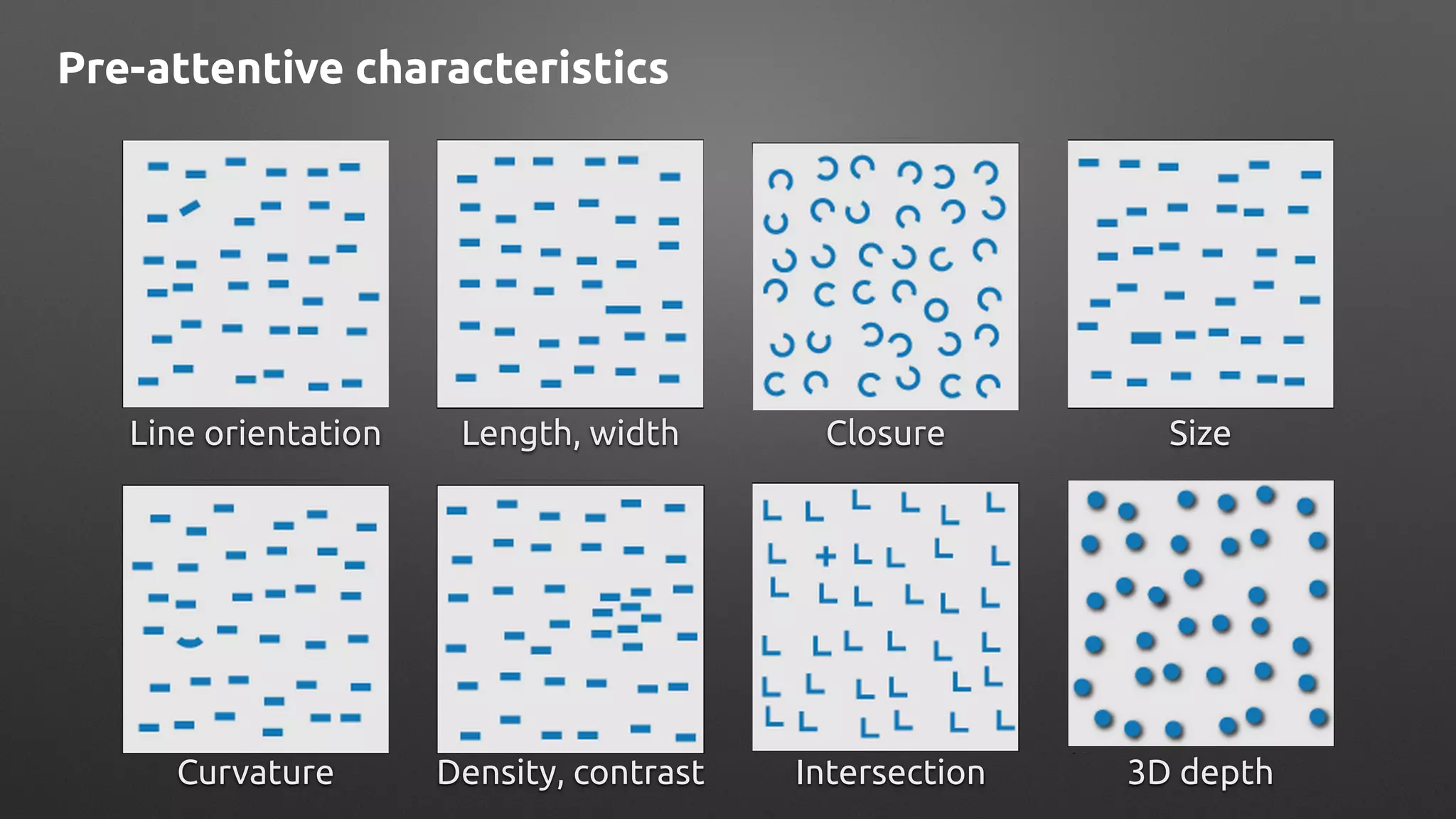
Pre-attentive characteristics
Line orientation Length, width Closure Size
Curvature Density, contrast Intersection 3D depth
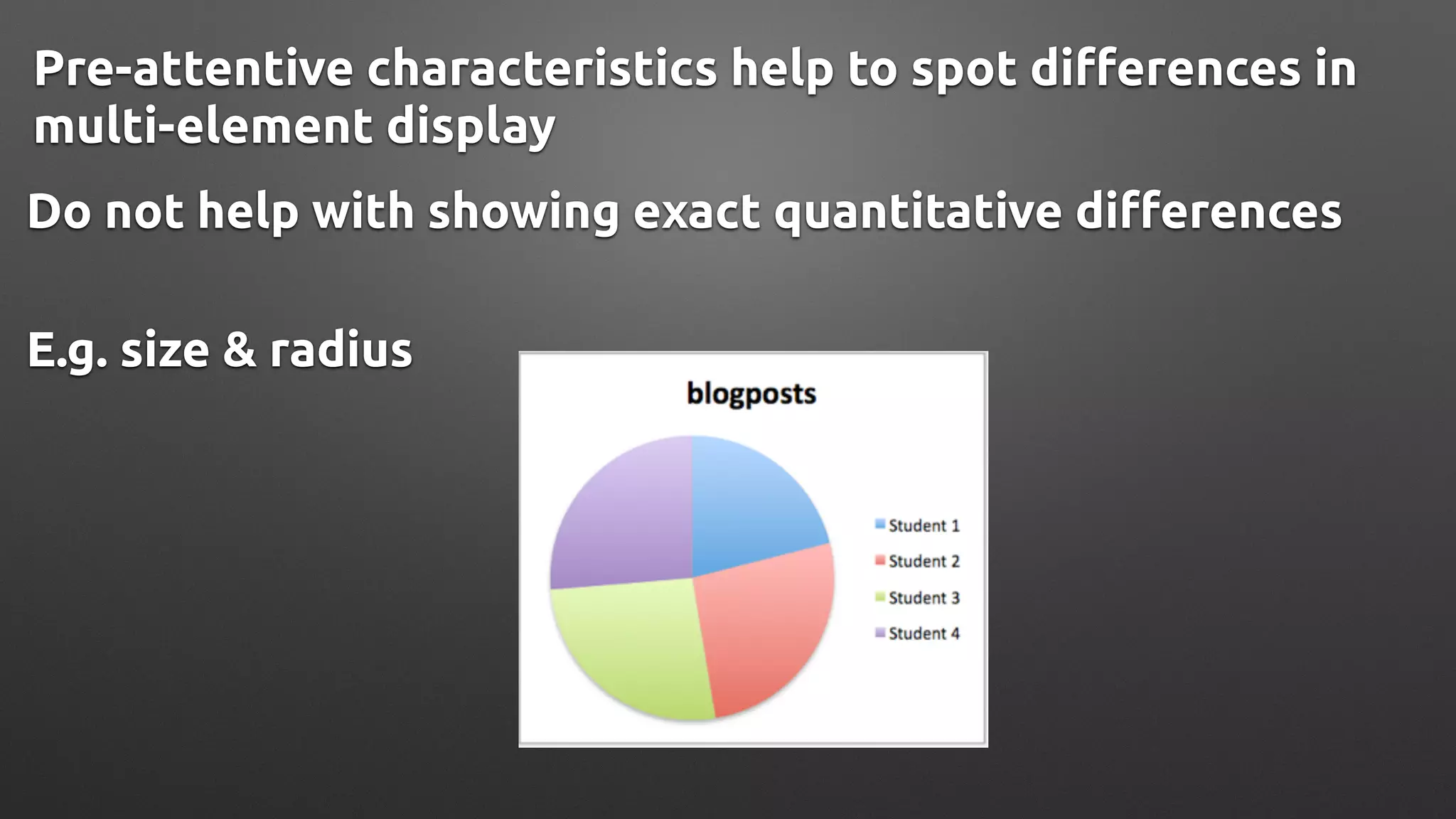
Do not help with showing exact quantitative differences
Pre-attentive characteristics help to spot differences in
multi-element display
E.g. size & radius
How to start your visualization?
Data set Visualisation
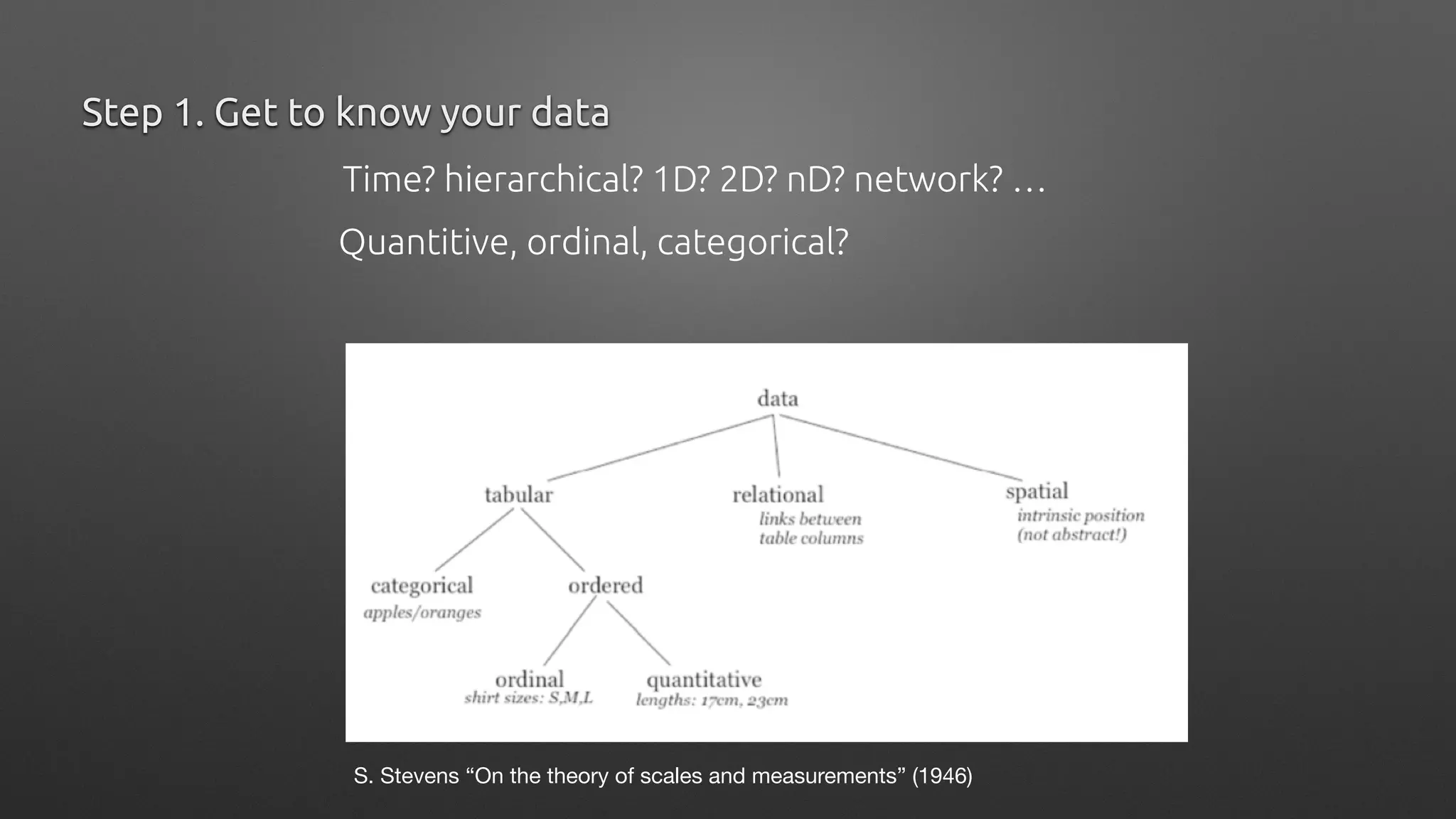
Step 1. Get to know your data
Time? hierarchical? 1D? 2D? nD? network? …
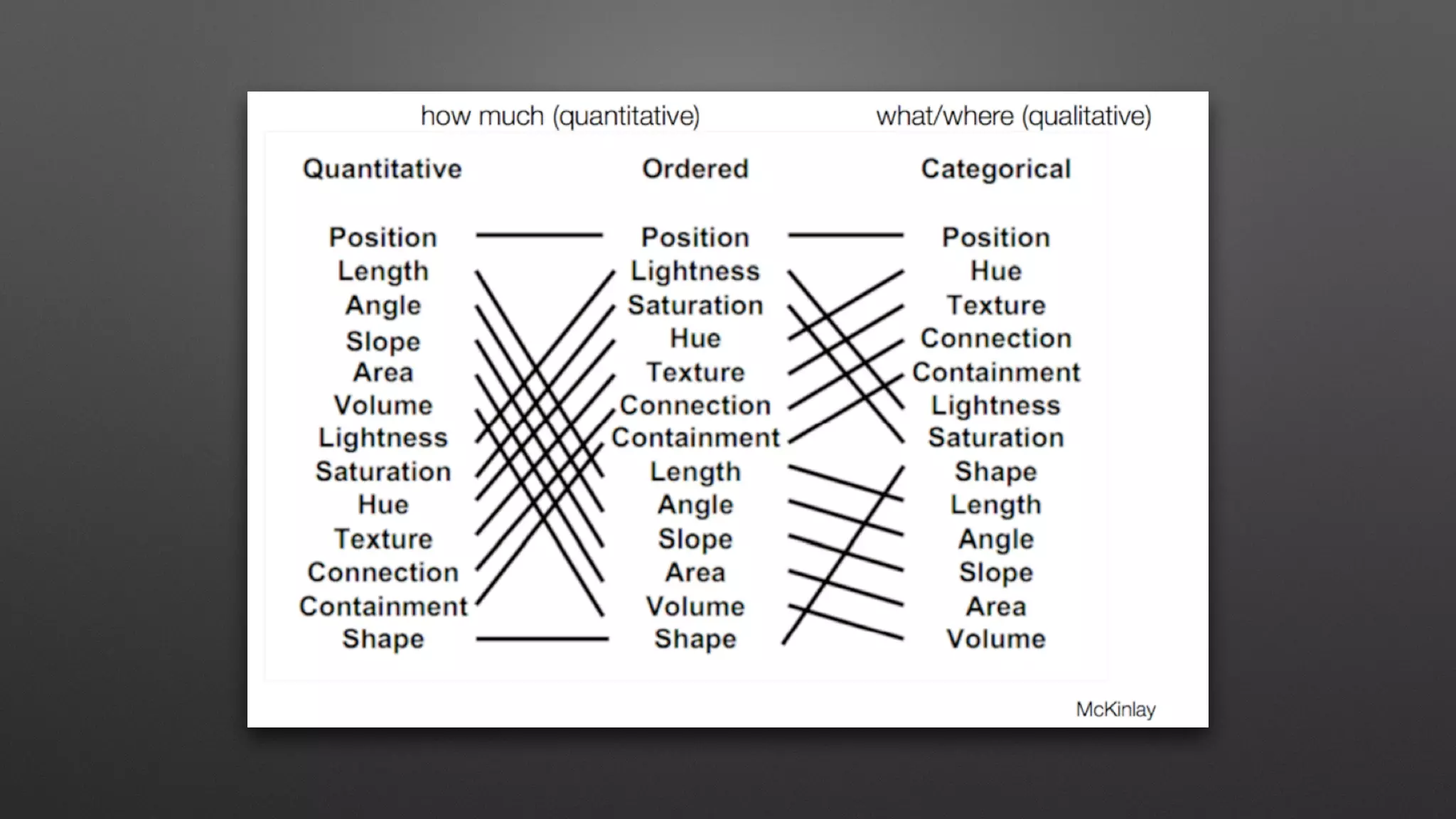
Quantitive, ordinal, categorical?
S. Stevens “On the theory of scales and measurements” (1946)
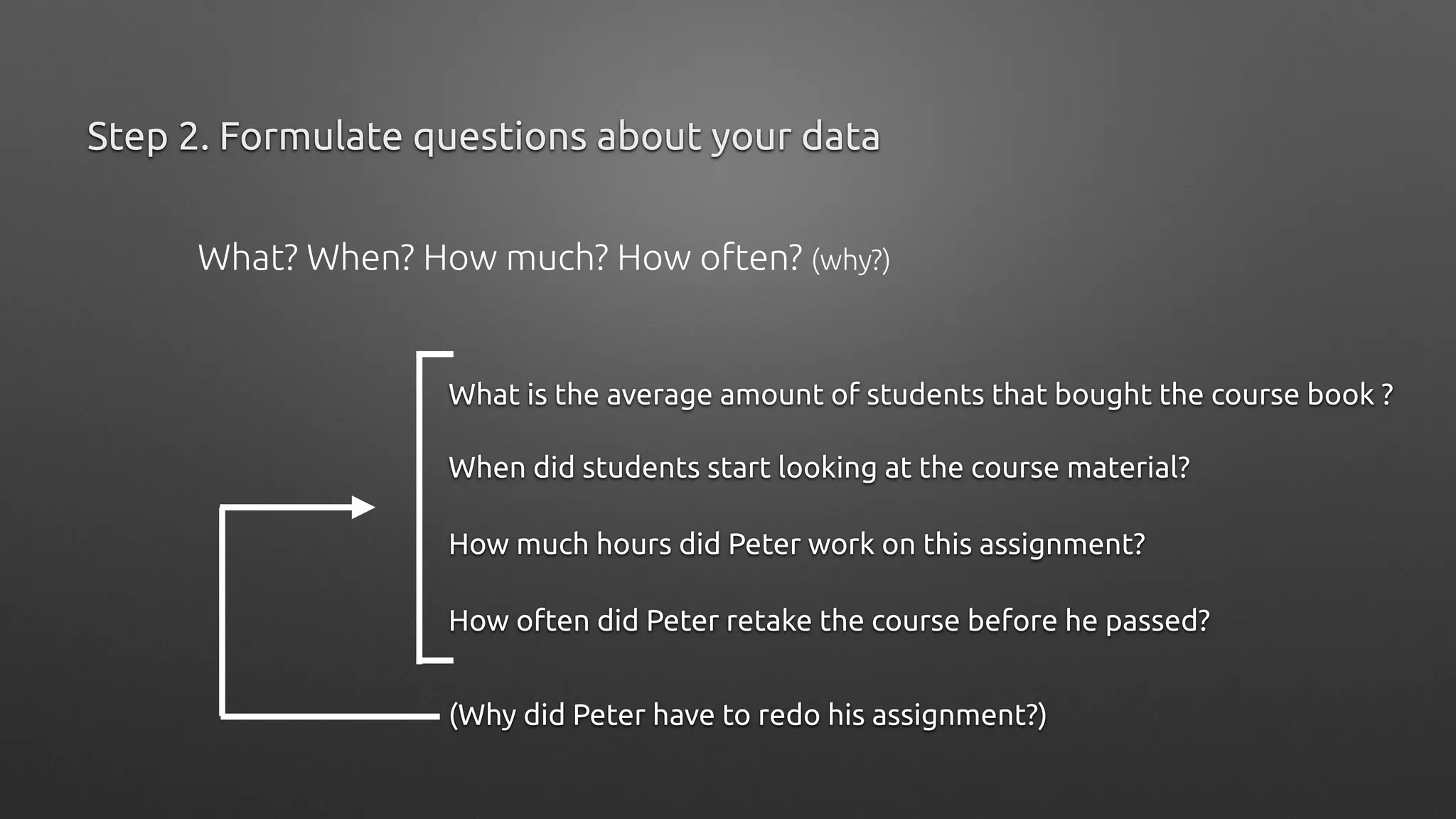
What is the average amount of students that bought the course book ?
Step 2. Formulate questions about your data
What? When? How much? How often? (why?)
When did students start looking at the course material?
How much hours did Peter work on this assignment?
(Why did Peter have to redo his assignment?)
How often did Peter retake the course before he passed?
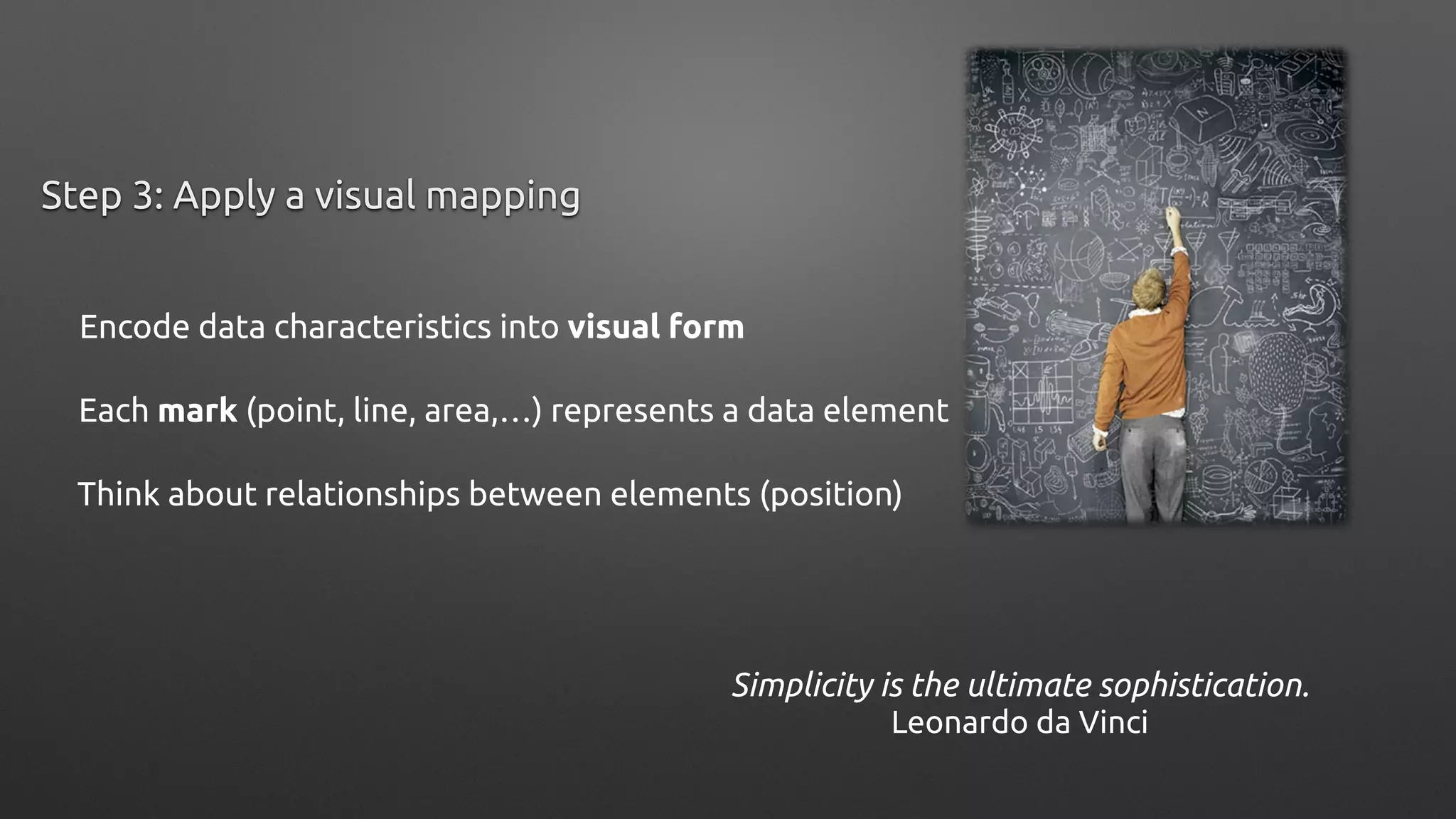
Encode data characteristics into visual form
Step 3: Apply a visual mapping
Simplicity is the ultimate sophistication.
Leonardo da Vinci
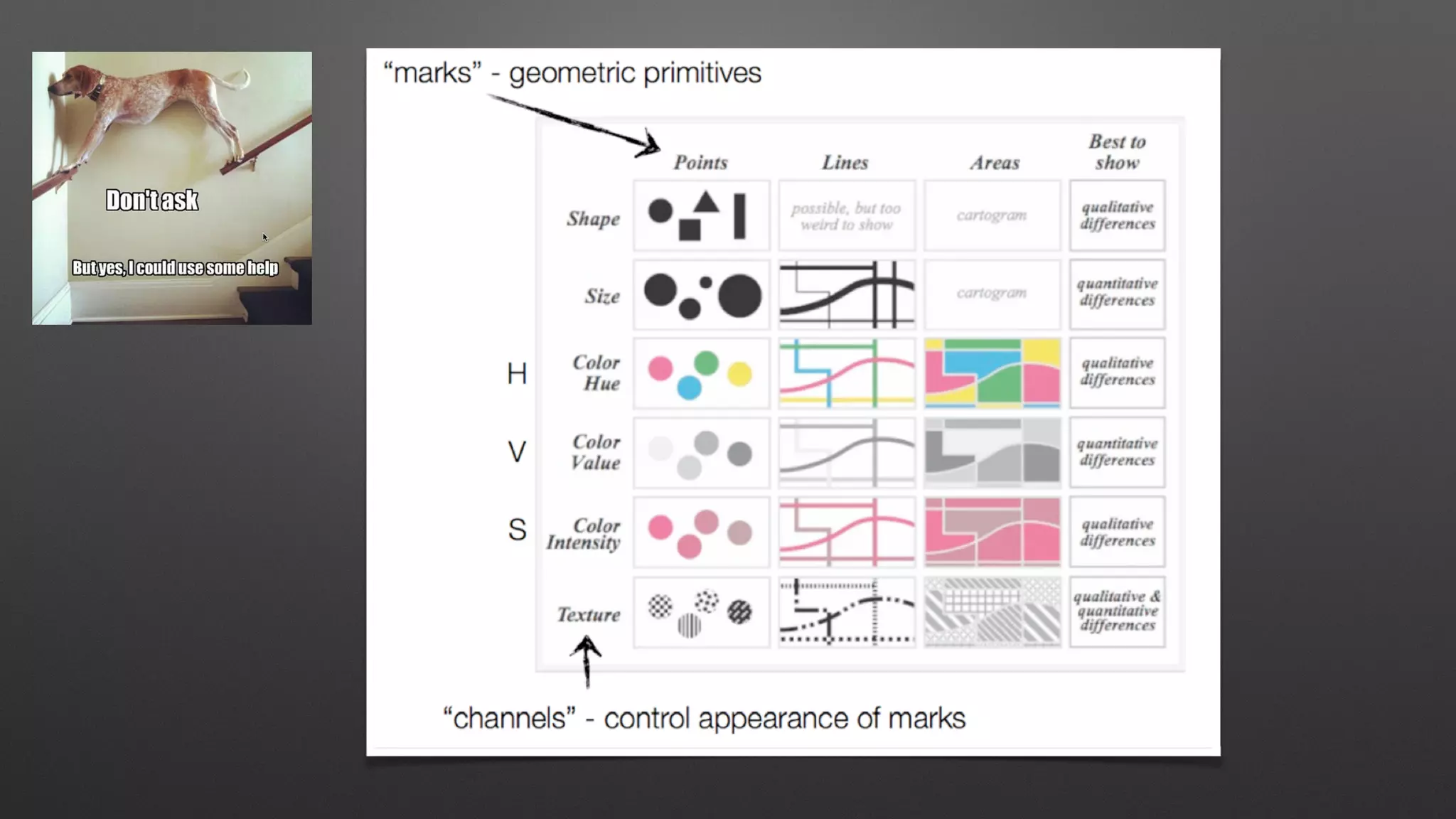
Each mark (point, line, area,…) represents a data element
Think about relationships between elements (position)
Find all possible ways to visualize a
small data set of two numbers { 75, 37 }
http://blog.visual.ly/45-ways-to-communicate-two-quantities/
+/- 15 minutes
Small groups - sketch
EXERCISE
Learning analytics
31
Collecting traces that learners leave behind
and using those traces to improve learning
http://erikduval.wordpress.com/2012/01/30/learning-analytics-and-educational-data-mining/
Learning analytics
32
What to measure?
Depends on the user
33
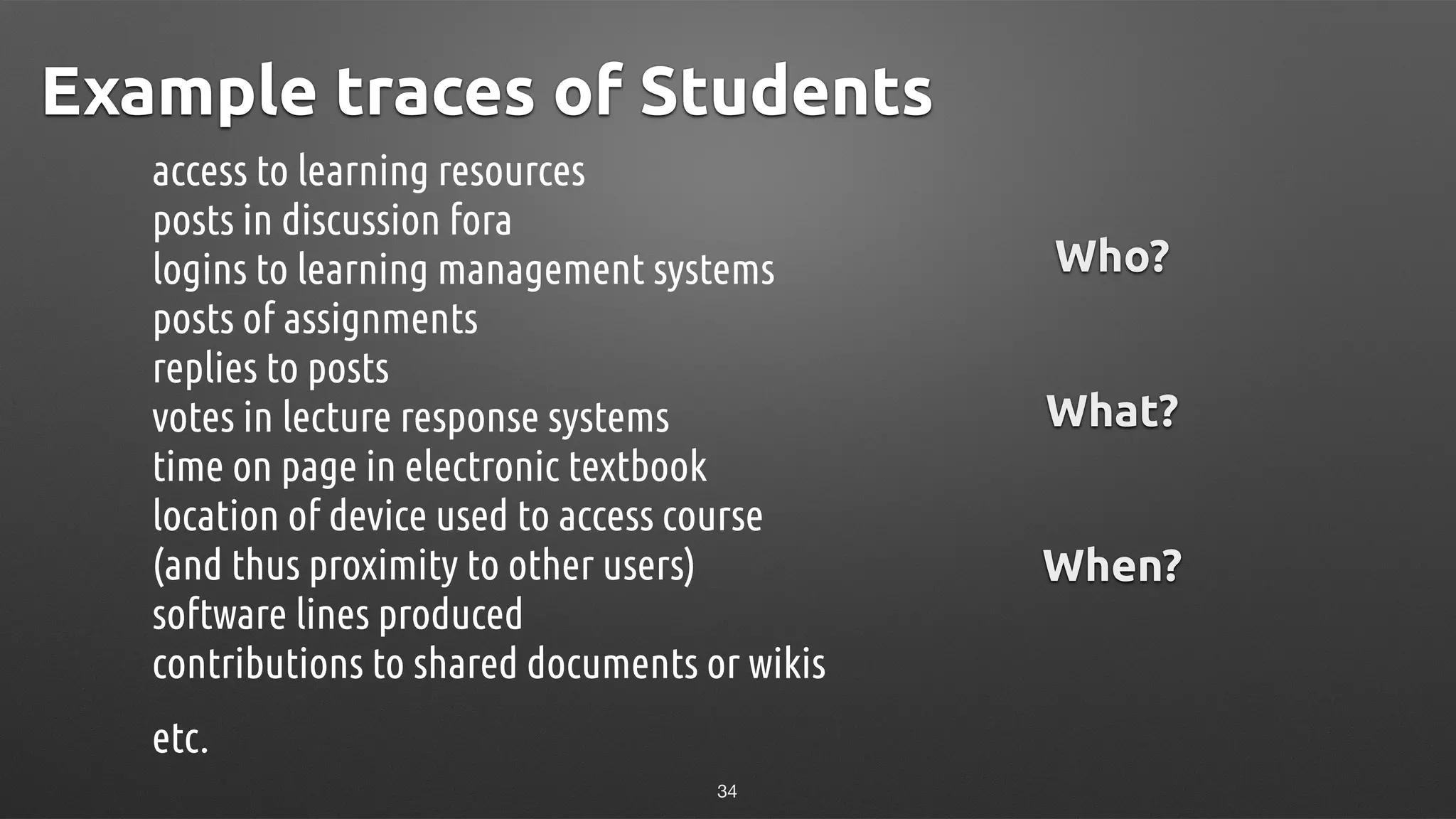
Example traces of Students
access to learning resources

posts in discussion fora

logins to learning management systems

posts of assignments

replies to posts

votes in lecture response systems

time on page in electronic textbook

location of device used to access course

(and thus proximity to other users)

software lines produced

contributions to shared documents or wikis
etc.
Who?
!
!
What?
!
!
When?
34
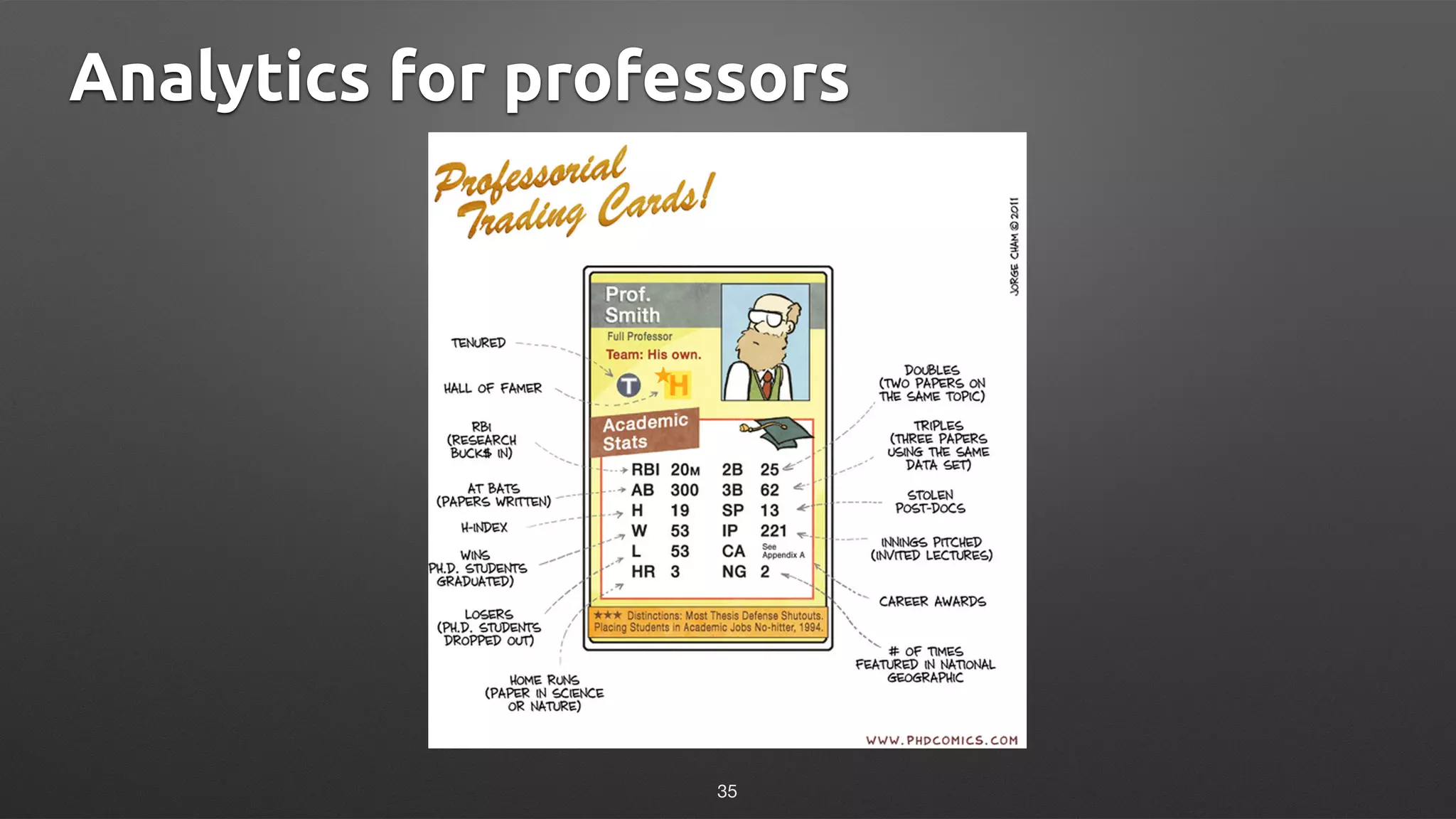
Analytics for professors
35
email, twitter, facebook, web reading, physical
movement, location, proximity, food intake,
sleeping, drinking, emotion tracking, weather
info, attention, brainwaves, …
As learning moves online,
traces also include…
36
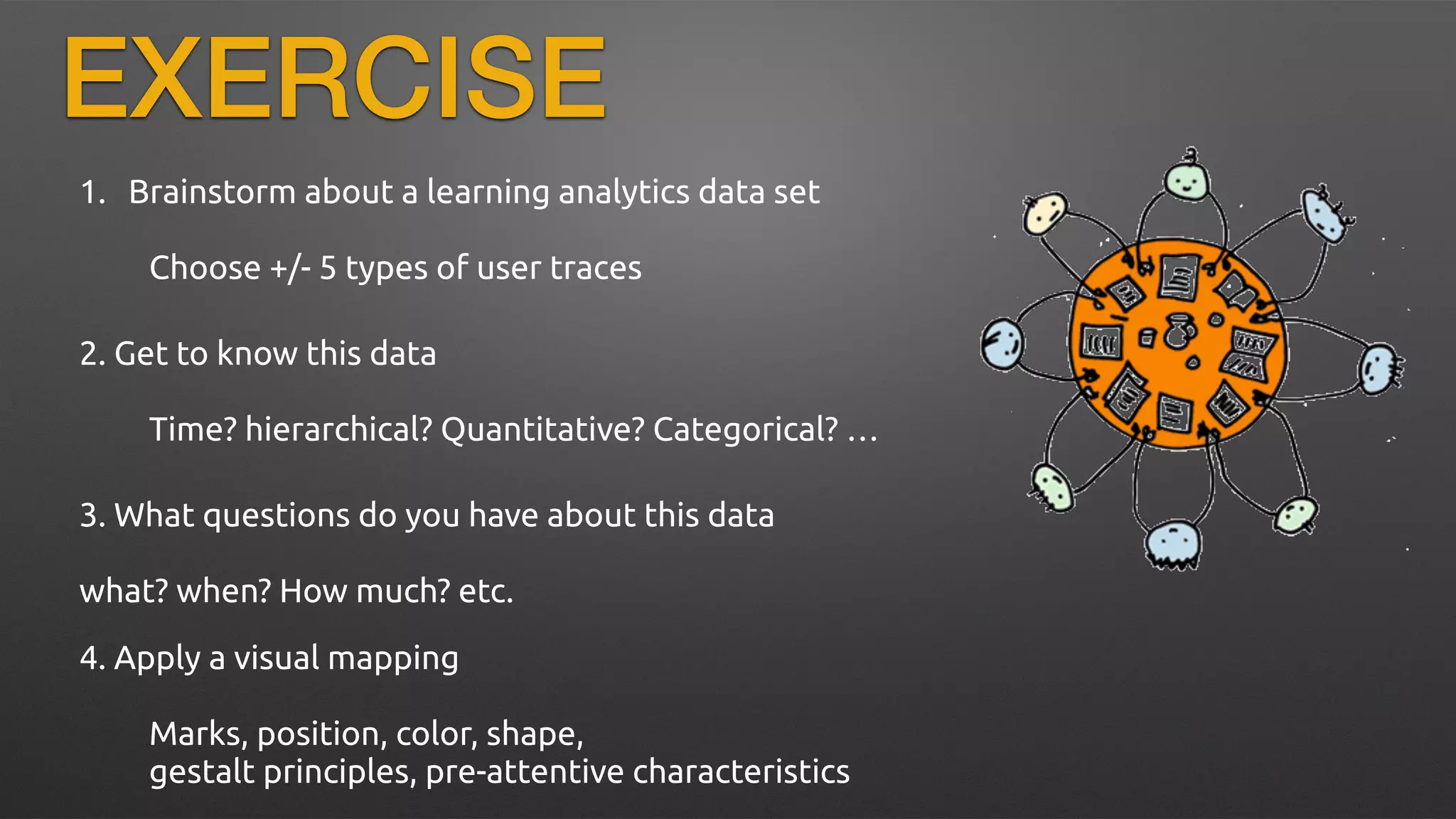
EXERCISE
1. Brainstorm about a learning analytics data set
!
	
 	
 Choose +/- 5 types of user traces
2. Get to know this data
!
	
 	
 Time? hierarchical? Quantitative? Categorical? …
3. What questions do you have about this data
!
what? when? How much? etc.
4. Apply a visual mapping
!
	
 	
 Marks, position, color, shape,
	
 	
 gestalt principles, pre-attentive characteristics
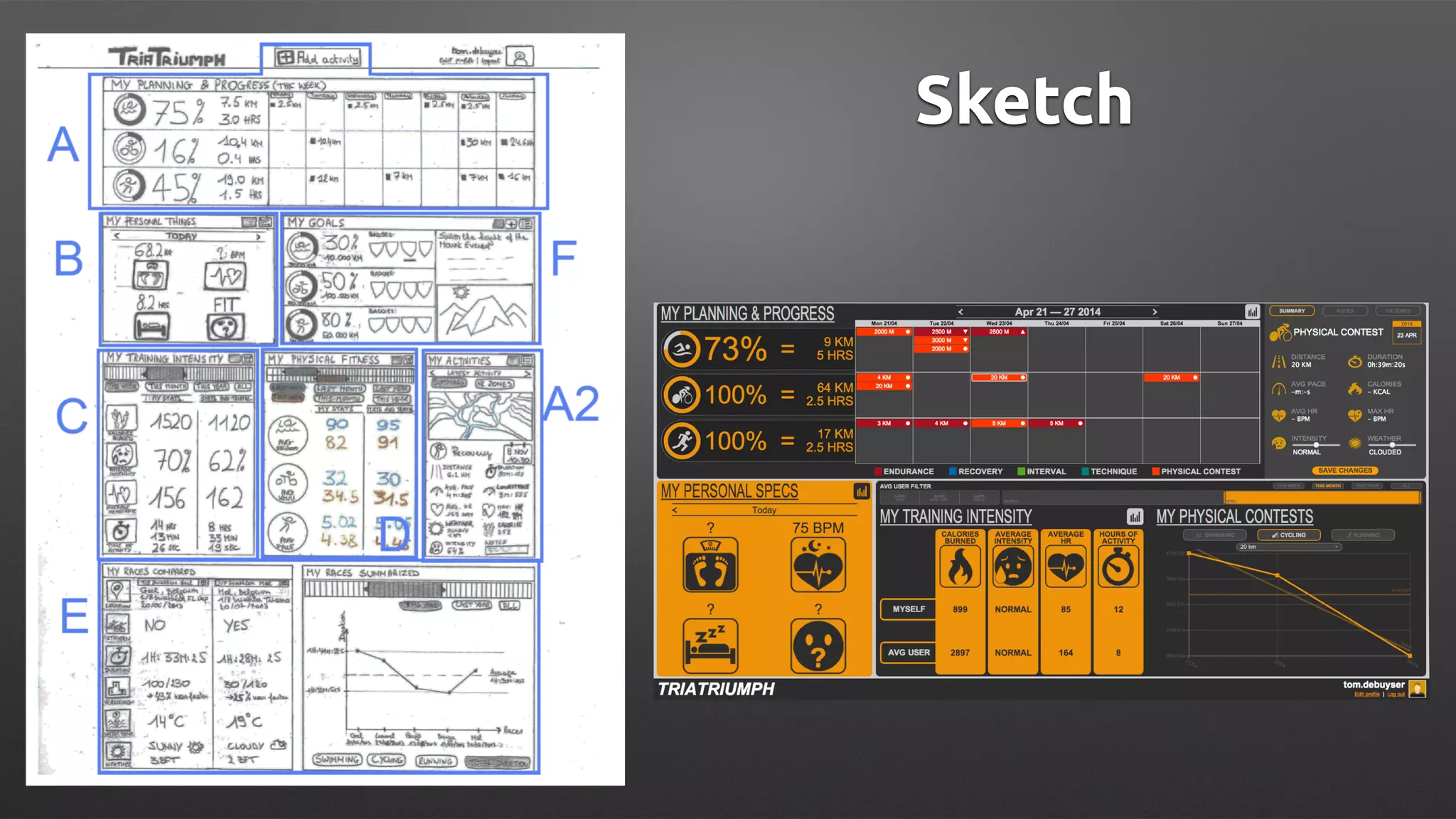
Sketch
BREAK
LEARNING DASHBOARDS
(SVEN)
Tips `n tricks
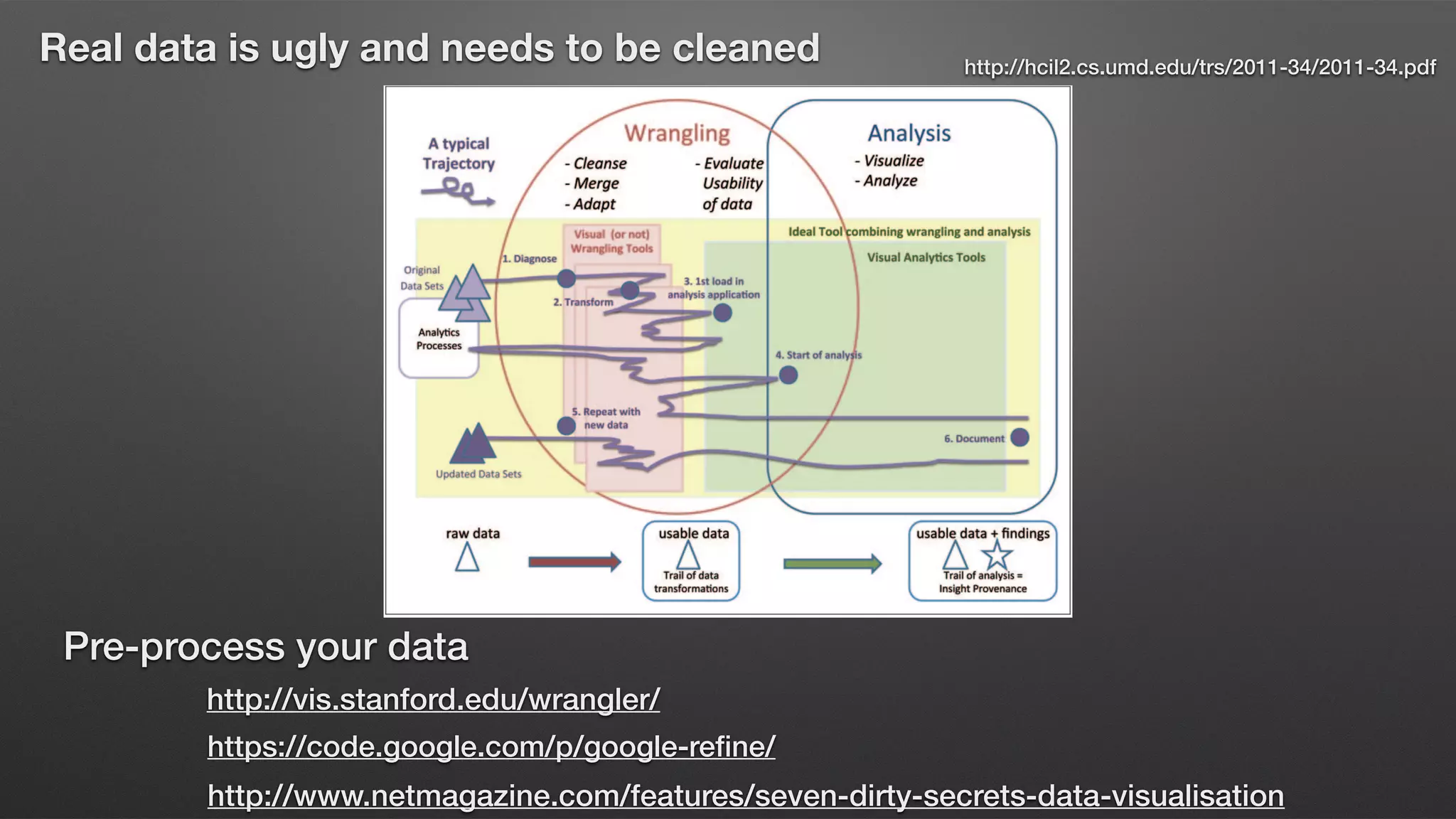
Real data is ugly and needs to be cleaned
http://www.netmagazine.com/features/seven-dirty-secrets-data-visualisation
https://code.google.com/p/google-refine/
http://vis.stanford.edu/wrangler/
Pre-process your data
http://hcil2.cs.umd.edu/trs/2011-34/2011-34.pdf
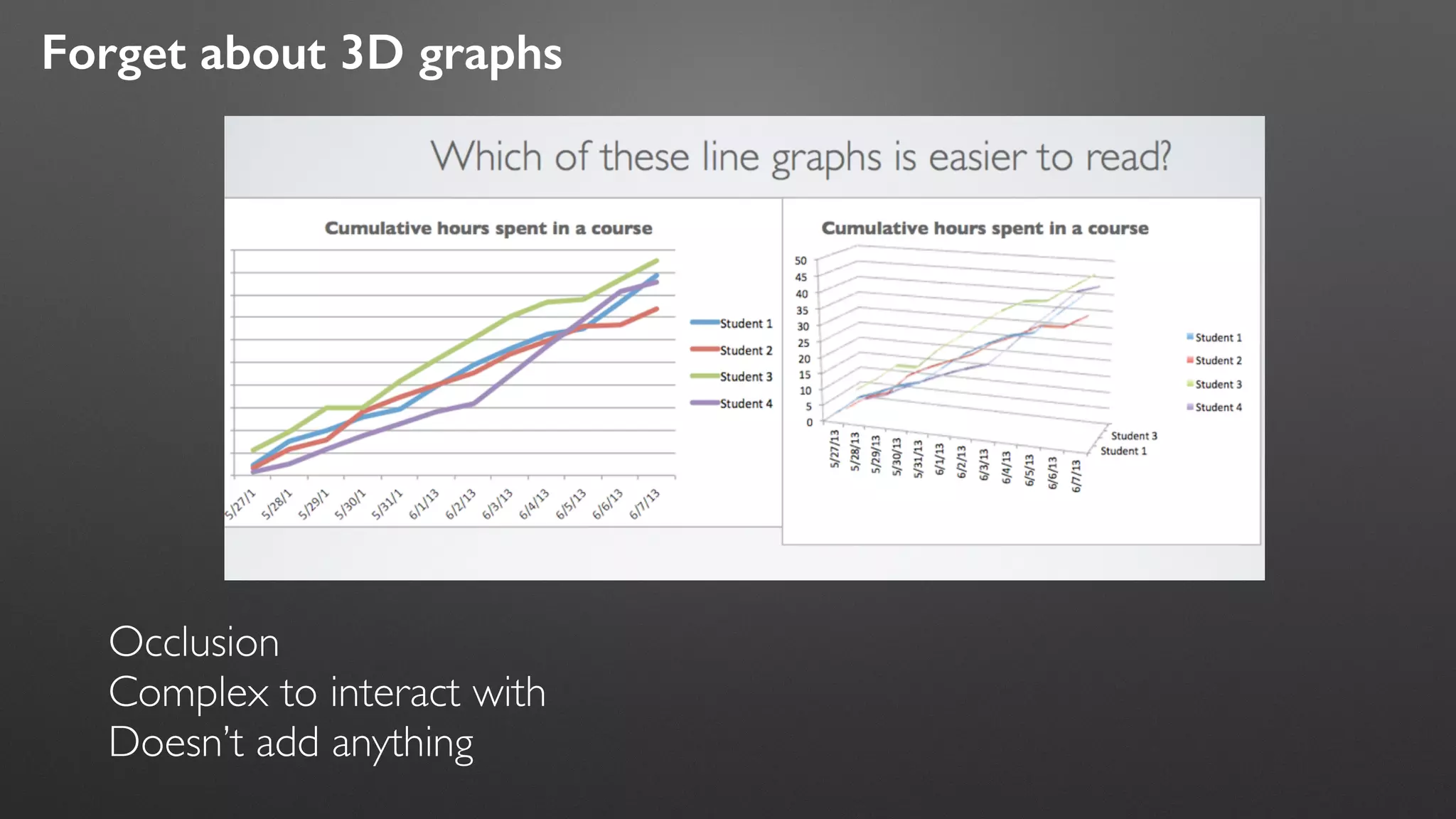
Forget about 3D graphs
Occlusion	

Complex to interact with	

Doesn’t add anything
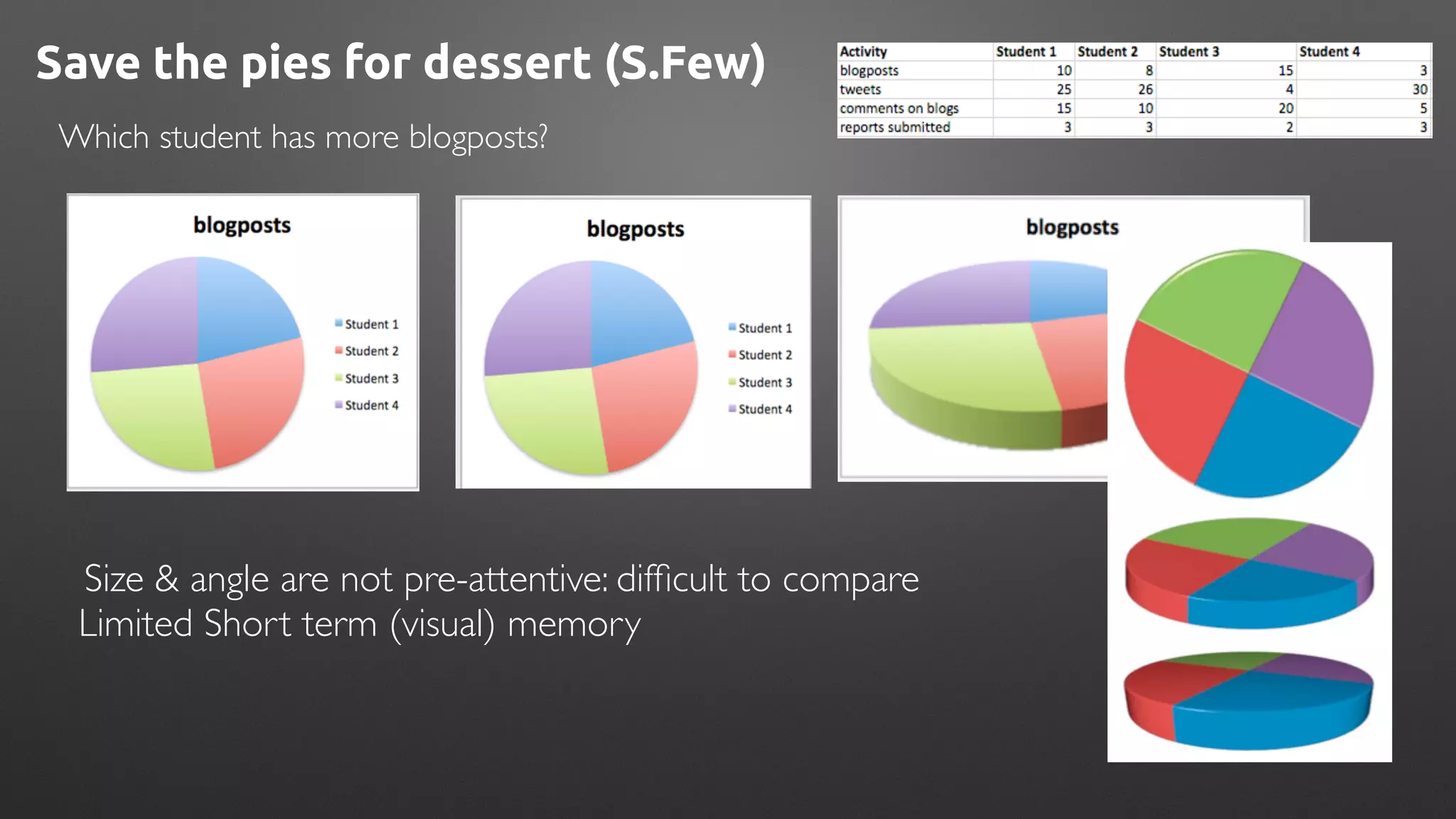
Size & angle are not pre-attentive: difficult to compare	

Limited Short term (visual) memory
Save the pies for dessert (S.Few)
Which student has more blogposts?
0"
5"
10"
15"
20"
25"
30"
blogposts" tweets" comments"on"
blogs"
reports"
submi6ed"
Student'1'
Student"1"
0"
5"
10"
15"
20"
25"
30"
blogposts" comments"on"
blogs"
tweets" reports"
submi6ed"
Student'1'
Student"1"
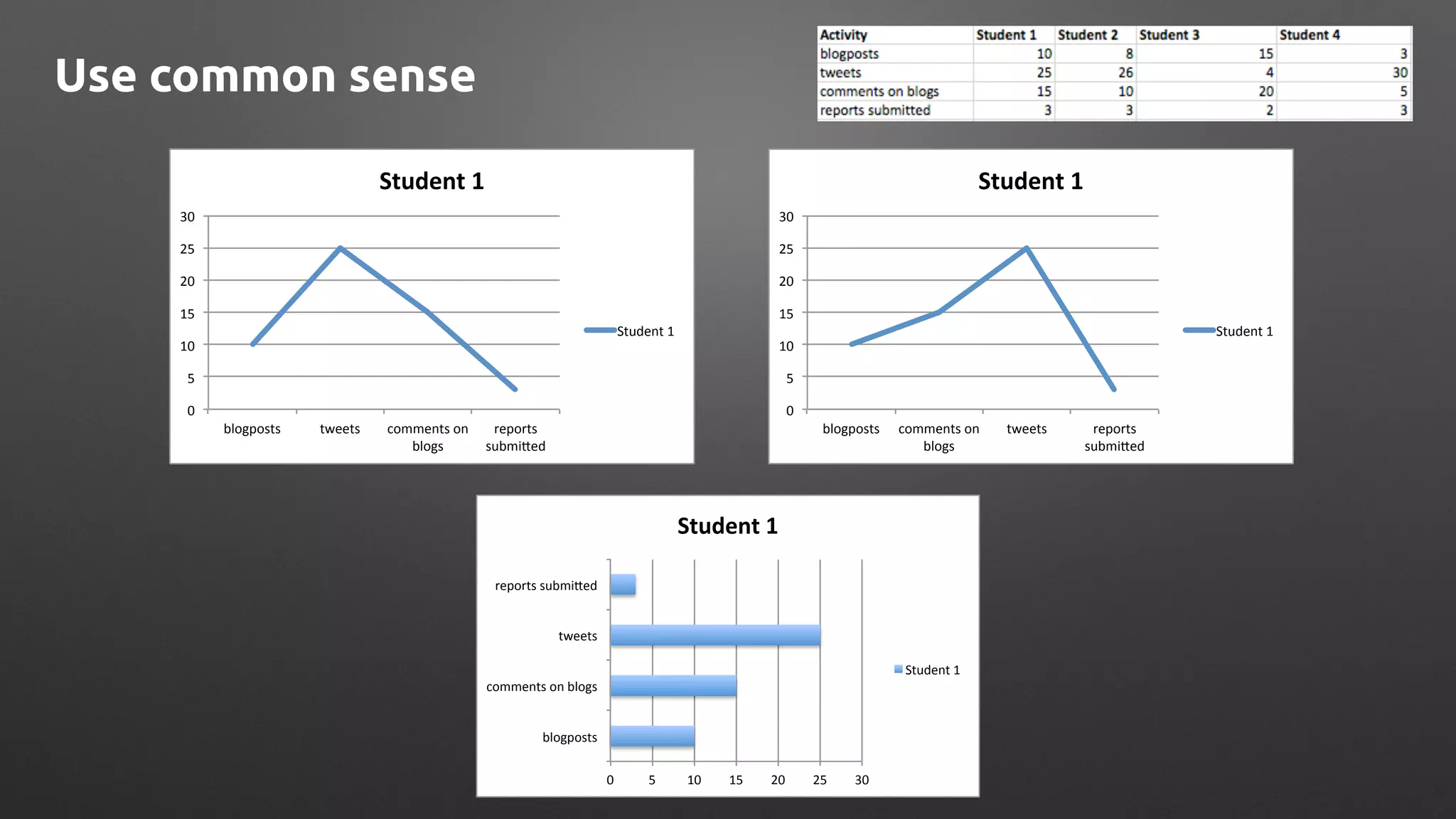
Use common sense
0" 5" 10" 15" 20" 25" 30"
blogposts"
comments"on"blogs"
tweets"
reports"submi6ed"
Student'1'
Student"1"
0" 10" 20" 30" 40" 50" 60"
Student"1"
Student"2"
Student"3"
Student"4"
blogposts"
tweets"
comments"on"blogs"
reports"submi:ed"
0%# 20%# 40%# 60%# 80%# 100%#
Student#1#
Student#2#
Student#3#
Student#4#
blogposts#
tweets#
comments#on#blogs#
reports#submi;ed#
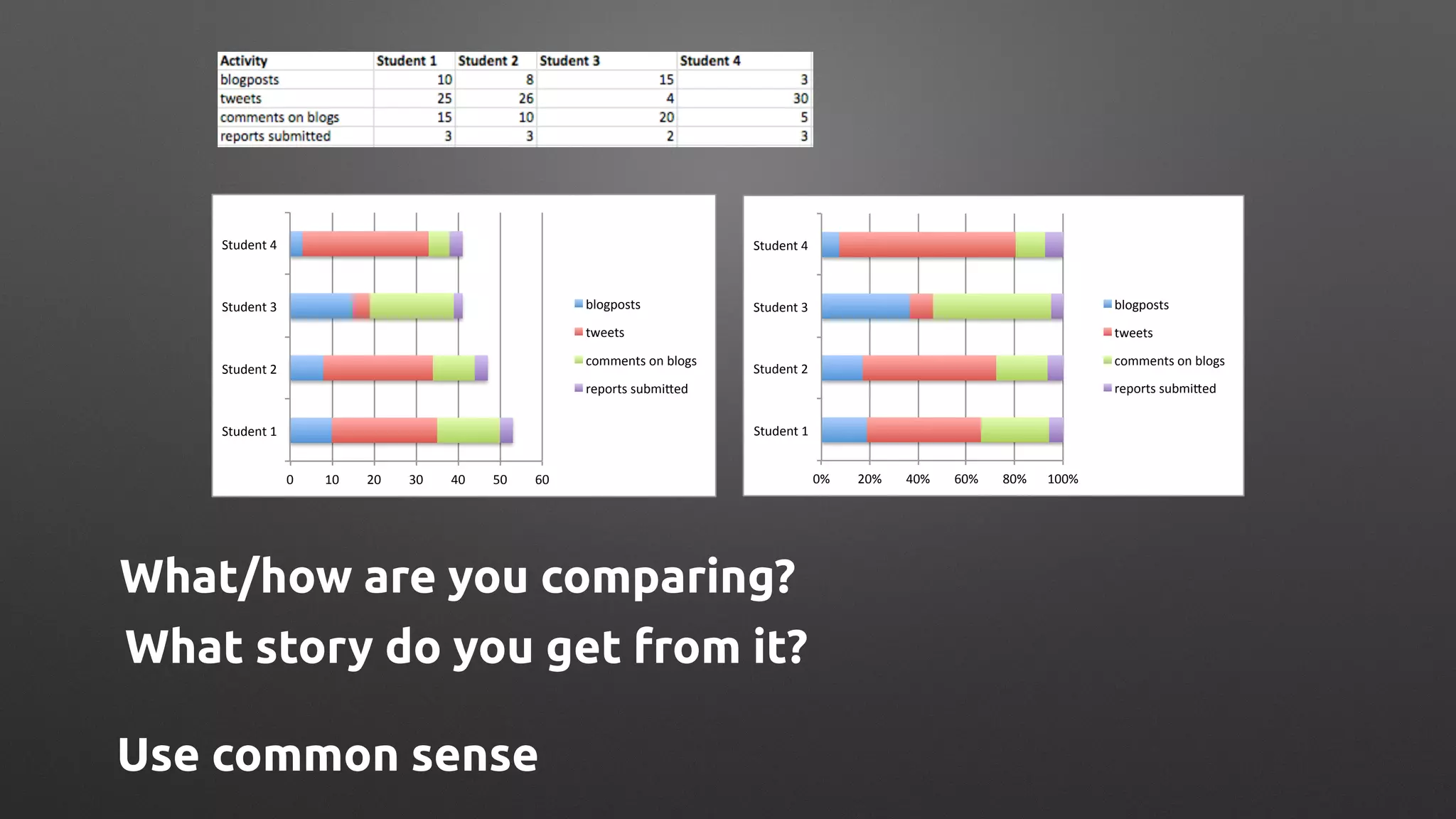
What/how are you comparing?
What story do you get from it?
Use common sense
http://www.perceptualedge.com/
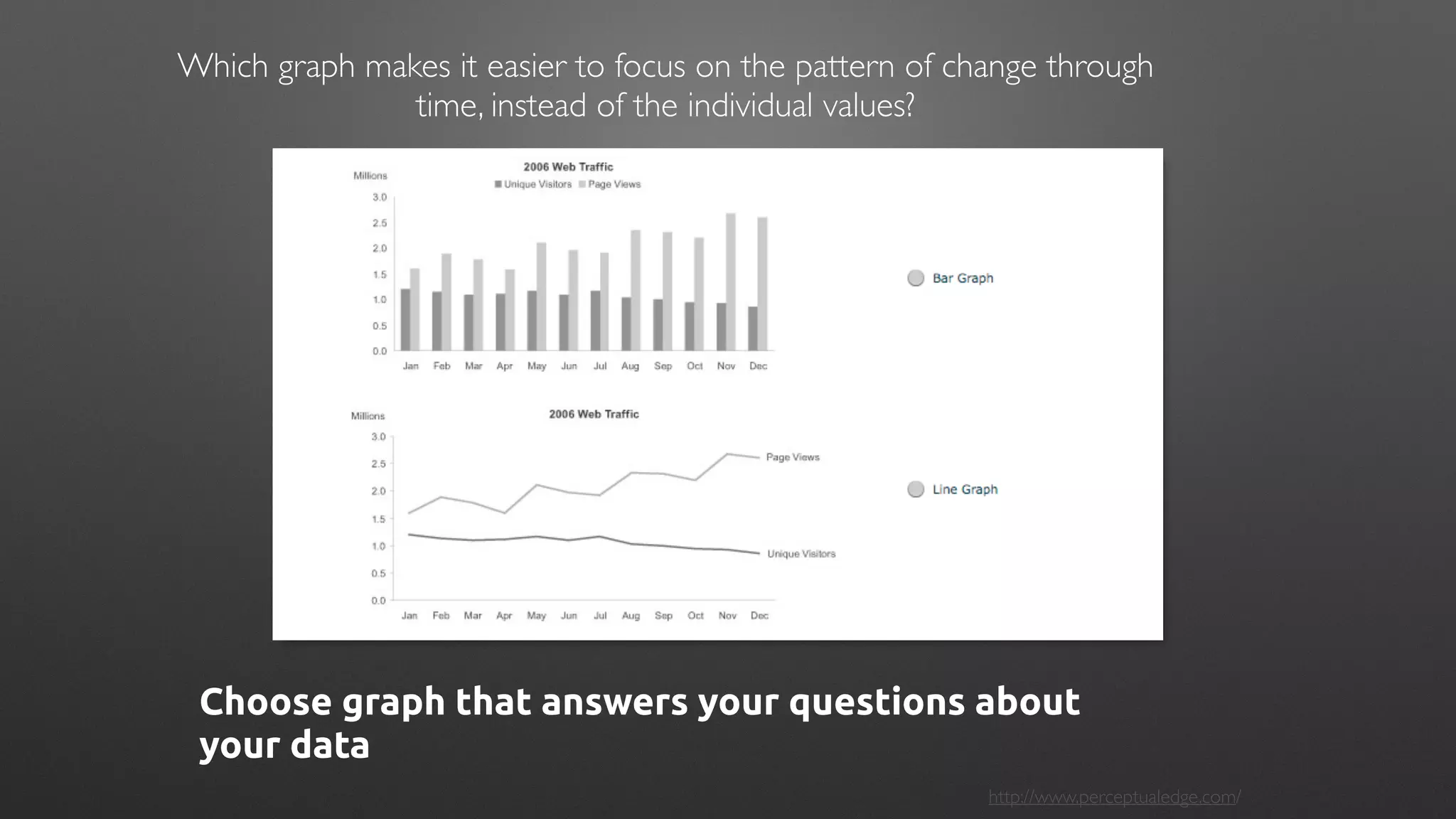
Which graph makes it easier to focus on the pattern of change through
time, instead of the individual values?
Choose graph that answers your questions about
your data
http://flowingdata.com/category/statistics/mistaken-data/
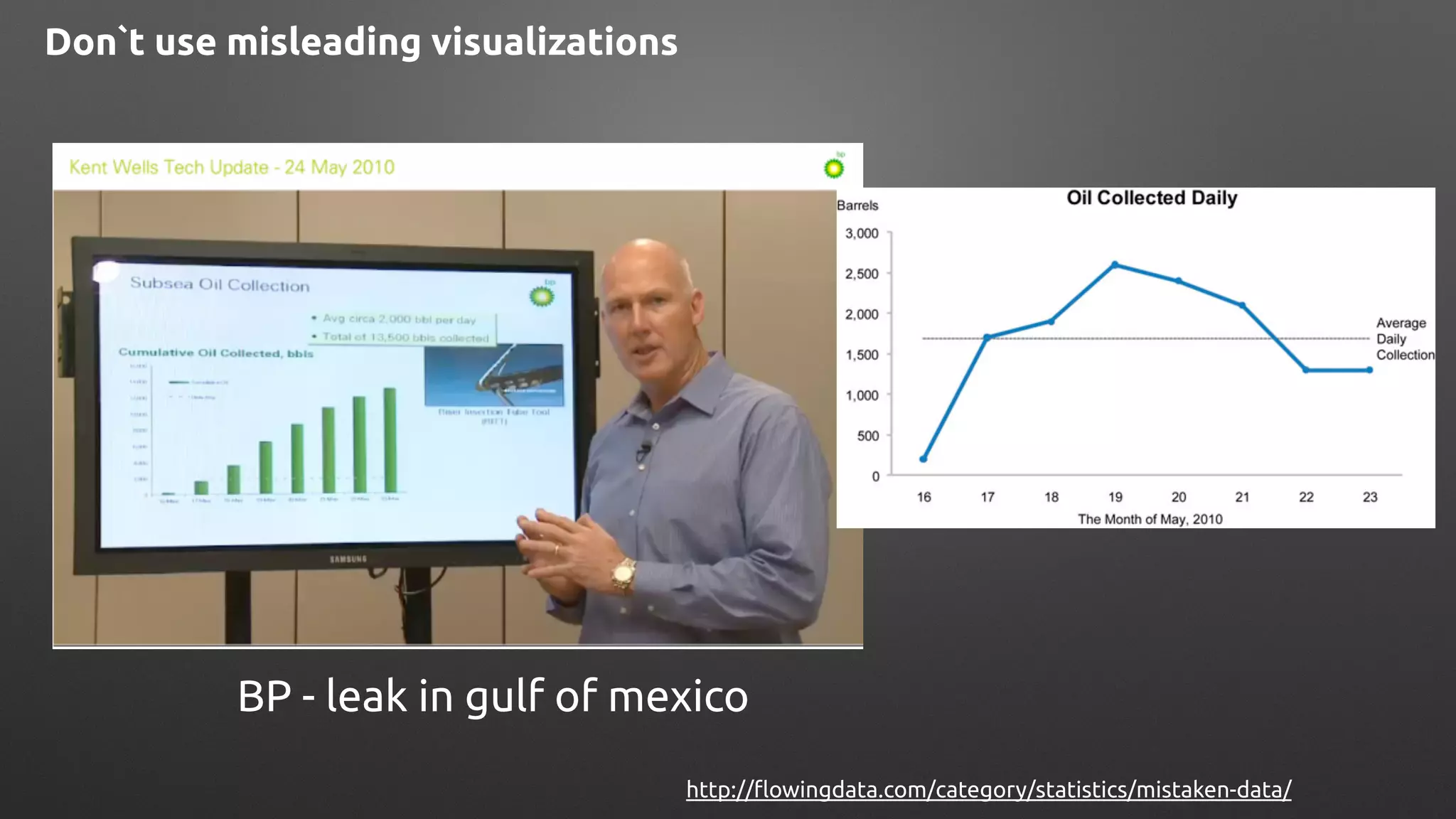
BP - leak in gulf of mexico
Don`t use misleading visualizations
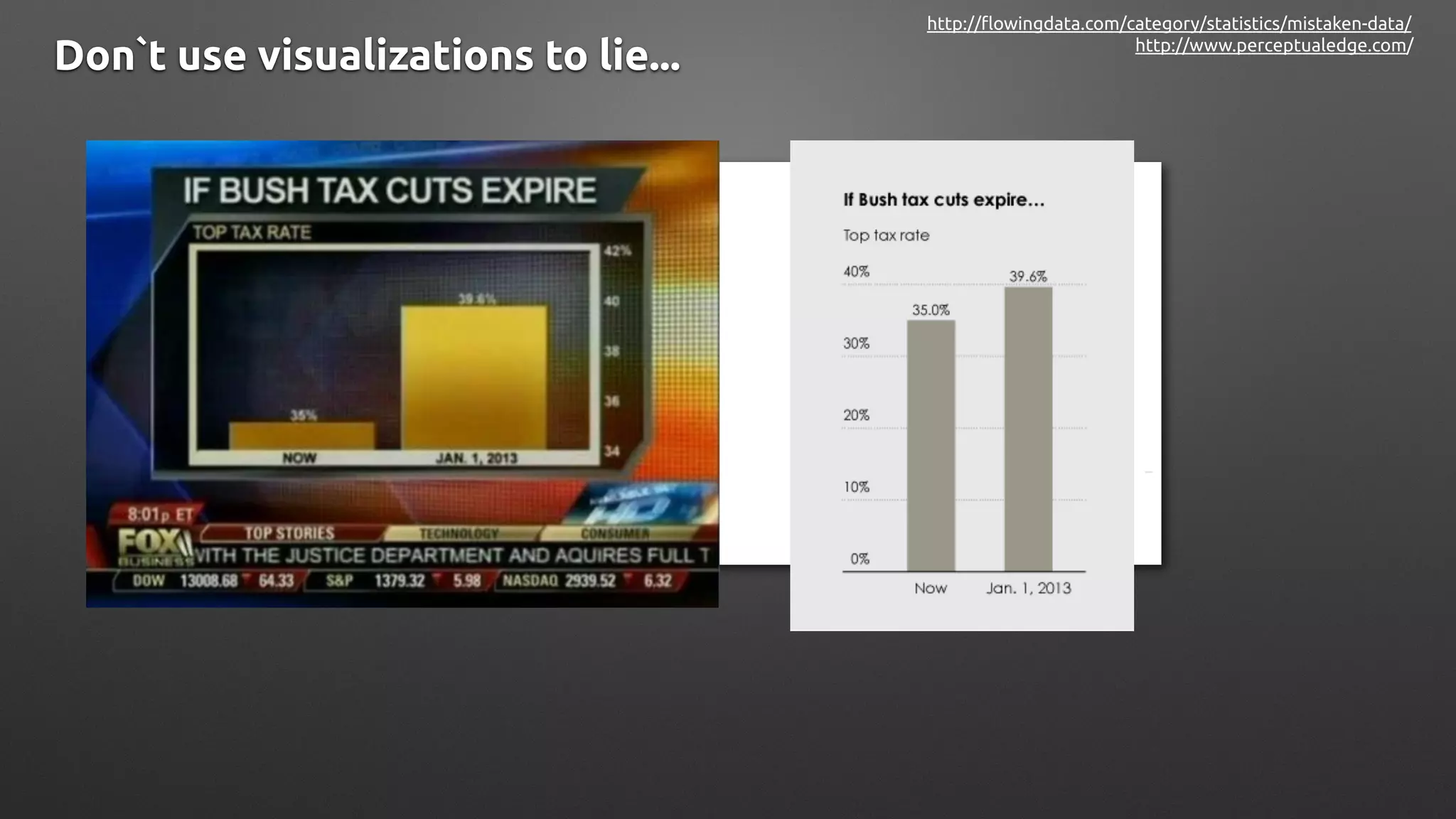
Don`t use visualizations to lie... http://www.perceptualedge.com/
http://flowingdata.com/category/statistics/mistaken-data/
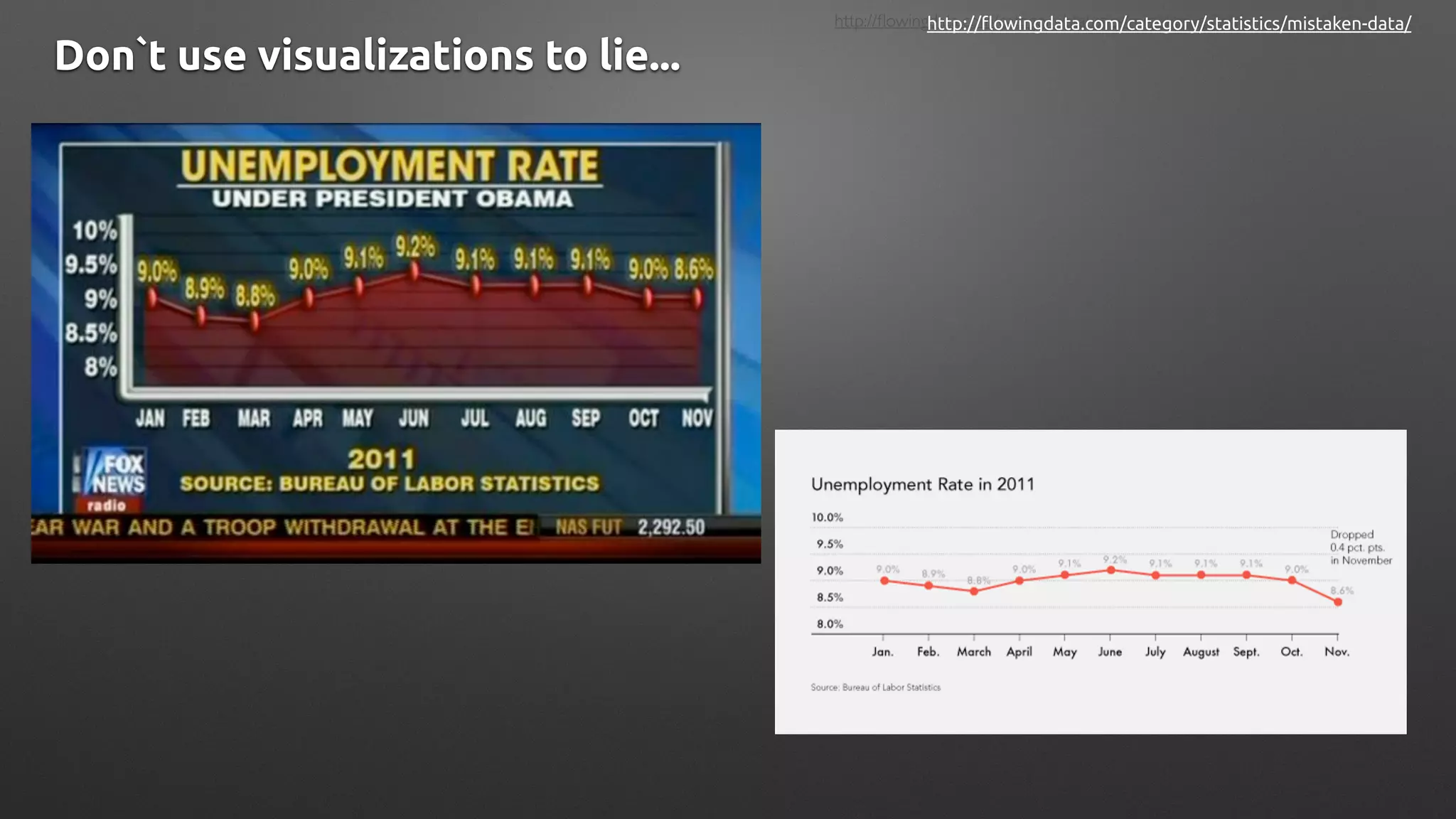
http://flowingdata.com/category/statistics/mistaken-data/http://flowingdata.com/category/statistics/mistaken-data/
Don`t use visualizations to lie...
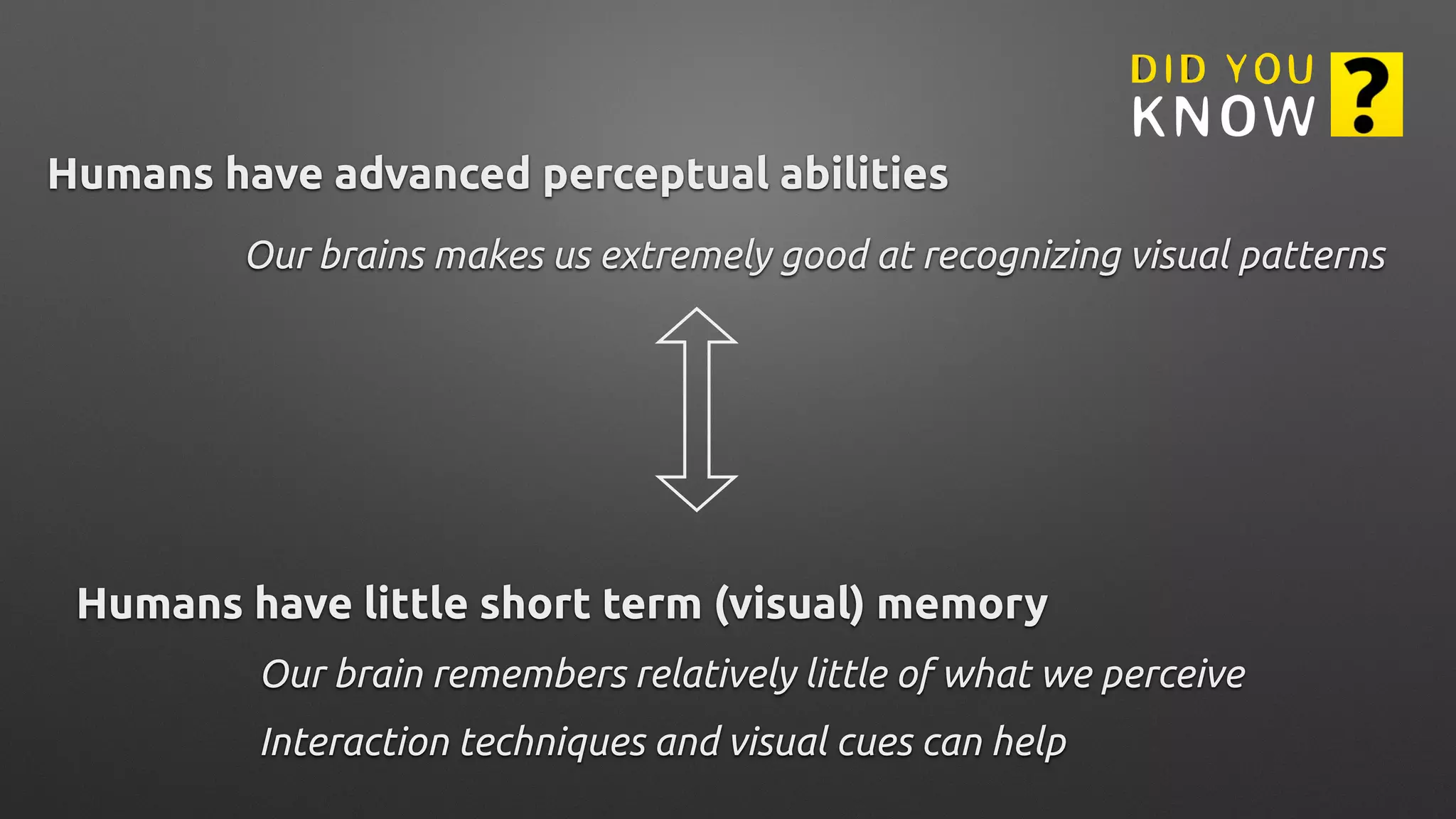
Humans have little short term (visual) memory
Our brain remembers relatively little of what we perceive
Humans have advanced perceptual abilities
Our brains makes us extremely good at recognizing visual patterns
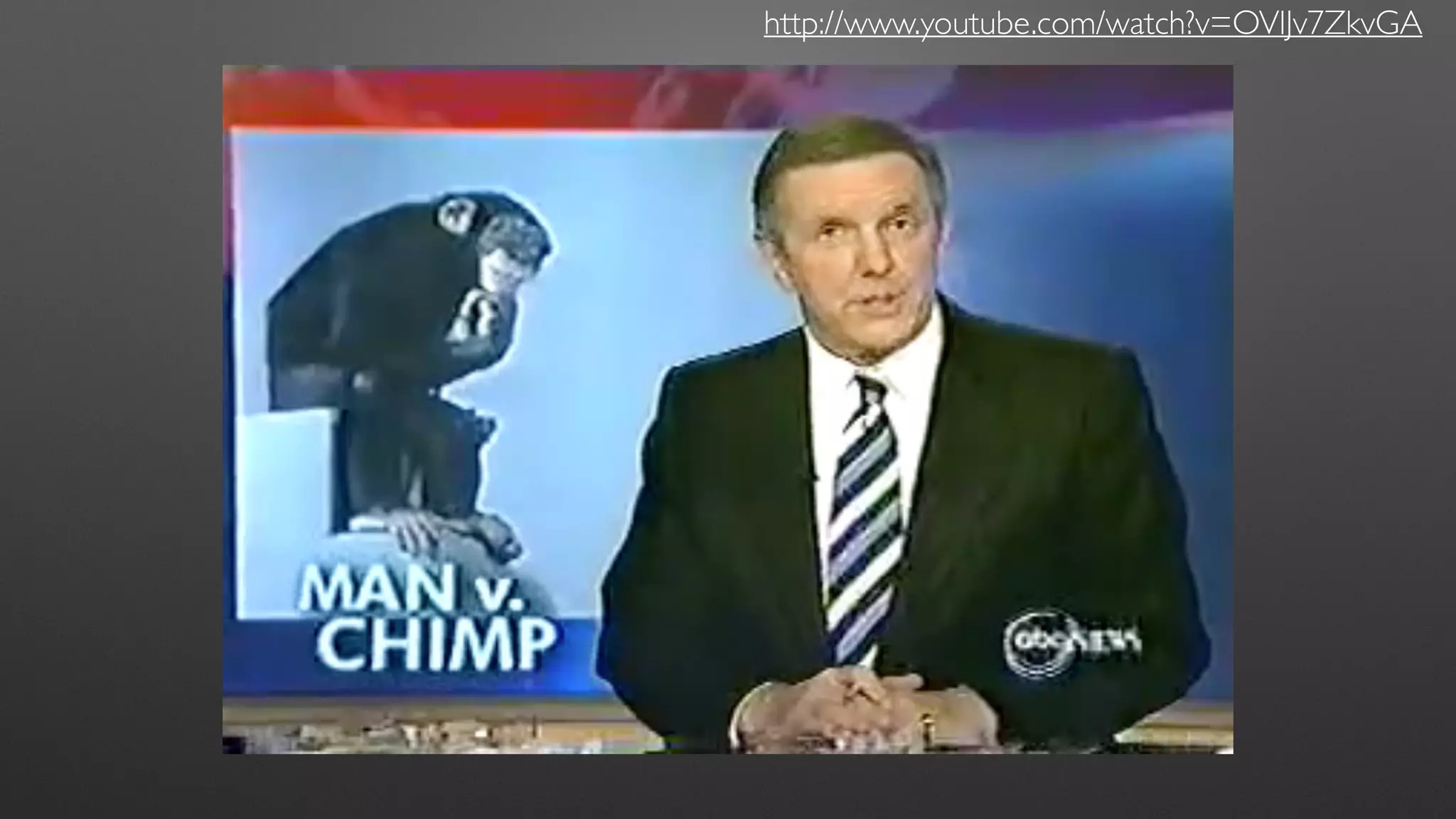
Interaction techniques and visual cues can help
http://www.youtube.com/watch?v=OVlJv7ZkvGA
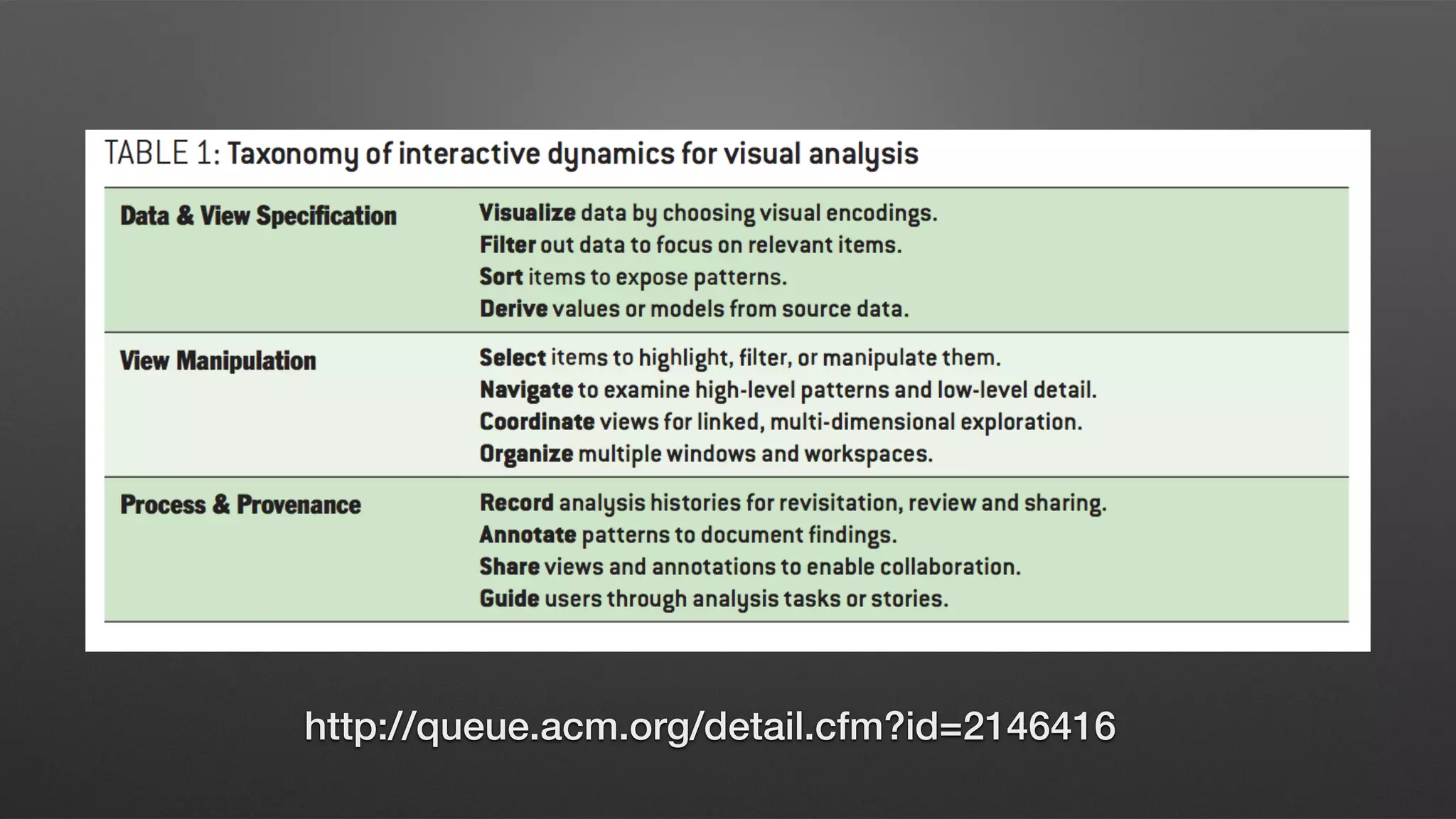
http://queue.acm.org/detail.cfm?id=2146416
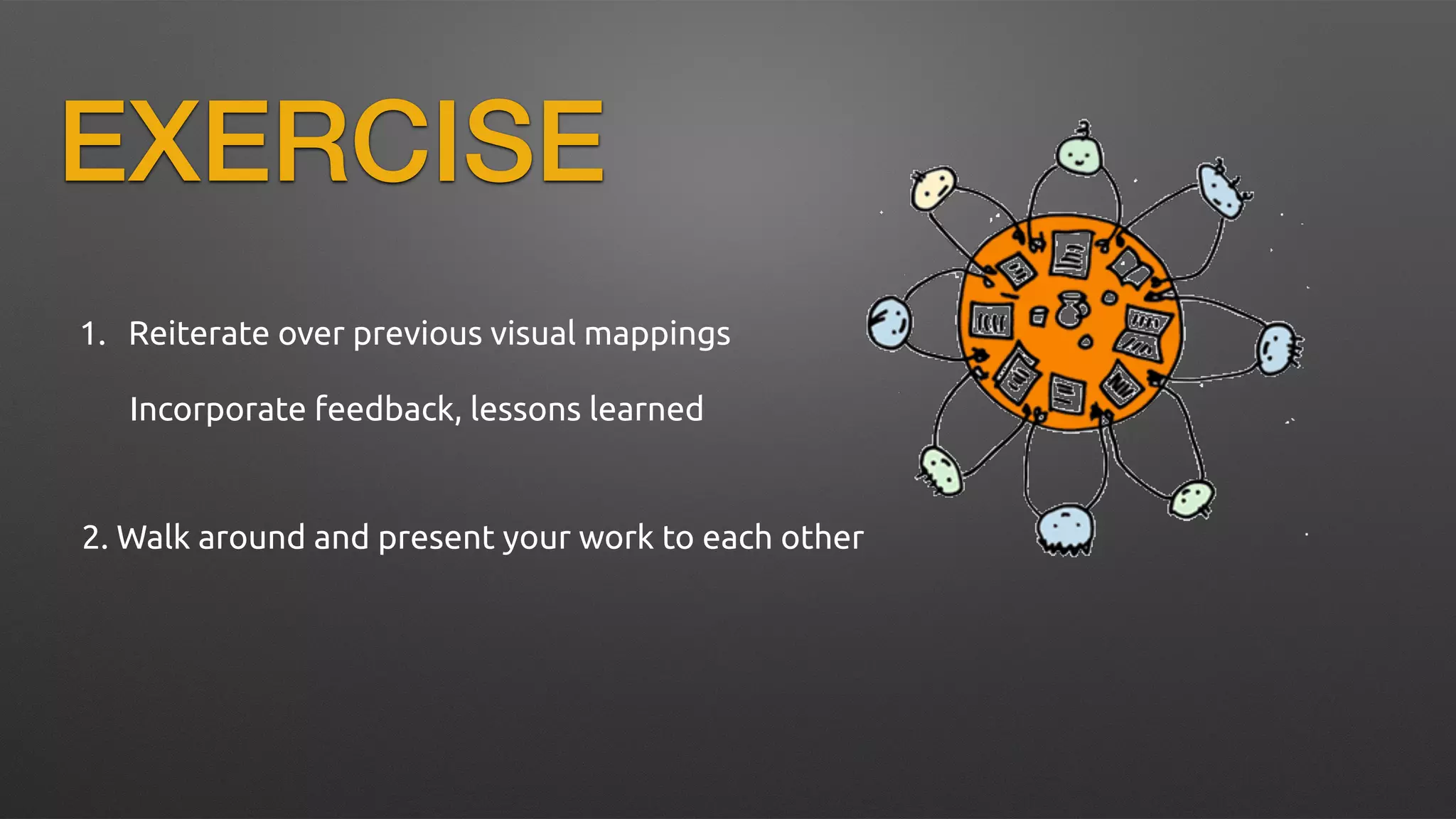
EXERCISE
1. Reiterate over previous visual mappings
!
	
 Incorporate feedback, lessons learned
2. Walk around and present your work to each other
!

Bring your own idea - Visual learning analytics