Using technology to
support mathematics
education and research
Dr. Christian Bokhove
13 July 2017
Hong Kong
Who am I
• Dr. Christian Bokhove
• From 1998-2012 teacher maths, computer science, head of
ICT secondary school Netherlands
• National projects Maths & ICT at Freudenthal Instituut,
Utrecht University
• PhD 2011 under Prof. Jan van Maanen and prof. Paul Drijvers
• Lecturer at University of
Southampton
– Maths education
– Technology use
– Large-scale assessment
– Computer Science stuff
Contents
WORKING WITH THE FREUDENTHAL INSTITUTE
ALGEBRA AND TECHNOLOGY 
DIGITAL MATHEMATICAL BOOKS 
ENGASIA 
CONCLUSION
Contents
WORKING WITH THE FREUDENTHAL INSTITUTE
ALGEBRA AND TECHNOLOGY
DIGITAL MATHEMATICAL BOOKS
ENGASIA
CONCLUSION
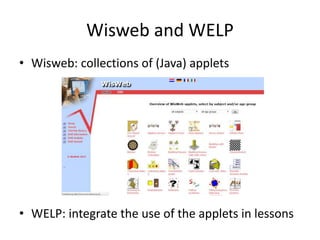
Wisweb and WELP
• Wisweb: collections of (Java) applets
• WELP: integrate the use of the applets in lessons
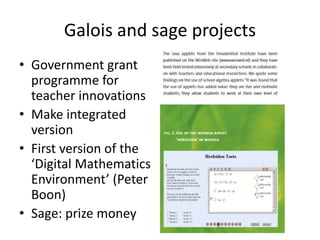
Galois and sage projects
• Government grant
programme for
teacher innovations
• Make integrated
version
• First version of the
‘Digital Mathematics
Environment’ (Peter
Boon)
• Sage: prize money
More on FI
With thanks to Prof. Paul Drijvers
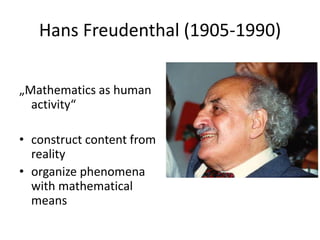
Hans Freudenthal (1905-1990)
„Mathematics as human
activity“
• construct content from
reality
• organize phenomena
with mathematical
means
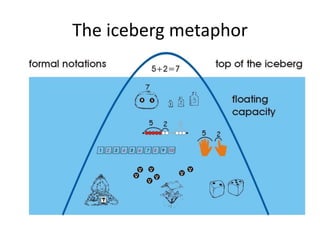
The iceberg metaphor
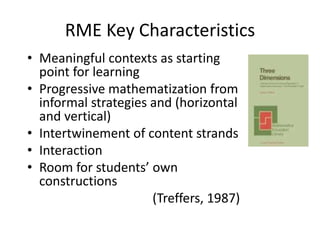
RME Key Characteristics
• Meaningful contexts as starting
point for learning
• Progressive mathematization from
informal strategies and (horizontal
and vertical)
• Intertwinement of content strands
• Interaction
• Room for students’ own
constructions
(Treffers, 1987)
What do we mean by “Realistic”?
“Realistic” may have different meanings:
• Realistic in the sense of feasible in educational practice
• Realistic in the sense of related to real life
(real world, phantasy world, math world)
• Realistic in the sense of meaningful, sense making for
students
• Realistic in the sense of “zich realiseren” = to realize, to
be aware of, to imagine
• HF: “How real the concepts are depends on the
conceiver”
11
Key RME design heuristics
A. Guided reinvention
B. Didactical phenomenology
C. Horizontal and Vertical Mathematization
D. Emergent Modeling
A. Guided reinvention
• Reinvention:
Reconstructing and developing a mathematical
concept in a natural way in a given problem
situation.
• Guidance:
Students need guidance (from books, peers,
teacher) to ascertain convergence towards
common mathematical standards
• Reinvention <-> guidance: a balancing act
B. Didactical phenomenology
The art to find phenomena, contexts, problem
situations that …
• … beg to be organized by mathematical means
• … invites students to develop the targeted
mathematical concepts
These phenomena can come from real life or
can be ‘experientially real’
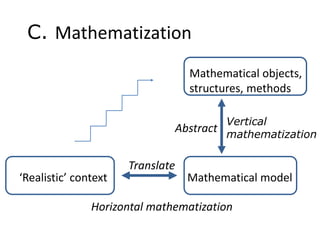
‘Realistic’ context Mathematical model
Mathematical objects,
structures, methods
Horizontal mathematization
Translate
Vertical
mathematization
Abstract
C. Mathematization
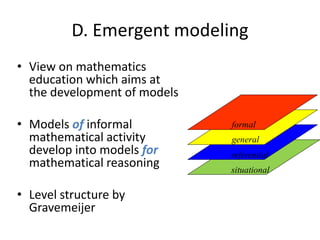
D. Emergent modeling
• View on mathematics
education which aims at
the development of models
• Models of informal
mathematical activity
develop into models for
mathematical reasoning
• Level structure by
Gravemeijer
situational
referential
general
formal
Some debate
• Implementation ok? (Gravemeijer, Bruin-Muurling,
Kraemer, & van Stiphout, 2016)
• Influence of contexts? (Hickendorff, 2013)
• Procedural skills and conceptual understanding go
hand in hand (Rittle-Johnson, Schneider, & Star, 2015)
• Not enough emphasis on procedural skills e.g.
algorithms (Fan & Bokhove, 2014)
I don’t see a contradiction doing both. Combined in
subsequent PhD work
Contents
WORKING WITH THE FREUDENTHAL INSTITUTE
ALGEBRA AND TECHNOLOGY
DIGITAL MATHEMATICAL BOOKS
ENGASIA
CONCLUSION
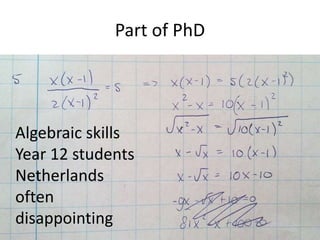
Part of PhD
Algebraic skills
Year 12 students
Netherlands
often
disappointing
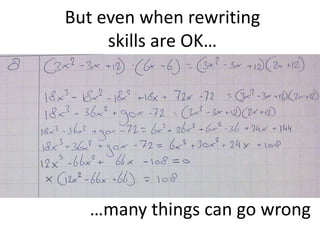
But even when rewriting
skills are OK…
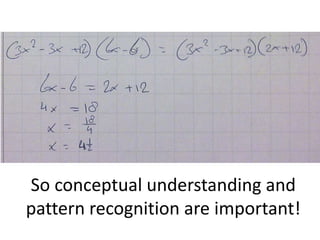
…many things can go wrong
So conceptual understanding and
pattern recognition are important!
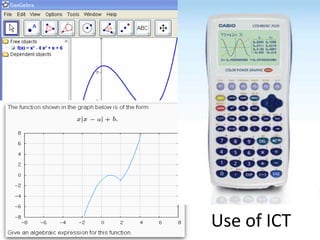
Use of ICT
So can’t we use ICT for acquiring,
practicing and assessing algebraic
expertise?
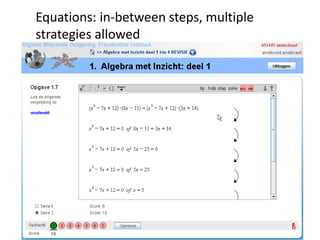
Equations: in-between steps, multiple
strategies allowed
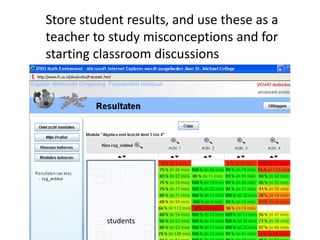
Store student results, and use these as a
teacher to study misconceptions and for
starting classroom discussions
students
Design principles
(i) students learn a lot from what goes wrong,
(ii) but students will not always overcome these if
no feedback is provided, and
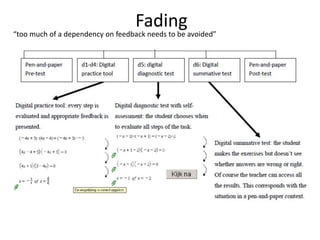
(iii) that too much of a dependency on feedback
needs to be avoided, as summative assessment
typically does not provide feedback.
These three challenges are addressed by principles
for crises, feedback and fading, respectively.
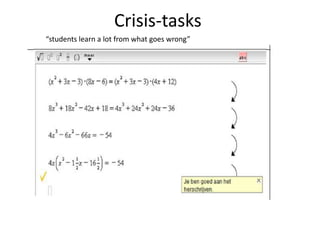
Crisis-tasks
“students learn a lot from what goes wrong”
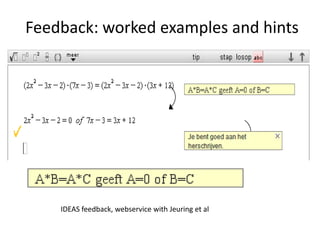
Feedback: worked examples and hints
IDEAS feedback, webservice with Jeuring et al
Fading
“too much of a dependency on feedback needs to be avoided”
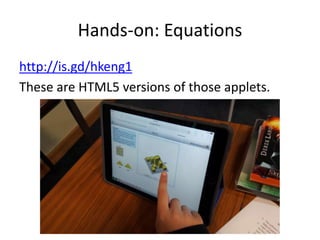
Hands-on: Equations
http://is.gd/hkeng1
These are HTML5 versions of those applets.
Contents
WORKING WITH THE FREUDENTHAL INSTITUTE
ALGEBRA AND TECHNOLOGY
DIGITAL MATHEMATICAL BOOKS
ENGASIA
CONCLUSION
Towards digital textbooks
• Digital textbook: theory, examples,
explanations
• Interactive content (in MC-squared widgets)
• Interactive quizzes (formative assessment,
feedback)
• Integrated workbook
FP7 EU project
Designing creative electronic books
for mathematical creativity
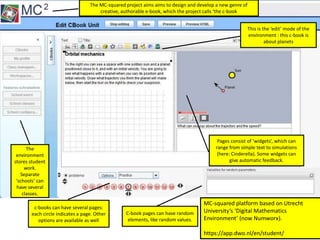
The
environment
stores student
work.
Separate
‘schools’ can
have several
classes.
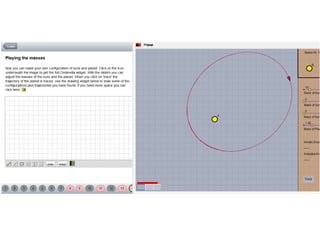
This is the ‘edit’ mode of the
environment : this c-book is
about planets
c-books can have several pages:
each circle indicates a page. Other
options are available as well
C-book pages can have random
elements, like random values.
Pages consist of ‘widgets’, which can
range from simple text to simulations
(here: Cinderella). Some widgets can
give automatic feedback.
The MC-squared project aims aims to design and develop a new genre of
creative, authorable e-book, which the project calls 'the c-book
MC-squared platform based on Utrecht
University’s ‘Digital Mathematics
Environment’ (now Numworx).
https://app.dwo.nl/en/student/
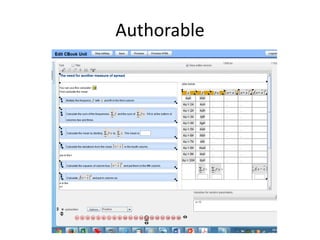
Authorable
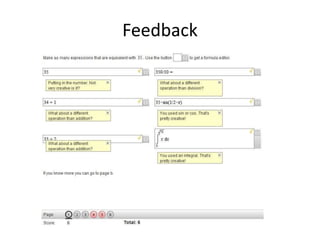
Feedback
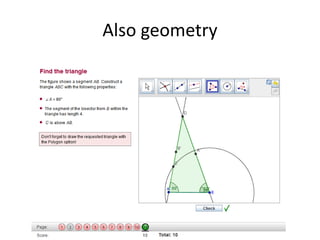
Also geometry
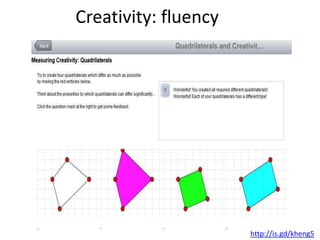
Creativity: fluency
http://is.gd/kheng5
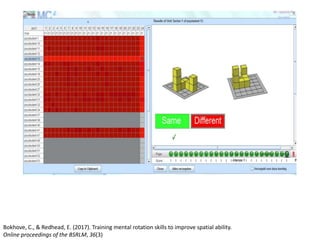
Bokhove, C., & Redhead, E. (2017). Training mental rotation skills to improve spatial ability.
Online proceedings of the BSRLM, 36(3)
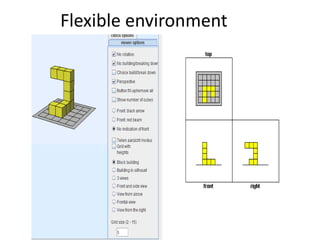
Flexible environment
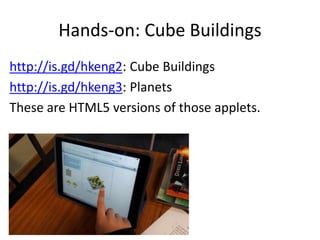
Hands-on: Cube Buildings
http://is.gd/hkeng2: Cube Buildings
http://is.gd/hkeng3: Planets
These are HTML5 versions of those applets.
Contents
WORKING WITH THE FREUDENTHAL INSTITUTE
ALGEBRA AND TECHNOLOGY
DIGITAL MATHEMATICAL BOOKS
ENGASIA
CONCLUSION
enGasia project
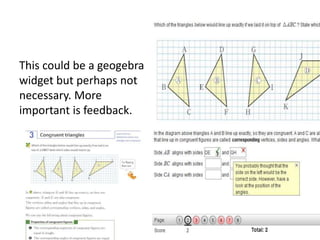
1. Compare geometry education in England, Japan and
Hong Kong → some shown now.
2. two digital resources (electronic books) will be
designed. They are then implemented in classrooms
in those countries.
3. The methodology will include a more qualitative
approach based on lesson observations and a quasi-
experimental element.
This could be a geogebra
widget but perhaps not
necessary. More
important is feedback.
Challenges
• Differences in curriculum regarding geometry
• School and teacher participation
• Software: Java
Now writing the findings in several articles.
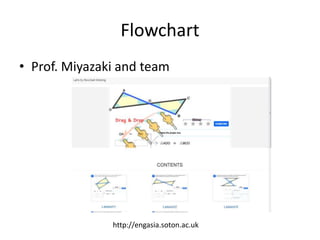
Flowchart
• Prof. Miyazaki and team
http://engasia.soton.ac.uk
Contents
WORKING WITH THE FREUDENTHAL INSTITUTE
ALGEBRA AND TECHNOLOGY
DIGITAL MATHEMATICAL BOOKS
ENGASIA
CONCLUSION
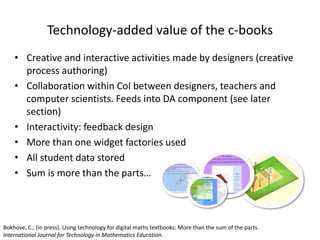
Technology-added value of the c-books
• Creative and interactive activities made by designers (creative
process authoring)
• Collaboration within CoI between designers, teachers and
computer scientists. Feeds into DA component (see later
section)
• Interactivity: feedback design
• More than one widget factories used
• All student data stored
• Sum is more than the parts…
Bokhove, C., (in press). Using technology for digital maths textbooks: More than the sum of the parts.
International Journal for Technology in Mathematics Education.
Thank you
• Contact:
–C.Bokhove@soton.ac.uk
–Twitter: @cbokhove
–www.bokhove.net
• Most papers available somewhere; if
can’t get access just ask.
• I’ll add the references and post on
Slideshare
Bokhove, C., (in press). Using technology for digital maths textbooks: More than the sum of the parts. International
Journal for Technology in Mathematics Education.
Bokhove, C., &Drijvers, P. (2010). Digital tools for algebra education: criteria and evaluation. International Journal of
Computers for Mathematical Learning, 15(1), 45-62. Online first.
Bokhove, C., & Drijvers, P. (2012). Effects of a digital intervention on the development of algebraic expertise.
Computers & Education, 58(1), 197-208. doi:10.1016/j.compedu.2011.08.010
Bokhove, C., & Redhead, E. (2017). Training mental rotation skills to improve spatial ability. Online proceedings of
the BSRLM, 36(3)
Fan, L., & Bokhove, C. (2014). Rethinking the role of algorithms in school mathematics: a conceptual model with
focus on cognitive development. ZDM-International Journal on Mathematics Education, 46(3), doi:10.1007/s11858-
014-0590-2
Fischer, G. (2001). Communities of interest: learning through the interaction of multiple knowledge systems. In the
Proceedings of the 24th IRIS Conference S. Bjornestad, R. Moe, A. Morch, A. Opdahl (Eds.) (pp. 1-14). August 2001,
Ulvik, Department of Information Science, Bergen, Norway.
Freudenthal, H. (1991). Revisiting Mathematics Education. China Lectures. Dordrecht: Kluwer Academic Publishers.
Gravemeijer, K., Bruin-Muurling, G., Kraemer, J-M. & van Stiphout, I. (2016). Shortcomings of mathematics
education reform in the Netherlands: A paradigm case?, Mathematical Thinking and Learning, 18(1), 25-44,
doi:10.1080/10986065.2016.1107821
Hickendorff M. (2013), The effects of presenting multidigit mathematics problems in a realistic context on sixth
graders' problem solving, Cognition and Instruction 31(3), 314-344.
Jaworksi, B. (2006). Theory and practice in mathematics teaching development: critical inquiry as a mode of
learning in teaching. Journal of Mathematics Teacher Education, 9(2), 187-211.
Rittle-Johnson, B. Schneider, M. & Star, J. (2015). Not a one-way street: Bi-directional relations between procedural
and conceptual knowledge of mathematics. Educational Psychology Review, 27. doi:10.1007/s10648-015-9302-x
Treffers, A. (1987). Three dimensions. A model of goal and theory description in mathematics instruction – The
Wiskobas project. Dordrecht: D. Reidel Publishing Company.
Wenger, E. (1998). Communities of Practice: Learning, Meaning, Identity. Cambridge University Press.

Using technology to support mathematics education and research

  • 1.
    Using technology to supportmathematics education and research Dr. Christian Bokhove 13 July 2017 Hong Kong
  • 2.
    Who am I •Dr. Christian Bokhove • From 1998-2012 teacher maths, computer science, head of ICT secondary school Netherlands • National projects Maths & ICT at Freudenthal Instituut, Utrecht University • PhD 2011 under Prof. Jan van Maanen and prof. Paul Drijvers • Lecturer at University of Southampton – Maths education – Technology use – Large-scale assessment – Computer Science stuff
  • 3.
    Contents WORKING WITH THEFREUDENTHAL INSTITUTE ALGEBRA AND TECHNOLOGY  DIGITAL MATHEMATICAL BOOKS  ENGASIA  CONCLUSION
  • 4.
    Contents WORKING WITH THEFREUDENTHAL INSTITUTE ALGEBRA AND TECHNOLOGY DIGITAL MATHEMATICAL BOOKS ENGASIA CONCLUSION
  • 5.
    Wisweb and WELP •Wisweb: collections of (Java) applets • WELP: integrate the use of the applets in lessons
  • 6.
    Galois and sageprojects • Government grant programme for teacher innovations • Make integrated version • First version of the ‘Digital Mathematics Environment’ (Peter Boon) • Sage: prize money
  • 7.
    More on FI Withthanks to Prof. Paul Drijvers
  • 8.
    Hans Freudenthal (1905-1990) „Mathematicsas human activity“ • construct content from reality • organize phenomena with mathematical means
  • 9.
  • 10.
    RME Key Characteristics •Meaningful contexts as starting point for learning • Progressive mathematization from informal strategies and (horizontal and vertical) • Intertwinement of content strands • Interaction • Room for students’ own constructions (Treffers, 1987)
  • 11.
    What do wemean by “Realistic”? “Realistic” may have different meanings: • Realistic in the sense of feasible in educational practice • Realistic in the sense of related to real life (real world, phantasy world, math world) • Realistic in the sense of meaningful, sense making for students • Realistic in the sense of “zich realiseren” = to realize, to be aware of, to imagine • HF: “How real the concepts are depends on the conceiver” 11
  • 12.
    Key RME designheuristics A. Guided reinvention B. Didactical phenomenology C. Horizontal and Vertical Mathematization D. Emergent Modeling
  • 13.
    A. Guided reinvention •Reinvention: Reconstructing and developing a mathematical concept in a natural way in a given problem situation. • Guidance: Students need guidance (from books, peers, teacher) to ascertain convergence towards common mathematical standards • Reinvention <-> guidance: a balancing act
  • 14.
    B. Didactical phenomenology Theart to find phenomena, contexts, problem situations that … • … beg to be organized by mathematical means • … invites students to develop the targeted mathematical concepts These phenomena can come from real life or can be ‘experientially real’
  • 15.
    ‘Realistic’ context Mathematicalmodel Mathematical objects, structures, methods Horizontal mathematization Translate Vertical mathematization Abstract C. Mathematization
  • 16.
    D. Emergent modeling •View on mathematics education which aims at the development of models • Models of informal mathematical activity develop into models for mathematical reasoning • Level structure by Gravemeijer situational referential general formal
  • 17.
    Some debate • Implementationok? (Gravemeijer, Bruin-Muurling, Kraemer, & van Stiphout, 2016) • Influence of contexts? (Hickendorff, 2013) • Procedural skills and conceptual understanding go hand in hand (Rittle-Johnson, Schneider, & Star, 2015) • Not enough emphasis on procedural skills e.g. algorithms (Fan & Bokhove, 2014) I don’t see a contradiction doing both. Combined in subsequent PhD work
  • 18.
    Contents WORKING WITH THEFREUDENTHAL INSTITUTE ALGEBRA AND TECHNOLOGY DIGITAL MATHEMATICAL BOOKS ENGASIA CONCLUSION
  • 19.
    Part of PhD Algebraicskills Year 12 students Netherlands often disappointing
  • 20.
    But even whenrewriting skills are OK… …many things can go wrong
  • 21.
    So conceptual understandingand pattern recognition are important!
  • 22.
  • 23.
    So can’t weuse ICT for acquiring, practicing and assessing algebraic expertise?
  • 24.
    Equations: in-between steps,multiple strategies allowed
  • 25.
    Store student results,and use these as a teacher to study misconceptions and for starting classroom discussions students
  • 26.
    Design principles (i) studentslearn a lot from what goes wrong, (ii) but students will not always overcome these if no feedback is provided, and (iii) that too much of a dependency on feedback needs to be avoided, as summative assessment typically does not provide feedback. These three challenges are addressed by principles for crises, feedback and fading, respectively.
  • 27.
    Crisis-tasks “students learn alot from what goes wrong”
  • 28.
    Feedback: worked examplesand hints IDEAS feedback, webservice with Jeuring et al
  • 29.
    Fading “too much ofa dependency on feedback needs to be avoided”
  • 30.
    Hands-on: Equations http://is.gd/hkeng1 These areHTML5 versions of those applets.
  • 31.
    Contents WORKING WITH THEFREUDENTHAL INSTITUTE ALGEBRA AND TECHNOLOGY DIGITAL MATHEMATICAL BOOKS ENGASIA CONCLUSION
  • 32.
    Towards digital textbooks •Digital textbook: theory, examples, explanations • Interactive content (in MC-squared widgets) • Interactive quizzes (formative assessment, feedback) • Integrated workbook
  • 33.
    FP7 EU project Designingcreative electronic books for mathematical creativity
  • 34.
    The environment stores student work. Separate ‘schools’ can haveseveral classes. This is the ‘edit’ mode of the environment : this c-book is about planets c-books can have several pages: each circle indicates a page. Other options are available as well C-book pages can have random elements, like random values. Pages consist of ‘widgets’, which can range from simple text to simulations (here: Cinderella). Some widgets can give automatic feedback. The MC-squared project aims aims to design and develop a new genre of creative, authorable e-book, which the project calls 'the c-book MC-squared platform based on Utrecht University’s ‘Digital Mathematics Environment’ (now Numworx). https://app.dwo.nl/en/student/
  • 35.
  • 36.
  • 37.
  • 38.
  • 39.
    Bokhove, C., &Redhead, E. (2017). Training mental rotation skills to improve spatial ability. Online proceedings of the BSRLM, 36(3)
  • 40.
  • 42.
    Hands-on: Cube Buildings http://is.gd/hkeng2:Cube Buildings http://is.gd/hkeng3: Planets These are HTML5 versions of those applets.
  • 43.
    Contents WORKING WITH THEFREUDENTHAL INSTITUTE ALGEBRA AND TECHNOLOGY DIGITAL MATHEMATICAL BOOKS ENGASIA CONCLUSION
  • 44.
    enGasia project 1. Comparegeometry education in England, Japan and Hong Kong → some shown now. 2. two digital resources (electronic books) will be designed. They are then implemented in classrooms in those countries. 3. The methodology will include a more qualitative approach based on lesson observations and a quasi- experimental element.
  • 45.
    This could bea geogebra widget but perhaps not necessary. More important is feedback.
  • 46.
    Challenges • Differences incurriculum regarding geometry • School and teacher participation • Software: Java Now writing the findings in several articles.
  • 47.
    Flowchart • Prof. Miyazakiand team http://engasia.soton.ac.uk
  • 48.
    Contents WORKING WITH THEFREUDENTHAL INSTITUTE ALGEBRA AND TECHNOLOGY DIGITAL MATHEMATICAL BOOKS ENGASIA CONCLUSION
  • 49.
    Technology-added value ofthe c-books • Creative and interactive activities made by designers (creative process authoring) • Collaboration within CoI between designers, teachers and computer scientists. Feeds into DA component (see later section) • Interactivity: feedback design • More than one widget factories used • All student data stored • Sum is more than the parts… Bokhove, C., (in press). Using technology for digital maths textbooks: More than the sum of the parts. International Journal for Technology in Mathematics Education.
  • 50.
    Thank you • Contact: –C.Bokhove@soton.ac.uk –Twitter:@cbokhove –www.bokhove.net • Most papers available somewhere; if can’t get access just ask. • I’ll add the references and post on Slideshare
  • 51.
    Bokhove, C., (inpress). Using technology for digital maths textbooks: More than the sum of the parts. International Journal for Technology in Mathematics Education. Bokhove, C., &Drijvers, P. (2010). Digital tools for algebra education: criteria and evaluation. International Journal of Computers for Mathematical Learning, 15(1), 45-62. Online first. Bokhove, C., & Drijvers, P. (2012). Effects of a digital intervention on the development of algebraic expertise. Computers & Education, 58(1), 197-208. doi:10.1016/j.compedu.2011.08.010 Bokhove, C., & Redhead, E. (2017). Training mental rotation skills to improve spatial ability. Online proceedings of the BSRLM, 36(3) Fan, L., & Bokhove, C. (2014). Rethinking the role of algorithms in school mathematics: a conceptual model with focus on cognitive development. ZDM-International Journal on Mathematics Education, 46(3), doi:10.1007/s11858- 014-0590-2 Fischer, G. (2001). Communities of interest: learning through the interaction of multiple knowledge systems. In the Proceedings of the 24th IRIS Conference S. Bjornestad, R. Moe, A. Morch, A. Opdahl (Eds.) (pp. 1-14). August 2001, Ulvik, Department of Information Science, Bergen, Norway. Freudenthal, H. (1991). Revisiting Mathematics Education. China Lectures. Dordrecht: Kluwer Academic Publishers. Gravemeijer, K., Bruin-Muurling, G., Kraemer, J-M. & van Stiphout, I. (2016). Shortcomings of mathematics education reform in the Netherlands: A paradigm case?, Mathematical Thinking and Learning, 18(1), 25-44, doi:10.1080/10986065.2016.1107821 Hickendorff M. (2013), The effects of presenting multidigit mathematics problems in a realistic context on sixth graders' problem solving, Cognition and Instruction 31(3), 314-344. Jaworksi, B. (2006). Theory and practice in mathematics teaching development: critical inquiry as a mode of learning in teaching. Journal of Mathematics Teacher Education, 9(2), 187-211. Rittle-Johnson, B. Schneider, M. & Star, J. (2015). Not a one-way street: Bi-directional relations between procedural and conceptual knowledge of mathematics. Educational Psychology Review, 27. doi:10.1007/s10648-015-9302-x Treffers, A. (1987). Three dimensions. A model of goal and theory description in mathematics instruction – The Wiskobas project. Dordrecht: D. Reidel Publishing Company. Wenger, E. (1998). Communities of Practice: Learning, Meaning, Identity. Cambridge University Press.