Using Technology to Deepen the
 Learning Experience in 1st Year
         Mathematics


       by Ian Schroeder (UCT)
Contents
• Background
• Theory
• The learning task
  – Educational goals
  – Details
• Tools vs Task
• Feedback
  – Cycle
  – Explored
• Future considerations
Background and context
• Knowledge transfer

• Incoming student knowledge (Davidowitz & Rollnick, 2010)

• Maths perceptions (Leitze, 1996)
• Learning strategies (Mji, 2003)
• Financial constraints (Wandilsile & Tshiwula, 2012)

• Digital access and skill levels (surveys required)

• Class size and level
Theoretical Considerations
• Collaborative learning (Smith and MacGregor, 1992)

• Traditional (Marshall et al, 2007. Beichner, 2008) vs Web
  collaborative learning (Lipponen, 2002. Augar et al, 2004. Ben-
  Zivi, 2007. Martin & Premadasa, 2010. Micocha & Thomas, 2007)


• Motivation

• Influence primary learning space (tech vs paper)
The Learning Task

Educational Goals

• Facilitate a deeper exploration of the mathematical
  concepts via asynchronous collaborative learning

• Develop an appreciation for the applicability of
  mathematical content by exploring real world
  examples

• Initialise a reflective practitioner approach to problem
  solving by having to constantly review their group’s
  work over a period of time
The Learning Task cont
Task Details

• Work in assigned groups, collaborate asynchronously and
  contributes to CA mark.

• Warm up task from historical or modern mathematics.

• Digital skills support provided in warm up task (partly in supervised
  lab)

• add, edit and comment on content that is posted online by group
  members

• Teaching staff engaged in active facilitation
Task details continued

• Informed of grievance procedure and communications protocol

• Phase 2: Groups assigned a real world problem and be required to
  develop a ‘solution’

• Formal group meetings once a week – tutor present for part of this

• Project milestones – marks awarded

• Clear requirements e.g. history of technique, conceptual approach,
  solution explanation and numerical approach.

• Final presentation by random group member.

• Use of Turnitin and CPR (?)
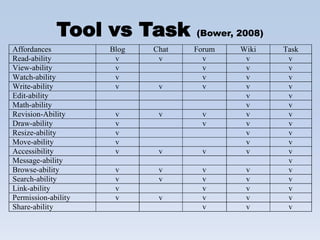
Tool vs Task          (Bower, 2008)
Affordances          Blog   Chat   Forum   Wiki    Task
Read-ability          v      v       v      v       v
View-ability          v              v      v       v
Watch-ability         v              v      v       v
Write-ability         v      v       v      v       v
Edit-ability                                v       v
Math-ability                                v       v
Revision-Ability      v      v      v       v       v
Draw-ability          v             v       v       v
Resize-ability        v                     v       v
Move-ability          v                     v       v
Accessibility         v      v      v       v       v
Message-ability                                     v
Browse-ability        v      v      v       v       v
Search-ability        v      v      v       v       v
Link-ability          v             v       v       v
Permission-ability    v      v      v       v       v
Share-ability                       v       v       v
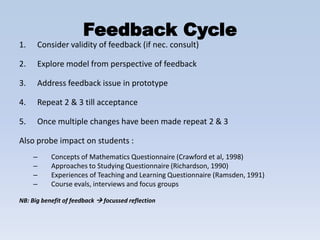
Feedback Cycle
1.    Consider validity of feedback (if nec. consult)

2.    Explore model from perspective of feedback

3.    Address feedback issue in prototype

4.    Repeat 2 & 3 till acceptance

5.    Once multiple changes have been made repeat 2 & 3

Also probe impact on students :
     –     Concepts of Mathematics Questionnaire (Crawford et al, 1998)
     –     Approaches to Studying Questionnaire (Richardson, 1990)
     –     Experiences of Teaching and Learning Questionnaire (Ramsden, 1991)
     –     Course evals, interviews and focus groups

NB: Big benefit of feedback  focussed reflection
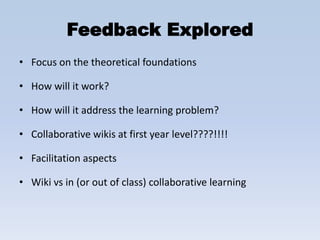
Feedback Explored
• Focus on the theoretical foundations

• How will it work?

• How will it address the learning problem?

• Collaborative wikis at first year level????!!!!

• Facilitation aspects

• Wiki vs in (or out of class) collaborative learning
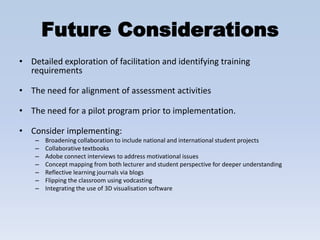
Future Considerations
• Detailed exploration of facilitation and identifying training
  requirements

• The need for alignment of assessment activities

• The need for a pilot program prior to implementation.

• Consider implementing:
    –   Broadening collaboration to include national and international student projects
    –   Collaborative textbooks
    –   Adobe connect interviews to address motivational issues
    –   Concept mapping from both lecturer and student perspective for deeper understanding
    –   Reflective learning journals via blogs
    –   Flipping the classroom using vodcasting
    –   Integrating the use of 3D visualisation software
References
•   Augar, N. Raitman, R. Zhou, W. (2004, December) ‘Teaching and learning online with wikis’, Proceedings of the 21st
    ASCILITE Conference, Perth, Australia: 95-104

•   Beichner, R. (2008) ‘The SCALE-UP Project: A Student-Centered Active Learning Environment for Undergraduate
    Programs’, BOSE Conference on Promising Practices-Innovation in Undergraduate STEM Education, Washington,
    DC.

•   Ben-Zivi, D. (2007) ‘Using Wiki to promote Collaborative Learning in Statistics Education’, Technology Innovations in
    Statistics Education, Center for the teaching of Statistics, UCLA, UC Los Angeles

•   Bower, M (2008). ‘Affordance Analysis – matching learning tasks with learning technologies’, Educational Media
    International, 45(1): 3-15

•   Crawford, K. Gordon, S. Nicholas, J. Prosser, M. (1998) ‘University mathematics students' conceptions of
    mathematics’, Studies in Higher Education, Volume 23 (1): 87-94

•   Davidowitz, B. Rollnick, M. (2010) ‘Adjustment of underprepared students to tertiary education’, in Rollnick, M.
    (eds) Identifying Potential for Equitable Access to Tertiary Level Science. Springer: 89-108

•   Leitze, A.R. (1996) ‘To major or not major in mathematics? Affective factors in the choice-of-major decision’, in
    Kaput, J. Schoenfeld, A. Dubinsky, E. (eds) CMBS Issues in Mathematics Education 6:83–100

•   Lipponen, L. (2002) ‘Exploring Foundations for Computer-Supported Collaborative Learning’, Proceedings of CSCL
    2002: 72-81
•   Martin,P. Premadasa,K. (2010), ‘effective use of Wikis in College Mathematics Classes’, Journal on
    Systemics, Cybernetics and Informatics, Volume 8(6): 76-78

•   Marshall, D. Lesai, M. Schroeder, I. (2007, December) ‘Making the Tacit Explicit: Accessing the
    Discourse of Physics’, For Engineering and Science Educators, Volume 11, 4-6.

•   Minocha, S. Thomas, P. (2007, December) ‘Collaborative Learning in a Wiki Environment:
    Experiences from a software engineering course’, New Review of Hypermedia and Multimedia,
    volume 13 (2): 187-209.

•   Mji, A. (2003) ‘A three-year perspective on conceptions of and orientations to learning mathematics
    of prospective teachers and first year university students’, International Journal of Mathematical
    Education in Science and Technology, volume 34 (5): 687-698

•   Ramsden, P.(1991) ‘A performance indicator of teaching quality in higher education: The Course
    Experience Questionnaire’, Studies in Higher Education, volume 16 (2): 129-150

•   Richardson, J. (1990) ‘Reliability and replicability of the Approaches to Studying Questionnaire’,
    Studies in Higher Education, volume 15 (2): 155-168

•   Smith, B. MacGregor, J. (1992) ‘What is Collaborative learning’, Goodsell, A. (eds) Collaborative
    learning: A Sourcebook for Higher Education, National Center on Postsecondary Teaching, Learning
    and Assessment, University Park, PA: 10-29

•   Wandisile, M. Tshiwula, L. (2012, January) ‘Student diversity in South African higher education’,
    Widening Participation and Lifelong Learning, Volume 13, Special Issue: 19-33

Emerging Technologies Presentation - CHEC 2012

  • 1.
    Using Technology toDeepen the Learning Experience in 1st Year Mathematics by Ian Schroeder (UCT)
  • 2.
    Contents • Background • Theory •The learning task – Educational goals – Details • Tools vs Task • Feedback – Cycle – Explored • Future considerations
  • 3.
    Background and context •Knowledge transfer • Incoming student knowledge (Davidowitz & Rollnick, 2010) • Maths perceptions (Leitze, 1996) • Learning strategies (Mji, 2003) • Financial constraints (Wandilsile & Tshiwula, 2012) • Digital access and skill levels (surveys required) • Class size and level
  • 4.
    Theoretical Considerations • Collaborativelearning (Smith and MacGregor, 1992) • Traditional (Marshall et al, 2007. Beichner, 2008) vs Web collaborative learning (Lipponen, 2002. Augar et al, 2004. Ben- Zivi, 2007. Martin & Premadasa, 2010. Micocha & Thomas, 2007) • Motivation • Influence primary learning space (tech vs paper)
  • 5.
    The Learning Task EducationalGoals • Facilitate a deeper exploration of the mathematical concepts via asynchronous collaborative learning • Develop an appreciation for the applicability of mathematical content by exploring real world examples • Initialise a reflective practitioner approach to problem solving by having to constantly review their group’s work over a period of time
  • 6.
    The Learning Taskcont Task Details • Work in assigned groups, collaborate asynchronously and contributes to CA mark. • Warm up task from historical or modern mathematics. • Digital skills support provided in warm up task (partly in supervised lab) • add, edit and comment on content that is posted online by group members • Teaching staff engaged in active facilitation
  • 7.
    Task details continued •Informed of grievance procedure and communications protocol • Phase 2: Groups assigned a real world problem and be required to develop a ‘solution’ • Formal group meetings once a week – tutor present for part of this • Project milestones – marks awarded • Clear requirements e.g. history of technique, conceptual approach, solution explanation and numerical approach. • Final presentation by random group member. • Use of Turnitin and CPR (?)
  • 8.
    Tool vs Task (Bower, 2008) Affordances Blog Chat Forum Wiki Task Read-ability v v v v v View-ability v v v v Watch-ability v v v v Write-ability v v v v v Edit-ability v v Math-ability v v Revision-Ability v v v v v Draw-ability v v v v Resize-ability v v v Move-ability v v v Accessibility v v v v v Message-ability v Browse-ability v v v v v Search-ability v v v v v Link-ability v v v v Permission-ability v v v v v Share-ability v v v
  • 9.
    Feedback Cycle 1. Consider validity of feedback (if nec. consult) 2. Explore model from perspective of feedback 3. Address feedback issue in prototype 4. Repeat 2 & 3 till acceptance 5. Once multiple changes have been made repeat 2 & 3 Also probe impact on students : – Concepts of Mathematics Questionnaire (Crawford et al, 1998) – Approaches to Studying Questionnaire (Richardson, 1990) – Experiences of Teaching and Learning Questionnaire (Ramsden, 1991) – Course evals, interviews and focus groups NB: Big benefit of feedback  focussed reflection
  • 10.
    Feedback Explored • Focuson the theoretical foundations • How will it work? • How will it address the learning problem? • Collaborative wikis at first year level????!!!! • Facilitation aspects • Wiki vs in (or out of class) collaborative learning
  • 11.
    Future Considerations • Detailedexploration of facilitation and identifying training requirements • The need for alignment of assessment activities • The need for a pilot program prior to implementation. • Consider implementing: – Broadening collaboration to include national and international student projects – Collaborative textbooks – Adobe connect interviews to address motivational issues – Concept mapping from both lecturer and student perspective for deeper understanding – Reflective learning journals via blogs – Flipping the classroom using vodcasting – Integrating the use of 3D visualisation software
  • 12.
    References • Augar, N. Raitman, R. Zhou, W. (2004, December) ‘Teaching and learning online with wikis’, Proceedings of the 21st ASCILITE Conference, Perth, Australia: 95-104 • Beichner, R. (2008) ‘The SCALE-UP Project: A Student-Centered Active Learning Environment for Undergraduate Programs’, BOSE Conference on Promising Practices-Innovation in Undergraduate STEM Education, Washington, DC. • Ben-Zivi, D. (2007) ‘Using Wiki to promote Collaborative Learning in Statistics Education’, Technology Innovations in Statistics Education, Center for the teaching of Statistics, UCLA, UC Los Angeles • Bower, M (2008). ‘Affordance Analysis – matching learning tasks with learning technologies’, Educational Media International, 45(1): 3-15 • Crawford, K. Gordon, S. Nicholas, J. Prosser, M. (1998) ‘University mathematics students' conceptions of mathematics’, Studies in Higher Education, Volume 23 (1): 87-94 • Davidowitz, B. Rollnick, M. (2010) ‘Adjustment of underprepared students to tertiary education’, in Rollnick, M. (eds) Identifying Potential for Equitable Access to Tertiary Level Science. Springer: 89-108 • Leitze, A.R. (1996) ‘To major or not major in mathematics? Affective factors in the choice-of-major decision’, in Kaput, J. Schoenfeld, A. Dubinsky, E. (eds) CMBS Issues in Mathematics Education 6:83–100 • Lipponen, L. (2002) ‘Exploring Foundations for Computer-Supported Collaborative Learning’, Proceedings of CSCL 2002: 72-81
  • 13.
    Martin,P. Premadasa,K. (2010), ‘effective use of Wikis in College Mathematics Classes’, Journal on Systemics, Cybernetics and Informatics, Volume 8(6): 76-78 • Marshall, D. Lesai, M. Schroeder, I. (2007, December) ‘Making the Tacit Explicit: Accessing the Discourse of Physics’, For Engineering and Science Educators, Volume 11, 4-6. • Minocha, S. Thomas, P. (2007, December) ‘Collaborative Learning in a Wiki Environment: Experiences from a software engineering course’, New Review of Hypermedia and Multimedia, volume 13 (2): 187-209. • Mji, A. (2003) ‘A three-year perspective on conceptions of and orientations to learning mathematics of prospective teachers and first year university students’, International Journal of Mathematical Education in Science and Technology, volume 34 (5): 687-698 • Ramsden, P.(1991) ‘A performance indicator of teaching quality in higher education: The Course Experience Questionnaire’, Studies in Higher Education, volume 16 (2): 129-150 • Richardson, J. (1990) ‘Reliability and replicability of the Approaches to Studying Questionnaire’, Studies in Higher Education, volume 15 (2): 155-168 • Smith, B. MacGregor, J. (1992) ‘What is Collaborative learning’, Goodsell, A. (eds) Collaborative learning: A Sourcebook for Higher Education, National Center on Postsecondary Teaching, Learning and Assessment, University Park, PA: 10-29 • Wandisile, M. Tshiwula, L. (2012, January) ‘Student diversity in South African higher education’, Widening Participation and Lifelong Learning, Volume 13, Special Issue: 19-33

Editor's Notes

  • #4 1- personal experience2- Gap between school and university, rote learners, survival strategies3- assess using questionnaires4-assess using instruments5- 150 and 1st year AD
  • #5 1 – builds up knowledge by challenging assumptions and misconceptions. Does need expert input.2- high tech in class (Scale Up), low tech – group around a table with pen and paper3- Asynchronous, Lecture is not the primary knowledge build location e.g. UWC flip chart, pens and group support. Intensive more closely resembles modern work environment4- provides platforms such as blogs, wikis, forums , chats
  • #6 Link problem to nature of tool
  • #8 2- Real world handling of problems3- Formal meetings to check if on track and where required award milestone marks6- 6 can take many forms
  • #9 First considered task affordances (bowen)Had to add some affordance typesThen compare these to the affordances of tool options.Clearly wiki is the best option. Ideally looking for a wiki with a sidebar chat? How will they communicate with each other.
  • #11 1- good grounding question2+3 – Made me review the process details and inspect clarity4 A warning linked to 55 – addressed earlier