The research leading to these results has received funding from the
European Union Seventh Framework Programme (FP7/2007-2013) under
grant agreement n° 610467 - project “M C Squared”. This publication
reflects only the author’s views and Union is not liable for any use that
may be made of the information contained therein.
Christian Bokhove & Keith Jones
Aims
• Design and develop a new genre of authorable e-book,
which we call 'the c-book' (c for creative)
– Creative Mathematical Thinking (CMT)
• Initiate a ‘Community of Interest’ (CoI) (Fischer, 2001)
– A community of interest consists of several stakeholders
from various ‘Communities of Practice’ (Wenger, 1998).
– England, Spain, Greece, France
– Within these teachers who co-design and use resources for
teaching, can contribute to their own professional
development (e.g., Jaworski, 2006).
– Social Creativity
• UK CoI: learning analytics
cBooks are boundary objects
• Boundary crossing
• A boundary is defined as "a socio-cultural
difference leading to discontinuity in action of
interaction (e.g., Bernstein, 1971; Engeström,
Engeström, & Kärkkäinen, 1995; Star, 1989;
Suchman, 1994)".
• “Where two worlds meet”
• Not only cBook interesting but process as well.
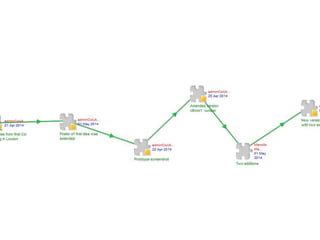
Simple example: cBook on numbers
1. First idea: the number 36
2. Expanding the idea
3. First prototype
4. Parallel idea involved expressions
5. Developing the first prototype
6. Adding open expression element for
pupils
Other cBook ideas
Between countries
• Size of group active CoI members. More activity means more
production.
• Number of ‘new’ CoI members. More new members means less
efficiency over the board as the new CoI members still need to get
acquainted with the work processes while ‘old’ CoI members are
helping the new ones to get there.
• Being acquainted with the way a CoI works, the ‘common interest’.
More common interest=better and more work. Less common
interest=harder to work.
• Ability to integrate CoI work in ‘normal job’. Better
integration=more efficient. Less integration=less efficient.
• Tangible rewards. A clear reward, like money or ‘in kind’ like
participation in conferences means more engagement and
commitment. Time=money, money=time.
• ‘Ownership’ of the product that is produced.
Ideas welcomed
After all, you are ‘my’
Community of Practice ;-)
References
Bernstein, B. (1971). Class, codes and control. London, UK: Routledge.
Engeström, Y., Engeström, R., & Kärkkäinen, M. (1995). Polycontextuality and boundary
crossing in expert cognition: Learning and problem solving in complex work activities. Learning
and Instruction, 5, 319–336.
Fischer, G. (2001). Communities of Interest: Learning through the Interaction of Multiple
Knowledge Systems. In the Proceedings of the 24th IRIS Conference S. Bjornestad, R. Moe, A.
Morch, A. Opdahl (Eds.) (pp. 1-14). August 2001, Ulvik, Department of Information Science,
Bergen, Norway.
Jaworski B. (2006). Theory and practice in mathematics teaching development: critical inquiry
as a mode of learning in teaching. Journal of Mathematics Teacher Education, 9(2), 187-211.
Wenger, E. (1998). Communities of Practice: Learning, Meaning, Identity. Cambridge University
Press.
Star, S. L. (1989). The structure of ill-structured solutions: Boundary objects and heterogeneous
distributed problem solving. In L. Gasser & M. Huhns (Eds.), Distributed artificial intelligence (pp.
37–54). San Mateo, CA: Morgan Kaufmann.
Suchman, L. (1994). Working relations of technology production and use. Computer Supported
Cooperative Work, 2, 21–39.
Wenger, E. (1998). Communities of practice, learning, meaning and identity. Cambridge, UK:
Cambridge University Press.

Presentation MASE meeting on MC2

  • 1.
    The research leadingto these results has received funding from the European Union Seventh Framework Programme (FP7/2007-2013) under grant agreement n° 610467 - project “M C Squared”. This publication reflects only the author’s views and Union is not liable for any use that may be made of the information contained therein. Christian Bokhove & Keith Jones
  • 2.
    Aims • Design anddevelop a new genre of authorable e-book, which we call 'the c-book' (c for creative) – Creative Mathematical Thinking (CMT) • Initiate a ‘Community of Interest’ (CoI) (Fischer, 2001) – A community of interest consists of several stakeholders from various ‘Communities of Practice’ (Wenger, 1998). – England, Spain, Greece, France – Within these teachers who co-design and use resources for teaching, can contribute to their own professional development (e.g., Jaworski, 2006). – Social Creativity • UK CoI: learning analytics
  • 6.
    cBooks are boundaryobjects • Boundary crossing • A boundary is defined as "a socio-cultural difference leading to discontinuity in action of interaction (e.g., Bernstein, 1971; Engeström, Engeström, & Kärkkäinen, 1995; Star, 1989; Suchman, 1994)". • “Where two worlds meet” • Not only cBook interesting but process as well.
  • 7.
    Simple example: cBookon numbers 1. First idea: the number 36
  • 8.
  • 9.
  • 10.
    4. Parallel ideainvolved expressions
  • 11.
    5. Developing thefirst prototype
  • 12.
    6. Adding openexpression element for pupils
  • 14.
  • 15.
    Between countries • Sizeof group active CoI members. More activity means more production. • Number of ‘new’ CoI members. More new members means less efficiency over the board as the new CoI members still need to get acquainted with the work processes while ‘old’ CoI members are helping the new ones to get there. • Being acquainted with the way a CoI works, the ‘common interest’. More common interest=better and more work. Less common interest=harder to work. • Ability to integrate CoI work in ‘normal job’. Better integration=more efficient. Less integration=less efficient. • Tangible rewards. A clear reward, like money or ‘in kind’ like participation in conferences means more engagement and commitment. Time=money, money=time. • ‘Ownership’ of the product that is produced.
  • 16.
    Ideas welcomed After all,you are ‘my’ Community of Practice ;-)
  • 17.
    References Bernstein, B. (1971).Class, codes and control. London, UK: Routledge. Engeström, Y., Engeström, R., & Kärkkäinen, M. (1995). Polycontextuality and boundary crossing in expert cognition: Learning and problem solving in complex work activities. Learning and Instruction, 5, 319–336. Fischer, G. (2001). Communities of Interest: Learning through the Interaction of Multiple Knowledge Systems. In the Proceedings of the 24th IRIS Conference S. Bjornestad, R. Moe, A. Morch, A. Opdahl (Eds.) (pp. 1-14). August 2001, Ulvik, Department of Information Science, Bergen, Norway. Jaworski B. (2006). Theory and practice in mathematics teaching development: critical inquiry as a mode of learning in teaching. Journal of Mathematics Teacher Education, 9(2), 187-211. Wenger, E. (1998). Communities of Practice: Learning, Meaning, Identity. Cambridge University Press. Star, S. L. (1989). The structure of ill-structured solutions: Boundary objects and heterogeneous distributed problem solving. In L. Gasser & M. Huhns (Eds.), Distributed artificial intelligence (pp. 37–54). San Mateo, CA: Morgan Kaufmann. Suchman, L. (1994). Working relations of technology production and use. Computer Supported Cooperative Work, 2, 21–39. Wenger, E. (1998). Communities of practice, learning, meaning and identity. Cambridge, UK: Cambridge University Press.

Editor's Notes

  • #2 The European ‘MC-squared’ project aims to start several so-called ‘Communities of Interest’ (CoI) (Fischer, 2001) in a number of European countries that work on digital, interactive, creative, mathematics textbooks, called cBooks. A community of interest consists of several stakeholders from various ‘Communities of Practice’ (Wenger, 1998). This paper documents the start-up process of the CoI in England by describing the development of two cBooks on building blocks, numbers and fractions. It describes how teachers, designers, researchers, teacher-educators jointly worked on cBooks as ‘boundary objects’ (Akkerman & Bakker, 2011) to facilitate thinking about creative mathematical thinking and social creativity. The process is illustrated by providing several artefacts that show the subsequent stages of development of the cBooks. The paper also describes the features of the cBooks themselves, showing several interactive ‘widgets’ that cater for creativity. The initial stages of the project provide a possible blueprint for the formation of CoI’s by working on digital, interactive, creative, mathematics textbooks.