Bureaucracy:  Centralization & Decentralization By GROUP-8 Debojit Roy – H66 Sritanu Das Mahapatra – H57 Abhisek Sahu – H3 Krishnakant Pandey – H25 Biswajit Ghosh – H12
ORGANISATION STRUCTURE A social unit deliberately constructed to seek specific goals Characterised by: planned divisions of responsibility power centres to control its efforts an explicit hierarchy and a well defined structure a communication network All organisations are  ‘goals led open systems’
Six key elements to be addressed when designing structure: Work Specialisation Departmentalisation Chain of Command (Scalar Chain) Span of Control (Number of subordinates reporting directly to a manager or supervisor.) Centralisation and Decentralisation Formalisation
ORGANISATIONAL STRUCTURE - KEY TERMS Formalisation   -  The degree to which jobs within the organization are standardized . Specialisation  - degree to which tasks are divided into separate jobs Centralisation  - describes the locus of decision making in the organisation; centralised organisations are characterised by a concentration of decision making at the top of the management hierarchy Departmentalization  -  The basis by which jobs are grouped together.
ORGANISATIONAL STRUCTURE - KEY TERMS Chain of Command  -  The unbroken line of authority that extends from the top of the organization to the lowest echelon and clarifies who reports to whom. Decentralization  -  The degree to which decision making is spread throughout the organization.
Bureaucracy A structure of highly operating routine tasks achieved through specialization, very formalized rules and regulations, tasks that are grouped into functional departments, centralized authority, narrow spans of control, and decision making that follows the chain of command.
Hierarchy Tall and flat forms Span of control Time span of discretion Bureaucratic structure
CLASSICAL APPROACH Emphasis on purpose, formal structure, hierarchy of management, technical requirements and common principles of organisation. This perspective was concerned with structuring organisations effectively. Two major sub-groupings of this approach are: Bureaucracy Scientific Management (sometimes categorised as an approach in its own right)
CLASSICAL APPROACH Major Contributors : Henri Fayol Linda Urwick Max Weber – most prominent of the three. Weber  proposed a bureaucratic form of structure that he believed would work for all organisations.
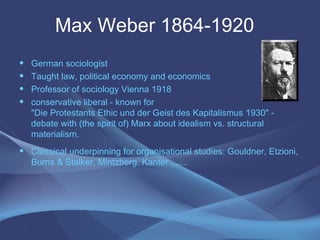
Max Weber 1864-1920  German sociologist Taught law, political economy and economics Professor of sociology Vienna 1918 conservative liberal - known for  "Die Protestants Ethic und der Geist des Kapitalismus 1930" - debate with (the spirit of) Marx about idealism vs. structural materialism. Classical underpinning for organisational studies: Gouldner, Etzioni, Burns & Stalker, Mintzberg, Kanter .......
CLASSICAL APPROACH Weber’s Ideal Bureaucracy Job Specialisation Authority Hierarchy Formal Selection Formal Rules and Regulations Impersonality Career Orientation Criticisms of Bureaucracy Lack of attention to the informal organisation. Restriction of psychological growth Bureaucratic dysfunction
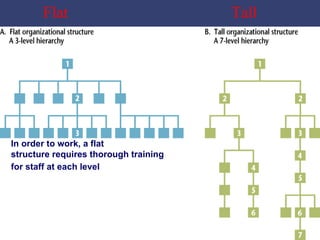
TALL STRUCTURES : Thought by classical theorists to be inefficient because of: Increased overheads Communication problems Ill defined management roles Duplication of effort Planning and co-ordination problems However, a contemporary view is that tall structures may facilitate team working, with all its attendant benefits
FLAT STRUCTURES: Result in delegation (motivational) Facilitate communication Clarify management hierarchies Result in meaningful progression for employees (less frequent promotions, but greater increases in authority between levels)
Flat Tall In order to work, a flat structure requires thorough training for staff at each level
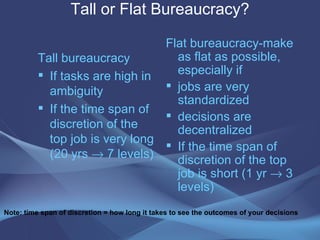
Tall or Flat Bureaucracy? Tall bureaucracy If tasks are high in ambiguity If the time span of discretion of the top job is very long (20 yrs    7 levels) Flat bureaucracy-make as flat as possible, especially if jobs are very standardized decisions are decentralized If the time span of discretion of the top job is short (1 yr    3 levels) Note: time span of discretion = how long it takes to see the outcomes of your decisions
SPAN OF CONTROL Basic building block of organisational structure Simply - number of subordinates who report to each manager 1 - 10: narrow span 11+: wide span Determines whether the organisation has a  TALL  or a  FLAT  structure
SPAN DETERMINED BY: Manager’s ability Subordinates’ abilities Similarity of subordinates’ work Nature of potential problems Amount of ‘self help’ available to subordinates Nature of controls required Availability of managerial support
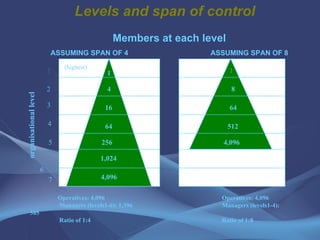
1 4 16 64 256 1,024 4,096 (highest) 1 8 64 512 4,096 1 2 3 4 5 6 7 organisational level Members at each level ASSUMING SPAN OF 4   ASSUMING SPAN OF 8 Operatives: 4,096   Operatives: 4,096 Managers (levels1-6): 1,396 Managers (levels1-4): 585 Ratio of 1:4   Ratio of 1:8 Levels and span of control
Centralisation and Decentralised Centralisation -   refers to the concentration of authority and responsibility for decision making in the hands of managers at the top of an organisation. Decentralisation -  refers to authority and responsibility for decision making being dispersed more widely downwards and given the to operating units, branches and lower-level managers.
CENTRALISATION Senior mgt can exercise greater control Procedures can be centralised for organisation as a whole Decisions can be taken from a global perspective Easier to maintain ‘balance’ between departments and functions Senior mgt more experienced decision makers Centralised management better in times of crisis
DECENTRALISATION Reduced stress and burden on senior management. Greater job satisfaction for subordinates Subordinates may have better ‘local’ knowledge Delegation increases flexibility and responsiveness to change Decentralisation can be used to train managers Decentralisation may lead to improved control
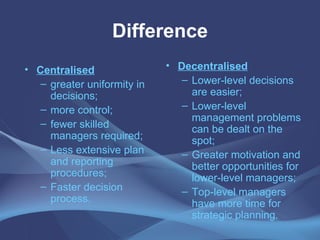
Difference Centralised greater uniformity in decisions; more control; fewer skilled managers required; Less extensive plan and reporting procedures; Faster decision process. Decentralised Lower-level decisions are easier; Lower-level management problems can be dealt on the spot; Greater motivation and better opportunities for lower-level managers; Top-level managers have more time for strategic planning.
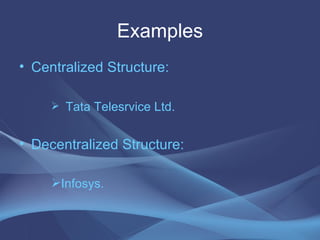
Examples Centralized Structure: Tata Telesrvice Ltd. Decentralized Structure: Infosys.

Bureaucracy: Centralization & Decentralization

  • 1.
    Bureaucracy: Centralization& Decentralization By GROUP-8 Debojit Roy – H66 Sritanu Das Mahapatra – H57 Abhisek Sahu – H3 Krishnakant Pandey – H25 Biswajit Ghosh – H12
  • 2.
    ORGANISATION STRUCTURE Asocial unit deliberately constructed to seek specific goals Characterised by: planned divisions of responsibility power centres to control its efforts an explicit hierarchy and a well defined structure a communication network All organisations are ‘goals led open systems’
  • 3.
    Six key elementsto be addressed when designing structure: Work Specialisation Departmentalisation Chain of Command (Scalar Chain) Span of Control (Number of subordinates reporting directly to a manager or supervisor.) Centralisation and Decentralisation Formalisation
  • 4.
    ORGANISATIONAL STRUCTURE -KEY TERMS Formalisation - The degree to which jobs within the organization are standardized . Specialisation - degree to which tasks are divided into separate jobs Centralisation - describes the locus of decision making in the organisation; centralised organisations are characterised by a concentration of decision making at the top of the management hierarchy Departmentalization - The basis by which jobs are grouped together.
  • 5.
    ORGANISATIONAL STRUCTURE -KEY TERMS Chain of Command - The unbroken line of authority that extends from the top of the organization to the lowest echelon and clarifies who reports to whom. Decentralization - The degree to which decision making is spread throughout the organization.
  • 6.
    Bureaucracy A structureof highly operating routine tasks achieved through specialization, very formalized rules and regulations, tasks that are grouped into functional departments, centralized authority, narrow spans of control, and decision making that follows the chain of command.
  • 7.
    Hierarchy Tall andflat forms Span of control Time span of discretion Bureaucratic structure
  • 8.
    CLASSICAL APPROACH Emphasison purpose, formal structure, hierarchy of management, technical requirements and common principles of organisation. This perspective was concerned with structuring organisations effectively. Two major sub-groupings of this approach are: Bureaucracy Scientific Management (sometimes categorised as an approach in its own right)
  • 9.
    CLASSICAL APPROACH MajorContributors : Henri Fayol Linda Urwick Max Weber – most prominent of the three. Weber proposed a bureaucratic form of structure that he believed would work for all organisations.
  • 10.
    Max Weber 1864-1920 German sociologist Taught law, political economy and economics Professor of sociology Vienna 1918 conservative liberal - known for "Die Protestants Ethic und der Geist des Kapitalismus 1930" - debate with (the spirit of) Marx about idealism vs. structural materialism. Classical underpinning for organisational studies: Gouldner, Etzioni, Burns & Stalker, Mintzberg, Kanter .......
  • 11.
    CLASSICAL APPROACH Weber’sIdeal Bureaucracy Job Specialisation Authority Hierarchy Formal Selection Formal Rules and Regulations Impersonality Career Orientation Criticisms of Bureaucracy Lack of attention to the informal organisation. Restriction of psychological growth Bureaucratic dysfunction
  • 12.
    TALL STRUCTURES :Thought by classical theorists to be inefficient because of: Increased overheads Communication problems Ill defined management roles Duplication of effort Planning and co-ordination problems However, a contemporary view is that tall structures may facilitate team working, with all its attendant benefits
  • 13.
    FLAT STRUCTURES: Resultin delegation (motivational) Facilitate communication Clarify management hierarchies Result in meaningful progression for employees (less frequent promotions, but greater increases in authority between levels)
  • 14.
    Flat Tall Inorder to work, a flat structure requires thorough training for staff at each level
  • 15.
    Tall or FlatBureaucracy? Tall bureaucracy If tasks are high in ambiguity If the time span of discretion of the top job is very long (20 yrs  7 levels) Flat bureaucracy-make as flat as possible, especially if jobs are very standardized decisions are decentralized If the time span of discretion of the top job is short (1 yr  3 levels) Note: time span of discretion = how long it takes to see the outcomes of your decisions
  • 16.
    SPAN OF CONTROLBasic building block of organisational structure Simply - number of subordinates who report to each manager 1 - 10: narrow span 11+: wide span Determines whether the organisation has a TALL or a FLAT structure
  • 17.
    SPAN DETERMINED BY:Manager’s ability Subordinates’ abilities Similarity of subordinates’ work Nature of potential problems Amount of ‘self help’ available to subordinates Nature of controls required Availability of managerial support
  • 18.
    1 4 1664 256 1,024 4,096 (highest) 1 8 64 512 4,096 1 2 3 4 5 6 7 organisational level Members at each level ASSUMING SPAN OF 4 ASSUMING SPAN OF 8 Operatives: 4,096 Operatives: 4,096 Managers (levels1-6): 1,396 Managers (levels1-4): 585 Ratio of 1:4 Ratio of 1:8 Levels and span of control
  • 19.
    Centralisation and DecentralisedCentralisation - refers to the concentration of authority and responsibility for decision making in the hands of managers at the top of an organisation. Decentralisation - refers to authority and responsibility for decision making being dispersed more widely downwards and given the to operating units, branches and lower-level managers.
  • 20.
    CENTRALISATION Senior mgtcan exercise greater control Procedures can be centralised for organisation as a whole Decisions can be taken from a global perspective Easier to maintain ‘balance’ between departments and functions Senior mgt more experienced decision makers Centralised management better in times of crisis
  • 21.
    DECENTRALISATION Reduced stressand burden on senior management. Greater job satisfaction for subordinates Subordinates may have better ‘local’ knowledge Delegation increases flexibility and responsiveness to change Decentralisation can be used to train managers Decentralisation may lead to improved control
  • 22.
    Difference Centralised greateruniformity in decisions; more control; fewer skilled managers required; Less extensive plan and reporting procedures; Faster decision process. Decentralised Lower-level decisions are easier; Lower-level management problems can be dealt on the spot; Greater motivation and better opportunities for lower-level managers; Top-level managers have more time for strategic planning.
  • 23.
    Examples Centralized Structure:Tata Telesrvice Ltd. Decentralized Structure: Infosys.

Editor's Notes