Lecture 3  Organisation Structure Prepared by: ANS First Prepared on: 11-01-06 Last Modified on: xx-xx-xx Quality checked by: HKP Copyright 2004 Asia Pacific Institute of Information Technology  Introduction to Management BM007-3-1
Learning Outcomes At the end of this chapter, YOU should be able to know:   How differentiation and integration influence an organisation structure How authority operates How Span of Control affects structure and managerial effectiveness The difference between centralised and decentralised organisation. How to allocate jobs to work units How to manage the unique challenges of the matrix structure.
Key Terms you must be able to use If you have mastered this topic,  you should be able to use the following terms correctly in your assignments and exams : Authority Responsibility Span of Control Delegation Centralisation and decentralisation
A formal pattern of interactions and coordination designed by management to link the tasks of individuals and group in achieving organisational goals  A formal framework by which jobs tasks are divided, grouped and coordinated. When managers develop or change an organisation’s structure thy engage in  Organisational Design Introduction
Organisational Structure How job tasks are formally  divided, grouped and coordinated . (Robbins, 1996). The established  pattern of relationships  between the component parts of an organisation, outlining both  communication, control and authority patterns. (Wilson and Rosenfeld, 1990).
Organisational Structure The  formal pattern of interactions and co-ordination  designed by management to link the tasks of  individuals and groups  in achieving  organisational goals. (Bartol and  M artin, 1994).
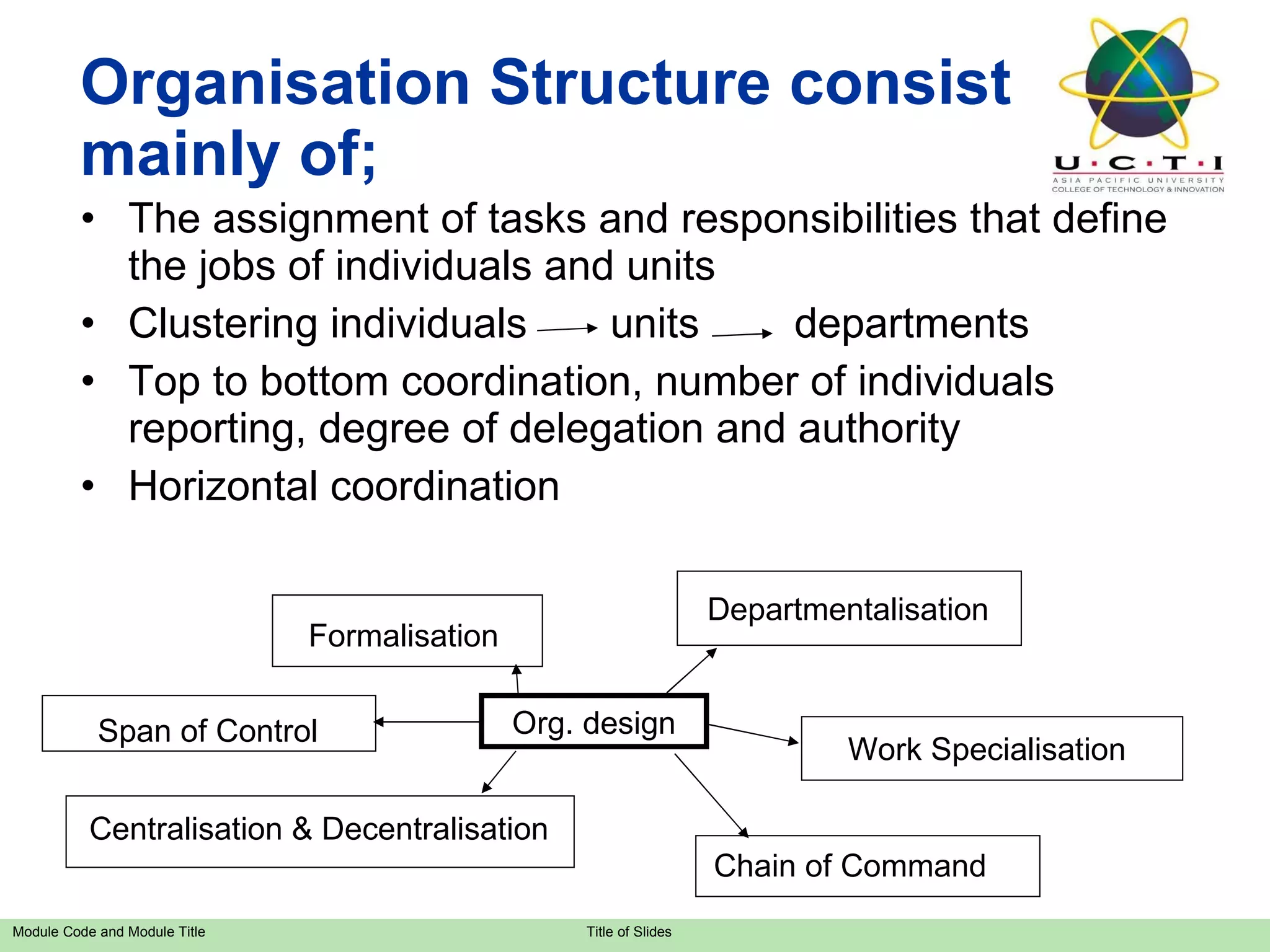
Organisation Structure consist mainly of; The assignment of tasks and responsibilities that define the jobs of individuals and units Clustering individuals  units  departments Top to bottom coordination, number of individuals reporting, degree of delegation and authority Horizontal coordination Org. design Departmentalisation Work Specialisation Chain of Command Centralisation & Decentralisation Span of Control Formalisation
Why Do Businesses Need to be Organised? Small businesses (particularly sole traders) have an informal organisational structure As a business gets bigger then it starts to form some kind of organisation An organisation structure is required as soon as there are several people working in the business The structure determines: Who is responsible for what job and Who is responsible to whom.
Responsibility  – Area of work for a person or group is accountable for. E.g. discipline of staff or sales of product. Duties  – Work or job requirements arising from responsibilities. E.g. Writing a warning letter for late coming or to meet clients or customers to persuade then to buy products or services. Authority  – the right to make decisions and take action. E.g. secretary is given the authority to sign orders up to RM500. Failure to coordinate between departments result in duplication of work, stress, communication breakdown and therefore frustrated staff Definition of terms
Responsibility  is defined as “a particular burden of obligation upon a person who is responsible.”  Responsible is defined as “answerable or accountable, as for something within one’s power or control.”  Therefore,  a leader is responsible and has responsibility for the operation for which she has been given authority.
Authority  is defined as “a power or right, delegated or given.”  In this sense,  the person or company that hires a leader vests him with the authority to manage or direct a particular operation.  It is expected that this individual will exercise the full scope of his authority to properly, profitably, and professionally manage the operation.
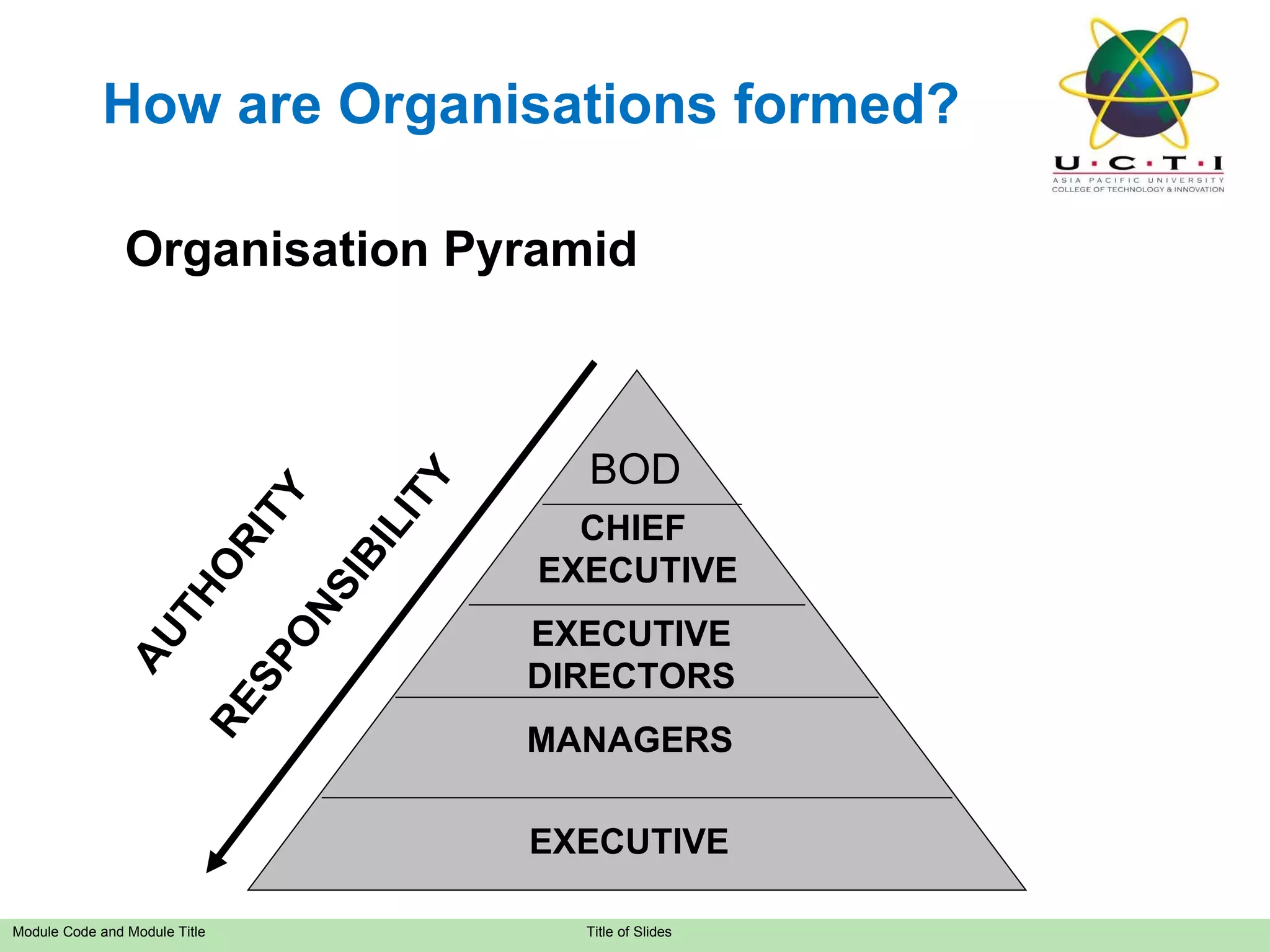
Organisation Pyramid BOD CHIEF  EXECUTIVE EXECUTIVE DIRECTORS MANAGERS EXECUTIVE AUTHORITY RESPONSIBILITY How are Organisations formed?
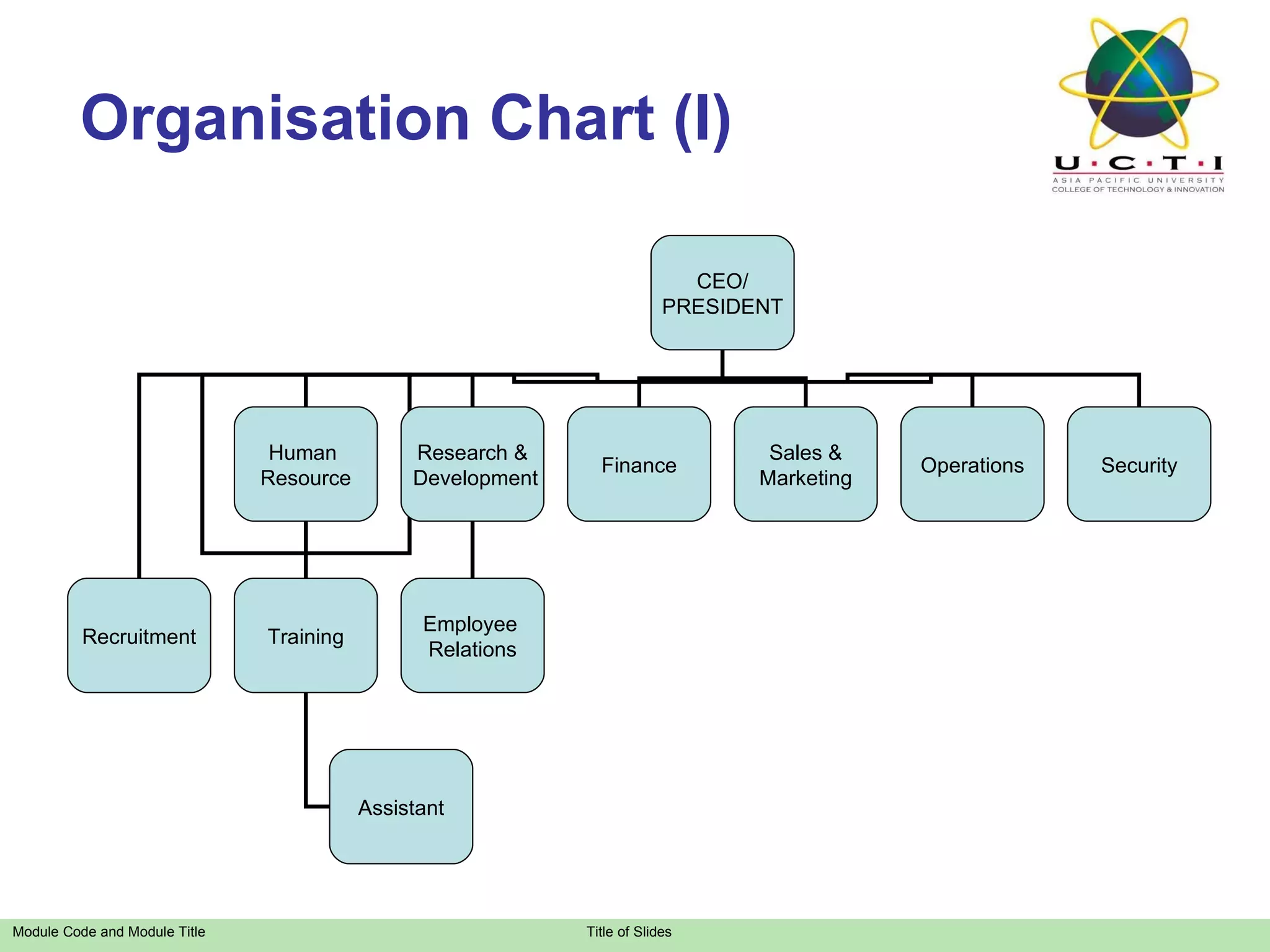
Organisation Chart (I) CEO/ PRESIDENT Human  Resource Operations Security Recruitment Finance Research & Development Training Sales & Marketing Employee   Relations Assistant
Organisation Chart (II) Shows; The business divided into areas where employees have responsibilities. States relationships between staffs e.g. Supervisor, subordinate, peer. Shows the number of people working in the organisation. Historical record – organisation changes makes the chart become out of date. As information to new employees and special group. Main lines of communication.
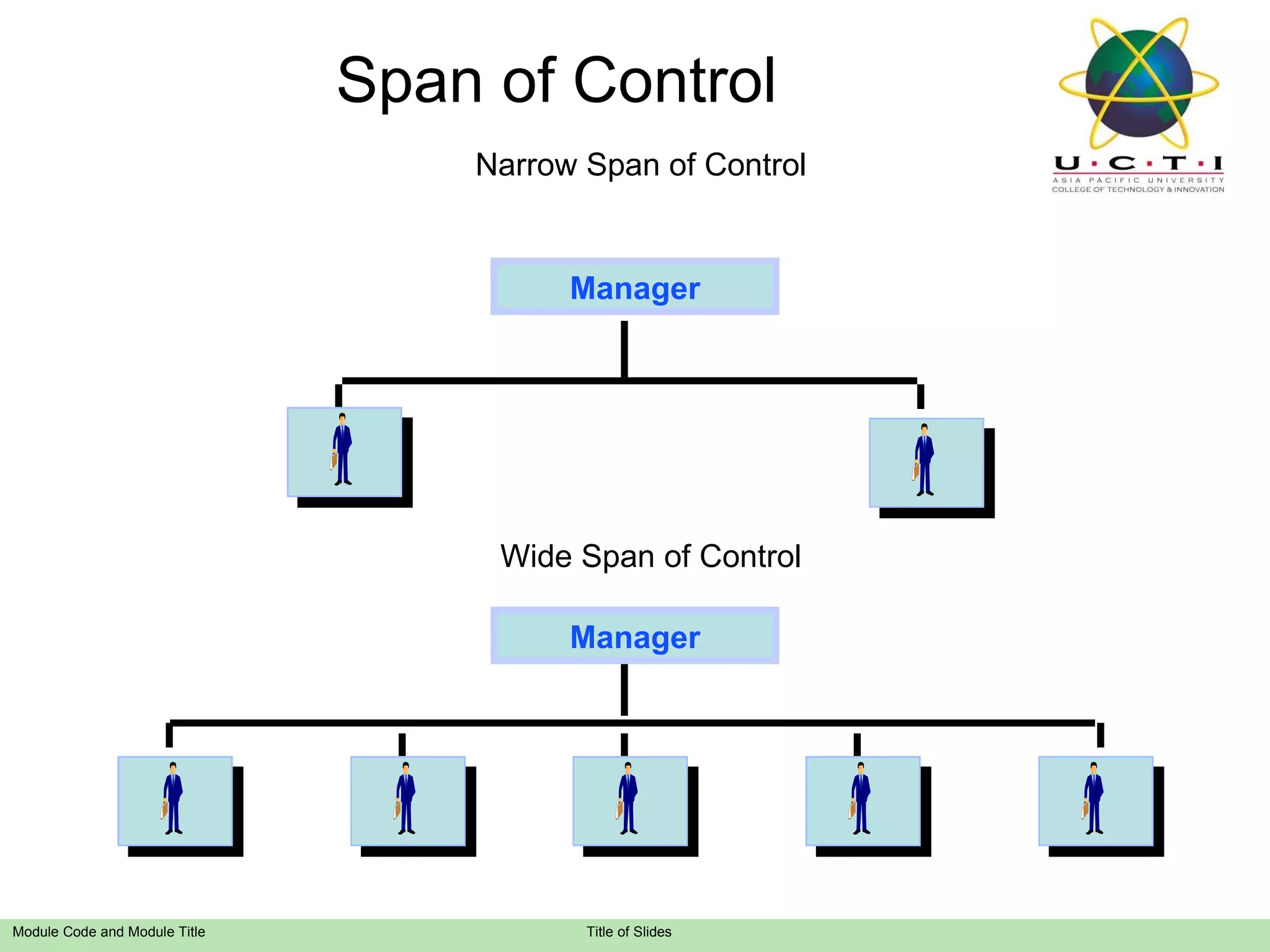
Span of Control (I) The number of subordinates a supervisor has reporting to him/her. It is recommended that a supervisor has about 5/6 subordinates for effective management. 2 types of span of Control;  Narrow Wide Narrow Closer and more contact with subordinate Tight control and tight supervision More time for other duties – planning, decision making A lot of layers, more positions
Span of Control (II) Wide Reduced operation and administrative costs Easier communication Coordination problems reduced Quicker decision making Can cultivate higher motivation level in subordinates
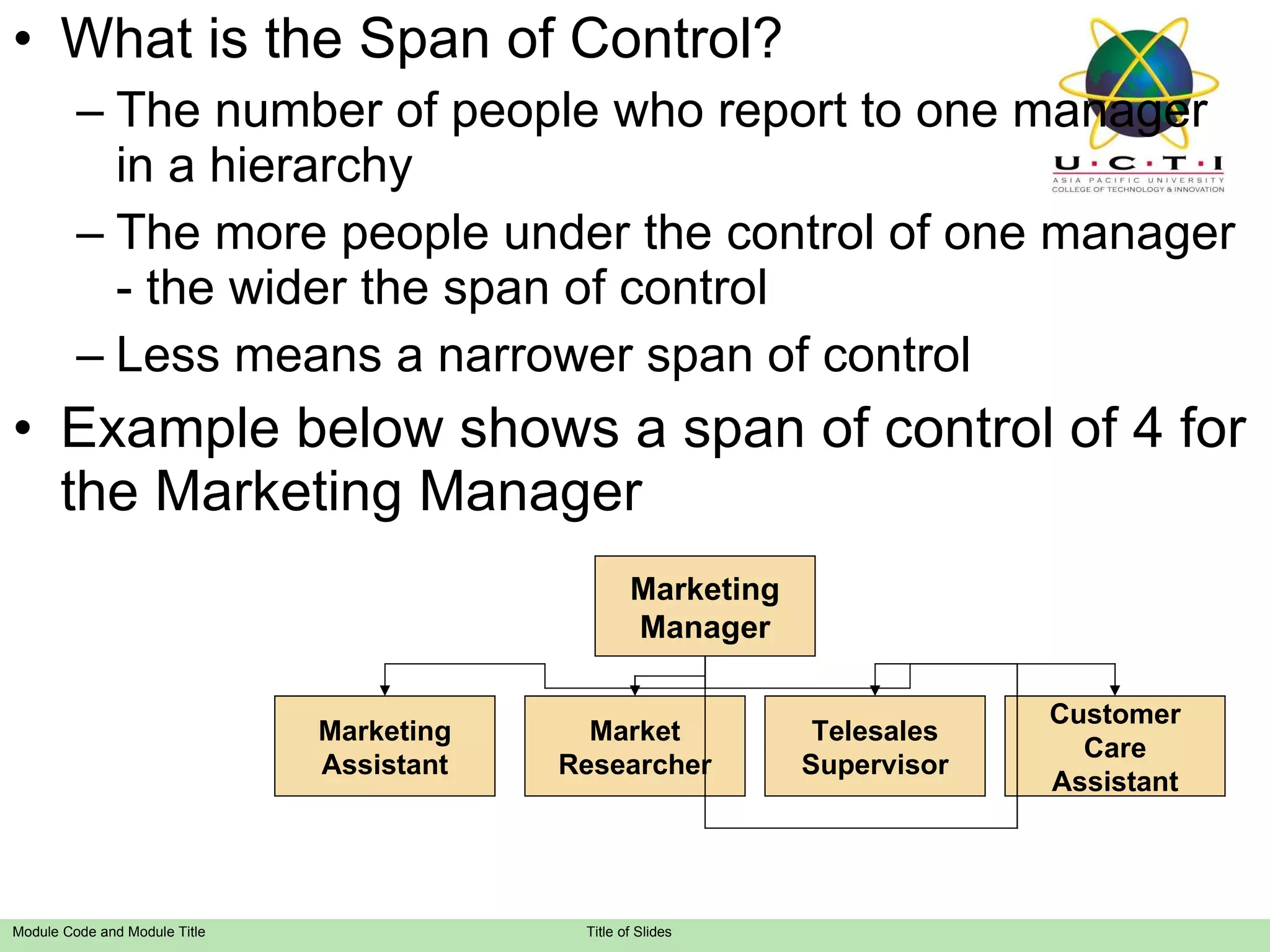
What is the Span of Control? The number of people who report to one manager in a hierarchy The more people under the control of one manager - the wider the span of control Less means a narrower span of control Example below shows a span of control of 4 for the Marketing Manager Marketing Manager Marketing Assistant Market Researcher Telesales Supervisor Customer Care Assistant
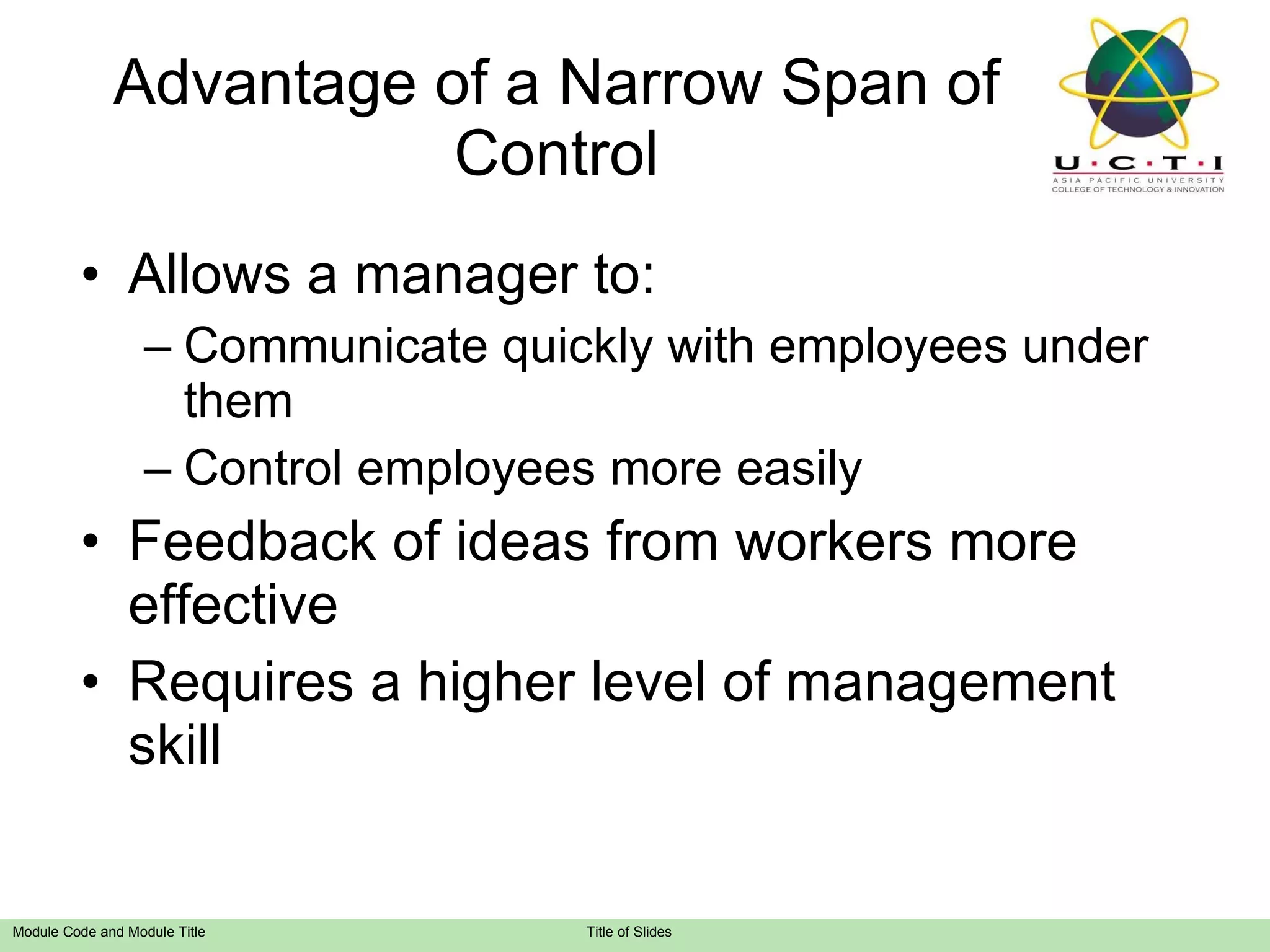
Advantage of a Narrow Span of Control Allows a manager to: Communicate quickly with employees under them Control employees more easily Feedback of ideas from workers more effective Requires a higher level of management skill
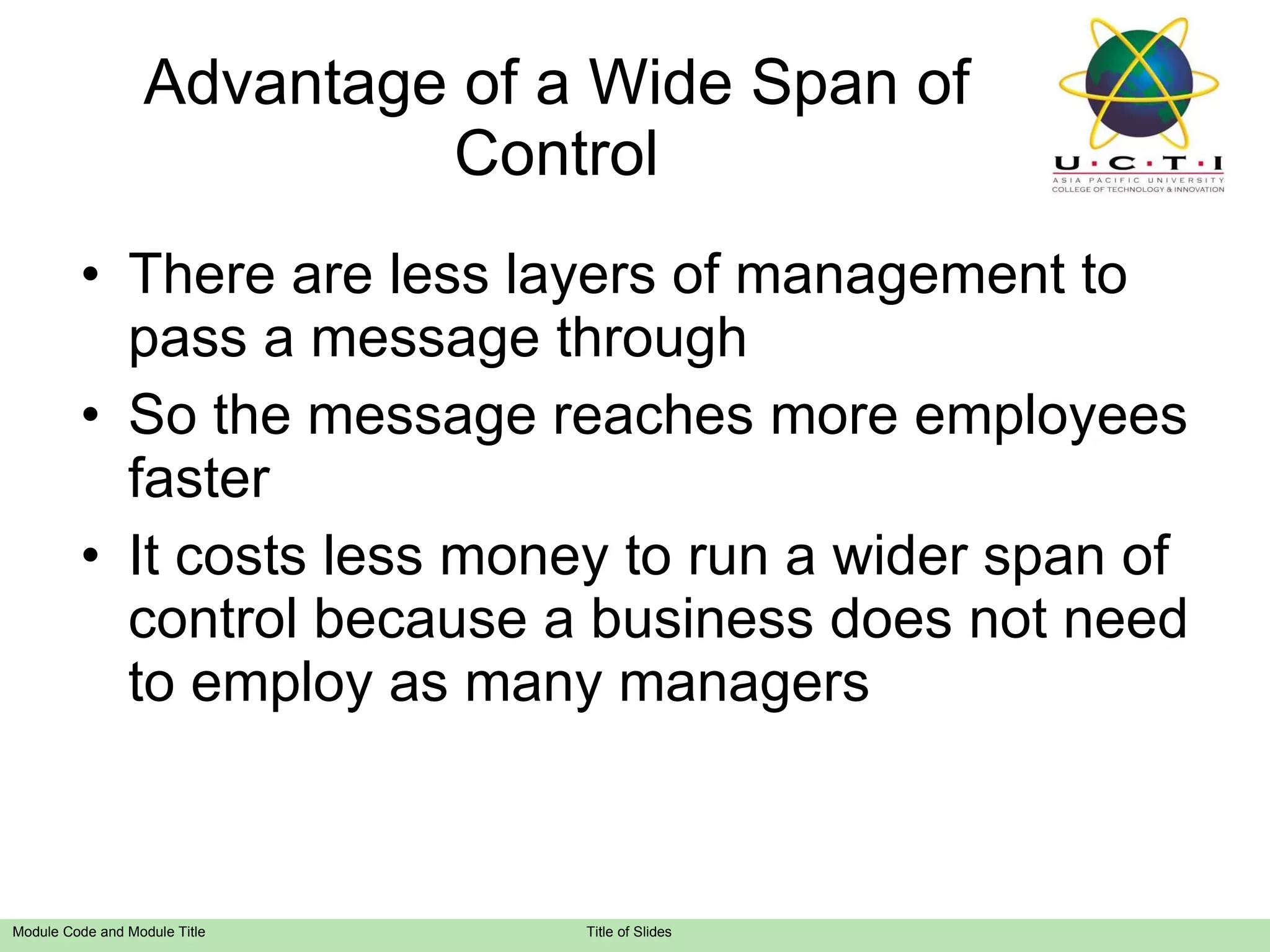
Advantage of a Wide Span of Control There are less layers of management to pass a message through So the message reaches more employees faster It costs less money to run a wider span of control because a business does not need to employ as many managers
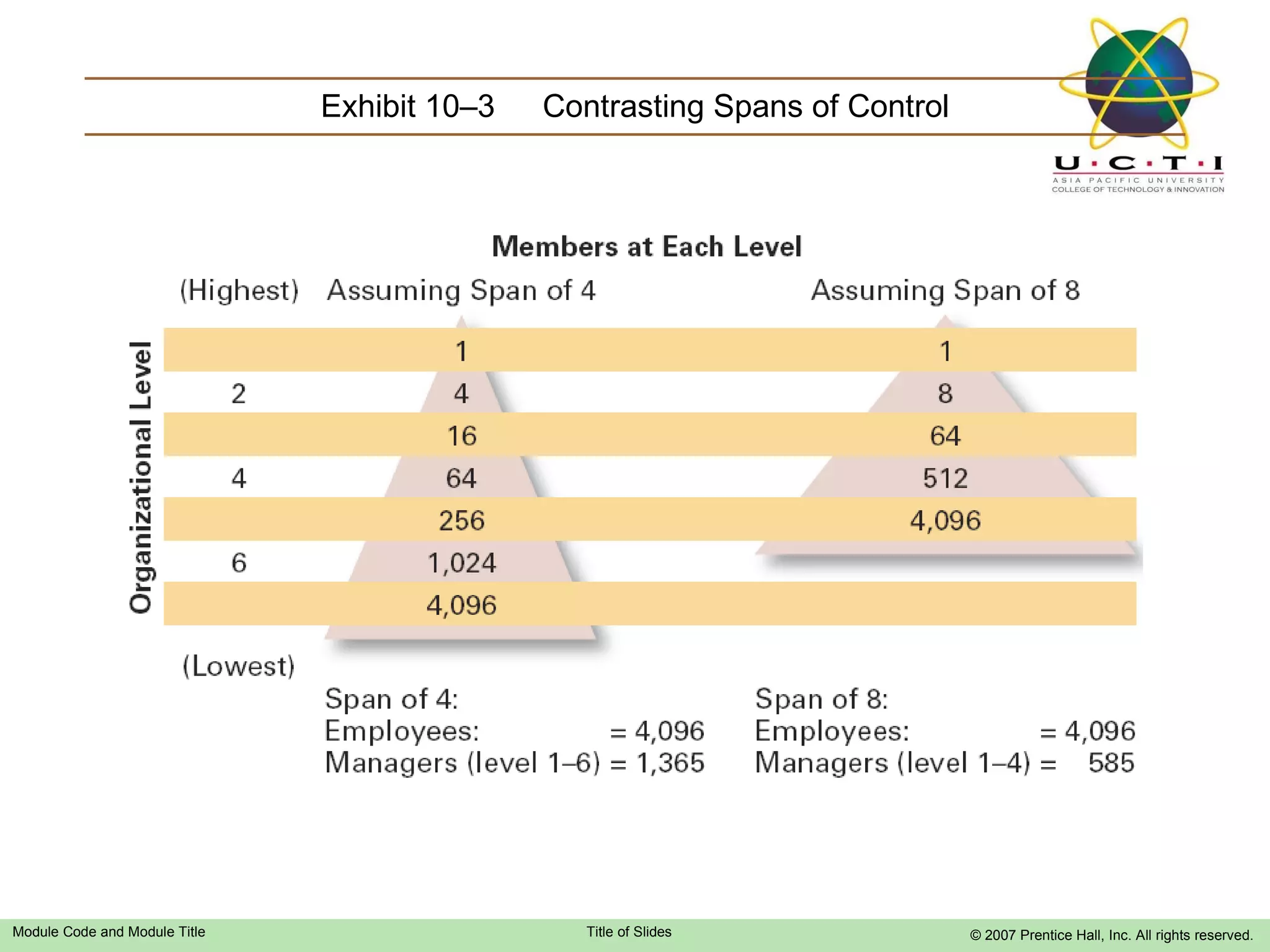
Exhibit 10–3 Contrasting Spans of Control © 2007 Prentice Hall, Inc. All rights reserved.
Span of Control Narrow Span of Control Manager Wide Span of Control Manager
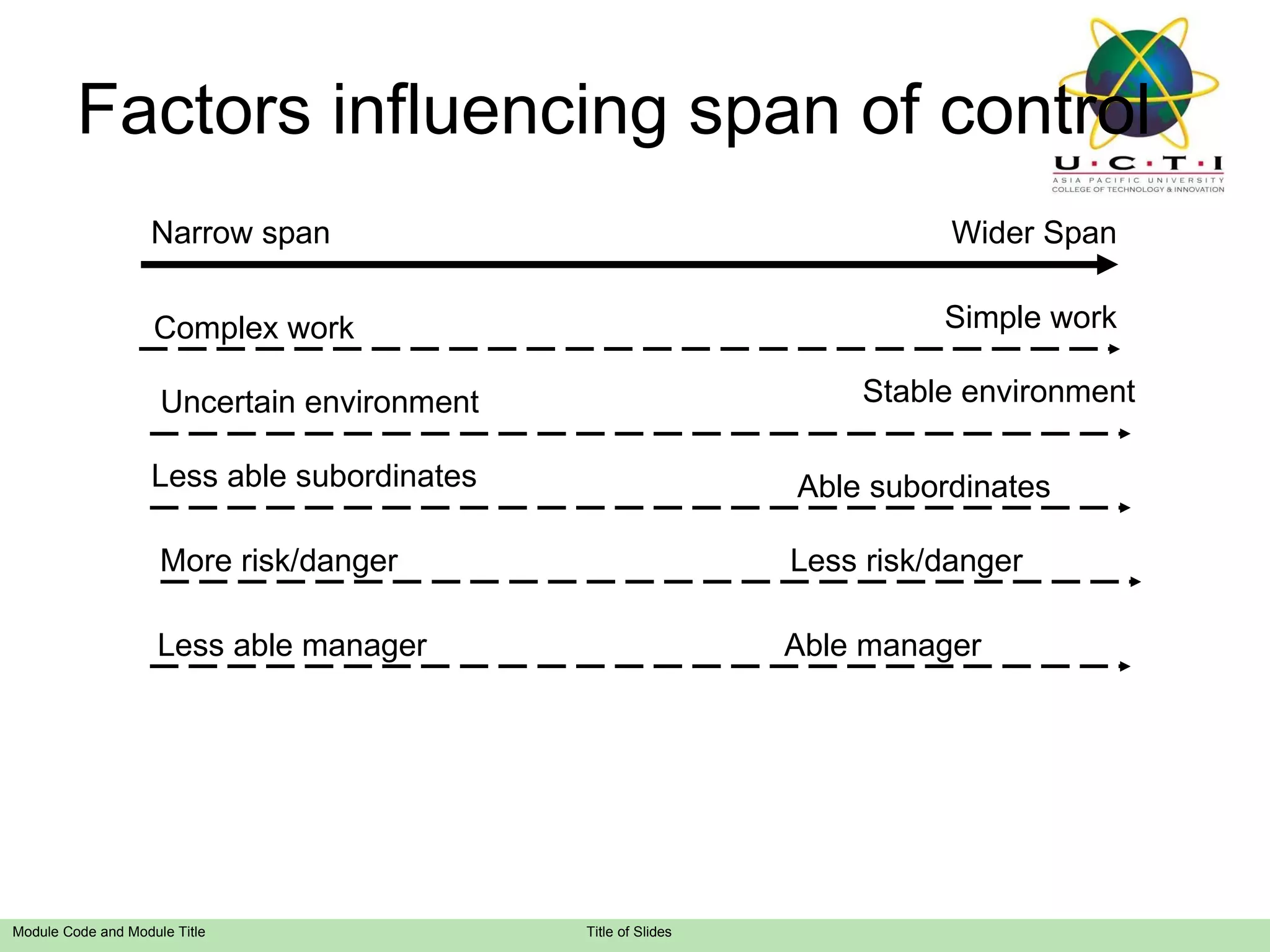
Factors influencing span of control Narrow span Wider Span Complex work Simple work Uncertain environment Stable environment Less able subordinates Able subordinates More risk/danger Less risk/danger Less able manager Able manager
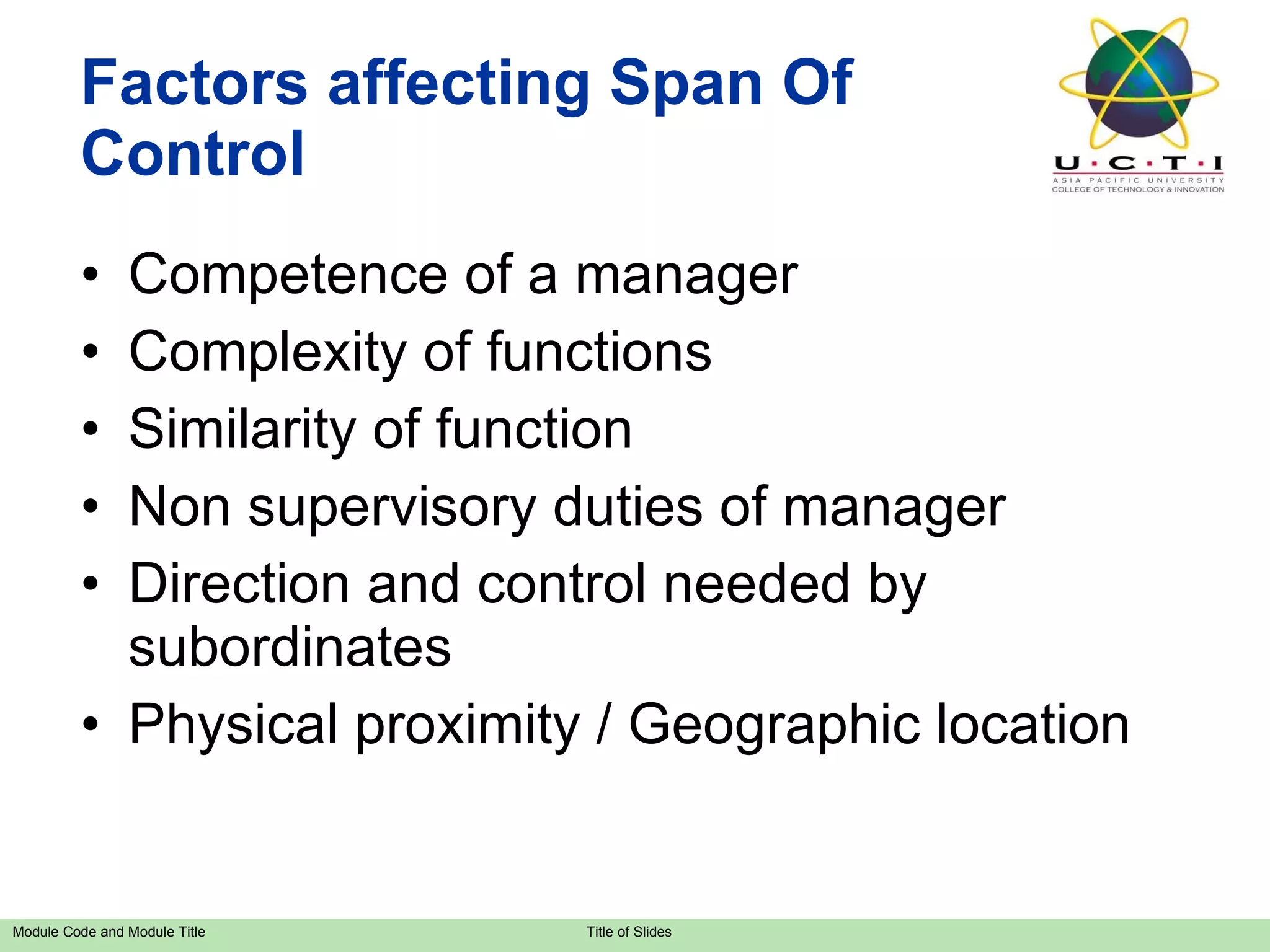
Factors affecting Span Of Control Competence of a manager Complexity of functions Similarity of function Non supervisory duties of manager Direction and control needed by subordinates Physical proximity / Geographic location
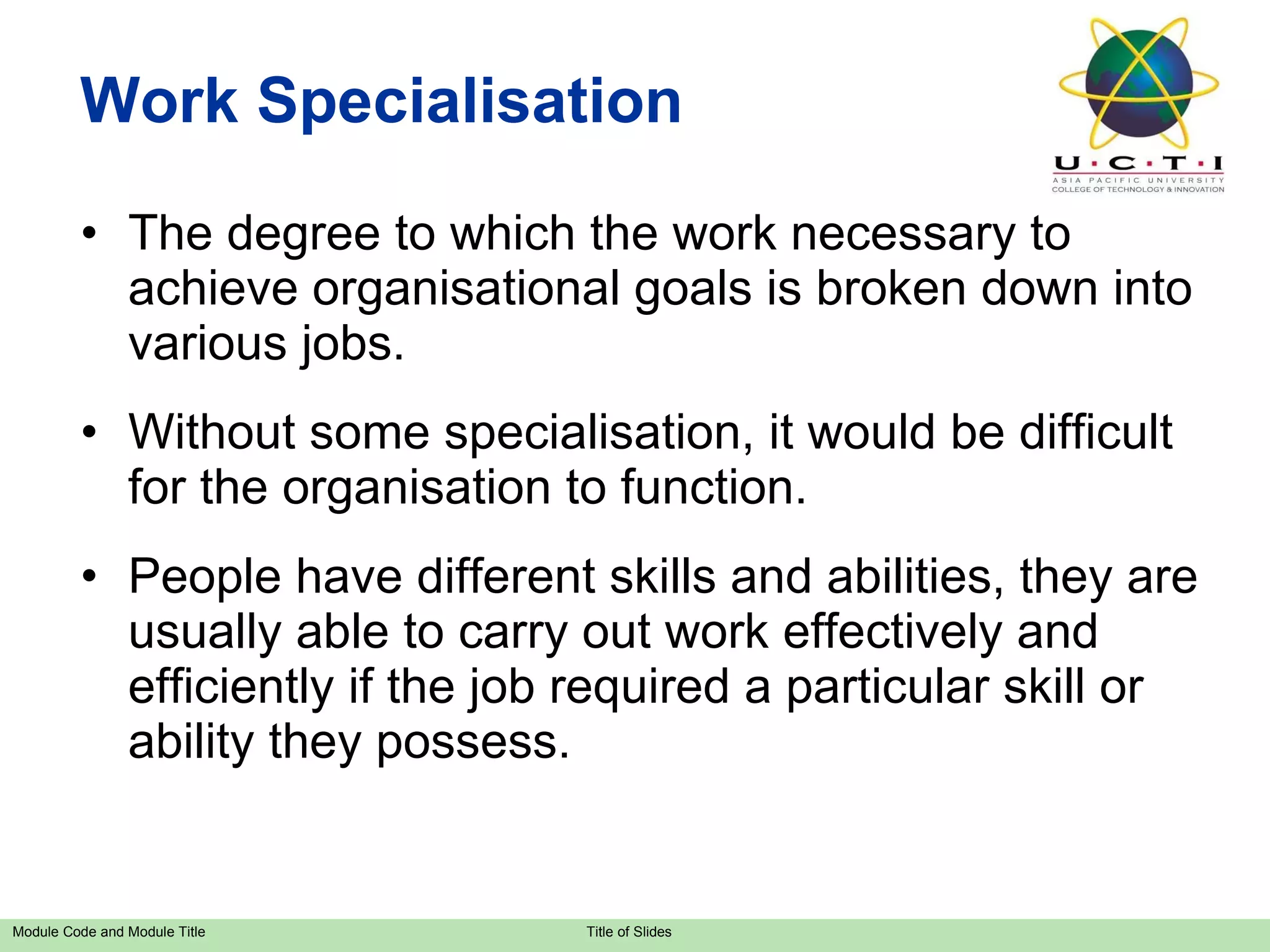
Work Specialisation The degree to which the work necessary to achieve organisational goals is broken down into various jobs. Without some specialisation, it would be difficult for the organisation to function. People have different skills and abilities, they are usually able to carry out work effectively and efficiently if the job required a particular skill or ability they possess.
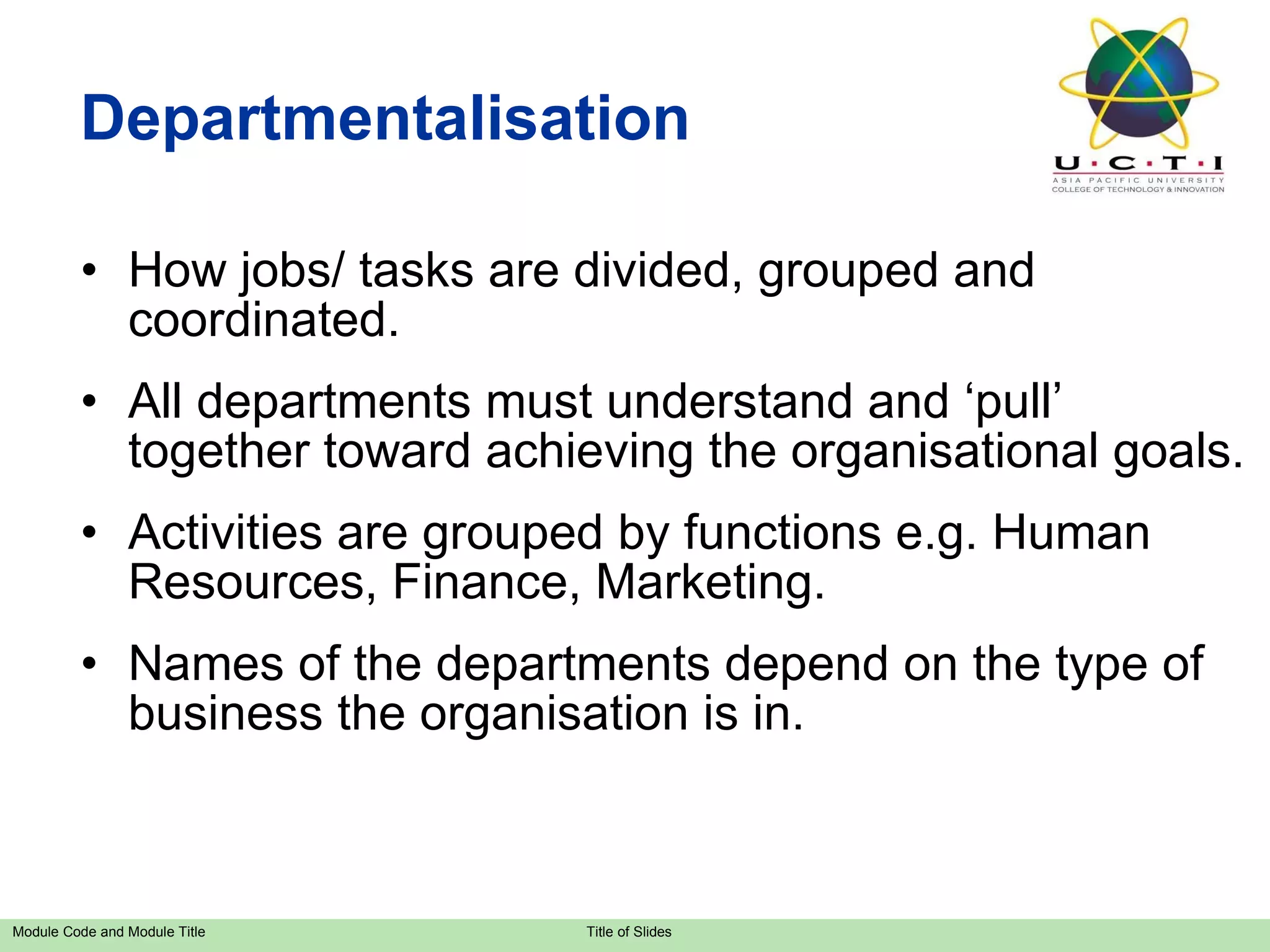
Departmentalisation The main department designs are by; Function Product Geography Matrix
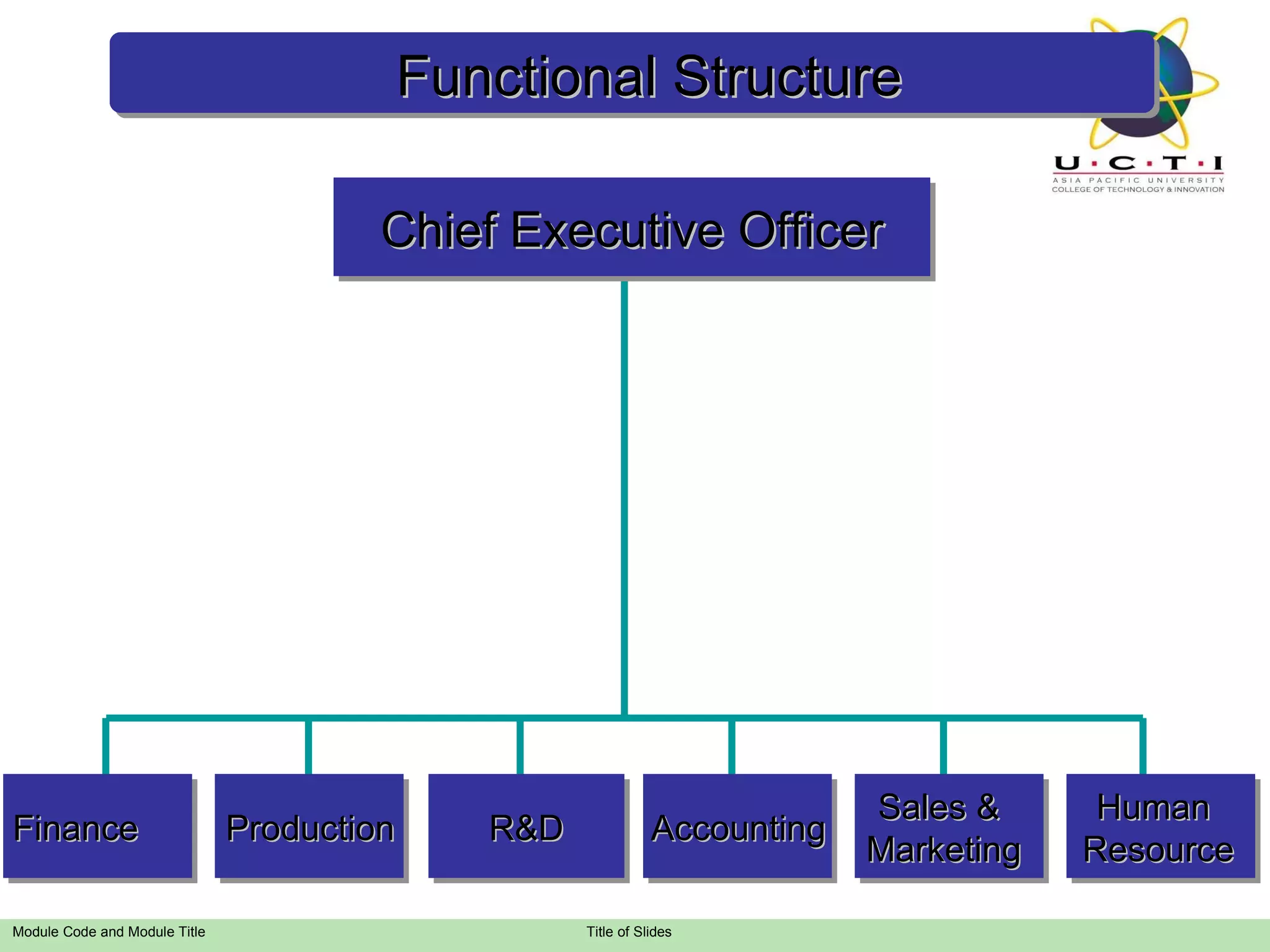
Departmentalisation How jobs/ tasks are divided, grouped and coordinated. All departments must understand and ‘pull’ together toward achieving the organisational goals. Activities are grouped by functions e.g. Human Resources, Finance, Marketing. Names of the departments depend on the type of business the organisation is in.
Production Finance R&D Accounting Sales &  Marketing Human  Resource Chief Executive Officer Functional Structure
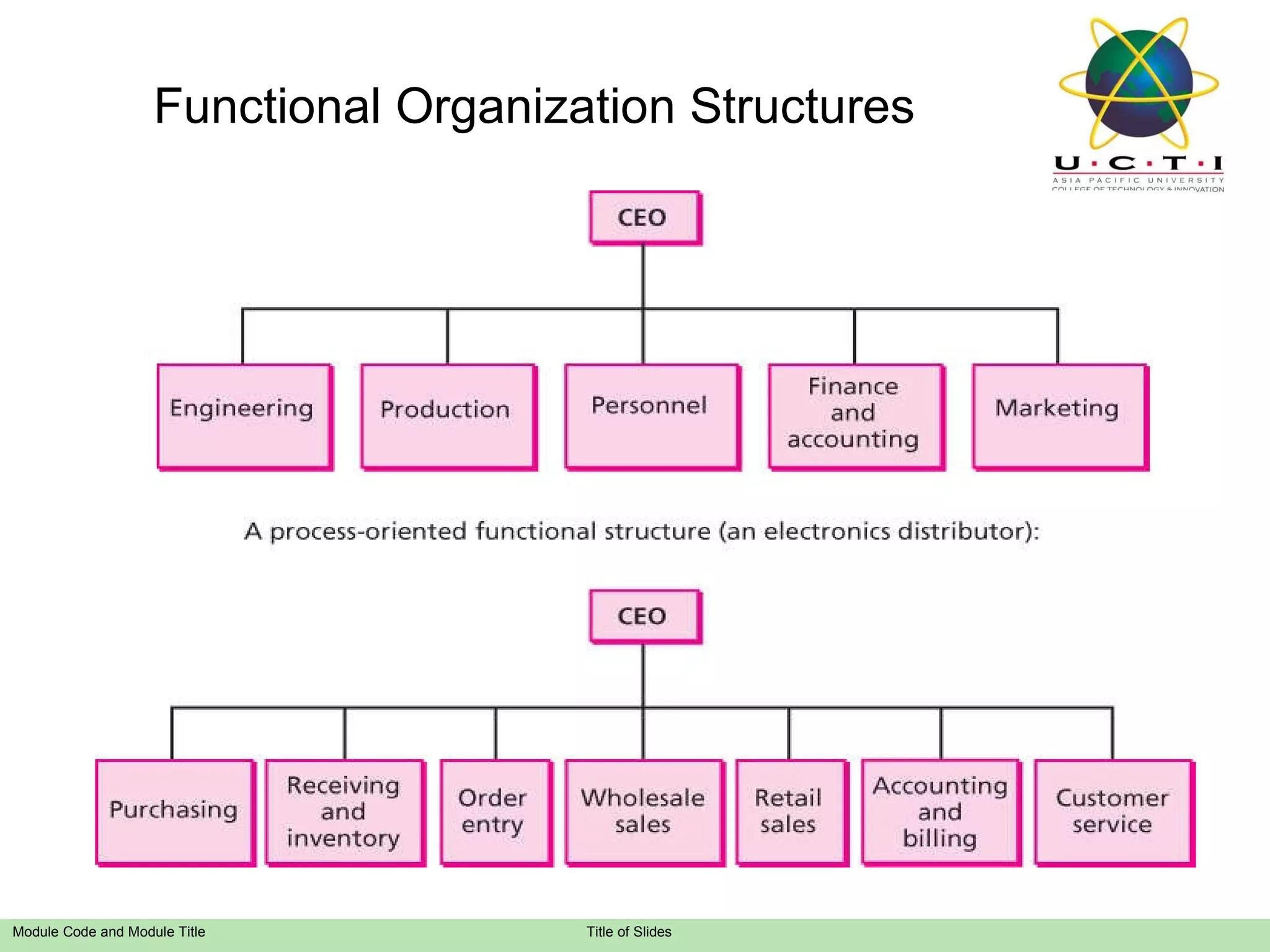
Functional Organization Structures
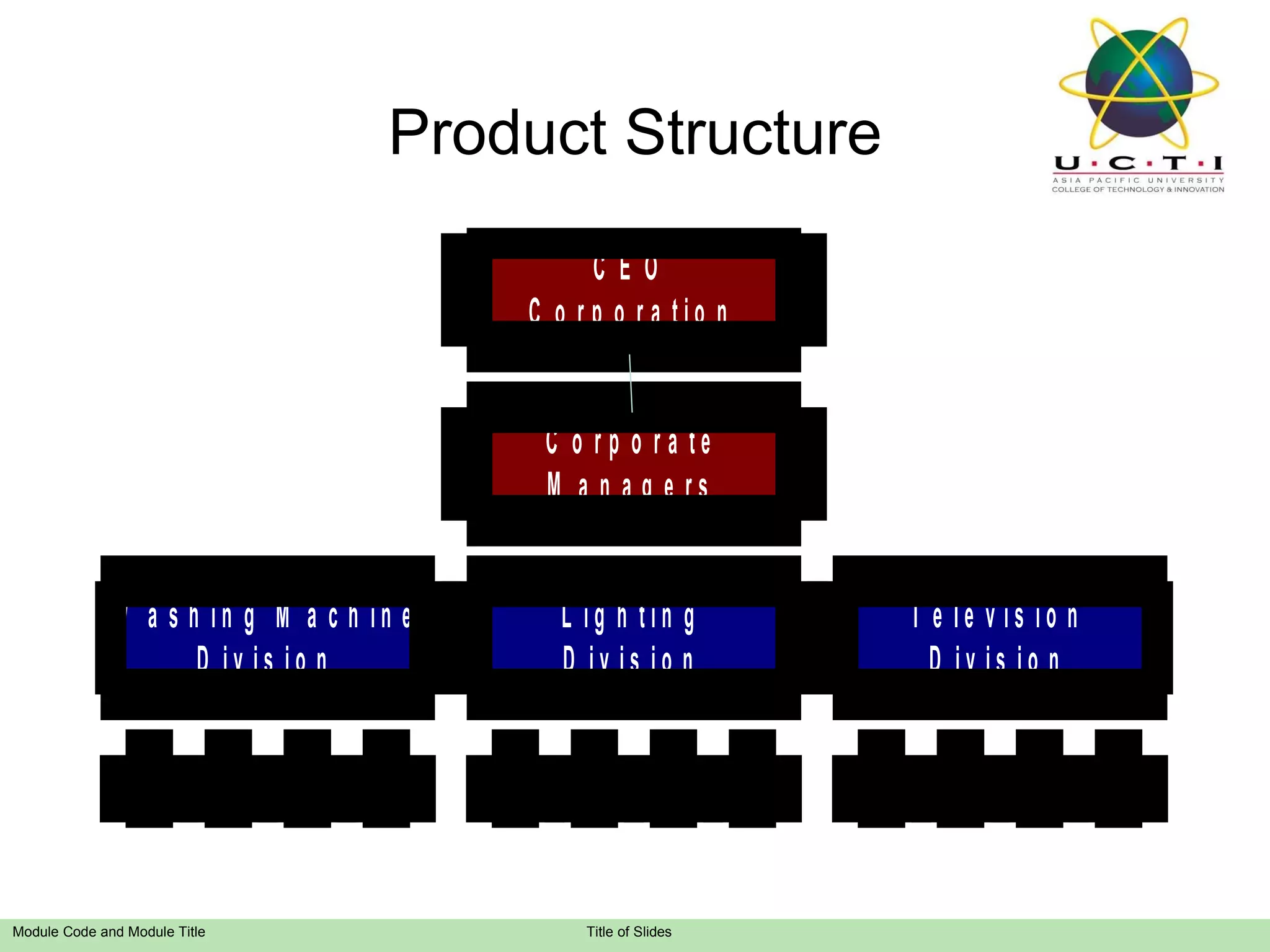
Product Structure
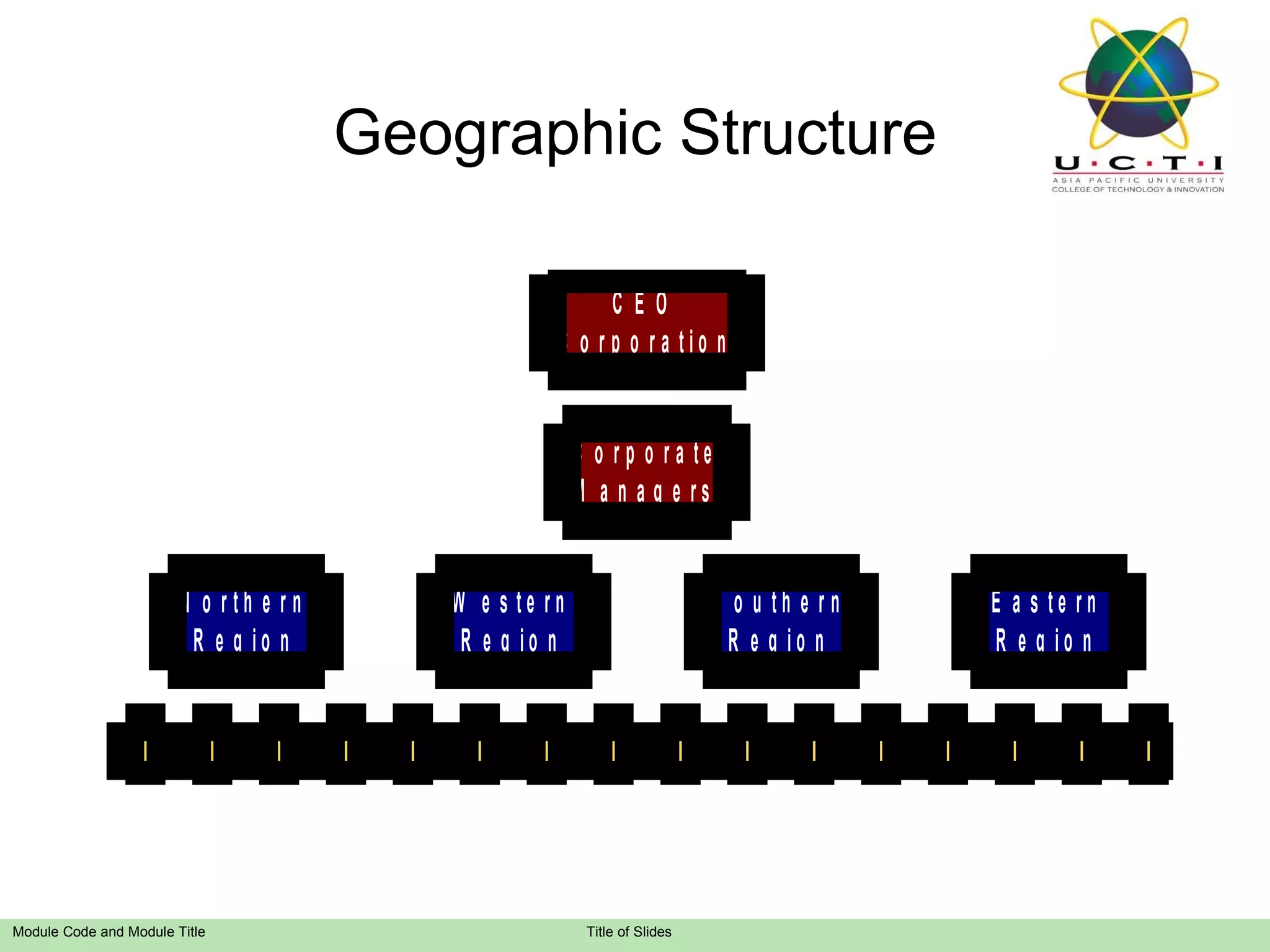
Geographic Structure
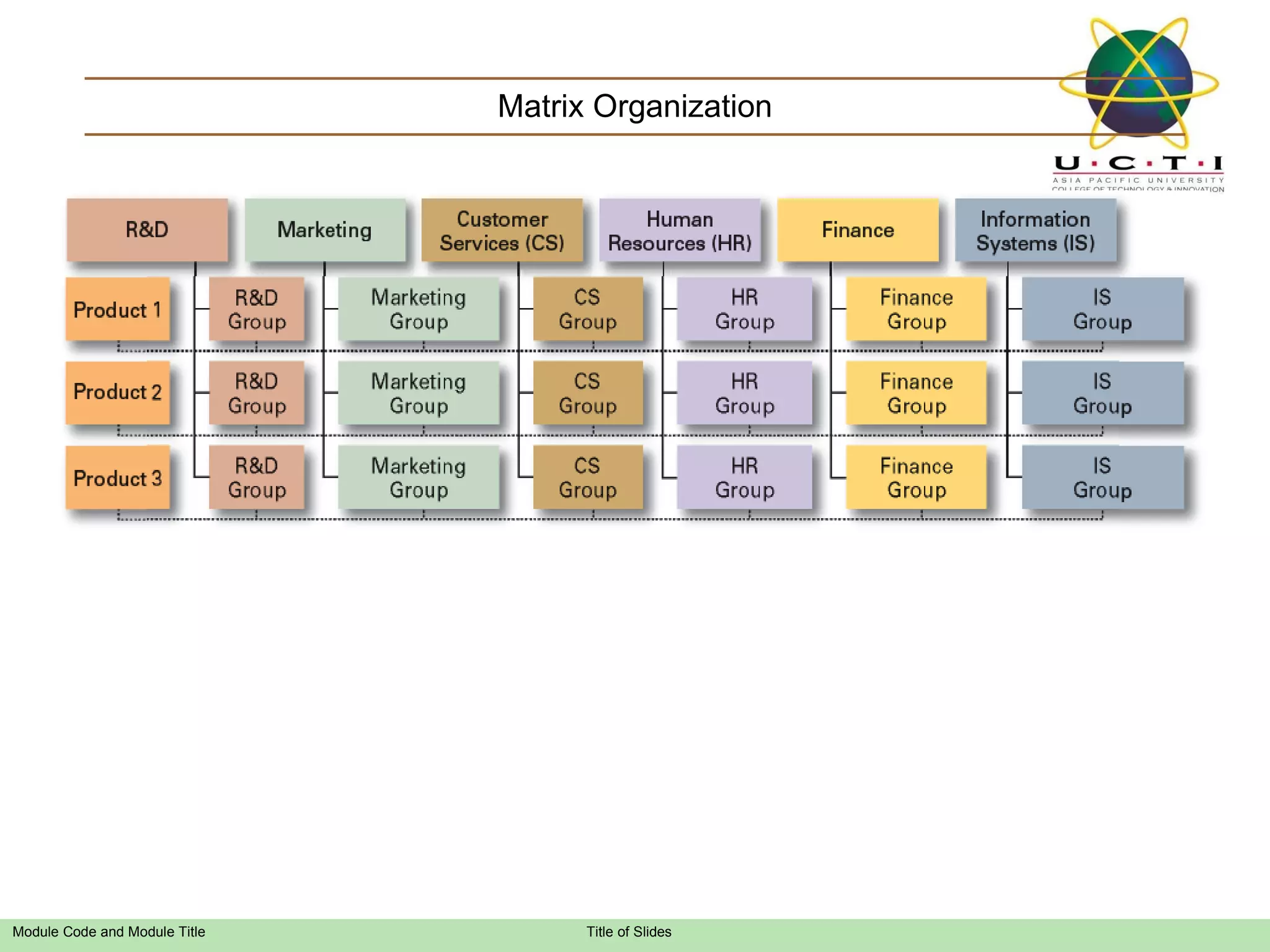
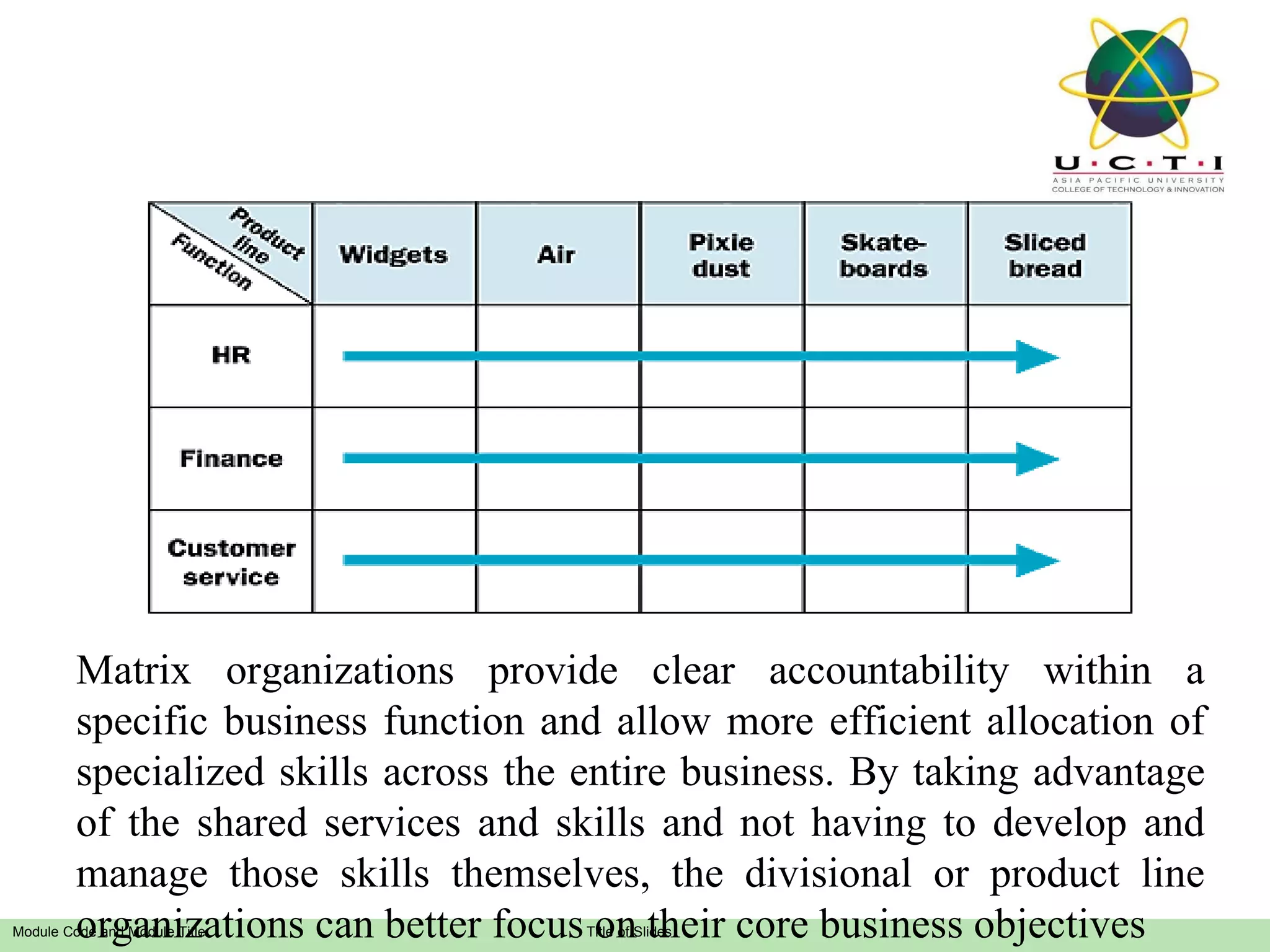
Matrix Organization
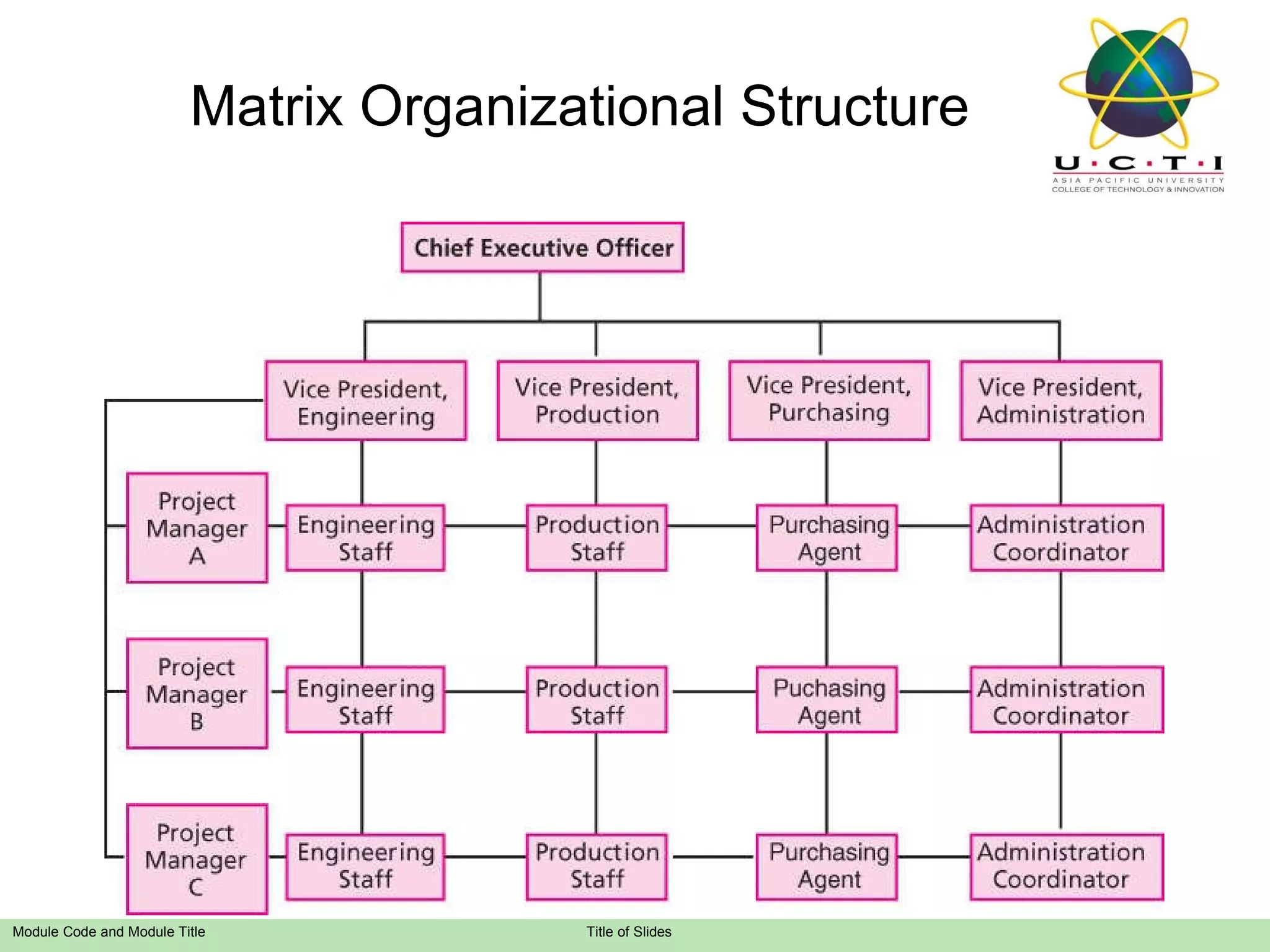
Matrix Organizational Structure
Matrix organizations provide clear accountability within a specific business function and allow more efficient allocation of specialized skills across the entire business. By taking advantage of the shared services and skills and not having to develop and manage those skills themselves, the divisional or product line organizations can better focus on their core business objectives
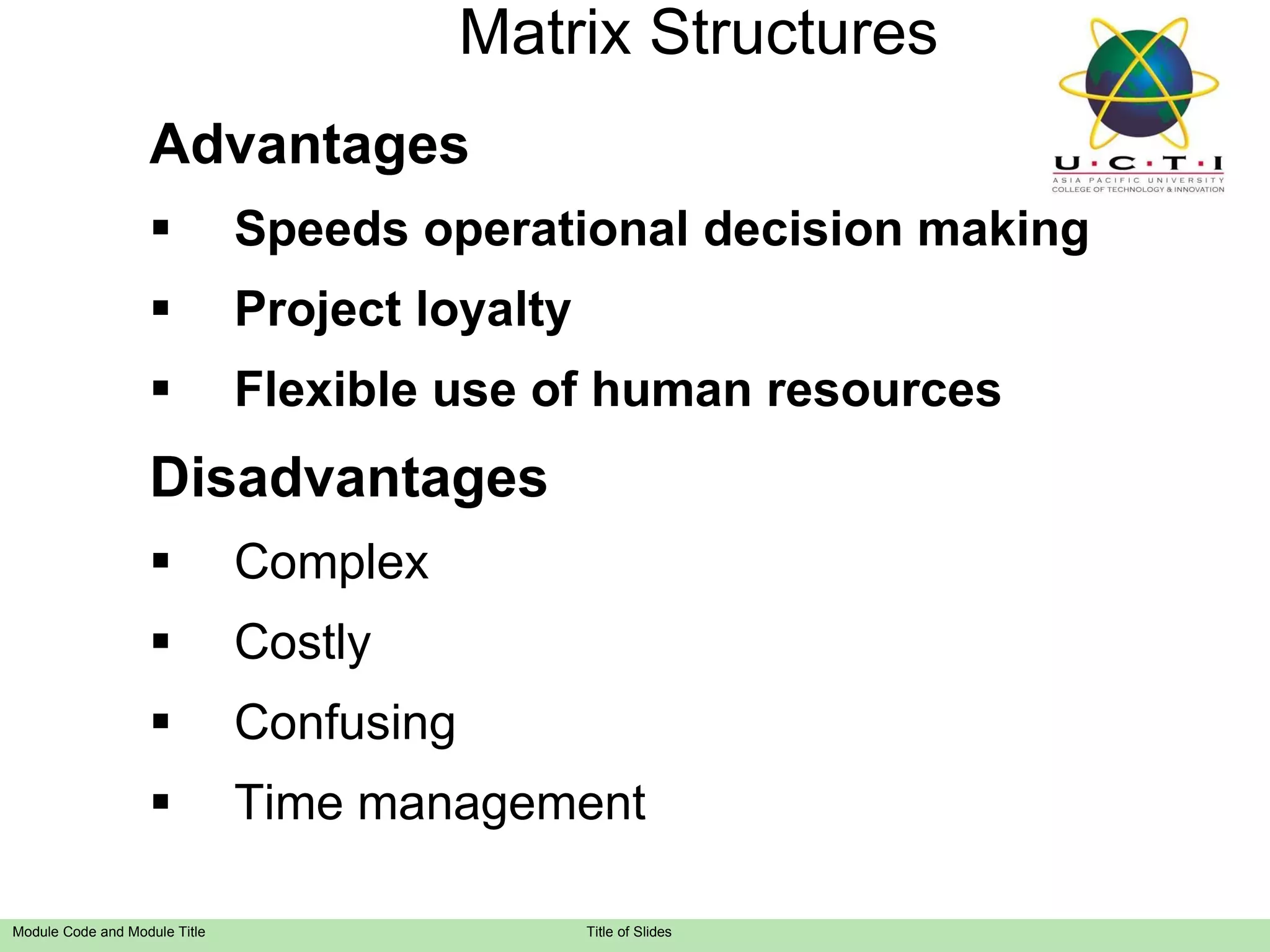
Matrix  Structure s Advantages Speeds operational decision making Project loyalty Flexible use of human resources Disadvantages Complex Costly Confusing Time management
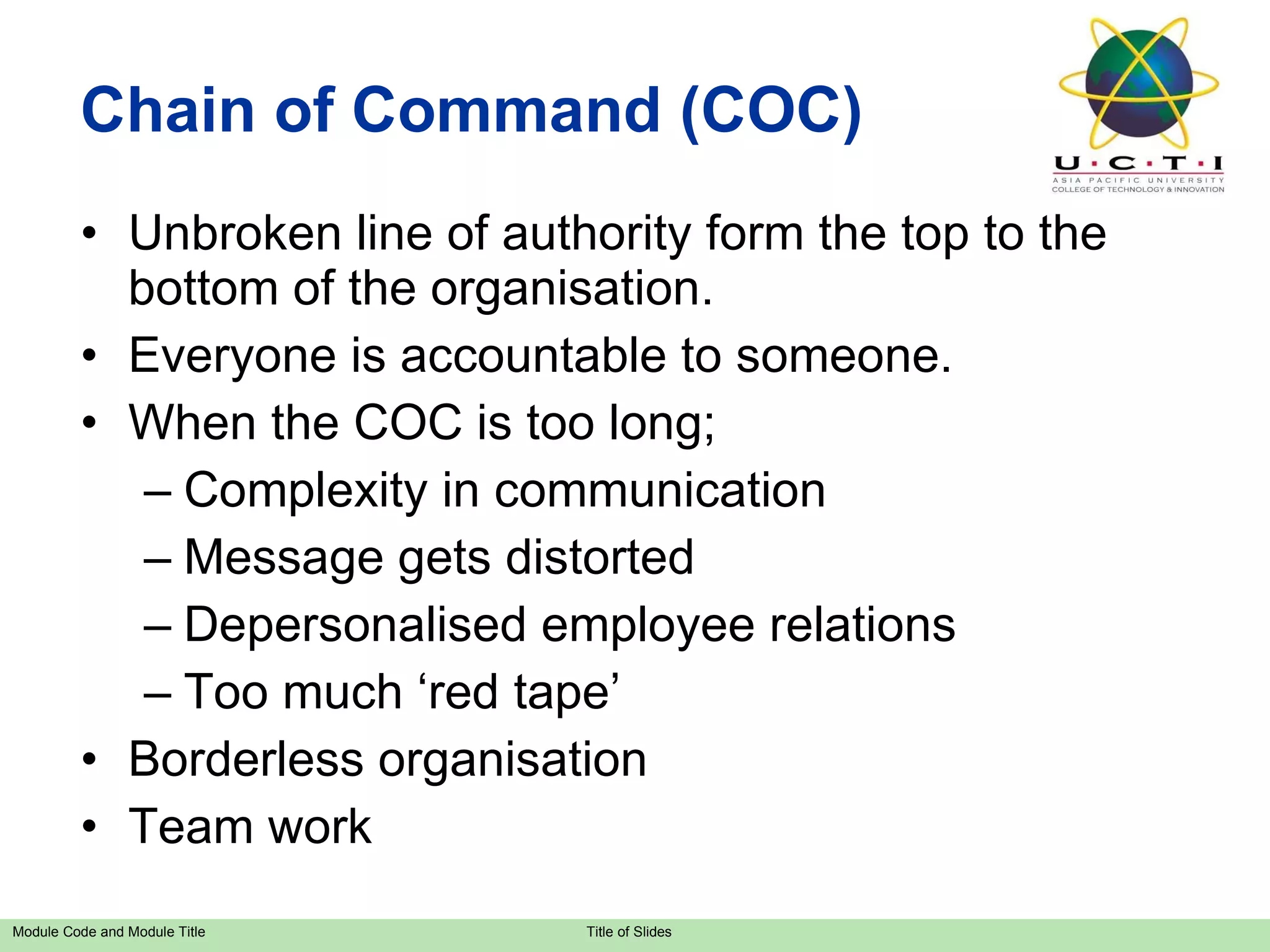
Chain of Command (COC) Unbroken line of authority form the top to the bottom of the organisation. Everyone is accountable to someone. When the COC is too long; Complexity in communication Message gets distorted Depersonalised employee relations Too much ‘red tape’ Borderless organisation Team work
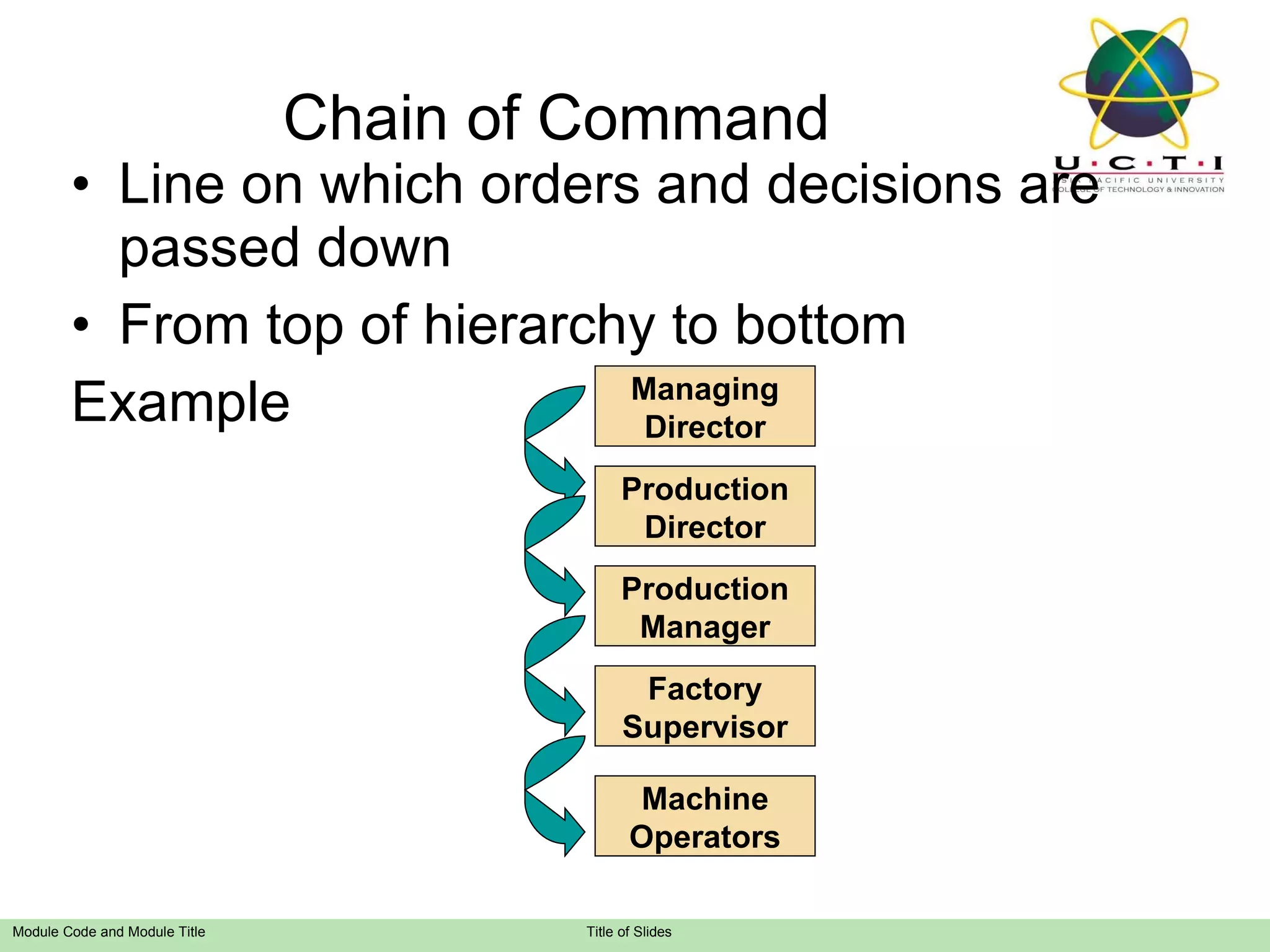
Chain of Command Line on which orders and decisions are passed down From top of hierarchy to bottom Example Managing Director Production Director Production Manager Factory Supervisor Machine Operators
Centralisation Amount of authority delegated to different positions in the organisation structure. Decision making is focused at the top of the organisation hierarchy and lower level just carry out decisions made. Authority and work is not / little delegated. Advantages Top management is aware of the happenings and overall needs, better control over activities Better standardised procedures and policy Easier to maintain secrecy
Decentralisation Decision are made at all management levels. Lower level management provide input in decision making. Authority and work is delegated Advantages Reduces work load for Top management Faster decisions Better decisions Employees learn to make decisions Improves staff morale Organisation becomes flexible
Centralised Organisations What are they? Organisations where important decisions are taken at the centre and then passed out to the various departments / locations Advantages Tight control of decisions Decisions made by senior management Helps decisions to be consistent across the business Avoids repetition of functions (e.g. only one purchasing department) Disadvantages Lack of motivation for managers Central management may be “out of touch” May be slow to make decisions that need to taken quickly
De-Centralised Organisations What are they? Organisations where important decisions are delegated to managers in other departments / locations Advantages Increased motivation of managers Encourages local initiatives Decisions based on more up-to-date information Decisions made quicker Disadvantages Managers may lack experience Local decisions may be inconsistent with the overall business aims and objectives Duplication of functions and costs
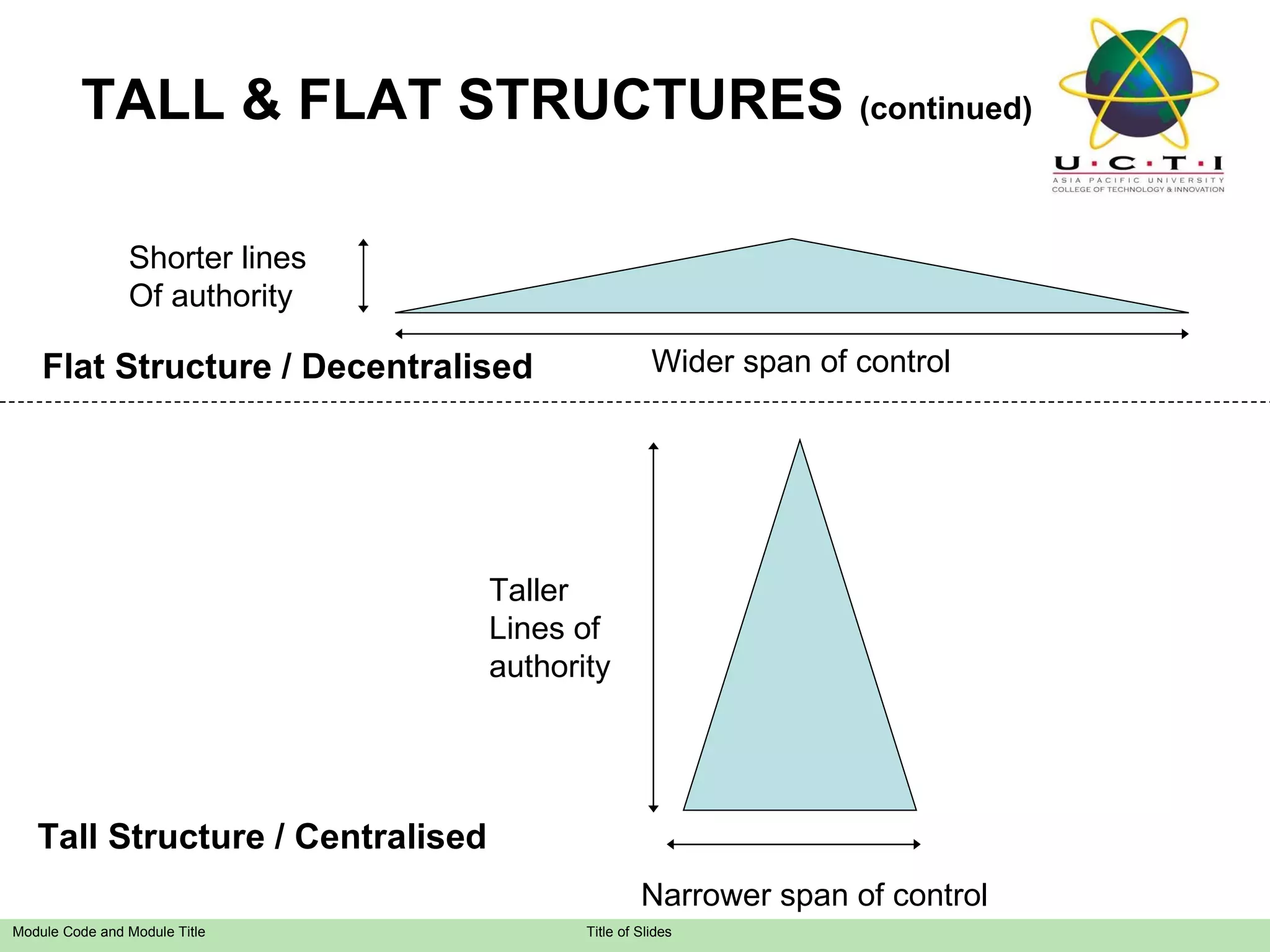
TALL & FLAT STRUCTURES  (continued) Flat Structure / Decentralised  Wider span of control Shorter lines Of authority Tall Structure / Centralised  Narrower span of control Taller  Lines of authority
Formalisation Actions which are and not to be done, stated in written policies, rules, procedures  Helps with vertical coordination
Does authority come together with responsibilities? Which is better a centralised or decentralised organisation? Why is that a long chain of command not seen to be good for the organisation? Quick Review Question
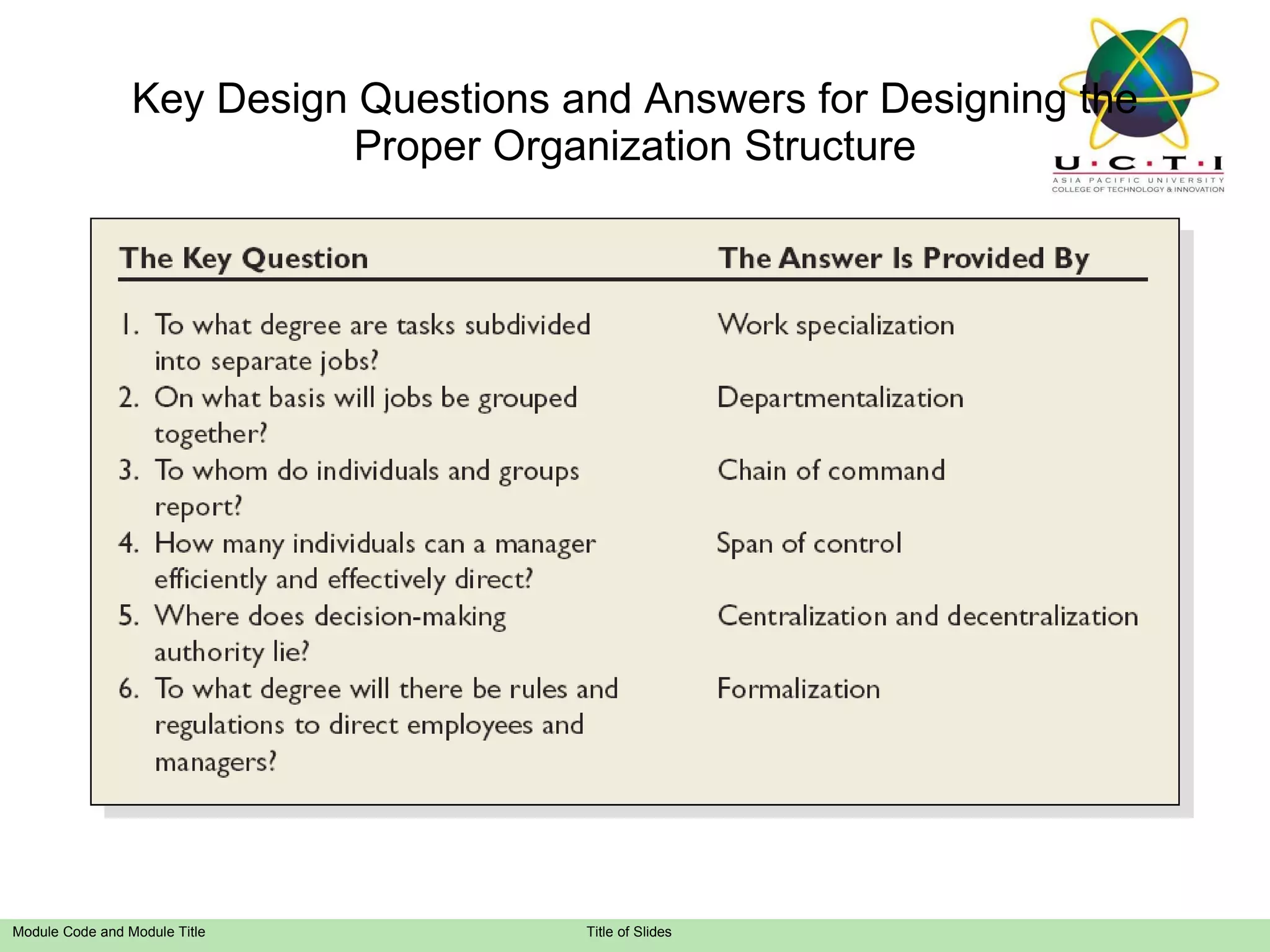
Key Design Questions and Answers for Designing the Proper Organization Structure
Follow Up Assignment Read Chapter 8 of Management by K.M. Bartol & D. C. Martin
Q & A Question and Answer Session
Chapter 4  –   Management Theories Next Session

Chap3 Organisation Structure

  • 1.
    Lecture 3 Organisation Structure Prepared by: ANS First Prepared on: 11-01-06 Last Modified on: xx-xx-xx Quality checked by: HKP Copyright 2004 Asia Pacific Institute of Information Technology Introduction to Management BM007-3-1
  • 2.
    Learning Outcomes Atthe end of this chapter, YOU should be able to know: How differentiation and integration influence an organisation structure How authority operates How Span of Control affects structure and managerial effectiveness The difference between centralised and decentralised organisation. How to allocate jobs to work units How to manage the unique challenges of the matrix structure.
  • 3.
    Key Terms youmust be able to use If you have mastered this topic, you should be able to use the following terms correctly in your assignments and exams : Authority Responsibility Span of Control Delegation Centralisation and decentralisation
  • 4.
    A formal patternof interactions and coordination designed by management to link the tasks of individuals and group in achieving organisational goals A formal framework by which jobs tasks are divided, grouped and coordinated. When managers develop or change an organisation’s structure thy engage in Organisational Design Introduction
  • 5.
    Organisational Structure Howjob tasks are formally divided, grouped and coordinated . (Robbins, 1996). The established pattern of relationships between the component parts of an organisation, outlining both communication, control and authority patterns. (Wilson and Rosenfeld, 1990).
  • 6.
    Organisational Structure The formal pattern of interactions and co-ordination designed by management to link the tasks of individuals and groups in achieving organisational goals. (Bartol and M artin, 1994).
  • 7.
    Organisation Structure consistmainly of; The assignment of tasks and responsibilities that define the jobs of individuals and units Clustering individuals units departments Top to bottom coordination, number of individuals reporting, degree of delegation and authority Horizontal coordination Org. design Departmentalisation Work Specialisation Chain of Command Centralisation & Decentralisation Span of Control Formalisation
  • 8.
    Why Do BusinessesNeed to be Organised? Small businesses (particularly sole traders) have an informal organisational structure As a business gets bigger then it starts to form some kind of organisation An organisation structure is required as soon as there are several people working in the business The structure determines: Who is responsible for what job and Who is responsible to whom.
  • 9.
    Responsibility –Area of work for a person or group is accountable for. E.g. discipline of staff or sales of product. Duties – Work or job requirements arising from responsibilities. E.g. Writing a warning letter for late coming or to meet clients or customers to persuade then to buy products or services. Authority – the right to make decisions and take action. E.g. secretary is given the authority to sign orders up to RM500. Failure to coordinate between departments result in duplication of work, stress, communication breakdown and therefore frustrated staff Definition of terms
  • 10.
    Responsibility isdefined as “a particular burden of obligation upon a person who is responsible.”  Responsible is defined as “answerable or accountable, as for something within one’s power or control.”  Therefore, a leader is responsible and has responsibility for the operation for which she has been given authority.
  • 11.
    Authority isdefined as “a power or right, delegated or given.”  In this sense, the person or company that hires a leader vests him with the authority to manage or direct a particular operation. It is expected that this individual will exercise the full scope of his authority to properly, profitably, and professionally manage the operation.
  • 12.
    Organisation Pyramid BODCHIEF EXECUTIVE EXECUTIVE DIRECTORS MANAGERS EXECUTIVE AUTHORITY RESPONSIBILITY How are Organisations formed?
  • 13.
    Organisation Chart (I)CEO/ PRESIDENT Human Resource Operations Security Recruitment Finance Research & Development Training Sales & Marketing Employee Relations Assistant
  • 14.
    Organisation Chart (II)Shows; The business divided into areas where employees have responsibilities. States relationships between staffs e.g. Supervisor, subordinate, peer. Shows the number of people working in the organisation. Historical record – organisation changes makes the chart become out of date. As information to new employees and special group. Main lines of communication.
  • 15.
    Span of Control(I) The number of subordinates a supervisor has reporting to him/her. It is recommended that a supervisor has about 5/6 subordinates for effective management. 2 types of span of Control; Narrow Wide Narrow Closer and more contact with subordinate Tight control and tight supervision More time for other duties – planning, decision making A lot of layers, more positions
  • 16.
    Span of Control(II) Wide Reduced operation and administrative costs Easier communication Coordination problems reduced Quicker decision making Can cultivate higher motivation level in subordinates
  • 17.
    What is theSpan of Control? The number of people who report to one manager in a hierarchy The more people under the control of one manager - the wider the span of control Less means a narrower span of control Example below shows a span of control of 4 for the Marketing Manager Marketing Manager Marketing Assistant Market Researcher Telesales Supervisor Customer Care Assistant
  • 18.
    Advantage of aNarrow Span of Control Allows a manager to: Communicate quickly with employees under them Control employees more easily Feedback of ideas from workers more effective Requires a higher level of management skill
  • 19.
    Advantage of aWide Span of Control There are less layers of management to pass a message through So the message reaches more employees faster It costs less money to run a wider span of control because a business does not need to employ as many managers
  • 20.
    Exhibit 10–3 ContrastingSpans of Control © 2007 Prentice Hall, Inc. All rights reserved.
  • 21.
    Span of ControlNarrow Span of Control Manager Wide Span of Control Manager
  • 22.
    Factors influencing spanof control Narrow span Wider Span Complex work Simple work Uncertain environment Stable environment Less able subordinates Able subordinates More risk/danger Less risk/danger Less able manager Able manager
  • 23.
    Factors affecting SpanOf Control Competence of a manager Complexity of functions Similarity of function Non supervisory duties of manager Direction and control needed by subordinates Physical proximity / Geographic location
  • 24.
    Work Specialisation Thedegree to which the work necessary to achieve organisational goals is broken down into various jobs. Without some specialisation, it would be difficult for the organisation to function. People have different skills and abilities, they are usually able to carry out work effectively and efficiently if the job required a particular skill or ability they possess.
  • 25.
    Departmentalisation The maindepartment designs are by; Function Product Geography Matrix
  • 26.
    Departmentalisation How jobs/tasks are divided, grouped and coordinated. All departments must understand and ‘pull’ together toward achieving the organisational goals. Activities are grouped by functions e.g. Human Resources, Finance, Marketing. Names of the departments depend on the type of business the organisation is in.
  • 27.
    Production Finance R&DAccounting Sales & Marketing Human Resource Chief Executive Officer Functional Structure
  • 28.
  • 29.
  • 30.
  • 31.
  • 32.
  • 33.
    Matrix organizations provideclear accountability within a specific business function and allow more efficient allocation of specialized skills across the entire business. By taking advantage of the shared services and skills and not having to develop and manage those skills themselves, the divisional or product line organizations can better focus on their core business objectives
  • 34.
    Matrix Structures Advantages Speeds operational decision making Project loyalty Flexible use of human resources Disadvantages Complex Costly Confusing Time management
  • 35.
    Chain of Command(COC) Unbroken line of authority form the top to the bottom of the organisation. Everyone is accountable to someone. When the COC is too long; Complexity in communication Message gets distorted Depersonalised employee relations Too much ‘red tape’ Borderless organisation Team work
  • 36.
    Chain of CommandLine on which orders and decisions are passed down From top of hierarchy to bottom Example Managing Director Production Director Production Manager Factory Supervisor Machine Operators
  • 37.
    Centralisation Amount ofauthority delegated to different positions in the organisation structure. Decision making is focused at the top of the organisation hierarchy and lower level just carry out decisions made. Authority and work is not / little delegated. Advantages Top management is aware of the happenings and overall needs, better control over activities Better standardised procedures and policy Easier to maintain secrecy
  • 38.
    Decentralisation Decision aremade at all management levels. Lower level management provide input in decision making. Authority and work is delegated Advantages Reduces work load for Top management Faster decisions Better decisions Employees learn to make decisions Improves staff morale Organisation becomes flexible
  • 39.
    Centralised Organisations Whatare they? Organisations where important decisions are taken at the centre and then passed out to the various departments / locations Advantages Tight control of decisions Decisions made by senior management Helps decisions to be consistent across the business Avoids repetition of functions (e.g. only one purchasing department) Disadvantages Lack of motivation for managers Central management may be “out of touch” May be slow to make decisions that need to taken quickly
  • 40.
    De-Centralised Organisations Whatare they? Organisations where important decisions are delegated to managers in other departments / locations Advantages Increased motivation of managers Encourages local initiatives Decisions based on more up-to-date information Decisions made quicker Disadvantages Managers may lack experience Local decisions may be inconsistent with the overall business aims and objectives Duplication of functions and costs
  • 41.
    TALL & FLATSTRUCTURES (continued) Flat Structure / Decentralised Wider span of control Shorter lines Of authority Tall Structure / Centralised Narrower span of control Taller Lines of authority
  • 42.
    Formalisation Actions whichare and not to be done, stated in written policies, rules, procedures Helps with vertical coordination
  • 43.
    Does authority cometogether with responsibilities? Which is better a centralised or decentralised organisation? Why is that a long chain of command not seen to be good for the organisation? Quick Review Question
  • 44.
    Key Design Questionsand Answers for Designing the Proper Organization Structure
  • 45.
    Follow Up AssignmentRead Chapter 8 of Management by K.M. Bartol & D. C. Martin
  • 46.
    Q & AQuestion and Answer Session
  • 47.
    Chapter 4 – Management Theories Next Session

Editor's Notes