Name: - Md Sahil Ali
Registration no.: -12212350
Course code: - PBA 603
Submitted to: -Dr. Deepak Sharma
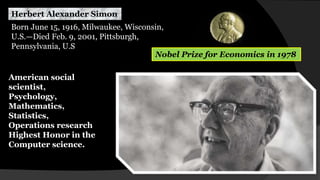
Herbert Alexander Simon
Born June 15, 1916, Milwaukee, Wisconsin,
U.S.—Died Feb. 9, 2001, Pittsburgh,
Pennsylvania, U.S
American social
scientist,
Psychology,
Mathematics,
Statistics,
Operations research
Highest Honor in the
Computer science.
Nobel Prize for Economics in 1978
Early Life
Simon graduated from the University of Chicago in 1936 and earned a doctorate
in political science there in 1943. After holding various posts in political science, he
became a professor of administration and psychology at the Carnegie Institute of
Technology in 1949, later becoming the Richard King Mellon University Professor of
Computer Science and Psychology there.
He is best known for his work on the theory of corporate decision making known
as “behaviourism.” In his influential book Administrative Behavior (1947), Simon
sought to replace the highly simplified classical approach to economic modeling—
based on a concept of the single decision-making, profit-maximizing with an
approach that recognized multiple factors that contribute to decision making.
Herbert A. Simon was 31 years old when he published his book
"Administrative Behavior" in 1947. The aim of the book was to show
how organizations can be understood in terms of their decision
processes.
His central point is that decision-making is the heart of
administration. The language and conceptual framework for
describing administration must be based on the logic and
psychology of human choice, i.e. economic theory and psychology.
Administrative Behavior
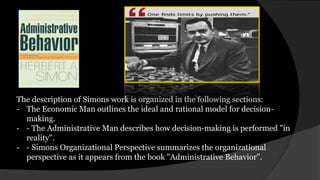
The description of Simons work is organized in the following sections:
- The Economic Man outlines the ideal and rational model for decision-
making.
- - The Administrative Man describes how decision-making is performed "in
reality".
- - Simons Organizational Perspective summarizes the organizational
perspective as it appears from the book "Administrative Behavior".
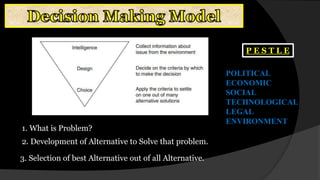
1. What is Problem?
2. Development of Alternative to Solve that problem.
3. Selection of best Alternative out of all Alternative.
P E S T L E
POLITICAL
ECONOMIC
SOCIAL
TECHNOLOGICAL
LEGAL
ENVIRONMENT
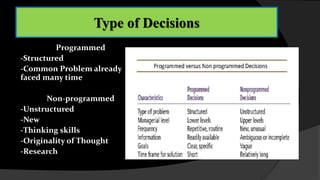
Type of Decisions
Programmed
-Structured
-Common Problem already
faced many time
Non-programmed
-Unstructured
-New
-Thinking skills
-Originality of Thought
-Research
Administrative Man:
Simon has given the concept of administrative man as the model
of decision-making. The model is based on the following
assumptions:
(i) Administrative man adopts satisfaction approach in decision-making
rather than the maximizing approach of economic man.
(ii) He perceives the word as a simplified model of real world. Thus, he
remains content with simplification,
(iii) He is able to make decisions with relatively simple rule of thumb, or
tricks of trade, or force of habit. The administrative man model
describes the decision-making process of mangers tarty then alternative
thereby of economic man.
Herbert A Simon.pptx

Herbert A Simon.pptx

  • 1.
    Name: - MdSahil Ali Registration no.: -12212350 Course code: - PBA 603 Submitted to: -Dr. Deepak Sharma
  • 2.
    Herbert Alexander Simon BornJune 15, 1916, Milwaukee, Wisconsin, U.S.—Died Feb. 9, 2001, Pittsburgh, Pennsylvania, U.S American social scientist, Psychology, Mathematics, Statistics, Operations research Highest Honor in the Computer science. Nobel Prize for Economics in 1978
  • 3.
    Early Life Simon graduatedfrom the University of Chicago in 1936 and earned a doctorate in political science there in 1943. After holding various posts in political science, he became a professor of administration and psychology at the Carnegie Institute of Technology in 1949, later becoming the Richard King Mellon University Professor of Computer Science and Psychology there. He is best known for his work on the theory of corporate decision making known as “behaviourism.” In his influential book Administrative Behavior (1947), Simon sought to replace the highly simplified classical approach to economic modeling— based on a concept of the single decision-making, profit-maximizing with an approach that recognized multiple factors that contribute to decision making.
  • 4.
    Herbert A. Simonwas 31 years old when he published his book "Administrative Behavior" in 1947. The aim of the book was to show how organizations can be understood in terms of their decision processes. His central point is that decision-making is the heart of administration. The language and conceptual framework for describing administration must be based on the logic and psychology of human choice, i.e. economic theory and psychology. Administrative Behavior
  • 5.
    The description ofSimons work is organized in the following sections: - The Economic Man outlines the ideal and rational model for decision- making. - - The Administrative Man describes how decision-making is performed "in reality". - - Simons Organizational Perspective summarizes the organizational perspective as it appears from the book "Administrative Behavior".
  • 6.
    1. What isProblem? 2. Development of Alternative to Solve that problem. 3. Selection of best Alternative out of all Alternative. P E S T L E POLITICAL ECONOMIC SOCIAL TECHNOLOGICAL LEGAL ENVIRONMENT
  • 7.
    Type of Decisions Programmed -Structured -CommonProblem already faced many time Non-programmed -Unstructured -New -Thinking skills -Originality of Thought -Research
  • 8.
    Administrative Man: Simon hasgiven the concept of administrative man as the model of decision-making. The model is based on the following assumptions: (i) Administrative man adopts satisfaction approach in decision-making rather than the maximizing approach of economic man. (ii) He perceives the word as a simplified model of real world. Thus, he remains content with simplification, (iii) He is able to make decisions with relatively simple rule of thumb, or tricks of trade, or force of habit. The administrative man model describes the decision-making process of mangers tarty then alternative thereby of economic man.