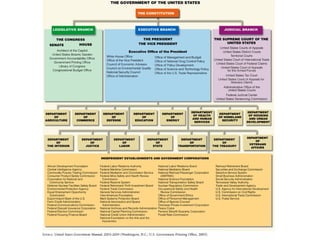
Chapter 13: The Bureaucracy
Tonight’s Class

 Review schedule
 Politics in the news
 The Presidency
Schedule

                               Ch 12
4/21   The Presidency
                               Ch 13
4/28   The Bureaucracy
                               Ch 14
5/5    The Judiciary

5/12   •Foreign policy         Ch 16

       •Wars in Iraq &
       Afghanistan
5/19   •Global warming
       •Review for the final
5/26   Final exam
Final exam

 50 multiple choice questions from ch. 7-14
 Two essays selected from:
   The current economic crisis
   Foreign policy
   Global warming
The Bureaucracy: The Power of
                      Rule-Making
                             5


                                    Click the icon to open the movie


Copyright © 2009 Cengage Learning
Questions
                                        6

 Why does Congress allow for bureaucratic
  rulemaking?
 What are the potential conflicts in a system that
  allows bureaucratic rulemaking?


Copyright © 2009 Cengage Learning
Bureaucracies
                                          7

 Bureaucracies are often handy political targets to
  blame for society’s ills.
 Yet, the same bureaucrats who are blamed for red
  tape have also accomplished some remarkable tasks:
      NASA
      TVA


Copyright © 2009 Cengage Learning
Bureaucracies (cont.)
                                       8

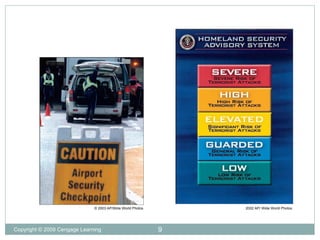
 Americans tend to be against “Big Government” in
   the abstract, but they also demand all kinds of
   government services.


Copyright © 2009 Cengage Learning
© 2003 AP/Wide World Photos       2002 AP/ Wide World Photos


Copyright © 2009 Cengage Learning                           9
Bureaucracy and the Policy Process
                                    10

 Client Groups
 Congress
 Triangles and Subgovernments
 Issue Networks


Copyright © 2009 Cengage Learning
The Veterans Affairs “Triangle”
                                    11


Copyright © 2009 Cengage Learning
The Politics of Bureaucracy
                                    12

 Bureaucracy and Public Opinion
 Bureaucracy and the President
 Bureaucracy and Policymaking


Copyright © 2009 Cengage Learning
Models of Bureaucracy
                                     13

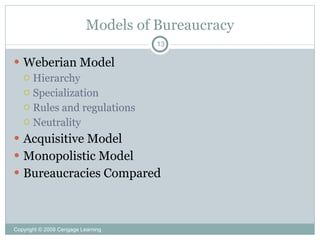
 Weberian Model
   Hierarchy
   Specialization
   Rules and regulations
   Neutrality

 Acquisitive Model
 Monopolistic Model
 Bureaucracies Compared


Copyright © 2009 Cengage Learning
The Size of the Bureaucracy
                                    14


  Today there are about 2.7
  million civilian
  employees of the federal
  government.


                                               (UPI Photo/Bill Greenblatt/Landov)


Copyright © 2009 Cengage Learning
A Profile of Bureaucracy: Government Employment—
                    Federal, State, and Local
                                    15


Copyright © 2009 Cengage Learning
© Bob Daemmrich /Stock, Boston /PictureQuest


Copyright © 2009 Cengage Learning   16
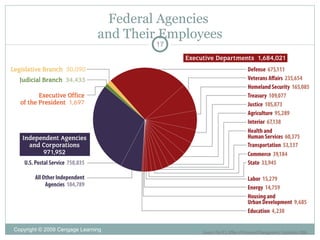
Federal Agencies
                               and Their Employees
                                       17


Copyright © 2009 Cengage Learning
18


   Government
Employment at the
Federal, State, and
   Local Levels


Copyright © 2009 Cengage Learning
Copyright © 2009 Cengage Learning   19
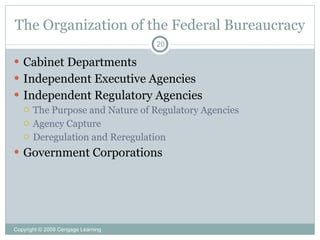
The Organization of the Federal Bureaucracy
                                    20

 Cabinet Departments
 Independent Executive Agencies
 Independent Regulatory Agencies
   The Purpose and Nature of Regulatory Agencies
   Agency Capture
   Deregulation and Reregulation

 Government Corporations


Copyright © 2009 Cengage Learning
Major Regulatory Agencies
                                    21

 The Federal Trade Commission (1914)
 The Federal Communications Commission (1934)
 The Securities and Exchange Commission (1934)
 The Federal Energy Regulatory Commission (1978)


Copyright © 2009 Cengage Learning
Deregulation
                                         22

 The government regulation of industry, which
  increased during the New Deal administration of
  FDR, had by the 1970s, become a target of criticism.
 In the 1970s, President Carter called for deregulation
  of airlines, banking, trucking, railroads, and
  telecommunications.


Copyright © 2009 Cengage Learning
The Growth of Social Regulation
                                    23

 Although considerable deregulation of
   transportation, communications, and financial
   industries took place, social regulation increased
   during the 1970s and 1980s.


Copyright © 2009 Cengage Learning
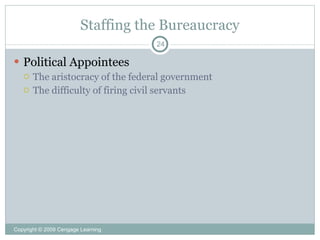
Staffing the Bureaucracy
                                    24

 Political Appointees
   The aristocracy of the federal government
   The difficulty of firing civil servants


Copyright © 2009 Cengage Learning
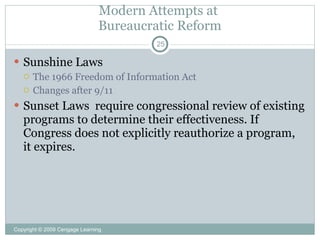
Modern Attempts at
                               Bureaucratic Reform
                                        25

 Sunshine Laws
   The 1966 Freedom of Information Act
   Changes after 9/11

 Sunset Laws require congressional review of existing
   programs to determine their effectiveness. If
   Congress does not explicitly reauthorize a program,
   it expires.


Copyright © 2009 Cengage Learning
The Civil Service
                                            26

 The Spoils System
 The Road to Reform
   1850s


Copyright © 2009 Cengage Learning
The Carter Reforms
                                      27

 The Civil Service Reform Act of 1978
 Whistle-blowers
 The Senior Executive Service


Copyright © 2009 Cengage Learning
“I’m sorry, dear, but you knew I was a
                              bureaucrat when you married me.”
                                    The New Yorker Collection 1980. Robert Weber from cartoonbank.com. All rights reserved.

Copyright © 2009 Cengage Learning                                          28
Modern Attempts at
                         Bureaucratic Reform (cont.)
                                     29

 Privatization
 Incentives for Efficiency and Productivity
   The Government Performance and Results Act
    of 1997
   Saving Costs through E-Government

 Helping Out the Whistle Blowers


Copyright © 2009 Cengage Learning
Bureaucrats as Politicians and Policy-Makers
                                     30


   The Rulemaking
     Environment
        Waiting periods and court
         challenges
        Negotiated Rulemaking


Copyright © 2009 Cengage Learning
Congressional Control of the Bureaucracy
                                    31

 The ultimate control is in the hands of Congress
  because Congress controls the
  purse strings.
 Congressional control of the bureaucracy includes
  the establishment of agencies and departments, the
  budget process, and oversight conducted through
  investigations, hearings, and review.


Copyright © 2009 Cengage Learning
Questions for
                                    Critical Thinking
                                            32

 What could be done to eliminate iron triangles?
 In modern times, we tend to equate the term
   “bureaucracy” with “red tape” or inefficiency. How
   does the goal of neutrality and the need for
   specialization help reinforce those images?


Copyright © 2009 Cengage Learning
Web Links
                                        33

 US Office of Personnel Management
 The Project on Government Oversight
 USA Jobs


Copyright © 2009 Cengage Learning
Web Links (cont.)
                                            34

 GAO—U.S. Government Accountability Office
 FAS—Federation of American Scientists
 OMB Watch
 Openthegovernment.org


Copyright © 2009 Cengage Learning

Bureaucracy

  • 1.
    Chapter 13: TheBureaucracy
  • 2.
    Tonight’s Class  Reviewschedule  Politics in the news  The Presidency
  • 3.
    Schedule Ch 12 4/21 The Presidency Ch 13 4/28 The Bureaucracy Ch 14 5/5 The Judiciary 5/12 •Foreign policy Ch 16 •Wars in Iraq & Afghanistan 5/19 •Global warming •Review for the final 5/26 Final exam
  • 4.
    Final exam  50multiple choice questions from ch. 7-14  Two essays selected from:  The current economic crisis  Foreign policy  Global warming
  • 5.
    The Bureaucracy: ThePower of Rule-Making 5 Click the icon to open the movie Copyright © 2009 Cengage Learning
  • 6.
    Questions 6  Why does Congress allow for bureaucratic rulemaking?  What are the potential conflicts in a system that allows bureaucratic rulemaking? Copyright © 2009 Cengage Learning
  • 7.
    Bureaucracies 7  Bureaucracies are often handy political targets to blame for society’s ills.  Yet, the same bureaucrats who are blamed for red tape have also accomplished some remarkable tasks:  NASA  TVA Copyright © 2009 Cengage Learning
  • 8.
    Bureaucracies (cont.) 8  Americans tend to be against “Big Government” in the abstract, but they also demand all kinds of government services. Copyright © 2009 Cengage Learning
  • 9.
    © 2003 AP/Wide World Photos 2002 AP/ Wide World Photos Copyright © 2009 Cengage Learning 9
  • 10.
    Bureaucracy and thePolicy Process 10  Client Groups  Congress  Triangles and Subgovernments  Issue Networks Copyright © 2009 Cengage Learning
  • 11.
    The Veterans Affairs“Triangle” 11 Copyright © 2009 Cengage Learning
  • 12.
    The Politics ofBureaucracy 12  Bureaucracy and Public Opinion  Bureaucracy and the President  Bureaucracy and Policymaking Copyright © 2009 Cengage Learning
  • 13.
    Models of Bureaucracy 13  Weberian Model  Hierarchy  Specialization  Rules and regulations  Neutrality  Acquisitive Model  Monopolistic Model  Bureaucracies Compared Copyright © 2009 Cengage Learning
  • 14.
    The Size ofthe Bureaucracy 14 Today there are about 2.7 million civilian employees of the federal government. (UPI Photo/Bill Greenblatt/Landov) Copyright © 2009 Cengage Learning
  • 15.
    A Profile ofBureaucracy: Government Employment— Federal, State, and Local 15 Copyright © 2009 Cengage Learning
  • 16.
  • 17.
    Federal Agencies and Their Employees 17 Copyright © 2009 Cengage Learning
  • 18.
    18 Government Employment at the Federal, State, and Local Levels Copyright © 2009 Cengage Learning
  • 19.
  • 20.
    The Organization ofthe Federal Bureaucracy 20  Cabinet Departments  Independent Executive Agencies  Independent Regulatory Agencies  The Purpose and Nature of Regulatory Agencies  Agency Capture  Deregulation and Reregulation  Government Corporations Copyright © 2009 Cengage Learning
  • 21.
    Major Regulatory Agencies 21  The Federal Trade Commission (1914)  The Federal Communications Commission (1934)  The Securities and Exchange Commission (1934)  The Federal Energy Regulatory Commission (1978) Copyright © 2009 Cengage Learning
  • 22.
    Deregulation 22  The government regulation of industry, which increased during the New Deal administration of FDR, had by the 1970s, become a target of criticism.  In the 1970s, President Carter called for deregulation of airlines, banking, trucking, railroads, and telecommunications. Copyright © 2009 Cengage Learning
  • 23.
    The Growth ofSocial Regulation 23  Although considerable deregulation of transportation, communications, and financial industries took place, social regulation increased during the 1970s and 1980s. Copyright © 2009 Cengage Learning
  • 24.
    Staffing the Bureaucracy 24  Political Appointees  The aristocracy of the federal government  The difficulty of firing civil servants Copyright © 2009 Cengage Learning
  • 25.
    Modern Attempts at Bureaucratic Reform 25  Sunshine Laws  The 1966 Freedom of Information Act  Changes after 9/11  Sunset Laws require congressional review of existing programs to determine their effectiveness. If Congress does not explicitly reauthorize a program, it expires. Copyright © 2009 Cengage Learning
  • 26.
    The Civil Service 26  The Spoils System  The Road to Reform  1850s Copyright © 2009 Cengage Learning
  • 27.
    The Carter Reforms 27  The Civil Service Reform Act of 1978  Whistle-blowers  The Senior Executive Service Copyright © 2009 Cengage Learning
  • 28.
    “I’m sorry, dear, but you knew I was a bureaucrat when you married me.” The New Yorker Collection 1980. Robert Weber from cartoonbank.com. All rights reserved. Copyright © 2009 Cengage Learning 28
  • 29.
    Modern Attempts at Bureaucratic Reform (cont.) 29  Privatization  Incentives for Efficiency and Productivity  The Government Performance and Results Act of 1997  Saving Costs through E-Government  Helping Out the Whistle Blowers Copyright © 2009 Cengage Learning
  • 30.
    Bureaucrats as Politiciansand Policy-Makers 30  The Rulemaking Environment  Waiting periods and court challenges  Negotiated Rulemaking Copyright © 2009 Cengage Learning
  • 31.
    Congressional Control ofthe Bureaucracy 31  The ultimate control is in the hands of Congress because Congress controls the purse strings.  Congressional control of the bureaucracy includes the establishment of agencies and departments, the budget process, and oversight conducted through investigations, hearings, and review. Copyright © 2009 Cengage Learning
  • 32.
    Questions for Critical Thinking 32  What could be done to eliminate iron triangles?  In modern times, we tend to equate the term “bureaucracy” with “red tape” or inefficiency. How does the goal of neutrality and the need for specialization help reinforce those images? Copyright © 2009 Cengage Learning
  • 33.
    Web Links 33  US Office of Personnel Management  The Project on Government Oversight  USA Jobs Copyright © 2009 Cengage Learning
  • 34.
    Web Links (cont.) 34  GAO—U.S. Government Accountability Office  FAS—Federation of American Scientists  OMB Watch  Openthegovernment.org Copyright © 2009 Cengage Learning