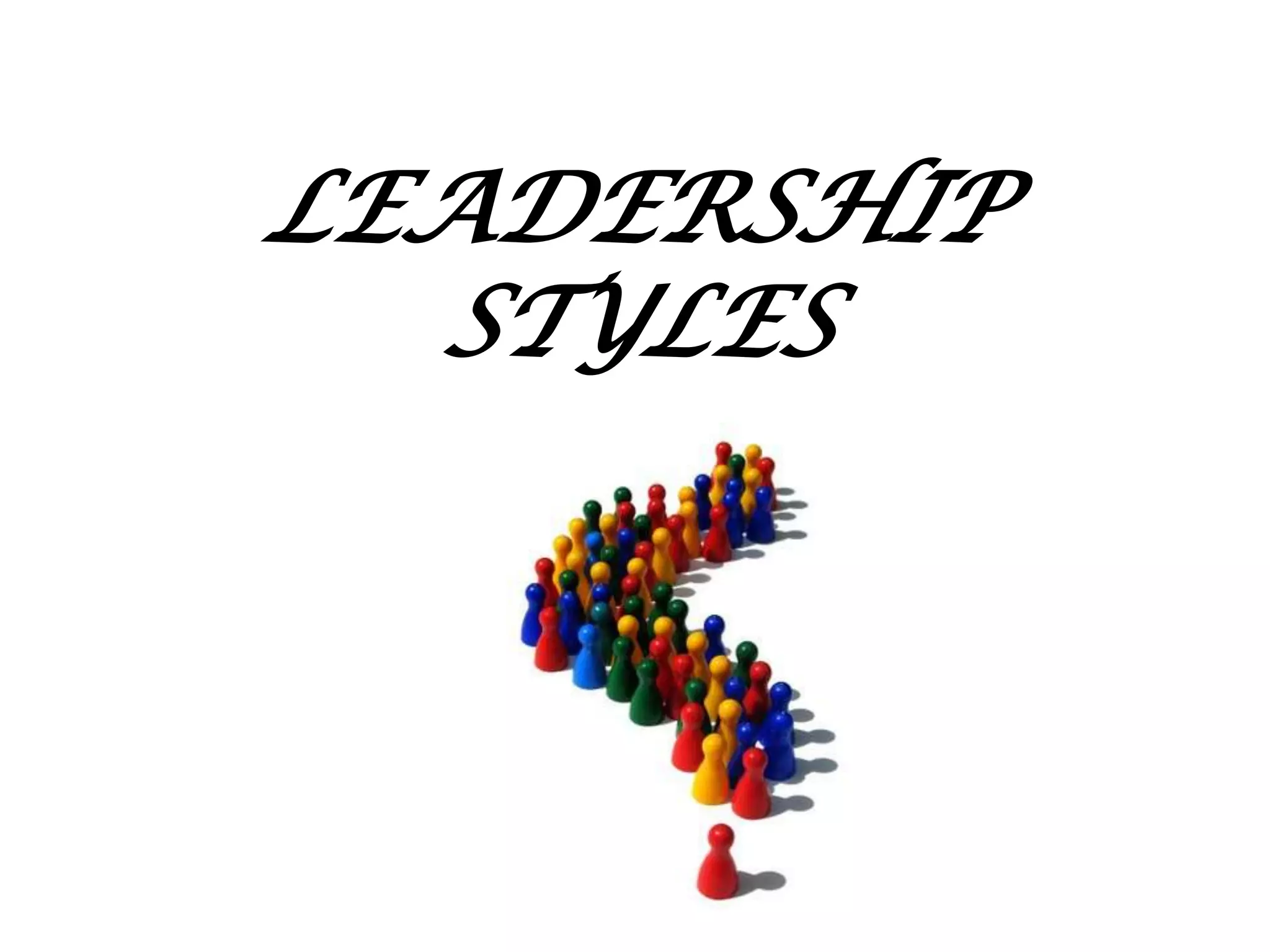
LEADERSHIP
STYLES
MEANING
STYLE refers to a way of doing something.
Leadership styles means the behavioural
pattern which a leader adopts to direct the
behaviour of members in an organisation in
order to achieve the goal of the organisation.
DEFINITION
According to Edwin Flippo:
“Leadership style is a pattern of behaviour
designed to integrate organisational and
personal interest in pursuit of some
objectives"
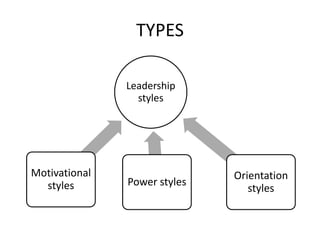
TYPES
Leadership
styles
Motivational
styles Power styles
Orientation
styles
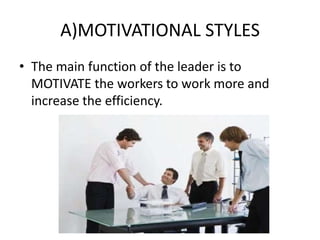
A)MOTIVATIONAL STYLES
• The main function of the leader is to
MOTIVATE the workers to work more and
increase the efficiency.
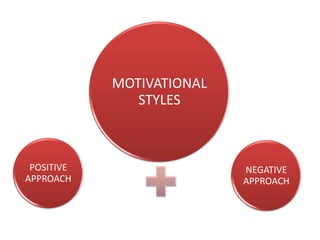
POSITIVE
APPROACH
NEGATIVE
APPROACH
MOTIVATIONAL
STYLES
i)POSITIVE APPROACH TO LEADERSHIP
• Rewards
• Money
• Higher efficiency
• Promotes peace
• Leave encashment scheme
ii)NEGATIVE APPROACH OF
LEADERSHIP
• Threatening
• Penalising
• Penalties
• Advantages
Reduction in labour turnover and absenteeism.
Boosts morale of employees.
Generates loyalty.
• Disadvantages
Employees may feel frustrated due to negative
motivation.
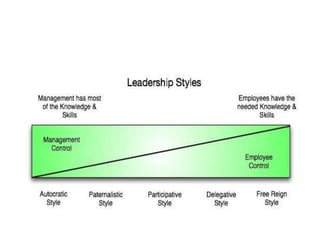
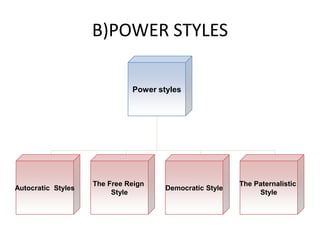
B)POWER STYLES
Power styles
Autocratic Styles
The Free Reign
Style
Democratic Style
The Paternalistic
Style
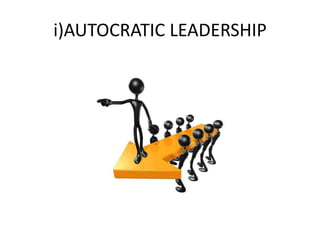
i)AUTOCRATIC LEADERSHIP
• It is also called as authoritarian or work
oriented leadership
• Plans and policies are determined by the
leader alone
• Demands strict obedience
• Relies on power of position
• Rewards and punishments
• Less freedom
• Greater concern for work is shown
TYPES OF AUTHOCRATIC LEADERS
• Strict autocrat
• Benevolent autocrat
• Incompetent autocrat
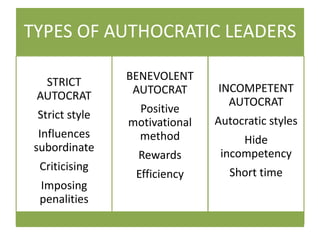
TYPES OF AUTHOCRATIC LEADERS
STRICT
AUTOCRAT
Strict style
Influences
subordinate
Criticising
Imposing
penalities
BENEVOLENT
AUTOCRAT
Positive
motivational
method
Rewards
Efficiency
INCOMPETENT
AUTOCRAT
Autocratic styles
Hide
incompetency
Short time
ii)THE FREE-REIN STYLE
• It is a type of leadership
where there is least
interference by the
leader
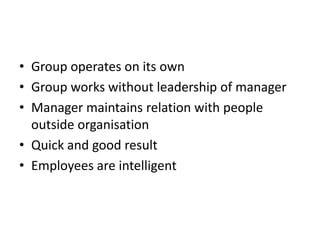
• Group operates on its own
• Group works without leadership of manager
• Manager maintains relation with people
outside organisation
• Quick and good result
• Employees are intelligent
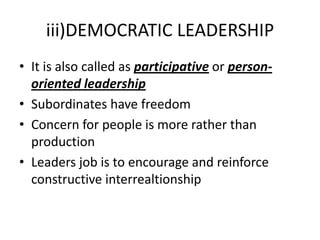
iii)DEMOCRATIC LEADERSHIP
• It is also called as participative or person-
oriented leadership
• Subordinates have freedom
• Concern for people is more rather than
production
• Leaders job is to encourage and reinforce
constructive interrealtionship
• Leader is quiet important figure in democratic
situation however he is the key model in
authoritarian type
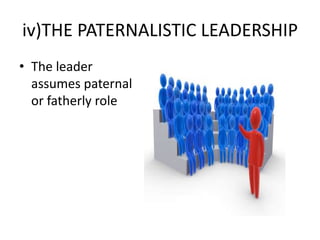
iv)THE PATERNALISTIC LEADERSHIP
• The leader
assumes paternal
or fatherly role
• Works to guide
• Protect
• Keep happy
• Good working condition
• Workers work hard with gratitude
• It can generate resentment in subordinates
Advantages:
Success of newly formed enterprise.
Guides employees in case of they are illiterate.
Disadvantages:
Employees become tensed.
Restricts delegation of authority.
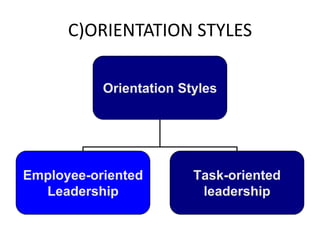
C)ORIENTATION STYLES
Orientation Styles
Employee-oriented
Leadership
Task-oriented
leadership
i)EMPLOYEE-ORIENTED STYLES
EMPLOYEE ORIENTED LEADERSHIP
• Concerned about subordinates
• They provide better working condition
• Pay highest attention to the subordinates
• Satisfy their needs
• Solve problems
ii)PRODUCTION OR TASK ORIENTED
LEADERSHIP
TASK ORIENTED LEADERSHIP
• Main concern is to get work done
• Subordinates are kept busy
• Zeal to produce more
• Ignore human aspect
LEADERSHIP TRAITS
• Leadership traits refers to qualities that make
individual a leader.
• Leadership are classified into 2 types
– Innate traits
– Acuirable traits
• Thus “leaders are not born and not made”
• Physical features
• Intelligence
• Objectivity
• Human relations
• Motivating skills
• Technical skills
• Communication skills
• Social skills
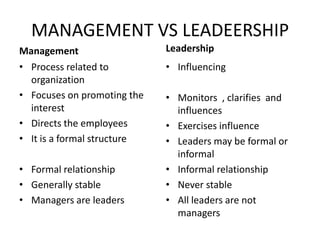
MANAGEMENT VS LEADEERSHIP
Management
• Process related to
organization
• Focuses on promoting the
interest
• Directs the employees
• It is a formal structure
• Formal relationship
• Generally stable
• Managers are leaders
Leadership
• Influencing
• Monitors , clarifies and
influences
• Exercises influence
• Leaders may be formal or
informal
• Informal relationship
• Never stable
• All leaders are not
managers
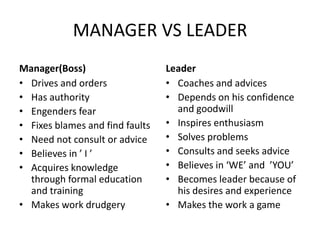
MANAGER VS LEADER
Manager(Boss)
• Drives and orders
• Has authority
• Engenders fear
• Fixes blames and find faults
• Need not consult or advice
• Believes in ’ I ’
• Acquires knowledge
through formal education
and training
• Makes work drudgery
Leader
• Coaches and advices
• Depends on his confidence
and goodwill
• Inspires enthusiasm
• Solves problems
• Consults and seeks advice
• Believes in ‘WE’ and ’YOU’
• Becomes leader because of
his desires and experience
• Makes the work a game
GROUP MEMBERS
• Mohit Malde 150
• Yash Jain 135
• Elston D’Almedia 115
• Sonal Joshi 136
• Mansi Dodia 139
• Parth Davda 118

Leadership Styles

  • 1.
  • 2.
    MEANING STYLE refers toa way of doing something. Leadership styles means the behavioural pattern which a leader adopts to direct the behaviour of members in an organisation in order to achieve the goal of the organisation.
  • 4.
    DEFINITION According to EdwinFlippo: “Leadership style is a pattern of behaviour designed to integrate organisational and personal interest in pursuit of some objectives"
  • 5.
  • 6.
    A)MOTIVATIONAL STYLES • Themain function of the leader is to MOTIVATE the workers to work more and increase the efficiency.
  • 7.
  • 8.
    i)POSITIVE APPROACH TOLEADERSHIP • Rewards • Money • Higher efficiency • Promotes peace • Leave encashment scheme
  • 9.
    ii)NEGATIVE APPROACH OF LEADERSHIP •Threatening • Penalising • Penalties
  • 10.
    • Advantages Reduction inlabour turnover and absenteeism. Boosts morale of employees. Generates loyalty. • Disadvantages Employees may feel frustrated due to negative motivation.
  • 11.
    B)POWER STYLES Power styles AutocraticStyles The Free Reign Style Democratic Style The Paternalistic Style
  • 12.
  • 13.
    • It isalso called as authoritarian or work oriented leadership • Plans and policies are determined by the leader alone • Demands strict obedience • Relies on power of position • Rewards and punishments
  • 14.
    • Less freedom •Greater concern for work is shown
  • 15.
    TYPES OF AUTHOCRATICLEADERS • Strict autocrat • Benevolent autocrat • Incompetent autocrat
  • 16.
    TYPES OF AUTHOCRATICLEADERS STRICT AUTOCRAT Strict style Influences subordinate Criticising Imposing penalities BENEVOLENT AUTOCRAT Positive motivational method Rewards Efficiency INCOMPETENT AUTOCRAT Autocratic styles Hide incompetency Short time
  • 17.
    ii)THE FREE-REIN STYLE •It is a type of leadership where there is least interference by the leader
  • 18.
    • Group operateson its own • Group works without leadership of manager • Manager maintains relation with people outside organisation • Quick and good result • Employees are intelligent
  • 19.
    iii)DEMOCRATIC LEADERSHIP • Itis also called as participative or person- oriented leadership • Subordinates have freedom • Concern for people is more rather than production • Leaders job is to encourage and reinforce constructive interrealtionship
  • 20.
    • Leader isquiet important figure in democratic situation however he is the key model in authoritarian type
  • 21.
    iv)THE PATERNALISTIC LEADERSHIP •The leader assumes paternal or fatherly role
  • 22.
    • Works toguide • Protect • Keep happy • Good working condition • Workers work hard with gratitude • It can generate resentment in subordinates
  • 23.
    Advantages: Success of newlyformed enterprise. Guides employees in case of they are illiterate. Disadvantages: Employees become tensed. Restricts delegation of authority.
  • 24.
  • 25.
  • 26.
    EMPLOYEE ORIENTED LEADERSHIP •Concerned about subordinates • They provide better working condition • Pay highest attention to the subordinates • Satisfy their needs • Solve problems
  • 27.
    ii)PRODUCTION OR TASKORIENTED LEADERSHIP
  • 28.
    TASK ORIENTED LEADERSHIP •Main concern is to get work done • Subordinates are kept busy • Zeal to produce more • Ignore human aspect
  • 29.
    LEADERSHIP TRAITS • Leadershiptraits refers to qualities that make individual a leader. • Leadership are classified into 2 types – Innate traits – Acuirable traits • Thus “leaders are not born and not made”
  • 30.
    • Physical features •Intelligence • Objectivity • Human relations
  • 31.
    • Motivating skills •Technical skills • Communication skills • Social skills
  • 32.
    MANAGEMENT VS LEADEERSHIP Management •Process related to organization • Focuses on promoting the interest • Directs the employees • It is a formal structure • Formal relationship • Generally stable • Managers are leaders Leadership • Influencing • Monitors , clarifies and influences • Exercises influence • Leaders may be formal or informal • Informal relationship • Never stable • All leaders are not managers
  • 33.
    MANAGER VS LEADER Manager(Boss) •Drives and orders • Has authority • Engenders fear • Fixes blames and find faults • Need not consult or advice • Believes in ’ I ’ • Acquires knowledge through formal education and training • Makes work drudgery Leader • Coaches and advices • Depends on his confidence and goodwill • Inspires enthusiasm • Solves problems • Consults and seeks advice • Believes in ‘WE’ and ’YOU’ • Becomes leader because of his desires and experience • Makes the work a game
  • 34.
    GROUP MEMBERS • MohitMalde 150 • Yash Jain 135 • Elston D’Almedia 115 • Sonal Joshi 136 • Mansi Dodia 139 • Parth Davda 118