By Megan Vincent
MARXIST THEORY
WHAT DOES THIS THEORY AFFIRM?
• Marxists believe that the transition from capitalism to socialism is a inevitable part of the
change in human society
• Marxism is based upon a materialist interpretation of history – social groups are driven by
creating and maintaining wealth.
• The term capitalism is defined by the refinement of the economic liberalism. Society has
moved from private producers to an isolated group of mass work without any rights in the
product they make.
• Marxism is an economic doctrine, it’s a theory of revolution and the basic explanation for
how societies change.
THEODOR ADORNO (1903-1969)
• Adorno believed that capitalism fed many people with the products of a society based on
the ‘culture industry’. This itself is the opposite of ‘true’ art which keeps the audience
passively satisfied and politically apathetic.
• Karl Marx placed a large emphasis on the world of economics whereas Adorno belived in
the role of culture in securing the status quo.
• This culture refers to popular culture which Adorno explained was the reason for people’s
passive satisfaction and lack of interest in overthrowing the capitalist system.
CULTURE INDUSTRIES
• Adorno suggested that these ‘culture industries’ create a debased mass of
unsophisticated products which have consequently replaced the more ‘difficult’ and critical
art forms which might raise activity within the audience. For example, leading people to
actually questioning social life.
• Products from culture industries could perhaps be emotional or apparently moving.
However, Adorno sees this as liberating- we might seek some comfort in media product
such as a sad film or song, express our sad emotions and then feel restored again.
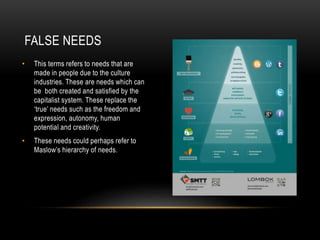
FALSE NEEDS
• This terms refers to needs that are
made in people due to the culture
industries. These are needs which can
be both created and satisfied by the
capitalist system. These replace the
‘true’ needs such as the freedom and
expression, autonomy, human
potential and creativity.
• These needs could perhaps refer to
Maslow’s hierarchy of needs.
COMMODITY FETISHISM
• Adorno believes that this is promoted by the media wihtin marketing, advertising and
media industries.
• This term refers to the social relations and cultural experiences which are objectified in
terms of money i.e we are delighted by something in how much it costs. Ultimately we are
materialistic.
MARXISM AND THE MEDIA
• Boiled down to its essence, the argument in modern-day would be that television leads
people away from talking to each other or being active and questioning the oppression in
their lives. But instead, many people participate in their daily routine and then absorb the
swallow all the TV’s nonsense like it is being fed to them. Then, the daily routine starts
again.
HOW IT HAS INFLUENCED PRODUCTION
DECISIONS
• We could argue that within our production, we are challenging Marxism and the idea of
being oppressive by not satisfying ‘real’ needs.
• This is because we are getting them to question food, health and the body and reject
theories of passivity. We are also getting them to question an authoritative body i.e the
ideas of the government and health organisations. This suggests that the audience are
not satisfying ‘false’ needs but the ‘true’ needs of freedom and expression because they
are questioning authority and creating an opinion for themselves. This also means that it
is not commodity fetishism because we are exploring factual and important things such as
health instead of something materialistic like shoes that we are delighted by due to the
cost.
HOWEVER…
• We may fulfil Theodor Adorno’s theory due to the fact are we are putting a large emphasis
on heath, which could be perceived as a way to ensure productivity of the work force as
the documentary encourages people to feel healthy. Thus, better physical health means
there will be an augmentation in physical well-being and the audience feel happy and
therefore they can conker and work for longer hours. Therefore, the audience work more,
generating more money for the owners and businesses. This is also hegemony.
‘Hegemony’ was developed by Gramsci in the late twenties and thirties. This was at the
time of the failure of Western European working-class movements. Gramsci was
determined to stop economic determinism due to Marxism and intellectual dictatorship. He
held that class struggle must always involve ideas and ideologies to make and prevent
revolution. He also stressed the role performed by human activity; not subverting
capitalism. Gramsci was more "dialectic" than "deterministic": he tried to build a theory
which recognised the autonomy, independence and importance of culture and ideology.
Gramsci also stated that hegemony can never be taken for granted.
HEGEMONY
• "...Dominant groups in society, including fundamentally but not exclusively the ruling
class, maintain their dominance by securing the 'spontaneous consent' of subordinate
groups, including the working class, through the negotiated construction of a political and
ideological consensus which incorporates both dominant and dominated groups."
(Strinati, 1995: 165)
• The definition of hegemony here clearly states that the higher class has succeeded in
persuading the other classes of society to accept its own values, a consent, either
physical or peaceful, is given by those in power and it can be understood as ‘common
sense’ which emerges from social and class struggles. Ultimately, it is a collection of
ideas thought of by dominant groups who strive to secure the content of subordinate
groups to their leadership.

Marxist theory

  • 1.
  • 2.
    WHAT DOES THISTHEORY AFFIRM? • Marxists believe that the transition from capitalism to socialism is a inevitable part of the change in human society • Marxism is based upon a materialist interpretation of history – social groups are driven by creating and maintaining wealth. • The term capitalism is defined by the refinement of the economic liberalism. Society has moved from private producers to an isolated group of mass work without any rights in the product they make. • Marxism is an economic doctrine, it’s a theory of revolution and the basic explanation for how societies change.
  • 3.
    THEODOR ADORNO (1903-1969) •Adorno believed that capitalism fed many people with the products of a society based on the ‘culture industry’. This itself is the opposite of ‘true’ art which keeps the audience passively satisfied and politically apathetic. • Karl Marx placed a large emphasis on the world of economics whereas Adorno belived in the role of culture in securing the status quo. • This culture refers to popular culture which Adorno explained was the reason for people’s passive satisfaction and lack of interest in overthrowing the capitalist system.
  • 4.
    CULTURE INDUSTRIES • Adornosuggested that these ‘culture industries’ create a debased mass of unsophisticated products which have consequently replaced the more ‘difficult’ and critical art forms which might raise activity within the audience. For example, leading people to actually questioning social life. • Products from culture industries could perhaps be emotional or apparently moving. However, Adorno sees this as liberating- we might seek some comfort in media product such as a sad film or song, express our sad emotions and then feel restored again.
  • 5.
    FALSE NEEDS • Thisterms refers to needs that are made in people due to the culture industries. These are needs which can be both created and satisfied by the capitalist system. These replace the ‘true’ needs such as the freedom and expression, autonomy, human potential and creativity. • These needs could perhaps refer to Maslow’s hierarchy of needs.
  • 6.
    COMMODITY FETISHISM • Adornobelieves that this is promoted by the media wihtin marketing, advertising and media industries. • This term refers to the social relations and cultural experiences which are objectified in terms of money i.e we are delighted by something in how much it costs. Ultimately we are materialistic.
  • 7.
    MARXISM AND THEMEDIA • Boiled down to its essence, the argument in modern-day would be that television leads people away from talking to each other or being active and questioning the oppression in their lives. But instead, many people participate in their daily routine and then absorb the swallow all the TV’s nonsense like it is being fed to them. Then, the daily routine starts again.
  • 8.
    HOW IT HASINFLUENCED PRODUCTION DECISIONS • We could argue that within our production, we are challenging Marxism and the idea of being oppressive by not satisfying ‘real’ needs. • This is because we are getting them to question food, health and the body and reject theories of passivity. We are also getting them to question an authoritative body i.e the ideas of the government and health organisations. This suggests that the audience are not satisfying ‘false’ needs but the ‘true’ needs of freedom and expression because they are questioning authority and creating an opinion for themselves. This also means that it is not commodity fetishism because we are exploring factual and important things such as health instead of something materialistic like shoes that we are delighted by due to the cost.
  • 9.
    HOWEVER… • We mayfulfil Theodor Adorno’s theory due to the fact are we are putting a large emphasis on heath, which could be perceived as a way to ensure productivity of the work force as the documentary encourages people to feel healthy. Thus, better physical health means there will be an augmentation in physical well-being and the audience feel happy and therefore they can conker and work for longer hours. Therefore, the audience work more, generating more money for the owners and businesses. This is also hegemony. ‘Hegemony’ was developed by Gramsci in the late twenties and thirties. This was at the time of the failure of Western European working-class movements. Gramsci was determined to stop economic determinism due to Marxism and intellectual dictatorship. He held that class struggle must always involve ideas and ideologies to make and prevent revolution. He also stressed the role performed by human activity; not subverting capitalism. Gramsci was more "dialectic" than "deterministic": he tried to build a theory which recognised the autonomy, independence and importance of culture and ideology. Gramsci also stated that hegemony can never be taken for granted.
  • 10.
    HEGEMONY • "...Dominant groupsin society, including fundamentally but not exclusively the ruling class, maintain their dominance by securing the 'spontaneous consent' of subordinate groups, including the working class, through the negotiated construction of a political and ideological consensus which incorporates both dominant and dominated groups." (Strinati, 1995: 165) • The definition of hegemony here clearly states that the higher class has succeeded in persuading the other classes of society to accept its own values, a consent, either physical or peaceful, is given by those in power and it can be understood as ‘common sense’ which emerges from social and class struggles. Ultimately, it is a collection of ideas thought of by dominant groups who strive to secure the content of subordinate groups to their leadership.