 Formulation of educational objectives
 Selecting learning experience
 Effective & efficient organization of lng
experience – theory & clinical
 Evaluation of curriculum
 Statement of those desired changes in
behavior as a result of specific teaching –
learning activity
 Philosophy of institution
 Social & health needs of society
 Needs of student
 Resources available
 Level of students
 Designation after class
 Minimum requirements syllabus)
 Future trends
 Criteria for appearing other exams
 In terms of desired behavioral change
 Help to select learning experience & guiding
teaching activity
 Desired behavior change should be in
consistent with stated objective
 Subject objectives contribute to overall
objective
 Attainable & practicable
 Worthwhile to society
 Consider needs ability & level of
students
 Objective of course , unit ,topic & lesson
should focus on development of
students
 Objectives should be motivating factors
 Should have continuity, sequence,
correlation & integration
 Cooperatively planned
 Each statement have only single
objective
 Should not be too detailed
 Scheme of evaluation to be planned while
formulating objective
1. Identify learners need
2. Identify need of society
3. Suggestion of experts
4. Formulate philosophy
5. State objectives (initial , as gathered)
6. Formulate a theory of learning
7. Screen objectives through philosophy
8. Define objectives clearly
9. State objectives in behavioral
terms(final)
 Institutional objective
 Intermediate - by curriculum committee
 Instructional – by teacher
 Central objective – for every topic or lesson
 Contributory or specific objective
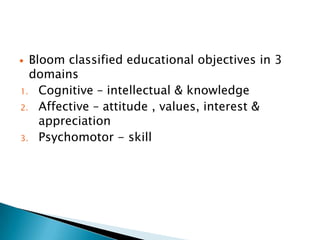
 Bloom classified educational objectives in 3
domains
1. Cognitive – intellectual & knowledge
2. Affective – attitude , values, interest &
appreciation
3. Psychomotor - skill
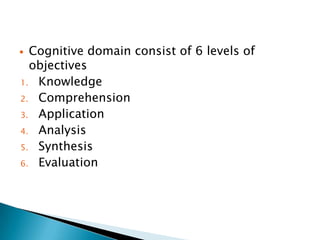
 Cognitive domain consist of 6 levels of
objectives
1. Knowledge
2. Comprehension
3. Application
4. Analysis
5. Synthesis
6. Evaluation
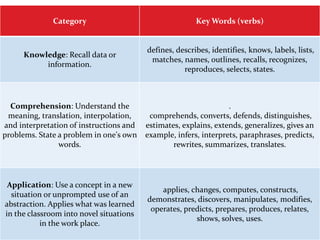
Category Key Words (verbs)
Knowledge: Recall data or
information.
defines, describes, identifies, knows, labels, lists,
matches, names, outlines, recalls, recognizes,
reproduces, selects, states.
Comprehension: Understand the
meaning, translation, interpolation,
and interpretation of instructions and
problems. State a problem in one's own
words.
.
comprehends, converts, defends, distinguishes,
estimates, explains, extends, generalizes, gives an
example, infers, interprets, paraphrases, predicts,
rewrites, summarizes, translates.
Application: Use a concept in a new
situation or unprompted use of an
abstraction. Applies what was learned
in the classroom into novel situations
in the work place.
applies, changes, computes, constructs,
demonstrates, discovers, manipulates, modifies,
operates, predicts, prepares, produces, relates,
shows, solves, uses.
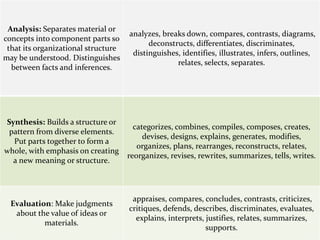
Analysis: Separates material or
concepts into component parts so
that its organizational structure
may be understood. Distinguishes
between facts and inferences.
analyzes, breaks down, compares, contrasts, diagrams,
deconstructs, differentiates, discriminates,
distinguishes, identifies, illustrates, infers, outlines,
relates, selects, separates.
Synthesis: Builds a structure or
pattern from diverse elements.
Put parts together to form a
whole, with emphasis on creating
a new meaning or structure.
categorizes, combines, compiles, composes, creates,
devises, designs, explains, generates, modifies,
organizes, plans, rearranges, reconstructs, relates,
reorganizes, revises, rewrites, summarizes, tells, writes.
Evaluation: Make judgments
about the value of ideas or
materials.
appraises, compares, concludes, contrasts, criticizes,
critiques, defends, describes, discriminates, evaluates,
explains, interprets, justifies, relates, summarizes,
supports.
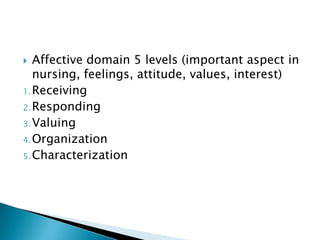
 Affective domain 5 levels (important aspect in
nursing, feelings, attitude, values, interest)
1.Receiving
2.Responding
3.Valuing
4.Organization
5.Characterization
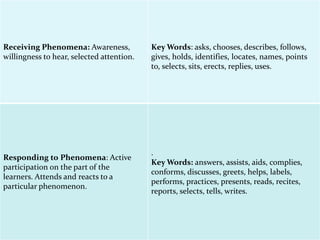
Receiving Phenomena: Awareness,
willingness to hear, selected attention.
.
Key Words: asks, chooses, describes, follows,
gives, holds, identifies, locates, names, points
to, selects, sits, erects, replies, uses.
Responding to Phenomena: Active
participation on the part of the
learners. Attends and reacts to a
particular phenomenon.
.
Key Words: answers, assists, aids, complies,
conforms, discusses, greets, helps, labels,
performs, practices, presents, reads, recites,
reports, selects, tells, writes.
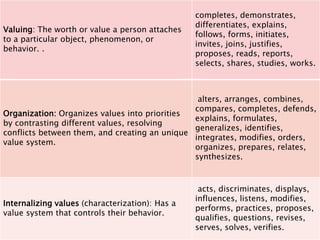
Valuing: The worth or value a person attaches
to a particular object, phenomenon, or
behavior. .
completes, demonstrates,
differentiates, explains,
follows, forms, initiates,
invites, joins, justifies,
proposes, reads, reports,
selects, shares, studies, works.
Organization: Organizes values into priorities
by contrasting different values, resolving
conflicts between them, and creating an unique
value system.
alters, arranges, combines,
compares, completes, defends,
explains, formulates,
generalizes, identifies,
integrates, modifies, orders,
organizes, prepares, relates,
synthesizes.
Internalizing values (characterization): Has a
value system that controls their behavior.
acts, discriminates, displays,
influences, listens, modifies,
performs, practices, proposes,
qualifies, questions, revises,
serves, solves, verifies.
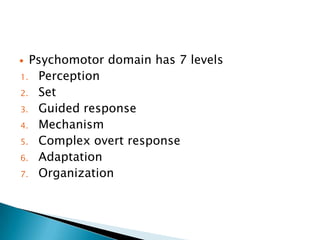
 Psychomotor domain has 7 levels
1. Perception
2. Set
3. Guided response
4. Mechanism
5. Complex overt response
6. Adaptation
7. Organization
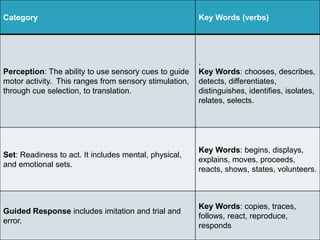
Category Key Words (verbs)
Perception: The ability to use sensory cues to guide
motor activity. This ranges from sensory stimulation,
through cue selection, to translation.
.
Key Words: chooses, describes,
detects, differentiates,
distinguishes, identifies, isolates,
relates, selects.
Set: Readiness to act. It includes mental, physical,
and emotional sets.
Key Words: begins, displays,
explains, moves, proceeds,
reacts, shows, states, volunteers.
Guided Response includes imitation and trial and
error.
Key Words: copies, traces,
follows, react, reproduce,
responds
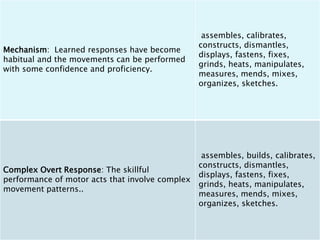
Mechanism: Learned responses have become
habitual and the movements can be performed
with some confidence and proficiency.
assembles, calibrates,
constructs, dismantles,
displays, fastens, fixes,
grinds, heats, manipulates,
measures, mends, mixes,
organizes, sketches.
Complex Overt Response: The skillful
performance of motor acts that involve complex
movement patterns..
assembles, builds, calibrates,
constructs, dismantles,
displays, fastens, fixes,
grinds, heats, manipulates,
measures, mends, mixes,
organizes, sketches.
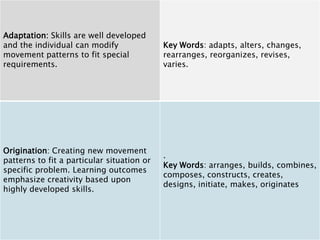
Adaptation: Skills are well developed
and the individual can modify
movement patterns to fit special
requirements.
Key Words: adapts, alters, changes,
rearranges, reorganizes, revises,
varies.
Origination: Creating new movement
patterns to fit a particular situation or
specific problem. Learning outcomes
emphasize creativity based upon
highly developed skills.
.
Key Words: arranges, builds, combines,
composes, constructs, creates,
designs, initiate, makes, originates
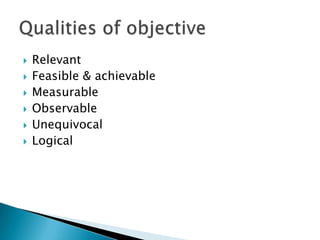
 Relevant
 Feasible & achievable
 Measurable
 Observable
 Unequivocal
 Logical
 A deliberately planned experiences in
selected situations where students actively
participate , interact & which result in
desirable changes of behavior
 Learning experience compromise both
theoretical & practical aspects
 All learning need should be in relation to
objective
 In relation to real life situation
 Effective integration between theory & practice
 Same learning experience many outcome &
vice versa
 selected in such a way that learners are
constantly motivated
 Students get meaning & see relation b/w past
& present experience & focus to future
 Learning is enhanced by utilizing wide variety of
teaching learning methods
 Will learn effectively if experiences are satisfactory
 Should consider students ability to undergo
change
 Learning experience selected should not be
beyond stage of development
 Should be according to the need of students
 Same & equal chance for all students
 Allow learning by doing
 Create motivation & interest
 Challenging to students
 Satisfy the needs of time
 Bring multiple outcomes in student
 Help to acquire knowledge, skill & attitude
 Helpful in gathering information
 Help to attain educational objectives
 Should be in consistent with philosophy of
institution
 Variable & flexible enough
 Provide opportunity to practice
 Provide opportunity for development of
independent thinking,descision making, self
discipline, judgment
 Planned & evaluated co-operatively by teacher &
student
 Aim is to bring & relate various learning
experience together to produce the maximum
cumulative effect in order to give a unified
view of the whole so that the educational
objectives are achieved (Tyler)
 Should be done carefully, sequentially &
systematically
 Learning experiences have to be vertically &
horizontally organized
 Succeeding experiences are build upon
preceding ones
 Experiences in one area & other to be related
 Should utilize allotted time cost effectively
 Organized in broad areas to facilitate relating
in allied areas
 Broad principles of education to be applied &
emphasized
 Provide ample opportunities for students in
each areas
 Provide opportunity to concentrate on one or
more electives
 Organize in terms of broad subject matters ;
humanities, behavioral science etc
 Neither too flexible or rigid
 Clinical experiences & assignments on the
basis of students experiences
 Organized in such a way that students are
able to practice nursing
 Grouping learning experiences under subject
heading
 Preparation of master plan for curriculum
 Placement of learning experience in the
curriculum
 Preparation of correlation chart
 Organization of clinical experience
 Follow teaching system
 To provide optimum experience to students
 Group learning experience under subject
heading
 Master plan guide teachers in the placement
of subject matters & clinical experience
 Gives a clear idea when to plan the subject
 Should be prepared in accordance to the
requirements of council and university
 Total duration of programme
 Different courses of study with theory &
practical
 Allotted time for each
 Teaching learning method
 Co curricular activities
 Clinical rotation plan is the statement which
explains the order of clinical posting of
various group of students belonging to
different classes in relevant clinical &
community setting
 Requirement as stated by university or
council
 Objectives of the course
 Number of students could be posted
 Infrastructure of the clinical area
 Availability of educators for supervision
 Developed in accordance to master plan
 Made in cooperation with faculty members
 Maxims of teaching to be followed
 Follow principles of sequence, integration & continuity
 Enough teaching staff should be made available
 Seek suggestions from staff working in the clinical areas
 First year students should receive maximum supervision
& attention
 All students should receive enough clinical experience
 Assignments related to, to be completed before posting
finish
 Over crowding in clinical area is not advisible
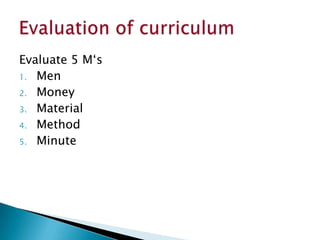
Evaluate 5 M‘s
1. Men
2. Money
3. Material
4. Method
5. Minute
 Evaluation should find out how much
objectives are achieved
 Objectives of curriculum evaluation should be
in terms of behavior or the reaction to be
measured

Steps of curriculum development

  • 2.
     Formulation ofeducational objectives  Selecting learning experience  Effective & efficient organization of lng experience – theory & clinical  Evaluation of curriculum
  • 3.
     Statement ofthose desired changes in behavior as a result of specific teaching – learning activity
  • 4.
     Philosophy ofinstitution  Social & health needs of society  Needs of student  Resources available  Level of students  Designation after class  Minimum requirements syllabus)  Future trends  Criteria for appearing other exams
  • 5.
     In termsof desired behavioral change  Help to select learning experience & guiding teaching activity  Desired behavior change should be in consistent with stated objective  Subject objectives contribute to overall objective  Attainable & practicable
  • 6.
     Worthwhile tosociety  Consider needs ability & level of students  Objective of course , unit ,topic & lesson should focus on development of students  Objectives should be motivating factors  Should have continuity, sequence, correlation & integration  Cooperatively planned  Each statement have only single objective
  • 7.
     Should notbe too detailed  Scheme of evaluation to be planned while formulating objective
  • 8.
    1. Identify learnersneed 2. Identify need of society 3. Suggestion of experts 4. Formulate philosophy 5. State objectives (initial , as gathered) 6. Formulate a theory of learning 7. Screen objectives through philosophy 8. Define objectives clearly 9. State objectives in behavioral terms(final)
  • 9.
     Institutional objective Intermediate - by curriculum committee  Instructional – by teacher  Central objective – for every topic or lesson  Contributory or specific objective
  • 11.
     Bloom classifiededucational objectives in 3 domains 1. Cognitive – intellectual & knowledge 2. Affective – attitude , values, interest & appreciation 3. Psychomotor - skill
  • 12.
     Cognitive domainconsist of 6 levels of objectives 1. Knowledge 2. Comprehension 3. Application 4. Analysis 5. Synthesis 6. Evaluation
  • 13.
    Category Key Words(verbs) Knowledge: Recall data or information. defines, describes, identifies, knows, labels, lists, matches, names, outlines, recalls, recognizes, reproduces, selects, states. Comprehension: Understand the meaning, translation, interpolation, and interpretation of instructions and problems. State a problem in one's own words. . comprehends, converts, defends, distinguishes, estimates, explains, extends, generalizes, gives an example, infers, interprets, paraphrases, predicts, rewrites, summarizes, translates. Application: Use a concept in a new situation or unprompted use of an abstraction. Applies what was learned in the classroom into novel situations in the work place. applies, changes, computes, constructs, demonstrates, discovers, manipulates, modifies, operates, predicts, prepares, produces, relates, shows, solves, uses.
  • 14.
    Analysis: Separates materialor concepts into component parts so that its organizational structure may be understood. Distinguishes between facts and inferences. analyzes, breaks down, compares, contrasts, diagrams, deconstructs, differentiates, discriminates, distinguishes, identifies, illustrates, infers, outlines, relates, selects, separates. Synthesis: Builds a structure or pattern from diverse elements. Put parts together to form a whole, with emphasis on creating a new meaning or structure. categorizes, combines, compiles, composes, creates, devises, designs, explains, generates, modifies, organizes, plans, rearranges, reconstructs, relates, reorganizes, revises, rewrites, summarizes, tells, writes. Evaluation: Make judgments about the value of ideas or materials. appraises, compares, concludes, contrasts, criticizes, critiques, defends, describes, discriminates, evaluates, explains, interprets, justifies, relates, summarizes, supports.
  • 15.
     Affective domain5 levels (important aspect in nursing, feelings, attitude, values, interest) 1.Receiving 2.Responding 3.Valuing 4.Organization 5.Characterization
  • 16.
    Receiving Phenomena: Awareness, willingnessto hear, selected attention. . Key Words: asks, chooses, describes, follows, gives, holds, identifies, locates, names, points to, selects, sits, erects, replies, uses. Responding to Phenomena: Active participation on the part of the learners. Attends and reacts to a particular phenomenon. . Key Words: answers, assists, aids, complies, conforms, discusses, greets, helps, labels, performs, practices, presents, reads, recites, reports, selects, tells, writes.
  • 17.
    Valuing: The worthor value a person attaches to a particular object, phenomenon, or behavior. . completes, demonstrates, differentiates, explains, follows, forms, initiates, invites, joins, justifies, proposes, reads, reports, selects, shares, studies, works. Organization: Organizes values into priorities by contrasting different values, resolving conflicts between them, and creating an unique value system. alters, arranges, combines, compares, completes, defends, explains, formulates, generalizes, identifies, integrates, modifies, orders, organizes, prepares, relates, synthesizes. Internalizing values (characterization): Has a value system that controls their behavior. acts, discriminates, displays, influences, listens, modifies, performs, practices, proposes, qualifies, questions, revises, serves, solves, verifies.
  • 18.
     Psychomotor domainhas 7 levels 1. Perception 2. Set 3. Guided response 4. Mechanism 5. Complex overt response 6. Adaptation 7. Organization
  • 19.
    Category Key Words(verbs) Perception: The ability to use sensory cues to guide motor activity. This ranges from sensory stimulation, through cue selection, to translation. . Key Words: chooses, describes, detects, differentiates, distinguishes, identifies, isolates, relates, selects. Set: Readiness to act. It includes mental, physical, and emotional sets. Key Words: begins, displays, explains, moves, proceeds, reacts, shows, states, volunteers. Guided Response includes imitation and trial and error. Key Words: copies, traces, follows, react, reproduce, responds
  • 20.
    Mechanism: Learned responseshave become habitual and the movements can be performed with some confidence and proficiency. assembles, calibrates, constructs, dismantles, displays, fastens, fixes, grinds, heats, manipulates, measures, mends, mixes, organizes, sketches. Complex Overt Response: The skillful performance of motor acts that involve complex movement patterns.. assembles, builds, calibrates, constructs, dismantles, displays, fastens, fixes, grinds, heats, manipulates, measures, mends, mixes, organizes, sketches.
  • 21.
    Adaptation: Skills arewell developed and the individual can modify movement patterns to fit special requirements. Key Words: adapts, alters, changes, rearranges, reorganizes, revises, varies. Origination: Creating new movement patterns to fit a particular situation or specific problem. Learning outcomes emphasize creativity based upon highly developed skills. . Key Words: arranges, builds, combines, composes, constructs, creates, designs, initiate, makes, originates
  • 22.
     Relevant  Feasible& achievable  Measurable  Observable  Unequivocal  Logical
  • 23.
     A deliberatelyplanned experiences in selected situations where students actively participate , interact & which result in desirable changes of behavior  Learning experience compromise both theoretical & practical aspects
  • 24.
     All learningneed should be in relation to objective  In relation to real life situation  Effective integration between theory & practice  Same learning experience many outcome & vice versa  selected in such a way that learners are constantly motivated  Students get meaning & see relation b/w past & present experience & focus to future
  • 25.
     Learning isenhanced by utilizing wide variety of teaching learning methods  Will learn effectively if experiences are satisfactory  Should consider students ability to undergo change  Learning experience selected should not be beyond stage of development  Should be according to the need of students  Same & equal chance for all students
  • 26.
     Allow learningby doing  Create motivation & interest  Challenging to students  Satisfy the needs of time  Bring multiple outcomes in student  Help to acquire knowledge, skill & attitude  Helpful in gathering information  Help to attain educational objectives
  • 27.
     Should bein consistent with philosophy of institution  Variable & flexible enough  Provide opportunity to practice  Provide opportunity for development of independent thinking,descision making, self discipline, judgment  Planned & evaluated co-operatively by teacher & student
  • 28.
     Aim isto bring & relate various learning experience together to produce the maximum cumulative effect in order to give a unified view of the whole so that the educational objectives are achieved (Tyler)  Should be done carefully, sequentially & systematically  Learning experiences have to be vertically & horizontally organized
  • 29.
     Succeeding experiencesare build upon preceding ones  Experiences in one area & other to be related  Should utilize allotted time cost effectively  Organized in broad areas to facilitate relating in allied areas  Broad principles of education to be applied & emphasized  Provide ample opportunities for students in each areas  Provide opportunity to concentrate on one or more electives
  • 30.
     Organize interms of broad subject matters ; humanities, behavioral science etc  Neither too flexible or rigid  Clinical experiences & assignments on the basis of students experiences  Organized in such a way that students are able to practice nursing
  • 31.
     Grouping learningexperiences under subject heading  Preparation of master plan for curriculum  Placement of learning experience in the curriculum  Preparation of correlation chart  Organization of clinical experience  Follow teaching system
  • 32.
     To provideoptimum experience to students  Group learning experience under subject heading
  • 33.
     Master planguide teachers in the placement of subject matters & clinical experience  Gives a clear idea when to plan the subject  Should be prepared in accordance to the requirements of council and university
  • 34.
     Total durationof programme  Different courses of study with theory & practical  Allotted time for each  Teaching learning method  Co curricular activities
  • 35.
     Clinical rotationplan is the statement which explains the order of clinical posting of various group of students belonging to different classes in relevant clinical & community setting
  • 36.
     Requirement asstated by university or council  Objectives of the course  Number of students could be posted  Infrastructure of the clinical area  Availability of educators for supervision
  • 37.
     Developed inaccordance to master plan  Made in cooperation with faculty members  Maxims of teaching to be followed  Follow principles of sequence, integration & continuity  Enough teaching staff should be made available  Seek suggestions from staff working in the clinical areas  First year students should receive maximum supervision & attention  All students should receive enough clinical experience  Assignments related to, to be completed before posting finish  Over crowding in clinical area is not advisible
  • 38.
    Evaluate 5 M‘s 1.Men 2. Money 3. Material 4. Method 5. Minute
  • 39.
     Evaluation shouldfind out how much objectives are achieved  Objectives of curriculum evaluation should be in terms of behavior or the reaction to be measured