PRINCIPLES OF EDUCATION &
TEACHING LEARNING PROCESS
PRESENTED BY
Mrs.MADHURIMA.D
Assistant Professor
Shri Sathya Sai College of Nursing
SBV University
EDUCATION
• In literary sense, education owes its origin to the two
Latin words: ‘Educare’ and ‘Educere’.
• ‘Educare’- means ‘to nourish’, ‘to bring up’, ‘to raise’;
‘Educere’- means ‘to bring forth’, ‘to draw out’, ‘to
lead out’.
• ‘Educatum’- means- ‘the act of teaching and
training’.
EDUCATION TECHNOLOGY
• Educational technology refers to the systematic
application of technology in education, combining
hardware, software, and educational theory to
enhance learning
AIMS OF EDUCATION
AIMS OF EDUCATIONAL
TECHNOLOGY
Improve learning outcomes
Facilitate effective teaching methods
 Integrate technology in the educational
process
12/16/24 6
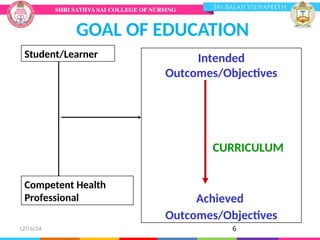
GOAL OF EDUCATION
Student/Learner
Competent Health
Professional
Intended
Outcomes/Objectives
CURRICULUM
Achieved
Outcomes/Objectives
APPROACHES OF EDUCATIONAL
TECHNOLOGY
– Behavioral Approach: Focuses on observable
changes in behavior
– Constructivist Approach: Encourages active
learning and knowledge construction.
APPROACHES OF EDUCATIONAL
TECHNOLOGY
• Transformational Education:
Emphasizes changing the learner's perspective and
fostering critical thinking.
• Relationship-Based Education:
Focuses on building strong teacher-student
relationships to enhance learning.
• Competency-Based Education:
Allows students to progress based on their mastery
of skills rather than time spent in class
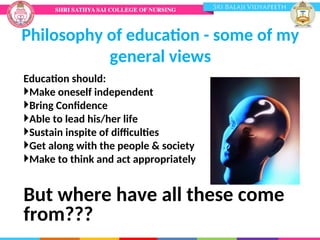
Philosophy of education - some of my
general views
Education should:
Make oneself independent
Bring Confidence
Able to lead his/her life
Sustain inspite of difficulties
Get along with the people & society
Make to think and act appropriately
But where have all these come
from???
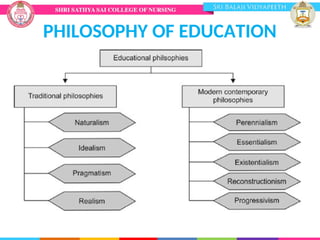
PHILOSOPHY OF EDUCATION
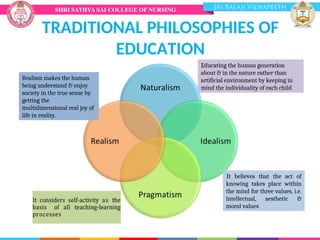
TRADITIONAL PHILOSOPHIES OF
EDUCATION
Educating the human generation
about & in the nature rather than
artificial environment by keeping in
mind the individuality of each child
It believes that the act of
knowing takes place within
the mind for three values, i.e.
intellectual, aesthetic &
moral values
Realism makes the human
being understand & enjoy
society in the true sense by
getting the
multidimensional real joy of
life in reality.
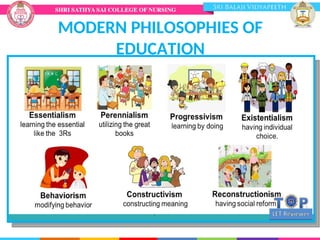
MODERN PHILOSOPHIES OF
EDUCATION
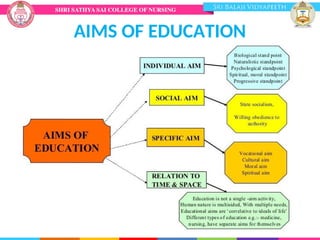
AIMS OF EDUCATION
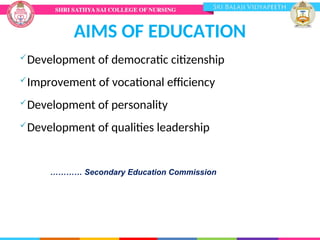
AIMS OF EDUCATION
Development of democratic citizenship
Improvement of vocational efficiency
Development of personality
Development of qualities leadership
………… Secondary Education Commission
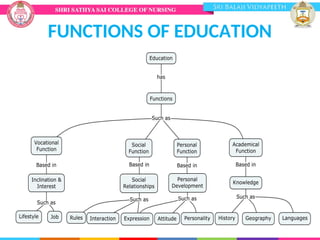
FUNCTIONS OF EDUCATION
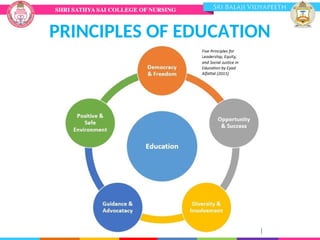
PRINCIPLES OF EDUCATION
TEACHING
• Teaching refers to activities that are designed
and performed to produce change in student's
(pupil) behaviour (Clark, 1970).
• Teaching is an intimate contact between a
more mature personality and less mature one
which is designed to further the education of
the latter.
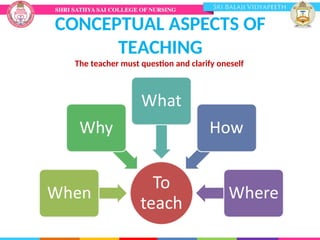
CONCEPTUAL ASPECTS OF
TEACHING
The teacher must question and clarify oneself
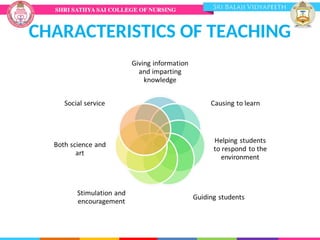
CHARACTERISTICS OF TEACHING
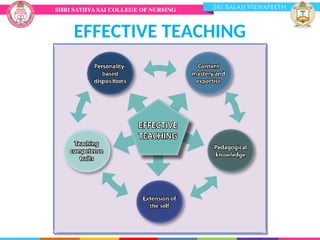
EFFECTIVE TEACHING
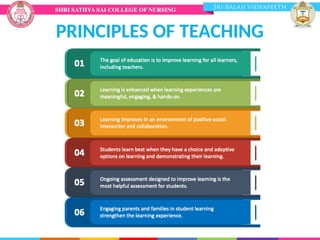
PRINCIPLES OF TEACHING
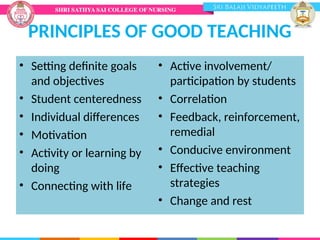
PRINCIPLES OF GOOD TEACHING
• Setting definite goals
and objectives
• Student centeredness
• Individual differences
• Motivation
• Activity or learning by
doing
• Connecting with life
• Active involvement/
participation by students
• Correlation
• Feedback, reinforcement,
remedial
• Conducive environment
• Effective teaching
strategies
• Change and rest
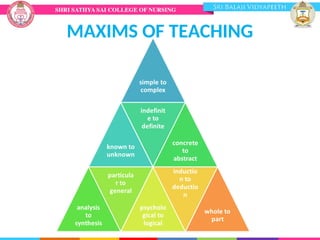
MAXIMS OF TEACHING
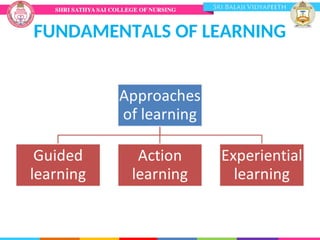
FUNDAMENTALS OF LEARNING
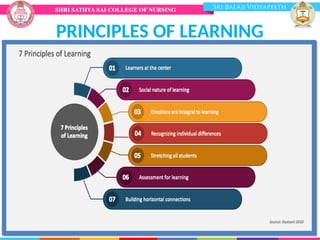
PRINCIPLES OF LEARNING
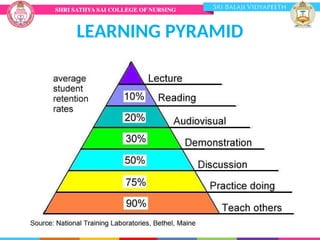
LEARNING PYRAMID
27
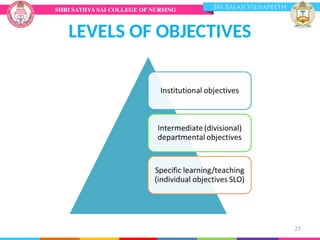
LEVELS OF OBJECTIVES
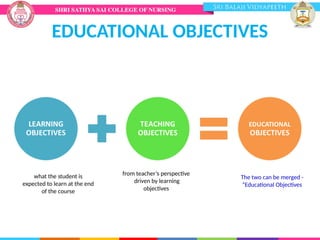
EDUCATIONAL OBJECTIVES
from teacher’s perspective
driven by learning
objectives
what the student is
expected to learn at the end
of the course
The two can be merged -
“Educational Objectives
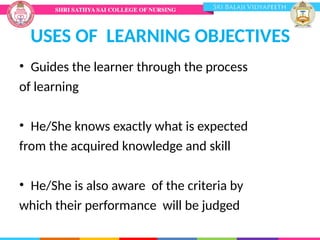
USES OF LEARNING OBJECTIVES
• Guides the learner through the process
of learning
• He/She knows exactly what is expected
from the acquired knowledge and skill
• He/She is also aware of the criteria by
which their performance will be judged
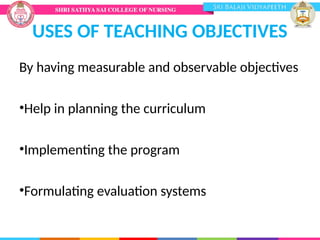
USES OF TEACHING OBJECTIVES
By having measurable and observable objectives
•Help in planning the curriculum
•Implementing the program
•Formulating evaluation systems
KNOWLEDGE AND EDUCATION
• Knowledge – all of the information
about any topic
• Education – all the knowledge plus the
process of teaching and learning it.
• Education is more “holistic” word
TAXONOMY
Etymology - From the Greek word –
arrangement
• Taxonomy means: a system of grouping or
categorizing things
• Taxonomy and classification are synonymous
EDUCATIONAL OBJECTIVES
• To achieve that ultimate status of complete
Learning
- first step is to understand what all
aspects or components have to be covered
• Systematic categorization or classification
of all the components is called as
Taxonomy of Educational Objectives
34
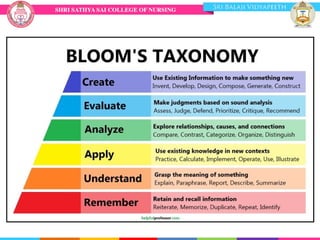
BLOOM’S TAXONOMY
•A committee of colleagues, led by
Benjamin Bloom (1956), identified three
domains of educational activities
•Is an instructional theory that categorizes
levels of learning.
•A tool for instructors to assist with writing
learning outcomes, curriculum planning,
content delivery as well as assessment of
learning levels.
BLOOM’S TAXONOMY
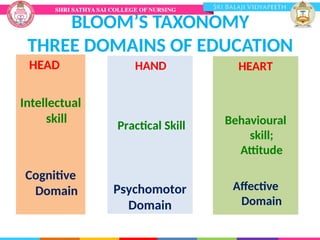
THREE DOMAINS OF EDUCATION
HEAD
Intellectual
skill
Cognitive
Domain
HEART
Behavioural
skill;
Attitude
Affective
Domain
HAND
Practical Skill
Psychomotor
Domain
GOALS OF LEARNING
At the end of the learning session the
learner should have acquired
New Knowledge
New Skills
New Attitudes
KSA
THE DOMAINS - SUBCLASSES
The three domains are divided into
subdivisions,
starting from the simplest
behavior to the most complex.
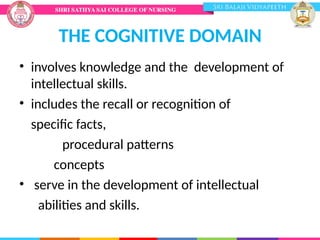
THE COGNITIVE DOMAIN
• involves knowledge and the development of
intellectual skills.
• includes the recall or recognition of
specific facts,
procedural patterns
concepts
• serve in the development of intellectual
abilities and skills.
CATEGORIES IN THE COGNITIVE
DOMAIN
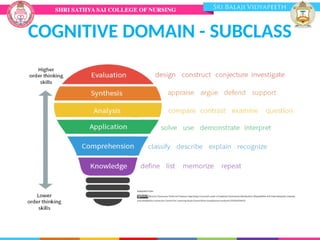
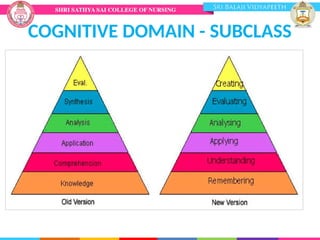
• There are six major categories
• The categories can be thought of as degrees of
difficulties.
• That is, the first ones must normally be
mastered before the next ones can take place
COGNITIVE DOMAIN - SUBCLASS
1. Knowledge
• Recall data or information
• Remembering of previously learned
Information
• Knowledge of terminology, specific facts,
principles, theories
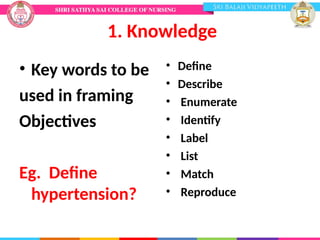
1. Knowledge
• Key words to be
used in framing
Objectives
Eg. Define
hypertension?
• Define
• Describe
• Enumerate
• Identify
• Label
• List
• Match
• Reproduce
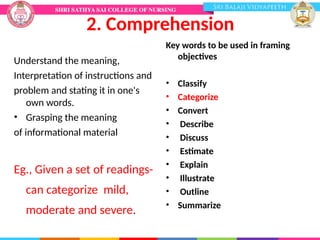
2. Comprehension
Understand the meaning,
Interpretation of instructions and
problem and stating it in one's
own words.
• Grasping the meaning
of informational material
Eg., Given a set of readings-
can categorize mild,
moderate and severe.
Key words to be used in framing
objectives
• Classify
• Categorize
• Convert
• Describe
• Discuss
• Estimate
• Explain
• Illustrate
• Outline
• Summarize
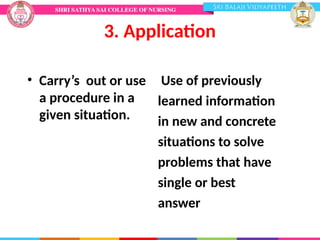
3. Application
• Carry’s out or use
a procedure in a
given situation.
Use of previously
learned information
in new and concrete
situations to solve
problems that have
single or best
answer
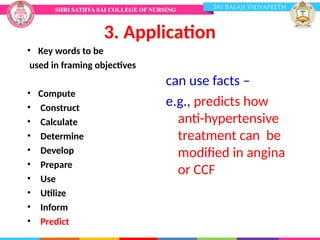
3. Application
• Key words to be
used in framing objectives
• Compute
• Construct
• Calculate
• Determine
• Develop
• Prepare
• Use
• Utilize
• Inform
• Predict
can use facts –
e.g., predicts how
anti-hypertensive
treatment can be
modified in angina
or CCF
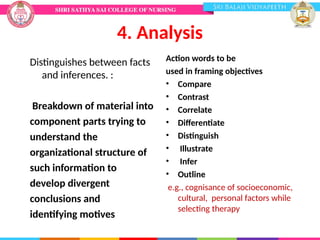
4. Analysis
Distinguishes between facts
and inferences. :
Breakdown of material into
component parts trying to
understand the
organizational structure of
such information to
develop divergent
conclusions and
identifying motives
Action words to be
used in framing objectives
• Compare
• Contrast
• Correlate
• Differentiate
• Distinguish
• Illustrate
• Infer
• Outline
e.g., cognisance of socioeconomic,
cultural, personal factors while
selecting therapy
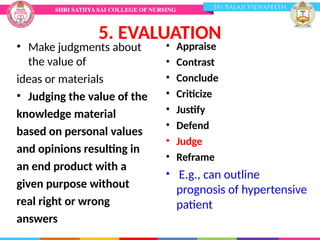
• Make judgments about
the value of
ideas or materials
• Judging the value of the
knowledge material
based on personal values
and opinions resulting in
an end product with a
given purpose without
real right or wrong
answers
• Appraise
• Contrast
• Conclude
• Criticize
• Justify
• Defend
• Judge
• Reframe
• E.g., can outline
prognosis of hypertensive
patient
5. EVALUATION
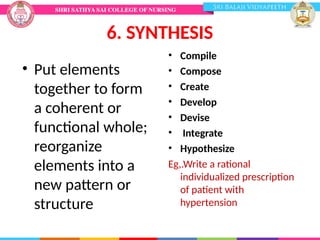
• Put elements
together to form
a coherent or
functional whole;
reorganize
elements into a
new pattern or
structure
• Compile
• Compose
• Create
• Develop
• Devise
• Integrate
• Hypothesize
Eg,.Write a rational
individualized prescription
of patient with
hypertension
6. SYNTHESIS
50
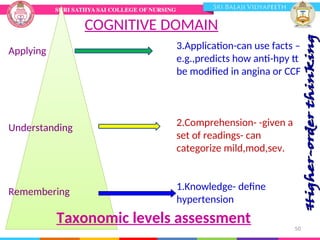
COGNITIVE DOMAIN
Applying
Understanding
Remembering
3.Application-can use facts –
e.g.,predicts how anti-hpy tt
be modified in angina or CCF
2.Comprehension- -given a
set of readings- can
categorize mild,mod,sev.
1.Knowledge- define
hypertension
Taxonomic levels assessment
COGNITIVE DOMAIN
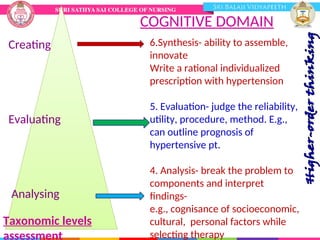
Creating
Evaluating
Analysing
6.Synthesis- ability to assemble,
innovate
Write a rational individualized
prescription with hypertension
5. Evaluation- judge the reliability,
utility, procedure, method. E.g.,
can outline prognosis of
hypertensive pt.
4. Analysis- break the problem to
components and interpret
findings-
e.g., cognisance of socioeconomic,
cultural, personal factors while
selecting therapy
Taxonomic levels
assessment
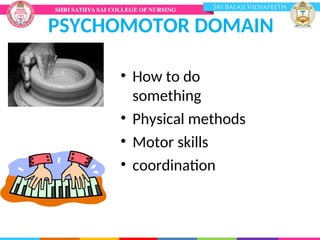
PSYCHOMOTOR DOMAIN
• How to do
something
• Physical methods
• Motor skills
• coordination
54
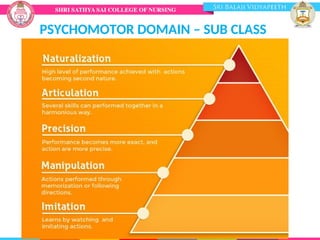
• Psychomotor Domain
• Development of these
skills requires
– Practice
– Measured in terms of
speed,
– precision, distance,
procedures, or
– techniques in execution.
• Three major categories
- from the
• simplest behavior to
the complex
PSYCHOMOTOR DOMAIN
PSYCHOMOTOR DOMAIN – SUB CLASS
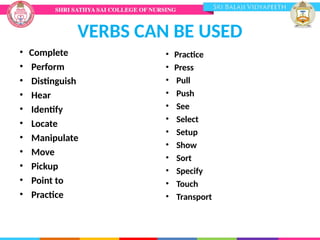
VERBS CAN BE USED
• Complete
• Perform
• Distinguish
• Hear
• Identify
• Locate
• Manipulate
• Move
• Pickup
• Point to
• Practice
• Practice
• Press
• Pull
• Push
• See
• Select
• Setup
• Show
• Sort
• Specify
• Touch
• Transport
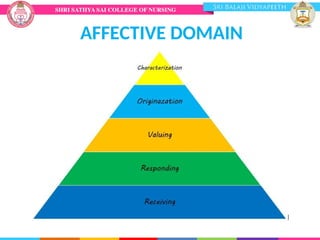
AFFECTIVE DOMAIN
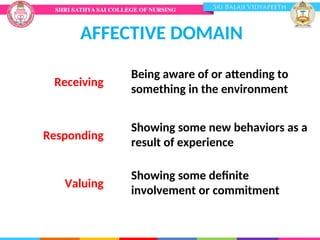
AFFECTIVE DOMAIN
Receiving
Being aware of or attending to
something in the environment
Responding
Showing some new behaviors as a
result of experience
Valuing
Showing some definite
involvement or commitment
Krathwohl, D., Bloom, B., & Masia, B. (1956). Taxonomy of educational objectives.
Handbook II: Affective domain. New York: David McKay.
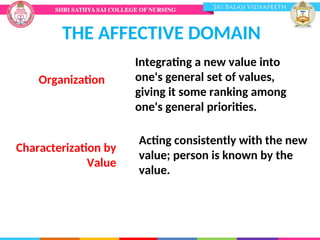
Organization
Integrating a new value into
one's general set of values,
giving it some ranking among
one's general priorities.
Characterization by
Value
Acting consistently with the new
value; person is known by the
value.
THE AFFECTIVE DOMAIN
AFFECTIVE DOMAIN-TAXONOMIC LEVELS
ASSESSMENT
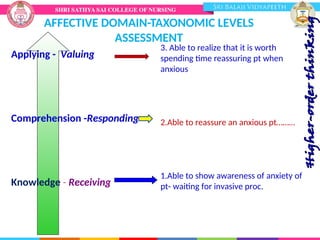
Applying - Valuing
Comprehension -Responding
Knowledge - Receiving
3. Able to realize that it is worth
spending time reassuring pt when
anxious
2.Able to reassure an anxious pt………
1.Able to show awareness of anxiety of
pt- waiting for invasive proc.
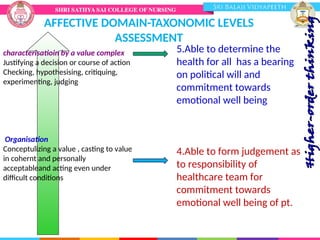
characterisatioin by a value complex
Justifying a decision or course of action
Checking, hypothesising, critiquing,
experimenting, judging
Organisation
Conceptulizing a value , casting to value
in cohernt and personally
acceptableand acting even under
difficult conditions
5.Able to determine the
health for all has a bearing
on political will and
commitment towards
emotional well being
4.Able to form judgement as
to responsibility of
healthcare team for
commitment towards
emotional well being of pt.
AFFECTIVE DOMAIN-TAXONOMIC LEVELS
ASSESSMENT
LESSON PLAN
The clearer the structure of a lesson and
the more precise the directions on what is
to be accomplished, the higher the
achievement rate.
LESSON PLAN
Increases the chances that
•all of your students will learn what you
want them to learn
•To make purposeful decisions
•be prepared to support your students
through the learning process
Importance of Lesson planning
1. It gives a bird’s eye of view of things to be taught and
learned everyday.
2. It makes you organized whilst teaching.
3. It provides the teacher many ways to keep the
teaching process not monotonous and redundant.
4. It gives teacher a reality check of his everyday
performance.
5. It definitely improves teaching skills.
PURPOSE OF A LESSON PLAN:
• structure the lesson
• organize its contents/materials
• determine method of its delivery
• assess students’ learning
• evaluate is application/effectiveness
MAJOR ELEMENTS
• Educational Objectives
• Content and Appropriate Teaching Activities
• Preparation of all the Material
• Monitoring & Assessing Learning
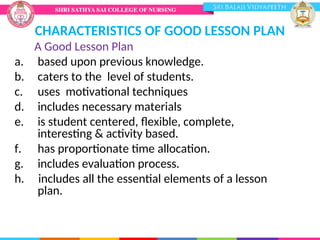
CHARACTERISTICS OF GOOD LESSON PLAN
A Good Lesson Plan
a. based upon previous knowledge.
b. caters to the level of students.
c. uses motivational techniques
d. includes necessary materials
e. is student centered, flexible, complete,
interesting & activity based.
f. has proportionate time allocation.
g. includes evaluation process.
h. includes all the essential elements of a lesson
plan.
ADVANTAGES OF A LESSON PLAN
• a key to the target.
• saves time.
• makes the work regular & organized.
• induces confidence.
• promotes learning.
• improves results.
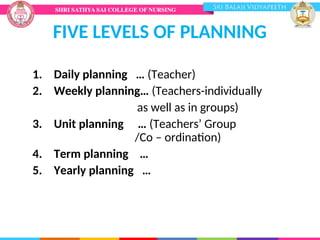
FIVE LEVELS OF PLANNING
1. Daily planning … (Teacher)
2. Weekly planning… (Teachers-individually
as well as in groups)
3. Unit planning … (Teachers’ Group
/Co – ordination)
4. Term planning …
5. Yearly planning …
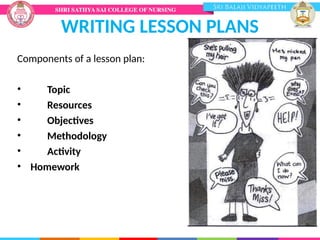
Components of a lesson plan:
• Topic
• Resources
• Objectives
• Methodology
• Activity
• Homework
WRITING LESSON PLANS
EDUCATIONAL OBJECTIVES
• Specify the new skills that the students will
gain as a result of the lesson
• Focus on student’s (not teacher’s)
attainment
• Determine the degree or criterion for
satisfactory attainment of the objectives.
EDUCATIONAL OBJECTIVES
Setting Objectives
What will the learner be able to:
• Know (concept…cognitive)
• Do (skill… psychomotor)
• Feel (behavior, attitude, appreciation or ideas…
affective)
Each defined objective is matched with:
• Teaching Method
• Learning Activities
• Type of Assessment
Note: Relevance is the essential quality of the
educational objectives
EDUCATIONAL OBJECTIVES
• Specific
• Measurable
• Attainable
• Realistic
• Time bound
WRITING LESSON PLANS
Methodology - Specify Timings of each of these steps:
(40/80 minutes)
• Settling time
• Introduction
• Previous Knowledge
• Presentation – Brainstorming / Discussion / teacher’s
Input
• Practice (Students output) – CW. Oral / Written
• Home Work
• Assessment – Test / worksheets
principles of education, teaching & learning-.ppt

principles of education, teaching & learning-.ppt

  • 1.
    PRINCIPLES OF EDUCATION& TEACHING LEARNING PROCESS PRESENTED BY Mrs.MADHURIMA.D Assistant Professor Shri Sathya Sai College of Nursing SBV University
  • 2.
    EDUCATION • In literarysense, education owes its origin to the two Latin words: ‘Educare’ and ‘Educere’. • ‘Educare’- means ‘to nourish’, ‘to bring up’, ‘to raise’; ‘Educere’- means ‘to bring forth’, ‘to draw out’, ‘to lead out’. • ‘Educatum’- means- ‘the act of teaching and training’.
  • 3.
    EDUCATION TECHNOLOGY • Educationaltechnology refers to the systematic application of technology in education, combining hardware, software, and educational theory to enhance learning
  • 4.
  • 5.
    AIMS OF EDUCATIONAL TECHNOLOGY Improvelearning outcomes Facilitate effective teaching methods  Integrate technology in the educational process
  • 6.
    12/16/24 6 GOAL OFEDUCATION Student/Learner Competent Health Professional Intended Outcomes/Objectives CURRICULUM Achieved Outcomes/Objectives
  • 7.
    APPROACHES OF EDUCATIONAL TECHNOLOGY –Behavioral Approach: Focuses on observable changes in behavior – Constructivist Approach: Encourages active learning and knowledge construction.
  • 8.
    APPROACHES OF EDUCATIONAL TECHNOLOGY •Transformational Education: Emphasizes changing the learner's perspective and fostering critical thinking. • Relationship-Based Education: Focuses on building strong teacher-student relationships to enhance learning. • Competency-Based Education: Allows students to progress based on their mastery of skills rather than time spent in class
  • 9.
    Philosophy of education- some of my general views Education should: Make oneself independent Bring Confidence Able to lead his/her life Sustain inspite of difficulties Get along with the people & society Make to think and act appropriately But where have all these come from???
  • 10.
  • 11.
    TRADITIONAL PHILOSOPHIES OF EDUCATION Educatingthe human generation about & in the nature rather than artificial environment by keeping in mind the individuality of each child It believes that the act of knowing takes place within the mind for three values, i.e. intellectual, aesthetic & moral values Realism makes the human being understand & enjoy society in the true sense by getting the multidimensional real joy of life in reality.
  • 12.
  • 13.
  • 14.
    AIMS OF EDUCATION Developmentof democratic citizenship Improvement of vocational efficiency Development of personality Development of qualities leadership ………… Secondary Education Commission
  • 15.
  • 16.
  • 17.
    TEACHING • Teaching refersto activities that are designed and performed to produce change in student's (pupil) behaviour (Clark, 1970). • Teaching is an intimate contact between a more mature personality and less mature one which is designed to further the education of the latter.
  • 18.
    CONCEPTUAL ASPECTS OF TEACHING Theteacher must question and clarify oneself
  • 19.
  • 20.
  • 21.
  • 22.
    PRINCIPLES OF GOODTEACHING • Setting definite goals and objectives • Student centeredness • Individual differences • Motivation • Activity or learning by doing • Connecting with life • Active involvement/ participation by students • Correlation • Feedback, reinforcement, remedial • Conducive environment • Effective teaching strategies • Change and rest
  • 23.
  • 24.
  • 25.
  • 26.
  • 27.
  • 28.
    EDUCATIONAL OBJECTIVES from teacher’sperspective driven by learning objectives what the student is expected to learn at the end of the course The two can be merged - “Educational Objectives
  • 29.
    USES OF LEARNINGOBJECTIVES • Guides the learner through the process of learning • He/She knows exactly what is expected from the acquired knowledge and skill • He/She is also aware of the criteria by which their performance will be judged
  • 30.
    USES OF TEACHINGOBJECTIVES By having measurable and observable objectives •Help in planning the curriculum •Implementing the program •Formulating evaluation systems
  • 31.
    KNOWLEDGE AND EDUCATION •Knowledge – all of the information about any topic • Education – all the knowledge plus the process of teaching and learning it. • Education is more “holistic” word
  • 32.
    TAXONOMY Etymology - Fromthe Greek word – arrangement • Taxonomy means: a system of grouping or categorizing things • Taxonomy and classification are synonymous
  • 33.
    EDUCATIONAL OBJECTIVES • Toachieve that ultimate status of complete Learning - first step is to understand what all aspects or components have to be covered • Systematic categorization or classification of all the components is called as Taxonomy of Educational Objectives
  • 34.
    34 BLOOM’S TAXONOMY •A committeeof colleagues, led by Benjamin Bloom (1956), identified three domains of educational activities •Is an instructional theory that categorizes levels of learning. •A tool for instructors to assist with writing learning outcomes, curriculum planning, content delivery as well as assessment of learning levels.
  • 35.
    BLOOM’S TAXONOMY THREE DOMAINSOF EDUCATION HEAD Intellectual skill Cognitive Domain HEART Behavioural skill; Attitude Affective Domain HAND Practical Skill Psychomotor Domain
  • 36.
    GOALS OF LEARNING Atthe end of the learning session the learner should have acquired New Knowledge New Skills New Attitudes KSA
  • 37.
    THE DOMAINS -SUBCLASSES The three domains are divided into subdivisions, starting from the simplest behavior to the most complex.
  • 38.
    THE COGNITIVE DOMAIN •involves knowledge and the development of intellectual skills. • includes the recall or recognition of specific facts, procedural patterns concepts • serve in the development of intellectual abilities and skills.
  • 39.
    CATEGORIES IN THECOGNITIVE DOMAIN • There are six major categories • The categories can be thought of as degrees of difficulties. • That is, the first ones must normally be mastered before the next ones can take place
  • 40.
  • 41.
  • 42.
    1. Knowledge • Recalldata or information • Remembering of previously learned Information • Knowledge of terminology, specific facts, principles, theories
  • 43.
    1. Knowledge • Keywords to be used in framing Objectives Eg. Define hypertension? • Define • Describe • Enumerate • Identify • Label • List • Match • Reproduce
  • 44.
    2. Comprehension Understand themeaning, Interpretation of instructions and problem and stating it in one's own words. • Grasping the meaning of informational material Eg., Given a set of readings- can categorize mild, moderate and severe. Key words to be used in framing objectives • Classify • Categorize • Convert • Describe • Discuss • Estimate • Explain • Illustrate • Outline • Summarize
  • 45.
    3. Application • Carry’sout or use a procedure in a given situation. Use of previously learned information in new and concrete situations to solve problems that have single or best answer
  • 46.
    3. Application • Keywords to be used in framing objectives • Compute • Construct • Calculate • Determine • Develop • Prepare • Use • Utilize • Inform • Predict can use facts – e.g., predicts how anti-hypertensive treatment can be modified in angina or CCF
  • 47.
    4. Analysis Distinguishes betweenfacts and inferences. : Breakdown of material into component parts trying to understand the organizational structure of such information to develop divergent conclusions and identifying motives Action words to be used in framing objectives • Compare • Contrast • Correlate • Differentiate • Distinguish • Illustrate • Infer • Outline e.g., cognisance of socioeconomic, cultural, personal factors while selecting therapy
  • 48.
    • Make judgmentsabout the value of ideas or materials • Judging the value of the knowledge material based on personal values and opinions resulting in an end product with a given purpose without real right or wrong answers • Appraise • Contrast • Conclude • Criticize • Justify • Defend • Judge • Reframe • E.g., can outline prognosis of hypertensive patient 5. EVALUATION
  • 49.
    • Put elements togetherto form a coherent or functional whole; reorganize elements into a new pattern or structure • Compile • Compose • Create • Develop • Devise • Integrate • Hypothesize Eg,.Write a rational individualized prescription of patient with hypertension 6. SYNTHESIS
  • 50.
    50 COGNITIVE DOMAIN Applying Understanding Remembering 3.Application-can usefacts – e.g.,predicts how anti-hpy tt be modified in angina or CCF 2.Comprehension- -given a set of readings- can categorize mild,mod,sev. 1.Knowledge- define hypertension Taxonomic levels assessment
  • 51.
    COGNITIVE DOMAIN Creating Evaluating Analysing 6.Synthesis- abilityto assemble, innovate Write a rational individualized prescription with hypertension 5. Evaluation- judge the reliability, utility, procedure, method. E.g., can outline prognosis of hypertensive pt. 4. Analysis- break the problem to components and interpret findings- e.g., cognisance of socioeconomic, cultural, personal factors while selecting therapy Taxonomic levels assessment
  • 53.
    PSYCHOMOTOR DOMAIN • Howto do something • Physical methods • Motor skills • coordination
  • 54.
    54 • Psychomotor Domain •Development of these skills requires – Practice – Measured in terms of speed, – precision, distance, procedures, or – techniques in execution. • Three major categories - from the • simplest behavior to the complex PSYCHOMOTOR DOMAIN
  • 55.
  • 56.
    VERBS CAN BEUSED • Complete • Perform • Distinguish • Hear • Identify • Locate • Manipulate • Move • Pickup • Point to • Practice • Practice • Press • Pull • Push • See • Select • Setup • Show • Sort • Specify • Touch • Transport
  • 57.
  • 58.
    AFFECTIVE DOMAIN Receiving Being awareof or attending to something in the environment Responding Showing some new behaviors as a result of experience Valuing Showing some definite involvement or commitment Krathwohl, D., Bloom, B., & Masia, B. (1956). Taxonomy of educational objectives. Handbook II: Affective domain. New York: David McKay.
  • 59.
    Organization Integrating a newvalue into one's general set of values, giving it some ranking among one's general priorities. Characterization by Value Acting consistently with the new value; person is known by the value. THE AFFECTIVE DOMAIN
  • 60.
    AFFECTIVE DOMAIN-TAXONOMIC LEVELS ASSESSMENT Applying- Valuing Comprehension -Responding Knowledge - Receiving 3. Able to realize that it is worth spending time reassuring pt when anxious 2.Able to reassure an anxious pt……… 1.Able to show awareness of anxiety of pt- waiting for invasive proc.
  • 61.
    characterisatioin by avalue complex Justifying a decision or course of action Checking, hypothesising, critiquing, experimenting, judging Organisation Conceptulizing a value , casting to value in cohernt and personally acceptableand acting even under difficult conditions 5.Able to determine the health for all has a bearing on political will and commitment towards emotional well being 4.Able to form judgement as to responsibility of healthcare team for commitment towards emotional well being of pt. AFFECTIVE DOMAIN-TAXONOMIC LEVELS ASSESSMENT
  • 62.
    LESSON PLAN The clearerthe structure of a lesson and the more precise the directions on what is to be accomplished, the higher the achievement rate.
  • 63.
    LESSON PLAN Increases thechances that •all of your students will learn what you want them to learn •To make purposeful decisions •be prepared to support your students through the learning process
  • 64.
    Importance of Lessonplanning 1. It gives a bird’s eye of view of things to be taught and learned everyday. 2. It makes you organized whilst teaching. 3. It provides the teacher many ways to keep the teaching process not monotonous and redundant. 4. It gives teacher a reality check of his everyday performance. 5. It definitely improves teaching skills.
  • 65.
    PURPOSE OF ALESSON PLAN: • structure the lesson • organize its contents/materials • determine method of its delivery • assess students’ learning • evaluate is application/effectiveness
  • 66.
    MAJOR ELEMENTS • EducationalObjectives • Content and Appropriate Teaching Activities • Preparation of all the Material • Monitoring & Assessing Learning
  • 67.
    CHARACTERISTICS OF GOODLESSON PLAN A Good Lesson Plan a. based upon previous knowledge. b. caters to the level of students. c. uses motivational techniques d. includes necessary materials e. is student centered, flexible, complete, interesting & activity based. f. has proportionate time allocation. g. includes evaluation process. h. includes all the essential elements of a lesson plan.
  • 68.
    ADVANTAGES OF ALESSON PLAN • a key to the target. • saves time. • makes the work regular & organized. • induces confidence. • promotes learning. • improves results.
  • 69.
    FIVE LEVELS OFPLANNING 1. Daily planning … (Teacher) 2. Weekly planning… (Teachers-individually as well as in groups) 3. Unit planning … (Teachers’ Group /Co – ordination) 4. Term planning … 5. Yearly planning …
  • 70.
    Components of alesson plan: • Topic • Resources • Objectives • Methodology • Activity • Homework WRITING LESSON PLANS
  • 71.
    EDUCATIONAL OBJECTIVES • Specifythe new skills that the students will gain as a result of the lesson • Focus on student’s (not teacher’s) attainment • Determine the degree or criterion for satisfactory attainment of the objectives.
  • 72.
    EDUCATIONAL OBJECTIVES Setting Objectives Whatwill the learner be able to: • Know (concept…cognitive) • Do (skill… psychomotor) • Feel (behavior, attitude, appreciation or ideas… affective) Each defined objective is matched with: • Teaching Method • Learning Activities • Type of Assessment Note: Relevance is the essential quality of the educational objectives
  • 73.
    EDUCATIONAL OBJECTIVES • Specific •Measurable • Attainable • Realistic • Time bound
  • 74.
    WRITING LESSON PLANS Methodology- Specify Timings of each of these steps: (40/80 minutes) • Settling time • Introduction • Previous Knowledge • Presentation – Brainstorming / Discussion / teacher’s Input • Practice (Students output) – CW. Oral / Written • Home Work • Assessment – Test / worksheets

Editor's Notes

  • #13 Individual aim: Development as an individual of a human being. Moral & spiritual development. Cultural development. Harmonious development Promote positive physical development Development of a right personality Development of good citizenship Development of good leadership Emotional & mental development Character building, etc.
  • #14 Individual aim: Development as an individual of a human being. Moral & spiritual development. Cultural development. Harmonious development Promote positive physical development Development of a right personality Development of good citizenship Development of good leadership Emotional & mental development Character building, etc.
  • #15 Individual aim: Development as an individual of a human being. Moral & spiritual development. Cultural development. Harmonious development Promote positive physical development Development of a right personality Development of good citizenship Development of good leadership Emotional & mental development Character building, etc.
  • #28 Learning Objectives what the student is expected to learn at the end of the course what the student is expected to learn at the end of the course Teaching Objectives from teacher’s perspective driven by learning objectives The two can be merged - “Educational Objectives
  • #53 Review information on procedural knowledge, using the steps in the recipe to illustrate the composition of procedural knowledge. Emphasize the sequential nature of procedures. Sometimes “next,” “then,” and “now” are used instead of 1, 2, 3, and so on.
  • #67 (evaluation process :how well students apply what they learn)
  • #70 What content should be taught Motivational techniques to be used Specific steps and activities for students Needed material Evaluation process
  • #74 Practice – guided or CW Assessment HW unguided / unmonitored practice