Welcome 
to the Workshop Presentation on 
Advanced Image Classification 
BAYES AHMED 
PhD Student 
University College London (UCL), UK 
Workshop at BIP, Bangladesh 
13 September 2014
IImmaaggee CCllaassssiiffiiccaattiioonn 
Image classification refers to the task of extracting 
information classes from a multiband raster 
image. 
The resulting raster from image classification can 
be used to create thematic maps.
IImmaaggee CCllaassssiiffiiccaattiioonn 
SSaatteelllliittee IImmaaggee TThheemmaattiicc MMaapp
IImmaaggee CCllaassssiiffiiccaattiioonn 
Here IMAGE stands for Raster Image 
(e.g. Satellite Image) 
In general in GIS, we use two types of Image 
Classification: 
1.Pixel Based 
2.Object Based
PPiixxeell 
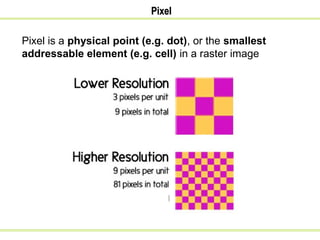
Pixel is a physical point (e.g. dot), or the smallest 
addressable element (e.g. cell) in a raster image
PPiixxeell RReessoolluuttiioonn
LLaannddssaatt SSaatteelllliittee IImmaaggeess
IImmaaggee CCoommppoossiittiioonn 
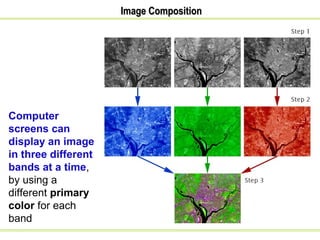
Computer 
screens can 
display an image 
in three different 
bands at a time, 
by using a 
different primary 
color for each 
band
FFaallssee CCoolloorr CCoommppoossiittiioonn ((FFCCCC)) 
http://earthobservatory.nasa.gov/Features/FalseColor/page6.php
DDiiggiittaall IImmaaggee CCllaassssiiffiiccaattiioonn 
Digital image classification uses the 
spectral information represented by 
the digital numbers in one or more 
spectral bands, and attempts to 
classify each individual pixel based on 
this spectral information.
Spectral and Information Classes 
Spectral Classes are groups of pixels that are uniform (or 
near-similar) with respect to their brightness values in the 
different spectral channels of the data. 
Information Classes are those categories of interest that the 
analyst is actually trying to identify in the imagery. 
A broad information class may contain a number of 
spectral sub-classes with unique spectral variations. It is 
the analyst's job to decide on the utility of the different spectral 
classes and their correspondence to useful information classes.
SSuuppeerrvviisseedd CCllaassssiiffiiccaattiioonn 
There are two general approaches to pixel-based image 
classification: supervised and unsupervised. 
Supervised Classification: the analyst identifies in the 
imagery homogeneous representative samples 
(information classes) of interest. These samples are 
referred to as training areas. 
The selection of appropriate training areas is based on the 
analyst's familiarity with the geographical area and their 
knowledge of the actual surface cover types present in 
the image. Thus, the analyst is "supervising" the 
categorization of a set of specific classes.
SSuuppeerrvviisseedd CCllaassssiiffiiccaattiioonn 
Information classes (i.e., landcover types) 
The software system is then 
used to develop a statistical 
characterization/ algorithm 
(mean, variance and 
covariance) of the reflectances 
for each information class. This 
stage is often called signature 
development.
SSuuppeerrvviisseedd CCllaassssiiffiiccaattiioonn 
The image is then classified by examining the reflectance for 
each pixel and making a decision about which of the 
signatures it resembles most. There are several techniques 
for making these decisions, called classifiers. 
Classifiers: Minimum distance to means (MINDIST), 
maximum likelihood (MAXLIKE), linear discriminant analysis 
(FISHER), Bayesian (BAYCLASS), multi-layer perceptron 
(MLP) neural network, self-organizing map (SOM) neural 
network; Mahalanobis typicalities (MAHALCLASS), Dempster- 
Shafer belief (BELCLASS), linear spectral unmixing (UNMIX), 
fuzzy (FUZCLASS), spectral angle mapper (HYPERSAM), 
minimum distance to means (HYPERMIN), linear spectral 
unmixing (HYPERUNMIX), orthogonal subspace projection 
(HYPEROSP), and absorption area analysis 
(HYPERABSORB) etc.
MMaaxxiimmuumm LLiikkeelliihhoooodd 
The maximum likelihood classifier calculates for each class the 
probability of the cell belonging to that class given its attribute 
values. Each pixel is assigned to the class that has the 
highest probability (that is, the maximum likelihood).
O Final Ouuttppuutt ((IImmaaggee CCllaassssiiffiiccaattiioonn))
UUnnssuuppeerrvviisseedd CCllaassssiiffiiccaattiioonn 
Unsupervised classification reverses the supervised 
classification process. 
Spectral classes (or clusters) are grouped first, based 
solely on the numerical information in the data, and are then 
matched by the analyst to information classes (if possible). 
Programs, called clustering algorithms, are used to 
determine the natural (statistical) groupings or structures in the 
data.
UUnnssuuppeerrvviisseedd CCllaassssiiffiiccaattiioonn
Clus Iso Clustteerr UUnnssuuppeerrvviisseedd CCllaassssiiffiiccaattiioonn 
Statistically, clusters are naturally occurring groupings in 
the data. 
The Iso prefix of the isodata clustering algorithm stands for 
Iterative Self Organizing (ISO), a method of performing 
clustering. 
The iso cluster algorithm is an iterative process for computing 
the minimum Euclidean distance when assigning each 
candidate cell to a cluster. 
The specified Number of classes value is the maximum 
number of clusters that can result from the clustering process.
Clus Iso Clustteerr UUnnssuuppeerrvviisseedd CCllaassssiiffiiccaattiioonn 
An empty graph is made with the range of values in the first 
band plotted on the x-axis and the range of values in the 
second band plotted on the y-axis. 
A 45-degree line is drawn and 
divided into the number of 
classes you specify. The 
center point of each of these 
line segments is the initial 
mean value for the classes.
Clus Iso Clustteerr UUnnssuuppeerrvviisseedd CCllaassssiiffiiccaattiioonn 
Each sample cell is plotted on the graph, and the distance 
from the point to each mean center point on the 45-degree 
line is determined. The distance is calculated in attribute space 
using the Pythagorean theorem. The sample point is assigned 
to the cluster represented by the closest mean center point.
Clus Iso Clustteerr UUnnssuuppeerrvviisseedd CCllaassssiiffiiccaattiioonn 
The next sample point is plotted, and the above procedure is 
repeated for all sample points.
Clus Iso Clustteerr UUnnssuuppeerrvviisseedd CCllaassssiiffiiccaattiioonn 
The above process will iterate. Before the next iteration, a new 
mean center point is calculated for each cluster based on 
the values of the cell locations currently assigned to the cluster 
in the previous iteration. With the new mean center point for 
each cluster, the previous two steps are repeated.
Supervised vs. UUnnssuuppeerrvviisseedd CCllaassssiiffiiccaattiioonn
Object-bbaasseedd IImmaaggee AAnnaallyyssiiss ((OOBBIIAA)) 
The pixel-based procedures analyze the spectral 
properties of every pixel within the area of interest, 
without taking into account the spatial or contextual 
information related to the pixel of interest. 
OBIA analyzes both the spectral and spatial/contextual 
properties of pixels and use a segmentation process 
and iterative learning algorithm to achieve a semi-automatic 
classification. 
It considers – spectral properties (i.e., color), size, 
shape, and texture, as well as context from a 
neighborhood surrounding the pixels.
Object-bbaasseedd IImmaaggee AAnnaallyyssiiss ((OOBBIIAA))
Thank You All, QUESTIONS? 
http://bd.linkedin.com/in/bayesahmed 
Email: bayesahmedgis@gmail.com

Avanced Image Classification

  • 1.
    Welcome to theWorkshop Presentation on Advanced Image Classification BAYES AHMED PhD Student University College London (UCL), UK Workshop at BIP, Bangladesh 13 September 2014
  • 2.
    IImmaaggee CCllaassssiiffiiccaattiioonn Imageclassification refers to the task of extracting information classes from a multiband raster image. The resulting raster from image classification can be used to create thematic maps.
  • 3.
  • 4.
    IImmaaggee CCllaassssiiffiiccaattiioonn HereIMAGE stands for Raster Image (e.g. Satellite Image) In general in GIS, we use two types of Image Classification: 1.Pixel Based 2.Object Based
  • 5.
    PPiixxeell Pixel isa physical point (e.g. dot), or the smallest addressable element (e.g. cell) in a raster image
  • 6.
  • 7.
  • 8.
    IImmaaggee CCoommppoossiittiioonn Computer screens can display an image in three different bands at a time, by using a different primary color for each band
  • 9.
    FFaallssee CCoolloorr CCoommppoossiittiioonn((FFCCCC)) http://earthobservatory.nasa.gov/Features/FalseColor/page6.php
  • 10.
    DDiiggiittaall IImmaaggee CCllaassssiiffiiccaattiioonn Digital image classification uses the spectral information represented by the digital numbers in one or more spectral bands, and attempts to classify each individual pixel based on this spectral information.
  • 11.
    Spectral and InformationClasses Spectral Classes are groups of pixels that are uniform (or near-similar) with respect to their brightness values in the different spectral channels of the data. Information Classes are those categories of interest that the analyst is actually trying to identify in the imagery. A broad information class may contain a number of spectral sub-classes with unique spectral variations. It is the analyst's job to decide on the utility of the different spectral classes and their correspondence to useful information classes.
  • 12.
    SSuuppeerrvviisseedd CCllaassssiiffiiccaattiioonn Thereare two general approaches to pixel-based image classification: supervised and unsupervised. Supervised Classification: the analyst identifies in the imagery homogeneous representative samples (information classes) of interest. These samples are referred to as training areas. The selection of appropriate training areas is based on the analyst's familiarity with the geographical area and their knowledge of the actual surface cover types present in the image. Thus, the analyst is "supervising" the categorization of a set of specific classes.
  • 13.
    SSuuppeerrvviisseedd CCllaassssiiffiiccaattiioonn Informationclasses (i.e., landcover types) The software system is then used to develop a statistical characterization/ algorithm (mean, variance and covariance) of the reflectances for each information class. This stage is often called signature development.
  • 14.
    SSuuppeerrvviisseedd CCllaassssiiffiiccaattiioonn Theimage is then classified by examining the reflectance for each pixel and making a decision about which of the signatures it resembles most. There are several techniques for making these decisions, called classifiers. Classifiers: Minimum distance to means (MINDIST), maximum likelihood (MAXLIKE), linear discriminant analysis (FISHER), Bayesian (BAYCLASS), multi-layer perceptron (MLP) neural network, self-organizing map (SOM) neural network; Mahalanobis typicalities (MAHALCLASS), Dempster- Shafer belief (BELCLASS), linear spectral unmixing (UNMIX), fuzzy (FUZCLASS), spectral angle mapper (HYPERSAM), minimum distance to means (HYPERMIN), linear spectral unmixing (HYPERUNMIX), orthogonal subspace projection (HYPEROSP), and absorption area analysis (HYPERABSORB) etc.
  • 15.
    MMaaxxiimmuumm LLiikkeelliihhoooodd Themaximum likelihood classifier calculates for each class the probability of the cell belonging to that class given its attribute values. Each pixel is assigned to the class that has the highest probability (that is, the maximum likelihood).
  • 16.
    O Final Ouuttppuutt((IImmaaggee CCllaassssiiffiiccaattiioonn))
  • 17.
    UUnnssuuppeerrvviisseedd CCllaassssiiffiiccaattiioonn Unsupervisedclassification reverses the supervised classification process. Spectral classes (or clusters) are grouped first, based solely on the numerical information in the data, and are then matched by the analyst to information classes (if possible). Programs, called clustering algorithms, are used to determine the natural (statistical) groupings or structures in the data.
  • 18.
  • 19.
    Clus Iso ClustteerrUUnnssuuppeerrvviisseedd CCllaassssiiffiiccaattiioonn Statistically, clusters are naturally occurring groupings in the data. The Iso prefix of the isodata clustering algorithm stands for Iterative Self Organizing (ISO), a method of performing clustering. The iso cluster algorithm is an iterative process for computing the minimum Euclidean distance when assigning each candidate cell to a cluster. The specified Number of classes value is the maximum number of clusters that can result from the clustering process.
  • 20.
    Clus Iso ClustteerrUUnnssuuppeerrvviisseedd CCllaassssiiffiiccaattiioonn An empty graph is made with the range of values in the first band plotted on the x-axis and the range of values in the second band plotted on the y-axis. A 45-degree line is drawn and divided into the number of classes you specify. The center point of each of these line segments is the initial mean value for the classes.
  • 21.
    Clus Iso ClustteerrUUnnssuuppeerrvviisseedd CCllaassssiiffiiccaattiioonn Each sample cell is plotted on the graph, and the distance from the point to each mean center point on the 45-degree line is determined. The distance is calculated in attribute space using the Pythagorean theorem. The sample point is assigned to the cluster represented by the closest mean center point.
  • 22.
    Clus Iso ClustteerrUUnnssuuppeerrvviisseedd CCllaassssiiffiiccaattiioonn The next sample point is plotted, and the above procedure is repeated for all sample points.
  • 23.
    Clus Iso ClustteerrUUnnssuuppeerrvviisseedd CCllaassssiiffiiccaattiioonn The above process will iterate. Before the next iteration, a new mean center point is calculated for each cluster based on the values of the cell locations currently assigned to the cluster in the previous iteration. With the new mean center point for each cluster, the previous two steps are repeated.
  • 24.
    Supervised vs. UUnnssuuppeerrvviisseeddCCllaassssiiffiiccaattiioonn
  • 25.
    Object-bbaasseedd IImmaaggee AAnnaallyyssiiss((OOBBIIAA)) The pixel-based procedures analyze the spectral properties of every pixel within the area of interest, without taking into account the spatial or contextual information related to the pixel of interest. OBIA analyzes both the spectral and spatial/contextual properties of pixels and use a segmentation process and iterative learning algorithm to achieve a semi-automatic classification. It considers – spectral properties (i.e., color), size, shape, and texture, as well as context from a neighborhood surrounding the pixels.
  • 26.
  • 27.
  • 28.
  • 29.
    Thank You All,QUESTIONS? http://bd.linkedin.com/in/bayesahmed Email: bayesahmedgis@gmail.com