This document discusses various orthoptic instruments and their therapeutic uses. It describes major amblyoscopes, diploscopes, bar readers, stereogram cards, and pigeon cantonette stereoscopes which are used for fusional exercises, amblyopia therapy, and overcoming suppression. The synoptophore is explained in detail as a haploscopic device used for fusion exercises, antisuppression exercises, and treatment of abnormal retinal correspondence. Procedures for using instruments like the diploscope, cherioscope, and pigeon cantonette stereoscope are provided.
Introduction to orthoptic instruments with a focus on therapeutic uses.
Covers types of therapeutic exercises including fusional exercises and amblyopic therapy.
Introduction to various instruments used in orthoptic therapy such as major amblyoscope and diploscope.
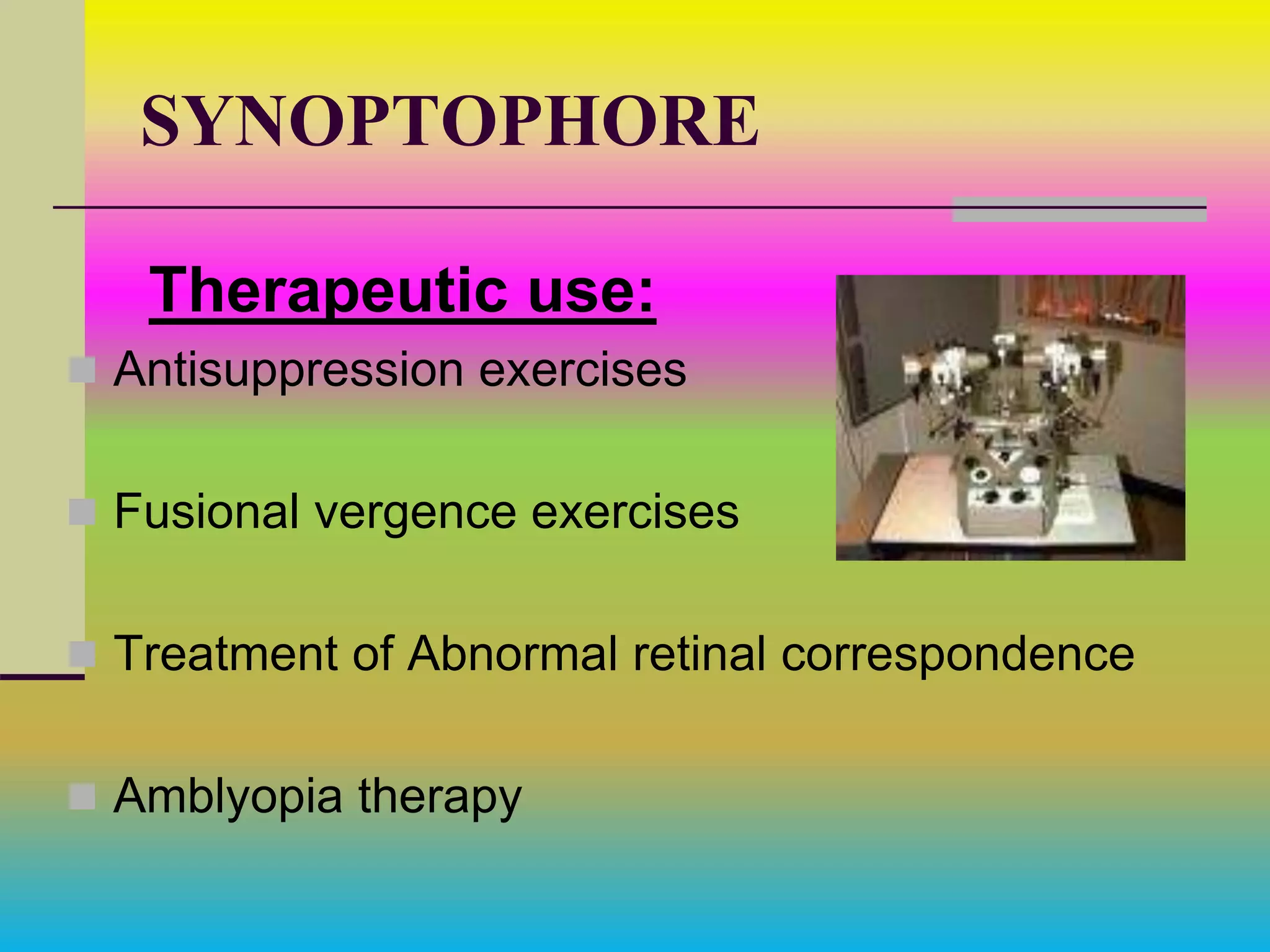
Details on the Synoptophore, including its principle, therapeutic uses, and types of fusion exercises.Covers the principle, construction, and various positions involved while using the Diploscope.
Explains the applications of the Diploscope in teaching convergence and visual axis placement.
Details of the Cherioscope, including its mechanisms and procedures for treating visual suppression.
Describes various types of bar readers and their roles in improving binocular vision.
Construction and operational methods of the Pigeon Cantonnet Stereoscope for treating visual issues.
Explanation of stereogram cards utilized for training relative convergence and divergence.
SYNOPTOPHORE
Fusion exercises:
Tubesare set at angle of deviation
Subject is asked to inform when object is seen
double on increasing amount of adduction
SYNOPTOPHORE
Stimulation of retinalarea:
Observer moves other tube forward and
backward over macular area
Patient is encouraged to see moving picture
and to say when he sees it pass across
stationary picture
14.
SYNOPTOPHORE
Stimulation ofretinal area:
Excursion and speed of movement is reduced
slowly
Fusion slides are used
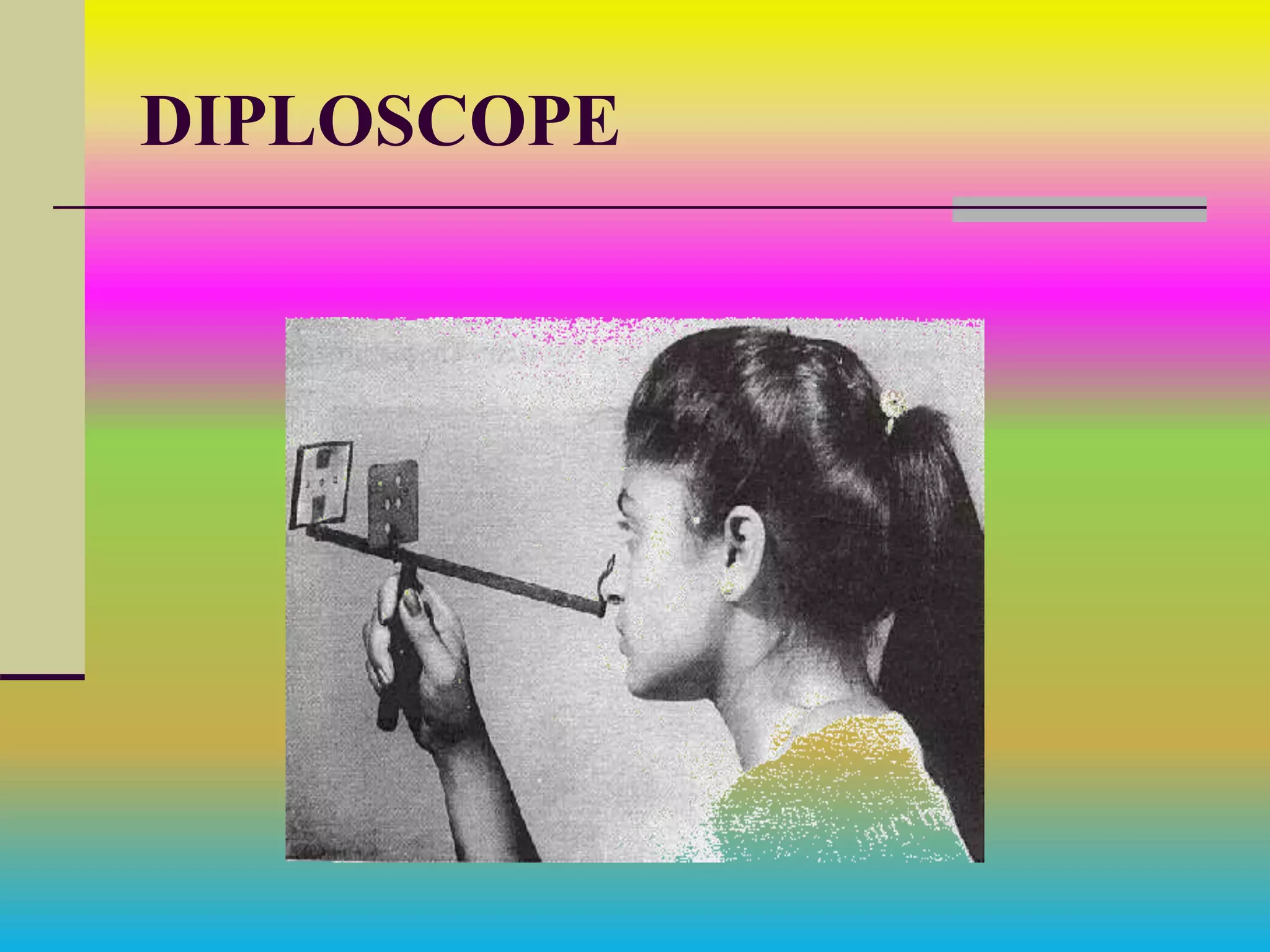
DIPLOSCOPE
Principle :
Spacedissociation done by septum is the
working principle
Used to make patient aware of position of his
visual axis
17.
DIPLOSCOPE
Construction :
Consistsof metal shaft 25 cm in length
Small metal pad called “face-piece” is located
at one end
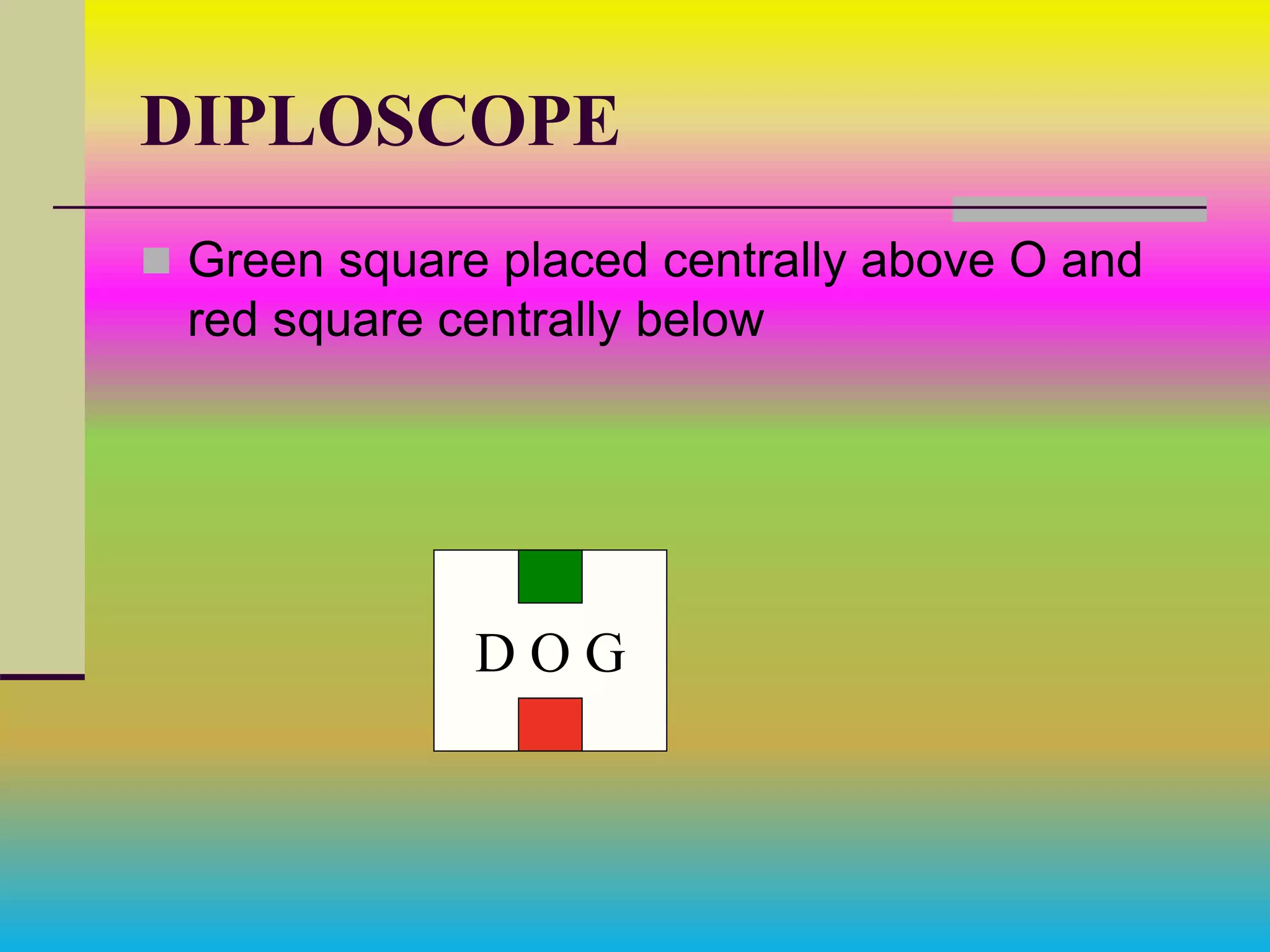
White card printed with D O G placed in card
holder is located at other end
DIPLOSCOPE
Metal septumis placed parallel at 6.5 cm
from card
Four apertures are provided in metal septum
Two horizontal apertures of 8mm diameter
are at equidistance from center of shaft and
are 15mm apart
20.
DIPLOSCOPE
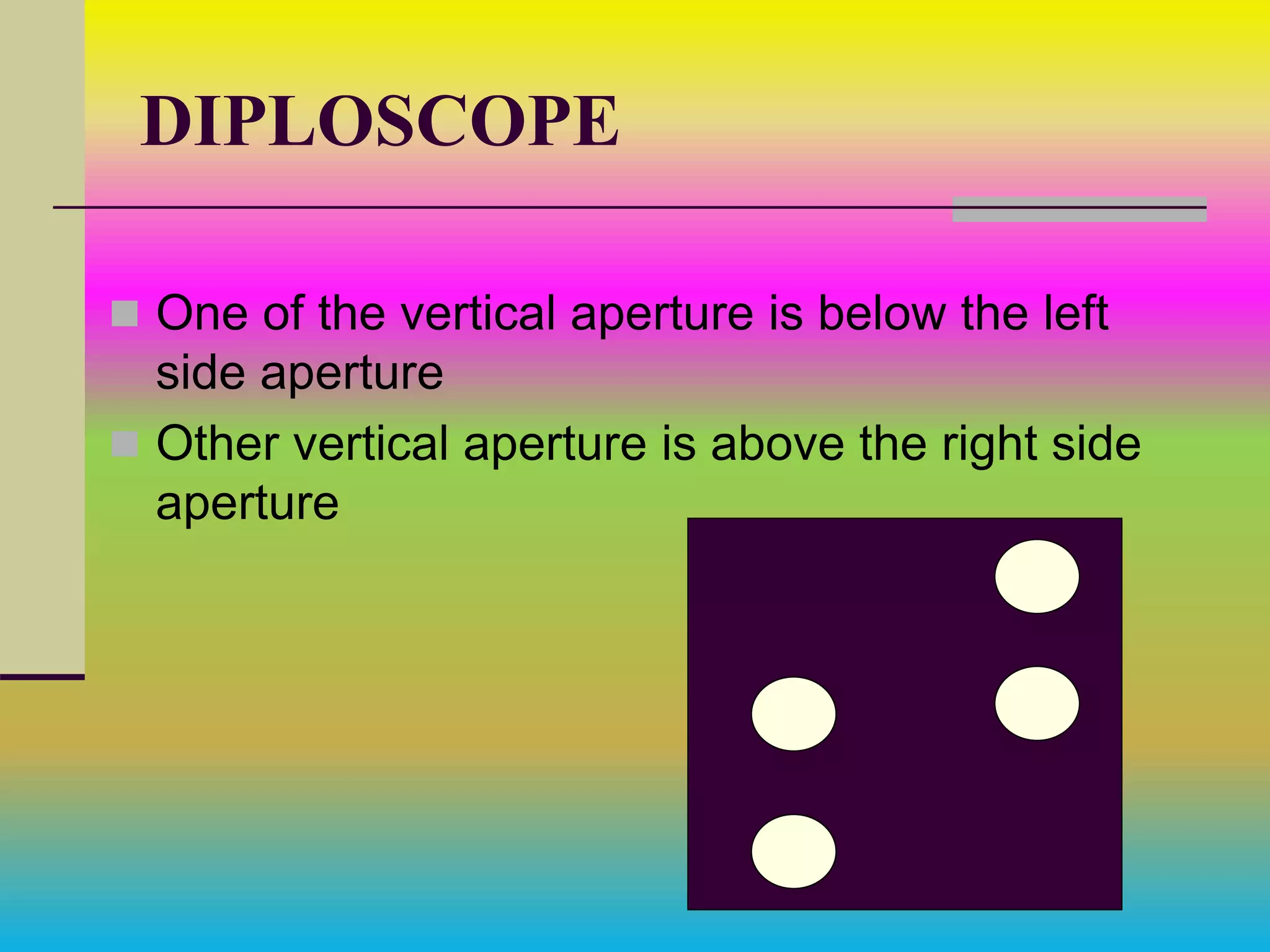
One ofthe vertical aperture is below the left
side aperture
Other vertical aperture is above the right side
aperture
DIPLOSCOPE
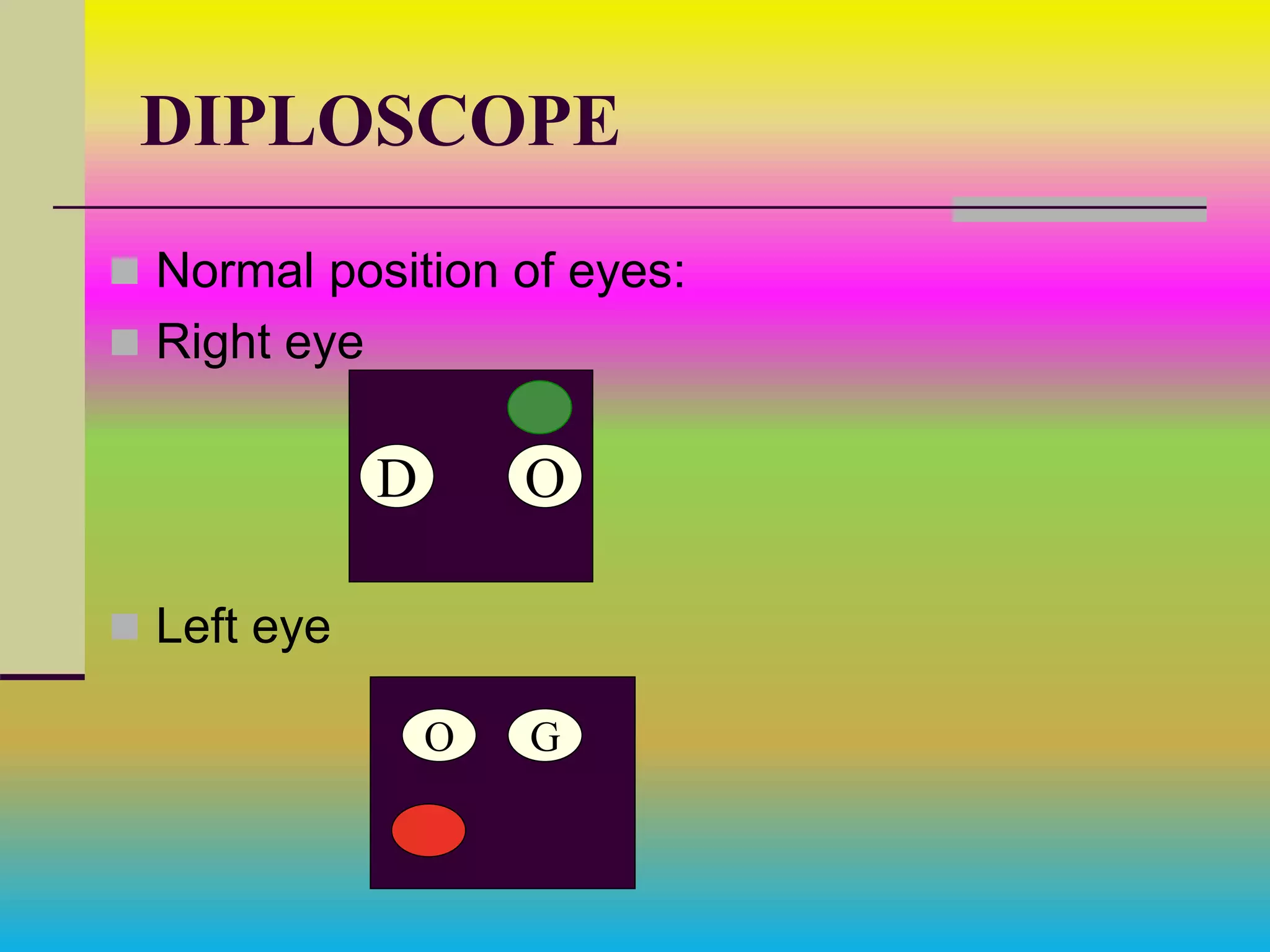
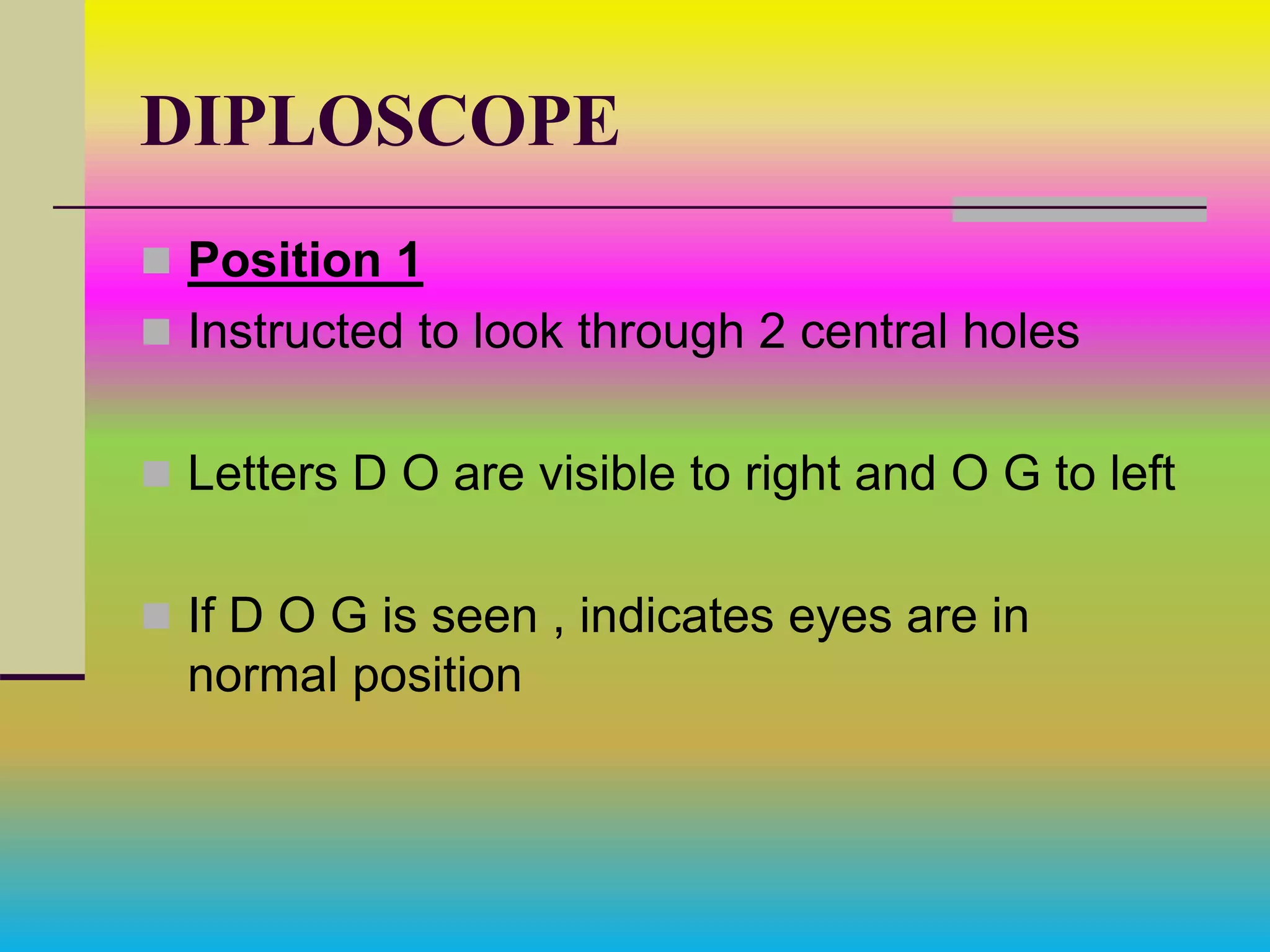
Position 1
Instructed to look through 2 central holes
Letters D O are visible to right and O G to left
If D O G is seen , indicates eyes are in
normal position
23.
DIPLOSCOPE
Position 2
Instructed to look at point between 2
horizontal holes
Position 3
Instructed to look at object held half-way
between septum and his eyes
24.
DIPLOSCOPE
Position 4
Instructed to look at a distance object and
slightly above printed card
Images seen by each are projected in
crossed way
25.
DIPLOSCOPE
Position 4
Useful in convergent squint to teach in
placing visual axis in divergent position
In intermittent divergent squint to keep 4
letters equidistant from each other
26.
DIPLOSCOPE
Positions 1,2,3requires convergence of
increasing amount
Position 4 requires relative divergence
relative to printed card
CHERIOSCOPE
Procedure
Patient supportshis head on head rest and
looks through lenses
One looks into mirror and other at base
Using pair of toys such as butterfly and net
CHERIOSCOPE
Procedure
To overcomesuppression patient must aim at
seeing butterfly and net simultaneously
By moving net ,butterfly should exactly be
placed into it
33.
CHERIOSCOPE
Procedure:
Examiner canmove the butterfly from place to
place and ask subject to catch butterfly each
time it moved
Prisms can be used when subject is not able
to match images because of large angles
34.
CHERIOSCOPE
Procedure:
Prisms equalto amount of angle of deviation
placed are in eyepieces
Base out prisms for esotropia and Base in
prisms for exotropia
35.
BAR READERS
Types:
Thumb barreader
Priestly Smiths Zigzag bar reader
Adjustable mayou bar reader
Head band bar reader
36.
BAR READERS
Usedonce appreciation of physiological
diplopia is achieved to eliminate suppression
Used to train the patient to maintain binocular
single vision for reading accommodation and
convergence are in correct relationship for
given size of print
37.
BAR READERS
Procedure
Baris introduced print and subjects eye
If subject fixes binocularly on print , bar is
seen double
But as bar obstructs small vertical strip of
words seen by one eye and a different strip
by other eye, if two eyes are functioning
properly there is no obstruction
38.
BAR READERS
Largeprint is read first and then practiced
with small print
Can be given as home exercise
Given for distance with Snellens chart viewed
in mirror at 3meters
PIGEON CANTONNET
STEREOSCOPE
Position 1
Toteach alternation:
Toys, pictures or coins can be used
Placed on each side of septum
Patient tries to identify as it appears
PIGEON CANTONNET
STEREOSCOPE
Position 2
Image is seen at same distance on non
reflected flap
Two objects kept at equidistance are seen
superimposed when orthophoria exists
PIGEON CANTONNET
STEREOSCOPE
Position 2
Toys are used mounted in short holder and in
conjunction with figure of man
Large objects are used in cases of considerable
suppression
Instructed to move in and out on man’s face
until suppression is overcome
STEREOGRAM CARDS
Pairof objects printed on a card
As their images can be fused to form a single
image
Some cards are provided with disparity to
have stereopsis effect
53.
STEREOGRAM CARDS
Procedure
Usedto train relative convergence or divergence
Subject is asked to exercise relative divergence
relative to printed card
Physiological diplopia creates 4 images
54.
STEREOGRAM CARDS
Twoadjacent middle images gets
superimposed and fused
Finally subject sees 3 figures
Central fused figure and 2 monocular figures