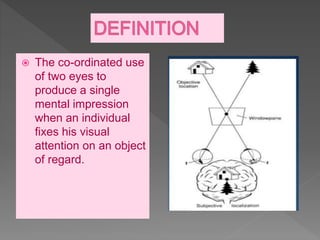
 The co-ordinated use
of two eyes to
produce a single
mental impression
when an individual
fixes his visual
attention on an object
of regard.
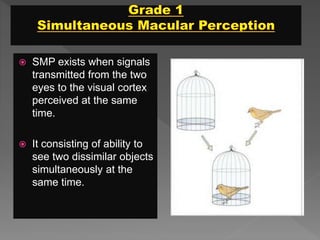
 SMP exists when signals
transmitted from the two
eyes to the visual cortex
perceived at the same
time.
 It consisting of ability to
see two dissimilar objects
simultaneously at the
same time.
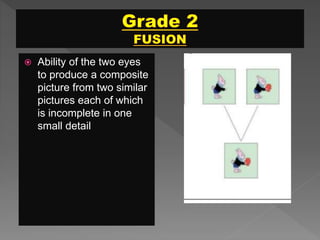
 Ability of the two eyes
to produce a composite
picture from two similar
pictures each of which
is incomplete in one
small detail
 Ability to fuse images
Which are slightly
focused from different
angle result in
binocular appreciation
of visual object in
depth ie: in 3D.
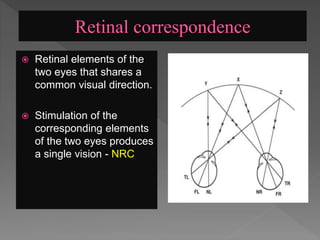
 Retinal elements of the
two eyes that shares a
common visual direction.
 Stimulation of the
corresponding elements
of the two eyes produces
a single vision - NRC
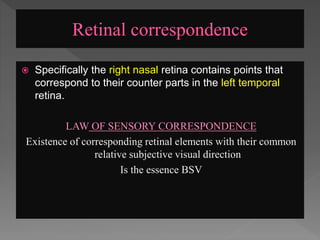
 Specifically the right nasal retina contains points that
correspond to their counter parts in the left temporal
retina.
LAW OF SENSORY CORRESPONDENCE
Existence of corresponding retinal elements with their common
relative subjective visual direction
Is the essence BSV
 When the fovea of one
eye has a common
visual direction with an
extra foveal element in
the other eye.
 Angle of squint small
when the extra foveal
element is close to the
fovea- to regain the
BSV although its
anomalous.
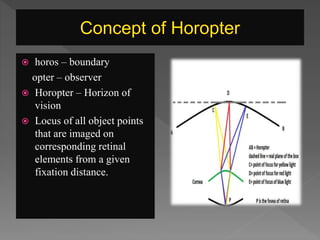
 horos – boundary
opter – observer
 Horopter – Horizon of
vision
 Locus of all object points
that are imaged on
corresponding retinal
elements from a given
fixation distance.
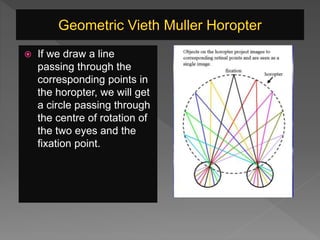
 If we draw a line
passing through the
corresponding points in
the horopter, we will get
a circle passing through
the centre of rotation of
the two eyes and the
fixation point.
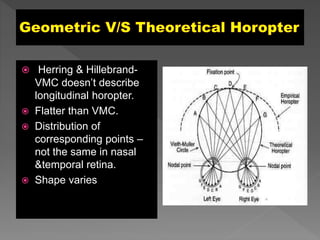
 Herring & Hillebrand-
VMC doesn’t describe
longitudinal horopter.
 Flatter than VMC.
 Distribution of
corresponding points –
not the same in nasal
&temporal retina.
 Shape varies
 Region infront & back of
the horopter in which
single vision is present.
 Narrowest at the fixation
point& become border in
the periphery at a rate of
1-2 arc minute
 Assessment of relationship b/w fovea of the fixing eye
and the retinal area stimulated in the squinting eye .
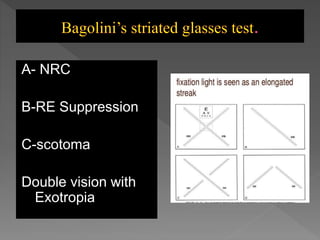
1. Bagolini’s striated glasses test.
2. Worth Four Dot Test.
3. Synaptophore using SMP slides for
measuring the obj & sub angles .
A- NRC
B-RE Suppression
C-scotoma
Double vision with
Exotropia
Four Dots
NRC –No Heterotropia
Normal BSV – No manifest Deviation
Harmonimous ARC – Manifest Deviation
Five Dots
Esotropia –uncrossed – red dot to the right
Exotropia – crossed –red to the left of green
Three Green Dot Suppression - RE
Two Red Dot
Suppression - LE
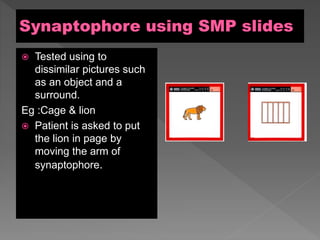
 Tested using to
dissimilar pictures such
as an object and a
surround.
Eg :Cage & lion
 Patient is asked to put
the lion in page by
moving the arm of
synaptophore.
Simultaneous Macular Perception -Nayana

Simultaneous Macular Perception -Nayana

  • 3.
     The co-ordinateduse of two eyes to produce a single mental impression when an individual fixes his visual attention on an object of regard.
  • 6.
     SMP existswhen signals transmitted from the two eyes to the visual cortex perceived at the same time.  It consisting of ability to see two dissimilar objects simultaneously at the same time.
  • 7.
     Ability ofthe two eyes to produce a composite picture from two similar pictures each of which is incomplete in one small detail
  • 8.
     Ability tofuse images Which are slightly focused from different angle result in binocular appreciation of visual object in depth ie: in 3D.
  • 9.
     Retinal elementsof the two eyes that shares a common visual direction.  Stimulation of the corresponding elements of the two eyes produces a single vision - NRC
  • 10.
     Specifically theright nasal retina contains points that correspond to their counter parts in the left temporal retina. LAW OF SENSORY CORRESPONDENCE Existence of corresponding retinal elements with their common relative subjective visual direction Is the essence BSV
  • 11.
     When thefovea of one eye has a common visual direction with an extra foveal element in the other eye.  Angle of squint small when the extra foveal element is close to the fovea- to regain the BSV although its anomalous.
  • 12.
     horos –boundary opter – observer  Horopter – Horizon of vision  Locus of all object points that are imaged on corresponding retinal elements from a given fixation distance.
  • 13.
     If wedraw a line passing through the corresponding points in the horopter, we will get a circle passing through the centre of rotation of the two eyes and the fixation point.
  • 14.
     Herring &Hillebrand- VMC doesn’t describe longitudinal horopter.  Flatter than VMC.  Distribution of corresponding points – not the same in nasal &temporal retina.  Shape varies
  • 15.
     Region infront& back of the horopter in which single vision is present.  Narrowest at the fixation point& become border in the periphery at a rate of 1-2 arc minute
  • 16.
     Assessment ofrelationship b/w fovea of the fixing eye and the retinal area stimulated in the squinting eye . 1. Bagolini’s striated glasses test. 2. Worth Four Dot Test. 3. Synaptophore using SMP slides for measuring the obj & sub angles .
  • 17.
  • 18.
    Four Dots NRC –NoHeterotropia Normal BSV – No manifest Deviation Harmonimous ARC – Manifest Deviation Five Dots Esotropia –uncrossed – red dot to the right Exotropia – crossed –red to the left of green Three Green Dot Suppression - RE Two Red Dot Suppression - LE
  • 19.
     Tested usingto dissimilar pictures such as an object and a surround. Eg :Cage & lion  Patient is asked to put the lion in page by moving the arm of synaptophore.