Integration & Application of
integration
By GP - Mumbai
Contents:
1. Definition of integration as antiderivative
2. Rules of integration
3. Integration by substitution
4. Integration of composite function
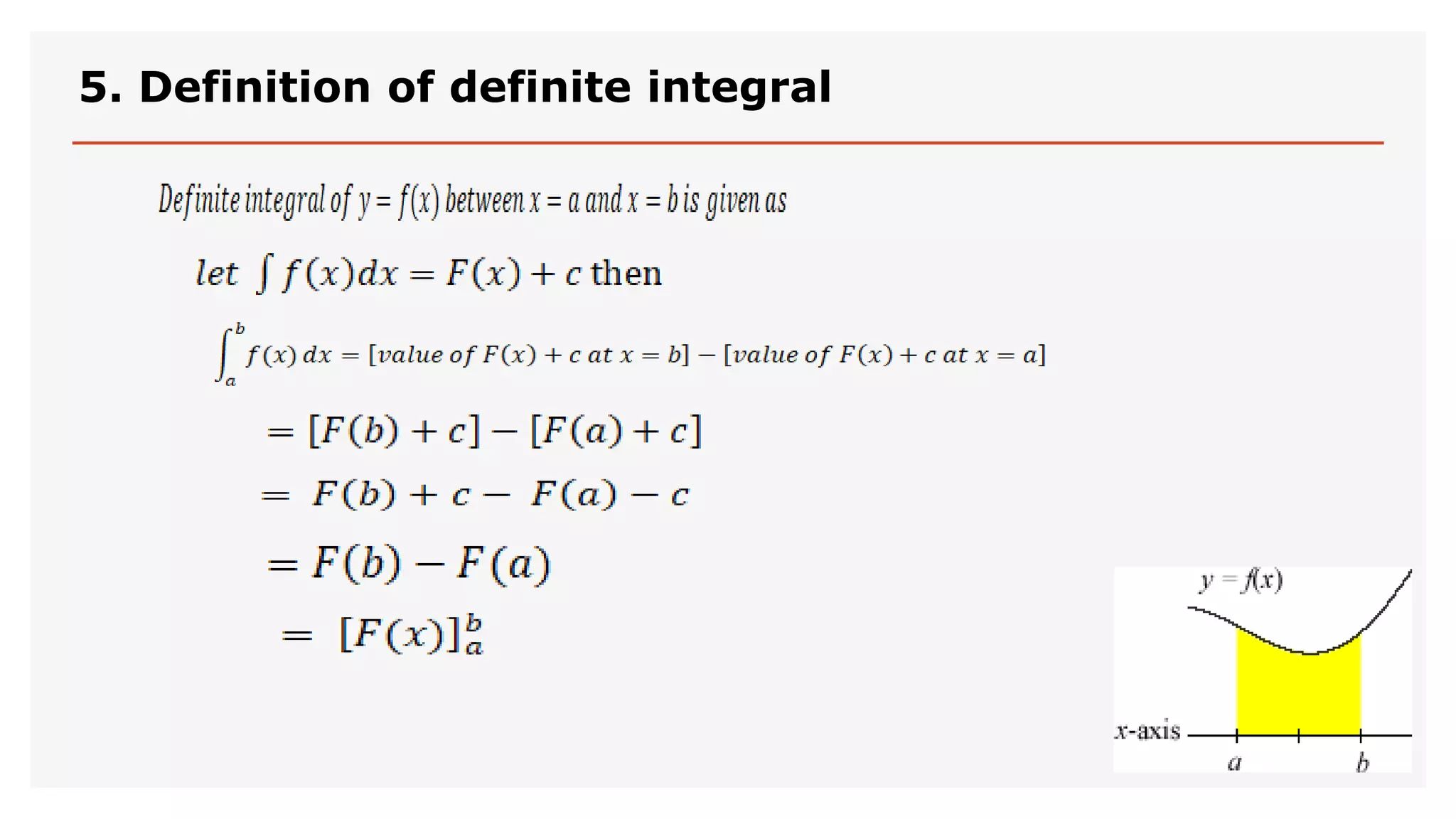
5. Definition of definite integral
6. Properties of definite integral with simple problems
7. Area under the curve
8. Area bounded by two curves
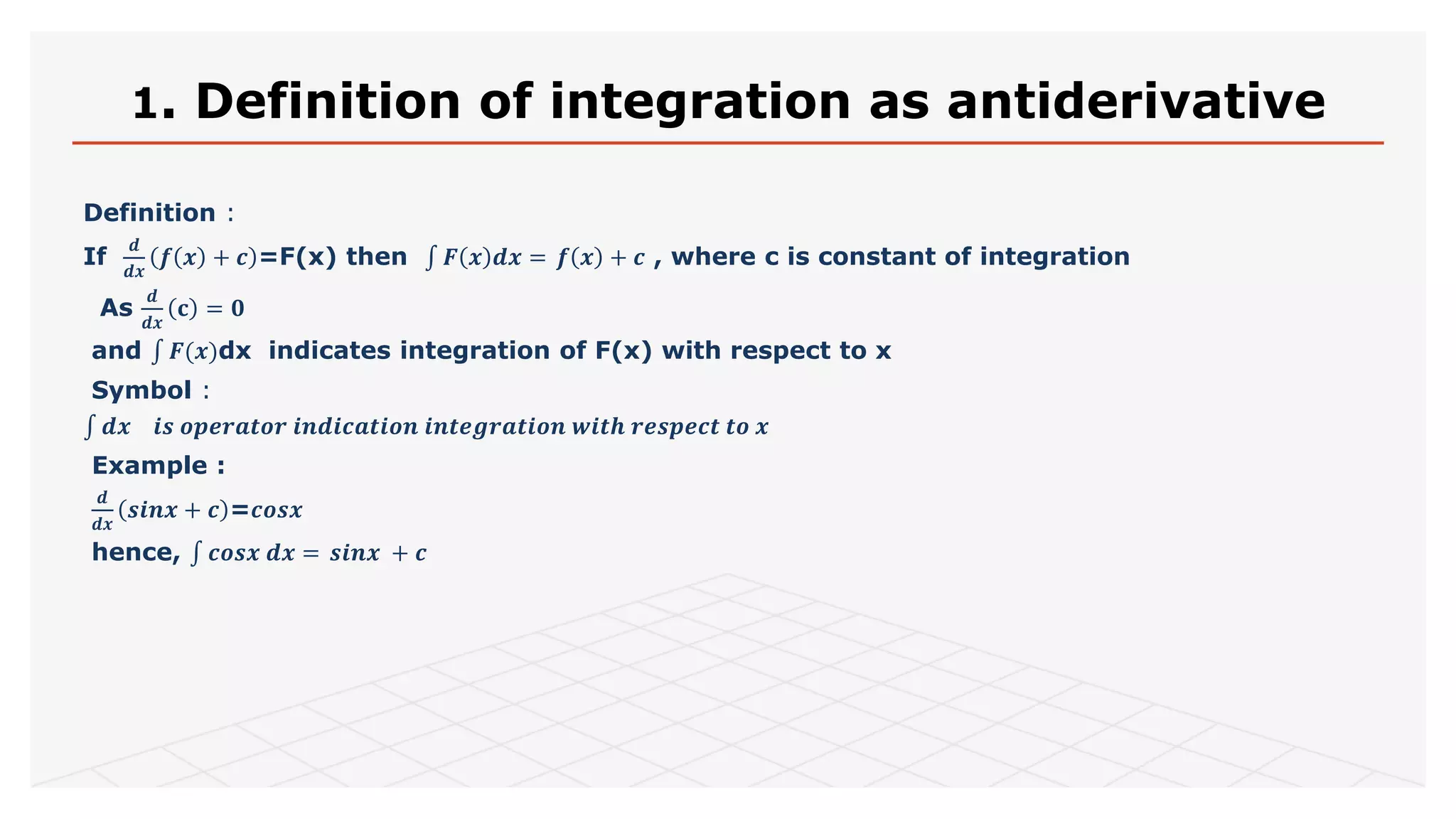
1. Definition of integration as antiderivative
Definition :
If
𝒅
𝒅𝒙
𝒇 𝒙 + 𝒄 =F(x) then 𝑭 𝒙 𝒅𝒙 = 𝒇 𝒙 + 𝒄 , where c is constant of integration
As
𝒅
𝒅𝒙
𝐜 = 𝟎
and 𝑭(𝒙)dx indicates integration of F(x) with respect to x
Symbol :
𝒅𝒙 𝒊𝒔 𝒐𝒑𝒆𝒓𝒂𝒕𝒐𝒓 𝒊𝒏𝒅𝒊𝒄𝒂𝒕𝒊𝒐𝒏 𝒊𝒏𝒕𝒆𝒈𝒓𝒂𝒕𝒊𝒐𝒏 𝒘𝒊𝒕𝒉 𝒓𝒆𝒔𝒑𝒆𝒄𝒕 𝒕𝒐 𝒙
Example :
𝒅
𝒅𝒙
𝒔𝒊𝒏𝒙 + 𝒄 =𝒄𝒐𝒔𝒙
hence, 𝒄𝒐𝒔𝒙 𝒅𝒙 = 𝒔𝒊𝒏𝒙 + 𝒄
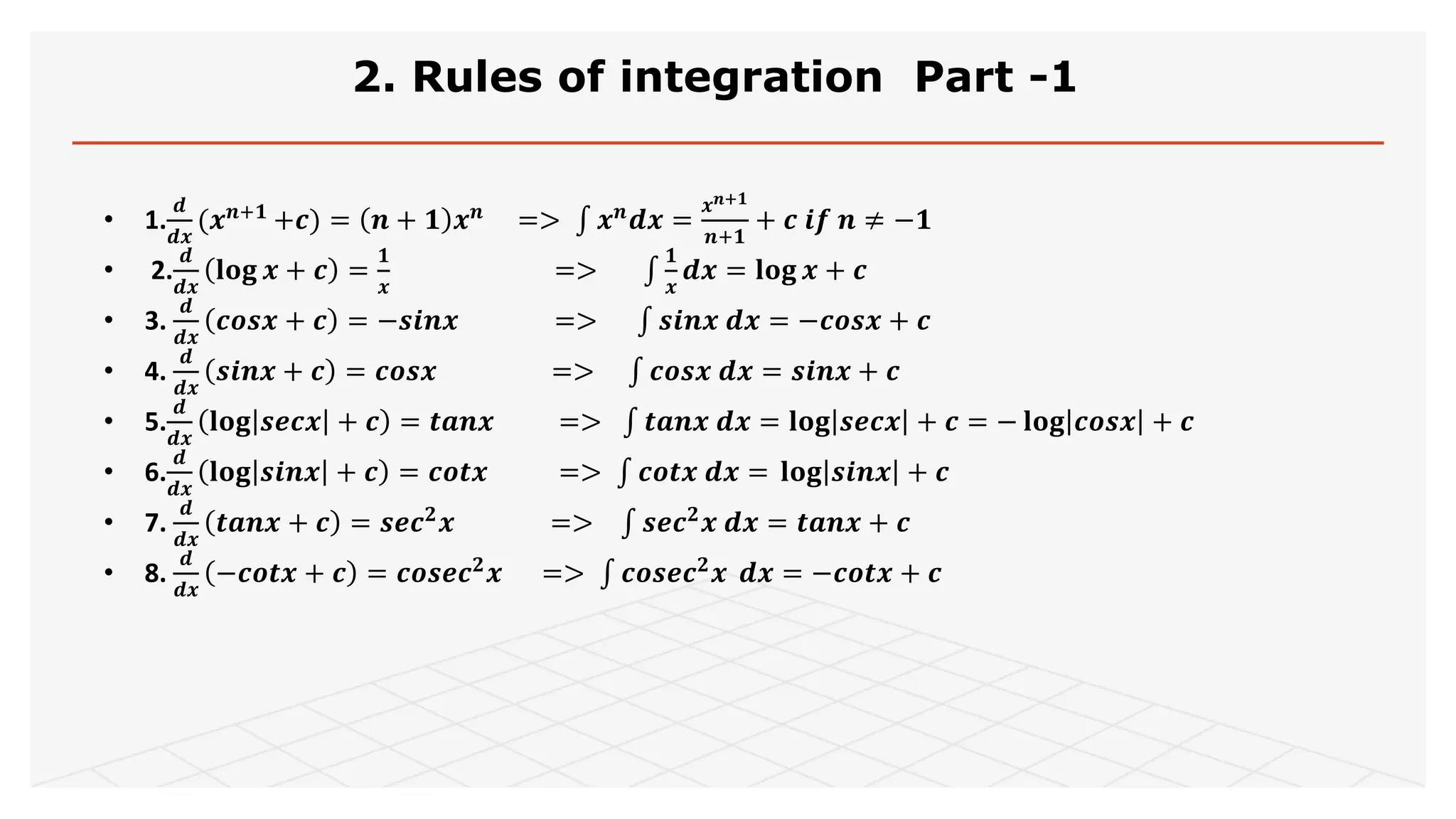
2. Rules of integration Part -1
• 1.
𝒅
𝒅𝒙
(𝒙 𝒏+𝟏
+𝒄) = 𝒏 + 𝟏 𝒙 𝒏
=> 𝒙 𝒏
𝒅𝒙 =
𝒙 𝒏+𝟏
𝒏+𝟏
+ 𝒄 𝒊𝒇 𝒏 ≠ −𝟏
• 2.
𝒅
𝒅𝒙
𝐥𝐨𝐠 𝒙 + 𝒄 =
𝟏
𝒙
=>
𝟏
𝒙
𝒅𝒙 = 𝐥𝐨𝐠 𝒙 + 𝒄
• 3.
𝒅
𝒅𝒙
𝒄𝒐𝒔𝒙 + 𝒄 = −𝒔𝒊𝒏𝒙 => 𝒔𝒊𝒏𝒙 𝒅𝒙 = −𝒄𝒐𝒔𝒙 + 𝒄
• 4.
𝒅
𝒅𝒙
𝒔𝒊𝒏𝒙 + 𝒄 = 𝒄𝒐𝒔𝒙 => 𝒄𝒐𝒔𝒙 𝒅𝒙 = 𝒔𝒊𝒏𝒙 + 𝒄
• 5.
𝒅
𝒅𝒙
𝐥𝐨𝐠 𝒔𝒆𝒄𝒙 + 𝒄 = 𝒕𝒂𝒏𝒙 => 𝒕𝒂𝒏𝒙 𝒅𝒙 = 𝐥𝐨𝐠 𝒔𝒆𝒄𝒙 + 𝒄 = − 𝐥𝐨𝐠 𝒄𝒐𝒔𝒙 + 𝒄
• 6.
𝒅
𝒅𝒙
𝐥𝐨𝐠 𝒔𝒊𝒏𝒙 + 𝒄 = 𝒄𝒐𝒕𝒙 => 𝒄𝒐𝒕𝒙 𝒅𝒙 = 𝐥𝐨𝐠 𝒔𝒊𝒏𝒙 + 𝒄
• 7.
𝒅
𝒅𝒙
𝒕𝒂𝒏𝒙 + 𝒄 = 𝒔𝒆𝒄 𝟐
𝒙 => 𝒔𝒆𝒄 𝟐
𝒙 𝒅𝒙 = 𝒕𝒂𝒏𝒙 + 𝒄
• 8.
𝒅
𝒅𝒙
−𝒄𝒐𝒕𝒙 + 𝒄 = 𝒄𝒐𝒔𝒆𝒄 𝟐
𝒙 => 𝒄𝒐𝒔𝒆𝒄 𝟐
𝒙 𝒅𝒙 = −𝒄𝒐𝒕𝒙 + 𝒄
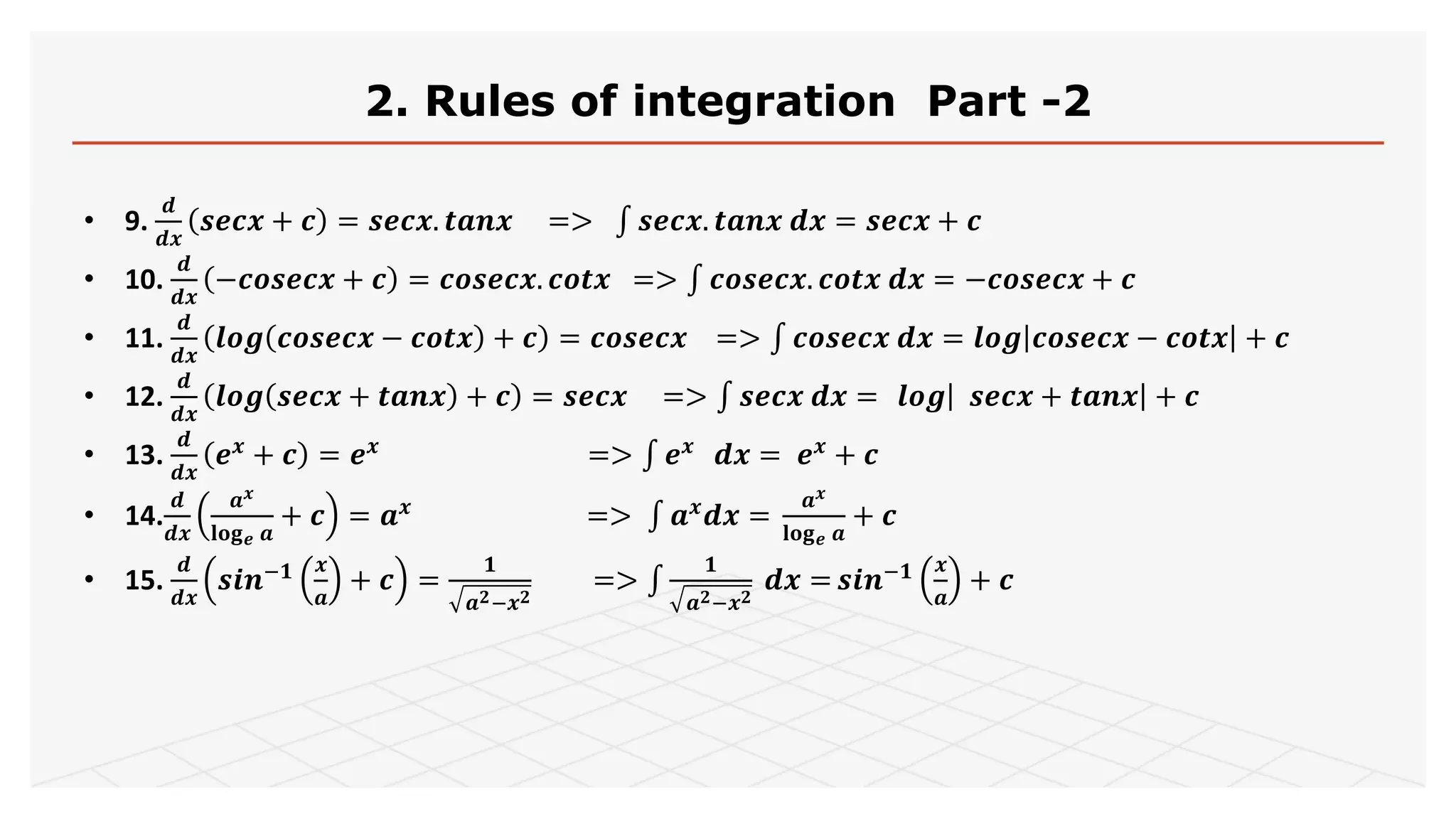
2. Rules of integration Part -2
• 9.
𝒅
𝒅𝒙
𝒔𝒆𝒄𝒙 + 𝒄 = 𝒔𝒆𝒄𝒙. 𝒕𝒂𝒏𝒙 => 𝒔𝒆𝒄𝒙. 𝒕𝒂𝒏𝒙 𝒅𝒙 = 𝒔𝒆𝒄𝒙 + 𝒄
• 10.
𝒅
𝒅𝒙
−𝒄𝒐𝒔𝒆𝒄𝒙 + 𝒄 = 𝒄𝒐𝒔𝒆𝒄𝒙. 𝒄𝒐𝒕𝒙 => 𝒄𝒐𝒔𝒆𝒄𝒙. 𝒄𝒐𝒕𝒙 𝒅𝒙 = −𝒄𝒐𝒔𝒆𝒄𝒙 + 𝒄
• 11.
𝒅
𝒅𝒙
𝒍𝒐𝒈 𝒄𝒐𝒔𝒆𝒄𝒙 − 𝒄𝒐𝒕𝒙 + 𝒄 = 𝒄𝒐𝒔𝒆𝒄𝒙 => 𝒄𝒐𝒔𝒆𝒄𝒙 𝒅𝒙 = 𝒍𝒐𝒈 𝒄𝒐𝒔𝒆𝒄𝒙 − 𝒄𝒐𝒕𝒙 + 𝒄
• 12.
𝒅
𝒅𝒙
𝒍𝒐𝒈 𝒔𝒆𝒄𝒙 + 𝒕𝒂𝒏𝒙 + 𝒄 = 𝒔𝒆𝒄𝒙 => 𝒔𝒆𝒄𝒙 𝒅𝒙 = 𝒍𝒐𝒈 𝒔𝒆𝒄𝒙 + 𝒕𝒂𝒏𝒙 + 𝒄
• 13.
𝒅
𝒅𝒙
𝒆 𝒙
+ 𝒄 = 𝒆 𝒙
=> 𝒆 𝒙
𝒅𝒙 = 𝒆 𝒙
+ 𝒄
• 14.
𝒅
𝒅𝒙
𝒂 𝒙
𝐥𝐨𝐠 𝒆 𝒂
+ 𝒄 = 𝒂 𝒙 => 𝒂 𝒙 𝒅𝒙 =
𝒂 𝒙
𝐥𝐨𝐠 𝒆 𝒂
+ 𝒄
• 15.
𝒅
𝒅𝒙
𝒔𝒊𝒏−𝟏 𝒙
𝒂
+ 𝒄 =
𝟏
𝒂 𝟐−𝒙 𝟐
=>
𝟏
𝒂 𝟐−𝒙 𝟐
𝒅𝒙 = 𝒔𝒊𝒏−𝟏 𝒙
𝒂
+ 𝒄
2. Rules of integration Part -3
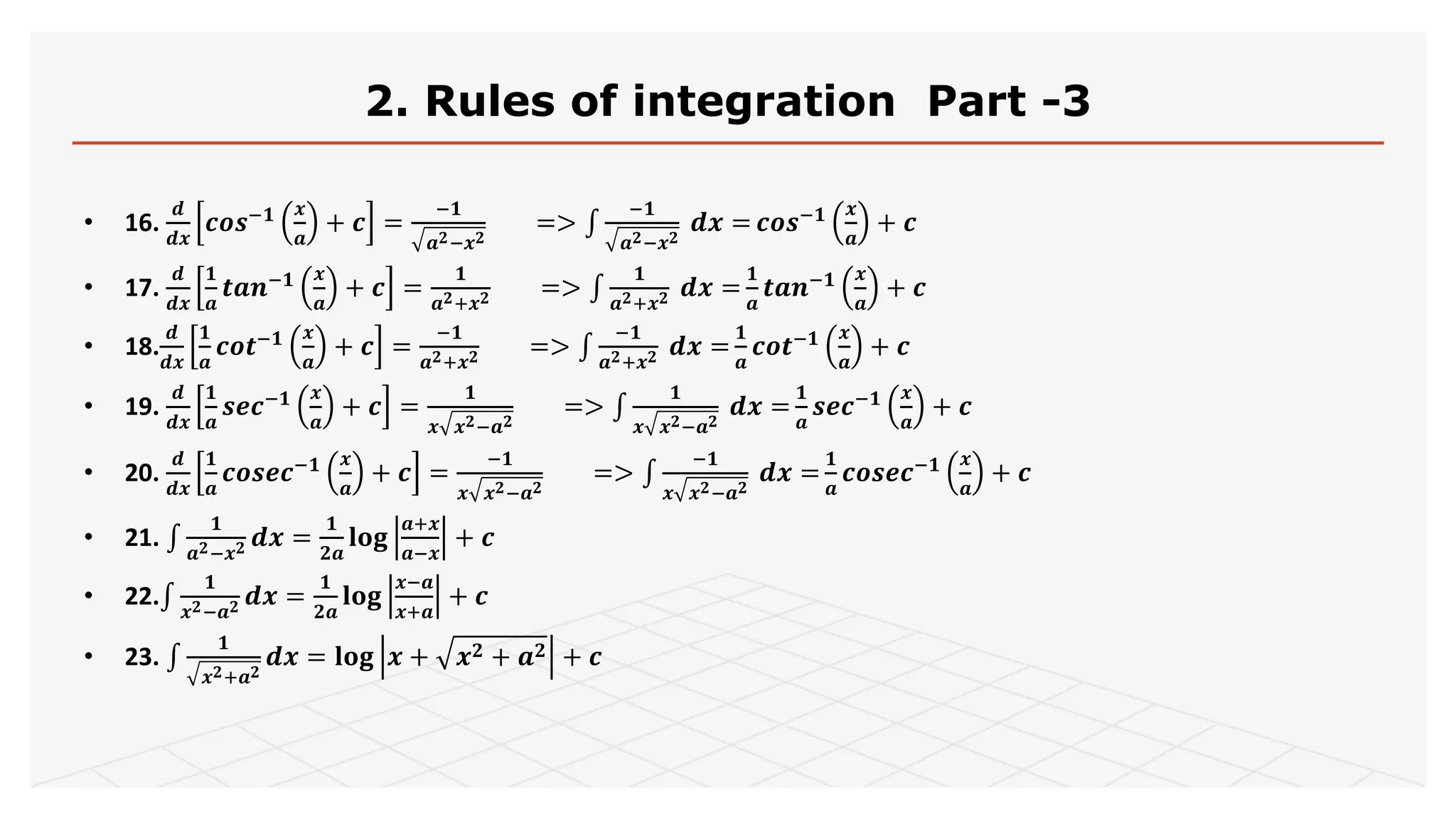
• 16.
𝒅
𝒅𝒙
𝒄𝒐𝒔−𝟏 𝒙
𝒂
+ 𝒄 =
−𝟏
𝒂 𝟐−𝒙 𝟐
=>
−𝟏
𝒂 𝟐−𝒙 𝟐
𝒅𝒙 = 𝒄𝒐𝒔−𝟏 𝒙
𝒂
+ 𝒄
• 17.
𝒅
𝒅𝒙
𝟏
𝒂
𝒕𝒂𝒏−𝟏 𝒙
𝒂
+ 𝒄 =
𝟏
𝒂 𝟐+𝒙 𝟐 =>
𝟏
𝒂 𝟐+𝒙 𝟐 𝒅𝒙 =
𝟏
𝒂
𝒕𝒂𝒏−𝟏 𝒙
𝒂
+ 𝒄
• 18.
𝒅
𝒅𝒙
𝟏
𝒂
𝒄𝒐𝒕−𝟏 𝒙
𝒂
+ 𝒄 =
−𝟏
𝒂 𝟐+𝒙 𝟐 =>
−𝟏
𝒂 𝟐+𝒙 𝟐 𝒅𝒙 =
𝟏
𝒂
𝒄𝒐𝒕−𝟏 𝒙
𝒂
+ 𝒄
• 19.
𝒅
𝒅𝒙
𝟏
𝒂
𝒔𝒆𝒄−𝟏 𝒙
𝒂
+ 𝒄 =
𝟏
𝒙 𝒙 𝟐−𝒂 𝟐
=>
𝟏
𝒙 𝒙 𝟐−𝒂 𝟐
𝒅𝒙 =
𝟏
𝒂
𝒔𝒆𝒄−𝟏 𝒙
𝒂
+ 𝒄
• 20.
𝒅
𝒅𝒙
𝟏
𝒂
𝒄𝒐𝒔𝒆𝒄−𝟏 𝒙
𝒂
+ 𝒄 =
−𝟏
𝒙 𝒙 𝟐−𝒂 𝟐
=>
−𝟏
𝒙 𝒙 𝟐−𝒂 𝟐
𝒅𝒙 =
𝟏
𝒂
𝒄𝒐𝒔𝒆𝒄−𝟏 𝒙
𝒂
+ 𝒄
• 21.
𝟏
𝒂 𝟐−𝒙 𝟐 𝒅𝒙 =
𝟏
𝟐𝒂
𝐥𝐨𝐠
𝒂+𝒙
𝒂−𝒙
+ 𝒄
• 22.
𝟏
𝒙 𝟐−𝒂 𝟐 𝒅𝒙 =
𝟏
𝟐𝒂
𝐥𝐨𝐠
𝒙−𝒂
𝒙+𝒂
+ 𝒄
• 23.
𝟏
𝒙 𝟐+𝒂 𝟐
𝒅𝒙 = 𝐥𝐨𝐠 𝒙 + 𝒙 𝟐 + 𝒂 𝟐 + 𝒄
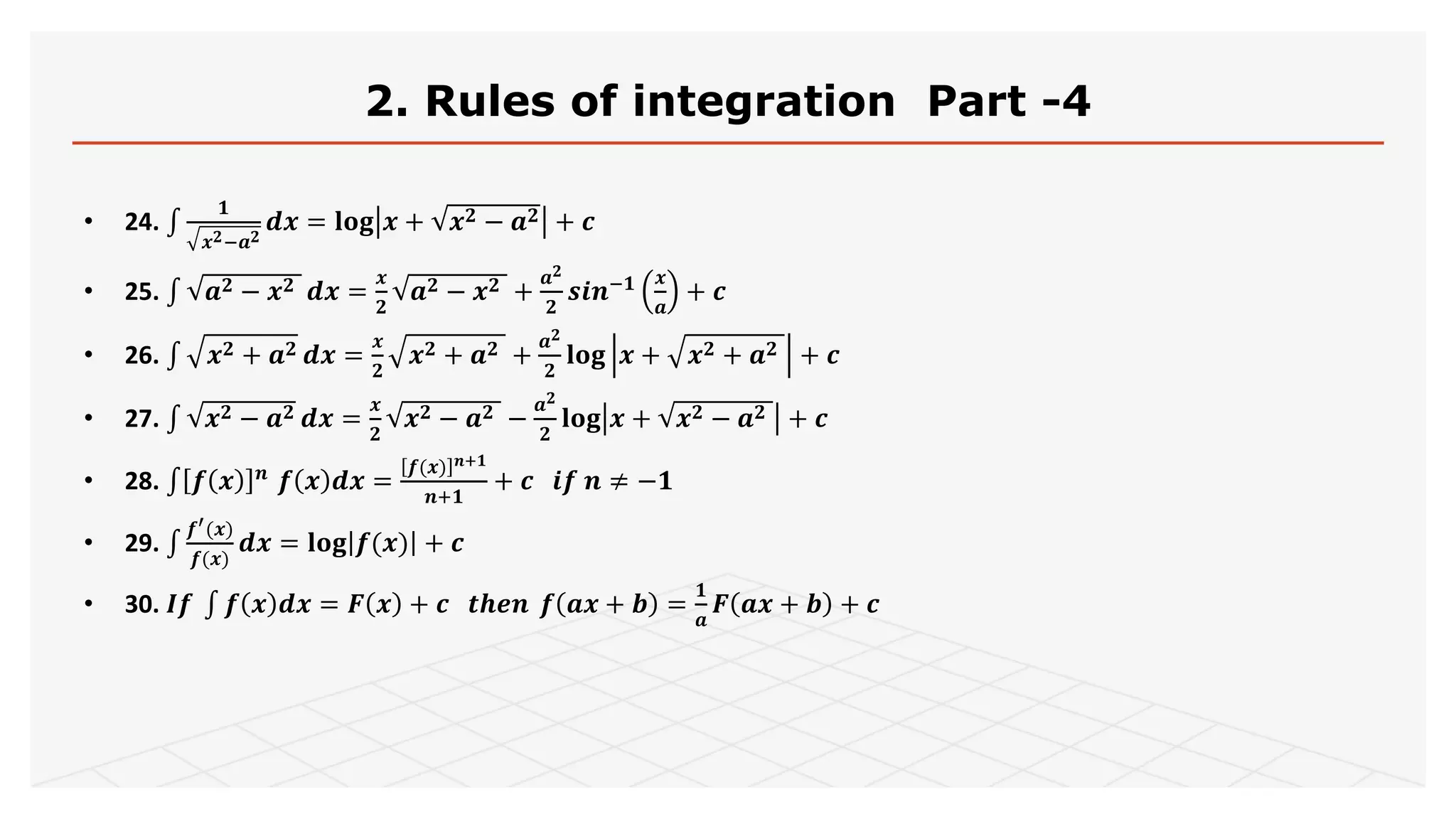
2. Rules of integration Part -4
• 24.
𝟏
𝒙 𝟐−𝒂 𝟐
𝒅𝒙 = 𝐥𝐨𝐠 𝒙 + 𝒙 𝟐 − 𝒂 𝟐 + 𝒄
• 25. 𝒂 𝟐 − 𝒙 𝟐 𝒅𝒙 =
𝒙
𝟐
𝒂 𝟐 − 𝒙 𝟐 +
𝒂 𝟐
𝟐
𝒔𝒊𝒏−𝟏 𝒙
𝒂
+ 𝒄
• 26. 𝒙 𝟐 + 𝒂 𝟐 𝒅𝒙 =
𝒙
𝟐
𝒙 𝟐 + 𝒂 𝟐 +
𝒂 𝟐
𝟐
𝐥𝐨𝐠 𝒙 + 𝒙 𝟐 + 𝒂 𝟐 + 𝒄
• 27. 𝒙 𝟐 − 𝒂 𝟐 𝒅𝒙 =
𝒙
𝟐
𝒙 𝟐 − 𝒂 𝟐 −
𝒂 𝟐
𝟐
𝐥𝐨𝐠 𝒙 + 𝒙 𝟐 − 𝒂 𝟐 + 𝒄
• 28. 𝒇 𝒙 𝒏
𝒇 𝒙 𝒅𝒙 =
𝒇(𝒙) 𝒏+𝟏
𝒏+𝟏
+ 𝒄 𝒊𝒇 𝒏 ≠ −𝟏
• 29.
𝒇′(𝒙)
𝒇(𝒙)
𝒅𝒙 = 𝐥𝐨𝐠 𝒇(𝒙) + 𝒄
• 30. 𝑰𝒇 𝒇 𝒙 𝒅𝒙 = 𝑭 𝒙 + 𝒄 𝒕𝒉𝒆𝒏 𝒇 𝒂𝒙 + 𝒃 =
𝟏
𝒂
𝑭 𝒂𝒙 + 𝒃 + 𝒄
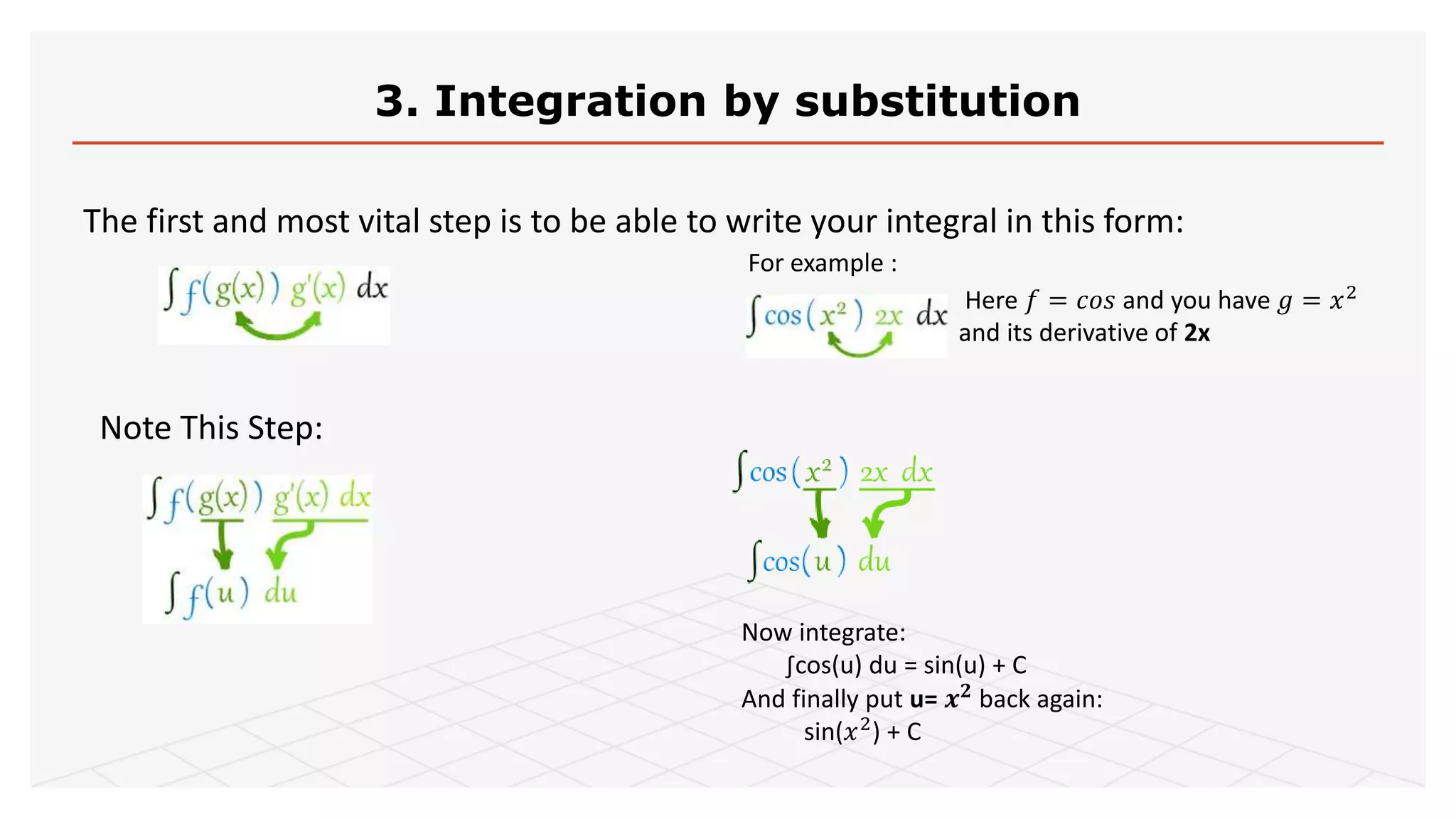
3. Integration by substitution
The first and most vital step is to be able to write your integral in this form:
Note This Step:
For example :
Here 𝑓 = 𝑐𝑜𝑠 and you have 𝑔 = 𝑥2
and its derivative of 2x
Now integrate:
∫cos(u) du = sin(u) + C
And finally put u= 𝒙 𝟐
back again:
sin(𝑥2
) + C
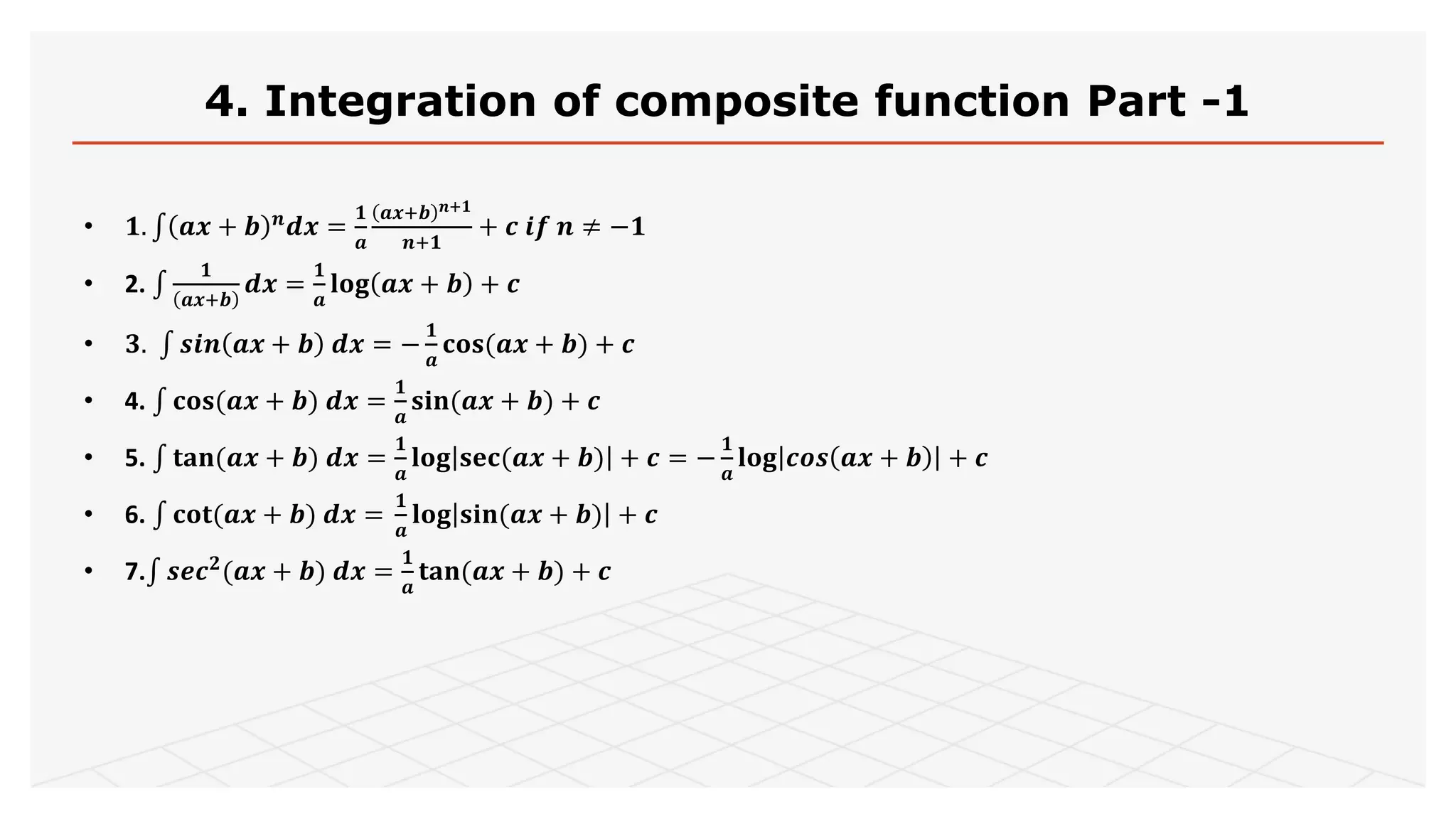
4. Integration of composite function Part -1
• 𝟏. 𝒂𝒙 + 𝒃 𝒏
𝒅𝒙 =
𝟏
𝒂
𝒂𝒙+𝒃 𝒏+𝟏
𝒏+𝟏
+ 𝒄 𝒊𝒇 𝒏 ≠ −𝟏
• 2.
𝟏
𝒂𝒙+𝒃
𝒅𝒙 =
𝟏
𝒂
𝐥𝐨𝐠 𝒂𝒙 + 𝒃 + 𝒄
• 𝟑. 𝒔𝒊𝒏 𝒂𝒙 + 𝒃 𝒅𝒙 = −
𝟏
𝒂
𝐜𝐨𝐬(𝒂𝒙 + 𝒃) + 𝒄
• 4. 𝐜𝐨𝐬(𝒂𝒙 + 𝒃) 𝒅𝒙 =
𝟏
𝒂
𝐬𝐢𝐧(𝒂𝒙 + 𝒃) + 𝒄
• 5. 𝐭𝐚𝐧(𝒂𝒙 + 𝒃) 𝒅𝒙 =
𝟏
𝒂
𝐥𝐨𝐠 𝐬𝐞𝐜(𝒂𝒙 + 𝒃) + 𝒄 = −
𝟏
𝒂
𝐥𝐨𝐠 𝒄𝒐𝒔 𝒂𝒙 + 𝒃 + 𝒄
• 6. 𝐜𝐨𝐭(𝒂𝒙 + 𝒃) 𝒅𝒙 =
𝟏
𝒂
𝐥𝐨𝐠 𝐬𝐢𝐧(𝒂𝒙 + 𝒃) + 𝒄
• 7. 𝒔𝒆𝒄 𝟐
(𝒂𝒙 + 𝒃) 𝒅𝒙 =
𝟏
𝒂
𝐭𝐚𝐧(𝒂𝒙 + 𝒃) + 𝒄
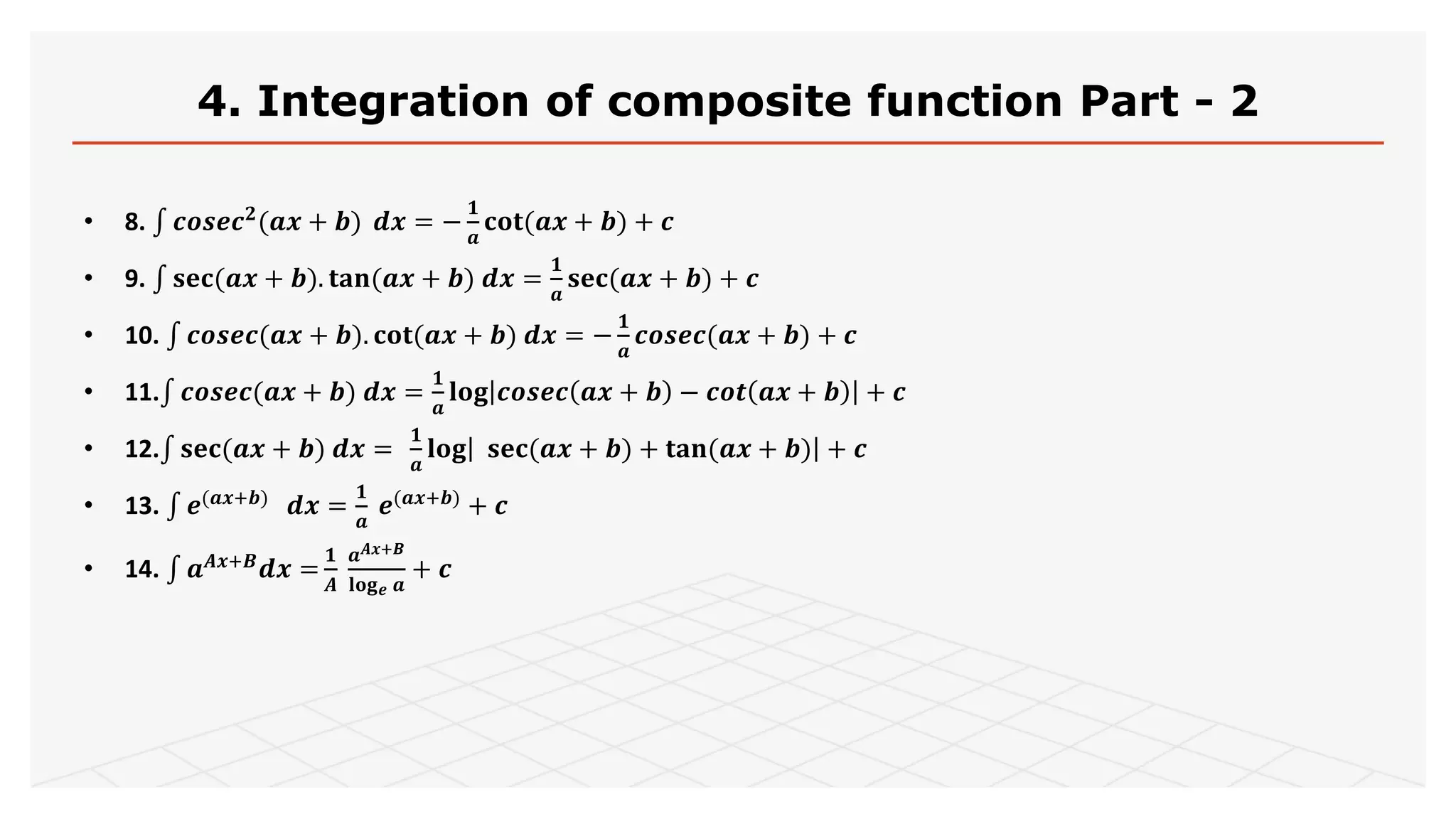
4. Integration of composite function Part - 2
• 8. 𝒄𝒐𝒔𝒆𝒄 𝟐(𝒂𝒙 + 𝒃) 𝒅𝒙 = −
𝟏
𝒂
𝐜𝐨𝐭(𝒂𝒙 + 𝒃) + 𝒄
• 9. 𝐬𝐞𝐜(𝒂𝒙 + 𝒃). 𝐭𝐚𝐧(𝒂𝒙 + 𝒃) 𝒅𝒙 =
𝟏
𝒂
𝐬𝐞𝐜(𝒂𝒙 + 𝒃) + 𝒄
• 10. 𝒄𝒐𝒔𝒆𝒄(𝒂𝒙 + 𝒃). 𝐜𝐨𝐭(𝒂𝒙 + 𝒃) 𝒅𝒙 = −
𝟏
𝒂
𝒄𝒐𝒔𝒆𝒄(𝒂𝒙 + 𝒃) + 𝒄
• 11. 𝒄𝒐𝒔𝒆𝒄(𝒂𝒙 + 𝒃) 𝒅𝒙 =
𝟏
𝒂
𝐥𝐨𝐠 𝒄𝒐𝒔𝒆𝒄 𝒂𝒙 + 𝒃 − 𝒄𝒐𝒕 𝒂𝒙 + 𝒃 + 𝒄
• 12. 𝐬𝐞𝐜(𝒂𝒙 + 𝒃) 𝒅𝒙 =
𝟏
𝒂
𝐥𝐨𝐠 𝐬𝐞𝐜(𝒂𝒙 + 𝒃) + 𝐭𝐚𝐧(𝒂𝒙 + 𝒃) + 𝒄
• 13. 𝒆(𝒂𝒙+𝒃) 𝒅𝒙 =
𝟏
𝒂
𝒆(𝒂𝒙+𝒃) + 𝒄
• 14. 𝒂 𝑨𝒙+𝑩
𝒅𝒙 =
𝟏
𝑨
𝒂 𝑨𝒙+𝑩
𝐥𝐨𝐠 𝒆 𝒂
+ 𝒄
5. Definition of definite integral
6. Properties of definite integral with simple problems -1
• 1. 𝒂
𝒃
𝒇(𝒙) 𝒅𝒙= 𝒂
𝒃
𝒇(𝒕) 𝒅𝒕
• 2. 𝒂
𝒃
𝒇(𝒙) 𝒅𝒙 = – 𝒃
𝒂
𝒇(𝒙) 𝒅𝒙 … [Also, 𝒂
𝒂
𝒇(𝒙) 𝒅𝒙 = 𝟎]
• 3. 𝒂
𝒃
𝒇(𝒙) 𝒅𝒙 = 𝒂
𝒄
𝒇(𝒙) 𝒅𝒙 + 𝒄
𝒃
𝒇(𝒙) 𝒅𝒙
• 4. 𝒂
𝒃
𝒇(𝒙) 𝒅𝒙 = 𝒂
𝒃
𝒇(𝒂 + 𝒃 − 𝒙) 𝒅𝒙
• 5. 𝟎
𝒂
𝒇(𝒙) 𝒅𝒙 = 𝟎
𝒂
𝒇(𝒂 − 𝒙) 𝒅𝒙]
• 6. 𝟎
𝟐𝒂
𝒇(𝒙) 𝒅𝒙 = 𝟎
𝒂
𝒇(𝒙) 𝒅𝒙 + 𝟎
𝒂
𝒇(𝟐𝒂 − 𝒙) 𝒅𝒙
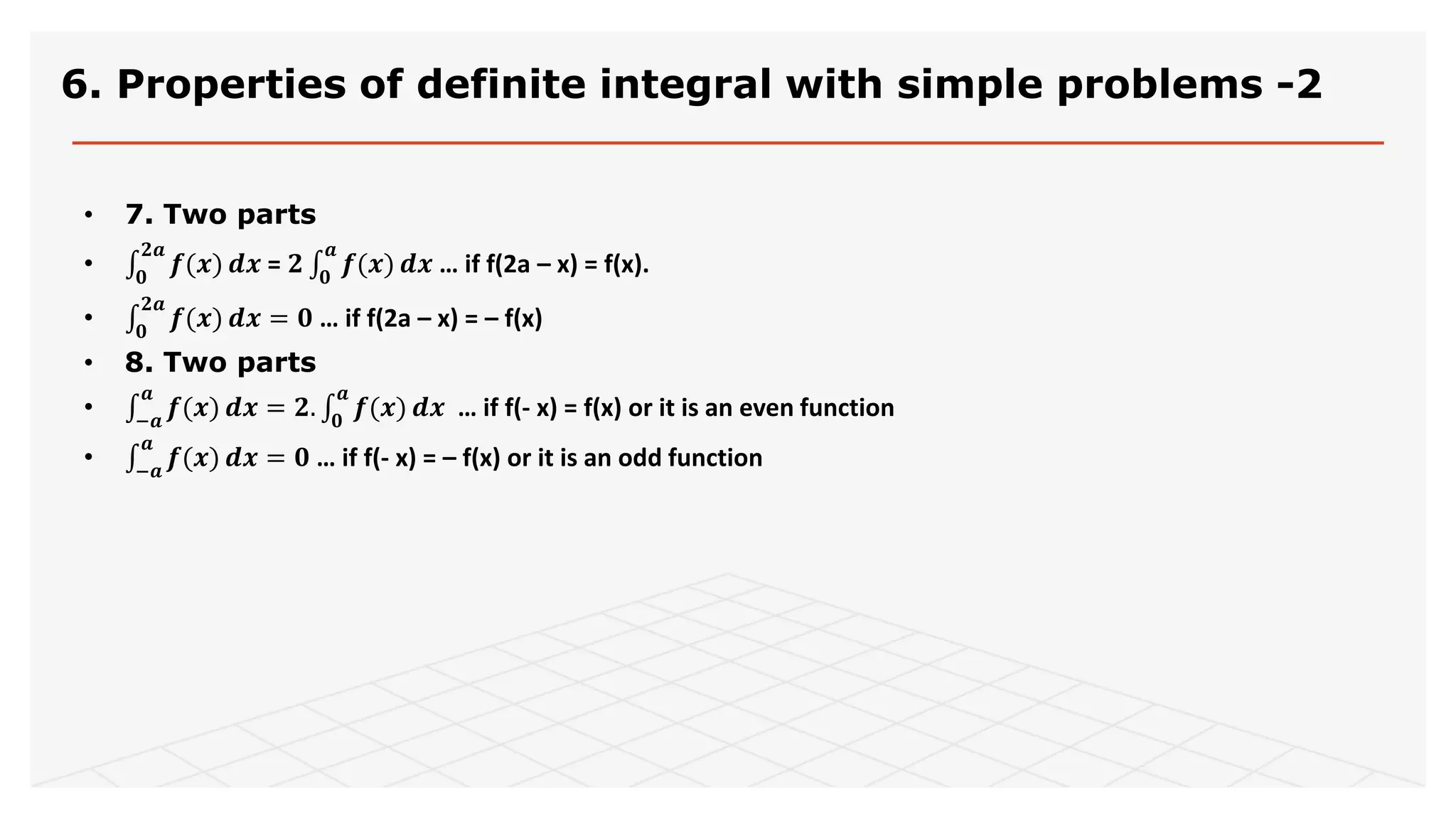
6. Properties of definite integral with simple problems -2
• 7. Two parts
• 𝟎
𝟐𝒂
𝒇(𝒙) 𝒅𝒙 = 𝟐 𝟎
𝒂
𝒇(𝒙) 𝒅𝒙 … if f(2a – x) = f(x).
• 𝟎
𝟐𝒂
𝒇(𝒙) 𝒅𝒙 = 𝟎 … if f(2a – x) = – f(x)
• 8. Two parts
• −𝒂
𝒂
𝒇(𝒙) 𝒅𝒙 = 𝟐. 𝟎
𝒂
𝒇(𝒙) 𝒅𝒙 … if f(- x) = f(x) or it is an even function
• −𝒂
𝒂
𝒇(𝒙) 𝒅𝒙 = 𝟎 … if f(- x) = – f(x) or it is an odd function
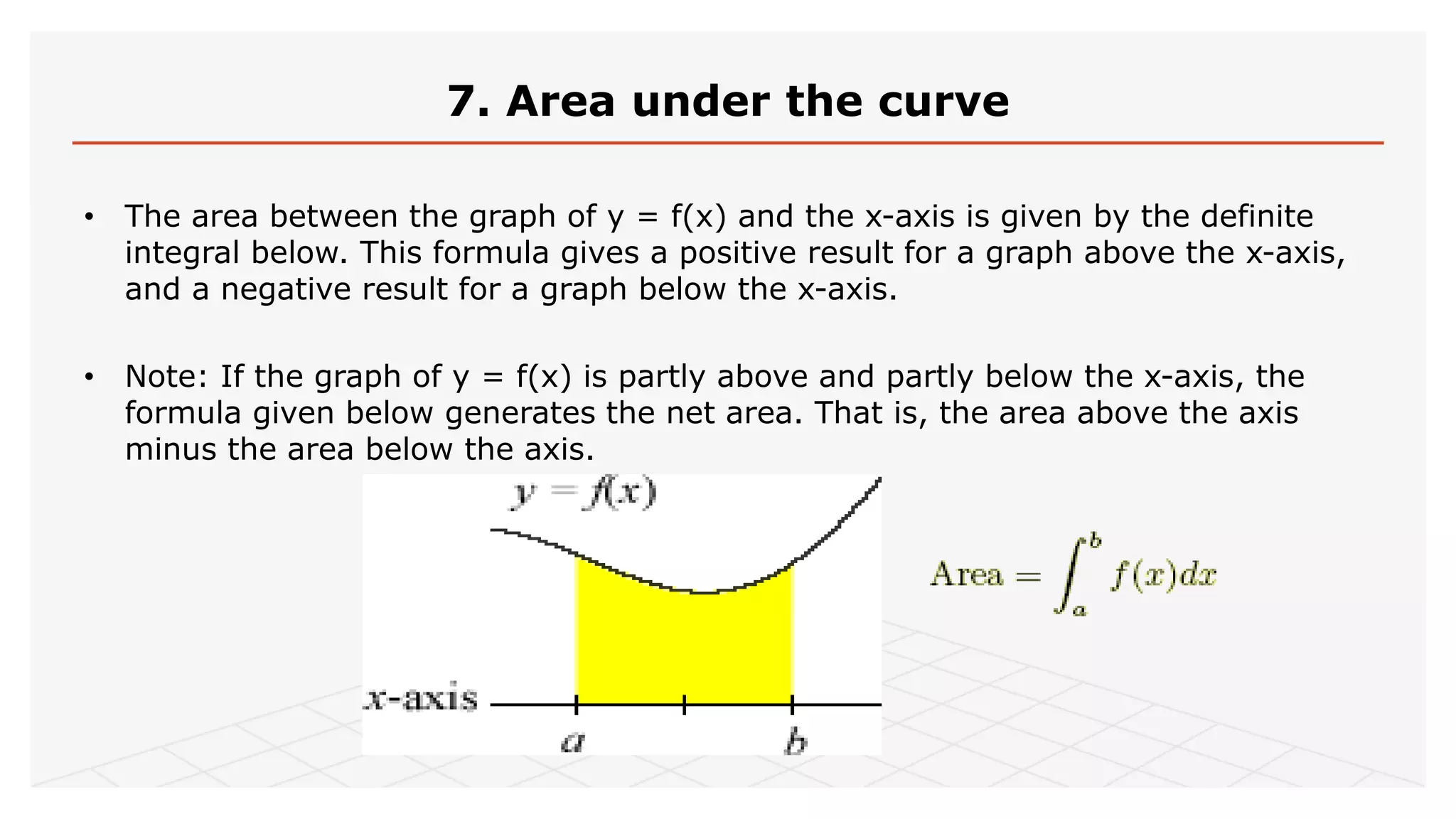
7. Area under the curve
• The area between the graph of y = f(x) and the x-axis is given by the definite
integral below. This formula gives a positive result for a graph above the x-axis,
and a negative result for a graph below the x-axis.
• Note: If the graph of y = f(x) is partly above and partly below the x-axis, the
formula given below generates the net area. That is, the area above the axis
minus the area below the axis.
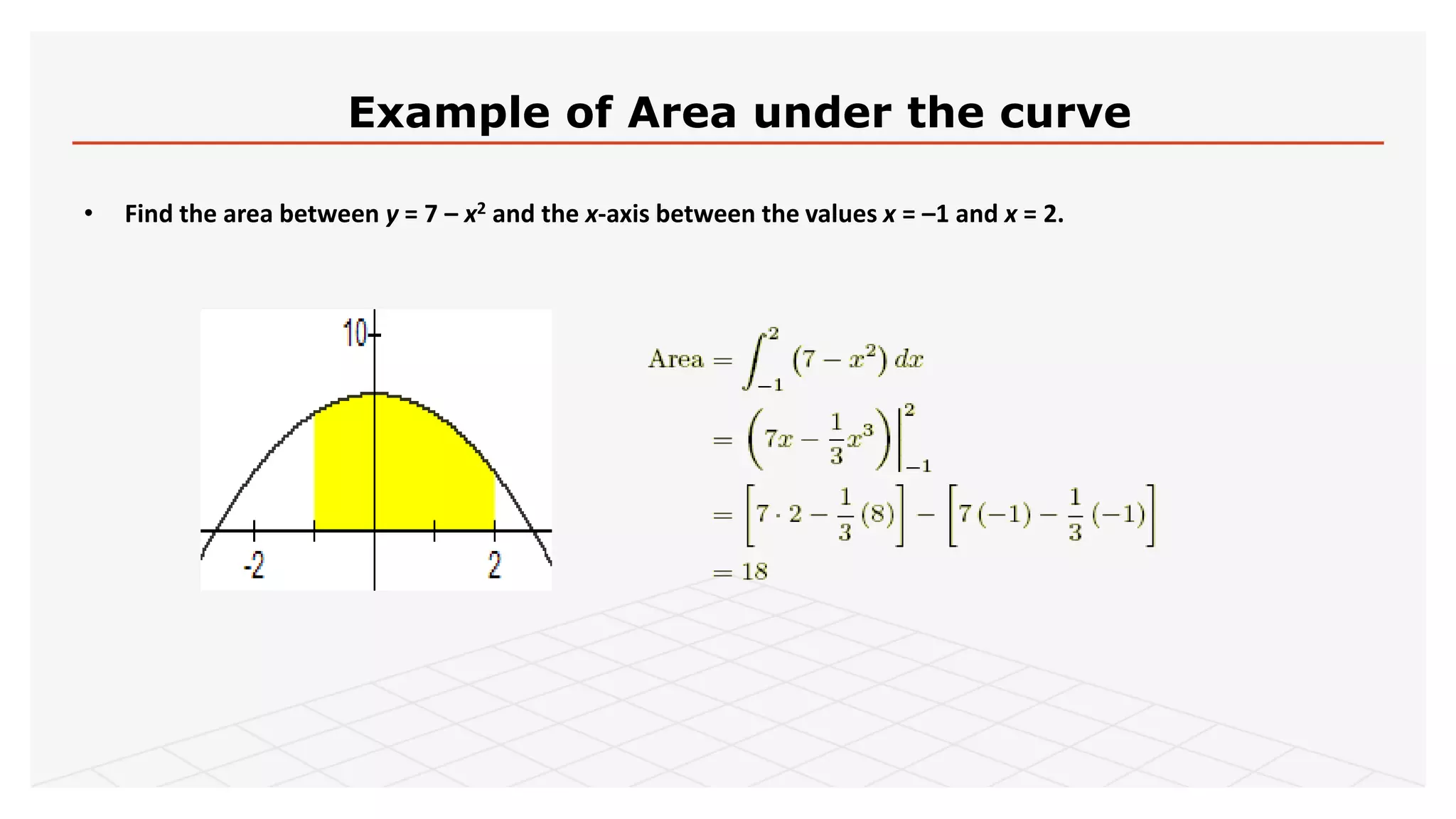
Example of Area under the curve
• Find the area between y = 7 – x2 and the x-axis between the values x = –1 and x = 2.
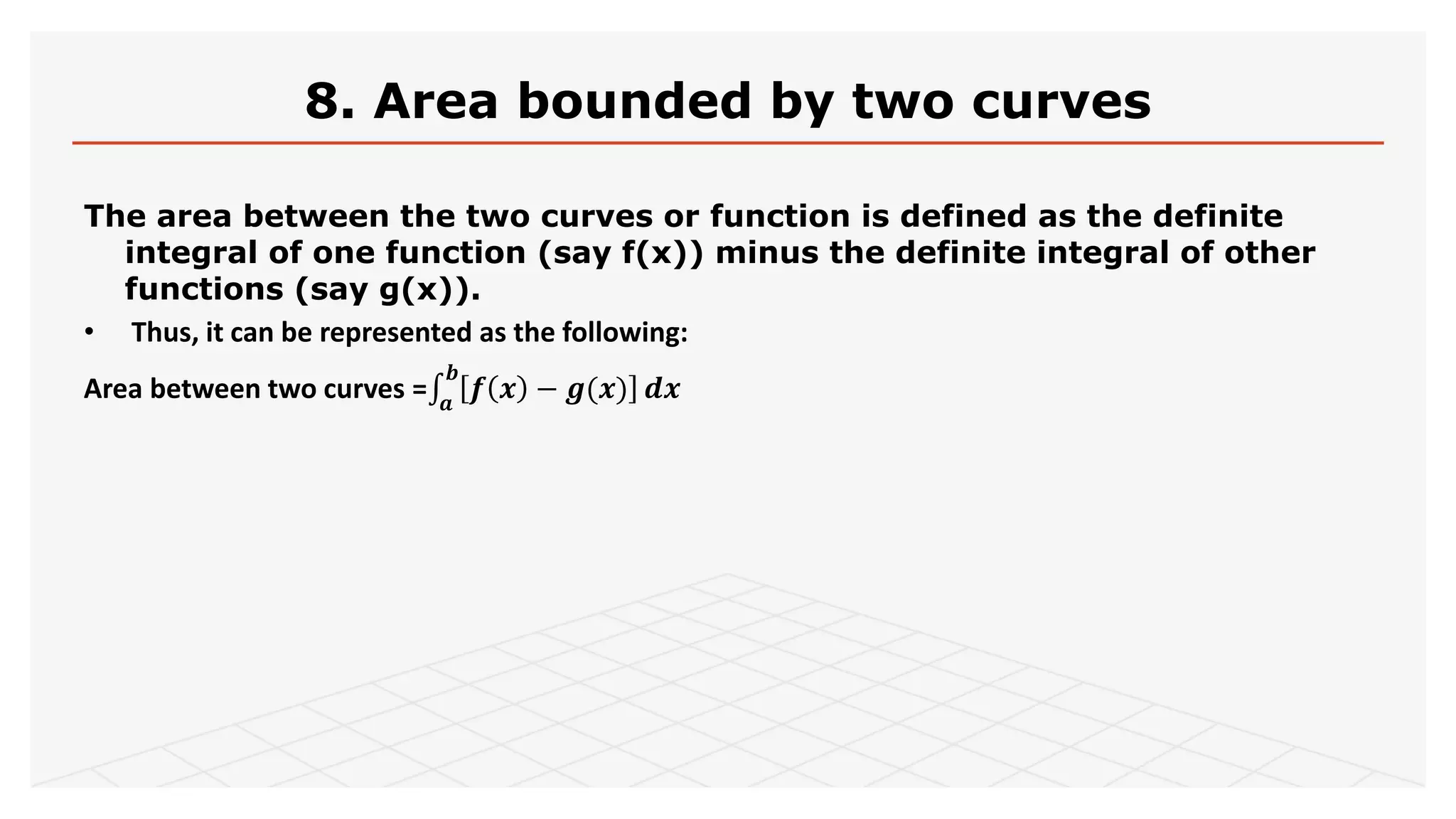
8. Area bounded by two curves
The area between the two curves or function is defined as the definite
integral of one function (say f(x)) minus the definite integral of other
functions (say g(x)).
• Thus, it can be represented as the following:
Area between two curves = 𝒂
𝒃
𝒇 𝒙 − 𝒈(𝒙) 𝒅𝒙
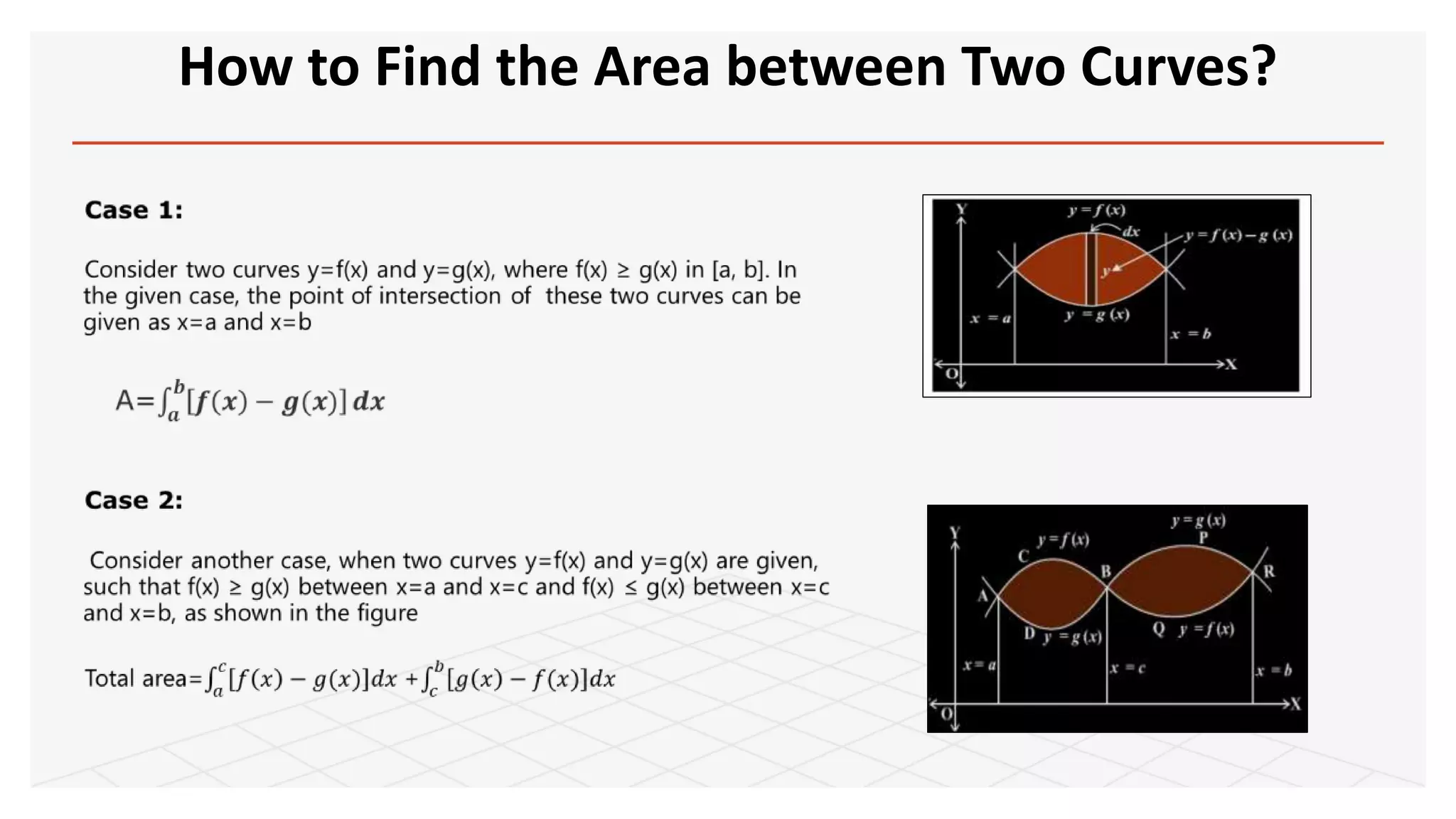
How to Find the Area between Two Curves?
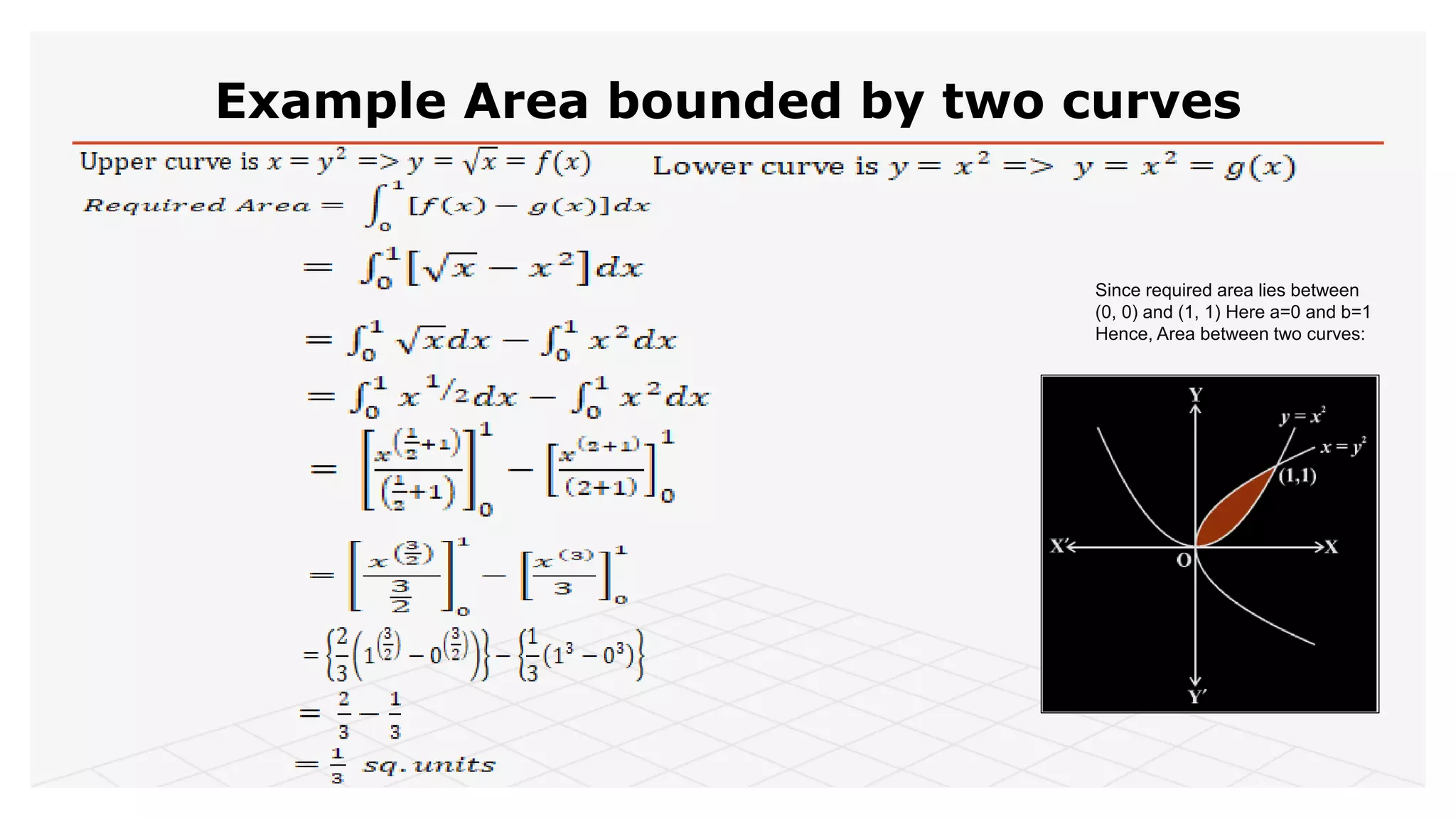
Example Area bounded by two curves
Since required area lies between
(0, 0) and (1, 1) Here a=0 and b=1
Hence, Area between two curves:
THANK YOU !

Ch 5-integration-part-1

  • 1.
    Integration & Applicationof integration By GP - Mumbai
  • 2.
    Contents: 1. Definition ofintegration as antiderivative 2. Rules of integration 3. Integration by substitution 4. Integration of composite function 5. Definition of definite integral 6. Properties of definite integral with simple problems 7. Area under the curve 8. Area bounded by two curves
  • 3.
    1. Definition ofintegration as antiderivative Definition : If 𝒅 𝒅𝒙 𝒇 𝒙 + 𝒄 =F(x) then 𝑭 𝒙 𝒅𝒙 = 𝒇 𝒙 + 𝒄 , where c is constant of integration As 𝒅 𝒅𝒙 𝐜 = 𝟎 and 𝑭(𝒙)dx indicates integration of F(x) with respect to x Symbol : 𝒅𝒙 𝒊𝒔 𝒐𝒑𝒆𝒓𝒂𝒕𝒐𝒓 𝒊𝒏𝒅𝒊𝒄𝒂𝒕𝒊𝒐𝒏 𝒊𝒏𝒕𝒆𝒈𝒓𝒂𝒕𝒊𝒐𝒏 𝒘𝒊𝒕𝒉 𝒓𝒆𝒔𝒑𝒆𝒄𝒕 𝒕𝒐 𝒙 Example : 𝒅 𝒅𝒙 𝒔𝒊𝒏𝒙 + 𝒄 =𝒄𝒐𝒔𝒙 hence, 𝒄𝒐𝒔𝒙 𝒅𝒙 = 𝒔𝒊𝒏𝒙 + 𝒄
  • 4.
    2. Rules ofintegration Part -1 • 1. 𝒅 𝒅𝒙 (𝒙 𝒏+𝟏 +𝒄) = 𝒏 + 𝟏 𝒙 𝒏 => 𝒙 𝒏 𝒅𝒙 = 𝒙 𝒏+𝟏 𝒏+𝟏 + 𝒄 𝒊𝒇 𝒏 ≠ −𝟏 • 2. 𝒅 𝒅𝒙 𝐥𝐨𝐠 𝒙 + 𝒄 = 𝟏 𝒙 => 𝟏 𝒙 𝒅𝒙 = 𝐥𝐨𝐠 𝒙 + 𝒄 • 3. 𝒅 𝒅𝒙 𝒄𝒐𝒔𝒙 + 𝒄 = −𝒔𝒊𝒏𝒙 => 𝒔𝒊𝒏𝒙 𝒅𝒙 = −𝒄𝒐𝒔𝒙 + 𝒄 • 4. 𝒅 𝒅𝒙 𝒔𝒊𝒏𝒙 + 𝒄 = 𝒄𝒐𝒔𝒙 => 𝒄𝒐𝒔𝒙 𝒅𝒙 = 𝒔𝒊𝒏𝒙 + 𝒄 • 5. 𝒅 𝒅𝒙 𝐥𝐨𝐠 𝒔𝒆𝒄𝒙 + 𝒄 = 𝒕𝒂𝒏𝒙 => 𝒕𝒂𝒏𝒙 𝒅𝒙 = 𝐥𝐨𝐠 𝒔𝒆𝒄𝒙 + 𝒄 = − 𝐥𝐨𝐠 𝒄𝒐𝒔𝒙 + 𝒄 • 6. 𝒅 𝒅𝒙 𝐥𝐨𝐠 𝒔𝒊𝒏𝒙 + 𝒄 = 𝒄𝒐𝒕𝒙 => 𝒄𝒐𝒕𝒙 𝒅𝒙 = 𝐥𝐨𝐠 𝒔𝒊𝒏𝒙 + 𝒄 • 7. 𝒅 𝒅𝒙 𝒕𝒂𝒏𝒙 + 𝒄 = 𝒔𝒆𝒄 𝟐 𝒙 => 𝒔𝒆𝒄 𝟐 𝒙 𝒅𝒙 = 𝒕𝒂𝒏𝒙 + 𝒄 • 8. 𝒅 𝒅𝒙 −𝒄𝒐𝒕𝒙 + 𝒄 = 𝒄𝒐𝒔𝒆𝒄 𝟐 𝒙 => 𝒄𝒐𝒔𝒆𝒄 𝟐 𝒙 𝒅𝒙 = −𝒄𝒐𝒕𝒙 + 𝒄
  • 5.
    2. Rules ofintegration Part -2 • 9. 𝒅 𝒅𝒙 𝒔𝒆𝒄𝒙 + 𝒄 = 𝒔𝒆𝒄𝒙. 𝒕𝒂𝒏𝒙 => 𝒔𝒆𝒄𝒙. 𝒕𝒂𝒏𝒙 𝒅𝒙 = 𝒔𝒆𝒄𝒙 + 𝒄 • 10. 𝒅 𝒅𝒙 −𝒄𝒐𝒔𝒆𝒄𝒙 + 𝒄 = 𝒄𝒐𝒔𝒆𝒄𝒙. 𝒄𝒐𝒕𝒙 => 𝒄𝒐𝒔𝒆𝒄𝒙. 𝒄𝒐𝒕𝒙 𝒅𝒙 = −𝒄𝒐𝒔𝒆𝒄𝒙 + 𝒄 • 11. 𝒅 𝒅𝒙 𝒍𝒐𝒈 𝒄𝒐𝒔𝒆𝒄𝒙 − 𝒄𝒐𝒕𝒙 + 𝒄 = 𝒄𝒐𝒔𝒆𝒄𝒙 => 𝒄𝒐𝒔𝒆𝒄𝒙 𝒅𝒙 = 𝒍𝒐𝒈 𝒄𝒐𝒔𝒆𝒄𝒙 − 𝒄𝒐𝒕𝒙 + 𝒄 • 12. 𝒅 𝒅𝒙 𝒍𝒐𝒈 𝒔𝒆𝒄𝒙 + 𝒕𝒂𝒏𝒙 + 𝒄 = 𝒔𝒆𝒄𝒙 => 𝒔𝒆𝒄𝒙 𝒅𝒙 = 𝒍𝒐𝒈 𝒔𝒆𝒄𝒙 + 𝒕𝒂𝒏𝒙 + 𝒄 • 13. 𝒅 𝒅𝒙 𝒆 𝒙 + 𝒄 = 𝒆 𝒙 => 𝒆 𝒙 𝒅𝒙 = 𝒆 𝒙 + 𝒄 • 14. 𝒅 𝒅𝒙 𝒂 𝒙 𝐥𝐨𝐠 𝒆 𝒂 + 𝒄 = 𝒂 𝒙 => 𝒂 𝒙 𝒅𝒙 = 𝒂 𝒙 𝐥𝐨𝐠 𝒆 𝒂 + 𝒄 • 15. 𝒅 𝒅𝒙 𝒔𝒊𝒏−𝟏 𝒙 𝒂 + 𝒄 = 𝟏 𝒂 𝟐−𝒙 𝟐 => 𝟏 𝒂 𝟐−𝒙 𝟐 𝒅𝒙 = 𝒔𝒊𝒏−𝟏 𝒙 𝒂 + 𝒄
  • 6.
    2. Rules ofintegration Part -3 • 16. 𝒅 𝒅𝒙 𝒄𝒐𝒔−𝟏 𝒙 𝒂 + 𝒄 = −𝟏 𝒂 𝟐−𝒙 𝟐 => −𝟏 𝒂 𝟐−𝒙 𝟐 𝒅𝒙 = 𝒄𝒐𝒔−𝟏 𝒙 𝒂 + 𝒄 • 17. 𝒅 𝒅𝒙 𝟏 𝒂 𝒕𝒂𝒏−𝟏 𝒙 𝒂 + 𝒄 = 𝟏 𝒂 𝟐+𝒙 𝟐 => 𝟏 𝒂 𝟐+𝒙 𝟐 𝒅𝒙 = 𝟏 𝒂 𝒕𝒂𝒏−𝟏 𝒙 𝒂 + 𝒄 • 18. 𝒅 𝒅𝒙 𝟏 𝒂 𝒄𝒐𝒕−𝟏 𝒙 𝒂 + 𝒄 = −𝟏 𝒂 𝟐+𝒙 𝟐 => −𝟏 𝒂 𝟐+𝒙 𝟐 𝒅𝒙 = 𝟏 𝒂 𝒄𝒐𝒕−𝟏 𝒙 𝒂 + 𝒄 • 19. 𝒅 𝒅𝒙 𝟏 𝒂 𝒔𝒆𝒄−𝟏 𝒙 𝒂 + 𝒄 = 𝟏 𝒙 𝒙 𝟐−𝒂 𝟐 => 𝟏 𝒙 𝒙 𝟐−𝒂 𝟐 𝒅𝒙 = 𝟏 𝒂 𝒔𝒆𝒄−𝟏 𝒙 𝒂 + 𝒄 • 20. 𝒅 𝒅𝒙 𝟏 𝒂 𝒄𝒐𝒔𝒆𝒄−𝟏 𝒙 𝒂 + 𝒄 = −𝟏 𝒙 𝒙 𝟐−𝒂 𝟐 => −𝟏 𝒙 𝒙 𝟐−𝒂 𝟐 𝒅𝒙 = 𝟏 𝒂 𝒄𝒐𝒔𝒆𝒄−𝟏 𝒙 𝒂 + 𝒄 • 21. 𝟏 𝒂 𝟐−𝒙 𝟐 𝒅𝒙 = 𝟏 𝟐𝒂 𝐥𝐨𝐠 𝒂+𝒙 𝒂−𝒙 + 𝒄 • 22. 𝟏 𝒙 𝟐−𝒂 𝟐 𝒅𝒙 = 𝟏 𝟐𝒂 𝐥𝐨𝐠 𝒙−𝒂 𝒙+𝒂 + 𝒄 • 23. 𝟏 𝒙 𝟐+𝒂 𝟐 𝒅𝒙 = 𝐥𝐨𝐠 𝒙 + 𝒙 𝟐 + 𝒂 𝟐 + 𝒄
  • 7.
    2. Rules ofintegration Part -4 • 24. 𝟏 𝒙 𝟐−𝒂 𝟐 𝒅𝒙 = 𝐥𝐨𝐠 𝒙 + 𝒙 𝟐 − 𝒂 𝟐 + 𝒄 • 25. 𝒂 𝟐 − 𝒙 𝟐 𝒅𝒙 = 𝒙 𝟐 𝒂 𝟐 − 𝒙 𝟐 + 𝒂 𝟐 𝟐 𝒔𝒊𝒏−𝟏 𝒙 𝒂 + 𝒄 • 26. 𝒙 𝟐 + 𝒂 𝟐 𝒅𝒙 = 𝒙 𝟐 𝒙 𝟐 + 𝒂 𝟐 + 𝒂 𝟐 𝟐 𝐥𝐨𝐠 𝒙 + 𝒙 𝟐 + 𝒂 𝟐 + 𝒄 • 27. 𝒙 𝟐 − 𝒂 𝟐 𝒅𝒙 = 𝒙 𝟐 𝒙 𝟐 − 𝒂 𝟐 − 𝒂 𝟐 𝟐 𝐥𝐨𝐠 𝒙 + 𝒙 𝟐 − 𝒂 𝟐 + 𝒄 • 28. 𝒇 𝒙 𝒏 𝒇 𝒙 𝒅𝒙 = 𝒇(𝒙) 𝒏+𝟏 𝒏+𝟏 + 𝒄 𝒊𝒇 𝒏 ≠ −𝟏 • 29. 𝒇′(𝒙) 𝒇(𝒙) 𝒅𝒙 = 𝐥𝐨𝐠 𝒇(𝒙) + 𝒄 • 30. 𝑰𝒇 𝒇 𝒙 𝒅𝒙 = 𝑭 𝒙 + 𝒄 𝒕𝒉𝒆𝒏 𝒇 𝒂𝒙 + 𝒃 = 𝟏 𝒂 𝑭 𝒂𝒙 + 𝒃 + 𝒄
  • 8.
    3. Integration bysubstitution The first and most vital step is to be able to write your integral in this form: Note This Step: For example : Here 𝑓 = 𝑐𝑜𝑠 and you have 𝑔 = 𝑥2 and its derivative of 2x Now integrate: ∫cos(u) du = sin(u) + C And finally put u= 𝒙 𝟐 back again: sin(𝑥2 ) + C
  • 9.
    4. Integration ofcomposite function Part -1 • 𝟏. 𝒂𝒙 + 𝒃 𝒏 𝒅𝒙 = 𝟏 𝒂 𝒂𝒙+𝒃 𝒏+𝟏 𝒏+𝟏 + 𝒄 𝒊𝒇 𝒏 ≠ −𝟏 • 2. 𝟏 𝒂𝒙+𝒃 𝒅𝒙 = 𝟏 𝒂 𝐥𝐨𝐠 𝒂𝒙 + 𝒃 + 𝒄 • 𝟑. 𝒔𝒊𝒏 𝒂𝒙 + 𝒃 𝒅𝒙 = − 𝟏 𝒂 𝐜𝐨𝐬(𝒂𝒙 + 𝒃) + 𝒄 • 4. 𝐜𝐨𝐬(𝒂𝒙 + 𝒃) 𝒅𝒙 = 𝟏 𝒂 𝐬𝐢𝐧(𝒂𝒙 + 𝒃) + 𝒄 • 5. 𝐭𝐚𝐧(𝒂𝒙 + 𝒃) 𝒅𝒙 = 𝟏 𝒂 𝐥𝐨𝐠 𝐬𝐞𝐜(𝒂𝒙 + 𝒃) + 𝒄 = − 𝟏 𝒂 𝐥𝐨𝐠 𝒄𝒐𝒔 𝒂𝒙 + 𝒃 + 𝒄 • 6. 𝐜𝐨𝐭(𝒂𝒙 + 𝒃) 𝒅𝒙 = 𝟏 𝒂 𝐥𝐨𝐠 𝐬𝐢𝐧(𝒂𝒙 + 𝒃) + 𝒄 • 7. 𝒔𝒆𝒄 𝟐 (𝒂𝒙 + 𝒃) 𝒅𝒙 = 𝟏 𝒂 𝐭𝐚𝐧(𝒂𝒙 + 𝒃) + 𝒄
  • 10.
    4. Integration ofcomposite function Part - 2 • 8. 𝒄𝒐𝒔𝒆𝒄 𝟐(𝒂𝒙 + 𝒃) 𝒅𝒙 = − 𝟏 𝒂 𝐜𝐨𝐭(𝒂𝒙 + 𝒃) + 𝒄 • 9. 𝐬𝐞𝐜(𝒂𝒙 + 𝒃). 𝐭𝐚𝐧(𝒂𝒙 + 𝒃) 𝒅𝒙 = 𝟏 𝒂 𝐬𝐞𝐜(𝒂𝒙 + 𝒃) + 𝒄 • 10. 𝒄𝒐𝒔𝒆𝒄(𝒂𝒙 + 𝒃). 𝐜𝐨𝐭(𝒂𝒙 + 𝒃) 𝒅𝒙 = − 𝟏 𝒂 𝒄𝒐𝒔𝒆𝒄(𝒂𝒙 + 𝒃) + 𝒄 • 11. 𝒄𝒐𝒔𝒆𝒄(𝒂𝒙 + 𝒃) 𝒅𝒙 = 𝟏 𝒂 𝐥𝐨𝐠 𝒄𝒐𝒔𝒆𝒄 𝒂𝒙 + 𝒃 − 𝒄𝒐𝒕 𝒂𝒙 + 𝒃 + 𝒄 • 12. 𝐬𝐞𝐜(𝒂𝒙 + 𝒃) 𝒅𝒙 = 𝟏 𝒂 𝐥𝐨𝐠 𝐬𝐞𝐜(𝒂𝒙 + 𝒃) + 𝐭𝐚𝐧(𝒂𝒙 + 𝒃) + 𝒄 • 13. 𝒆(𝒂𝒙+𝒃) 𝒅𝒙 = 𝟏 𝒂 𝒆(𝒂𝒙+𝒃) + 𝒄 • 14. 𝒂 𝑨𝒙+𝑩 𝒅𝒙 = 𝟏 𝑨 𝒂 𝑨𝒙+𝑩 𝐥𝐨𝐠 𝒆 𝒂 + 𝒄
  • 11.
    5. Definition ofdefinite integral
  • 12.
    6. Properties ofdefinite integral with simple problems -1 • 1. 𝒂 𝒃 𝒇(𝒙) 𝒅𝒙= 𝒂 𝒃 𝒇(𝒕) 𝒅𝒕 • 2. 𝒂 𝒃 𝒇(𝒙) 𝒅𝒙 = – 𝒃 𝒂 𝒇(𝒙) 𝒅𝒙 … [Also, 𝒂 𝒂 𝒇(𝒙) 𝒅𝒙 = 𝟎] • 3. 𝒂 𝒃 𝒇(𝒙) 𝒅𝒙 = 𝒂 𝒄 𝒇(𝒙) 𝒅𝒙 + 𝒄 𝒃 𝒇(𝒙) 𝒅𝒙 • 4. 𝒂 𝒃 𝒇(𝒙) 𝒅𝒙 = 𝒂 𝒃 𝒇(𝒂 + 𝒃 − 𝒙) 𝒅𝒙 • 5. 𝟎 𝒂 𝒇(𝒙) 𝒅𝒙 = 𝟎 𝒂 𝒇(𝒂 − 𝒙) 𝒅𝒙] • 6. 𝟎 𝟐𝒂 𝒇(𝒙) 𝒅𝒙 = 𝟎 𝒂 𝒇(𝒙) 𝒅𝒙 + 𝟎 𝒂 𝒇(𝟐𝒂 − 𝒙) 𝒅𝒙
  • 13.
    6. Properties ofdefinite integral with simple problems -2 • 7. Two parts • 𝟎 𝟐𝒂 𝒇(𝒙) 𝒅𝒙 = 𝟐 𝟎 𝒂 𝒇(𝒙) 𝒅𝒙 … if f(2a – x) = f(x). • 𝟎 𝟐𝒂 𝒇(𝒙) 𝒅𝒙 = 𝟎 … if f(2a – x) = – f(x) • 8. Two parts • −𝒂 𝒂 𝒇(𝒙) 𝒅𝒙 = 𝟐. 𝟎 𝒂 𝒇(𝒙) 𝒅𝒙 … if f(- x) = f(x) or it is an even function • −𝒂 𝒂 𝒇(𝒙) 𝒅𝒙 = 𝟎 … if f(- x) = – f(x) or it is an odd function
  • 14.
    7. Area underthe curve • The area between the graph of y = f(x) and the x-axis is given by the definite integral below. This formula gives a positive result for a graph above the x-axis, and a negative result for a graph below the x-axis. • Note: If the graph of y = f(x) is partly above and partly below the x-axis, the formula given below generates the net area. That is, the area above the axis minus the area below the axis.
  • 15.
    Example of Areaunder the curve • Find the area between y = 7 – x2 and the x-axis between the values x = –1 and x = 2.
  • 16.
    8. Area boundedby two curves The area between the two curves or function is defined as the definite integral of one function (say f(x)) minus the definite integral of other functions (say g(x)). • Thus, it can be represented as the following: Area between two curves = 𝒂 𝒃 𝒇 𝒙 − 𝒈(𝒙) 𝒅𝒙
  • 17.
    How to Findthe Area between Two Curves?
  • 18.
    Example Area boundedby two curves Since required area lies between (0, 0) and (1, 1) Here a=0 and b=1 Hence, Area between two curves:
  • 19.