Integral Calculus Formula Sheet 
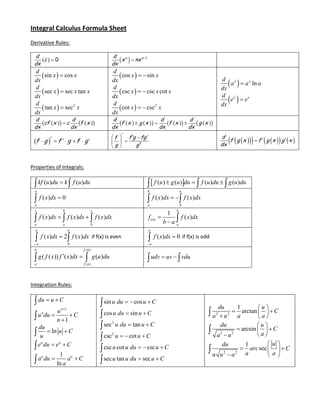
Derivative Rules: 
  0
d
c
dx
     1n nd
x nx
dx

    
 sin cos
d
x x
dx

 sec sec tan
d
x x x
dx

  2
tan sec
d
x x
dx
  
 cos sin
d
x x
dx
 
 csc csc cot
d
x x x
dx
 
  2
cot csc
d
x x
dx
   
  lnx xd
a a a
dx

 x xd
e e
dx
  
     
d d
cf x c f x
dx dx
           
d d d
f x g x f x g x
dx dx dx
  
 f g f g f g       2
f g fgf
g g
    
 
 
         
d
f g x f g x g x
dx
 
Properties of Integrals: 
( ) ( )kf u du k f u du   ( ) ( ) ( ) ( )f u g u du f u du g u du    
( ) 0
a
a
f x dx    ( ) ( )
b a
a b
f x dx f x dx    
( ) ( ) ( )
c b c
a a b
f x dx f x dx f x dx     
1
( )
b
ave
a
f f x dx
b a

   
0
( ) 2 ( )
a a
a
f x dx f x dx

   if f(x) is even  ( ) 0
a
a
f x dx

  if f(x) is odd 
( )
( )
( ( )) ( ) ( )
f bb
a f a
g f x f x dx g u du     udv uv vdu    
 
Integration Rules: 
du u C 
1
1
n
n u
u du C
n

 

ln
du
u C
u
 
u u
e du e C 
1
ln
u u
a du a C
a
   
sin cosu du u C  
cos sinu du u C 
2
sec tanu du u C 
2
csc cotu u C  
csc cot cscu u du u C  
sec tan secu u du u C   
2 2
1
arctan
du u
C
a u a a
 
  
  

2 2
arcsin
du u
C
aa u
 
  
 

2 2
1
sec
udu
arc C
a au u a
 
  
  

 
 
Fundamental Theorem of Calculus: 
     '  
x
a
d
F x f t dt f x
dx
 where   f t  is a continuous function on [a, x]. 
      
b
a
f x dx F b F a , where F(x) is any antiderivative of f(x). 
 
Riemann Sums: 
1 1
n n
i i
i i
ca c a
 
 
1 1 1
n n n
i i i i
i i i
a b a b
  
      
1
( ) lim ( )
b n
n
ia
f x dx f a i x x


   
n
ab
x

  
1
1
n
i
n


1
( 1)
2
n
i
n n
i



2
1
( 1)(2 1)
6
n
i
n n n
i

 

2
3
1
( 1)
2
n
i
n n
i

 
  
 

   height of th rectangle width of th rectangle
i
i i
Right Endpoint Rule:
 



n
i
n
ab
n
ab
n
i
iafxxiaf
1
)()(
1
)()()()(
Left Endpoint Rule:
( ) ( )
1 1
( ( 1) )( ) ( ) ( ( 1) )
n n
b a b a
n n
i i
f a i x x f a i 
 
       
Midpoint Rule:
   ( 1) ( ) ( 1) ( )
2 2
1 1
( )( ) ( ) ( )
n n
i i b a i i b a
n n
i i
f a x x f a     
 
     
 
Net Change: 
Displacement:  ( )
b
a
v x dx   Distance Traveled:  ( )
b
a
v x dx  
0
( ) (0) ( )
t
s t s v x dx    
0
( ) (0) ( )
t
Q t Q Q x dx  
 
Trig Formulas: 
 2 1
2sin ( ) 1 cos(2 )x x   
sin
tan
cos
x
x
x
  
1
sec
cos
x
x
  
cos( ) cos( )x x    2 2
sin ( ) cos ( ) 1x x 
 2 1
2cos ( ) 1 cos(2 )x x   
cos
cot
sin
x
x
x
  
1
csc
sin
x
x
  
sin( ) sin( )x x     2 2
tan ( ) 1 sec ( )x x 
 
Geometry Fomulas: 
Area of a Square: 
2
A s  
Area of a Triangle: 
1
2A bh  
Area of an 
Equilateral Trangle:
23
4A s  
Area of a Circle: 
2
A r  
Area of a 
Rectangle: 
A bh  
   
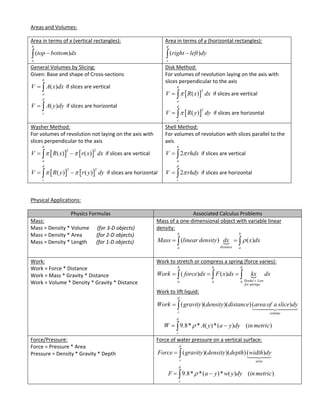
Areas and Volumes: 
Area in terms of x (vertical rectangles): 
( )
b
a
top bottom dx  
Area in terms of y (horizontal rectangles): 
( )
d
c
right left dy  
General Volumes by Slicing: 
Given: Base and shape of Cross‐sections 
( )
b
a
V A x dx   if slices are vertical 
( )
d
c
V A y dy   if slices are horizontal 
 
Disk Method: 
For volumes of revolution laying on the axis with 
slices perpendicular to the axis 
 
2
( )
b
a
V R x dx   if slices are vertical 
 
2
( )
d
c
V R y dy   if slices are horizontal 
Washer Method: 
For volumes of revolution not laying on the axis with 
slices perpendicular to the axis 
   
2 2
( ) ( )
b
a
V R x r x dx    if slices are vertical 
   
2 2
( ) ( )
d
c
V R y r y dy    if slices are horizontal 
Shell Method: 
For volumes of revolution with slices parallel to the 
axis 
2
b
a
V rhdx   if slices are vertical 
2
d
c
V rhdy   if slices are horizontal 
 
Physical Applications: 
Physics Formulas  Associated Calculus Problems 
Mass: 
Mass = Density * Volume      (for 3‐D objects) 
Mass = Density * Area           (for 2‐D objects) 
Mass = Density * Length       (for 1‐D objects) 
Mass of a one‐dimensional object with variable linear 
density: 
( ) ( )
b b
distancea a
Mass linear density dx x dx    
 
Work: 
Work = Force * Distance 
Work = Mass * Gravity * Distance   
Work = Volume * Density * Gravity * Distance 
Work to stretch or compress a spring (force varies): 

'
( ) ( )
b b b
Hooke s Lawa a a
for springs
Work force dx F x dx kx dx      
Work to lift liquid: 
( )( )( )( )
9.8* * ( )*( ) ( )
d
c volume
d
c
Work gravity density distance areaof a slice dy
W A y a y dy inmetric

 



Force/Pressure: 
Force = Pressure * Area 
Pressure = Density * Gravity * Depth 
Force of water pressure on a vertical surface: 
( )( )( )( )
9.8* *( )* ( ) ( )
d
c area
d
c
Force gravity density depth width dy
F a y w y dy inmetric

 



 
 
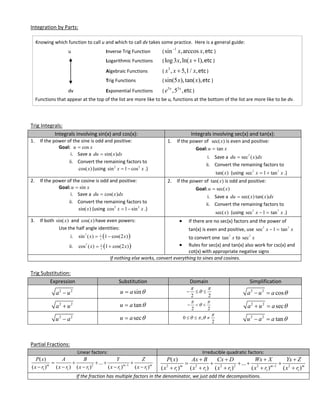
Integration by Parts: 
 
Knowing which function to call u and which to call dv takes some practice.  Here is a general guide: 
    u    Inverse Trig Function   (
1
sin ,arccos ,x x
etc ) 
        Logarithmic Functions   ( log3 ,ln( 1),x x  etc ) 
        Algebraic Functions   (
3
, 5,1/ ,x x x etc) 
        Trig Functions     (sin(5 ),tan( ),x x etc ) 
    dv    Exponential Functions   (
3 3
,5 ,x x
e etc ) 
Functions that appear at the top of the list are more like to be u, functions at the bottom of the list are more like to be dv. 
 
Trig Integrals: 
Integrals involving sin(x) and cos(x):  Integrals involving sec(x) and tan(x): 
1. If the power of the sine is odd and positive: 
Goal:   cosu x  
i. Save a  sin( )du x dx    
ii. Convert the remaining factors to 
cos( )x (using  2 2
sin 1 cosx x  .)   
1. If the power of   sec( )x is even and positive:  
Goal: tanu x  
i. Save a 
2
sec ( )du x dx    
ii. Convert the remaining factors to 
tan( )x  (using 
2 2
sec 1 tanx x  .)   
2. If the power of the cosine is odd and positive:
Goal: sinu x  
i. Save a  cos( )du x dx  
ii. Convert the remaining factors to 
sin( )x (using  2 2
cos 1 sinx x  .)   
2. If the power of  tan( )x is odd and positive: 
Goal: sec( )u x  
i. Save a  sec( ) tan( )du x x dx  
ii. Convert the remaining factors to 
sec( )x  (using 
2 2
sec 1 tanx x  .)   
3. If both sin( )x  and  cos( )x have even powers: 
Use the half angle identities:  
i.  2 1
2
sin ( ) 1 cos(2 )x x                
ii.  2 1
2
cos ( ) 1 cos(2 )x x   
 If there are no sec(x) factors and the power of 
tan(x) is even and positive, use 
2 2
sec 1 tanx x 
to convert one 
2
tan x to 
2
sec x  
 Rules for sec(x) and tan(x) also work for csc(x) and 
cot(x) with appropriate negative signs
If nothing else works, convert everything to sines and cosines. 
 
Trig Substitution: 
Expression  Substitution  Domain  Simplification 
2 2
a u   sinu a   
2 2
 
     2 2
cosa u a    
2 2
a u   tanu a   
2 2
 
     2 2
seca u a    
2 2
u a   secu a    0 ,
2

       2 2
tanu a a    
 
 
Partial Fractions: 
Linear factors:  Irreducible quadratic factors:
2 1
1 1 1 1 1
( )
...
( ) ( ) ( ) ( ) ( )m m m
P x A B Y Z
x r x r x r x r x r
    
    
 
2 2 2 2 2 1 2
1 1 1 1 1
( )
...
( ) ( ) ( ) ( ) ( )m m m
P x Ax B Cx D Wx X Yx Z
x r x r x r x r x r
   
    
    
 
If the fraction has multiple factors in the denominator, we just add the decompositions.
 

Integral calculus formula sheet

  • 1.
    Integral Calculus Formula Sheet  Derivative Rules:    0 d c dx     1n nd x nx dx        sin cos d x x dx   sec sec tan d x x x dx    2 tan sec d x x dx     cos sin d x x dx    csc csc cot d x x x dx     2 cot csc d x x dx       lnx xd a a a dx   x xd e e dx          d d cf x c f x dx dx             d d d f x g x f x g x dx dx dx     f g f g f g       2 f g fgf g g                    d f g x f g x g x dx   Properties of Integrals:  ( ) ( )kf u du k f u du   ( ) ( ) ( ) ( )f u g u du f u du g u du     ( ) 0 a a f x dx    ( ) ( ) b a a b f x dx f x dx     ( ) ( ) ( ) c b c a a b f x dx f x dx f x dx      1 ( ) b ave a f f x dx b a      0 ( ) 2 ( ) a a a f x dx f x dx     if f(x) is even  ( ) 0 a a f x dx    if f(x) is odd  ( ) ( ) ( ( )) ( ) ( ) f bb a f a g f x f x dx g u du     udv uv vdu       Integration Rules:  du u C  1 1 n n u u du C n     ln du u C u   u u e du e C  1 ln u u a du a C a     sin cosu du u C   cos sinu du u C  2 sec tanu du u C  2 csc cotu u C   csc cot cscu u du u C   sec tan secu u du u C    2 2 1 arctan du u C a u a a          2 2 arcsin du u C aa u         2 2 1 sec udu arc C a au u a             
  • 2.
    Fundamental Theorem of Calculus:      '   x a d F x f t dt f x dx  where   f t  is a continuous function on [a, x].         b a f x dx F b F a , where F(x) is any antiderivative of f(x).    Riemann Sums:  1 1 n n i i i i ca c a     1 1 1 n n n i i i i i i i a b a b           1 ( ) lim ( ) b n n ia f x dx f a i x x       n ab x     1 1 n i n   1 ( 1) 2 n i n n i    2 1 ( 1)(2 1) 6 n i n n n i     2 3 1 ( 1) 2 n i n n i             height of th rectangle width of th rectangle i i i Right Endpoint Rule:      n i n ab n ab n i iafxxiaf 1 )()( 1 )()()()( Left Endpoint Rule: ( ) ( ) 1 1 ( ( 1) )( ) ( ) ( ( 1) ) n n b a b a n n i i f a i x x f a i            Midpoint Rule:    ( 1) ( ) ( 1) ( ) 2 2 1 1 ( )( ) ( ) ( ) n n i i b a i i b a n n i i f a x x f a                Net Change:  Displacement:  ( ) b a v x dx   Distance Traveled:  ( ) b a v x dx   0 ( ) (0) ( ) t s t s v x dx     0 ( ) (0) ( ) t Q t Q Q x dx     Trig Formulas:   2 1 2sin ( ) 1 cos(2 )x x    sin tan cos x x x    1 sec cos x x    cos( ) cos( )x x    2 2 sin ( ) cos ( ) 1x x   2 1 2cos ( ) 1 cos(2 )x x    cos cot sin x x x    1 csc sin x x    sin( ) sin( )x x     2 2 tan ( ) 1 sec ( )x x    Geometry Fomulas:  Area of a Square:  2 A s   Area of a Triangle:  1 2A bh   Area of an  Equilateral Trangle: 23 4A s   Area of a Circle:  2 A r   Area of a  Rectangle:  A bh      
  • 3.
    Areas and Volumes:  Area in terms of x (vertical rectangles):  ( ) b a top bottomdx   Area in terms of y (horizontal rectangles):  ( ) d c right left dy   General Volumes by Slicing:  Given: Base and shape of Cross‐sections  ( ) b a V A x dx   if slices are vertical  ( ) d c V A y dy   if slices are horizontal    Disk Method:  For volumes of revolution laying on the axis with  slices perpendicular to the axis    2 ( ) b a V R x dx   if slices are vertical    2 ( ) d c V R y dy   if slices are horizontal  Washer Method:  For volumes of revolution not laying on the axis with  slices perpendicular to the axis      2 2 ( ) ( ) b a V R x r x dx    if slices are vertical      2 2 ( ) ( ) d c V R y r y dy    if slices are horizontal  Shell Method:  For volumes of revolution with slices parallel to the  axis  2 b a V rhdx   if slices are vertical  2 d c V rhdy   if slices are horizontal    Physical Applications:  Physics Formulas  Associated Calculus Problems  Mass:  Mass = Density * Volume      (for 3‐D objects)  Mass = Density * Area           (for 2‐D objects)  Mass = Density * Length       (for 1‐D objects)  Mass of a one‐dimensional object with variable linear  density:  ( ) ( ) b b distancea a Mass linear density dx x dx       Work:  Work = Force * Distance  Work = Mass * Gravity * Distance    Work = Volume * Density * Gravity * Distance  Work to stretch or compress a spring (force varies):   ' ( ) ( ) b b b Hooke s Lawa a a for springs Work force dx F x dx kx dx       Work to lift liquid:  ( )( )( )( ) 9.8* * ( )*( ) ( ) d c volume d c Work gravity density distance areaof a slice dy W A y a y dy inmetric       Force/Pressure:  Force = Pressure * Area  Pressure = Density * Gravity * Depth  Force of water pressure on a vertical surface:  ( )( )( )( ) 9.8* *( )* ( ) ( ) d c area d c Force gravity density depth width dy F a y w y dy inmetric          
  • 4.
    Integration by Parts:    Knowing which function to call u and which to call dv takes some practice.  Here is a general guide:      u   Inverse Trig Function   ( 1 sin ,arccos ,x x etc )          Logarithmic Functions   ( log3 ,ln( 1),x x  etc )          Algebraic Functions   ( 3 , 5,1/ ,x x x etc)          Trig Functions     (sin(5 ),tan( ),x x etc )      dv    Exponential Functions   ( 3 3 ,5 ,x x e etc )  Functions that appear at the top of the list are more like to be u, functions at the bottom of the list are more like to be dv.    Trig Integrals:  Integrals involving sin(x) and cos(x):  Integrals involving sec(x) and tan(x):  1. If the power of the sine is odd and positive:  Goal:   cosu x   i. Save a  sin( )du x dx     ii. Convert the remaining factors to  cos( )x (using  2 2 sin 1 cosx x  .)    1. If the power of   sec( )x is even and positive:   Goal: tanu x   i. Save a  2 sec ( )du x dx     ii. Convert the remaining factors to  tan( )x  (using  2 2 sec 1 tanx x  .)    2. If the power of the cosine is odd and positive: Goal: sinu x   i. Save a  cos( )du x dx   ii. Convert the remaining factors to  sin( )x (using  2 2 cos 1 sinx x  .)    2. If the power of  tan( )x is odd and positive:  Goal: sec( )u x   i. Save a  sec( ) tan( )du x x dx   ii. Convert the remaining factors to  sec( )x  (using  2 2 sec 1 tanx x  .)    3. If both sin( )x  and  cos( )x have even powers:  Use the half angle identities:   i.  2 1 2 sin ( ) 1 cos(2 )x x                 ii.  2 1 2 cos ( ) 1 cos(2 )x x     If there are no sec(x) factors and the power of  tan(x) is even and positive, use  2 2 sec 1 tanx x  to convert one  2 tan x to  2 sec x    Rules for sec(x) and tan(x) also work for csc(x) and  cot(x) with appropriate negative signs If nothing else works, convert everything to sines and cosines.    Trig Substitution:  Expression  Substitution  Domain  Simplification  2 2 a u   sinu a    2 2        2 2 cosa u a     2 2 a u   tanu a    2 2        2 2 seca u a     2 2 u a   secu a    0 , 2         2 2 tanu a a         Partial Fractions:  Linear factors:  Irreducible quadratic factors: 2 1 1 1 1 1 1 ( ) ... ( ) ( ) ( ) ( ) ( )m m m P x A B Y Z x r x r x r x r x r             2 2 2 2 2 1 2 1 1 1 1 1 ( ) ... ( ) ( ) ( ) ( ) ( )m m m P x Ax B Cx D Wx X Yx Z x r x r x r x r x r                 If the fraction has multiple factors in the denominator, we just add the decompositions.