Capital Budgeting
Techniques
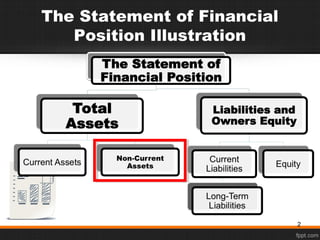
The Statement of Financial
Position Illustration
2
Section 1
Estimating Cash Flows
3
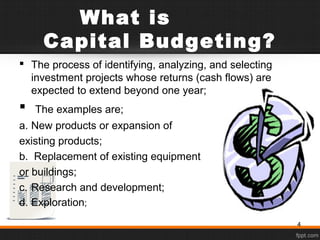
What is
Capital Budgeting?
 The process of identifying, analyzing, and selecting
investment projects whose returns (cash flows) are
expected to extend beyond one year;
 The examples are;
a. New products or expansion of
existing products;
b. Replacement of existing equipment
or buildings;
c. Research and development;
d. Exploration;
4
The Capital Budgeting
Process
 Generate investment proposals consistent with the firm’s
strategic objectives;
 Evaluate projected cash flows;
 Select projects based on a value-maximizing acceptance
criterion;
 Reevaluate implemented investment projects continually
and perform post audits for completed projects;
5
Relevant Cost
Assumption
 Cash flows of a project must be calculated based on
relevant costing assumptions;
 Relevant cost is a decision specific cost which arises as
a direct consequence of decision made;
A company produces tires.It can manufacture 1,000 units in a month for a fixed
cost of $300,000 and variable cost of $500 per unit. Its current demand is
600 units which it sells at $1,000 per unit. Company B considers to order
200 units of tire at $700 per unit. Should the company accept the order?
Solution
a)700-(300000/1000+500)=$100 Reject
b)Relevant costing assumption
(700-500)=$200 Accept 6
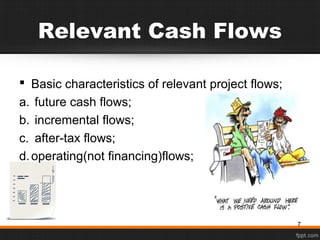
Relevant Cash Flows
 Basic characteristics of relevant project flows;
a. future cash flows;
b. incremental flows;
c. after-tax flows;
d.operating(not financing)flows;
7
Estimating Cash Flows
 Principles that must be adhered to in the
estimation;
a. ignore sunk costs;
b. ignore committed costs;
c. include opportunity costs;
d. include project-driven
changes in working capital;
e. include effects of inflation;
8
Calculating Project Cash
Flows
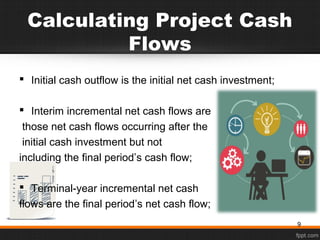
 Initial cash outflow is the initial net cash investment;
 Interim incremental net cash flows are
those net cash flows occurring after the
initial cash investment but not
including the final period’s cash flow;
 Terminal-year incremental net cash
flows are the final period’s net cash flow;
9
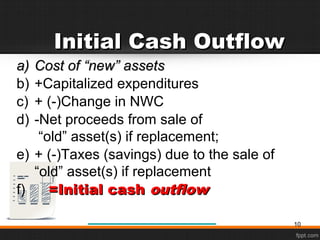
Initial Cash OutflowInitial Cash Outflow
a)a) Cost ofCost of “new” assets“new” assets
b) +Capitalized expenditures
c) + (-)Change in NWC
d) -Net proceeds from sale of
“old” asset(s) if replacement;
e) + (-)Taxes (savings) due to the sale of
“old” asset(s) if replacement
f) =Initial cash=Initial cash outflowoutflow
10
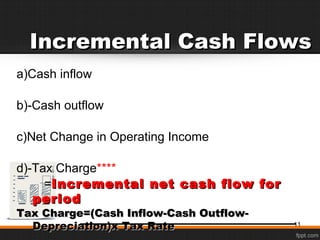
Incremental Cash FlowsIncremental Cash Flows
a)Cash inflow
b)-Cash outflow
c)Net Change in Operating Income
d)-Tax Charge****
==Incremental net cash flow forIncremental net cash flow for
periodperiod
Tax Charge=(Cash Inflow-Cash Outflow-Tax Charge=(Cash Inflow-Cash Outflow-
Depreciation)x Tax RateDepreciation)x Tax Rate 11
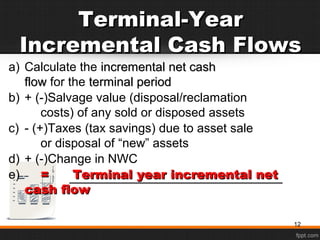
Terminal-YearTerminal-Year
Incremental Cash FlowsIncremental Cash Flows
a) Calculate the incremental net cashincremental net cash
flowflow for the terminal periodterminal period
b) + (-)Salvage value (disposal/reclamation
costs) of any sold or disposed assets
c) - (+)Taxes (tax savings) due to asset sale
or disposal of “new” assets
d) + (-)Change in NWC
e) == Terminal year incremental netTerminal year incremental net
cash flowcash flow
12
Example of an AssetExample of an Asset
Expansion ProjectExpansion Project
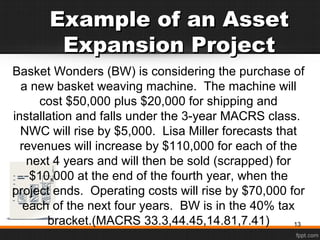
Basket Wonders (BW) is considering the purchase of
a new basket weaving machine. The machine will
cost $50,000 plus $20,000 for shipping and
installation and falls under the 3-year MACRS class.
NWC will rise by $5,000. Lisa Miller forecasts that
revenues will increase by $110,000 for each of the
next 4 years and will then be sold (scrapped) for
$10,000 at the end of the fourth year, when the
project ends. Operating costs will rise by $70,000 for
each of the next four years. BW is in the 40% tax
bracket.(MACRS 33.3,44.45,14.81,7.41) 13
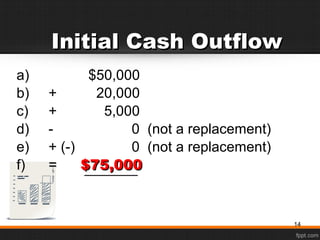
Initial Cash OutflowInitial Cash Outflow
a) $50,000
b) + 20,000
c) + 5,000
d) - 0 (not a replacement)
e) + (-) 0 (not a replacement)
f) == $75,000$75,000
14
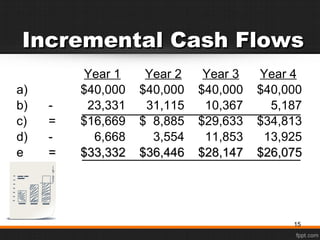
Incremental Cash FlowsIncremental Cash Flows
Year 1 Year 2 Year 3 Year 4
a) $40,000 $40,000 $40,000 $40,000
b) - 23,331 31,115 10,367 5,187
c) = $16,669 $ 8,885 $29,633 $34,813
d) - 6,668 3,554 11,853 13,925
e == $33,332 $36,446 $28,147 $26,075$33,332 $36,446 $28,147 $26,075
15
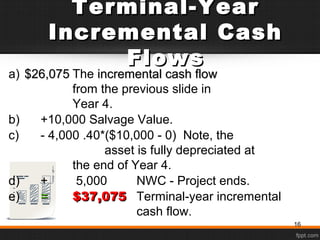
Terminal-YearTerminal-Year
Incremental CashIncremental Cash
FlowsFlows
a) $26,075$26,075 The incremental cash flowincremental cash flow
from the previous slide in
Year 4.
b) +10,000 Salvage Value.
c) - 4,000 .40*($10,000 - 0) Note, the
asset is fully depreciated at
the end of Year 4.
d) + 5,000 NWC - Project ends.
e) == $37,075$37,075 Terminal-year incremental
cash flow.
16
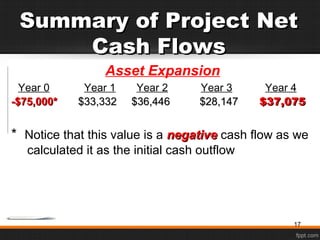
Summary of Project NetSummary of Project Net
Cash FlowsCash Flows
Asset Expansion
Year 0 Year 1 Year 2 Year 3 Year 4
-$75,000*-$75,000* $33,332 $36,446 $28,147$33,332 $36,446 $28,147 $37,075$37,075
* Notice that this value is a negativenegative cash flow as we
calculated it as the initial cash outflow
17
SECTİON 2
Capital Budgeting
Techniques
18
Project Evaluation:
Alternative Methods
 Payback Period (PBP)
 Internal Rate of Return (IRR)
 Net Present Value (NPV)
 Profitability Index (PI)
19
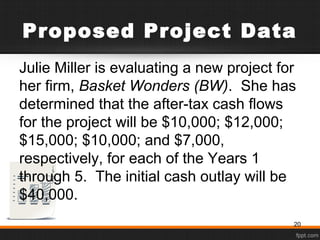
Proposed Project Data
Julie Miller is evaluating a new project for
her firm, Basket Wonders (BW). She has
determined that the after-tax cash flows
for the project will be $10,000; $12,000;
$15,000; $10,000; and $7,000,
respectively, for each of the Years 1
through 5. The initial cash outlay will be
$40,000.
20
Independent Project
 For this project we will assume that it is
independent of any other potential
projects that Basket Wonders may
undertake;
 IndependentIndependent project is a project
whose acceptance (or rejection) does
not prevent the acceptance of other
projects under consideration;
21
Payback Period
 The payback method of investment appraisal is popular
appraisal technique despite of it’s limitations;
 It is the time it takes the cash inflows from a capital
investment project to equal the cash outflows, usually
expressed in years;
 In other words payback is the amount of time it takes
for cash inflows = cash outflows;
22
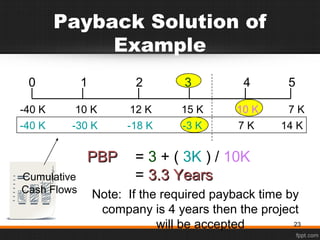
PBPPBP = 3 + ( 3K ) / 10K
= 3.3 Years3.3 Years
Note: If the required payback time by
company is 4 years then the project
will be accepted
Cumulative
Cash Flows
-40 K 10 K 12 K 15 K 10 K 7 K
0 1 2 3 4 5
-40 K -30 K -18 K -3 K 7 K 14 K
Payback Solution of
Example
23
Payback Period
(cont.)
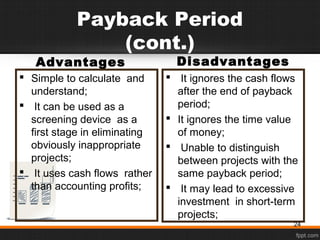
Advantages
 Simple to calculate and
understand;
 It can be used as a
screening device as a
first stage in eliminating
obviously inappropriate
projects;
 It uses cash flows rather
than accounting profits;
Disadvantages
 It ignores the cash flows
after the end of payback
period;
 It ignores the time value
of money;
 Unable to distinguish
between projects with the
same payback period;
 It may lead to excessive
investment in short-term
projects;
24
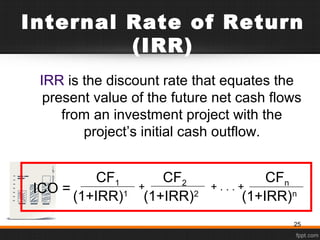
Internal Rate of Return
(IRR)
IRR is the discount rate that equates the
present value of the future net cash flows
from an investment project with the
project’s initial cash outflow.
CF1 CF2 CFn
(1+IRR)1
(1+IRR)2
(1+IRR)n
+ . . . ++ICO =
25
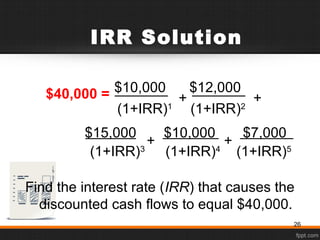
$15,000 $10,000 $7,000
IRR Solution
$10,000 $12,000
(1+IRR)1
(1+IRR)2
Find the interest rate (IRR) that causes the
discounted cash flows to equal $40,000.
+ +
++$40,000 =
(1+IRR)3
(1+IRR)4
(1+IRR)5
26
IRR Acceptance
Criterion
The management of Basket Wonders
has determined that the hurdle rate
is 13% for projects of this type.
Should the project be accepted?
No! The firm will receive 11.57% for
each dollar invested in this project at a
cost of 13%. [ IRR < Hurdle Rate ]
27
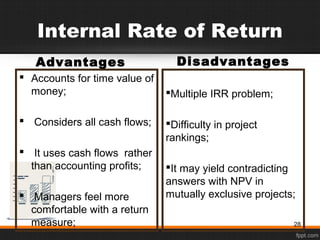
Internal Rate of Return
Advantages
 Accounts for time value of
money;
 Considers all cash flows;
 It uses cash flows rather
than accounting profits;
 Managers feel more
comfortable with a return
measure;
Disadvantages
Multiple IRR problem;
Difficulty in project
rankings;
It may yield contradicting
answers with NPV in
mutually exclusive projects;
28
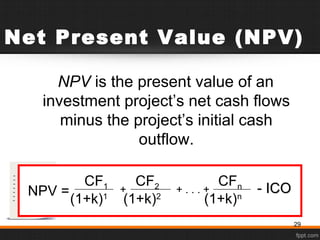
Net Present Value (NPV)
NPV is the present value of an
investment project’s net cash flows
minus the project’s initial cash
outflow.
CF1 CF2 CFn
(1+k)1
(1+k)2
(1+k)n
+ . . . ++ - ICOICONPV =
29
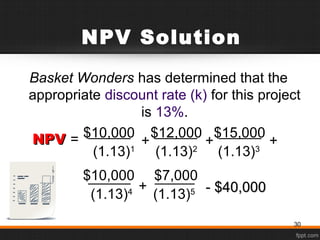
Basket Wonders has determined that the
appropriate discount rate (k) for this project
is 13%.
$10,000 $7,000
NPV Solution
$10,000 $12,000 $15,000
(1.13)1
(1.13)2
(1.13)3
+ +
+ - $40,000$40,000(1.13)4
(1.13)5
NPVNPV = +
30
NPV Solution
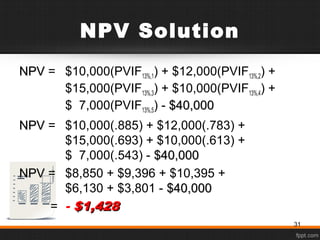
NPVNPV = $10,000(PVIF13%,1) + $12,000(PVIF13%,2) +
$15,000(PVIF13%,3) + $10,000(PVIF13%,4) +
$ 7,000(PVIF13%,5) - $40,000$40,000
NPVNPV = $10,000(.885) + $12,000(.783) +
$15,000(.693) + $10,000(.613) +
$ 7,000(.543) - $40,000$40,000
NPVNPV = $8,850 + $9,396 + $10,395 +
$6,130 + $3,801 - $40,000$40,000
= - $1,428$1,428
31
NPV Acceptance
Criterion
The management of Basket Wonders has
determined that the required rate is 13%
for projects of this type.
Should this project be accepted?
No! The NPV is negative. This means
that the project is reducing shareholder
wealth. [RejectReject as NPVNPV < 00 ]
32
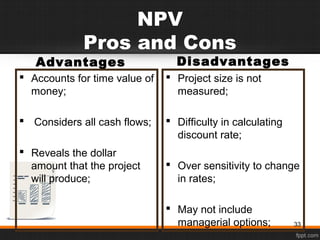
NPV
Pros and Cons
Advantages
 Accounts for time value of
money;
 Considers all cash flows;
 Reveals the dollar
amount that the project
will produce;
Disadvantages
 Project size is not
measured;
 Difficulty in calculating
discount rate;
 Over sensitivity to change
in rates;
 May not include
managerial options; 33
Profitability Index (PI)
PI is the ratio of the present value of a
project’s future net cash flows to the
project’s initial cash outflow.
CF1 CF2 CFn
(1+k)1
(1+k)2
(1+k)n
+ . . . ++ ICOICOPI =
34
PI Acceptance
Criterion
PIPI = $38,572 / $40,000
= .9643 (Method #1, 13-34)
Should this project be accepted?
No! The PIPI is less than 1.00. This
means that the project is not profitable.
[RejectReject as PIPI < 1.001.00 ]
35
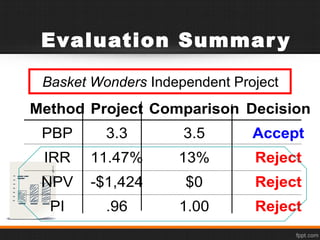
Evaluation Summary
Method Project Comparison Decision
PBP 3.3 3.5 Accept
IRR 11.47% 13% Reject
NPV -$1,424 $0 Reject
PI .96 1.00 Reject
Basket Wonders Independent Project
Other Project
Relationships
 DependeDependentnt -a project whose
acceptance depends on the
acceptance of one or more
other projects;
 Mutually ExclusiveMutually Exclusive - a
project whose acceptance
precludes the acceptance of one or more alternative projects;
37
Potential Problems
Under Mutual
Exclusivity Ranking of project proposals may create
contradictory results;
a.scale of investment;
b.cash flow pattern;
c.project life;
38
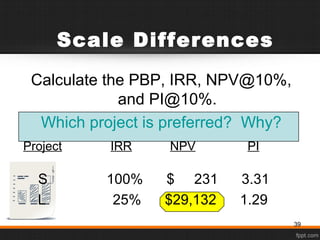
Scale Differences
Calculate the PBP, IRR, NPV@10%,
and PI@10%.
Which project is preferred? Why?
Project IRR NPV PI
S 100% $ 231 3.31
L 25% $29,132 1.29
39
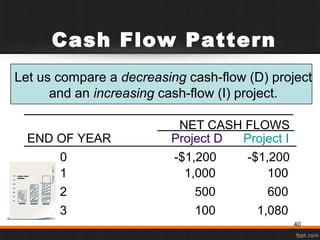
Cash Flow Pattern
Let us compare a decreasing cash-flow (D) project
and an increasing cash-flow (I) project.
NET CASH FLOWS
Project D Project IEND OF YEAR
0 -$1,200 -$1,200
1 1,000 100
2 500 600
3 100 1,080
40
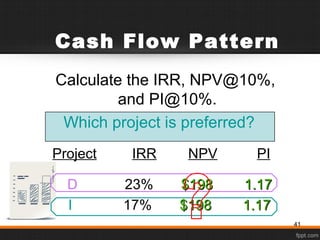
D 23% $198 1.17$198 1.17
I 17% $198 1.17$198 1.17
Cash Flow Pattern
Calculate the IRR, NPV@10%,
and PI@10%.
Which project is preferred?
Project IRR NPV PI
41
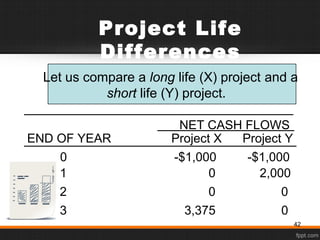
Project Life
Differences
Let us compare a long life (X) project and a
short life (Y) project.
NET CASH FLOWS
Project X Project YEND OF YEAR
0 -$1,000 -$1,000
1 0 2,000
2 0 0
3 3,375 0
42
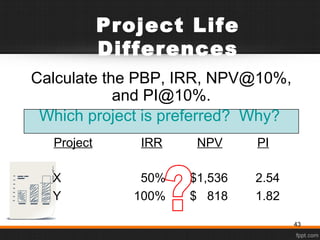
X 50% $1,536 2.54
Y 100% $ 818 1.82
Project Life
Differences
Calculate the PBP, IRR, NPV@10%,
and PI@10%.
Which project is preferred? Why?
Project IRR NPV PI
43
Thank You
44

Chapter 8.Capital Budgeting Techniques

  • 1.
  • 2.
    The Statement ofFinancial Position Illustration 2
  • 3.
  • 4.
    What is Capital Budgeting? The process of identifying, analyzing, and selecting investment projects whose returns (cash flows) are expected to extend beyond one year;  The examples are; a. New products or expansion of existing products; b. Replacement of existing equipment or buildings; c. Research and development; d. Exploration; 4
  • 5.
    The Capital Budgeting Process Generate investment proposals consistent with the firm’s strategic objectives;  Evaluate projected cash flows;  Select projects based on a value-maximizing acceptance criterion;  Reevaluate implemented investment projects continually and perform post audits for completed projects; 5
  • 6.
    Relevant Cost Assumption  Cashflows of a project must be calculated based on relevant costing assumptions;  Relevant cost is a decision specific cost which arises as a direct consequence of decision made; A company produces tires.It can manufacture 1,000 units in a month for a fixed cost of $300,000 and variable cost of $500 per unit. Its current demand is 600 units which it sells at $1,000 per unit. Company B considers to order 200 units of tire at $700 per unit. Should the company accept the order? Solution a)700-(300000/1000+500)=$100 Reject b)Relevant costing assumption (700-500)=$200 Accept 6
  • 7.
    Relevant Cash Flows Basic characteristics of relevant project flows; a. future cash flows; b. incremental flows; c. after-tax flows; d.operating(not financing)flows; 7
  • 8.
    Estimating Cash Flows Principles that must be adhered to in the estimation; a. ignore sunk costs; b. ignore committed costs; c. include opportunity costs; d. include project-driven changes in working capital; e. include effects of inflation; 8
  • 9.
    Calculating Project Cash Flows Initial cash outflow is the initial net cash investment;  Interim incremental net cash flows are those net cash flows occurring after the initial cash investment but not including the final period’s cash flow;  Terminal-year incremental net cash flows are the final period’s net cash flow; 9
  • 10.
    Initial Cash OutflowInitialCash Outflow a)a) Cost ofCost of “new” assets“new” assets b) +Capitalized expenditures c) + (-)Change in NWC d) -Net proceeds from sale of “old” asset(s) if replacement; e) + (-)Taxes (savings) due to the sale of “old” asset(s) if replacement f) =Initial cash=Initial cash outflowoutflow 10
  • 11.
    Incremental Cash FlowsIncrementalCash Flows a)Cash inflow b)-Cash outflow c)Net Change in Operating Income d)-Tax Charge**** ==Incremental net cash flow forIncremental net cash flow for periodperiod Tax Charge=(Cash Inflow-Cash Outflow-Tax Charge=(Cash Inflow-Cash Outflow- Depreciation)x Tax RateDepreciation)x Tax Rate 11
  • 12.
    Terminal-YearTerminal-Year Incremental Cash FlowsIncrementalCash Flows a) Calculate the incremental net cashincremental net cash flowflow for the terminal periodterminal period b) + (-)Salvage value (disposal/reclamation costs) of any sold or disposed assets c) - (+)Taxes (tax savings) due to asset sale or disposal of “new” assets d) + (-)Change in NWC e) == Terminal year incremental netTerminal year incremental net cash flowcash flow 12
  • 13.
    Example of anAssetExample of an Asset Expansion ProjectExpansion Project Basket Wonders (BW) is considering the purchase of a new basket weaving machine. The machine will cost $50,000 plus $20,000 for shipping and installation and falls under the 3-year MACRS class. NWC will rise by $5,000. Lisa Miller forecasts that revenues will increase by $110,000 for each of the next 4 years and will then be sold (scrapped) for $10,000 at the end of the fourth year, when the project ends. Operating costs will rise by $70,000 for each of the next four years. BW is in the 40% tax bracket.(MACRS 33.3,44.45,14.81,7.41) 13
  • 14.
    Initial Cash OutflowInitialCash Outflow a) $50,000 b) + 20,000 c) + 5,000 d) - 0 (not a replacement) e) + (-) 0 (not a replacement) f) == $75,000$75,000 14
  • 15.
    Incremental Cash FlowsIncrementalCash Flows Year 1 Year 2 Year 3 Year 4 a) $40,000 $40,000 $40,000 $40,000 b) - 23,331 31,115 10,367 5,187 c) = $16,669 $ 8,885 $29,633 $34,813 d) - 6,668 3,554 11,853 13,925 e == $33,332 $36,446 $28,147 $26,075$33,332 $36,446 $28,147 $26,075 15
  • 16.
    Terminal-YearTerminal-Year Incremental CashIncremental Cash FlowsFlows a)$26,075$26,075 The incremental cash flowincremental cash flow from the previous slide in Year 4. b) +10,000 Salvage Value. c) - 4,000 .40*($10,000 - 0) Note, the asset is fully depreciated at the end of Year 4. d) + 5,000 NWC - Project ends. e) == $37,075$37,075 Terminal-year incremental cash flow. 16
  • 17.
    Summary of ProjectNetSummary of Project Net Cash FlowsCash Flows Asset Expansion Year 0 Year 1 Year 2 Year 3 Year 4 -$75,000*-$75,000* $33,332 $36,446 $28,147$33,332 $36,446 $28,147 $37,075$37,075 * Notice that this value is a negativenegative cash flow as we calculated it as the initial cash outflow 17
  • 18.
  • 19.
    Project Evaluation: Alternative Methods Payback Period (PBP)  Internal Rate of Return (IRR)  Net Present Value (NPV)  Profitability Index (PI) 19
  • 20.
    Proposed Project Data JulieMiller is evaluating a new project for her firm, Basket Wonders (BW). She has determined that the after-tax cash flows for the project will be $10,000; $12,000; $15,000; $10,000; and $7,000, respectively, for each of the Years 1 through 5. The initial cash outlay will be $40,000. 20
  • 21.
    Independent Project  Forthis project we will assume that it is independent of any other potential projects that Basket Wonders may undertake;  IndependentIndependent project is a project whose acceptance (or rejection) does not prevent the acceptance of other projects under consideration; 21
  • 22.
    Payback Period  Thepayback method of investment appraisal is popular appraisal technique despite of it’s limitations;  It is the time it takes the cash inflows from a capital investment project to equal the cash outflows, usually expressed in years;  In other words payback is the amount of time it takes for cash inflows = cash outflows; 22
  • 23.
    PBPPBP = 3+ ( 3K ) / 10K = 3.3 Years3.3 Years Note: If the required payback time by company is 4 years then the project will be accepted Cumulative Cash Flows -40 K 10 K 12 K 15 K 10 K 7 K 0 1 2 3 4 5 -40 K -30 K -18 K -3 K 7 K 14 K Payback Solution of Example 23
  • 24.
    Payback Period (cont.) Advantages  Simpleto calculate and understand;  It can be used as a screening device as a first stage in eliminating obviously inappropriate projects;  It uses cash flows rather than accounting profits; Disadvantages  It ignores the cash flows after the end of payback period;  It ignores the time value of money;  Unable to distinguish between projects with the same payback period;  It may lead to excessive investment in short-term projects; 24
  • 25.
    Internal Rate ofReturn (IRR) IRR is the discount rate that equates the present value of the future net cash flows from an investment project with the project’s initial cash outflow. CF1 CF2 CFn (1+IRR)1 (1+IRR)2 (1+IRR)n + . . . ++ICO = 25
  • 26.
    $15,000 $10,000 $7,000 IRRSolution $10,000 $12,000 (1+IRR)1 (1+IRR)2 Find the interest rate (IRR) that causes the discounted cash flows to equal $40,000. + + ++$40,000 = (1+IRR)3 (1+IRR)4 (1+IRR)5 26
  • 27.
    IRR Acceptance Criterion The managementof Basket Wonders has determined that the hurdle rate is 13% for projects of this type. Should the project be accepted? No! The firm will receive 11.57% for each dollar invested in this project at a cost of 13%. [ IRR < Hurdle Rate ] 27
  • 28.
    Internal Rate ofReturn Advantages  Accounts for time value of money;  Considers all cash flows;  It uses cash flows rather than accounting profits;  Managers feel more comfortable with a return measure; Disadvantages Multiple IRR problem; Difficulty in project rankings; It may yield contradicting answers with NPV in mutually exclusive projects; 28
  • 29.
    Net Present Value(NPV) NPV is the present value of an investment project’s net cash flows minus the project’s initial cash outflow. CF1 CF2 CFn (1+k)1 (1+k)2 (1+k)n + . . . ++ - ICOICONPV = 29
  • 30.
    Basket Wonders hasdetermined that the appropriate discount rate (k) for this project is 13%. $10,000 $7,000 NPV Solution $10,000 $12,000 $15,000 (1.13)1 (1.13)2 (1.13)3 + + + - $40,000$40,000(1.13)4 (1.13)5 NPVNPV = + 30
  • 31.
    NPV Solution NPVNPV =$10,000(PVIF13%,1) + $12,000(PVIF13%,2) + $15,000(PVIF13%,3) + $10,000(PVIF13%,4) + $ 7,000(PVIF13%,5) - $40,000$40,000 NPVNPV = $10,000(.885) + $12,000(.783) + $15,000(.693) + $10,000(.613) + $ 7,000(.543) - $40,000$40,000 NPVNPV = $8,850 + $9,396 + $10,395 + $6,130 + $3,801 - $40,000$40,000 = - $1,428$1,428 31
  • 32.
    NPV Acceptance Criterion The managementof Basket Wonders has determined that the required rate is 13% for projects of this type. Should this project be accepted? No! The NPV is negative. This means that the project is reducing shareholder wealth. [RejectReject as NPVNPV < 00 ] 32
  • 33.
    NPV Pros and Cons Advantages Accounts for time value of money;  Considers all cash flows;  Reveals the dollar amount that the project will produce; Disadvantages  Project size is not measured;  Difficulty in calculating discount rate;  Over sensitivity to change in rates;  May not include managerial options; 33
  • 34.
    Profitability Index (PI) PIis the ratio of the present value of a project’s future net cash flows to the project’s initial cash outflow. CF1 CF2 CFn (1+k)1 (1+k)2 (1+k)n + . . . ++ ICOICOPI = 34
  • 35.
    PI Acceptance Criterion PIPI =$38,572 / $40,000 = .9643 (Method #1, 13-34) Should this project be accepted? No! The PIPI is less than 1.00. This means that the project is not profitable. [RejectReject as PIPI < 1.001.00 ] 35
  • 36.
    Evaluation Summary Method ProjectComparison Decision PBP 3.3 3.5 Accept IRR 11.47% 13% Reject NPV -$1,424 $0 Reject PI .96 1.00 Reject Basket Wonders Independent Project
  • 37.
    Other Project Relationships  DependeDependentnt-a project whose acceptance depends on the acceptance of one or more other projects;  Mutually ExclusiveMutually Exclusive - a project whose acceptance precludes the acceptance of one or more alternative projects; 37
  • 38.
    Potential Problems Under Mutual ExclusivityRanking of project proposals may create contradictory results; a.scale of investment; b.cash flow pattern; c.project life; 38
  • 39.
    Scale Differences Calculate thePBP, IRR, NPV@10%, and PI@10%. Which project is preferred? Why? Project IRR NPV PI S 100% $ 231 3.31 L 25% $29,132 1.29 39
  • 40.
    Cash Flow Pattern Letus compare a decreasing cash-flow (D) project and an increasing cash-flow (I) project. NET CASH FLOWS Project D Project IEND OF YEAR 0 -$1,200 -$1,200 1 1,000 100 2 500 600 3 100 1,080 40
  • 41.
    D 23% $1981.17$198 1.17 I 17% $198 1.17$198 1.17 Cash Flow Pattern Calculate the IRR, NPV@10%, and PI@10%. Which project is preferred? Project IRR NPV PI 41
  • 42.
    Project Life Differences Let uscompare a long life (X) project and a short life (Y) project. NET CASH FLOWS Project X Project YEND OF YEAR 0 -$1,000 -$1,000 1 0 2,000 2 0 0 3 3,375 0 42
  • 43.
    X 50% $1,5362.54 Y 100% $ 818 1.82 Project Life Differences Calculate the PBP, IRR, NPV@10%, and PI@10%. Which project is preferred? Why? Project IRR NPV PI 43
  • 44.