Somatic Symptom
and Related
Disorders
Zahiruddin Othman
Psychiatry Dept, PPSP USM
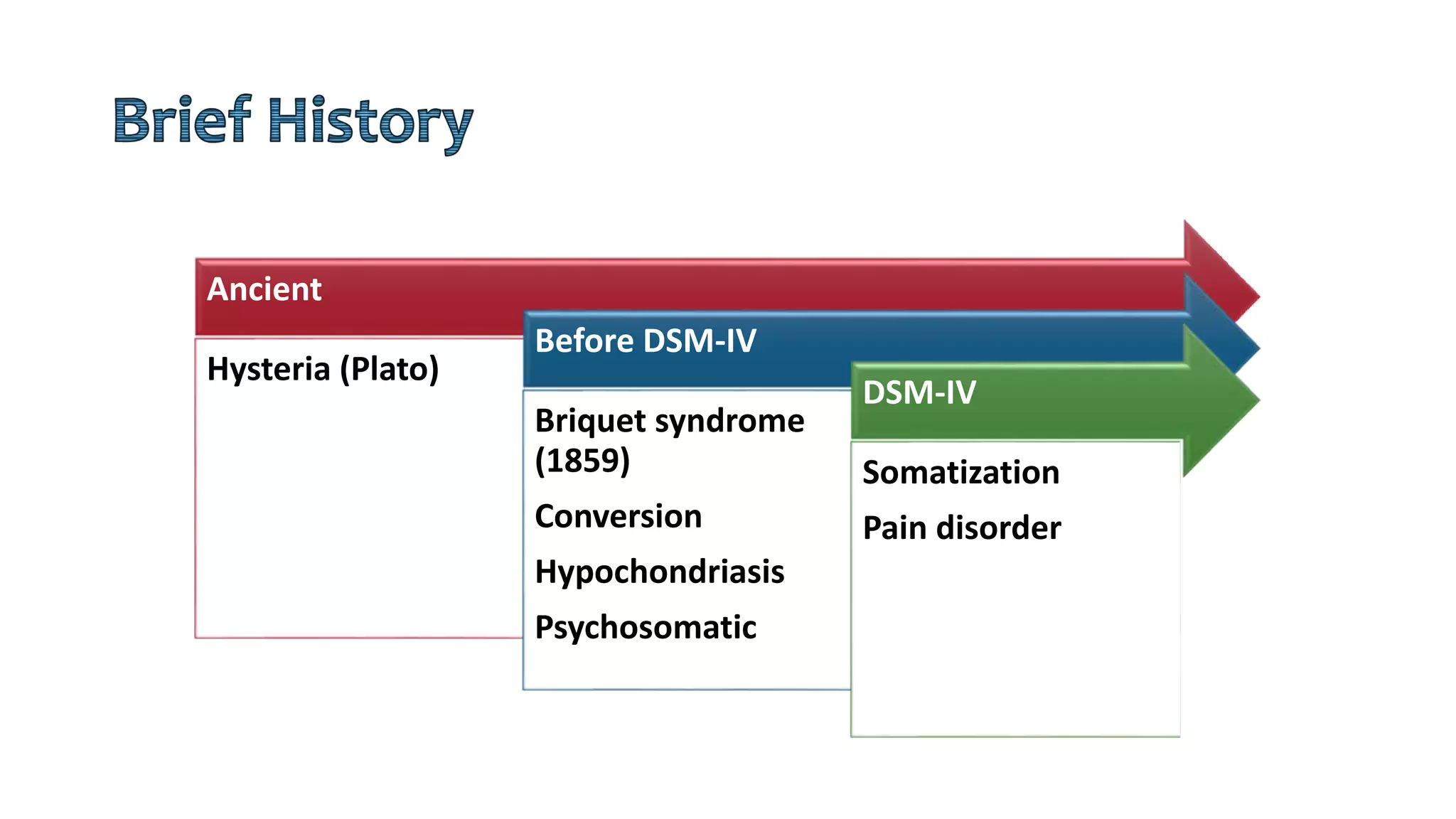
Ancient
Hysteria (Plato)
Before DSM-IV
Briquet syndrome
(1859)
Conversion
Hypochondriasis
Psychosomatic
DSM-IV
Somatization
Pain disorder
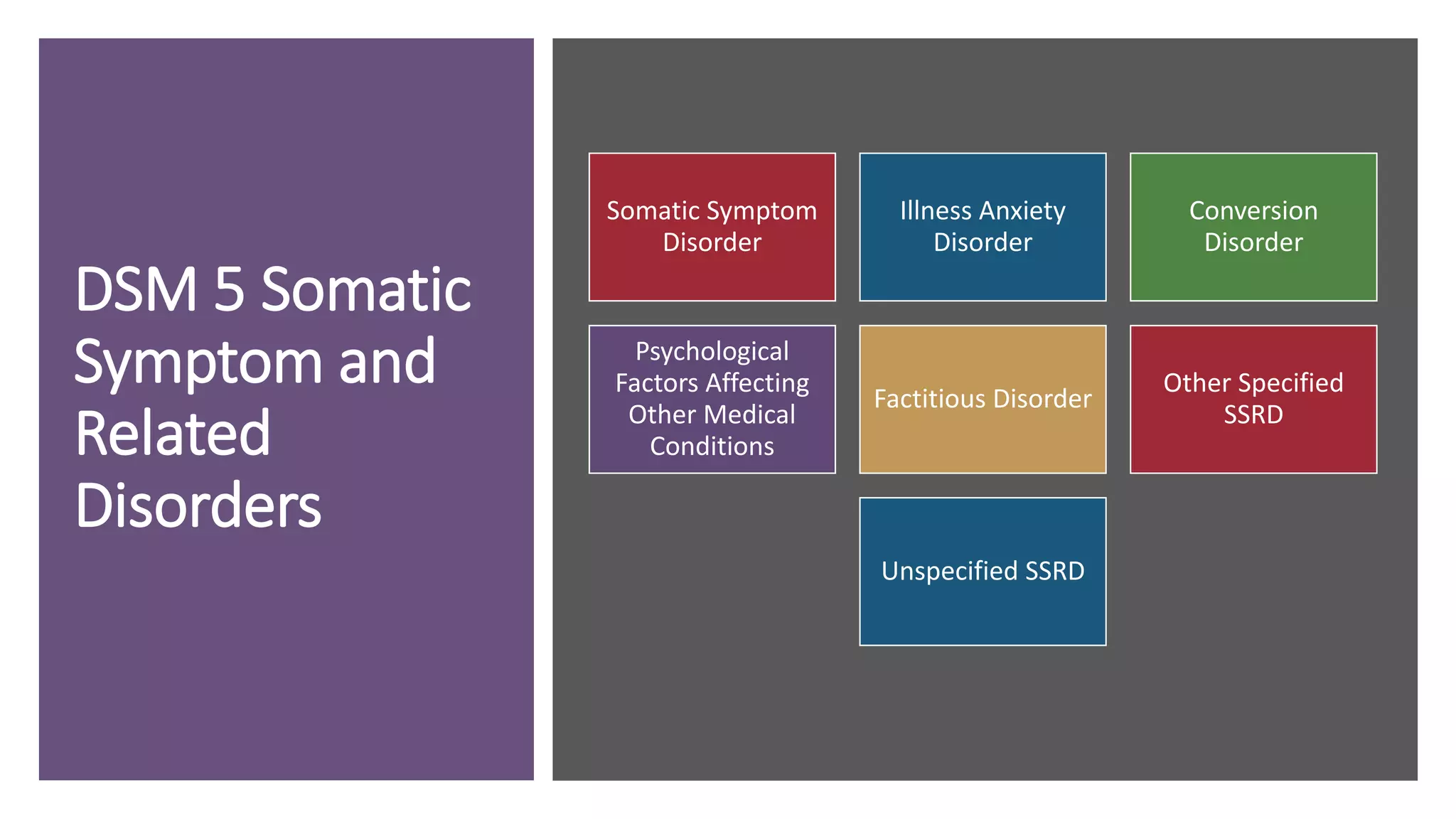
DSM 5 Somatic
Symptom and
Related
Disorders
Somatic Symptom
Disorder
Illness Anxiety
Disorder
Conversion
Disorder
Psychological
Factors Affecting
Other Medical
Conditions
Factitious Disorder
Other Specified
SSRD
Unspecified SSRD
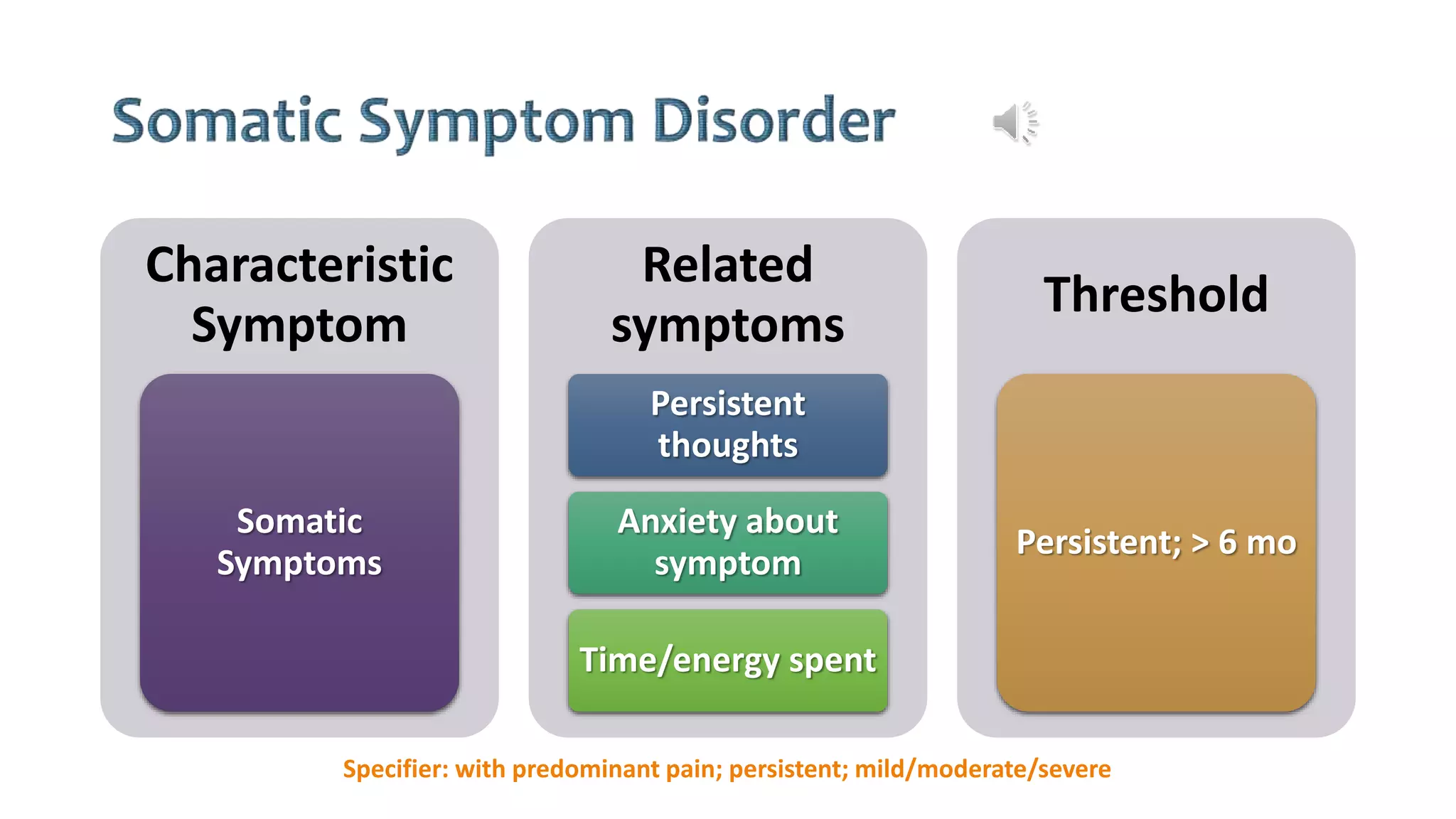
Characteristic
Symptom
Somatic
Symptoms
Related
symptoms
Persistent
thoughts
Anxiety about
symptom
Time/energy spent
Threshold
Persistent; > 6 mo
Specifier: with predominant pain; persistent; mild/moderate/severe
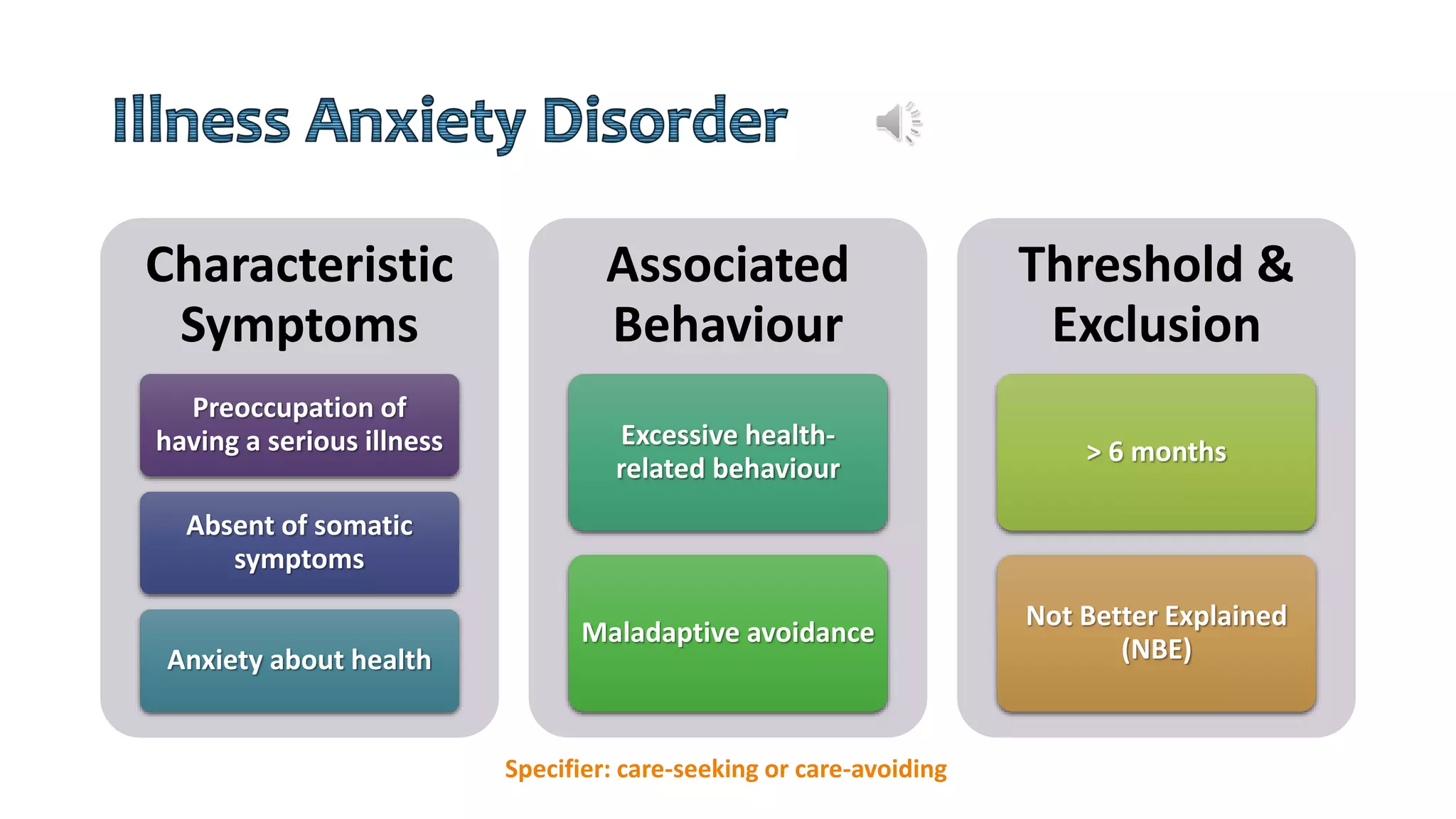
Characteristic
Symptoms
Preoccupation of
having a serious illness
Absent of somatic
symptoms
Anxiety about health
Associated
Behaviour
Excessive health-
related behaviour
Maladaptive avoidance
Threshold &
Exclusion
> 6 months
Not Better Explained
(NBE)
Specifier: care-seeking or care-avoiding
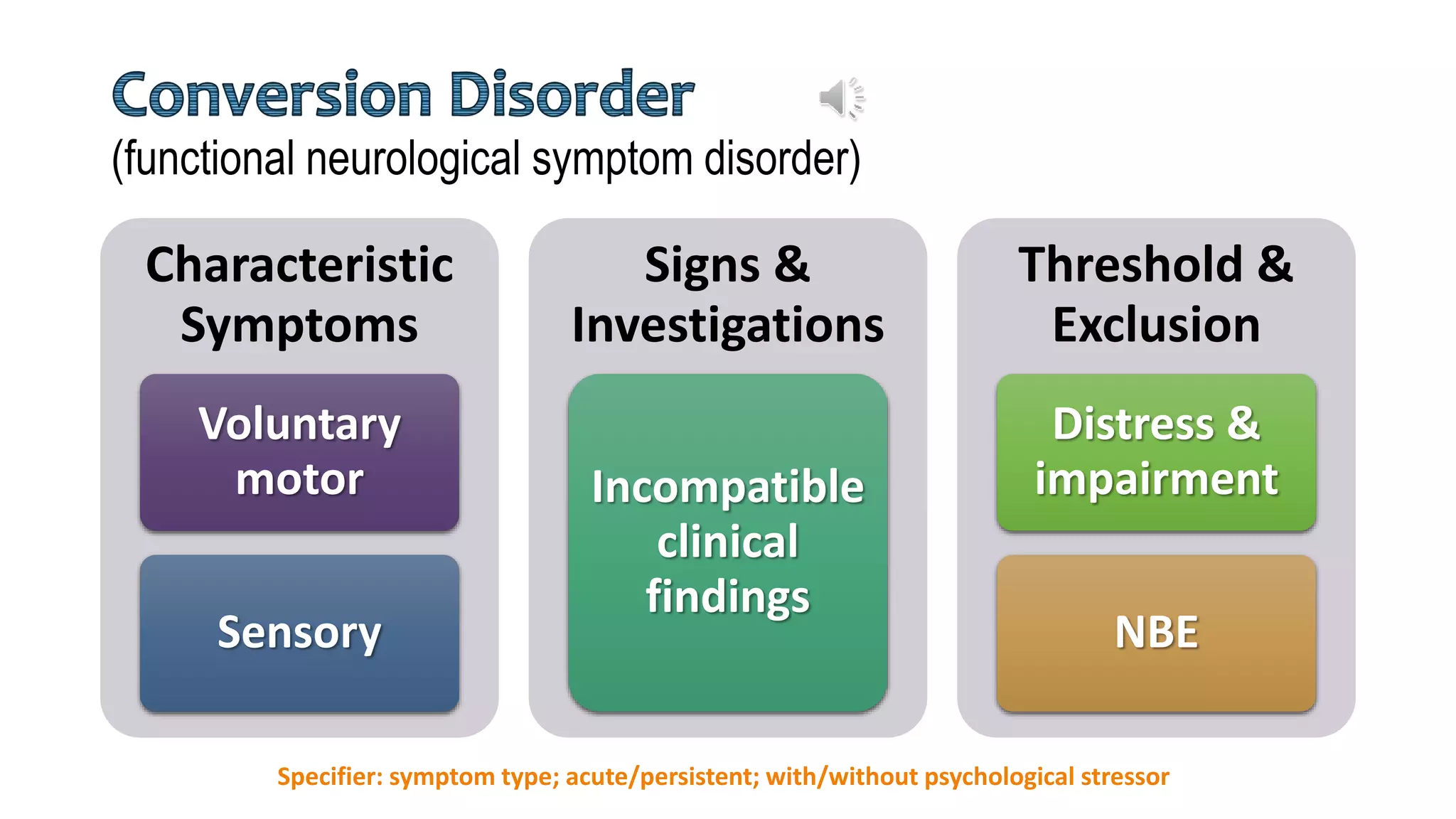
(functional neurological symptom disorder)
Characteristic
Symptoms
Voluntary
motor
Sensory
Signs &
Investigations
Incompatible
clinical
findings
Threshold &
Exclusion
Distress &
impairment
NBE
Specifier: symptom type; acute/persistent; with/without psychological stressor
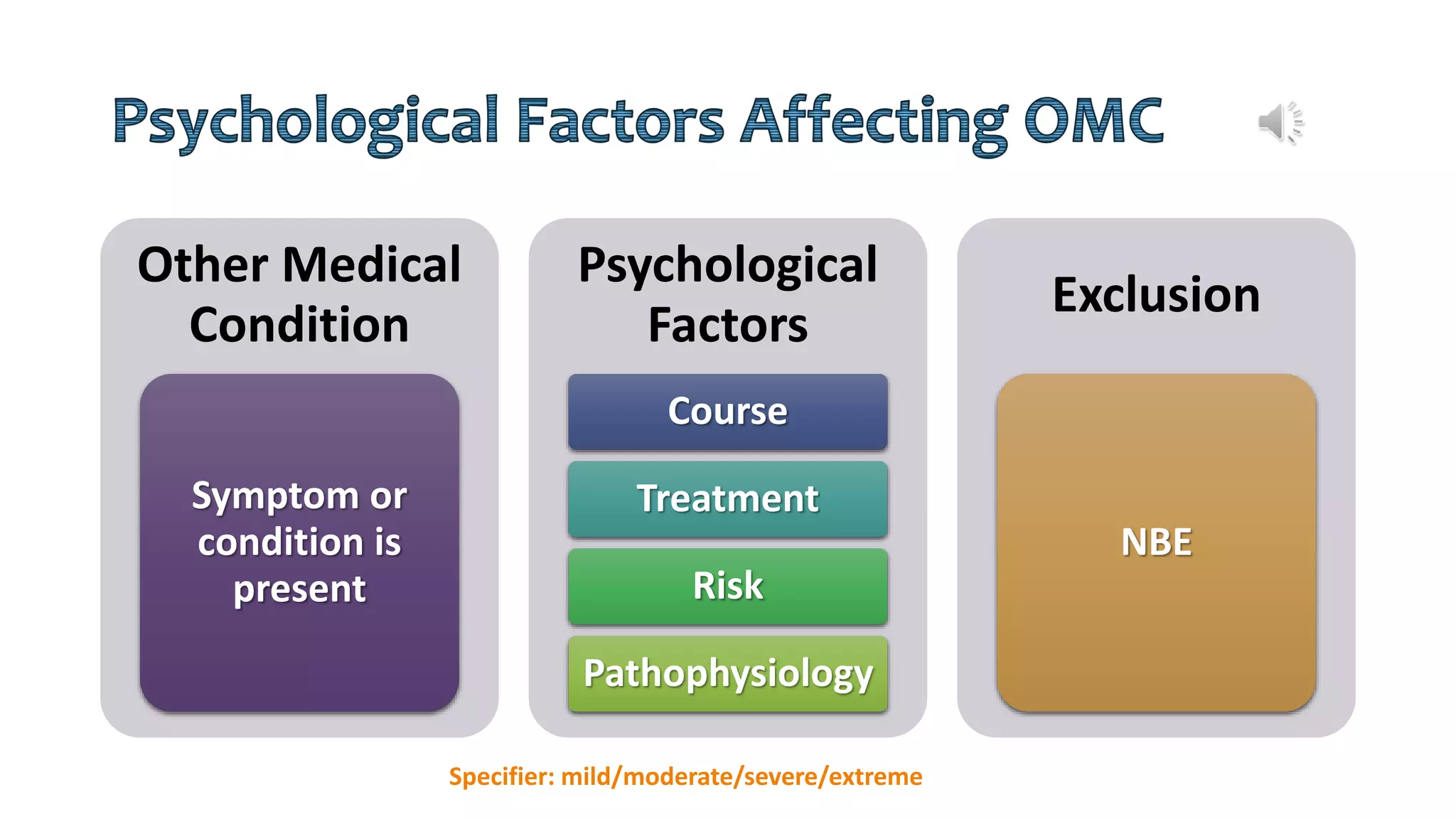
Other Medical
Condition
Symptom or
condition is
present
Psychological
Factors
Course
Treatment
Risk
Pathophysiology
Exclusion
NBE
Specifier: mild/moderate/severe/extreme
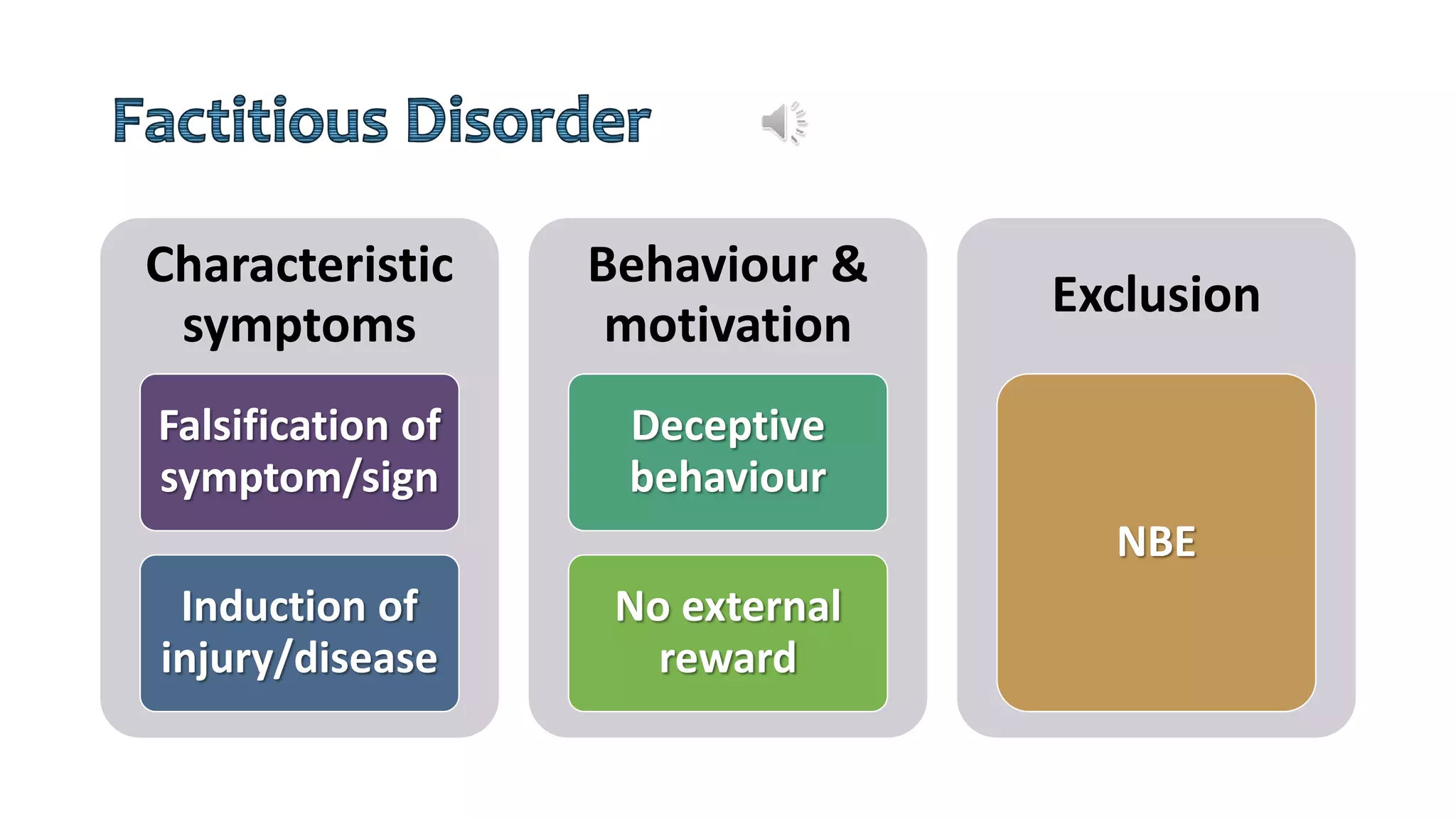
Characteristic
symptoms
Falsification of
symptom/sign
Induction of
injury/disease
Behaviour &
motivation
Deceptive
behaviour
No external
reward
Exclusion
NBE
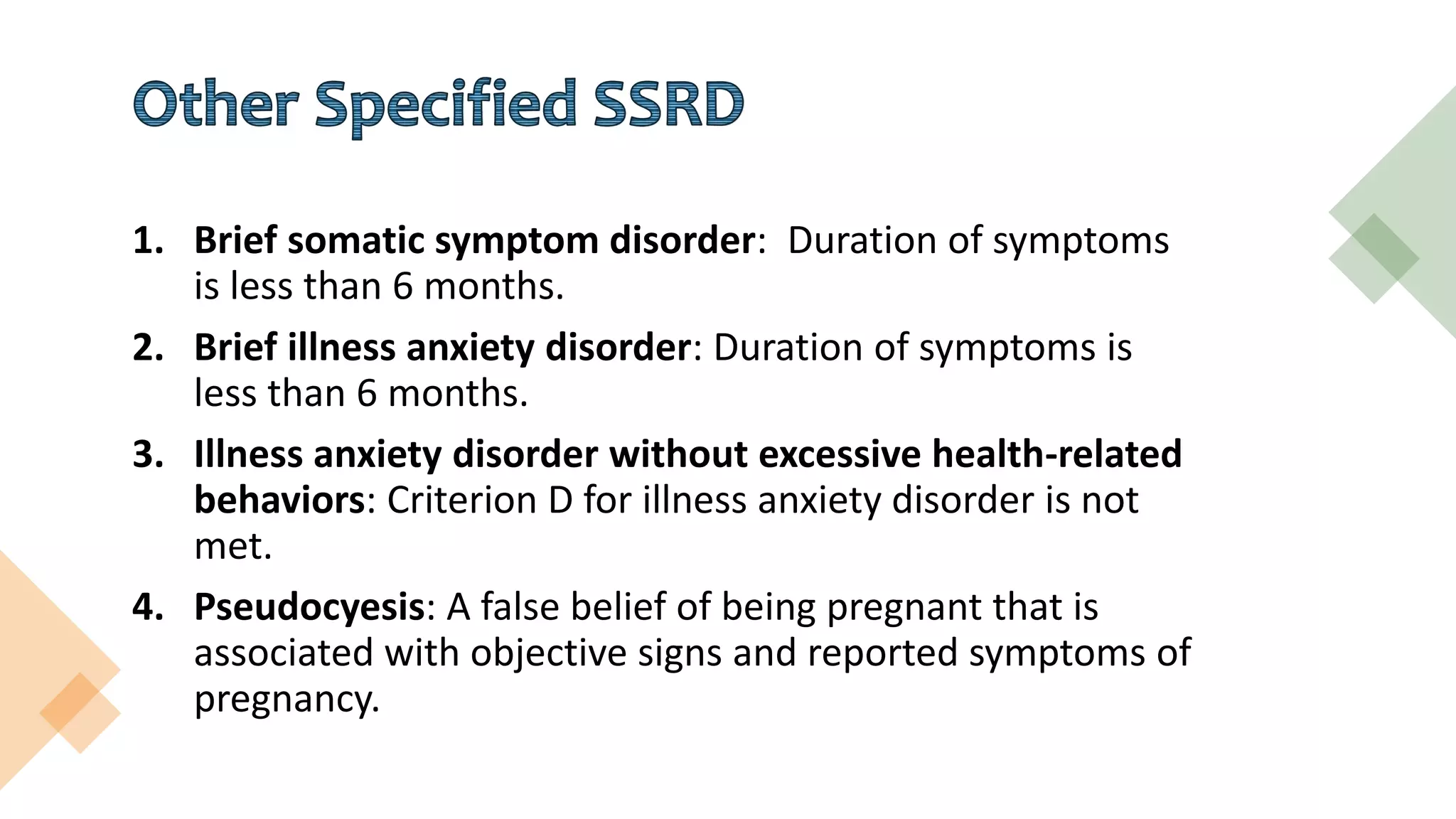
1. Brief somatic symptom disorder: Duration of symptoms
is less than 6 months.
2. Brief illness anxiety disorder: Duration of symptoms is
less than 6 months.
3. Illness anxiety disorder without excessive health-related
behaviors: Criterion D for illness anxiety disorder is not
met.
4. Pseudocyesis: A false belief of being pregnant that is
associated with objective signs and reported symptoms of
pregnancy.
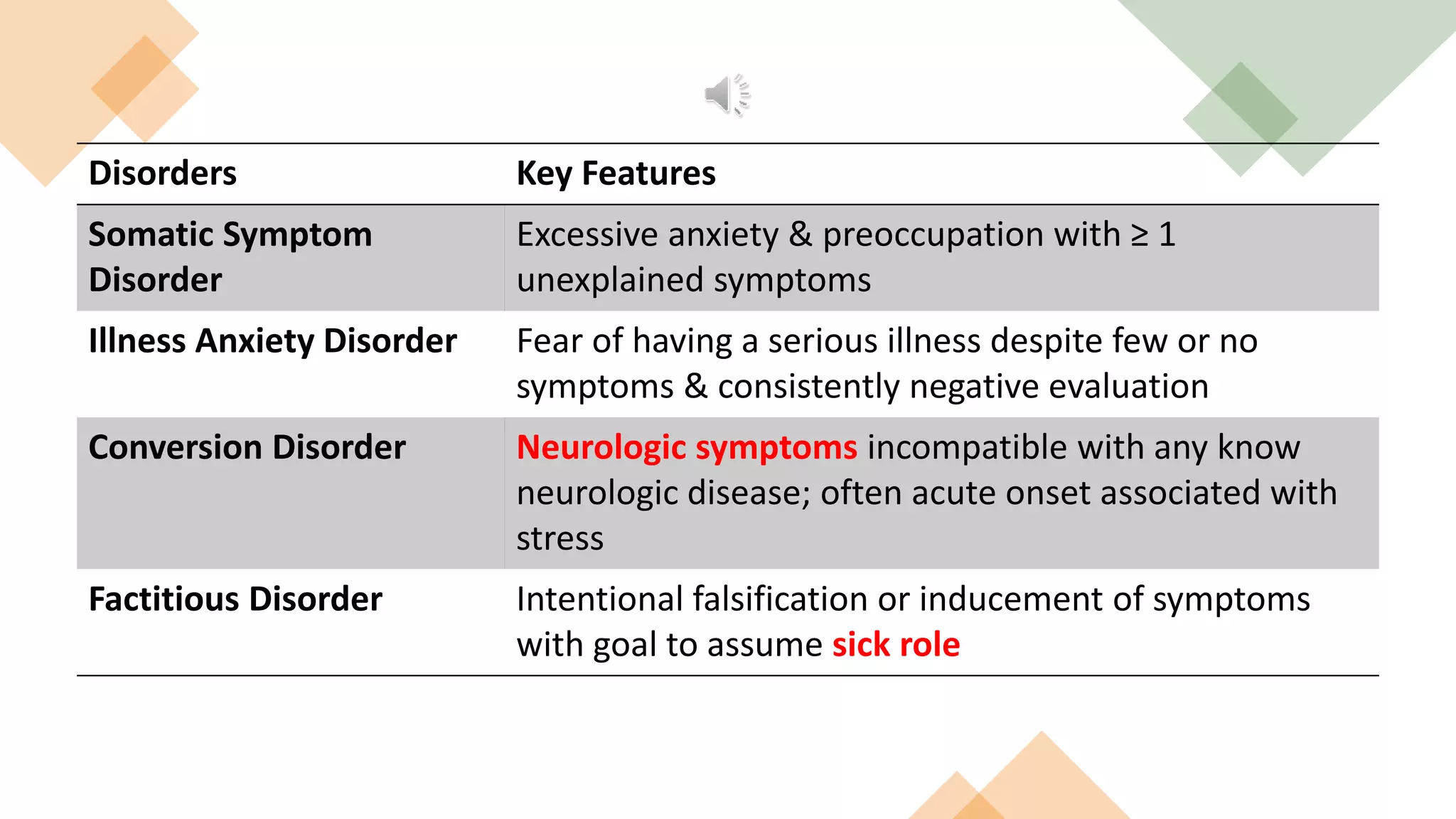
Disorders Key Features
Somatic Symptom
Disorder
Excessive anxiety & preoccupation with ≥ 1
unexplained symptoms
Illness Anxiety Disorder Fear of having a serious illness despite few or no
symptoms & consistently negative evaluation
Conversion Disorder Neurologic symptoms incompatible with any know
neurologic disease; often acute onset associated with
stress
Factitious Disorder Intentional falsification or inducement of symptoms
with goal to assume sick role
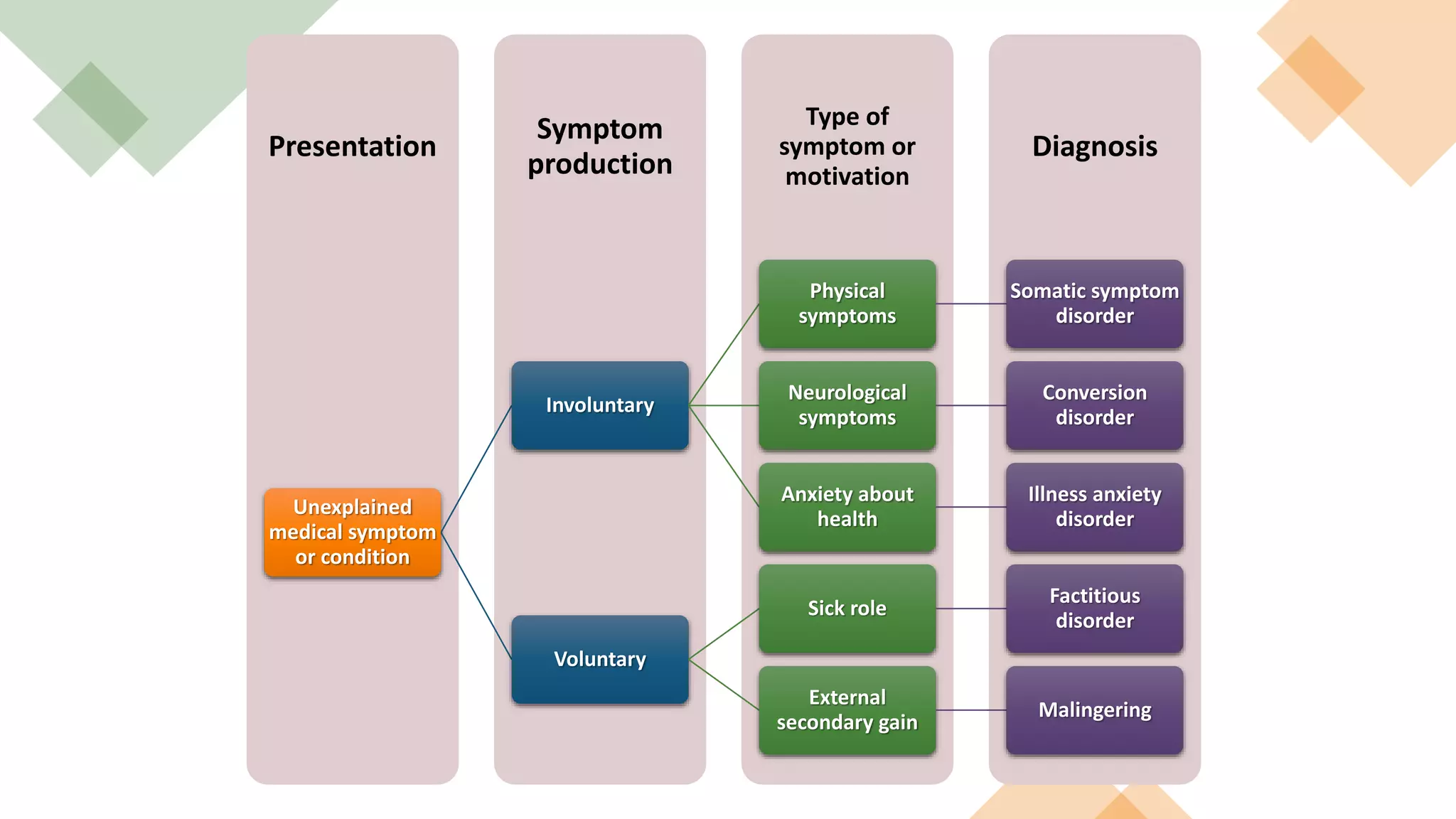
Diagnosis
Type of
symptom or
motivation
Symptom
production
Presentation
Unexplained
medical symptom
or condition
Involuntary
Physical
symptoms
Somatic symptom
disorder
Neurological
symptoms
Conversion
disorder
Anxiety about
health
Illness anxiety
disorder
Voluntary
Sick role
Factitious
disorder
External
secondary gain
Malingering
Involuntary < --------------INTENTION------------- > Voluntary
Malingering
Factitious
Disorder
Compensation
Neurosis
Conversion Disorder
[DSM-5 Functional
Neurological Disorder]
Internal<----MOTIVATION---->External
Malingering is NOT a psychiatric disorder
Exaggeration <-----> Deception
Primarygain<----->Secondarygain
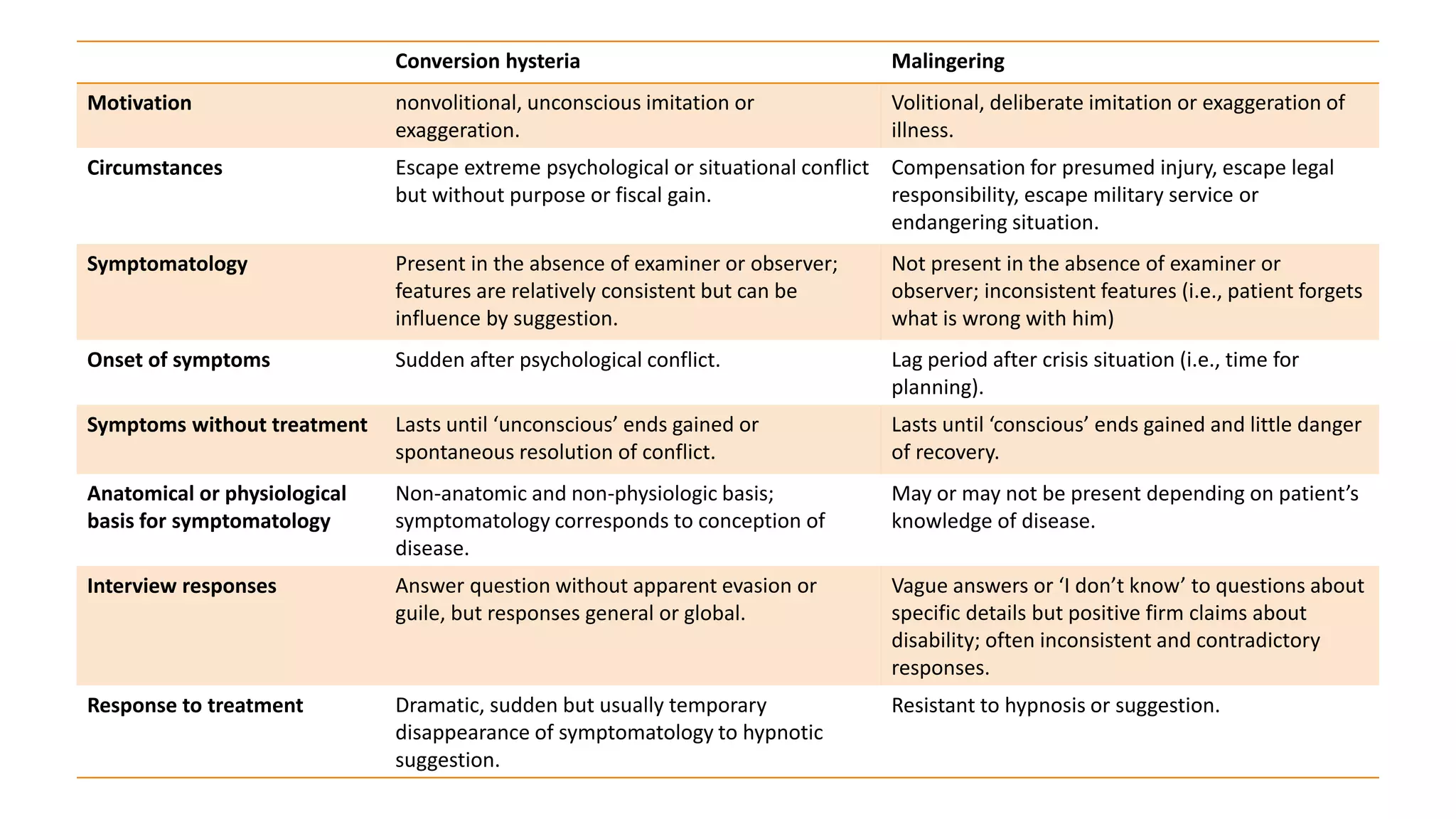
Conversion hysteria Malingering
Motivation nonvolitional, unconscious imitation or
exaggeration.
Volitional, deliberate imitation or exaggeration of
illness.
Circumstances Escape extreme psychological or situational conflict
but without purpose or fiscal gain.
Compensation for presumed injury, escape legal
responsibility, escape military service or
endangering situation.
Symptomatology Present in the absence of examiner or observer;
features are relatively consistent but can be
influence by suggestion.
Not present in the absence of examiner or
observer; inconsistent features (i.e., patient forgets
what is wrong with him)
Onset of symptoms Sudden after psychological conflict. Lag period after crisis situation (i.e., time for
planning).
Symptoms without treatment Lasts until ‘unconscious’ ends gained or
spontaneous resolution of conflict.
Lasts until ‘conscious’ ends gained and little danger
of recovery.
Anatomical or physiological
basis for symptomatology
Non-anatomic and non-physiologic basis;
symptomatology corresponds to conception of
disease.
May or may not be present depending on patient’s
knowledge of disease.
Interview responses Answer question without apparent evasion or
guile, but responses general or global.
Vague answers or ‘I don’t know’ to questions about
specific details but positive firm claims about
disability; often inconsistent and contradictory
responses.
Response to treatment Dramatic, sudden but usually temporary
disappearance of symptomatology to hypnotic
suggestion.
Resistant to hypnosis or suggestion.
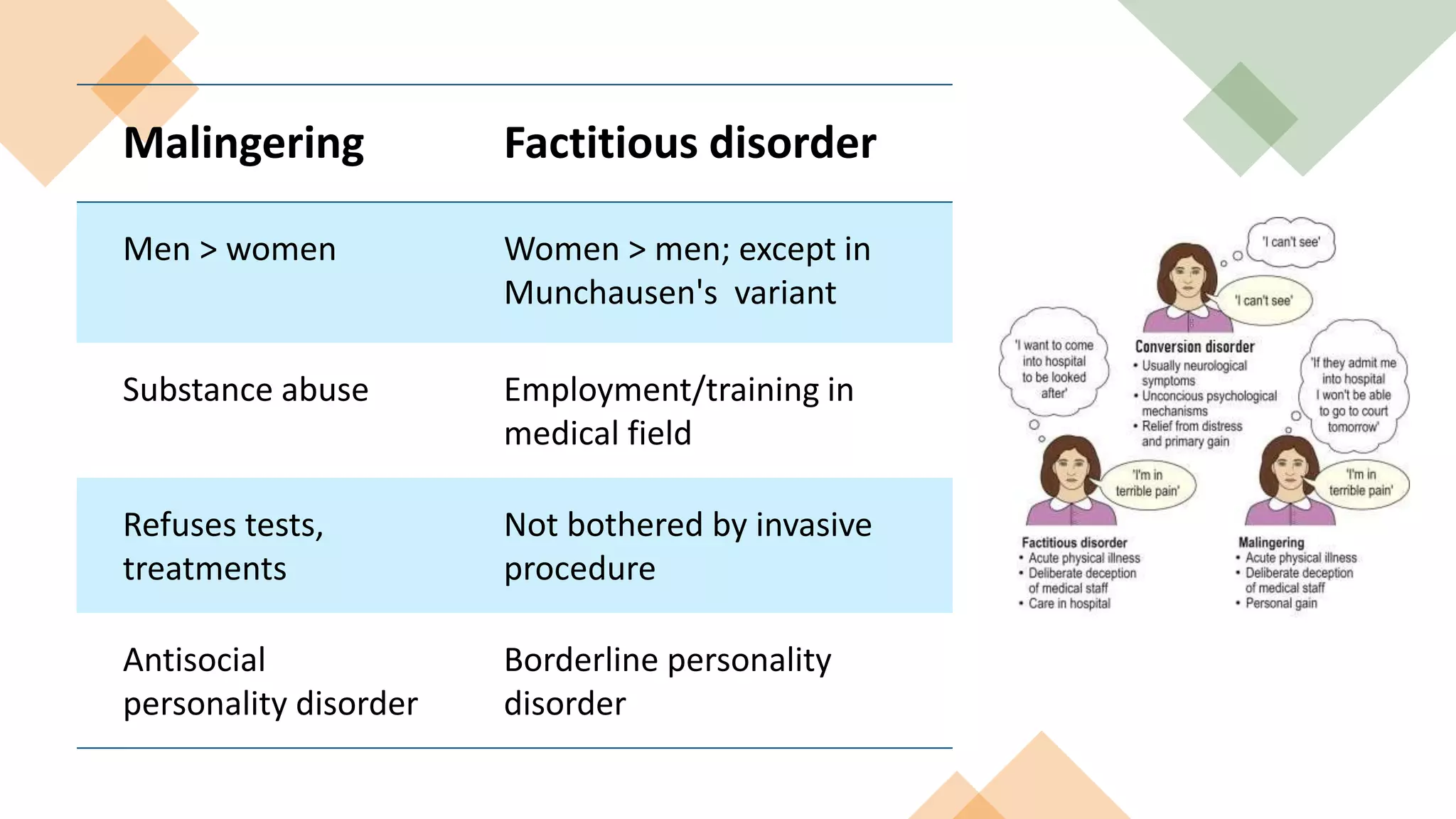
Malingering Factitious disorder
Men > women Women > men; except in
Munchausen's variant
Substance abuse Employment/training in
medical field
Refuses tests,
treatments
Not bothered by invasive
procedure
Antisocial
personality disorder
Borderline personality
disorder
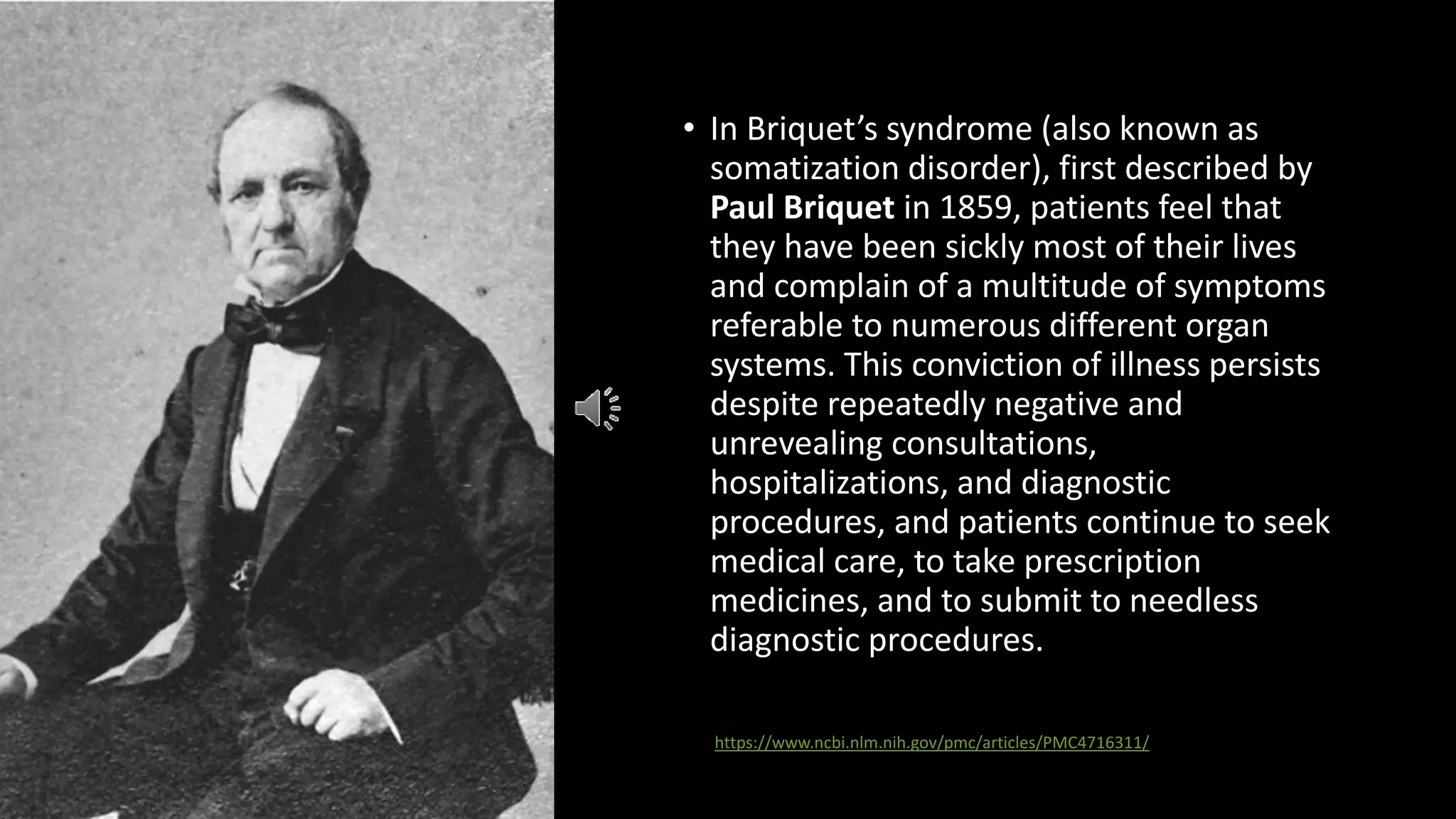
• In Briquet’s syndrome (also known as
somatization disorder), first described by
Paul Briquet in 1859, patients feel that
they have been sickly most of their lives
and complain of a multitude of symptoms
referable to numerous different organ
systems. This conviction of illness persists
despite repeatedly negative and
unrevealing consultations,
hospitalizations, and diagnostic
procedures, and patients continue to seek
medical care, to take prescription
medicines, and to submit to needless
diagnostic procedures.
https://www.ncbi.nlm.nih.gov/pmc/articles/PMC4716311/
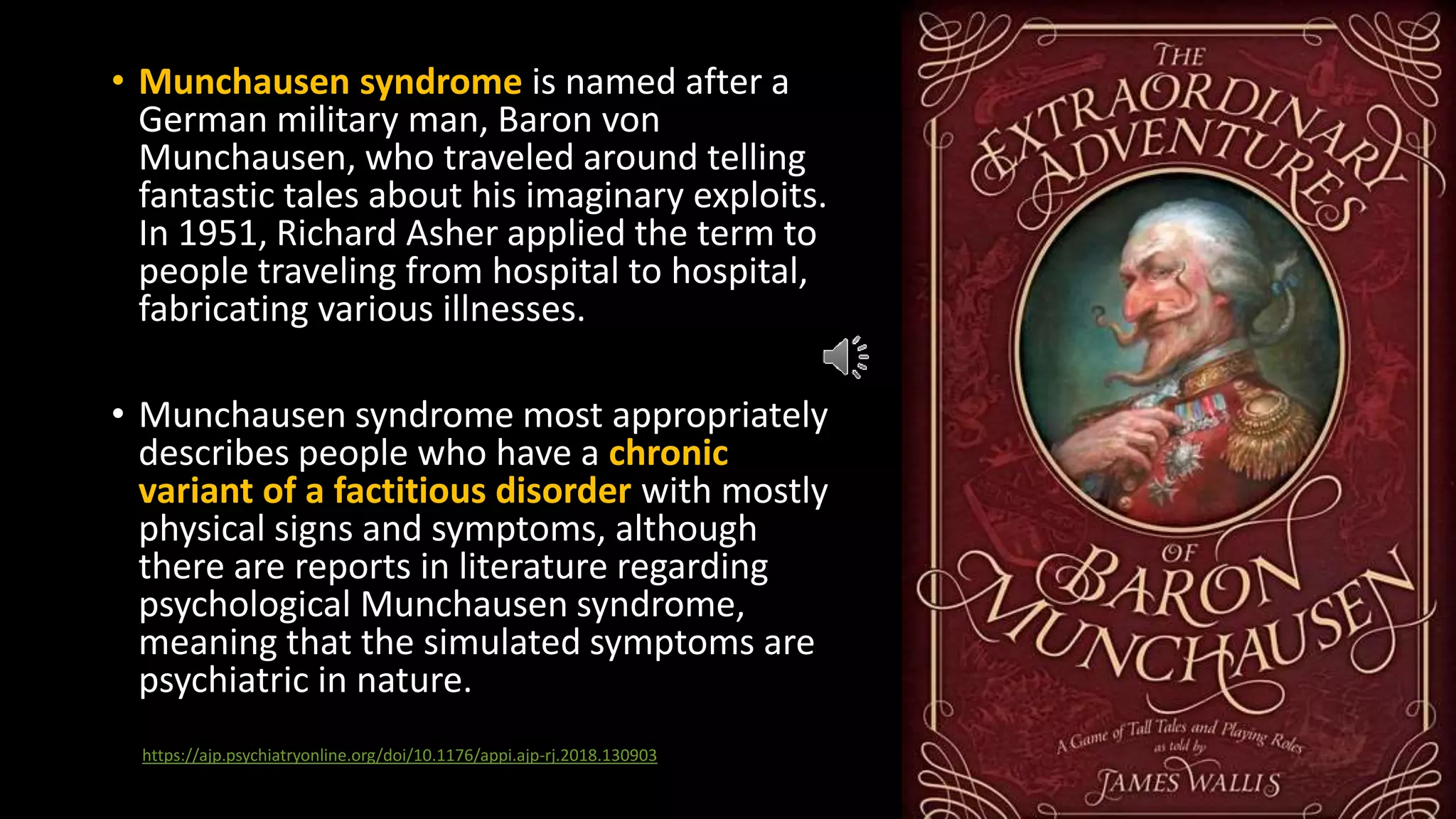
• Munchausen syndrome is named after a
German military man, Baron von
Munchausen, who traveled around telling
fantastic tales about his imaginary exploits.
In 1951, Richard Asher applied the term to
people traveling from hospital to hospital,
fabricating various illnesses.
• Munchausen syndrome most appropriately
describes people who have a chronic
variant of a factitious disorder with mostly
physical signs and symptoms, although
there are reports in literature regarding
psychological Munchausen syndrome,
meaning that the simulated symptoms are
psychiatric in nature.
https://ajp.psychiatryonline.org/doi/10.1176/appi.ajp-rj.2018.130903
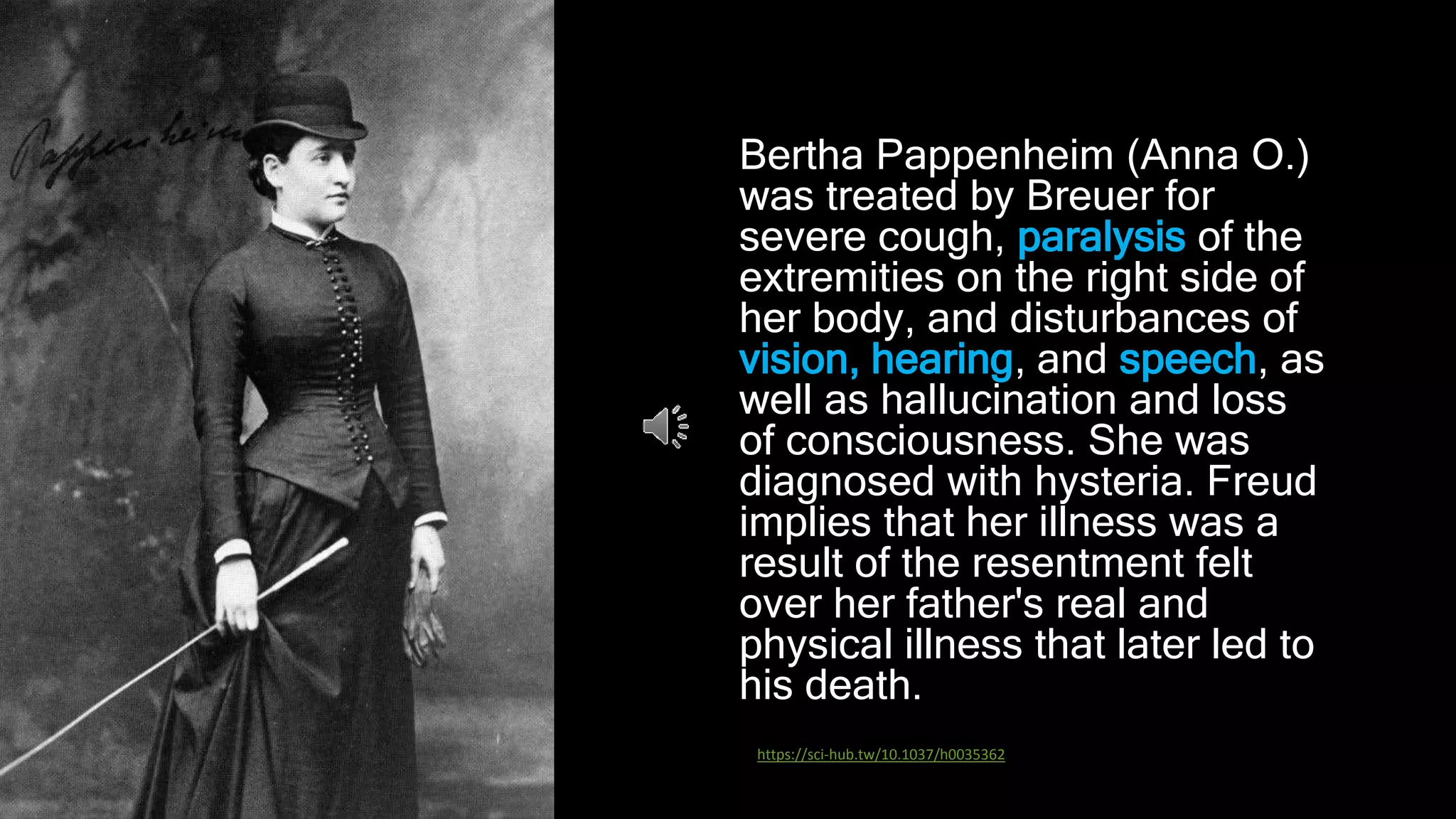
Bertha Pappenheim (Anna O.)
was treated by Breuer for
severe cough, paralysis of the
extremities on the right side of
her body, and disturbances of
vision, hearing, and speech, as
well as hallucination and loss
of consciousness. She was
diagnosed with hysteria. Freud
implies that her illness was a
result of the resentment felt
over her father's real and
physical illness that later led to
his death.
https://sci-hub.tw/10.1037/h0035362
• The Greek word hypokhondria,
literally means “under the cartilage
(of the breastbone).”
• The upper abdomen, it turns out,
was thought to be the seat of
melancholy at a time when the
now-outdated medical theory of
the 4 humors (blood, phlegm,
yellow bile [choler], and black bile
[melancholy]) was accepted as a
basis for legitimate health practice.
• In the 17th century, hypochondriac
referred to people who suffered
from “depression and melancholy
without cause”.
https://doi.org/10.1176/ajp.141.12.1608
Several theories have been postulated regarding the cause
of pseudocyesis, of which the following are widely
accepted.
1. Conflict theory: A desire for or fear of pregnancy
creates an internal conflict and causes endocrine changes
to explain the signs, symptoms and laboratory
findings in pseudocyesis.
2. Wish-fulfillment theory: Minor body changes
initiate the false belief in pregnancy in susceptible
individuals.
3. Depression theory: Pseudocyesis may be initiated by
the neuro-endocrine changes associated with major
depressive disorder

Somatic Symptom and Related Disorders [2020]

  • 1.
    Somatic Symptom and Related Disorders ZahiruddinOthman Psychiatry Dept, PPSP USM
  • 2.
    Ancient Hysteria (Plato) Before DSM-IV Briquetsyndrome (1859) Conversion Hypochondriasis Psychosomatic DSM-IV Somatization Pain disorder
  • 3.
    DSM 5 Somatic Symptomand Related Disorders Somatic Symptom Disorder Illness Anxiety Disorder Conversion Disorder Psychological Factors Affecting Other Medical Conditions Factitious Disorder Other Specified SSRD Unspecified SSRD
  • 4.
  • 5.
    Characteristic Symptoms Preoccupation of having aserious illness Absent of somatic symptoms Anxiety about health Associated Behaviour Excessive health- related behaviour Maladaptive avoidance Threshold & Exclusion > 6 months Not Better Explained (NBE) Specifier: care-seeking or care-avoiding
  • 6.
    (functional neurological symptomdisorder) Characteristic Symptoms Voluntary motor Sensory Signs & Investigations Incompatible clinical findings Threshold & Exclusion Distress & impairment NBE Specifier: symptom type; acute/persistent; with/without psychological stressor
  • 7.
    Other Medical Condition Symptom or conditionis present Psychological Factors Course Treatment Risk Pathophysiology Exclusion NBE Specifier: mild/moderate/severe/extreme
  • 8.
    Characteristic symptoms Falsification of symptom/sign Induction of injury/disease Behaviour& motivation Deceptive behaviour No external reward Exclusion NBE
  • 9.
    1. Brief somaticsymptom disorder: Duration of symptoms is less than 6 months. 2. Brief illness anxiety disorder: Duration of symptoms is less than 6 months. 3. Illness anxiety disorder without excessive health-related behaviors: Criterion D for illness anxiety disorder is not met. 4. Pseudocyesis: A false belief of being pregnant that is associated with objective signs and reported symptoms of pregnancy.
  • 10.
    Disorders Key Features SomaticSymptom Disorder Excessive anxiety & preoccupation with ≥ 1 unexplained symptoms Illness Anxiety Disorder Fear of having a serious illness despite few or no symptoms & consistently negative evaluation Conversion Disorder Neurologic symptoms incompatible with any know neurologic disease; often acute onset associated with stress Factitious Disorder Intentional falsification or inducement of symptoms with goal to assume sick role
  • 11.
    Diagnosis Type of symptom or motivation Symptom production Presentation Unexplained medicalsymptom or condition Involuntary Physical symptoms Somatic symptom disorder Neurological symptoms Conversion disorder Anxiety about health Illness anxiety disorder Voluntary Sick role Factitious disorder External secondary gain Malingering
  • 12.
    Involuntary < --------------INTENTION-------------> Voluntary Malingering Factitious Disorder Compensation Neurosis Conversion Disorder [DSM-5 Functional Neurological Disorder] Internal<----MOTIVATION---->External Malingering is NOT a psychiatric disorder Exaggeration <-----> Deception Primarygain<----->Secondarygain
  • 14.
    Conversion hysteria Malingering Motivationnonvolitional, unconscious imitation or exaggeration. Volitional, deliberate imitation or exaggeration of illness. Circumstances Escape extreme psychological or situational conflict but without purpose or fiscal gain. Compensation for presumed injury, escape legal responsibility, escape military service or endangering situation. Symptomatology Present in the absence of examiner or observer; features are relatively consistent but can be influence by suggestion. Not present in the absence of examiner or observer; inconsistent features (i.e., patient forgets what is wrong with him) Onset of symptoms Sudden after psychological conflict. Lag period after crisis situation (i.e., time for planning). Symptoms without treatment Lasts until ‘unconscious’ ends gained or spontaneous resolution of conflict. Lasts until ‘conscious’ ends gained and little danger of recovery. Anatomical or physiological basis for symptomatology Non-anatomic and non-physiologic basis; symptomatology corresponds to conception of disease. May or may not be present depending on patient’s knowledge of disease. Interview responses Answer question without apparent evasion or guile, but responses general or global. Vague answers or ‘I don’t know’ to questions about specific details but positive firm claims about disability; often inconsistent and contradictory responses. Response to treatment Dramatic, sudden but usually temporary disappearance of symptomatology to hypnotic suggestion. Resistant to hypnosis or suggestion.
  • 15.
    Malingering Factitious disorder Men> women Women > men; except in Munchausen's variant Substance abuse Employment/training in medical field Refuses tests, treatments Not bothered by invasive procedure Antisocial personality disorder Borderline personality disorder
  • 16.
    • In Briquet’ssyndrome (also known as somatization disorder), first described by Paul Briquet in 1859, patients feel that they have been sickly most of their lives and complain of a multitude of symptoms referable to numerous different organ systems. This conviction of illness persists despite repeatedly negative and unrevealing consultations, hospitalizations, and diagnostic procedures, and patients continue to seek medical care, to take prescription medicines, and to submit to needless diagnostic procedures. https://www.ncbi.nlm.nih.gov/pmc/articles/PMC4716311/
  • 17.
    • Munchausen syndromeis named after a German military man, Baron von Munchausen, who traveled around telling fantastic tales about his imaginary exploits. In 1951, Richard Asher applied the term to people traveling from hospital to hospital, fabricating various illnesses. • Munchausen syndrome most appropriately describes people who have a chronic variant of a factitious disorder with mostly physical signs and symptoms, although there are reports in literature regarding psychological Munchausen syndrome, meaning that the simulated symptoms are psychiatric in nature. https://ajp.psychiatryonline.org/doi/10.1176/appi.ajp-rj.2018.130903
  • 18.
    Bertha Pappenheim (AnnaO.) was treated by Breuer for severe cough, paralysis of the extremities on the right side of her body, and disturbances of vision, hearing, and speech, as well as hallucination and loss of consciousness. She was diagnosed with hysteria. Freud implies that her illness was a result of the resentment felt over her father's real and physical illness that later led to his death. https://sci-hub.tw/10.1037/h0035362
  • 19.
    • The Greekword hypokhondria, literally means “under the cartilage (of the breastbone).” • The upper abdomen, it turns out, was thought to be the seat of melancholy at a time when the now-outdated medical theory of the 4 humors (blood, phlegm, yellow bile [choler], and black bile [melancholy]) was accepted as a basis for legitimate health practice. • In the 17th century, hypochondriac referred to people who suffered from “depression and melancholy without cause”. https://doi.org/10.1176/ajp.141.12.1608
  • 20.
    Several theories havebeen postulated regarding the cause of pseudocyesis, of which the following are widely accepted. 1. Conflict theory: A desire for or fear of pregnancy creates an internal conflict and causes endocrine changes to explain the signs, symptoms and laboratory findings in pseudocyesis. 2. Wish-fulfillment theory: Minor body changes initiate the false belief in pregnancy in susceptible individuals. 3. Depression theory: Pseudocyesis may be initiated by the neuro-endocrine changes associated with major depressive disorder