Somatoform DisordersHYACINTH C. MANOOD, M.D., F.P.P.A..
Group of illnesses that have bodily signs and symptoms as a major component;Symptoms are not imaginary;
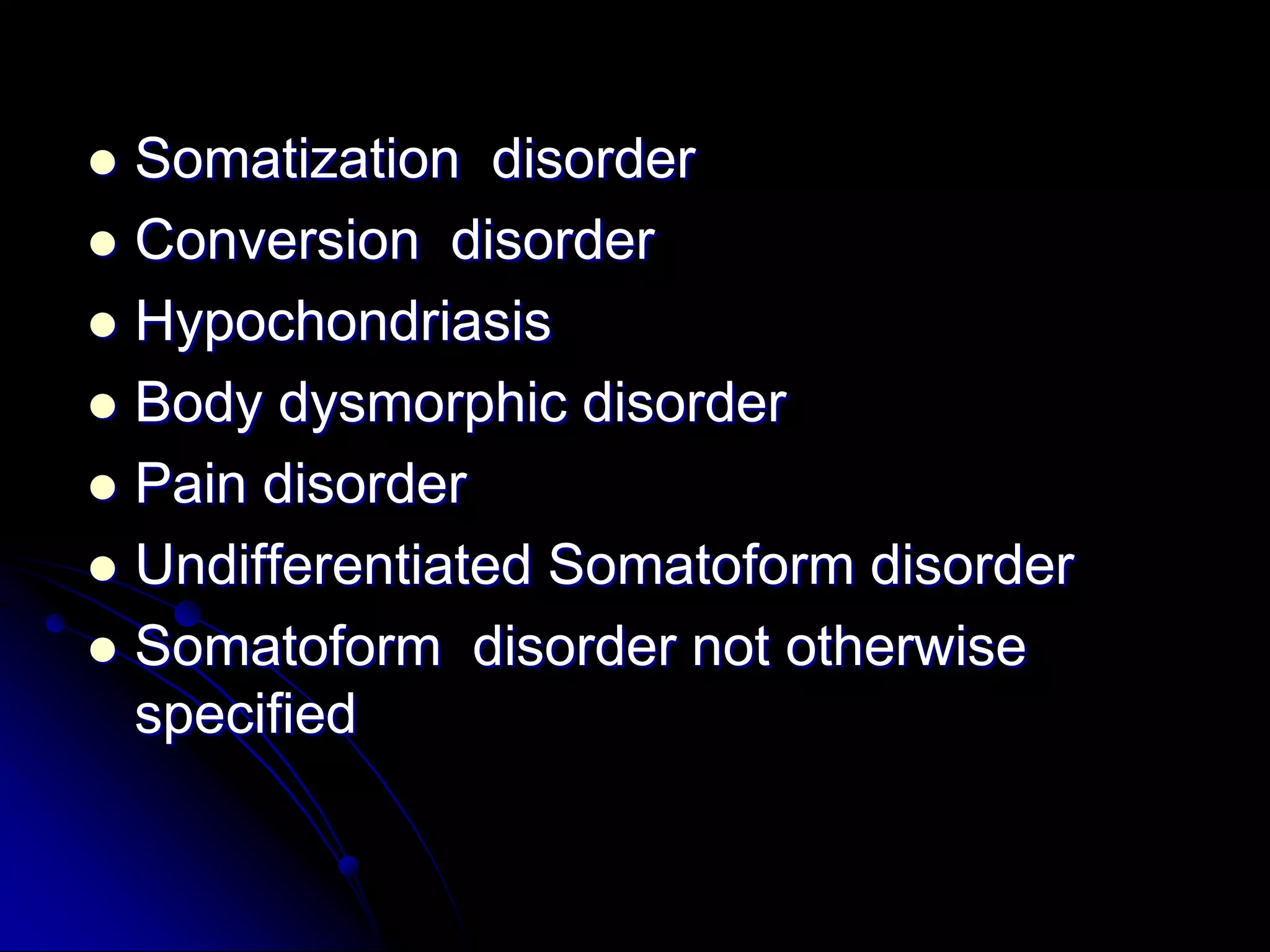
Somatization  disorderConversion  disorderHypochondriasis  Body dysmorphic disorder Pain disorderUndifferentiated Somatoform disorderSomatoform  disorder not otherwise specified
Somatization DisorderCharacterized by multiple somatic  complaints in multiple organ systems that cannot be explained adequately on the basis of physical and laboratory examinations.Chronic; excessive medical-help-seeking behaviors;Briquet’s syndrome
Lifetime prevalence in the general population :0.2 % to 2% in women 0.2 percent in men Women  outnumber men 5 to 20 times ;Asso. With little education and low income
Begins before the age of 304 pain symptoms2 gastrointestinal symptoms1 sexual symptom1 pseudoneurological symptomCause is unknown
ETIOLOGYPSYCHOSOCIAL	Interpretation of symptoms:	a. to avoid obligation	b. to express emotions	c. to symbolize a feeling or belief	- symptoms substitute for repressed instinctual impulses.
BIOLOGICAL FACTORS	- genetic loading	10 – 20% of first degree female relatives	29% concordance rate in monozygotic twins; 10% in dizygotic  twins
CLINICAL FEATURES:Many somatic complaintsLong, complicated medical histories: circumstantial, vague, inconsistent; disorganizedPatients frequently believe that they have been sickly most of their lives.Psychological distress and interpersonal problems are prominent; anxiety and depression are the most prevalent psychiatric conditions  Suicide threats are common
Patients may be perceived as dependent, self-centered, hungry for admiration or praise, and manipulative major depressive disorder, personality disorders, substance-related disorders, generalized anxiety disorder, and phobias Nausea/vomiting, difficulty swallowing, pain in the arms and legs, shortness of breath unrelated to exertion, amnesia, complications of pregnancy and menstruation
chronic, undulating, and relapsing disorder that rarely remits completely;There should be a single identified physician as primary caretaker;Individual  and Group PsychotherapyListen to somatic complaints as emotional expressions rather than medical complaints
Conversion Disordersymptoms or deficits that affect voluntary motor or sensory functions, which suggest another medical condition, but that is judged to be caused by psychological factors because the illness is preceded by conflicts or other stressors. The disturbance does not conform to current concepts  of anatomy and physiology of the CNS and PNS.
not intentionally produced, are not caused by substance use, are not limited to pain or sexual symptoms, and the gain is primarily psychological and not social, monetary, or legal;women to men : 2-10 to 1Symptoms are more common on the left than on the right side of the body in women
Prevalence is variable:	1/3 of general pop – mild symptoms	11 – 500/100.000 pop.	2:1 female – male ratio	In children, higher predominance in girls
Affected males often involved in occupational or military accidents;Onset at anytime; most common in adolescents and young adults
ComorbidityMedical and, especially, neurological disordersDepressive disorders, anxiety disorders, and somatization disordersPersonality disorders: histrionic type & passive-dependent type
ETIOLOGYAccording to psychoanalytic theory, conversion disorder is caused by repression of unconscious intrapsychic conflict and conversion of anxiety into a physical symptom.conflict is between an instinctual impulse (e.g., aggression or sexuality) and the prohibitions against its expression
In terms of conditioned learning theory, a conversion symptom can be seen as a piece of classically conditioned learned behavior; symptoms of illness, learned in childhood, are called forth as a means of coping with an otherwise impossible situation.
hypometabolism of the dominant hemisphere and hypermetabolism of the nondominant hemisphere excessive cortical arousal that sets off negative feedback loops between the cerebral cortex and the brainstem reticular formation
Paralysis, blindness, and mutism are the most common conversion disorder symptoms anesthesia and paresthesia are common, especially of the extremities. Pseudoseizures
Patients achieve primary gain by keeping internal conflicts outside their awareness. tangible advantages and benefits as a result of being sick La belle indifference is a patient's inappropriately cavalier attitude toward serious symptoms
The onset of conversion disorder is usually acute, but a crescendo of symptomatology may also occur;approximately 95 percent of acute cases remit spontaneously, usually within 2 weeks in hospitalized patients Recurrence occurs in one fifth to one fourth of people within 1 year of the first episode
A good prognosis is heralded by acute onset, presence of clearly identifiable stressors at the time of onset, a short interval between onset and the institution of treatment, and above average intelligence. Paralysis, aphonia, and blindness are associated with a good prognosis, whereas tremor and seizures are poor prognostic factors.
Resolution of the conversion disorder symptom is usually spontaneous;Insight-oriented supportive or behavior therapy
Hypochondriasischaracterized  by a  general and nondelusional preoccupation with fears of having, or the idea that one has, a serious disease based on the person's misinterpretation of bodily symptoms
6-month prevalence of 4 to 6% up to 15% in a general medical clinic population Men and women are equally affected most commonly appears in persons 20 to 30 years of age
low thresholds for, and low tolerance of, physical discomfort. viewed as a request for admission to the sick role made by a person facing seemingly insurmountable and insolvable problems. a variant form of other mental disorders, among which depressive disorders and anxiety disorders
Psychodynamic  School of Thought:  	“aggressive and hostile wishes toward others are transferred (through repression and displacement) into physical complaints.”	“also viewed as a defense against guilt, a sense of innate badness, an expression of low self-esteem, and a sign of excessive self-concern.”
CLINICAL FEATURESPatients believe that they have a serious disease that has not yet been detected, and they cannot be persuaded to the contrary. often accompanied by symptoms of depression and anxiety and commonly coexists with a depressive or anxiety disorder.
course is usually episodic;good prognosis is associated with high socioeconomic status, treatment-responsive anxiety or depression, sudden onset of symptoms, the absence of a personality disorder, and the absence of a related non-psychiatric medical condition;
usually resist psychiatric treatment Group psychotherapy often benefits such patients,
Body Dysmorphic Disordercharacterized by a preoccupation with an imagined defect in appearance that causes clinically significant distress or impairment in important areas of functioning. ; concern is excessive and bothersome.a poorly studied condition
most common age of onset is between 15 and 30 yearswomen are affected somewhat more often than men commonly coexists with other mental disorders
may involve serotonin reflecting the displacement of a sexual or emotional conflict onto a nonrelated body part defense mechanisms of repression, dissociation, distortion, symbolization, and projection.
facial flaws, particularly those involving specific parts (e.g., the nose).ideas or frank delusions of reference (usually about persons' noticing the alleged body flaweither excessive mirror checking or avoidance of reflective surfacesattempts to hide the presumed deformity (with makeup or clothing).
usually begins during adolescenceusually has a long and undulating course with few symptom-free intervalsclomipramine (Anafranil) and fluoxetine (Prozac) reduce symptoms in at least 50 percent of patients Augmentation with clomipramine (Anafranil), buspirone (BuSpar), lithium (Eskalith), methylphenidate (Ritalin), or antipsychotics may improve the response rate.
Pain Disordercharacterized by the presence of, and focus on, pain in one or more body sites and is sufficiently severe to come to clinical attention.somatoform pain disorder, psychogenic pain disorder, idiopathic pain disorder, and atypical pain disorder
Lifetime  prevalence is approximately 12%Associated  with other psychiatric disorders, especially affective and anxiety disorders Chronic pain appears to be most frequently associated with depressive disorders, and acute pain appears to be more commonly associated with anxiety disorders.
may be symbolically expressing an intrapsychic conflict through the body.symbolic meaning of body disturbances may also relate to atonement for perceived sin, to expiation of guilt, or to suppressed aggression.displacement, substitution, and repression.
Pain behaviors are reinforced when rewarded and are inhibited when ignored or punished.Intractable pain has been conceptualized as a means for manipulation and gaining advantage in interpersonal relationships, for example, to ensure the devotion of a family member or to stabilize a fragile marriage.
often have long histories of medical and surgical care. completely preoccupied with their pain and cite it as the source of all their miseryMajor depressive disorder is present in about 25 to 50 percent of patients with pain disordergenerally begins abruptly and increases in severity for a few weeks or months.
treatment approach must address rehabilitation. Antidepressants, such as tricyclics and SSRIs, are the most effective pharmacological agents.psychodynamic psychotherapy
Undifferentiated Somatoform Disordercharacterized by one or more unexplained physical symptoms of at least 6 months' duration, which are below the threshold for a diagnosis of somatization disorder autonomic nervous system and  fatigue or weakness. autonomic arousal disorder
Somatoform Disorder Not Otherwise Specifieda residual category for patients who have symptoms suggesting a somatoform disorder, but do not meet the specific diagnostic criteria for other somatoform disorders e.g., pseudocyesis
Pseudocyesis: a false belief of being pregnant that is associated with objective signs of pregnancy, which may include abdominal enlargement (although the umbilicus does not become everted), reduced menstrual flow, amenorrhea, subjective sensation of fetal movement, nausea, breast engorgement and secretions, and labor pains at the expected date of delivery.

Somatoform disorders,PSYCH II

  • 1.
    Somatoform DisordersHYACINTH C.MANOOD, M.D., F.P.P.A..
  • 2.
    Group of illnessesthat have bodily signs and symptoms as a major component;Symptoms are not imaginary;
  • 3.
    Somatization disorderConversion disorderHypochondriasis Body dysmorphic disorder Pain disorderUndifferentiated Somatoform disorderSomatoform disorder not otherwise specified
  • 4.
    Somatization DisorderCharacterized bymultiple somatic complaints in multiple organ systems that cannot be explained adequately on the basis of physical and laboratory examinations.Chronic; excessive medical-help-seeking behaviors;Briquet’s syndrome
  • 5.
    Lifetime prevalence inthe general population :0.2 % to 2% in women 0.2 percent in men Women outnumber men 5 to 20 times ;Asso. With little education and low income
  • 6.
    Begins before theage of 304 pain symptoms2 gastrointestinal symptoms1 sexual symptom1 pseudoneurological symptomCause is unknown
  • 7.
    ETIOLOGYPSYCHOSOCIAL Interpretation of symptoms: a.to avoid obligation b. to express emotions c. to symbolize a feeling or belief - symptoms substitute for repressed instinctual impulses.
  • 8.
    BIOLOGICAL FACTORS - geneticloading 10 – 20% of first degree female relatives 29% concordance rate in monozygotic twins; 10% in dizygotic twins
  • 9.
    CLINICAL FEATURES:Many somaticcomplaintsLong, complicated medical histories: circumstantial, vague, inconsistent; disorganizedPatients frequently believe that they have been sickly most of their lives.Psychological distress and interpersonal problems are prominent; anxiety and depression are the most prevalent psychiatric conditions Suicide threats are common
  • 10.
    Patients may beperceived as dependent, self-centered, hungry for admiration or praise, and manipulative major depressive disorder, personality disorders, substance-related disorders, generalized anxiety disorder, and phobias Nausea/vomiting, difficulty swallowing, pain in the arms and legs, shortness of breath unrelated to exertion, amnesia, complications of pregnancy and menstruation
  • 11.
    chronic, undulating, andrelapsing disorder that rarely remits completely;There should be a single identified physician as primary caretaker;Individual and Group PsychotherapyListen to somatic complaints as emotional expressions rather than medical complaints
  • 12.
    Conversion Disordersymptoms ordeficits that affect voluntary motor or sensory functions, which suggest another medical condition, but that is judged to be caused by psychological factors because the illness is preceded by conflicts or other stressors. The disturbance does not conform to current concepts of anatomy and physiology of the CNS and PNS.
  • 13.
    not intentionally produced,are not caused by substance use, are not limited to pain or sexual symptoms, and the gain is primarily psychological and not social, monetary, or legal;women to men : 2-10 to 1Symptoms are more common on the left than on the right side of the body in women
  • 14.
    Prevalence is variable: 1/3of general pop – mild symptoms 11 – 500/100.000 pop. 2:1 female – male ratio In children, higher predominance in girls
  • 15.
    Affected males ofteninvolved in occupational or military accidents;Onset at anytime; most common in adolescents and young adults
  • 16.
    ComorbidityMedical and, especially,neurological disordersDepressive disorders, anxiety disorders, and somatization disordersPersonality disorders: histrionic type & passive-dependent type
  • 17.
    ETIOLOGYAccording to psychoanalytictheory, conversion disorder is caused by repression of unconscious intrapsychic conflict and conversion of anxiety into a physical symptom.conflict is between an instinctual impulse (e.g., aggression or sexuality) and the prohibitions against its expression
  • 18.
    In terms ofconditioned learning theory, a conversion symptom can be seen as a piece of classically conditioned learned behavior; symptoms of illness, learned in childhood, are called forth as a means of coping with an otherwise impossible situation.
  • 19.
    hypometabolism of thedominant hemisphere and hypermetabolism of the nondominant hemisphere excessive cortical arousal that sets off negative feedback loops between the cerebral cortex and the brainstem reticular formation
  • 20.
    Paralysis, blindness, andmutism are the most common conversion disorder symptoms anesthesia and paresthesia are common, especially of the extremities. Pseudoseizures
  • 21.
    Patients achieve primarygain by keeping internal conflicts outside their awareness. tangible advantages and benefits as a result of being sick La belle indifference is a patient's inappropriately cavalier attitude toward serious symptoms
  • 22.
    The onset ofconversion disorder is usually acute, but a crescendo of symptomatology may also occur;approximately 95 percent of acute cases remit spontaneously, usually within 2 weeks in hospitalized patients Recurrence occurs in one fifth to one fourth of people within 1 year of the first episode
  • 23.
    A good prognosisis heralded by acute onset, presence of clearly identifiable stressors at the time of onset, a short interval between onset and the institution of treatment, and above average intelligence. Paralysis, aphonia, and blindness are associated with a good prognosis, whereas tremor and seizures are poor prognostic factors.
  • 24.
    Resolution of theconversion disorder symptom is usually spontaneous;Insight-oriented supportive or behavior therapy
  • 25.
    Hypochondriasischaracterized bya general and nondelusional preoccupation with fears of having, or the idea that one has, a serious disease based on the person's misinterpretation of bodily symptoms
  • 26.
    6-month prevalence of4 to 6% up to 15% in a general medical clinic population Men and women are equally affected most commonly appears in persons 20 to 30 years of age
  • 27.
    low thresholds for,and low tolerance of, physical discomfort. viewed as a request for admission to the sick role made by a person facing seemingly insurmountable and insolvable problems. a variant form of other mental disorders, among which depressive disorders and anxiety disorders
  • 28.
    Psychodynamic Schoolof Thought: “aggressive and hostile wishes toward others are transferred (through repression and displacement) into physical complaints.” “also viewed as a defense against guilt, a sense of innate badness, an expression of low self-esteem, and a sign of excessive self-concern.”
  • 29.
    CLINICAL FEATURESPatients believethat they have a serious disease that has not yet been detected, and they cannot be persuaded to the contrary. often accompanied by symptoms of depression and anxiety and commonly coexists with a depressive or anxiety disorder.
  • 30.
    course is usuallyepisodic;good prognosis is associated with high socioeconomic status, treatment-responsive anxiety or depression, sudden onset of symptoms, the absence of a personality disorder, and the absence of a related non-psychiatric medical condition;
  • 31.
    usually resist psychiatrictreatment Group psychotherapy often benefits such patients,
  • 32.
    Body Dysmorphic Disordercharacterizedby a preoccupation with an imagined defect in appearance that causes clinically significant distress or impairment in important areas of functioning. ; concern is excessive and bothersome.a poorly studied condition
  • 33.
    most common ageof onset is between 15 and 30 yearswomen are affected somewhat more often than men commonly coexists with other mental disorders
  • 34.
    may involve serotoninreflecting the displacement of a sexual or emotional conflict onto a nonrelated body part defense mechanisms of repression, dissociation, distortion, symbolization, and projection.
  • 35.
    facial flaws, particularlythose involving specific parts (e.g., the nose).ideas or frank delusions of reference (usually about persons' noticing the alleged body flaweither excessive mirror checking or avoidance of reflective surfacesattempts to hide the presumed deformity (with makeup or clothing).
  • 36.
    usually begins duringadolescenceusually has a long and undulating course with few symptom-free intervalsclomipramine (Anafranil) and fluoxetine (Prozac) reduce symptoms in at least 50 percent of patients Augmentation with clomipramine (Anafranil), buspirone (BuSpar), lithium (Eskalith), methylphenidate (Ritalin), or antipsychotics may improve the response rate.
  • 37.
    Pain Disordercharacterized bythe presence of, and focus on, pain in one or more body sites and is sufficiently severe to come to clinical attention.somatoform pain disorder, psychogenic pain disorder, idiopathic pain disorder, and atypical pain disorder
  • 38.
    Lifetime prevalenceis approximately 12%Associated with other psychiatric disorders, especially affective and anxiety disorders Chronic pain appears to be most frequently associated with depressive disorders, and acute pain appears to be more commonly associated with anxiety disorders.
  • 39.
    may be symbolicallyexpressing an intrapsychic conflict through the body.symbolic meaning of body disturbances may also relate to atonement for perceived sin, to expiation of guilt, or to suppressed aggression.displacement, substitution, and repression.
  • 40.
    Pain behaviors arereinforced when rewarded and are inhibited when ignored or punished.Intractable pain has been conceptualized as a means for manipulation and gaining advantage in interpersonal relationships, for example, to ensure the devotion of a family member or to stabilize a fragile marriage.
  • 41.
    often have longhistories of medical and surgical care. completely preoccupied with their pain and cite it as the source of all their miseryMajor depressive disorder is present in about 25 to 50 percent of patients with pain disordergenerally begins abruptly and increases in severity for a few weeks or months.
  • 42.
    treatment approach mustaddress rehabilitation. Antidepressants, such as tricyclics and SSRIs, are the most effective pharmacological agents.psychodynamic psychotherapy
  • 43.
    Undifferentiated Somatoform Disordercharacterizedby one or more unexplained physical symptoms of at least 6 months' duration, which are below the threshold for a diagnosis of somatization disorder autonomic nervous system and fatigue or weakness. autonomic arousal disorder
  • 44.
    Somatoform Disorder NotOtherwise Specifieda residual category for patients who have symptoms suggesting a somatoform disorder, but do not meet the specific diagnostic criteria for other somatoform disorders e.g., pseudocyesis
  • 45.
    Pseudocyesis: a falsebelief of being pregnant that is associated with objective signs of pregnancy, which may include abdominal enlargement (although the umbilicus does not become everted), reduced menstrual flow, amenorrhea, subjective sensation of fetal movement, nausea, breast engorgement and secretions, and labor pains at the expected date of delivery.