1 
Biological Nutrient Removal Applications for Monitoring ORP
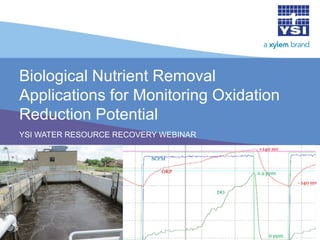
Biological Nutrient Removal Applications for Monitoring Oxidation Reduction Potential 
YSI WATER RESOURCE RECOVERY WEBINAR 
2
Today’s Topics 
• 
The Science of ORP (oxidation reduction potential) or Redox 
• 
Putting ORP to Use 
• 
Applications 
• 
Sensor Care and Parting Thoughts 
3
The Science of ORP 
4
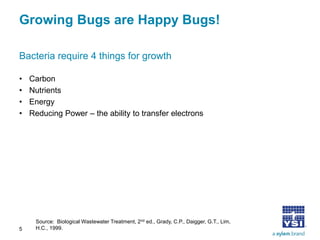
Growing Bugs are Happy Bugs! 
• 
Carbon 
• 
Nutrients 
• 
Energy 
• 
Reducing Power – the ability to transfer electrons 
Bacteria require 4 things for growth 
5 
Source: Biological Wastewater Treatment, 2nd ed., Grady, C.P., Daigger, G.T., Lim, H.C., 1999.
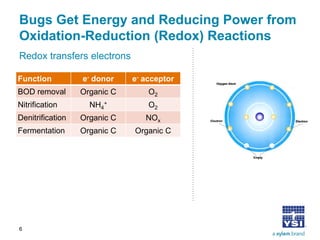
Bugs Get Energy and Reducing Power from Oxidation-Reduction (Redox) Reactions 
Redox transfers electrons 
Function 
e- donor 
e- acceptor 
BOD removal 
Organic C 
O2 
Nitrification 
NH4+ 
O2 
Denitrification 
Organic C 
NOx 
Fermentation 
Organic C 
Organic C 
6
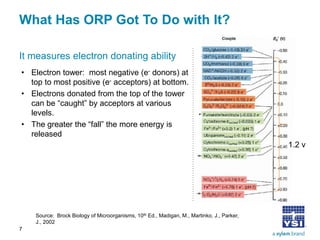
What Has ORP Got To Do with It? 
It measures electron donating ability 
• 
Electron tower: most negative (e- donors) at top to most positive (e- acceptors) at bottom. 
• 
Electrons donated from the top of the tower can be “caught” by acceptors at various levels. 
• 
The greater the “fall” the more energy is released 
7 
1.2 v 
Source: Brock Biology of Microorganisms, 10th Ed., Madigan, M., Martinko, J., Parker, J., 2002
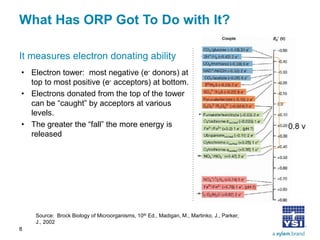
What Has ORP Got To Do with It? 
It measures electron donating ability 
• 
Electron tower: most negative (e- donors) at top to most positive (e- acceptors) at bottom. 
• 
Electrons donated from the top of the tower can be “caught” by acceptors at various levels. 
• 
The greater the “fall” the more energy is released 
8 
0.8 v 
Source: Brock Biology of Microorganisms, 10th Ed., Madigan, M., Martinko, J., Parker, J., 2002
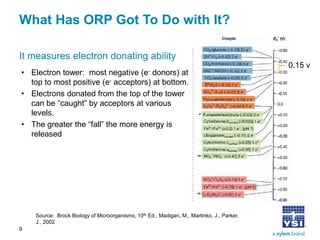
What Has ORP Got To Do with It? 
It measures electron donating ability 
• 
Electron tower: most negative (e- donors) at top to most positive (e- acceptors) at bottom. 
• 
Electrons donated from the top of the tower can be “caught” by acceptors at various levels. 
• 
The greater the “fall” the more energy is released 
9 
0.15 v 
Source: Brock Biology of Microorganisms, 10th Ed., Madigan, M., Martinko, J., Parker, J., 2002
Sounds Complicated, Huh? 
It is, but…. 
• 
Can be very simple if only interested in measuring e- 
10
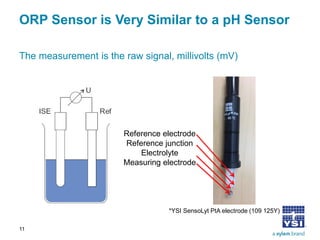
ORP Sensor is Very Similar to a pH Sensor 
The measurement is the raw signal, millivolts (mV) 
11 
Reference electrode 
Reference junction 
Electrolyte 
Measuring electrode 
*YSI SensoLyt PtA electrode (109 125Y)
Putting ORP to Use 
12
Terminology 
• 
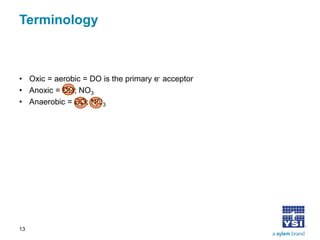
Oxic = aerobic = DO is the primary e- acceptor 
• 
Anoxic = DO; NO3 
• 
Anaerobic = DO; NO3 
13
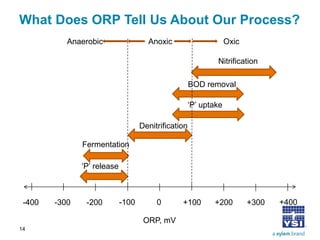
What Does ORP Tell Us About Our Process? 
14 
0 
-100 
-200 
-300 
-400 
+400 
+300 
+200 
+100 
Nitrification 
BOD removal 
‘P’ uptake 
Denitrification 
Fermentation 
‘P’ release 
ORP, mV 
Oxic 
Anaerobic 
Anoxic
ORP as a DO Sensor 
• 
DO > 1.0 mg/L: primarily O2 
• 
No direct meaning as to the status of nitrification 
• 
DO < 1.0 mg/L: O2 + other e- acceptors 
• 
No direct meaning as to the status of denitrification 
• 
When DO is < 0.1 primarily other e- acceptors 
Think of ORP as a DO sensor that measures negative 
15
ORP as a ‘N’ Sensor 
• 
NO3 and NO2 
• 
Ammonium and TKN 
• 
Little to no dissolved ‘N’ (and no DO) 
ORP can indicate what forms of N are present 
16 
+ 
-
ORP as a ‘P’ Sensor 
• 
‘P’ is neither oxidized or reduced 
• 
However, it can tell you when conditions are ripe for uptake and release 
Well, it can’t really do that 
17
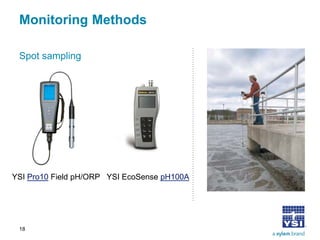
Monitoring Methods 
Spot sampling 
18 
YSI Pro10 Field pH/ORP 
YSI EcoSense pH100A
Monitoring Methods 
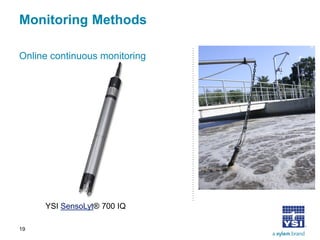
Online continuous monitoring 
19 
YSI SensoLyt® 700 IQ
Applications 
20
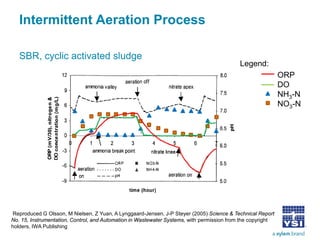
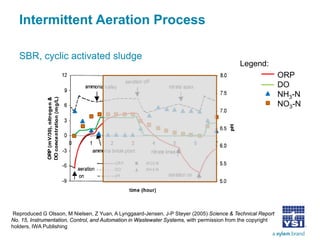
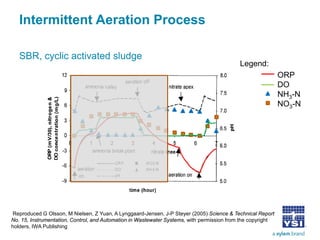
Intermittent Aeration Process 
SBR, cyclic activated sludge 
Reproduced G Olsson, M Nielsen, Z Yuan, A Lynggaard-Jensen, J-P Steyer (2005) Science & Technical Report No. 15, Instrumentation, Control, and Automation in Wastewater Systems, with permission from the copyright holders, IWA Publishing 
ORP 
DO 
NH3-N 
NO3-N 
Legend:
Intermittent Aeration Process 
SBR, cyclic activated sludge 
Reproduced G Olsson, M Nielsen, Z Yuan, A Lynggaard-Jensen, J-P Steyer (2005) Science & Technical Report No. 15, Instrumentation, Control, and Automation in Wastewater Systems, with permission from the copyright holders, IWA Publishing 
ORP DO NH3-N NO3-N 
Legend:
Intermittent Aeration Process 
SBR, cyclic activated sludge 
Reproduced G Olsson, M Nielsen, Z Yuan, A Lynggaard-Jensen, J-P Steyer (2005) Science & Technical Report No. 15, Instrumentation, Control, and Automation in Wastewater Systems, with permission from the copyright holders, IWA Publishing 
ORP 
DO 
NH3-N 
NO3-N 
Legend:
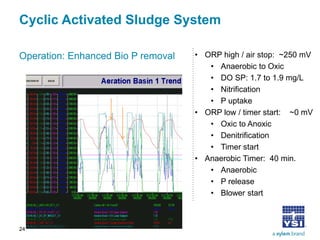
Cyclic Activated Sludge System 
Operation: Enhanced Bio P removal 
• 
ORP high / air stop: ~250 mV 
• 
Anaerobic to Oxic 
• 
DO SP: 1.7 to 1.9 mg/L 
• 
Nitrification 
• 
P uptake 
• 
ORP low / timer start: ~0 mV 
• 
Oxic to Anoxic 
• 
Denitrification 
• 
Timer start 
• 
Anaerobic Timer: 40 min. 
• 
Anaerobic 
• 
P release 
• 
Blower start 
24
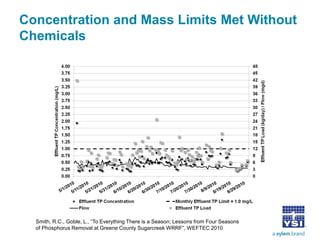
Concentration and Mass Limits Met Without Chemicals 
Smith, R.C., Goble, L., “To Everything There is a Season; Lessons from Four Seasons of Phosphorus Removal at Greene County Sugarcreek WRRF”, WEFTEC 2010
Continuous Flow Systems 
• 
Effluent ammonia control / chloramination 
• 
Aeration control 
• 
Simultaneous nitrification denitrification 
Applications 
26
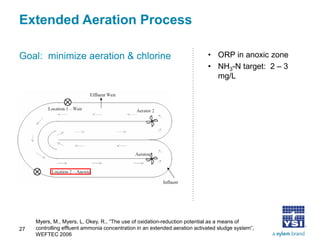
Extended Aeration Process 
Goal: minimize aeration & chlorine 
• 
ORP in anoxic zone 
• 
NH3-N target: 2 – 3 mg/L 
27 
Myers, M., Myers, L, Okey, R., “The use of oxidation-reduction potential as a means of controlling effluent ammonia concentration in an extended aeration activated sludge system”, WEFTEC 2006
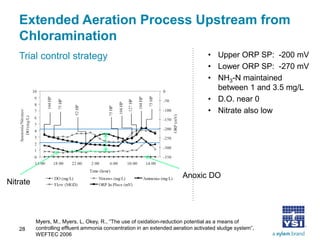
Extended Aeration Process Upstream from Chloramination 
Trial control strategy 
• 
Upper ORP SP: -200 mV 
• 
Lower ORP SP: -270 mV 
• 
NH3-N maintained between 1 and 3.5 mg/L 
• 
D.O. near 0 
• 
Nitrate also low 
28 
Anoxic DO 
Nitrate 
Myers, M., Myers, L, Okey, R., “The use of oxidation-reduction potential as a means of controlling effluent ammonia concentration in an extended aeration activated sludge system”, WEFTEC 2006
Sensor Care and Parting Thoughts 
29
Calibration, Cleaning, Replacement 
• 
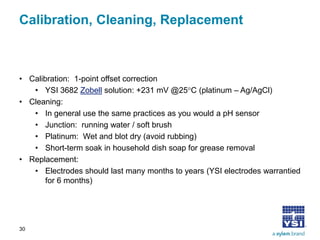
Calibration: 1-point offset correction 
• 
YSI 3682 Zobell solution: +231 mV @25°C (platinum – Ag/AgCl) 
• 
Cleaning: 
• 
In general use the same practices as you would a pH sensor 
• 
Junction: running water / soft brush 
• 
Platinum: Wet and blot dry (avoid rubbing) 
• 
Short-term soak in household dish soap for grease removal 
• 
Replacement: 
• 
Electrodes should last many months to years (YSI electrodes warrantied for 6 months) 
30
Parting Thoughts 
• 
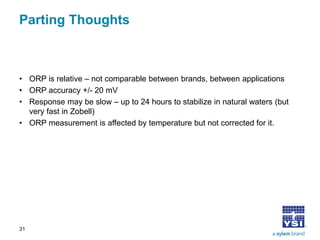
ORP is relative – not comparable between brands, between applications 
• 
ORP accuracy +/- 20 mV 
• 
Response may be slow – up to 24 hours to stabilize in natural waters (but very fast in Zobell) 
• 
ORP measurement is affected by temperature but not corrected for it. 
31
Feeling Better? 
ORP is cool! 
32
For More Information… 
IQ SensorNet 
• 
YSI.com/IQ 
• 
+1 (937) 767-7241 
• 
(800) 897-4151 
• 
info@ysi.com 
• 
Application Note 
ORP Management in Wastewater as an Indicator of Process Efficiency 
33

Biological Nutrient Removal Applications for Monitoring ORP | YSI

  • 1.
    1 Biological NutrientRemoval Applications for Monitoring ORP
  • 2.
    Biological Nutrient RemovalApplications for Monitoring Oxidation Reduction Potential YSI WATER RESOURCE RECOVERY WEBINAR 2
  • 3.
    Today’s Topics • The Science of ORP (oxidation reduction potential) or Redox • Putting ORP to Use • Applications • Sensor Care and Parting Thoughts 3
  • 4.
  • 5.
    Growing Bugs areHappy Bugs! • Carbon • Nutrients • Energy • Reducing Power – the ability to transfer electrons Bacteria require 4 things for growth 5 Source: Biological Wastewater Treatment, 2nd ed., Grady, C.P., Daigger, G.T., Lim, H.C., 1999.
  • 6.
    Bugs Get Energyand Reducing Power from Oxidation-Reduction (Redox) Reactions Redox transfers electrons Function e- donor e- acceptor BOD removal Organic C O2 Nitrification NH4+ O2 Denitrification Organic C NOx Fermentation Organic C Organic C 6
  • 7.
    What Has ORPGot To Do with It? It measures electron donating ability • Electron tower: most negative (e- donors) at top to most positive (e- acceptors) at bottom. • Electrons donated from the top of the tower can be “caught” by acceptors at various levels. • The greater the “fall” the more energy is released 7 1.2 v Source: Brock Biology of Microorganisms, 10th Ed., Madigan, M., Martinko, J., Parker, J., 2002
  • 8.
    What Has ORPGot To Do with It? It measures electron donating ability • Electron tower: most negative (e- donors) at top to most positive (e- acceptors) at bottom. • Electrons donated from the top of the tower can be “caught” by acceptors at various levels. • The greater the “fall” the more energy is released 8 0.8 v Source: Brock Biology of Microorganisms, 10th Ed., Madigan, M., Martinko, J., Parker, J., 2002
  • 9.
    What Has ORPGot To Do with It? It measures electron donating ability • Electron tower: most negative (e- donors) at top to most positive (e- acceptors) at bottom. • Electrons donated from the top of the tower can be “caught” by acceptors at various levels. • The greater the “fall” the more energy is released 9 0.15 v Source: Brock Biology of Microorganisms, 10th Ed., Madigan, M., Martinko, J., Parker, J., 2002
  • 10.
    Sounds Complicated, Huh? It is, but…. • Can be very simple if only interested in measuring e- 10
  • 11.
    ORP Sensor isVery Similar to a pH Sensor The measurement is the raw signal, millivolts (mV) 11 Reference electrode Reference junction Electrolyte Measuring electrode *YSI SensoLyt PtA electrode (109 125Y)
  • 12.
  • 13.
    Terminology • Oxic= aerobic = DO is the primary e- acceptor • Anoxic = DO; NO3 • Anaerobic = DO; NO3 13
  • 14.
    What Does ORPTell Us About Our Process? 14 0 -100 -200 -300 -400 +400 +300 +200 +100 Nitrification BOD removal ‘P’ uptake Denitrification Fermentation ‘P’ release ORP, mV Oxic Anaerobic Anoxic
  • 15.
    ORP as aDO Sensor • DO > 1.0 mg/L: primarily O2 • No direct meaning as to the status of nitrification • DO < 1.0 mg/L: O2 + other e- acceptors • No direct meaning as to the status of denitrification • When DO is < 0.1 primarily other e- acceptors Think of ORP as a DO sensor that measures negative 15
  • 16.
    ORP as a‘N’ Sensor • NO3 and NO2 • Ammonium and TKN • Little to no dissolved ‘N’ (and no DO) ORP can indicate what forms of N are present 16 + -
  • 17.
    ORP as a‘P’ Sensor • ‘P’ is neither oxidized or reduced • However, it can tell you when conditions are ripe for uptake and release Well, it can’t really do that 17
  • 18.
    Monitoring Methods Spotsampling 18 YSI Pro10 Field pH/ORP YSI EcoSense pH100A
  • 19.
    Monitoring Methods Onlinecontinuous monitoring 19 YSI SensoLyt® 700 IQ
  • 20.
  • 21.
    Intermittent Aeration Process SBR, cyclic activated sludge Reproduced G Olsson, M Nielsen, Z Yuan, A Lynggaard-Jensen, J-P Steyer (2005) Science & Technical Report No. 15, Instrumentation, Control, and Automation in Wastewater Systems, with permission from the copyright holders, IWA Publishing ORP DO NH3-N NO3-N Legend:
  • 22.
    Intermittent Aeration Process SBR, cyclic activated sludge Reproduced G Olsson, M Nielsen, Z Yuan, A Lynggaard-Jensen, J-P Steyer (2005) Science & Technical Report No. 15, Instrumentation, Control, and Automation in Wastewater Systems, with permission from the copyright holders, IWA Publishing ORP DO NH3-N NO3-N Legend:
  • 23.
    Intermittent Aeration Process SBR, cyclic activated sludge Reproduced G Olsson, M Nielsen, Z Yuan, A Lynggaard-Jensen, J-P Steyer (2005) Science & Technical Report No. 15, Instrumentation, Control, and Automation in Wastewater Systems, with permission from the copyright holders, IWA Publishing ORP DO NH3-N NO3-N Legend:
  • 24.
    Cyclic Activated SludgeSystem Operation: Enhanced Bio P removal • ORP high / air stop: ~250 mV • Anaerobic to Oxic • DO SP: 1.7 to 1.9 mg/L • Nitrification • P uptake • ORP low / timer start: ~0 mV • Oxic to Anoxic • Denitrification • Timer start • Anaerobic Timer: 40 min. • Anaerobic • P release • Blower start 24
  • 25.
    Concentration and MassLimits Met Without Chemicals Smith, R.C., Goble, L., “To Everything There is a Season; Lessons from Four Seasons of Phosphorus Removal at Greene County Sugarcreek WRRF”, WEFTEC 2010
  • 26.
    Continuous Flow Systems • Effluent ammonia control / chloramination • Aeration control • Simultaneous nitrification denitrification Applications 26
  • 27.
    Extended Aeration Process Goal: minimize aeration & chlorine • ORP in anoxic zone • NH3-N target: 2 – 3 mg/L 27 Myers, M., Myers, L, Okey, R., “The use of oxidation-reduction potential as a means of controlling effluent ammonia concentration in an extended aeration activated sludge system”, WEFTEC 2006
  • 28.
    Extended Aeration ProcessUpstream from Chloramination Trial control strategy • Upper ORP SP: -200 mV • Lower ORP SP: -270 mV • NH3-N maintained between 1 and 3.5 mg/L • D.O. near 0 • Nitrate also low 28 Anoxic DO Nitrate Myers, M., Myers, L, Okey, R., “The use of oxidation-reduction potential as a means of controlling effluent ammonia concentration in an extended aeration activated sludge system”, WEFTEC 2006
  • 29.
    Sensor Care andParting Thoughts 29
  • 30.
    Calibration, Cleaning, Replacement • Calibration: 1-point offset correction • YSI 3682 Zobell solution: +231 mV @25°C (platinum – Ag/AgCl) • Cleaning: • In general use the same practices as you would a pH sensor • Junction: running water / soft brush • Platinum: Wet and blot dry (avoid rubbing) • Short-term soak in household dish soap for grease removal • Replacement: • Electrodes should last many months to years (YSI electrodes warrantied for 6 months) 30
  • 31.
    Parting Thoughts • ORP is relative – not comparable between brands, between applications • ORP accuracy +/- 20 mV • Response may be slow – up to 24 hours to stabilize in natural waters (but very fast in Zobell) • ORP measurement is affected by temperature but not corrected for it. 31
  • 32.
  • 33.
    For More Information… IQ SensorNet • YSI.com/IQ • +1 (937) 767-7241 • (800) 897-4151 • info@ysi.com • Application Note ORP Management in Wastewater as an Indicator of Process Efficiency 33