U niversità degli Studi di Salerno Dipartimento di Ingegneria Civile Laurea in Ingegneria per l’Ambiente ed il Territorio in  Impianti di trattamento delle acque reflue II ENHANCED BIOLOGICAL PHOSPHORUS REMOVAL BY ANAEROBIC, AEROBIC/ANOXIC PROCESSES Allievo Paolo Siano N.Mat. 06205-000160 Relatore: Prof.Ing. Luigi Rizzo Correlatore: Prof.ssa. Maria Ascensão Reis
: : Enhanced Biological Phosphorus Removal by anaerobic, aerobic/anoxic processes : :  29 April 2011  Framework Background Objectives Materials and methods Wastewater sampling Batch test Chemical Analysis Results Phosphorus in Beirolas WWTP Anaerobic-Aerobic and Anaerobic/Anoxic batch tests Conclusions
: : Enhanced Biological Phosphorus Removal by anaerobic, aerobic/anoxic processes : :  29 April 2011  Background
Background : : Enhanced Biological Phosphorus Removal by anaerobic, aerobic/anoxic processes : :  29 April 2011  World Resource  i nstitute (www.wri.org)
Background : : Enhanced Biological Phosphorus Removal by anaerobic, aerobic/anoxic processes : :  29 April 2011  World Resource  i nstitute (www.wri.org) Parameter Power plant in terms of population equivalent D.E. 91/271/CEE  10,000 – 100,000 >100,000 Concentrazione % di riduzione Concentr. % di riduz. Total P  (P mg/l) ≤  2 80 ≤  1 80 Total N  (N mg/l) ≤  15 70-80 ≤  10 70-80
PRECIPITATION ADDITION OF  METAL SALTS ENHANCE Background : : Enhanced Biological Phosphorus Removal by anaerobic, aerobic/anoxic processes : :  Presented on the 29 April 2011  ANAEROBIC/AEROBIC PROCESSES promoted by P oliphosphate  A ccumulating  O rganisms (PAOs) Much lower operating costs Reduced sludge production Reuse processed sludge Chemical Removal Biological Removal (EBPR)
Phoredox [A/O] ANAEROBIC CONDITIONS AEROBIC CONDITIONS Background : : Enhanced Biological Phosphorus Removal by anaerobic, aerobic/anoxic processes : :  Presented on the 29 April 2011  energy liquid phase energy O 2 liquid phase O 2
Phoredox 3-stage [A 2 /O] Background : : Enhanced Biological Phosphorus Removal by anaerobic, aerobic/anoxic processes : :  Presented on the 29 April 2011  energy O 2 liquid phase N O 2 N O 3
University of Cape Town (UCT) Bardenpho Combined nitrogen and phosphorus removal schemes Virginia Initiative Plant [VIP] A 2 /O Background : : Enhanced Biological Phosphorus Removal by anaerobic, aerobic/anoxic processes : :  Presented on the 29 April 2011
Background : : Enhanced Biological Phosphorus Removal by anaerobic, aerobic/anoxic processes : :  Presented on the 29 April 2011  Carvalho et. al. (2007)  observed  difference in anoxic P-uptake and proposed hypothesis that  different Accumulibacter clades have different metabolic capabilities . *** Flowers et al., (2009)  confirmed  that two different clades have affinities to nitrate: type I Accumulibacter, hereafter refered as  PAOI , seems having the ability to denitrify using nitrate, contrary to Type II Accumulibacter, hereafter  PAOII . Although anoxic conditions with nitrate seems to favor PAOI over PAOII, they seem be able to co-exist.
The aim of the study has been the optimization of  the Enhanced Biological Phosphorus Removal (EBPR) through: Objectives Reproduction of the EBPR process at lab-scale and evaluation process efficiency; Estimation of the microbial composition of Beirolas UWWTP through chemical analysis, according to the method proposed by Meinhold et al. (1999). : : Enhanced Biological Phosphorus Removal by anaerobic, aerobic/anoxic processes : :  Presented on the 29 April 2011
: : Enhanced Biological Phosphorus Removal by anaerobic, aerobic/anoxic processes : :  Presented on the 29 April 2011  Experimental
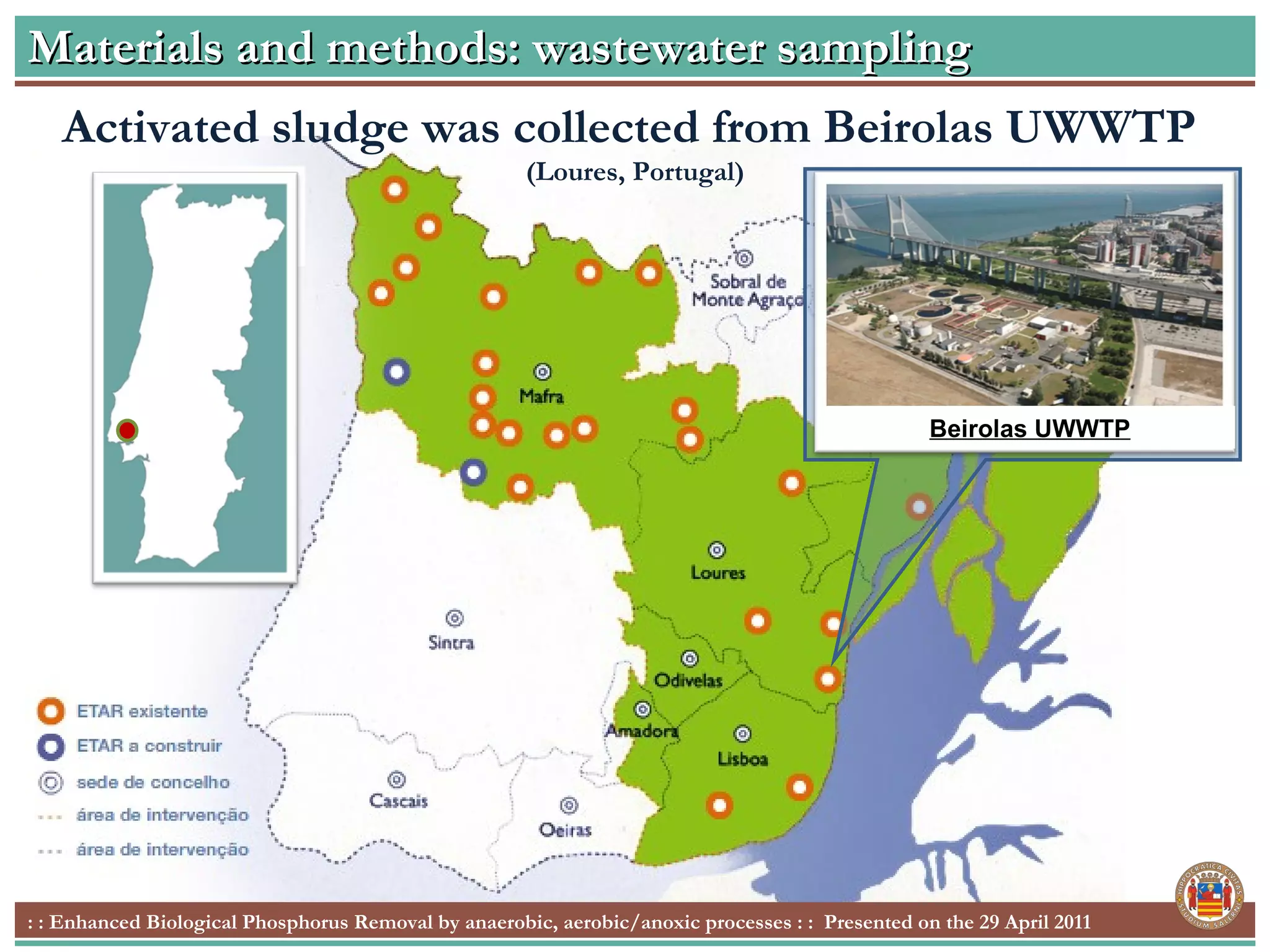
Materials and methods: wastewater sampling Activated sludge was collected from Beirolas UWWTP  (Loures, Portugal) : : Enhanced Biological Phosphorus Removal by anaerobic, aerobic/anoxic processes : :  Presented on the 29 April 2011  Beirolas UWWTP
Materials and methods: wastewater sampling "Barden-pho" BPR unit configuration based on 3-stages : : Enhanced Biological Phosphorus Removal by anaerobic, aerobic/anoxic processes : :  Presented on the 29 April 2011  Anaerobic zone   (4.3% of total); Anoxic zone ( 21.3% of total); Aerobic zone (74.4% volume total).
Materials and methods: wastewater sampling : : Enhanced Biological Phosphorus Removal by anaerobic, aerobic/anoxic processes : :  Presented on the 29 April 2011  5 L  of sludge from aerobic tank  to arrange biological batch tests.
Materials and methods: wastewater sampling : : Enhanced Biological Phosphorus Removal by anaerobic, aerobic/anoxic processes : :  Presented on the 29 April 2011  Additional samples from : biological units  (Anaerobic, anoxic and aerobic tank); primary and secondary settling.  In order to characterize the plant.
: : Enhanced Biological Phosphorus Removal by anaerobic, aerobic/anoxic processes : :  Presented on the 29 April 2011  Materials and methods: batch test Batch test conditions Acetate as carbon source Temperature of 22°C ( ± 2°C) pH in the range 6.5 ÷ 7.5 SPLIT ANAEROBIC REACTOR AEROBIC  REACTOR ANOXIC  REACTOR Volume 1.5 L Volume 0.6 L Volume 0.6 L
: : Enhanced Biological Phosphorus Removal by anaerobic, aerobic/anoxic processes : :  Presented on the 29 April 2011  Chemical Analysis Phosphorus, Acetate, Nitrate  Hight Pressure Liquid Chromatography (HPLC) IonPac® AS9-HC Phosporus Ascorbic acid method Skalar 5100 Ammonia Ammonia gas sensing combination electrode  Thermo Orion, NH4/95-12 Total and Volatile Suspended Solids  (TSS, VSS) Membrane Filtration Method
: : Enhanced Biological Phosphorus Removal by anaerobic, aerobic/anoxic processes : :  Presented on the 29 April 2011  ANAEROBIC  REACTOR Time (min) Conc. of P ~  120 ~  360 Max release of P anaer. aer./anox. Carbon comsuption Results:  Anaerobic-Aerobic and Anaerobic/Anoxic batch tests
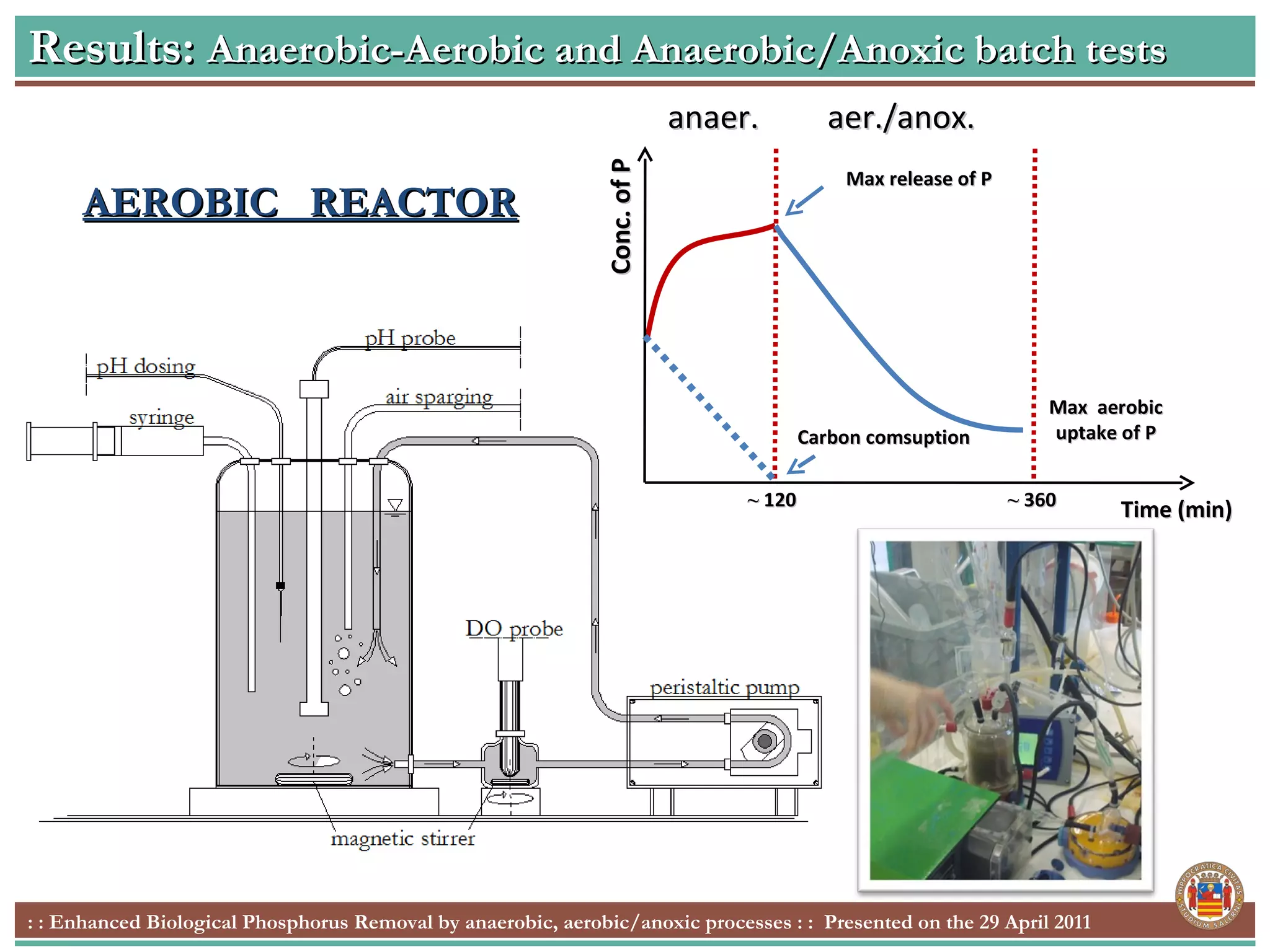
: : Enhanced Biological Phosphorus Removal by anaerobic, aerobic/anoxic processes : :  Presented on the 29 April 2011  AEROBIC  REACTOR Max release of P Max  aerobic uptake of P Time (min) Conc. of P anaer. ~  120 ~  360 aer./anox. Carbon comsuption Results:  Anaerobic-Aerobic and Anaerobic/Anoxic batch tests
: : Enhanced Biological Phosphorus Removal by anaerobic, aerobic/anoxic processes : :  Presented on the 29 April 2011  ANOXIC REACTOR Max release of P Max  anoxic uptake of P Time (min) Conc. of P ~  120 ~  360 anaer. aer./anox. Carbon comsuption Nitrate comsuption Results:  Anaerobic-Aerobic and Anaerobic/Anoxic batch tests
: : Enhanced Biological Phosphorus Removal by anaerobic, aerobic/anoxic processes : :  Presented on the 29 April 2011  Results:  Anaerobic-Aerobic and Anaerobic/Anoxic batch tests Batch test for B 4  samples.  Initial Acetate concentration 25 ppm; Initial concentration of P 20ppm; Initial NO 3  25ppm. Anaerobic condition Aerobic/Anoxic condition
: : Enhanced Biological Phosphorus Removal by anaerobic, aerobic/anoxic processes : :  Presented on the 29 April 2011  Results:  Anaerobic-Aerobic and Anaerobic/Anoxic batch tests Batch test for B 6  samples. Initial Acetate concentration 30 ppm; Initial concentration of P 20ppm; Initial NO 3  25ppm. Anaerobic condition Aerobic/Anoxic condition
: : Enhanced Biological Phosphorus Removal by anaerobic, aerobic/anoxic processes : :  Presented on the 29 April 2011  Results:  Anaerobic-Aerobic and Anaerobic/Anoxic batch tests Batch test for B 7  samples.  Initial Acetate concentration 40 ppm; Initial concentration of P 20ppm; Initial NO 3  25ppm. Spiking of P Anaerobic condition Aerobic/Anoxic condition Aerobic condition
: : Enhanced Biological Phosphorus Removal by anaerobic, aerobic/anoxic processes : :  Presented on the 29 April 2011  Results:  Anaerobic-Aerobic and Anaerobic/Anoxic batch tests Batch test for B 8  samples. Initial Acetate concentration 40 ppm; Initial concentration of P 20ppm; Initial NO 3  25ppm. Anaerobic condition Aerobic/Anoxic condition P Ae  (on Ax)
: : Enhanced Biological Phosphorus Removal by anaerobic, aerobic/anoxic processes : :  Presented on the 29 April 2011  Results:  Anaerobic-Aerobic and Anaerobic/Anoxic batch tests Batch test for B 5  samples. Initial Acetate concentration 50 ppm; Initial concentration of P 20ppm; Initial NO 3  25ppm. Anaerobic condition Anoxic condition Aerobic condition
: : Enhanced Biological Phosphorus Removal by anaerobic, aerobic/anoxic processes : :  Presented on the 29 April 2011  Results:  Anaerobic-Aerobic and Anaerobic/Anoxic batch tests Summary of the anaerobic-aerobic-anoxic activity batch tests results carried out According to other studies n°  Batch Initial  Hac P-release  rate An. P/HAc  ratio Ae P-uptake  rate Ax. P-uptake  rate Ax/Ae  P uptake rate [-] [mg/L] [mgP/gVSS/h] [molP/molHAc] [mgP/gVSS/h] [mgP/gVSS/h] [%] B 4 25 9.73 0.37 7.40 3.68 36.45 B 6 30 11.63 0.19 3.87 1.50 28.44 B 7 40 6.68 0.18 8.57 3.55 45.34 B 8 40 9.98 0.22 6.51 1.88 49.40 B 5 50 8.61 0.22 n.r. n.r. n.r. avarage  >> 9.33 0.23 6.59 2.65 39.91 stand.dev. >> 1.83 0.08 2.00 1.12 9.36
: : Enhanced Biological Phosphorus Removal by anaerobic, aerobic/anoxic processes : :  Presented on the 29 April 2011  Results:  Assessing PAO/DPAO activity Time (min) Conc. of P ~  120 ~  360 anaer. aer./anox. Anoxic uptake Aerobic uptake Anaerobic release Aerobic uptake Anoxic uptake Acetate consuption Nitrate consuption XDPAO XPAO D Pax D Pox  = Relative activity of DPAO  in EBPR systems (Meinhold et al.,1999)
: : Enhanced Biological Phosphorus Removal by anaerobic, aerobic/anoxic processes : :  Presented on the 29 April 2011  Results:  Assessing PAO/DPAO activity XDPAO XPAO D Pax D Pox  = Relative activity of DPAO  in EBPR systems (Meinhold et al.,1999)
: : Enhanced Biological Phosphorus Removal by anaerobic, aerobic/anoxic processes : :  Presented on the 29 April 2011  Results: phosphorus in Beirolas WWTP Efficiency  92% ? “ secondary”  P-release
: : Enhanced Biological Phosphorus Removal by anaerobic, aerobic/anoxic processes : :  Presented on the 29 April 2011  Results:  WWTP & Batch tests
: : Enhanced Biological Phosphorus Removal by anaerobic, aerobic/anoxic processes : :  Presented on the 29 April 2011  Conclusions EBPR process at lab-scale was reproduced  and typical trends of phosphorus, nitrate and acetate were observed; The batch tests results obtained suggest that phosphorus removal is due to two type of PAOs:  PAOs type I  (also called DPAOs) that are likely to be able to reduce nitrate and  PAO type II  that cannot; Relative chemical activity of PAOs and DPAOs was estimated, (Meinhold et al. 1999):  DPAOs occurrence as high as 40% and PAOs occurrence as high as 60%; Phosphorus removal efficiency  at Beirolas UWWTP is quite variable, but under the investigated conditions a 92% removal was observed; The higher the concentration of intracellular phosphorous in aerobic tank of UWWTP the higher the phosphorus release rate in the anaerobic phase of batch test.
: : Enhanced Biological Phosphorus Removal by anaerobic, aerobic/anoxic processes : :  Presented on the 29 April 2011  Conclusions The knowledge of the microbial composition and its efficiency  is key factor to perform good P and N removals.
: : Enhanced Biological Phosphorus Removal by anaerobic, aerobic/anoxic processes : :  Presented on the 29 April 2011

Enhanced Biological Phosporous Removal by Anaerobic and Aerobic/Anoxic processes

  • 1.
    U niversità degliStudi di Salerno Dipartimento di Ingegneria Civile Laurea in Ingegneria per l’Ambiente ed il Territorio in Impianti di trattamento delle acque reflue II ENHANCED BIOLOGICAL PHOSPHORUS REMOVAL BY ANAEROBIC, AEROBIC/ANOXIC PROCESSES Allievo Paolo Siano N.Mat. 06205-000160 Relatore: Prof.Ing. Luigi Rizzo Correlatore: Prof.ssa. Maria Ascensão Reis
  • 2.
    : : EnhancedBiological Phosphorus Removal by anaerobic, aerobic/anoxic processes : : 29 April 2011 Framework Background Objectives Materials and methods Wastewater sampling Batch test Chemical Analysis Results Phosphorus in Beirolas WWTP Anaerobic-Aerobic and Anaerobic/Anoxic batch tests Conclusions
  • 3.
    : : EnhancedBiological Phosphorus Removal by anaerobic, aerobic/anoxic processes : : 29 April 2011 Background
  • 4.
    Background : :Enhanced Biological Phosphorus Removal by anaerobic, aerobic/anoxic processes : : 29 April 2011 World Resource i nstitute (www.wri.org)
  • 5.
    Background : :Enhanced Biological Phosphorus Removal by anaerobic, aerobic/anoxic processes : : 29 April 2011 World Resource i nstitute (www.wri.org)
  • 6.
    Background : :Enhanced Biological Phosphorus Removal by anaerobic, aerobic/anoxic processes : : 29 April 2011 World Resource i nstitute (www.wri.org) Parameter Power plant in terms of population equivalent D.E. 91/271/CEE 10,000 – 100,000 >100,000 Concentrazione % di riduzione Concentr. % di riduz. Total P (P mg/l) ≤ 2 80 ≤ 1 80 Total N (N mg/l) ≤ 15 70-80 ≤ 10 70-80
  • 7.
    PRECIPITATION ADDITION OF METAL SALTS ENHANCE Background : : Enhanced Biological Phosphorus Removal by anaerobic, aerobic/anoxic processes : : Presented on the 29 April 2011 ANAEROBIC/AEROBIC PROCESSES promoted by P oliphosphate A ccumulating O rganisms (PAOs) Much lower operating costs Reduced sludge production Reuse processed sludge Chemical Removal Biological Removal (EBPR)
  • 8.
    Phoredox [A/O] ANAEROBICCONDITIONS AEROBIC CONDITIONS Background : : Enhanced Biological Phosphorus Removal by anaerobic, aerobic/anoxic processes : : Presented on the 29 April 2011 energy liquid phase energy O 2 liquid phase O 2
  • 9.
    Phoredox 3-stage [A2 /O] Background : : Enhanced Biological Phosphorus Removal by anaerobic, aerobic/anoxic processes : : Presented on the 29 April 2011 energy O 2 liquid phase N O 2 N O 3
  • 10.
    University of CapeTown (UCT) Bardenpho Combined nitrogen and phosphorus removal schemes Virginia Initiative Plant [VIP] A 2 /O Background : : Enhanced Biological Phosphorus Removal by anaerobic, aerobic/anoxic processes : : Presented on the 29 April 2011
  • 11.
    Background : :Enhanced Biological Phosphorus Removal by anaerobic, aerobic/anoxic processes : : Presented on the 29 April 2011 Carvalho et. al. (2007) observed difference in anoxic P-uptake and proposed hypothesis that different Accumulibacter clades have different metabolic capabilities . *** Flowers et al., (2009) confirmed that two different clades have affinities to nitrate: type I Accumulibacter, hereafter refered as PAOI , seems having the ability to denitrify using nitrate, contrary to Type II Accumulibacter, hereafter PAOII . Although anoxic conditions with nitrate seems to favor PAOI over PAOII, they seem be able to co-exist.
  • 12.
    The aim ofthe study has been the optimization of the Enhanced Biological Phosphorus Removal (EBPR) through: Objectives Reproduction of the EBPR process at lab-scale and evaluation process efficiency; Estimation of the microbial composition of Beirolas UWWTP through chemical analysis, according to the method proposed by Meinhold et al. (1999). : : Enhanced Biological Phosphorus Removal by anaerobic, aerobic/anoxic processes : : Presented on the 29 April 2011
  • 13.
    : : EnhancedBiological Phosphorus Removal by anaerobic, aerobic/anoxic processes : : Presented on the 29 April 2011 Experimental
  • 14.
    Materials and methods:wastewater sampling Activated sludge was collected from Beirolas UWWTP (Loures, Portugal) : : Enhanced Biological Phosphorus Removal by anaerobic, aerobic/anoxic processes : : Presented on the 29 April 2011 Beirolas UWWTP
  • 15.
    Materials and methods:wastewater sampling "Barden-pho" BPR unit configuration based on 3-stages : : Enhanced Biological Phosphorus Removal by anaerobic, aerobic/anoxic processes : : Presented on the 29 April 2011 Anaerobic zone (4.3% of total); Anoxic zone ( 21.3% of total); Aerobic zone (74.4% volume total).
  • 16.
    Materials and methods:wastewater sampling : : Enhanced Biological Phosphorus Removal by anaerobic, aerobic/anoxic processes : : Presented on the 29 April 2011 5 L of sludge from aerobic tank to arrange biological batch tests.
  • 17.
    Materials and methods:wastewater sampling : : Enhanced Biological Phosphorus Removal by anaerobic, aerobic/anoxic processes : : Presented on the 29 April 2011 Additional samples from : biological units (Anaerobic, anoxic and aerobic tank); primary and secondary settling. In order to characterize the plant.
  • 18.
    : : EnhancedBiological Phosphorus Removal by anaerobic, aerobic/anoxic processes : : Presented on the 29 April 2011 Materials and methods: batch test Batch test conditions Acetate as carbon source Temperature of 22°C ( ± 2°C) pH in the range 6.5 ÷ 7.5 SPLIT ANAEROBIC REACTOR AEROBIC REACTOR ANOXIC REACTOR Volume 1.5 L Volume 0.6 L Volume 0.6 L
  • 19.
    : : EnhancedBiological Phosphorus Removal by anaerobic, aerobic/anoxic processes : : Presented on the 29 April 2011 Chemical Analysis Phosphorus, Acetate, Nitrate Hight Pressure Liquid Chromatography (HPLC) IonPac® AS9-HC Phosporus Ascorbic acid method Skalar 5100 Ammonia Ammonia gas sensing combination electrode Thermo Orion, NH4/95-12 Total and Volatile Suspended Solids (TSS, VSS) Membrane Filtration Method
  • 20.
    : : EnhancedBiological Phosphorus Removal by anaerobic, aerobic/anoxic processes : : Presented on the 29 April 2011 ANAEROBIC REACTOR Time (min) Conc. of P ~ 120 ~ 360 Max release of P anaer. aer./anox. Carbon comsuption Results: Anaerobic-Aerobic and Anaerobic/Anoxic batch tests
  • 21.
    : : EnhancedBiological Phosphorus Removal by anaerobic, aerobic/anoxic processes : : Presented on the 29 April 2011 AEROBIC REACTOR Max release of P Max aerobic uptake of P Time (min) Conc. of P anaer. ~ 120 ~ 360 aer./anox. Carbon comsuption Results: Anaerobic-Aerobic and Anaerobic/Anoxic batch tests
  • 22.
    : : EnhancedBiological Phosphorus Removal by anaerobic, aerobic/anoxic processes : : Presented on the 29 April 2011 ANOXIC REACTOR Max release of P Max anoxic uptake of P Time (min) Conc. of P ~ 120 ~ 360 anaer. aer./anox. Carbon comsuption Nitrate comsuption Results: Anaerobic-Aerobic and Anaerobic/Anoxic batch tests
  • 23.
    : : EnhancedBiological Phosphorus Removal by anaerobic, aerobic/anoxic processes : : Presented on the 29 April 2011 Results: Anaerobic-Aerobic and Anaerobic/Anoxic batch tests Batch test for B 4 samples. Initial Acetate concentration 25 ppm; Initial concentration of P 20ppm; Initial NO 3 25ppm. Anaerobic condition Aerobic/Anoxic condition
  • 24.
    : : EnhancedBiological Phosphorus Removal by anaerobic, aerobic/anoxic processes : : Presented on the 29 April 2011 Results: Anaerobic-Aerobic and Anaerobic/Anoxic batch tests Batch test for B 6 samples. Initial Acetate concentration 30 ppm; Initial concentration of P 20ppm; Initial NO 3 25ppm. Anaerobic condition Aerobic/Anoxic condition
  • 25.
    : : EnhancedBiological Phosphorus Removal by anaerobic, aerobic/anoxic processes : : Presented on the 29 April 2011 Results: Anaerobic-Aerobic and Anaerobic/Anoxic batch tests Batch test for B 7 samples. Initial Acetate concentration 40 ppm; Initial concentration of P 20ppm; Initial NO 3 25ppm. Spiking of P Anaerobic condition Aerobic/Anoxic condition Aerobic condition
  • 26.
    : : EnhancedBiological Phosphorus Removal by anaerobic, aerobic/anoxic processes : : Presented on the 29 April 2011 Results: Anaerobic-Aerobic and Anaerobic/Anoxic batch tests Batch test for B 8 samples. Initial Acetate concentration 40 ppm; Initial concentration of P 20ppm; Initial NO 3 25ppm. Anaerobic condition Aerobic/Anoxic condition P Ae (on Ax)
  • 27.
    : : EnhancedBiological Phosphorus Removal by anaerobic, aerobic/anoxic processes : : Presented on the 29 April 2011 Results: Anaerobic-Aerobic and Anaerobic/Anoxic batch tests Batch test for B 5 samples. Initial Acetate concentration 50 ppm; Initial concentration of P 20ppm; Initial NO 3 25ppm. Anaerobic condition Anoxic condition Aerobic condition
  • 28.
    : : EnhancedBiological Phosphorus Removal by anaerobic, aerobic/anoxic processes : : Presented on the 29 April 2011 Results: Anaerobic-Aerobic and Anaerobic/Anoxic batch tests Summary of the anaerobic-aerobic-anoxic activity batch tests results carried out According to other studies n° Batch Initial Hac P-release rate An. P/HAc ratio Ae P-uptake rate Ax. P-uptake rate Ax/Ae P uptake rate [-] [mg/L] [mgP/gVSS/h] [molP/molHAc] [mgP/gVSS/h] [mgP/gVSS/h] [%] B 4 25 9.73 0.37 7.40 3.68 36.45 B 6 30 11.63 0.19 3.87 1.50 28.44 B 7 40 6.68 0.18 8.57 3.55 45.34 B 8 40 9.98 0.22 6.51 1.88 49.40 B 5 50 8.61 0.22 n.r. n.r. n.r. avarage >> 9.33 0.23 6.59 2.65 39.91 stand.dev. >> 1.83 0.08 2.00 1.12 9.36
  • 29.
    : : EnhancedBiological Phosphorus Removal by anaerobic, aerobic/anoxic processes : : Presented on the 29 April 2011 Results: Assessing PAO/DPAO activity Time (min) Conc. of P ~ 120 ~ 360 anaer. aer./anox. Anoxic uptake Aerobic uptake Anaerobic release Aerobic uptake Anoxic uptake Acetate consuption Nitrate consuption XDPAO XPAO D Pax D Pox = Relative activity of DPAO in EBPR systems (Meinhold et al.,1999)
  • 30.
    : : EnhancedBiological Phosphorus Removal by anaerobic, aerobic/anoxic processes : : Presented on the 29 April 2011 Results: Assessing PAO/DPAO activity XDPAO XPAO D Pax D Pox = Relative activity of DPAO in EBPR systems (Meinhold et al.,1999)
  • 31.
    : : EnhancedBiological Phosphorus Removal by anaerobic, aerobic/anoxic processes : : Presented on the 29 April 2011 Results: phosphorus in Beirolas WWTP Efficiency 92% ? “ secondary” P-release
  • 32.
    : : EnhancedBiological Phosphorus Removal by anaerobic, aerobic/anoxic processes : : Presented on the 29 April 2011 Results: WWTP & Batch tests
  • 33.
    : : EnhancedBiological Phosphorus Removal by anaerobic, aerobic/anoxic processes : : Presented on the 29 April 2011 Conclusions EBPR process at lab-scale was reproduced and typical trends of phosphorus, nitrate and acetate were observed; The batch tests results obtained suggest that phosphorus removal is due to two type of PAOs: PAOs type I (also called DPAOs) that are likely to be able to reduce nitrate and PAO type II that cannot; Relative chemical activity of PAOs and DPAOs was estimated, (Meinhold et al. 1999): DPAOs occurrence as high as 40% and PAOs occurrence as high as 60%; Phosphorus removal efficiency at Beirolas UWWTP is quite variable, but under the investigated conditions a 92% removal was observed; The higher the concentration of intracellular phosphorous in aerobic tank of UWWTP the higher the phosphorus release rate in the anaerobic phase of batch test.
  • 34.
    : : EnhancedBiological Phosphorus Removal by anaerobic, aerobic/anoxic processes : : Presented on the 29 April 2011 Conclusions The knowledge of the microbial composition and its efficiency is key factor to perform good P and N removals.
  • 35.
    : : EnhancedBiological Phosphorus Removal by anaerobic, aerobic/anoxic processes : : Presented on the 29 April 2011