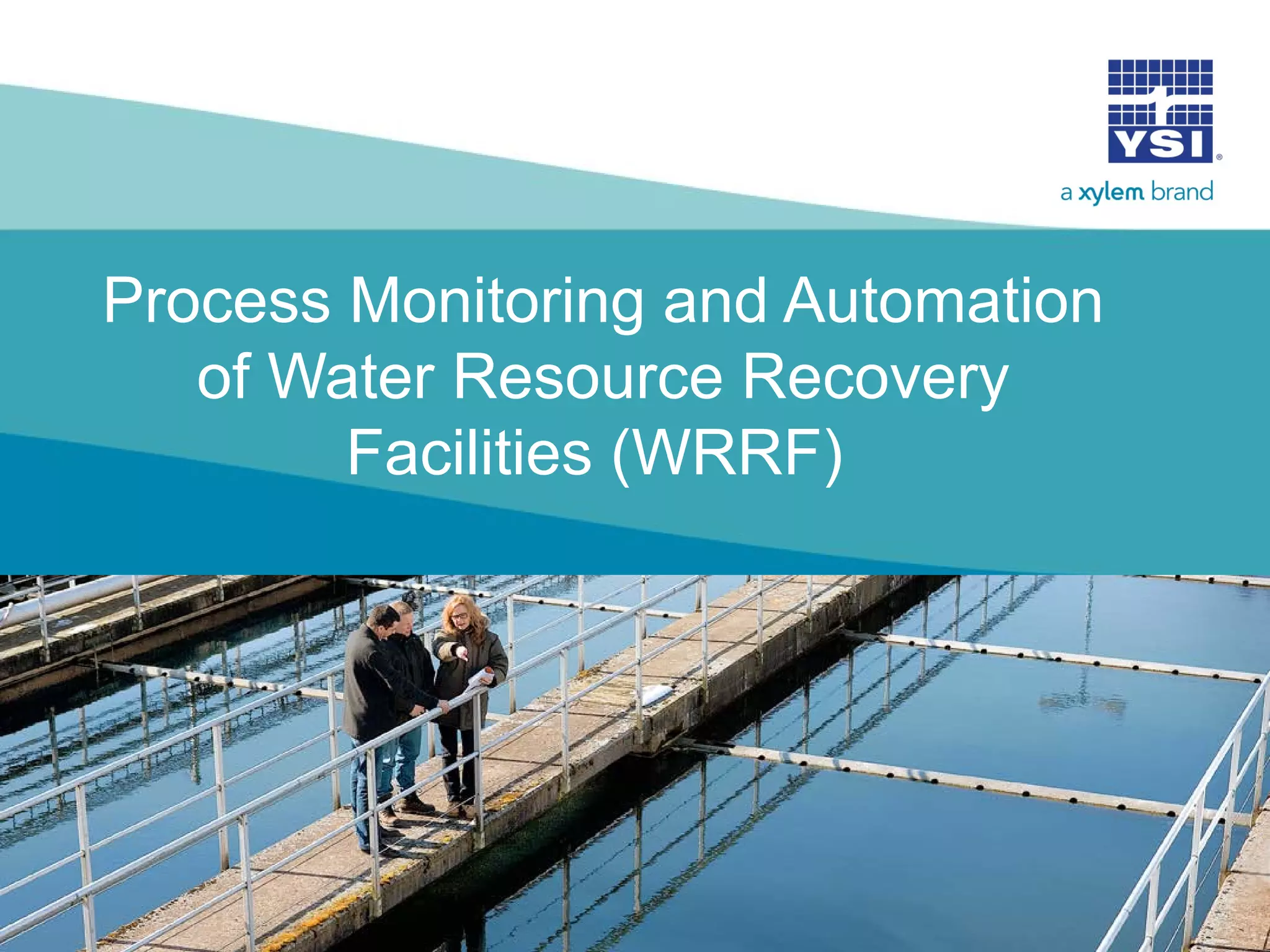
Process Monitoring and Automation
of Water Resource Recovery
Facilities (WRRF)
What’s Inside?
• Online process monitoring instrumentation –
what’s new?
• Dissolved Oxygen measurement (optical)
• DO aeration control
• Nitrogen measurement (ISE)
• Ammonium based aeration control
• TSS
• SRT (Solids Retention Time) control
• Nitrogen, COD, phosphate
Online Process Monitoring Instrumentation
• Solid-state in-situ sensors
• Multiparameter universal controllers
• Digital communications
• Measurement
• New parameters – NH4, NOx
• New methods – DO, TSS
• Better performance
What’s new
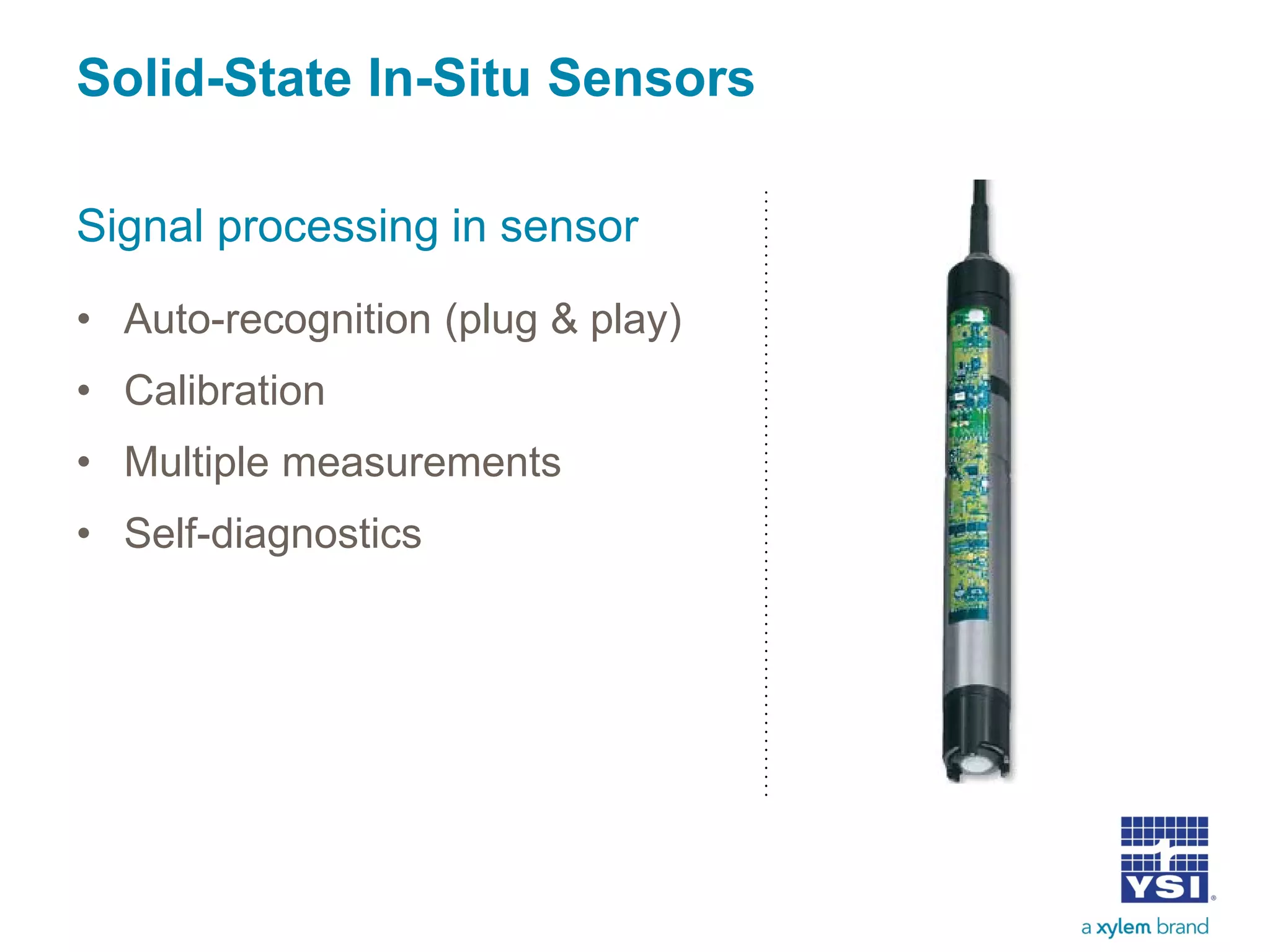
Solid-State In-Situ Sensors
Signal processing in sensor
• Auto-recognition (plug & play)
• Calibration
• Multiple measurements
• Self-diagnostics
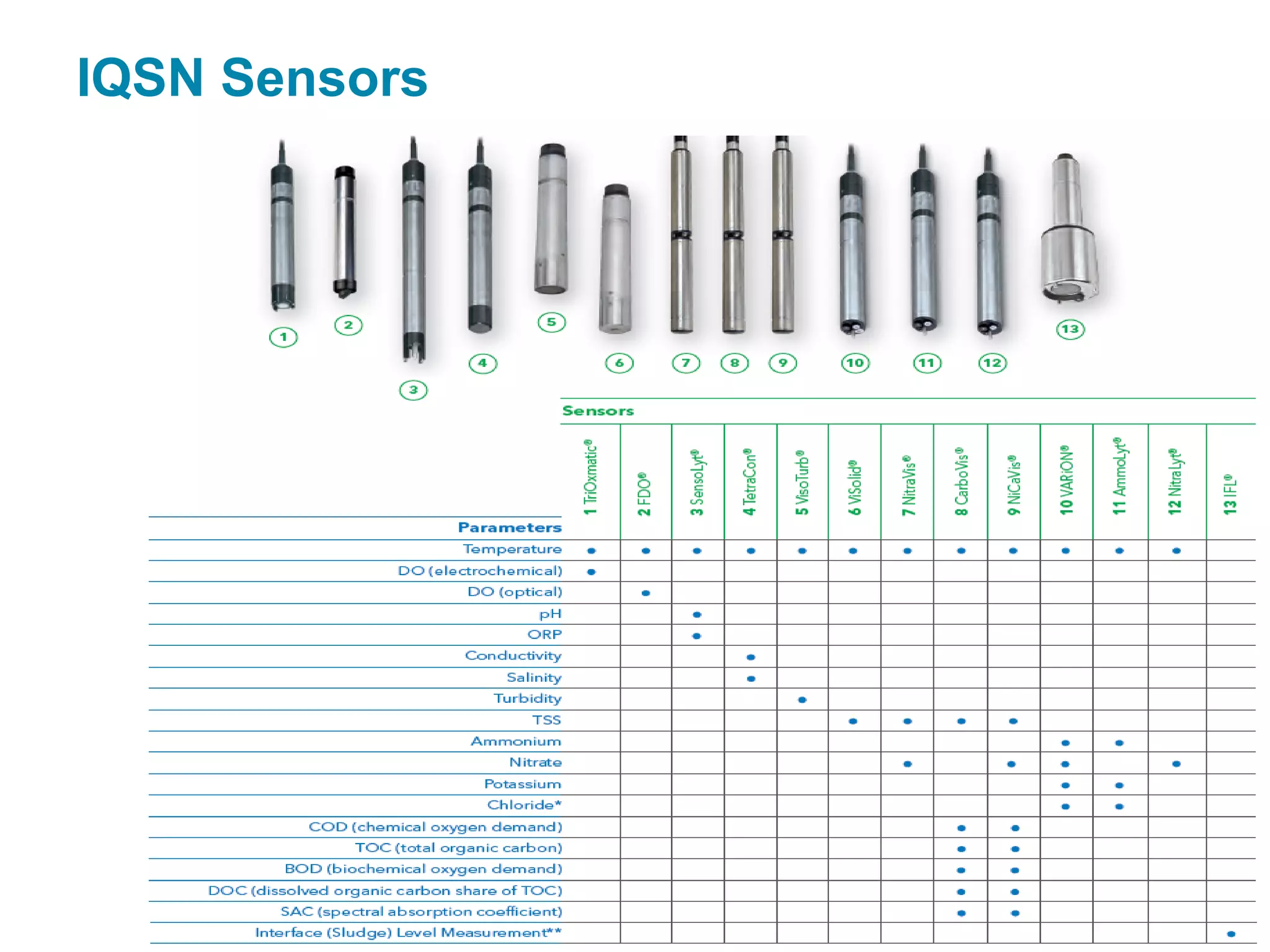
IQSN Sensors
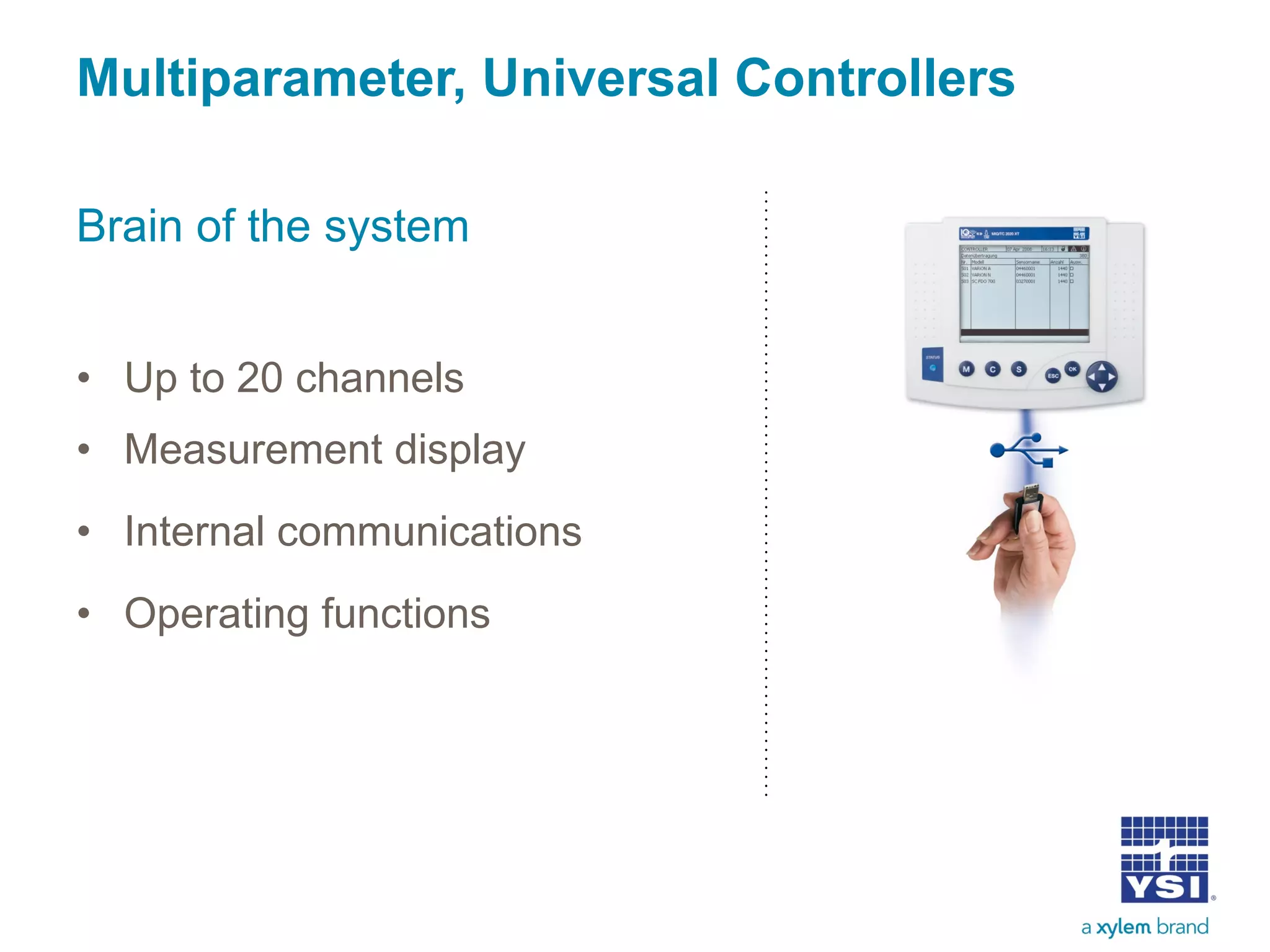
Multiparameter, Universal Controllers
Brain of the system
• Up to 20 channels
• Measurement display
• Internal communications
• Operating functions
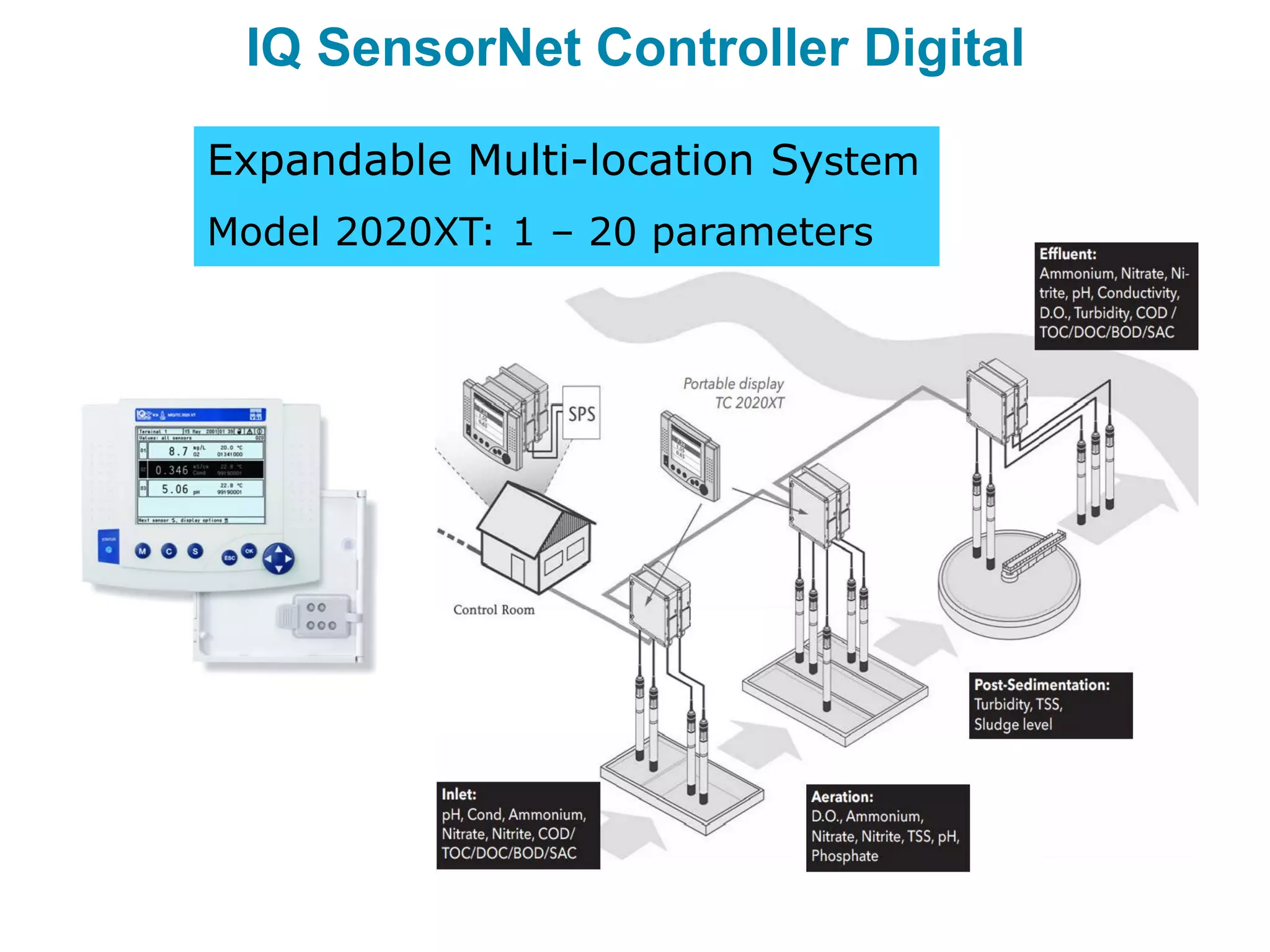
IQ SensorNet Controller Digital
Expandable Multi-location System
Model 2020XT: 1 – 20 parameters
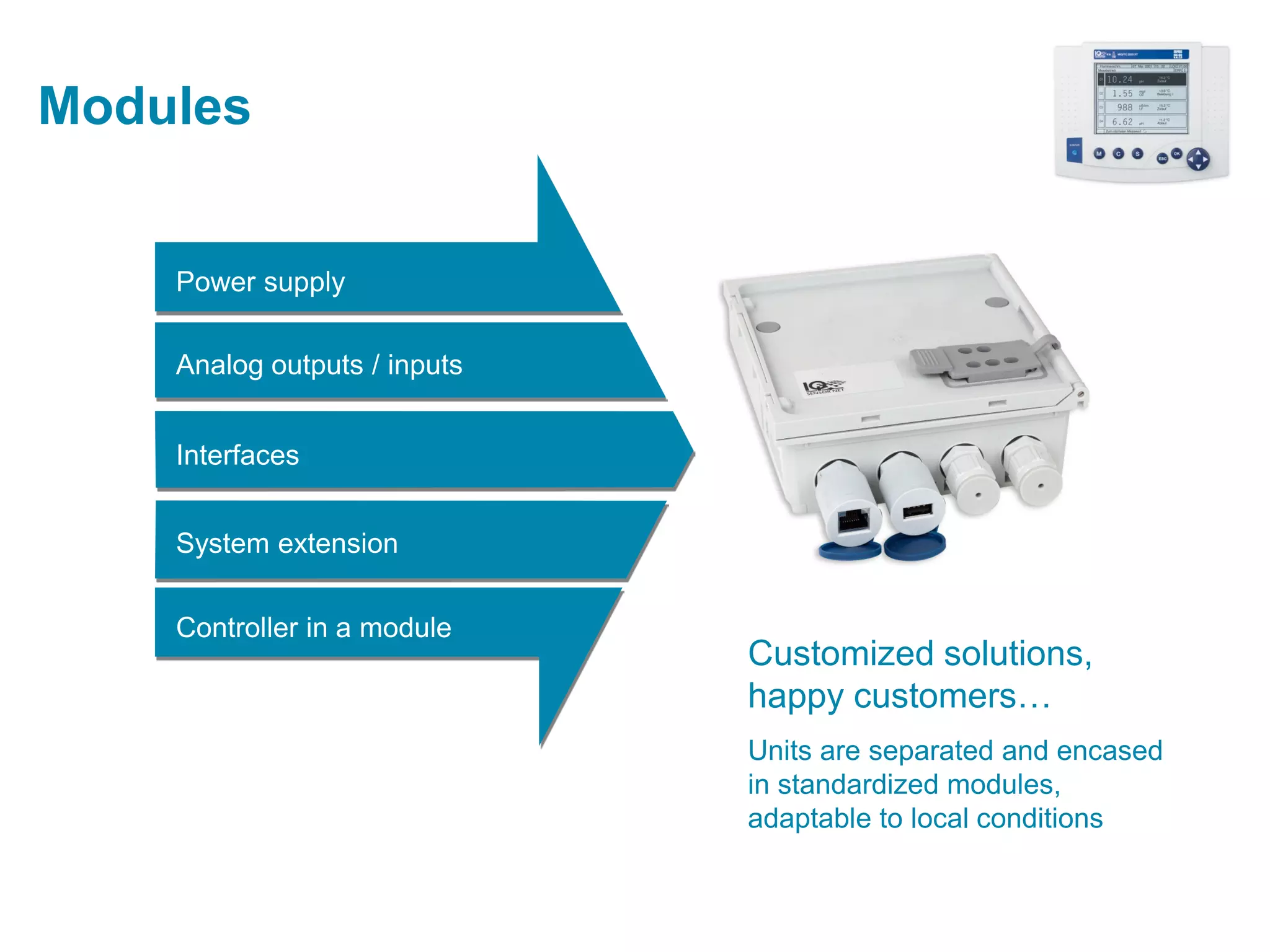
Customized solutions,
happy customers…
Units are separated and encased
in standardized modules,
adaptable to local conditions
Power supply
Analog outputs / inputs
Interfaces
System extension
Controller in a module
Modules
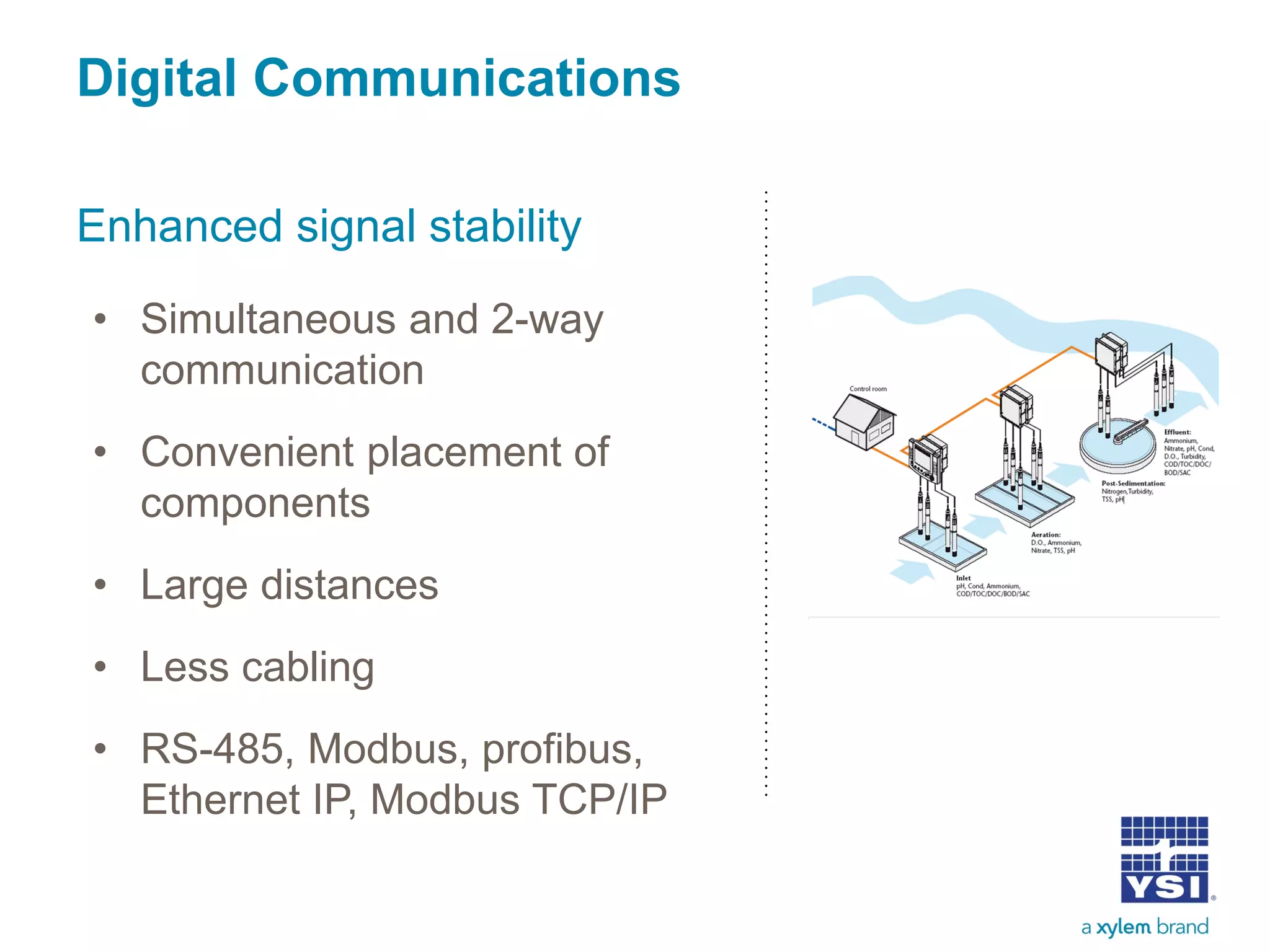
Digital Communications
Enhanced signal stability
• Simultaneous and 2-way
communication
• Convenient placement of
components
• Large distances
• Less cabling
• RS-485, Modbus, profibus,
Ethernet IP, Modbus TCP/IP
Dissolved Oxygen
(Optical)
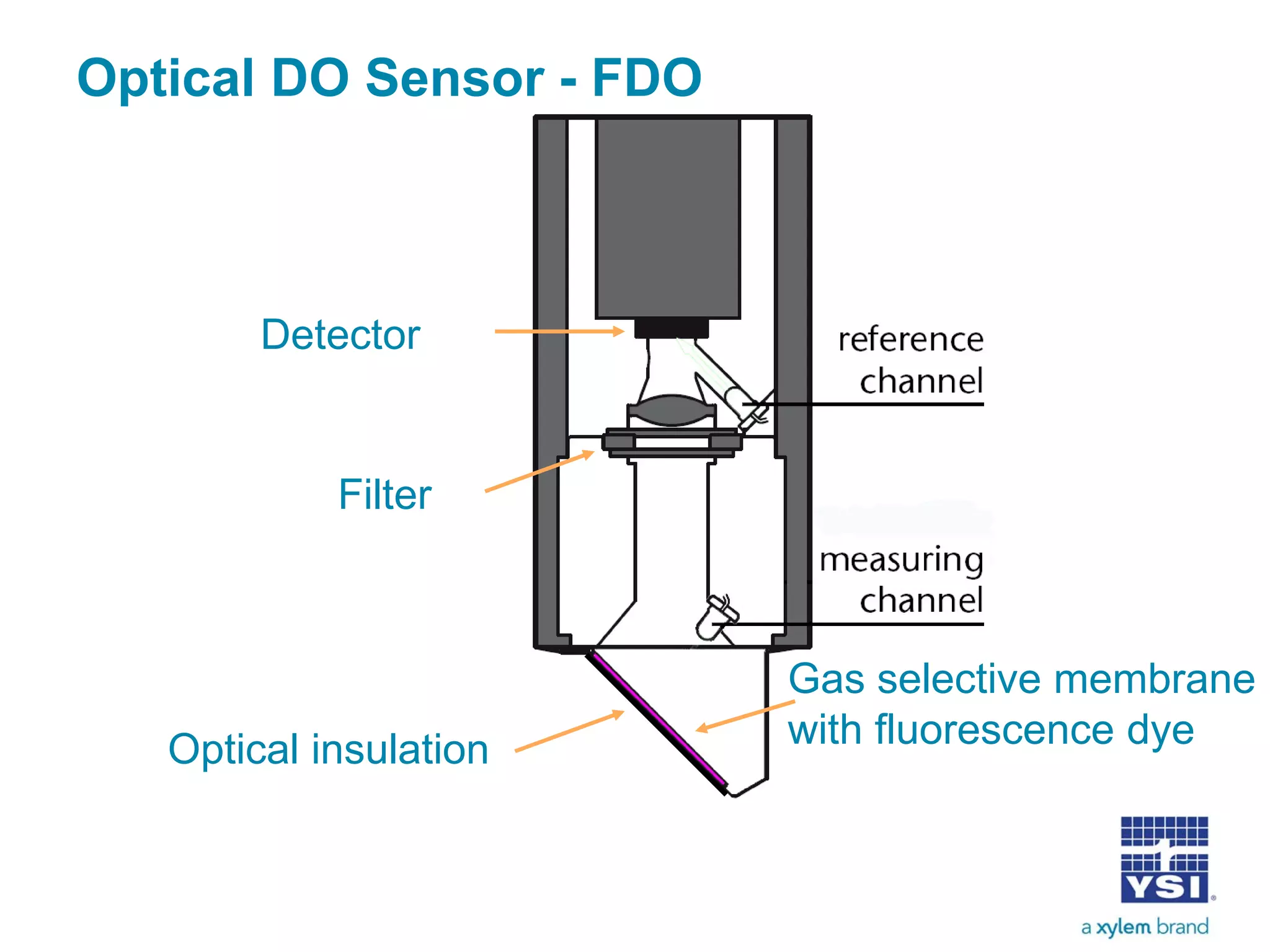
Optical insulation
Filter
Detector
Optical DO Sensor - FDO
Gas selective membrane
with fluorescence dye
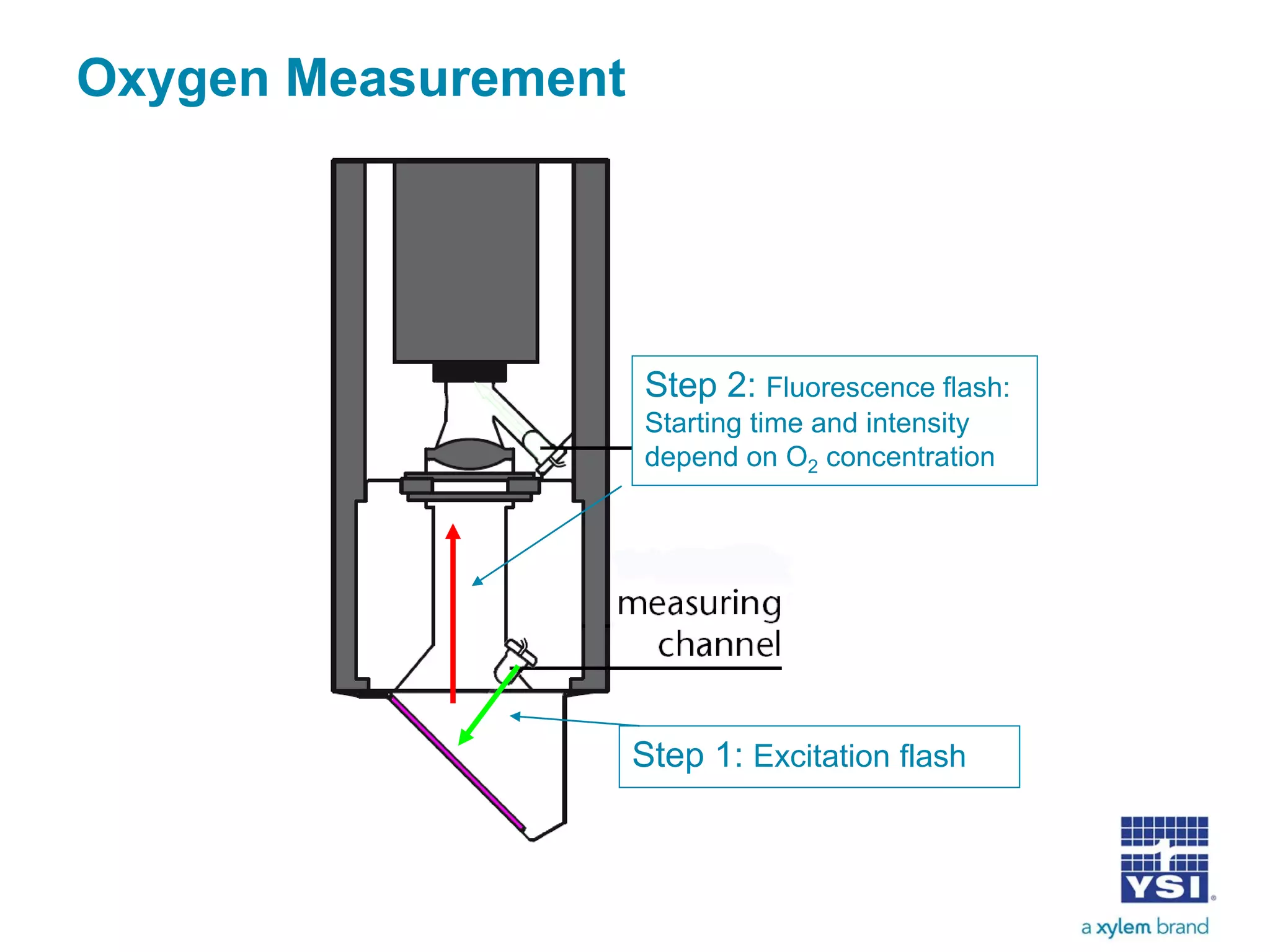
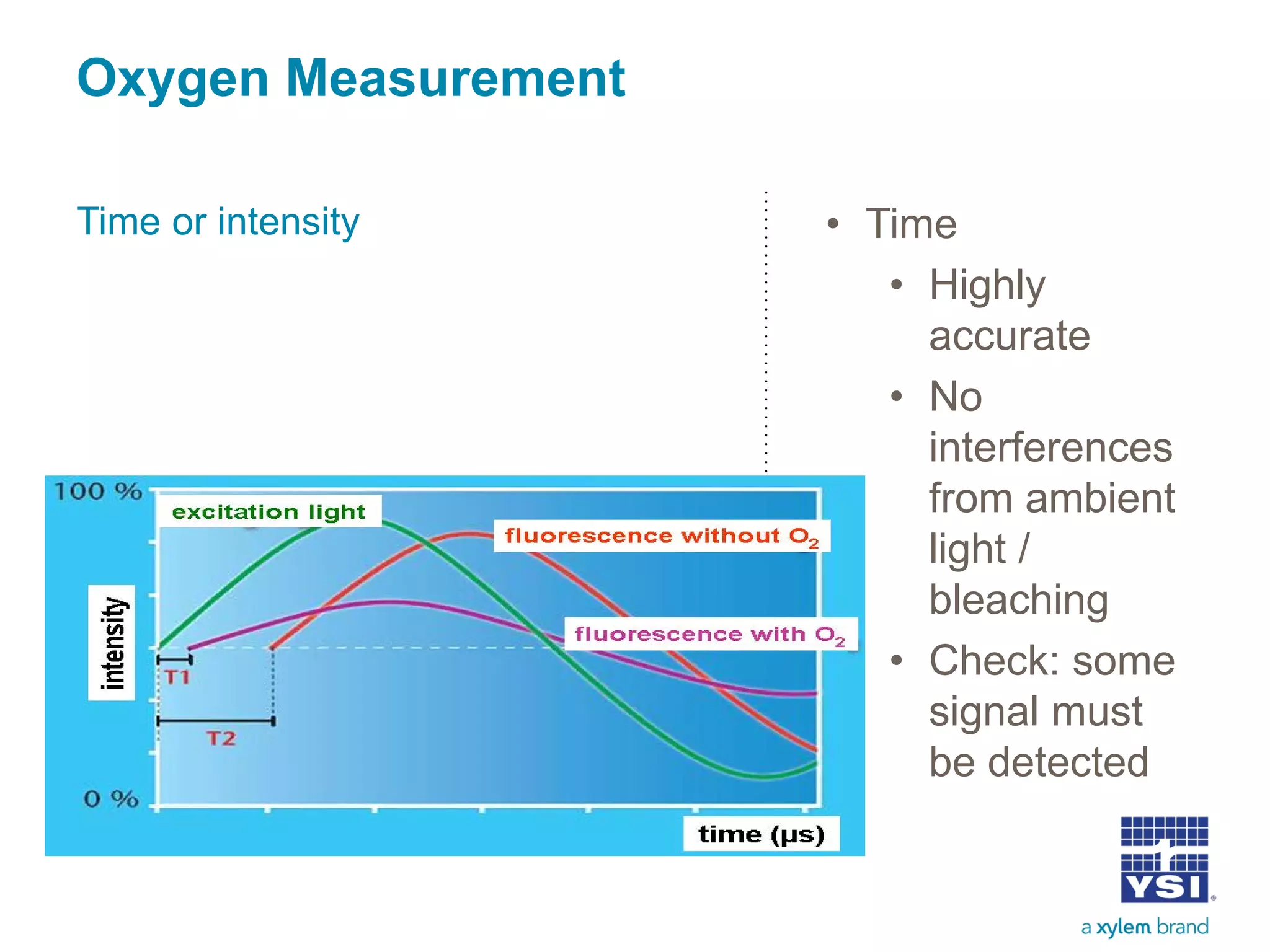
Step 1: Excitation flash
Step 2: Fluorescence flash:
Starting time and intensity
depend on O2 concentration
Oxygen Measurement
Oxygen Measurement
Time or intensity • Time
• Highly
accurate
• No
interferences
from ambient
light /
bleaching
• Check: some
signal must
be detected
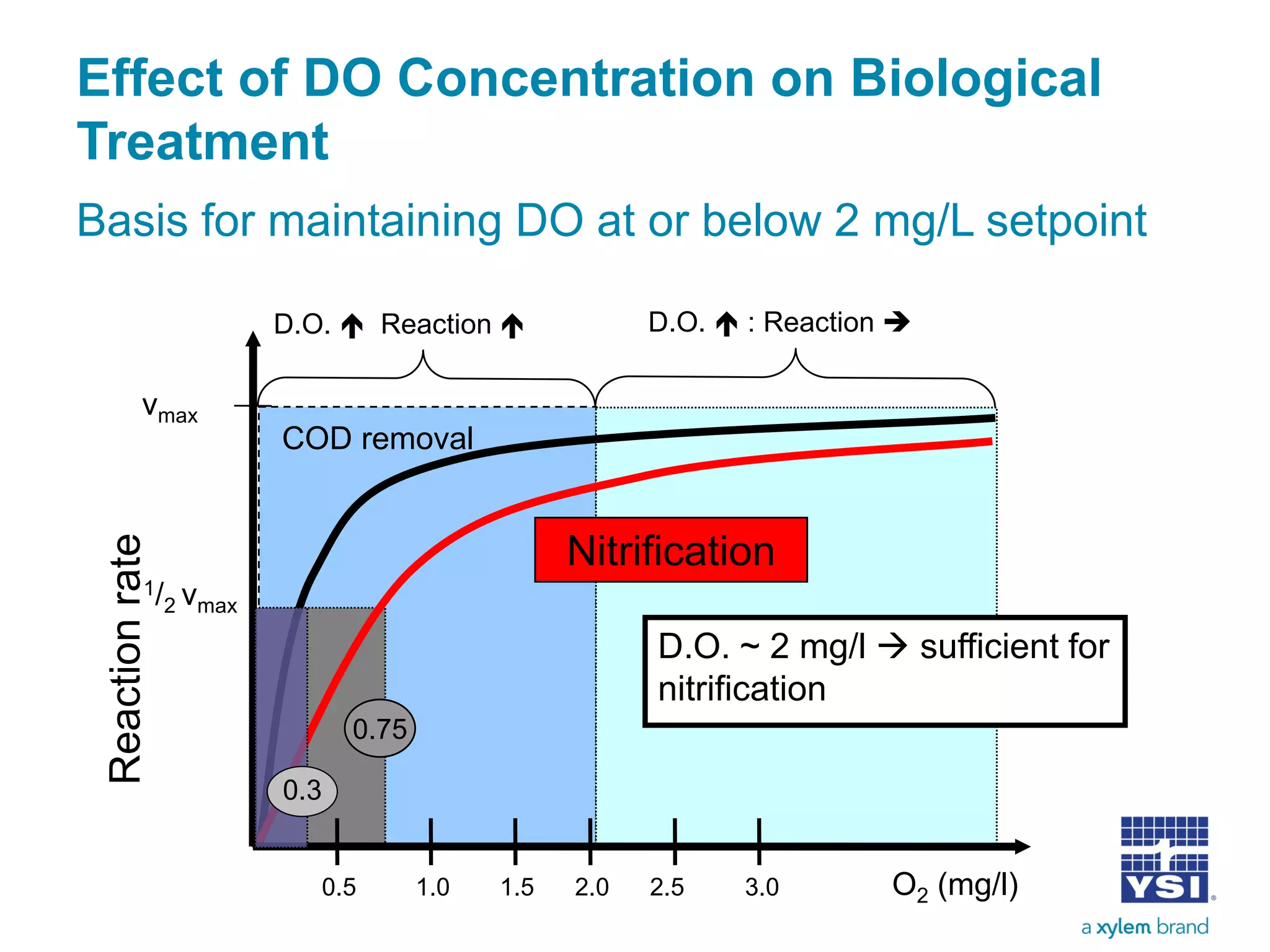
Effect of DO Concentration on Biological
Treatment
Basis for maintaining DO at or below 2 mg/L setpoint
D.O.  Reaction 
0.75
D.O.  : Reaction 
D.O. ~ 2 mg/l  sufficient for
nitrification
COD removal
Nitrification
0.5 1.0 2.01.5 2.5 3.0 O2 (mg/l)
1/2 vmax
vmax
Reactionrate
0.3
Automated DO Control Alternatives
• On-off
• Mixing required
• Never at setpoint
• Direct control of airflow
• Difficult control problem - DO vs. airflow non-linear
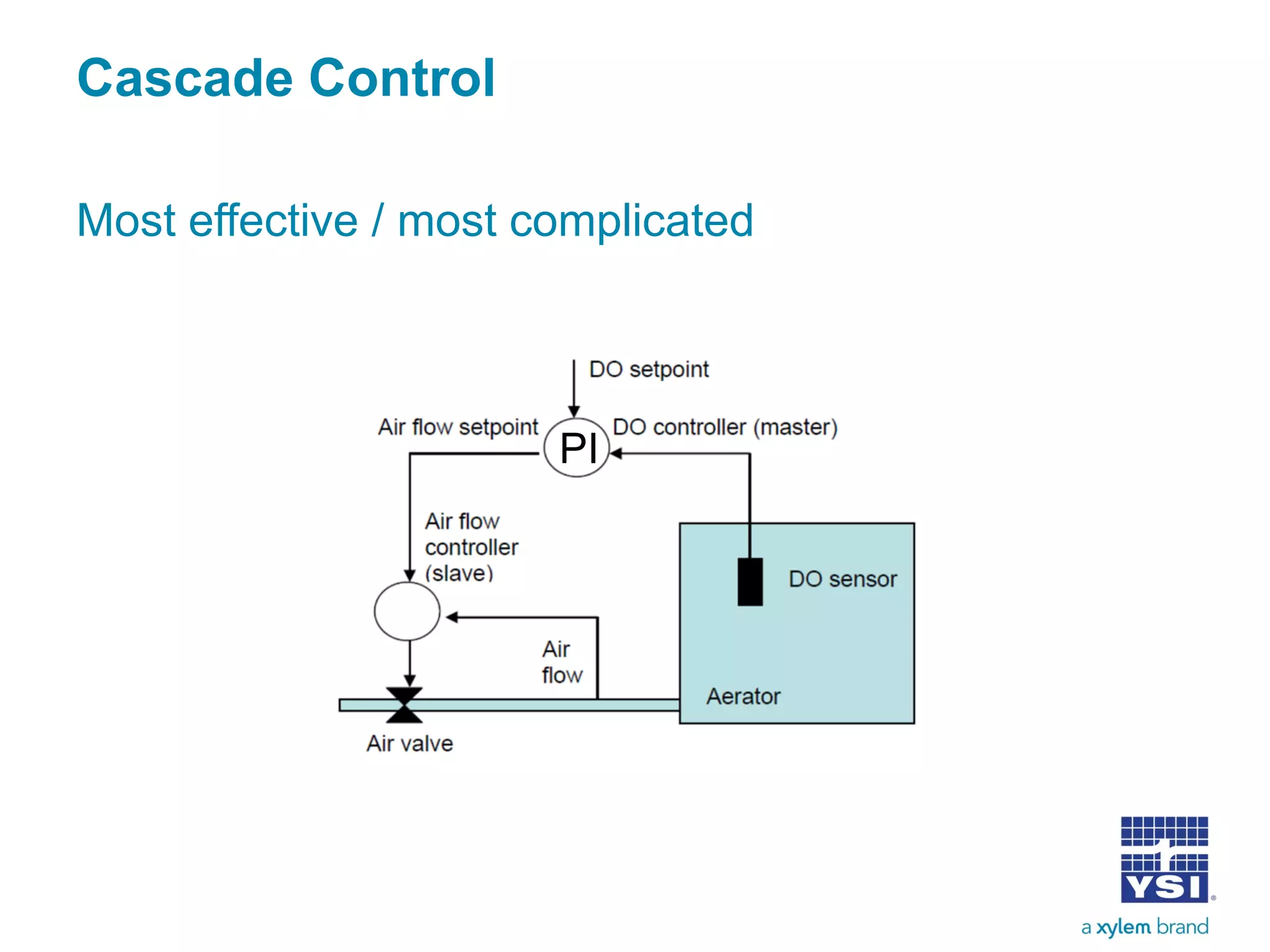
Cascade Control
Most effective / most complicated
PI
FDO 700 IQ
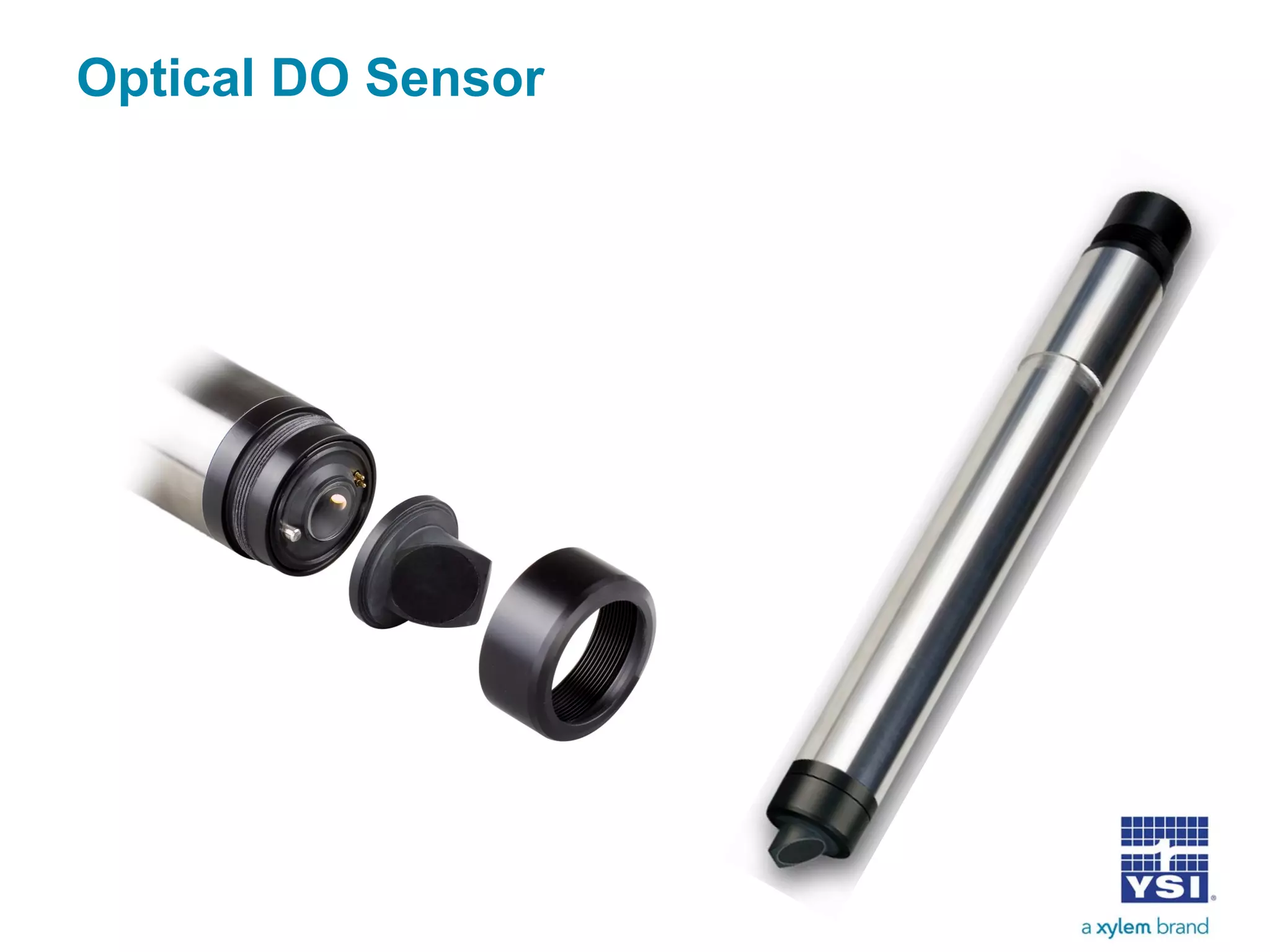
Optical DO Sensor
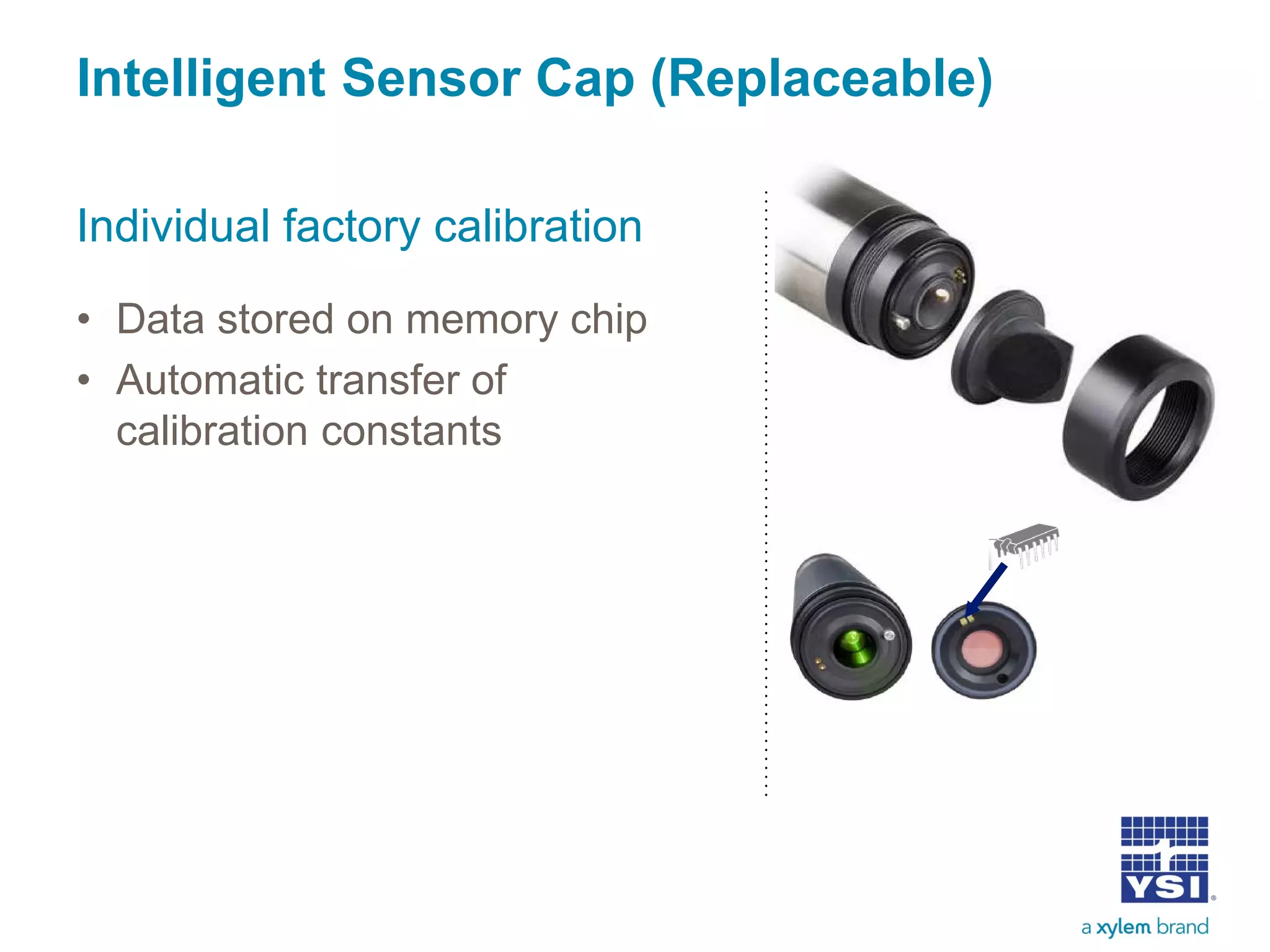
Intelligent Sensor Cap (Replaceable)
• Data stored on memory chip
• Automatic transfer of
calibration constants
Individual factory calibration
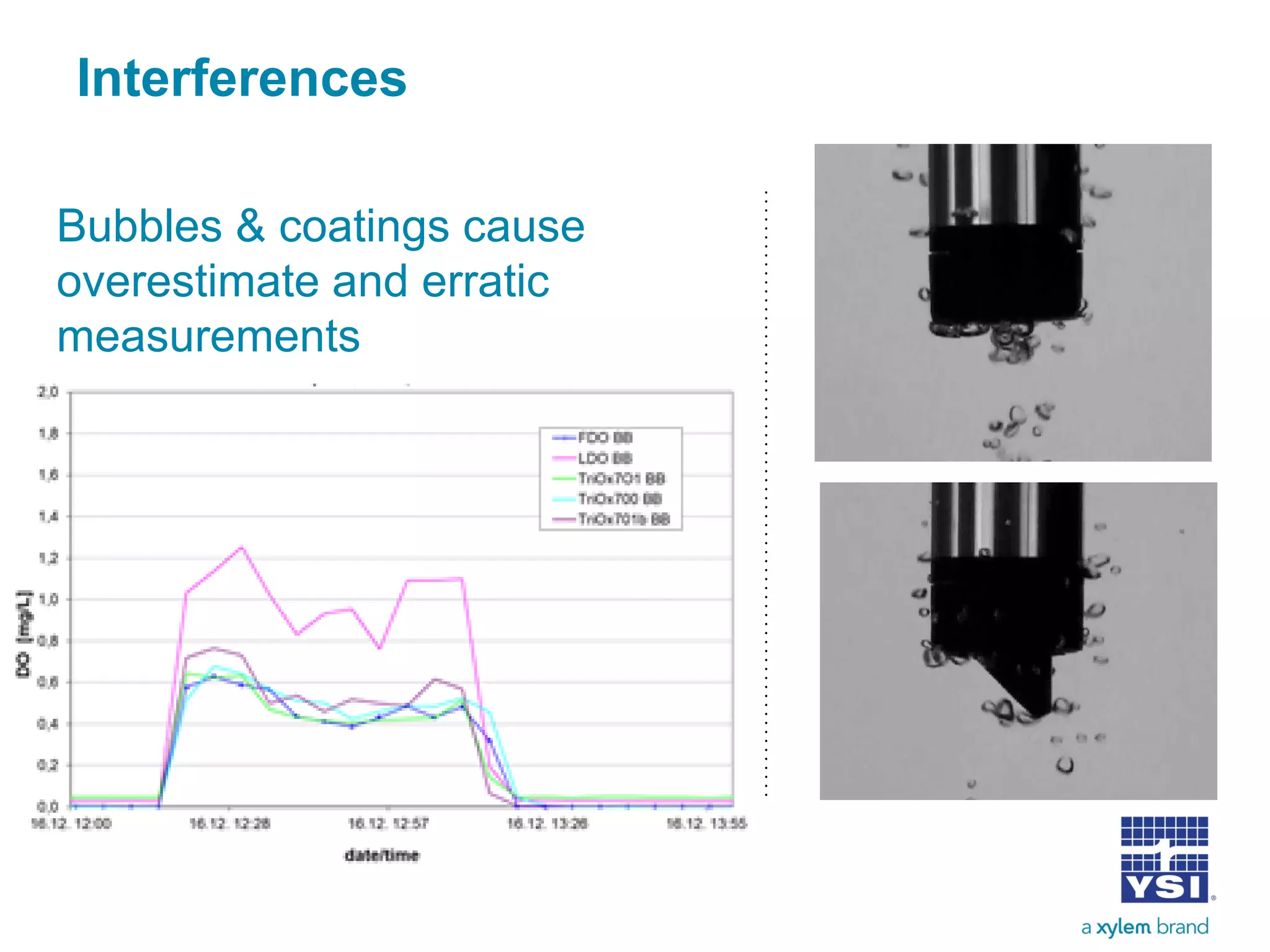
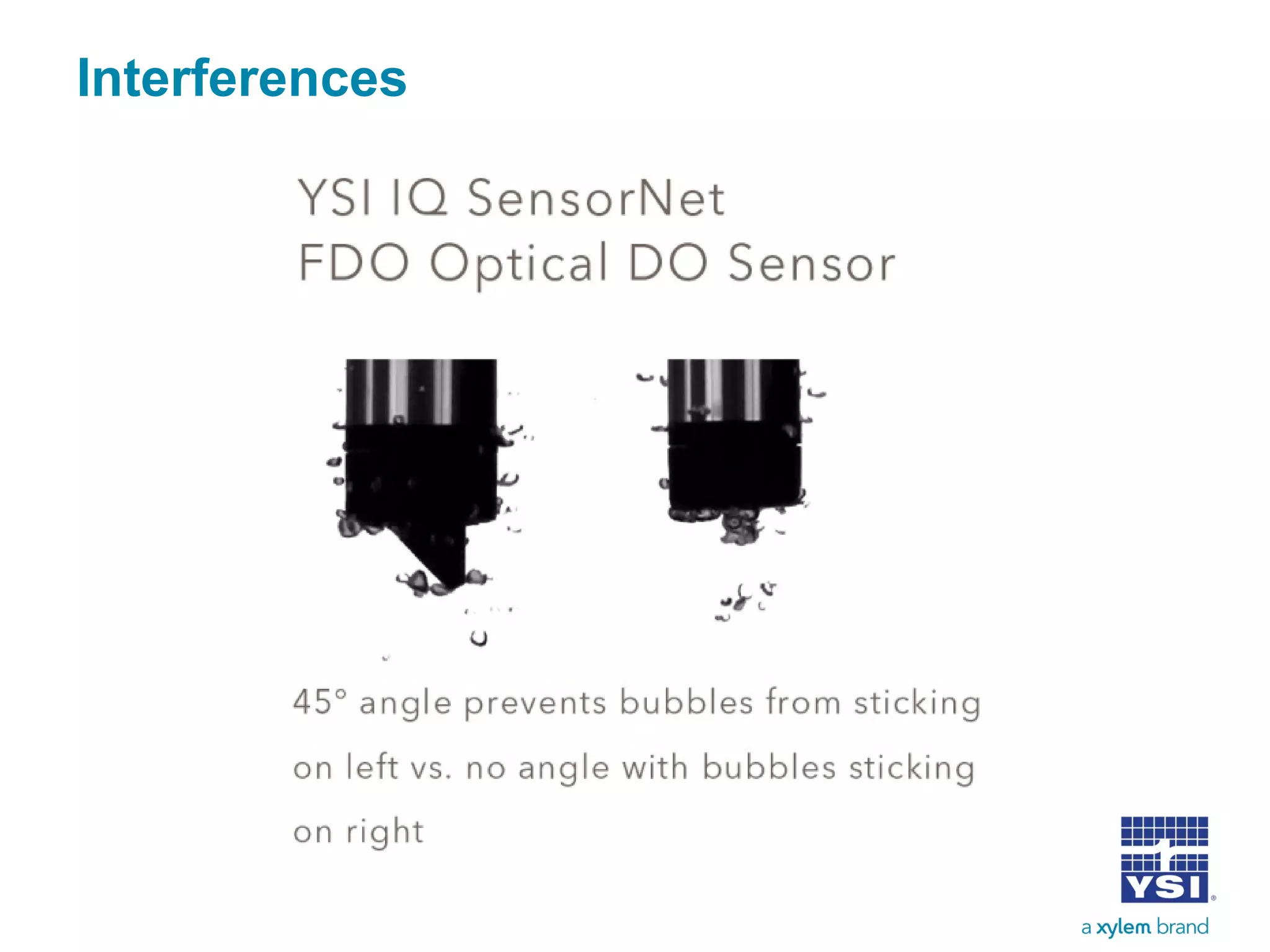
Interferences
Bubbles & coatings cause
overestimate and erratic
measurements
Interferences
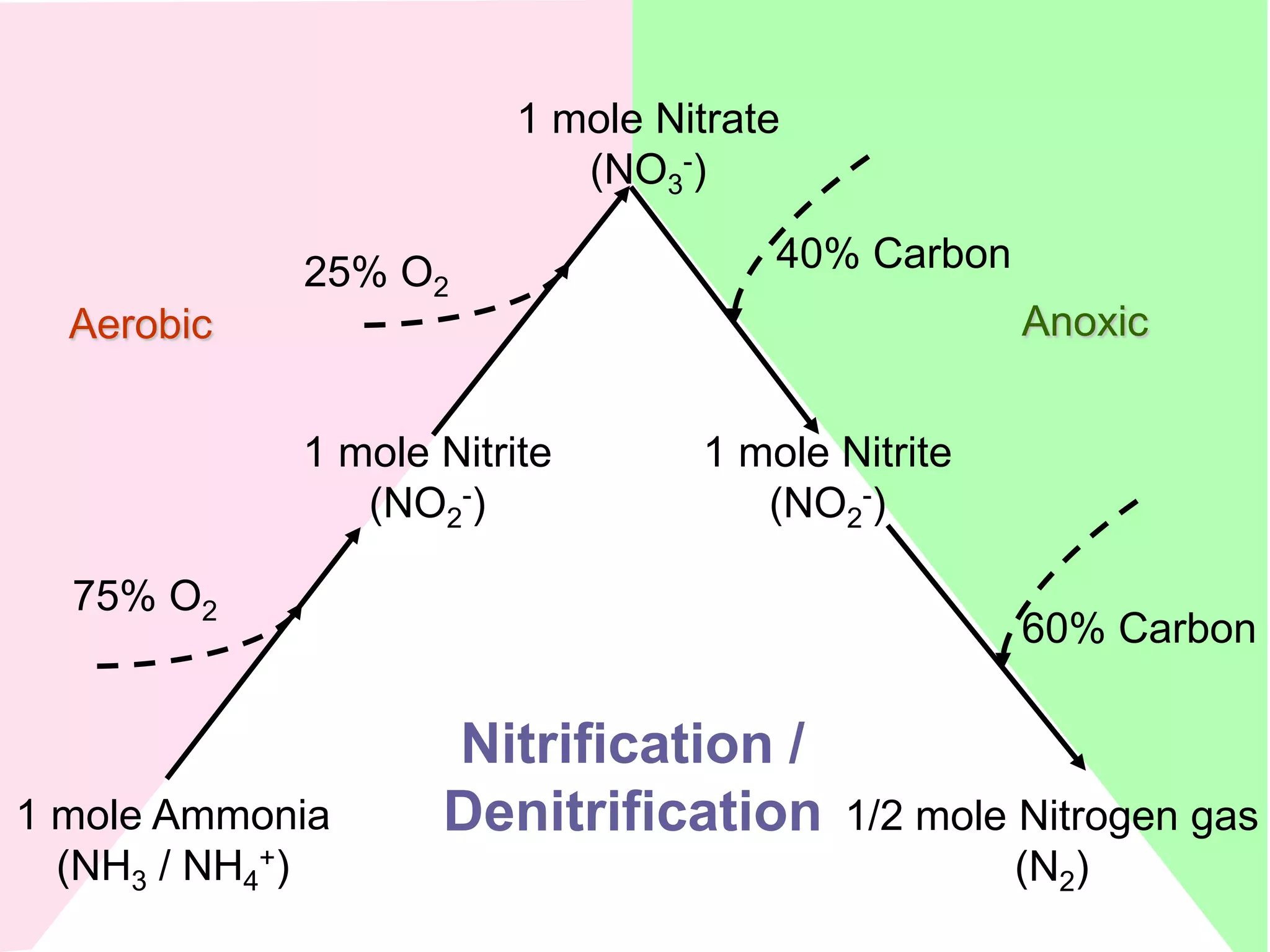
Nitrogen Removal – The
Traditional Way
1 mole Ammonia
(NH3 / NH4
+)
1 mole Nitrite
(NO2
-)
1 mole Nitrate
(NO3
-)
1 mole Nitrite
(NO2
-)
1/2 mole Nitrogen gas
(N2)
75% O2
25% O2
40% Carbon
60% Carbon
Nitrification /
Denitrification
Aerobic Anoxic
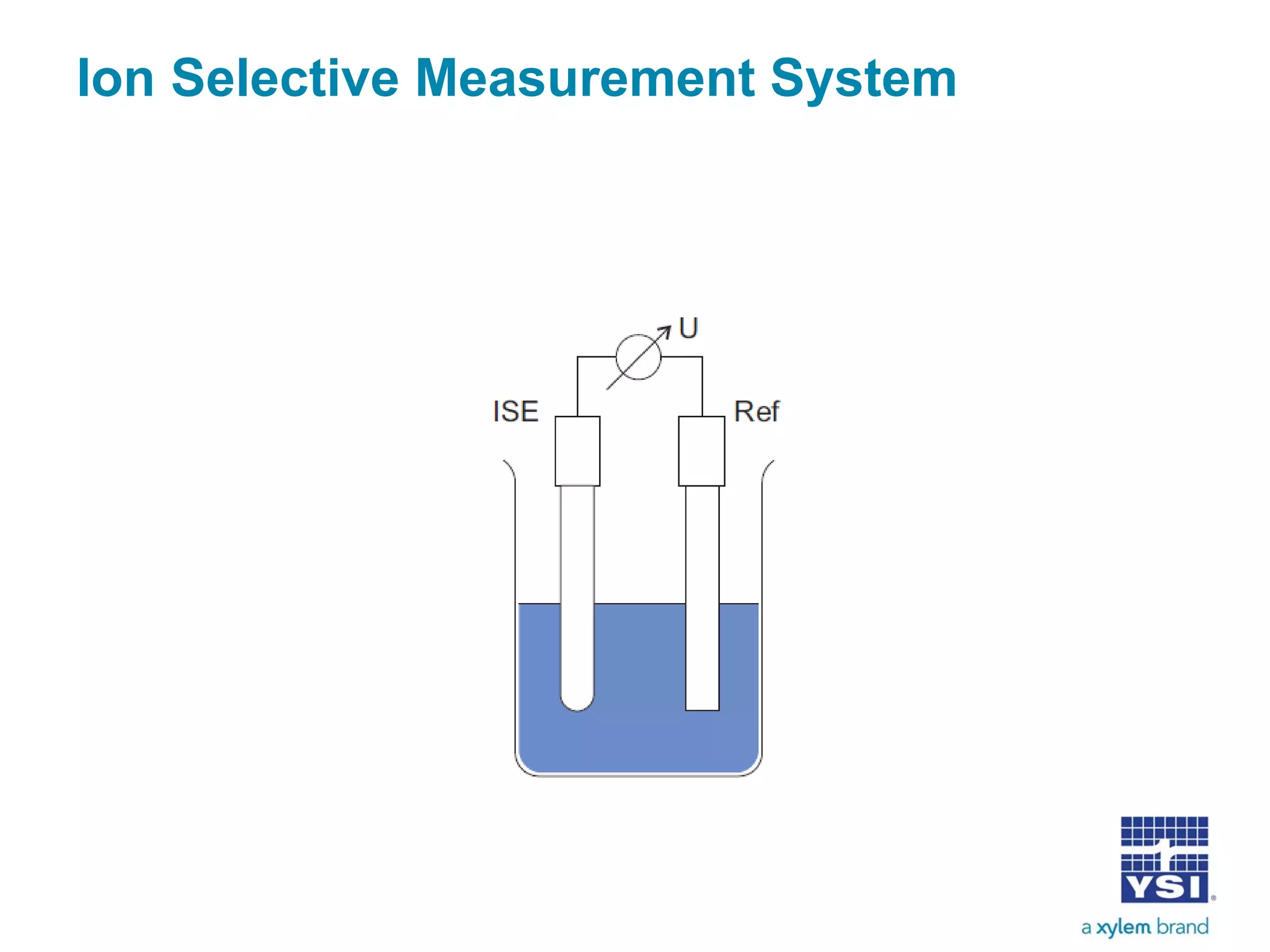
Ion Selective Measurement System
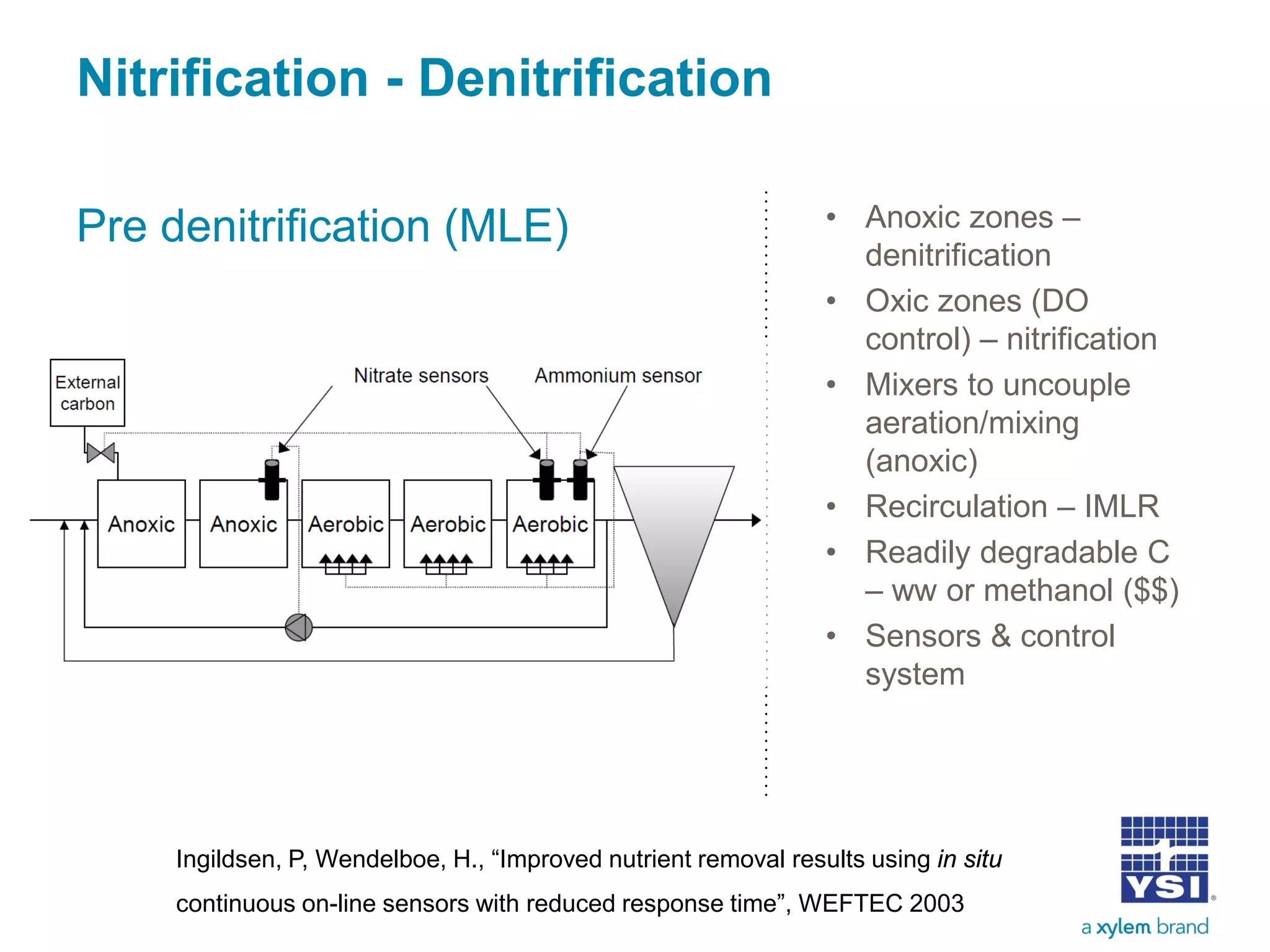
Nitrification - Denitrification
Pre denitrification (MLE) • Anoxic zones –
denitrification
• Oxic zones (DO
control) – nitrification
• Mixers to uncouple
aeration/mixing
(anoxic)
• Recirculation – IMLR
• Readily degradable C
– ww or methanol ($$)
• Sensors & control
system
Ingildsen, P, Wendelboe, H., “Improved nutrient removal results using in situ
continuous on-line sensors with reduced response time”, WEFTEC 2003
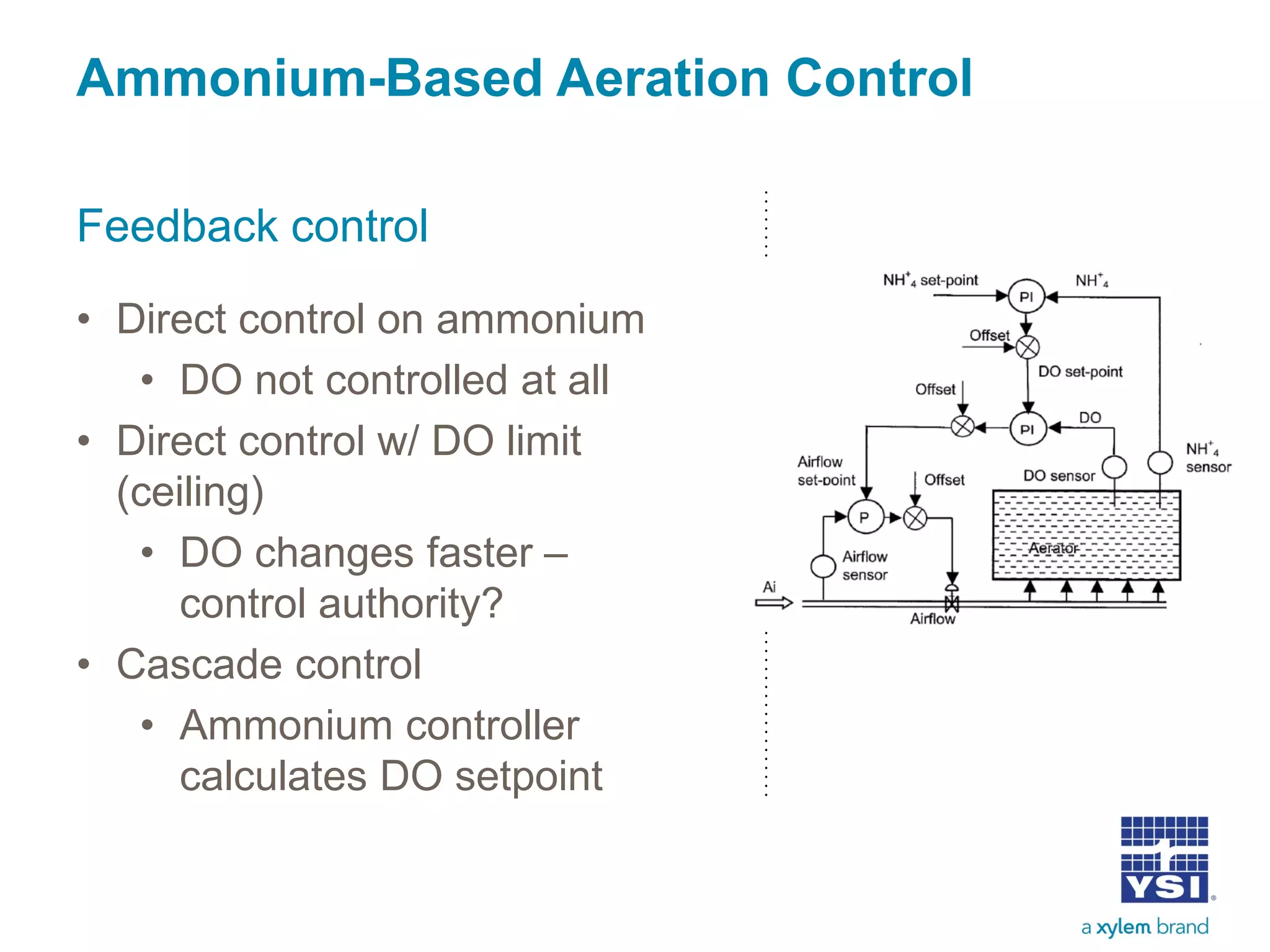
Ammonium-Based Aeration Control
Feedback control
• Direct control on ammonium
• DO not controlled at all
• Direct control w/ DO limit
(ceiling)
• DO changes faster –
control authority?
• Cascade control
• Ammonium controller
calculates DO setpoint
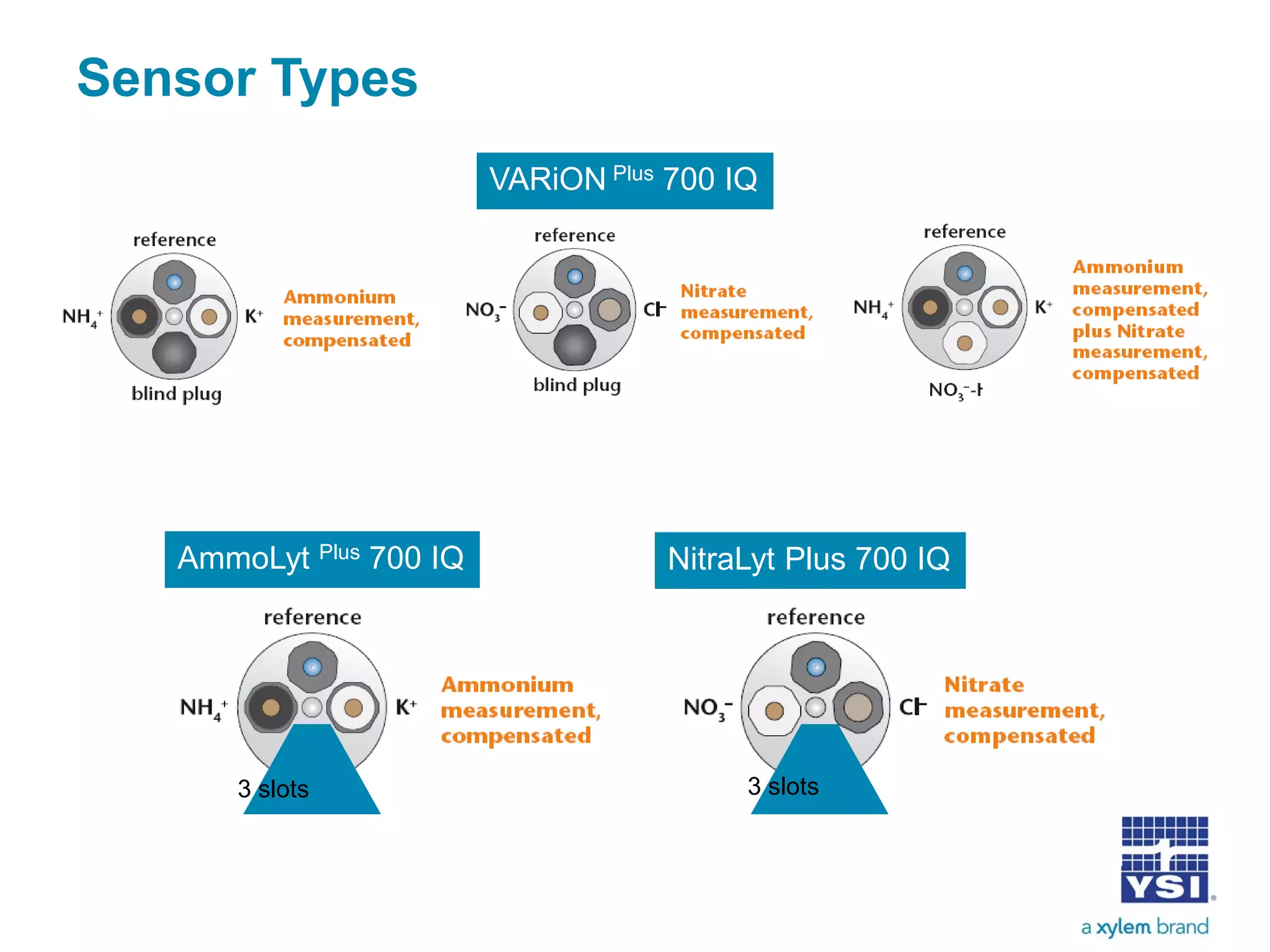
VARiON Plus 700 IQ, AmmoLyt Plus 700 IQ,
NitraLyt Plus 700 IQ - Nitrogen Measurement
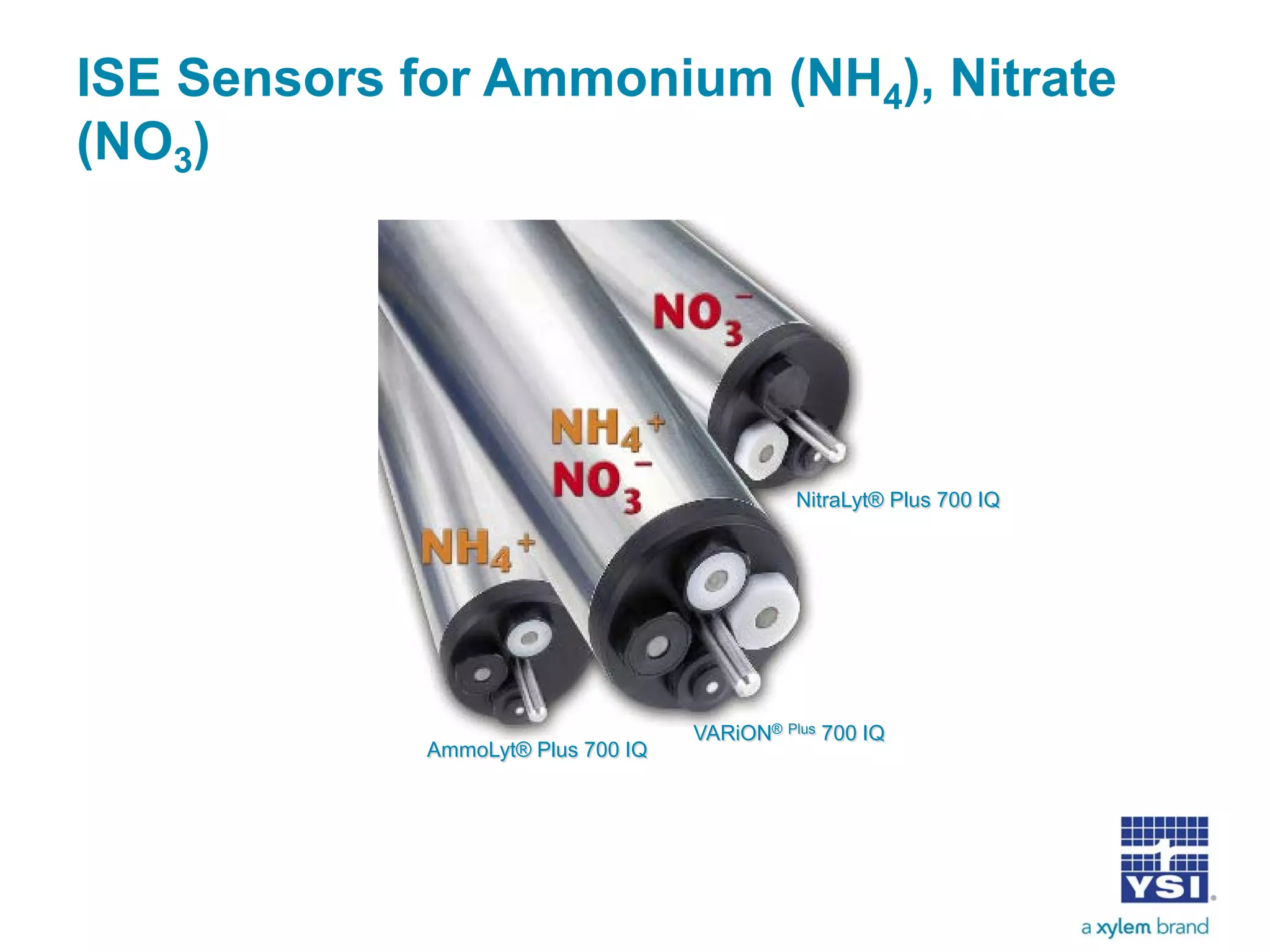
VARiON® Plus 700 IQ
AmmoLyt® Plus 700 IQ
NitraLyt® Plus 700 IQ
ISE Sensors for Ammonium (NH4), Nitrate
(NO3)
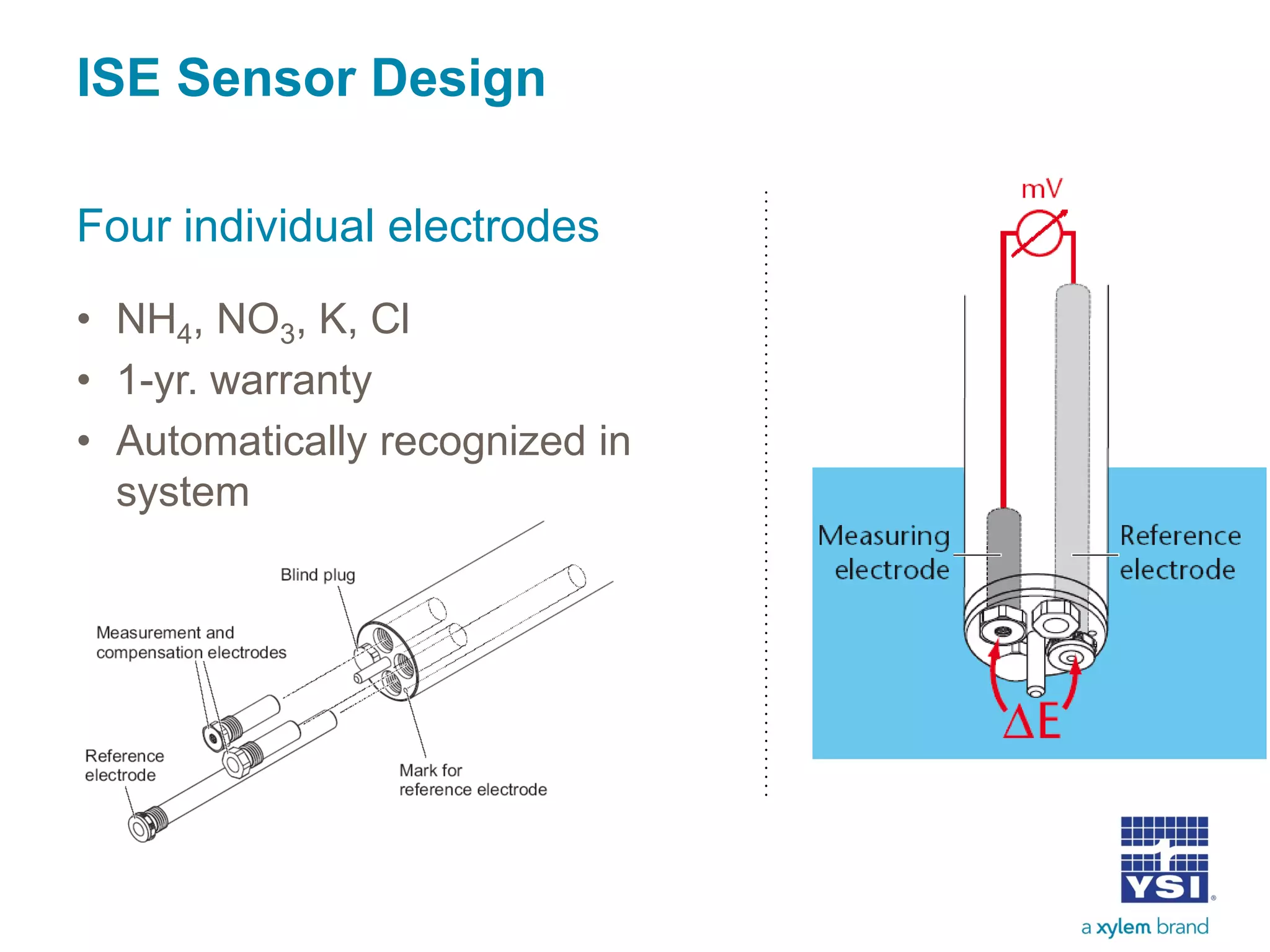
ISE Sensor Design
Four individual electrodes
• NH4, NO3, K, Cl
• 1-yr. warranty
• Automatically recognized in
system
AmmoLyt Plus 700 IQ NitraLyt Plus 700 IQ
VARiON Plus 700 IQ
3 slots 3 slots
Sensor Types
Total Suspended Solids
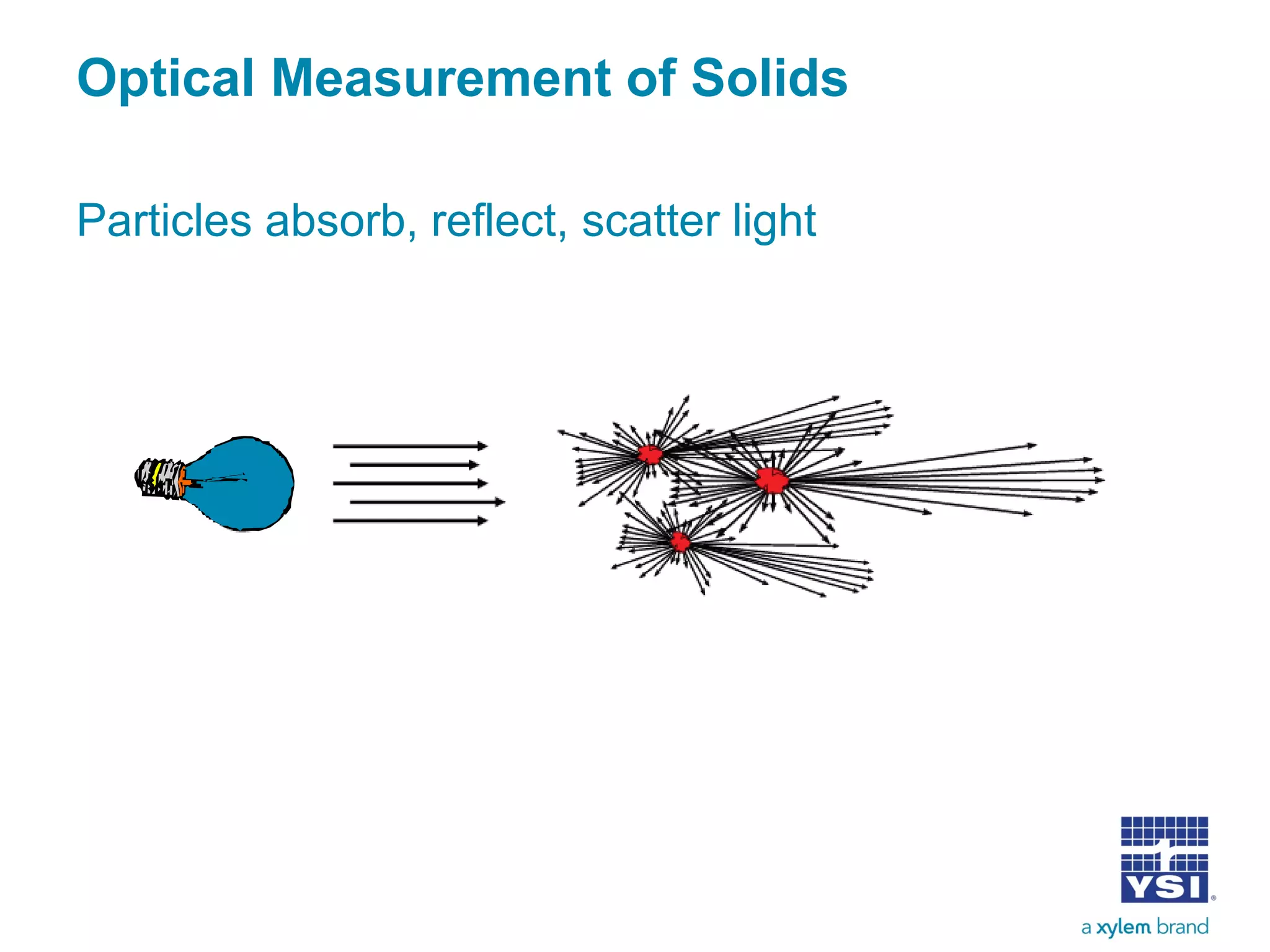
Optical Measurement of Solids
Particles absorb, reflect, scatter light
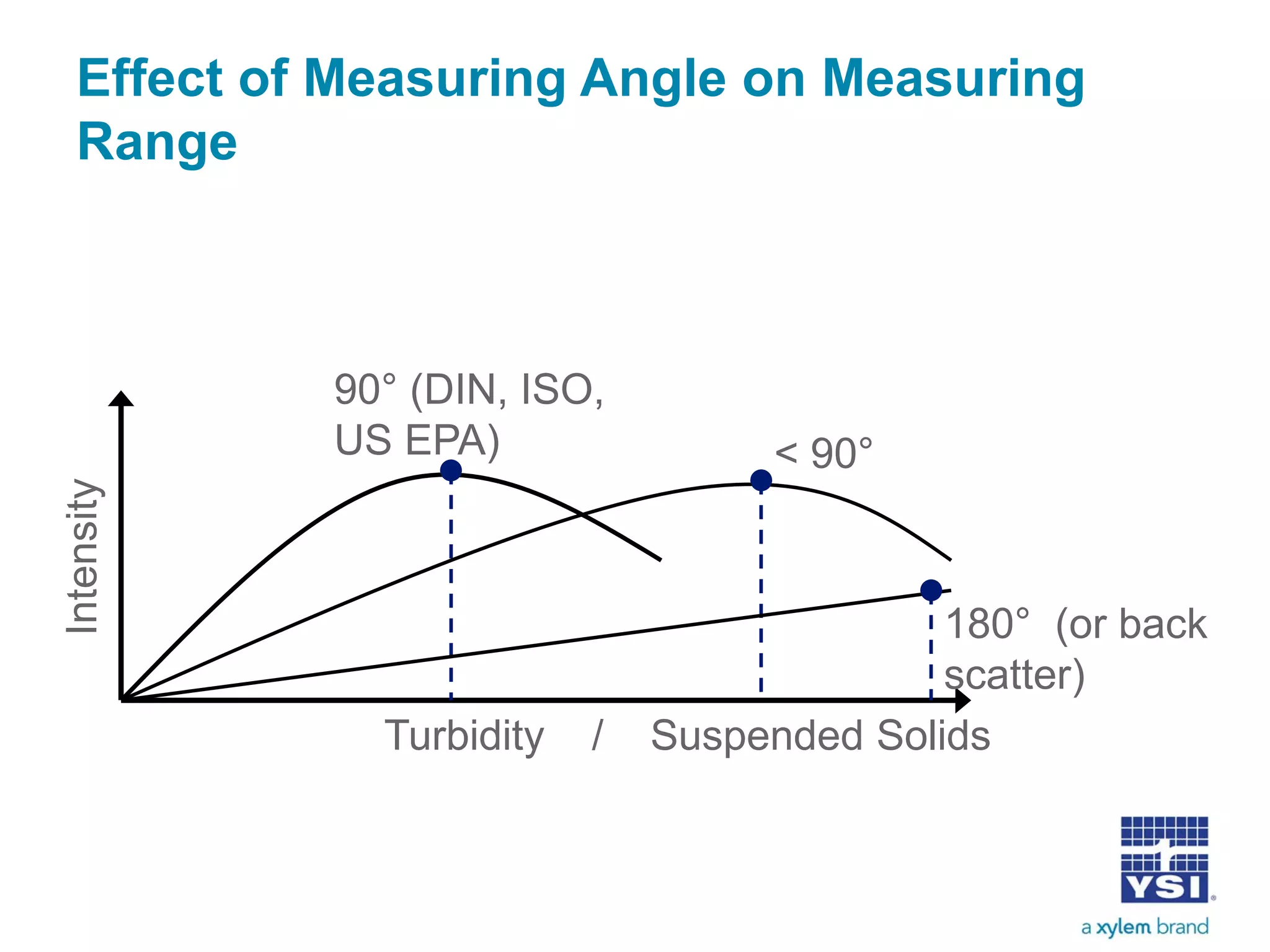
Intensity
Turbidity / Suspended Solids
90° (DIN, ISO,
US EPA) < 90°
180° (or back
scatter)
Effect of Measuring Angle on Measuring
Range
0.0
4.0
8.0
12.0
16.0
5 10 15 20 25
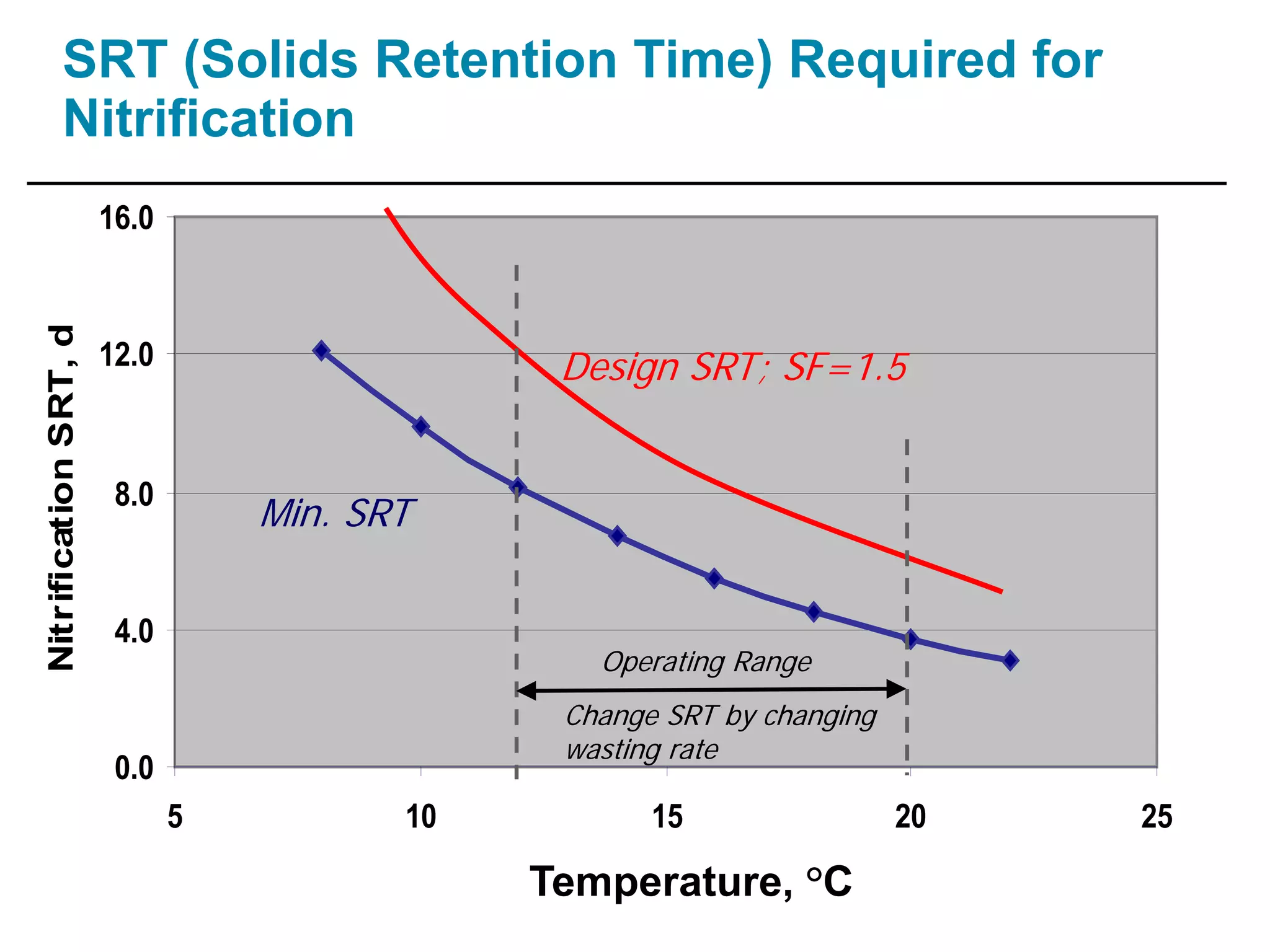
NitrificationSRT,dSRT (Solids Retention Time) Required for
Nitrification
Design SRT; SF=1.5
Operating Range
Change SRT by changing
wasting rate
Min. SRT
Temperature, °C
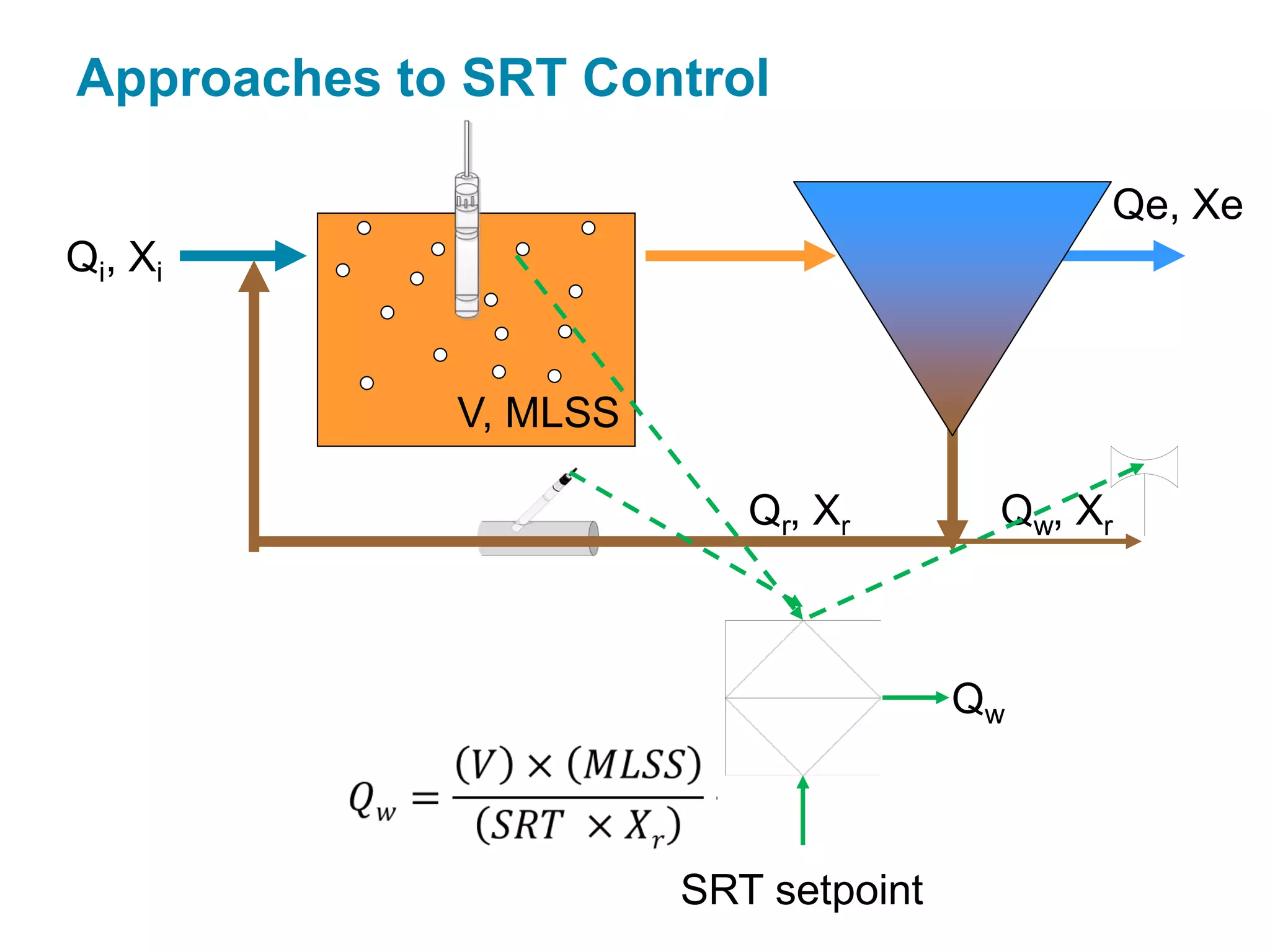
Approaches to SRT Control
Qe, Xe
V, MLSS
Qr, Xr Qw, Xr
Qi, Xi
SRT setpoint
Qw
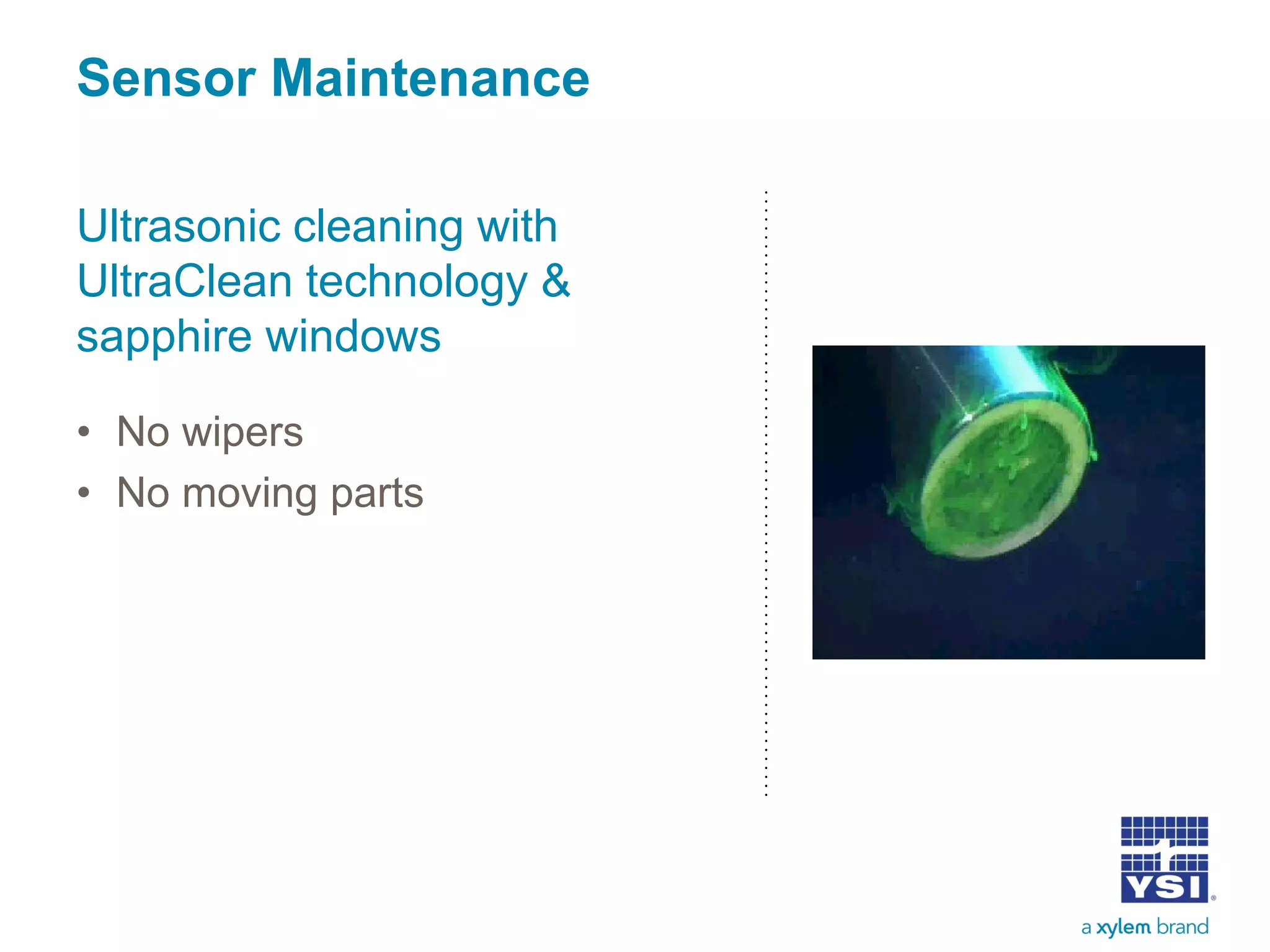
Sensor Maintenance
Ultrasonic cleaning with
UltraClean technology &
sapphire windows
• No wipers
• No moving parts
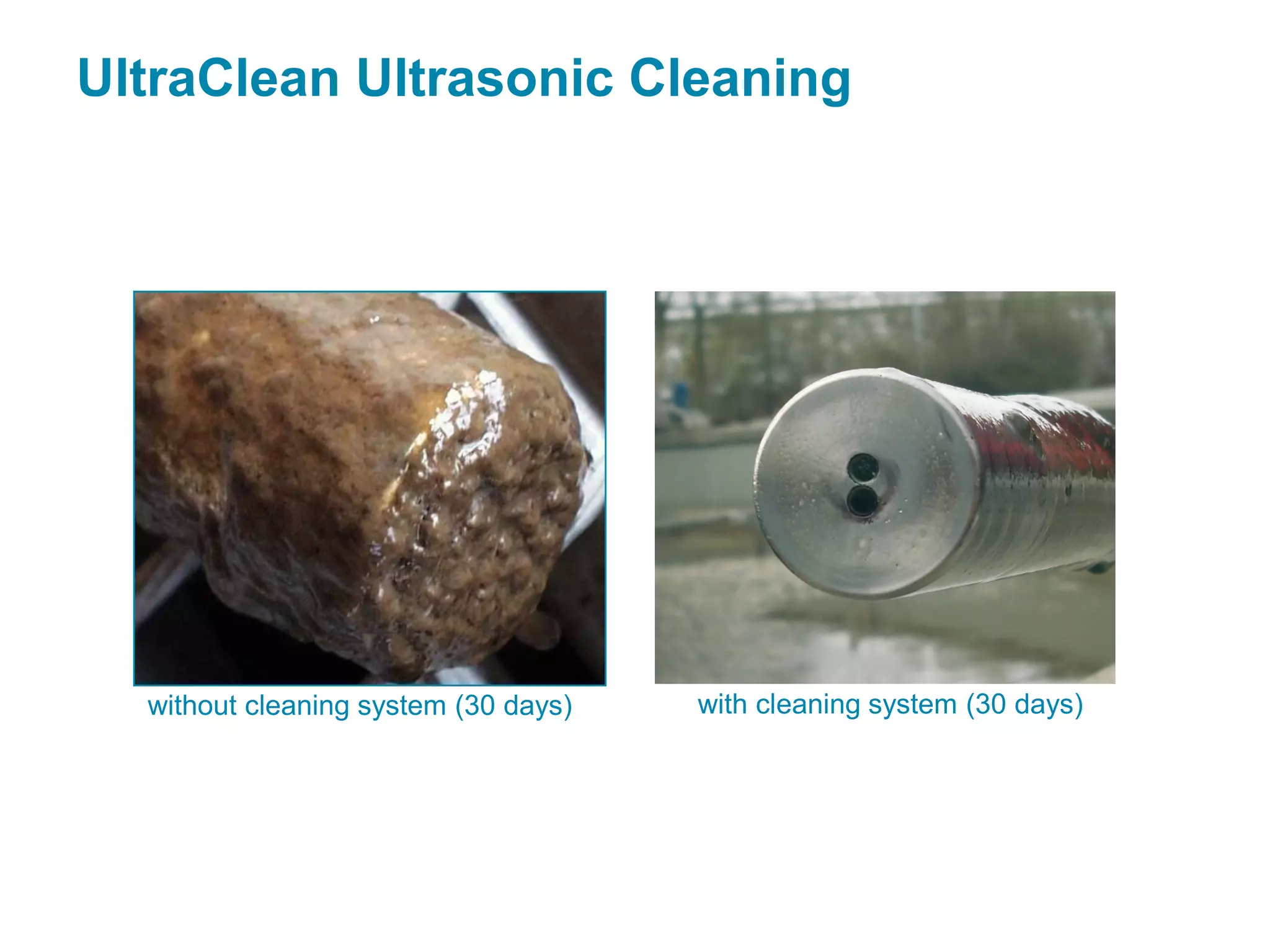
without cleaning system (30 days) with cleaning system (30 days)
UltraClean Ultrasonic Cleaning
Nitritation - Anammox
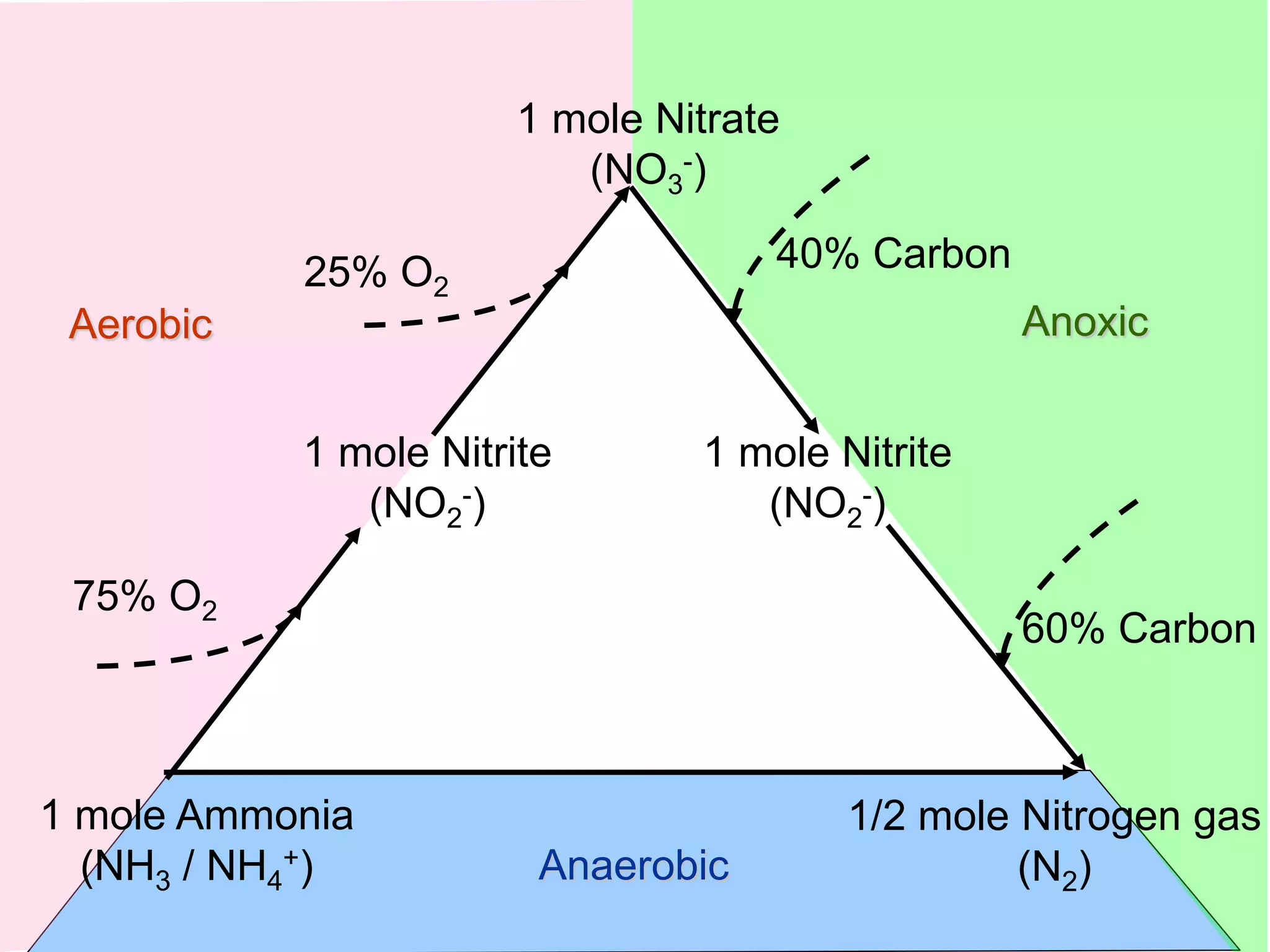
1 mole Ammonia
(NH3 / NH4
+)
1 mole Nitrite
(NO2
-)
1 mole Nitrate
(NO3
-)
1 mole Nitrite
(NO2
-)
1/2 mole Nitrogen gas
(N2)
75% O2
25% O2
40% Carbon
60% Carbon
Aerobic Anoxic
Anaerobic
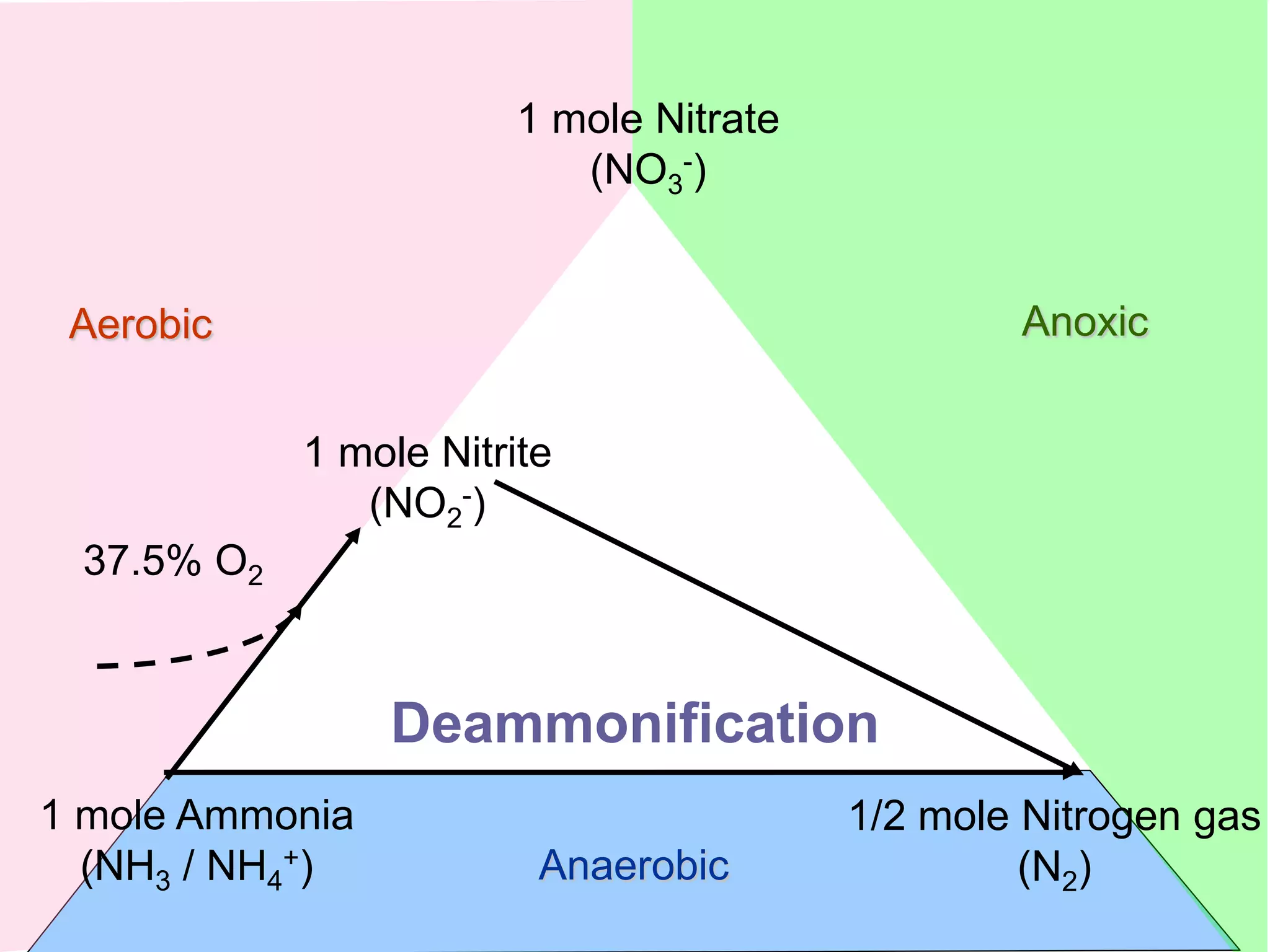
1 mole Ammonia
(NH3 / NH4
+)
1 mole Nitrite
(NO2
-)
1 mole Nitrate
(NO3
-)
1/2 mole Nitrogen gas
(N2)
Aerobic Anoxic
Deammonification
Anaerobic
37.5% O2
2013 WEF/IWA Nutrient Removal &
Recovery Conference
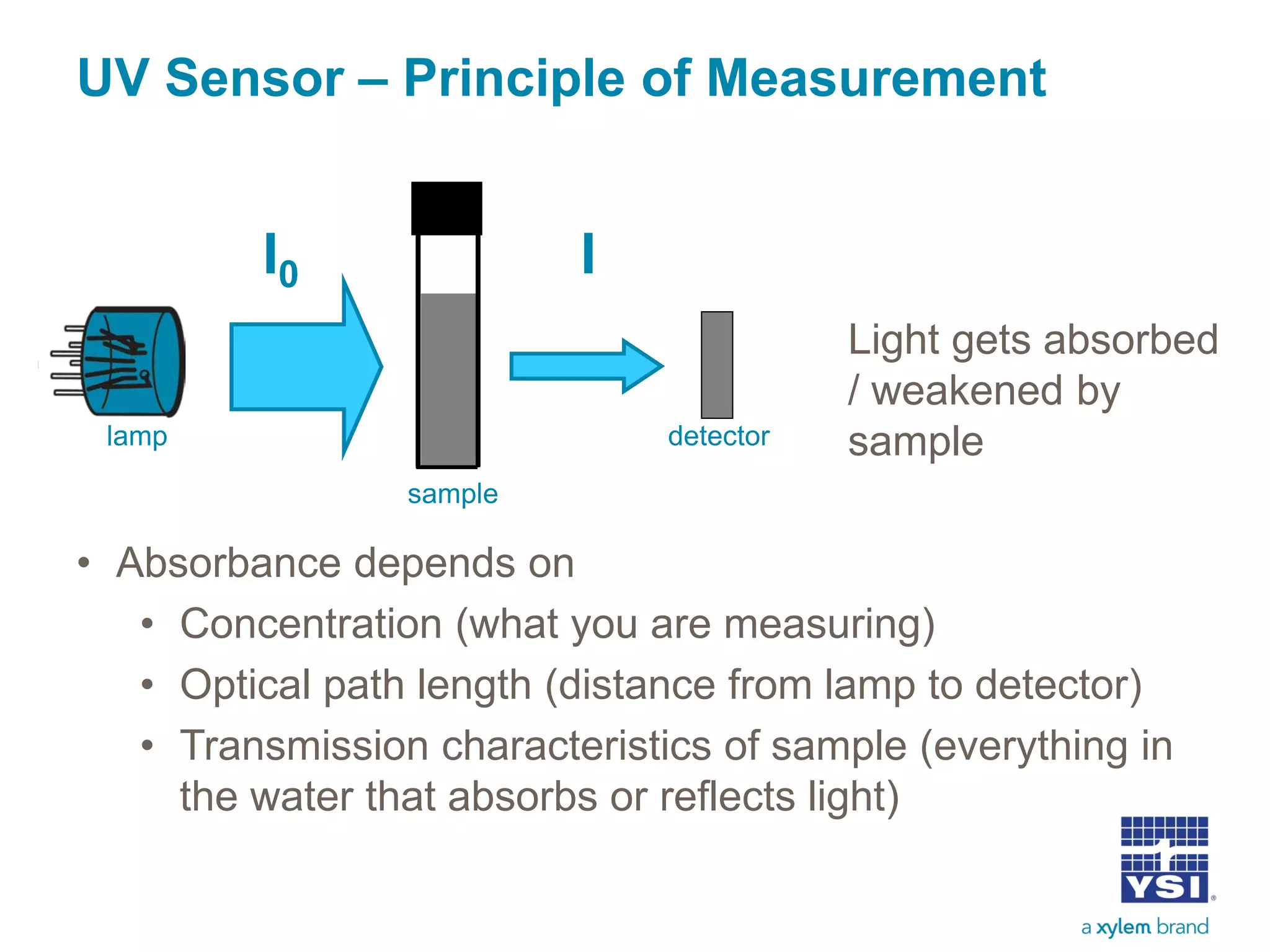
UV Sensor – Principle of Measurement
• Absorbance depends on
• Concentration (what you are measuring)
• Optical path length (distance from lamp to detector)
• Transmission characteristics of sample (everything in
the water that absorbs or reflects light)
lamp detector
I0 I
Light gets absorbed
/ weakened by
sample
sample
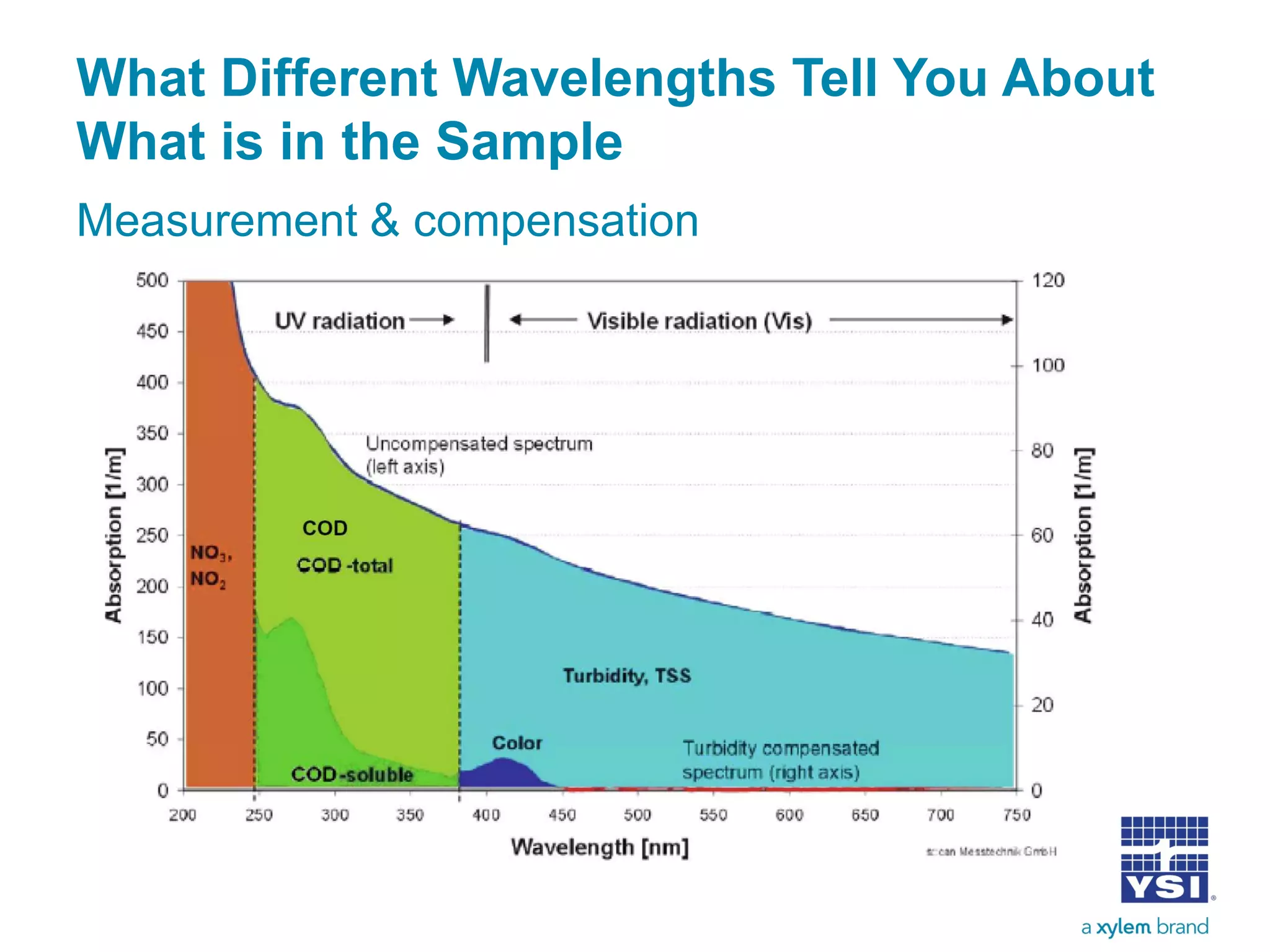
What Different Wavelengths Tell You About
What is in the Sample
Measurement & compensation
Difference Between UV and UV-VIS Sensors
Measurement of NO2 and NO3
• 256 wavelengths measured
• 200 – 390 nm
• 0.74 nm resolution
wavelength [nm]
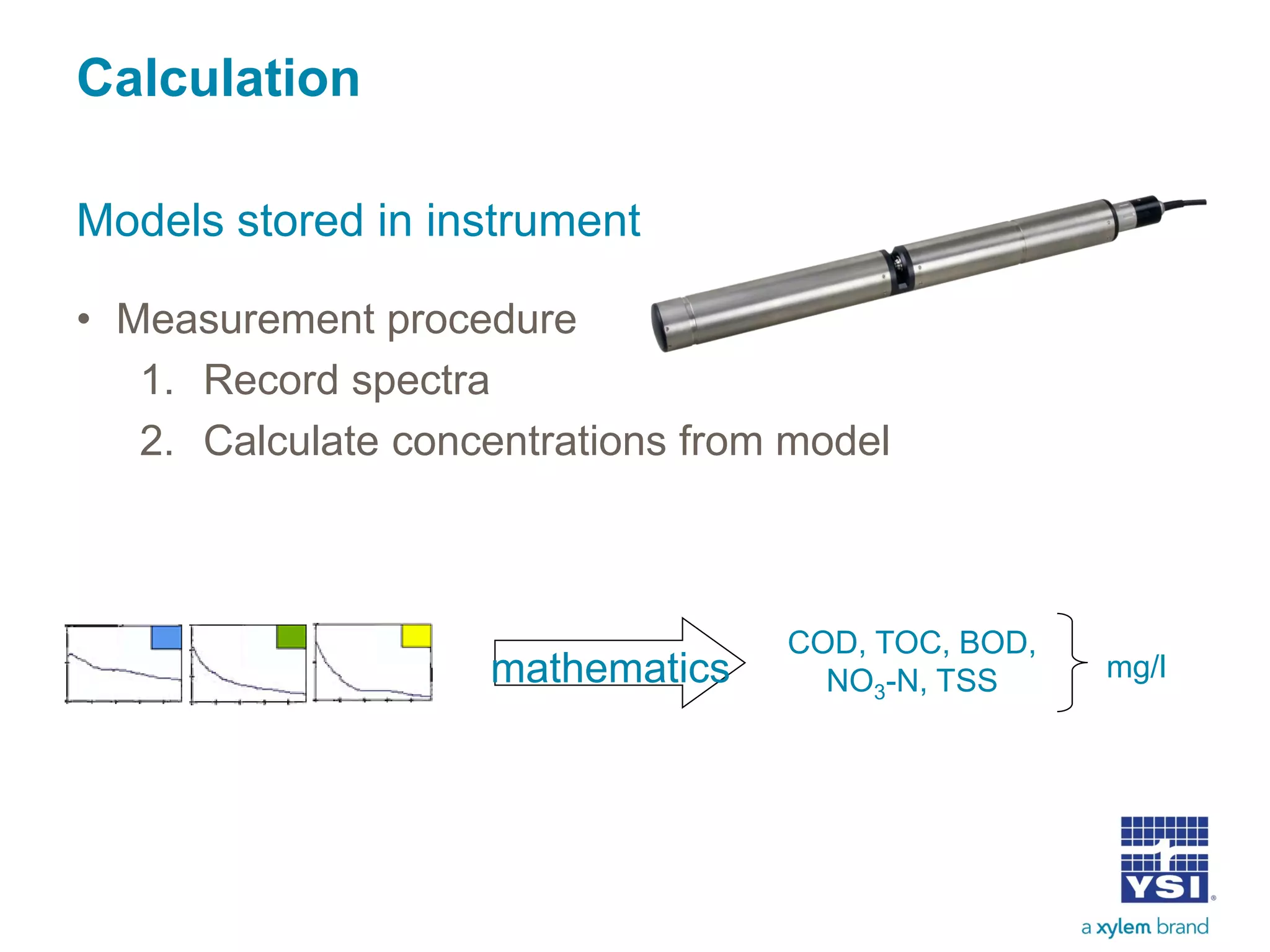
COD, TOC, BOD,
NO3-N, TSS mg/lmathematics
Calculation
• Measurement procedure
1. Record spectra
2. Calculate concentrations from model
Models stored in instrument
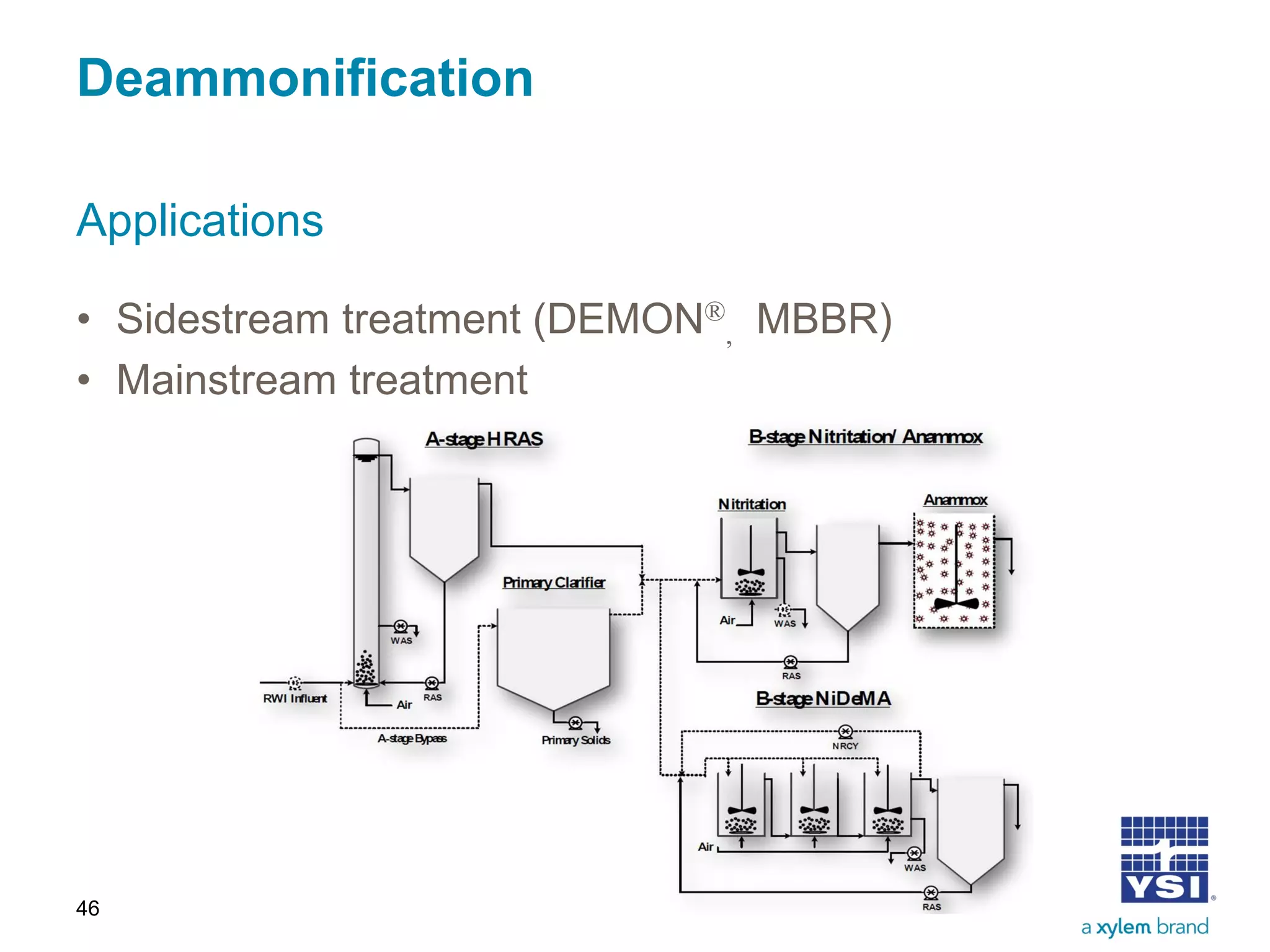
Deammonification
• Sidestream treatment (DEMON®
, MBBR)
• Mainstream treatment
Applications
46
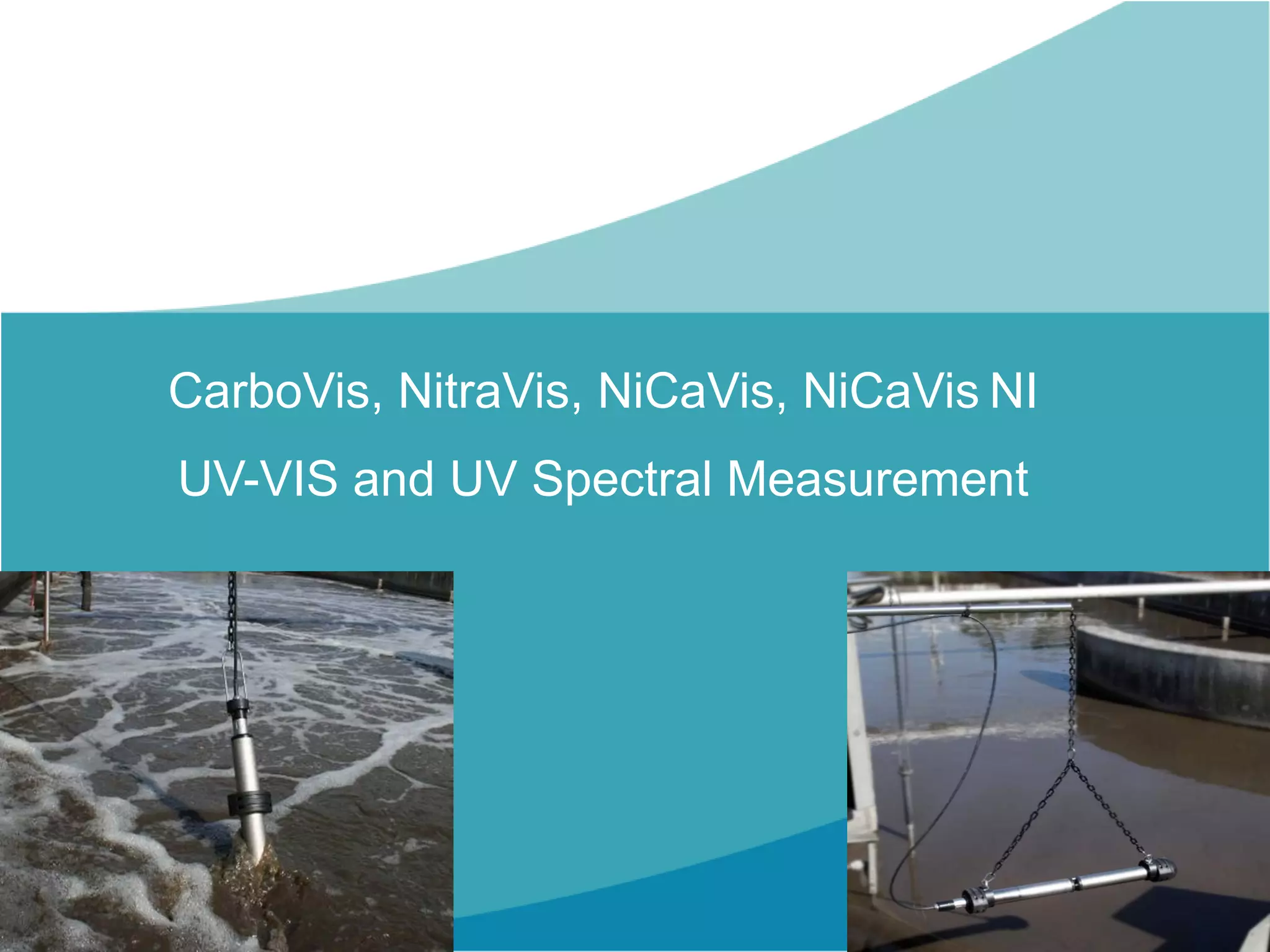
CarboVis, NitraVis, NiCaVis, NiCaVis NI
UV-VIS and UV Spectral Measurement
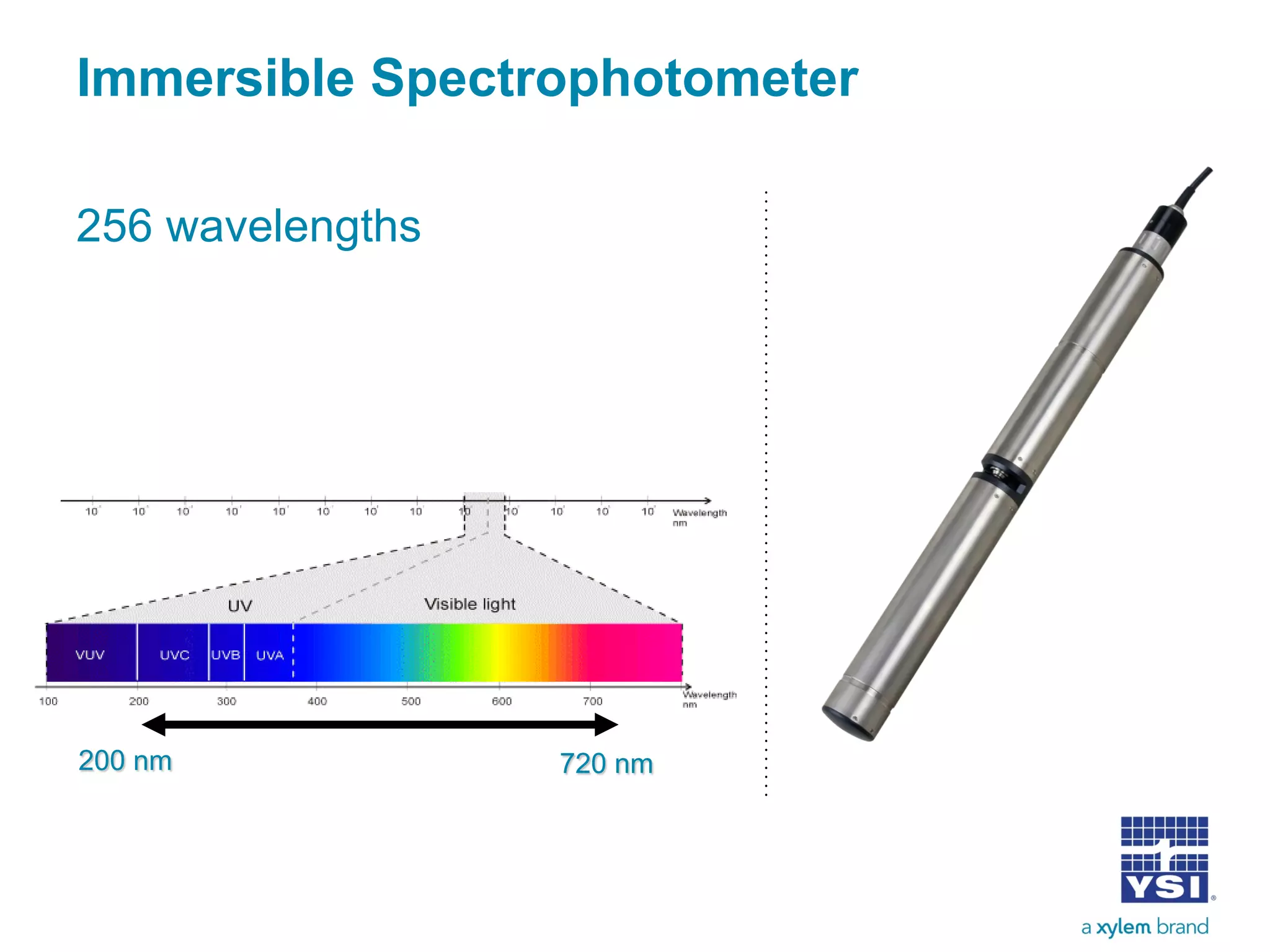
200 nm 720 nm
Immersible Spectrophotometer
256 wavelengths
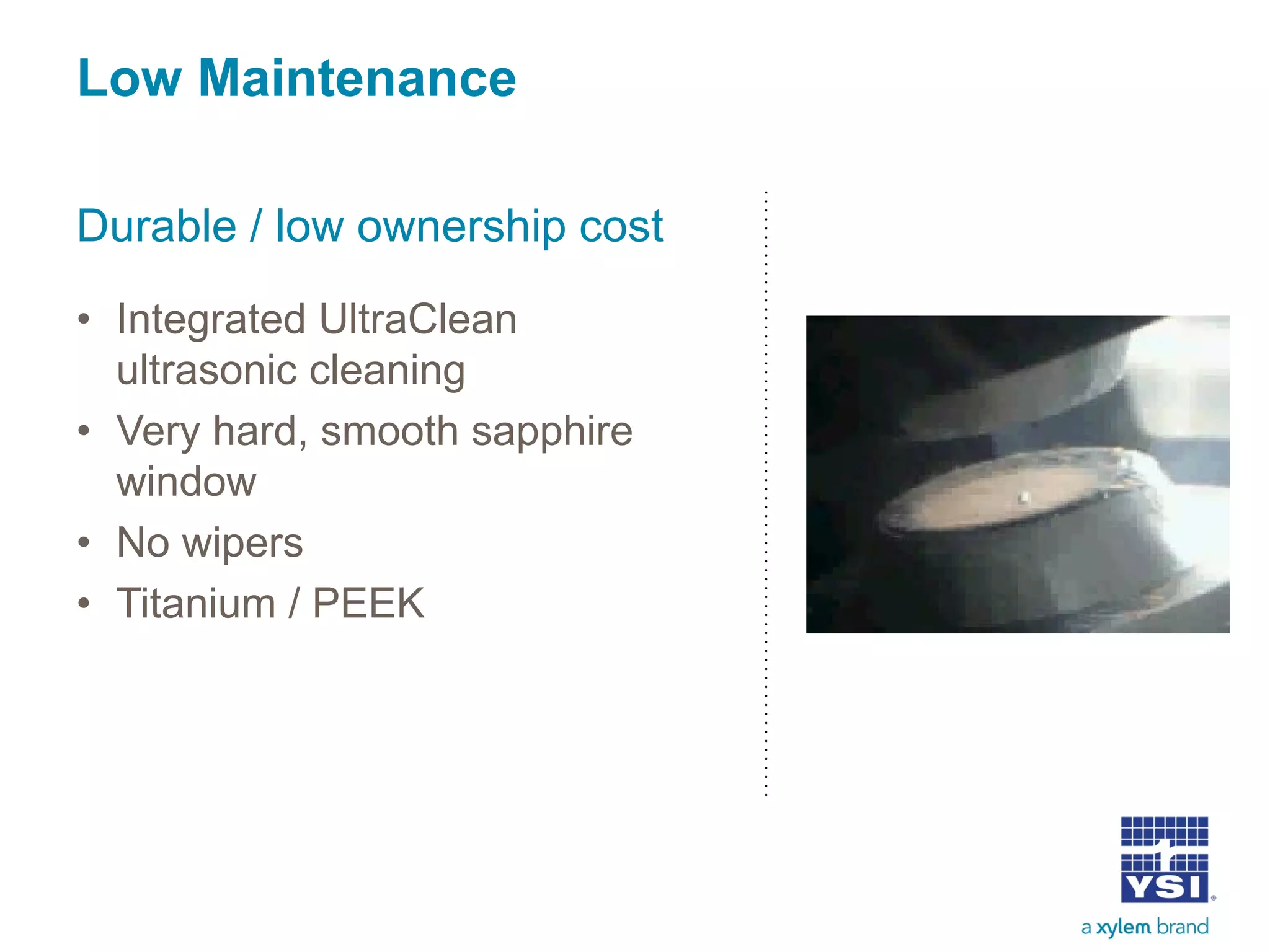
Low Maintenance
Durable / low ownership cost
• Integrated UltraClean
ultrasonic cleaning
• Very hard, smooth sapphire
window
• No wipers
• Titanium / PEEK
• NitraVis: NOx, (TSS)
• CarboVis: SAC, CODtotal, CODsoluble, BOD, DOC, TOC,
(TSS)
• NiCaVis NI: NO3, NO2, SAC, CODtotal, CODsoluble, BOD,
DOC, TOC
• 200 nm to 390 nm (UV only)
• Measuring gap
• 1 mm (high concentrations)
• 5 mm (low concentrations)
Sensor Types
Up to 5 parameters on one sensor
Phosphate
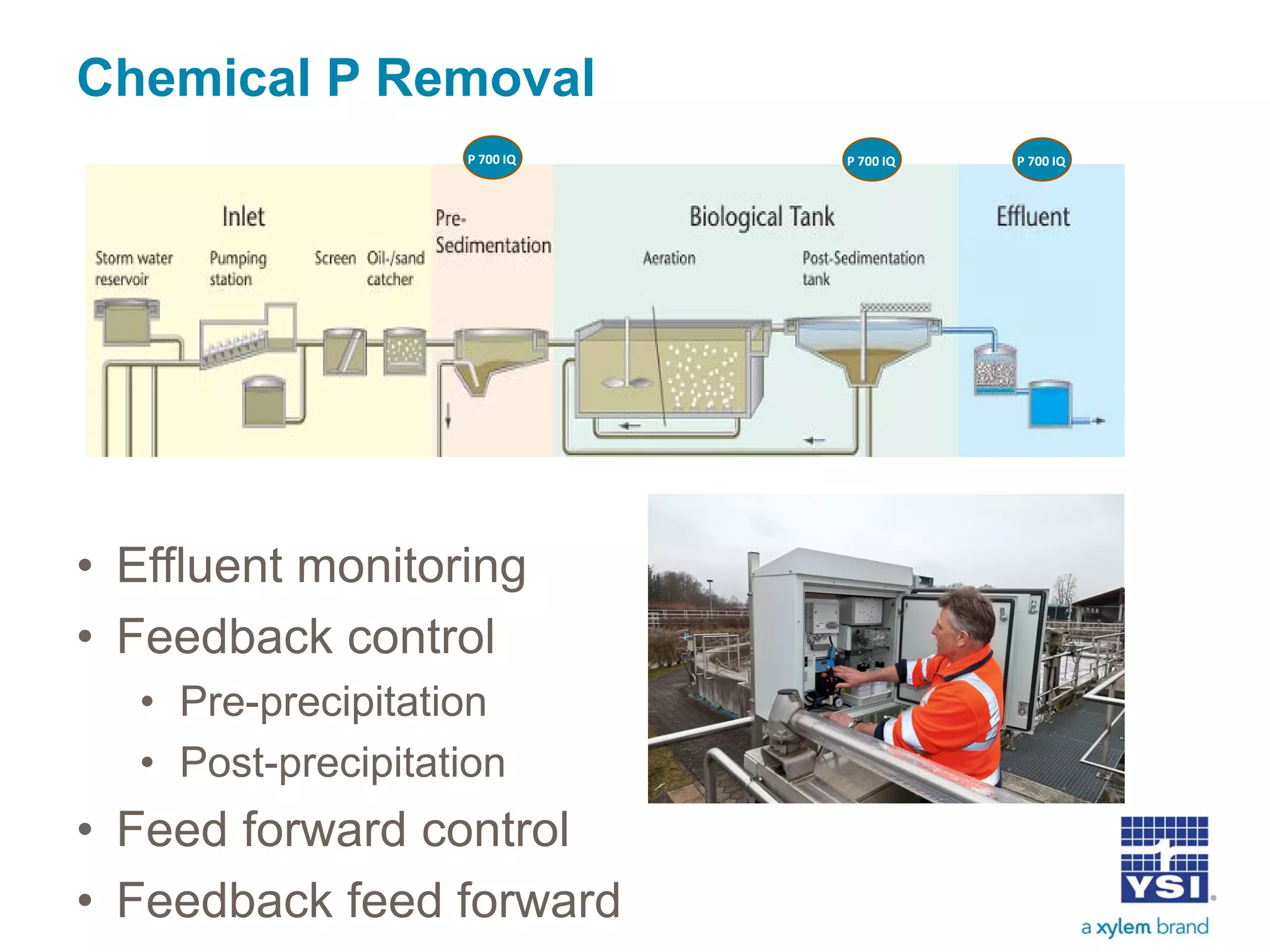
Chemical P Removal
• Effluent monitoring
• Feedback control
• Pre-precipitation
• Post-precipitation
• Feed forward control
• Feedback feed forward
P 700 IQ P 700 IQ P 700 IQ
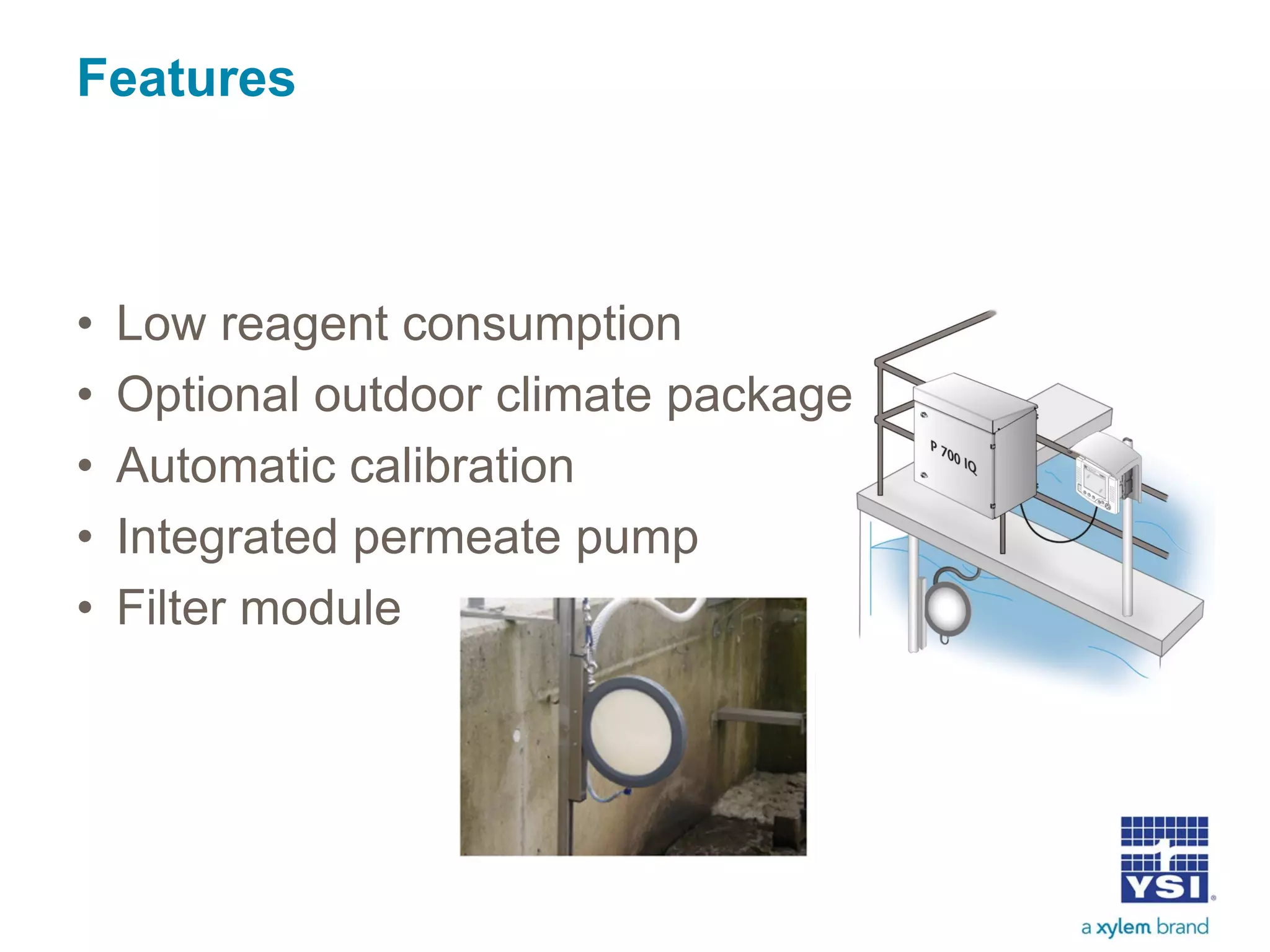
Features
• Low reagent consumption
• Optional outdoor climate package
• Automatic calibration
• Integrated permeate pump
• Filter module
Application Example Chemical Dosing
Flocculating
agent
Phosphate
[mg/l]
time
Use of P700 IQ for regulation of
flocculating agent dosage
Resources
YSI.com/IQ
bit.ly/IQwin (win an IQ instrument)
bit.ly/IQanimation (IQ overview video)
bit.ly/IQfeatures (IQ features video)
bit.ly/IQcolorado (IQ installed in WWTP in Colorado)
blog.ysi.com/IQ-SensorNet (related blog posts about IQ)
Contact Us
+1 (937) 767-7241
(800) 765-4974
info@ysi.com
YSI.com
@YSIinc

Process Monitoring and Automation of Water Resource Recovery Facilities | IQ SensorNet | YSI 

  • 1.
    Process Monitoring andAutomation of Water Resource Recovery Facilities (WRRF)
  • 2.
    What’s Inside? • Onlineprocess monitoring instrumentation – what’s new? • Dissolved Oxygen measurement (optical) • DO aeration control • Nitrogen measurement (ISE) • Ammonium based aeration control • TSS • SRT (Solids Retention Time) control • Nitrogen, COD, phosphate
  • 3.
    Online Process MonitoringInstrumentation • Solid-state in-situ sensors • Multiparameter universal controllers • Digital communications • Measurement • New parameters – NH4, NOx • New methods – DO, TSS • Better performance What’s new
  • 4.
    Solid-State In-Situ Sensors Signalprocessing in sensor • Auto-recognition (plug & play) • Calibration • Multiple measurements • Self-diagnostics
  • 5.
  • 6.
    Multiparameter, Universal Controllers Brainof the system • Up to 20 channels • Measurement display • Internal communications • Operating functions
  • 7.
    IQ SensorNet ControllerDigital Expandable Multi-location System Model 2020XT: 1 – 20 parameters
  • 8.
    Customized solutions, happy customers… Unitsare separated and encased in standardized modules, adaptable to local conditions Power supply Analog outputs / inputs Interfaces System extension Controller in a module Modules
  • 9.
    Digital Communications Enhanced signalstability • Simultaneous and 2-way communication • Convenient placement of components • Large distances • Less cabling • RS-485, Modbus, profibus, Ethernet IP, Modbus TCP/IP
  • 10.
  • 11.
    Optical insulation Filter Detector Optical DOSensor - FDO Gas selective membrane with fluorescence dye
  • 12.
    Step 1: Excitationflash Step 2: Fluorescence flash: Starting time and intensity depend on O2 concentration Oxygen Measurement
  • 13.
    Oxygen Measurement Time orintensity • Time • Highly accurate • No interferences from ambient light / bleaching • Check: some signal must be detected
  • 14.
    Effect of DOConcentration on Biological Treatment Basis for maintaining DO at or below 2 mg/L setpoint D.O.  Reaction  0.75 D.O.  : Reaction  D.O. ~ 2 mg/l  sufficient for nitrification COD removal Nitrification 0.5 1.0 2.01.5 2.5 3.0 O2 (mg/l) 1/2 vmax vmax Reactionrate 0.3
  • 15.
    Automated DO ControlAlternatives • On-off • Mixing required • Never at setpoint • Direct control of airflow • Difficult control problem - DO vs. airflow non-linear
  • 16.
    Cascade Control Most effective/ most complicated PI
  • 17.
  • 18.
  • 19.
    Intelligent Sensor Cap(Replaceable) • Data stored on memory chip • Automatic transfer of calibration constants Individual factory calibration
  • 20.
    Interferences Bubbles & coatingscause overestimate and erratic measurements
  • 21.
  • 22.
    Nitrogen Removal –The Traditional Way
  • 23.
    1 mole Ammonia (NH3/ NH4 +) 1 mole Nitrite (NO2 -) 1 mole Nitrate (NO3 -) 1 mole Nitrite (NO2 -) 1/2 mole Nitrogen gas (N2) 75% O2 25% O2 40% Carbon 60% Carbon Nitrification / Denitrification Aerobic Anoxic
  • 24.
  • 25.
    Nitrification - Denitrification Predenitrification (MLE) • Anoxic zones – denitrification • Oxic zones (DO control) – nitrification • Mixers to uncouple aeration/mixing (anoxic) • Recirculation – IMLR • Readily degradable C – ww or methanol ($$) • Sensors & control system Ingildsen, P, Wendelboe, H., “Improved nutrient removal results using in situ continuous on-line sensors with reduced response time”, WEFTEC 2003
  • 26.
    Ammonium-Based Aeration Control Feedbackcontrol • Direct control on ammonium • DO not controlled at all • Direct control w/ DO limit (ceiling) • DO changes faster – control authority? • Cascade control • Ammonium controller calculates DO setpoint
  • 27.
    VARiON Plus 700IQ, AmmoLyt Plus 700 IQ, NitraLyt Plus 700 IQ - Nitrogen Measurement
  • 28.
    VARiON® Plus 700IQ AmmoLyt® Plus 700 IQ NitraLyt® Plus 700 IQ ISE Sensors for Ammonium (NH4), Nitrate (NO3)
  • 29.
    ISE Sensor Design Fourindividual electrodes • NH4, NO3, K, Cl • 1-yr. warranty • Automatically recognized in system
  • 30.
    AmmoLyt Plus 700IQ NitraLyt Plus 700 IQ VARiON Plus 700 IQ 3 slots 3 slots Sensor Types
  • 31.
  • 32.
    Optical Measurement ofSolids Particles absorb, reflect, scatter light
  • 33.
    Intensity Turbidity / SuspendedSolids 90° (DIN, ISO, US EPA) < 90° 180° (or back scatter) Effect of Measuring Angle on Measuring Range
  • 34.
    0.0 4.0 8.0 12.0 16.0 5 10 1520 25 NitrificationSRT,dSRT (Solids Retention Time) Required for Nitrification Design SRT; SF=1.5 Operating Range Change SRT by changing wasting rate Min. SRT Temperature, °C
  • 35.
    Approaches to SRTControl Qe, Xe V, MLSS Qr, Xr Qw, Xr Qi, Xi SRT setpoint Qw
  • 36.
    Sensor Maintenance Ultrasonic cleaningwith UltraClean technology & sapphire windows • No wipers • No moving parts
  • 37.
    without cleaning system(30 days) with cleaning system (30 days) UltraClean Ultrasonic Cleaning
  • 38.
  • 39.
    1 mole Ammonia (NH3/ NH4 +) 1 mole Nitrite (NO2 -) 1 mole Nitrate (NO3 -) 1 mole Nitrite (NO2 -) 1/2 mole Nitrogen gas (N2) 75% O2 25% O2 40% Carbon 60% Carbon Aerobic Anoxic Anaerobic
  • 40.
    1 mole Ammonia (NH3/ NH4 +) 1 mole Nitrite (NO2 -) 1 mole Nitrate (NO3 -) 1/2 mole Nitrogen gas (N2) Aerobic Anoxic Deammonification Anaerobic 37.5% O2
  • 41.
    2013 WEF/IWA NutrientRemoval & Recovery Conference
  • 42.
    UV Sensor –Principle of Measurement • Absorbance depends on • Concentration (what you are measuring) • Optical path length (distance from lamp to detector) • Transmission characteristics of sample (everything in the water that absorbs or reflects light) lamp detector I0 I Light gets absorbed / weakened by sample sample
  • 43.
    What Different WavelengthsTell You About What is in the Sample Measurement & compensation
  • 44.
    Difference Between UVand UV-VIS Sensors Measurement of NO2 and NO3 • 256 wavelengths measured • 200 – 390 nm • 0.74 nm resolution wavelength [nm]
  • 45.
    COD, TOC, BOD, NO3-N,TSS mg/lmathematics Calculation • Measurement procedure 1. Record spectra 2. Calculate concentrations from model Models stored in instrument
  • 46.
    Deammonification • Sidestream treatment(DEMON® , MBBR) • Mainstream treatment Applications 46
  • 47.
    CarboVis, NitraVis, NiCaVis,NiCaVis NI UV-VIS and UV Spectral Measurement
  • 48.
    200 nm 720nm Immersible Spectrophotometer 256 wavelengths
  • 49.
    Low Maintenance Durable /low ownership cost • Integrated UltraClean ultrasonic cleaning • Very hard, smooth sapphire window • No wipers • Titanium / PEEK
  • 50.
    • NitraVis: NOx,(TSS) • CarboVis: SAC, CODtotal, CODsoluble, BOD, DOC, TOC, (TSS) • NiCaVis NI: NO3, NO2, SAC, CODtotal, CODsoluble, BOD, DOC, TOC • 200 nm to 390 nm (UV only) • Measuring gap • 1 mm (high concentrations) • 5 mm (low concentrations) Sensor Types Up to 5 parameters on one sensor
  • 51.
  • 52.
    Chemical P Removal •Effluent monitoring • Feedback control • Pre-precipitation • Post-precipitation • Feed forward control • Feedback feed forward P 700 IQ P 700 IQ P 700 IQ
  • 53.
    Features • Low reagentconsumption • Optional outdoor climate package • Automatic calibration • Integrated permeate pump • Filter module
  • 54.
    Application Example ChemicalDosing Flocculating agent Phosphate [mg/l] time Use of P700 IQ for regulation of flocculating agent dosage
  • 55.
    Resources YSI.com/IQ bit.ly/IQwin (win anIQ instrument) bit.ly/IQanimation (IQ overview video) bit.ly/IQfeatures (IQ features video) bit.ly/IQcolorado (IQ installed in WWTP in Colorado) blog.ysi.com/IQ-SensorNet (related blog posts about IQ)
  • 57.
    Contact Us +1 (937)767-7241 (800) 765-4974 info@ysi.com YSI.com @YSIinc