



   Removing dissolved minerals from
    seawater, brackish groundwater, or
    treated wastewater

    —appears at first glance to be the ideal
    answer to freshwater shortages. What
    could be more attractive than
    harnessing the planet’s seemingly
    inexhaustible 1.34 quadrillion (that’s 15
    zeros) megaliters of seawater?
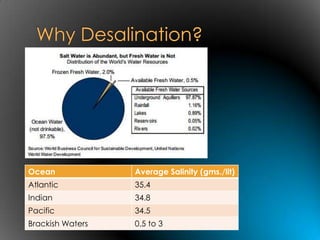
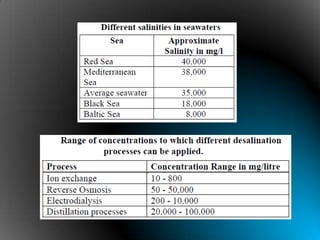
Ocean             Average Salinity (gms./lit)
Atlantic          35.4
Indian            34.8
Pacific           34.5
Brackish Waters   0.5 to 3
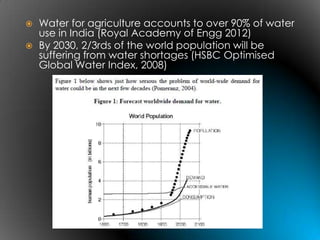
   Water for agriculture accounts to over 90% of water
    use in India (Royal Academy of Engg 2012)
   By 2030, 2/3rds of the world population will be
    suffering from water shortages (HSBC Optimised
    Global Water Index, 2008)
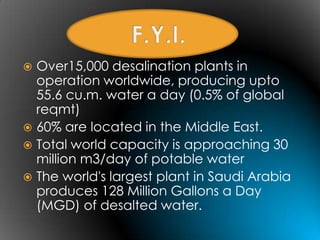
 Over15,000 desalination plants in
  operation worldwide, producing upto
  55.6 cu.m. water a day (0.5% of global
  reqmt)
 60% are located in the Middle East.
 Total world capacity is approaching 30
  million m3/day of potable water
 The world's largest plant in Saudi Arabia
  produces 128 Million Gallons a Day
  (MGD) of desalted water.
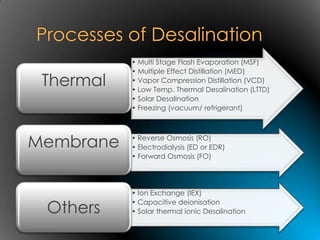
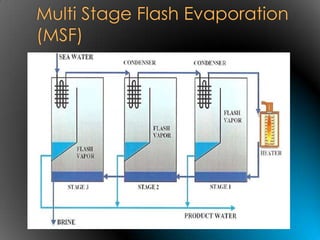
• Multi Stage Flash Evaporation (MSF)
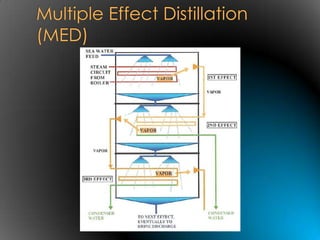
           • Multiple Effect Distillation (MED)
 Thermal   • Vapor Compression Distillation (VCD)
           • Low Temp. Thermal Desalination (LTTD)
           • Solar Desalination
           • Freezing (vacuum/ refrigerant)


Membrane   • Reverse Osmosis (RO)
           • Electrodialysis (ED or EDR)
           • Forward Osmosis (FO)


           • Ion Exchange (IEX)

 Others
           • Capacitive deionisation
           • Solar thermal ionic Desalination
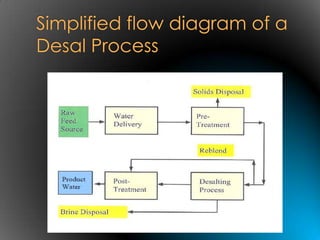
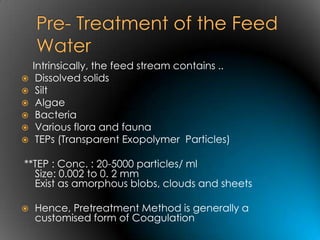
Intrinsically, the feed stream contains ..
    Dissolved solids
    Silt
    Algae
    Bacteria
    Various flora and fauna
    TEPs (Transparent Exopolymer Particles)

**TEP : Conc. : 20-5000 particles/ ml
  Size: 0.002 to 0. 2 mm
  Exist as amorphous blobs, clouds and sheets

   Hence, Pretreatment Method is generally a
    customised form of Coagulation
   How it works
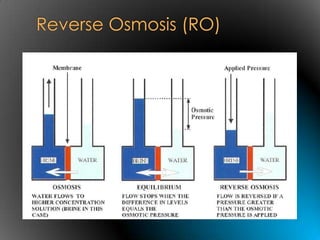
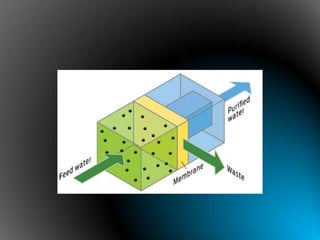
    Separate saltwater and freshwater with a membrane that blocks salt
    ions, and the freshwater rushes to the salty side by the natural process of
    osmosis. Reverse osmosis (RO) uses hydraulic pressure to shove water
    molecules in the opposite direction, with the membrane holding back the
    salt.

    Upside
    Comparatively low energy cost.

    Downside
    Toxic brine; can’t completely filter potentially harmful substances like
    boron, arsenic, lithium, and some pharmaceutical compounds. When
    membranes become clogged, they must be scraped and bleached or they
    stop working; cleaning, however, reduces the expensive membranes’
    lifetime. Pretreating the water to remove the gunk slows the rate of fouling
    but requires a lot of real estate.

    Best for
    Brackish groundwater, which contains on average only 3 to 5 grams of salt
    per liter. RO is also increasingly being used to desalinate seawater, however.
   Energy trade-off
    The pressure needed to push water through the membrane is proportional to
    the water’s salinity. Higher pressure means higher energy cost. On
    average, RO demands at least 3.5 MWh/ML produced from brackish water
   How it works
    Capacitive deionization works without membranes. It filters impurities by
    streaming the water between two charged electrodes. The electrodes
    attract ions in the water, which stick to them, leaving freshwater. The
    attached ions eventually clog the electrodes, but cleaning is easy:
    Simply reverse the electrical polarity to flush the ions back out. Good
    candidates for electrodes are advanced materials such as carbon
    aerogel and mesoporous carbon.
   Upside
    Easy to clean; requires less power. The process could theoretically go on
    forever without changing electrodes.
   Downside
    Works only for brackish water; in practice, electrodes can foul. Does not
    mitigate toxic brine.
   Best for
    Brackish water.
   Energy trade-off
    Far less pressure means less energy.
   What’s next
    This year, a test reactor will be unveiled in New Mexico, part of an
    international project led by Campbell Applied Physics, in Rancho
    Murieta, Calif., and several U.S. national laboratories.
 Adequate & Safe disposal of brine poses
  a significant environmental challenge
 Brine Salinity depends upon:
  Salinity of feedwater
  Desalination Method
  Recovery rate of plant
 Along with high salt levels, can contain
  Mg, Pb, I as well as chemicals introduced
  via urban & agril. runoff
 Reduce volume of brine to be
  discharged and minimize the adverse
  chemicals found therein.
 Usage of better artificial filters or even
  natural filters, to reduce the amt. of
  chemicals during the pre treatment
  process

   Coastal Methods:
    -Discharge to oceans
    -Confined Aquifers

   Inland Methods:
    -Deep well injection
    -Evaporation Ponds
    -Solar energy ponds
    -Shallow Aquifer storage for future use
   There’s no definitive ans. to this Qs. Since
    the Cost comprises of a no. of factors:
    -Labor
    -Chemicals
    -Peripherals
    -Maintenance
    -Electricity
    -Capital/Amortisation
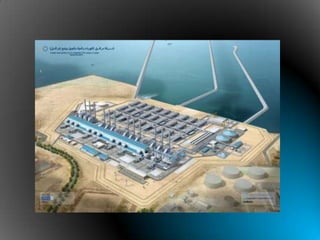
 The plant has been constructed in the
  New Jubail II Industrial Zone in the Saudi
  Arabia, Kingdom’s Eastern Province.
 Provides 8,00,000 cu.m. of freshwater for
  cities in the Eastern Province,
 Generates 2,750MW of electricity.
  Freshwater produced by the $3.8 billion
  desalination plant will be transported
   The Minjur desalination plant consists of 8,600 sea water
    RO membranes, 248 pressure vessels, 23 pressure
    exchangers, five high-pressure pumps, 16 pressure filter
    vessels, electrical, automation and control systems, and a
    1,200m of HDPE pipeline of 1,600mm diameter.

   The CMWSSB has laid a 33km pipeline with a cost of
    INR930m ($20m) to carry the treated fresh water from
    Minjur to Red Hills. The project also includes infrastructure
    for the collection of seawater. A 110kV/22kV sub-station
    has been set up by the Tamil Nadu Electricity Board for
    uninterrupted power supply to the desalination plant.

   A thorough environmental impact study was conducted in
    the planning stage.
   Chennai Water Desalination (CWDL) is
    executing the project for the CMWSSB on a
    design, build, own, operate and transfer
    (DBOOT) basis.

   In September 2005, the CMWSSB signed a
    bulk water purchase agreement (BWPA)
    with CWDL to purchase water from the
    Minjur desalination plant at a cost of
    INR48.66/m³ ($1.03/m³). It will be sold to
    industries at a rate of INR60/m³ ($1.27/m³).

   At the end of the 25-year agreement the
    contract shall be renewed.
   As promising as the process sounds, there’s still a
    price to pay. As long as the cost of desalination
    continues to depend on the cost of energy, these
    technologies won’t help much of the energy-starved
    developing world that needs them the most.
    Also, there is the problem of the toxic sludge
    generated as a by product.
   Throwing the brine back into the ocean can kill fish
    and smaller denizens of the food chain.
   Several contenders might make history of these
    concerns. New methods in the pipeline reduce
    desalination’s energy demands in innovative and
    intriguing ways. Further off are technologies that
    could turn desalination’s Achilles’ heel into a source
    of strength: In the future, desalination might just be
    powered by the very waste it filters out.
   http://www.fwr.org
   Desalination, with a grain of salt- A California
    perspective, Cooleym, Gleick, Woolf
   Fundamentals of Water Desalination, Dessouky and Elsevier, 2002
   Desalination: A National Perspective, National Research Council
    Committee on Adv. Desalination Tech., USA 2008
   http://www. Idadesal.org
   http://www.desline.com
Desalination for water supply

Desalination for water supply

  • 2.
    Removing dissolved minerals from seawater, brackish groundwater, or treated wastewater —appears at first glance to be the ideal answer to freshwater shortages. What could be more attractive than harnessing the planet’s seemingly inexhaustible 1.34 quadrillion (that’s 15 zeros) megaliters of seawater?
  • 3.
    Ocean Average Salinity (gms./lit) Atlantic 35.4 Indian 34.8 Pacific 34.5 Brackish Waters 0.5 to 3
  • 4.
    Water for agriculture accounts to over 90% of water use in India (Royal Academy of Engg 2012)  By 2030, 2/3rds of the world population will be suffering from water shortages (HSBC Optimised Global Water Index, 2008)
  • 6.
     Over15,000 desalinationplants in operation worldwide, producing upto 55.6 cu.m. water a day (0.5% of global reqmt)  60% are located in the Middle East.  Total world capacity is approaching 30 million m3/day of potable water  The world's largest plant in Saudi Arabia produces 128 Million Gallons a Day (MGD) of desalted water.
  • 7.
    • Multi StageFlash Evaporation (MSF) • Multiple Effect Distillation (MED) Thermal • Vapor Compression Distillation (VCD) • Low Temp. Thermal Desalination (LTTD) • Solar Desalination • Freezing (vacuum/ refrigerant) Membrane • Reverse Osmosis (RO) • Electrodialysis (ED or EDR) • Forward Osmosis (FO) • Ion Exchange (IEX) Others • Capacitive deionisation • Solar thermal ionic Desalination
  • 11.
    Intrinsically, the feedstream contains ..  Dissolved solids  Silt  Algae  Bacteria  Various flora and fauna  TEPs (Transparent Exopolymer Particles) **TEP : Conc. : 20-5000 particles/ ml Size: 0.002 to 0. 2 mm Exist as amorphous blobs, clouds and sheets  Hence, Pretreatment Method is generally a customised form of Coagulation
  • 15.
    How it works Separate saltwater and freshwater with a membrane that blocks salt ions, and the freshwater rushes to the salty side by the natural process of osmosis. Reverse osmosis (RO) uses hydraulic pressure to shove water molecules in the opposite direction, with the membrane holding back the salt. Upside Comparatively low energy cost. Downside Toxic brine; can’t completely filter potentially harmful substances like boron, arsenic, lithium, and some pharmaceutical compounds. When membranes become clogged, they must be scraped and bleached or they stop working; cleaning, however, reduces the expensive membranes’ lifetime. Pretreating the water to remove the gunk slows the rate of fouling but requires a lot of real estate. Best for Brackish groundwater, which contains on average only 3 to 5 grams of salt per liter. RO is also increasingly being used to desalinate seawater, however.  Energy trade-off The pressure needed to push water through the membrane is proportional to the water’s salinity. Higher pressure means higher energy cost. On average, RO demands at least 3.5 MWh/ML produced from brackish water
  • 16.
    How it works Capacitive deionization works without membranes. It filters impurities by streaming the water between two charged electrodes. The electrodes attract ions in the water, which stick to them, leaving freshwater. The attached ions eventually clog the electrodes, but cleaning is easy: Simply reverse the electrical polarity to flush the ions back out. Good candidates for electrodes are advanced materials such as carbon aerogel and mesoporous carbon.  Upside Easy to clean; requires less power. The process could theoretically go on forever without changing electrodes.  Downside Works only for brackish water; in practice, electrodes can foul. Does not mitigate toxic brine.  Best for Brackish water.  Energy trade-off Far less pressure means less energy.  What’s next This year, a test reactor will be unveiled in New Mexico, part of an international project led by Campbell Applied Physics, in Rancho Murieta, Calif., and several U.S. national laboratories.
  • 18.
     Adequate &Safe disposal of brine poses a significant environmental challenge  Brine Salinity depends upon: Salinity of feedwater Desalination Method Recovery rate of plant  Along with high salt levels, can contain Mg, Pb, I as well as chemicals introduced via urban & agril. runoff
  • 19.
     Reduce volumeof brine to be discharged and minimize the adverse chemicals found therein.  Usage of better artificial filters or even natural filters, to reduce the amt. of chemicals during the pre treatment process 
  • 20.
    Coastal Methods: -Discharge to oceans -Confined Aquifers  Inland Methods: -Deep well injection -Evaporation Ponds -Solar energy ponds -Shallow Aquifer storage for future use
  • 21.
    There’s no definitive ans. to this Qs. Since the Cost comprises of a no. of factors: -Labor -Chemicals -Peripherals -Maintenance -Electricity -Capital/Amortisation
  • 22.
     The planthas been constructed in the New Jubail II Industrial Zone in the Saudi Arabia, Kingdom’s Eastern Province.  Provides 8,00,000 cu.m. of freshwater for cities in the Eastern Province,  Generates 2,750MW of electricity. Freshwater produced by the $3.8 billion desalination plant will be transported
  • 24.
    The Minjur desalination plant consists of 8,600 sea water RO membranes, 248 pressure vessels, 23 pressure exchangers, five high-pressure pumps, 16 pressure filter vessels, electrical, automation and control systems, and a 1,200m of HDPE pipeline of 1,600mm diameter.  The CMWSSB has laid a 33km pipeline with a cost of INR930m ($20m) to carry the treated fresh water from Minjur to Red Hills. The project also includes infrastructure for the collection of seawater. A 110kV/22kV sub-station has been set up by the Tamil Nadu Electricity Board for uninterrupted power supply to the desalination plant.  A thorough environmental impact study was conducted in the planning stage.
  • 25.
    Chennai Water Desalination (CWDL) is executing the project for the CMWSSB on a design, build, own, operate and transfer (DBOOT) basis.  In September 2005, the CMWSSB signed a bulk water purchase agreement (BWPA) with CWDL to purchase water from the Minjur desalination plant at a cost of INR48.66/m³ ($1.03/m³). It will be sold to industries at a rate of INR60/m³ ($1.27/m³).  At the end of the 25-year agreement the contract shall be renewed.
  • 26.
    As promising as the process sounds, there’s still a price to pay. As long as the cost of desalination continues to depend on the cost of energy, these technologies won’t help much of the energy-starved developing world that needs them the most. Also, there is the problem of the toxic sludge generated as a by product.  Throwing the brine back into the ocean can kill fish and smaller denizens of the food chain.  Several contenders might make history of these concerns. New methods in the pipeline reduce desalination’s energy demands in innovative and intriguing ways. Further off are technologies that could turn desalination’s Achilles’ heel into a source of strength: In the future, desalination might just be powered by the very waste it filters out.
  • 27.
    http://www.fwr.org  Desalination, with a grain of salt- A California perspective, Cooleym, Gleick, Woolf  Fundamentals of Water Desalination, Dessouky and Elsevier, 2002  Desalination: A National Perspective, National Research Council Committee on Adv. Desalination Tech., USA 2008  http://www. Idadesal.org  http://www.desline.com

Editor's Notes

  • #11 Pretreatment: usually some form of coagulation process to rid off impurities, TEPs(transparentexopolymer particles: formed frm dissolved polymers exuded by phytoplankton n bacteria)
  • #20 Ultrafiltration can replace coagulants, effectively removing silt and org matter frmfeedwater.Balances pretreatment chemicals optimally.These filters are backwashed periodically with the same solutions used on RO Membranes. Backwash can be disposed off with waste brine or dewatered or disposed off on land.Subsurface intake wells, using natural sand as filter, reduce chemical usage during pretreatment by reducing biol. Organisms which cause bio fouling
  • #25 conducted to establish the effect of the plant on the livelihoods of fishermen and other communities. Studies were also conducted on the impact of high saline discharge on the fisheries and turtle nesting before the construction of the plant