Pharmacodynamics
What the drug does to body?
DR. Heba A Mahmoud
Pharmacodynamics
Study of biochemical and physiological effects of drugs
and study of mechanisms of drug action in living
organisms
Action Mechanism of Action
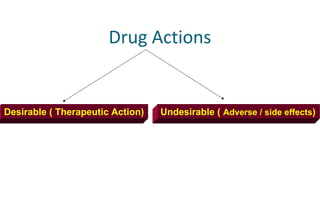
Drug Actions
Desirable ( Therapeutic Action) Undesirable ( Adverse / side effects)
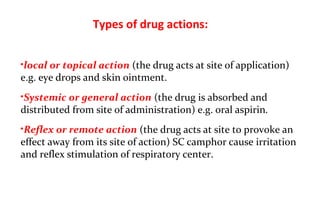
Types of drug actions:
•local or topical action (the drug acts at site of application)
e.g. eye drops and skin ointment.
•Systemic or general action (the drug is absorbed and
distributed from site of administration) e.g. oral aspirin.
•Reflex or remote action (the drug acts at site to provoke an
effect away from its site of action) SC camphor cause irritation
and reflex stimulation of respiratory center.
Mechanism of action
 Action on receptors ( Agonist /
antagonist)
 Physical
 Chemical
 Interference with cell division
 Interference with metabolic pathway
 Inhibition of enzymes
 Action on ion channel
Receptor
Cellular macromolecule that reacts specifically with
Ligand (drug, transmitter or hormone)
Drug Receptor Interaction
Characteristic of interaction :
Affinity ( ability to bind to receptor).
Efficacy ( Ability to produce action)
DRUG (D) + RECEPTOR(R) ActionD - R
Affinity Efficacy
 DRUG + RECEPTOR D-R
Action NO
Response
Drug is Agonist Drug is
Antagonist
Receptor
Types of ligands
• Agonist
• Antagonist
• Partial
agonist
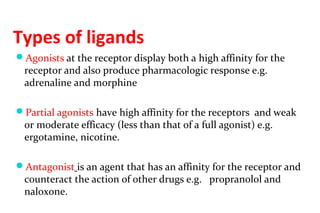
Types of ligands
Agonists at the receptor display both a high affinity for the
receptor and also produce pharmacologic response e.g.
adrenaline and morphine
Partial agonists have high affinity for the receptors and weak
or moderate efficacy (less than that of a full agonist) e.g.
ergotamine, nicotine.
Antagonist is an agent that has an affinity for the receptor and
counteract the action of other drugs e.g. propranolol and
naloxone.
 
•Physical e.g. adsorption effect of kaolin in diarrhea.
•Chemical
Neutralization e.g.NaHCO3
(antacid) in treatment of hyperacidity.
Chelation : e.g.Sodium edetate for calcium
Desferrioxamine for ferric iron
•Interference with cell division e.g. anticancer drugs.
•Inhibition of enzymes Drugs can cause their effects by interfering
with the enzyme system e.g. aminophylline inhibits phosphodiesterase
enzyme
•Action on ion channel: local anesthetics block sodium channels.
Mechanism of action (contu.)
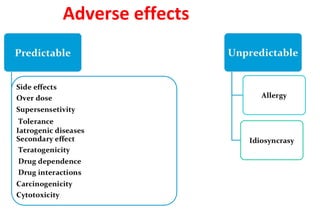
Adverse effects
Adverse effects (cont.)
Allergy (Hypersensetivity)
Unpredictable abnormal response due to Antigen /Antibody reaction.
Idiosyncrasy (Pharmacogenetics)
Unpredictable abnormal response due to GENETIC abnormality
Hemolytic anemia in patient with favism (glucose 6- phosphate
dehydrogenase deficiency)
Side Effects:
Unavoidable Undesirable part of normal pharmacologic actions by
therapeutic dose of a drug
Over – Dose: (Toxicity)
Exaggerated normal action due to high dose of drug
Adverse effects (cont.)
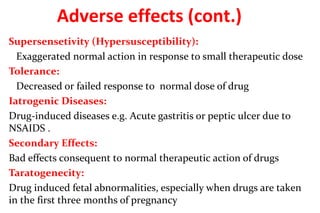
Supersensetivity (Hypersusceptibility):
Exaggerated normal action in response to small therapeutic dose
Tolerance:
Decreased or failed response to normal dose of drug
Iatrogenic Diseases:
Drug-induced diseases e.g. Acute gastritis or peptic ulcer due to
NSAIDS .
Secondary Effects:
Bad effects consequent to normal therapeutic action of drugs
Taratogenecity:
Drug induced fetal abnormalities, especially when drugs are taken
in the first three months of pregnancy
Adverse effects (cont.)
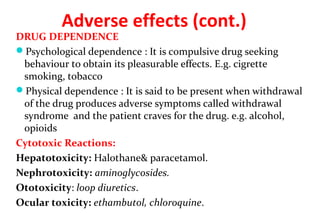
DRUG DEPENDENCE
Psychological dependence : It is compulsive drug seeking
behaviour to obtain its pleasurable effects. E.g. cigrette
smoking, tobacco
Physical dependence : It is said to be present when withdrawal
of the drug produces adverse symptoms called withdrawal
syndrome and the patient craves for the drug. e.g. alcohol,
opioids
Cytotoxic Reactions:
Hepatotoxicity: Halothane& paracetamol.
Nephrotoxicity: aminoglycosides.
Ototoxicity: loop diuretics.
Ocular toxicity: ethambutol, chloroquine.
Drug – Drug Interaction
They will have a lecture in the second course
2.pharmacodynamics

2.pharmacodynamics

  • 1.
    Pharmacodynamics What the drugdoes to body? DR. Heba A Mahmoud
  • 2.
    Pharmacodynamics Study of biochemicaland physiological effects of drugs and study of mechanisms of drug action in living organisms Action Mechanism of Action
  • 3.
    Drug Actions Desirable (Therapeutic Action) Undesirable ( Adverse / side effects)
  • 5.
    Types of drugactions: •local or topical action (the drug acts at site of application) e.g. eye drops and skin ointment. •Systemic or general action (the drug is absorbed and distributed from site of administration) e.g. oral aspirin. •Reflex or remote action (the drug acts at site to provoke an effect away from its site of action) SC camphor cause irritation and reflex stimulation of respiratory center.
  • 6.
    Mechanism of action Action on receptors ( Agonist / antagonist)  Physical  Chemical  Interference with cell division  Interference with metabolic pathway  Inhibition of enzymes  Action on ion channel
  • 7.
    Receptor Cellular macromolecule thatreacts specifically with Ligand (drug, transmitter or hormone)
  • 8.
    Drug Receptor Interaction Characteristicof interaction : Affinity ( ability to bind to receptor). Efficacy ( Ability to produce action) DRUG (D) + RECEPTOR(R) ActionD - R Affinity Efficacy
  • 9.
     DRUG +RECEPTOR D-R Action NO Response Drug is Agonist Drug is Antagonist
  • 10.
  • 11.
    Types of ligands •Agonist • Antagonist • Partial agonist
  • 12.
    Types of ligands Agonistsat the receptor display both a high affinity for the receptor and also produce pharmacologic response e.g. adrenaline and morphine Partial agonists have high affinity for the receptors and weak or moderate efficacy (less than that of a full agonist) e.g. ergotamine, nicotine. Antagonist is an agent that has an affinity for the receptor and counteract the action of other drugs e.g. propranolol and naloxone.  
  • 13.
    •Physical e.g. adsorptioneffect of kaolin in diarrhea. •Chemical Neutralization e.g.NaHCO3 (antacid) in treatment of hyperacidity. Chelation : e.g.Sodium edetate for calcium Desferrioxamine for ferric iron •Interference with cell division e.g. anticancer drugs. •Inhibition of enzymes Drugs can cause their effects by interfering with the enzyme system e.g. aminophylline inhibits phosphodiesterase enzyme •Action on ion channel: local anesthetics block sodium channels. Mechanism of action (contu.)
  • 14.
  • 15.
    Adverse effects (cont.) Allergy (Hypersensetivity) Unpredictableabnormal response due to Antigen /Antibody reaction. Idiosyncrasy (Pharmacogenetics) Unpredictable abnormal response due to GENETIC abnormality Hemolytic anemia in patient with favism (glucose 6- phosphate dehydrogenase deficiency) Side Effects: Unavoidable Undesirable part of normal pharmacologic actions by therapeutic dose of a drug Over – Dose: (Toxicity) Exaggerated normal action due to high dose of drug
  • 16.
    Adverse effects (cont.) Supersensetivity(Hypersusceptibility): Exaggerated normal action in response to small therapeutic dose Tolerance: Decreased or failed response to normal dose of drug Iatrogenic Diseases: Drug-induced diseases e.g. Acute gastritis or peptic ulcer due to NSAIDS . Secondary Effects: Bad effects consequent to normal therapeutic action of drugs Taratogenecity: Drug induced fetal abnormalities, especially when drugs are taken in the first three months of pregnancy
  • 17.
    Adverse effects (cont.) DRUGDEPENDENCE Psychological dependence : It is compulsive drug seeking behaviour to obtain its pleasurable effects. E.g. cigrette smoking, tobacco Physical dependence : It is said to be present when withdrawal of the drug produces adverse symptoms called withdrawal syndrome and the patient craves for the drug. e.g. alcohol, opioids Cytotoxic Reactions: Hepatotoxicity: Halothane& paracetamol. Nephrotoxicity: aminoglycosides. Ototoxicity: loop diuretics. Ocular toxicity: ethambutol, chloroquine.
  • 18.
    Drug – DrugInteraction They will have a lecture in the second course